
The Applications of palynostratigraphy to the Devonian of Bolivia
218
0
0
Full text
(2) UNIVERSITY OF SOUTHAMPTON FACULTY OF ENGINEERING, SCIENCE & MATHEMATICS School of Ocean & Earth Sciences. The Applications of Palynostratigraphy to the Devonian of Bolivia. by. Ian Troth. Thesis for the degree of Doctor of Philosophy. February 2006.
(3) UNIVERSITY OF SOUTHAMPTON ABSTRACT FACULTY OF ENGINEERING, SCIENCE & MATHEMATICS SCHOOL OF OCEAN & EARTH SCIENCES Doctor of Philosopy THE APPLICATIONS OF PALYNOSTRATIGRAPHY TO THE DEVONIAN OF BOLIVIA by Ian Troth A continuous and unthrusted 1.2km section of ?latest Emsian to Frasnian sediments is exposed in the Rio Lajas at Bermejo, Santa Cruz Province, Bolivia . One hundred and forty-five samples were taken from this section to validate the cuttings-based Devonian subsurface palynostratigraphy. Similar palynological trends were identified in the same stratigraphic order as seen in the subsurface. A detailed study of the chitinozoan fauna was undertaken and 36 taxa were identified of which 9 are new but retained in open nomenclature pending formal description. Only 3 of the chitinozoan taxa are cosmopolitan. The palynostratigraphy from Bermejo for the first time is tied to accurate lithostratigraphy and this data was used to revise the Devonian stratigraphy at the Campo Redondo and Cha-Kjeri sections in Chiquisaca Province. Mid Devonian age assignments for the economically important Devonian Huamampampa Formation reservoir are not valid, since the new palynology indicates a mainly Early Devonian (Emsian) age. There is sedimentological evidence in the basal Los Monos Formation for an early Eifelian marine transgression associated with the important acritarch Evittia sommeri. In Bolivia and South America, due to the near/effective absence of conodonts and goniatites, the Devonian Euramerican sea-level curve is relatively untested. However, a possible candidate for the Chotec Event is the basal Los Monos Formation transgression. This is the only major transgressive event during the early Eifelian. Assuming similar stratigraphic trends to Bolivia, attempts were made to find E. sommeri at the Chotec level in Euramerica. A total of 158 Emsian/Eifelian samples were collected and processed for palynology from the Czech Republic, Morocco, Spain and the UK with additional non-Euramerican samples from Russia . E. sommeri was not found. While 2 younger Devonian marine transgressions are recorded in Bolivia (mid-late Givetian and early Frasnian), the major flooding event around the Eifelia n/Givetian boundary in Euramerica (Kacák Event) is notably absent. This is important since the Kacák Event has been implicated in the break-up of the high latitude, cool water Malvinokaffric Realm that included Bolivia..
(4) Graduate School of the National Oceanography Centre, Southampton. This Ph.D dissertation by Ian Troth. has been produced under the supervision of the following persons. Supervisors Dr. John Marshall Dr. Andrew Racey. Chair of Advisory Panel Professor Alan Kemp.
(5) Graduate School of the National Oceanography Centre, Southampton. Ph.D dissertation by Ian Troth. Declaration. The work presented in this thesis is my own, and was done wholly whilst in candidature for a research degree at this University. Where I have consulted or quoted from the published work of others, the source is always clearly attributed. I have acknowledged all main sources of help. None of this work has been published before submission.. Signed:. Date:.
(6) CONTENTS CHAPTER 1 – INTRODUCTION 1.1. Background. 1. 1.2. Objectives. 1. 1.3. Regional setting. 2. 1.4. Devonian lithostratigraphy in the Subandean of Bolivia. 2. 1.5. Previous stratigraphic investigations. 5. 1.6. Biostratigraphy in South America. 5. 1.7. Palaeogeography. 8. 1.8. The Euramerican sea-level curve. 11. CHAPTER 2 – METHODS 2.1. Fieldwork. 13. 2.2. Palynological preparation. 14. 2.3. TOC analysis. 14. 2.4. TM. RockEval. pyrolysis. 15. CHAPTER 3 – STRATIGRAPHY 3.1. Introduction. 16. 3.2. Lithostratigraphy. 16. 3.2.1. Bermejo. 16. 3.2.2. Campo Redondo. 19. 3.2.3. Cha-Kjeri. 21. 3.2.4. Stratigraphic comparisons: Bermejo/Campo Redondo/Cha-Kjeri. 21. 3.2.5. Comparison of surface and subsurface lithostratigraphy. 23. 3.3. Biostratigraphy. 24. 3.3.1. Subsurface Devonian palynology in Bolivia. 24. 3.3.2. Important biostratigraphic markers in the subsurface. 25. 3.4. Biostratigraphy and chronostratigraphy of the Bermejo section. 26. 3.4.1. General biostratigraphic trends at Bermejo. 26. 3.4.2. Bermejo chronostratigraphy. 26. 3.5. The Evittia sommeri Epibiole at Bermejo. 32. 3.5.1. Stratigraphic position and extent of the E. sommeri Epibole at Bermejo. 32. 3.5.2. Associated palynomorphs. 35. 3.5.3. Age of the Evittia sommeri Epibole. 35. 3.5.4. Geographic distribution of the E. sommeri Epibole. 35. i.
(7) 3.6. Correlation of Bermejo with other sections in Bolivia. 36. 3.6.1. Implications for Devonian chronostratigraphy in Bolivia. 36. 3.7. Summary. 39. 3.8. Systematic palaeontology. 41. Evittia sommeri. 41. Bimerga bensonii. 43. Crucidia camirense. 44. Petrovina connata. 46. CHAPTER 4 – CHITINOZOA 4.1. Introduction. 54. 4.1.1. Chitinozoa. 54. 4.1.2. Chitinozoan biostratigraphy. 56. 4.1.3. Chitinozoan palaeoecology. 56. 4.1.4. Previous chitinozoan research in Bolivia. 58. 4.1.5. Chitinozoan morphology. 59. 4.2. Systematic palaeontology. 61. 4.3. Discussion. 116. 4.3.1. Comparison of chitinozoan ranges with Brazil. 116. 4.3.2. Comments on the Paris et al. (2000) and Grahn (2005) zonation schemes. 117. 4.3.3. Global distribution of the described Bermejo chitinozoan taxa. 118. 4.3.4. Comments on chitinozoan palaeoecology at Bermejo. 118. 4.4. Summary. 119. CHAPTER 5 – PALAEOENVIRONMENTS 5.1. Introduction. 120. 5.1.1. Comments on palaeogeography. 120. 5.2. Palaeoenvironmental interpretation. 126. 5.2.1. Huamampampa Formation. 126. 5.2.2. Los Monos Formation. 128. 5.2.3. Iquiri Formation. 134. 5.3. Sequence stratigraphy and sea-level change. 152. CHAPTER 6 – THE SEARCH FOR E. SOMMERI 6.1. Introduction. 155. 6.2. Spain. 155. 6.3. UK (St. Mary’s Bay, near Brixham). 158. ii.
(8) 6.4. Morocco. 162. 6.5. Siberia. 163. 6.6. Czech Republic. 163. 6.7. Conclusion. 168. CHAPTER 7 – DISCUSSION 7.1. Validation of subsurface Devonian palynostratigraphy. 175. 7.2. Validity of the E. sommeri Epibole. 176. 7.3. Age of the Huamampampa Formation. 177. 7.4. Chitinozoa. 178. 7.5. Palaeoenvironment. 178. 7.6. Global context. 179. 7.6.1. South America. 179. 7.6.2. Comparison with the Euramerica sea-level curve. 179. 7.6.3. Implications for the breakdown of the Malvinokaffric Realm. 182. CHAPTER 8 – CONCLUSION. 184. CHAPTER 9 – REFERENCES. 187. iii.
(9) LIST OF FIGURES AND TABLES CHAPTER 1 - INTRODUCTION Figure 1.1. Siluro-Devonian outcrop in Bolivia. 3. Figure 1.2. Devonian stratigraphy in the southern Subandean. 3. Figure 1.3. Landsat imagery of Bolivia and the southern Subandean. 4. Figure 1.4. Emsian-Frasnian conodont and goniatite stratigraphy. 6. Figure 1.5. Emsian-Frasnian spore zonation. 7. Figure 1.6. Mid-Devonian palaeogeography of the world. 9. Figure 1.7. Mid-Devonian paleogeography of South America. 10. Figure 1.8. Euramerican sea-level curve. 12. CHAPTER 3 - STRATIGRAPHY Figure 3.1. Location map. 17. Figure 3.2. Log of the Bermejo section. 18. Figure 3.3. Log of the Campo Redondo section. 20. Figure 3.4. Log of the Cha-Kjeri section. 22. Figure 3.5. Devonian palynomorph events in the subsurface of Bolivia. 27. Figure 3.6. Key biostratigraphic markers at Bermejo. 28. Figure 3.7. Lithostratigraphy of Bermejo and spore zonation. 29. Figure 3.8. Conodont and spore zonation (Mid-Devonian, Europe). 30. Figure 3.9. Relative abundance of selected palynomorphs in the basal Los Monos Formation at Bermejo. 33. Figure 3.10. The E. sommeri Epibole in selected wells. 34. Figure 3.11. Correlation of four Devonian sections in Bolivia. 37. Figure 3.12. Summary of previous lithostratigraphic age assignments. 38. Figure 3.13. Palynomorphs from Ayo Ayo. 40. Figure 3.14. Goniatites and spores from Campo Redondo. 41. Plate 1. ‘Epibole ’ palynomorphs. 48-49. Plate 2. ‘Epibole’ palynomorphs. 50-51. Plate 3. ‘Epibole’ palynomorphs. 52-53. CHAPTER 4 - CHITINOZOA Figure 4.1. Chitinozoan range chart. 55. Figure 4.2. Provisional global chitinozoan biozonation. 57. Figure 4.3. Suprageneric and generic classification. 58. iv.
(10) Figure 4.4. Main morphological characteristics in the 3 families of chitinozoa. 60. Figure 4.5. Vesicular dimensions. 60. Figure 4.6. Vesicular wall surfaces. 60. Figure 4.7. Vesicle form. 60. Figure 4.8. Ancyrochitina spp. cross plot. 68. Figure 4.9. Lagenochitina spp. cross plot. 74. Figure 4.10. Angochitina spp. cross plot. 76. Figure 4.11. Ramochitina spp. cross plot. 83. Figure 4.12. Urochitina spp. cross plot. 94. Figure 4.13. Shaw Plot – Bermejo vs. Well RSP-1-MT. Plate 1. Bermejo chitinozoa. 96-97. Plate 2. Bermejo chitinozoa. 98-99. Plate 3. Bermejo chitinozoa. 100-101. Plate 4. Bermejo chitinozoa. 102-103. Plate 5. Bermejo chitinozoa. 104-105. Plate 6. Bermejo chitinozoa. 106-107. Plate 7. Bermejo chitinozoa. (undescribed). 108-109. Plate 8. Bermejo chitinozoa. (undescribed). 110-111. Plate 9. Bermejo chitinozoa. (undescribed). 112-113. Plate 10. Bermejo chitinozoa. (undescribed). 114-115. Table 4.1. Summary of the distinguishing features of the Ancyrochitina, spp. described. Table 4.2. 67. Summary of the distinguishing features of the Angoochitina, spp. described. Table 4.3. 75. Summary of the distinguishing features of the Ramochitina, spp. described. Table 4 .4. 116. 82. Geographic distributions of the chitinozoan taxa identified at Bermejo. 118. CHAPTER 5 – PALAEOENVIRONMENTS Figure 5.1. Subsurface stratigraphic thickness between palynomorph acmes and palaeogeography. 121. Figure 5.2. Percentage marine palynomorphs and absolute palynomorph abundances 122. Figure 5.3. Bermejo section TOC profile. 123. v.
(11) Figure 5.4. TOC histograms of the Los Monos and Iquiri Formations. 124. Figure 5.5. TOC profile of the Givetian and Frasnian shale packages. 125. Figure 5.6. TOC vs S2 values for the Givetian and Frasnian shales. 125. Figure 5.7. Huamampampa/Los Monos Formation boundary. 127. Figure 5.8. E. sommeri bearing shales. 127. Figure 5.9. Carbonate concretion on the Lower Los Monos Formation. 130. Figure 5.10. Close up of Figure 9. 131. Figure 5.11. Sand laminae in the lower Los Monos Formation. 132. Figure 5.12. Increasing sand content in the Los Monos Formation. 133. Figure 5.13. Persistent sandstone horizons in the Los Monos Formation. 132. Figure 5.14. Wavy/lenticular bedding in the Los Monos Formation. 132. Figure 5.15. Sandier intervals in the Los Monos Formation. 133. Figure 5.16. Mud dominant interval in the Los Monos Formation. 133. Figure 5.17. Sandstone channels in the Iquiri Formation. 139. Figure 5.18. Siderite clasts and sandstone channel, Iquiri Formation. 139. Figure 5.19. Rippled sandstones in the Iquiri Formation. 140. Figure 5.20. Sandstone package in the basal Iquiri Formation. 140. Figure 5.21. Siderite, Iquiri Formation. 141. Figure 5.22. Siderite, Iquiri Formation. 141. Figure 5.23. Siderite, Iquiri Formation. 142. Figure 5.24. Brachiopods with a sideritic channel fill, Iquiri Formation. 142. Figure 5.25. Lenticular/wavy bedding. Bermejo beds. 143. Figure 5.26. Sandstone and siderite. Bermejo beds. 143. Figure 5.27. Coarse sandstone. Bermejo beds. 144. Figure 5.28. Sandstone package at 805m. Iquiri Formation. 144. Figure 5.29. Top of the sandstone package in Figure 28. 145. Figure 5.30. Truncated water escape structure. Iquiri Formation. 145. Figure 5.31. Rip-up clasts. Iquiri Formation. 146. Figure 5.32. Givetian shales. Iquiri Formation. 146. Figure 5.33. Sandstone and siderite overlying the Givetian shales. 147. Figure 5.34. Frasnian shales. Iquiri Formation. 147. Figure 5.35. Close-up of Frasnian shales. 148. Figure 5.36. Uppermost Iquiri Formation. 148. Figure 5.37. Iquiri/Itacua Formation boundary. 149. Figure 5.38. Crinoid in the Bermejo beds. Iquiri Formation. 149. Figure 5.39. Echinoderm in the Bermejo beds. Iquiri Formation. 150. Figure 5.40. Trilobite remains in the Bermejo beds. Iquiri Formation. 150. vi.
(12) Figure 5.41. Summary of depositional environments at Bermejo. 151. Figure 5.42. Changes in water depth (Eifelian-Frasnian). 154. CHAPTER 6 – THE SEARCH FOR E. SOMMERI Figure 6.1. Sampled localities. 156. Figure 6.2. Lithostratigraphy of sampled regions. 157. Figure 6.3. La Vid/Vegacervera, León, N. Spain. 159. Figure 6.4. Ciñera, León, N. Spain. 159. Figure 6.5. Huergas, León, N. Spain. 160. Figure 6.6. San Roman, Asturias, N. Spain. 160. Figure 6.7. Moniello inlet, Asturias, N. Spain. 161. Figure 6.8. Arbejal , Palencía, N. Spain. 161. Figure 6.9. St. Mary’s Bay, Devon, UK. 164. Figure 6.10. Bou Tserfine, Dra Valley, SW. Morocco. 164. Figure 6.11. Malaya Salairka Quarry, Salair, Russia. 165. Figure 6.12. Rubble in Malaya Salairka Quarry, Salair, Russia. 165. Figure 6.13. Kala, Barrandian area, Czech Republic. 166. Figure 6.14. Škrábek Quarry, Barrandian area, Czech Republic. 166. Figure 6.15. U Dubu, Barrandian area, Czech Republic. 166. Figure 6.16. Hlubocepy, Barrandian area, Czech Republic. 167. Figure 6.17. Early Devonian palaeogeography. 168. Plate 1. Euramerican chitinozoa. 169-170. Plate 2. Euramerican palynomorphs and trilobites. 171-172. Plate 3. Undescribed nautiloid. 173-174. CHAPTER 7 – DISCUSSION Figure 7.1. Surface and subsurface Devonian stratigraphy in Bolivia. 176. Figure 7.2. Euramerican sea-level curve. 181. vii.
(13) LIST OF SUPPLEMENTARY MATERIAL (On the CDs in the back of this thesis). APPENDICES A.. Locality data. B.. TOC/RockEvalTM data. C.. Palynology including: Bermejo (acritarchs, spores and palynomorph abundance data) Other Bolivian localities Rest of the world localities. D.. Chitinozoa. viii.
(14) ACKNOWLEDGEMENTS The Natural Environment Research Council, BG Group and the University of Southampton are acknowledged for their generous financia l support during this study. BG Group and Repsol also allowed access to their extensive Bolivian subsurface dataset. Thanks to my supervisors Dr. John Marshall and Dr. Andrew Racey for their unwavering support throughout my PhD; John for always having an open office door and Andy for his strong resolve whilst editing parts of this thesis (Chapter 4 especially). Both John and Andy also granted me leave from the microscope and palynology laboratory to partake in over 5 months of ‘fieldwork’ for which I am very grateful. Fieldwork in Bolivia would not have been possible without Asterio Aayaviri, Gary Beccar, Marc Bond, John Fletcher, Magali Lama, Sean Smyth, Mario Suárez-Riglos, Matthew Wakefield, Richard Wrigley and Juan-Mario ‘Johnny’ Zambrano. Moreover, without the careful planning of the Subcommission on Devonian Stratigraphy, fieldwork in Morocco and Siberia would have been equally impossible. In Spain, thanks are due to Dr. Clive Boulter for first introducing me to the Devonian in the Cantabrians and Dr. Ian Harding for his help in the field. Additional gratitude is expressed to Dr. Damon Teagle for his assistance in obtaining additional funding and Richard and Mark Hawkes at Stone Treasures of Edwinstowe for helping me spend it on Jurassic fossils. Finally, during the endless days of palynological processing and chitinozoan taxonomy, Gates, Mondez, Dan, Dave, Roz, Bob, John, Shir, stickcricket.com and Friday nights in the Platform Tavern are recognised for the light relief they provided! Thanks all.. Margarita Fieldtrip, September 2003.. ix.
(15) Chapter 1 - Introduction ___________________________________________________________________________________. CHAPTER 1 - INTRODUCTION 1.1. Background Hydrocarbon exploration in Bolivia has increased since the late 1990s, with the Devonian. Huamampampa Formation being the main subsurface target. The main Devonian outcrop occurs in the Subandean thrust belt, where thrusting and folding over the last 10Ma have complicated the stratigraphy. Since seismic data is often poor quality, resolving subsurface structure and stratigraphy has often proved problematic. Furthermore, the application of surface Devonian chronostratigraphy and lithostratigraphy to the subsurface has proved difficult resulting in conflict over formation age assignments (especially the Huamampampa Formation). Palynology was recognised by the BG Group as a potentially useful tool which could be integrated with seismic data to help refine subsurface models. A regional palynological dataset comprising 24 wells covering central/southern Bolivia and northern Argentina (many drilled in the Subandean thrust belt) was assembled by the BG Group to help address these difficulties. In the Bolivian subsurface, a succession of distinctive marine palynomorph ‘events’ or epiboles (Marshall et al., unpublished) were identified in the Devonian. There are five such epiboles which involve monospecific pulses in abundance (oldest to youngest) of the chitinozoan Ramochitina magnifica, the acritarchs Evittia sommeri, Bimerga bensonii, Crucidia camirense and the green alga Petrovina connata. Coupled with general palynological trends, these epiboles provide a means of recognising stratigraphic intervals whilst drilling. The E. sommeri Epibole is the most important as it occurs in the basal Los Monos Formation immediately above the Huamampampa Formation reservoir section. However, the subsurface Devonian biostratigraphy is cuttings-based and contamination by cavings is sometimes a problem which raised questions as to the validity of the subsurface palynology, especially the E. sommeri Epibole. The situation was further complicated by difficulties in applying accurate Devonian chronostratigraphy to the subsurface.. 1.2. Objectives This project was devised in order to resolve the above stratigraphic issues. The aims of. this study were: 1) Validate the subsurface Devonian palynostratigraphy by comparing the subsurface data derived by the BG Group (Marshall et al., unpublished) with a detailed study of a continuous, unthrusted surface section (Bermejo). 2) Assess the validity of the E. sommeri Epibole. 3) Refine the Devonian chronostratigraphy and constrain the age of the Huamampampa Formation.. -1-.
(16) Chapter 1 - Introduction ___________________________________________________________________________________. 4) Complete a detailed study of the chitinozoa at Bermejo with a view to assessing their correlative value. 5) Study the palynostratigraphy and relate this to palaeoenvironment. 6) If possible, place the palynological events and sedimentological trends in global context by studying similar aged sections elsewhere in the world. To achieve these objectives, three field seasons were completed in Bolivia during 20022004. In addition, fieldwork was also carried out in Spain (2003-4), UK (2003), Morocco (2004), Siberia (2005) and the Czech Republic (2005). Over 600 samples were collected for palynology and/or geochemistry during these expeditions and these are listed in Appendix 1. The palynological data produced in this study has already been applied successfully during the drilling of the Margarita-4 appraisal well in southern Bolivia during 2004.. 1.3. Regional setting This study concentrates on the Devonian of the southern Subandean thrust belt of Bolivia. (Fig. 1.1-1.2). The southern Subandean is an active thin-skinned thrust and fold belt extending 600km from just west of Santa Cruz southwards into NW Argentina and formed in response to continued subduction along the western margin of South America. Deformation propagated into the Subandean at around 10Ma (Schmitz & Kley, 1997) along dècollement surfaces in Silurian and Devonian strata. The amount of tectonic shortening varies along strike with published values between 50-150km (Echiavarria et al., 2003 and references therein). The region is characterised by NNE-SSW trending anticlines developed over westdipping listric faults with Devonian strata commonly exposed within the cores of these anticlines (Fig. 1.3).. 1.4. Devonian lithostratigraphy in the Subandean The Devonian sediments in the Subandean region (Figs. 1.1-1.2) comprise a clastic. dominated sequence with an unthrusted thickness of approximately 2.5km. There are five major formations in the Devonian (youngest to oldest): Iquiri (White, 1925), Los Monos (Mather, 1922), Huamampampa (Steinmann in Ulrich, 1892), Icla (Kozlowski, 1923) and Santa Rosa (Ahlfeld & Branisa, 1960). These are all mainly shallow marine deposits spanning the Lochkovian to Frasnian interval. The overlying Itacua Formation comprises diamictites and has occasionally been assigned to the latest Devonian (Famennian) but this has yet to be proved in the southern Subandean and the formation is not considered further herein. There are two informal divisions in the subsurface: the ‘Terrestrial Los Monos’ (‘TLM’) and the ‘Huamampampa Sucio’ (Dirty or Silty Huamampampa). The validity of these informal divisions is discussed in Chapter 3.. -2-.
(17) Chapter 1 - Introduction ___________________________________________________________________________________. -3-.
(18) Chapter 1 - Introduction ___________________________________________________________________________________. -4-.
(19) Chapter 1 - Introduction ___________________________________________________________________________________. 1.5. Previous stratigraphic investigations A summary of the earliest work on the Devonian of Bolivia is given in Davila &. Rodriguez (1967). Steinman (1929) was the first to divide and name the Devonian stratigraphic units in the Subandean based on his observations made in the late 19th century. Further work by Ahlfeld (1946) and Ahlfeld & Branisa (1960) incorporating new data from private oil companies prospecting in the region further refined these early schemes. Branisa (1965) published a valuable guide to Palaeozoic palaeontology and stratigraphy in Bolivia but little was published on Devonian stratigraphy until Isaacson (1977a, b) who studied several sections to produce a countrywide correlation based on brachiopods. The importance of palynology in resolving stratigraphic issues in Bolivia was not realised until McGregor (1984) placed the base of the Devonian near the bottom of the Santa Rosa Formation using spores. This refined the earlier work of Branisa (1960) who claimed the Silurian/Devonian boundary was at the base of the overlying Icla Series (=Icla Formation). Although commonly integrated with macrofossil data, the use of palynology for correlation purposes in Bolivia has persisted (Blieck et al., 1996; Limachi et al., 1996; Racheboeuf et al., 1993) with the most recent work integrating palynological data and other disciplines in attempts to apply sequence stratigraphy to the Devonian in Bolivia (Miranda et al., 2000, 2003; Albariño et al., 2002).. 1.6. Biostratigraphy in South America In Euramerica, marine Devonian sequences are primarily dated using conodonts and a. parallel goniatite zonation scheme (Fig. 1.4). However, these groups are absent/extremely rare in the Malvinokaffric Realm, with the other potentially useful macrofossil groups such as brachiopods and trilobites being endemic (Boucot & Racheboeuf, 1993) and therefore of little value outside of the realm in terms of chronostratigraphy. However, the use of palynology particularly acritarchs, chitinozoans and spores has proved more rewarding. There have been attempts at regional zonation schemes in South America for acritarchs (Le Hérissé, 2001; Le Hérissé et al., 1996) and chitinozoa (Costa, 1971; Grahn, 2005; Grahn & Paris, 1992a; Lange, 1967a; Ottone & Rossello, 1996; Quadros, 1982; Volkheimer et al., 1986). Recent published work on Devonian palynomorphs in South America has focussed mainly on spores from subsurface wells in Brazil (e.g. Melo & Loboziak, 2003, and references therein) where Western European spore zonations (Richardson & McGregor, 1986; Streel et al., 1987-see Fig. 1.5) are applied. Since the most detailed Devonian palynological studies in the Malvinokaffric Realm have come from Brazil, this country is the main area in which the most worthwhile comparisons can be made with the Bolivian data presented herein. Due to the general absence of conodonts and goniatites, spores are used to underpin Devonian chronostratigraphy in South America and spore workers date Devonian sections. -5-.
(20) Chapter 1 - Introduction ___________________________________________________________________________________. -6-.
(21) Chapter 1 - Introduction ___________________________________________________________________________________. -7-.
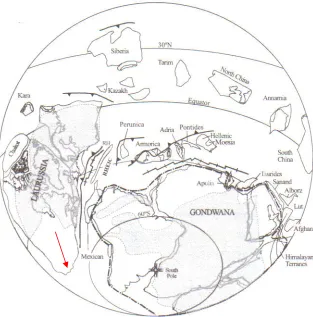
(22) Chapter 1 - Introduction ___________________________________________________________________________________. using cosmopolitan spore taxa found in sections with well-constrained biostratigraphy, i.e. conodonts and/or goniatites in Europe (e.g. Streel et al., 1987).. However, this assumes that. these spores have similar stratigraphic ranges in both regions. Studies specifically on Bolivian palynomorphs are rarer (Díaz-Martínez et al., 1999; Grahn, 2002; Kimyai, 1983; McGregor, 1984, Ottone & Rossello, 1996; Perez-Leyton, 1990; Racheboeuf el al., 1993; Suarez-Riglos et al., 1991; Vavrdová & Isaacson, 2000, 1996; Vavrdová et al., 1996; Wood, 2004) and in common with most South American Devonian palynological studies, the biostratigraphic data was mainly obtained from well cuttings. Biostratigraphic data derived from cuttings samples is prone to contamination by younger material caved from uphole and consequently the true biostratigraphic ranges (especially bases) of palynomorphs in well sections is often poorly constrained. A detailed palynological investigation at outcrop was therefore undertaken with a view to validating and refining subsurface interpretations/zonations based mainly on ranges derived from cuttings samples.. 1.7. Palaeogeography In the Devonian, Bolivia was located along the western margin of Gondwana (Fig. 1.6). around 60oS during the latest Emsian prior to slowly rotating and beginning a northward drift in the Mid-Late Devonian (Isaacson & Díaz-Martínez, 1995). Throughout most of this period, Bolivia occupied a cratonic foreland basin setting, the Bolivia Basin (Isaacson & Sablock, 1990), which ran parallel to the Pacific Margin of South America (Fig. 1.7). According to Sempere (1995), the basin deepened along its axis toward the north or northwest with marine transgressions also originating from the northwest. Marine connections existed with other South American countries via shallow epicontinental seaways (Fig. 1.7). There was a high degree of provincialism amongst marine faunas during the Early Devonian (e.g. Boucot & Blodgett, 2001) when Bolivia was part of a distinct Southern Hemisphere realm (Malvinokaffric). Boucot & Racheboeuf (1993) attribute the first recognition of a unique Devonian marine fauna in the Southern Hemisphere to Clarke (1913), however initial use of the term Malvinokaffric was by Richter (1941) to describe his ‘Malvinocaffrischen Fauna’. Subsequently, Richter & Richter (1942) expanded on this with a discussion of the ‘Malvinocaffrische Provinz’, which was then assigned realm status by Boucot (1975) to become the Malvinokaffric Realm. The Malvinokaffric Realm comprises Antarctica, the Falkland Islands, the southern two thirds of South America, part of west Africa (Ghana and Guinea) and South Africa. Compared with extra-Malvinokaffric biogeographic units, the marine benthic macrofossils comprise a very restricted fauna with low taxonomic diversity which Boucot & Racheboeuf (1993) claimed was characteristic of ancient and modern cool water faunas at high latitudes. Notable also is the scarcity/absence of several major marine groups including conodonts, goniatites, corals and stromatoporoids.. -8-.
(23) Chapter 1 - Introduction ___________________________________________________________________________________. -9-.
(24) Chapter 1 - Introduction ___________________________________________________________________________________. A presence of a cool water, high latitude Malvinokaffric Realm is further supported by the absence of climatically sensitive sediments suggestive of warmer climates, e.g. coal, limestone and dolomite, reefs, red beds and bauxite.. Precisely when the Malvinokaffric Realm broke down is conjectural. It is generally assumed that this occurred sometime in the Mid-Devonian based mainly on the occurrence of the extra-Malvinokaffric brachiopods Tropidoleptus and Rhipidothyris in Bolivia and South Africa which are both thought to represent warmer water conditions in the realm (Boucot & Theron, 2001; Boucot et al., 1983; Issacson, 1993; Isaacson & Díaz-Martínez, 1995; Isaacson & Perry, 1977; Issacson & Sablock, 1990; Melo, 1988; Racheboeuf et al., 1993). However, the supposed warm water ‘post-Malvinokaffric’ brachiopod faunas still do not achieve the diversity of coeval faunas in North America and North Africa (Isaacson & Díaz-Martínez, 1995) which may imply the persistence of cold water in ‘South America’.. -10-.
(25) Chapter 1 - Introduction ___________________________________________________________________________________. 1.8. Johnson et al. (1985) Euramerican sea-level curve Johnson et al. (1985) published a Euramerican sea-level curve (Fig. 1.8) using high-. resolution conodont biostratigraphy and sedimentology to identify coeval sea-level fluctuations in the Devonian across North America and in Europe. Although, 20 years old, the Johnson et al. (1985) curve is still the basis for most literature relating to Devonian sealevel change (e.g. Hüneke, in press; Sandberg et al., 2002; Walliser, 1996 and references therein). Johnson et al. (1985) assumed that the major sea-level changes on their curve were eustatic, although House pers.comm. (2002) noted that unless the sedimentary effects can be recognised synchronously in many areas on all continents they cannot be considered eustatic. This is also true of Devonian ‘global’ biotic events representing periods of turnover in important marine groups which Walliser (1996) tied to specific sea-level fluctuations on the Johnson et al. (1985) curve (Fig. 1.8). Most literature correlating Devonian stratigraphy in South America with the transgressive/regressive TR cycles of Johnson et al. (1985) has been from Brazil (e.g. Melo,1988; Loboziak et al.,1997), although Albariño et al. (2002) noted the main reservoir intervals in Bolivia are related to overall regressive periods on the Euramerican sea-level curve. No attempts at identifying specific ‘events’, e.g. the Choteč Event have been made due to the general absence of Devonian conodonts and goniatites throughout South America, and the endemicity of the marine macrofauna. Conodonts have been found in the Late Devonian of the Amazon Basin (Hünicken et al., 1988) whilst a small number of Mid-Late Devonian goniatites have been recorded from Bolivia and Argentina (Babin et al., 1991). An as yet unidentified Early Devonian goniatite was collected by the author from the basal Huamampampa Formation at Campo Redondo in 2004 (see Chapter 3). Bioclastic carbonates in the lower Los Monos Formation were processed for conodonts by Daphne Woods (formerly of the National Oceanography Centre, Southampton) but none were recovered.. -11-.
(26) Chapter 1 - Introduction ___________________________________________________________________________________. -12-.
(27) Chapter 2 - Methodology ___________________________________________________________________________________. CHAPTER 2 – METHODOLOGY 2.1. Fieldwork Initial fieldwork in Bolivia (10/2002) involved locating useful Devonian study sections in. the Subandean of central and southern Bolivia. The 1.3km ?latest Early-Late Devonian section (upper Huamampampa-top Iquiri Formation) at Bermejo, Santa Cruz Province was identified as being the most suitable since a near continuous and unthrusted exposure occurs in the Rio Lajas. A total of 145 palynological samples were taken from shales along the 1.3km measured section with the highest density across the Huamampampa/Los Monos boundary corresponding to the assumed stratigraphic position of the E. sommeri Epibole (see Chapter 3). All 145 palynology samples from Bermejo were also processed for TOC (% total organic content). The Bermejo section now represents the most continuous and densely sampled surface Devonian palynological record in Bolivia and the data generated has also been fully integrated with the lithostratigraphy. Note that in Chapters 3 and 4 the stratigraphy is inverted to enable comparison with the subsurface. Due to political unrest, the second field season (9/2003) in Bolivia was abandoned, although a subsequent expedition was completed successfully (7/2004). The final field season involved a palynological investigation of the Devonian sections at Campo Redondo and Cha-Kjeri in Chiquisaca Province (Chapter 3) since the only goniatite with a ‘well constrained’ stratigraphic position (although its Mid-Late Devonian age assignment is doubtful) in Bolivia had been found at Campo Redondo (Hünicken et al., 1980) and ChaKjeri is the unofficial type section for the Huamampampa Formation (Chamot, unpublished; Issacson, 1977a). By resolving the age of this goniatite and placing the E. sommeri Epibole in stratigraphic context at Cha-Kjeri a revision of Devonian stratigraphy was possible using the Bermejo surface section and pre-existing subsurface data. Selected stratigraphic intervals were re-investigated in more detail in terms of sedimentology and palaeoenvironment at Bermejo during this second field season (see Chapter 5). Furthermore, two organic rich shale packages in the Iquiri Formation were re-sampled at 1m intervals for TOC analysis and RockEvalTM pyrolysis. Using palynology, attempts were also made to correla te more accurately the Devonian stratigraphy in Bolivia with sections in Europe and North Africa which have well-constrained biostratigraphy (conodonts and goniatites). Most samples investigated in these regions came from the Emsian/Eifelian interval since locating a non-South American E. sommeri Epibole was the objective. Assuming a similar stratigraphic distribution outside South America for the E. sommeri Epibole, locating this event in Europe or North Africa would provide a Euramerican calibrated age assignment for the basal Los Monos Formation. Euramerican calibrated age assignments are lacking in the Devonian of South America (and the Malvinokaffric Realm generally) due to the absence/scarcity of conodonts and goniatites and. -13-.
(28) Chapter 2 - Methodology ___________________________________________________________________________________. the endemicity of the marine fauna. Sampled intervals in these regions and the results of this work are discussed in Chapter 6.. 2.2. Palynological preparation The samples were processed for palynological examination using HCl and HF preparation. techniques. 10g of crushed sample was leached with 100ml. of 28% HCl to remove any carbonate, followed by decant washing to neutral pH, and then by digestion in 60% HF for 24 hours. The residue was decant washed again and spiked with modern Lycopodium spores to allow quantitative counts of acritarchs, chitinozoa and spores. The sample was then sieved at 15µm and briefly boiled in concentrated HCl to remove any neoformed fluorides. After the HCl treatment and final sieving, the residues were vialed. Due to the medium-low maturity of the samples, oxidation with concentrated HNO 3 was not necessary and the quality of preservation of the palynomorphs is generally good. After checking for undissolved minerals, the residues were mounted in Elvacite 2044 on glass slides. Palynological investigations were carried out using a conventional transmitted light microscope fitted with a Nikon Coolpix digital camera. All measurements are taken at x40 magnification and are subject to a ± 2.5µm error. Three hundred palynomorphs were counted on each slide and the ratio of marine to non-marine palynomorphs calculated per sample. Due to time constraints, detailed palynofacies work was not undertaken. Although intervals which are visually rich in phytoclasts and AOM were noted. Samples identified as containing chitinozoa during palynological investigations were sieved at 85µm. From this material, the most pristine chitinozoa were picked and mounted on glass slides. Picking residues for chitinzoa was advantageous since it increased the number of specimens from which descriptions could be generated. However, this method introduced a population bias and subsequently made precise measurements of the abundance of individual taxa difficult (see Chapter 4).. 2.3. TOC analysis TOC analysis was undertaken on each of the 145 samples from the first field season at. Bermejo and an additional 71 samples from the Givetian (TAG samples) and Frasnian shale (FRA samples, see Appendix B ) intercalations in the Iquiri Formation collected during the third field season. The samples were crushed individually to a fine homogenous powder and decarbonated (although this was found to be unnecessary since there is negligible carbonate in the Bermejo samples). Two to three milligrams of sample was measured for TOC using a Carlo-Erba EA-1108 elemental analyser operated as per standard conditions.. -14-.
(29) Chapter 2 - Methodology ___________________________________________________________________________________. 2.4. RockEvalTM pyrolysis RockEvalTM pyrolysis is used to assess the petroleum-generative potential and thermal. maturity of rocks (Espitalié et al., 1977; Peters, 1986). Selected powdered and decarbonated samples from Bermejo were sent to the University of Newcastle for analysis by Dr. Martin Jones and the following parameters were measured: S1 – the amount of hydrocarbons (HC, in mg) that can be thermally distilled from 1g of rock. S2 – the amount of hydrocarbons (in mg) generated by thermal cracking of kerogen in the rock. Tmax – the temperature at which the maximum release of S2 hydrocarbons occurs. The TOC data for these samples were also supplied enabling the HI (hydrogen index) to be calculated. HI is the S2 value divided by weight % TOC multiplied by 100 and provides information on the type of kerogen in a rock. Generally, clastic rocks have reasonable source potential if TOC values are >1%, S1 > 0.5, S2 > 2.5 and HI > 100.. -15-.
(30) Chapter 3 - Stratigraphy ___________________________________________________________________________________. CHAPTER 3 - STRATIGRAPHY Introduction. 3.1. A detailed palynological and sedimentological investigation on the 1.2km Devonian section at Bermejo, Santa Cruz Province was undertaken. At Bermejo a stratigraphic section comprising the uppermost Huamampampa through to the top (truncated) of the Iquiri Formation interval is almost continuously exposed along the banks of the Rio Lajas. Initially, the section was logged and 145 samples were taken for palynology, with over 120 yielding fair to well preserved palynomorphs. Using the palynological data obtained, particular emphasis was placed on validating the subsurface biostratigraphy, especially the validity of the E. sommeri Epibole at the base of the Los Monos Formation. This epibole is of particular stratigraphic importance as it marks the approximate top of the Huamampampa Formation (an economically important gas-bearing sandstone reservoir). A review of Devonian stratigraphy in Bolivia was also undertaken, integrating the new data from Bermejo to significantly refine existing stratigraphic interpretations, especially those based on a single goniatite specimen, Tornoceras bolivianum. The Devonian subsurface stratigraphy in Bolivia is largely based on palynology and is reasonably reliable since it is underpinned by a large regional dataset. However, the surface stratigraphy in Bolivia is less well known and influenced by poorly applied lithostratigraphy. Correlation based on lithostratigraphy in the Subandean is often problematical, since the region is an active thrust belt, and consequently matching the surface and subsurface stratigraphies on the basis of lithostratigraphy can be difficult. This has led to a debate concerning the age assignments of the various Devonian formations. To resolve this issue, an integrated lithostratigraphic and biostratigraphic framework was developed based on outcrop sections from Bermejo, Santa Cruz Province, which was then applied to other sections at Campo Redondo and Cha-Kjeri in Chiquisaca Province. The lithostratigraphy and detailed biostratigraphy of these sections is discussed below.. 3.2. Lithostratigraphy. 3.21. Bermejo. Bermejo, Santa Cruz Province (Figs. 3.1-2) is located approximately 80km SW of Santa Cruz on the Samaipata road (20 K 429876/7994666) and has previously been referred to as Lajas (Issacson, 1977a; Wood, 2004, 1995, 1994). Exposed along the banks of the Rio Lajas immediately south of the road between kilometre posts 80 and 82 is a continuous and undeformed 1.2km ?latest Emsian to mid-Frasnian section comprising the uppermost Huamampampa-Los Monos-Iquiri interval.. -16-.
(31) Chapter 3 - Stratigraphy ___________________________________________________________________________________. -17-.
(32) Chapter 3 - Stratigraphy ___________________________________________________________________________________. -18-.
(33) Chapter 3 - Stratigraphy ___________________________________________________________________________________. Iquiri Formation ca 840m thick. The youngest of the studied formations in Bolivia has an unconformable upper contact with ?latest Devonian/Early Carboniferous diamictites of the Itacua Formation (Fig. 3.2a) and a gradational lower contact with the underlying Los Monos Formation. Lithologically, the Iquiri Formation consists of grey to black shales, green/grey siltstones and pale sandstones (usually fine to medium grained, rarely coarse grained) that are commonly interbedded on cm/m scales, although discrete sand and shale rich intervals do occur. Common sedimentary structures include channels, cross-bedding, flaser bedding and bioturbation. Fe (siderite)-rich horizons (typically <10cm thick) are common in the basal Iquiri at Bermejo. The informal subsurface interval referred to as the ‘TLM’ (now the Bermejo beds see Chapter 5) was found to be present within the Iquiri Formation at Bermejo. The lowest occurrence of channelised sandstones marks the base of the Iquiri Formation. Los Monos Formation 230m thick . The top of the Los Monos consists of cm to m scale interbedded fine sandstones, siltstones and mudstones. Eventually, the sand content decreases towards the base of the formation, resulting in a monotonous sequence of grey to dark grey shales containing Fe-rich layers and rare carbonate doggers (up to 2m diameter). The base of the Los Monos Formation is disconformable (Fig. 3.2b) with the underlying Huamampampa Formation and consists of green/grey fine sandstone and siltstone (= Huamampampa Sucio, see Figure 3.2c).. Huamampampa Formation pars. 75m+ thick At the top of the Huamampampa Formation, pale channelised, cross-bedded sandstones are developed, the upper surface of which is marked by a disconformity. The remainder of the Formation consists of bioturbated green/grey fine sandstone although the base of the formation is not observed at Bermejo.. 3.2.2. Campo Redondo. The section at Campo Redondo (20K 0359902/ 7864249) is located 3km west of Padilla, Chiquisaca Province on the Rio Sillani where the Icla/Huamampampa interval is exposed (Figs. .3.1, 3.3). Approximately 560m of section was sampled for palynology. This section was visited since it is the type locality for the goniatite Tornoceras bolivianum, a specimen considered to be of great chronostratigraphic importance to the Devonian of the Malvinokaffric Realm (Hünicken et al. 1980; see also Section 3.6.1). Hence, sampling the section for palynology would validate the lithostratigraphy and therefore age assignment of T. bolivianum. There is some faulting on the section within the Huamampampa Formation but. -19-.
(34) Chapter 3 - Stratigraphy ___________________________________________________________________________________. -20-.
(35) Chapter 3 - Stratigraphy ___________________________________________________________________________________. the displacements are minor. Based on spores and general palynological assemblages, the measured section at Campo Redondo is ?early/mid Emsian to early Eifelian in age.. Huamampampa Formation ca. 350m The measured section (Fig. 3.3) terminates within a 20m thick package of dark shale beneath which is a monotonous sequence of grey/green siltstones and sandstones. The contact between the shale package and underlying lithologies was unexposed. Siltstones and sandstones constitute the majority of the Huamampampa Formation at Campo Redondo but nodular layers do yield conularids and brachiopods associated with rare trilobites and goniatites. The base of the Huamampampa Formation is gradational with the underlying dark shales of the Icla Formation.. Icla Formation (pars) 200m Only 200m of the Icla Formation were measured at Campo Redondo (Fig. 3.3) and the base of the formation was not seen. The measured section of the Icla Formation can be subdivided into an upper fossiliferous dark shale package and a lower unit consisting of sandy shales containing siderite beds and nodules. This lower unit is fossiliferous (brachiopods, conularids and trilobites) although not as prolific as the upper shales.. 3.2.3. Cha-Kjeri. Cha-Kjeri, Chiquisaca Province (Figs. 3.1, 3.4) is located on the road from Tarabuco to Icla (20 K 0308461, 7868032) and is the type section for the Huamampampa Formation (770m thick) as defined in an unpublished paper by Chamot (1969) who divided the formation into six members as shown on Figure 3.4a. At Cha-Kjeri, spot samples for palynology were taken from each member of the Huamampampa Formation for comparison with Bermejo and the approximate positions of these samples is shown on Figure 3.4b. The Track Shale Member of the Cha-Kjeri Formation was also sampled. The section investigated at Cha-Kjeri is Eifelian-Givetian in age.. 3.2.4. Stratigraphic comparisons with Bermejo and Campo Redondo/Cha-Kjeri. Integrating the biostratigraphy and lithostratigraphy from Bermejo, it is possible to assess the formation assignments at Campo Redondo and Cha-Kjeri. The essential datum for correlation are the shales in the basal Los Monos Formation containing the acritarch Evittia sommeri (see Sections 3.3.2, 3.8, 3.5.1-3.5.4) since these are widely used as the subsurface marker for the top of the Huamampampa Formation reservoir. Evittia sommeri was found in shale packages at Campo Redondo and Cha-Kjeri (Figs. 3.3-3.4) and since E. sommeri is. -21-.
(36) Chapter 3 - Stratigraphy ___________________________________________________________________________________. unique to the basal Los Monos Formation, these shales have to be the lateral equivalents of the basal Los Monos Formation even if they have not been assigned as such.. -22-.
(37) Chapter 3 - Stratigraphy ___________________________________________________________________________________. The Los Monos Formation has not been previously recognised at Campo Redondo (see Hünicken et al., 1980) but its presence is proved by the appearance of E. sommeri, which has a restricted occurrence (Section 3.8), in the dark shales at the very top of the measured section (Fig. 3.3A). At Cha-Kjeri, E. sommeri was found in the Carinatus Shale Member of the Huamampampa Formation (Fig. 3.4D). The Los Monos Formation is not used in the ChaKjeri area therefore to maintain consistency with the subsurface and Bermejo, the top of the Huamampampa is placed at the top of the Siete Hermanos Sandstone and the Carinatus Shale incorporated into the Cha-Kjeri Formation herein. The Track Shale Member of the ChaKjeri Formation displays ‘Iquiri type’ facies and has a palynomorph assemblage characteristic of the Bermejo beds (see Section 3.3). Although not sampled for palynology, the Catarata Sandstone and Orko-Capilla Sandstone must be the equivalent of the upper Los Monos/lower Iquiri Formation (mostly sub ‘TLM’) interval.. 3.2.5. Comparison of surface and subsurface lithostratigraphy. The subsurface thickness of the Middle and Upper Devonian (Los Monos and Iquiri Formations) is estimated to be approximately 1km (Marc Bond (BG Group), pers. comm.) and at Bermejo a similar value (1070m) is observed. Although the total thickness of this interval is similar, the positioning of the boundary between the Iquiri and Los Monos Formation is different because at Bermejo, the boundary between these formations can be defined lithologically rather than palynologically. Consequently, the Iquiri Formation is much thicker (840m) and the Los Monos Formation thinner (230m) than generally seen in the subsurface. The subsurface palynological boundary between the Iquiri and Los Monos Formations would be defined 650m higher than the lithological boundary at Bermejo after a late Givetian flooding event. An informal palynological division of the Los Monos Formation in the subsurface, the ‘TLM’ is assigned to the Iquiri Formation due to the correct identification of formation boundaries and is renamed herein the Bermejo beds (see Chapter 5). The ‘Huamampampa Sucio’ is another informal (but seldom used) subsurface division assigned to an interval of muddy sandstones and siltstones present immediately above the Huamampampa Formation reservoir. Stratigraphically, the ‘Huamampampa Sucio’ is disconformable with the Huamampampa Formation reservoir at Bermejo and it therefore makes sense to assign these sandstones and siltstones to the Los Monos Formation at Bermejo since lithologically they represent the early part of the basal Los Monos Formation transgression.. -23-.
(38) Chapter 3 - Stratigraphy ___________________________________________________________________________________. 3.3. Biostratigraphy. 3.3.1. Subsurface Devonian palynology in Bolivia.. There is a wealth of largely unpublished oil industry subsurface palynological data for Bolivia and although cuttings-based, a number of distinct palynological trends/epiboles are consistently identifiable throughout the central and southern Bolivian subsurface (Marshall et al., in prep.). There are differences between surface and subsurface lithological picks and these have been discussed in Section 3.2.5. The subsurface formation assignments and their palynological characteristics from youngest to oldest are summarised below (BG, pers. comm. 2004):. Iquiri Formation (ca. 500m thick) The top of the Iquiri Formation is marked by an unconformity overlain by latest Devonian/early Carboniferous age diamictites (Itacua Formation) which can erode down as far as the basal Iquiri Formation as defined in the subsurface, i.e. to the top of the Bermejo beds (Marshall et al., in prep.). Within the Iquiri Formation two discrete levels containing abundant amorphous organic matter (AOM), marine palynomorphs and pulses of prasinophytes are recognised and are interpreted as marine flooding events. These marine transgressions are thought to be Frasnian and latest Givetian in age, with the base of the Givetian flooding being the pick for the base of the Iquiri Formation.. ‘Terrestrial Los Monos Member’ (=Bermejo beds), Los Monos Formation (ca. 300m thick) The informally assigned TLM, represents the uppermost Los Monos Formation in the subsurface and is characterised by an influx of spores associated with abundant cuticle and large phytoclasts, and a decline in the abundance of marine palynomorphs. The TLM represents a shallowing into a more proximal, possibly nearshore, environment with rare acritarchs and chitinozoa suggesting that the interval is still pervasively marine. Spore assemblages provide a Givetian age for the TLM.. Los Monos Formation (ca. 300m thick) A decrease in the relative abundance of terrestrial palynomorphs marks the transition from the TLM into the Los Monos Formation proper. The base of the formation is marked by an acritarch and prasinophyte dominated assemblage indicative of a marine flooding and an open shelf environment. Compared to the overlying TLM, the Los Monos interval is relatively impoverished palynologically and as a result it is often difficult to date precisely due to poor quality recovery from the cuttings and the occurrence of caved material from. -24-.
(39) Chapter 3 - Stratigraphy ___________________________________________________________________________________. uphole. Furthermore, the base of the formation is dominated by cosmopolitan, long ranging acritarchs and endemic spores. The Los Monos Formation is considered to be of Eifelian age.. Huamampampa Formation (ca. 200m thick) Apart from caved material, in situ palynological yields from the Huamampampa Formation are lean. Based mainly on its stratigraphic position in the subsurface this Formation is considered to be pre-early Eifelian.. Icla Formation (ca. 500m thick) The Icla Formation is often palynologically barren but does intermittently contain a sparse palynomorph assemblage consisting of simple spores and generally long ranging marine palynomorphs. Rare diagnostic palynomorphs suggest an Emsian-Pragian age for this formation (McGregor, 1984).. Santa Rosa Formation This formation is rarely encountered in the subsurface and generally highly impoverished with respect to palynomorphs, although Pragian and Lochkovian taxa have been recorded (Marshall, et al., in prep.).. 3.3.2. Important biostratigraphic markers subsurface in Bolivia. Five distinctive marine palynomorph epiboles comprising short-lived monospecific pulses of acritarchs, chlorophyta and chitinozoa are recognised in the Bolivian subsurface. These comprise (youngest to oldest): the chlorophyte Petrovina connata, the acritarchs Crucidia camirense, Bimerga bensonii and Evittia sommeri and the chitinozoan Ramochitina magnifica. The P. connata, C. camirense, B. bensonii and E. sommeri epiboles are described in Section 3.8, and these allow a framework for relative stratigraphical positioning within the Devonian sequence in Bolivia. The acmes (maximum relative abundance) of P. connata and C. camirense are found in the Iquiri Formation (Frasnian). The B. bensonii acme is found in the uppermost Los Monos Formation (Givetian) underneath the ‘TLM’ (=Bermejo beds) and the E. sommeri acme is situated in the basal Los Monos Formation (Eifelian). The acme of R. magnifica occurs in the basal Icla Formation (Pragian) but is rarely penetrated in the subsurface. Assuming no tectonic repetition, all of the acmes where present subsurface, always occur in the same stratigraphic order (Fig. 3.5) although none have been previously identified and precisely dated at outcrop. The E. sommeri acme (or E. sommeri Epibole herein) is the most important palynomorph epibole stratigraphically because it occurs immediately above the Huamampampa Formation reservoir in the base of the overlying Los Monos Formation. Consequently, particular. -25-.
(40) Chapter 3 - Stratigraphy ___________________________________________________________________________________. emphasis has been placed on understanding the E. sommeri Epibole in terms of its precise stratigraphic and geographical extent and its sedimentological context.. 3.4. Biostratigraphy and chronostratigraphy of the Bermejo section. 3.4.1. General palynological trends at Bermejo. The general palynological trends (section 3.3) encountered in the subsurface throughout central and southern Bolivia were all identified at Bermejo. Apart from R. magnifica (the Icla Formation in which this taxon occurs is not exposed in the study area), the acmes of the remaining four important palynomorphs were all located stratigraphically with precision (Fig. 3.6). Significantly, these epiboles all occur in the same order as previously recorded in the subsurface. The P. connata and C. camirense acmes are associated with the younger of two marine floodings within the Iquiri Formation. The B. bensonii acme occurs during an interval of general marine regression at the base of the Iquiri Formation as defined sedimentologically at Bermejo (see Chapter 5) and the E. sommeri Epibole is found in black shales marking the marine transgression in the basal Los Monos Formation.. 3.4.2. Bermejo chronostratigraphy. At Bermejo seven palynomorph taxa, comprising three chitinozoan and four diagnostic spore species, were identified and used to assign ages to the section. The chitinozoan taxa are also described in Chapter 4. The chronostratigraphic implications of these seven taxa to the Bermejo section are discussed below. It is possible to indirectly correlate parts of the Los Monos and Iquiri Formations with Euramerican conodont zones using spores although few conodont zones can be tied to spore zones with certainty. An integrated Euramerica spore and conodont zonation based on Streel et al. (2000) is shown on Figure 3.7.. Iquiri Formation The persistence of the spore Cristatisporites triangulatus (Fig. 3.6) throughout the uppermost Iquiri Formation indicates an age of no younger than mid Frasnian for the top of the Iquiri Formation since this taxon does not range above the early Frasnian (Avkhimovitch et al., 1993). Urochitina bastosi (Fig. 3.6) found in samples CGH 141-CGH 143 ranges ca. 15m beneath the erosive unconformity at the top of the Iquiri Formation (Fig. 3.6). In Grahn & Melo (2002) the U. bastosi interval zone in Brazil is found in the upper IV miospore zone (mid to late Frasnian) although the total range of U. bastosi extends into the Famennian. A probable mid Frasnian age is therefore assigned to the top of the Iquiri Formation at Bermejo, although a slightly younger Frasnian age cannot currently be ruled out.. -26-.
(41) Chapter 3 - Stratigraphy ___________________________________________________________________________________. -27-.
(42) Chapter 3 - Stratigraphy ___________________________________________________________________________________. -28-.
(43) Chapter 3 - Stratigraphy ___________________________________________________________________________________. -29-.
(44) Chapter 3 - Stratigraphy ___________________________________________________________________________________. The first occurrence of Verrucosisporites bulliferus (Fig. 3.6) defines the base of the BJ Oppel Zone (Streel et al., 1987) or the ovalis-bulliferus Assemblage Zone of Richardson & McGregor (1986) and indicates an early Frasnian age (Fig. 3.7). The base of the BJ Oppel Zone does not coincide with the Givetian/Frasnian boundary. Therefore the Givetian/Frasnian boundary is placed around sample CGH 116 corresponding to the first occurrence of P. connata (Fig. 3.6), an exclusively Frasnian taxon in Brazil (Le Hérissé, 2001) based on spores (Loboziak et al., 1997a,b). Hoegisphaera glabra s.s. is a Frasnian chitinozoan (see Chapter 4) and occurs in samples CGH 124-CGH 125 and its presence at this level (Fig. 3.6) is consistent with the occurrence of V. bulliferus in the underlying sample range CGH 117-CGH 121.. Based on work by Turnau & Racki (1999) in Poland, the lower and upper Givetian (in part). -30-.
(45) Chapter 3 - Stratigraphy ___________________________________________________________________________________. can be divided into three spore subzones (oldest – youngest) Ex 1, Ex 2, Ex 3 of the extensa Zone (Fig. 3.8). These subzones are defined by: the occurrence of Geminospora lemurata and other key spore taxa (Ex 1), and the inceptions of Chelinospora concinna (base Ex 2) and Cristatisporites triangulatus (base Ex 3). This division of the Givetian does create difficulties in fixing the top of Ex 2 and base Ex 3 boundaries since the first occurrence of C. concinna appears to be regionally diachronous, e.g. in Belarus (Obukhuskaya, 2000), Russia (Avkhimovitch et al., 1993), and Canada (McGregor & Camfield, 1982), the oldest occurrence of C. triangulatus is stratigraphically above C. concinna whereas in Germany (Loboziak et al., 1991) the sequence is reversed. At Bermejo, these spores occur in the same sequence as the non-German records (Fig. 3.8). The first occurrence of C. triangulatus in CGH 108 marks the base of the TA Oppel Zone (Loboziak et al., 1997a; Fig. 3.7) although only a single specimen of C. concinna was found in sample CGH 106 marking the base of the TCo Oppel Zone. Due to difficulties with the Ex 2/Ex 3 boundary, the Ex 1 – Ex 3 spore division of the Givetian is not adopted at Bermejo. Furthermore, the TA and TCo Oppel Zones are also in reverse order at Bermejo and are not therefore applicable. Melo & Loboziak (2003) resolved this problem in the Amazonas Basin, Brazil by using the Trg Zone which encompasses both Oppel Zones and is defined by the first occurrence of C. triangulatus. The first occurrence of G. lemurata which marks the base of the AD lem Oppel Zone (Steel et al., 1987) is in sample CGH 77 (907.7m) and is broadly coincident with the boundary between the Los Monos and Iquiri Formations at ca. 920m (Fig. 3.6) as defined by sedimentology (see Chapter 5). At Bermejo, the Iquiri Formation is assigned an early Givetian to mid-Frasnian age range.. Los Monos Formation The top of the Los Monos is latest Eifelian based on the presence of the Givetian marker G. lemurata in the overlying basal Iquiri Formation, although dating the base of the Los Monos Formation is more problematical. In Euramerica, the Early to Mid Devonian spore assemblages are notable for the few spore forms that become extinct. The spore assemblages are instead characterised by innovation in spore construction with the latest Emsian/early Eifelian interval being marked by an increase in spore size and a proliferation in the abundance of zonate and camerate forms (Richardson & McGregor, 1986). In the subsurface of Bolivia, a similar trend is observed in the basal Los Monos Formation and also at the Campo Redondo outcrop section (Section 3.6) where these forms are rare/absent below the uppermost Huamampampa Formation. Although similar trends in spore evolution are identified in Bolivia as in Euramerica (McGregor, 1984), the basal Los Monos spore flora appears to be largely endemic lacking key zonal markers such as Grandispora. -31-.
(46) Chapter 3 - Stratigraphy ___________________________________________________________________________________. douglastownense and Ancyrospora eurypterota (Richardson & McGregor, 1986). The acritarch flora at this level is dominated by long ranging forms but a very distinctive chitinozoan, Alpenachitina eisenacki, is important as it is a well known cosmopolitan taxon with a conodont-calibrated first occurrence in the early Eifelian (partitus Conodont Zone, see Figure 3.7) in the USA (Paris et al., 2000; Wright, 1980). The first occurrence of A. eisenacki in CGH 46 at Bermejo, and also elsewhere in Bolivia, is associated with abundant large camerate and zonate spores (Pl. 3, fig. 18), consistent with an early Eifelian age for the basal Los Monos Formation.. Huamampampa Formation Palynomorph recovery was poor in the Huamampampa Formation at Bermejo although the formation has to be pre-early Eifelian or older based on stratigraphic relationships. At Campo Redondo the base of the formation was dated as mid Emsian based on palynology (see Section 3.6.1).. The E. sommeri Epibole at Bermejo. 3.5. Although present at the same stratigraphic level in 22 of the 24 wells drilled in Bolivia (basal Los Monos Formation), the precise stratigraphic position and palaeoenvironmental significance of the E. sommeri Epibole is only poorly understood. Since the E. sommeri Epibole had only been identified in cuttings samples, it was not possible to accurately determine the position of the epibole relative to the top of the Huamampampa Formation, or its stratigraphic thickness. To investigate these parameters, the undeformed Bermejo section was sampled to determine the total stratigraphic range of E. sommeri and the precise stratigraphic position and extent of the E. sommeri Epibole.. 3.5.1. Stratigraphic position and extent of the E. sommeri Epibole at Bermejo. E. sommeri is restricted to the Los Monos Formation in samples CGH 18 –CGH 57 a total stratigraphic range of ca. 100m (Fig. 3.9). A similar acritarch (see also Loboziak et al., 1997b) is found within the Iquiri Formation in CGH 116 and younger samples but this was identified as E. geometrica not E. sommeri (Pl. 1, fig. 14-17). Analysis of the relative abundance of E. sommeri reveals a distinct spike in CGH 27 of 12900 specimens g-1 (Fig. 3.9). E. sommeri dominates the microplankton assemblage at this level with an abundance that is greater than all of the other acritarchs combined (8700 specimens g-1). Only spores have a greater relative abundance in CGH 27, ca. 25000 specimens g-1. CGH 27 represents the E. sommeri acme, although the E. sommeri Epibole ranges through samples CGH 25CGH 29 and has an approximate thickness of 10m. The E. sommeri acme is clearly visible on Figure 3.9.. -32-.
(47) Chapter 3 - Stratigraphy ___________________________________________________________________________________. -33-.
(48) Chapter 3 - Stratigraphy ___________________________________________________________________________________. -34-.
(49) Chapter 3 - Stratigraphy ___________________________________________________________________________________. 3.5.2. Associated palynomorphs. The palynomorph assemblage associated with the E. sommeri Epibole (Plate 3) comprises long-ranging acritarchs including: Diexallophasis simplex, Estiastra rhytidoa, Exochoderma arca, Multisplicisphaeridium ramusculosum, Navifusa bacillum, Triangulina alagarda and Veryhachium trispinosum; the chitinozoa Ancyrochitina sp. 1 and Ramochitina sp. 1 (described in Chapter 4) and common prasinophytes such as Duvernaysphaera angelae and leiospheres. These palynomorphs are found in association with common large camerate spores.. 3.5.3. Age of the E. sommeri Epibole. The E. sommeri Epibole occurs 30m below the first occurrence of Alpenachitina eisenacki, a cosmopolitan early Eifelian-early Givetian taxon (Burjack & Paris, 1989) and the epibole is therefore assigned an earliest Eifelian age.. 3.5.4. Geographical distribution of the E. sommeri Epibole. The E. sommeri Epibole has been identified in the subsurface throughout central and southern Bolivia and northern Argentina, with representative expressions of this epibole from three widely spaced wells shown in Figure 3.10. E. sommeri was also recovered from Los Monos Formation-equivalent shaly facies (see Section 3.8) at Campo Redondo and ChaKjeri, Chiquisaca Province, where it is associated with the same palynomorph assemblage seen at Bermejo. Spot samples collected by Dr. John Marshall (National Oceanography Centre, Southampton) at Ayo Ayo on the Altiplano from the Belén Formation (Figs. 3.11, 3.13; Díaz-Martínez et al., 2000) yielded some degraded E. sommeri specimens, again associated with a palynomorph assemblage similar to Bermejo. However, the E. sommeri Epibole could not be defined precisely due to the low sample density. More detailed sampling at these localities should prove the presence of the E. sommeri Epibole. The type material of E. sommeri comes from 1646-1648m depth (Core 48) in Petrobras Well 2-PM-1-MA in the Parnaíba Basin NE Brazil (Brito, 1967; Chapter 1, Fig. 1.7). This occurs within a transgressive black shale in the basal Pimenteira Formation which marks an Eifelian marine transgression (Melo, 1988). The Pimenteira Formation at this level can therefore be considered a lateral equivalent of the basal Los Monos Formation and also has a palynomorph assemblage that is very similar to that seen in Bolivia (Plate 3). Using spores, Loboziak et al. (1992) dated this level in Well 2-PM-1-MA to the Eifelian AD pre lem biozone consistent with the age assigned to E. sommeri in Bolivia. The similarity in environment, palynological assemblage and age for both Brazil and Bolivia suggests this event may represent a synchronous marine transgression that took place across South America during early Eifelian time.. -35-.
(50) Chapter 3 - Stratigraphy ___________________________________________________________________________________. 3.6. Correlation of Bermejo with other Devonian sections in Bolivia With an integrated lithostratigraphic and biostratigraphic framework in place at Bermejo. it is now possible to more accurately correlate this section with other Devonian sections in Bolivia. Direct correlation using the basal Los Monos Formation (E. sommeri Epibole marine transgression) at Bermejo was successful at Campo Redondo and Cha-Kjeri outcrop sections. A revision of the unpublished (but accepted) formation assignments was necessary at ChaKjeri to avoid confusion and this has been discussed in Section 3.2.4. The samples collected at Ayo Ayo on the Altiplano were used to make a preliminary correlation with the other studied sections (Fig. 3.11) and a subsequent revision of the Devonian chronostratigraphy (Fig. 3.12).. 3.6.1. Implications for Devonian chronostratigraphy in Bolivia. Age assignments for the Devonian formations in Bolivia are shown in Figure 3.12. Large differences in opinion regarding age assignments of these formations are due mainly to poorly-defined lithostratigraphy and little or no supporting biostratigraphy. These factors are highlighted when considering the variable ages given to the Huamampampa Formation. The discovery of a single goniatite, Tornoceras bolivianum, in the basal Huamampampa Formation at Campo Redondo (Hünicken et al., 1980) was considered a major breakthrough since Devonian goniatites are rare in South America and are important for dating Devonian marine sequences in Euramerica. T. bolivianum was assigned to the Givetian/Frasnian based on its presumed affinities with the cosmopolitan Mid to Late Devonian genus Tornoceras. Despite being a tornoceratid, the generic assignment of this specimen is no longer thought to be valid but its age is still currently accepted (Prof. R.T. Becker pers. comm., 2004). The Huamampampa Formation has therefore been consistently dated as Mid Devonian because of the chronostratigraphic importance placed this single specimen of T. bolivianum. To accommodate this Mid Devonian age for the Huamampampa Formation an hiatus was commonly placed within the Lower Devonian (Fig. 3.12). Some workers cite the Hünicken et al.(1980) specimen as signalling the break up of the cold water Malvinokaffric Realm during the Givetian and Frasnian allowing an influx of warm water goniatites, and this assertion is again based on the presumed Mid Devonian age of T. bolivianum (e.g. Boucot, 1988). The stratigraphic level from which T. bolivianum was recovered at Campo Redondo is reasonably well constrained and consequently, the palynology of Campo Redondo was investigated to determine if the lithostratigraphy of this level, and therefore the dating of this specimen, was correct. During sampling at Campo Redondo, another as yet unidentified, goniatite (Fig. 3.14) was recovered from a nodular horizon approximately 15m above the presumed level of the Hünicken et al. (1980) specimen. However, both this level and the T.. -36-.
(51) Chapter 3 - Stratigraphy ___________________________________________________________________________________. -37-.
(52) Chapter 3 - Stratigraphy ___________________________________________________________________________________. -38-.
(53) Chapter 3 - Stratigraphy ___________________________________________________________________________________. bolivianum level were palynologically barren. A sample (CMR 69) taken from the lower Huamampampa Formation approximately 135m above the stratigraphic level that the goniatite in this study was found, yielded Dictyotriletes emsiensis and Camarozonotrilites sextantii (Fig. 3.14), an association no younger than mid Emsian (Richardson & McGregor, 1986). The occurrence of E. sommeri and associated palynomorph assemblage 160m stratigraphically higher than CMR 69 further constrains the age of the Huamampampa Formation as mid Emsian to early Eifelian. Therefore, T. bolivianum also has to be Emsian and subsequently there is therefore no reason to place a hiatus within the Lower Devonian in Bolivia on account of this goniatite. According to Grahn (2002), the Huamampampa Formation at Tarabuco, Chiquisaca Province contains a chitinozoan fauna including Alpenachitina eisenacki and Ancyrochitina postdesmea, a view supported by Racheboeuf et al. (1993) who report A. eisenacki 25m above the base of the Huamampampa Formation at Presto, Chiquisaca Province. This study demonstrates that A. eisenacki is restricted to the Eifelian and A. postdesmea is a short lived Givetian taxon (see Chapter 4). These taxa are restricted to the Los Monos and Iquiri Formations respectively at Bermejo and therefore the samples in Grahn (2002) and Racheboeuf et al. (1993) could not have come from the Huamampampa Formation. Grahn (2002) concluded that the Los Monos/Iquiri Formation boundary was diachronous in order to accommodate a late Eifelian/early Givetian Huamampampa Formation and explain the presence of early Givetian chitinozoans in both the Los Monos and Iquiri Formations. The Los Monos/Iquiri Formation does not need to be diachronous based on the biostratigraphic and lithostratigraphic data from Bermejo, since the Los Monos Formation is Eifelian and the Iquiri Formation is Givetian/Frasnian. Consequently, the age assignments used in Grahn (2002) are questionable on the grounds of suspect lithostratigraphy.. 3.7. Summary. In order to validate subsurface biostratigraphy and improve Devonian chronostratigraphy in Bolivia, a detailed palynological study of the Mid to Late Devonian section exposed at Bermejo, Santa Cruz Province was undertaken. The Bermejo section ranges from latest Emsian to mid Frasnian. Biostratigraphic markers identical to those observed in the subsurface were identified and the E. sommeri Epibole was shown to represent a single, shortlived but, geographically widespread event that is always found in the basal Los Monos Formation or lateral equivalent. The biostratigraphic data obtained from Bermejo was integrated with lithostratigraphy and correlated with other Devonian sections at Campo Redondo, Cha-Kjeri and Ayo Ayo using the base of the transgressive shale facies associated with the E. sommeri Epibole as a datum. Devonian chronostratigraphy and lithostratigraphy in Bolivia were reviewed and problems with formation age assignments demonstrated.. -39-.
(54) Chapter 3 - Stratigraphy ___________________________________________________________________________________. Palynology proved that there was no reason to place an hiatus within the Lower Devonian on account of a single assumed Givetian/Frasnian goniatite since the specimen is in fact Emsian. The need for a diachronous Los Monos/Iquiri Formation has also now been demonstrated to be unnecessary.. -40-.
Figure
Outline
Bermejo chronostratigraphy
Correlation of Bermejo with other Devonian sections in Bolivia
Systematic palaeontology
Chitinozoan morphology
Los Monos Formation (Fig 5.2, 46-377m)
Iquiri Formation (Fig 5.2, 377-1214m) Localities: Bermejo and Cha-Kjeri (equivalent facies).
Global context 1 South America
Related documents
Intervention effects with respect to ‘ PTA ’ , ‘ INFO ’ , ‘ SAFED ’ , clinical patient outcomes, and health-related quality of life were estimated using general- ised
For the poorest farmers in eastern India, then, the benefits of groundwater irrigation have come through three routes: in large part, through purchased pump irrigation and, in a
The Quarterly financial statistics Survey covers a sample of private enterprises operating in the formal non-agricultural business sector of the South African economy. It
Since NCBI Viral Genomes contained only a small number endogenous nonretrovi- ral, endogenous retroviral, and LTR retrotransposon sequences, we further determined the extent to
19% serve a county. Fourteen per cent of the centers provide service for adjoining states in addition to the states in which they are located; usually these adjoining states have
Assessing the Impact of Biodiversity Conservation in the Management of Maize Stalk Borer (Busseola f
Field experiments were conducted at Ebonyi State University Research Farm during 2009 and 2010 farming seasons to evaluate the effect of intercropping maize with
SP-A, surfactant protein A; SP-D, surfactant protein D; BALF, bronchoalveolar lavage fluid; HS, healthy subjects; IPF, idiopathic pulmonary fibrosis patients; SAR,
It was decided that with the presence of such significant red flag signs that she should undergo advanced imaging, in this case an MRI, that revealed an underlying malignancy, which
