UNIVERSITI TEKNIKAL MALAYSIA MELAKA
THE EFFECTIVENESS OF USING PHASE CHANGE
MATERIAL (PCM) IN REDUCING CAR INTERIOR
TEMPERATURE DURING DAY-TIME
This report submitted in accordance with requirement of the Universiti Teknikal Malaysia Melaka (UTeM) for the Bachelor Degree of Mechanical Engineering
Technology(Automotive Technology) (Hons.)
by
MUHAMMAD NAJIB FAIZ BIN NE’MAT B071310712
940819065399
UNIVERSITI TEKNIKAL MALAYSIA MELAKA
BORANG PENGESAHAN STATUS LAPORAN PROJEK SARJANA MUDA
TAJUK: THE EFFECTIVENESS OF USING PHASE CHANGE MATERIAL
(PCM) IN REDUCING CAR INTERIOR TEMPERATURE DURING DAY-TIME
SESI PENGAJIAN: 2016/17 Semester 1/2
Saya MUHAMMAD NAJIB FAIZ BIN NE’MAT
mengaku membenarkan Laporan PSM ini disimpan di Perpustakaan Universiti Teknikal Malaysia Melaka (UTeM) dengan syarat-syarat kegunaan seperti berikut:
1. Laporan PSM adalah hak milik Universiti Teknikal Malaysia Melaka dan penulis. 2. Perpustakaan Universiti Teknikal Malaysia Melaka dibenarkan membuat salinan
untuk tujuan pengajian sahaja dengan izin penulis.
3. Perpustakaan dibenarkan membuat salinan laporan PSM ini sebagai bahan pertukaran antara institusi pengajian tinggi.
4. **Sila tandakan ( )
SULIT
TERHAD
TIDAK TERHAD
(Mengandungi maklumat yang berdarjah keselamatan atau kepentingan Malaysia sebagaimana yang termaktub dalam AKTA RAHSIA RASMI 1972)
(Mengandungi maklumat TERHAD yang telah ditentukan oleh organisasi/badan di mana penyelidikan dijalankan)
Alamat Tetap:
No 317, Lrg Cempaka
Kampung Mahkota
Pahang,
Tarikh: ________________________
Disahkan oleh:
Cop Rasmi:
Tarikh: ________________________
DECLARATION
I hereby, declared this report entitled “The Effectiveness of Using Phase Change Material (PCM) In Reducing Car Interior Temperature Especially During Day-time”
is the results of my own research except as cited in references.
Signature : ………
Author’s Name : ………
APPROVAL
This report is submitted to the Faculty of Engineering Technology of UTeM as a partial fulfillment of the requirements for the degree of Bachelor of Mechanical Engineering Technology (Automotive Technology) with Honours. The member of the supervisory is as follow:
………..… (Project Supervisor)
i
ABSTRAK
ii
ABSTRACT
iii
DEDICATION
iv
ACKNOWLEDGEMENT
Foremost, I would like to express my sincere gratitude to my advisor En. Aludin bin Mohd Serah for the continuous support of my thesis study and research, for his patience, motivation, enthusiasm, and immense knowledge. His guidance helped me in all the time of research and writing of this thesis. I could not have imagined having a better advisor and mentor for my bachelor degree study.
v
TABLE OF CONTENT
Abstrak i
Abstract ii
Dedication iii
Acknowledgement iv
Table of Content v
List of Tables viii
List of Figures v
List Abbreviations, Symbols and Nomenclatures v
v
CHAPTER 1: INTRODUCTION 1
1.0 Introduction 1
1.1 Background 1
1.1.1 Global Warming 1
1.1.2 Car Interior Temperature 2
1.1.3 Passive Cooling System using Phase Change Material(PCM) 3
1.2 Problem Statement 4
1.3 Project Objective 6
1.3.1 General Objective 6
1.3.2 Specific Objective 6
1.4 Research Scope 6
CHAPTER 2: LITERATURE REVIEW 7
2.0 Introduction 7
2.1 Phase Change Material (PCM) 7
2.1.1 Classification of PCM 9
2.1.2 Organic PCMs 9
2.1.3 Inorganic PCMs 11
vi
2.1.5 Criteria of Best PCMs 13
2.2 Encapsulation Techniques 15
2.2.1 Microencapsulation of PCMs 15
2.2.2 Macroencapsulation of PCMs 17
2.2.2.1 Encapsulation of PCMs for Buildings Application 17 2.2.2.2 Encapsulation of PCMs for Automotive application 18
2.3 Measurement of Thermal Properties of PCMs 20
2.3.1 Differential Scanning Calorimeter (DSC) 20
2.3.2 Differential Thermal Analysis (DTA) 21
2.3.3 T-History Method 22
2.4 Calculation of Efficieny of PCM-based Cooling System 22
CHAPTER 3: METHODOLOGY 24
3.0 Introduction 24
3.1 Selection of Phase Change Material (PCM) 24
3.1.1 Melting Point 24
3.1.2 Measurement of Car Interior Temperature 25
3.2 Thermal Properties by DSC Analysis 25
3.3 Preparation of PCM bead 27
3.3.1 Encapsulation by Using Plastic Capsule 28 3.3.2 Encapsulation by Using Aluminum Casing 30 3.3.3 Encapsulation by Using Aluminum Foil 29
3.4 Car Interior Model 30
3.4.1 Design of Car Interior Model 30
3.4.2 List of Materials and Equipment 31
3.5 Calculation of Efficiency of PCM-based Cooling System 32
CHAPTER 4: RESULT& DISCUSSION 34
4.0 Introduction 34
4.1 Car Interior Temperature during Day-time 34
4.2 Differential Scanner Calorimeter(DSC) test 35
4.3 Fabrication of Car Interior Model 36
vii
4.5 Encapsulation Materials 38
4.5.1 PCM with Plastic Capsule 39
4.5.2 PCM with Aluminum Casing 39
4.5.3 PCM with Aluminum Foil 39
4.6 Effectiveness of PCM Encapsulation Technique in Reducing 40 Car Interior Model Temperature
4.5 Efficiency of System 52
4.6 Comparison of Encapsulation Materials on Effectiveness in 54 Reducing Car Interior Temperature
CHAPTER 5: CONCLUSION & RECOMMENDATION 55
5.0 Introduction 55
5.1 Summary of Research 55
5.2 Achievement of Research Objectives 56
5.3 Significance of the Research 57
5.4 Problem Faced During Research 57
5.5 Suggestion for Future Work 57
REFERENCES 58
viii
LIST OF TABLES
No Title Page
2.1 Melting point and latent of fusion: paraffins 9
2.2 Melting point and latent heat of fusion: metals 10
2.3 Comparison of different kinds of PCMs 12
2.4 Main criteria for selecting PCMs 13
3.1 The description of car temperature measurement 25
3.2 List of Materials and Equipment 32
4.1 The temperature of car interiorat 8.00 a.m. until 6.00 p.m. 34
4.2 Experiment without using PCM in 33 minutes 41
4.3 Experiment with using plastic capsule PCM in 33 minutes 44
4.4 Experiment with Using aluminum casing PCM in 33 minutes 47
4.5 Experiment with Using aluminum foil PCM in 33 minutes 50
ix
LIST OF FIGURES
No Title Page
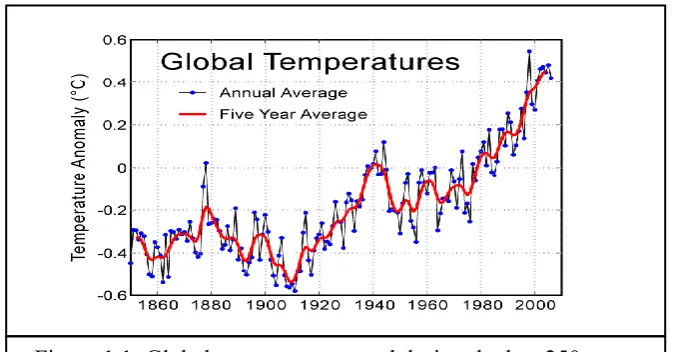
1.1 Global temperatures trend during the last 250 years 2
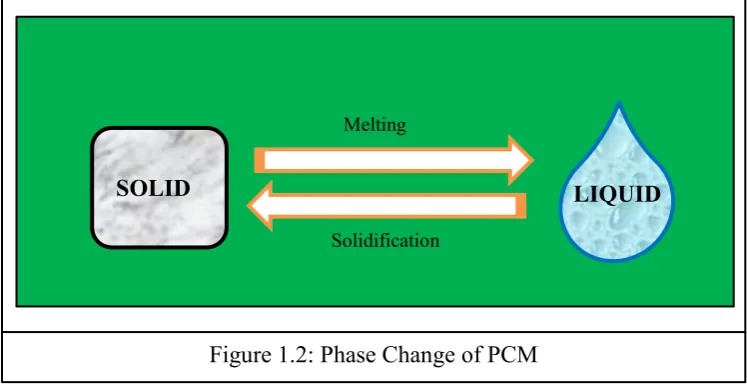
1.2 Phase Change between Solid and Liquid 3
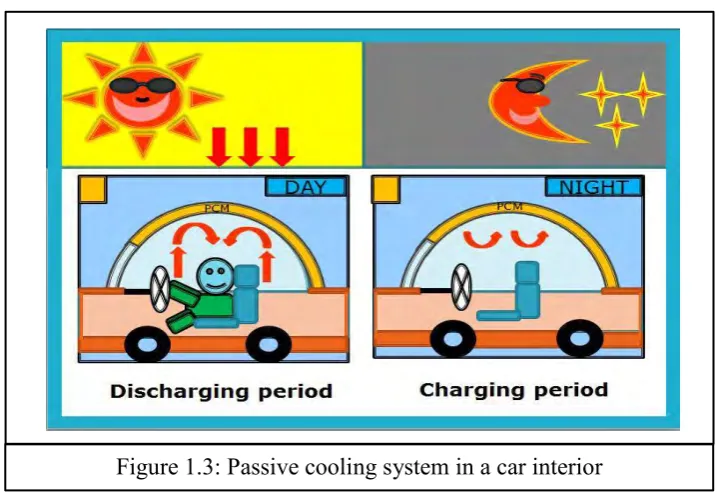
1.3 Passive cooling system in a car interior 4
1.4 The leakage of paraffin PCM in a car 5
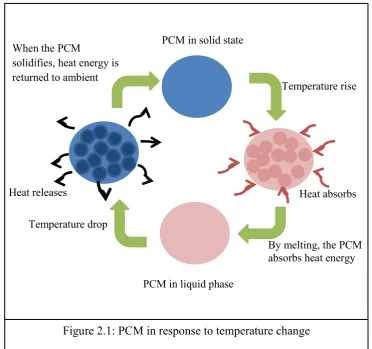
2.1 PCM in response to temperature change 8
2.2 General classifications of PCMs 9
2.3 The range size of the microcapsulation. 16
2.4 Microcapsules inserted inside foam matrix and well compatible 17
2.5 Outline of the ceiling board system. 18
2.6 Cross-section of the automobile 19
2.7 The configuration of the PCM layer in the automobile 20
2.8 Reference pan and sample pan in DSC 21
2.9 Experimental configuration of a PCM layer in the ceiling part of the
automobile 23
3.1 DSC machine 26
3.2 The pan puncher 26
3.3 The placement of sample in DSC machine 27
3.4 Paraffin 27
3.5 Paraffin in bead-form 28
3.6 PCM beads in plastic capsule 29
3.7 PCM beads in aluminum foil 29
3.8 PCM beads in aluminum casing 30
3.9 Drawing and sketching of car interior model 31
4.1 DSC curve for paraffin 36
4.2 Car Interior Model 36
4.3 The position of temperature channel in car interior model 37
4.4 Bead-form PCM 38
4.5 Car interior model without using PCM 40
x
4.7 Car interior model with plastic capsule 43
4.8 Car Interior Temperature with PCM encapsulated by plastic capsule 45
4.9 Car interior model with aluminum casing 46
4.10 Car Interior Temperature with PCM encapsulated by aluminum casing 48
4.11 Car interior model with aluminum foil 49
4.12 Car Interior Temperature with PCM encapsulated by aluminum foil 51 5.1 Comparison of Maximum Temperature in Different Encapsulation
Methods 54
xi
LIST ABBREVIATIONS, SYMBOLS AND
NOMENCLATURES
PCM - Phase Change Material
LHTES - Latent heat thermal energy storage DSC - Differential Scanning Calorimeter
1
CHAPTER 1
INTRODUCTION
1.0 Introduction
The chapter starts with the background of this study then continues with the problem statement which is solid-liquid phase transition problem of phase change material (PCM). Finally this chapter highlights the objectives and the scope of this study.
1.1 Background
Global warming has already had observable effects worldwide. This phenomenon also affects to the car interior temperature and the passive cooling system was introduced.
1.1.1 Global Warming
2 This is because the amount of extra energy needed to increase the world‟s temperature, even by a little, is vast. The graph of temperature trend during the last 250 years system is shown in Figure 1.1.
The global temperature has increased ever since the start of the industrial revolution. Current temperature level is probably higher than they have been anytime during the last 20 million years. This phenomenon triggers awareness to scientists, engineers, economists, and politician and the global citizens. The temperature is expected to increase at an accelerating pace during the next century.
1.1.2 Car Interior Temperature
[image:17.595.173.510.149.325.2]Global warming affects to human lifestyle and environment. It also occurs to car interior. In the hot days, when the cars are parked in the parking facing the sun or even during the driving, drivers feel discomfort just after entering the vehicle. For those vehicles with air conditioning system, it usually takes minutes before the comfort temperature is reached. Temperature inside the vehicle cabin is very important to provide thermal comfort to the car passenger.
3 The temperature can be controlled by using air conditioning system that can be operated when the car engine is in operation. However, when the car is left or parked directly under the sunlight, temperature car interior will undoubtly increase. This may create interior temperature conditions that are extremely uncomfortable to the passengers.
1.1.3 Passive Cooling System using Phase Change Material
This study introduces the usage of Phase Change Material (PCM) as an alternative cooling system in automobile which is passive and energy-free. PCM functions by storing cool energy that is available over-night within the PCM and later the stored energy is used to absorb the internal and solar heat gains during the day-time thus cooling the car interior. The phase change processes between solid and liquid PCM is illustrated as in Figure 1.2.
Melting
Solidification
When a PCM freezes, it releases a large amount of energy in the form of latent heat at a relatively constant temperature. Conversely, when it melts, it absorbs a large amount of heat from the environment. PCMs recharge as ambient temperatures fluctuate, making them ideal for a variety of everyday applications that require temperature control.
[image:18.595.158.532.403.595.2]This passive cooling does not require mechanical energy or any form of electricity to run the system. It also does not require any electronic device
Figure 1.2: Phase Change of PCM
4 such as sensor. It is natural and also promotes potential energy saving p. This passive cooling system in car interior is illustrated in Figure 1.3.
When temperature rise, PCM melts and it absorbs heat, whereas when it changes to a solid (freezing), it releases the heat. Therefore, when PCM melts during day-time, it absorbs the car internal heat gains and use the stored energy capacity. As a result, the car interior temperature level decreases and become more comfortable to the driver and passenger.
1.2 Problem Statement
Global warming causes temperature rise day by day. This phenomenon also happens to car interior. When the cars are parked in the parking area facing the sun or even during the driving, the driver feels extremely thermal discomfort especially in a few minutes after entering his or her car.
[image:19.595.160.520.111.358.2]Heat trap in the car interior creates high temperature environment to certain extent some people experience headache and dizziness. There has also been accidental death of young children or animals that had been left in the cars parked facing the sun in hot days. More concrete and practical actions need to be taken into considerations concerning thermal comfort of driver and passengers. Furthermore,
5 more environmentally and people friendly alternatives should be studied in order to reduce impact to the people and environment. This study, therefore, attempts to reduce car interior temperature by using paraffin PCM. This cooling method needs zero energy thus can be classified as passive cooling system. Among various kind of PCM, paraffin have been found to exhibit many desirable properties such as high heat of fusion, negligible supercooling, low vapor pressure in the melt, chemically inert and stable, self-nucleating, and many others. One of the major drawback paraffin is that they are liquid PCM. They are reported to leak out during solid-liquid phase transition. Figure 1.4 illustrates the leakage of PCM when it is applied in a car interior.
[image:20.595.116.520.293.524.2]Thus, PCM need to be encapsulated with a supporting material. In this study, the paraffin is encapsulated with various encapsulation materials. The effect of the encapsulated PCMs in reducing interior temperature by using a car interior model was investigated.
6
1.3 Project Objective
In order to ensure the project focus on its target, several objectives were established.
1.3.1 General Objective
This study aims to investigate the effectiveness of using Phase Change Material (PCM) in reducing car interior temperature especially during day-time.
1.3.2 Specific Objectives
To investigate the best encapsulation material for paraffin PCM.
To determine the effectiveness of using encapsulated PCMs in reducing interior temperature by using a car interior model.
To calculate thermal efficiency of this passive cooling system.
1.4 Research Scope
This project main focus on encapsulation material of paraffin PCM.
This project focused especially on the method of encapsulation of PCMs with different parameters.
A car interior temperature was simulated by using a small scale car interior model.
7
CHAPTER 2
LITERATURE REVIEW
2.0 Introduction
This chapter mainly discusses on the concept of solid-liquid transition of PCM, the characteristics and classification of PCM which reviewed by several researchers. Some building and automotive applications of PCM are also introduced. This chapter then introduces the thermal properties measurement of paraffin as phase change material (PCM).
2.1 Phase Change Material
A phase-change material (PCM) is a substance with a high heat of fusion which, melting and solidifying at a certain temperature. A PCM is capable of storing and releasing large amounts of energy at relatively constant temperature. Heat is absorbed or released when the material changes from solid to liquid and vice versa; thus, PCMs are classified as latent heat storage material (Mostafa Kassem, 2007). The thermal energy transfer occurs when a material changes from solid to liquid, or liquid to solid. This is called a change in state, or phase. Initially, these solid–liquid PCMs perform like conventional storage material, their temperature rises as they absorb heat. Unlike sensible storage materials, however, PCM absorbs and release heat at a nearly constant temperature.
8
their employment as latent heat storage materials these materials must exhibit certain desirable thermodynamic, kinetic and chemical properties
D. Juárez (2000) stated that PCM provides a solution to the increasing consumer demand for better energy efficiency and thermal regulation. The PCM substance is typically paraffin that absorbs and releases heat in order to maintain a required temperature. The PCM in response to temperature change is illustrated in Figure 2.1.
PCM in liquid phase
[image:23.595.165.538.222.571.2]When temperature rises, PCM absorbs heat and melts. Conversely, when temperature drops, PCM releases heat to surrounding and return to solid phase. This solid-liquid phase change cycles of PCM may repeated for hundreds or even few thousands time without undergoing significant change in its properties.
Figure 2.1: PCM in response to temperature change Heat releases
Temperature drop
By melting, the PCM absorbs heat energy
Heat absorbs When the PCM
solidifies, heat energy is returned to ambient
PCM in solid state
9 2.1.1 Classification of PCM
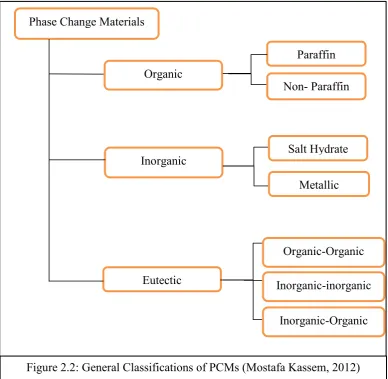
According to D. Buddhi (2009), a large number of PCM (organic, inorganic and eutectic) are available in any required temperature range. There are a large number of organic and inorganic chemical materials, which can be identified as PCM base on their melting temperature and latent heat of fusion. Figure 2.2 shows the general classifications of PCMs.
2.1.2 Organic PCMs
Organic materials are further divided into paraffin and non-paraffin. Paraffins exhibit congruent melting which means they melt and freeze repeatedly without phase segregation and consequent reduction of
Phase Change Materials
Organic
Inorganic
[image:24.595.152.541.227.606.2]Eutectic
Figure 2.2: General Classifications of PCMs (Mostafa Kassem, 2012) Metallic Salt Hydrate
Organic-Organic
Inorganic-inorganic
Inorganic-Organic Paraffin