Al-Hanafy, Waleed and Weiss, S. (2009) Sum-rate maximisation comparison using incremental approaches with different constraints. In: The Third Mosharaka International Conference on Communications, Computers and Applications (MIC-CCA2009) , October 2009, Amman, Jordan.
http://strathprints.strath.ac.uk/27155/
Strathprints is designed to allow users to access the research output of the University of Strathclyde. Copyright © and Moral Rights for the papers on this site are retained by the individual authors and/or other copyright owners. You may not engage in further
distribution of the material for any profitmaking activities or any commercial gain. You may freely distribute both the url (http://strathprints.strath.ac.uk) and the content of this paper for research or study, educational, or not-for-profit purposes without prior
permission or charge. You may freely distribute the url (http://strathprints.strath.ac.uk) of the Strathprints website.
Sum-Rate Maximisation Comparison using Incremental Approaches with
Different Constraints
Waleed Al-Hanafy?‡ and Stephan Weiss?
? Centre for Excellence in Signal & Image Processing, Dept. of EEE, Univ. of Strathclyde, Glasgow, Scotland, UK ‡ Electronics & Comm. Eng. Dept., Faculty of Electronic Engineering, Menoufia Univ., Menouf, Egypt
Email:{waleed.alhanafy, stephan.weiss}@eee.strath.ac.uk
Abstract—In this work, the problem of rate maximisation of multichannel systems is consi-dered. Two greedy allocation approaches using power (GPA) and bit (GBA) loading schemes with a slight difference in design constraints that aiming to maximise the overall system throughput are compared. Both algorithms use incremental bit loading whereby, the GPA is designed with main interest of efficient power utilisation. Whereas, the GBA sacrifices power utilisation to another design issue of achieving an average bit error ratio (BER) less than the target BER. Simulation results shows that with GPA algorithm better throughput is gained over the GBA algorithm while the latter guaranteed less BER.
Index Terms—Incremental bit-loading, power allocation, waterfilling algorithms, constrained op-timisation, greedy algorithms.
I. INTRODUCTION
Adaptation of transmission resources to chan-nel conditions in multichanchan-nel systems has been proved to significantly enhance the overall sys-tem performance provided that channel state information (CSI) is known to the transmitter [1], [2]. This includes the achievement of either higher data rates or lower power requirements under one or more practical/design constraints known respectively in the literature as rate
maxi-misation [3], [4], or margin maximaxi-misation [5],
[6]. Commonly, these multichannels arise for multicarrier systems (e.g., OFDM) by converting the frequency-selective channel into a number of narrowband subchannels and for MIMO systems by using singular value decomposition (SVD), the later is the interest of this paper. In both cases we result in a number of subchannels with
different gains over which a reliable commu-nication is aimed. The parameters to be consi-dered in such loading problems are: data rate, bit error ratio (BER) and total transmit power. The sum-rate of a multichannel system with different subchannel gains is of particular interest from the system design point of view which can be optimised using power and/or bit loading schemes.
Research for power and bit allocation pro-blems is usually considering closed form ex-pressions for either channel capacity [3], [7] or probability of bit error [8], [9]. Alternati-vely, incremental (greedy) approaches optimising sum-rate using power [10] and bit [11] loading schemes achieve higher rate at the expense of computational complexity.
In this paper, the sum-rate maximisation is considered using both power and bit loading schemes. Two different greedy approaches are examined and compared, both are trying to maximise the overall system rate with the same set of constraints. However, one of these algo-rithms considers greedy power allocation (GPA) that achieves only the desirable target BER and therefore would save some unused power from the available transmit power budget. The other algorithm uses the greedy approach but with bit loading (power is uniform distributed among all subchannels) and with the main concern of achieving an average BER not to exceed the target BER, we call this algorithm: greedy bit allocation (GBA).
Sec. III. Simulation results to these solutions are evaluated and discussed in Sec. IV, whereby a number of conclusions are drawn in Sec. V.
II. PROBLEMFORMALISATION
We consider the problem of maximising the sum-rate of a narrowband MIMO system charac-terised by a NR×NT channel matrix H under
the constraints of
1) a fixed total transmit power budget
Pbudget,
2) a specified target BER Pbtarget, and a square-QAM modulation scheme
Mk=
2bk, 1≤k≤K
0, k= 0 , (1)
where the maximum constellation
size MK = 2b
max
, with bk ∈
{0,2,4,· · ·, bmax}, is limited.
By means of a SVD, the channel matrix Hcan be decoupled into N independent subchannels with gains of descending order σ2
i,1 ≤i≤ N,
where N = rank (H) ≤ min(NR, NT) and σi are the singular values of H. This maximisation can be defined by the optimisation problem
max
N X
i=1
bi, (2)
subjected to the constraints
N X
i=1
Pi≤Pbudget and Pb =Pbtarget (2a)
or
N X
i=1
Pi =Pbudget and Pb ≤ Pbtarget, (2b)
wherebi andPi are, respectively, the number of
bits and amount of power allocated to the ith subchannel. The average system BER is defined as
Pb = PN
i=1biPb,i PN
i=1bi
(3)
with Pb,i being the BER of the ith subchannel.
The aim of this paper is to explore the effect of these two different constraints on the overall data rate by using greedy algorithms that perform power or bit allocation , respectively.
The channel-to-noise ratio of theith subchan-nel is given by
CNRi = σ
2
i N0
, (4)
while its signal-to-noise is
γi=Pi×CNRi. (5)
Closed form expressions and solutions of the sum-rate in (2) are extensively considered in the literature — see for example [12], [6] for a review — based on the concept of the SNR-gap [13] as
bi = log2
1 +Pi×CNRi Γ
, (6)
where Γ denotes the SNR-gap that signifies the loss in SNR of a particular transmission scheme when compared to the theoretical channel capa-city. For QAM modulation schemes, this SNR-gap is given by
Γ = 1 3
Q−1
Ps,i
4 2
, (7)
where Q−1 is the inverse of the well-known Q
-function Q(x) = √1 2π
´∞
x e−u
2/2
du, and Ps,i is
the symbol error rate (SER) of theith subchan-nel. It is clear from (7) that Γ is not fixed for all subchannel but depends on the subchannel SER, which in turn depends onbi andγi of (6).
This dependence has to be taken into account whenever the rate or the gain in (6) is changed. Nevertheless, the system’s operation is in fixed at very low BER — typically 10−6 — and higher
QAM levels which is not usually the case for realistic applications [4].
Moreover, direct optimisation of (6) with the constraints in (2a) or (2b) under considerations leads to the well-know waterfilling solution [14]. However, the resultant bit allocation obtained by the waterfilling is real valued and requires roun-ding off to the nearest integer value. This quan-tisation leads to an overall loss in performance. Alternatively and more accurately, greedy ap-proaches [5], [15], [16] have been proven optimal in this sense [17].
For a certain BER
where
Ps,i= 1− "
1−2
1−√1 Mk
Q
r
3γi
Mk−1 !#2
(8b)
is the SER for the rectangular QAM modula-tion [18], the ith subchannel can carry bi bits
per symbols. The word length bi = log2Mk
is drawn from the QAM constellation of size
Mk,1 ≤ k ≤ K with the minimum required
SNR γi obtained from (8b) and (8a) as [19]
γkQAM=
Mk−1
3
"
Q−1 1−
√
1− Pblog2Mk
2 1−1/√Mk
!#2
.
(9)
III. BITLOADING WITHDIFFERENT
CONSTRAINTS
Expression (9) is of particular interest in im-plementing the GPA algorithm, as it returns the minimum required allocated power (γ
QAM
k
CNRi) for a certain subchannel withCNRi to be loaded with
a square QAM modulation scheme of constel-lation size Mk to achieve a target BER Pb.
Therefore optimality is guaranteed in terms of saving power [10]. In the case of GBA algo-rithm, (8a) and (8b) represent the core issue for this algorithm. Note that different from GPA algorithm, GBA algorithm proceeds with the optimal strategy of avoiding the worst bit-loading that violates the condition of Pbtarget, similar to the algorithm of [11]. As (9), (8a), and (8b) are deduced from each other, a fair comparison between GPA and GBA algorithms would be expected. The difference between the algorithms lies in the strategy of optimality considered by each of them as highlighted in this paragraph.
In turn, we will provide details of the algorith-mic steps for both GPA and GBA algorithms.
A. Greedy Power Allocation (GPA) Algorithm:
In this algorithm, the sum-rate of a MIMO system with a target BERPb=Pbtarget is
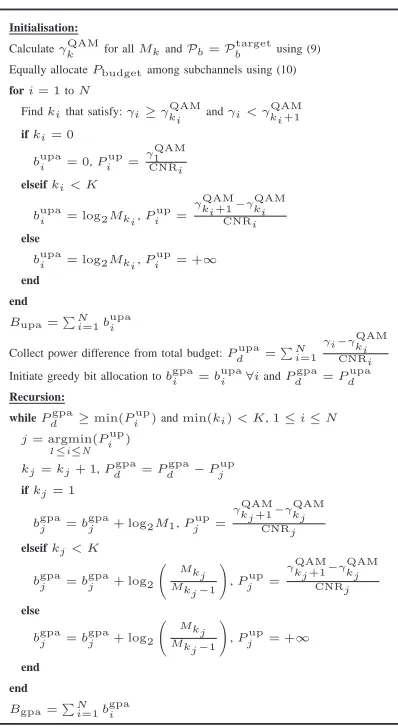
maxi-mised subjected to the constraints in (2a). The GPA algorithm achieves optimality by finding, at each iteration, the subchannel of minimum re-quired power to upgrade to the next QAM level. The initialisation procedures is done using the uniform power allocation (UPA) arrangements (the initialisation part of Table I), whereby sub-channels are resided into QAM levels according
to their SNRs γi,1 ≤ i ≤ N and a uniform
power allocation across all subchannels
γi =
Pbudget
N ×CNRi. (10)
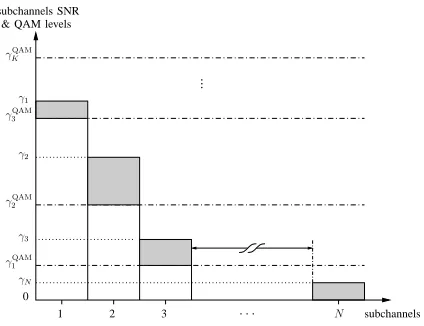
The procedures of the GPA algorithm with the UPA initialisation is illustrated by Fig. 1 and given completely in Table I. The algorithm starts with loading subchannels with bits to the nearest QAM level that is just less in power than the subchannel SNRs. Then extra power difference from Pbudget, Pdupa is collected and
iteratively allocated to subchannels that do not yet reach their maximum allowable QAM level
MK = 2b
max
. The sum-rate of this algorithm
Bgpaand its final power difference fromPbudget,
Pdgpa, are evaluated. The usage power of both UPA and GPA algorithms are therefore
Pusedupa =Pbudget−Pdupa, (11a)
and Pusedgpa =Pbudget−Pdgpa, (11b)
this is a useful measure of how efficient, in terms of power utilisation, both algorithms are. Note that this quantity is not defined for the GBA algorithm as it uses, by definition, the total power budget.
subchannels SNR
subchannels
1 2 3 N
& QAM levels
γQAMK
γQAM 3
γQAM2
γQAM 1
γ1
γ2
γN γ3
0
...
[image:4.612.326.538.434.597.2]· · ·
Figure 1: Subchannels residing into QAM levels according to their SNRs and UPA
B. Greedy Bit Allocation (GBA) Algorithm:
Table I: Bit Loading using UPA and GPA -Constraint (2a)
Initialisation:
CalculateγQAMk for allMkandPb=Pbtargetusing (9)
Equally allocatePbudgetamong subchannels using (10)
fori= 1toN
Findkithat satisfy:γi≥γkiQAMandγi< γkiQAM+1
ifki= 0
bupai = 0,Piup=γ QAM 1 CNRi
elseifki< K
bupai = log2Mki,Piup=
γQAM
ki+1−γ
QAM
ki
CNRi
else
bupai = log2Mki,Piup= +∞ end
end
Bupa=PNi=1b upa
i
Collect power difference from total budget:Pdupa=PN
i=1
γi−γQAM
ki
CNRi
Initiate greedy bit allocation tobgpai =bupai ∀iandPdgpa=Pdupa
Recursion:
whilePdgpa≥min(Piup)andmin(ki)< K,1≤i≤N
j= argmin
1≤i≤N
(Piup)
kj=kj+ 1,Pdgpa=P
gpa
d −P
up
j
ifkj= 1
bgpaj =bgpaj + log2M1,Pjup=
γQAM
kj+1−γ
QAM
kj
CNRj
elseifkj< K
bgpaj =bgpaj + log2
Mkj
Mkj−1
!
,Pjup=
γQAM
kj+1−γ
QAM
kj
CNRj
else
bgpaj =bgpaj + log2
Mkj
Mkj−1
!
,Pjup= +∞
end
end
Bgpa=PNi=1b gpa
i
to maximise the sum-rate of a MIMO system with fully utilisation of the total transmit power budget PN
i=1Pi = Pbudget and achieving an
average BER not to exceed the target BER
Pb ≤ Pbtarget as the constraints in (2b). This
algorithm starts with loading all subchannels to bits of the maximum allowable QAM level, i.e.
bmax, then computes the average BER for all
subchannels using (3). Thereafter, the algorithm proceeds with the bit removal approach [15] tied up by keeping the average BER less than or equal to the target BER.
The approach of this algorithm is different from that of the GPA algorithm in the sense that the overall available transmit power budget is completely utilised and the sum-rate maximi-sation is therefore being sought, at each
algo-rithmic iteration, by removing the bits with the highest degradation impact on the the average BER Pb. In section IV the performance of the
overall bit rate of this algorithmBgbais
[image:5.612.328.533.225.529.2]compa-red with that of GPA and UPA algorithms and some useful comments and discussion of both GPA and GBA algorithms are highlighted which clarify system design requirements issues.
Table II: Bit Loading using GBA - Constraint (2b)
Initialisation:
Calculateγifor all subchannels with upa (Pi=PbudgetN ) using (5)
Load all subchannels withMK, i.e.,ki=Kandbgbai = log2MK ∀i
CalculatePb,ifor all subchannels1≤i≤Nusing (8a) and (8b)
Pb=
PN
i=1Pb,i
N ifPb≤ Pbtarget
Maintain current loading
else
Recursion:
whilePb>Pbtarget
j= argmax 1≤i≤N
Pb,i
kj=kj−1
ifkj≥1
bgbaj =bgbaj −log2
Mkj+1
Mkj
!
Re-calculatePb,jwithγjandMkjusing (8a) and (8b) UpdatePbusing (3)
else
bgbaj = 0,Pb,j= 0
UpdatePbusing (3)
ifP
jb
gba
j = 0
Pb= 0 end
end
end
end
Bgba=PNi=1b gba
i
IV. SIMULATIONRESULTS
Computer simulations are conducted to inves-tigate the performance of both GPA and GBA algorithms. A 4x4 MIMO system of frequency-flat channel H ∈ CNR×NT with entries h
ij ∈ CN(0,1) and bmax is set to 8 bits. It is shown
from the sum-rate results for aPbtarget= 10−3in
is inefficient power allocation scheme, therefore, wasting power for unnecessary improvement of the average BER Pb < Pbtarget. On the other
hand, the GPA algorithm is efficiently utilise the total power budget Pbudget (power is allocated
according to the greedy approach) to maximise the overall throughput while achieving BER to its maximum requirements, Pbtarget. This means better investment of the total power towards the rate maximisation problem.
0 10 20 30 40 50 60
0 5 10 15 20 25 30 35
SNR [dB]
Throughput [bits/symbol]
B
upa
B
gpa
B
[image:6.612.334.536.79.234.2]gba
Figure 2: Sum-rate results for a 4x4 MIMO
system withPbtarget =10−
3
[image:6.612.84.286.229.380.2]and varying SNR
Fig. 3 shows the throughput versus target BER at SNR=30 dB, intuitively, throughput is increasing with the increase of target BER. The GPA algorithm outperforms its GBA counterpart by more than 2 bits for a Pbtarget of 10−7
and thereafter the improvement is decreasing with further increasing of Pbtarget. In Fig. 4, the power utilisation of UPA and GPA algorithms is compared, which shows better performance of GPA over UPA algorithm. Note that GBA algorithm (shown as the Pbudget curve) cannot
be compared here as it spends the total po-wer budget getting improvement in the achieved average BER as shown in Fig. 5. Once the throughput reaches its expected maximum of
4(subchannel)×8(bits) = 32(bits), extra power is no longer required. Therefore, the effective used power for both UPA and GPA algorithms in (11a) and (11b), respectively, starts to sa-turate to the minimum power that is required to achieve the maximum bit-loading bmax for
10−7 10−6 10−5 10−4 10−3
19 20 21 22 23 24 25 26 27
BER
Throughput [bits/symbol]
B
upa
B
gpa
B
gba
Figure 3: Sum-rate results for a 4x4 MIMO
system at SNR = 30 dB and varying Pbtarget
all subchannels, i.e., P i
γQAM
K
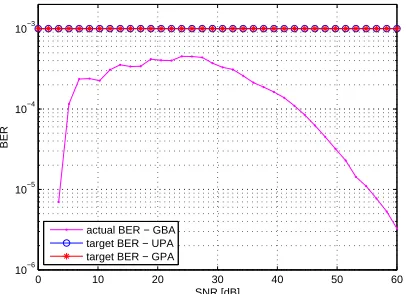
CNRi which is found to be ≈ 45.94 dB (shown in Fig. 4 by the dashed line). Fig. 5 shows the actual achieved BER of the GBA algorithm, which is less than the target BER. Again both the UPA and GPA algorithms cannot be compared in this results as they both achieve only the target BER (shown as
Pbtarget= 10−3).
0 10 20 30 40 50 60
100 101 102 103 104 105 106
SNR [dB]
Pbudget
/N
0
Pupa used
Pgpa
used
Pgba
used = Pbudget
Figure 4: Power utilisation of UPA and GPA algorithms - constraint (2a)
[image:6.612.332.535.425.578.2]0 10 20 30 40 50 60 10−6
10−5 10−4 10−3
SNR [dB]
BER
[image:7.612.83.286.82.229.2]actual BER − GBA target BER − UPA target BER − GPA
Figure 5: Actual BER of GBA algorithm -constraints (2b)
GBA would be the right algorithm as it always achieves Pb <Pbtarget as shown in Fig. 5.
V. CONCLUSIONS
Rate maximisation using greedy power GPA and bit GBA allocation schemes with different constraints is considered. Both algorithms share the main target of optimising the overall system throughput. GPA algorithm tackles this from the efficient power utilisation point of view keeping the target BER to its maximum requirements. While GBA algorithm guarantees less average BER than target BER. This can be thought, respectively, as a conversion between achieving higher system throughput with target BER or at-taining higher quality of service in terms of BER with some degradation in throughput, which is useful in design selection of systems with parti-cular interests.
REFERENCES
[1] I. E. Telatar, “Capacity of Multi-antenna Gaussian Channels,” European Transactions on Telecommuni-cations, vol. 10, no. 6, pp. 585–595, December 1999. [2] A. Goldsmith, S. Jafar, N. Jindal, and S. Vishwanath, “Capacity limits of MIMO channels,” Selected Areas in Communications, IEEE Journal on, vol. 21, no. 5, pp. 684–702, June 2003.
[3] A. Leke and J. M. Cioffi, “A Maximum Rate Loa-ding Algorithm for Discrete Multitone Modulation Systems,” in IEEE Global Telecommunications Confe-rence, GLOBECOM ’97, vol. 3, Phoenix, AZ, USA, November 1997, pp. 1514–1518.
[4] X. Zhang and B. Ottersten, “Power Allocation and Bit Loading for Spatial Multiplexing in MIMO Sys-tems,” in IEEE International Conference on Acoustics, Speech, and Signal Processing, (ICASSP ’03), vol. 5, April 2003, pp. V–53–56.
[5] J. Campello, “Practical bit loading for DMT,” in Com-munications, 1999. ICC ’99. 1999 IEEE International Conference on, vol. 2, 1999, pp. 801–805 vol.2. [6] N. Papandreou and T. Antonakopoulos, “Bit and
Po-wer Allocation in Constrained Multicarrier Systems: The Single-User Case,” EURASIP Journal on Ad-vances in Signal Processing, vol. 2008, pp. 1–14, 2008.
[7] D. Palomar and J. Fonollosa, “Practical Algorithms for a Family of Waterfilling Solutions,” IEEE Tran-sactions on Signal Processing, vol. 53, no. 2, pp. 686– 695, Feb 2005.
[8] R. Fischer and J. Huber, “A New Loading Algorithm for Discrete Multitone Transmission,” in Global Tele-communications Conference, GLOBECOM ’96, vol. 1, London, November 1996, pp. 724–728.
[9] H. Rohling and C. Fellenberg, “Successive bit loading scheme,” Electronics Letters, vol. 45, no. 4, pp. 214– 216, 12 2009.
[10] L. Zeng, S. McGrath, and E. Cano, “Rate Maximiza-tion for Multiband OFDM Ultra Wideband Systems Using Adaptive Power and Bit Loading Algorithm,” in IEEE Fifth Advanced International Conference Telecommunications, AICT ’09, Venice/Mestre, Italy, May 2009, pp. 369–374.
[11] A. M. Wyglinski, F. Labeau, and P. Kabal, “Bit Loading with BER-Constraint for Multicarrier Sys-tems,” IEEE Transactions on Wireless Communica-tions, vol. 4, no. 4, pp. 1383–1387, July 2005. [12] E. Baccarelli, A. Fasano, and M. Biagi, “Novel
Efficient Bit-Loading Algorithms for Peak-Energy-Limited ADSL-Type Multicarrier Systems,” IEEE Transactions on Signal Processing, vol. 50, no. 5, pp. 1237–1247, May 2002.
[13] J. M. Cioffi, “A Multicarrier Primer,” ANSI Contribu-tion T1E1.4/91-157, Clearfield, Fla, USA, Tech. Rep., 1991.
[14] B. Krongold, K. Ramchandran, and D. Jones, “Com-putationally efficient optimal power allocation algo-rithms for multicarrier communication systems,” IEEE Transactions on Communications, vol. 48, no. 1, pp. 23–27, Jan 2000.
[15] R. Sonalkar and R. Shively, “An efficient bit-loading algorithm for DMT applications,” IEEE Communica-tions Letters, vol. 4, no. 3, pp. 80–82, Mar 2000. [16] C. Assimakopoulos and F.-N. Pavlidou, “New bit
loading algorithms for DMT systems based on the greedy approach,” Wireless Communications and Mo-bile Computing, vol. 6, no. 8, pp. 1047–1056, 2006. [17] J. Campello, “Optimal Discrete Bit Loading for
Mul-ticarrier Modulation Systems,” in IEEE International Symposium on Information Theory, Aug 1998, p. 193. [18] J. G. Proakis, Digital Communications, 3rd ed. New
York: McGraw-Hill, 1995.