Rochester Institute of Technology
RIT Scholar Works
Theses
Thesis/Dissertation Collections
11-1-2010
Framework for optimizing intelligence collection
requirements
Khiem Tong
Follow this and additional works at:
http://scholarworks.rit.edu/theses
This Thesis is brought to you for free and open access by the Thesis/Dissertation Collections at RIT Scholar Works. It has been accepted for inclusion in Theses by an authorized administrator of RIT Scholar Works. For more information, please [email protected].
Recommended Citation
Framework for Optimizing Intelligence Collection Requirements
by
Khiem Duy Tong
A Thesis Submitted in Partial Fulfillment of the Requirements for the Degree of Master of Science in Computer Engineering
Supervised by
Rochester Institute of Technology Dr. Shancieh Jay Yang Department of Computer Engineering
Kate Gleason College of Engineering Rochester Institute of Technology
Rochester, New York November 2010
Approved By:
Dr. Shancieh Jay Yang
Rochester Institute of Technology Primary Adviser
Dr. Moises Sudit University at Buffalo
Dr. Andres Kwasinski
Thesis Release Permission Form
Rochester Institute of Technology Kate Gleason College of Engineering
Title: Framework for Optimizing Intelligence Collection Requirements
I, Khiem Duy Tong, hereby grant permission to the Wallace Memorial Library to reproduce my
thesis in whole or in part.
Khiem Duy Tong
Dedication
Acknowledgments
I would like to express my gratitude to Dr. Shanchieh Jay Yang for his mentorship, without whose
help and inspiration I would never have finished this work.
I would like to thank Dr. Moises Sudit, Dr. Andres Kwasinski, and Jared Holsopple for their
valuable advice.
Lastly I would like to acknowledge CUBRC and AFRL for providing the financial funding needed
Glossary
A
AOI Area of Interest, p. 7.
C
COA Course of Action, sequence of actions that can be performed, p. 1.
CRAs Collection Requirement Actions, actions that are performed to collect intelligence, p. 2.
D
decision support model, tools, or processes which can aid effective decision making, p. 1.
DM Decision Maker, individual with responsibility of making decisions in an operation or
mission, p. 1.
DSS Decision Support System, systems which model, analyze, or visualize information to
aid effective decision making, p. 1.
G
GUI Graphical User Interface, p. 12.
J
JIPOE Joint Intelligence Preparation of the Operational Environment, analytical process used
P
PF Plausible Future, any event or set of events that could occur in future as anticipated by
Abstract
In the military, typical mission execution goes through cycles of intelligence collection and action
planning phases. For complex operations where many parameters affect the outcomes of the
mis-sion, several steps may be taken for intelligence collection before the optimal Course of Action is
actually carried out. Human analytics suggests the steps of: (1) anticipating plausible futures, (2)
determining information requirements, and (3) optimize the choice of feasible and cost-effective
intelligence requirements. This work formalizes this process by developing a decision support tool
to determine information requirements needed to differentiate critical plausible futures, and
formu-lating a mixed integer programming problem to trade-off the feasibility and benefits of intelligence
collection requirements.
Course of Action planning has been widely studied in the military domain, but mostly in an
abstract fashion. Intelligence collection, while intuitively aiming at reducing uncertainties, should
ultimately produce optimal outcomes for mission success. Building on previous efforts, this work
studies the effect of plausible futures estimated based on current adversary activities. A set of
differentiating event attributes are derived for each set of high impact futures, forming a candidate
collection requirement action. The candidate collection requirement actions are then used as inputs
to a MIP formulation, which optimizes the plausible future mission state subject to timing and
cost constraints. The plausible future mission state is estimated by assuming that the CRAs can
potentially avert the damages adversary future activities might cause. A case study was performed
Contents
Dedication . . . . iii
Acknowledgments . . . . iv
Glossary . . . . v
Abstract . . . . vii
1 Introduction. . . . 1
2 Understanding the Problem . . . . 3
2.1 Generalized Information Flow Model . . . 3
2.2 Analytical Processes . . . 6
2.3 Automated Tools . . . 8
2.3.1 INFERD . . . 8
2.3.2 FuSIA . . . 9
2.4 Subjective Assessments and Hierarchal Modeling of Missions . . . 10
2.5 Problem in Perspective . . . 12
3 Intelligence Collection Framework. . . . 14
3.1 Determining CRAs from Plausible Futures . . . 17
3.1.1 Identification of critical plausible futures . . . 21
3.1.2 Analysis of plausible futures using attributes . . . 24
3.1.3 Ranking plausible futures . . . 24
3.2 Evaluating Mission Impact Using CRA Matrices . . . 26
3.3 Aggregation Functions . . . 28
3.3.1 Ordered Weighted Average . . . 29
3.4 Optimization Formulation . . . 29
3.4.1 Logical Constraints . . . 31
4 Case Study . . . . 36
4.1 Scenario: Hostage Rescue . . . 36
4.2 Results . . . 42
4.3 Limitations . . . 42
5 Conclusion and Future Work. . . . 45
5.1 Future Work . . . 45
5.1.1 Fully integrated decision support system . . . 45
5.1.2 Exploring feedback in collection requirements . . . 45
5.1.3 Generalizing framework to other domains . . . 46
List of Figures
2.1 Generalized informatin flow model [28] . . . 4
2.2 Decision state matrix [27] . . . 6
2.3 Effects Based Planning model . . . 10
2.4 Example cross impact matrix [19] . . . 11
3.1 Intelligence collection framework flow . . . 14
3.2 Example of gathering plausible futures from a database . . . 19
3.3 Plausible futures conversion tool . . . 20
3.4 Configuring and display of important attributes . . . 22
3.5 Determining which attributes affect plausible futures most . . . 23
3.6 Analysis of sets of plausible futures . . . 25
3.7 Ranking of plausible futures based on attributes . . . 26
3.8 Example CRA matrix . . . 26
3.9 Representing current and future asset states . . . 27
3.10 Mission hierarchy tree. . . 28
3.11 Gurobi implementation of logical max constraint . . . 33
4.1 Attribute-based analysis of plausible futures . . . 37
4.2 Future impact matrix . . . 38
List of Tables
3.1 Example plausible futures . . . 18
Chapter 1
Introduction
In the military domain, missions are defined to accomplish goals which can require complex
de-cisions. As a result decision making has been studied extensively in the military to establish
doc-trine [3, 7, 16]. The fundamental notion in these works is the iterative cycle of Course of Action
(COA) development, determination of which COA(s) to adopt, and implementation of COA(s) [23].
Intelligence collection plays a crucial role in all three fundamental phases; better intelligence
collection improves decision maker’s (DM’s) and analyst’s ability to develop and adopt effective
COAs. In turn, intelligence collection requires its own set of steps: (1) anticipating plausible futures
(PF), (2) determining information requirements, (3) optimizing collection based on feasibility and
cost-effectiveness.
These steps are not trivial and along with the need for intelligence collection at the
strate-gic, tactical, and operational level present a challenging problem for analysts [13]. The number
of parameters and expert knowledge required to effectively carry out intelligence collection
sug-gests the need for decision support. Decision support systems (DSS) are computerized tools which
provide decision support by supplying information that can reinforce and improve a DM’s
effec-tiveness [14, 17, 20]. DSS have been implemented in many different domains such as in supply
chains [2, 5], medicine [6], information fusion [15], and some existing military applications [14].
However, to properly offer decision support an understanding of the intelligence collection
process is required. Intelligence collection has been studied extensively as analytical processes.
Hutchinset al.[10] work on the Tactical Decision Making Under Stress (TADMUS) program cover
the principles that are needed for decision support with regards to navy ships operating in littoral
(coastline) regions of world. Where challenges such as closer proximity to enemies and swiftly
performed by humans in these military operations and subsequently discussed how decision support
and (human-system) interaction design could be used to reduce the cognitive requirement on a
deci-sion maker. It was found that DSS could not adequately replicate expertise gained from experience.
Since all contingencies in a situation cannot be anticipated, a human expert’s intuition is needed.
However, DSS can reduce search time for relevant information through graphical presentations, and
reduce amount of cognitive computation required for certain tasks. This project suggests that the
use of DSS can prove beneficial in a military context.
This research builds off previous works to develop a formal decision support framework for
intelligence collection. The framework is composed a decision support tool that determines
infor-mation requirements needed to differentiate between critical plausible futures and a mixed integer
programming (MIP) optimization formulation that can trade-off between the feasibility and benefits
of different intelligence requirements. In essence the the effort allows for analysts to differentiate
between plausible futures via attributes to craft candidate collection requirement actions (CRAs). A
set of optimal collection requirement actions are produced via the MIP formulation that can guide
Chapter 2
Understanding the Problem
Providing decision support for intelligence collection requires a thorough understanding of the
intel-ligence collection process. Several works were critical in building the foundation needed to properly
interpret the problem.
2.1
Generalized Information Flow Model
Yovitset al. [27, 28] work on the Generalized Information Flow Model acted as a starting point.
As shown in Figure 2.1, Yovits tries to capture the ability of a DM to learn and adapt over time.
Yovits’ model relies on three hypotheses: (1) information is data of value in decision-making, (2)
information gives rise to observable effects, and (3) information feedback exists so that the DM will
adjust his model for later decisions.
A fundamental idea in this model is that the two sources of information come from the
envi-ronment and from feedback based on observations of results from previous decisions (e.g. DM’s
experience). In this model, information is captured from the environment through a process called
Information Acquisition and Dissemination (IAD). This is simply the process by which sensors
capture data and this data is propagated to the analysts and DMs. This information is processed
and provided as input to the decision maker. The decision maker uses the information available
to choose a COA. The COA is executed and the results are observed. These results are compared
against anticipated results and transformed into data that can be used in a feedback loop at the IAD
stage. In this way the DM learns about how decisions and outcomes are related and can adjust
accordingly.
Environment
Information Acquisition and Dissemination (IAD)
Decision-Making Execution (E)
Transformation (T)
Environment
Observables Courses of
Action Information
[image:16.612.105.514.96.323.2]Data
Figure 2.1: Generalized informatin flow model [28]
from the information available to them (from the environment and experience). These two elements
are representative of the natural elements in human decision making: considering the current
en-vironment and anticipating future events. The generalized decision making process according to
Yovits is given below:
1. DM makes a decision (chooses a COA) on the basis of all information available.
2. DM predicts some probable outcomes.
3. A comparison is made between observed results and anticipated results (feedback).
4. Updates the model of the situation from results observed.
5. Return to step 1.
Yovits asserts that DMs will always try to fulfill two main objectives: choose the best COA
and learn as much as possible about the current situation. Yovits states that while classical decision
making maintains that DMs will always choose to prioritize the former, this is an
or wanting to learn more about the current situation. Thus, intelligence plays a critical role in the
mission planning process and selection of COAs.
Yovits also emphasizes the vital role of uncertainty in decision making and categorizes it into
three categories: (1) state of nature uncertainty, (2) executional uncertainty, and (3) goal
uncer-tainty. State of nature uncertainty is the result of uncontrollable external conditions that could
influence outcomes. Examples of state of nature include: weather, governmental regulation,
econ-omy, etc. Executional uncertainty refers to the unknowns arising from DMs identifying available
COAs (options) and outcomes of the COAs. Yovits asserts that the relationship between COAs and
outcomes are probabilistic and not deterministic (even with known state of nature). Finally goal
uncertainty arises from DMs having to consider outcomes and the influence they have on the end
goal. Intelligence collection can be seen as a way to resolve these uncertainties to reach end goals.
As part of this work, a matrix representation was used capture a DM’s decision state [28].
Figure 2.2 shows an example decision state matrix where am are COAs, on are outcomes, ωijk is
a probabilistic measure, andvk(on) are the effective values of the outcomes. Effective values are
defined as the rating of how much an outcome moves the situation towards a desired end goal.
The values of ω are subjective probabilistic measures that relate COAs to outcomes. Using this
representation allows a DM to accomplish their two main tasks of choosing the best COA and
learning about the situation. To choose the best COA a DM tries to maximize the sum of the
effective values of the outcomes. The DM can also use the matrix to learn more about the situation
by reviewing thewij values. This allows the DM to see which COA they are most uncertain about
(i.e.,those with lowwij values).
Llinas [12] builds off Yovits’ work to develop the conceptual idea of a mathematical
program-ming based optimization problem to model the decision making process. Llinas states that when
selecting a COA a DM is basically defining a task to be carried out. The next logical step requires
determining what kind of resources can be used to feasibly perform the tasks. Finally a DM must
select the best or optimal resource to perform the tasks. This leads to the idea of an optimization
problem. The outputs of this optimization problem are the resources that should be employed to
carry out the COA.
In summary, Yovits developed a generalized model for the decision making process and ways
Relative Values vk(o1 vk(o2) . . . vk(oj) . . . vk(on)
Outcomes o1 o2 . . . oj . . . on
Courses of action
a1 w11k wk12 . . . wk1j . . . wk1n a2 w21k wk22 . . . wk2j . . . wk2n
. . . .
. . . .
. . . .
ai wik1 wki2 . . . wkij . . . wkin
. . . .
. . . .
. . . .
[image:18.612.123.496.87.262.2]am wkm1 wmk2 . . . wmjk . . . wmnk
Figure 2.2: Decision state matrix [27]
is possible to use a mathematical programming based optimization problem to help achieve mission
success.
2.2
Analytical Processes
There is existing doctrine which define analytical approaches to the creation and selection of COAs
in the military domain. Previous efforts have also created automated tools that generate plausible
futures.
Joint Intelligence Preparation of the Operational Environment [16] (JIPOE) is a systematic
(structured) analytical process employed by the joint intelligence organizations. The operational
environment refers to the set of conditions, circumstances, and factors that can affect a decision
maker. The JIPOE process aims to provide a holistic view of the operational environment by
char-acterizing pertinent information with regards to air, land, maritime, space, and cyberspace domains.
The breadth and diversity of the domains require a large amount of subject matter expertise [16].
The analytical process will usually involve experts from several different agencies and allies
coop-erating together. There are four steps in the JIPOE process:
1. Define the operational environment,
2. Describe the impact of the operational environment,
4. Determine the adversary COAs
JIPOE is cyclical in nature and similar to Yovits’ model reflects how analysts must constantly
learn and adapt.
The first step in the JPIOE process is to define the operational environment [16]. The analysts
identify the operational area and the characteristics of the operational environment that are relevant
to the mission. They must keep the intent of the commander in mind to accomplish this. The analysts
must define the bounds of the areas of interest (AOI), both physical and non-physical. A trade-off
must be considered by analysts to determine what level of detail is needed and the amount of time
that is available to accomplish it. This step also involves the analyst figuring out the intelligence
gaps, priorities and shortfalls. As evidenced there are a large number of factors even within this
initial step. In step two of JPIOE the impact of the operational environment is described. This
involves considering all of the potential factors that could impact operations. For example how will
climate, weather, sociocultural, and other factors impact operations. Also in this step the analyst
must understand the relationships in the operational environment from a systems perspective, how
the elements are connected and what interactions they have.
In the third step of the JPIOE process the adversary must be evaluated [16]. This is a procedure
where the analysts must identify capabilities, limitations, doctrine, patterns of operation, tactics
and techniques of the adversary. This space is constrained by the factors identified in step two of
the process which reduces the possibilities based on the operational environment. Still it can be
seen that the considerations that an analyst must make are significant. An analyst must consider
adversary capabilities and define COAs that they can use to interfere with Blue’s (the friendly)
mission. 2 In the fourth step the adversary COAs are determined [16]. The holistic view that has
been built up through the previous steps is put to use and an understanding of the the adversary’s
intent and strategy is developed. The analysts identify what the adversary’s goal and objectives
are. The analyst must then consider and create the full set of adversary COAs. Once the set of
COAs have been created the analyst goes on to prioritize (rank) the COAs in order of probability
of adoption. Effectively predicting what the likely set of actions the adversary will take. Given the
amount of time that was determined in the previous step the analysts flesh out as much detail for
each COA as possible. Finally the analysts identify initial collection requirements. This is used to
adopted, effectively determining friendly (Blue) COAs.
JIPOE provides a doctrinal approach to mission planning that revolves around establishment
and selection of COAs. Intelligence collection provides the essential ingredient needed for success
in both phases.
Intelligence Preparation of the Battlefield (IPB) is another analytical process for threat
assess-ment, and understanding of the environment in a geographic area [3]. The main purpose of IPB is
similar to that of JPIOE as both are designed to support analyst and commander’s decision
mak-ing [3]. In essence IPB is the description of the effects of the battlefield and determination of the
threat’s COA to determine a friendlies best COA.
The main functions that are performed during IPB are essentially the same as those in JPIOE
except at a finer detail. They differ specifically in their focus, JPIOE is designed to help the
com-mander at the overall mission level whereas IPB and its finer degree of detail supports component
command operations. JPIOE and IPB can be used together however these two processes should not
overlap [16]. IPB can be extremely detailed, for example an individual soldier can informally
per-form IPB when he considers the possible actions of an enemy soldier he is about to engage. JPIOE
will usually be performed at a higher level.
2.3
Automated Tools
2.3.1 INFERD
INformation Fusion Engine for Real-time Decision-making (INFERD) is a stream based processing
system to update track estimates in real time as sensor messages are fed in as input [22]. The tracks
used in INFERD are semantic or contextual and not kinematic and can be viewed a grouping of
correlated events [22]. The system’s architecture was designed to function in different domains.
Two sets of inputs are provided as inputs for INFERD: a priori models, and runtime sensor data
(measurement). These inputs are used in an information flow consisting of:
1. Data Alignment
2. Connotation Elicitation
4. Track Update and Reporting
First sensor data from diverse sources are written to a database which is then read by INFERD.
The data then goes through Data Alignment, a preprocessing step to homogenize the data [22].
This is done through a wrapper which converts each type of sensor message into a common format
used by INFERD. Next in Connotation Elicitation, theSensor Messageis used to create anElicited
Message which is simply a Sensor Message with an additional Model Connotation Layer [22].
This is additional information generated using thea priorimodels provided to add more meaning
to the sensor data. This could be viewed as classifying messages based on their attributes into
categories. In the following step, Data Association, an estimate is made to determine which track
the measurement is a part of. In addition to this, how does the new measurement associate with the
existing track. The cardinality of the set of feasible tracks and elements that are produced by the
data association stage is used to decide which of three kinds of processing the Track Update module
takes [22]:
1. If an Elicited Message is not associated to any track, a new track is created.
2. If it’s associated with a single track, message is added to that track.
3. If associated to multiple tracks, a hyper track will be created and the possible predecessor
tracks are linked.
In essence, INFERD is an automated system which produces estimates of adversary activities
by correlating observations and usinga prioriknowledge.
2.3.2 FuSIA
Future Situation and Impact Awareness (FuSIA) [8] is a generalized threat assessment framework
applied specifically to cyber security that is able to estimate plausible presents and futures in a
de-fined environment. FuSIA is not a predictor of future events; plausible futures are simply generated
and assigned a rating.
FuSIA takes input in the form of attack tracks. The futures are generated using an ontology that
represents the relationships between objects and activities in the attack tracks. Three algorithms
aspects separately and then combines them to generate plausible futures. A plausibility score is
assigned for each generated future. The plausibility score that FuSIA generates is not a probability
[8]. Plausibility scores do not have to sum to one across all the possible generated futures and is
only a rating based on the current available evidence.
JIPOE, FuSIA, and INFERD provide stepping stones for formalizing the intelligence collection
process as a framework. They offer components that are needed to develop a DSS for intelligence
collection.
2.4
Subjective Assessments and Hierarchal Modeling of Missions
A2
A3 A1
A7 A6 A5 A4 SE2
SE3 SE1
SE5 SE4 DC1
[image:22.612.158.465.306.576.2]DC2 MES
Figure 2.3: Effects Based Planning model relating Military End State (MES), Decisive Conditions (DC), Supporting Effects (SE), and Actions (A) [18]
Schubert et al. [9, 18, 19] formulated a subjective assessment method for mission planning,
specifically in Effects Based Planning [21]. In EBP, a hierarchal plan is constructed relating Military
Figure 2.4: Example cross impact matrix [19]
shown in Figure 2.3. The Military End State is the desired end goal of the plan. A Decisive
Condition is a condition required for a transition between its phases. Supporting Effects are effects
that are associated with one or many DCs. Finally, Actions are activities needed to fulfill one or
many SEs. A CIM, as shown in Figure 2.4, is created in the initial planning process by subject
matter experts (SMEs) as required by the type of operation. These SMEs assess how each element
of the EBP process can affect each other, all the way up to the Military End State. In the CIM
approach only the direct first-order influences for each object (DC, SE, A) are considered. Objects
that are on the same level can influence each other bidirectionally while those on different levels are
limited to unidirectional influence. The idea of influences also leads to the idea of multiplicative
effects (sum of influences is greater than individual influence) which is not modeled in the CIM
approach. The values in the CIM denote the influence ranging from -9 (negative influence) to 9
(positive influence) and are assigned by the aforementioned SMEs. Analysis of the CIM can lead to
discovery of previously unseen synergies, alternatives, and conflicts [19].
A Collaborative Synchronization Management Tool (CSMT) was developed [9] which
by SMEs and display various views of the data via a graphical user interface. This simplifies the
analysis process by presenting the data within a graphical user interface (GUI)allowing easier
ma-nipulation and interaction. The views are displays of the results of processing on the data provided
by the user.
2.5
Problem in Perspective
In the military domain missions are carefully planned out and executed following a process which
revolves around the creation of both adversary and friendly COAs. Existing analytical processes
such as JIPOE [16] and IPB [3] define precise procedures for analysts and commanders to carry
out these tasks. Intelligence collection is vital to both of these activities and requires a prescribed
process itself. Due to the complexity of intelligence collection, decision support is desirable [10,
14, 15]. However, to provide proper decision support an understanding of the intelligence collection
process and its components is required.
Yovits’ [27, 28] and Llinas’ [12] showed that intelligence collection revolves around reducing
uncertainty. This is done by organizing collection requirements and performing collection activities.
Yovits provided a generalized model by which this could be done. The fundamental idea ind Yovits’
model is that information comes from two main sources, the environment and analyst experience.
This information provides DMs with the options available to them. Improved quality of information
provides a DM with more options and an improved ability to make better decisions. Llinas’ builds
off Yovits’ work and suggests that mathematical optimization could be used to find optimal sets of
actions to be performed to gather intelligence.
Thus, to provide decision support information sources that conform to the categories of
envi-ronmental information (collected by sensors) and experiential (analytical) information are needed.
JIPOE and IPB are analytical processes employed by the military and can provide the analytical
components needed. INFERD [22] and FuSIA [8] are automated tools developed previously that
process sensor data and can provide the type of environmental data required.
A model was needed in order to evaluate the influences of the data from the information sources.
Schubert’s work [9, 18, 19] formalized a subjective assessment method for mission planning. This
level factors could influence a mission. The use of a hierarchy required appropriate algebraic
repre-sentation and aggregation functions were found to be appropriate for combining influences as they
were propagated in the hierarchy [1].
This effort ties together these ideas with novel contributions to develop an intelligence collection
Chapter 3
Intelligence Collection Framework
The overall structure of the intelligence collection requirements framework is shown in Figure 3.1.
The framework is composed of two main components: a plausible futures tool, and an optimization
formulation. The plausible futures tool is an application that allows for attribute based analysis of
plausible futures. Candidate CRAs can be derived from such analysis. These CRAs are then used in
an MIP optimization formulation to select the best CRA by trading off feasibility and effectiveness.
The end result is an optimized set of CRAs that can be used to aid DMs in their decision making.
However there are several challenges that first need to be overcome:
• How can collection requirements be determined from plausible futures?
• How can the resulting collection requirements be represented so that they can be optimized?
• Implementing the optimization problem.
Before these challenges can be tackled an understanding of the intuition behind the framework
is required. This starts with understanding what exactly are plausible futures and CRAs.
Candidate CRAs
Optimized CRAs PF Analysis Tool
Plausible Futures
[image:26.612.145.478.561.620.2]Optimization
Figure 3.1: Intelligence collection framework flow
Plausible futures are likely adversary actions that can come from analytical processes such as
futures and COAs is that plausible futures is a loosely defined term that can refer to individual
actions or a generic set of actions whereas COAs strictly refer to a sequence of actions. Plausible
futures can be represented as a set of characteristic attributes that are domain dependent. For this
work the attributes used include:
1. ID
2. Name
3. Source
4. Target
5. Impact
A mission can be defined as a set of actions with associated assets that are responsible for their
completion [12]. These assets each have a current state which measures the ability of these assets
to complete a task. Consider i assets responsible for carrying out actions in a mission with the
relationship between assets and actions being defined by analysts. Acurrent impact matrix(Sc) can
be defined which associates theiassets with a current state as shown.
Sc= state
a1 0.0
a2 0.0
a3 0.0
a4 0.0
a5 0.0
Analysts can consider plausible futures each of which can impact the assets. The impact value
is a subjective measure ranging from 0.0 (no effect) to 1.0 (maximum effect) conveying how a
plausible future influences the health of assets. Consideriassets andj plausible futures, afuture
futures can be associated with different adversaries. Thus, the j columns can be associated any
combination of adversaries.
Sf =
p1 p2 p3 p4 p5
a1 0.1 0.0 0.0 0.3 0.15
a2 0.24 0.2 0.0 0.6 0.0
a3 0.33 0.0 0.0 0.73 0.0
a4 0.05 0.8 0.55 0.0 0.23
a5 0.9 .67 .34 0.8 0.0
A Collection Requirement Action (CRA) is an action that can be taken mitigate impact from
plausible futures. These actions are defined by analysts from domain knowledge. A CRA can be
defined as a binaryCRA matrix(CRAn(i, j)) which associates plausible futures to assets that they
affect. This allows for differentiation between candidate actions that can be taken as each action
will correspond to plausible future-asset pairs. There can be overlaps in plausible future-asset pairs
between CRAs. The monitoring state of plausible future-asset pairs across all selected CRAs is
aggregated to form a single matrix (α(i, j)), whereα(i, j) =max(CRAn(i, j)),∀i, j, n.
CRAn(i, j) =
p1 p2 p3 p4 p5
a1 0 0 0 0 0
a2 0 1 1 0 0
a3 0 0 0 0 0
a4 0 0 0 0 0
a5 0 0 0 0 0
During mission planning there may be a large number of candidate actions that can be taken.
For each asset there are multiple plausible futures that could influence its health. An aggregation
only have one state. If a CRA is taken (i.e. the action is selected and carried out as prescribed by
analysts) the influence on assets from a plausible future is considered mitigated. In effect the impact
from these CRAs are known and are accounted for in the health of the assets. The health of assets
in the future is a function of the aggregate from all plausible futures that have been accounted for
by CRAs as shown in Equation 3.1.
y(i) =AGGj(Sf(i, j)α(i, j)) +Sc(i)(1−maxj(α(i, j))),∀i, j (3.1)
In evaluating which CRA should be selected an analyst should consider which of the candidate
CRAs (if performed) would avert the most impact. Fundamentally the optimal CRA is the one
which can avert the most impact.
The following sections detail the inner workings of overall framework.
3.1
Determining CRAs from Plausible Futures
The overall flow of the framework begins with finding the differentiating attributes using the
plau-sible futures analysis tool. This process can be performed analytically by analysts without the aid
of any tool. However, a support tool is necessitated due to the possibly overwhelming number of
plausible futures. The purpose of the decision support tool is to provide a facility for viewing large
numbers of plausible futures efficiently and simplify the analyst’s task of identifying
differentiat-ing attributes to enable the creation of candidate CRAs. User interaction and insight is heavily
influenced by the GUI components of the tool, careful consideration was made to use appropriate
components and avoid common interface errors [4, 11].
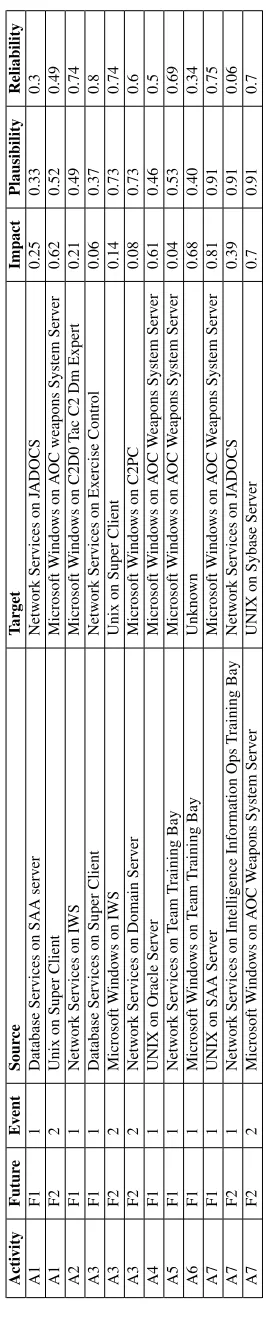
In implementation, plausible futures are stored in a MySQL database. Table 3.1 shows an
example set of plausible futures and how they are stored as rows of attributes in a relational database.
Figure 3.2 shows an example MySQL query for retrieving plausible futures. In essence the data is
gathered based on defined relationships and attributes. The plausible futures were organized using
the following hierarchy:
1. Activities
1 SELECT fact.id,
fact.activityid,
a1.name AS activityname,
fact.futureid, fact.eventid,
6 e1.name AS entityname,
e2.name AS targetentityname, e2.id,
e2.entitytypeid AS targetentitytypeid,
t1.TYPE AS typename,
11 fact.impact,
fact.reliability, fact.fused FROM entities e1,
entities e2,
16 entitytypes t1,
activities a1, (SELECT f.*
FROM futures f
INNER JOIN (SELECT activityid,
21 Max(eventid) AS maxeventid
FROM futures
GROUP BY activityid) groupedactid
ON f.activityid = groupedactid.activityid
AND f.eventid = groupedactid.maxeventid) AS fact
26 WHERE e1.id = fact.entityid
AND e2.id = fact.targetentityid AND a1.id = fact.activityid AND t1.id = e2.entitytypeid
ORDER BY fact.activityid,
31 fact.futureid,
[image:31.612.72.528.88.424.2]Field(typename, "Mission", "Submission", "Step", "Host", "HostCluster", "Application", "Service", "Version"), e1.name ASC;
Figure 3.2: Example of gathering plausible futures from a database
3. Events
Activities are groupings of related plausible futures, and events are discrete actions within
plau-sible futures.
One of the main design decisions was how to display plausible futures efficiently. A tree table
was the final design choice since the plausible futures were hierarchal in nature. Each of the
plausi-ble futures are associated with an activity which is the likely event that could occur. The individual
plausible futures for each activity are defined for individual targets along with an estimated impact
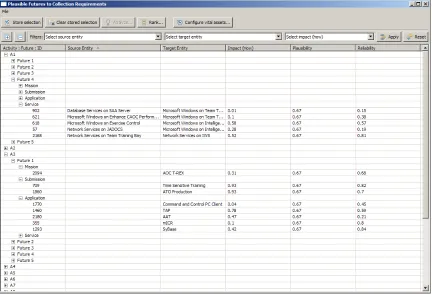
value. Figure 3.3 shows the main window of the tool. Since the plausible futures are stored as rows
in the database it made sense to translate this to the graphical interface as a tree table as well. The
ability to collapse and expand particular activities allows for analysts to focus either on individual
The key features of the decision support tool are: (1) identification of critical futures based on
attributes, (2) allows for analysis of plausible futures based on attributes, and (3) ability to rank of
plausible futures by criteria.
3.1.1 Identification of critical plausible futures
Analysts have insight into assets/entities in a mission which are critical to mission success. Critical
plausible futures are those which have attributes that involve these type of entities. Having these
critical futures emphasized draws an analysts attention and helps them to identify plausible futures.
Thus, the tool allows analysts to configure which assets they consider critical and subsequently
highlights them in the interface.
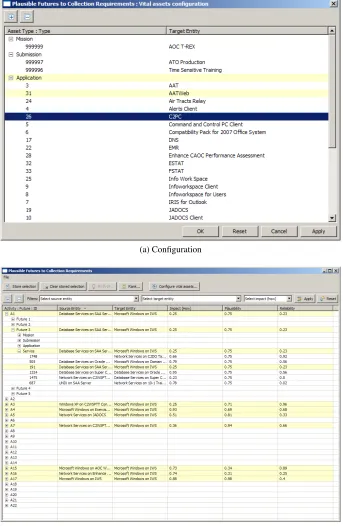
The analyst can configure what attribute (specifically target) they think are critical to the success
of the operation as seen in Figure 3.4a. This results in the plausible futures which involve this
attribute being highlighted in the GUI. This reduces the effort the analyst needs to spend identifying
plausible futures of interest as the number of plausible futures increases. They can spend a minimum
amount of time up front identifying the attributes that they consider vital and allow the tool to
identify the critical plausible futures for them. In implementation, this is accomplished by keeping
a list of vital attributes that are configured by the user in a singleton object. The singleton guarantees
that there is only ever one instance of the list. As the display of the plausible futures occurs each
attribute is checked against the list to determine whether it is critical plausible future or not. Figure
3.4b shows the vital attributes configuration reflected in the main window.
Since the display is tree based, data is also rolled up so that at the highest level the analyst
can see vital assets with maximum impact in the display as seen in Figure 3.4b. This functionality
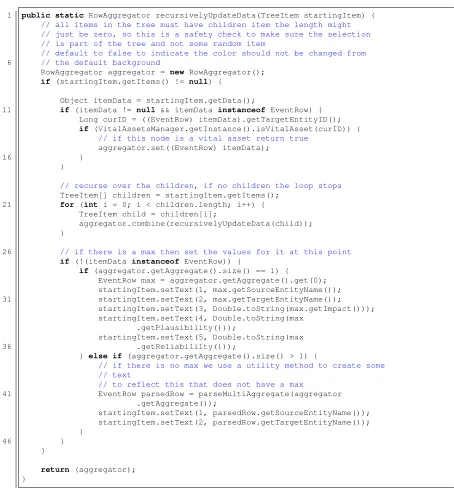
is implemented using the code seen in Figure 3.5. This code recursively traverses the complete
hierarchal tree of all plausible futures in the display and checks to see if each node is one which
involves a critical entity. A RowAggregator object is used to track the maximum values at each
level in the hierarchy. This object stores the current maximum impact value and as the traversal
occurs each node is checked and the maximum value is updated if a new max is found. This results
in the hierarchal rollup which shows the analyst at each level the maximum impact to a critical
asset (Figure 3.4b). The interface draws the analysts attention to certain plausible futures by both
(a) Configuration
[image:34.612.139.482.122.648.2](b) Display
1 public static RowAggregator recursivelyUpdateData(TreeItem startingItem) {
// all items in the tree must have children item the length might // just be zero, so this is a safety check to make sure the selection // is part of the tree and not some random item
// default to false to indicate the color should not be changed from
6 // the default background
RowAggregator aggregator = new RowAggregator(); if (startingItem.getItems() != null) {
Object itemData = startingItem.getData();
11 if (itemData != null && itemData instanceof EventRow) { Long curID = ((EventRow) itemData).getTargetEntityID(); if (VitalAssetsManager.getInstance().isVitalAsset(curID)) {
// if this node is a vital asset return true
aggregator.set((EventRow) itemData);
16 }
}
// recurse over the children, if no children the loop stops
TreeItem[] children = startingItem.getItems(); 21 for (int i = 0; i < children.length; i++) {
TreeItem child = children[i];
aggregator.combine(recursivelyUpdateData(child)); }
26 // if there is a max then set the values for it at this point
if (!(itemData instanceof EventRow)) {
if (aggregator.getAggregate().size() == 1) {
EventRow max = aggregator.getAggregate().get(0); startingItem.setText(1, max.getSourceEntityName());
31 startingItem.setText(2, max.getTargetEntityName());
startingItem.setText(3, Double.toString(max.getImpact())); startingItem.setText(4, Double.toString(max
.getPlausibility()));
startingItem.setText(5, Double.toString(max
36 .getReliabililty()));
} else if (aggregator.getAggregate().size() > 1) {
// if there is no max we use a utility method to create some // text
// to reflect this that does not have a max
41 EventRow parsedRow = parseMultiAggregate(aggregator
.getAggregate());
startingItem.setText(1, parsedRow.getSourceEntityName()); startingItem.setText(2, parsedRow.getTargetEntityName()); }
46 }
}
[image:35.612.72.526.133.621.2]return (aggregator); }
3.1.2 Analysis of plausible futures using attributes
Using the plausible futures tool, the user can also perform analysis for a select set of plausible
futures that they want to consider from the larger overall set. This allows for observations such as
overlaps in attributes between plausible futures. A possible benefit from this is that a single action
might suffice to mitigate the impact of multiple plausible futures if they share attributes.
Figure 3.6a displays the attribute selection screen that is displayed when analysis is performed
on a set of plausible futures. This panel shows all of the attributes related to the selected plausible
futures as well as the activities they belong to. When an analyst looks at the panel they can see which
attributes are shared between plausible futures by the labels beside each attribute. For example, it
can be seen that the target entity attribute‘Microsoft Windows on AOC Weapons System Server’is
involved in two plausible futures (1.5, 3.1). The highlight on‘Network Services on Enhance CAOC
Performance Assessment System Server’denotes that this target entity has previously been marked
as critical by the analyst which helps to draw attention.
The analyst selects attributes they are interested in and can monitor. This brings up a new dialog
as seen in Figure 3.6b, which displays the plausible futures that involve the selected attributes. Rows
highlighted in blue are plausible futures that were part of the initial set selected by the analyst. Gray
highlighted rows are other plausible futures that involve the selected attributes but were not part of
the initial set selected by the analysts. The results pane provides a complete set of plausible futures
that are effectively covered by CRAs performed on the selected attributes.
3.1.3 Ranking plausible futures
A ranking feature was also implemented so that analysts could view the top N ranked plausible
futures based on a specified criteria. The ranking of plausible futures provides another quick way
for analysts to identify important plausible futures. The criteria for the ranking is based on either
subjective assessments or algorithmically. The ranking panel also displays a column which identifies
other plausible futures (that are also ranked or not ranked) that share common attributes with the
ranked plausible future. This allows for analysts to easily identify important CRAs that could cover
multiple plausible futures resulting in more efficient CRAs.
Using the plausible futures tool an analyst can intelligently craft candidate CRAs such as shown
(a) Selection of attributes to compare
[image:37.612.118.506.107.297.2](b) Results of analysis
Figure 3.7: Ranking of plausible futures based on attributes
future influences an asset, which implicitly means that an action can be taken to mitigate the impact
from the plausible future.
3.2
Evaluating Mission Impact Using CRA Matrices
As previously state, a current impact matrixand a future impact matrixis used to represent the
state of assets. The current impact matrix is the current state of the assets, and future impact matrix
is the possible state of the assets if plausible futures occur. Actions (candidate actions) can be
p1 p2 p3 p4 p5
a1 0 0 0 0 1
a2 0 0 0 1 0
a3 0 1 0 0 0
a4 1 0 1 1 0
a5 1 0 0 1 0
[image:38.612.246.373.558.653.2] state
a1 0
a2 0
a3 0
a4 0
a5 0
(a) Current impact matrix
p1 p2 p3 p4 p5 a1 0.2 0.0 0.8 0.0 0.64 a2 0.5 0.0 0.0 0.89 0.55 a3 0.0 0.0 0.5 0.26 0.78 a4 0.0 0.98 0.0 0.8 0.0 a5 0.8 0.34 0.0 0.2 0.4
[image:39.612.188.431.101.208.2](b) Future impact matrix
Figure 3.9: Representing current and future asset states
performed to mitigate the impact from plausible futures, this mitigated impact can be viewed as
the benefit from performing the action. Optimization occurs on the premise of maximizing the
mitigated impact to the mission, not the difference in the states of the assets. The candidate actions
are represented algebraically as CRA matrices as shown in 3.8, which uses a binary value to show
whether a plausible future influences an asset or not.
So in essence, if a CRA is taken (carried out) than the impact from the plausible future is
accounted for and effectively replaces the current impact value in our consideration.
Equation (3.1) selects between the current impact value and a plausible future impact value
(Figure 3.9) based on a decision variable of whether or not a CRA was taken and therefore the impact
was mitigated. A mission model is used to propagate the low level impacts from this evaluation to
the overall mission.
The concept of a mission model has been seen in previous works such as Schubertet al. work
on CIMs and effect-based planning [9, 18, 19]. The framework defines a mission hierarchy (model)
based on an analyst’s expertise as shown in Figure 3.10. The analyst creates the hierarchya priori
to model the relationships and interactions from assets up to the overall mission. The mission
hierarchy defined by the framework does not consider influences by elements at the same level of
the hierarchy. The number of possible combinations of influences as well as their multiplicative
effects are difficult to take into account and thus not within the scope of this work.
The hierarchy is asset based, the assumption is that within any given mission ultimately the
assets allow for the mission to be accomplished by carrying out tasks [12]. The definition of an
asset is purposely loose for generalization purposes. An asset is any entity of value to the mission;
Task 1
+
+ Aggregation function
Task 2
+
Task 3
+
Task 4
+
Asset 1 Asset 2 Asset 3 Asset 4 Asset 5
Mission
[image:40.612.170.451.95.309.2]+
Figure 3.10: Mission hierarchy tree.
shows an the impact matrices which forms the lowest level of input for the mission hierarchy. Where
the impact values for each asset is a value from [0.0, 1.0] with 1.0 being the maximum impact and
0.0 being no impact. These values are also absolute and not a delta value and can be viewed as the
state of the asset.
3.3
Aggregation Functions
Forward propagation of impacts occurs via aggregation functions such as a weighted average or
Yager’s Ordered Weighted Average [24] [26] [25]. The use of a hierarchy necessitates the use
of functions that can produce representative values from a large number of inputs, aggregation
functions provide this utility. The different levels in a hierarchy can be viewed as progressively
becoming more complex as the number of entities each level encapsulates increases. Aggregation
functions facilitate this representation efficiently and selection of appropriate aggregation functions
to model relationships in a mission is a significant task.
Aggregation functions (operators) are simply functions with special properties [1]:
Definition 3.3.1. An aggregation function is a function of n > 1 arguments that maps the
(i) f(0,0, . . . ,0
| {z }
n times
) = 0andf(1,1, . . . ,1
| {z }
n times ) = 1
(ii) x≤yimpliesf(x)≤f(y)∀x, y∈[0,1]n
3.3.1 Ordered Weighted Average
An aggregation function of particular interest are Ordered Weighted Averages (OWA) [24–26] as
OWA can be used to represent different logical relationships. OWA is exactly the same as a simple
weighted average however the↘subscript indicates that inputs are first sorted in descending order.
This allows OWA to represent different relationships depending on how the weighting vector is
specified. This flexibility is desirable in a model as it simplifies implementation and allows analysts
to create different relationships efficiently.
Definition - Ordered Weighted Average. For a given weighting vector w, wi ≥ 0,∑wi = 1, the OWA function [1, 24] is given by
• OW Aw(x) = n
∑
i=1
wix(i)=⟨w,x↘⟩
wmax =
[
1 0 0 0 0
]
x↘=
[
5 4 3 2 1
]
wtop2=
[
0.5 0.5 0 0 0
]
x↘=
[
5 4 3 2 1
]
Since OWA can be used to formulate different relationships analysts can change the weights of
the function as parameters rather than using explicit logical functions.
3.4
Optimization Formulation
The final step in the framework is the ability to optimize the set of CRAs to select the best based on
Equation 3.3 defines a cost constraint which limits the amount of feasible CRAs that can be
taken based on resources available. Equation 3.4 is a timing constraint that limits which CRAs can
be taken based on turnaround time.
Variables
X(n) =
1, If CRAnis selected
0, o.w.
Amax(j) =whether plausible future j has maximum impact
Tmax(i) =whether asset i has maximum impact
Mmax(l) =whether task l has maximum impact
α(i, j) =
1, assetifor plausible futurejis monitored
0, o.w.
y(i) =aggregated impact on asseti
Dtask(l) =aggregated impact on taskl
Dm =aggregated impact on mission
Parameters
cn=cost of executingXn
tn=time alotted forXnto complete
T =max turnaround time
B =total budget
An(i, j) =monitored stated for asseti, plausible futurej
Sc(i) =current impact for asseti
Sf(i, j) =future impact for asseti, plausible futurej
Objective:
Subject to:
n
∑
i=1
Xn·ci ≤B (3.3)
Xn·tn≤T,∀n (3.4)
α(i, j)≥Xn·CRAn(i, j),∀i, j, n (3.5)
α(i, j)≤ n
∑
i=1
Xn·CRAn(i, j),∀i, j (3.6)
y(i) =maxj(Sf(i, j)α(i, j))
+Sc(i)(1−maxj(α(i, j))),∀i, j
(3.7)
i
∑
k=1
Tmax=i−1 (3.8)
y(i)≤Dtask(l),∀i, l (3.9)
Dtask(l)≤C·Tmax(l, i) +y(i),∀i, l (3.10)
l
∑
k=1
Mmax=l−1 (3.11)
Dtask(l)≤Dm,∀l, m (3.12)
Dm ≤C·Mmax(l) +Dtask(l),∀l, m (3.13)
The optimization formulation incorporates all of the ideas previously mentioned.
3.4.1 Logical Constraints
Logical constraints need to be algebraically formulated to be used in MIP solvers such as Gurobi.
j
∑
k=1
Amax=j−1 (3.14)
y(i, j)≤Dasset(i) (3.15)
Dasset(i)≤C·Amax(i, j) +y(i, j) (3.16)
Constraints 3.14, 3.15, 3.16 enforce a max relationship as the aggregation function for asset
damage. The following example illustrates the logic which create the max relationship.
IfAmaxis a matrix of binary decision variables (i.e.,values are bounded from 0 to 1).
A=
[
0 1 1 1 1
]
y(i, j) =
[
4 3 5 1 2
]
IfAhas a value of zero corresponding with four iny(i, j)then 3.15 is violated since 3.16 forces
Dassetto be four. In fact for all values except five this constraint is violated. WhenAhas a value
of zero corresponding with five, Dasset is bounded on top to be 5 and it is indeed greater than or
equal to all other elements which satisfies constraint 3.15. The constantCis just a sufficiently large
constant that should be much greater than all values iny(i, j). Since the values in the impact matrix
fall between zero and one, a value of one can be used as the constant. Due to computation concerns
the smallest value constant possible should always be used based on analysis of the inputs.
A logical mininum constraint can be constructed in a similar fashion by putting the binary
variable (in 3.16) to the lower bound and changing the addition to subtraction. So that the constraint
forces the minimum value to fixed only when.
j
∑
k=1
Amin =j−1 (3.17)
Dasset(i)≤y(i, j) (3.18)
// Constraint that ensures only one element in aMax // will be zero and all others are 1
//
// : sum(aMax_j) == n - 1
5 for (int i = 0; i < numAssets; i++) {
GRBLinExpr exprLHS = new GRBLinExpr(); for (int j = 0; j < numFutures; j++) {
exprLHS.addTerm(1.0, aMax[i][j]); }
10 model.addConstr(exprLHS, GRB.EQUAL, numFutures - 1, ""); }
// Ensures that the assetImpact is bounded on the bottom
for (int i = 0; i < numAssets; i++) {
15 GRBLinExpr exprRHS = new GRBLinExpr(); exprRHS.addTerm(1.0, assetImpact[i]);
for (int j = 0; j < numFutures; j++) {
GRBLinExpr exprLHS = new GRBLinExpr();
20 exprLHS.addTerm(1.0, y[i][j]);
model.addConstr(exprLHS, GRB.LESS_EQUAL, exprRHS, ""); }
} 25
// Ensures that the assetImpact is bounded from the top
for (int i = 0; i < numAssets; i++) {
GRBLinExpr exprLHS = new GRBLinExpr(); exprLHS.addTerm(1.0, assetImpact[i]); 30
for (int j = 0; j < numFutures; j++) {
GRBLinExpr exprRHS = new GRBLinExpr(); exprRHS.addTerm(1.0, y[i][j]);
exprRHS.addTerm(1000, aMax[i][j]);
35 model.addConstr(exprLHS, GRB.LESS_EQUAL, exprRHS, ""); }
[image:45.612.74.529.200.563.2]}
Figure 3.11 shows how logical constraints (in this case max) can be written in Gurobi. The
figure shows that writing constraints in a modeling package requires the use of for loops to replicate
the∀(i, j) condition. The model is represented as a single object and all variables are for defined
for this model. The model is solved via amodel.optimize()method call.
3.5
Implementation of Optimization Problem
After the set of CRAs have been determined and the mission hierarchy used to evaluate how these
CRAs impact the overall mission. The next logical step is to optimize and select a subset of the
CRAs based on the tradeoff of feasibility and cost-effectiveness. This problem was formulated as
a mixed integer programming problem based on the requirements of the inputs: the selection of
CRAs is binary and the evaluation of mission impact values is continuous.
There are many different optimization packages available for MIP problems. However, in
im-plementation the most important step is to start at the algebraic formulation to determine the
require-ments needed from the package chosen. From Chapter 3.4 the requirerequire-ments are that the package can
solve MIP type problems, and be able to handle a large number of constraints. The most well known
commercial solvers were considered: Lindo, CPLEX, Microsoft Solver Foundation. The problem
with selecting these packages are that they are expensive. Gurobi is a recently released optimization
package that is available commercially but also offers free academic licenses. These packages each
have different interfaces for creating the model. Lindo uses a modeling language called LINGO,
and CPLEX can be used with OPL. The modeling languages closely reflect algebraic formulations
and simplify the implementation of algebraic expressions. Alternatively, all packages have s which
allows for standard programming with languages such as Java, C++, C#, and Python. Gurobi was
selected as the package of choice due to easy access. Microsoft Excel also includes a Solver which
was used a simple alternative used for prototyping and smaller problems.
Algorithm 1Gurobi optimization problem setup create parameter matrices
model.create()
create and add decision variables to model define constraints
Figure 1 presents the basic flow for setting up an optimization problem in Gurobi. These
Chapter 4
Case Study
A case study was performed to evaluate the frame work. The case study emulated the processes an
analyst would perform using the framework to demonstrate its capabilities.
4.1
Scenario: Hostage Rescue
A hostage rescue scenario was considered involving a special forces team sent to rescue hostages
being held by a terrorist group. A helicopter is to be used for transporting the team and extracting
the team and rescued hostages.
Mission
A special forces team is sent to rescue a group of hostages being held by
terror-ists. The operation uses a helicopter for transport.
In planning the mission an analyst can anticipate the the following plausible futures.
Plausible Futures
The terrorists could acquire weapons to use against the special forces team (p1)
Terrorist scouts perform surveillance on friendly forces (p2)
Terrorist combatants utilize their intelligence on friendlies to lay an ambush (p3)
The terrorists decide to relocate the hostages (p4)
The terrorists decide execute the hostages (p5)
From the friendly analyst’s perspective the following assets are of interest to the overall mission
ID Plausible Future Source Target Impact
1 Acquire weapons Terrorists leadership Special forces 0.9
2 Acquire weapons Terrorists leadership Hostages 0.6
3 Acquire weapons Terrorists leadership Helicopter 0.8
4 Acquire weapons Terrorists leadership Landing site 0.55
5 Acquire weapons Terrorists leadership Friendly base 0.6
6 Surveillance Terrorist scouts Special forces 0.7
7 Surveillance Terrorists scouts Hostages 0.2
8 Surveillance Terrorists scouts Helicopter 0.55
9 Surveillance Terrorists scouts Landing site 0.75
. . . . .
. . . . .
. . . . .
(a) Plausible futures
ID Attribute name
1 Special forces
2 Hostages
3 Helicopter
4 Landing site
5 Friendly base
[image:49.612.98.535.97.296.2](b) Assets
Figure 4.1: Attribute-based analysis of plausible futures
Assets
Special forces team (a1)
Hostages (a2)
Helicopter (a3)
Landing site for helicopter (a4)
Friendly base (a5)
Finally, a set of tasks need to be accomplished to successfully complete the hostage rescue.
Tasks
Land safely in drop off zone (t1)
Secure terrorist base (t2)
Capture terrorists (t3)
Rescue hostages (t4)
Return to base (t5)
An analyst can arrive at estimated impacts of plausible futures to assets. These estimates can be
[image:49.612.233.385.335.459.2]derived from an analyst’s experience, intuition, and with the aid of automated tools.
Figure 4.2 shows the estimated future impacts from plausible futures. An analyst can arrive at
Acquire weapons Surveillance Ambush Relocate Execute
Special forces 0.9 0.7 0.85 0.6 0.3
Hostages 0.6 0.2 0.5 0.7 1
Helicopter 0.8 0.55 0.8 0.1 0.05
Landing site 0.55 0.75 0.9 0.15 0.05
Friendly base 0.6 0.5 0.2 0.3 0.05
[image:50.612.123.497.126.228.2]
Figure 4.2: Future impact matrix
p1 p2 p3 p4 p5
a1 0 0 0 0 0
a2 0 0 0 1 1
a3 0 0 0 0 0
a4 0 0 0 0 0
a5 0 0 0 0 0
(a)
p1 p2 p3 p4 p5
a1 1 0 0 0 0
a2 1 0 0 0 0
a3 1 0 0 0 0
a4 0 0 0 0 0
a5 0 0 0 0 0
(b)
p1 p2 p3 p4 p5
a1 0 1 0 0 0
a2 0 0 0 0 0
a3 0 0 0 0 0
a4 0 1 0 0 0
a5 0 1 0 0 0
(c)
p1 p2 p3 p4 p5
a1 0 0 0 1 0
a2 0 0 0 1 0
a3 0 0 0 0 0
a4 0 0 0 1 0
a5 0 0 0 0 0
(d)
p1 p2 p3 p4 p5
a1 0 0 1 0 0
a2 0 0 0 0 0
a3 0 0 1 0 0
a4 0 0 1 0 0
a5 0 0 0 0 0
(e)
[image:50.612.173.450.333.625.2]An analyst must then consider a set of collection requirement actions that are derived from
the plausible futures. The developed plausible futures tool facilitates this process. Figure 4.1(a)
shows example plausible futures as well as their corresponding attributes. From the analysts point
of view the friendly assets would be critical to mission success. Analysis can be performed using
the plausible futures tool. If the analyst selects the special forces team and hostages as vital to the
mission. The result would be that the analyst’s attention would be drawn to the plausible futures
which involve these assets. The analyst notice that one of the highest impact plausible futures (i.e.,
terrorists acquire weapons) involves this asset so a CRA that monitors this plausible future would
be advisable.
The collection requirement (CRA 1) that is derived is that the weapons capability of the terrorists
must be monitored. Appropriate actions must be defined by the analyst to determine what weapons
the adversary has access to. A subjective relative cost is assigned to the CRA of 0.5 (with a range
of 0 to 1.0). To differentiate between the different CRAs so cost and time required for each CRA
can be assigned relative to each other. Figure 4.3(a) shows the matrix representation of this CRA.
The values in the matrix reflect the analyst’s intuition regarding which assets could be influenced if
this collection requirement is selected. In this case if the weapons capability of the terrorists is not
determined the weapons could in turn be used against the special forces team, the helicopter, and
possibly hostages. For simplification the time required for all CRAs to be performed in the case
study was set at relative value of 0.5 units. The timing constraint in this case study is used limit
feasible number of actions.
A second CRA (CRA 2) would be to determine the state of the hostages. An analyst can expect
that the terrorists would communicate and give demands which would mean determining this
infor-mation is relatively low cost so a value of 0.10 can be subjectively assigned. Figure 4.3(b) shows
the matrix representation of this CRA. Intuitively if the hostages are executed or relocated then they
would be impacted, the matrix reflects this idea.
The analyst would likely also want to know about the terrorist’s intelligence level on friendlies.
This forms the third CRA (CRA 3) as shown Figure 4.3(c). Due to the complexity of determining
such information the cost of this CRA is rated high relative to the others at 0.75. The matrix shows
that if surveillance has occurred it would likely impact the friendly base as well, special forces team,
Collection requirements could also be related to each other. For example, if the terrorists have
adequate intelligence on friendly forces they might choose to relocate the hostages. This would
require a new CRA (CRA 4) to determine the location of the hostages. Since the operational areas
of the terrorists can be determined from previous
![Figure 2.1: Generalized informatin flow model [28]](https://thumb-us.123doks.com/thumbv2/123dok_us/55052.5057/16.612.105.514.96.323/figure-generalized-informatin-ow-model.webp)
![Figure 2.2: Decision state matrix [27]](https://thumb-us.123doks.com/thumbv2/123dok_us/55052.5057/18.612.123.496.87.262/figure-decision-state-matrix.webp)
![Figure 2.3: Effects Based Planning model relating Military End State (MES), Decisive Conditions(DC), Supporting Effects (SE), and Actions (A) [18]](https://thumb-us.123doks.com/thumbv2/123dok_us/55052.5057/22.612.158.465.306.576/effects-planning-relating-military-decisive-conditions-supporting-actions.webp)
![Figure 2.4: Example cross impact matrix [19]](https://thumb-us.123doks.com/thumbv2/123dok_us/55052.5057/23.612.194.426.98.334/figure-example-cross-impact-matrix.webp)