A Cost-Sensitive AdaBoost algorithm for Ordinal
Regression based on Extreme Learning Machine
Annalisa Riccardi, Francisco Fern´andez-Navarro,
Member IEEE
and Sante Carloni
Abstract—In this paper, the well-known Stagewise Additive
1
Modeling using a Multi-class Exponential (SAMME) boosting
2
algorithm is extended to address problems where there exists a
3
natural order in the targets using a cost-sensitive approach. The
4
proposed ensemble model uses as a base classifier an Extreme
5
Learning Machine (ELM) model, (with the Gaussian kernel and
6
the additional regularization parameter). The closed form of the
7
derived Weighted Least Squares Problem (WLSP) is provided
8
and it is employed to estimate analytically the parameters
9
connecting the hidden layer to the output layer at each iteration
10
of the boosting algorithm. Compared to the state-of-the-art
11
boosting algorithms, in particular those using ELM as base
12
classifier, the suggested technique doesn’t require the generation
13
of a new training dataset at each iteration. The adoption of
14
the weighted least squares formulation of the problem has been
15
presented as an unbiased and alternative approach to the already
16
existing ELM boosting techniques. Moreover, the addition of a
17
cost model for weighting the patterns, according to the order
18
of the targets, extends further the classifier to tackle ordinal
19
regression problems. The proposed method has been validated
20
by an experimental study with comparison to already existing
21
ensemble methods and ELM techniques for ordinal regression,
22
showing competitive results.
23
Index Terms—Ordinal Regression, Boosting, SAMME
algo-24
rithm, Extreme Learning Machine, Neural Networks
25
I. INTRODUCTION 26
Ordinal regression resides between multi-classification and 27
standard regression in the area of supervised learning. In an 28
ordinal regression problem, the patterns are labeled with a set 29
of discrete ranks [1], [2], [3], [4]. It is commonly formulated 30
as a multi-class problem with ordinal constraints [5], [6]. The 31
goal of learning in ordinal regression is to find a model based 32
on training set which can predict the rank of the patterns in 33
the test set. Several approaches for ordinal regression were 34
proposed in recent years from a machine learning perspective. 35
Vast majority of the algorithms are based on the idea of 36
transforming the ordinal scales into numeric values, and then 37
solving the problem as a standard regression problem [5], [7], 38
[8], [9], [10]. This kind of algorithms are called threshold 39
models. Two examples of threshold algorithms are the support 40
vector based formulations [11], [12] and the Gaussian Process 41
for Ordinal Regression (GPOR) [13] method. 42
In the field of Extreme Learning Machines (ELMs), Deng 43
et al. [14] proposed a modification in the encoding scheme 44
to adapt the standard ELM algorithm to the ordinal scenario. 45
They considered three methodologies with its corresponding 46
All the authors are with the Advanced Concepts Team, Euro-pean Space Research and Technology Centre (ESTEC), European Space Agency (ESA), 2201 AZ Noordwijk, Netherlands, e-mail: [email protected], [email protected],[email protected] and [email protected]
encoding schemes: the single multi-output classifier approach, 47
the multiple binary-classifications with one-against-all decom-48
position method and the one-against-one method. After that, 49
the models parameters are trained using the corresponding 50
encoding framework. From another perspective, Becerra et al. 51
[15] proposed an evolutionary approach based on the Evolu-52
tionary ELM (E-ELM) [16] to address the ordinal regression 53
problem. The authors relied on the assumption that the ordinal 54
structure of the set of class labels is also reflected in the 55
topology of the instance space. Under this idea, Becerra et 56
al. [15] proposed an evolutionary algorithm in two stages. 57
The first stage makes a projection of the ordinal structure of 58
the feature space. Next, an evolutionary algorithm tunes the 59
first projection working with the misclassified patterns near 60
the border of their right class. 61
On the other hand, ensembles are a promising machine 62
learning research field, where several models are combined 63
to generate a final output [17], [18], [19]. Two factors must 64
be considered in order to enhance the generalization per-65
formance of a neural network ensemble. One is diversity 66
and the other one is the performance of the models that 67
comprise the ensemble. A trade-off study between the optimal 68
measures of diversity and performance is available in [18]. The 69
approaches for designing neural network ensembles can be 70
divided in two groups: the first one iterates between different 71
architectures and parameters settings while the second one 72
gets diverse models by training them on different training 73
sets. Some approaches on this idea are bagging, boosting or 74
cross-validation [20], [21], [22]. Both groups of methodologies 75
directly generate a group of neural networks which are error 76
uncorrelated. 77
For ordinal regression problems, there are some ensemble-78
related approaches. The main idea of these approaches is 79
to transform the classification problem into a nested binary 80
classification one, and then combine the resulting classifier 81
predictions to obtain the final ensemble model. For example, 82
Frank and Hall [23] proposed a general algorithm that enables 83
binary classifiers to make use of order information in the 84
targets, using as base binary classifier a tree model. Waegeman 85
and Boullart [24] proposed an enhanced method based on 86
an ensemble of Support Vector Machines (SVMs). In their 87
proposal, each binary classifier is trained with specific weights 88
for each pattern of the training set. 89
Recently, two neural network threshold ensemble models for 90
ordinal regression have been proposed in [10], [25]. For the 91
first ensemble method, the thresholds are fixed a priori and 92
are not modified during training. The second one considers 93
the thresholds of each member of the ensemble as free 94
process. This is achieved through a reformulation of the 1
tunable thresholds to avoid the definition of constraints in the 2
ordinal regression problem. During training diversity, existing 3
in the different projections generated by each member, is 4
taken into account for the parameter updating according to the 5
Negative Correlation Learning (NCL) framework [26], [27]. 6
In the NCL framework, an ensemble of M neural networks 7
are trained in parallel using gradient descent techniques. The 8
error function for each neural network, in addition to the usual 9
squared error term, contains a penalty term proportional to the 10
correlation of the network projections with those of all the 11
other networks. The ordinal thresholds ensemble models of 12
[10], [25] were validated using an economic dataset and real 13
benchmark ordinal datasets 14
From another point of view, Perez-Ortiz et al. [28] proposed 15
a projection-based ensemble model where every single model 16
is trained in order to distinguish between one given class (j) 17
and all the remaining ones, while grouping them in those 18
classes with a rank lower than j, and those with a rank 19
higher than j. Actually, the proposal could be considered as 20
a reformulation of the well-known one-versus-all scheme. In 21
the study, the base algorithm for the ensemble could be any 22
threshold (or even probabilistic) model. 23
From a boosting perspective, two algorithms (ORBoost 24
and AdaBoost.OR) [29], [30] were proposed for the ordinal 25
scenario. ORBoost is a thresholded ensemble model for or-26
dinal regression which consists of a weighted ensemble of 27
confidence functions and an ordered vector of thresholds. In 28
[29], the authors also derived novel large margin bounds of 29
common error functions, such as the classification error and 30
the absolute error. Apart from this boosting approach based 31
on binary confidence functions, the same authors proposed 32
an extension of the well-known AdaBoost using the reverse 33
technique to directly improve the performance of existing cost-34
sensitive ordinal ranking algorithms, AdaBoost.OR [30]. 35
In this paper, the Stagewise Additive Modeling using a 36
Multi-class Exponential (SAMME) boosting algorithm [31] is 37
extended to address ordinal problems. The SAMME model 38
is an alternative approach to the multi class boosting algo-39
rithm called AdaBoost.MH [32]. The AdaBoost.MH algorithm 40
addresses the multi class problem performing J one-against-41
all classifications, where J is the number of classes, while 42
SAMME performs directly theJ class classification problem. 43
SAMME only needs weak classifiers better than random guess 44
(e.g. correct probability larger than1/J), rather than better than
45
1/2 as the two-class AdaBoost requires.
46
The proposed ensemble model uses as a base classifier an 47
Extreme Learning Machine (ELM) [33] model. Concretely, in 48
this work the Gaussian kernel version of the ELM with the 49
regularization parameter has been considered. The approach 50
integrates the advantages of variable weighting and the speed 51
of ELM. In each iteration of the SAMME algorithm, non-52
negative weights are assigned to different time steps of the 53
boosting process, reflecting the importance of each pattern in 54
each interval. The parameters corresponding to the linear part 55
of the model are analytically determined in each iteration ac-56
cording to the closed form of the Weighted Least Squares Error 57
(WLSE). Traditionally, the state-of-the-art boosting algorithms 58
using ELM as base classifier generate a new training subset 59
at each iteration. This task is unnecessary if the closed form 60
of the weighted least squares problems is adopted. 61
Summarizing, the main contributions of this paper are: 62
• The adaptation of the multi-class SAMME algorithm 63
to the ordinal scenario considering a cost-sensitive ap-64
proach. 65
• The use of a ELM model with Gaussian kernel and 66
the regularization parameter as base classifier (for its 67
competitive trade-off between efficiency and accuracy). 68
• The WLS closed-form solution of the error function 69
was considered to estimate the linear parameters of the 70
individuals in the final ensemble model. This avoids to 71
generate M different sub-datasets, where M is the size 72
of the ensemble, differently from what has been done 73
traditionally in the ELM community [34], [35], [36]. 74
The remainder of the paper is organised as follows: a brief 75
analysis of the SAMME algorithm for multi-class classifi-76
cation is given in Section II. Section III describes the cost-77
sensitive ensemble model proposed and Section IV draws the 78
way to estimate analytically the parameters of the ELM classi-79
fier based on the WLSE. Section V presents the experimental 80
framework while the results are discussed in Section VI. 81
Finally, Section VII summarises the achievements and outlines 82
some future developments of the proposed methodology. 83
II. MULTI-CLASSADABOOST 84
In this paper, the so-called Stagewise Additive Modeling 85
using a Multi-class Exponential loss function (SAMME) [31], 86
multi-class version of the AdaBoost method, is adopted. 87
SAMME directly handles the J-class problem by building 88
a single J-class classifier, instead of J binary ones. Zhu et 89
al. [31] proves that the solution of SAMME is consistent 90
with the Bayes classification rule, so it is optimal in mini-91
mizing the misclassification error. Given a training set D = 92
{X,C}={xn, cn}Nn=1, wherexn = (x1n, x2n, . . . , xKn)∈RK 93
and cn ∈ {1. . . J} ⊂ N is the n-th input pattern and its
94
corresponding target, the goal is to find a regression function 95
f : RK →
RJ, i.e., f(x) = (f1(x), . . . , fJ(x)) such that 96
minimizes the following error function: 97
min
f(x)
N
X
n=1
L(yn,f(xn)) (1)
s.t f1(xn) +. . .+fJ(xn) = 0, ∀n= 1, . . . , N
where 98
L(yn,f(xn)) = exp −1/J(y1
nf1(xn) +. . .+y J
nfJ(xn))
= exp −1/JyT
nf(xn)
,
is the exponential loss function for then-th pattern and 99
yn = (y1n, . . . , y J
n), (2)
is theJ-dimensional vector, encoding of the targetcn, defined 100
for allj= 1, . . . J as 101
ynj =
1 ifcn=j,
− 1
J−1 ifcn6=j.
SAMME Algorithm:
Require: Training dataset (D)
Require: Size of the ensemble (M)
Ensure: Ensemble model
1: w(1)n ←1/N,∀n= 1, . . . , N {Initialization of the patterns weights}
2: Initialization of the parameters of the ensemble model 3: form= 1, . . . , M do
4: Fit a classifier to the training set using weightswn(m)
5: e(m)←PN n=1w
(m)
n I(o(m)(xn)6=cn)/PNn=1w(nm) {Computation of the error of the weighted ELM model}
6: α(m)←log1−e(m)
e(m) + log(J−1) 7: w(nm+1)←w
(m)
n exp(α(m)I(o(m)(xn)6=cn)),∀n= 1, . . . , N {Updating the weights}
8: w(nm+1)←w
(m+1)
n /PNn=1w
(m+1)
n ,∀n= 1, . . . , N {Normalization of the weights}
9: end for
10: Output:C(x) = arg max
j
PM m=1α
(m)
I(o(m)(x) =j)
11: return Ensemble model
Fig. 1: SAMME training algorithm framework
The symmetric constraint f1(xn) + . . . +fJ(xn) = 0 is 1
included to guarantee the unicity of the solution f, since 2
adding a constant to all fj(xn) will give the same loss as 3
PJ
j=1y
j
n = 0 for every n ∈ {1, ..., N}. As proved in [31] 4
the formulation of Problem 1 is consistent with the Bayes 5
classification rule. 6
Fig. 1 describes the algorithmic flow of the SAMME 7
algorithm, where w(nm) is the weight of the n-th pattern, at 8
the m-th iteration of the ensemble model, and o(m)(x
n) is 9
the index of the maximum component of the corresponding 10
predicted values 11
o(m)(xn) = arg maxf(m)(xn), (4)
withf(m)(xn)them-th classifier,I(·)is the indicator function
12
(I(x) = 0 if x is false, 1 otherwise) and C(x) is the class 13
predicted by the ensemble model for the test pattern x. 14
From Fig. 1, it is possible to recognise which is the main 15
difference between SAMME and two-class AdaBoost. This 16
difference resides in Step 6 of Fig. 1. A furtherlog(J−1)term 17
is added to guarantee the positiveness of the exponent α(m)
18
(and hence the increasing of the corresponding weight for the 19
misclassified pattern) when the weighted errore(m)<(J−1)/J,
20
at each iteration m of the ensemble model. In the case of 21
J = 2, the SAMME algorithm is equivalent to the original 22
two-class AdaBoost because log(J−1) = 0. 23
III. COSTSENSITIVEADABOOST FORORDINAL 24
REGRESSION 25
In ordinal regression problems exists an order relation 26
between labels, such as C1 ≺ C2 ≺. . .CJ, where ≺denotes 27
the given order between different ranks. To be compliant 28
with the previous notation, a bijection between the labels 29
set{Cj}Jj=1 and integer values{1, . . . , J}is established, that
30
maintains the order, such asCj ↔j. 31
Based on the approach of [37], designed to tackle combi-32
natorial and imbalanced datasets with a cost-sensitive boost-33
ing classifier, a cost model that encodes the penalty of the 34
misclassified patterns for ordinal regression problems is intro-35
duced in the ensemble model here proposed. The cost matrix 36
K ∈RJ×RJ used to encode the penalty of the misclassified
37
patterns is the Absolute cost matrix reported in Table I, for 38
the particular case of a 5-class classification problem, where 39
the element at position(i, j)represents the cost of classifying 40
[image:3.612.321.563.572.715.2]a pattern of class ias pattern of classj 1. 41
TABLE I: Example of different cost matrices.
Zero-one Absolute cost Quadratic cost
0 1 1 1 1
1 0 1 1 1
1 1 0 1 1
1 1 1 0 1
1 1 1 1 0
0 1 2 3 4
1 0 1 2 3
2 1 0 1 2
3 2 1 0 1
4 3 2 1 0
0 1 4 9 16
1 0 1 4 9
4 1 0 1 4
9 4 1 0 1
16 9 4 1 0
Three cost-sensitive variants of the SAMME algorithm 42
are provided. To guarantee the equivalence to the stagewise 43
additive modeling three different loss functions are used 44
1) L1(yn,f(xn)) =κnexp(−1/JyTnf(xn)), 45
2) L2(yn,f(xn)) = exp(−κn/JyTnf(xn)), 46
3) L3(yn,f(xn)) =κnexp(−κn/JyTnf(xn)), 47
whereκnrepresents the cost of misclassifying then-th pattern. 48
Each formulation affect the update rule of the error estimation 49
and/or of the pattern weights at the m-th iteration of the 50
ensemble model (where the weights used in the following 51
iteration are determined). In particular 52
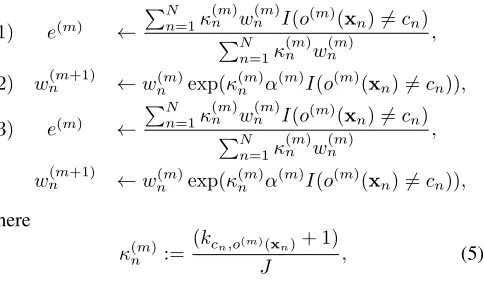
1) e(m) ←
PN
n=1κ (m)
n w
(m)
n I(o(m)(xn)6=cn)
PN
n=1κ (m)
n w(nm)
,
2) w(nm+1) ←w(nm)exp(κ
(m)
n α
(m)I(o(m)(xn)6=cn)),
3) e(m) ←
PN
n=1κ (m)
n w
(m)
n I(o(m)(xn)6=cn)
PN
n=1κ (m)
n w
(m)
n
,
w(nm+1) ←w(nm)exp(κ
(m)
n α
(m)
I(o(m)(xn)6=cn)),
where 53
κ(nm):= (kcn,o(m)(xn)+ 1)
J , (5)
1Please note that all the cost matrices in Table I are symmetric. It is
with kcn,o(m)(xn) the (cn, o(m)(xn))-element of the cost ma-1
trix, hence the cost of misclassifying patternxnof classcn as 2
pattern of the class o(m)(x
n); J is introduced for robustness 3
as normalization factor and 1 is added to avoid zeroing the 4
equation. If compared with [37], where only one cost value is 5
assigned to the misclassification of each pattern, the proposed 6
model includes a cost schema,κ(nm), whose values depend on 7
the prediction of the m-th model. 8
For the details of the proof of equivalence with the stagewise 9
additive modeling please refer to [31]. 10
IV. WEIGHTEDLEASTSQUARESESTIMATION FOR 11
EXTREMELEARNINGMACHINE 12
Extreme Learning Machine (ELM) is an efficient algorithm 13
that determines the output weights of a Single Layer Feedfor-14
ward Neural Network (SLFNN) using an analytical solution 15
instead of the standard gradient descent algorithm [39]. ELM 16
have been used to solve classification and regression problems 17
in several domains ranging from computer vision [40], credit 18
risk evaluation [41] or bioinformatics [42]. 19
Traditionally, for a SLFNN, all the parameters for the 20
different layers need to be tuned and there is a dependency 21
among the different layers. The gradient descent algorithm is 22
slow and is prone to converge to local minima. Furthermore, to 23
achieve good generalization performance several iterative steps 24
are necessary [33], [43], [44]. The ELM scheme proposed by 25
Huang et. al. [43] overcomes these problems by randomly as-26
signing weights to the input layers and analytically computing 27
the weights for the output layer using a simple generalized 28
inverse operation. The ELM framework has shown comparable 29
classification performance, and faster run times in comparison 30
to support vector machines [45], [46]. 31
Let’s note as vs = (vs1, vs2, . . . , vsK) the weight vector 32
connecting the input nodes to the s-th basis function, for 33
s= 1,2, . . . , S and withβj= (β1j, . . . , βSj)the weight vector 34
connecting the basis functions to the j-th output node for 35
j = 1, . . . , J. 36
During the training process, ELM determines the parameters 37
βj, for all j values, by minimizing the Least Squared Error 38
(LSE) function: 39
LSE = N
X
n=1
J
X
j=1
(fj(xn)−ynj)2, (6)
wherefj(xn)is the estimated output corresponding to then-th 40
input pattern and thej-th class. It is defined as: 41
fj(xn) = S
X
s=1
βjsφ(xn;vs), n∈ {1, . . . , N}, (7)
whereφ(xn;vs)is the activation function. According to [47] 42
the concurrent minimization of the training error and the 43
norm of the weight parameters, allows better generalization 44
performance for the network. Hence the minimization problem 45
has the following form 46
min
β∈RS×RJ
kHβ−Yk2, kβk
(8)
wherek·kis the L2 norm,His the hidden layer output matrix of the SLFN:
H= (h1,h2, . . . ,hS) =
=
φ1(x1;v1) . . . φS(x1;vS)
. . . . φ1(xN;v1) . . . φS(xN;vS)
∈R
N
×RS (9)
Y= (y1,y2, . . . ,yN)T ∈RN ×RJ, (10)
and 47
β= (β1,β2, . . . ,βJ)∈RS×RJ. (11)
The ELM algorithm starts choosing the activation function 48
φ(x,v) and the number of basis functions S. Generally, the 49
sigmoidal function is the one selected in the ELM framework 50
although other types of basis functions could be also consid-51
ered [48], [49]. In the first step, arbitrary weights are assigned 52
to the input weight vectors vs. The problem of minimizing 53
the training error reduces to solve the linear system 54
Hβ=Y. (12)
Therefore the output weights β are approximated by the 55
Moore-Penrose generalized inverse [43], [44], to guarantee 56
better generalization performance [50], 57
ˆ
β=H†Y, (13)
where
H†=
(
HT I
C+HH T−1
for N < S, I
C +H TH−1
HT otherwise, (14)
and C ∈ R is a user-specified parameter that promotes
58
generalization performance. 59
Traditionally Boosting algorithms proceed by continuously 60
minimizing the Weighted Least Square Error (WLSE) between 61
the estimated outputs and its true target. In the field of ELM, 62
several adaptations of the original AdaBoost algorithm have 63
been proposed for regression and classification problems [34], 64
[35], [36]. These approaches use the AdaBoost algorithm to 65
generate M training subsets from the training set, and then 66
train one ELM regressor/classifier for each of training subsets, 67
henceM regressors/classifiers are finally obtained. 68
In this work, the weights distribution is employed to directly 69
estimate the β parameters instead of using it to generateM
70
different sub-datasets. The generation of theseM sub-datasets 71
is unnecessary if the WLSE is adopted. Therefore, the goal is 72
to find the parameter matrix β which minimizes the WLSE 73
for allnpatterns in the training set with weightwn, i.e.: 74
WLSE = N
X
n=1
J
X
j=1
wn(fj(xn)−ynj)2. (15)
As before, to improve the generalization performance, the 75
norm of the weights need to be minimized concurrently. 76
Therefore the problem can be formulated as 77
min
β∈RS×RJ
(Hβ−Y)TW(Hβ−Y), kβk
AdaBoost(ELM) Algorithm:
Require: Training dataset (D)
Require: Size of the ensemble (M)
Require: Regularization Parameter (C)
Require: Width Gaussian Kernel (k)
Ensure: ELM Ensemble model
1: w(1)n ←1/N,∀n= 1, . . . , N {Initialization of the patterns weights}
2: Estimation ofΩELM
3: Initialization of the parameters of the ensemble model 4: form= 1, . . . , M do
5: f(m)(x) :=K(x)TCI +W(m)ΩELM
−1
W(m)Y{Computation of the kernelized output function}
6: e(m)←PN n=1w
(m)
n I(o(m)(xn)6=cn)/PNn=1w (m)
n {Computation of the error of the weighted ELM model}
7: α(m)←log1−e(m)
e(m) + log(J−1)
8: w(nm+1)←wn(m)exp(α(m)I(o(m)(xn)6=cn)),∀n= 1, . . . , N {Updating of the weights}
9: w(nm+1)←w(nm+1)/PnN=1wn(m+1),∀n= 1, . . . , N {Normalization of the weights}
10: end for
11: Output:C(x) = arg max
j
PM m=1α
(m)I(o(m)(x) =j)
[image:5.612.109.510.290.456.2]12: return Ensemble model
Fig. 2: AdaBoost(ELM) training algorithm framework
Fig. 3: Graphical illustration of the AdaBoost(ELM)
where Wis a diagonal matrix of dimensionN ×N defined 1
as: 2
W =
w1 0 . . . 0 0 w2 . . . 0
. . . .
0 . . . 0 wN
∈RN ×RN. (17)
The optimalβvalue is computed as critical point of the first order derivative of the weighted error function, hence solution of the following linear system
∂ ∂β
(Hβ−Y)TW(Hβ−Y)
= 0
∂ ∂β
h
(βTHTWHβ−βTHTWY−YTWHβ+
+YTWY)
= 0
(HTWHβ)T+βTHTWH−(HTWY)T −YTWH= 0
2βTHTWH−2YTWH= 0.
Finally, the weighted least squares solution can be approx-3
imate by the generalized form: 4
ˆ
β=
(
HT I
C+WHH
T−1
WY forN < S, I
C +H
TWH−1HTWY otherwise. (18)
The output function of them-th ELM classifier is defined as (just for the case N < S)
f(m)(x) =h(x)βˆ
=h(x)HT
I
C +WHH
T
−1
WY, (19)
where h(x) is a mapping function that corresponds to the basis functions outputs in the neural network literature or it is unknown to users in the kernel machines literature. Therefore, the output function can be kernelized, as suggested in [44], as
f(m)(x) =K(x)T
I
C +WΩELM
−1
where K(x) : RK →
RN is the vector of kernel functions
1
K(x)T = [K(x,x
1), . . . , K(x,xN)]. The Gaussian kernel 2
function here considered is 3
K(x,xi) = exp(−k||x−xi||2), i= 1, . . . , N (21)
where k ∈ R is the kernel parameter. Similarly the kernel
4
matrixΩELM= [Ωi,j]i,j=1,...,N is defined element by element 5
as 6
Ωi,j =K(xi,xj). (22)
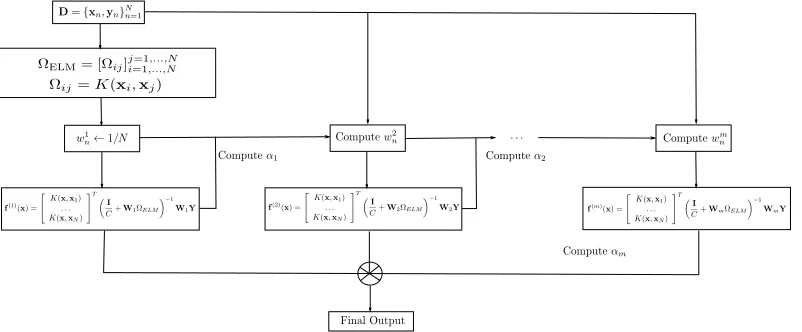
The algorithm proposed is named AdaBoost based on ELM 7
(AdaBoost(ELM)) and is described in Fig. 2 and Fig. 3. 8
To tackle Ordinal Regression problems the AdaBoost(ELM) 9
algorithm has been extended to include the cost model intro-10
duced in Section III. In particular three new algorithms are 11
generated, namely AdaBoost for Ordinal Regression based 12
on ELM and Cost model i (AdaBoost(ELM).ORC[i]), with 13
i= 1,2,3. They differ from the algorithm in Figure 2 in the 14
update schema of the error estimation and/or of the patterns 15
weights. In particular the following modifications apply 16
• AdaBoost(ELM).ORC1:
6 :e(m)←
PN
n=1κ (m)
n wn(m)I(o(m)(xn)6=cn)
PN
n=1κ (m)
n w
(m)
n
• AdaBoost(ELM).ORC2:
8 :w(nm+1)←wn(m)exp(κ(nm)α(m)I(o(m)(xn)6=cn))
∀n= 1, . . . , N
• AdaBoost(ELM).ORC3:
6 :e(m)←
PN
n=1κ (m)
n wn(m)I(o(m)(xn)6=cn)
PN
n=1κ (m)
n w
(m)
n
8 :w(nm+1)←wn(m)exp(κn(m)α(m)I(o(m)(xn)6=cn))
∀n= 1, . . . , N
where κ(nm) is the cost factor computed as described in 17
Section III. 18
V. EXPERIMENTALFRAMEWORK 19
In this section, the experimental study performed to validate 20
the new algorithms is presented. In Section V-A details of the 21
datasets selected for the experimentation are provided. Section 22
V-B gives the measures employed to evaluate the performance 23
of the algorithms. Instead, Section V-C is dedicated to a de-24
scription of the algorithms chosen for the comparison and their 25
relevant parameters. Finally, the description of the statistical 26
tests used to validate the obtained results (see Section V-D) is 27
provided. 28
A. Ordinal regression datasets 29
Sixteen datasets have been selected from the UCI [51] and 30
the mldata.org repositories and one synthetic dataset (the toy 31
dataset) has been included in the test sets. The latter dataset 32
was created as suggested in [52]: 300 example patterns x= 33
(x1, x2)were generated uniformly at random in the unit square
34
[0,1]×[0,1] ⊂ R2. To each pattern a class y from the set
35
{C1,C2,C3,C4,C5} has been assigned according to:
36
O(y) = min{j:θj−1<10(x1−0.5)(x2−0.5) +ε < θj}
where O(y) represents the rank of the patterns, θj is the threshold for thej-th class, according to the values
(θ0, θ1, θ2, θ3, θ4, θ5) = (−∞,−1,−0.1,0.25,1,∞),
andε∼N(0; 0.1252)simulates the possible existence of error
37
in the assignment of the true class to x. 38
TABLE II: Characteristics of the sixteen datasets used for the experiments: number of patterns (Size), total number of inputs (#In.), number of classes (#Out.), and number of patterns per-class (NPPC)
Dataset Size #In.#Out. NPPC
ERA 1000 4 9 (92,142,181,172,158,118,88,31,18) ELS 488 4 9 (2,12,38,100,116,135,62,19,4) LEV 1000 4 5 (93,280,403,197,27) SWD 1000 10 4 (32,352,399,217) automobile 205 71 6 (3,22,67,54,32,27) balance-scale 625 4 3 (288,49,288)
car 1728 21 4 (1210,384,69,65) contact-lenses 24 6 3 (15,4,4)
eucalyptus 736 91 5 (180,107,130,214,105) newthyroid 215 5 3 (30,150,35)
pasture 36 25 3 (12,12,12) squash-stored 52 51 3 (23,21,8) squash-unstored 52 52 3 (24,24,4)
tae 151 54 3 (49,50,52)
toy 300 2 5 (35,87,79,68,31) winequality-red 1599 11 6 (10,53,681,638,199,19)
Table II summarizes the properties of the selected datasets. 39
It shows, for each dataset, the number of patterns (Size), 40
the total number of inputs (#In.), the number of classes 41
(#Out.) and the number of patterns per-class (NPPC). Their 42
descriptions (available in the web sites) lead to the conclusion 43
that they are ordinal datasets since the class labels show an 44
ordinal nature. 45
The datasets considered are partitioned by using a hold-out 46
cross-validation procedure. Concretely, 30 different stratified 47
random splits of the datasets have been considered, with 48
75% and 25% of the instances in the training and test sets 49
respectively (30 hold-outs). 50
B. Performance measures for Ordinal Regression 51
In this study, ordinal regression datasets are considered. 52
In these domains, two measures are widely used because 53
of their simplicity and successful application. Therefore, 54
two evaluation metrics have been considered which quan-55
tify the accuracy of N predicted ordinal labels for a given 56
dataset {y1,ˆ y2, . . . ,ˆ yˆN}, with respect to the true targets 57
{y1, y2, . . . , yN}. Namely they are: 58
• Accuracy rate (Acc): It is the number of successful hits 59
(correct classifications) relative to the total number of 60
TABLE III: Parameter specification for the methods considered (C: regularization parameter; k: width of the Gaussian functions;M: number of models in the ensemble;S: number of basis functions). The criteria for selecting the best configuration was theM AE performance
Algorithm Ref. Parameters
ASAOR [23] There is no hyperparameters to be considered
MCOSvm [24] C: Best∈ {103,102, . . . ,10−3};k: Best∈ {103,102, . . . ,10−3}; Gaussian Kernel ORBoost-All [29] M= 25;SBest∈ {5,10,15,20,30,40}; Sigmoidal Basis Function
ORBoost-LR [29] M= 25;SBest∈ {5,10,15,20,30,40}; Sigmoidal Basis Function ELMOR [53] SBest∈ {10 +i10},i= 0, . . . ,19; Sigmoidal Basis Function
AdaBoost(ELM) - M= 25;C: Best∈ {103,102, . . . ,10−3};k: Best∈ {103,102, . . . ,10−3}; Gaussian Kernel AdaBoost(ELM).ORC1 - M= 25;C: Best∈ {103,102, . . . ,10−3};k: Best∈ {103,102, . . . ,10−3}; Gaussian Kernel AdaBoost(ELM).ORC2 - M= 25;C: Best∈ {103,102, . . . ,10−3};k: Best∈ {103,102, . . . ,10−3}; Gaussian Kernel AdaBoost(ELM).ORC3 - M= 25;C: Best∈ {103,102, . . . ,10−3};k: Best∈ {103,102, . . . ,10−3}; Gaussian Kernel
used metric to assess the performance of classifiers for 1
years [3]. The mathematical expression ofAcc is: 2
Acc= 1
N
N
X
n=1
I(ˆyn=yn), (23)
where I(·) is the zero-one loss function and N is the 3
number of patterns of the dataset. 4
• Mean Absolute Error (M AE): It is the average devia-5
tion of the prediction from the true targets, i.e.: 6
M AE= 1
N
N
X
n=1
|O(ˆyn)− O(yn)|, (24)
where O(Cj) =j,1≤j ≤J, i.e.O(yn)is the rank of 7
pattern xn according to the encoding scheme used. 8
These measures aim to evaluate different aspects that can 9
be taken into account when an ordinal regression problem is 10
considered: (a)Acc measures that patterns are generally well 11
classified, and (b)M AE measures that the classifier tends to 12
predict a class as closely as possible to the real class without 13
taking into account the relative sizes of the classes. 14
Additionally, the time required to estimate the parameters 15
of each method has been also considered. The time (T) is the 16
simplest way to measure the practical efficiency of a method. 17
The average time elapsed (in seconds) is analyzed by every 18
method, considering cross-validation time, training and test 19
time. 20
C. Comparison Methods 21
The models proposed have been evaluated comparing their 22
results to the results of ensemble models for ordinal regression 23
and one extreme learning approach for ordinal data. All of 24
them have been already mentioned in the Introduction section. 25
• Ensemble approaches for Ordinal regression: 26
– A Simple Approach to Ordinal Regression
27
(ASAOR)[23] is a meta classifier that allows stan-28
dard classification algorithms to be applied to ordinal 29
class problems. In the current work, the C4.5 method 30
available in Weka [54] is used as the underlying 31
classification algorithm, since this is the one initially 32
employed by the authors. 33
– Multi-Class Ordinal Support vector machines
34
(MCOSvm) [24] is an enhanced ensemble method 35
for ordinal regression. As proposed in [24], weighted 36
SVMs are used as base classifiers. Specific weights 37
are assigned to each pattern in such a way that 38
errors of more than one rank are heavier penalized. 39
Therefore the weight of a training pattern differs for 40
each binary SVM. 41
– Ordinal Regression Boosting (ORBoost) [29] is 42
a thresholded ensemble model for ordinal regres-43
sion problems. The model consists of a weighted 44
ensemble of confidence functions and an ordered 45
vector of thresholds. ORBoost can be used with 46
any base learners for confidence functions. In the 47
presented experimental study, a standard feedforward 48
neural network is used as the underlying classifica-49
tion model. Two boosting approaches are considered: 50
∗ ORBoost with all margins (ORBoost-All). 51
∗ ORBoost with left-right margins (ORBoost-LR). 52
• ELM models for Ordinal regression: 53
– Extreme Learning Machine for Ordinal
Regres-54
sion (ELMOR) [53]. For this experimental study 55
the single model proposed in [53] is employed. The 56
other two multiple model approaches have not been 57
considered for efficiency reasons. 58
Table III presents the parameters configuration of the dif-59
ferent models proposed. In the case of ensemble models the 60
same size has been considered for all the methods M = 25. 61
However, for the iterative neural network ensemble algorithms 62
(ORBoost.LR and ORBoost.All), the number of basis func-63
tions S, were selected by considering the following values, 64
S ∈ {5,10,20,30,40} while for the ordinal ELM algorithm 65
(ELMOR), it is necessary to consider a more extensive set of 66
possible number of basis functions, in this caseS ∈ {10+i10}
67
with i = 0, . . . ,19, given that the method relies on random 68
projections. For the ensemble kernel methods (MCOSvm and 69
AdaBoost(ELM) algorithm and its ordinal variants), the regu-70
larization parameter,C, and the width of the Gaussian kernel, 71
k, were selected by considering the following set of values, 72
C andk ∈ {103,102, . . . ,10−3}. The hyperparameters were 73
adjusted using a grid search with a 5-fold cross-validation 74
considering just the training set. Despite this, the optimal 75
number of basis functions for the ELMOR could be also 76
D. Statistical Tests for Performance Comparison 1
In the presented experimental study, the hypothesis testing 2
techniques are used to provide statistical support for the 3
analysis of the results. Concretely, nonparametric tests have 4
been used, due to the fact that the initial conditions that 5
guarantee the reliability of the parametric tests may not be 6
satisfied, causing the statistical analysis to lose credibility [56]. 7
Throughout the study, the Friedman test is used to detect 8
statistical differences among the methods. Holmpost hoc pro-9
cedure will be used to find out which methods are distinctive 10
among the multiple comparisons performed [56]. 11
VI. RESULTS ANDANALYSIS 12
In this section, the different experimental studies carried 13
out with the cost-sensitive boosting proposals are detailed. In 14
particular, the aims are multiple: 15
1) To compare the generalization performance of the ap-16
proaches proposed to recent ensemble and ELM algo-17
rithms for ordinal regression (Section VI-A). 18
2) To test the time complexity of the models proposed 19
compared to the above-mentioned methods (Section 20
VI-B). 21
3) To show the influence of the hyperparameters in the 22
overall performance (Section VI-C) 23
A. Comparison between the models proposed and ensemble 24
and ELM algorithms for ordinal regression 25
For the sake of simplicity, only the graphical and the sum-26
mary of the statistical results achieved are included, whereas 27
[image:8.612.56.293.488.695.2]the complete results can be found online2. 28
TABLE IV: Summary of results in Acc and M AE for the generalization set: Mean results over all the datasets, mean ranking and Holm statistical test results (using as the control method the one with the best mean ranking) for α= 0.10
Accgeneralization results
Algorithm Acc RAcc z-statistic p-value αAdjusted
ELMOR• 64.12 7.68 5.06 0.00 0.01
AdaBoost(ELM)• 66.36 6.84 4.19 3.0E-5 0.01
ASAOR• 66.12 5.68 3.00 2.6E-3 0.01
ORBoost−All• 69.58 5.28 2.58 9.8E-3 0.02
AdaBoost(ELM).ORC1 69.68 4.46 1.74 0.08 0.03 ORBoost-LR 70.32 4.28 1.54 0.12 0.03 AdaBoost(ELM).ORC2 70.34 4.18 1.45 0.14 0.05 MCOSvm 71.36 3.78 1.03 0.30 0.10
AdaBoost(ELM).ORC3+ 71.88 2.78 - - -M AEgeneralization results
Algorithm M AE RMAE z-statistic p-value αAdjusted
ELMOR• 0.49 8.43 6.51 0.00 0.01
AdaBoost(ELM)• 0.42 7.06 5.09 0.00 0.01
ASAOR• 0.40 5.62 3.61 3.0E-4 0.01
AdaBoost(ELM).ORC1• 0.37 5.12 3.09 1.9E-3 0.02
ORBoost−All• 0.36 5.03 3.00 2.6E-3 0.03
ORBoost−LR• 0.36 4.40 2.35 0.01 0.03
AdaBoost(ELM).ORC2 0.36 3.78 1.71 0.08 0.05 MCOSvm 0.34 3.40 1.32 0.18 0.10
AdaBoost(ELM).ORC3+ 0.34 2.12 - -
-•Statistical differences are found
+Control Method
Fig. 4 is the star plot representation of generalization 29
performance of the comparison of the different methodologies. 30
2http://www.esa.int/gsp/ACT/cms/projects/ResultsAdaboostELM.zip
This star plot represents the performance as the distance from 31
the center; hence a higher area determines the best average 32
performance where the goal is to maximize the metric (Acc) 33
and lower area determines the best average performance where 34
the goal is to minimize (M AE). The plot allows to visualize 35
the performance of the algorithms comparatively for each 36
dataset. As can be seen in Fig. 4, the AdaBoost(ELM).ORC3 is 37
the most promising methodology following by the MCOSvm 38
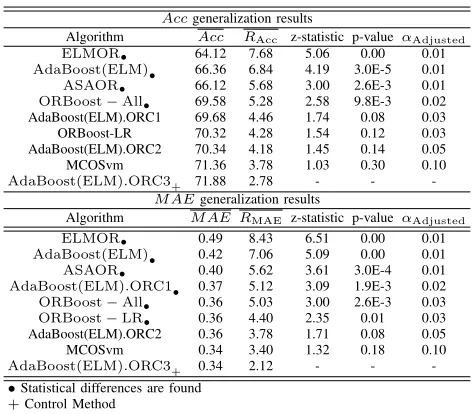
method. From the analysis of the results (Table IV), it can 39
be concluded that the AdaBoost(ELM).ORC3 model produces 40
the best mean ranking in Acc and M AE (RAcc = 2.78 and 41
RMAE = 2.12), reporting also the best mean accuracy and 42
mean absolute error (Acc= 71.88% andM AE = 0.34). 43
To determine the statistical significance of the rank differ-44
ences observed for each method in the different datasets, a 45
non-parametric Friedman test [57] has been completed with 46
the ranking ofAccandM AE in the generalization set of the 47
best models as test variables. The test shows that the effect of 48
the method used for classification is statistically significant at 49
a significance level of10%. 50
Based on this rejection, the Holm post-hoc test was used 51
to compare all classifiers with a control method [58]. For the 52
experiments carried out, the control method selected is the 53
one reporting the best mean ranking in Acc and M AE, the 54
AdaBoost(ELM).ORC3. The results of the Holm test forα= 55
0.10can be seen in Table IV. By using a level of significance 56
α= 0.10, AdaBoost(ELM).ORC3 is significantly better than 57
ELMOR, AdaBoost(ELM), ASAOR and ORBoost-All using 58
Acc as variable test, and significantly better than ELMOR, 59
AdaBoost(ELM), ASAOR, AdaBoost(ELM).ORC1, ORBoost-60
All and ORBoost-LR using M AE as variable test. 61
As can be seen in Table IV, the AdaBoost(ELM).ORC3 62
algorithm is competitive when compared to the most promising 63
ensemble methods for ordinal regression. Furthermore, it is 64
much more efficient than most of them. This justifies its 65
proposal. 66
B. Time complexity analysis 67
In this section, the computational time and complexity of 68
the proposed methods are analyzed and compared to the al-69
ready existing ensemble models for ordinal regression already 70
presented in the experimental section. 71
The computational complexity of the SAMME algorithm is 72
conditioned by the choice of its base classifier. In the proposed 73
ELM model the computation of the kernel matrix has a 74
quadratic complexity inN, whereN is the size of the dataset. 75
However the kernel matrix is initialized at the beginning of 76
the ensemble and not recomputed. In each iteration of model, 77
the most time consuming task is the inversion of a N ×N
78
matrix and the multiplication of it with a matrix of dimension 79
N×J. The computational complexity of the multiplication of 80
the two matrices isO(N2J), while the complexity of inverting 81
the matrix of dimension N is O(N3) (if the Gauss–Jordan 82
elimination algorithm is used), where N is the number of 83
training patterns and J is the number of classes. Hence the 84
computational complexity of the AdaBoost(ELM) algorithm is 85
O((N3+N2J)M), whereM is the size of its ensemble [31].
0 10 20 30 40 50 60 70 80 90 100 ERA
ESL
LEV
SWD
automobile
balance-scale
car
contact-lenses eucalyptus
newthyroid pasture squash-stored squash-unstored
tae toy
winequality-red AdaBoost(ELM)
AdaBoost(ELM).ORC1 AdaBoost(ELM).ORC2 AdaBoost(ELM).ORC3
(a)Accresults: Comparison to AdaBoost models
0 0.2 0.4 0.6 0.8 1 1.2 1.4 1.6
AdaBoost(ELM) AdaBoost(ELM).ORC1 AdaBoost(ELM).ORC2 AdaBoost(ELM).ORC3
(b)M AEresults: Comparison to AdaBoost models
0 10 20 30 40 50 60 70 80 90 100 ERA
ESL
LEV
SWD
automobile
balance-scale
car
contact-lenses eucalyptus
newthyroid pasture squash-stored squash-unstored
tae toy winequality-red
ASAOR MCOSvm ORBoost-All ORBoost-LR ELMOR AdaBoost(ELM).ORC3
(c)Accresults: AdaBoost(ELM).ORC3 versus state-of-the-art models
0 0.2 0.4 0.6 0.8 1 1.2 1.4 1.6
ERA
ESL
LEV
SWD
automobile
balance-scale
car
contact-lenses eucalyptus
newthyroid pasture squash-stored squash-unstored
tae toy winequality-red
ASAOR MCOSvm ORBoost-All ORBoost-LR ELMOR AdaBoost(ELM).ORC3
[image:9.612.49.576.64.452.2](d)M AEresults: AdaBoost(ELM).ORC3 versus state-of-the-art models Fig. 4: Radar illustration of the results onAcc(Figure 4a and 4c) and M AE (Figure 4b and 4d)
The time recorded included cross-validation, training and 1
test, and it is shown in Table V. The number of hyperparam-2
eters of each method is decisive for the final time spent in 3
running the algorithms, given that they have to be adjusted 4
using a time-consuming cross-validation process (see Section 5
V-C for further details). 6
TABLE V: Computational time results in seconds (cross-validation, training and test) for the toy dataset and all the methods: average and standard deviation over the30holdouts.
Computational Time (M eanSD)
ORBoost-All 216.92 (160.54)
ORBoost-LR 215.92 (76.35)
MCOSvm 27.4 (0.90)
AdaBoost(ELM).ORC1 10.6 (0.5)
AdaBoost(ELM).ORC2 10.6 (0.5)
AdaBoost(ELM).ORC3 10.5 (0.3)
AdaBoost(ELM) 10.4 (0.4)
ELMOR 1.2 (0.6)
ASAOR 0.15 (0.04)
As can be seen, the ensemble models proposed are the 7
methods with the lowest computational time, together with 8
MCOSvm, ELMOR and ASAOR. The differences in time 9
of these methods are not significant if they are compared 10
to the differences with the ORBoost-All and ORBoost-LR 11
methods. A simplified version of the proposed ensemble 12
model, with a neural network as base classifier and without the 13
regularization parameter and the kernel functions, has a single 14
hyperparameter to be tuned (the number of hidden nodes) and 15
doesn’t require the computation of the kernel matrix. This 16
results in a more computational efficient model (is gained 17
approximately one order of magnitude) but less performing. 18
For this reason, the base classifier with its kernel version and 19
with the regularization parameter is the one proposed in this 20
paper. 21
Furthermore, note that software implementations can affect 22
these times. For example, the ASAOR Weka implementation 23
was written in Java and the remaining methods were run using 24
a common Matlab framework proposed in Gutierrez et al. [59]. 25
In general, the most efficient algorithms are the ones based 26
on ELM. Both are trained without iterative tuning. Despite 27
this, the lowest computation time is achieved by the ASAOR 28
not any hyperparameters to be optimized by cross-validation 1
unlike ELMOR and AdaBoost(ELM) approaches (they have, 2
respectively, the number of basis functions S, and the kernel 3
and regularization parameters(C, k)as hyperparameters). The 4
efficiency of the models proposed and their good performance 5
justify their proposal. 6
C. Influence of the hyperparameters 7
The proposed algorithms rely on three hypeparameters that 8
need to be set: the size of the ensemble M, the regularization 9
coefficient, C and the width of the Gaussian kernel k. A 10
study has been performed to analyze the sensitivity of the 11
model, in terms of Accuracy and M AE, with respect to the 12
three hyperparameters. The algorithm considered is the one 13
achieving the best results, AdaBoost(ELM).ORC3, on the toy 14
problem. The hyperparameters are compared 2-by-2 fixing the 15
value of the third one to the best value achieved in the cross 16
validation process. In particular the best set of values used in 17
this particular case is 18
(M∗, C∗, k∗) = (25,10,1). (25)
While (C∗, k∗) are result of the cross-validation process,
M∗ = 25 has been considered as competitive trade-off between efficiency, diversity and accuracy [60]. Several runs of the AdaBoost(ELM).ORC3 model have been performed for values of the three hyperparameters ranging in the sets
M ∈ {10, . . . ,50}
C, k∈ {10−3, . . . ,103}. (26)
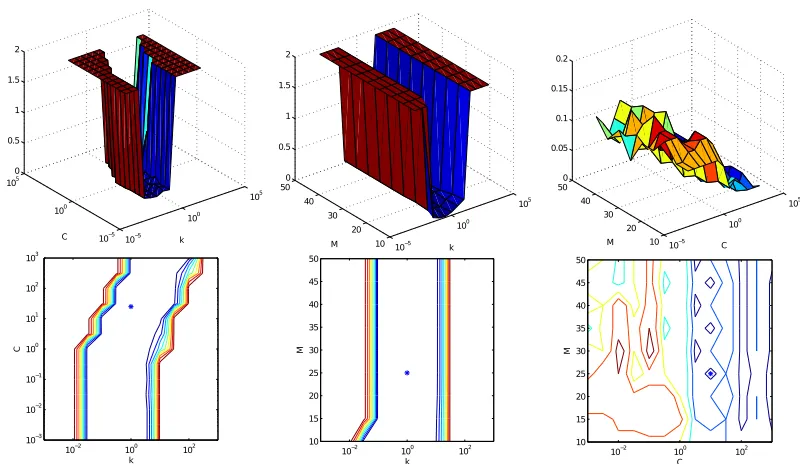
Results are reported in Fig. 5 and Fig. 6, where also the 19
solution of the cross validation process is drawn in the contour 20
lines plot for comparison. As expected the model is less 21
sensitive to the size of its ensemble: the significant variations 22
in performance are determined by the (C, k)parameters. The 23
most critical parameter is the width of the Gaussian kernelk. 24
The accuracy of the model has a very sensitive behavior with 25
respect to the parameter k, with a drop down up to 80% of 26
the overall model performance. 27
VII. CONCLUSIONS 28
The presented work extends the class of boosting algorithms 29
for ordinal regression. In particular it enlarges the family of 30
models that employ Extreme Learning Machine (ELM) as a 31
base classifier. It differs from the already existing techniques 32
in the way of addressing the training at each iteration of the 33
ensemble. Instead of generating at each step a new training 34
dataset according to the new set of patterns weights, the 35
weights are used into the definition of the training problem, 36
solving the derived Weighted Least Squares Problem (WLSP) 37
in a close form and maintain the original training dataset 38
during all the iterations cycle. Moreover, in order to be 39
applied to Ordinal Regression problems, three cost models 40
have been proposed that affect the way in which the weights 41
are redistributed among the patterns. 42
After introducing the existing boosting algorithms, in par-43
ticular those using ELM as base classifier, more attention has 44
been given to the description of the Stagewise Additive Mod-45
eling using a Multi-class Exponential loss function (SAMME) 46
algorithm, being the version of the AdaBoost method adopted 47
in the proposed algorithms. The SAMME algorithm has been 48
extended, in order to address ordinal regression problems, 49
including three cost models and using an ELM as base classi-50
fier that determines the linear parameters of the kernel ELM 51
method using the analytic solution of the WLSP. This led to 52
the definition of four new algorithms, namely AdaBoost(ELM) 53
for nominal classification and AdaBoost(ELM).ORC1, Ad-54
aBoost(ELM).ORC2 and AdaBoost(ELM).ORC3 for ordinal 55
regression. 56
Ordinal regression datasets available in the community and 57
one synthetic dataset (the toy dataset) have been used as 58
benchmark test sets, four algorithms from the state-of-the-art 59
ensemble models for ordinal regression (ASAOR, MCOSvm, 60
ORBoost-All, ORBoost-LR) and one extreme learning ap-61
proach for ordinal data (ELMOR) have been used for compar-62
ison and the model performance has been evaluated using the 63
Accuracy and Mean Absolute Error (M AE) measures. Finally 64
the models have been compared also in terms of computational 65
efficiency, non parametric statistical tests have been performed 66
to validate the results and an analysis of the influence of 67
the hyperparameters on the selected metrics has also been 68
included. 69
From the results of these tests the AdaBoost(ELM).ORC3 70
algorithm is the method, among the one proposed in this 71
article, with the most effective cost model. The algorithm 72
reaches competitive results in terms of performance with the 73
state of the art ensemble models, achieving the best mean 74
ranking in accuracy and in mean absolute error. Furthermore, 75
the models proposed outperforms in efficiency the selected 76
ensemble models for ordinal regression but the ASAOR algo-77
rithm. It’s comparable performances with the state-of-the-art 78
algorithms and its efficiency justify its proposal. 79
The adaptation of the algorithms proposed to the incre-80
mental learning paradigm will be considered as future work. 81
Indeed the Adaboost algorithm has already been adapted to the 82
incremental learning paradigm [61] for nominal classification 83
[62], [63] but not for ordinal regression problems. 84
REFERENCES 85
[1] A. K. Jain, R. P. Duin, and J. Mao, “Statistical pattern recognition: A re-86
view,”IEEE Transactions on Pattern Analysis and Machine Intelligence, 87
vol. 22, no. 1, pp. 4–37, 2000. 88
[2] R. O. Duda, P. E. Hart, and D. G. Stork,Pattern Classification, 2nd ed. 89
Wiley-Interscience, 2000. 90
[3] I. H. Witten and E. Frank,Data Mining: Practical Machine Learning 91
Tools and Techniques, 2nd ed., ser. Data Management Systems. Morgan 92
Kaufmann (Elsevier), 2005. 93
[4] V. Cherkassky and F. M. Mulier,Learning from Data: Concepts, Theory, 94
and Methods. Wiley-Interscience, 2007. 95
[5] B.-Y. Sun, J. Li, D. D. Wu, X.-M. Zhang, and W.-B. Li, “Kernel 96
discriminant learning for ordinal regression,” IEEE Transactions on 97
Knowledge and Data Engineering, vol. 22, no. 6, pp. 906–910, 2010. 98
[6] C.-W. Seah, I. W. Tsang, and Y.-S. Ong, “Transductive ordinal regres-99
sion,” IEEE Transactions on Neural Networks and Learning Systems, 100
vol. 23, no. 7, pp. 1074–1086, 2012. 101
[7] P. McCullagh, “Regression models for ordinal data,” Journal of the 102
Royal Statistical Society. Series B (Methodological), vol. 42, no. 2, pp. 103
10−5
100
105
10−5
100
1005
20 40 60 80 100
k C
k
C
10−2 100 102
10−3
10−2
10−1
100
101
102
103
10−5
100
105
10 20 30 40 50
0 20 40 60 80 100
k M
k
M
10−2 100 102
10 15 20 25 30 35 40 45 50
10−5
100
105
10 20 30 40 50 86 88 90 92 94 96 98 100
C M
AdaBoost.ORC3 Accuracy
C
M
10−2 100 102
[image:11.612.108.504.57.293.2]10 15 20 25 30 35 40 45 50
Fig. 5: Hypeparameters study on Acc for the AdaBoost(ELM).ORC3 algorithm and the parameters: M (ensemble size), C
(regularization coefficient), k (width of the Gaussian kernel).
10−5
100
105
10−5
100
1005
0.5 1 1.5 2
k C
k
C
10−2 100 102
10−3
10−2
10−1
100
101
102
103 10
−5
100
105
10 20 30 40
500
0.5 1 1.5 2
k M
k
M
10−2 100 102
10 15 20 25 30 35 40 45 50
10−5
100
105
10 20 30 40
500
0.05 0.1 0.15 0.2
C M
AdaBoost.ORC3 Mean Absolute Error
C
M
10−2 100 102
10 15 20 25 30 35 40 45 50
Fig. 6: Hypeparameters study on M AE for the AdaBoost(ELM).ORC3 algorithm and the parameters:M (ensemble size),C
(regularization coefficient), k (width of the Gaussian kernel).
[8] J. A. Anderson, “Regression and ordered categorical variables,”Journal 1
of the Royal Statistical Society. Series B (Methodological), vol. 46, no. 1, 2
pp. 1–30, 1984. 3
[9] M. J. Mathieson, “Ordinal models for neural networks,” inProceedings 4
of the Third International Conference on Neural Networks in the Capital 5
Markets, ser. Neural Networks in Financial Engineering, J. M. A.-P. 6
N. Refenes, Y. Abu-Mostafa and A. Weigend, Eds. World Scientific, 7
1996, pp. 523–536. 8
[10] F. Fern´andez-Navarro, P. Campoy, M. De la Paz, C. Herv´as-Mart´ınez, 9
and X. Yao, “Addressing the EU sovereign ratings using an ordinal 10
regression approach,”IEEE Transaction on Cybernetics, vol. 43, no. 6, 11
pp. 2228–2240, 2013. 12
[11] R. Herbrich, T. Graepel, and K. Obermayer, “Large margin rank bound-13
aries for ordinal regression,” inAdvances in Large Margin Classifiers, 14
A. Smola, P. Bartlett, B. Sch¨olkopf, and D. Schuurmans, Eds. Cam-15
bridge, MA: MIT Press, 2000, pp. 115–132. 16
[12] W. Chu and S. S. Keerthi, “Support Vector Ordinal Regression,”Neural 17
Computation, vol. 19, no. 3, pp. 792–815, 2007. 18
[13] W. Chu and Z. Ghahramani, “Gaussian processes for ordinal regression,” 19
J. Mach. Learn. Res., vol. 6, pp. 1019–1041, Dec. 2005. 20
[14] W. Deng and L. Chen, “Color image watermarking using regularized 21
extreme learning machine,”Neural Network World, vol. 20, no. 3, pp. 22
317–330, 2010. 23
[15] D. Becerra-Alonso, M. Carbonero-Ruz, F. J. Mart´ınez-Estudillo, and 24
A. C. Mart´ınez-Estudillo, “Evolutionary extreme learning machine for 25
[image:11.612.104.504.343.575.2]in Computer Science, 2012, vol. 7665, pp. 217–227. 1
[16] Q.-Y. Zhu, A. K. Qin, P. N. Suganthan, and G.-B. Huang, “Evolutionary 2
extreme learning machine,”Pattern Recognition, vol. 38, no. 10, pp. 3
1759–1763, 2005. 4
[17] Y. Liu, X. Yao, and T. Higuchi, “Ensembles with negative correlation 5
learning,” IEEE Transactions on Evolutionary Computation, vol. 4, 6
no. 4, pp. 380–387, 2000. 7
[18] A. Chandra and X. Yao, “Divace: Diverse and accurate ensemble 8
learning algorithm,” inProceedings of the Fifth International Conference 9
on intelligent Data Engineering and Automated learning, vol. 3177. 10
Exeter, UK: Lectures Notes and Computer Science, Springer, Berlin, 11
2005, pp. 619–625. 12
[19] X. Zhu, P. Zhang, X. Lin, and Y. Shi, “Active learning from stream 13
data using optimal weight classifier ensemble,”IEEE Transactions on 14
Systems, Man, and Cybernetics, Part B: Cybernetics, vol. 40, no. 6, pp. 15
1607–1621, 2010. 16
[20] D. Hernandez-Lobato, G. Martinez-Mu??oz, and A. Suarez, “Empirical 17
analysis and evaluation of approximate techniques for pruning regression 18
bagging ensembles,”Neurocomputing, vol. 74, no. 12-13, pp. 2250 – 19
2264, 2011. 20
[21] A. L. Coelho and D. S. Nascimento, “On the evolutionary design of 21
heterogeneous bagging models,” Neurocomputing, vol. 73, no. 16-18, 22
pp. 3319 – 3322, 2010. 23
[22] Z. Qi, Y. Xu, L. Wang, and Y. Song, “Online multiple instance boosting 24
for object detection,”Neurocomputing, vol. 74, no. 10, pp. 1769 – 1775, 25
2011. 26
[23] E. Frank and M. Hall, “A simple approach to ordinal classification,” in 27
ECML’01, 2001, pp. 145–156. 28
[24] W. Waegeman and L. Boullart, “An ensemble of weighted support vector 29
machines for ordinal regression,” International Journal of Computer 30
Systems Science and Engineering, vol. 3, no. 1, pp. 47–51, 2009. 31
[25] F. Fern´andez-Navarro, P. Gutierrez, C. Herv´as-Mart´ınez, and X. Yao, 32
“Negative correlation ensemble learning for ordinal regression,”IEEE 33
Transaction on Neural Networks and Learning Systems, vol. 24, no. 11, 34
pp. 1836–1849, 2013. 35
[26] Y. Liu and X. Yao, “Negatively correlated neural networks can produce 36
best ensembles,”Australian Journal of Intelligent Information Process-37
ing Systems, vol. 4, no. 3, pp. 176–185, 1997. 38
[27] ——, “Ensemble learning via negative correlation,” Neural Networks, 39
vol. 12, no. 10, pp. 1399–1404, 1999. 40
[28] M. P´erez-Ortiz, P. Guti´errez, and C. Herv´as-Mart´ınez, “Projection-41
based ensemble learning for ordinal regression,”IEEE Transactions on 42
Cybernetics, vol. PP, no. 99, pp. 1–1, 2013. 43
[29] H.-T. Lin and L. Li, “Large-margin thresholded ensembles for ordinal 44
regression: theory and practice,” inProceedings of the 17th international 45
conference on Algorithmic Learning Theory, ser. ALT’06. Springer-46
Verlag, 2006, pp. 319–333. 47
[30] ——, “Combining ordinal preferences by boosting,” inProceedings of 48
the ECML/PKDD 2009, ser. Workshop on Preference Learning, 2009, 49
pp. 69–83. 50
[31] J. Zhu, H. Zou, S. Rosset, and T. Hastie, “Multi-class adaboost,” 51
Statistics and Its Interface, vol. 2, no. 1, pp. 349–360, 2009. 52
[32] R. E. Schapire and Y. Singer, “Improved boosting algorithms using 53
confidence-rated predictions,” Machine Learning, vol. 37, no. 3, pp. 54
297–336, 1999. 55
[33] G.-B. Huang, D. Wang, and Y. Lan, “Extreme learning machines: a 56
survey,”International Journal of Machine Learning and Cybernetics, 57
vol. 2, no. 2, pp. 107–122, 2011. 58
[34] G. Wang and P. Li, “Dynamic adaboost ensemble extreme learning 59
machine,” inAdvanced Computer Theory and Engineering (ICACTE), 60
2010 3rd International Conference on, vol. 3, 2010, pp. V3–54–V3–58. 61
[35] H.-X. Tian and Z.-Z. Mao, “An ensemble elm based on modified 62
adaboost.rt algorithm for predicting the temperature of molten steel in 63
ladle furnace,”Automation Science and Engineering, IEEE Transactions 64
on, vol. 7, no. 1, pp. 73–80, 2010. 65
[36] J.-H. Zhai, H.-Y. Xu, and X.-Z. Wang, “Dynamic ensemble extreme 66
learning machine based on sample entropy,”Soft Computing, vol. 16, 67
no. 9, pp. 1493–1502, 2012. 68
[37] Y. Sun, M. S. Kamel, A. K. C. Wong, and Y. Wang, “Cost-sensitive 69
boosting for classification of imbalanced data,” Pattern Recognition, 70
vol. 40, no. 12, pp. 3358–3378, 2007. 71
[38] H.-T. Lin and L. Li, “Reduction from cost-sensitive ordinal ranking to 72
weighted binary classification,”Neural Computation, vol. 24, no. 5, pp. 73
1329–1367, 2012. 74
[39] G. B. Huang, Q. Y. Zhu, and C. K. Siew, “Extreme learning machine: 75
A new learning scheme of feedforward neural networks,” in IEEE 76
International Conference on Neural Networks - Conference Proceedings, 77
vol. 2, 2004, pp. 985–990. 78
[40] C. Zhaohu, R. Xuemei, and C. Qiang, “Camera calibration based on 79
extreme learning machine,” in Proceedings of the 2012 International 80
Conference on Communication, Electronics and Automation Engineer-81
ing, ser. Advances in Intelligent Systems and Computing. Springer 82
Berlin Heidelberg, 2013, vol. 181, pp. 115–120. 83
[41] H. Zhou, Y. Lan, Y. C. Soh, G.-B. Huang, and R. Zhang, “Credit 84
risk evaluation with extreme learning machine,” inSystems, Man, and 85
Cybernetics (SMC), 2012 IEEE International Conference on, 2012, pp. 86
1064–1069. 87
[42] J. S´anchez-Monedero, M. Cruz-Ram´ırez, F. Fern´andez-Navarro, J. C. 88
Fern´andez, P. A. Guti´errez, and C. Herv´as-Mart´ınez, “On the suitability 89
of extreme learning machine for gene classification using feature selec-90
tion,” inISDA ’10: Proceedings of the 2010 International Conference 91
on Intelligent Systems Design and Applications. Cairo, Egypt: IEEE 92
Computer Society, 2010, pp. 507–512. 93
[43] G.-B. Huang, Q.-Y. Zhu, and C.-K. Siew, “Extreme learning machine: 94
Theory and applications,”Neurocomputing, vol. 70, no. 1-3, pp. 489 – 95
501, 2006. 96
[44] G.-B. Huang, H. Zhou, X. Ding, and R. Zhang, “Extreme learning 97
machine for regression and multiclass classification,”IEEE Transactions 98
on Systems, Man, and Cybernetics, Part B: Cybernetics, vol. 42, no. 2, 99
pp. 513–529, 2012. 100
[45] V. N. Vapnik,The Nature of Statistical Learning Theory. Springer, 101
1999. 102
[46] R. Zhang, G.-B. Huang, N. Sundararajan, and P. Saratchandran, “Multi-103
category classification using an extreme learning machine for microarray 104
gene expression cancer diagnosis,”IEEE/ACM Transactions on Compu-105
tational Biology and Bioinformatics, vol. 4, no. 3, pp. 485–495, 2007. 106
[47] P. Bartlett, “The sample complexity of pattern classification with neural 107
networks: the size of the weights is more important than the size of the 108
network,”Information Theory, IEEE Transactions on, vol. 44, no. 2, pp. 109
525–536, 1998. 110
[48] J. Cao, Z. Lin, and G.-b. Huang, “Composite function wavelet neural 111
networks with extreme learning machine,”Neurocomputing, vol. 73, no. 112
7-9, pp. 1405–1416, 2010. 113
[49] F. Fern´andez-Navarro, C. Herv´as-Mart´ınez, J. S´anchez-Monedero, and 114
P. A. Gutierrez, “MELM-GRBF: A modified version of the extreme 115
learning machine for generalized radial basis function neural networks,” 116
Neurocomputing, vol. 74, no. 16, pp. 2502–2510, 2011. 117
[50] A. E. Hoerl and R. W. Kennard, “Ridge regression: Biased estimation 118
for nonorthogonal problems,”Technometrics, vol. 12, no. 1, pp. 55–67, 119
1970. 120
[51] A. Asuncion and D. Newman, “UCI machine learning repository,” 2007. 121
[Online]. Available: http://www.ics.uci.edu/∼mlearn/MLRepository.html
122
[52] J. S. Cardoso and J. F. Pinto da Costa, “Learning to classify ordinal 123
data: The data replication method,” J. Mach. Learn. Res., vol. 8, pp. 124
1393–1429, Dec. 2007. 125
[53] W.-Y. Deng, Q.-H. Zheng, S. Lian, L. Chen, and X. Wang, “Ordinal 126
extreme learning machine,”Neurocomputing, vol. 74, no. 1–3, pp. 447– 127
456, 2010. 128
[54] M. Hall, E. Frank, G. Holmes, B. Pfahringer, P. Reutemann, and I. H. 129
Witten, “The WEKA data mining software: an update,”Special Interest 130
Group on Knowledge Discovery and Data Mining Explorer Newsletter, 131
vol. 11, pp. 10–18, November 2009. 132
[55] A. Casta˜no, F. Fern´andez-Navarro, and C. Herv´as-Mart´ınez, “PCA-133
ELM: A robust and pruned extreme learning machine approach based 134
on principal component analysis,”Neural Processing Letters, vol. 37, 135
no. 3, pp. 377–392, 2013. 136
[56] J. Demˇsar, “Statistical comparisons of classifiers over multiple data sets,” 137
J. Mach. Learn. Res., vol. 7, pp. 1–30, Dec. 2006. 138
[57] M. Friedman, “A comparison of alternative tests of significance for the 139
problem of m rankings,”Annals of Mathematical Statistics, vol. 11, 140
no. 1, pp. 86–92, 1940. 141
[58] Y. Hochberg and A. Tamhane,Multiple Comparison Procedures. John 142
Wiley & Sons, 1987. 143
[59] P. A. Guti´errez, M. P´erez-Ortiz, F. Fern´andez-Navarro, J. S´anchez-144
Monedero, and C. Herv´as-Mart´ınez, “An experimental study of different 145
ordinal regression methods and measures,” inHybrid Artificial Intelli-146
gent Systems, ser. Lecture Notes in Computer Science. Springer Berlin 147
Heidelberg, 2012, vol. 7209, pp. 296–307. 148
[60] G. Brown, J. L. Wyatt, and P. Tiˇno, “Managing diversity in regression 149
ensembles,” J. Mach. Learn. Res., vol. 6, pp. 1621–1650, Dec. 2005. 150