
RIT Scholar Works
Theses Thesis/Dissertation Collections
2011
Implementation of Kosovo's action plan on
decentralization : [presentation given on
September 6, 2011]
Rozafa Ukimeraj
Follow this and additional works at:http://scholarworks.rit.edu/theses
This Master's Project is brought to you for free and open access by the Thesis/Dissertation Collections at RIT Scholar Works. It has been accepted for inclusion in Theses by an authorized administrator of RIT Scholar Works. For more information, please [email protected].
Recommended Citation
In partnership with
ROCHESTER INSTITUTE OF TECHNOLOGY
Master of Science Degree in Professional Studies
IMPLEMENTATION OF KOSOVO’S ACTION PLAN ON DECENTRALIZATION
Rozafa UKIMERAJ
August 31, 2011
ACKNOWLEDGEMENT
I would start this acknowledgment letter with this quotation “There is more hunger for love and appreciation in this world than bread” said by Mother Teresa.
In this regard, I would appreciate the generous contribution of the USAID for a scholarship award to attend the professional studies in master of sciences, in very prestigious educational institutions. I am highly honored to be the recipient of this award and I am glad to have the opportunity to thank the USAID without which many students would be unable to pursue the career of their dreams.
I am very thankful to my husband, my parents, my sisters and my brother for encouraging and supporting me all the time during my studies.
I am truly grateful to my chief Mr. Besnik Osmani, for his understanding and especially for his professional support regarding the decentralization process.
I really appreciate and thank Professor Brian Bowen for taking the time out of his busy schedule to talk to me, to advise and to guide about the master thesis. I want to express my sincere gratitude for all the efforts he has taken during these academic years.
I would also thank my consultant Mr. Alan Packer, for his professional support.
LIST OF APPENDIXES
EU European Union
CEC Central Election Commission ICO International Civilian Office
IMGD Inter-ministerial Group on Decentralization LLSG Law on Local Self Government
MFE Ministry of Economy and Finances
MLGA Ministry of Local Government Administration MoU Memorandum of Understanding
NGO Non-governmental Organization PMU Pilot Municipal Unit
PPP Public Private Partnership
TABLE OF CONTENT
Acknowledgement……….……….…. 2
List of appendixes………...3
List of figures...5
Executive summary...7
1. General information on the organization and functioning of local government in Kosovo…….………....…..9
1.1The current system of organization and functioning of local government……..…....12
2. Legal framework for local self-government in the republic of Kosovo…...………..14
2.1 Basic principles of the European charter of local self government…………...……..14
2.2 Legislation, brief history (1999-2007)…...……….…...17
2.3 Constitution of the republic of Kosovo…...…..………...……….…...19
2.4 Law on local self-government……...……….………….……..19
2.5 Law on local elections…...………...………21
2.6 Law on municipal boundaries…...………...………….22
2.7 Law on local finances…...………..………...24
3. Reform of local government and decentralization in Kosovo- opportunities and challenges………..………...….27
3.1 Political aspect of reform and decentralization………...……….………27
3.2 Administrative aspect of the reform and decentralization………..31
4. Decentralization, the case of Kosovo………...………37
5. Implementation of the plan of action on decentralization……….……....42
5.1. Legislation reform, challenges………...……….……..45
5.2 Transfer of powers, challenges………...………..47
5.3 Coordination with donors and capacity building, challenges…...………...….50
5.4 Establishment of new municipalities, challenges……….51
6. The process of reform of local government in the countries of the region………..………...………...55
6.2 Albania………..56
7. Discussion challenges and recommendations...………..…………..……58
List of references………....……63
LIST OF FIGURES
Figure 1 Ethnic Composition in Kosovo, year 2005...12
Figure 2.1 “Do you think it is better pre-consulting of the citizens in cases of the establishment the new municipalities”…..……….16
Figure 2.2 Municipal organization based on UNMIK regulation 2000/45…………..…..17
Figure no 2.2.1 municipal organization based on UNMIK regulation 2007/30………….18
Figure no 2.4 municipal organization based on Law on local self government……….…20
Figure 2.6 Map of the Municipalities of Kosovo (based on Law on Municipal boundaries)………23
Figure 2.6.1 List of the Municipalities Regulation 200/43………..…..24
Figure 2.6.2 Three PMU-s created by UNMIK Administrative Order on 2005...…24
Figure 2.6.3 Five+1 new created Municipalities by law on municipal boundaries...……24
Figure 2.7 “Municipal expenditures for 2010”………...…...25
Figure 3.1 “Are you satisfied with decentralization” …..………..30
Figure 3.1.2 “Has the decentralization process improved the interethnic relations?”.…31 Figure 3.2 “Do you think that Kosovo needs more than 38 municipalities?” ...……;….32
Figure 3.3 Number of the municipal staff based on the approval budget for 2008……..34
Figure 4 “Who do you think benefits from the decentralization?” ….……….37
Figure 5.2 Competencies and responsibilities of the municipalities………...48
Figure 5.4.1 “Do you think that is better to create the new municipality of the north Mitrovica”………...53
7%
22%
71%
Executive Summary
Kosovo is passing through a dramatic transitional phase of political, economic and social development. In these circumstances decentralization has taken primacy among political and institutional developments. This capstone project addressed the problem of the implementation of the Action Plan on Decentralization in Kosovo, used by the government as a “tool”, to implement the local reform in Kosovo. The capstone project examined the main issues through the process of decentralization, including the acceptance of the decentralization by the Albanians, being the ethnic majority in Kosovo, and the impact of implementation of decentralization on the integration of Serbs. In order to have to have a clear understanding of what citizens think regarding the decentralization process, there was a survey conducted with 100 citizens, plus 30
responsible people from Government, Municipalities, NGO-s and the Political Parties. Level of satisfaction with decentralization
The survey from this capstone project showed that only 7 % were satisfied with decentralization. Over 71 % of interviewees were not satisfied enough and 22 % were not satisfied at all. (see figure)
The capstone project highlights that
decentralization process in Kosovo is characterized by two issues: the legal and political. Under the legal, there need to be a transfer of power from central level toward the local authorities and politically there must be a strategy to overcome and resolve the concerns of minority communities.
new municipalities. In general, there is an impression that decentralization was a benefit just for minority groups. Around 20% of the respondents think that from the decentralization benefits all citizens. The other part of respondents thinks that from decentralization benefited minorities groups only.
Recommendations of the capstone project show that the decentralization should be understood as part of local government reform and not only be understood as beneficial to minorities. The main outcome from the capstone project was to highlight the progress and the challenges of decentralization as a part of the local reform in Kosovo. This resulted with three main areas of recommendations:
The legal framework on local self government to be reviewed and to be completed. The package of e-governance laws, Law on city of Prishtina, Law on naming the villages and settlements, are some of new laws that need to be approved. The existing legal framework should be reviewed, such as Law on local Self Government, Law on Public Private Partnership, law on Public Enterprises and Law on Managing the Municipal Property.
After the decentralization process in terms of the "Ahtisaari package" has taken its form, the process of reform and decentralization should continue in the coming years fully in accordance with the European Charter of Local Self-Government1. In this context, they should not be based only on ethnic criteria.
Upon the creation of further new municipalities, it is needed to have preliminary consultations with citizens
The decentralization reform must focus also on: administration reform (such as the size of the administration and institutional memory); political reform (to avoid the second round - ballot in the local election for electing the Mayor); and financial reform (to increase the financial autonomy of the municipalities).
1
1. GENERAL INFORMATION ON THE ORGANIZATION AND FUNCTIONING OF LOCAL GOVERNMENT IN KOSOVO
Since 1999, Kosovo passed the transition from a centralist system toward a system of democratic values and free market. In this context, local government has had its steady progress over the years. In 1999, in accordance with the terms of the new situation created after the conflict, is the origin of a modern system of local government that aspires to be as close as possible to and to serve the citizens of Kosovo. In the same year the United Nations Mission in Kosovo2 has began the process of transfer of
competences.
In the wake of this process, Kosovo institutions have undertaken a range of activities for the implementation of the process of local government reform in terms of creating the legal framework to ensure a wider autonomy to municipalities. Regulation 2000/45 was the first modern organic law which paved the road and created conditions for the functioning of local governance based on principles of the European Charter of Local Self Government. In this regard, the main territorial unit of local government in Kosovo was the municipality, which exercises all powers that are not expressly reserved to the Central Government. Based on this regulation, the mayor was elected by the Municipal Assembly. In 2001 the "Constitutional Framework for Provisional Self-Government in Kosovo" entered into force. In that time the Central Government had a wide range of responsibilities in relation to local government level.
The Ministry of Local Government Administration was established in December 2004, as an effort of central government to create structures that would be exclusively in charge of local governance issues. The creation of the Ministry of Local Government Administration helped to create favorable conditions for policy making and sponsoring legislation for local self-government, to encourage and promote local self-government in accordance with the European Charter of Local Self Government, and to increase the coordination between the levels of governance.
Since 2006, decentralization and its implementation as a process, was a topic of discussion in the negotiating table in Vienna3 when the Kosovo institutions began
negotiations to define the final status of Kosovo. On February 2007, the UN Special Envoy, Martti Ahtisaari, delivered a draft status settlement proposal4 covering a wide
range of issues related to Kosovo's future, in particular measures to protect Kosovo's non-Albanian communities. In the same year came a major step towards reforming local government in Kosovo. For the first time the citizens had the opportunity to elect directly their mayor.
On February 2008, the Kosovo institutions declared the independence of Kosovo5 and
in these circumstances it was necessary to make changes in the legislation. Kosovo Assembly had expressed commitment to implement the "Ahtisaari Plan", which is incorporated even in the Constitution6 and in the laws which were approved by the
Assembly of Kosovo. The decentralization chapter of the Ahtisaari package7 contained
the basic provisions regarding the local reform. To implement this kind of reform for policymakers in Kosovo was needed, firstly, political consensus, number of certain laws to be approved by the parliament8, and public campaign, in order to inform the citizens
particularly because community acceptance of the decentralization process, by both Serbs and Albanians, had two opposing dynamics.
Decentralization, however, took on negative connotations for the Serb community when decentralization was linked to, and understood as coming from, the package that paved the way for Kosovo Independence9. On the other hand Albanian population
believed that the expansion of new Serbian municipalities into majority Albanian villages and the creation of new municipalities with a Serbian majority creates and strengthens Serb controlled areas. Because of this situation government officials faced various
3
Annual report of the ministry of local government Administration (2006)
4
Comprehensive settlement for final status of Kosovo, Ahtisaari document
5 Declaration of independence of republic of Kosovo, 17 February 2008
6 Constitution of republic of Kosovo, entered to power on 15 of June 2008
7
Chapter 3 of the Ahtisaari document
8
The Assembly of Republic of Kosovo, has passed 41 laws, in order to fulfill obligations regarding the Ahtisaari package;
9
difficulties and challenges when attempting to proceed with the decentralization process. In this regard was needed time and resources to try and explain the benefits that decentralization brings Kosovo and its citizens. In this process was needed also a great deal of cooperation and coordination at both the horizontal level (central government level) and vertical level (centre and local government), on one hand and with citizens on the other hand. To implement the decentralization process it was needed to inform citizens through the public campaign10 and to have a wide range of political consensuses.
In this process, one of the greatest challenges for implementing the decentralization plan in Kosovo has been the level of acceptance from Kosovo Communities. Despite Government efforts, opposition from the both the Kosovo Serb and Kosovo Albanian communities has created a very delicate situation. In these circumstances, the situation was made even worse with the influence that came from Belgrade politics which had a negative impact on the integration of the Serbian community in the public institutions and public life in Kosovo.
Meantime an Action Plan for the Implementation of Decentralization11 was prepared to
help implement the process of Decentralization. Recently, with the new constitution in place, after the declaration of independence, and with new laws that regulate the local government in the Republic of Kosovo, the territory has been expanded into 38 municipalities12. The new Serb municipalities have been created and this will be the
starting point for a long term integration of Serbs within Kosovo’s social and institutional life.
10
Public campaign organized by Ministry of local Government Administration, since 2008
11
Action plan on Decentralization, approved by government of Republic of Kosovo, may 2008
12
Figure 1. Ethnic Composition in Kosovo, year 2005
1.1 The current system of organization and functioning of Local Government
2. LEGAL FRAMEWORK FOR LOCAL SELF-GOVERNMENT IN THE REPUBLIC OF KOSOVO
Local government reforms, including the decentralization of authority from central to municipal level, should promote transparency, good governance, accountability, and effectiveness in public services. The legal framework on local self-governance in Kosovo meets the pre-conditions for establishing an advanced local government system, and provides a broad autonomy for the local leadership13. In this regard, this chapter will
provide information on the legal framework for local self-government in the republic of Kosovo such as the basic principles of the European Charter of Local Self Government, brief history of the legislation, Constitution of Republic of Kosovo, Law on Local Self Government, Law on Local Election, Law on Local Finances etc.
2.1 Basic Principles of the European Charter of Local Self Government
The European Charter of Local Self-Government was adopted on October 15, 198514 in
the form of the Convention by the Committee of Ministers of the Council of Europe (see Annex 1) and is open for signature by member states of the Council of Europe. It describes basic principles for local government and serves as a reference to the legal framework for local government in all member countries of the Council of Europe. The Charter establishes the principle of local self-government15. The concept of local
self-government is stated in Article 3 of the Charter and includes “the right and ability of local authorities, within the limits of the law, to regulate and manage a substantial part of public affairs under their own responsibility and in the interests of the local population”. Article 4 continues to describe the scope of local government including a basic description of "own" competencies and "delegated" powers. Paragraph 3 of this article requires that "public responsibilities be exercised generally, by preference, by those authorities which are closest to the citizen. Assignment of responsibility to another
13
Capacity assessment of municipal capacities, published by MLGA on 2009
14
European Charter of Local Self-Government has signed and ratified by 43 of the 47 member states of the Council of Europe
authority should consider the extent and nature of the task and demands for efficiency and economy”. This principle is otherwise known as the principle of subsidiarity. Given the importance of the principle of subsidiarity, the Committee of Ministers of the Council of Europe adopted Recommendation no. R (95) 19 to implement the “principle of subsidiarity”. Therefore, the Kosovo authorities had in mind the principles of the European charter during the overall process of drafting the new constitution and the basic legislation for local governance. Through the European charter are guaranteed some of the basic principles as described below:
The basic powers and responsibilities of local authorities shall be prescribed by the constitution or by statute. However, this provision shall not prevent the attribution to local authorities of powers and responsibilities for specific purposes in accordance with the law.
Local authorities shall, within the limits of the law, have full discretion to exercise their initiative with regard to any matter which is not excluded from their competence nor assigned to any other authority.
Public responsibilities shall generally be exercised, in preference, by those authorities which are closest to the citizen. Allocation of responsibility to another authority should weigh up the extent and nature of the task and requirements of efficiency and economy.
Powers given to local authorities shall normally be full and exclusive. They may not be undermined or limited by another, central or regional, authority except as provided for by the law.
Where powers are delegated to them by a central or regional authority, local authorities shall, insofar as possible, be allowed discretion in adapting their exercise to local conditions.
Local authorities shall be consulted, insofar as possible, in due time and in an appropriate way in the planning and decision-making processes for all matters which concern them directly16.
Proposals for changes to its boundaries, of which amalgamations with other authorities are extreme cases, are obviously of fundamental importance to a
16
Do you think it is better pre-consulting for establishing new municipalities?
82% 2%
16%
yes
no
don't know local authority and the citizens whom it serves. Whilst in most countries it is regarded as unrealistic to expect the local community to have power to veto such changes, prior consultation of it, either directly or indirectly, is essential. Referendums will possibly provide an appropriate procedure for such consultations but there is no statutory provision for them in a number of countries. Where statutory provisions do not make recourse to a referendum mandatory, other forms of consultation may be exercised17
[image:17.612.94.515.383.641.2]As we can see, most of the principles of the Charter have been adopted within the constitution and other laws, except consultation with citizens in the case of changing the boundaries. In the question toward the respondents “do you think it is better pre-consulting for establishing new municipalities, 82 % of respondents answer yes, 16% do not know the answer, and only 2 % say not ( see figure 2.1)
Figure 2.1 “Do you think it is better pre-consulting of the citizens in cases of the establishment the new municipalities” (capstone project questionnaire, January 2011)
2.2 Legislation, Brief History (1999-2007)
17
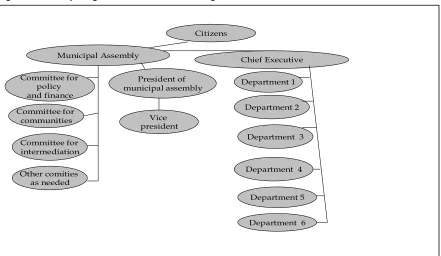
Fundamental changes in political and economic system are accompanied by a comprehensive reform of the legislation that deals with local government. Principles of organization of local government are given by the UNMIK regulation 2000/45 which has provided the legal basis of Self-Government18.
Figure 2.2. Municipal organization based on UNMIK regulation 2000/45
Citizens
Municipal Assembly Chief Executive
President of municipal assembly
Vice president Committee for
policy and finance Committee for
communities
Committee for intermediation
Other comities as needed
Department 1
Department 2
Department 3
Department 4
Department 5
Department 6
In 2007, UNMIK repealed the old Regulation on "Municipal Elections in Kosovo"19 and
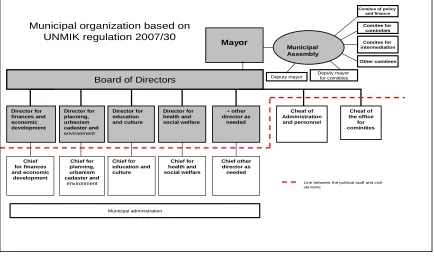
promulgated a new one which created the legal basis for holding direct elections for mayors and municipal assemblies. This led automatically to change the UNMIK regulation 2000/45. The regulation 2007/3020 was the new regulation that created the
legal basic for organizing functioning of the local government in Kosovo. Regulation 2007/30, changed the organization and structuring of local government in Kosovo. It intended to strength the authority of the Mayor as the highest executive body elected directly by citizens. The Mayor of the municipality acted also as Chairperson of the Municipal Assembly. Based on this regulation the Municipal administration consist of the Department of Administration and Personnel, the Department of Health and Social Welfare, the Department of Education and Culture, the Department of Finance,
18
UNMIK regulation 2000/45 on Local self government of municipalities of Kosovo
19
UNMIK Regulation 2007/27 on Local elections
20
Economy and Development, the Department of Urban Planning, Cadastre and Environmental Protection, the Municipal Community21Office and such other
[image:19.612.90.524.268.526.2]Departments as deemed necessary and appropriate to carry out the functions and responsibilities of the Municipality. Each Municipal Department had a Director appointed by the Mayor and was responsible for direction and management of the Municipal Department. This regulation foreseen that each Municipal Department comprising municipal civil servants have a Head recruited in accordance with the applicable law on the Kosovo civil service22.
Figure 2.2.1 municipal organization based on UNMIK regulation 2007/30
Mayor Director for planning, urbanism cadaster and environment
+ other director as needed Municipal Assembly Cheaf of the office for cominities Chief for planning, urbanism cadaster and environment Cheaf of Administration and personnel Director for finances and economic development Chief for finances and economic development Chief for education and culture Director for education and culture Chief for health and social welfare Director for health and social welfare
Municipal organization based on UNMIK regulation 2007/30
Comitee of policy and finance Comitee for cominities Comitee for intermediation Other comitees
Deputy mayor Deputy mayor for comitities
Board of Directors
Line between the political staff and civil servants
Chief other director as needed
Municipal administration
On June 15, 2008 entered into force the Constitution of the Republic of Kosovo23 as the
highest legal act of the country which are defined the general principles of local self-government and the organization and functioning of local self-government. Pursuant to the constitution the most important step towards the advancement of the competencies of the local government and increased local autonomy is considered to be the new Law on Local Self Government. This law has been the basis of the democratic functioning of
21
Article 29.1 of the regulation 2007/30
22
Article 29.5 of the regulation 2007/30
23
institutions at local level, based on the principles of European Charter for Local Self-Government.
2.3 Constitution of Republic of Kosovo
Chapter 10 of the constitution has defined the general principles of local governance as requiring that local self-government be explicitly regulated by law. Local government bodies should be elected directly by citizens in accordance with law. Exercise of the responsibilities of local authorities should be fully in accordance with the law and the European Charter of Local Self Government.
The constitution guarantees respect for the basic principles of local government which include good governance and the transparent, efficient, effective delivery of public services consistently for all citizens. The municipality remains the main unit of local government but has a higher degree of power and competencies. Article 13 of the Constitution of the Republic foresees that the Capital of the Republic of Kosovo, Prishtina, will have a special status and different organization. With the provisions of the Constitution (Article 124) is guaranteed the right of municipalities to cooperate with each other within their areas of competence, in order to perform the function of common interest in accordance with the principles of European Charter of Local Self Government. Also, municipalities have the right to cross-border cooperation and to enter into cooperative agreements within their own competencies and enhanced competencies. Administrative review of acts of municipalities will be covered by the central authorities, and is limited just to ensure the compliance with the Constitution and Law.
2.4 Law on Local Self-Government
The Law on Local Self-Government24 has XI chapters (90 articles in total). This law
defines the legal status of municipalities, the powers and principles of municipal finance, organization and functioning of municipal bodies, inter-municipal cooperation, including
24
cross-border cooperation and relations between municipalities and central government. This law also provides a one-tier system of local government with the municipality is defined as the main unit of local government, consisting of a community of citizens in a defined territory, as is foreseen by law, and shall exercise all powers which are not expressly reserved for the central institutions. Based on this law, the organs of a municipality are the Municipal Assembly and the Mayor25. Municipalities exercise their
own, delegated and enhanced competencies. Based on this law the Mayor of the Municipality shall be elected by a direct election in accordance with the law on local elections26 and the mayor doesn’t chair the municipal assembly. Also Directors of the
[image:21.612.93.532.349.594.2]municipal departments are appointed by mayor and there is no chief of department as it was foreseen with UNMIK regulation 2007/3027 (see figure 2.4).
Figure no 2.4 municipal organization based on Law on local self government
17 Chairperson
Municipal assembly
Deputy chairperson
(10 % e of communities)
C o m m it te e f o r c o m m u n it ie s O ther c o m it ie s legislative Mayor O the r de p a rt m e nt s as ne e d e d Excecutive
Director Director Director Director Director
C o m m it te e f o r pol ic y an d f inan c e C o n s u lta ti v e c o m iti e s Deputy mayor
(10 % of communities) Deputy mayor
Civil service of the municipality
D e pa rt m e nt 4t De p a rt m e n t 3 De p a rt m e n t 2 De p a rt m e n t 1 Chief of personnel
2.5 Law on Local Elections
25 Article 10 of Law on local self-government
26
Article 56 of Law on local self government
27
The Law on Local Elections in the Republic of Kosovo is an act to determine the organization and conduct of direct elections for local assembly members and for mayors. The issuance of this law results in strengthening local governance through permitting direct election by citizens. The law is designed in conformity with legal standards with the aim of establishing a stable functioning system of local government in the territory of Kosovo, in providing better conditions for all citizens of municipalities, improving the efficiency of public services. Regarding the Electoral system, each municipality is considered a single electoral area. A voter may vote only for one (1) political entity that is certified in the official list of candidates. Each certified political entity is required to present in an "open list" of candidates for each municipality in which the certified political party is contesting the election. Voters may vote for up to ten (10) candidates from the list of candidates of a single political entity. The distribution of seats in the municipal assembly is made according to a general formula set by law. The Law on Local Elections also defines criteria for candidates for mayor. Apart from other general conditions they must have been a municipal resident for at least (3) years. The candidate is elected as Mayor if he wins more than 50% plus one (1) vote of the total valid votes. If no candidate wins more than 50% plus one (1) vote of the total valid votes cast in that municipality, the CEC organizes a second round of elections between the two candidates who received the most valid votes. The candidate who receives the most votes in the second round is elected Mayor. The mandate of the Municipal Assemblies and Mayors ends in the same month in the fourth year after the date of regular elections. The Mayor and members of the Assembly may not be members of any other elected body. Local elections are set and announced by the President of Kosovo, after consultation with political parties. Elections to local self-governing bodies are held on a Sunday every four (4) years. Final election results are certified by the Central Elections Commission.
Other issues that are foreseen in the law respecting international standards are:
• Right to vote,
• Code of Conduct for political parties,
• candidates and their supporters; elections
• costs for local branch
• announcement of elections and events;
• campaigns for political
• media during the election campaign,
• observers;
• election
• Central Elections Commission;
• municipal election commissions;
• advice of polling;
• the polls;
• voting abroad;
• vote of persons with special needs;
• process of counting ballots and election results;
• announcement of elections
• informing the voters and the media, and commission for complaints and appeals.
2.6 Law on Municipal Boundaries
Law for the administrative boundaries of municipalities regulates the territorial organization of local self-government in the Republic of Kosovo, establishes new municipalities, delineates the territory of a municipality as the unit of local self-government, defines the administrative municipal boundaries, names and residencies of the municipalities, sets forth the provisional arrangements between the existing and new municipalities established under this law, as well as defining the procedures for alteration of administrative municipal boundaries28
1. Deçan 2. Gjakovë 3. Gllogoc 4. Gjilan; 5. Dragash 6. Istog 7. Kaçanik 8. Klinë
9. Fushë Kosovë
10. Kamenicë 11. Leposaviq 12. Lipjan 13. Obiliq; 14. Rahovec 15. Pejë 16. Podujevë 17. Prishtinë 18. Prizren 19. Skënderaj 20. Shtime; 21. Shtërpcë 22. Suharekë 23. Ferizaj 24. Viti 25. Vushtrri 26. Zubin Potok
27. Zveçan
28. Malishevë
29. Novobërdë
30. Mitrovicë
1. Junik 2. Hani i Elezit
3. Mamushë 1. North Mitrovica 2. Graçanicë 3. Ranillug 4. Partesh
5. Kllokot +
6. Extended
[image:25.612.106.520.77.513.2]Novobërda
Figure 2.6.1 List of the Fig 2.6.2 Three PMU-s created by Figure 2.6.3 Five +1 new created
Municipalities UNMIK Administrative Municipalities by law on Regulation 200/43 Order on 2005 municipal boundaries
The law on municipal boundaries foresees that establishment of new municipalities, merger, separation, alteration of administrative municipal boundaries, and delineation of the name or residency of the municipality shall be effected through a revision or amendment of this Law. The administrative boundaries of municipalities shall not be altered prior to consultation with citizens of municipalities or parts of municipalities affected by such alteration29, The Territorial
Organization of Local Self-Government is foreseen by law on municipal boundaries30. (see figure no.2.6.1)
2.7 Law on local finances
The law guarantees the independence of local finance in accordance with national economic policies and considering fiscal sustainability of municipalities and the Government of Kosovo. The law creates a solid foundation for the independence of the municipal budget and categorizes the sources of municipal financing. Based on this law, Kosovo municipalities shall be entitled, within national economic policy and having due regard for the municipalities and the central government fiscal sustainability, to adequate
29
Article 9 of the Law on Municipal boundaries
30
financial resources of their own that they may dispose of freely in the discharge of their municipal competencies in accordance with the applicable laws of Kosovo31. This law
[image:26.612.92.523.223.584.2]guarantee the municipal autonomy, consists of municipal financial recourses; Categories of Own Source Revenues; Charges, Rents, Fines and Co-Payments and Other Own Source Revenue; governmental grants and other institutional provisions. Below is a table which shows the balance of municipal expenditures for the years 201032.
Figure no 2.7 “Municipal expenditures for 2010”
Graphical overview of municipal expenditures for 2010
98 96
93 94 96
74 95 97
90 91 92 96
94 96 96 95 92 84 98 98 93 93 87 97
94 94 96 97 93 99 97 88 97 Gllog ovc Fus hë K
osov ë Lipj an Obi liq Podu jevë Pris htin ë Shti me Dragas h Priz ren Raho vec Suhar ekë Mal ishev ë Deça n Gjak
ovëIstog Klin ë Pejë Lep osav iq Mitro vicë Skende raj Vusht rri Zubi n Pot ok Zveç an Gjila n Kaç anik Kam enicë Nov
o Bër d
Shtë rpcë
Fer izaj Viti
Juni ku Mam usha Hani I El ezit 31
Article 2 of the Law on Local Finances
32
3. REFORM OF LOCAL GOVERNMENT AND DECENTRALIZATION IN KOSOVO - OPPORTUNITIES AND CHALLENGES
The decentralization process is associated with other important political developments in the country, namely the independence of Kosovo on February 17, 2008. With the proclamation of Kosovo as an independent, sovereign and democratic state, the Assembly has expressed commitment to implement the Comprehensive Proposal for Kosovo Status Settlement33, which is incorporated in the Constitution and national
legislation of the Republic of Kosovo34. In this chapter will be treated the political aspect
of reform and decentralization and the administrative aspect of the reform and decentralization
3.1 Political aspect of reform and decentralization
Kosovo has inherited the system of local self-government from ex-Yugoslavia, as it was part of it until 1999. Since the establishment of international administration until now, Kosovo has gone through a long process of reform of local government and decentralization. From time to time, decentralization and reform of the power of local authorities has been used as a tool that ensures integration of communities and it has consistently been the subject of negotiations in attempts to resolve the final status of Kosovo. However, after this period, after the declaration of independence of Kosovo, decentralization has played a key role in efforts to integrate the Serb community in social and institutional life. Even further, decentralization remains one of the main issues following the new state because, especially in the north part of the country, the Serb minority is unwilling to accept the decentralization plan, and one new municipality for their benefit is still only partly completed.
33
Ahtisaari document
34
In another aspect, the decentralization process was followed with the transfer of powers and responsibilities to municipalities guaranteed and defined by Regulation 2000/4535. Based on this Regulation, the municipalities were obliged, inter alia, to deliver
the social services, housing, primary health care to urban planning and public services, including emergency and fire services36. In addition to these powers, municipalities can
also take action in relation to other matters of interest to the municipality, such as tourism, culture, sports, youth activities and economic and civic promotion37.
Responsibilities of local government were expanded into areas that reflect directly on the services they provide to citizens, including competence in the field of preschool, primary and secondary education, primary health service, local economic development, planning and rural development, public housing, naming of streets and public squares, and other municipal services.
Some years later, in the wake of efforts to reform local government, decentralization was used as a tool that helps in reducing ethnic tensions in Kosovo after the war. At the request of the Presidential Declaration addressed through the Security Council on April 30, 2004, was established a Working Group on Local Governance co-chaired by UNMIK and the Provisional Institutions of Self Government in Kosovo. The resulting ‘Framework Document’ aimed at a better local governance for all citizens of Kosovo, to show more power transferred to municipalities, to create a line of demarcation between the powers of central and local level, to create an effective system of oversight of legality in municipalities, creation of new municipalities as pilot projects on the basis of ethnic composition, and increasing citizen participation in decision-making processes. Meanwhile, in the wake of efforts of the central government, within its organization to have a structure that would be responsible for local government, the Ministry of Local Government Administration was established. This ministry is responsible for matters relating to the promotion of effective local government.
35
UNMIK regulation 2000/45 on local self government of Municipalities of Kosovo ( 11 August, 2000)
36
See article 3 of the UNMIK regulation 2000/45
37
In 2005, the idea for the creation of some pilot municipalities, within the existing territory of the municipalities materialized when UNMIK issued an Administrative Order for Pilot Projects. According to the Administrative Order it was foreseen to establish five pilot municipal units specifically Junik, Hani i Elezit, Partesh, Graçanica and Mamusha. Two of these with a majority Serb population (Partesh and Gracaniça) were not realized because of their refusal.
In 2006, the process of local government reform and decentralization was the topic of discussion at the negotiating table in Vienna, when the Kosovo institutions have begun negotiations to define the final status of Kosovo. The international community insisted in creating several Serb-majority entities as this seemed like an opportunity for their integration.
Later on, in 200738, is considered to be the main step of speeding the local government
reform in terms of developing a genuine local democracy. For the first time, the mayor was elected directly by citizens. Election to the municipal structures arises as a result of the election system with open lists for the Municipal Assemblies and the direct election of mayors by citizens. There is a strong mayor with executive powers and at the same time a municipal assembly which is voted through the open lists. The political aspect of local government reform and decentralization extended to the creation of new municipal structures.
In 2009, were held the first elections after the independence of the state. Through this elections were created new municipalities: Gracanica, Rranillug, Kllokot and expanded Novo Bërdë. Progress in the establishment of new municipalities has continued with the municipality of Partesh. On June 2010, were successfully held the local elections for the new municipality of Partesh39. New municipalities (Gracanica, Ranillug and Kllokot)
have adopted the necessary legislation to continue their work. Municipalities have also organized their administration and have completed their staff. By October 2010, the process of hiring staff in these municipalities was over 70% complete and meets their
38
UNMIK regulation 2007/27 on local election
39
needs depending on the management of these municipalities. These new municipalities have their budgets and documentation was systematically transferred from ‘mother’ municipalities. The municipalities of Gracanica, Kllokot, Ranillug and Novo Brdo received most of cadastral documentation, property tax records, financial records and registry entries from the Municipalities of Pristina, Fushë Kosova and Lipljan, Gjilan, Viti and Kamenica respectively. On the other hand, even though there is considerable progress in establishment and functionalizing the new municipalities, there has not been enough progress in creating the new municipality of Mitrovica North. Because of the tense situation and ethnic problems, the ongoing process of creation of this municipality is still facing with difficulties. Sometimes the integration of Serb minorities through the decentralization process seems to be in doubt. Three existing northern municipalities, Leposaviq, Zubin-Potok and Zveçan, have no collaboration with the Kosovo authorities. On the question of whether respondents are satisfied with decentralization, in only 7 percent of cases the answer is yes, 71 percent say no and 22 percent say not enough. From discussions with focus groups, the respondents say that decentralization has isolated Serbs and put barriers to their integration, concentrating them only in certain territories, and limiting their participation in the political and social life throughout the territory of Kosovo.
Figure 3.1 “Are you satisfied with decentralization” (Capstone project questionnaire, January 2011)
Are you satisf ied w ith decentralization?
7%
22%
71%
yes
no
On the other question, if decentralization in political terms has improved interethnic relations, the answer was slightly better in 56 percent of cases, 24 percent had not noticed any change, 17 percent are of the opinion that there are definitely no changes and just 3 percent of the respondents think that this process has had a positive effect.
Figure 3.1.2. “Has the decentralization process improved the interethnic relations?” (Capstone project questionnaire, January 2011)
Has the decentralization process improved interethnic relationship?
3%
56% 24%
17%
very positively a little better no changes definitely not
3.2 Administrative aspect of the reform and decentralization
Administrative aspects of reform in terms and conditions of a normal functioning of a state should have the right proportion among three main components:
• The number of municipal officials • Territory
• Population
for the administration expenditures, while providing very small percentage of revenue from taxes and fees, as own revenues. This indicates that smaller units with their budget just manage to keep the administration, but struggle to meet the minimum essential public services. Kosovo is a small country, around 10,887 km2. A large number of local government units may be a burden on the poor budget of the country. Currently, the total number of units of local government is 3840. However, it seems that the existing
[image:32.612.91.524.361.553.2]number of municipalities will be increased, because other communities have already distributed their requests. In this regard, when the respondents have been asked, if Kosovo needs a larger number than 38 municipalities answer was as follows: 36% of respondents answering no, 39% of respondents think that this should be done through a consultative process, 14% answer as is prescribed by the European Charter, while only 11% respond yes.
Figure 3.2 “Do you think that Kosovo needs more than 38 municipalities?” (Capstone project questionnaire, January 2011)
Do you think that Kosovo needs more then 38 municipalities?
11%
36% 39%
14%
yes no
through preconsulting process based in EU Charter
14
In addition, one of the key components for the effective functioning of administration and local government reform is also the professionalism of the staff of the Municipal Administration. If we consider that in rural areas the level of education is lower and given the experience with the PMUs41 where there were difficulties in recruiting
professional staff, we can conclude that the low level of professionalism can bring about a reduced quality of work of the local administration, at a time when the demands of
40
Law on Municipal boundaries
41
decentralization is deepening. Thus, we can see the risk from the number of new municipalities that have lower populations and a large percentage of administrative staff without higher education. This phenomenon has limited options for selecting the professional staff of the municipal administration of new units that are located in rural areas with a small population. On the other hand, if we start from an assessment of the real situation in the field the level of capacities of municipalities in general is in a medium level. Even though most of them have tradition, the lack of capacities is evident especially in the following areas: communication, strategic planning, public utilities, human resource management and local finances42. The new approach of the reform
should move in the opposite direction to the creation of new municipalities with a significant ethnic element. Size has an important and complex impact on the capacity of local and regional authorities to function and perform their tasks as well as on the effectiveness of local and regional democracy. Efforts are rightly focused on achieving the optimal size, however there is no standard optimal size applicable to all situations. The optimal size is dependent on factors such as the distribution of competences between levels of government, the degree of financial autonomy and the existence of financial equalization systems. In the case of Kosovo, the establishment of new municipalities should take into account criteria such as the number of inhabitants of the municipality. For example a minimum of 7000 to 8000 inhabitants, the suburban residence distance from the center of the unit is less than 20 km, the traditional historical-geographical connection is respected, etc. Principles on which the community must rely on the creation of new municipalities should be efficiency and effectiveness, functionality and stability, subsidiarity, citizen’s participation and consultation; these principles will ensure local self-functionality and sustainability43. According to an analysis
of the Ministry of local government administration in relation to services provided per capita in the municipality appears to have a total disproportion and numerically can reflect as follows: in Novobërda the number of administrative staff that provide services total one employee for 69 inhabitants, and in Prizren, a worker provides for 711 inhabitants (see the table below).
42 Capacity Assessment Report of the Municipalities, published by Ministry Of Local Government Administration, year
2009
43
Figure 3.3 Number of the municipal staff based on the approval budget for 200844
44
Evaluation of the municipal staff based on the approval budget for 2008, published by Ministry of Local government Administration
No. Municipalities Population
number of municipal staff, conform the approval budget for the year 2008
number of municipal staff toward the number of inhabitants
1 2 3=1/2
1 Gllogoc 60,000 140 428.57
2 Fushë Kosovë 35,000 136 257.35
3 Lipjan 75,000 186 403.23
4 Obiliq 26,000 92 282.61
5 Podujevë 117,000 221 529.41
6 Prishtinë 400,000 678 589.97
7 Shtime 28,000 85 329.41
8 Dragash 35,000 128 273.44
9 Prizren 214,963 302 711.80
10 Rahovec 63,000 163 386.50
11 Suharekë 80,000 156 512.82
12 Malishevë 52,000 155 335.48
13 Deçan 38,240 114 335.44
14 Gjakovë 115,000 269 427.51
15 Istog 44,000 138 318.84
16 Klinë 44,000 139 316.55
17 Pejë 115,000 305 377.05
18 Leposaviq 19,000 118 161.02
19 Mitrovicë 110,000 376 292.55
20 Skenderaj 56,000 190 294.74
21 Vushtrri 75,000 223 336.32
22 Zubin Potok 15,000 126 119.05
23 Zveçan 16,000 63 253.97
24 Gjilan 110,000 271 405.90
25 Kaçanik 32,861 111 296.05
26 Kamenicë 55,000 184 298.91
Although the Government of Kosovo, has made an effort to determine the criteria for the size of municipal administration the decision has still not been implemented. The governmental decision brings two (2) criteria:
(I) basic criteria: - that all municipalities regardless of their size, based on obligations arising from the operation of their legislation need a minimum staff of 55.
(II) A ratio of staff to municipal size
Unfortunately the specific ratios proposed in the decision are confusing, however, considering the text of the decision and the included illustrative table, the proposed number of staff would seem to be that for municipalities with more than 100,000 inhabitants there should be 1 administrative officer to serve 750 citizens except Pristina that should have 1 for 1,000 citizens. Municipalities that have fewer than 100,000 inhabitants should have 1 administrative officer to serve 620 citizens.
Staff calculated according to the supplementary criteria, is available to the relevant municipal authorities, to allocate according to local municipal policy goals, priorities, etc.45.
If you do an analysis of the EU practices today, we see as a tendency of the European Union member states and candidate countries to decrease the number of administrative units. A reform in relation to the reduction of local government units is made by a number of Balkan countries. In this respect Greece some years ago, has made a substantial reduction of administrative units. The Czech Republic46 and Slovakia during
the last decade have reduced 50% the number of local units.
45
Government decision on the criteria’s of the municipal staff no. 10/45, date 03.12.2008
46
http://publius.oxfordjournals.org/cgi/content/abstract/34/1/35
28 Shtërpcë 11,000 69 159.42
29 Ferizaj 111,000 243 456.79
Experiences of countries that have carried this reform show that there is not a universal model that can be exported to be implemented; this means that territorial reform is more an “political compromise” than a science that can be applied equally everywhere.
During the last three decades most European countries have passed through a politico-administrative reorganization. Decentralization and territorial politico-administrative reforms have been the dominant patterns of these reforms. Within the process of reorganization have passed almost all older member countries of the EU and other new member countries (such as the Czech Republic, Poland, Slovakia) in order to adapt to the reform policies in the EU). In the case of Kosovo, in addition to the aforementioned elements in the process of government reform and implementation of decentralization, should be reconsidered also the creation of new municipalities.
4. DECENTRALIZATION, THE CASE OF KOSOVO
The idea to promote decentralization, did not happen spontaneously, but rather was politically motivated. All was materialized with the comprehensive document for the final settlement of the status of Kosovo (the Ahtisaari document)47. There were many
[image:37.612.92.521.383.660.2]controversies at that time and there was an impression that decentralization was a process that favored only the Serb community. This can be seen from the responses of respondents: 70 percent said that they think that the Serb minorities benefited through this process, 20 percent think that all citizens benefited, 6 percent said do not know and 4 percent think that from this process benefited the governmental officials.
Figure 4. “Who do you think benefits from the decentralization?” (Capstone project questionnaire, January 2011)
Who do you think benefits from the decentralization?
20%
4%
70%
6%
citizens
government officials
ethnic groups
don't know
47
On the other hand, a complex situation was the extent of sovereignty in the north of the country. Whilst we had the situation of three municipalities with Serbian majority which have no communication with the central government in Prishtina, and are outside of the jurisdiction of the state of Kosovo, based on the respondents opinion could be considered that there was no need to create new entities within the territory to integrate the Serb community into social and political life. As a bad example of no collaboration of the three municipalities in the north (which claim territorial autonomy as expressed by an assembly held at one of the municipalities in the north) at the same time to create new structures across the country was very confusing for citizens. One aspect of this was that even Albanians refused to be part of this process. We have the case of Gjilani municipality where some citizens should now travel for 22 kilometers for services, instead of two kilometers to reach services in Gjilan municipality, because with the new division of the territory they are part of the municipality of Novobërdë.
Decentralization under normal circumstances is considered a long term process and evaluation of the advantages and results requires longer period of time. Decentralization is a multidimensional phenomenon and includes a wide range of changes deriving from transfer of competencies, respectively, transfer of authority and responsibility from central to local level.
Responsibilities of local authorities are continuously expanding into areas that reflect directly on the services they provide to citizens, including additional powers in the fields as follows:
• preschool, primary and secondary education;
• Primary Health Service;
• Local Economic Development,
• Planning and rural development;
• Public Housing;
• Naming of streets and squares, and
Recently, with the approval of the legislative package in the field of local government, there is thrown another step towards the transfer of responsibilities and powers, but the achievement of goals and targets is very challenging. Another important element is the institutional commitment towards capacity building at local level. This introduces a problem when we consider that the treatment and professional capacity building in municipalities is done without any coordination between local institutions and donors.
In addition, the process of decentralization should go hand in hand with the strengthening of fiscal autonomy. The new law on local finances of the Assembly of Kosovo enables the necessary resources needed by the local government to exercise its functions. However, we are dealing with an area that needs ongoing systematization and requires extensive involvement of local communities on issues of governance, tax collection rates and fiscal policy in correlation with the capacity and local economic development parameters. The data shows that even the states with a strong economic position and high democratic participation reach the highest percentage of local budget for municipal administration in comparison to with the overall public spending (some over 30%48) as illustrated below:
- Switzerland 27.9% - Denmark 31.28% - Finland 29.5% - US 32.0%
The current figure for Kosovo is 24.9%
An important aspect concerning decentralization as part of reform remains absolutely coordination and cooperation with major donors to implement their programs. In this regard, the World Bank and other interested partners, national and international, may be involved in implementation of the decentralization process with special focus on assistance to municipalities in the development of management capacity to successfully take over new responsibilities.
48
If we consider that decentralization improves governance qualities in terms of efficiency as well as in strengthening accountability, increasing transparency and involvement of citizens and communities in governance, the project for local government reform should be in full compliance with the Charter European Local Self Government.
There is an inevitable tension between economic efficiency and decentralization. The closer you get to citizen participation in smaller units you get further away from the efficient scale of larger units. It can be illustrated that the socialist states represent a high level of economic efficiency, however, the exclusion of the mass of people from participation in decision making has (demonstrably in Eastern Europe) led to a complete collapse of the system, including economic collapse. The ‘ideal’ is a balance between small units (high decentralization) that allow people to be involved, and efficiency (in the use of scarce financial resources).
In upcoming years the program of local government reform will focus on the following components:
Fiscal autonomy of municipalities that will change and improve collection of their own taxes and fees. At the same time transfers from the consolidated budget is transparent, objective, based on analytical formula and based on performance criteria of the municipalities in relation to the provision of citizen services;
Territorial boundaries and administrative units as established by law;
The creation of new municipalities to be based on democratic and functional criteria, excluding an ethnicity based element;
Management and transfer of public utilities, social and cultural and public property;
Exercise of powers in education, health, social services, primarily based on the coordination of activities, partnerships, decentralization and deconcentration of power, in relation to central government.
Finally, the decentralization process aims to provide decision-making closer to citizens, the expansion of local autonomy, including the expansion of powers in many areas. But, to all these above mentioned elements of decentralization, in the case of Kosovo is added another component that is based on a comprehensive plan for Kosovo's status, addressing the specific concerns of non-majority communities49. This is a main reason
that in the future, when Kosovo has fulfilled all the obligations regarding the international community in the name of independence, to revise this system and to establish another system based in the principles of the local democracy.
49
5. IMPLEMENTATION OF THE PLAN OF ACTION ON DECENTRALIZATION
On 2008, after the entry into force of the legislative package for Local Government was opened the way for implementing the decentralization process in Kosovo. In this case, with the proposal to have a comprehensive coordination of all activities was approved an action plan on implementation of decentralization in Kosovo. In the action plan is reflected the strategic goal of the Government to establish a stable and effective system of local government throughout the territory, which will provide better conditions of living for all its citizens by appropriate attention to special needs of non-majority communities in Kosovo50.
The Decentralization Action Plan was approved by the Government and based on it was established the Inter-Ministerial Group on Decentralization (IGD), composed of most of the Ministers of the Government. This governmental body is responsible for coordinating the government policies in implementing the decentralization process in the Republic of Kosovo. The mandate of the IGD was set by the Decision of the Government51. This group is co-chaired by the Ministry of Local Government
Administration and the International Civilian Representative Office in Kosovo. Within the inter-ministerial group on decentralization, the action plan 2008 operated five working subgroups: Subgroup to Reform Legislation; subgroup for Transfer of Competences and Resources; subgroup for Establishment of New Municipalities; Subgroup on Capacity Building and Donor Coordination and Subgroup on Information Campaign for Decentralization.
Working group on the Reform and Legislation has treated entire existing
legislation and has given recommendations for harmonization of new laws relating to local government. This group has compiled a list that identifies collision of laws,
50
Action Plan on decentralization
51
especially with the Law on Local Self-Government. This group has made proposals for amending laws where it is seen as necessary, and depending on the sectoral areas has created functional committees from the field of education, culture, youth, sports, health; committee for administration, security and social welfare; committee for finance, economy, trade, industry, energy and mining; committee for urbanism, cadastre, agriculture, spatial planning and environment.
Working group on Establishment of New Municipalities, the main task is the
establishment of new municipalities and leading the process towards the establishment of new municipalities, as an essential part of a comprehensive plan for resolving the Kosovo’s status, which is incorporated in the Law on Local Self-Government, at the part of extended competences and implementation of the Law on Administrative Municipal Boundaries, namely, establishment of 5 new municipalities and 1 extended municipality with a Serbian majority, as foreseen in the Comprehensive Plan for Kosovo status settlement (Ahtisaari document). The group has analyzed the financial costs for the establishment of new municipalities and in the fourth meeting of the IGD has presented the document "Guidelines/description of duties for the establishment of municipal preparation teams and new municipalities”. In July 2008 were established Municipal Preparation Teams which have as a main task to provide preconditions for establishment of new municipalities in order to be prepared and to be ready to be led by municipal elected officials immediately after new local elections.
Working group on the Transfer of Competences and Resources, immediately
transferred to municipalities as provided by law, while the group has coordinated all activities in relation to MEF and municipalities. In 2008, also in the field of social services competences, in cooperation with the MLSW were made all preparations and coordination of all activities for the transfer of this competence from the Ministry to the Municipality. Municipalities have exercised these competences by early 2009. During 2009, similar focus groups were formed in fields of culture, health and business registration, management of public transport enterprises, cadastre, forestry, which according to an agenda are being transferred to municipalities. In October 2009, the management of theaters and libraries were transferred to the competence of the municipality. We can consider that the process of transferring of own competencies to municipalities has been closed. There are some other issues to deal with the delegated competencies. Then in further years, based on the Law on Local self government, should start the process of transferring enhanced competencies.
The Working group on Capacity Building and Coordination with Donors in its
composition has created three other subgroups: working sub-group on capacity building; sub-group on infrastructure; and working sub-group on coordination with donors. The work of this working group is focused on three components: the development of capacity for existing municipalities, in strengthening the capacity of pilot units and, municipal capacity building in the new municipalities.
In this regard are prepared relevant documents, such as assessment of capacities of existing municipalities, based on which were made concrete plans for professional capacity building of municipal officials; plans for PMU capacity building and capacity building plans for new municipalities. Simultaneously these documents were presented in front of the donors, in order to accomplish coordination of activities with training providers, various donors involved in capacity building on the one side, and coordination with donors in terms of investment, towards implementation of decentralization, on the other side.
The Working group on Information Campaign throughout the entire process has
relevant and the right information related to decentralization as part of local government reform. Through the information campaign is affirmed the process of local government reform where the citizens are informed about the territorial reorganization of municipalities, establishment of new municipalities, and recognition with new legislation that created the basis for implementation of the decentralization process. This subgroup, through print and electronic media, has launched information and has organized debates with various key players in the process, in terms of informing the citizens.
The original Decentralization Working Group and all other subgroups that were part of its mandate ended in 2010 and then with the decision of the new Government of Kosovo52 the mandate of this group was continued until 2012. Under the new
Government decision, some groups were merged and were created four new working subgroups: Subgroup for Establishing New Municipalities; subgroup on Legislation and Transfer of Competencies: Subgroup on Capacity Building and Donor Coordination, and the subgroup for informational campaign.
5.1. Legislation reform, challenges
Implementation of the new legislative package was challenged in the early days of its implementation. New legislation on local self-government of municipalities was passed when the municipalities were at the beginning of a new mandate, had constituted their bodies, and were on the way to approve revised statutes, based on UNMIK regulation 2007/30. Whilst local elections were held in late 2007, in the first half of 2008 the new legislation came into force and municipalities had to implement this legislation. They were obliged for a very short period of time to adopt their statutes and to choose the chairperson of their assemblies. This led municipalities to a confusing situation. The new law on local self-government had a retroactive effect, with obligations to the municipalities. Through this process they had to adopt new statutes, and were in the difficult position to absorb a large set of new municipal competencies. Some
52








![An assessment of road traffic safety in Kosovo : {presentation given on September 6, 2011]](data:image/gif;base64,R0lGODlhAQABAIAAAP///wAAACH5BAEAAAAALAAAAAABAAEAAAICRAEAOw==)