City, University of London Institutional Repository
Citation
:
Pettinicchio, A.K. (2011). Auditing and Regulations. (Unpublished Doctoral thesis, City University London)This is the accepted version of the paper.
This version of the publication may differ from the final published
version.
Permanent repository link:
http://openaccess.city.ac.uk/11662/Link to published version
:
Copyright and reuse:
City Research Online aims to make research
outputs of City, University of London available to a wider audience.
Copyright and Moral Rights remain with the author(s) and/or copyright
holders. URLs from City Research Online may be freely distributed and
linked to.
Auditing and Regulations
Supervisors:
Gilad Livne
Miles Gietzmann
Angela Kate Pettinicchio
Faculty of Finance
Thesis submitted August
2011
~
Cass Business School
Table of Contents
1. Introduction ... 11
1 .1 Background ... 11
1.2 Empirical Studies ... 15
1.3 Structure of the thesis ... 18
2. Audit Regulatory Choices ... 21
2.1.1 Self-regulation ... 22
2.1.2 Direct Intervention ... 26
2.1.3 The focus of this thesis ... 28
3. Institutional background ... 31
3.1 The mandatory rotation rule: application around the world ... 31
3.1.1 Italy ... 31
3.1.2 The European Union ... 36
3.1.3 The United States ... 3 8 3.1.4 The rest of the world ... 41
3.2 Arguments supporting and contrasting the mandatory rotation rule ... .42
3.2.1 Audit firm level ... 42
3.2.2 Audit partner level ... 44
3.3. SEC comment letters ... 46
3.3.1 Section 408 Sarbanes Oxley Act.. ... .4 7 3.3.2 Comment letter process ... 49
3.3.3 Contents of comment letters ... 55
3.3.4 Examples of comment letters ... 60
4. PAPER I: Partner mandatory rotations versus firm mandatory rotations: Evidence from Italy ... 70
4.1 Introduction ... 70
4.2 Literature Review ... 75
4.2.1 Audit firm level. ... 75
4.2.2 Audit partner level ... 80
4.3 Hypotheses development ... 82
4.4 Data and methodology ... 88
4.5 Main results ... 93
4.5.2 Empirical results ... 94
4.6 Additional analyses and robustness tests ... 97
4.7 Conclusions and limitations ... 1 00 4.8 Tables ... 102
5. PAPER II: Mandatory Auditor Rotation, Accounting Conservatism and the Mandatory Adoption of IFRS ... 116
5.1 Introduction ... 116
5.2 Hypotheses development ... 122
5.2.1 Auditor rotations and reporting conservatism ... 122
5.2.2 Auditor tenure and reporting conservatism ... 123
5.2.3 External demand for TLR: leverage, firm size and market-to-book ... 124
5.2.4 IFRS vs. domestic Italian GAAP ... 125
5.3 Data and methodology ... 127
5.4 Main results ... 13 0 5.4.1 Descriptive statistics ... 130
5.4.2 Pooled regressions ... 131
5.4.3 Rotations and the role of client firm leverage, size and market-to-book ... 132
5.4.4 Audit firm rotations, tenure and the adoption ofIFRS ... 134
5.4.5 Additional analyses ... 136
5.5 Conclusions and limitations ... 13 7 5.6 Tables ... 140
6. PAPER III: An Analysis of External Auditor Fees Following Sec Comment Letters ... 153
6.1 Introduction ... 153
6.2 Literature Review ... 155
6.2.1 The audit fee literature ... 155
6.2.2 Prior research on SEC comment letters ... 157
6.3 Principal Hypotheses ... 15 8 6.4 Data sources and model specification ... 161
6.5 Empirical Results ... 162
6.5.1 Levels Analysis ... 164
6.5.2 Persistence Effects ... 165
6.5.4 Sensitivity Checks ... 167
6.6 Conclusion ... 168
6.7 Tables ... 171
7. Conclusions and future research ... 187
7.1 Empirical findings ... 187
7.2 Comments to empirical findings ... 188
7.3 Future research ... 189
8. References ... 193
8.1 Academic references ... 193
8.2 Legislative references ... 205
8.2.1. Italy ... 205
8.2.2. European Union ... 205
List of Tables
CHAPTER 4
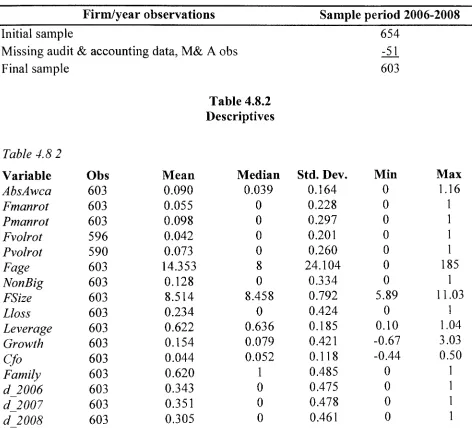
Table 4.8 1: Sample Composition ... 102
Table 4.8 2: Descriptives ... 102
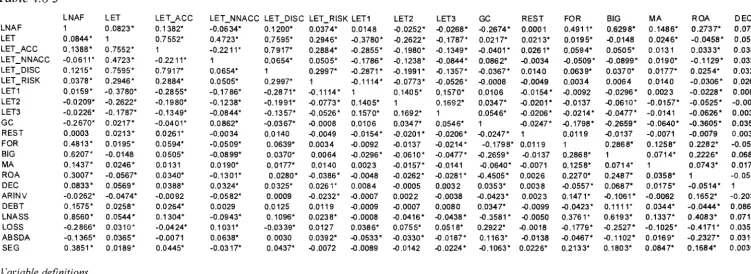
Table 4.8 3: Correlations ... 104
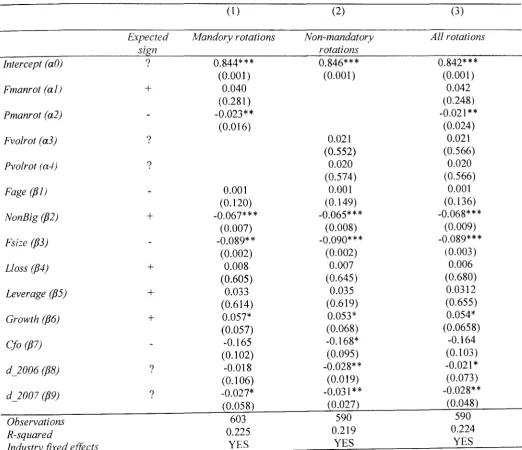
Table 4.8 4: Regression of absolute abnormal working capital Accruals on auditor rotations ... 105
Table 4.8 5: Regression of absolute abnormal working capital Acrruals on auditor rotations considering task complexity and demand for audit quality ... 107
Table 4.8 6: Regression of absolute abnormal working capital Accruals on auditor rotations and auditor tenure ... 109
Table 4.87: Regression of absolute abnormal working capital Accruals on auditor rotations excluding non-Big audit firm ... 111
Table 4.8 8: Regression of absolute abnormal Accruals on auditor rotations ... 113
CHAPTER 5 Table 5.61: Sample Composition ... 140
Table 5.6 2: Descriptive Statistics 1990-2008 ... 140
Table 5.6 3: Correlatios ... 142
Table 5.6 4: Firm Rotations, Firm tenure and Timely Loss Recognition ... 143
Table 5.6 5: Mandatory Audit Firm Rotations in 1990-2008: Leverage, Firm Size, Market-to-Book and Timely Loss Recognition (regression of changes in earnings on lagged changes in earnings) ... 145
Table 5.6 6: Firm tenure in 1990-2008: Feverage, Firm Size, Market-to-Book and Timely Loss Recognition (regression of changes in earnings on lagged changes in earnings) ... 146
Table 5.6 8: Finn tenure in 1990-2008: Leverage, Finn Size, Market-to-Book and
Timely Loss Recognition (regression of accruals on cash flow operations) ... 149
Table 5.6 9: Mandatory Audit Finn Rotations, Firm tenure, adoption of IFRS and Timely Loss Recognition ... 150
CHAPTER 6 Table 6.71 Panel A-Panel B:Yearly and industry relative distribution on comment letters ... '" ... 171
Table 6.7 2: Descriptive Statistics ... 172
Table 6.7 3: Correlation Matrix ... '" ... 173
Table 6.7 4: Effect of SEC Comment Letters on Audit Fees ... 174
Table 6.7 5: Effect of SEC Comment Letters on change in Audit Fees ... 176
Table 6.7 6: Effect of SEC Comment Letters on Non-Audit Fees ... 178
ACKNOWLEDGMENTS
My first acknowledgment goes, of course, to my supervisors Gilad and Miles, not only for their academic support, but also for their practical and personal encouragement throughout my PhD period.
Thank you to my parents for their great support and to Luigi and Sabine, who always showed (and for sure often pretended) high interest in my work, even in my highest moments of research speculation.
Auditing and Regulations
Abstract
Effective financial reporting has become of critical importance in our economic markets and the international accounting scandals of the last decades have accentuated the role of auditing in protecting stakeholders' interests and contributing to an efficient functioning of financial markets.
Auditing regulation has been at the centre of recent international debates (e.g. EU Green paper; 2010) and different regulatory interventions have been put in place in different countries and in different periods of time.
From a theoretical point of view, there is a broad spectrum of regulatory choices that legislators could take, the extremes being self-regulation and government direct interventions.
My empirical works focus on two extreme examples of how regulation may interact with auditing processes with the ultimate objective of improving financial information and therefore enhancing the effectiveness of financial markets.
In one case, I analyze whether an example of enforced audit self-regulation is effective in improving audit quality and ultimately, reporting quality. In particular, I analyze the mandatory audit rotation rule, i.e. the rule imposing the change of the auditor after a specified period of time, as a potential means to increase auditor independence and therefore audit and reporting quality.
I then study a case of direct monitoring activity on reporting quality carried out by a supervising body, namely the SEC in the U.S., and how this interacts and influences audit processes.
CHAPTER ONE
1.
Introduction
1.1
Background
The communication about effective information of organizations' levels of
performance has become of crucial strategic importance in our economic markets.
Investors base their investment decisions on companies reporting, and so in general do
financial institutions and creditors when deciding lending strategies. Other users of
financial information include tax authorities, costumers, competitors etc .. A conflict of
interest arises in all these cases as the reporting organizations have incentives to distort
information in their favour in order to enhance their position in the contractual exchanges
between the parties (Mookherjee and Png, 1989).
Moreover, the reporting entity typically holds a higher amount of information
compared to external users, and could use this disparity to pursue its own interests,
potentially creating harmful externalities to the market. The presence of information
asymmetry in contractual exchanges has been defined as one source of market failure
(Cooter and Ulen, 2008). Taking the example of Akerlof (1970) in his famous work "the
market for lemons", the buyer of a car does not know beforehand all the latent defects.
Therefore purchasers may end up paying too much for cars of low quality or refraining
from purchases because of a fear of latent defects. Similarly, investors are often at a
disadvantage in learning the true performance of a company and this could lead financial
markets not to work in a socially optimal manner. In order to protect the recipients of
financial information and to avoid these kinds of market failures, financial reporting in
the truth and fairness of the information communicated to the market. This reVIew
process enhances the reliability of reporting information for the other contracting parties
who do not take part in the information preparation (Arrunada, 2000). Given the critical
role of this monitoring activity in assuring the correct functioning of financial markets, a
crucial question becomes how to regulate the three parties involved: reporting companies,
auditors of financial information and the external users.
From a theoretical point of view, two extreme possibilities could be envisioned:
effective self-regulation versus direct governmental regulation.
Arrunada (2000) strongly favours the first solution. He argues that the market is by
itself able to punish market failures and dynamically to realign contractual mechanisms in
order to reach another stage of market equilibrium. The Enron scandal represents in his
view a good example. After the company's bankruptcy in 2002, Arthur Andersen ceased
to trade as an audit partnership and new policies were voluntarily adopted by all players.
Companies voluntarily decided to change their auditors or to limit the purchase of
non-audit services and non-audit firms enhanced their internal control mechanisms, for example
by imposing the rotation of the responsible partner after a specific number of years.
Arrunada (2000) considers these as examples of low-cost strategies that increase
auditors' incentives to perform a high quality monitoring activity thus preventing the risk
of other market failures. Other examples of low-cost strategies would be the threat of
loosing reputation capital and the use of client specific assets which would be lost in case
of a break in the audit-client contractual relationship. Finally, the author argues that the
audit market would naturally self-regulate having all the incentives to implement policies
parties' eyes (client, investors or the market). Under this perspective, the market would
automatically implement self-regulated policies that would optimize contractual
efficiency among the parties. Gunninghan and Rees (1997) define self-regulation as
"regulatory processes whereby an industry-level organization sets rules and standards
relating to the conduct of firms in the industry". The benefits of self-regulation are indeed
apparent: speed, flexibility to market circumstances and lower costs. However, complete
self regulation may not always be optimal. As some critics argue, it could also be used by
interested parties to give the "appearance" of regulation, thereby warding off the more
direct and effective government intervention (Braithwaite, 2010). In fact, corporations
may not be necessarily willing to regulate themselves effectively. As argued by
Braithwaite (2010), recommendations will stop many violations which are costly for the
company, are cost-neutral or eventually benefit the company only in the short-term, but
all others will be commonly ignored. This could be the case for auditors, who could
potentially prefer to collude with the client's management in order to pursue economic
interests. In such cases, the optimal regulatory choice would perhaps be "enforced
self-regulation", where the government compels each company to write a set of rules tailored
to the unique set or contingencies facing that firm.
Direct government regulation represents the opposite extreme within the spectrum
of regulatory choices. There is however a general consensus in the literature which stands
against this regulatory framework. Gunninghan and Rees (1997) state that direct
government regulation has become less attractive in the last decades and Braithwaite
(1982) argues that the state simply cannot afford to perform an effective job on its own as
1999). Arrunada (1999) also argues that regulators would lack the right incentives as the
may tend to exaggerate eventual external effects and therefore require higher than
optimum quality (that would involve no additional cost for them) and they may be
influenced by private interests alien to the audit market. Notwithstanding this argument,
governments in Europe have tightened their involvement in audit regulation after the
Enron scandal, as full self-regulation turned out to be not an effective solution (1. Tiedje, in Quick et aI., 2008). The result of this was the issuance of the new Directive on
Statutory Audit in 2006.
My empirical works focus on two extreme examples of how regulation may interact
with auditing processes with the ultimate objective of improving financial information
and therefore enhance the effectiveness of financial markets.
In one case, I analyze whether an example of enforced audit self-regulation is
effective in improving audit quality and ultimately, reporting quality. In particular, I
analyze the mandatory audit rotation rule, i.e. the rule imposing the change of the auditor
after a specified period of time, as a potential means to increase auditor independence and
therefore audit and reporting quality.
I then study a case of direct monitoring activity on reporting quality carried out by a
supervising body, namely the SEC in the U.S., and how this interacts and influences audit
processes.
I obviously do not pretend to find a definite answer on how to put an end to
corporate scandals and management misbehaviours. My intention is to provide empirical
efficiently work to Improve financial information and therefore enhance investors'
confidence.
1.2
Empirical Studies
This dissertation includes three empirical studies.
Specifically, the first two empirical papers analyze the mandatory rotation rule and
its role in affecting auditing and reporting quality. As briefly mentioned above, this rule
imposes a requirement for a specific company to change its auditor after a certain number
of years, drawing from the underlying assumption that extended audit tenure may weaken
auditor independence and impair the auditor's capacity for critical judgement. After the
Enron scandal, the Sarbanes Oxley Act of 2002 introduced in the US a mandatory
five-year rotation for the leading and concurring audit partner as a way of increasing audit
quality and to restore public confidence. The possibility of extending the requirement to
audit firms was also taken into consideration, but the decision was postponed as the
potential effects of the rule were not clear (GAO 2003). In fact, although academics and
legislators around the world are still debating the potential benefits and costs associated
with the mandatory rotation rule, there is still a call for supporting empirical evidence,
mainly due to a lack of data availability. This is due to two main problems. At the partner
level, research is made difficult given the lack of data availability, as the name of the
responsible partner is not published in the audit opinions of most of the countries in
which the rule is actually in force. At the firm level, the analysis of the empirical effects
of the rule is hindered because a mandatory rotation rule is actually in force in very few
For this reason, I decided to take advantage of a unique research setting, Italy. Here
the mandatory rotation rule is in force both at the firm level since 1975, and at the partner
level since 2006 and the name of the partner is available on the audit opinion. By
analyzing this audit environment I wanted to shed light on the actual benefits and costs
and help to improve the general understanding of this rule. Such evidence will be useful
for legislators around the world who are considering introducing or even extending this
rule in their own countries.
The specific topics covered in these two papers are summarized below.
The first empirical paper is entitled "Partner mandatory rotations versus firm
mandatory rotations: Evidence from Italy". In this study, I contrast the relation of partner
versus firm mandatory rotations with higher audit quality. Partner mandatory rotations
are likely to be associated with lower information asymmetry, lower loss of client
specific knowledge and smaller set up costs as the audit firm (and in most cases the audit
team) remains unchanged. Therefore I expect partner mandatory rotations to be
associated with higher audit quality compared to firm mandatory rotations. I test this
using a unique research setting where the mandatory rotation rule (MRR) is in force both
at firm and at partner level. Consistent with expectations, I find that only partner
mandatory rotations are positively associated with improved audit quality. I also predict
that the relation between auditor rotations and audit quality is a function of the
complexity of the audit task and demand for audit quality. I find that the positive
association between partner mandatory rotations and audit quality is weaker in a highly
proxies for the demand for audit quality. Finally, I show that voluntary rotations are not
associated with improved audit quality.
The second paper is entitled "Mandatory auditor rotation, earnings conservatism
and the mandatory adoption of IFRS". This paper examines the role of audit firm
rotations and auditor tenure for the supply of reporting conservatism, measured as timely
loss recognition (TLR) - under the regime of mandatory audit firm rotations in Italy. We
argue that conservative reporting will be required by more independent auditors and
auditors facing high information asymmetry. If auditor independence and information
asymmetry increase (decrease) with auditor rotations (tenure), we expect to find positive
(negative) association between mandatory rotations (tenure) and reporting conservatism.
If, however, the ability to identify and report a loss event in a timely fashion improves
over time, and is a dominant factor, we expect to find the reverse. We further investigate
whether these relations are moderated by external demand for TLR. Finally, we explore
whether the adoption of IFRS in 2005 has influenced the relations between tenure and
auditor rotations and TLR. We provide some evidence supporting a positive association
between mandatory firm rotations and TLR and that this association is stronger after
2005 than before 2001. We document that TLR is positively related to tenure, but only
before the adoption of IFRS. We also find evidence consistent with new auditors
responding to external demand for conservatism, but not incumbent auditors.
In the last empirical chapter I focus on a different monitoring mechanism, which is
the direct review activity that the SEC carries out on the quality of the financial
statements of listed companies in the U.S .. The title of the third empirical study is "An
The SEC is mandated to review the filings of public companies in the U.S. to
confirm that they comply with federal securities laws. Where the SEC staff believe that
filings could be improved or enhanced, a formal Comment Letter is issued to the
company setting out the commission's concerns. While the responsibility for reply and
the need to make any additional disclosures if necessary, lies completely with the
company, it is likely that the external auditor will become involved especially in the case
where the application of specific accounting standards is questioned. This research
considers first whether external auditor fees rise following the issue of a comment letter
and secondly whether for those letters that question the application of specific accounting
standards the fee change, if any, is more significant than for other reasons for letter
issuance. Then an investigation of persistence effects is conducted to see whether the data
is consistent with the hypothesis that SEC investigation and production of a comment
letter result in the external auditor materially revising the overall reporting risk measure
they assign to a client when setting risk adjusted audit prices in subsequent years, even
when no further comment letter is received.
1.3
Structure
of
the thesis
The thesis is structured as follows.
Chapter 2 includes an overview of the different possible regulatory frameworks in
the auditing area, and Chapter 3 provides a more detailed description of the two
regulatory mechanisms analyzed in this dissertation. Firstly, the regulation involving
mandatory auditor rotations is presented. In particular, the analysis focuses on Italy first,
which represents the research setting of my first two empirical works. A brief description
mandatory rotation rule is presented. The second part of chapter 3 describes the SEC
Comment letter process in depth, starting from the provision included in the Sarbanes
Oxley Act of 2002 and then moving to the actual steps the SEC Staff and the filer usually
undertake when a Comment letter is sent.
The three empirical works which constitute the core of this thesis follow.
Chapter 4 presents the first work "Partner Mandatory Rotations Versus Firm
Mandatory Rotations: Evidence From Italy". Chapter 5 follows which includes the paper
"Mandatory auditor rotation, earnings conservatism and the mandatory introduction of
IFRS". Finally, the study "An Analysis of External Auditor Fees Following Sec
Comment Letters" is presented in Chapter 6. These last three chapters present the typical
structure of articles included in international Journals. They first introduce the topic,
highlighting the motivation behind the study. Then the main relevant literature is
presented, followed by the development of the main hypotheses tested in the research.
The data and the methodology used in the study follow, together with the description of
the main results and any eventual additional tests performed in order to assess their
soundness. The final comments and conclusions are included in the last section of each
chapter.
CHAPTER TWO
2.
Audit Regulatory Choices
In this chapter different possible audit regulatory choices are presented, together
with a description of different regulatory frameworks. The final part of this chapter
positions this study within these frameworks and justifies the choice of the specific audit
regulations analyzed in this dissertation.
2.1
Self-Regulation & Market Mechanisms
Arrunada (2010) strongly favours the development and use of safeguards provided
by the free action of market forces. In his opinion, the role of regulation should be
minimal and only limited to facilitating audit firms, audit clients and self-regulatory
bodies to discover the most efficient mix of services and corresponding quality
safeguards directly through market interactions. Supporters of direct-market regulation
state that the threat of auditors bending to clients' pressure caused by lax regulation is
limited by reputation mechanisms. Even in that extreme case in which the law does not
provide any system of sanctions against auditors and it is therefore impossible for
external parties to sue them, there would still be private enforcement and sanctioning
instruments. In fact a certain level of demand for high quality would still be present as it
is independent of regulatory mechanisms: in such cases, switching decisions and low
rents would castigate underperformance.
Another example of "market mechanism" which represents an incentive to carry
out high quality audits regardless of the level of regulation consists of what is called in
able to charge a higher price compared to their competitors who contract without a
reputation. Therefore quasi-rents are defined as the difference between the remuneration
for any productive resource in its current use and the maximum remuneration which
would be received for its best alternative use (Arrunada, 2010). Of course, the continued
receipt of these higher fees is only ensured if the service provided is characterized by a
level of quality which is consistent with expectations.
Complete free-audit market monitoring, although strongly favoured by some
academics (Arrunada, 2010), is only theoretical and not present in any developed
economy, the reason being the importance of investors interests and of guaranteeing a
minimum level of investors' protection in those cases in which the incentives to produce
high-quality audits mentioned above are not sufficiently strong.
This is the reason why self-regulation as an alternative regulatory framework has
traditionally encountered strong support (Gunninghan and Rees, 1997; Braithwaite,
1982).
2. 1. 1 Self-regulation
Self-regulation is defined as "regulatory processes whereby an industry-level
organization sets rules and standards relating to the conduct of firms in the industry"
(Gunninghan and Rees, 1997). The supporters of self-regulation state that it is usually
characterized by speed, flexibility and relatively low costs. On the other hand, opponents
of th is form of regulation state that it may not always be optimal, as private incentives
could impair its effectiveness. Braithwaite (2010) concludes that recommendations will
stop many violations which are costly for the company, are cost-neutral or eventually
might be the case for auditors who may potentially prefer to collude with the client's
management in order to pursue economic interests. In such cases, the optimal regulatory
choice would perhaps be "enforced self-regulation", where the government compels each
company to write a set of rules tailored to the unique setting or contingencies facing that
firm.
Enforced Self-regulation
Enforced self-regulation in the audit-market is typically aimed at protecting auditor
independence. Independence has two main dimensions: real independence (or
independence in mind) and perceived independence. The first concerns the actual state of
mind of the auditor and how the auditor acts in/deals with a specific situation. Perceived
independence refers to the level of independence in appearance, or, in other words, how
independent the auditor is perceived by the market. Auditors have all the incentives to
increase at least the level of perceived independence, as this enhances reputation and
consequently the level of quasi-rents. However, it is the real independence which in the
end affects audit quality: for this reasons legislators in different countries have
traditionally intervened to guarantee that certain specific requirements be put in place
with the ultimate objective of increasing audit quality. These requirements typically
concerned the length of audit-client relationship and the del ivery of non-audit services.
The mandatory rotation rule
Long audit tenure may lead to potentially dangerous "cosy relationships" between
the auditor and the client. For this reason Big audit firms have often introduced internal
policies of auditor partner rotations in order to impose breaks on tight auditor-client
most cases voluntarily adopted by the audit firms themselves, they may be considered as
examples of self-regulation. Different legislators around the world then decided to
mandate auditor rotation by law after a specific period of time, either at the partner or at
the firm level!. This, in turn, represents an example of enforced self-regulation, where the
imposition comes directly from the legislator. It is important to notice that currently the
EU is considering a dual MRR by also requiring audit firm rotations (EC's Green Paper
-Audit Policy: Lessons from the Crisis, 2010).
Provision of non-audit services
Non-audit services refer to the provIsIon of activities such as advice and
consultancy, assistance and support in implementing transactions, tax services, advising
on information systems and other specific tasks. Even if this phenomenon is quite
widespread (in the late nineties non-audit services would count approximately 50% of
total audit fees, Arrunada, 2010), it has often been argued that the provision of this kind
of services could reduce the level of audit independence by increasing the economic
bonding between the auditor and the client. Even if empirical evidence does not provide
consistent results related to the effects of non-audit services on auditor independence
(Arrunada, 2010), legislators around the world are introducing different restrictions to the
possibility of delivering services different from the audit ones. The initial debate started
in the early seventies in the United States2, and the first reference in the European context
is the Cadbury Report in the U.K, which strongly opposed the non-audit service
restriction as it was considered an unnecessary and costly constraint on the freedom of
companies to choose their sources of advice. The Cadbury Report only recommended
1 The mandatory rotation rule is described in depth in Chapter 3, section 3.1.
audit clients to publish the amount of fees related to non-audit work. The Spanish
Oliviera Report on auditor independence in 1998 used a similar approach by only
including a recommendation for audit committees and Boards of Directors to monitor the
delivery of non-audit services. In 1996, the European Commission published the Green
Paper on the role of the statutory auditor in the EU. The text of the report, however, has
been subject to different criticisms as potentially subject to different kind of interpretation
(Arrunada, 2010). In short, the Green Paper does not prohibit ex-ante the delivery of
non-audit service, but proposes a set of restrictions that should avoid the non-auditor finding
him/herself in any situation which could compromise his/her independence.
Looking at the choices adopted in different countries around the word, three different
groups can be distinguished (Arrunada, 2010):
- Countries which allow all types of non-audit services to be provided: these
include Australia, Canada, Ireland, Luxemburg, The Netherlands, Sweden and the U.K ..
General rules safeguarding auditor independence are still present in these countries.
- Countries which prohibit the provision of any type of non-audit services: Belgium
and France prohibit audit firms from providing audit services by the same legal entity,
while in Italy the prohibition is clear-cut.
- Countries which prohibit only certain types of non-audit activities: almost all
countries (with the exception of Australia, Canada, Denmark, Ireland, Japan, Luxemburg,
The Netherlands, Portugal, Sweden and the U.K.) prohibit the delivery of book-keeping
and accountancy services. Japan prohibits tax and management advisory activities while
Denmark, Greece, Japan, Portugal and the U.S. forbid the provision of legal services.
2.1.2 Direct Intervention
On the opposite side of the regulatory spectrum we find what is called "direct
intervention". Direct involvement from the State has traditionally encountered strong
opposition among academics (Gunninghan and Rees, 1997; Braithwaite, 1982; Arrunada,
1999, 2010), the reason being that in most cases the State does not have sufficient
competence to carry out an efficient and effective monitoring role.
Strict legal intervention
According to Arrunada (20 I 0) extremely restrictive legal sanctions should be
avoided. The assumption behind this position is that when auditors are subject to
disproportionate liability, their independence may be trivialized. In this case, the auditor
could be tempted to "play safe", and base his/her opinion only on evidence that can be
easily verified by third parties (so called "hard" infonnation), as this may be used as a
defence in litigation. "Soft" infonnation, i.e. all kind of evidence which is not verifiable
by external parties, will not generally be considered by external auditors, even if it
contains valuable infonnation for the auditor. As mentioned before, the market is usually
more competent than the legal system in verifying qualitative infonnation and therefore
even soft infonnation would be used by auditors should the sanctions be decided by the
market as opposed to the legal system. This would benefit the ultimate quality of the
audit.
SEC reviews
One extreme example of strict legal intervention is represented by the situation in
which direct review processes on financial infonnation are carried out directly by the
State or other governmental bodies. A typical example is represented by the periodical
compames. In the worst scenano In which the financial information is seriously
misreported, the review process leads to enforcement action. The latter typically has a
significant financial impact on the company's stock prices, suggesting that the review
process performed by the SEC is considered to be of high value by investors. In most
cases the review process will lead to no action by the SEC, meaning that the Staff
considers the company's financial reporting true and fair. If the SEC has doubts or
concerns, the Staff sends a comment letter to the company and the latter has a limited
period of time (typically 10 days) to answer the SEC concerns. Even if the severity of
these comment letters is much lower compared to cases of enforcement, prior literature
has demonstrated that comment letters do have an impact on financial markets3. These
findings suggest that, at least with reference to this specific monitoring activity
performed directly by the SEC, the Staff is considered capable and with the right
competences to perform a valuable monitoring activity.
- The role of peer reviews
The accounting profession in the U.S. represents an interesting example of shifting from
a self-regulated environment to a more strictly regulated industry, where governmental
bodies playa significant role.
Until the introduction of the Sarbanes Oxley Act in 2002, audit firms in the U.S. were
subject to a specific form of self/regulated peer reviews. These were administered by the
American Institute of Certified Public Accountants (AICPA). However, this particular
form of self-regulation was heavily criticized (Hilary and Lennox, 2005) for two main
reasons. First of all, reviews were conducted by interviewing audit staff and inspecting
working papers but they did not directly test the validity or appropriateness of the audit
work. Secondly, it was claimed that reviewers lacked incentives to perform independent
reviews as they may have been subject to future reviews, potentially carried out by the
same firms they had to report on. For this reason, the Sarbanes Oxley Act of 2002
replaced this form of self-regulation with independent inspections conducted directly by
the Public Companies Accounting Oversight Board (PCAOB) which can be defined as a
"non-profit corporation established by Congress to oversee the audits of public
companies in order to protect the interests of investors and further the public interest in
the preparation of informative, accurate and independent audit reports,,4. This with the
aim of restoring investors' confidence in the role of independent auditors after the well
known accounting scandals and audit failures. In short, the PCAOB may be defined as
the "auditor of auditors". The PCAOB has broad powers, including the ability to levy
fines and other penalties for non-compliance (from expanded civil liability to outright
criminal prosecution).
2.1.3 The focus of this thesis
This thesis focuses on two different regulatory examples within the broad spectrum of
legislative frameworks outlined in this chapter. In particular, the first two empirical
chapters of this dissertation (ch. 4 and ch. 5) analyze the mandatory auditor rotation rule
as an example of auditing enforced self-regulation. The aim of this part is to understand
whether such regulatory choice is valid in enhancing audit quality and therefore reporting
quality. The third empirical chapter focuses on SEC oversight activity as an example of
direct governmental monitoring perfonned on the financial statements of listed
companies in the U.S .. In particular, we analyze how auditors react to SEC comment
letters when adjusting their risk pricing: increases in auditor fees after the receipt of a
SEC comment letter would suggest that auditors believe in the validity of the SEC
monitoring process and therefore perceive an increase in risk. By examining the effects of
SEC comment letters and auditors risk-adjusted fees, therefore, we can also better
understand how the two monitoring parties (SEC and external auditors) interact with the
ultimate objective of assuring transparent financial information. The choice of these two
different regulatory frameworks is motivated by two main reasons. Firstly, given that the
possible auditing legislative frameworks may be quite different and therefore the
empirical analysis of the effectiveness of each regulatory solution is almost impossible,
by looking at two extreme examples (self-regulation and direct oversight activity) I
endeavour to catch their most important aspects. This in order to obtain a good
understanding of where these two opposite regulatory tendencies might lead. Secondly,
while most of the regulatory choices outlined above have already been empirically
studied5, the call for empirical evidence on the two areas analyzed in this dissertation still
exists, for reasons which will be outlined in more detail in chapters 4, 5, and 6.
CHAPTER THREE
3.
Institutional background
In this chapter the two different types of regulation analyzed in the empirical part
are presented. Firstly, the audit mandatory rotation rule is presented, with particular focus
on Italy, Europe and the U.S. The SEC Comment Letter process is then presented, as an
example of direct oversight activity carried out by a governmental supervisory body on
the quality of reporting information.
- Self-Regulation
- Direct Intervention
- The role of peer reviews
3. 1
The mandatory rotation rule: application around the world
3.1.1 Italy
Auditing activity was only introduced in Italy in the early twenties, with a
considerable delay compared with the Anglo-Saxon experience. The first Italian
regulation dealing with audit activity dates back to 1936, when the Regio Decreto n. 1648
was enforced.
However, audit regulation remained unchanged for the following twenty-five years.
3.1.1.1 Presidential Decree 13611975
Presidential Decree n .13 6/1975 which enforced Law 21611974 aimed at filling in
the regulatory gap concerning audit activity. This law regulated audit activity and
to be carried out by audit firms registered in a specific register ("Albo Speciale") ruled by
Article 2. of the Decree introduced for the first time in Italy the mandatory rotation
rule for listed companies, marking a difference between Italian audit regulation and the
audit disciplines of most other countries. In particular, art.2, comma 4 stated.
"L 'incarico ha la durata di tre esercizi, puo essere rinnovato per non piu
di due volte e puo essere nuovamente conferito alia stessa societa solo
dopo il decorso di cinque esercizi ".
(Audit engagement lasts three years, may be renewed maximum twice and
the same audit firm cannot be reappointed before five years have passed)
This was defined as the "3+3+3" scheme according to which the length of the audit
engagement was set at three years and this was renewable maximum twice, setting the
limit for audit firm tenure at nine years. A "cooling-off' period of five years before the
same audit firm could be reappointed was also introduced.
The assumption behind this choice was that auditor independence might be
threatened in long-lasting relationship between the auditor and the client's management.
No rotation requirements were introduced at the partner level.
3.1.1.2 Legislative Decree 58/1998
The peculiarity of the Italian audit regulation was confirmed with the reform of the
Italian commercial law which was enforced in 1998.
6 Consob (Commissione Nazionale per Ie Societa e la Borsa) is the public authority responsible for
Article 159 confirmed the previous regulation, stating that:
L'incarico [di revisione] dura tre esercizi e puo essere rinnovato per non
piit di due volte.
(The audit engagement lasts three years and cannot be renewed more than twice).
The "3+3+3" scheme was confirmed, but no specific mention of the cooling-off
period was foreseen. This caused different interpretative problems (Tron and Sanzo,
1998; Donativi, 1998), as it may have been suggesting a complete impossibility of future
reappointments. CONSOB therefore intervened, stating that a cooling-off period of three
years still had to be applied (CONSOB, 2001). Again, no rotation requirements were
introduced for the audit partners.
3.1.1.3 Law 26212005
The period between the above mentioned enforcement of Legislative Decree
58/1998 and the following legislative reform was characterized by two important events
which significantly influenced the new audit regulation. On the one hand, as mentioned
in the following paragraph 3.1.2, a set of European Community interventions were
issued, drawing from the Green Paper of 1996 on the role of auditors in the European
Union. On the other hand, a series of financial scandals shocked the financial markets
around the world. In particular, the Parmalat scandal pushed the Italian Legislator to set
up regulatory interventions aimed at strengthening the role of auditors in Italy, thus
restoring investors' confidence. Drawing from this, law n.262/2005 was enforced.
With reference to audit activity and in particular to the mandatory rotation regime,
L'incarico [di revisione] ha durata di sei esercizi,
e
rinnovabile una solavolta e non puo essere rinnovato se non siano decorsi almeno tre anni
dalla data di cessazione del precedente. In caso di rinnovo il responsabile
della revisione deve essere sostituito con altro soggetto. (art. 159.4)
(The audit engagement lasts six years, can be renewed only once and the
same audit company cannot be reappointed
if
at least three years have not passed since the previous engagement. In case of renewal, the responsiblepartner has to rotate)
Moreover, Article 160 introduces for the first time in Italy the mandatory rotation
of the audit partner.
L 'incarico di responsabile della revisione dei bilanci di una stessa societa
non puo essere esercitato dalla medesima persona per un periodo
eccedente sei esercizi sociali, ne questa persona puo assumere
nuovamente tale incarico, relativamente alia revisione dei bilanci della
medesima societa 0 di societa da essa con tro lIate, ad essa collegate, che
la controllano 0 sono sottoposte a comune control/o, neppure per conto di
una diversa societa di revisione, se non siano decorsi almeno tre anni
dalla cessazione del precedente. (art. 160.1-quater)
(The audit partner engagement cannot exceed six years. The same partner
cannot be reappointed to audit the financial statements of the client, or of
controlled or associate companies, or of companies controlling the same
company,
if
at least three years have not passed since the previous engagement}. (art. 160.1-quater)However, the interpretation of this new formulation of the rule was subject to
different critiques (Sabbatini 2006). The original intention of the Italian legislator was in
fact to reduce the maximum limit for audit firm engagement from nine to six years and to
introduce partner mandatory rotation as mentioned in the Parliamentary Act of the 3rd of
March 2005 (Documento Camera dei Deputati). However, during the legislative iter, the
formulation of the rule was slightly modified with critical consequences. The greatest
part of the professionals and academics interpreted the rule as introducing a "6+6"
scheme, where the six years engagement could be renewed once, up to a maximum limit
of twelve years and the mandatory rotation of the responsible partner was introduced
after the end of the first engagement. The cooling off period was interpreted as being
three years both for the audit firm and for the audit partner.
3.1.1.4 Legislative Decree 30312006
As the reform introduced by the previous legislation was subject to hard critiques,
the Italian Legislator issued the Legislative Decree 303/2006.
The previous disputed article 159.4 was modified.
L'incarico ha durata di nove esercizi e non puo essere rinnovato 0
nuovamente conferito se non siano decorsi almeno tre anni dalla data di
cessazione del precedente.
(The length of the audit engagement is nine years, and cannot be renewed
The maXImum limit for the audit engagement was brought back to mne years.
According to this new formulation, however, the "three years scheme" was abolished.
The dispositions concerning the partner rotation and the cooling-off period were not
modified.
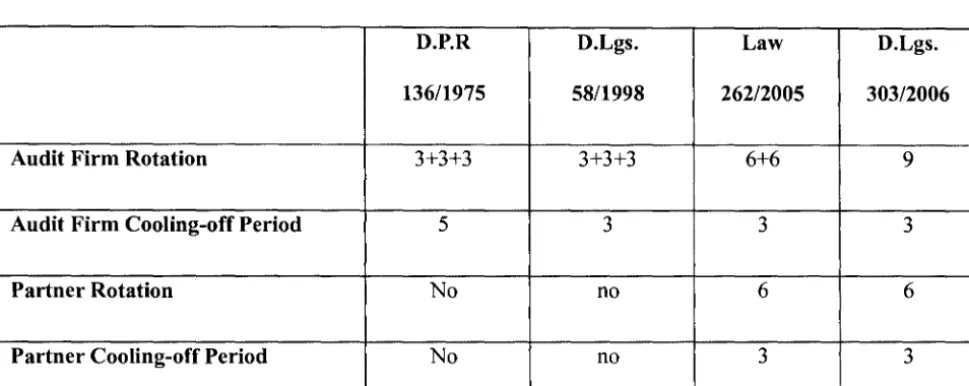
To conclude, a brief summary of the development of the Italian audit regulation is
[image:37.699.105.590.347.540.2]presented in the Table below.
Table 3.1
D.P.R D.Lgs. Law D.Lgs.
136/1975 58/1998 26212005 303/2006
Audit Firm Rotation 3+3+3 3+3+3 6+6 9
Audit Firm Cooling-off Period 5 3 3 3
Partner Rotation No no 6 6
Partner Cooling-off Period No no 3 3
3.1.2 The European Union
There are many differences concerning the rotation rules around the world, and
these were even more pronounced before the European Union began its long
hannonization process. Apart from Italy, other European countries which applied the
rotation rule at the firm level were Spain and Austria, but in both cases the rule was
abandoned7• Partner mandatory rotation, on the other hand, has encountered much greater
7 Austria enforced the firm mandatory rotation rule every six years (with a cooling-off period of three
support. In particular, apart from Italy, the UK and The Netherlands introduced
mandatory partner rotation every five years in 2003. Germany and France enforced the
rule in 2002 and 2003 respectively, mandating partner rotations every six years.
With the so called "Green Paper" of 1996, the European Union provided an
overview of auditing legislations among the State members, at the same time highlighting
intemational best practices which could be applied within the EU. In particular, at
paragraph 4.15 on "auditor independence", the EU commissions mention the mandatory
audit firm rotation as a means of reducing the "familiarity threat". However, this
eventuality is not considered favourably as "the arguments in favour of such a system are
not conclusive". Greater support is given to partner mandatory rotation: "A solution
which could enhance the perception of the auditor's objectivity, without causing the
efficiency and quality drawbacks of firm rotation, could consist in setting up a rotation of
audit partners within the same firm". Even if in paragraph 4.16 it is acknowledged that
auditor independence is dealt with differently in Member States, being based on different
traditions and experiences, the Green Paper definitely expresses preference for the partner
mandatory rotation rule.
The Commission Recommendation of 16th of May 2002, "Auditing: Commission
Issues Recommendations on independence of statutory auditors" represents another
important step towards understanding the position of EU with reference to auditor
rotation rules. It is stated that "to mitigate a familiarity or trust threat to the independence
of a Statutory Auditor who is engaged to audit an Audit Client of public interest, the
requirement to replace the Engagement Partner and the other Key Audit Partners of the
safeguards". Finally, in the Eighth Company Law Directive, 2006/43/EC, the partner
mandatory rotation rule is again considered as an effective means to increase auditor
independence. Article 26 of the Directive states: "In order to reinforce the independence
of auditors of public-interest entities, the key audit partner(s) auditing such entities
should rotate. To organise such rotation, Member States should require a change of key
audit partner(s) dealing with an audited entity, while allowing the audit firm with which
the key audit partner(s) is/are associated to continue being the statutory auditor of such
entity. Where a Member State considers it appropriate in order to attain the objectives
pursued, that Member State might, alternatively, require a change of audit firm, without
prejudice to Article 42(2)". Article 42.(2) continues "Member States shall ensure that the
key audit partner(s) responsible for carrying out a statutory audit rotate(s) from the audit
engagement within a maximum period of seven years from the date of appointment and
is/are allowed to participate in the audit of the audited entity again after a period of at
least two years".
To conclude, mandatory firm rotation seems to be considered as an additional
requirement which should not however substitute partner rotations. The European Union
therefore confirms its greater preference for partner rotations as an effective means of
enhancing audit independence.
3.1.3 The United States
The American Institute of Certified Public Accountants (AICP A) introduced the
mandatory partner rotation in the eighties as a fundamental aspect of monitoring
processes for those audit firms serving SEC registrants (SEC, 2003). In particular, partner
means to enhance auditor independence and to bring in "new fresh eyes". On the other
hand, the "Securitises Exchange Act" did not discipline mandatory rotations until the
Sarbanes-Oxley Act (SOX) was introduced in 2002.
In Section 203, SOX states:
"AUDIT PARTNER ROTATION - It shall be unlawful for a registered
public accounting firm to provide audit services to an issuer
if
the lead (or coordinating) audit partner (having primary responsibility for theaudit), or the audit partner responsible for reviewing the audit, has
performed audit services for that issuer in each of the 5 previous fiscal
years of that issuer ".
Partner mandatory rotations every five years were therefore legally introduced,
whereas no specific mention is made with reference to the cooling-off period.
Concerning firm mandatory rotations, on the other hand, the US legislator opted for
a more cautious approach. Sec. 207, titled "Study of Mandatory Rotation of Registered
Public Accounting firms", delegates The Comptroller General of the United States to
"conduct a study and review of the potential effects of requiring the mandatory rotation
of registered public accounting firms". The results of this study, which were presented in
a report in November 2003, did not support the introduction of the rule and therefore the
decision was postponed until the debate around the costs and benefits of mandatory firm
rotations provided consistent opinions.
It is also important to mention Sec. 208, which delegates the SEC to issue a final
regulation to carry out each subsection of the above mentioned rule. A fertile debate
rules. This lead the SEC to issue the "Final rule: Strengthening the Commissions'
Requirements Regarding Auditor Independence", which was enforced on 6th of May
2003. The mandatory partner rotation was confirmed for both the leading and concurring
partner every five years and a cooling-off period of five years was also introduced.
Particularly interesting is the definition of audit partner given by the rule:
"(. . .) a member of the audit engagement team who has responsibility for
decision-making on significant auditing, accounting, and reporting
matters that affect the financial statements or who maintains regular
contact with management and the audit committee. The term (. . .) would
include the lead and concurring partners, partners such as relationship
partners who serve the client at the issuer or parent level, other than a
partner who consults with other on the audit engagement team during the
audit, review, attestation engagement regarding technical or
industry-specific issues, transactions, or events, and the lead partner on
subsidiaries of the issuer whose assets or revenues constitute 20% or
more of the consolidates assets or revenues of the issuer".
The rule therefore does not take into consideration the formal appointment of the
partner, but rather the substantial type of relationship between the partner and the audit
client.
F or partners different from the lead and the concurring ones, a different regime of
rotation is introduced, i.e. every seven years and with a cooling-off period of two years.
This, in order to facilitate the switch of the leading and ofthe concurring partners through
the two years prior to the switch before becoming the new lead partner. This, in order to
overcome the potential loss of client specific knowledge deriving from the rotation.
Finally, the "Final Rule" gives the option to small audit firms (Le. with less than ten
partners and five SEC Registrants) of not applying the rule but to be subject to periodical
audits from the Public Accounting Oversight Board (PCAOB).
3.1.4 The rest of the world
The other countries which have adopted the firm mandatory rotation rule are very
few. The mandatory audit firm rotation is enforced, apart from Italy, in Brazil, South
Korea, Singapore and India (Cameran et aI., 2007). Brazil introduced mandatory firm
rotation for banks every five years in 1996 and then extended the rule for all listed
companies in 1999. South Korea adopted the rule in 2006, mandating a change of the
audit firm every six years. In Singapore the mandatory rotation rule is enforced only for
banks (starting from 2002), while in India it was set for banks, privatised insurance
companies and Governmental companies in 2004.
Partner mandatory rotation is more commonly enforced. It is also recommended by
the IFAC Codes of Ethics (Section 290).
Apart from the European Union and United States mentioned above, the rule has
been enforced in Japan (GAO 203), Australia (Ryen et aI, 2007), and Malaysia (Sori and
Karbhari, 2005). In particular, Japan introduced partner mandatory rotation in 2004,
requiring the rotation for both the lead and concurring partner every seven years.
Australian regulation is similar to the US one: starting from December 2003 the rotation
stricter, imposing mandatory rotation every five years for both the lead and concurring
partner. Finally, Malaysia introduced the rotation every seven years.
3.2
Arguments supporting and contrasting the mandatory
rotation rule
There are different views concerning the effects that mandatory audit rotation may
have on audit quality. Some of these arguments support the assumption that audit quality
decreases as audit tenure (the number of years the same auditor performs its services to
the same client company) increases. The supporters of this view look favourably at the
introduction of the mandatory rotation rule as an instrument aimed at enhancing audit
quality. Equally logical arguments exist which support the opposite, i.e. audit quality
should increase as audit tenure increases. Obviously, in this case, the mandatory rotation
rule is not seen as an effective way of improving the quality of an audit and thus
protecting the investors' interests.
All of these arguments may be valid both at the audit firm and at the partner level,
even if some differences exist which justify a separate discussion.
3.2.1 Audit firm level
At the audit firm level, mandatory audit rotation may enhance audit quality by
increasing auditor independence. Long-term relationships between the auditor and audit
client management may become "cosy" and thus may work to affect the monitoring role
played by the auditor adversely. Under this perspective, rotation would lead to better
development of tight personal relationships between the two parties (Mautz and
Sharaf, 1961; Farmer et al,1987; Brody and Moscove, 1998).
Moreover, it is argued that mandatory rotation may Increase auditor critical
capacity, as "new fresh eyes" approach the financial statement, (AI CPA 1978; Hoyle
1978; McLaren 1958). If the auditor performs its services towards the same client for a
long number of years, it could incur in a type of professional routine (Shockley, 1981).
The auditor could in fact assume to have a good knowledge of the clients' internal control
procedures and accounting systems, thus decreasing the level of scepticism which should
instead characterize every audit. Moreover, it is possible that the auditor will tend to rely
on previous years' controls, especially with reference to the extensive internal control
tests which are usually performed during the initial years of the audit engagement. In all
these cases, the probability of not discovering an error or a mistake increases, and thus
audit quality would decrease.
On the other hand, it could also be argued that imposing the rotation of the audit
firm may decrease audit quality. Supporters of this view state that in the first years of the
engagement period the new auditor is usually less familiar or experienced with the affairs
of the new audited firm, and, for this reason, it can monitor audit quality less effectively
(PriceWaterhouseCoopers, 2002; Petty and Cuganesan, 1996; Geiger and Raghumamdan,
2002; Carcello and Nagy, 2004; Myers et aI., 2003). This suggests that audit quality will
be poorer following the auditor rotation.
In addition, the incoming auditor will have strong incentives to retain the new client
and therefore to use a low balling approach (DeAngelo, 1981). If ~~ new auditor is
f
client, he/she will exert less effort thus reducing audit quality (Beck, Frecka, and
Solomon 1988).
Finally, another argument against the effectiveness of the mandatory rotation rule
looks at the last years of the engagement. In this period, should the rule be applied, the
economic incentive to perform high quality audit decreases and hence earnings quality
would suffer, as the incumbent auditor reaches the termination of the contract (Elitzur
and Falk, 1996). However, one needs to take into account the possibility that reputation
and litigation considerations on part of the incumbent auditor may attenuate this
argument.
3.2.2 Audit partner level
At the partner level, arguments in favour and against the mandatory rotation rule
are similar, but it is still necessary to highlight some differences.
As before, the mandatory rotation of the audit partner should enhance audit
independence by imposing a limit to the management-partner relationship and should
increase partners' critical ability as a new "fresh look" comes in.
On the other hand, the loss of client specific knowledge which could characterize
the first years of a new engagement should be lower at the partner level compared to the
audit firm level. In the former case, in fact, the audit team usually remains unchanged
whereas the overall guidance and responsibility come from a new perspective (Hamilton
et al. 2005). Moreover, the transfer of knowledge from the previous auditor to the new
one is much more immediate if the change occurs at the partner level as compared to the