Vol.36 No.1, pp.89-94.
Ageing industries
Harry Kromydas, Cliff Lockyer, Robert E. Wright University of Strathclyde
Abstract: This paper uses micro-data from four years of the Labour Force Survey (1995, 2000, 2005 and 2010) to examine the relationship between employment share and age structure across Scottish industries. Over the three decades, there has been a considerable shift in employment away from manufacturing industries to services industries. It is less well known that there are large differences in the age structure of employment between industries. There is some evidence from other countries that growing industries attract younger workers while declining industries keep older workers. If this is true, then the processes of labour force ageing and employment decline reinforce each other resulting in large and likely problematic age structure differences in certain industries. The analysis presented it this preliminary paper generates some evidence consistent with this view. The analysis also brings into some doubt the longer-term sustainability of the agriculture and fishing industry given the very top heavy nature of its age structure of employment.
1. Introduction
It is well known that the Scottish population will age considerably over the coming decades (see for example, Lisiankova, Mosca and Wright, 2008; National Records of Scotland, 2011, W right 2004). Population ageing is the shift in age structure away from the younger to the older age groups. It results in an increasing share of total population being concentrated in the older age groups and a
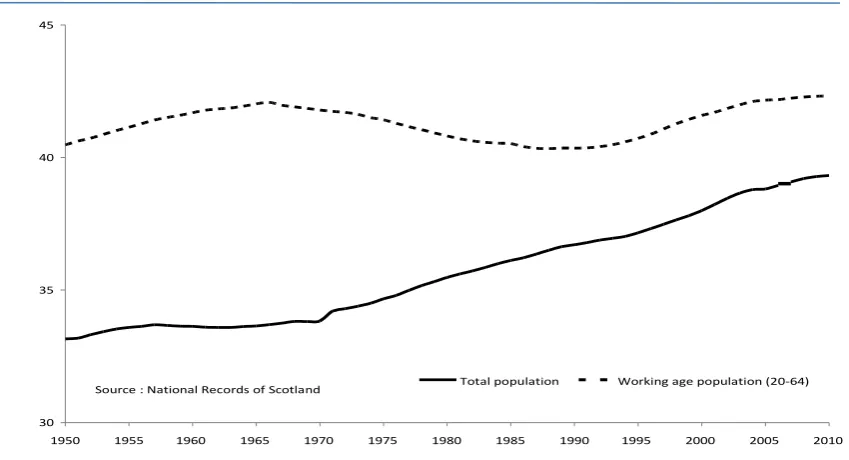
decreasing share being concentrated in the younger age groups. It is worth stressing that population ageing is not new - the Scottish population has been ageing for some time. This is illustrated in Figure 1, which shows the average age of the population for the period 1950 to 2010. In 1950 the average age was 33.3 years. By 2010, this had risen to 39.3 years. The most recent set of “official” population projections suggest that the average age of the population will reach 44.3 years by 2035 (National Records of Scotland, 2011).
What is not so well recognised is that as a population ages so does its labour force. Over 95 per cent of those who are employed (both full-time and part-time) are in the age range 20-64 years. With labour force ageing, the potential supply of “older workers” (e.g. older than 35 years) will
increase and the potential supply of “younger workers (e.g. younger than 35 years) will decrease. As Figure 1 shows, the average age of this population aged 20-64 years in 1950 was 40.5 years. By 2010, this had risen to 42.3 years. The official population projections suggest that the size of age 20-64 group will change little over the next three decades but it will continue to get older on average. In addition, its share of the total population will progressively get smaller.
Are slow rates of labour force growth and labour force ageing problematic? It seems to be widely agreed that a growing high-skilled labour force is critical for long-run economic growth. A shrinking labour force puts upwards pressure on wage rates which leads to decreased
competitiveness. If workers of different ages are not perfect substitutes, then labour force ageing can lead to lower average productivity. It is therefore not difficult to conclude that demographic change of this type impacts on the labour force in a non-growth enhancing way.
It is important to point over the past decades there has been a considerable shift in the industry structure of Scottish employment. As is documented below, there has been a shift away from manufacturing jobs to service sector jobs. In addition, the age structure of employment differs considerably by industry. Recent research by Autor and Dorn (2009), Feyrer (2007) and Han and Suen (2011) have demonstrated that industry-specific human capital increases the incentives for younger works to join growing industries and decreases the incentives for older workers to leave declining industries. This suggests that growing industries attract younger workers while declining industries keep older workers. Empirically this suggests a negative relationship between the employment share and average age of employment across industries. With slow or no labour force growth, there is considerable competition for workers. If these authors are correct, then declining industries will lose out in the competition for workers resulting in age structures of employment in some industries that are not sustainable.
We know of no research that has examined the relationship between employment share and age structure across Scottish industries. This is surprising since there has been considerable interest in the economic impacts of
demographic change, particularly the challenges it is generating for the government to provide welfare services and pensions. With this in mind, this paper uses micro-data from four years of the Labour Force Survey (1995, 2000, 2005 and 2010) to examine this relationship in Scotland. In order to provide a comparator, estimates are also
Vol.36 No.1, pp.89-94.
Year Scotland RUK
1995 11.8% 12.6%
2000 11.1% 13.5%
2005 16.9% 16.8%
2010 19.1% 19.5%
2. Changes in the age structure of
employment
[image:2.596.83.508.117.347.2]In this paper, the age structure of employment is measured in three ways. The first is the average age of the employed
Figure 1: Average age of total population and working age population in Scotland 1950 - 2010
45
40
35
Source : National Records of Scotland Total population Working age population (20-64)
30
1950 1955 1960 1965 1970 1975 1980 1985 1990 1995 2000 2005 2010
population. The second is the share of employment population aged 55 and older. The third is the ratio of “older workers” to “younger workers”, where age 35 years is used as the cut-off to define the two groups of workers. Tables 1- 3 present these three measures for Scotland and the RUK for 1995, 2000, 2005 and 2010.
Turning first to the average age of the employed population (Table 1), the estimates confirm that the average age of those in employment has risen both in Scotland and the RUK between 1995 and 2010. However, there is little
There are also no major differences between Scotland and the RUK when the share of the employed population aged 55 and older is considered (Table 2). In 1995, this share was 11.8% in Scotland and 12.6% in the RUK. In 2010, the share had increased to 19.1% in Scotland and to 19.5% in the RUK. In relative terms, the share of workers in this age group increased by 62% in Scotland and by 55% in the RUK in this fifteen year period.
Table 2: Share of employed population aged 55 and older (%), Scotland and UK, 1995-2010
difference between Scotland and the RUK in any of the
years. For example, in 1995, the average age was 38.4 years in Scotland and 39.0 years in the RUK. Likewise, in 2010, the average age was 41.9 years in Scotland and 41.8 years in the RUK. In both cases, the average age has increased by around three years in this period.
Table 1: Average age of employed population, Scotland and RUK, 1995-2010
Year Scotland RUK
1995 38.4 39.0
2000 38.5 39.2
2005 40.5 40.3
2010 41.9 41.8
Source: Authors‟ calculations, Labour Force Survey
Source: Authors‟ calculations, Labour Force Survey
[image:2.596.51.292.634.710.2]Vol.36 No.1, pp.89-94.
Table 3: Ratio of Older Workers to Younger Workers, Scotland and RUK, 1995-2010
Year Scotland RUK
1995 1.4 1.5
2000 1.6 1.7
2005 2.1 2.0
2010 2.3 2.3
Source: Authors‟ calculations, Labour Force Survey
3. Changes in the industry structure of
employment
Table 4 reports the employment shares across nine industry groupings for 1995 and 2010 for both Scotland and the RUK. The table also show the percentage change (growth or decline) in employment between the two points in time. Industry is defined using the 2-digit “Standard Industrial Classification (SIC)”. This classification is particularly useful for our purposes since it is comparable over time and not subject to major definitional changes in the period that is our focus.
Table 4 confirms that in this fifteen year period that has been a large decrease in the share of employment in “Manufacturing” in both Scotland the RUK. In Scotland, this share declined from 16.0% to 8.3%. In the RUK, the share declined from 18.9% to 10.9%. In both cases, this change in
percentage terms is over 40%. In the same period, there were sizeable increases in the share of employment in certain service sectors industries such as “Banking, Finance, Real Estate and Insurance Services” and “Public Administration and Education”. In both Scotland and the RUK, there have been declines in the employment shares in “Agriculture and Fishing”, “Distribution, Hotels and
Restaurants” and “Transport and Communication”. It is interesting to note (but not surprising) that the employment share in “Energy and Water Supply” has increased in Scotland but declined in the RUK in this period.
It is clear that for both Scotland and the RUK manufacturing is no longer a major employer with the 2010 employment share being 8.3% in Scotland and 10.9% in the RUK. In both Scotland and UK, almost 1 in 3 workers are employed in “Public Administration and Education” jobs. Likewise, around 2/3rds of all workers are employed in “Distribution, Hotels and Restaurants”, “Banking, Finance, Real Estate and Insurance Services” and “Public Administration and Education”.
For our purposes the estimates in Table 4 confirm that in period 1995 to 2010 there has been considerable
[image:3.596.267.547.474.654.2]redistribution of employment between industries. It is clear that there has been big employment growth in certain industries and big employment declines in other industries. However, these estimates which are based only on an industry breakdown make it difficult to conclude that
Table 4: Employment Share (%) by Industry, Scotland and RUK, 1995 and 2010
Industry: 1995
Scotland
2010 %∆ 1995
RUK
2010 %∆
Agriculture & Fishing 2.8% 2.7% -2.9 2.0% 1.6% -21.4%
Energy & Water Supply 2.5% 3.2% +27.2 1.2% 1.0% -18.2%
Manufacturing 16.0% 8.3% -48.2 18.9% 10.9% -42.2%
Construction 7.4% 7.4% +0.2 6.9% 7.3% +5.0%
Distribution, Hotels & Restaurant 20.1% 19.4% -3.5 20.4% 18.4% -9.8%
Transport & Communication 6.0% 5.9% -2.6 6.3% 6.3% -0.2%
Banking, Finance, Real Estate and Insurance Services 11.7% 15.0% +27.5 13.8% 16.9% +22.0%
Public Administration & Education 27.0% 32.1% +18.7 24.5% 31.5% +28.6%
Other Services 6.4% 6.1% -5.2 5.9% 6.2% +4.9%
All Industries 100% 100% -- 100% 100% --
Vol.36 No.1, pp.89-94.
Table 5: Average Age of Employed Population by Industry, Scotland and RUK, 1995 and 2010
Industry: 1995
Scotland
2010 %∆ 1995
RUK
2010 %∆
Agriculture & Fishing 44.9 47.4 +5.6% 43.8 47.9 +9.4%
Energy & Water Supply 38.3 40.9 +6.8% 40.1 43.9 +9.5%
Manufacturing 37.9 43.3 +14.2% 38.9 43.6 +12.1%
Construction 38.6 42.3 +9.6% 39.6 42.5 +7.3%
Distribution, Hotels & Restaurant 35.8 37.8 +5.6% 36.8 38.1 +3.5%
Transport & Communication
Banking, Finance, Real Estate and Insurance Services
39.9
37.3
44.5
41.9
+11.5%
+11.1%
39.4
38.2
44.1
42.1
+11.9%
+10.2%
Public Administration & Education 40.1 43.8 +9.2% 40.6 43.5 +7.1%
Other Services 40.0 42.2 +5.5% 39.7 41.0 +3.3%
All Industries 38.5 42.1 +9.4% 39.0 42.2 +7.9%
Source: Authors‟ calculations, Labour Force Survey
distribution of employment across these industries is drastically different between Scotland and the RUK at least at this level of industry disaggregation.
4. Changes in the industry and age structure
of employment
Tables 5-7 present the three measures of the age structure of employment separately for each industry. That is, the estimates in these tables are analogous to those in Tables 1-3 but are broken down by industry. Before considering each table in turn, there are three general observations worth making. The first relates to the direction of change in these measures between 1995 and 2010. In all but one case, (i.e. RUK, ratio of older to younger workers, “Distribution, Hotels and Restaurants”) the changes are positive suggesting that almost all industries “got older” in
this period. The second is there is considerable variation across industries in the size of this change. This is the case for both Scotland and the RUK. The third is that there is considerable variation within specific industries in the size of this change between Scotland and the RUK.
Table 5 illustrates the average age of the employed population by sector. The “oldest” industry based on this measure is “Agriculture and Fishing” in both Scotland and the RUK. In Scotland in 2010, the average age was 47.4 years. In the RUK in 2010, the average age was 47.9 years. It is also important to note that in 1995, “Agriculture and Fishing” in Scotland and the RUK was also the oldest industry, with the average age of those employed being 44.9 and 43.8 years, respectively. The “youngest industry” in both Scotland and the RUK is “Distribution, Hotels and
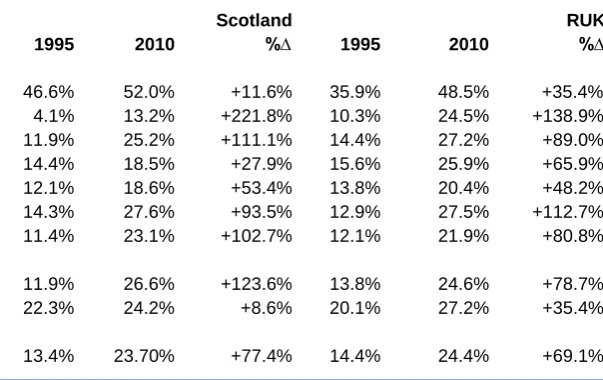
Table 6: Share of employed population aged 55 and older by industry, Scotland and RUK, 1995 and 2010
Industry: 1995 2010
Scotland
%∆ 1995 2010
RUK %∆
Agriculture & Fishing 46.6% 52.0% +11.6% 35.9% 48.5% +35.4%
Energy & Water Supply 4.1% 13.2% +221.8% 10.3% 24.5% +138.9%
Manufacturing 11.9% 25.2% +111.1% 14.4% 27.2% +89.0%
Construction 14.4% 18.5% +27.9% 15.6% 25.9% +65.9%
Distribution, Hotels & Restaurant 12.1% 18.6% +53.4% 13.8% 20.4% +48.2%
Transport & Communication 14.3% 27.6% +93.5% 12.9% 27.5% +112.7%
Banking, Finance, Real Estate and Insurance Services
Public Administration & Education
11.4%
11.9%
23.1%
26.6%
+102.7%
+123.6%
12.1%
13.8%
21.9%
24.6%
+80.8%
+78.7%
Other Services 22.3% 24.2% +8.6% 20.1% 27.2% +35.4%
All Industries 13.4% 23.70% +77.4% 14.4% 24.4% +69.1%
[image:4.596.259.561.562.752.2]Vol.36 No.1, pp.89-94.
Restaurants”. In this industry in 2010, the average age in Scotland was 37.8 years and 38.1 years in the RUK. IN 1995, this sector also had the lowest average age in both Scotland (35.8 years) and the RUK (36.8 years). The largest increase in the average age of employment between 1975 and 2010 was in “Manufacturing”. This increase was 14.2%
in Scotland and 12.1% in the RUK. Increases of over 10% occurred in “Transport and Communications” and “Banking, Finance, Real Estate and Insurance Services”. In both Scotland and the RUK, the smallest increase was in “Other services” followed by “Distribution, Hotels and Restaurants”.
Table 7: Ratio of older workers to younger workers by industry, Scotland and RUK, 1995 and 2010
Scotland RUK
Industry: 1995 2010 %∆ 1995 2010 %∆
Agriculture & Fishing 2.3 4.3 +85.1% 2.2 4.4 +137.8%
Energy & Water Supply 1.6 2.1 +30.4% 2.0 3.1 +138.4%
Manufacturing 1.4 3.0 +117.5% 1.4 3.0 +36.2%
Construction 1.4 2.6 +79.5% 1.6 2.4 +34.7%
Distribution, Hotels & Restaurant 1.0 1.3 +29.5% 1.1 1.3 -2.0%
Transport & Communication 1.9 3.2 +74.5% 1.6 3.2 +85.2%
Banking, Finance, Real Estate and Insurance Services
Public Administration & Education
1.2
1.9
2.3
3.1
+88.9%
+63.5%
1.3
2.1
2.2
3.0
+17.9%
+84.2%
Other Services 1.5 2.2 +42.2% 1.5 1.8 +24.6%
All Industries 1.4 2.3 +62.9% 1.5 2.3 +41.1%
Source: Authors‟ calculations, Labour Force Survey
Table 6 shows the estimates for the share of the employed population aged 55 and older by industry. This measure confirms that in both Scotland and the RUK, “Agriculture and Fishing” is the “oldest industry” both in 1995 and 2010. However, there is a major difference between Scotland and the RUK with respect to the “youngest industry”. In 1995, it was “Energy and Water” in both Scotland (4.1%) and the RUK (10.3%). In 2010 in Scotland, “Energy and Water” remained the youngest industry (13.2%). However, this is not the case for the RUK. The youngest industry in 2010 is “Distribution, Hotels and Restaurants” (20.4%). These estimates almost certainly reflect the importance of the energy sector in Scotland, which is heavily based on oil. In terms of change, the biggest increase between 1995 and 2010 was in “Energy and Water Supply”, In Scotland; the increase was 222% while in the increase for the RUK was 139%. The smallest changes were for “Agriculture and Fishing”, and “Other services”.
Table 7 shows the estimates of the ratio of older workers to younger workers by industry. Based on this measure, “Agriculture and Fishing” was the oldest industry in both Scotland and the RUK in 1995 and 2010. In 2010, the ratio was 4.3 in Scotland and 4.4 in the RUK. In 2010 in Scotland the second highest ratio was in “Transport and
Communication” (3.2) followed by “Public Administration and Education” (3.1) and “Manufacturing” (3.0). In 2010, the second highest ratio is also in “Transportation and
Communication” (3.2) followed by “Energy and Water Supply” (3.1) (which is one of the youngest industries in Scotland). Based on this measure, the youngest industry in
2010 in both Scotland and the UK is “Distributions, Hotel and Restaurant” (a ratio of 1.3 for both). In terms of change between 1995 and 2010, the industries in Scotland experiencing the largest increase in this measure were “Manufacturing” (117.5%), “Banking, Finance, Real Estate and Insurance Services” (88.9%) and “Construction” (79.5%). In the RUK, the largest increases were in “Energy and Water Supply” (138.4%), Agriculture and Fishing (137.8%) and “Transportation and Communication” (85.2%). The smallest change in Scotland was for “Distribution, Hotels and Restaurants” (29.5%). Likewise, the smallest change for the RUK was also in this industry, with the data suggesting a small decline the older to younger workers ratio.
5. Concluding comments
Vol.36 No.1, pp.89-94.
In terms of the nine sectors that we considered, the manufacturing sector has aged “most rapidly” in the period 1995 to 2010. The three measures of ageing that we calculate all consistently point to this. However, it is not the case the service sector as whole is ageing least rapidly. In a regression analysis of the data presented in Tables 4-7 (but not reported here), no support was found for a strong statistically relationship between changes in employment shares and rates of labour force ageing (as was found by for example, Han and Suen, 2011).
Of the nine industries considered in this paper, agriculture and fishing has a much older age structure than the other eight industries by a considerable margin. In Scotland, the ratio of older to younger workers is nearly double the value for all industries. The share of workers over 55 years of age and older is also over double the value for all industries. The average age of workers is more than four years higher than for all industries. This average age is almost 10 years higher than the average for workers in distribution, hotel and restaurant industries. It is clear that a large share of those employed in this industry is above “pensionable age”. It is also clear fewer younger workers are entering the industry, although we recognise the barriers to entry to farming (see for example, the Macaulay Institute et al (2008) Barriers to New Entrants to Scottish Farming). In our view, this heightens concerns as to the longer-term sustainability of this industry.
Wright, R.E., (2004), Scotland‟s Demographic Challenge, Stirling/Glasgow, Scottish Economic Policy Network
References
Autor, D. and D. Dorn, (2009), “The Job is „Getting Old‟: Measuring Changes in Job Opportunities using
Occupational Age Structure”, American Economic Review, vol. 99, pp. 45-51
Feyrer, J., (2007), “Demographics and Productivity”, Review
of Economics and Statistics, vol. 89, pp. 100-109
Han, J. and W. Suen, (2011), “Age Structure of the Workforce in Growing and Declining Industries: Evidence from Hong Kong”, Journal of Population Economics, vol. 24, pp. 167-189
Lisiankova, K., I. Mosca and R.E. Wright (2008), “Ireland and Scotland: Converging or Diverging Demography?”,
Scottish Affairs, vol. 64, pp. 18-36
Macaulay Institute, Cook, P., The Rural Development Company and the Scottish Agricultural College, (2008),
Barriers to New Entrants to Scottish Farming. An Industry
Consultation for the Tenant Framing Forum.
National Records of Scotland, (2011), Projected Population of Scotland (2010-based). National Population Projections
by Sex and Age, with UK and European Comparisons,