1 Evolutionary Multi-Objective Optimal Control of Combined Sewer Overflows
Upaka S. Rathnayake and Tiku T. Tanyimboh
Department of Civil and Environmental Engineering, University of Strathclyde Glasgow
Authors
1. Upaka S. Rathnayake, PhD
Department of Civil and Environmental Engineering, University of Strathclyde Glasgow, James Weir Building, Glasgow G4 0NG, UK.
Current Address: Department of Civil Engineering, Faculty of Engineering, Sri Lanka Institute of Information Technology, New Kandy Road, Malabe, Sri Lanka.
E-mail: [email protected]
2. Tiku T. Tanyimboh, PhD (Corresponding Author)
Department of Civil and Environmental Engineering, University of Strathclyde Glasgow, James Weir Building, Glasgow G4 0NG, UK.
E-mail: [email protected], Telephone: +44 (0)141 548 3688
This paper is published in Water Resources Management, 29(8), pp. 2715-2731, 2015. DOI: 10.1007/s11269-015-0965-3
2 Evolutionary Multi-Objective Optimal Control of Combined Sewer Overflows
Abstract
This paper presents a novel multi-objective evolutionary optimization approach for the active control of intermittent unsatisfactory discharges from combined sewer systems. The procedure proposed considers the unsteady flows and water quality in the sewers together with the wastewater treatment costs. The distinction between the portion of wastewater that receives full secondary treatment and the overall capacity of the wastewater treatment works (including storm overflow tanks) is addressed. Temporal and spatial variations in the concentrations of the primary contaminants are incorporated also. The formulation is different from previous approaches in the literature in that in addition to the wastewater treatment cost we consider at once the relative polluting effects of the various primary contaminants in wastewater. This is achieved by incorporating a measure of the overall pollution called the effluent quality index. The differences between two diametrically opposed control objectives are illustrated, i.e. the minimization of the pollution of the receiving water or, alternatively, the minimization of the wastewater treatment cost. Results are included for a realistic interceptor sewer system that show that the combination of a multi-objective genetic algorithm and a stormwater management model is effective. The genetic algorithm achieved consistently the frontier optimal control settings that, in turn, revealed the trade-offs between the wastewater treatment cost and pollution of the receiving water.
Keywords: Optimal control, combined sewer system, effluent quality index, integrated
3 1 INTRODUCTION
Combined sewer systems carry both sanitary wastewater and stormwater. However, the capacity of sewers is limited and this results in occasional flooding of some areas and intermittent unsatisfactory discharges to the receiving water known as combined sewer overflows (Rodriguez et al. 2012). Even though new combined sewer systems are no longer constructed because of greater environmental awareness and more effective regulation in recent years, the existing networks still operate in many cities. Therefore, controlling the operation of the existing systems is self-evidently a possible way of alleviating the problem of pollution due to the intermittent unsatisfactory discharges from combined sewer systems. The causes, adverse consequences and mitigation measures of pluvial flooding are discussed in Susnik et al. (2014). A review of the optimization of the design of sewer systems is available in Karovic and Mays (2014). The description of a combined sewer overflow chamber and its modelling is available in Chen et al. (2013). Details on the effectiveness of best management practices are available in Kaini et al. (2012). Best management practices are measures that contribute to improve or safeguard the condition of receiving water bodies.
Most of the previous approaches in the literature utilised control measures for combined sewer overflows based on the volume of wastewater discharged from the sewer system without considering water quality (Beraud et al. 2010, Cembrano et al. 2004, Darsono
4 control of intermittent unsatisfactory discharges or combined sewer overflows (CSOs).
On the other hand, Fu et al. (2008 and 2010) addressed the water quality in the receiving water by treating several water quality indices (e.g. biochemical oxygen demand and the concentration of dissolved oxygen) as separate objectives to be optimized. However, the approach leads to complications because on the whole the water quality measures are highly interrelated. Also, while the effects of combined sewer discharges on the receiving water have been considered previously (Fu et al. 2010, Lacour and Schutze 2010, Petruck et al. 1998, Vanrolleghem et al. 2005, Weinreich et al. 1997) the associated trade-offs were not addressed directly. For example, the wastewater treatment costs corresponding to alternative control settings were not considered (Darsono and Labade 2007, Fu et al. 2010). A major disadvantage of single-objective optimization (Cembrano et al. 2004, Darsono et al. 2007, Rauch et al. 1999b) is that it provides only one optimal solution to the problem. Single objective optimization methods can be useful if the trade-off between the objectives is not important. The multi-objective approach, on the other hand, considers the integrity of all the objectives and, therefore, reduces somewhat the requirement to consider the relative importance of each objective beforehand. In other words, all objectives are considered together to obtain the Pareto-optimal solutions in a single run of the optimization procedure.
5 simulation model for urban and sub-urban areas in which gradually varying unsteady flows are routed using the mass conservation and momentum equations. The equations are solved using the finite difference method to obtain the flow rates in the sewers and water levels at the junctions. Also, for water quality routing, the sewers and tanks are modelled as continuously stirred tank reactors in which mass conservation is used to calculate the concentrations of the chemical species leaving a conduit or tank at the end of each flow routing time step (Rossman 2006).
6 identify possible priority areas for future improvement.
2 MODEL FORMULATION AND SOLUTION
Two opposing aims were considered in the multi-objective optimization model. The first was to minimize the pollution load to the receiving water while the second was to minimize the cost of treating the wastewater at the wastewater treatment plant downstream. Minimization of the pollution load to the receiving water aims primarily to manage the pollution load from the combined sewer overflows by spatial and temporal control of the flows in the entire interceptor sewer system. This is done by taking advantage of any spare capacity in the sewerage system including the sewers, the wastewater treatment works and any on-line or off-line storage. Inevitably this leads to variations in the flow regime at the wastewater treatment works. To account for this we included the wastewater treatment cost in the optimization model as an objective that is to be minimized.
Figure 1 shows an interceptor sewer system. For the ith overflow chamber at time t, hi,t
is the water level; Hsiis the spill level; Ii,t is the inflow rate from the catchment; Oi,t is the rate
of discharge to the receiving water; qi,t is the volumetric through-flow rate in the sewer; and
Qi,t is the volumetric flow rate from the combined sewer overflow chamber to the interceptor
sewer. The constraints that address the continuity of flow are as follows.
, max,
0
≤
q
i t≤
q
i(1)
, 1, , 0
i t i t i t
Q +q− −q =
(2)
,
, , , ; , ,
i t
T i i t i t i t S i
h
A I Q h H
t
∆
= − <
∆ (3a)
,
, , , , ; , ,
i t
T i i t i t i t i t S i
h
A I Q O h H
t
∆
= − − >
∆ (3b)
7 surface area in the overflow chamber and is assumed to be constant; ∆hi,t ∆t approximates the time rate of change of the water level in the overflow chamber. Eqs. 3b represent conditions in which discharge to the receiving water occurs, i.e. when the water level in the overflow chamber is above the spill level HS,i (Figure 1). Eqs. 3a apply when the water level is
below the spill level and therefore discharge to the receiving water does not occur. The term on the left hand side of Eqs. 3 represents the rate at which the volume of water in the overflow chamber is changing. Eq. 1 defines the feasibility of the volumetric flow rates in the interceptor sewer system. Eq. 2 defines the continuity of the flows at the nodes of the interceptor sewer system. Eqs. 3 define the continuity of the flows of the combined sewer overflow chambers.
The decision variables of the optimization problem are the combined sewer overflow settings. More specifically, the decision variables are the respective orifice and other settings that control the flows from the sub-catchments to the interceptor sewer. For simplicity we assumed that the flow from the overflow chamber to the interceptor sewer takes place by means of an orifice in the overflow chamber. Thus the decision variables here are the Qi,t
values, the time-varying volumetric flow rates from the overflow chambers to the interceptor sewer. Inherently, the hydraulic simulation model SWMM 5.0 accounts for Eqs. 2 and 3 that are thus satisfied automatically. The concept of constraint dominance in Deb et al. (2002) was used to address Eqs. 1. The procedure is not described here as it is well established.
2.1 Pollution load evaluation
8 sensitivity index for wastewater treatment (Copp 2002, Kim et al. 2006, Lee et al. 2006). Additional information on the effluent quality index is available in Mussati et al. (2002) and Rathnayake and Tanyimboh (2012a). This parameter is particularly useful as it aims to quantify the total amount of pollution as shown in Eq. 4.
[
C t C t C t C t C t]
Q t dtt t
E t w
t TSS COD BOD NOX TKN
i f f i ) ( ) ( 20 ) ( 20 ) ( 2 ) ( ) ( 2 1
∫
+ + + + −= (4)
E is the effluent quality index that represents the effective pollution rate (for example, in kg/day with the units of the terms in Eq. 4 selected accordingly); ti and tf respectively
represent the start and end of the period during which the wastewater discharge takes place;
Qw is the volumetric flow rate of the wastewater; CTSS, CCOD, CNOX, CBOD and CTKN are the
concentrations of total suspended solids, chemical oxygen demand, nitrates/nitrites, five-day biochemical oxygen demand and total Kjeldahl nitrogen, respectively.
Various catchment characteristics e.g. land-use i.e. residential, commercial, agricultural, etc. influence the concentrations of the various contaminants in the run-off from rainfall. For example, Duncan (1999) described the composition of stormwater run-off for different land-uses. Also, the pollutographs for various contaminants have been derived empirically in previous studies (Li et al. 2007, Yusop et al. 2005). We carried out a detailed and extensive investigation of the properties of the relevant pollutographs and thus developed pollutographs for the interceptor sewer system discussed in the next section (Rathnayake and Tanyimboh 2012a, Rathnayake 2013). The objective function for the pollution load was taken as
∑
∑
= = = i t N i t i N t E F 1 , 11 (5) The subscripts t and i represent the time steps and overflow chambers, respectively; Nt is the
number of time steps; Ni is the number of overflow chambers; Ei,t is the pollution load
contributed by overflow chamber i during time step t; F1 is the total pollution load to the
9 concentrations of the contaminants in the wastewater throughout the duration of a storm.
2.2 Wastewater treatment cost
A wastewater treatment plant typically has an overall capacity that may be approximately about twice the secondary treatment capacity. Any excess flow above the secondary treatment capacity is held in stormwater detention tanks which have a role similar to primary sedimentation tanks. If the total volume of wastewater exceeds the overall capacity of the plant, then the stormwater detention tanks fill completely and overflow to the receiving water (Metcalf and Eddy 2004). We developed a generic indicative cost model for wastewater treatment (Rathnayake and Tanyimboh 2012a,b; Rathnayake 2013) based on various models and data in the literature (Friedler and Pisanty 2006, Hernandez-Sancho and Sala-Garrido 2008, United Nations 2003). For example, Friedler and Pisanty (2006) observed that the operation and maintenance cost, as a proportion of the total treatment cost, rises as the design flow rate increases and has the general form of an “S shaped” curve. The generalised approximation to the wastewater treatment cost was taken as
C =
d w f
w Q Q
aQ ; ≤3 (6a)
d w d d w f
d cQ dQ e Q Q Q
bQ + − + ; 3 ≤ ≤6 (6b)
d w d
f
d dQ e Q Q
bQ + + ; >6 (6c)
where C (€/year) is the cost; Qw (m3/s) is the volumetric flow rate of the wastewater; andQd
10
∑
=
= t
N
t t C F
1
2 (7) where Ctis the wastewater treatment cost for time step t and F2is the total cost for the entire
duration of the storm.
2.3 Optimization problem and solution
The optimization problem can be summarized as follows. Minimize f=(F1, F2)T subject to the
system constraints. The conservation of mass and energy and other system equations were satisfied by the hydraulic simulation model SWMM 5.0. However, the constraints for the capacity of the interceptor sewer i.e. Eqs. 1 were addressed using the binary constraint-tournament method in the Non-dominated Sorting Genetic Algorithm (NSGA) II (Deb et al.
2002). We wrote a routine in the C computer programming language to link the optimization and simulation models.
NSGA II is a computationally fast and elitist multi-objective evolutionary optimization algorithm that has been applied successfully in many practical problems in various disciplines (Tabari and Soltani 2013, Takbiri and Afshar 2012) including urban wastewater systems (Fu et al. 2010). Additional applications include a memetic algorithm with local search and cultural learning (Barlow and Tanyimboh 2014) and recently introduced penalty-free methods for water distribution systems (Siew and Tanyimboh 2012, Siew et al. 2014, Saleh and Tanyimboh 2013, 2014). The above-mentioned enhanced implementations have been shown to be particularly effective in terms of the computational efficiency and quality of the solutions. However, in view of the complexity of the problem addressed here, and as a first attempt, we used the binary constraint-tournament method (Deb et al. 2002).
11 were defined to cover the entire duration of the storm. For the first time step the heights of the orifices were generated randomly to create the initial population of solutions. Then, a hydraulic simulation was carried out. The results of the hydraulic simulation were used to calculate the pollution load and the wastewater treatment cost. For subsequent time steps the optimized orifice heights from the preceding time step were taken as the initial conditions.
3 PRACTICAL APPLICATION
A realistic generic interceptor sewer system derived from modifications to the interceptor sewer system described in Thomas et al. (1999, 2000) and Thomas (2000) that is based on the interceptor sewer system in Liverpool, UK, was used for illustration purposes, for a storm duration of 2.5 hours. A schematic diagram of the interceptor sewer system is shown in Figure 1c. We extended the system's capacity and operational complexity by adding two storage tanks, i.e. tanks 8 and 9, at overflow chambers 2 and 5, respectively. These new tanks were assumed to operate on-line; i.e. they start to fill as the volumetric flow rate in the interceptor sewer approaches the maximum through-flow rate. The wastewater in the on-line tanks returns later to the interceptor sewer when the flow from the upstream section plus the inflow from the subcatchment is less than the capacity of the sewer.
12 Rathnayake and Tanyimboh (2012a) and Rathnayake (2013).
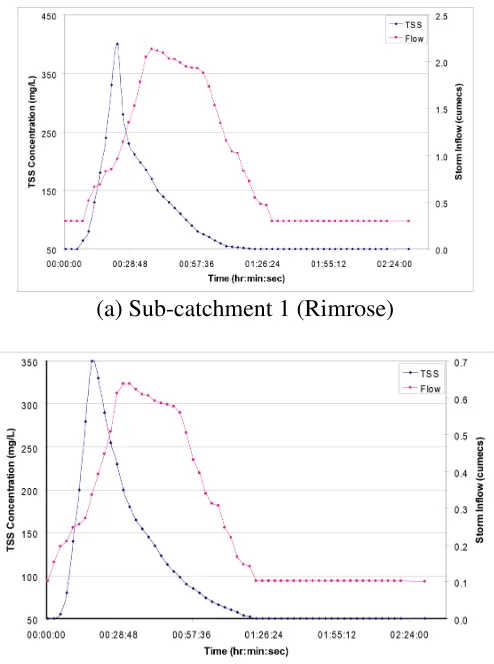
The various sub-catchments have stormwater run-off hydrographs the details of which are available in Thomas (2000) and references therein (Thomas et al. 1999, 2000; etc.). The present demonstration is for the average dry-weather flow for sanitary wastewater in conjunction with a single storm. Due to the relatively short duration of the storm, and as in Thomas (2000), we did not consider the diurnal variations in the flow rate of sanitary wastewater. The surface water run-off hydrographs and temporal and spatial variations in the concentrations of contaminants (Eqs. 4 and 5) are available in Rathnayake (2013). Figure 2 shows run-off hydrographs and suspended solids concentrations for sub-catchments 1 to 3.
13 successive time step started at time t = 0 and continued until the end of the time step. Therefore the execution time of the optimization algorithm was increased significantly. We used a Pentium 4 desktop personal computer (2.7 GHz Core 2 Duo processor, 4 GB RAM).
4 RESULTS AND DISCUSSION
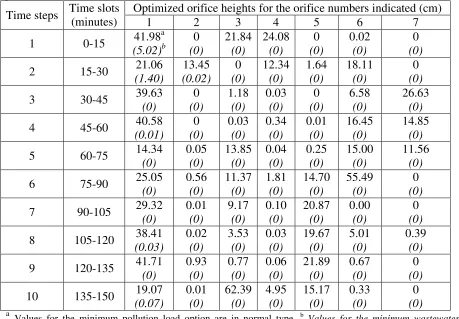
An optimization run with 10,000 function evaluations in each time step for the minimum pollution load and minimum treatment cost options for a storm of 2.5 hours with ten time steps took about 76 minutes and 18 minutes, respectively. Table 1 shows that the orifices for the minimum treatment cost option are essentially closed in practical terms. The exception is orifice 1 for time steps 1 and 2. The orifice closures reduce effectively the size of the sewer system that is simulated for the fitness assessments and, consequently, the hydraulic simulations require less time. The Pareto-optimal fronts obtained for ten different randomly generated initial populations were essentially the identical; Figure 3a shows the Pareto-optimal front at time t = 15 minutes. Solution AT1(S) gives the minimum pollution load
whereas solution BT1(S) gives the minimum treatment cost. Figures 3b and 3c illustrate the
progress of the optimization. It can be seen the algorithm convergences quickly at about 2000 function evaluations.
At time t = 30 minutes, the solution for the minimum pollution load was obtained by executing the optimization from time t = 0 to 30 minutes, with the control settings from Solution AT1(S) (Figure 3a) as the initial condition. Similarly, for the minimum treatment cost
option, the optimization was run from time t = 0 to 30 minutes, with the control settings from Solution BT1(S) (Figure 3a) as the initial condition. The optimized solutions achieved have
14 the minimum treatment cost option are essentially closed (Table 1). This minimizes the flow to the interceptor sewer and the treatment plant which keeps the treatment costs low. This low cost is achieved at the expense of a high pollution load to the receiving water. For the minimum pollution load option more wastewater reaches the interceptor sewer and the treatment plant which reduces pollution.
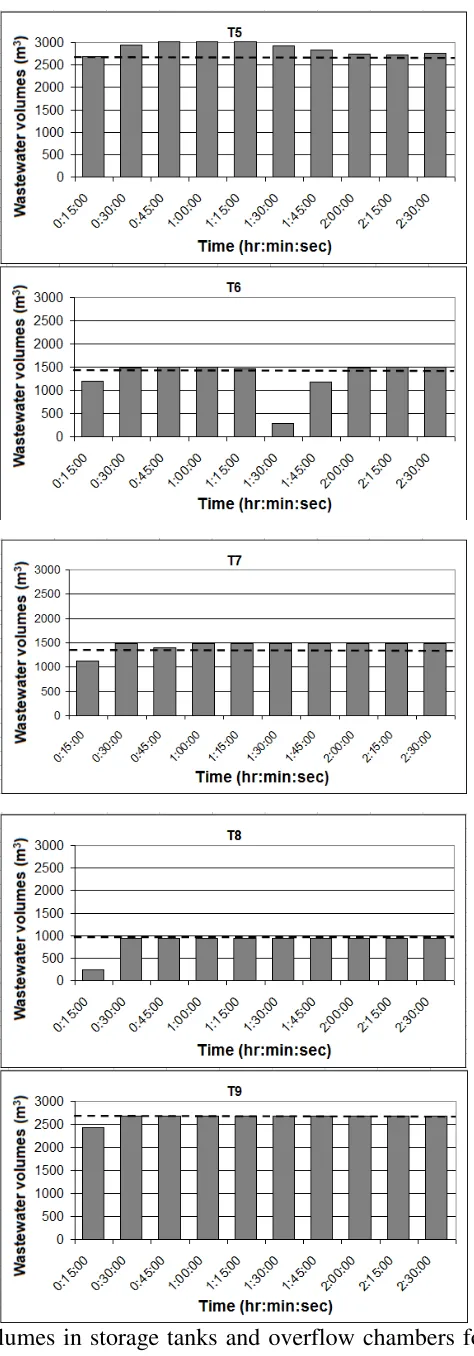
On completion of the optimization, the respective sets of orifice settings obtained for orifices 1 to 7 were used to conduct full hydraulic simulations to check the solutions achieved. Figure 5 shows the volumetric flow rates in the conduits at the end of each time step for the minimum pollution option; the dashed lines represent the respective capacities. The maximum flow rates did not exceed the capacities, i.e. the solutions obtained may be considered feasible. Furthermore, conduits 4 to 7 have higher flow rates than conduits 1 to 3. This is consistent with the normal expectation that downstream sewers would carry more wastewater than those upstream. The results show a consistent spatial progression of increasing flow rates for conduits 1 to 7.
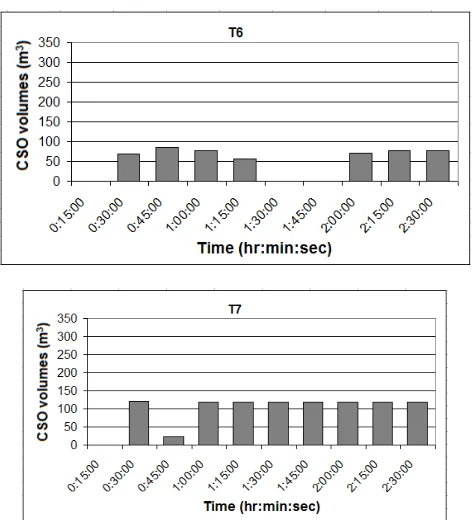
15 downstream end of the sewer system has relatively constant rates of discharge during the entire storm as it carries combined wastewater from the entire catchment.
Figure 7 shows the cumulative pollution loads, wastewater treatment costs and combined sewer overflows, for both the minimum pollution load and minimum treatment cost options. It is noted that the minimum pollution load option at the end of any time step has a lower pollution load than the minimum treatment cost option (Figure 7a). Conversely, the minimum treatment cost option has lower treatment costs throughout the storm than the minimum pollution load option (Figure 7b). Figure 7c illustrates an interesting result. Until 01:30:00 hours, the two control options have roughly comparable spillage volumes. However, Figure 7a shows the corresponding pollution loads are significantly different during this time period. This demonstrates clearly that a volumetric optimization approach that does not address the water quality aspects explicitly may not be sensitive enough to control the sewer system satisfactorily. Besides the wastewater treatment cost, the proposed optimization model has an objective function that addresses water quality explicitly. The effluent quality index considers at once five major water pollution parameters. This represents an advance on previous approaches (Fu et al. 2008 and 2010; Vanrolleghen et al. 2005). Using one objective function for the overall pollution, difficulties associated with optimization problems with many objectives are avoided (Saxena et al. 2013; Sinha et al. 2013).
16 many challenges related to issues such as land-use, rainfall run-off and pollution wash-off characteristics and the cost objective function. Also, the response of the receiving water and details of the wastewater treatment plant were not addressed.
5 CONCLUSIONS
A novel multi-objective evolutionary optimization approach for control of combined sewer overflows that considers unsteady sewer flows, pollution load to the receiving water and wastewater treatment costs was developed. It can handle temporal and spatial variations in water quality in the rainfall run-off from different sub-catchments and considers various contaminants including suspended solids, nitrates/nitrites and ammonia at once. The decision variables of the optimization problem are the time-dependent combined sewer overflow settings. The optimization model was applied to a realistic interceptor sewer system. The results demonstrate the benefits of the multi-objective optimization. The non-dominated solutions provide a range of alternative control options that offer choice and flexibility to the sewer system controllers to enable the best control settings based on the environmental regulations, costs and other relevant factors to be chosen. Verification through simulations in SWMM 5.0 of the control options identified further indicates that the solutions found are both feasible and effective. With further developments in the technology to measure flows and water quality parameters and send feedback to a control location, this dynamic optimization model is proposed as a contribution in the active control of integrated urban wastewater systems.
Acknowledgement
Upaka Rathnayake's PhD was funded by the UK Government’s Overseas Research Students Award Scheme and
the University of Strathclyde. The authors are grateful for the above mentioned funding and the support of Prof.
17 References
Barlow E, Tanyimboh T (2014) Multiobjective memetic algorithm applied to the optimisation of water distribution systems. Water Resour Manage 28(8):2229-2242.
Beraud B, Mourad M, Soyeux E, Lemoine C, Lovera M (2010) Optimisation of sewer networks hydraulic behaviour during storm weather: coupling genetic algorithms with two sewer networks modelling tools. NOVATECH 2010, Lyon, France.
Cembrano G, Quevedo J, Salamero M, Puig V, Figueras J, Marti J (2004) Optimal control of urban drainage systems. Control Eng. Practice 12:1-9.
Chen Z, Han S, Zhou F-Y, Wang K (2013) A CFD modeling approach for municipal sewer system design optimization to minimize emissions into receiving water body. Water Resour Manage 27:2053-2069.
Copp H, Spanjers H, Vanrolleghem P (2002) Respirometry in Control of the Activated Sludge Process. IWA Publishing Scientific and Technical Report No. 11.
Darsono S, Labade J (2007) Neural-optimal control algorithm for real-time regulation of in-line storage in combined sewer systems. Environ Modelling and Software 22:1349-1361. Deb K, Pratap A, Agarwal S, Meyarivan T (2002) A fast and elitist multiobjective genetic algorithm: NSGA II. Trans. Evolutionary Computation 6(2):182-197.
Duncan P (1999) Urban Stormwater Quality: A Statistical Overview. Cooperative Research Centre for Catchment Hydrology 99/3, ISBN 1876006455.
Friedler E, Pisanty E (2006) Effects of design flow and treatment level on construction and operation costs of municipal wastewater treatment plants and their implications on policy making. Water Research 40:3751-3758.
Fu G, Butler D, Khu S (2008) Multiple objective optimal control of integrated urban wastewater systems. Environmental Modelling and Software 23(2):225-234.
18 impact of new developments on receiving water quality. J. Env. Eng. 136(3):335-342.
Hernandez-Sancho, Sala-Garrido (2008) Cost modelling in wastewater treatment processes: An empirical analysis for Spain. Dangerous Pollutants in Urban Water Cycle4:219-226. Institution of Water and Environmental Management (IWEM) (1993) Handbook of UK Wastewater Practice: Glossary.
Joseph-Duran B, Jung M, Ocampo-Martinez C, Sager S, Cembrano G (2014) Minimization of sewage network overflow. Water Resources Management 28:41-63.
Kaini P, Artita K, et al. (2012) Optimizing structural best management practices using SWAT and genetic algorithm to improve water quality goals. Water Resour Manage 26:1827-1845. Karovic O, Mays L (2014) Sewer system design using simulated annealing in Excel. Water Resour Manage 28:4551-4565.
Kim J, Ko J, Lee J et al. (2006) Parameter sensitivity analysis for activated sludge models No. 1 and 3 combined with one-dimensional settling model. Water Sc. and Tech 53:129-138. Lacour C, Schütze M (2010) Real time control of sewer systems using turbidity measurements. Int. Conf. Sustainable Technics and Strategies for Urban Water Mngt, Lyon. Lau J, Butler D, Schutze M (2002) Is combined sewer overflow spill frequency/volume a good indicator of receiving water quality impact? Urban Water 4:181-189.
Lee S, Ko J, Poo K et al. (2006) Practical approach to parameter estimation for ASM3+bio-P module applied to five-stage step-feed EBPR process. Water Sc. and Tech 53:139-148.
Li L, Yin C, He Q, Kong L (2007) First flush of storm runoff pollution from an urban catchment in China. Journal of Environmental Sciences 19:295-299.
Meirlaen J, Van Assel J, Vanrolleghem P (2002) Real time control of integrated urban wastewater system using surrogate models. Water Sc. Tech 45(3):109-116.
19 wastewater treatment plant. Clean Technology Env. Policy 4:171-182.
Petruck A, Cassar A, Dettmar J (1998) Advanced real time control of a combined sewer system. Water Science and Technology 37(1):319-326.
Rathnayake U (2013) Optimal management and operational control of urban sewer systems. PhD Thesis, University of Strathclyde, UK.
Rathnayake U, Tanyimboh T (2012a) Integrated optimal control of urban wastewater systems. IWA-WCE conference. Dublin, Republic of Ireland, 13-18 May 2012.
Rathnayake U, Tanyimboh T (2012b) Multi-objective optimization of urban wastewater systems. 10th International Conf. on Hydroinfomatics. Hamburg, Germany, 14-18 July 2012. Rauch W, Harremoes P (1998) Correlation of combined sewer overflow reduction due to real-time control and resulting effect on oxygen concentration in the river. Water Sc. Tech 37(12):69-76.
Rodrıguez R, Gundy P, Rijal G, Gerba C (2012) The impact of combined sewage overflows on the viral contamination of receiving waters. Food Environ Virol 4:34-40.
Rossman LA (2009) SWMM 5.0 User's Manual EPA/600/R-05/040 Water Supply and Water Resources Division, National Risk Management Research Laboratory Cincinnati, USA. Rossman LA (2006) Storm Water Management Model Quality Assurance Report: Dynamic Wave Flow Routing. EPA National Risk Management Research Laboratory, Cincinnati USA. Saleh S, Tanyimboh T (2013) Coupled topology and pipe size optimization of water distribution systems. Water Resour Manage 27(14):4795-4814.
Saleh S, Tanyimboh T (2014) Optimal design of water distribution systems based on entropy and topology. Water Resour Manage 28(11):3555-3575.
20 Siew C, Tanyimboh T, Seyoum A (2014) Assessment of penalty-free multi-objective evolutionary optimization approach for the design and rehabilitation of water distribution systems. Water Resour Manage 28(2):373-389.
Saxena K, Duro J, Tiwari A, Deb K (2013) Objective reduction in many-objective optimization: Linear and non-linear algorithms. Trans. Evol. Computation17(1):77-99. Sinha A, Saxena D, Deb K, Tiwari A (2013) Using objective reduction and interactive procedure to handle many-objective optimization problems. Applied Soft Computing 13(1):415-427.
Susnik J, Clemens S et al. (2014) Assessing financial loss due to pluvial flooding and the efficacy of risk-reduction measures in the residential property sector. Water Resour Manage. Tabari M, Soltani J (2013) Multi-objective optimal model for conjunctive use management using SGAs and NSGA-II models. Water Resources Management 27(1):37-53.
Takbiri Z, Afshar A (2012) Multi-Objective optimization of fusegates system under hydrologic uncertainties. Water Resources Management 26(8):2323-2345.
Thomas N (2000) Optimal pollution control models for interceptor sewer systems. PhD Thesis, University of Liverpool, UK.
Thomas N, Templeman A, Burrows R (1999) Optimal pollution control models for interceptor sewers and overflow chambers. International Conference on Computing and Control for the Water Industry.Exeter, UK, 265-278.
Thomas N, Templeman A, Burrows R (2000) Pollutant load overspill minimization of interceptor sewer systems. Engineering Optimization 32:393-416.
United Nations (2003) Wastewater Treatment Technologies: A General Review.
Vanrolleghen P, Benedetti L, Meirlaen J (2005) Modelling and real-time control of integrated urban wastewater system. Env. Modelling and Software 20(4):427-442.
21 real-time control optimization in integrated urban wastewater system. Water Sc. Tech 45:373-381.
Yusop Z, Tan L, Ujang Z, Mohamed M, Nasir K (2005) Runoff quality and pollution loading from a tropical urban catchment. Water Science and Technology. 52(9):125-132.
22 List of Tables
Table 1: Combined sewer overflow settings for the minimum treatment cost and pollution load options
List of Figures
Figure 1 Interceptor sewer system
Figure 2 Rainfall run-off hydrographs with suspended solids concentrations for three sub-catchments
Figure 3 Convergence rate and Pareto-optimal solutions for the period 0-15 minutes Figure 4 Volumetric flow rates in interceptor conduits for minimum pollution load control
option
Figure 5 Wastewater volumes in storage tanks and overflow chambers for minimum pollution control option
Figure 6 Combined sewer overflows for minimum pollution load control option
Figure 7 Cumulative pollution loads, wastewater treatment costs and overflow volumes
Figure Captions
Figure 1 Interceptor sewer system. (a) Flows at interceptor sewer node (b) Overflow chamber. Hs,i is the spill level; hi,tis the depth of water in the chamber at time t.
(c) Layout of the interceptor sewer system with overflow chambers and storage tanks.
Figure 2 Rainfall run-off hydrographs with suspended solids concentrations for three sub-catchments. (a) Sub-catchment 1 (Rimrose). (b) Sub-catchment 2 (Strand Road). (c) Sub-catchment 3 (Millers Bridge).
Figure 3 Convergence rate and Pareto-optimal solutions for the period 0-15 minutes. (a) Pareto-optimal front. The vertical scale is logarithmic. (b) Progress of the treatment cost. The vertical scale is logarithmic. (c) Progress of the pollution load.
Figure 4 Volumetric flow rates in interceptor conduits for minimum pollution load control option. The dashed horizontal lines represent the respective capacities.
Figure 5 Wastewater volumes in storage tanks and overflow chambers for minimum pollution control option. The excess volumes superimposed above the dashed horizontal lines that represent the respective capacities of the chambers are the overflows shown in Figure 6.
Figure 6 Combined sewer overflows for minimum pollution load control option
23 Table 1 Combined sewer overflow settings for the minimum treatment cost and pollution load options
Time steps Time slots (minutes)
Optimized orifice heights for the orifice numbers indicated (cm)
1 2 3 4 5 6 7
1 0-15 41.98
a (5.02)b 0 (0) 21.84 (0) 24.08 (0) 0 (0) 0.02 (0) 0 (0)
2 15-30 21.06
(1.40) 13.45 (0.02) 0 (0) 12.34 (0) 1.64 (0) 18.11 (0) 0 (0)
3 30-45 39.63
(0) 0 (0) 1.18 (0) 0.03 (0) 0 (0) 6.58 (0) 26.63 (0)
4 45-60 40.58
(0.01) 0 (0) 0.03 (0) 0.34 (0) 0.01 (0) 16.45 (0) 14.85 (0)
5 60-75 14.34
(0) 0.05 (0) 13.85 (0) 0.04 (0) 0.25 (0) 15.00 (0) 11.56 (0)
6 75-90 25.05
(0) 0.56 (0) 11.37 (0) 1.81 (0) 14.70 (0) 55.49 (0) 0 (0)
7 90-105 29.32
(0) 0.01 (0) 9.17 (0) 0.10 (0) 20.87 (0) 0.00 (0) 0 (0)
8 105-120 38.41
(0.03) 0.02 (0) 3.53 (0) 0.03 (0) 19.67 (0) 5.01 (0) 0.39 (0)
9 120-135 41.71
(0) 0.93 (0) 0.77 (0) 0.06 (0) 21.89 (0) 0.67 (0) 0 (0)
10 135-150 19.07
(0.07) 0.01 (0) 62.39 (0) 4.95 (0) 15.17 (0) 0.33 (0) 0 (0) a
24 (c)
Fig. 1 Interceptor sewer system. (a) Flows at interceptor sewer node (b) Overflow chamber.
Hs,i is the spill level; hi,tis the depth of water in the chamber at time t. (c) Layout of the
25 (a) Sub-catchment 1 (Rimrose)
(b) Sub-catchment 2 (Strand Road)
[image:25.595.175.422.69.401.2](c) Sub-catchment 3 (Millers Bridge)
26 (a) Pareto-optimal front. The vertical scale is logarithmic.
(b) Progress of the treatment cost. The vertical scale is logarithmic.
[image:26.595.174.424.453.625.2](c) Progress of the pollution load
33
(a) Cumulative pollution loads
(b) Cumulative treatment costs
[image:33.595.138.457.67.501.2](c) Cumulative combined sewer overflow volumes