City, University of London Institutional Repository
Citation
:
Kyle, F. E. and Harris, M. (2010). Predictors of reading development in deaf children: A 3-year longitudinal study. Journal of Experimental Child Psychology, 107(3), pp. 229-243. doi: 10.1016/j.jecp.2010.04.011This is the unspecified version of the paper.
This version of the publication may differ from the final published
version.
Permanent repository link:
http://openaccess.city.ac.uk/3368/Link to published version
:
http://dx.doi.org/10.1016/j.jecp.2010.04.011Copyright and reuse:
City Research Online aims to make research
outputs of City, University of London available to a wider audience.
Copyright and Moral Rights remain with the author(s) and/or copyright
holders. URLs from City Research Online may be freely distributed and
linked to.
City Research Online: http://openaccess.city.ac.uk/ [email protected]
Kyle, F. E., & Harris, M. (2010). Predictors of reading development in deaf children: a 3-year longitudinal study. Journal of Experimental Child Psychology, 107, 229-243. doi.org/10.1016/j.jecp.2010.04.011. Available at
http://dx.doi.org/10.1016/j.jecp.2010.04.011
Running head: Longitudinal predictors of deaf children’s reading development
Predictors of reading development in deaf children: a three year longitudinal
study
Fiona E. Kyle1 & Margaret Harris2 1
Deafness, Cognition and Language Research Centre (DCAL), Division of Psychology and Language Sciences, University College London, UK
2
Psychology Department, Oxford Brookes University, UK.
Address for correspondence
Fiona Kyle
Centre for Neuroscience in Education Faculty of Education
University of Cambridge 184 Hills Road
Cambridge CB2 8PQ England
Predictors of reading development in deaf children: a three year longitudinal
study
Abstract
The development of reading ability in a group of deaf children was followed over a three year period. 29 deaf children, aged 7-8 years old at the first assessment, participated in the study and every 12 months they were given a battery of literacy, cognitive and language based tasks. Earlier vocabulary and speechreading skills predicted longitudinal growth in reading achievement. The relations between reading and the predictor variables showed developmental change. Earlier reading ability was related to later phonological awareness skills, suggesting that deaf children might develop their phonological awareness through reading. Deaf children who had the most age-appropriate reading skills tended to have less severe hearing losses, earlier diagnoses and preferred to communicate through speech. The theoretical implications of the role for speechreading, vocabulary and phonological awareness in deaf
children’s literacy are discussed.
Keywords:
Acknowledgments
Introduction
Over the past 30 years, a considerable body of research has shown that deaf children’s
reading achievements lag significantly behind those of hearing peers, resulting in the average deaf student leaving school with a reading age approximately equivalent to that of a nine year old hearing child (e.g. Allen, 1986; Conrad, 1979, DiFrancesca, 1972; Trybus & Karchmer, 1977; Wauters, van Bon & Tellings, 2006). The majority of previous research has, however, been cross-sectional in design and therefore it simply documents lags in achievement rather than providing insight into why so many deaf children have poor literacy skills. Furthermore, large-scale cross-sectional studies tend to mask the huge individual variation in deaf children’s reading ability,
obscuring the fact that some learn to read very successfully. Longitudinal studies are essential to gain an understanding of how deaf children’s reading skills actually develop year on year and to investigate whether the predictors of reading ability change with increasing levels of skill. The principle aims of the present study were to chart the developmental trajectory of reading ability in a group of deaf school children and to determine the predictive role of certain cognitive and language-based skills. The study was longitudinal, following a group of children over a three year period.
reading development of 132 orally educated hearing impaired children aged between 10 and 16 years and reported a 0.6 grade improvement in reading per year over a four year period (although it is difficult to interpret this finding as insufficient information was provided about the hearing losses of the children). Harris and Beech (1998) followed a group of 24 young deaf and hearing beginning readers, initially matched for reading ability, over the first year of reading instruction. While it was not reported how much progress they made over that first year of schooling, as they were not given a standardized test, it was found that they made significantly less progress than the hearing children.
Another way to look at how reading ability develops is to investigate
predictors of literacy attainment. A plethora of longitudinal studies has looked at the relative importance of cognitive and language skills for the reading process in typically developing hearing children. It is generally recognised that children utilize the relationships between the letters and sounds when learning to read and write an alphabetic script; and the better children are at learning and exploiting these
relationships, the better they tend to be at reading. Thus, the ability to detect and manipulate the constitute sounds of words, known as phonological awareness, is one of the most consistently reported correlates and predictors of reading and spelling achievements for typically developing hearing children (for reviews see Castles & Coltheart, 2004; Adams, 1990; Wagner & Torgesen, 1987). Strong predictive
Given the importance of phonological skills in learning to read, a hotly contested debate within deaf education has been whether deaf children, who typically do not hear all the sounds of the spoken language, make use of phonological
knowledge in reading. Phonological awareness is typically assessed orally in hearing children and a range of tasks has been designed to tap into different levels of
phonological processing, either at the epi- or the meta-phonological level (see Gombert, 1992). Epi-phonological awareness refers to a phonological sensitivity or implicit knowledge of the constituent linguistic units; tasks measuring this ability include rhyme judgement (do the words cat and bat rhyme?) and oddity tasks (which is the odd word out from catbatrag). Meta-phonological awareness refers to the ability to explicitly identify and manipulate the constituent linguistic units such as in a phoneme deletion paradigm (what word is left if you take the /b/ sound from band?) or a phoneme blending task (what word does /k/ /æ/ and /t/ make?). When attempting to assess deaf children’s phonological awareness of the spoken language, an oral testing format would obviously be inappropriate and therefore most researchers have tended to devise pictorially based tasks. As a result of this pictorial testing format, phonological awareness in deaf children is usually assessed at the epi-phonological awareness level.
Harris and Beech (1998) gave a range of language-based tasks to a group of 24 deaf pre-readers (aged between 4 and 6 years) and examined the longitudinal relations between performance on these tasks prior to learning to read and reading progress one year later. The children were assessed for their epi-phonological
(.37) and reading development one year later. Similarly, Colin, Magnan, Ecalle and Leybaert (2007) found that pre-reading epi-phonological awareness skills, including rhyme judgement and rhyme generation, predicted the reading progress made over one year by a group of 6 year old French deaf children educated with Cued Speech. Cued Speech is a special communication method that disambiguates speechreading through the use of a system of hand shapes placed adjacent to the mouth (for a more detailed description see Charlier & Leybaert, 2000).
The majority of research concerning predictors of reading achievement in deaf children has focused on the concurrent relation between phonological awareness and reading ability. While two studies reported a positive concurrent association between reading and performance on tasks measuring phonological awareness (Dyer,
MacSweeney, Szczerbinski, Green, & Campbell, 2003; Campbell & Wright, 1988), the majority of studies failed to find a significant correlation (e.g. Hanson & Fowler, 1987; Hanson & McGarr, 1989; Izzo, 2002; Kyle & Harris, 2006; Leybaert & Alegria, 1993; Miller, 1997). The level at which phonological awareness has been measured (i.e. whether epi- or meta-phonological awareness) does not seem to be a driving factor in whether a significant association was observed with reading ability. For example, the two studies that reported significant associations between reading and phonological awareness used tasks measuring either epi-phonological awareness (Campbell & Wright, 1988; Dyer et al., 2003) or meta –phonological awareness (Dyer et al., 2003). Similarly, there is no obvious pattern in the studies that failed to find a significant relation as four of them assessed epi-phonological awareness and the remaining two measured meta-phonological awareness. Instead, the apparent disparity in the results can to some extent be explained by a combination of
educational backgrounds of the participants, the task demands of both the
phonological awareness task and the reading assessment and design factors such as whether hearing loss was controlled (see Kyle & Harris, 2006 for a further
discussion).
Other studies have reported strong correlations between language skills, including comprehension and vocabulary knowledge, and reading ability in deaf children and adolescents (e.g. Kyle & Harris, 2006; LaSasso & Davey, 1987; Waters & Doehring, 1990). This is not surprising given the severe delays typically observed in deaf children’s vocabulary knowledge (e.g. Geers & Moog, 1989; Griswold &
Commings, 1974; Waters & Doehring, 1990). The role played by short term memory has also been investigated and, while positive associations have been reported in studies with deaf teenagers (Daneman, Nemeth, Stainton & Huelsmann, 1995; Harris & Moreno, 2004; Waters & Doehring, 1990), short term memory does not appear to be a significant correlate of reading ability in younger deaf children (Harris & Moreno, 2004; Kyle & Harris, 2006; Waters & Doehring, 1990).
Speechreading ability (silent lipreading) has been found to be a strong correlate of reading ability in both deaf children (Arnold & Kospel, 1996; Campbell & Wright, 1988; Geers & Moog, 1989; Kyle & Harris, 2006) and deaf adults
(Mohammed, Campbell, MacSweeney, Barry & Coleman, 2006). Moreover, Harris and Moreno (2006) found that, in a group of 8 year old deaf children, good readers had higher speechreading scores than poor readers. The question of why
deaf children (e.g. Burden & Campbell, 1994; Dodd, 1980; Leybaert & Alegria, 1995). Consistent with this is the theory that a phonological code is abstract and thus can equally be derived through auditory or visual speech (see Alegria, 1996;
Campbell, 1997). Indeed, speechread errors have been observed in both deaf
children’s spelling (Dodd, 1980; Leybaert & Alegria, 1995) and in their performance
on phonological awareness tasks (Hanson, Shankweiler & Fischer, 1983; Leybaert & Charlier, 1996). It has been suggested that deaf children could essentially develop a phonological code through speechreading that is similar to that derived through auditory information by hearing children (see Kyle & Harris, 2006).
If speechreading is the mechanism through which deaf children develop their phonological representations, upon which their phonological code is based, it would make sense that the better their speechreading skills, the more distinct and specified their phonological representations would be. In support of this, Harris and Moreno (2006) found a strong relation between speechreading and phonetic spelling errors in a group of good and poor deaf readers. It is possible that deaf children’s phonological representations could consist of any auditory information about the word that the deaf child has, along with tactile, motoric and articulatory information incorporating lip, teeth and mouth shapes and movements. The quality of phonological representations is thought to be related to reading development in typically developing children (see Elbro, 1996) and it is reasonable to assume it may be the same for deaf children.
not phonological awareness. It is therefore possible that speechreading ability of single words may act as a proxy for phonological awareness or the distinctness of the phonological representations in the early years and thus initially emerges as a stronger predictor. Longitudinal investigations are needed to clarify whether speechreading is the mechanism through which deaf children’s phonological representations and skills
develop and how speechreading and phonological awareness are related to reading achievement at different stages.
It should also be noted that although speechreading ability was the only skill that correctly identified all the good deaf readers in the Harris and Moreno (2006) study, several of the poor readers had similar speechreading skills to the good readers. This suggests that whilst speechreading skills appear necessary for successful reading, they are not sufficient. This view was confirmed by the findings of a recent cross sectional study of a group of 7 year old deaf children in which the strongest concurrent predictors of reading ability were speechreading skills and vocabulary knowledge (Kyle & Harris, 2006). The relative predictive role of these two skills varied according to the component of reading assessed: speechreading was the
strongest predictor of single word reading ability, whereas vocabulary knowledge was the strongest predictor of performance on the sentence comprehension task.
The Current study
developmental trajectory of reading ability in deaf children of primary school age over a three year period? (2) Were earlier speechreading and vocabulary skills related to later reading development? Would different patterns of associations be observed across different reading components? (3) Were speechreading and vocabulary skills predictive of growth in deaf children’s reading achievements over time? (4) What was the longitudinal relationship between speechreading, phonological awareness and reading? (5) Could any of the individual background characteristics of the children account for the severity of reading delay exhibited at the end of the study?
Method
Participants
of Deaf). At Time 1, all children were given three subtests from the British Ability Scales II (BAS II; Elliot, Smith, & McCulloch, 1996) to estimate their non-verbal intelligence (NVIQ). All participating children attained scores within the normal range (within one standard deviation of the mean) using hearing norms.
Materials
The study was longitudinal in design and all children participated at every stage of the study. Each child was given a battery of literacy, cognitive and language based tasks every 12 months for three years. All literacy and experimental tasks were
administered at all testing sessions apart from reading comprehension, which was only given at T2 (12 months), T3 (24 months) and T4 (36 months), as the children were not sufficiently proficient to achieve a reliable score at T1, and phonological awareness which was given at T1, T2 and T4 only. The phonological awareness task was not administered at T3 due to time constraints on the testing session.
A pilot study was initially conducted with six comparable deaf children to pre-test all experimental items and pictures to make sure they were suitable and familiar to 7 year old deaf children. All instructions and procedures were also checked and amended to ensure deaf children were able to follow them.
Reading tasks
The children were administered three reading tests measuring different components of the reading process: single word reading, cloze sentence comprehension and text comprehension.
presented with an A4 sheet of printed single words of increasing difficulty and were required to read the words. They were allowed to respond in their preferred
communication method; spoken English, signing or a combination of both. The maximum score was 90.
Cloze sentence comprehension ability was measured by the Primary Reading Test (France, 1981). This test contained 48 sentences, each of which had a missing word. The child was instructed to read the sentences (either silently or aloud in their preferred communication method) and circle the missing word, from a selection of five, which would complete the sentence. The maximum score was 48.
Text comprehension ability was assessed through the Neale Analysis of Reading II (NARA II; Neale, 1997). Children were required to read a series of short passages in their preferred communication method: spoken English, signing or a combination of the two. After each passage, they were asked several open-ended comprehension questions about the story, requiring both literal and inferential answers. All questions were delivered using each child’s preferred communication method. The maximum score was 44.
there are no standardized reading assessments in the UK that have been designed for use with deaf children. However, as the reading tests progressed, the words became increasingly more irregular in spelling, thereby requiring specific word knowledge to arrive at the correct pronunciation. Thus, for all but the earliest items, the advantage to speech users would have disappeared.
Experimental tasks
The children were given four additional tasks measuring skills hypothesized to be important for literacy development: phonological awareness, productive vocabulary, speechreading and short-term memory.
Phonological awareness was assessed using a picture-based phonological similarity judgement task (see Kyle & Harris, 2006). This task measured
items were chosen because they were rated as being acquired early (see norms from Morrison, Chappell and Ellis, 1997) and of high frequency (see Masterson, Stuart, Dixon & Lovejoy, 2003). Each child was pre-tested on all the pictures in a preceding session and the correct labels were provided for any items that the child did not know. In the testing session proper, children were asked to name each item again when shown the items simply to ensure that they were using the correct label. The order in which the sections were presented was counterbalanced. In addition to the 24 trials, there were three practice trials for each section, in which feedback was provided. No feedback was provided once the task proper began. The maximum score was 24.
Productive Vocabulary was measured using the Productive Vocabulary subtest from the British Abilities Scales II (BAS II; Elliot et al., 1996). The children were given a booklet containing 36 pictures and asked to produce the correct label for each item. The children were allowed to name the pictures using sign, speech or
fingerspelling. Using similar guidelines to Connor and Zwolan (2004), any response that was deemed to be a sign rather than a gesture or description was accepted.
There were five different picture boards, each requiring a different contrast to be made. Board 1 contained items of varying syllabic length (e.g. fish, baby, butterfly) whereas board 2 was comprised of disyllabic words (e.g. flower, hammer, carrot). Board 3 consisted of monosyllabic items that all began with the same sound and thus required the child to distinguish between the endings of words (e.g. box, ball, bike). The items on boards 4 and 5 were monosyllabic words that shared the same rime and therefore assessed the child’s ability to differentiate between the beginning of the
words (e.g. bear, fair, hair and knee, tree, bee respectively). The order in which the boards were presented was counterbalanced. Upon presentation of each board, the items were named before the task began to ensure that the children were familiar with the items. The maximum score was 50.
and Vanderwart (1980) database. At the beginning of the session, each child was shown the pictures and asked to name them to ensure that they were using the correct label and that the pictures were familiar to them. The children were allowed to
answer in their preferred language: spoken English, sign language or a combination of both. The order of presentation for the sections was counterbalanced. The maximum score was 6.
Procedure
At each of the four testing periods (T1, T2, T3, and T4) children were assessed over six sessions. They were tested individually in a quiet room, usually adjacent to the classroom. Each session lasted for a maximum of twenty minutes. The tests were administered according to instruction manuals but were delivered in the child’s preferred language; spoken English, signing or a combination of the two.
Results
At all testing periods, the reliability of each experimental task was calculated using Cronbach’s alpha. All tasks were found to be statistically reliable as they were above
the accepted criterion of 0.7. The mean reliability for speechreading was .91 and phonological awareness .71. Reliability was not calculated for the short term memory test as it was a progressive task (see Leather & Henry, 1994). The data distributions for all tasks were examined and fulfilled the criteria for parametric tests where employed.
Reading development over the three year period
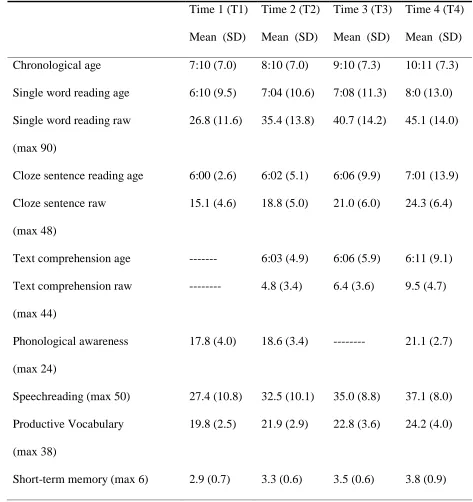
from T1 (reported in Kyle & Harris, 2006) are included in tables where appropriate.) The children made an average of 0.3 grade improvement per year in reading ability (see Table 1); however, there was considerable individual variation in reading progress.
<Table 1 about here>
Longitudinal relations between earlier cognitive and language skills and later
reading outcomes
This section will focus on the specific longitudinal relations that answer the research questions posited in the introduction section. Table 2 shows the partial correlations between the cognitive, language and reading tasks at T1 and T2, after controlling for NVIQ and hearing loss. Both speechreading T1 and vocabulary at T1 were
significantly associated with later word reading and sentence comprehension ability at T2 (large effects). Additionally, there was a moderate yet significant association between phonological awareness at T1 and sentence comprehension ability at T2.
<Table 2 about here>
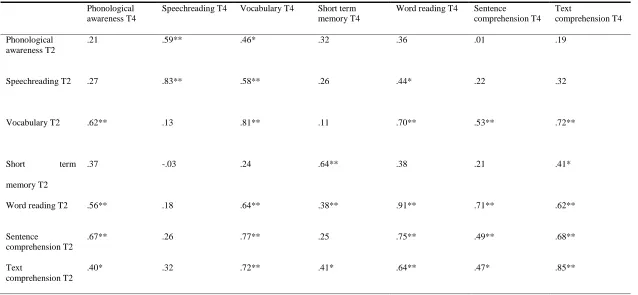
Table 3 shows the partial correlations between the cognitive and language skills at the mid point of the study (T2) and later literacy outcomes, including text comprehension ability, two years later at T4. The results from the partial correlations between T2 and T4 revealed a slightly different pattern of relations from those
observed from T1 to T2. Whilst vocabulary at T2 was positively correlated with later performance on all three reading tests, speechreading at T2 was now only
significantly related to later word reading ability at T4. There were no significant associations between phonological awareness at T2 and later reading scores.
and sentence comprehension at T2, showed significant positive relations with later phonological awareness scores at T4 (ranging from r = .40 to r = .67), even after controlling for NVIQ and hearing loss.
<Table 3 about here>
Predicting longitudinal growth in reading achievement
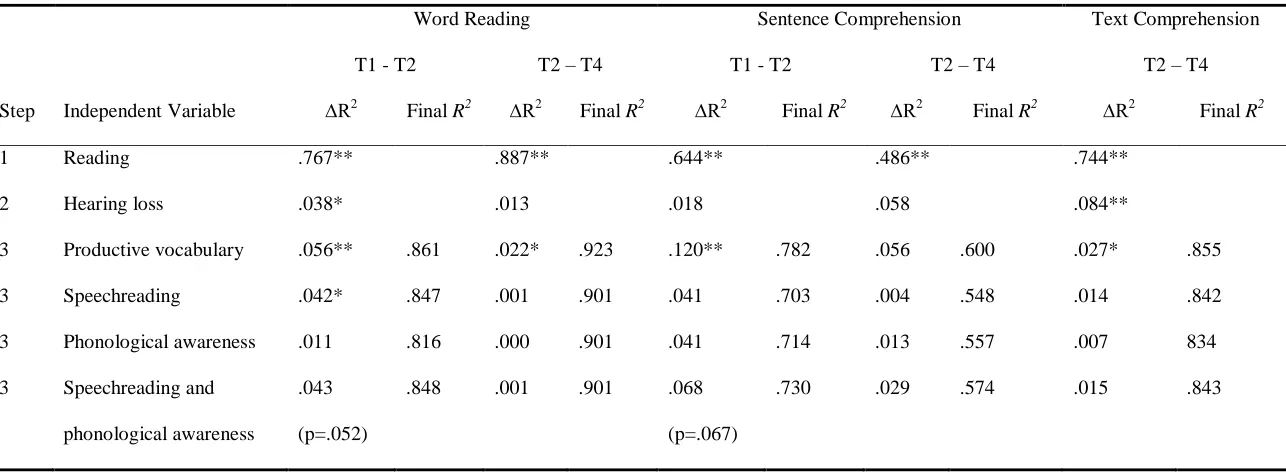
Fixed-order multiple regression analyses were used to investigate which of the cognitive and language skills predicted the growth in reading achievement between the time periods measured. Entering earlier levels of reading ability into the regression analyses provided a way to examine the change in reading achievement over time. Earlier reading levels were always entered in Step 1 followed by the degree of hearing loss at Step 2. The selection of subsequent potential predictors was based upon the results from the longitudinal partial correlations. Results from the multiple regression analyses should be interpreted with a note of caution due to the current sample size of 29 being just below the recommended sample size of 31 in order to detect a large effect with three predictors (Green, 1991).
productive vocabulary at T1 was entered at step 3, it accounted for an additional 12% of the variance in the sentence comprehension scores at T2.
<Table 4 about here>
In order to determine whether the cognitive and language tasks at T2 could predict the growth observed in the reading scores by the end of the study at T4, a similar set of analyses were run from T2 to T4. After earlier reading ability at T2 accounted for 89% of the variance, only vocabulary at T2 contributed a small yet significant 2% towards the word reading scores two years later at T4. Earlier sentence comprehension scores at T2 were the only significant predictor of later sentence comprehension scores. For text comprehension, earlier reading
comprehension at T2 and hearing loss explained 82% of the variance in scores two years later at T4. Vocabulary at T2 contributed a small yet significant 3% of the variance over and above that explained by hearing loss and earlier text comprehension scores.
The relations between speechreading, phonological awareness and reading
awareness was not predictive of reading growth on any of the three reading tasks across either time period.
The strong longitudinal correlations between speechreading and phonological awareness across different time periods necessitate clarification over which variable is a unique predictor of reading ability. Due to a lack of statistical power, the current sample size of 29 prevents speechreading and phonological awareness being entered consecutively into a forced entry multiple regression analysis. Alternately, the shared variance between these two variables could be investigated by entering them into the multiple regression analysis in a block and examining whether the block can account for any extra variance than when the variables were entered individually. Table 4 shows that entering phonological and speechreading together as a block in step 3 did not account for any additional variance in the word reading scores from T1 to T2 or T2 to T4 than speechreading alone. For the sentence comprehension scores, entering speechreading and phonological awareness together increased the T1 to T2 R2 change from 4% to almost 7%. However, the R2 change was just short of reaching statistical significance (p=.067), potentially due to a lack of statistical power, which makes it difficult to draw definitive conclusions. This finding does appear to corroborate the partial correlation results from T1 to T2 whereby speechreading is a unique predictor of early word reading whereas speechreading and phonological awareness together account for additional variance in predicting sentence comprehension ability.
related. Two additional multiple regression analyses, with phonological awareness at T4 as the outcome variable, revealed that even after entering earlier phonological awareness skill and hearing loss, both word reading at T2 and sentence
comprehension at T2 accounted for a further 20% and 28% respectively of the variance in phonological awareness scores at T4.
<Table 5 about here>
The role played by background factors and individual characteristics in the reading
development of deaf children
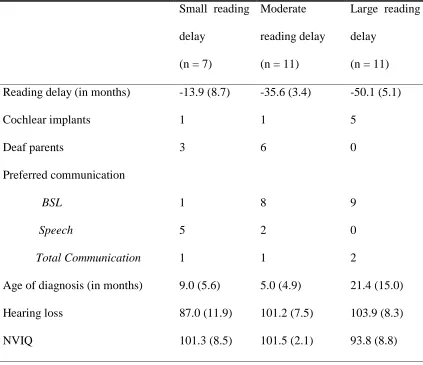
Given the heterogeneity in the language backgrounds and individual characteristics within the cohort, the potential role played by these factors in reading development was also examined. In order to do this, the children were split into three groups based upon the severity of their reading delay exhibited at the end of the study: (1) those children with a small reading delay (mean delay of 14 months, range -2 to -25 months), (2) moderate reading delay (mean 36 months, range -31 to -41 months) and (3) a large reading delay (mean 50 months, range -44 to -60 months). Reading delay was calculated as the difference between chronological age and reading age on the single word reading test (estimated using hearing norms). The individual background characteristics of these three groups (small, moderate and large reading delay) are shown in Table 6.
<Table 6 about here>
There were no significant differences in NVIQ or in the distribution of cochlear implants across the three groups (Chi-square (2) = 4.16, ns and χ2(2) = 4.46,
degree of hearing loss and age of diagnosis of deafness and also in the distribution of deaf parents and language preferences. Those children in the small or medium delay groups were more likely to have a less severe hearing impairment (Chi-square (2) = 8.11, p = .017), have had this impairment diagnosed at an earlier age (Chi-square (2) = 9.82, p = .007), have deaf parents (χ2 (2) = 8.24, p = .016), and to use speech as their dominant language (χ2
(2) = 9.14, p = .01) than those children in the large delay group. As expected, the two cognitive skills from T1 that were predictive of single word reading development were shown to significantly differ between the three groups: speechreading T1, Chi-square (2) = 14.19, p = .001 and vocabulary T1, Chi-square (2) = 14.10, p = .001. Post-hoc tests revealed that the children in the large reading delay group had significantly poorer speechreading and vocabulary at T1 than the children in the small and medium delay groups.
A stepwise discriminate analysis was conducted to find out if the background factors could correctly classify membership of the three reading delay groups. Two discriminate functions were calculated, χ2(6) = 36.10, p < .001 and χ2(2) = 6.02, p = .049, which accounted for 100% of the between group variance and separated the three groups. Using a stepwise classification containing degree of hearing loss, age of diagnosis and parental hearing status, 79.3% of the children were correctly classified as having a small, moderate or large reading delay. It was expected that degree of hearing loss would be part of the discriminate function as it had been a significant predictor in the regression analyses.
severely deaf children had at least one deaf parent and had been exposed to BSL from an early age, although they preferred to use speech themselves. The remaining two children had profound hearing losses; one was a fluent BSL user with Deaf parents and the other had a cochlear implant and currently communicated only through speech although previously he had been exposed to BSL between diagnosis at 12 months and implantation at 36 months.
Discussion
The most important finding from this study concerned the longitudinal predictors of growth in deaf children’s reading, some of which were stable over the course of the study and some of which changed over time. Speechreading was a significant predictor of initial growth in word reading ability between ages 7 and 8 years. Vocabulary was the strongest and most consistent longitudinal predictor of later reading achievement and reading growth for all three reading components across all time periods measured. In addition to the results from the multiple regression and correlational analyses, the importance of vocabulary and speechreading for deaf children’s word reading was evident in the finding that children in the small, medium
longitudinally predictive of later word reading ability and earlier vocabulary is also predictive of later sentence and text comprehension skills.
Different skills are known to be important for different components of reading ability in hearing children and the current study indicated that the same is true for deaf children. For hearing children, phonological skills (for reviews see Adams, 1990; Goswami & Bryant, 1990) and vocabulary knowledge (e.g. Dickinson et al., 2003; Juel et al., 1986) are generally found to be important for word reading whereas higher order language skills including vocabulary tend to be more related to reading
comprehension (e.g. Muter, Hulme, Snowling, & Stevenson, 2004; Roth, Speece, & Cooper, 2002). In the present study, both speechreading and vocabulary showed longitudinal associations with word reading, whereas only vocabulary knowledge was longitudinally related to word reading and sentence and text comprehension. The similarity of the findings for deaf and hearing children suggests that the process of learning to read is rather similar in the two populations, but with one important difference: for deaf children, it might be that speechreading ability gives rise to the code or strategy that is typically provided by phonological skills in hearing children.
undertaken in the current study were more stringent than in Harris and Beech (1998) and Colin et al. (2007) studies, as the auto-regressive effect of earlier reading ability was statistically controlled.
In the current study, phonological awareness and reading ability appeared to become related as the children got older and the strength of the concurrent
correlations with all three reading tasks at T4 was similar to that typically observed between phonological awareness and reading in younger hearing children (e.g. Muter et al., 2004). The longitudinal correlations and regressions suggest that it was earlier reading ability that was predominately associated with later phonological awareness rather than the other way round. This finding could be taken as novel evidence in support of an argument proposed by Musselman (2000) and Goldin-Meadow and Mayberry (2001) that deaf children’s phonological abilities mainly develop as a consequence of learning to read rather than being a pre-requisite of reading, as in hearing children. On this view, the relationship between phonological ability and learning to read in deaf children might be fundamentally different from the
relationship normally observed in hearing children whereby phonological awareness is typically both a pre-cursor of word reading ability and also later on exhibits a reciprocal relation with word reading (e.g. Burgess & Lonigan, 1998; Perfetti, Beck, Bell, & Hughes, 1987; see Castles & Coltheart, 2004 for a review). Up until now, this argument has primarily been based on the finding that the most consistent evidence of phonological awareness has came from studies of deaf adolescents and college
T1, whereby the children were significantly more accurate on the items that could be solved by using orthographic knowledge (see Kyle & Harris, 2006).
Our final set of findings concerned individual differences. Children with small reading delays, i.e. the “good” readers, tended to have better levels of hearing, were diagnosed earlier, more likely to have deaf parents and use speech than those children with large reading delays. These background factors all contribute in some way to language proficiency, whether through having deaf parents and thereby having better communication and early access to a functional language (sign language) or, alternately, through having hearing parents but with either an early diagnosis thereby resulting in early language input or a less severe hearing loss thereby benefiting more from intervention such as hearing aids. Indeed, some of these background
characteristics could account for some of the individual variability observed in speechreading and vocabulary skills. It must be remembered that 3 out of the 7 children in the small reading delay group had been exposed to high levels of BSL from an early age. Therefore, one interpretation of these results is that proficient and early access to language is necessary for reading ability in deaf children but that the specific modality of the language is not important, consistent with previous arguments proposed by Marschark and Harris (1996) and Musselman (2000). Readers may be surprised that more of the good readers did not have cochlear implants; however, it must be noted that the age of implantation for these children ranged from 3 years 10 months to 5 years 8 months and so these were not early implanted. The advantage in reading ability typically found for cochlear implanted deaf children is usually
observed in early implanted children (see Archbold, Harris, O’Donoghue,
What do the current findings tell us about how similar or different deaf children’s reading development is to that of typically developing hearing children? Deaf children’s reading development was similar to hearing children’s in that: (1)
vocabulary knowledge was a strong longitudinal predictor of word reading and reading comprehension, even after controlling for earlier reading levels (see Roth, Speece, & Cooper, 2002; Senechal, Ouellette & Rodney, 2006); (2) different
cognitive skills underpinned the decoding and comprehension components of reading; and (3) early reading ability was found to be strongly related to later levels of
phonological awareness (see Wagner & Torgeson, 1987). However, there were two findings that highlighted the differences between deaf and hearing children’s reading development: (1) phonological awareness was not found to be a precursor of word reading ability in deaf children whereas this relation is consistently reported for hearing children. (2) Speechreading ability was associated with later reading ability in deaf children but without further research, it is unclear whether speechreading would play an important role in hearing children’s reading development.
Given the developmental changes observed in the associations between speechreading, phonological awareness and reading ability in deaf children, it is important to consider why these relative contributions and relations may change over time. Speechreading was a longitudinal predictor of early reading growth and also showed strong longitudinal associations with later phonological awareness whereas reading and phonological awareness became more strongly related as the children’s reading skills developed and by the end of the study speechreading was no longer a significant predictor. This suggests a developmental pattern whereby speechreading is initially a significant predictor of reading in deaf children as it is directly tapping the input for the phonological representations being used to support reading ability. However, as reading skill itself develops and the underlying phonological
representations become more specified, thereby enabling a child to make
phonological judgements more consistently, tasks that tap phonological awareness become more strongly associated with reading ability. The current results support the argument that speechreading could provide the input for deaf children’s phonological representations and suggest that speechreading and phonological awareness tasks are potentially tapping the same underlying abilities and representations. Speechreading of single words could plausibly act as a marker of the quality of phonological
References
Adams, M. J. (1990). Beginning to read: Thinking and learning about print. Cambridge, MA: MIT Press.
Alegria, J. (1996). On the origin of phonological representations in deaf people. In M. Carreiras & J. E. Garcia-Albea & N. Sebastian-Galles (Eds.), Language processing in Spanish (pp. 119-143). Mahwah, New Jersey: Lawrence Erlbaum Associates.
Allen, T. E. (1986). Patterns of academic achievement among hearing impaired students: 1974 and 1983. In A. N. Schildroth & M. A. Karchmer (Eds.), Deaf children in America (pp. 161- 206). San Diego, CA: College-Hill Press.
Archbold, S., Harris, M., O’Donoghue, G., Nikolopoulos, T., White, A., &
Richmond, H. (2008). Reading abilities after cochlear implantation: The effect of age at implantation on outcomes at 5 and 7 years after implantation.
International Journal of Pediatric Otorhinolaryngology, 72(10), 1471 – 1478. Arnold, P., & Kopsel, A. (1996). Lipreading, reading and memory of hearing and hearing-impaired children. Scandinavian Journal of Audiology, 25(1), 13 - 20. Bowey, J. A., & Patel, R. K. (1988). Metalinguistic ability and early reading
achievement. Applied Psycholinguistics, 9, 367-383.
Burden, V., & Campbell, R. (1994). The development of word-coding skills in the born deaf: An experimental study of deaf school leavers. British Journal of Developmental Psychology, 12, 331-349.
Burgess, S. R., & Lonigan, C., J. (1998). Bidirectional relations of phonological sensitivity and prereading abilities: Evidence from a preschool sample.
Campbell, R. (1997). Read the lips: speculations on the nature and role of lipreading in cognitive development of deaf children. In M. Marschark & P. Siple & D. Lillo-Martin & R. Campbell & V. S. Everhart (Eds.), Relations of Language and Thought: The View from Sign Language and Deaf Children (pp. 110-146). Oxford: Oxford University Press.
Campbell, R., & Wright, H. (1988). Deafness, spelling and rhyme: How spelling supports written word and picture rhyming skills in deaf subjects. The Quarterly Journal of Experimental Psychology, 40A(4), 771-788.
Caravolas, M., Hulme, C., & Snowling, M. J. (2001). The foundations of spelling ability: evidence from a 3-Year longitudinal study. Journal of Memory and Language, 45, 751-774.
Castles, A., & Coltheart, M. (2004). Is there a causal link from phonological awareness to success in learning to read? Cognition, 91(1), 77-111.
Charlier, B. L., & Leybaert, J. (2000). The rhyming skills of deaf children educated with phonetically augmented speechreading. The Quarterly Journal of Experimental Psychology, 53A(2), 349-375.
Colin, S., Magnan, A., Ecalle, J., & Leybaert, J. (2007). Relation between deaf children’s phonological skills in kindergarten and word recognition
performance in first grade. Journal of Child Psychology and Psychiatry, 48(2), 139-146.
Connor, C. M., & Zwolan, T. A. (2004). Examining multiple sources of influence on the reading comprehension skills of children who use cochlear implants.
Journal of Speech, Language, and Hearing Research, 47, 509-526.
Deacon, S. H., & Kirby, J. R. (2004). Morphological awareness: Just "more morphological"? The roles of morphological and phonological awareness in reading development. Applied Psycholinguistics, 25, 223-238.
Dickinson, D. K., McCabe, A., Anastasopoulos, L., Peisner-Feinberg, E. S., & Poe, M. D. (2003). The comprehensive language approach to early literacy: The interrelationships among vocabulary, phonological sensitivity, and print knowledge among preschool-aged children. Journal of Educational Psychology, 95(3), 465-481.
DiFrancesca, S. (1972). Academic Achievement Test Results of a National Testing Program for Hearing Impaired Students: United States, Spring 1971 (Report
No. 9, Series D). Washington, DC: Gallaudet College, Office of Demographic Studies.
Dodd, B. (1980). The spelling abilities of profoundly pre-lingually deaf children. In U. Frith (Ed.), Cognitive Processes in Spelling (pp. 423-440). London: Academic Press.
Dyer, A., MacSweeney, M., Szczerbinski, M., Green, L., & Campbell. R. (2003). Predictors of reading delay in deaf adolescents: the relative contributions of rapid automatized naming speed and phonological awareness and decoding.
Journal of Deaf Studies and Deaf Education, 8(3), 215-229.
Elbro, C. (1996). Early linguistic abilities and reading development: A review and a hypothesis. Reading and Writing: An Interdisciplinary Journal, 8, 453-485. Elliot, C. D., Smith, P., & McCulloch, K. (1996). British Ability Scales II (BAS II).
Windsor, Berks: NFER-Nelson.
Ellis, N., & Large, B. (1988). The early stages of reading: a longitudinal study.
France, N. (1981). The Primary Reading Test. Windsor, Berks: NFER-Nelson.
Geers, A., & Moog, J. (1989). Factors predictive of the development of literacy in profoundly hearing-impaired adolescents. The Volta Review, 91, 69-86.
Goldin-Meadow, S., & Mayberry, R. I. (2001). How do profoundly deaf children learn to read? Learning Disabilities Research & Practice, 16(4), 222-229. Gombert, J. E. (1992). Metalinguistic development. London: Harvester Wheatsheaf. Green, S. B. (1991). How many subjects does it take to do a regression analysis?
Multivariate Behavioral Research, 26(3), 499-510.
Griswold, L. E., & Commings, J. (1974). The expressive vocabulary of preschool deaf children. American Annals of the Deaf, 119(1), 16-29.
Hanson, V. L., & Fowler, C. A. (1987). Phonological coding in word reading: Evidence from hearing and deaf readers. Memory and Cognition, 15(3), 199-207.
Hanson, V. L., & McGarr, N. S. (1989). Rhyme generation by deaf adults. Journal of Speech and Hearing Research, 32, 2-11.
Hanson, V. L., Shankweiler, D., & Fischer, F. W. (1983). Determinants of spelling ability in deaf and hearing adults: Access to linguistic structure. Cognition, 14, 323-344.
Harris, M., & Beech, J. R. (1998). Implicit phonological awareness and early reading development in prelingually deaf children. Journal of Deaf Studies and Deaf Education, 3(3), 205-216.
Harris, M., & Moreno, C. (2006). Speech reading and learning to read: a comparison of 8-year-old profoundly deaf children with good and poor reading ability.
Journal of Deaf Studies and Deaf Education, 11, 189-201.
Izzo, A. (2002). Phonemic awareness and reading ability: an investigation with young readers who are deaf. American Annals of the Deaf, 147(4), 18-28.
Kenny, D. A. (1975). Cross-lagged panel correlation: a test for spuriousness.
Psychological Bulletin, 82(6), 887-903.
Kyle, F., & Harris, M. (2006). Concurrent correlates and predictors of reading and spelling achievement in deaf and hearing school children. Journal of Deaf Studies and Deaf Education, 11, 273-288.
Lane, H. S., & Baker, D. (1974). Reading achievement of the deaf: another look. The Volta Review, 76, 489-499.
LaSasso, C. J., & Davey, B. (1987). The relationship between lexical knowledge and reading comprehension for prelingually profoundly hearing-impaired students.
The Volta Review, 89(4), 211-220.
Leather, C. V., & Henry, L. A. (1994). Working memory span and phonological awareness tasks as predictors of early reading ability. Journal of Experimental Child Psychology, 58, 88-111.
Leybaert, J., & Alegria, J. (1993). Is word processing involuntary in deaf children?
British Journal of Developmental Psychology, 11, 1-29.
Leybaert, J., & Charlier, B. L. (1996). Visual speech in the head: the effect of Cued-Speech on rhyming, remembering and spelling. Journal of Deaf Studies and Deaf Education, 1(4), 234-248.
Marschark, M., & Harris, M. (1996). Success and failure in Learning to Read: the Special Case (?) of Deaf Children. In C. Cornoldi & J. Oakhill (Eds.), Reading Comprehension Difficulties: Process and Intervention (pp. 279-300). Hillsdale, NJ: Lawrence Erlbaum Associates.
Masterson, J., Stuart, M., Dixon, M., & Lovejoy, S. (2003). Children's Printed Word Database: University of Essex.
Miller, P. (1997). The effect of communication mode on the development of phonemic awareness in prelingually deaf students. Journal of Speech, Language, and Hearing Research, 40(5), 1151-1163.
Mohammed, T., Campbell, R., MacSweeney, M., Barry, F., & Coleman, M. (2006). Speechreading and its association with reading among deaf, hearing and dyslexic individuals. Clinical Linguistics & Phonetics, 20(7-8), 621-630. Morrison, C. M., Chappell, T. D., & Ellis, A. W. (1997). Age of acquisition norms for
a large set of object names and their relation to adult estimates and other variables. The Quarterly Journal of Experimental Psychology, 50A(3), 528-559.
Musselman, C. (2000). How do children who can't hear learn to read an alphabetic script? A review of the literature on reading and deafness. Journal of Deaf Studies and Deaf Education, 5(1), 9-31.
Neale, M. D. (1997). The Neale analysis of reading ability II (NARA II). Windsor, Berks: NFER-Nelson.
Perfetti, C. A., Beck, I., Bell, L. C., & Hughes, C. (1987). Phonemic Knowledge and Learning to Read are Reciprocal: A Longitudinal Study of First Grade Children. Merrill-Palmer Quarterly, 33(3), 283-319.
Roth, F. P., Speece, D. L., & Cooper, D. H. (2002). A Longitudinal Analysis of the Connection between Oral Language and Early Reading. Journal of Educational Research, 95, 259-272.
Senechal, M., Ouellette, G., & Rodney, D. (2006). The Misunderstood Giant: On the Predictive Role of Early Vocabulary to Future Reading. In D. K. Dickinson & S. B. Neuman (Eds.), Handbook of Early Literacy Research (Vol. 2, pp. 173-182). New York: The Guildford Press.
Snodgrass, J. G., & Vanderwart, M. (1980). A standardized set of 260 pictures: norms for name agreement, image agreement, familiarity, and visual complexity.
Journal of Experimental Psychology: Human Learning and Memory, 6(2), 174-215.
Snowling, M. J., Gallagher, A., & Frith, U. (2003). Family risk of dyslexia is continuous: individual differences in the precursors of reading skill. Child Development, 74(2), 358-373.
Swanson, H. L., & Howell, M. (2001). Working memory, short-term memory, and speech rate as predictors of children's reading performance at different ages.
Journal of Educational Psychology, 93(4), 720-734.
Trybus, R. J., & Karchmer, M. A. (1977). School achievement scores of hearing impaired children: national data on achievement status and growth patterns.
Vermeulen, A. M., van Bon, W., Schreuder, R., Knoors, H., & Snik, A. (2007). Reading Comprehension of Deaf Children With Cochlear Implants. J. Deaf Stud. Deaf Educ., 12(3), 283-302.
Wagner, R. K., & Torgesen, J. K. (1987). The nature of phonological processing and its casual role in the acquisition of reading skills. Psychological Bulletin, 101(2), 192-212.
Waters, G. S., & Doehring, D. G. (1990). Reading acquisition in congentially deaf children who communicate orally: insights from an analysis of component reading, language, and memory skills. In T. H. Carr & B. A. Levy (Eds.),
Reading and its Development: Component Skills Approaches (pp. 323-373): Academic Press.
Wauters, L. N., van Bon, W. H. J., & Tellings, A. E. J. M. (2006). Reading comprehension of Dutch deaf children. Reading and Writing, 19, 49-76. Wolk, S., & Allen, T. E. (1984). A 5-year follow-up of reading comprehension
achievement of hearing-impaired students in special education programs.
Table 1: Means and standard deviations for the reading, cognitive and language tasks at each testing period
Time 1 (T1) Mean (SD)
Time 2 (T2) Mean (SD)
Time 3 (T3) Mean (SD)
Time 4 (T4) Mean (SD) Chronological age 7:10 (7.0) 8:10 (7.0) 9:10 (7.3) 10:11 (7.3) Single word reading age 6:10 (9.5) 7:04 (10.6) 7:08 (11.3) 8:0 (13.0) Single word reading raw
(max 90)
26.8 (11.6) 35.4 (13.8) 40.7 (14.2) 45.1 (14.0)
Cloze sentence reading age 6:00 (2.6) 6:02 (5.1) 6:06 (9.9) 7:01 (13.9) Cloze sentence raw
(max 48)
15.1 (4.6) 18.8 (5.0) 21.0 (6.0) 24.3 (6.4)
Text comprehension age --- 6:03 (4.9) 6:06 (5.9) 6:11 (9.1) Text comprehension raw
(max 44)
--- 4.8 (3.4) 6.4 (3.6) 9.5 (4.7)
Phonological awareness (max 24)
17.8 (4.0) 18.6 (3.4) --- 21.1 (2.7)
Speechreading (max 50) 27.4 (10.8) 32.5 (10.1) 35.0 (8.8) 37.1 (8.0) Productive Vocabulary
(max 38)
19.8 (2.5) 21.9 (2.9) 22.8 (3.6) 24.2 (4.0)
Table 2: Matrix of partial correlations between T1 and T2 controlling for NVIQ and hearing loss
Phonological awareness T2
Speechreading T2 Vocabulary T2 Short term memory T2
Word reading T2 Sentence
comprehension T2 Phonological
awareness T1
.57** .36 .32 .02 .30 .45*
Speechreading T1 .62** .79** .35 .14 ..69** .55**
Vocabulary T1 .36 .49** .82** .36 .63** .78**
Short term memory T1
-.04 .04 .24 .41* .32 .38
Word reading T1 .38 (p=.054) .50** .35 .13 .83** .56**
Sentence
comprehension T1
.26 .52** .52** .11 .75** .67**
Table 3: Matrix of partial correlations between T2 and T4 controlling for NVIQ and hearing loss
Phonological awareness T4
Speechreading T4 Vocabulary T4 Short term memory T4
Word reading T4 Sentence
comprehension T4 Text
comprehension T4 Phonological
awareness T2
.21 .59** .46* .32 .36 .01 .19
Speechreading T2 .27 .83** .58** .26 .44* .22 .32
Vocabulary T2 .62** .13 .81** .11 .70** .53** .72**
Short term memory T2
.37 -.03 .24 .64** .38 .21 .41*
Word reading T2 .56** .18 .64** .38** .91** .71** .62**
Sentence
comprehension T2
.67** .26 .77** .25 .75** .49** .68**
Text
comprehension T2
.40* .32 .72** .41* .64** .47* .85**
Table 4: Multiple regression analyses for the tasks at T1 as predictors of reading at T2/tasks at T2 as predictors of reading at T4
Word Reading Sentence Comprehension Text Comprehension
T1 - T2 T2 – T4 T1 - T2 T2 – T4 T2 – T4
Step Independent Variable ∆R2 Final R2 ∆R2 Final R2 ∆R2 Final R2 ∆R2 Final R2 ∆R2 Final R2
1 Reading .767** .887** .644** .486** .744**
2 Hearing loss .038* .013 .018 .058 .084**
3 Productive vocabulary .056** .861 .022* .923 .120** .782 .056 .600 .027* .855
3 Speechreading .042* .847 .001 .901 .041 .703 .004 .548 .014 .842
3 Phonological awareness .011 .816 .000 .901 .041 .714 .013 .557 .007 834
3 Speechreading and
phonological awareness
.043
(p=.052)
.848 .001 .901 .068
(p=.067)
.730 .029 .574 .015 .843
Table 5: Partial correlation matrix at T4 controlling for NVIQ and hearing loss
Phonological awareness
Speechreading Vocabulary Short term memory
Word reading Sentence comprehension
Text
comprehension Age -.11 .14 -.12 .19 .01 .20 -.12
Phonological awareness
.10 .63** .23 .65** .49* .47*
Speechreading .45* .01 .19 -.08 .13
Vocabulary .18 .76** .41* .68**
Short term memory
.39* .25 .34
Word reading .71** .76**
Sentence comprehension
.69**
Table 6: Individual characteristics of the three reading delay groups
Small reading delay
(n = 7)
Moderate reading delay (n = 11)
Large reading delay
(n = 11) Reading delay (in months) -13.9 (8.7) -35.6 (3.4) -50.1 (5.1)
Cochlear implants 1 1 5
Deaf parents 3 6 0
Preferred communication
BSL 1 8 9
Speech 5 2 0
Total Communication 1 1 2
Age of diagnosis (in months) 9.0 (5.6) 5.0 (4.9) 21.4 (15.0) Hearing loss 87.0 (11.9) 101.2 (7.5) 103.9 (8.3)