DOCUMENT
PROGRAMME OF RESEARCH AND
ACTION ON THE DEVELOPMENT OF THE
LABOUR MARKET
Developing support structure for workers'
cooperatives
COMMISSION
This document has been prepared for use within the Commission. It does not necessarily represent the Commission's official position.
Cataloguing data can be found at the end of this publication
Luxembourg: Office for Official Publications of the European Communities, 1986
ISBN: 92-825-5888-6
Catalogue number: CB-45-85-381-EN-C
Articles and texts appearing in this document may be reproduced freely in whole or in part providing their source is mentioned.
Commission of the European Communities
PROGRAMME OF RESEARCH AND ACTION ON THE DEVELOPMENT OF THE LABOUR MARKET
DeveLoping support structure for workers cooperatives
by
Trade Union Research Unit Ruskin College
T h e r e s e a r c h on w h i c h t h e s e r e p o r t s w e r e b a s e d w a s f i n a n c e d by t h e C o m m i s s i o n of t h e E u r o p e a n C o m m u n i t i e s as p a r t of
its pppgpsrøme of R e s e a r c h and A c t i o n s on t h e D e v e l o p m e n t of t h e L a b o u r M a r k e t .
"like slave labeur, like serf labour, hired labour is but a transitory and inferior form, destinied to disappear before associated labour plying its toil with a willing hand, a ready mind, and a joyous heart."
Marx 1864
Acknowledgements
I would like to thank the members of the management committee of the Wales Co-operative Development and Training Centre for
their support during the research for this project. Thanks are due in particular to George Wright, Secretary of the Wales TUC, and Les Paul, Treasurer of the management committee, for their perseverance and encouragement. The staff and the secretaries of the Co-op Centre provided much useful information without which this report could not have been produced. Finally, I would like to thank Michelle Lloyd, the secretarial assistant to TURU, for her quiet competence, and Ginny Hetherington for her invaluable help with the ultimate production of this report. I alone remain responsible for any errors or faulty interpretations.
Denis Gregory, TUFD,
LIST OF CONTENTS
Chapter 1 Background to the Project and Research Design
page 1
Chapter 2 The Wales Co-operative Development and Training Centre
Chapter 3 Establishing an Investment Fund for Worker Co-ops
21
Chapter 4 Trade Unions as Support Structures for Co-ops:
Constraints and Prospects
31
Chapter 5 Some Preliminary Conclusions from the Wales TUC's
Experience
37
Appendix 1 Rules of the Wales Co-operative Development and Training Centre Limited
Appendix 2 Proposed Trust Deed for the Wales Local Authorities' Co-operative Deposit and
Gift Funds
55
Appendix 3 Potential Co-ops - Ideas and Products being worked upon by the WCD&DC as
at October 1983.
78
Appendix 4 The Formation of Co-ops in Wales
1980-83
81
Appendix 5 Some Examples of Promotional Material
1
-Chapter 1 Background to the Project and Research Design
1. Introduction
1.1 This report sets out the results of an action research project carried out by the Trade Union Research Unit (TURU), Ruskin College, Oxford in Co-operation with the Wales TUC.
1.2 Against the background of the Wales TUC's initiatives on worker co-operatives,* the project was designed to examine and evaluate the potential support roles and responsibilities which exist for trade union organisations in the general process of the development of worker co-operatives .
1.3 The basic research was undertaken over the period January-September 1983. During this time the Wales TUC launched the Wales Co-operative Development and Training Centre (WCDTC). Hence, the timing of the
research enabled the pre-planning and start up phase of the centre to be observed and evaluated. The report also included a description and eval-uation of the Wales TUC'S proposed investment fund for Worker Co-ops in the principality.
1.4 The original research brief submitted to the EEC in July 1982 indentified four crucial elements in the establishment of the centre which an action research project could usefully study and evaluate, namely, the ways in which the Wales TUC began:
- Setting up a communication and contact network with existing worker owned enterprises, local authorities, trade unions,official agencies and Co-operative support groups;
- preparing documentation and material for promotional and education purposes;
- developing and testing training modules in specific
-2-- areas of co-2--operative management and organisation;
- recruiting and training staff for the centre.
1.5 As well as providing the means to assess the potential for trade
union involvement in specific elements in a support infrastructure i.e.
the centre and the fund, it was intended that the research would also
enable evaluations to be made of the need for, and constraints upon trade
union involvement at the individual enterprise level. In particular, how
unions might assist in overcoming initial training and organisational
difficulties in the early stages of worker co-operatives were considered
important areas for study.
1.6 The Wales TUC was felt to be particularly suited for the study
since they, more than any other UK based union organisation liad accepted
that unions must play a direct role in the support structures which
surr-ound worker co-ops. More importantly, the WTUC had initiated developments
of their own in order to supplement and strengthen the ¡.support networks
which were already in existence in Wales.
1.7 The Mutual Aid Centre report "Prospects for Workers Co-operatives
in Europe"* echoed the view of many other recent analysts by stressing
the impórtanos of support agencies for co-operatives. They also noted
the importance of trade union attitudes to worker co-operatives as a
potential force either negative or positive on future governmental policy
towards co-operatives. Amongst other things Mutual Aid Centre called for
more research on "the role that the support organisations do and could
play". The work detailed in this report represents a small contribution
towards fulfilling this wider research need.
Methodology : Why Action Research?
1.8 To make any practical assessment of a trade union organisation as
either a support agency in its own right or as part of a wider supportive
infrastructure, it was clearly necessary to move beyond the theoretical
debate as to what unions could or could not do to help worker co-ops
develop. This inevitably, pushed the research design towardö a 'live'
* Submitted to DG'V in December 1981 as part of the Programme of Research
-3-examination and evaluation of the Wales TUC's various initiatives on worker co-ops. In any event, it was felt that the theoretical debate would possibly benefit from the opportunity to test some of the conflicts and constraints which are commonly assumed to confine and limit the support which British unions can give to worker co-ops.
1.9 For this report,action research is understood to embrace the study and broad evaluation of the sequence of décisions, actions and responses which surrounded the establishment of the WTUC' Co-op Development and Training Centre, and those which continue to inform their attempts to found an independent investment fund for worker co-ops.
1.10 The principle research method used has been that of participant observation. In plain terms, this involves the research worker partic-ipating in the key decisions and actions relevant to the issues identified in the initial research brief. To this end the author of this report joined the management board of the WCD&TC and served as a member of the Board's Sub group dealing with the formulation and foundation of the in-vestment fund. In addition the author had direct responsibilites for certain aspects of the pre-planning and launching of the Centre, part-icipated in the initial drawing up of job specifications and recruitment of key Centre staff, and at the time of writing continues to provide certain specialist inputs to both the management board and the Centre's staff.
1.11 To provide an accurate description of the involvement of the WTUC in developing a support structure for co-ops and to begin to evaluate the constraints it is difficult to see how more traditional research methods would have proved more effective given also the very short time scale of the research. .Nonetheless, it has to be recognised that the evaluation contained in this report is derived from a close contact with the actual process studied and a strong indentification with the objectives of the WCD&TC management Board.
-5-Chapter 2
The Wales Co-operative Development and Training Centre
Initial Conception
2.1 The WTUC's indentification of the need for a strong support structure to assist the birth and development of worker co-ops was born out of
practical experience. Between 1976 and 1978 alongside the struggle against closures in BSC plants at Ebbw Vale, East Moors and Shotton, many small and medium sized engineering and manufacturing companies in Wales closed their doors. In a number of cases, notablyTriangat Merthyr Tydfil and R.D.L. at Treorchy the Wales TUC was asked for advice by the workforce as to how their jobs might be rescued. This inevitably led to the examination of some form of co-operative as a suitable revival vehicle. At the same time groups of steel workers, particularly at East Moors in Cardiff where an ambitious plan for a worker buyout of the plant was developed, were begining to consider ways in which they could band
together to produce their own jobs.
2.2 It was quickly apparent to the leadership and staff of the WTUC that beyond broadly endorsing these worker initiatives, they could do little more than make contact on behalf of these groups with the agencies
that had been set up in Wales - the Welsh Development Agency and in London - the Co-operative Development Agency. This proved to be a fruitless but nonetheless instructive exercise. It was clear that the WDA at that time was not attuned to the needs of groups of working people who wanted to form co-operatives. The CDA by comparison was sympathetic to those needs but, paradoxically, incapable of providing the resources
(as a result of the very narrow remit, it had been given by the then Labour government)to overcome the problem.
2.3 As a result, these early initiatives tendered to founder as the workers' initial enthusiasm became frustrated and dissipated at the lack of real
-6-2.4 With the election of a conservative government in 1979 pledged to cut back public expenditure it was readily apparent that unemployment in
Wales would continue to rise as both the manufacturing and service
sectors of the economy in Wales bore the brunt of this much more restric tive economic policy. The Wales TUC took the view that more and more groups of workers would be left to their own devices since traditional job creation strategies, never particularly effective in Wales, were now to be set impossible targets with much reduced resources. In these circumstances it was decided to examine the potential for creating jobs from within Wales by the efforts and skills of the communities that exist in the Principality.
2.5 In Ί980-81 the Wales TUC commissioned a feasibility study to assess the job creation potential of worker co-ops in Wales. The report produced suggested that across a range of sectors in the economy of Wales co-ops were a feasible corporate form. It argued that three interlocking elements were needed to advance theoretical job creation into reality, namely:
(a) That the trade union movement in Wales must back worker co-ops;
(b) That a resource centre to provide the necessary professional and managerial skills to would be and new start co-ops should be established; and
(c) That an independent investment fund dedicated to the provision of risk capital for new co-ops be founded to operate in parallel with the resource centre.
2.6 These conclusions had been reached as a result of a study of six worker co-ops in Wales, together with an examination of the Banking and professional services supplied by the Caja Laboral Popular in
-7-2.7 Trade union endorsement for the establishment of a resource centre and fund was formally achieved at the Wales TUC conferences in 1982 and
1983. From mid 1982 until April 1983 efforts were, therefore, concentr-ated on raising the necessary financial, physical and human resources to bring a co-op resource centre into being.
Finance and the Centre
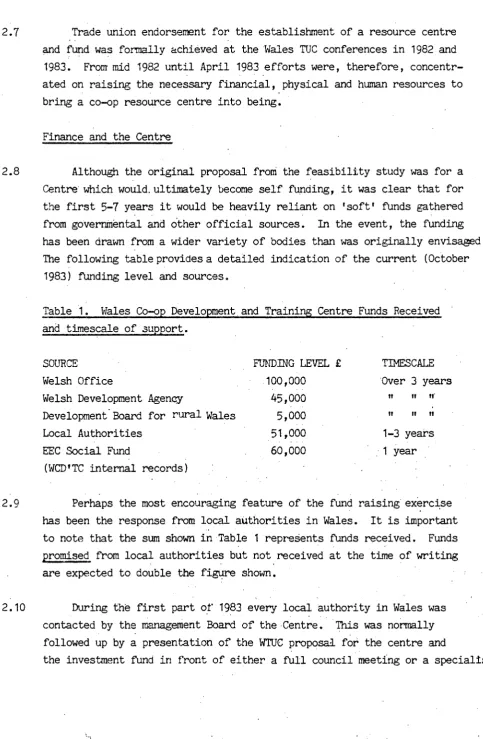
2.8 Although the original proposal from the feasibility study was for a Centre which would, ultimately become self funding, it was clear that for the first 5-7 years it would be heavily reliant on 'soft' funds gathered from governmental and other official sources. In the event, the funding has been drawn from a wider variety of bodies than was originally envisaged The following table provides a detailed indication of the current (October
[image:19.578.63.547.63.803.2]1983) funding level and sources.
Table 1. Wales Co-op Development and Training Centre Funds Received and timescale of support.
SOURCE FUNDING LEVEL £ TIMESCALE Welsh Office 100,000 Over 3 years Welsh Development Agency 45,000 " " "' Development'Board for rural Wales 5,000 " " " Local Authorities 51,000 1-3 years EEC Social Fund 60,000 . 1 year
(WCD'TC internal records)
2.9 Perhaps the most encouraging feature of the fund raising exercise has been the response from local authorities in Wales. It is important to note that the sum shown in Table 1 represents funds received. Funds promised from local authorities but nöt received at the time of writing are expected to double the figure shown.
2.10 During the first part of 1983 every local authority in Wales was contacted by the management Board of the Centre. This was normally followed up by a presentation of the WTUC proposal for the centre and
-8-committee of the council concerned. In virtually every case the response to both ideas has been strongly sympathetic.
2.11 The WTUC team essentially has asked for five forms of assistance from each local authority:
(i) A grant renewable annually towards the cost of establishing and running the Centre - this has been roughly scaled according to the size of the authority. Hence, it was suggested that the County Councils should consider a grant in the order of £10,000 p.a.
(ii) A deposit into the investment fund once this has been established. The size of the deposit to be determined by the Council but with some commit-ment towards maintaining that deposit for a fixed period of time - 5 years has been suggested.
(iii) A contact point within the authority to ensure proper co-ordination of efforts and to keep the authority involved in WCD&TC activities in
their particular area.
(iv) The use of facilities and property controlled by the authority either for activities connected with the promotion of co-operatives or to help the start up phase of new co-ops.
(v) The drawing up of a property bank to enable the WCD&TC to match the needs of local groups with facilities that exist in their particular area.
-9-2.13 Looking to the future, local authority support is likely to remain necessary and may even assume a greater importance if the Welsh Office support is limited to a three year period. This is not, however, inconsistent with the original conception of the Centre's natural inst-itutional supporters as being formed out of a mobilisation of the
combined resources of the labour movement and local Authorities in Wales. Early indications of the strength of this combination can be measured not simply in terms of funds raised, but also in the way in which ClwycL have made available office space for the Centre's workers in North Wales, and the extensive work which South Glamorgan is currently putting in to the renovation and preparation of LLandaff Court as the head office of the Centre.
Pre-Planning and Launching the Centre
2.14 Once Welsh Office commitment had been secured to contribute towards the setting up and running costs of the centre - a decision which came through in September 1982 - a planning period prior to the launch of the Centre in April "983 was initiated. A planning committee of 9 members was put together. This consisted of 6 nominees from the WTUC together with one each from the EEC office in Wales, the CBI Wales and Cardiff City
Council. This committee carried the full responsibility for initiating the development programme prior to the official launch of the Centre. All committee members contributed to the programme of visits to local authorities in Wales.
2.15 This committee has now been formally constituted as the management Board of the Centre. It has recently accepted into membership the Director of the British Co-operative Development Agency.
2.16 The pre-planning and development work in the main concerned the comm-ittee in: - Fund raising and general 'missionary' work with local
authorities, unions and local support agencies.
-10-- Formulating and registering a constitution for the Centre;
- Continuing discussions with the co-op Bank and other financial institutions on the shape and functions of the proposed investment fund.
Throughout this period regular reports were made to meetings of the WTUC general council. In addition every effort was made to keep the Welsh media informed of progress.
2.17 Early in 1983 the Centre recruited its first full time staff, a sec-retary and liason officer. The latter was charged with organising the launch conference on April 15th. The conference was attended by over 300 representatives from all quarters of the community in Wales. It was addressed by the Secretary of the Wales TUC and James Callaghan MP who had been a member of the labour government which had established the
national CDA in 1976. A special pack of promotional material was produced for the conference (see Appendices) and a number of existing co-operatives in Wales exhibited their goods and services at the conference hall.
The Structure and Functions of the Centre
2.18 One of the first decisions that the planning committee took was to register the Centre as a co-operative. It was felt that for it to exist in any other form would be wholly inconsistent with its aims and objectives. Hence, the Centre was formally registered under the industrial and Prov-ident Societies Act 1965. The rules of the Centre (attached as Appendix 1) are a modified version of the standard ICOM Co-op rules.
2.19 There are two features of the rules which are worthy of note. First of all rule 6 on membership is framed to allow for the future participation as members by:
"People who live or work or have interests within the community ; any society, company, or other corporate body with interests within the community".
-11-co-operatives and local co-op support groups will be able to make to the Centre. The second feature relates to the management of the Centre.
The rules provide for this to be the responsibility of a committee comprising:
"not less than seven nor more than 12 committee members.... elected from the members each year at the Annual General meeting"
However, to reflect the fact that the Centre originated from a Wales TUC initiative and that that body remains accountable for the public funds flowing to the centre, the WTUC retains the right in the "first three years of the Co-operatives existence" to appoint 7 members of the co-op to serve on the committee". After this three year period the WTUC will have the right to appoint 2 members on to the management committee.
2.20 This latter feature serves to underline both thè WTUC's commitment to the Centre, its responsibility to it in its first years, and the longer term intention to widen the base of the centre's membership and to prov-ide for a corresponding wprov-idening of involvement in the actual management of the Centre.
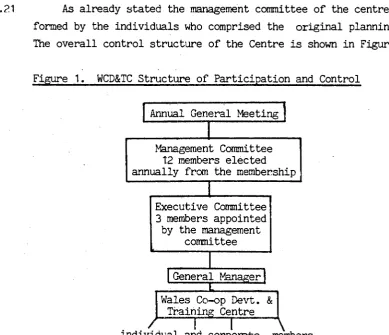
[image:23.578.68.458.417.752.2]2.21 As already stated the management committee of the centre is currently formed by the individuals who comprised the original planning committee. The overall control structure of the Centre is shown in Figure 1.
Figure 1. WCD&TC Structure of Participation and Control
Annual General Meeting Management Committee
Î2 members elected annually from the membership
Executive Committee 3 members appointed by the management
committee Genera Manager| Wales Co-op Devt. &
Training Centre
-12-2.22 It should be noted that the individual staff of the Centre are not at present full members of the Co-operative. Currently, they are invited to provide reports to the monthly meetings of the management Committee and are de facto represented at those meetings through the general manager. However, the general manager is not a full member of the co-operative either. As the number of full time staff at the Centre
increases this could give rise to some conflict over their lack of for-mal representation on the management committee. The solution may well lie in providing some form of associate membership for employed staff with the right to an elected representative on the management board.
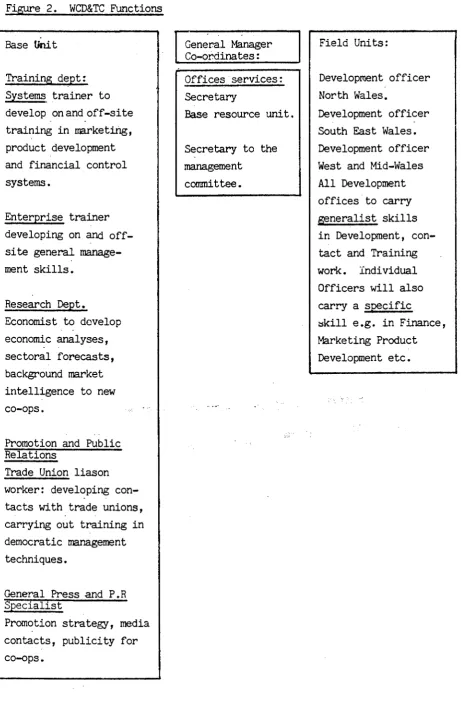
2.23 The functions of the Centre are shown in figure 2. The design and development of these functions have been heavily conditioned by the need to incorporate flexibility into the building up of professional skills and resources. Hence, all members of staff are expected to carry a training role and will operate as training resources both on and off the job. In addition, it is anticipated that where a staff member has a particular skill, say for example an accountancy training, that skill will be made available outside of his or her particular geographical area.
2.24 The Principle objectives of thé Centre can be defined as follows:
(i) To provide individuals and groups who wish to form worker-owned enterprises with ready and continuing access to technical and consultancy resources, in order that such enterprises can develop independent and robust operational forms.
(ii) To demonstrate and propagate the value of participative structures within worker owned enterprises;
(iii) To transmit the necessary management skills to strengthen and educate worker owned enterprises in the critical start-up and development stages;
-13-In addition to the more 'tailored' service that would be available, a range of common services will be developed including:
legal, auditing, cost & management, accounting, financial control & cash flow forecasting, buying & stock control, printing & advertising, sales and marketing.
(v) To support the efforts of local agencies to develop and sustain worker owned enterprises.
(vi) To broaden public and political awareness of the potential of worker-owned enterprises, by acting as a forum for debate and as an advocate for such leg-islative change as may be necessary in order to
advance the cause of co-operation and worker ownership.
(vii) To locate and help develop 'alliances' of community resources (physical, fiscal and intellectual) that could provide more locally specific support structures for the development of worker owned enterprises.
(viii) To continually monitor and investigate market
-14-Figure 2. WCD&TC Functions
Base Unit Training dept: Systems trainer to develop on and off-site training in marketing, product development and financial control systems.
Enterprise trainer developing on and off-site general manage-ment skills.
Research Dept.
Economist to develop economic analyses, sectoral forecasts, background market intelligence to new co-ops.
Promotion and Public Relations
Trade Union liason worker: developing con-tacts with trade unions, carrying out training in democratic management techniques.
General Press and P.R Specialist
Promotion strategy, media contacts, publicity for co-ops.
General Manager Co-ordinates : Offices services :
Secretara-Base resource unit. Secretary to the management committee. Field Units: Development officer North Wales. Development officer South East Wales. Development officer West and Mid-Wales All Development offices to carry generalist skills in Development, con-tact and Training work. Individual Officers will also carry a specific
[image:26.578.54.516.68.776.2]
-15-An Overview of the Centre's First Phase
2.25 It is too early, after only 6 months full tine operation to make a realistic assessment of the extent to which the centre is meeting the broad ob jectives listed in the previous section. What can be described, however, are the strengths and weaknesses which have emerged in this first phase and how they may affect the achievement of these objectives.
2.26 If we take the development period from pre-launch through to the present, three solid achievements stand out:
<a) The successful fund raising effort;
(b) The development of good relationships with local co-op support groups;
(c) A boost to the rate of new co-op formation in Wales directly linked to the Centre's activities. 2.27 With regard to (a) above there can be little doubt that the backing
of the Wales TUC has played an important role here. The standing and reputation are elements which have an effect when trying to win endorsement for a support agency for worker co-ops. Equally, important however, is the impact which a union organisation taking positive steps to foster job creation (albeit through worker owned enterprises) has on bodies such as the Welsh Office,.the Welsh Development Agency and local authorities. Some part of the support from these bodies was probably due to their recognition that here was a union organisation moving well beyond its tradtional defensive postures.
16
uncritically to the model of coop support exemplified by the system dev
eloped in Mondragon. Finally, they distrusted what they saw as a "top
down" approach which would "parachute in " expertise but could not provide
the continuity of support which is so crucial to new coops.
2.29
Faced with this the staff of thé centre appear to have achieved a
considerable strengthening of relationships with individual coop develop
ment 'agencies. In part this may reflect the fact that two of the centre's
full time staff are well known to the CDA network in Wales. More importantly
it may indicate that these local agencies have started to view the centre
as a supplement rather than as a threat to their particular skills and
interests.
2.30
It is difficult to be precise as to exactly how much the centre's
establishment has contributed to the rate of coop formation in Wales.
Certainly that rate has grown in the last year and the centre is the only
significant addition to the network of support agencies in the Principality
established in that time.
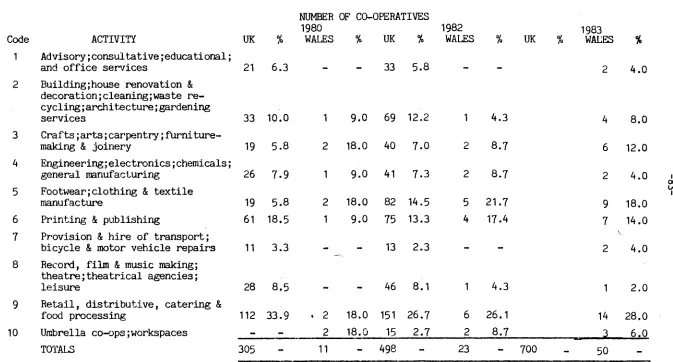
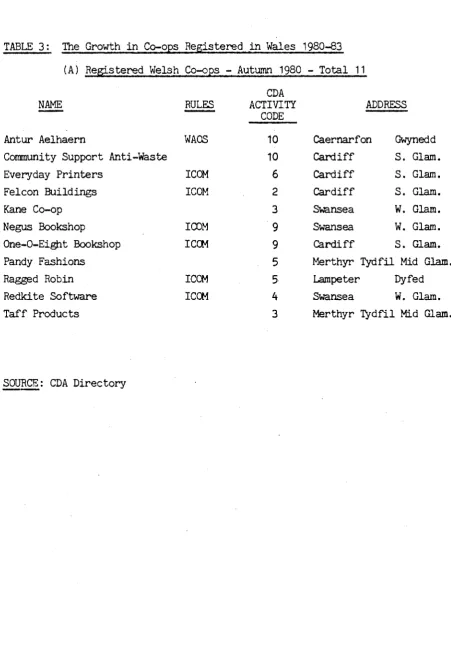
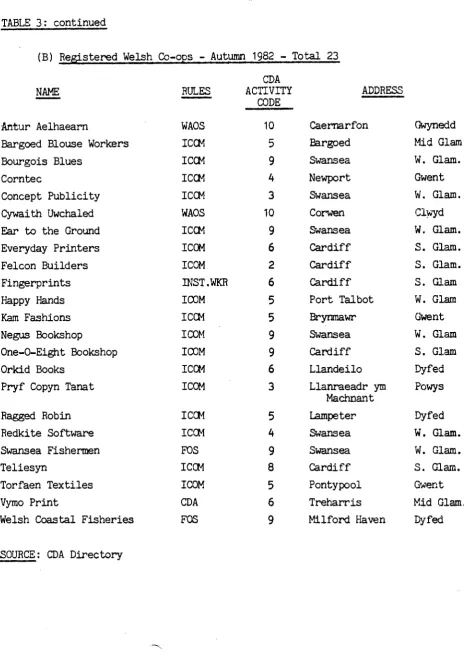
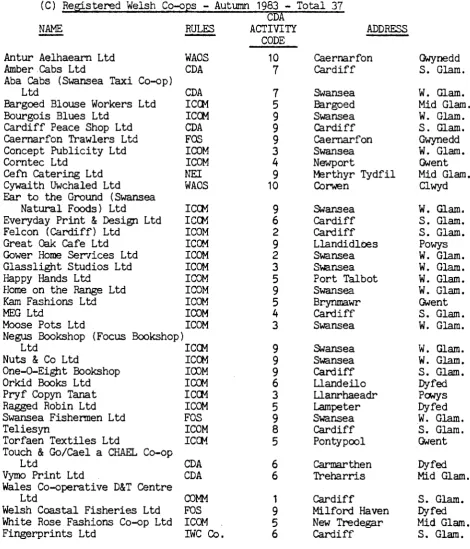
Table 2 Coop Formation in Wales 19801983
1980
11 Λ
1982
23 / registered
1983
37
~>
2.32 The scale and nature of the workload of the field officers does, however, raise important questions as to whether the resources of the Centre are being deployed optimally. There has, perhaps, been an over-emphasis during this first phase to 'produce the goods' i.e. get some co-ops started. This has had two effects. First of all, field officers have felt obliged to respond to virtually every inquiry that came their way no matter now small or obscure. In consequence they are now begining
to feel the effects of being spread too thinly across an expanding number of client groups. Secondly, this has severly limited the centre's resources available for contact and training.
2.33 The danger here is that the centre is being pulled away from its initial objective of developing a particular set of skills aimed at both supplementing the resources of existing support agencies but also to oper-ating with groupings who have hitherto remained peripheral to co-op dev-elopment - i.e. the bulk of the trade union movement in Wales. Whilst the Centre's staff have been and are'involved with a small number of trade unionists in the formation of particular co-ops, the need to set up a
major education and training programme for a much wider trade union audience remains to be taken up.
2.34 Some of these difficulties will doubtless be eased when the Centre is fully staffed. Nonetheless, optimising the impact of those resources will remain a vital task for both the general manager of the centre and
the management committee. A primary consideration must be the avoidance of duplication of efforts. In this sense it is important for the centre to maintain its efforts to encourage existing local CDA's and to foster the development of new ones. This will enable the centre to pass on to local resources much of the early developmental work and so release its own resources to concentrate on providing the professional services which for co-ops make the difference between a 'hand to mouth' existence and commercial efficiency.
-18-This was unavoidable since substantial renovation was necessary and no critisism of South Glamorgan County Council is implied. Nevertheless, it has resulted in thé centre spending its crucial first phase split between an office supplied by the Transport and General Workers Union (TGWU) at Transport House and a small suite of offices supplied by the Banking, Insurance and Finance Union (BIFU) in another part of Cardiff. This has inevitably created problems of co-ordination and has militated against the centre projecting a unified image. Currently, it is estimated that the centre will move into its offices in Llandaff Court in the early part of 1984. Until such time it is likely to continue to suffer some 'physical' constraints on its development.
2.36 The second and probably more serious constraint concerns the problem of recruitment. Apart from the staff already in post it has without doubt proven more difficult than was envisaged to recruit staff for the centre who combine the appropriate business skills with empathy and experience of either the trade union movement or worker co-ops. It may well of course be the case that such individuals either do not exist or are not attracted to the work of the centre. Hopefully, as the centre's profile becomes more fully recognisable and as knowledge of its activities and achievements spreads this latter possibility can be overcome. Either way, however, the recruitment of high quality staff dedicated to co-operative development seems likely to remain something of a stumbling.block. Clearly, the centre will have to put more effort into its own training of potential field work-ers. Moreover, it is difficult to escape the conclusion first put forward in the Mutual Aid Report on prospects for Worker co-ops in Europe, that much greater institutional effort should be directed at training and con-verting individuals with specific business skills to become enabling agents in the process of job creation.
-19-Strengths Weaknesses
* *
*
Clean Start
Accumulated knowledge of other support models Links with trade unions International Co-op contacts
Organisational skills Shop floor contacts Welsh identity
Sympathy with worker democracy
Could be innovatory
* * * * * * *
Suspicion about motives Over expectation of job creation potential
Poor links with Welsh Co-ops Antagonism from Welsh Co-op Agencies
Hierarchical Approach
Problems reaching the unemployed Cardiff axis
Remote from co-op practice Entrenched attidudes in the Labour movement
2.38 Taking the weakness listed first. As already noted, the antagonism from other support agencies and suspicion about the WTUC's motives
appear to have largely been overcome. Similarly, with the positioning of resources in North Wales and the extensive work of the field officers in South and West Wales, the accusation of concentration on Cardiff has fallen away. Problems reaching the unemployed certainly exist (the un-employed are far more fragmented and much less likely to congregate in one place'than is frequently imagined) but the centre has latterly taken steps to plug into the network of unemployed centres (some 30 established to date) developed by the WTUC. It is also the case that as the centre has raised its profile so its links with the general co-op movement in Wales have improved. It would not now be justified to say that the workers at the centre are remote from the practice of co-ops. Equally the charge of operating ahierarchical model of co-operative development could not be substantiated against the way in which the centre has operated in its first phase. The weaknesses that do remain, are concentrated mainly in the areas of changing attitudes in the trade union movement in Wales. It certainly is the case,that despite the endorsement of the annual
-20-2.39 Of the strength listed, it is perhaps ironic that the links with trade unions, shop floor contacts and sympathy with worker democracy have not combined more forcefully to have a greater effect on trade union attitudes. Certainly the organisational skills of the WTUC have operated to good effect in terms of the fund raising and basic development work which went into the launch of the centre and have helped it through some of the difficulties of the first phase. However, it remains for these
-21-Chapter 3
Establishing an Investment Fund for Worker Co-ops. 3.1 Background
Experience with attempts to form co-ops by groups of workers
threatened by closure quickly acquainted the WTUC with the difficulties of raising suitable finance. Most U.K.-based financial institutions simply regard a worker-based initiative/ particularly when a co-operative is the preferred form, as being too risky for serious consideration. As a result, many co-ops start up with the disadvantage of being under-capitalised.
3.2 Most financial institutions deny any inbuilt bias against co·*· operatives. Instead, they will frequently argue that co-cps do not pay sufficient attention to profitability and do not prepare their business proposals professionally enough. The WTUC have always taken this criticism seriously. One of the prime objectives of establishing the Centre was to provide the sort of professional skills which bankers would recognise and respect. Equally, there -has always been a total acceptance of the need to create co-ops that can survive in a competitive market environment. Despite these acknowledgements the WTUC have
found that co-ops they have promoted have consistently run into funding difficulties, seemingly irrespective of the professionalism of their business plan or the promise of their market research.
3.3 By and large the problem comes down to the unwillingness of banks to advance significant amounts of unsecured loan capital, added to their aversion to becoming involved in enterprises that to them are heavily overgeared (i.e. dependent on loans rather than equity). By definition, co-ops are always likely to suffer problems in these respects: very few new starts or rescue' co-ops are going to have much by way of assets against which a loan can be secured. Moreover,
since most participants in co-ops have limited personal financial resources, and the rules of co-operatives preclude, in most cases, outside shareholder participation, their ability to accumulate a significant equity base will always be in question.*
-?2-3.4 For all these reasons the WTUC accepted the need to explore ways and means of creating an independent funding instrument which would provide unsecured loan and working capital to worker owned businesses.
3.5 The original conception
It is clear that the success of the Caja Laboral Popular in Mondragon was, and remains, an inspiration to the WTUC. However, rather than take on the daunting job of creating a new bank, the WTUC decided in the first instance to enlist the support of the Co-operative Bank as a possible partner in any future scheme.'
3.6 The idea put to the Co-op Bank in 1982 suggested that: (i) an independent savings and investment fund be
established;
(ii) the fund would take savings from trade union members and would make loans to trade unionists
involved in the forming or running of worker co-ops? (iii) the fund would also be open to deposits from other
organisations like unions, local authorities and pension funds;
(iv) ihe rate of interest paid to depositors would be set below a commercial rate, but this would be offset by the 'community interest' that would arise from thè fund being only used for local job creation; (v) the trade unions would have a responsibility to
market the savings aspect to their members; and (vi) the Co-op Bank would manage the fund, underwrite
any loans and take responsibility for the overall husbandry of the fund.
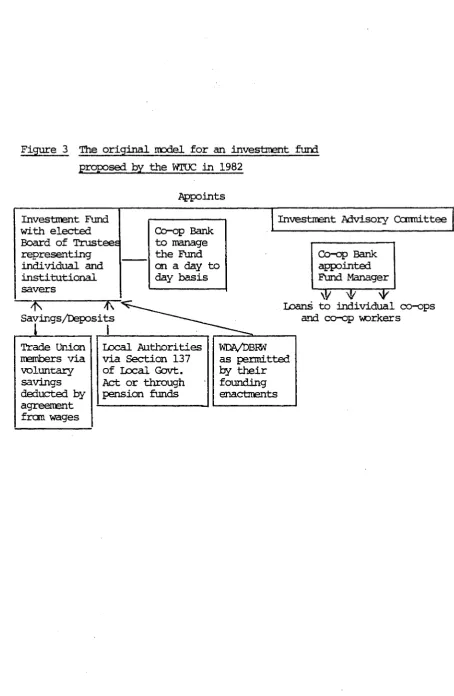
3.7 The original proposal, represented schematically in Figure 3, proved unacceptable to the Co-op Bank's advisers on three counts:
a) the intention to limit loans to trade union members only - it was argued that this would be deemed by the Bank of England to be too restrictive;
-23-Figure 3 The original model for an investment fund proposed by the WTUC in 1982
Appoints
Investment Fund with elected Board of Trustees representing individual and institutional savers
Savings/Deposits
Co-op Bank to manage the Fund on a day to day basis
Investment Advisory Ccmtiittee
Co-op Bank appointed Fund Manager
Ψ
ψ
W
Loans to individual co-ops and co-op workers
Trade Union members via voluntary savings deducted by agreement f rem wages
Local Authorities via Section 137 of Local Govt. Act or through pension funds
[image:35.578.92.547.72.769.2]
-24-c) constitute a fiduciary interest for the Bank in the fund which would disqualify the Bank from managing it.
3.8 Seme months were subsequently spent by the Co-op Bank and its advisors in searching for a suitable form for the fund which would remain true to the original concept but would prove acceptable to the Co-op Bank Board and ultimately to the Bank of England. During this time the Steering Committee established by the WTUC to plan and launch the Centre and fund, embarked upon an extensive series of presentations to local authorities throughout Wales. The objective was to drum up political and financial support for both initiatives.
3.9 When describing the fund to local authorities the Steering Committee stressed:
- That although the fund was designed to operate in parallel with the proposed centre, its control and investment
decisions would be clearly separated;
- that the objective would be to provide a vehicle whereby local savings could be utilised and made available to co-operative initiatives;
- that it was envisaged that the fund would pay a fixed rate of interest for term deposits (ndnimum 5 years) and possibly a lower rate for short-term savings. Loans would be made to co-ops at a fixed rate of interest and would be tailored to suit the needs (as far as possible) of the enterprise concerned;
- likely depositors with the fund would be: for term deposits - trade unions, local authorities and other
sympathetic organisations, and for shortterm deposits -individual savers possibly using deductions from pay
(as for trade union subscriptions);
-25-3.10 In almost every case the local authorities visited by the Conmittee endorsed the idea of a fund and gave firm indications that they would be prepared to make deposits as and when it was finally established. In one or two cases councils went further and suggested that they would be prepared to match f rem their own resources any loans made from the fund to Co-op initiatives established in their particular area. It was estimated that sate £500,000 in deposits from local authorities could be expected to help establish the fund. There can be little doubt that the WTUC's initiative struck a sympathetic chord with the majority of local authorities visited. Plainly, the fact that the Co-op Bank were involved helped to provide credence to the scheme, but it was equally clear that councillors and their professional
advisers accepted the need to mobilise local savings for local job creation.
3.11 The outcome of these meetings was fed back to the Co-op Bank in order to maintain the momentum of the Bank's efforts to come up with workable alternatives to the original idea. Probably as a result of the strong backing for the fund that was coming through from local authorities in Wales, the Bank's next proposal, put forward in July 1983, shifted the major responsibility for the mobilisation of the fund sharply towards local authorities in Wales, with the WTUC occupying essentially a secondary role.
3.12 The Bank, following extensive legal advice, proposed that local authorities in Wales should, via a trust, establish
a) a deposit fund, to be called the Wales Local Authorities' Co-operative Deposit Fund; and
b) a gift fund, to be called the Wales Local Authorities' Co-operative Gift Fund,
-26-3.13 It was plain that the proposal had moved some way from the original idea put forward by the WTUC almost a year previously. Nonetheless, the Steering Committee on receiving the Bank's view felt that subject to one or two amendments and further discussions with representatives of the local authorities there was no real reason why a trust fund could not be set up which would be acceptable to the WTUC and local authorities in Wales.
3.14 In broad terms, the current version of the trust deed (as at 3rd October 1983) attached in full as Appendix 2 to this report, provides:
- for the Board of management of the funds to be able to make finance available to ventures whose risks would take them outside of the ambit of conventional lending institutions, but who promise if successful to produce a "potential gain in employment";
- for the gift fund to supplement the deposit .fund in order to cushicn the acceptance of this greater degree of risk;
- for the founders to admit other local authorities to membership and to admit to associate membership persons and bodies other than local authorities. Associate members may also be co-opted onto the Board of management to give "an effective voice to large depositors".
Although it should be noted that it is not the intention that associate members should have voting rights either when co-opted onto the board of management or at any meeting of the fund's membership;
-27-3.15 It will be noted from this that the role for trade unions is confined to that of associate members with the possibility of trade union representatives being co-opted onto the board of management or onto the advisory caimittee to the board. However, at no time are they to be accorded voting rights. In view of the union movement's belief in, and commitment to, industrial democracy it will be surprising if they are prepared to accept this diminution of their influence
-particularly if they are to be significant depositors with the fund. Indeed, disenfranchising unions may well prove self-defeating in this respect - unions taking the view that they will only participate if they can exercise seme real influence over the key decisions surrounding the operation of the fund.
3.16 There must be doubts also as to the acceptability of some of the proposed requirements which the trust deed would impose on local
authorities who become members. To secure the deposit fund, for example, it will be a "condition of membership" for each local authority "to underwrite cne quarter of the sums advanced to enterprises having their principal or only place of business in the member's area, whether by way of loan or by way of guarantee which the Trustees are called upon
to honour and which are found to be irrecoverable."
3.17 Given that the eight county councils are being asked to shoulder the burden of the initial start up of the fund by providing a £10,000 deposit each to be maintained in the fund for 6 months, and that the Board may from time to time make further calls on the founders to contribute a share (calculated in proportion to population size) to any sum that may be necessary to maintain the aggregate of the deposit fund at four times its liabilities, it seems highly probable that county council finance officers will baulk at the notion of their further underwriting of the fund's loan operations.
-28-Figure 4 Deposit and Gift Fund: Proposed Control Structure Board of Management
of 21 persons: 8 permanent members from county councils, 13 appointed frem district councils
(one third to retire annually) and
co-opted associate members
appoints an
I
Advisory Committee of 9 persons from among members not represented on the Board and associate members. To advise the Board an the application of the fundsanrnints
Trustees: 4 persons who receive the fund monies and are
charged with main-taining the Fund
As it is currently framed the Board of Management has supreme power, being capable of both appointing and removing members of the Advisory Committee and individual Trustees.
3.19 It seems likely that individual unions and the WTUC will challenge the lack of genuine representation for them 'on the Board of Management and may also take issue with the Board's right to appoint members of the Advisory Committee. If this particular body were to be freely elected to represent those members and associate members who were not an the Board, it would at least restore some democracy to the process.
[image:40.578.82.461.58.435.2]
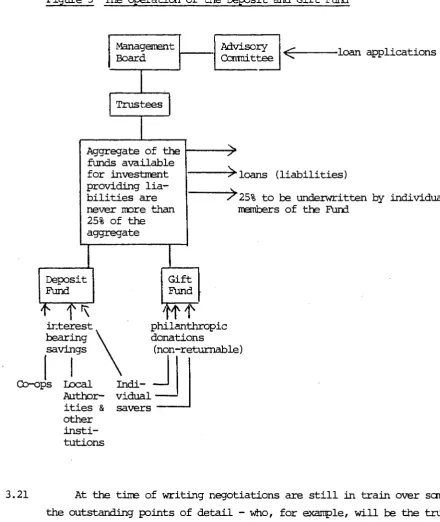
-29-Figure 5 The Operation of the Deposit and Gift Fund
Management Board
Trustees
Aggregate of the funds available for investment providing lia-bilities are never more than
25% of the aggregate
Deposit Fund
f
fK
interest bearing savings Gift Fund
tPT
AdvisoryCommittee
<e
-loan applications"7" loans (liabilities)
/ 2 5 % to be underwritten by individual members of the Fund
Co-ops Local Author-ities & other insti-tutions philanthropic donations (non-returnable) Indi-vidual savers
3.21 At the time of writing negotiations are still in train over some of the outstanding points of detail who, for example, will be the trustees -will the WTUC, for example, be represented directly in the shape of one of the trustees? Moreover, it is not known how the full board of the Co-op Bank will react to the idea - although, since the Bank's role as implied in the proposed trust deed seems to have been confined to that of a
[image:41.578.70.511.69.592.2]
-31-Chapter 4
Trade Unions as Support Structures for Co-ops: Constraints and Prospects 4.1 The origins of trade union support
The support, both general and specific, that the trade union move-ment can be expected to give to worker co-operatives derives from a number of sources. Insofar as the British trade union movement is concerned the following categorisations may provide a prelimnary analytical framework:
4.2 'Ideological/historical'
- The basic ideology of the trade union movement, with very few exceptions, commits trade unions to seek and widen the social ownership of the means of production. Hence the constitutions of the major unions contain some reference 'which can be
inter-preted to imply at least support for vrorker co-ops as one particular means towards this end;
- Linked to basic ideology the demand for democratic control over decisions affecting social, economic and production relations at the workplace again prefigures co-operatives as one way of
approaching industrial democracy;
- The establishment of a workers' co-operative as a union response to a direct confrontation with capital has a lengthy history. The mid 70's attempts associated with Tony Benn, then Secretary for
Industry, to rescue a number of enterprises by forming workers' co-ops were, for example, significantly predated by the formation of the Walsall Lock Company and Equity Shoes of Leicester, both co-operatives born out of strikes and lockouts at the turn of the century and brought into being by local trade unionists.
4.3 'Contemporary/pragmatic'
32
cooperative being formed in order to stop or ameliorate a plant
closure, or 'job creating', for example, where redundant workers
organise to form an entirely new enterprise;
Pragmatically, unions may use the threat of a worker takeover
(usually taken to imply the establishment of a cooperative) in an
attempt to change particularly unfavourable decisions for example,
plant closures or ownership transfers (it is not inconceivable that
a worker takeover might be put up to prevent a management buy out).
4.4 'Comparative'
Whilst in practice the British trade union movement may have adopted
a low profile in respect to their involvement in worker coops (parti·*·,
cularly with regard to the more recently developed ICOM variants),
there is significant experience from trade unions elsewhere in Europe
and Scandinavia to draw upen. For example, the endorsement of
Italian trade unions is held to be a positive factor in the development
of what is, in volume terms, the strongest cooperative sector in
Europe.*
4.5 The nature of trade union support
Support from trade unions both individually and as a movement
can operate at the macro and micro economic level.
4.6 At the macroeconomic level broad endorsement for the concept of
worker cooperatives can be translated into political support for, for
example, favourable legislation designed to foster the growth of co
operatives, or for more resources to be made available to official
agencies pledged to the development of cooperatives. Equally,
individual trade unions, or federations of trade unions, might take
positive steps to enhance the development of the general and the
specifics of worker coops. For the most part, examples of these
latter types of activity, e.g. the T&GWU support of the Unicorn Shirt
Coop in Taunton, Somerset, and indeed the Wales TUC's initiative in
setting up a cooperative centre and an inàependent investment fund,
have stemmed from pragmatic rather than ideological considerations.
-33-4.7 At the micro-economic level, i.e. at the workplace, union support
as well as lending local political weight can take the form of specific
assistance to cope with initial start up difficulties. This can vary
from help in the preparation of preliminary business plans to the
design and implementation of manpower policy and personnel practices.
On top of this unions can help via training or access to professional
assistance with problems in marketing, finance or the law.
4.8 The skills and experience of üill-time officials can generally be
readily supplemented using the 'union' as a contact point through
■which external expertise can be channelled.
4.9 Monitoring union support for a number of co-operatives in Wales
reveals key roles for unions within co-ops. In some ways these could
be cast as classic defensive roles, as is the case where union presence
is used to minimise any tendency towards self exploitation, or where
union vigilance is necessary to avoid bureaucratic degeneracy. Other
roles are relatively new: for example, where a union may become
involved in the lobbying process to secure finance, premises and
markets for a new co-operative.
4.10 The union as advocate for an enterprise remains, however, linked
to traditional postures. Not so the union as entrepreneur; yet such
a role is emerging for key trade unionists (whether full-time official
or elected representative) involved in worker co-ops. It is here
that experience is probably outweighed by the sheer ingenuity and
imagination of same trade unionists. It is also here where charges
that co-ops are turning workers into capitalists find their most
uncomfortable resonances. As a result, the argument hangs finely
balanced between those who accept the defensive and a limited advocacy
role for unions, and those who argue that union support must extend
beyond this into the areas normally populated by the entrepreneur.
4.11 Constraints on union support
Following the framework already sketched, two principal sets of
-34-At the macro économie level:
- Faith in the Morrisonian model of nationalisation still apparently conditions the 'conventional wisdom' of the upper levels of the trade union leadership insofar as their historical commitment to widening the social ownership of the means of production is concerned.
- Largely as a result of this, there has been little attempt (or
opportunity) to formulate and test out any general theory or guidelines for union involvement in the development of a worker co-operative sector. In their absence caution has tended to prevail.
- Critics within the union movement have employed a variation of the 'lame-duck defence' (ironically they are more often than not on the receiving end of such jibes in the context of their own defence of nationalised industries) specifically against job saving co-ops, i.e. that co-ops will be counter-productive, diversionary and doomed to fail if they attempt to rescue private enterprise failures (this, of course, can scmetimes put a union in the paradoxical and ideologically contradictory position of only being able to favour more private
enterprise job creation/job saving as opposed to worker owned efforts).
4.12 At the micro economic level:
- Time and resources can be a constraint on the full-time official. New co-operatives require a substantial investment of 'nurture capital' which the demands already imposed upon a full-time official can easily prevent.
- Where the shop stewards or lay representatives assume leading roles in the development and management of a co-op role conflict can arise. In particular, where the role and functions of management are not sufficiently separated frcm the traditional defensive roles of the steward.*
-35-4.13 Given the constraints briefly outlined it is, at least for the present and foreseeable future, perhaps more instructive to view unions as enabling organisations, as opposed to dedicated agencies for co-op development. In this way a more realistic appraisal can be attempted of their supportive potential.
4.14 Setting up trade union support
As already indicated, the British TUC's support for the development of worker co-operatives has tended to be tacit and passive. Whether this simply reflects the chastening experience of KME, the Scots Daily News and latterly Meriden, or is more indicative of some deeper rooted aversion to worker co-ops is a question worthy of more detailed comment than is possible here.
4.15 Suffice it to say that critics cite this apparent lack of dynamism as proof positive of the TUC's inability to move beyond a limited set of prescriptive and essentially centralist views on the right way to achieve a fully employed and collectively owned economy. This does the TUC less than justice - a preoccupation with the mainstream functions of the economy is inevitable. Moreover, the view that workers' co-operatives as vehicles for job creation are marginal to the problems of 3 million unemployed is not reasonable, although it may underestimate the
longer term demonstration effect which an expanding worker co-operative sector could create.
4.16 In view of the TUC's position it is hardly surprising that trade union support for co-operatives has manifested itself around particular plant closures and has developed in those labour markets where
unemployment has became chronically high. There is nothing particularly unusual in this - for example, an Italian trade unionist recently
commented that one of the reasons why the Italians have more worker co-cps than any other European country was because Italy had experienced more economic crises than any of its European neighbours in the post war period.,*
-36-4.17 However, if a high level of unemployment is a pre-condition for trade union support for co-ops, how solid can that support be said to be? If much higher levels of employment could be achieved either by orthodox reflation, keynesian remedies or more radically by major reductions in working time, would union support for worker co-ops which, without much doubt, has grown in places like Wales, Scotland, the North East of England and South Yorkshire, evaporate? In other words, is the union endorsement even in the hard hit areas simply a crisis management response?
4.18 It is important that these questions are confronted since the answers will, to a large extent, influence the degree of ccmmitment and support coming through from union organisations. Where co-ops are seen to be a component in an essentially short run crisis management strategy support seems likely to remain lukewarm and essentially passive. On the other hand, where trade unions have witnessed the persistent failures of post war economic management to provide reasonably full employment, and particularly where that failure has continued despite the existence of a significant
-37-Chapter 5
Some Preliminary Conclusions from the Wales TUC's Experience
5.1 The Labour Market
In order to evaluate the lessons to be drawn from the Wales TUC's experience as a supportive agency for workers' co-ops, it is important to reiterate the économie context against which that initiative has developed. First and foremost, there have been no appreciable improve-ments in the prospects for the economy in Wales.
- Since 1979 the numbers out of work in Wales have doubled from 80,000 to 174,000 in September 1983.
7 Throughout the period vacancies notified to Job Centres have rarely exceeded 10% of the total unemployed
-currently vacancies are running at about 5% of the total unemployed figure.
- By the beginning of 1983 41% of men and 25% of women registered as unemployed had been on the register for more than 12 months.
- Each succeeding year has started with a higher level of school leaver unemployment - despite increasing expenditure on schemes like the Youth Opportunities Programme and the new Youth Training Scheme.
- In the last four years some 100,000 jobs, nearly one third of the workforce in the manufacturing sector, have been lost. Around 31,000 jobs have been lost in the services sector reversing the long-term trend of employment growth in this sector.
-38-5.2 The political background to these trends has been dominated by the Government's attempts to cut back public expenditure. The public sector in Wales accounts for a disproportionately high level of
employment by comparison with Britain as a whole. In consequence, these generalised cuts have had a particularly marked effect on employment in public administration and the nationalised industries. Moreover, cuts in regional assistance have weakened the attractiveness of Wales as a likely location for any 'footloose' investment.
5.3 Faced with these elements it is not surprising that the WTUC has viewed its involvement with worker co-ops in job creational terms. Equally, it is no surprise that the leadership particularly of the public services unions in Wales tend to see the WTUC initiative as
something of a diversion of resources away from the more direct political challenges posed by a continued pressure on public expenditure and an increased drive towards privatisation.
5.4 On the evidence to hand, it is difficult to provide a satisfactory answer to the question of whether the WTUC support for worker co-ops would oLiminish if strong and sustained growth returned to the economy. Certainly on present trends the question is academic, if not redondant. The reality is a deflated economy with entrenched, mass unemployment. Moreover, even the most 'bullish' forecasters are not suggesting that economie growth will restore the demand for labour on the scale needed to make any real impression on present unemployment levels.
5.5 In the absence of any radical changes in working time (which has been a longstanding policy of the WTUC) it is difficult to see
unemployment in Wales falling much below its present level. Hence, WTUC support for worker centred employment initiatives is likely to remain strong. Moreover, if we examine the persistence and
-39-5.6 Apart from gaining endorsement from the Welsh Office (no small achievement given the prevailing views of the Government on the
trade union movement) the value of the WTUC's commitment and persistence can be measured in terms of the concrete support for the Centre and fund elicited from the local authorities in Wales.
5.7 With the Centre launched and through the first six months of operation, and with negotiations over the investment fund at an
advanced stage, it is demonstrably the case that the WTUC has advanced much further its support for worker co-ops, than any comparable union organisation in Britain. The early indications are that this has had a positive effect on the existing support infrastructure, and has probably helped boost the rate of new co-op formations - although clearly more time has to elapse before this can be realistically assessed.
5.8 It is apparent that the shift from traditional 'reactive' to new 'proactive' postures will not be achieved without meeting same resistance frcm within the labour movement - particularly with falling union member-ship and mounting governmental pressures. In many respects this remains the major challenge to the WTUC's initiative. Successive annual
conferences since 1981 have endorsed the idea and efforts and an increasing number of trade union activists and officials are becoming interested and involved as part of their individual struggle to hold on to a crumbling job base. As yet, however, the idea of a workers' co-operative remains very much a last resort option.
5.9 Raising the profile of the Centre with the wider trade union movement is clearly of primary importance here. And there can be little doubt that the fund, even in the amended form outlined in
Chapter 3, will boost the awareness and confidence of workers pondering the decision to 'do it for themselves'.
-40-group for this being full-time officials of unions operating in Wales. 5.11 It would perhaps not be too unreasonable or unrealistic to argue
on the basis of the experience detailed in this report, that the WTUC and its creation, the Co-op Centre, have got off to a sound start, have cleared the first hurdles, but still face a long run to the finishing line. Hopefully, the way in which the WTUC tackles this course will continue to serve as an example to others both in Britain and elsewhere where the livelihoods and security of workers is
-
41-APPENDIX 1
RULES OF WALES CO-OPERATIVE DEVELOPMENT & TRAINING CENTRE LIMITED
registered under the Industrial and Provident Societies Acts 1965-1978 ("the Act")
1. NAME
The name of the society shall be WALES CO-OPERATIVE DEVELOPMENT & TRAINING
CENTRE LIMITED (referred to below as "the Co-operative").
2. OBJECTS
The objects of the Co-operative shall be to carry on as a bona fide
co-operative society for the benefit of its members (as members of the
community in Wales ("the Community") the provision of professional
training and educational service to promote, establish, develop and
support co-operative enterprise, and any related industry, business
or trade activities determined from time to time by a General Meeting.
3. POWERS
The Co-operative shall have power to do all things necessary or expedient
to fulfill its objects.
\
4. REGISTERED OFFICE
The registered office of the Co-operative shall be at TRANSPORT HOUSE,
42
5. SHARES
(a) THE VALUE OF SHARES
The nominal value of the shares of the Co-operative shall be £1.
Each member shall hold at least one share, and no member may hold
more than the maximum permitted by law.
(b) DESCRIPTION OF SHARES
Shares shall be transferable, but not withdrawable.
(c) TRANSFERS
A member may with the approval of the Management Committee ("the
Committee") described in Rule 11 below transfer his shares to any
other member.
The application to transfer shares must:
- give details of the shares to be transferred;
- be signed by the transferor;
- be signed by the transferee, to the effect that he accepts
the conditions attached to the shares;
and must be approved by the Committee and recorded in the Co-operative's
REgister of Members.
(d) INTEREST
If the Committee so decides, interest shall be payable on each share,
the amount to be fixed by the Annual General Meeting in accordance
with Rule 13. The interest paid shall not exceed 5 per cent per
43
-6. MEMBERSHIP
The membership of the Co-operative shall consist
ofr-ia) all those who sign the application for registration;
(b) people who live or work or have interests within the Community;
(c) any society, company, or other corporate body with interests within
the Community;
whose application for admission has been approved by the Committee and
whose names are recorded in the Co-operative's Register of Members.
Any member which is a body corporate may by a resolution of its governing
body appoint a representative to act on its behalf and vote at any Meeting
of the Co-operative. A copy of the resolution executed under the seal
of the body corporate shall be deposited with the Secretary of the
Co-operative.
APPLICATION FOR MEMBERSHIP
On application for membership and payment for shares by any person or
corporate body qualifying under Rule 6 above the Co-operative shall issue
each applicant with one share for each £1 paid and an appropriate entry
44
-CESSATION OF MEMBERSHIP
Members shall cease to be members if they:
(a) cease to live or work or have interests within the Community;
(b) become bankrupt or make any composition or arrangement with their
creditors ;
(c) resign in writing to the Secretary;
(d) transfer all their shares to another person;
(e) are expelled;
(f) die.
When a member applies in writing to resign from membership the Committee
may:
(i) repay the value of his shares together with any interest or dividend
due, provided that there are no outstanding claims on the shares;
such shares shall be cancelled and an appropriate entry shall be
made in the Register of Members;
(ii) tranfer the shares to any other member of the Co-operative nominated
by the transferor in accordance with Rule 5, or
(iii) transfer the shares to any person or corporate body approved as eligible
45
9. BORROWING
(a) The Co-operative may borrow money for its purposes in any way including
loans on the security of its assets, provided that the amount outstanding
does not exceed £100,000,000. It shall not accept deposits.
(b) the rate of interest on money borrowed, except on that borrowed by
way of bank overdraft or on a mortgage from a building society or
local authority, shall not exceed 6^% per annum or 3 per cent above
the base lending rate of Co-operative Bank pic.
10. GENERAL MEETINGS
(a) There shall be regular General Meetings of all members of the
Co-operative. These shall be called by the Secretary, giving all
members 14 clear days' notice of the date, time, and place of the
meeting and the issues upon which decisions are to be taken. The
Secretary shall also call a meeting at the written request of one
third or more of the members.
(b) An Annual General Meeting shall be held within six months of the close
of the financial year of the Co-operative. Its business shall include:
(i) The receipt of the Chairman's Report, Accounts and Balance Sheet;
(ii) the appointment of an Auditor;
(iii) the election of Committee Members.
(c) Every member present at any Meeting shall have one vote, and questions
shall be decided upon a majority vote of members present. In the
event of a tie the Chairman shall have a casting vote.
(d) No business shall be conducted at any Meeting unless one quarter of
46
11. COMMITTEE
(a) The management of the Co-operative shall be the responsibility of the
Committee.
(b) The Committee shall comprise not less than seven nor more than twelve
Committee Members and shall be elected from the members each year
at the Annual General Meeting. During the first three years of the
Co-operatives existence the Wales Trades Union Council shall have
the power to appoint seven members of the Co-operative to serve
on the Committee and thereafter have the power to appoint two members
of the Co-operative to so serve. The remainder of the Committee
(if any) shall be elected from and by the members at the Annual
General Meeting.
(c) The quorum of the Committee shall be five.
(d) Any Committee Member may be removed from office by a majority vote
at a General Me