This is a repository copy of
A versatile, pulsed anion source utilizing plasma-entrainment:
Characterization and applications
.
White Rose Research Online URL for this paper:
http://eprints.whiterose.ac.uk/121959/
Version: Published Version
Article:
Lu, Y-J, Lehman, JH orcid.org/0000-0001-6610-6519 and Lineberger, WC (2015) A
versatile, pulsed anion source utilizing plasma-entrainment: Characterization and
applications. The Journal of Chemical Physics, 142 (4). 044201. ISSN 0021-9606
https://doi.org/10.1063/1.4906300
© 2015 AIP Publishing LLC. This article may be downloaded for personal use only. Any
other use requires prior permission of the author and AIP Publishing. The following article
appeared in The Journal of Chemical Physics 142 (4) and may be found at
https://doi.org/10.1063/1.4906300
[email protected] https://eprints.whiterose.ac.uk/
Reuse
Unless indicated otherwise, fulltext items are protected by copyright with all rights reserved. The copyright exception in section 29 of the Copyright, Designs and Patents Act 1988 allows the making of a single copy solely for the purpose of non-commercial research or private study within the limits of fair dealing. The publisher or other rights-holder may allow further reproduction and re-use of this version - refer to the White Rose Research Online record for this item. Where records identify the publisher as the copyright holder, users can verify any specific terms of use on the publisher’s website.
Takedown
If you consider content in White Rose Research Online to be in breach of UK law, please notify us by
A versatile, pulsed anion source utilizing plasma-entrainment: Characterization and
applications
Yu-Ju Lu, Julia H. Lehman, and W. Carl Lineberger
Citation: The Journal of Chemical Physics 142, 044201 (2015); doi: 10.1063/1.4906300 View online: https://doi.org/10.1063/1.4906300
View Table of Contents: http://aip.scitation.org/toc/jcp/142/4
Published by the American Institute of Physics
Articles you may be interested in
Velocity map imaging of ions and electrons using electrostatic lenses: Application in photoelectron and photofragment ion imaging of molecular oxygen
Review of Scientific Instruments 68, 3477 (1997); 10.1063/1.1148310
Anion photoelectron spectroscopy of deprotonated ortho-, meta-, and para-methylphenol
The Journal of Chemical Physics 146, 074302 (2017); 10.1063/1.4975330
Finite slice analysis (FINA)—A general reconstruction method for velocity mapped and time-sliced ion imaging
The Journal of Chemical Physics 147, 013913 (2017); 10.1063/1.4979305
Photoelectron spectroscopy of the hydroxymethoxide anion, H2C(OH)O
-The Journal of Chemical Physics 145, 124317 (2016); 10.1063/1.4963225
Perspective: Electrospray photoelectron spectroscopy: From multiply-charged anions to ultracold anions
The Journal of Chemical Physics 143, 040901 (2015); 10.1063/1.4927086
Photodissociation spectroscopy and dynamics of the N2O-2 anion
THE JOURNAL OF CHEMICAL PHYSICS142, 044201 (2015)
A versatile, pulsed anion source utilizing plasma-entrainment:
Characterization and applications
Yu-Ju Lu, Julia H. Lehman, and W. Carl Linebergera)
JILA and Department of Chemistry and Biochemistry, University of Colorado, Boulder, Colorado 80309, USA (Received 23 November 2014; accepted 8 January 2015; published online 26 January 2015)
A novel pulsed anion source has been developed, using plasma entrainment into a supersonic expansion. A pulsed discharge source perpendicular to the main gas expansion greatly reduces unwanted “heating” of the main expansion, a major setback in many pulsed anion sources in use today. The design principles and construction information are described and several examples demonstrate the range of applicability of this anion source. Large OH−
(Ar)nclusters can be generated,
with over 40 Ar solvating OH−
. The solvation energy of OH−
(Ar)n, where n=1-3, 7, 12, and 18,
is derived from photoelectron spectroscopy and shows that by n = 12-18, each Ar is bound by about 10 meV. In addition, cis– andtrans– HOCO−
are generated through rational anion synthesis (OH−+
CO+M→HOCO−+M) and the photoelectron spectra compared with previous results. These results, along with several further proof-of-principle experiments on solvation and transient anion synthesis, demonstrate the ability of this source to efficiently produce cold anions. With modifications to two standard General Valve assemblies and very little maintenance, this anion source provides a versatile and straightforward addition to a wide array of experiments. C 2015 AIP Publishing LLC.[http://dx.doi.org/10.1063/1.4906300]
I. INTRODUCTION
Negative ion photoelectron spectroscopy has been widely applied to investigate the spectroscopic properties of neutral species1–3 and the dynamics of photodissociation,4,5 cage recombination,6,7 SN2 reactions,8 isomerization,9 and charge
transfer.10,11 In order to study such an extensive array of photochemical processes and reaction dynamics, a variety of anion sources have been developed for both continuous wave (cw) and pulsed instruments, the latter of which is the focus of this investigation.
A pulsed anion beam is typically constructed using a pulsed supersonic jet which is coaxially or perpendicularly intersected with a continuous beam of 1 keV electrons from an electron gun.12For the formation of some anions, an
elec-trical discharge source13–16or a laser vaporization source17–20
is required, either of which can result in a high temperature environment. These common pulsed sources use the main pulsed expansion in which to create ions. In general, collisions with an atomic carrier gas in a supersonic expansion lead to sufficient cooling of the internal degrees of freedom for high-resolution spectroscopic applications. However, a gas expan-sion that passes through or is responsible for the generation of a hot plasma contains too many energetically excited neutral species to completely cool the anions formed. The insufficient internal cooling of anions in the supersonic jet from rovibra-tional excitation produces broad and/or dense photoelectron spectra, limiting the ability to extract spectroscopic informa-tion.
To prevent this, several methods for cooling anions gener-ated in a hot source have become common. For example,
a)Email: [email protected]
Ar-tagging21,22 uses a supersonic entrainment technique to
attach Ar solvent atoms to anions and build large complexes. Additional neutral solvents can be added through the entrain-ment source, such as in the supersonic afterglow reactor devel-oped by Johnson and coworkers22or the cw combined plasma and “pick-up” line ion source from Bowen and coworkers.23,24 Since Ar atoms weakly bind to anions, mass selecting for anion-Ar clusters limits the internal energy of the anion, suppressing hot bands and reducing spectral congestion.25–28
However, more than simply cooling the hot anions will be essential if the goal is to synthesize anions of interest via rational multistep synthetic methods.
Cryogenic ion trapping has also been used with great suc-cess to generate cold anions from an initially hot ion source.29,30
These ions can be mass-selected, stored, and cooled in a cryo-genic ion trap via collisions with a cold buffer gas before being extracted for further spectroscopic measurements. Cryogenic ion trapping has been coupled to electrospray ionization (ESI) sources to transfer ions from solution into the gas phase and efficiently cool the numerous internal degrees of freedom of large species.31–34While ESI is a soft-ionization technique to generate large (macromolecular) gas phase ions, these ions must have already been stable in solution. In addition, it is difficult to initiate and control chemical reactions for produc-tion of new species. The new source described here should be viewed as a complement to the ESI/cryogenic ion trapping source, in that it is able to address different subsets of ions: both of those whose neutral counterpart is either already in the gas phase or has a high vapor pressure, as well as the ability to generate transient ion species through rational synthesis, a unique feature of this new ion source.
This ion source is essentially an entrainment source, simi-lar to those already discussed. However, the main expansion
044201-2 Lu, Lehman, and Lineberger J. Chem. Phys.142, 044201 (2015)
is not used directly as the ion source and entrainment is not limited to neutral species. Instead, plasma generated in a vi-olent, high-energy environment in a side discharge expan-sion is entrained into the region of high density of a second (main) expansion. The design of the side discharge preferen-tially injects plasma into the primary expansion, minimizing entrainment of hot neutral molecules, which facilitates efficient cooling of the injected charged particles. The capabilities of this novel source are explored here, such as electron and ion entrainment, solvation or tagging, and rational ion synthesis, demonstrating its versatility. While the production of anionic species is shown, this source can likely be used for cation production as well. This new source addresses many of the pre-vious drawbacks or difficulties present in other current pulsed anion sources, particularly the difficulty of efficient cooling and generating transient species through rational chemical means, while being adaptable to many types of experiments, low-maintenance, and straightforward to construct.
II. EXPERIMENTAL SETUP AND ION SOURCE CHARACTERIZATION
Beyond the new ion source, which is discussed below, the remaining aspects of the experimental apparatus have been described in detail elsewhere.35 Briefly, ions are perpendic-ularly extracted into a Wiley-McLaren time-of-flight (TOF) mass spectrometer, where they are accelerated, steered, and focused onto an inline microchannel plate (MCP) detector, yielding the TOF mass spectra reported herein. Prior to the inline detector, the interaction of the anion mass of interest with an appropriately timed laser pulse detaches electrons. A pulsed electric field, which constitutes the first stage of a velocity map imaging setup,36,37then accelerates the electrons perpendicular
to the molecular beam axis. The electrons are velocity mapped onto a MCP/phosphor screen coupled to a CCD camera. The
resulting photoelectron image is converted to a kinetic energy distribution following inverse Abel transformation through the BASEX algorithm.38The kinetic energy distribution is related to the electron binding energy (eBE) through the photon energy used. The photoelectron spectra reported herein are shown as a function of the electron binding energy.
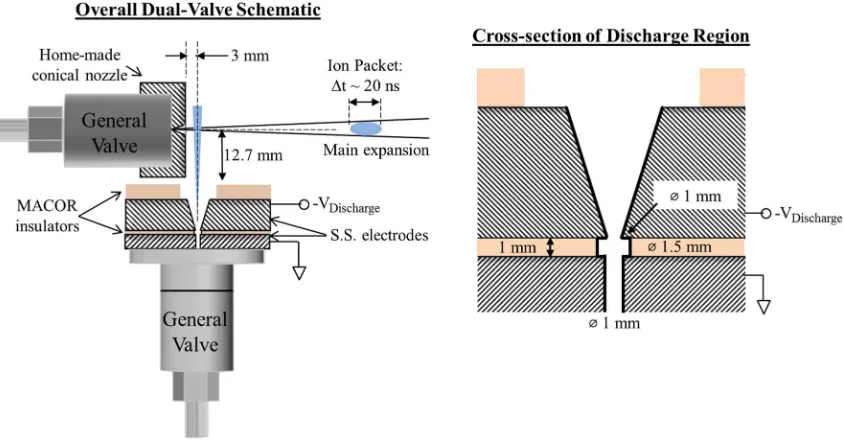
Figure 1 shows a schematic of the new pulsed anion source. The setup employs two pulsed General Valves (Parker-Hannifin, Series 9): one that functions to generate the main expansion and the other, oriented perpendicular and very close to this main expansion, utilizes a pulsed electrical discharge. Since the two valves are independently controlled by a com-mercial multi-channel Iota-One pulse driver and a digital delay generator, temporal overlap of the two gas pulses can be adjusted in real time.
The main valve operates under “normal” pulsed super-sonic jet expansion conditions. Typical pulse widths and back-ing pressures are in the range of 110-160 µs and 40 psig, respectively. The backing gas composition varies, depending on the experiment. However, since efficient cooling is neces-sary for the examples discussed herein, Ar is the primary component of the main gas expansion. The main valve assem-bly is altered from the standard General Valve assemassem-bly by replacing the standard faceplate with a modified one, shown schematically in Fig. 1 and in detail in the Supplementary Material.39 The outer diameter of the faceplate is reduced in
order to allow the second nozzle to be situated much closer than what was previously possible, with a distance of approx-imately 13 mm between the front of the side valve assembly and the orifice of the main valve faceplate, as shown in Fig.
1. In addition, in order to increase the forward intensity of the main expansion, a 40◦
conical nozzle with a 0.5-mm orifice (DO) and an aspect ratio (L/DO) of 7 was designed.40While this
[image:4.594.87.509.495.716.2]last modification is not necessarily crucial to the anion source, the enhanced collimation of the main expansion does aid in
044201-3 Lu, Lehman, and Lineberger J. Chem. Phys.142, 044201 (2015)
improving the overall performance of this source. The new faceplate seals in the same manner as the commercial faceplate and, thus, couples with the unmodified General Valve body.
The side valve operates under mechanically limited valve opening conditions, where the gas throughput per pulse is roughly one order of magnitude less than that from the main valve. For example, above a source chamber base pressure of around 5×10⁻⁶
Torr, the operating pressure with the main valve firing is approximately 2.8×10⁻⁵ Torr and
approxi-mately 3.1×10⁻⁵Torr with both valves firing (50 Hz repetition
rate, source chamber vacuum achieved with a 10 in. oil diff u-sion pump having an approximate 4000 l/s air pumping speed specification). While typical pulse widths and backing pres-sures are similar to the main expansion, the side valve tension is adjusted to give this performance; both valves operate with the same Iota-One controller drive voltage. The entrainment of the plasma, discussed below, from the side valve into the main supersonic expansion without disruption of the main expansion, relies on the side valve operating under low gas density conditions, making this setup specification crucial to the functionality of the ion source.
The pulsed discharge assembly is attached to an unmod-ified side valve faceplate (General Valve, 0.8 mm orifice). It is comprised of two electrodes, where the one adjacent to the faceplate is held at ground and the other is pulsed to a high negative voltage; a cylindrical MACOR plate insulates the two electrodes from each other. A second MACOR ring is added to the end of the whole assembly. While the electrodes used for the majority of the work presented here are stainless steel, an aluminum cathode has also been used, primarily for discharging halogen-containing compounds or for use with lower (below−1000 V) pulsed voltages. The dimensions of the
discharge assembly are shown in detail in the Supplementary Material.39
A pulsed voltage between−500 and−2000 V is used to
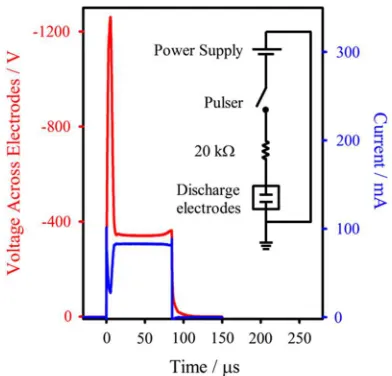
maximize the ion intensities and the stability of the discharge. The negative voltage pulse is provided by a pulse generator (Directed Energy, Inc. (DEI), GRX-3.0K-H or PVX-4140) with a DC power supply (Bertan associates, Inc., 205-03R or Kepco ABC 2500). The pulser is triggered by a digital delay generator which controls the discharge timing and pulse duration (40–140 µs), both of which are adjusted to opti-mize ion intensities. In addition, a 20 kΩ resistor in series with the cathode acts as a ballast resistor, allowing a high voltage discharge ignition followed by a current regulated, stable discharge. A time trace for the voltage measured across the discharge electrodes for a−2000 V, 85µs applied discharge pulse is shown in Fig.2(red trace), with an inset illustrating the circuit diagram. When this pulse is applied through the 20 kΩ
resistor, the voltage drop across the resistor is approximately
−1600 V, corresponding to a discharge current of ∼80 mA
(also shown in Fig.2, blue trace). The ballast resistor depicted allows the roughly−1300 V between the plates to initiate the
discharge, but then limits the discharge current to a maximum of 100 mA, providing current regulation and arc suppression.
[image:5.594.330.526.47.235.2]The spatial volume over which the discharge occurs is very small, as seen in the righthand side of Fig.1. As the gas expands into the discharge assembly, the breakdown occurs in a small 2 mm3annulus between the ground and high voltage
FIG. 2. Voltage and current time traces resulting from a−2000 V, 85 µs applied discharge voltage for OH−
production. Through the 20 kΩresistor, the voltage drops about 1600 V (red trace), which corresponds to the peak discharge current of 80 mA (blue trace). The inset shows the circuit diagram in which the discharge electrodes are under vacuum in the source chamber.
electrodes, approximately 1.5 mm in diameter and 1 mm thick, made possible by the slightly wider hole through the central MACOR insulator compared to the electrodes. After initiating a discharge in the side expansion, the gas forms a plasma (a neutral medium consisting of many charged parti-cles: electrons, cations, and anions) with a Debye shielding length which is much shorter than the physical dimension of the plasma. However, the charged species of a plasma do not move independently. The slow, heavy ions pull back on the rapidly moving light electrons, creating an ambipolar diffusion that results in the electrons and ions having the same diffusion rate.41 This diffusion rate is approximately twice that of the
free diffusion of the ions, whereas it is substantially less than that of free electrons. As the plasma exits the side discharge, the small degree of its expansion is described by its ambipolar diffusion. Assuming a 200 m/s expansion velocity, the plasma originating from the small annulus would form a 2 cm long plasma “pellet” during a typical 100 µs discharge pulse. By contrast, any hot neutrals that are formed in a typical 120 µs gas pulse of the side valve expand in a near-effusive manner due to the overall low gas density and the construction of the side discharge valve conical aperture.
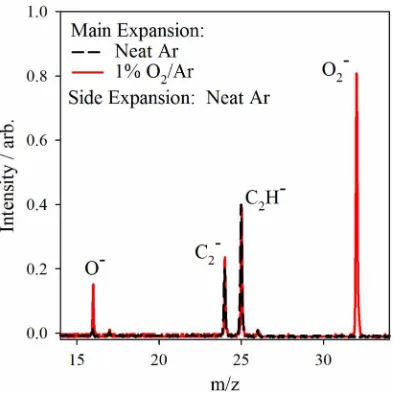
The confirmation of a plasma being formed is tested through the entrainment of electrons into the main expansion. Electrons not part of a plasma would expand far beyond the size of the main expansion and significant electron entrainment would not be possible. However, with ambipolar diffusion of a plasma, the attachment of slow electrons to neutral molecules in the main expansion is possible. The achievement of electron entrainment in the main expansion is demonstrated by the mass spectra in Fig.3. Using neat Ar in both the main expansion and the side discharge (−2000 V in a 140-µs discharge pulse), the
only ions observed arise from sputtering of the stainless steel discharge plates and are present in most of the mass spectra reported here. Keeping the same neat Ar side discharge and adding a small amount of O2to the main expansion (1% O2
in Ar) creates intense O−
044201-4 Lu, Lehman, and Lineberger J. Chem. Phys.142, 044201 (2015)
FIG. 3. Comparison between TOF mass spectra from experiments using neat Ar (black dashed) and 1% O2/Ar (red) for the main expansion. Neat Ar is used in the side discharge source for both experiments. Entrainment of electrons is demonstrated from the formation of the O−and O
2−anions. The appearance
of small hydrocarbons arises from sputtering of the stainless steel discharge electrodes.
in Fig. 3), which can only arise from electron attachment in the following manner: the O−
is the product of disso-ciative attachment of hot electrons to O2, while O2−results
from collisionally stabilized slow electron attachment to O2.
This ion formation through electron entrainment confirms the generation of a plasma in the side discharge valve. It is important to note that the ion signals obtained here are at least as intense as the other common sources mentioned earlier.
The time spread of the ion packet entrained in the main expansion is measured by varying the timing of the extrac-tion plate that directs anions into the TOF mass spectrometer. Even though both pulsed valve opening times are around 120-140 µs and a long pulsed discharge width (near 100 µs) is used, a significantly smaller time width of the ion packet is measured, where its full-width-at-half-maximum (fwhm) is approximately 20 µs. This indicates a small spatial coverage of ions within the main gas expansion. This ion time width remains approximately constant through all the experiments described below, regardless of the pulsed discharge time width (varied from 40 to 140µs) and is significantly shorter than the gas pulse widths of the two valves, both larger than 100µs. The mechanically limited valve opening of the side valve resulting in a low gas density is combined with the narrow spatial region over which the discharge occurs and the ambipolar diffusion holding the plasma together, which likely results in a plasma “pellet” surrounded by near-effusive hot neutrals. The narrow time spread of the ion packet then stems from the spatial and temporal cross section of the plasma “pellet” with the main gas expansion.
The plasma created in the side discharge is introduced into the main expansion at a distance of approximately 3 mm beyond the faceplate of the main valve. Taking nozzle length (3.5 mm) into account, this corresponds to about 13 nozzle diameters downstream. Minimizing this distance has proven to be crucial to the ideal performance of this anion source, both in
optimizing for spatial constraints and physical properties of the gas expansion. While shorter distances (less than 3 mm) still allow plasma entrainment and might be desired, the body of the main valve faceplate begins to intrude and thus limits the anion signal intensity. Entrainment is also still possible at distances further than 3 mm, but there is diminished collisional cooling which substantially reduces the ability of this new source to produce the species described in Sec.III.
While the necessary conditions for the best overall perfor-mance of this anion source have already been discussed (e.g., side valve performance and distance between valves), there are several other variables that change with each experiment. For the preparation of the desired anions, a suitable gas mixture is crucial, as is an appropriate discharge voltage. In each of the following applications, these variables have been optimized and are reported.
III. RESULTS AND DISCUSSION
A. Anion solvation: OH−(Ar) n
The new source is readily and reproducibly able to solvate anions efficiently and with ample signal intensity to then use in photoelectron imaging experiments. In this experiment, OH−
is formed in a discharge of 1% O2and 25% H2in Ar at a total
pressure of 55 psig, with−2000 V applied to the discharge
for 40-140 µs. With a main expansion of neat Ar (40 psig), large OH−
(Ar)n clusters are easily formed, where OH− can
be solvated by more than 40 Ar atoms. Figure 4 shows a composite mass spectrum of Ar-tagged OH−
, OH−(
Ar)n,
rang-ing from 0 to 29 Ar atoms. Below m/z=50, there are three predominant peaks: O−
, OH−
, and O2−. These ions are formed
in the discharge source and drawn into the main expansion of neat Ar. Once in the main expansion, some of the OH−
anions cluster with Ar atoms generating OH−
(Ar)n. The peaks
for n=12 and 18 are prominent, suggesting that 12 and 18 are “magic numbers” that indicate a particularly stable cluster geometry.42,43The same magic numbers are also observed in
O−
(Ar)nand correspond to the closing of the solvation shell in
an icosahedral (12 Ar atoms) and double icosahedral (18 Ar atoms) structure.24Similar solvation shell arrangements likely
account for the peak intensities observed for n=12 and 18 in the OH−
(Ar)nmass spectrum.
Prior to using this ion source, OH−
was unable to be solvated with more than three Ar atoms using an electron gun source in this laboratory. This new source vastly im-proves the ability to cool the expansion, making it possible for more than 40 Ar to solvate OH−
. Various gas mixtures of N2O/CH4/Ar, N2O/H2/Ar, and O2/CH4/Ar have been
attempted for OH−
production; however, in all cases, the discharge of these gas mixtures produces OH−
intensities that are less intense than the O2/H2/Ar mixture. Furthermore, for
these other mixtures, many N2O– or CH4–solvated anionic
complexes, e.g., OH−
(N2O)n or OH−(CH4)n, also form and
result in an undesirable background.
The large cluster anion signal intensity formed from this ion source allows for the photoelectron spectra to be deter-mined for OH−
(Ar)nas a function of the degree of solvation
044201-5 Lu, Lehman, and Lineberger J. Chem. Phys.142, 044201 (2015)
FIG. 4. Composite mass spectrum of OH−(
Ar)n. The small cluster sizes are scaled down as marked in order to view the large cluster distribution and “magic
numbers” at n=12 and 18 (labeled in green). While this mass spectrum only shows out to n=29, this anion source is able to solvate OH−with over 40 Ar
atoms.
spectra for OH−
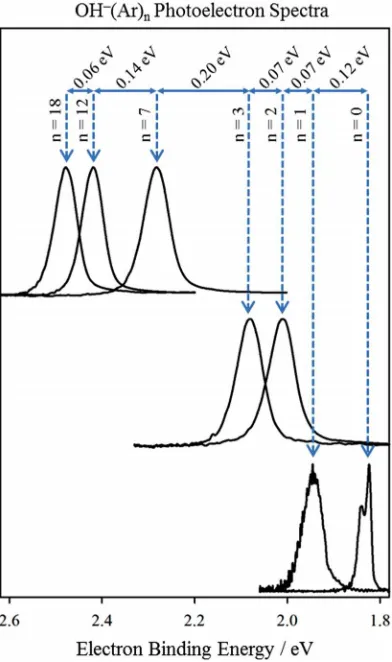
(Ar)nclusters with n=0, 1, 2, 3, 7, 12, and 18,
obtained using three different photodetachment wavelengths: 459 (2.703 eV), 532 (2.330 eV), and 602 (2.060 eV) nm. In the photoelectron spectrum of isolated OH−
, the rotational
FIG. 5. Photoelectron spectra of OH−(Ar)n
=0,1,2,3,7,12,and 18at three different wavelengths: 459 (top), 532 (middle), and 602 (bottom) nm. The solvation energy, indicated above, is derived from peak shift upon further solvation.
branches of the OH radical in the2
Π3/2 and2Π1/2states are
resolved. In the spectra for all of the complexes, there is a single broad peak that shifts to higher electron binding energy as the number of Ar atoms increases. The peak shift is a result of the greater binding energy of the solvent to the anionic cluster than to the neutral cluster. Solvation by the first Ar atom increases the electron binding energy by about 0.12 eV. The next two consecutive Ar additions (n= 2 and 3) each shift the vertical detachment energy (VDE) by about 0.07 eV. The solvation energies (magnitude of the VDE shift) for the various cluster sizes studied are shown in Fig.5, and demonstrate that the average solvation energy per Ar atom decreases as the cluster size increases. Since Ar atoms in outer solvation shells interact less with the localized negative charge, the addition of Ar atoms beyond n=12 only shifts the VDE minimally; in fact, the difference in the VDE of n =12 and n =18 is only∼0.06 eV, suggesting an average size-dependent binding
energy of 10 meV per Ar atom. This solvation behavior is consistent with studies of I2
−
(Ar)nand O−(Ar)n clusters.24,27
The diatomic anion is formed from a chemical reaction within the hot, violent environment of the discharge source, but the successful entrainment of the plasma into the main Ar expan-sion efficiently cools the anions to the point where these very weakly bound complexes (less than 10 meV per Ar on average at the largest cluster sizes studied) are efficiently formed.
Solvation and tagging of ions are important to many areas of physical chemistry. For example, efficient means of produc-ing cold solvated anions has been pursued as a bridge be-tween isolated and bulk (aqueous) systems to better under-stand the role of the solvent in chemical reaction dynamics. A significant contribution of this new source is to efficiently generate, collisionally cool, and solvate diatomics, triatomics, and larger species with a range of solvents, such as Ar or H2O.44 In addition, vibrational predissociation spectroscopy
uses weakly bound species, such as Ar or H2, as a messenger
[image:7.594.68.264.383.714.2]044201-6 Lu, Lehman, and Lineberger J. Chem. Phys.142, 044201 (2015)
a vibrational predissociation spectrum of the ion is recorded. With the aid of electronic structure calculations and modeling, the spectroscopic signatures observed can help identify and characterize the structure of the ion of interest. First recorded using predissociation of H2–solvated species as a function of
photon energy, it has facilitated the measurement of infrared spectra of cationic clusters in a continuous beam.45–47 This
technique has since been used with great success for a variety of systems, ranging from small ions to larger biomolecules. Most recent ion sources rely on a cryogenic ion trap to generate sufficiently cold ion clusters.32This ion source is able to tag
larger species, such as CH3O−(H2)nand O−3(H2O)nArm, with
Ar or H2 solvent species. Both of these systems are briefly
discussed in the Supplementary Material.39
B. Rational anion synthesis: HOCO−
With a cold OH−
(Ar)n source, as demonstrated in Sec. III A, a well-controlled chemical reaction can facilitate the formation of the anionic forms of OH-containing reaction intermediates that are of interest in atmospheric and combus-tion chemistry. For example,cis– andtrans–HOCO−
are gener-ated in the new ion source through a condensation reaction between neutral CO, present in the main expansion (1% CO in Ar, 40 psig), and OH−
, formed in the side discharge as in Sec.III A,
OH−
(Ar)n≥0+CO→HOCO
− +nAr,
∆Hrxn≈0.9 eV(Refs. 48 and 49).
The 764 nm photoelectron spectrum ofcis– andtrans–HOCO−
is shown as the green trace in Fig.6. Previously, Johnsonet al.
coupled a cryogenic ion trap to a photoelectron-photofragment coincidence spectrometer for storing and cooling of HOCO−
anions in a∼20 K environment.30,49Their near-threshold
spec-FIG. 6. Comparison of the photoelectron spectra of HOCO−between the
764 nm spectrum (this work, green) and the 775 nm spectrum (blue) from Johnsonet al.49The diamond and star symbols denote the EA ofcis– and
trans–HOCO, respectively, from the assignments in the work of Johnson et al.49
trum (775 nm) is reproduced as the blue trace in Fig.6.49 Com-parison of the two spectra conclusively identifies and illus-trates the success of the rational anion synthesis of HOCO−
in the new ion source.
In addition, the lack of vibrational hot bands from the new ion source demonstrates the ability of this source to efficiently cool isolated (unsolvated, not Ar-tagged) polyatomic anions, despite being formed through an exothermic (by nearly 0.9 eV48,49) chemical association reaction. The association
reac-tion takes place in the high density region early in the expan-sion and subsequent colliexpan-sions of the anion with Ar result in internally cold HOCO−
. Bond forming and collisional cooling are likely made possible by taking place in the dense collisional region of the main expansion. However, it is also possible that the initial step in this mechanism contains an association mechanism of OH−(
Ar)n+CO, where the excess energy from
the exothermic bond forming process is funneled into boiling offthe weakly bound Ar solvent molecules, allowing the newly formed transient species to stabilize. An additional rational anion synthesis experiment was tested using the new anion source, generating CH3OO−through the exothermic
associa-tion reacassocia-tion of CH−
3 with O2and is briefly discussed in the
Supplementary Material.39
The adiabatic electron affinities (EAs) ofcis– andtrans– HOCO are determined to be 1.511(5) and 1.381(5) eV. This is consistent with, although more precise than, what was previ-ously determined with the aid of modeling, where the EAs ofcis– andtrans–HOCO are reported as 1.51(1) and 1.38(1) eV, respectively.49 The spectrum from this work also has a larger contribution from the trans–HOCO−
isomer than the previous data. The different proportions of the two isomers are likely due to the way in which the anions are formed. In the previous experiment, the HOCO−
anions are stored in the ion trap for several hundred milliseconds where most would likely be quenched to the global minimum,cis–HOCO−
. In the new plasma entrainment source, however, the two isomers are suddenly cooled to their individual minima and are in a col-lisionless region shortly thereafter, “trapping” proportionally moretransisomers.
IV. CONCLUSIONS
A versatile, pulsed anion source that utilizes a plasma-entrainment method suitable for production of cold anions has been developed. This novel setup is capable of solvating or tagging anions with weakly bound Ar atoms to ensure that the internal energy of the ions is low. For example, large ion intensities of OH−(
Ar)n allow for the solvation energy to be
determined for several cluster sizes, where Ar is bound by 10 meV on average in the largest cluster sizes investigated. Further, this ion source is able to produce cold anions through a well-controlled ion-molecule reaction, as demonstrated by the production of HOCO−
via association reaction. Additional proof-of-principle experiments demonstrate the versatility of this anion source to be used in the investigation of many cold exotic or transient species, solvated complexes, as well as Ar or H2tagged anions. While no experiments were attempted here,
[image:8.594.66.267.470.696.2]044201-7 Lu, Lehman, and Lineberger J. Chem. Phys.142, 044201 (2015)
ACKNOWLEDGMENTS
The authors gratefully acknowledge support from NSF (Nos. PHY1125844 and CHE1213862) and AFOSR (No. FA9550-12-1-0125) for significant contributions to this proj-ect.
1K. M. Ervin and W. C. Lineberger, inAdvances in Gas Phase Ion Chemistry,
edited by N. G. Adams and L. M. Babcock (JAP Press, Greenwich, 1992), Vol. 1, p. 121.
2D. M. Neumark,J. Phys. chem. A112, 13287 (2008).
3A. Sanov and R. Mabbs,Int. Rev. Phys. Chem.27, 53 (2008).
4R. Mabbs, K. Pichugin, and A. Sanov,J. Chem. Phys.122, 174305 (2005).
5M. T. Zanni, B. J. Greenblatt, A. V. Davis, and D. M. Neumark,J. Chem.
Phys.111, 2991 (1999).
6B. J. Greenblatt, M. T. Zanni, and D. M. Neumark,Science276, 1675 (1997).
7N. J. Kim, D. H. Paik, and A. H. Zewail,J. Chem. Phys.118, 6930 (2003).
8R. Wester, A. E. Bragg, A. V. Davis, and D. M. Neumark,J. Chem. Phys.
119, 10032 (2003).
9L. R. McCunn, G. H. Gardenier, T. L. Guasco, B. M. Elliott, J. C. Bopp, R.
A. Relph, and M. A. Johnson,J. Chem. Phys.128, 234311 (2008).
10L. Sheps, E. M. Miller, S. Horvath, M. A. Thompson, R. Parson, A. B.
McCoy, and W. C. Lineberger,Science328, 220 (2010).
11J. R. Verlet, A. Kammrath, G. B. Griffin, and D. M. Neumark,J. Chem. Phys.
123, 231102 (2005).
12M. A. Johnson and W. C. Lineberger, inTechniques for the Study of Ion
Molecule Reactions, edited by J. M. Farrar and J. W. Saunders (Wiley, New York, 1988), p. 591.
13D. W. Boo, Y. Ozaki, L. H. Andersen, and W. C. Lineberger,J. Phys. Chem.
A101, 6688 (1997).
14E. Garand, T. I. Yacovitch, and D. M. Neumark,J. Chem. Phys.130, 064304 (2009).
15X. Li, A. Grubisic, S. T. Stokes, J. Cordes, G. F. Ganteför, K. H. Bowen, B.
Kiran, M. Willis, P. Jena, R. Burgert, and H. Schnöckel,Science315, 356 (2007).
16D. L. Osborn, D. J. Leahy, D. R. Cyr, and D. M. Neumark,J. Chem. Phys.
104, 5026 (1996).
17O. Cheshnovsky, S. H. Yang, C. L. Pettiette, M. J. Craycraft, Y. Liu, and R.
E. Smalley,Chem. Phys. Lett.138, 119 (1987).
18L.-S. Wang, H.-S. Cheng, and J. Fan,J. Chem. Phys.102, 9480 (1995).
19J. M. Weber,Rev. Sci. Instrum.76, 043301 (2005).
20W. Zheng, S. Xu, D. Radisic, S. Stokes, X. Li, and K. H. Bowen,J. Chem.
Phys.122, 101103 (2005).
21W. H. Robertson and M. A. Johnson,Annu. Rev. Phys. Chem.54, 173 (2003).
22W. H. Robertson, J. A. Kelley, and M. A. Johnson,Rev. Sci. Instrum.71,
4431 (2000).
23J. H. Hendricks, H. L. de Clercq, C. B. Freidhoff, S. T. Arnold, J. G. Eaton,
C. Fancher, S. A. Lyapustina, J. T. Snodgrass, and K. H. Bowen,J. Chem. Phys.116, 7926 (2002).
24S. T. Arnold, J. H. Hendricks, and K. H. Bowen,J. Chem. Phys.102, 39
(1995).
25C. L. Adams, H. Schneider, K. M. Ervin, and J. M. Weber,J. Chem. Phys.
130, 074307 (2009).
26C. L. Adams and J. M. Weber,J. Chem. Phys.134, 244301 (2011). 27K. R. Asmis, T. R. Taylor, C. Xu, and D. M. Neumark,J. Chem. Phys.109,
4389 (1998).
28E. M. Miller, L. Sheps, Y.-J. Lu, A. S. Case, A. B. McCoy, and W. C.
Lineberger,J. Chem. Phys.136, 044313 (2012).
29C. Hock, J. B. Kim, M. L. Weichman, T. I. Yacovitch, and D. M. Neumark,
J. Chem. Phys.137, 244201 (2012).
30C. J. Johnson, B. B. Shen, B. L. J. Poad, and R. E. Continetti,Rev. Sci.
Instrum.82, 105105 (2011).
31K. R. Asmis and D. M. Neumark,Acc. Chem. Res.45, 43 (2012).
32M. Z. Kamrath, R. A. Relph, T. L. Guasco, C. M. Leavitt, and M. A. Johnson,
Int. J. Mass Spectrom. Ion Processes300, 91 (2011).
33T. R. Rizzo, J. A. Stearns, and O. V. Boyarkin,Int. Rev. Phys. Chem.28, 481 (2009).
34X.-B. Wang and L.-S. Wang,Rev. Sci. Instrum.79, 073108 (2008).
35L. Sheps, E. M. Miller, and W. C. Lineberger,J. Chem. Phys.131, 064304 (2009).
36D. W. Chandler and P. L. Houston,J. Chem. Phys.87, 1445 (1987).
37A. T. J. B. Eppink and D. H. Parker,Rev. Sci. Instrum.68, 3477 (1997).
38V. Dribinski, A. Ossadtchi, V. A. Mandelshtam, and H. Reisler,Rev. Sci.
Instrum.73, 2634 (2002).
39See Supplementary Material at http://dx.doi.org/10.1063/1.4906300 for
detailed schematics of the discharge assembly and general upkeep instructions, as well as additional proof-of-principle experiments.
40K. Luria, W. Christen, and U. Even,J. Phys. Chem. A115, 7362 (2011).
41L. J. Puckett and W. C. Lineberg,Phys. Rev. A1, 1635 (1970).
42S. R. Desai, C. S. Feigerle, and J. C. Miller,J. Chem. Phys.97, 1793 (1992). 43O. Echt, K. Sattler, and E. Recknagel,Phys. Rev. Lett.47, 1121 (1981).
44J. H. Lehman and W. C. Lineberger,J. Chem. Phys.141, 154312 (2014).
45M. Okumura, L. I. Yeh, and Y. T. Lee,J. Chem. Phys.83, 3705 (1985).
46M. Okumura, L. I. Yeh, J. D. Myers, and Y. T. Lee,J. Chem. Phys.85, 2328 (1986).
47M. Okumura, L. I. Yeh, J. D. Myers, and Y. T. Lee,J. Phys. Chem.94, 3416 (1990).
48J. Li, Y. M. Wang, B. Jiang, J. Y. Ma, R. Dawes, D. Q. Xie, J. M. Bowman,
and H. Guo,J. Chem. Phys.136, 041103 (2012).
49C. J. Johnson, M. E. Harding, B. L. J. Poad, J. F. Stanton, and R. E. Continetti,