Array Signal Processing Algorithms
for Localization and Equalization
in Complex Acoustic Channels
Dumidu S. Talagala
B.Sc. Eng. (Hons.), University of Moratuwa, Sri Lanka
November 2013
Athesis submitted for the degree ofDoctor ofPhilosophy ofTheAustralianNational University
Applied Signal Processing Group
Research School of Engineering
Declaration
The content of this thesis are the results of original research and has not been submit-ted for a higher degree at any other university or institution. Much of this work has either been published or submitted for publications as journal papers and conference proceedings. These papers are:
Journal Publications
• Talagala D. S.; Zhang W.; Abhayapala T. D.; Kamineni A., 2013. “Binaural Sound Source Localisation using the Frequency Diversity of the Head-Related Transfer Function,” Journal of the Acoustical Society of America, submitted July 2013, revise and resubmit with minor revisions October 2013.
• Talagala D. S.; Zhang W.; and Abhayapala T. D., 2013. “Multi-Channel Adaptive Room Equalization and Echo Suppression in Spatial Soundfield Reproduction,” IEEE Transactions on Audio, Speech and Language Processing, submitted March 2013.
• Talagala D. S.; Zhang W.; and Abhayapala T. D., 2013. “Broadband DOA Es-timation using Sensor Arrays on Complex-Shaped Rigid Bodies,” IEEE Trans-actions on Audio, Speech and Language Processing, Vol 21, No 8, pp. 1573-1585, August 2013. doi:10.1109/TASL.2013.2255282.
• Talagala D. S.; Zhang W.; and Abhayapala T. D.,. “Exploiting Spatial Diversity Information in Frequency for Closely Spaced Source Resolution,” IEEE Signal Processing Letters, to be submitted.
Conference Proceedings
• Talagala D. S.; Zhang W.; and Abhayapala T. D., 2013. “Robustness Analysis of Room Equalization for Soundfield Reproduction within a Region,” in Proceed-ings of MeetProceed-ings on Acoustics, International Congress on Acoustics 2013 (ICA 2013), Vol 19, No 1, pp. 015023, June 2013, Montréal, Canada. doi:10.1121/1.4800256.
• Talagala D. S.; Zhang W.; and Abhayapala T. D., 2013. “Active Acoustic Echo Cancellation in Spatial Soundfield Reproduction,” in Proc. 38th IEEE
• Talagala D. S. and Abhayapala T. D., 2012. “HRTF Aided Broadband DOA Es-timation using Two Microphones,” inProc. 12th IEEE International Symposium on Communications and Information Technologies (ISCIT 2012), pp. 1133-1138, Oc-tober 2012, Gold Coast, Australia. doi:10.1109/ISCIT.2012.6380863.
• Talagala D. S. and Abhayapala T. D., 2010. “Novel Head Related Transfer Func-tion Model for Sound Source LocalisaFunc-tion,” inProc. 4th IEEE International Con-ference on Signal Processing and Communication Systems (ICSPCS 2010), pp. 1-6, December 2010, Gold Coast, Australia. doi:10.1109/ICSPCS.2010.5709769.
Related work not included in this thesis:
• Talagala D. S.; Wu X.; Zhang W.; and Abhayapala T. D.,. “Binaural Localization of Speech Sources in the Median Plane Using Cepstral HRTF Extraction,”39th IEEE International Conference on Acoustics, Speech, and Signal Processing (ICASSP 2014), submitted October 2013.
The research represented in this thesis has been performed jointly with Prof. Thushara Abhayapala and Dr. Wen Zhang. The majority, approximately 80%, of this work is my own.
Dumidu S. Talagala
Applied Signal Processing Group, Research School of Engineering,
College of Engineering and Computer Science, The Australian National University,
Canberra, ACT 0200, Australia.
Acknowledgements
Firstly, I would like to express my deepest gratitude to my supervisors Prof. Thushara Abhayapala and Dr. Wen Zhang for their insight, feedback and encouragement through this journey. A special thanks goes to Thushara for giving me the oppor-tunity to pursue this doctorate, as well as for his continuing support and belief in me over the years. This thesis would not have been possible without his guidance, optimism and patience, and I am grateful for the many possibilities it has awakened. Thank you to Wen for her feedback and encouragement when I was in need of it the most.
Secondly, the Commonwealth Government and the College of Engineering and Com-puter Science for supporting me financially, and allowing me the use of their facilities in the production of this thesis. A special thanks to Lesley, Elspeth and Lincoln for providing administrative and IT support. My advisors Prof. Rodney Kennedy and Dr. Tharaka Lamahewa. My colleagues in the department Sandun, Akramus, Zubair, Yibe and Prasanga, who have kept me company in addition to providing valuable technical insights.
This doctorate would not have been possible without my parents, who have raised me and supported me to pursue my dreams. Last, but not least, my wife Aruni, who has encouraged and believed in me through these years. Thank you for tolerating my crazy antics, and for standing beside me during these trying times.
Abstract
The reproduction of realistic soundscapes in consumer electronic applications has been a driving force behind the development of spatial audio signal processing tech-niques. In order to accurately reproduce or decompose a particular spatial sound field, being able to exploit or estimate the effects of the acoustic environment be-comes essential. This requires both an understanding of the source of the complexity in the acoustic channel (the acoustic path between a source and a receiver) and the ability to characterize its spatial attributes. In this thesis, we explore how to exploit or overcome the effects of the acoustic channel for sound source localization and sound field reproduction.
The behaviour of a typical acoustic channel can be visualized as a transformation of its free field behaviour, due to scattering and reflections off the measurement apparatus and the surfaces in a room. These spatial effects can be modelled us-ing the solutions to the acoustic wave equation, yet the physical nature of these scatterers typically results in complex behaviour with frequency. The first half of this thesis explores how to exploit this diversity in the frequency-domain for sound source localization, a concept that has not been considered previously. We first ex-tract down-converted subband signals from the broadband audio signal, and collate these signals, such that the spatial diversity is retained. A signal model is then devel-oped to exploit the channel’s spatial information using a signal subspace approach. We show that this concept can be applied to multi-sensor arrays on complex-shaped rigid bodies as well as the special case of binaural localization. In both cases, an improvement in the closely spaced source resolution is demonstrated over tradi-tional techniques, through simulations and experiments using a KEMAR manikin. The binaural analysis further indicates that the human localization performance in certain spatial regions is limited by the lack of spatial diversity, as suggested in per-ceptual experiments in the literature. Finally, the possibility of exploiting known inter-subband correlated sources (e.g., speech) for localization in under-determined systems is demonstrated.
The second half of this thesis considers reverberation control, where reverberation is modelled as a superposition of sound fields created by a number of spatially dis-tributed sources. We consider the mode/wave-domain description of the sound field,
List of Acronyms
AEC Acoustic Echo Cancellation
CRB Cramér-Rao Bound
CSRB Complex-Shaped Rigid Body DFT Discrete Fourier Transform DOA Direction of Arrival
EAF Eigenspace Adaptive Filtering ERLE Echo Return Loss Enhancement
ESPRIT Estimation of Signal Parameters via Rotational Invariance Techniques FDAF Frequency-Domain Adaptive Filtering
FFT Fast Fourier Transform FIR Finite Impulse Response
FxRLS Filtered-X Recursive Least Squares GCC Generalized Cross Correlation HRIR Head-Related Impulse Response HRTF Head-Related Transfer Function IID Interaural Intensity Difference ITD Interaural Time Difference
KEMAR Knowles Electronics Mannequin for Acoustic Research LMS Least Mean Squares
MSE Mean Square Error
MUSIC MUltiple SIgnal Classification N-LMS Normalized Least Mean Squares RLS Recursive Least Squares
SNR Signal to Noise Ratio SPL Sound Pressure Level SRP Steered Response Power STFT Short Time Fourier Transform TDOA Time Difference of Arrival UCA Uniform Circular Array
WDAF Wave-Domain Adaptive Filtering WFS Wave Field Synthesis
Mathematical Functions and
Operators
d·e Ceiling operator
b·c Floor operator
∗ Convolution operator
[·]∗ Complex conjugate of a matrix
[·]T Transpose of a matrix
[·]H Hermitian transpose of a matrix
x·y Dot product
E{·} Expectation operator
δ(·) Dirac delta function δnm Kronecker delta function
i √−1
In n× n identity matrix
e(·) Exponential function
Em(·) Normalized exponential function
Ym
n(·) Spherical harmonics of degreenand orderm
Pl(·) Legendre polynomial of thel-th degree
Pn|m|(·) Associated Legendre function of degreenand order|m| Pn|m|(·) Normalized Legendre function of degreenand order|m|
Jn(·) n-th order Bessel function of the first kind
jn(·) n-th order spherical Bessel function of the first kind
Nn(·) n-th order Bessel function of the second kind
yn(·) n-th order spherical Bessel function of the second kind
H(n1)(·) n-th order Hankel function of the first kind
h(n1)(·) n-th order spherical Hankel function of the first kind
H(n2)(·) n-th order Hankel function of the second kind
h(n2)(·) n-th order spherical Hankel function of the second kind
F Fourier transform
F−1 Inverse Fourier transform
Contents
Declaration iii
Acknowledgements vii
Abstract ix
List of Acronyms xi
Mathematical Functions and Operators xiii
1 Introduction 1
1.1 Motivation and Background . . . 1
1.1.1 Sound Source Localization . . . 1
1.1.2 Sound Field Reproduction . . . 4
1.2 Problem Statement . . . 6
1.3 Thesis Structure and Contributions . . . 6
2 Background: Spatial Characterization of Sound Fields 11 2.1 Introduction . . . 11
2.2 The Acoustic Wave Equation . . . 12
2.2.1 Linearized Conservation of Momentum and Mass . . . 13
2.2.2 The Linear Acoustic Wave Equation . . . 14
2.3 Solutions to the Acoustic Wave Equation . . . 15
2.3.1 General Solution to the Helmholtz Equation . . . 17
2.3.1.1 Interior Domain Solution . . . 19
2.3.1.2 Exterior Domain Solution . . . 20
2.3.2 Helmholtz Integral Equation and Green’s Functions . . . 20
2.4 Acoustic Channel Effects on a Measured Sound Field . . . 21
2.4.1 Scattering in a Sound Field . . . 21
2.4.2 Reverberation in a Sound Field . . . 24
2.5 Summary . . . 26
3 Broadband Direction of Arrival Estimation using Sensor Arrays on
Complex-Shaped Rigid Bodies 27
3.1 Introduction . . . 27
3.2 System Model and Signal Representation . . . 30
3.2.1 Subband Expansion of Audio Signals . . . 31
3.2.2 Direction Encoding of Source Signals . . . 32
3.3 Signal Subspace Decomposition . . . 33
3.3.1 Subband Signal Extraction and Focussing . . . 33
3.3.2 Matrix Equation for Received Signals . . . 34
3.3.3 Eigenstructure of the Received Signal Correlation Matrix . . . . 35
3.4 Direction of Arrival Estimation Scenarios . . . 37
3.4.1 DOA Estimation: Unknown, Subband Uncorrelated Sources . . 37
3.4.2 DOA Estimation: Unknown, Subband Correlated Sources . . . . 38
3.4.3 DOA Estimation: Known, Subband Correlated Sources . . . 39
3.5 Localization Performance Measures . . . 41
3.5.1 Wideband DOA Estimators . . . 41
3.5.1.1 Wideband MUSIC . . . 41
3.5.1.2 Steered Response Power - Phase Transform . . . 42
3.5.2 Normalized Localization Confidence . . . 42
3.6 Channel Transfer Functions of Sensor Arrays . . . 43
3.6.1 Uniform Circular Array . . . 43
3.6.2 Sensor Array on a Complex-Shaped Rigid Body . . . 44
3.7 Simulation Results . . . 45
3.7.1 DOA Estimation: Unknown, Subband Uncorrelated Sources . . 46
3.7.2 DOA Estimation: Unknown, Subband Correlated Sources . . . . 49
3.7.3 DOA Estimation: Known, Subband Correlated Sources . . . 51
3.8 Computational Complexity . . . 53
3.9 Summary and Contributions . . . 54
4 Binaural Sound Source Localization using the Frequency Diversity of the Head-Related Transfer Function 55 4.1 Introduction . . . 55
4.2 Source Location Estimation using the Head-Related Transfer Function . 57 4.2.1 Subband Extraction of Binaural Broadband Signals . . . 58
4.2.2 Signal Subspace Decomposition . . . 60
4.2.3 Source Location Estimation . . . 62
4.2.3.1 Single Source Localization . . . 62
Contents xvii
4.3 Localization Performance Metrics . . . 64
4.4 Simulation Setup and Configuration . . . 65
4.4.1 Stimuli . . . 65
4.4.2 Experiment Scenarios . . . 66
4.5 Simulation Results . . . 66
4.5.1 Single Source Localization Performance . . . 66
4.5.1.1 Horizontal Plane Localization . . . 67
4.5.1.2 Vertical Plane Localization . . . 68
4.5.2 Multiple Source Localization Performance . . . 69
4.6 Experimental Setup and Configuration . . . 71
4.6.1 Equipment and Room Configuration . . . 71
4.6.2 Head-Related Transfer Function Measurement . . . 72
4.6.3 Stimuli . . . 73
4.6.4 Experiment Scenarios . . . 74
4.7 Experimental Results . . . 75
4.7.1 Single Source Localization Performance . . . 75
4.7.1.1 Horizontal Plane Localization . . . 75
4.7.1.2 Vertical Plane Localization . . . 77
4.7.2 Multiple Source Localization Performance . . . 79
4.8 Summary and Contributions . . . 82
5 Direction of Arrival Estimator Performance: Closely Spaced Source Resolution 83 5.1 Introduction . . . 83
5.2 Signal Model . . . 84
5.3 Cramér-Rao Bound . . . 86
5.3.1 Modelling the Steering Matrix of a Sensor Array . . . 87
5.4 Simulation Results . . . 88
5.4.1 Simulation Parameters . . . 88
5.4.2 Spatial Diversity Information and the Reduction of the CRB . . . 88
5.4.3 DOA Estimator Performance: Single Source . . . 90
5.4.4 DOA Estimator Performance: Two Closely Spaced Sources . . . 92
5.5 Summary and Contributions . . . 94
6 Multi-Channel Room Equalization and Acoustic Echo Cancellation in Spatial Sound Field Reproduction 97 6.1 Introduction . . . 97
6.2.1 The Signal and Channel Model . . . 100
6.2.2 Modal Representation of a Sound Field . . . 102
6.3 Listening Room Equalization . . . 104
6.3.1 Reverberant Channel Model . . . 104
6.3.2 Loudspeaker Compensation Signals . . . 105
6.4 Acoustic Echo Cancellation . . . 107
6.5 Reverberant Channel Estimation . . . 108
6.6 Robustness of Room Equalization . . . 109
6.6.1 Effect of Radial Perturbations . . . 110
6.6.2 Effect of Angular Perturbations . . . 110
6.7 Equalization Performance Measures . . . 110
6.7.1 Equalization Error at the Equalizer Array . . . 111
6.7.2 Equalization Error at the Transmitter Array . . . 111
6.7.3 Normalized Region Reproduction Error . . . 111
6.7.4 Echo Return Loss Enhancement . . . 112
6.8 Simulation Results . . . 112
6.8.1 Simulation Parameters . . . 112
6.8.2 Listening Room Equalization . . . 113
6.8.2.1 Narrowband Performance . . . 114
6.8.2.2 Wideband Performance . . . 117
6.8.3 Acoustic Echo Cancellation . . . 118
6.8.4 Equalizer Robustness to Perturbations . . . 122
6.9 Computational Complexity . . . 124
6.10 Summary and Contributions . . . 125
7 Conclusions and Future Research 127 7.1 Conclusions . . . 127
7.2 Future Research . . . 128
Appendices A Signal Subspace Decomposition for Direction of Arrival Estimation 131 A.1 Narrowband Signal Model . . . 131
A.2 Signal Subspace Decomposition . . . 132
A.3 Direction of Arrival Estimation . . . 133
B Broadband Direction of Arrival Estimators 135 B.1 Wideband MUSIC . . . 135
Contents xix
C Wave-Domain Adaptive Filtering 139
C.1 The Wave-Domain Signal Representation . . . 139 C.2 Wave-Domain Adaptive Filtering . . . 141
List of Figures
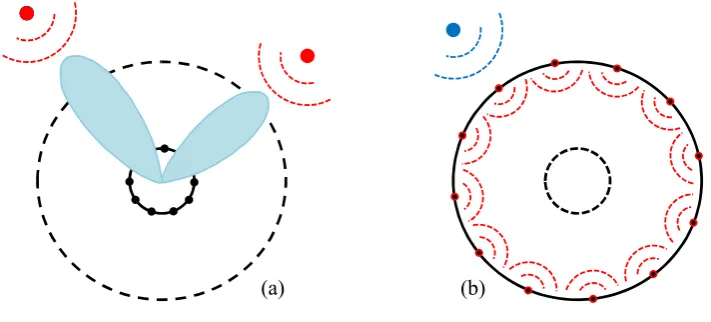
1.1 Array signal processing in (a) sound source localization / separation and (b) sound field reproduction applications. . . 2
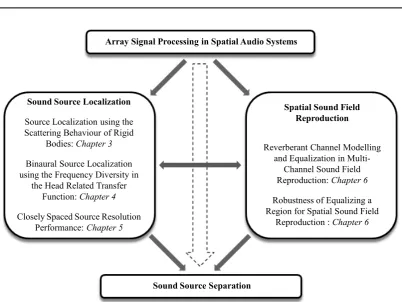
1.2 Overview of the general research areas in spatial audio and array sig-nal processing, and their relationship to the thesis structure. . . 6
2.1 Sound propagation in a one-dimensional medium. . . 12
2.2 The position of a source in (a) 3-D and (b) 2-D coordinate systems. . . 16
2.3 (a) Interior and (b) exterior domains of a sound field. . . 18
2.4 Scattering of a sound field (a) complex scattering (b) rigid sphere scat-terer. . . 22
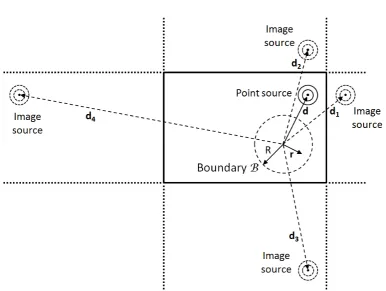
2.5 Geometric representation of a first-order (image depth of 1) reverber-ant 2-D sound field created by a point source using the image source model. . . 24
3.1 Source-sensor channel impulse responses of a sensor array mounted on a complex-shaped rigid body. . . 30
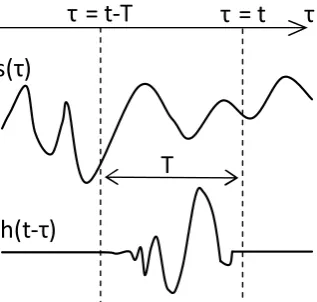
3.2 Convolution of a source signals(τ)and the source-sensor channel
im-pulse response h(τ). . . 31
3.3 The system model above consists of signal preprocessing and DOA estimation stages. Conceptually, the preprocessor separates each sen-sor signal intoKsubbands by passing it through a series of band-pass filters, before down-conversion and down-sampling. The localization algorithm estimates the source directions of arrival using the MK sub-band signals. . . 33
3.4 Array geometry of (a) an eight sensor uniform circular array and (b) an eight sensor array on a complex-shaped rigid body. . . 43
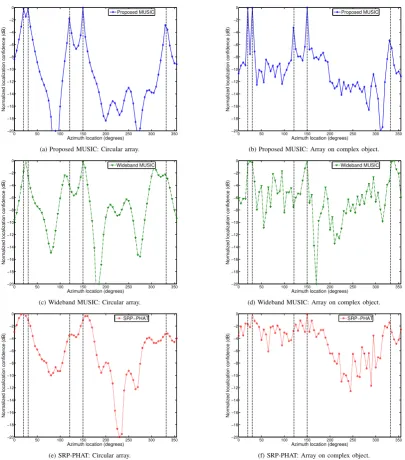
3.5 DOA estimates of the Proposed MUSIC, Wideband MUSIC and SRP-PHAT techniques for subband uncorrelated sources at 10 dB SNR and 4 kHz audio bandwidth. Subfigures (a), (c), (e) are the DOA estimates of the uniform circular array and (b), (d), (f) are those of the sensor array on the complex-shaped rigid body. The five sources are located on the azimuth plane at 20◦, 30◦, 121◦, 150◦ and 332◦, indicated by the dashed vertical lines. . . 47
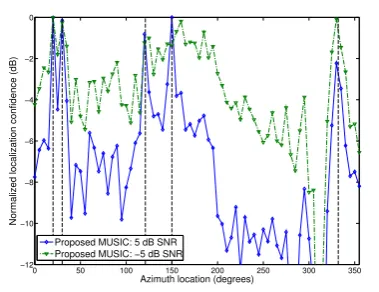
3.6 Performance of the Proposed MUSIC estimator with SNR for uncorre-lated sources using the sensor array on the complex-shaped rigid body at 4 kHz audio bandwidth. The five sources are located in the azimuth plane at 20◦, 30◦, 121◦, 150◦and 332◦, indicated by the dashed vertical lines. . . 48
3.7 DOA estimates of the Proposed MUSIC technique for subband un-correlated sources at 10 dB SNR for 4 kHz (dotted line) and 8 kHz (dot-dash line) audio bandwidths. Subfigures (a) and (b) are the DOA estimates of the uniform circular array and the sensor array on the complex-shaped rigid body respectively. The five sources are located in the azimuth plane at 20◦, 30◦, 121◦, 150◦ and 332◦, indicated by the dashed vertical lines. . . 48
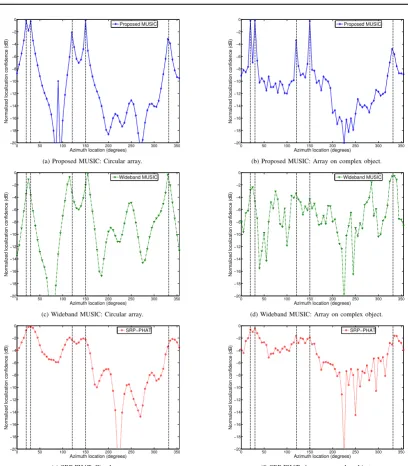
3.8 DOA estimates of the Proposed MUSIC, Wideband MUSIC and SRP-PHAT techniques for subband correlated sources at 10 dB SNR and 4 kHz audio bandwidth. Subfigures (a), (c), (e) are the DOA estimates of the uniform circular array and (b), (d), (f) are those of the sensor array on the complex-shaped rigid body. The five sources are located in the azimuth plane at 20◦, 30◦, 121◦, 150◦ and 332◦, indicated by the dashed vertical lines. . . 50
LIST OF FIGURES xxiii
3.10 DOA estimates of two known sources (imperfect source knowledge) in a sound field of three sources, using the Proposed MUSIC technique at 10 dB SNR and 4 kHz audio bandwidth. Three real-world speech and speech + music sources are simulated. Subfigures (a) and (b) are the DOA estimates of the uniform circular array and the sensor array on the complex-shaped rigid body respectively. The sources are located in the azimuth plane at 120◦, 150◦ and 330◦, indicated by the dashed vertical lines. . . 52
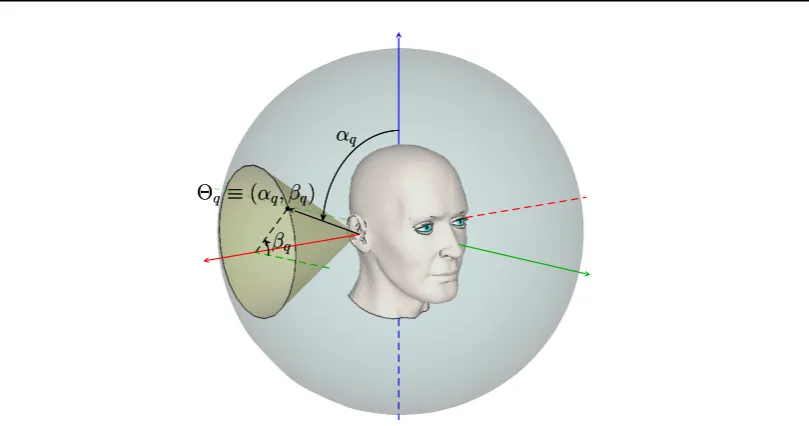
4.1 A source located on a “cone of confusion” in a sagittal coordinate system. 58
4.2 Filter bank model of the binaural sound source localization system. . . 59
4.3 Localization spectra of a source at azimuth 339◦ in the horizontal plane. 64
4.4 Localization spectra of a source located at azimuth 100◦ in the hori-zontal plane at 15 dB SNR. Subfigures (a) and (b) are the localization spectra for ideal and real-world sources respectively. The source loca-tion is indicated by the solid vertical line. . . 67
4.5 Localization spectra of a source located at elevation 78◦ in the vertical plane at 15 dB SNR. Subfigures (a) and (b) are the localization spectra for ideal and real-world sources respectively. The source location is indicated by the solid vertical line. . . 69
4.6 Localization spectra of multiple real-world sources at 15 dB SNR and 8000 Hz audio bandwidth. Two sources are detected in a sound field of three active sources in (a) the horizontal plane at azimuths 10◦, 100◦, 200◦ and (b) the vertical plane at elevations 0◦, 78◦, 157◦. . . 70
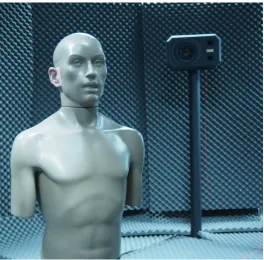
4.7 KEMAR manikin with a speaker positioned at 220◦ in the laboratory. . 71
4.8 Direct and reverberant path components of the measured HRIR for the right ear of the KEMAR manikin in the horizontal plane at azimuth 85◦. 73
4.9 Source location estimates for a single source located at various posi-tions in the horizontal plane. Results are averages of the experiments using different sound sources at 20 dB SNR and the calibrated mea-sured HRTFs. The markers indicate the detected source locations and the vertical lines correspond to the location uncertainty. . . 75
4.11 Source location estimates for two simultaneously active sources lo-cated at various positions in the horizontal plane. Results are averages of different sound sources at 20 dB SNR using the calibrated and di-rect path measured HRTFs at 4500 Hz audio bandwidth. The markers indicate the detected source locations and the vertical lines correspond to the location uncertainty. . . 80
5.1 CRB for the sensor array on the CSRB and the UCA in the direction of arrival of a single source at 10 dB SNR. The uncorrelated source scenarios consider a uniform distribution of signal energy across fre-quency (diagonal Pbs = I), and the correlated scenarios consider an
average source correlation matrix (non-diagonalPbs). . . 89
5.2 DOA estimation performance of a single source with respect to SNR using the UCA and the sensor array on the CSRB, for a real-world correlated source located at azimuth 20◦ in the horizontal plane. Sub-figures (a) and (b) indicate the estimation error (RMSE) of the DOA estimates, while (c) and (d) indicate the mean direction of arrival (M-DOA). . . 91
5.3 DOA estimation performance of two closely spaced sources with re-spect to SNR using the UCA and the sensor array on the CSRB. Two real-world correlated sources are located at azimuths 20◦ and 30◦ in the horizontal plane, and the results indicate the DOA estimation per-formance for the source at 20◦. Subfigures (a) and (b) indicate the esti-mation error (RMSE) of the DOA estimates, while (c) and (d) indicate the mean direction of arrival (M-DOA). . . 92
5.4 DOA estimation performance of two closely spaced sources with re-spect to SNR using the UCA and the sensor array on the CSRB. Two real-world correlated sources are located at azimuths 20◦ and 30◦ in the horizontal plane, and the results indicate the DOA estimation per-formance for the source at 30◦. Subfigures (a) and (b) indicate the esti-mation error (RMSE) of the DOA estimates, while (c) and (d) indicate the mean direction of arrival (M-DOA). . . 93
6.1 Loudspeaker and microphone array configuration of the proposed equal-ization system. . . 100
6.2 Signal flow block diagram of the proposed equalization system. . . 101
LIST OF FIGURES xxv
6.4 Reproduction of a 1 kHz monopole source at (1.7 m, π/3) within a
region of 1 m radius at 50 dB SNR. The dotted outer circle indicates the equalizer microphone array and the smaller inner circle indicates the transmitter microphone array. . . 114
6.5 Reproduction of a 1 kHz plane wave source (incident from azimuth
π/3) within a region of 1 m radius at 50 dB SNR. The dotted outer
circle indicates the equalizer microphone array and the smaller inner circle indicates the transmitter microphone array. . . 115
6.6 Equalization error of 1 kHz plane wave (dotted line) and monopole sources (solid line) at (a) the equalizer microphone array and (b) the transmitter microphone array vs. signal to noise ratio at the centre of the region of interest. Circular and triangular markers indicate the un-equalized and un-equalized equalization error after 500 adaptation steps, averaged over 10 trial runs. . . 116
6.7 Normalized region reproduction error of equalized and unequalized 1 kHz plane wave (dotted line) and monopole (solid line) sources within the 1 m radius region of interest. Circular and triangular markers indicate unequalized and equalized normalized region reproduction error, averaged over 10 trial runs. . . 116
6.8 Echo return loss enhancement (ERLE) of equalized and unequalized 1 kHz plane wave (dotted line) and monopole (solid line) sources at the transmitter microphone array. Circular markers indicate unequal-ized ERLE and triangular markers indicate equalunequal-ized ERLE after 500 adaptation steps. ERLE curves have been averaged over 10 trial runs. . 117
6.9 Normalized region reproduction error of 1 kHz bandwidth (a) plane wave and (b) monopole sources within a 1 m radius region of interest. The proposed technique (solid line) is compared with the multi-point (dotted line) and Filtered-x RLS (dot dash line) equalization after 500 adaptation steps, averaged over 10 trials. . . 118
6.11 Unequalized and equalized sound fields of a plane wave source repro-duced in the directionπ/3 at (a) 800 Hz, (b) 1600 Hz and (c) 2400 Hz
at 50 dB SNR. The dotted white inner circle indicates the 0.1 m radius microphone array and their locations, while the outer dashed circle indicates the reproduction region of 0.25 m radius. . . 120 6.12 Echo return loss enhancement (ERLE) of a reproduced plane wave
source in the directionπ/3, averaged over 10 trial runs at 50 dB SNR. . 121
6.13 Region reproduction error of a plane wave source in the directionπ/3
within a 0.25 m radius region of interest, averaged over 10 trial runs at 50 dB SNR. . . 121 6.14 Reproduced sound field of a 700 Hz plane wave incident from φy =
π/3 for perturbed loudspeaker-microphone positions. The white
dot-ted circle indicates the region of interest and the equalizer microphone array. . . 122 6.15 Normalized region reproduction error of a plane wave incident from
φy =π/3 for perturbed loudspeaker-microphone positions. . . 123
A.1 DOA estimation of far field sources impinging on a linear array. . . 132
List of Tables
3.1 Computational complexity of the DOA estimation process using the proposed technique and Wideband MUSIC. . . 53
4.1 Average number of false detections using the proposed binaural esti-mator with respect to the source location and SNR in the horizontal and vertical planes. . . 67 4.2 Localization uncertainty using the proposed binaural estimator with
respect to the source location and SNR in the horizontal and vertical planes. . . 69 4.3 Single source localization performance using the calibrated measured
HRTFs in the horizontal plane. . . 76 4.4 Single source localization performance using the direct path measured
HRTFs in the horizontal plane. . . 77 4.5 Single source localization performance using the calibrated measured
HRTFs in the 15◦ vertical plane. . . 78 4.6 Single source localization performance using the direct path measured
HRTFs in the 15◦ vertical plane. . . 79 4.7 Multiple source localization performance of the proposed technique
using the calibrated and direct path measured HRTFs in the horizontal plane. . . 81
6.1 Computational complexity of adaptive algorithms. . . 124
Chapter1
Introduction
1
.
1
Motivation and Background
Array signal processing is a broad area in the field of signal processing that en-compasses a range of topics from source detection and separation to sound field reproduction and measurement. In the context of audio signals, the main driver of research has been the interest in spatial audio systems. Spatial audio applications themselves can be categorized into two classes; systems that detect and decompose a sound field, and systems that reproduce a virtual sound field. Examples of these two application classes are illustrated in Figure 1.1. Sound field recording, source separation and source localization are applications that decompose a sound field us-ing a number of spatially separated measurements, while sound field reproduction applications attempt to recreate a desired sound field using a number of spatially separated sources. Although each of these applications appear to be dissimilar at first glance, the fundamental challenges in each application arise from a similar ori-gin, namely the behaviour and effect of the acoustic channel between a source and a receiver at any two points in space. This thesis concerns acoustic signal processing algorithms that can be used to exploit or overcome the effects of the acoustic channel in spatial audio applications.
1.1.1 Sound Source Localization
The first half of this thesis concerns the localization of sound sources, where scat-terers distort the incoming sound waves. In the natural environment, the auditory systems of animals exploit similar distortions to aid in source localization; a process that inspired and forms the basis for this work. The binaural1 hearing apparatus of humans and animals is arguably the most important spatial audio system in
exis-1Binaural capture of a sound field describes the recording of sound waves using two spatially
sepa-rated sensors. The term is generally used in the context of the human auditory system, where the ears act as the two sensors, or in artificial systems that replicate a similar function.
(a) (b)
Figure 1.1: Array signal processing in (a) sound source localization / separation and (b) sound field reproduction applications.
tence, whose functions are shared between two organs; the ear and the brain. In this context, the role of the ear is to receive, decode and recode the sound field [40], which is then transmitted to the auditory centres in the brain. The brain itself performs a number of tasks; the localization of the sound sources, sound source separation and high-level language processing. Typically, these abilities are acquired skills of the brain, with minimal interaction with other sensory inputs. Unlike the source sepa-ration abilities, the source localization ability is heavily influenced by the physical structure of the ear, specifically the outer ear or pinna [3, 12, 67, 69, 77, 79, 93]. Psychoacoustic studies have found that altering the physical structures of the pinna affects a person’s ability to accurately localize a source temporarily [45], and suggests that the brain is trained to be aware of the pinna’s effect on the received sound field. Naturally, this raises the question of what happens to a sound wave before it reaches the ear drum.
§1.1 Motivation and Background 3
The collective effects of these transformations are described in the frequency-domain by the Head-Related Transfer Function2(HRTF) [77]. Since the behaviour of the scat-tering and reflections are location-dependent, the HRTF acts as a signature of the source location that is imprinted on the received signal at the ear drum. Thus, any change to the physical structure of the body will alter this signature, where changes to the pinna for example will result in a different distribution of peaks and troughs for the same source location. The brain’s sensitivity to changes in the HRTF suggests that subtle variations in the frequency-domain of the acoustic transfer function3 are exploited for source localization.
The use of an array of receivers for source localization is a common practice in radar, sonar and communication applications. However, the key difference to the problem in audio signal processing is the assumption of free-space propagation of narrowband signals between the sources and receivers. As a result, the localization algorithms developed for these scenarios are also optimized to suit these conditions. Hence, the localization methods such as MUSIC (Multiple SIgnal Classification) [88], Wideband MUSIC [101], GCC (Generalized Cross Correlation) [54] and SRP (Steered Response Power) [30] are all essentially phase angle based estimators of the source locations. The application of these techniques to a problem such as binaural lo-calization is therefore compromised by their inability to fully appreciate the subtle frequency-domain variations of the channel transfer functions between locations. On the other hand, higher resolution, i.e., the ability to identify closely spaced sources, is typically achieved by increasing the number of receivers. The spatially separated receivers introduce additional diversity into the localization algorithm, and this in-formation is then processed to achieve a gain in resolution. In this context, the rich-ness introduced by the HRTF (the complex behaviour of the HRTF with frequency) can also be considered as additional location information, or a form of diversity in the frequency-domain. However, this information being part of the channel transfer function implies that the existing localization techniques are ill equipped to exploit this form of diversity, as demonstrated in the following chapters of this thesis.
From the discussion above, we identify a limitation of the existing localization methods (the inability to exploit location information encoded in frequency), and an opportunity to improve the accuracy and resolution of the source location estima-tor, by exploiting the diversity present in the acoustic transfer function due to the scattering objects encountered by the incoming sound waves.
2The interested reader is referred to [113] for additional background on the HRTF, including the
aspects of measurement, modelling and spatial dimensionality.
3The acoustic transfer function is the frequency-domain transformation of the acoustic channel
1.1.2 Sound Field Reproduction
The second half of this thesis concerns the recreation of a virtual sound field, where the ultimate goal is to be able to recreate a desired sound field, such that a lis-tener perceives the existence of a virtual source at a desired location in space. The simplest and most well-known mechanism is stereo sound reproduction, where the positioning of the source is achieved by panning the amplitude or introducing a de-lay between the left and right channels [61, 78]. Although this basic approach has been used in audio production for decades, the accurate reproduction of the source location or its direction of arrival is limited to a small spatial region, known as a "sweet spot". A number of other limitations also exist; such as the inability to re-produce a sound impinging from behind the listener, and the acoustic effects due to the dispersion behaviour of the loudspeakers. Multi-channel surround sound sys-tems were developed to solve some of these problems by exciting the sound field at a number of locations distributed in space. However, the sweet spot and many of the other problems still exist. Therefore, increasing the size of the region of interest while reproducing the correct perceptual effects, remains a challenge.
In this context, two approaches to sound field reproduction within a region of interest arose; higher order ambisonics [28, 39] or spherical harmonics [42, 76, 82, 104, 109] based approaches and the wave field synthesis (WFS) [10, 11] approach. The conceptual basis of these methods are similar, and they each consider the sound field in a spatial domain, either as solutions to the acoustic wave equation (spherical harmonics) or as a collection of propagating wave fronts based on the Huygens’ principle (wave field synthesis). Hence, any desired sound field can be described in the spatial domain, which when reproduced, retains the perceptual and physical attributes of the actual sound field. The number of active basis functions of the desired sound field is directly related to the size of the region of interest and the maximum operating frequency [13, 51]. The desired sound field can therefore be reproduced by a discrete set of loudspeakers. However, these approaches require two critical pieces of information; the loudspeakers’ positions and the knowledge of the acoustic channel.
§1.1 Motivation and Background 5
problem. We can consider a number of approaches to estimating the acoustic channel of a reverberant room. Modelling the room configuration and its scattering behaviour is one of the simpler mechanisms [36, 55, 57, 59], but it is limited by the simplifica-tions and assumpsimplifica-tions in the modelling process. Another approach is to measure the acoustic channel at a number of spatial locations. However, the direct application of these measurements for sound field reproduction is not robust in general [81], due to the large and rapid fluctuations of the acoustic channel between spatial locations [71, 92]. This leads to the third approach, where the sound field is measured and actively controlled in the spatial domain.
The active control approach to sound field reproduction consists of a multiple input output system, where an array of loudspeakers reproduce the desired sound field and an array of microphones measure the recreated sound field. Although the use of multiple loudspeakers proved advantageous when recreating a sound field in a region, the correlation between these loudspeaker signals complicates the process of estimating the unknown acoustic channels [9, 18, 37, 44]. This was first observed in multi-channel acoustic echo cancellation applications, and lead to the develop-ment of the domain processing concepts used in WFS [19, 20, 89]. The wave-domain (the equivalent of the mode-wave-domain in spherical harmonics) representation sufficiently decorrelates the loudspeaker signals, such that the effects of the acoustic channels can be described as a transformation of orthogonal waves in the wave-domain. Consequently, this lead to the development of active listening room equal-ization techniques based on estimates of the reverberant channels [90, 91, 94, 96], where feed forward control mechanisms such as filtered-x LMS and filtered-x RLS are employed to reproduce a desired sound field. However, implementing this type of listening room equalizer becomes more complex, due to the increasing computa-tional complexity with the number of reproduction channels [15]. Other concerns also emerge, such as the convergence behaviour of the filtered-x class algorithms and their sensitivity to errors in the acoustic channel estimates.
Spatial Sound Field Reproduction
Reverberant Channel Modelling and Equalization in
Multi-Channel Sound Field Reproduction: Chapter 6
Robustness of Equalizing a Region for Spatial Sound Field
Reproduction : Chapter 6
Sound Source Separation
Sound Source Localization
Source Localization using the Scattering Behaviour of Rigid
Bodies: Chapter 3
Binaural Source Localization using the Frequency Diversity in
the Head Related Transfer Function: Chapter 4
CloselySpacedSourceResolution Performance: Chapter 5 Array Signal Processing in Spatial Audio Systems
Spatial Sound Field Reproduction
Reverberant Channel Modelling and Equalization in
Multi-Channel Sound Field Reproduction: Chapter 6
Robustness of Equalizing a Region for Spatial Sound Field
Reproduction : Chapter 6
Sound Source Separation
Sound Source Localization
Source Localization using the Scattering Behaviour of Rigid
Bodies: Chapter 3
Binaural Source Localization using the Frequency Diversity in
the Head Related Transfer Function: Chapter 4
CloselySpacedSourceResolution Performance: Chapter 5 Array Signal Processing in Spatial Audio Systems
Spatial Sound Field Reproduction
Reverberant Channel Modelling and Equalization in
Multi-Channel Sound Field Reproduction: Chapter 6
Robustness of Equalizing a Region for Spatial Sound Field
Reproduction : Chapter 6
Sound Source Separation
Sound Source Localization
Source Localization using the Scattering Behaviour of Rigid
Bodies: Chapter 3
Binaural Source Localization using the Frequency Diversity in
the Head Related Transfer Function: Chapter 4
CloselySpacedSourceResolution Performance: Chapter 5 Array Signal Processing in Spatial Audio Systems
Spatial Sound Field Reproduction
Reverberant Channel Modelling and Equalization in
Multi-Channel Sound Field Reproduction: Chapter 6
Robustness of Equalizing a Region for Spatial Sound Field
Reproduction : Chapter 6
Sound Source Separation
Sound Source Localization
Source Localization using the Scattering Behaviour of Rigid
Bodies: Chapter 3
Binaural Source Localization using the Frequency Diversity in
the Head Related Transfer Function: Chapter 4
[image:34.595.73.476.85.387.2]CloselySpacedSourceResolution Performance: Chapter 5 Array Signal Processing in Spatial Audio Systems
Figure 1.2: Overview of the general research areas in spatial audio and array signal processing, and their relationship to the thesis structure.
1
.
2
Problem Statement
This thesis considers two application areas in spatial audio; analysis and synthesis of a spatial sound field, where the acoustic channel represents the common element that relates the two areas. The main problem solved in this thesis can be stated as
“The design of acoustic signal processing algorithms that exploit or overcome the effects of the acoustic channel to improve the localization capability, resolvability of closely spaced sources or enhance the fidelity in spatial audio applications.”
1
.
3
Thesis Structure and Contributions
§1.3 Thesis Structure and Contributions 7
more complex sound source separation problem4 (also known as the cocktail party problem), where the spatial information gained through these intermediate steps can be exploited through smarter beamforming and signal subspace approaches for source separation. The background for this thesis is derived from work in a number of diverse areas. For example, high-resolution signal subspace methods have been investigated extensively, and successfully used for direction of arrival estimation in wireless communication systems. Similarly the head-related transfer function and its effect on source localization capabilities have been investigated for many decades, and the localization cues were found to play a crucial role that determines binaural localization performance. In sound field reproduction, spatial transformations were shown to be an attractive method of decoupling correlated reproduction channels for active sound field control. This thesis discusses the limitations of applying these concepts to spatial audio problems, in the presence of acoustic channel effects, and proposes novel methods of incorporating or estimating the effects of the acoustic channel to improved performance.
The main questions addressed in the different chapters are:
• How to extract the diversity in the frequency-domain, created by the scattering and reflection of acoustic waves off a complex-shaped rigid body? Specifically, how do we extract this information at high frequencies?
• Why is this type of diversity lost to existing signal subspace approaches for direction of arrival estimation? Can the dimensionality of the signal correlation matrices be increased to retain this information?
• What is the significance of the different localization cues in the HRTF? Are some of these more or less significant in different localization scenarios? What role does the source location play in binaural source localization?
• Is it crucial to calibrate the HRTF measurements to a listening room? Do free field propagation assumptions provide adequate localization performance in mildly reverberant environments?
• How do direction of arrival estimators perform when resolving closely spaced sources? What is the effect of complex channel behaviour in the frequency-domain?
4The concepts presented in this thesis could be used to design more inspired solutions for sound
• Can we describe the effects of a reverberant listening room in terms of its re-sponse to a recreated sound field? If that is the case, can it be used to control and reproduce a desired sound field?
• How robust is equalizing a region in space to perturbations of the known rela-tive locations of the loudspeakers and microphones?
The specific contributions in each chapter of the thesis, shown in Figure 1.2, are outlined below.
Chapter 2 - Background: Spatial Characterization of Sound Fields
Chapter 2 provides a brief outline of the background theory related to sound field modelling and the spatial information contained within. This thesis primarily deals with the effects of the acoustic channel; hence, the introduction of the acoustic wave equation provides an excellent foundation for further discussions. This chapter intro-duces the background concepts of the acoustic wave equation, the general solutions to the wave equation, and the characterization of scattering and reverberation as a transformation of the sound field coefficients in the solutions to the wave equation.
Chapter 3 - Broadband Direction of Arrival Estimation using Sensor Arrays on Complex-Shaped Rigid Bodies
This chapter introduces a broadband direction of arrival estimator for source local-ization, using a sensor array mounted on a complex-shaped rigid body. It considers the scattering and reflection of sound waves off a rigid body to be a form of di-versity present in the frequency-domain of the acoustic channel impulse response, which can be used for high-resolution direction of arrival estimation. It draws upon the concepts of signal subspace decomposition and the combination of information across frequencies, to coherently extract the directional information encoded in the signals. In order to exploit this diversity information, the concept of increasing the dimensionality of the received signal correlation matrix is introduced. It is shown that multiple localization scenarios may exist, based on the requirements for the ex-istence of a noise subspace. Simulation comparisons of the algorithm with existing techniques using a sensor array on a hypothetical rigid body are used to show that clearer separation of closely spaced sources is possible.
Chapter 4 - Binaural Sound Source Localization using the Frequency Diversity of the Head-Related Transfer Function
§1.3 Thesis Structure and Contributions 9
source localization. Including the interaural intensity differences and the spectral cues in the HRTFs becomes critical for successful source localization in a vertical plane, where the interaural time delays are similar at each potential source location. The basic theory in Chapter 3 is developed to incorporate these features for binau-ral localization. The localization performance is evaluated and compared for sin-gle and multiple source localization scenarios in the horizontal and vertical planes through simulations and experiments. The ability to successfully localize a single sound source and resolve any ambiguities is demonstrated. It is shown that rever-beration acutely affected the localization performance in the vertical plane, whereas the impact on the horizontal plane was minimal. The spatial region inhabited by a sound source was shown to be the primary factor that affects the localization per-formance in multiple source localization scenarios, and corresponds well with the known localization regions in humans.
Chapter 5 - Direction of Arrival Estimator Performance: Closely Spaced Source Resolution
This chapter investigates the closely spaced source resolution performance of direc-tion of arrival estimators in complex acoustic channels. The degree of difference between the acoustic channels of adjacent source locations plays an important role that determines the ability to resolve two closely spaced sources, and the additional diversity information introduced by a complex-shaped rigid body could therefore en-hance this capability. The signal model in Chapter 3 is used to derive the Cramér-Rao Bound for a sensor array on a complex-shaped rigid body, and is used as a bench-mark to compare the performance of the different direction of arrival estimators. It is shown that the proposed estimator exploits the additional diversity information made available, and that an improvement in the capacity to resolve closely spaced sources can be achieved by applying the proposed estimator to signals received by a sensor array on a complex-shaped rigid body.
Chapter 6 - Multi-Channel Room Equalization and Acoustic Echo Cancellation in Spatial Sound Field Reproduction
a classical adaptive filtering problem in this domain. A parallel implementation is shown to be possible, which may further improve the performance of practical ap-plications. Spatial sound field reproduction performance that is comparable to exist-ing methods is demonstrated at reduced computational complexity. The robustness of equalizing the room effects within a region to perturbations in the loudspeaker-microphone positions is also investigated, and shown to depend on the relative per-turbations of the individual elements.
Chapter 7 - Conclusions and Future Research
The conclusions drawn form this thesis are summarized in Chapter 7, together with possible directions for future research. The application of the knowledge derived through this thesis to another problem in array signal processing, sound source sep-aration, is briefly discussed in this chapter.
Appendix A - Signal Subspace Decomposition for Direction of Arrival Estimation
The direction of arrival (DOA) estimation of far field narrowband sources using a linear array of sensors in free-space is summarized in Appendix A. The existence of orthogonal signal and noise spaces are demonstrated for uncorrelated single fre-quency sources embedded in noise, and it is shown that the noise space can be cal-culated from the eigenvalue decomposition of the received signal correlation matrix. The process of exploiting the orthogonality of these subspaces for DOA estimation is then described using the MUSIC DOA estimator.
Appendix B - Broadband Direction of Arrival Estimators
This appendix summarizes the broadband direction of arrival estimators, Wideband MUSIC and Steered Response Power - Phase Transform, used to compare and eval-uate the performance of the proposed broadband direction of arrival estimator in Chapters 3 and 5. The basic operation of the two methods are described, and the limitations of these methods in the context of small sensor arrays located on complex-shaped rigid bodies are discussed.
Appendix C - Wave-Domain Adaptive Filtering
Chapter2
Background: Spatial
Characterization of Sound Fields
Overview:This chapter outlines the background theory related to spatial acoustic modelling.
First, the derivation of the the fundamental equation that describes sound propagation in space, the linearized acoustic wave equation, is presented. This forms the foundations for the description of the effects of the acoustic channel, which can be modelled using the spatial basis functions obtained from the solutions to the wave equation. Next, the general solutions to the acoustic wave equation in the interior and exterior domains are introduced. Finally, scattering and reverberation of a sound field is described mathematically, as a transformation of the incident sound field using the general solutions to the wave equations.
2
.
1
Introduction
Acoustic waves are longitudinal waves, resulting from the displacement of air parti-cles in the direction of sound propagation. Unlike transversal waves, the propagation of a sound wave can be described in terms of the particle velocity, particle displace-ment or sound pressure, all of which can be related to each other and the particle density of the medium. For example consider the sound pressure distribution along the axis of propagation in a 1-D medium, illustrated in Figure 2.1. The displacement of the air molecules create regions of high and low particle density and a correspond-ing change in pressure. It is this change in the ambient pressure that we perceive as sound.
The mathematical description of sound propagation was first attempted by Isaac Newton in the 1600s. This was developed into its current form by Euler and La-grange, and includes significant later contributions from Green, Helmholtz, Rayleigh and others. The relationships between the different factors that affect sound propa-gation are described by a series of complex partial differential equations. However,
Molecular
density
Pressure wave
Direction of propagation
Figure 2.1: Sound propagation in a one-dimensional medium.
they can be linearized and simplified to obtain a simple acoustic wave equation that is applicable to many practical applications in acoustics.
2
.
2
The Acoustic Wave Equation
Consider a non-viscous Newtonian fluid with irrotational fluid flow and negligible gravitational effects. The relationship between the pressure, velocity and particle density can be described using the principles of conservation of momentum and conservation of mass [26, 85, 86]. Thus,
Conservation of momentum:
ρ
∂v
∂t +v•∇v
=−∇p (2.1)
Conservation of mass:
∂ρ
∂t +∇•(ρv) =0, (2.2)
where ρ is the absolute particle density, p is the absolute pressure and the vector
v is the absolute velocity of the medium. The vector differential operation for the particular coordinate system is denoted by the operator∇,∂/∂trepresents the partial
derivative with respect to time and•represents the dot product of vectors.
§2.2 The Acoustic Wave Equation 13
2.2.1 Linearized Conservation of Momentum and Mass
Consider small perturbations to the ambient pressure, velocity and particle density of a medium due to the propagation of an acoustic wave, denoted by the symbols ˜p,
˜
v and ˜ρ respectively. Neglecting the higher order terms for small perturbations, the
absolute quantities in the medium can then be described as
p= p0+p˜
v=v0+v˜ (2.3)
ρ =ρ0+ρ˜
and
∂p0
∂t =0
∂v0
∂t =0 (2.4)
∂ρ0
∂t
=0,
where p0, v0 andρ0 are the ambient pressure, velocity and particle density respec-tively [85]. The linearized continuity of momentum and continuity of mass equations can now be obtained as follows.
Conservation of momentum: In a homogeneous medium, the spatial derivative of the ambient, i.e., time averaged, pressure and particle density vanishes. Thus,
∇p0=∇ρ0 =0. (2.5)
Further, assuming the medium is at rest (i.e., the air mass is still),
v0=0. (2.6)
Applying (2.3) - (2.6) in (2.1), we obtain the linearized continuity of momentum equation
ρ0
∂v˜
∂t +∇p˜ =0. (2.7)
Conservation of mass: Assuming a homogeneous medium at rest, (2.3) - (2.6) can be applied in (2.2) to obtain
∂ρ˜
∂t
We eliminate the dependence of (2.8) on ˜ρby considering the medium to be an
ideal gas, which is compressed by sound waves in a reversible and adiabatic fashion. Thus, the equation of state can be expressed as
dp dρ =
cp
cv ·
p
ρ =c
2, (2.9)
wherecp,cvandcare the specific heat at a constant pressure, specific heat at a
constant volume and the speed of the wave propagating through the medium, respectively. For small perturbations of the pressure, velocity and particle den-sity
dp dρ ≈
˜ p ˜
ρ
p
ρ ≈
p0
ρ0
(2.10)
c2≈c20 = cp
cv ·
p0
ρ0 ,
wherec0is the nominal speed of sound in the medium. Hence,
˜ p ˜
ρ =c
2 0 =⇒
∂ρ˜
∂t =
1 c20 ·
∂p˜
∂t. (2.11)
Thus, the linearized conservation of mass equation becomes
∂p˜
∂t
+ρ0c20∇•(v˜) =0. (2.12)
The linear small perturbation model used in (2.7) and (2.12) are applicable for small perturbations, i.e., ˜p ρ0c20 and |v˜| c0 [86]. These conditions are satisfied for sound propagation in air, and enables the derivation of the linear acoustic wave equation in terms of sound pressure or particle velocity.
2.2.2 The Linear Acoustic Wave Equation
The acoustic wave equation can be expressed in terms of a single variable, pressure or velocity, using the continuity of momentum and mass equations. Rewriting (2.7) and (2.12) in terms of the change in ambient pressure ˜p→ pand velocity ˜v→v,
ρ0
∂v
∂t +∇p=0 (2.13)
and
∂p
∂t
§2.3 Solutions to the Acoustic Wave Equation 15
Calculating the partial time derivative of (2.13) and (2.14) we obtain
∂2v
∂t2 =−
1
ρ0
∇∂p
∂t (2.15)
and
∂2p
∂t2 =−ρ0c
2 0∇•
∂v
∂t
. (2.16)
Substituting (2.15) and (2.16) in (2.13) and (2.14), the linearized acoustic wave equa-tion can be expressed as a single partial differential equaequa-tion in terms of pressure or velocity, given by
∇2p− 1
c2 0
·∂
2p
∂t2 =0 (2.17)
and
∇2v− 1
c20 ·
∂2v ∂t2
=0, (2.18)
where ∇2 = ∇•∇ is the Laplacian. Assuming that pressure and velocity vary in a time-harmonic fashion, the single frequency acoustic wave equation becomes the “Helmholtz Equation”
∇2p(r,t) +k2p(r,t) =0 (2.19)
and
∇2v(r,t) +k2v(r,t) =0. (2.20)
The time-harmonic oscillatory component of pandvis given bye−iωtfor an angular
frequencyω, the wave number isk= ω/c0=2πf/c0, andr is the position vector of
a location in space using an appropriate coordinate system.
2
.
3
Solutions to the Acoustic Wave Equation
The pressure and velocity of a homogeneous acoustic field are governed by the Helmholtz equations (2.19) and (2.20). Thus, any spatial wave field can also be de-scribed using the solutions to these equations, expressed in terms of the natural basis functions in a particular coordinate system.
(a) (b)
Figure 2.2: The position of a source in (a) 3-D and (b) 2-D coordinate systems.
Spherical coordinates:
∇2(·) = 1
r2
∂
∂r
r2 ∂
∂r (·)
+ 1
r2sinθ
∂
∂θ
sinθ ∂ ∂θ(·)
+ 1
r2sin2
θ
∂2 ∂φ2 (·)
(2.21)
p(r,t;ω) =R(r;ω)Θ(θ;ω)Φ(φ;ω)e−iωt (2.22)
Polar coordinates:
∇2(·) = 1 r
∂
∂r
r ∂
∂r (·)
+ 1
r2
∂2 ∂φ2 (·)
(2.23)
p(r,t;ω) =R(r;ω)Φ(φ;ω)e−iωt, (2.24)
where R(r;ω), Θ(θ;ω)and Φ(φ;ω)represent the solutions for the radial, elevation
and azimuth directions.
The functions that describe the wave field in each coordinate system are obtained by solving the second order partial differential equation (2.19) using (2.22) or (2.24) through the separation of variables. The appropriate Laplacian and pressure function in (2.21) - (2.24) are substituted in the Helmholtz equation in (2.19) and divided by the pressure function to obtain the differential equations for each independent variable [106]. Thus, the functions describing the general solution in each dimension become:
Spherical coordinates:
d2Φ dφ2
+m2Φ=0
§2.3 Solutions to the Acoustic Wave Equation 17 1 sinθ d dθ
sinθdΘ
dθ
+
n(n+1)− m
2 sin2θ
Θ=0
Θ(θ) =Θ1Pnm(cosθ) (2.26)
1 r2
d dr
r2dR dr
+
k2− n(n+1) r2
R=0
R(r) =
(
R1jn(kr) +R2yn(kr)
R3h(n1)(kr) +R4h(n2)(kr)
(2.27)
Polar coordinates:
d2Φ dφ2 +n
2Φ=0
Φ(φ) =Φ1einφ+Φ2e−inφ (2.28)
d2R dr2 +
1 r
dR dr
k2− n 2 r2
R=0
R(r) =
(
R1Jn(kr) +R2Nn(kr)
R3H(n1)(kr) +R4Hn(2)(kr).
(2.29)
jn(·), yn(·) and hn(·) represent the three kinds of spherical Bessel functions, Jn(·),
Nn(·)and Hn(·)represent the three kinds of Bessel functions, and Pnm(·)represents
the Legendre function of the first kind. Φ1, Φ2, Θ1 and Ri (i = 1 . . . 4) are arbitrary
constants. mandnare integer constants owing to the periodicity ofφand to ensures
the solutions converge at cosθ ∈ {−1, 1}[106]. The general solutions are a complete
set of orthogonal functions in the relevant range ofθ,φ, and form the basis functions
that can be used to describe a sound field1. The appropriate form of (2.27) and (2.29) is determined by nature of the particular pressure field being considered as shown in Section 2.4, where the former represents the standing wave solutions and the latter represents the travelling wave solutions applicable to a fixed (far field) or changing (near field) pressure field in space, respectively.
2.3.1 General Solution to the Helmholtz Equation
The general solution to the Helmholtz equation can now be expressed using (2.25) -(2.29) as follows [106].
(a) (b)
Figure 2.3: (a) Interior and (b) exterior domains of a sound field.
Spherical coordinates:
p(r,t;ω) =
∞ ∑
n=0
n ∑
m=−n
h
Amn(ω)jn(kr) +Bmn(ω)yn(kr)
i
Ynm(θ,φ)e−iωt
∞
∑
n=0
n ∑
m=−n
h
Cmn(ω)h(n1)(kr) +Dmn(ω)h(n2)(kr)
i
Ynm(θ,φ)e−iωt,
(2.30) whereYnm(θ,φ)are spherical harmonics, the orthogonal basis functions on the
sphere, given by
Ynm(θ,φ)≡
s
(2n+1)
4π
(n−m)!
(n+m)!P
m
n(cosθ)eimφ.
Polar coordinates:
p(r,t;ω) =
∞ ∑
n=−∞
h
An(ω)Jn(kr) +Bn(ω)Nn(kr)
i
einφe−iωt
∞
∑
n=−∞
h
Cn(ω)Hn(1)(kr) +Dn(ω)Hn(2)(kr)
i
einφe−iωt.
(2.31)
The general solutions to the Helmholtz equation in (2.30) and (2.31) can now be used to characterize the sound field in any source-free spatial region. We consider two regions known as the interior and exterior domain, illustrated in Figure 2.32.
2The interior and exterior domain is bounded by a boundaryB, which for illustration purposes is
§2.3 Solutions to the Acoustic Wave Equation 19
2.3.1.1 Interior Domain Solution
The interior sound field can be defined as a source-free spatial region within the boundary B in Figure 2.3(a). The acoustic medium is homogeneous in this region, hence, the solutions to the Helmholtz equation can be used to characterize the sound field.
The general solution applicable in this scenario is determined by the behaviour of the basis functions within this region. For example,|Nn(·)| →∞and|yn(·)| →∞for
kr→0, and are therefore ill suited to describe a finite sound field. Thus, the general solution for the interior domain becomes
Spherical coordinates:
p(r,t;ω) =
∞
∑
n=0
n
∑
m=−n
βmn(ω)jn(kr)Ynm(θ,φ)e−iωt (2.32)
Polar coordinates:
p(r,t;ω) =
∞
∑
n=−∞
βn(ω)Jn(kr)einφe−iωt. (2.33)
βmn(ω)and βn(ω) are commonly known as the sound field coefficients; a series of
weights for the orthogonal basis functions that can be used to describe any sound field withinB. The basis functions themselves, jn(kr)Ynm(θ,φ)and Jn(kr)einφ, are also
known as sound field modes. Thus, the description of the sound field using the sound field coefficients is also known as modal decomposition.
The decomposed modes are obtained form the spatial Fourier transform of (2.32) and (2.33) using the measured sound pressure at the boundary B of the region of interest. Thus, for the spherical and cylindrical shell boundary conditions,
βmn(ω) = 1
jn(kR)
Z
S2p(R,θ,φ;ω)Y m
n(θ,φ)∗ sinθdθdφ (2.34)
and
βn(ω) = 1
Jn(kR)
Z 2π
0
p(R,φ;ω)e−inφdφ, (2.35)
where jn(kR), Jn(kR)6= 0. It should however be noted that the zero crossings of the