Theses Thesis/Dissertation Collections
12-12-2016
Framing of Skill Problems
Kirk M. Winans [email protected]
Follow this and additional works at:http://scholarworks.rit.edu/theses
This Thesis is brought to you for free and open access by the Thesis/Dissertation Collections at RIT Scholar Works. It has been accepted for inclusion in Theses by an authorized administrator of RIT Scholar Works. For more information, please [email protected].
Recommended Citation
Rochester Institute of Technology
School of Communication
College of Liberal Arts
Framing of Skill Problems
by
Kirk M. Winans
A Thesis presented
in partial fulfillment of the Master of Science degree
in Communication & Media Technologies
Degree Awarded:
The members of the Committee approved the thesis of
Kirk M. Winans presented on August 11, 2016.
________________________________________________ Andrea Hickerson, Ph.D.
Director and Associate Professor of Communication School of Communication
________________________________________________ Kelly Norris Martin, Ph.D.
Assistant Professor of Communication School of Communication
Thesis Advisor
________________________________________________ Benjamin M. Zwickl, Ph.D.
Assistant Professor of Physics School of Physics and Astronomy Thesis Advisor
________________________________________________ Grant Cos, Ph.D.
Associate Professor of Communication Director of Graduate Programs
Acknowledgements
This work could not have been completed without the contributions and support
by others. First, I would like to thank my advisors Dr. Kelly Norris Martin and Dr.
Benjamin M. Zwickl for their insightful comments and discussions we had regarding
the subject matter as well as other things. Also, a major thank you is in order for
bringing me in on the POWER project and allowing me to contribute to the project in
my own way. Without this, I would not have been able to complete the degree program
in such an expedited manner and, presumably, I would not be where I am today.
I also thank P. Deyo for serving as the second coder for inter-rater reliability that
allowed me to reflect on the code definitions and helped to make this work higher
quality.
Finally, I thank my wife for her dedication and encouragement to finish my
studies at RIT including this work. Also for putting up with the many late nights of
study, research, and writing and the late nights of much needed relaxation needed to
maintain sanity.
Table of Contents
Abstract... 6
Framing of Skill Problems ... 8
Literature Review ... 10
Framing Theory ... 10
Skills Gap Reports ... 15
Academic Research on Skill Problems ... 20
Research Questions and Hypotheses ... 25
Method ... 26
Identification of Sources of Data ... 26
Procedures for Collecting Data ... 28
Treatment of Data for Purposes of Analysis ... 31
Results ... 32
Identified Frames... 33
Authorship and Publication Venue ... 36
Discussion ... 37
Workforce Report Influences on Salient Frames ... 38
Sources of Frames ... 42
Limitations ... 43
Conclusion ... 43
References ... 46
Tables ... 52
FRAMING OF SKILL PROBLEMS
Kirk M. Winans
School of Communication
College of Liberal Arts
Master of Science in Communication & Media Technologies
Term Degree Awarded: Fall Semester 2016 (2161)
Abstract
More frequently since the Great Recession, various concerns about a “skills gap” have
been raised by industry leaders and organizations, politicians, and some economists.
The most basic definition of a “skills gap” is that the workforce does not possess the
skills required by employers. The most prominent concerns have been with STEM
education and “middle skills” occupations, those that require more than a high school
diploma but less than a 4-year degree. However, the various causes and solutions to
these issues are widespread. Much of the alarm has been stimulated by reports
published by industry and trade organizations asserting specific skills gaps present in
the workforce. However, workforce experts refute these claims and are concerned that
the public discussion is being driven by such alarmist reports. Many studies on framing
code for the presence of full frames; this study instead identifies the presence of
individual frame elements and implements a hierarchical cluster analysis to identify the
the frames present in the public discussion largely align with the alarmist frames,
concerning inadequate STEM education and preparation for “middle skills” jobs,
present in the workforce reports published by industry and trade groups. Given that
the majority of articles were written by journalists, these findings confirm the
hypothesis of framing theory that journalists tend to use frames suggested by political
actors, interest groups, and elites.
Framing of Skill Problems
In the past few years, especially since the Great Recession, many organizations,
such as Deloitte with the Manufacturing Institute and ManpowerGroup, have
published reports on the skills gap. These reports assert that employers are having
difficulty finding qualified people to hire for open jobs and that the future is bleak if we
do not solve this problem (Giffi et al., 2015; ManpowerGroup, 2015; Morrison et al.,
2011). Many of these, if not all, rely almost entirely on surveys of business leaders. The
reports have been picked up by journalists, politicians, and other business executives as
sources used to either discuss the issue or, as in the case of politicians and business
executives, to argue for reforms in education. The recent concerns about a STEM skills
gap have their roots in the report Rising Above the Gathering Storm published by the
National Academies in 2005. However, concerns with STEM education go even further
back to the post World War II report Science, the Endless Frontier by Vannevar Bush
(1945) and the Soviet Union’s launching of Sputnik (Teitelbaum, 2014). In fact,
Teitelbaum (2014) suggests similar concerns have been raised at least five times since
the 1940s.
However, some economists, such as Peter Cappelli and Paul Krugman, refuted
these claims on the basis of economics and on the methodology of the surveys
(Krugman, 2014; Nicklaus, 2014). Krugman (2014) stated that the ManpowerGroup
idea” (Krugman, 2014, para.10). For example, one of the questions is, “How much
difficulty are you having filling jobs due to lack of available talent?” (ManpowerGroup,
2015, p. 3). Krugman (2014) cites another question “Which of the following do you feel
best describes the ‘gap’ in the U.S. workforce skills gap?” and finds it “amazing that
8[%] of the respondents were willing to declare that there was no gap” (para. 10).
According to Nicklaus (2014), “[i]f there is a skills gap in the data, Cappelli says, it's the
opposite of the one the employers talk about. The average worker actually has more
education than his or her job requires” (para. 13). Cappelli describes the survey
questions as vague and argues that the reports should be disregarded and that the skills
gap is essentially a myth.
Cappelli (2015) introduces the term skill problems to refer collectively to the
different complaints about the supply of skills: skills gap, skills shortage, and skills
mismatch. He explains that the skills gap idea is the broadest complaint “that some
systematic shortfall exists in skills, broadly defined, across entire age cohorts of the
population” (Cappelli, 2015, p. 254). Usually, this is an argument that the educational
system (including K-12) has failed to provide students with basic skills. For Cappelli
(2015), the term skills shortage refers more specifically on job-related skills, usually in the
case of specific Science, Technology, Engineering, and Math (STEM) related
occupations. The term skills mismatch is different from skills gap and skills shortage, in
However, this paper will be more focused on higher education related complaints.
Whether or not there is actually a nationwide work force issue is beyond the
purview of this study; however, the mass media’s portrayal of this evidence is of utmost
concern to communication scholars. This topic is important for two primary reasons:
First, and topic of this study, there are many competing claims of what the problem
actually is, or if there really is a skills gap at all, along with various solutions. Secondly,
many of the solutions call for restructuring higher education, which could have
profound unintended consequences. Therefore, understanding what and who is driving
this policy discussion as it unfolds is absolutely necessary. On a deeper level, it requires
us as a society to ask ourselves what interest(s) our educational system is meant to
serve. Given the importance of this topic, the way it is framed in the media may
significantly influence how the public and decision makers understand the issue and
what actions are taken (Scheufele & Tewksbury, 2007).
Literature Review
Framing Theory
Erving Goffman (1974/1986) defines a frame as a “schemata of interpretation”
that people use to interpret new events and information (p. 21). Frames help us
categorize in order to relate new events and information to what we already know.
Goffman (1974/1986) makes the distinction between natural frames, which are
these, there are also primary frameworks that determine our initial reaction as to what
we think about an event. The frameworks used by members of a social group are
integral to that group’s culture.
Entman (1993) identifies framing as a scattered conceptualization. Essentially, the
concept is used for research in many disciplines, but there is not a unified
understanding. He describes the functions of framing and where framing is present in
the communication process. According to Entman (1993), “[t]o frame is to select some
aspects of a perceived reality and make them more salient in a communicating text, in such a
way as to promote a particular problem definition, causal interpretation, moral evaluation,
and/or treatment recommendation for the item described” (Entman, 1993, p. 52). In terms
of operationalizing framing theory specifically in the realm of media effects, Scheufele
(1999) develops a typology in order to create a system with which to compare the
fragmented approaches. This typology is based upon two dimensions, if the research
examined either media or audience frames and if the frame was treated as an
independent or dependent variable. With political communication as the focus,
Scheufele (1999) argues that framing is best understood in the context of social
constructivism as this is (or was) the current paradigm of understanding media effects.
Frameworks are what we use to interpret new information and events based
upon previous knowledge and ideas. Social events can be understood with both natural
understand things, but they are also used to present information. Entman (1993)
describes the action of framing in a clear way that can help to identify frames in texts.
He presents four possible functions performed by frames, frames can:
1. Define problems—determine what a causal agent is doing with what costs and
benefits, usually measured in terms of common cultural values;
2. Diagnose causes—identify the forces creating the problem;
3. Make moral judgments—evaluate causal agents and their effects;
4. Suggest remedies—offer and justify treatments for the problems and predict
their likely effects.
[numbering added for clarity] (Entman, 1993, p. 52)
For Entman (1993) frames are used by communicators to generate the message in ways
that reinforce certain facts or judgments. However, the receiver may not use the
intended frame to understand the messages and thus come to different conclusions.
Frames are a powerful force in society, especially when it comes to politics and
the news. Entman (1993) explains that frames within the news are an “imprint of
power” because frames present reality in a way that could influence the reaction of the
audience (p. 55). This is not to say that framing does not allow for audience autonomy;
on the other hand, framing research aims to describe the "dominant meaning" that
“consists of the problem, causal, evaluative, and treatment interpretations with the
(Entman, 1993, p. 56). Entman (1993) argues that since the general public is usually not
well-informed about politically important issues, the dominant frame has a strong
influence on its reaction.
Framing is also important to journalistic objectivity and content analysis.
Without an understanding of framing, objective reporting may not have the desired
effect because simply presenting facts from opposing sides of an issue, does not
necessarily amount to challenging a dominant frame (Entman, 1993). An unchallenged
dominant frame prevents the news from making other interpretations equally salient. In
fact there have been calls to train journalists in framing theory in order to avoid these
issues (Davis & Kent, 2013; Entman, 1993). In a similar way, content analysis can
misrepresent the effect of media messages by only using raw counts of negative or
positive terms. In order to determine the dominant meaning audience members receive
from media messages, content analysis should take into account the “salience of
elements in the text, and … the relationships of the most salient clusters of messages—
the frames—to the audience’s schemata” (Entman, 1993, p. 57).
Scheufele (1999) classifies the four typical operationalizations of framing theory
in order to develop a typology of framing research. The typology is based upon
whether framing is operationalized to examine media or individual frames and if the
frames are treated as independent or dependent variables. The appropriate research
in Table 1. Furthermore, Scheufele (1999) identifies four processes1 that link the
operationalizations into a cycle of influences. The first of these is frame building, which is
the processes through which media content gets framed and what factors influence the
final media frame. It is this first process that this study will examine to determine the
most salient frames and what/who are the sources of those frames.
Scheufele (1999) explains that framing, as it pertains to political communication,
falls within the social constructivism research paradigm of communication. In this,
news media provide versions of reality, including interpretations, to the public. The
journalists’ framing of a news story could be influenced by at least five factors: "social
norms and values, organizational pressures and constraints, pressures of interest
groups, journalistic routines, and ideological or political orientations of journalists"
(Scheufele, 1999, p.109).
Based upon previous research, the influence of these factors leads to the process
of frame building happening in at least three different ways. In order to interpret new
information, journalists often use their own ideological or political orientations and to
some extent, social norms and values. Frames can also be selected due to the
organizational pressures and constraints, as well as their journalistic routines
1 Frame setting is the process of audience frames being influenced by media frames. Scheufele (1999) notes
that a direct link between media frames and people’s behaviors has not been found. Instead, he argues that their individual frames impact these behaviors in the process of individual-level effects of framing. The final process is journalists as audiences where the individual attitudes and behaviors impact the
(Scheufele, 1999). A third way that frames are selected is by the influence of political
actors, interest groups, and elites. The frames suggested by such groups "are adopted
by journalists and incorporated in their coverage of an issue or event," although
Scheufele (1999) notes that this is likely to have stronger influence when there is a new
issue, as opposed to when an issue has received attention (p. 116).
Skills Gap Reports
Based upon preliminary searches, three popular concerns are raised within the
skills gap discourse: (a) a general lack of qualified people for businesses to hire
(ManpowerGroup, 2015), (b) an insufficient amount of STEM graduates to meet future
needs (Committee on Prospering in the Global Economy of the 21st Century (U.S.) &
Committee on Science, Engineering, and Public Policy (U.S.), 2007), and (c) a lack of
people trained for “middle-skills” jobs such as manufacturing (Giffi et al., 2015). It is
important to note, that many middle-skills jobs (i.e., those that require less than a four
year degree but more than a high school diploma) are related to STEM in that they
require skills/knowledge from STEM fields (Oleson, Hora, & Benbow, 2014). However,
these are interrelated ideas and typically amount to concerns over workforce
preparation by higher education. The following three relatively popular reports get
cited when making these claims.
In 2015, ManpowerGroup completed their 10th Annual Talent Shortage Survey.
right-skilled talent, and this trend shows no sign of abating” (“Talent shortage survey,” 2015).
They conducted a global survey of hiring managers about talent shortages that they
experienced. Globally, 54% of employers responded that this issue was impacting their
business in a negative manner and “38% of employers are having difficulty filling jobs”
(ManpowerGroup, 2015, p. 4). The hardest jobs to fill include mostly middle-skills jobs
such as skilled trade workers, technicians, production/machine operations, as well as
STEM occupations such as engineers and IT staff. Specifically, in the United States, the
survey found that 32% of employers had difficulty filling jobs. According to the report,
the top five reasons for this difficulty (at least globally) are: (1) lack of available
applications/no applications, (2) lack of technical competencies (hard skills), (3) lack of
experience, (4) lack of workplace competencies (soft skills), and (5) looking for more pay
than is offered (ManpowerGroup, 2015, p. 5). According to Cappelli (2015), this series of
reports is “[p]erhaps the most influential and widely quoted of the consultant reports”
(p. 260).
The “Skills Gap Report” series is typically cited in media reports on the troubles
of manufacturers finding qualified people to hire. These reports are published by the
Manufacturing Institute and Deloitte, with reports in 2001, 2005, 2011, and 2015 (“Skills
gap in manufacturing,” 2015). The most recent of these reports is based on the 2014
Manufacturing Skills Gap survey of over 450 manufacturing executives (Giffi et al.,
driver and it is expected by the International Monetary Fund (IMF) to grow; however,
the industry has experienced a talent gap for years now.
It is projected that, unless solutions are put into place to solve the problem, this
gap will widen as a result of more job openings due to retiring baby boomers and
economic expansion and the lack of new workers entering the industry. According to
the report “[o]ver the next decade nearly 3 ½ million manufacturing jobs likely need to
be filled. The skills gap is expected to result in 2 million of those jobs going unfilled”
(Giffi et al., 2015, p. 2). The reasons that enough new workers will not be able to take
those jobs is a combination of younger generations’ negative perception of the industry,
lack of STEM skills, as well as the decline of technical education in public schools (Giffi
et al., 2015).
It is interesting to note that the “Methodology” section only contains two pie
charts about the industry classification and annual revenue of the participations. At the
very least, they fail to report their sampling procedure which is crucial to
understanding how valid the results are and how representative the sample is of all U.S.
manufacturers. In addition, they use annual revenue as a measure of “company size.”
While this may be appropriate in certain cases, it would seem that when the focus is on
workforce skills, the company size should be based upon number of employees they
have. Certainly it could be the case that a company with a certain level of annual
or employ hundreds of people and produce many more, lower priced items. The top
four skills that the manufacturing executives reported as most deficient were: (1)
technology/computer skills (70%), (2) problem solving skills (69%), (3) basic technical
training (67%), and (4) math skills (60%). Apparently, this is measured as “the
percentage of executives who did not opt for ‘Extremely sufficient’ or ‘Sufficient’” (Giffi
et al., 2015, p. 6). It is unclear as to what the executives did select, another figure reveals
the answers to a shortage question as the “’Severe shortage’ and ‘High shortage’
response” being summed together, aside from this, there is no other indication (Giffi et
al., 2015, p. 8).
Most of the recent concerns about a STEM skills gap have been stimulated by
Rising Above the Gathering Storm a report published by the National Academies in 2005.
In fact, the America COMETES Act of 2007 is based off of the report’s prescriptions. The
concerns laid out in Rising Above the Gathering Storm stem from other countries (mostly
China) catching up to the United States in economic competitiveness. The report asserts
that research and technological progress lead to economic progress. Therefore,
increasing STEM education, to build the STEM workforce, and increasing incentives for
innovation, namely enhancing the Patent System and tax credits for research and
development (R&D), are called for to create and fill jobs in science and technology and
ensure that the United States remains in the lead of innovation (Committee on
Engineering, and Public Policy (U.S.), 2007). The connection between STEM R&D and
the economy can be traced back to Vennevar Bush’s, then Director of the Office of
Scientific Research and Development, 1945 report Science, the Endless Frontier (Bush,
1945).
Indeed, the two reports share a motivation for improving the public welfare
including health, security, and the economy. They also share recommendations to the
extent that increasing training in STEM fields and incentives for research to be
conducted by universities and private corporations. However, there are some major
differences. One being that Rising Above the Gathering Storm frames many of these
suggestions as ways to attract Multinational Corporations (MNCs) to create jobs in the
United States and seems to view educational institutions as primarily supplying the
training. The other major difference is that Bush (1945) maintains the importance of
other areas of academic inquiry and writes, “It would be folly to set up a program
under which research in the natural sciences and medicine was expanded at the cost of
the social sciences, humanities, and other studies so essential to national well-being” (A
Note of Warning section, para. 1). While Rising Above the Gathering Storm pays some
homage to the social sciences, it no doubt is focused on attracting the “best and
brightest” to science and engineering (p. 9); whereas, Bush (1945) is cautious about
drawing too much of the nation’s talent into the sciences. One could argue that Rising
Academic Research on Skill Problems
Teitelbaum (2014) identifies at least five previous instances of a concern about a
lack of scientists and engineers, or a STEM skills gap that have followed a similar
pattern of “alarm, boom, and bust” (p. 2). The alarm stage consists of concerns that the
United States is falling behind; this is reflected in Rising Above the Gathering Storm. The
alarm is typically echoed by interest groups, economic elites, and political elites. The
boom stage occurs when there is a political response that rapidly increases the number of
scientists and engineers. Teitelbaum (2014) admits that the bust stage did not always
occur, but generally the large number of newly minted scientists and engineers find a
tough labor market at the end of a long road of education which tends to decrease the
attractiveness of these careers for future young people. As for the current cycle,
Teitelbaum (2014) concludes that the recent alarms are not supported by the available
evidence. Furthermore, the solutions executed tend to damage the STEM enterprise and
that the current malaise of the STEM workforce cannot be solved by an influx of
funding.
Most of the policy discussion on this subject has been driven by reports from
major consulting agencies, industry and trade groups, and claims by economic elites
(Cappelli, 2015; Hira, 2010; Hira, Stephan, Salzman, Teitelbaum, & Matloff, 2014; Lowell
& Salzman, 2007; Salzman, Kuehn, & Lowell, 2013). Many of the employer-based
transparency about the methods. Cappelli (2015) asserts that in the cases when there is
really a problem, it is likely not with people fresh out of school since they make up a
small proportion of the workforce. Additionally, many of the discussions ignore the
interest of employees and students. This is evident in that while industry and university
leaders claim that there is a lack of supply of STEM workers, STEM workers believe that
there is a lack of demand (Hira, 2010). In fact, Cappelli (2015) states that,
[i]t is difficult to think of another labor market issue for which academic research
or even research using standard academic techniques has played such a small
role, where parties with a material interest in the outcomes have so dominated
the discussion, where the quality of evidence and discussion has been so poor,
and where the stakes are potentially so large. (p. 283)
Given that education outcomes have improved over the last 30 years and, when
surveyed, only two out of the top 15 work skills employers find missing are academic
skills such as oral communication and reading skills, the education system can hardly
be at fault for all of this (Cappelli, 2012). In fact, many of the top work skills on the list
would fall under Life and Career Skills in the Partnership for 21st Century Learning's
(2015) 21st Century Skills framework. The real problem is likely an issue with the
employers themselves. Lack of experience is a major part of the claims employers make
because companies would like workers to start contributing immediately, however, a
automation in human resource departments leads to many applications being thrown
out if the person does not meet all requirements or use the right words (Cappelli, 2012).
Cappelli (2012) argues that employers are framing the large number of jobs going
unfilled with high unemployment as a problem with workers, when in fact, the cause is
the employers’ expectations and flaws in the hiring process. Although, others such as
Hira, Stephan, Salzman, Teitelbaum, and Matloff (2014), explain the reasoning behind
these claims as more sinister, at least when it comes to STEM, in that these are
self-interested claims in order to have guest worker programs expanded and thus, cheapen
the price of labor.
Krugman (2014) asserts that if there were really a skills gap, companies would
offer higher wages and workers with the skills in short supply would be doing better
comparatively. However, this is not the case. He also suggests that this may be a way to
distract from rising profits while wages are stagnate. Indeed, the claims made by the
Manufacturing Institute reports have been challenged by Osterman and Weaver (2014)
where they find that the claims are “overblown.” They find that those having
difficulties hiring are in the minority. While not entirely dismissive of a future issue,
research conducted by The Boston Consulting Group states that any current issue is
local and not national and will not hamper a resurgence in manufacturing (Sirkin,
Zinser, & Rose, 2013). However, the report calls for investment by both the public and
Although, academic research has found evidence of some sort of skills problem.
It seems the middle-skills problem has been studied less than issues in higher education
STEM education as there is no aggregate estimate (the Deloitte and Manufacturing
Institute report figures were for manufacturing alone). Although, contrary to explaining
this as an issue with young people or an educational system failure, some suggest
broader economic shifts and to some extent, what young people are told, as the culprit
(Kochan, Finegold, & Osterman, 2012). There are two traditional routes to obtaining
skills, on-the-job training and higher education.
The first was largely driven by company loyalty to employees by promoting
from within, and employers and unions working together to offer apprenticeships;
however, as the proportion of unionized workers has diminished (to 7% in the private
sector and 12% overall) such apprenticeships, that are mostly at unionized workplaces,
and promotions from within have also declined (Kochan et al., 2012). Additionally, the
skills in demand have shifted towards those that require advanced training, either
technical or behavioral, and away from those that can easily be built through on-the-job
training. Kochan et al. (2012) also point out that human resources budgets are the first
to be cut partially due to a fear that they will invest in training someone that ends up
taking a position at another company once trained. These factors have also contributed
to the 36% decline in apprenticeships.
demand for STEM skills has increased, the proportion of college graduates in STEM
fields (15%) has remained the same over the past two decades. However, it is not clear if
they are talking about STEM degrees broadly or just about middle skills STEM jobs.
Kochan et al. (2012) seemingly argue that young people being told “that the key to the
American dream [is] to play by the rules and major in a field that [suits] your interests
and talents” has caused students to study liberal arts, despite a significant drop in the
demand for those with liberal arts degrees; although they fail to produce data on these
claims (p. 85). Presumably, they are implying that there might otherwise not be a STEM
skills gap if they were to pursue STEM instead of liberal arts.
Part of the concern here is that even those with STEM degrees might have
insufficient skills (Evans, Leinhardt, Karabinos, & Yaron, 2006; Fair, Kleist, & Stoy,
2014). Although, these findings are usually from within specific disciplines, for
example, chemistry. Earlier research, prior to the Great Recession, highlighted that
chemistry education, starting in high school, does not display the exciting aspects of
chemistry in the real world, and therefore, does not entice students to pursue the field
(Evans et al., 2006). Although, in more recent research, some claim that what is taught to
those with bachelor’s degrees in chemistry is not what employers need, in essence a
disconnect between what is taught in the classroom and what skills are needed by
industry (Fair et al., 2014).
focus on one variable to “fix” the problem(s). In the case of STEM, the vast complexity
of the system makes it impossible to both diagnose issues and predict the ramifications
of changing a single variable without accounting for the key elements shown in Table 2,
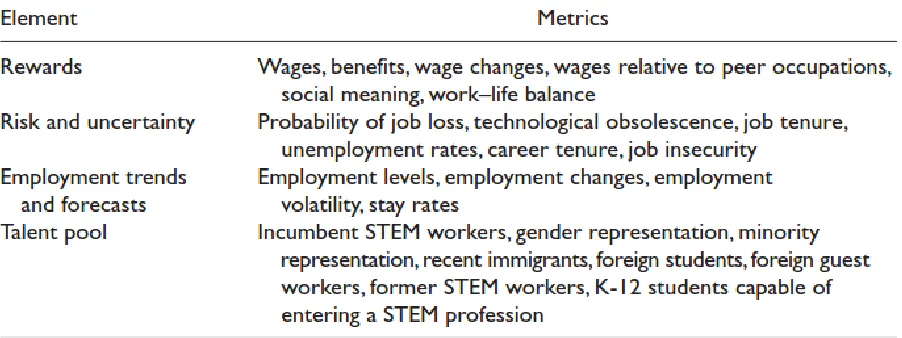
all of which need to be taken into account when giving policy prescriptions (Hira, 2010).
The first two, rewards and risk and uncertainty, encompass the variables that have an
impact on a person's decision to enter a certain occupation. The elements of
employment trends and forecasts and talent pool deal mostly with the macroeconomic
complexity of the STEM workforce system. What this amounts to is the problem is not
being studied in the right way, which typically leads to poor decisions (Hira, 2010).
Additionally, there is a false assumption typically made that the STEM labor market is
homogeneous. Hira (2010) explains that the STEM labor market “is better characterized
as … multiple labor markets, demarcated by occupation, level of degree, geographic
location, industry-specific knowledge, and years of experience" (p. 951).
Research Questions and Hypotheses
This study will seek to uncover the nuances of how frames are used in the
popular press when discussing the claims about inadequacies of the workforce. As
previously mentioned, various solutions are proposed to treat the skill problems. Using
Entman’s (1993) functions of frames as a guide, the articles can be analyzed for how the
issues are framed by those cited and/or the author. The general research question is
as dependent variables: What factors, such as interest groups, ideologies, attitudes,
and/or elites, influence how the popular press frames skill problems as they relate to
higher education? More specifically, to understand what frames are actually used, the
news articles will be analyzed for how they perform Entman’s (1993) four actions. Thus:
RQ1:What skill problems do news articles in major U.S. newspapers discuss?
RQ2:How do news articles evaluate the causal agents of the skill problems
and their effects?
RQ3:What remedies do news articles suggest for the skill problems?
The answers to RQ’s 1-3 will yield the frame element variables present in the articles.
This will allow for the identification of the most salient frames. Thus:
RQ4:What are the salient frames found in the major U.S. newspaper articles?
Knowing the sources of information for the news articles is important in understanding
what potential influence there is over the journalistic frame. It stands to reason that the
way a source frames the information could, and likely does, impact the way a journalist
frames the information and/or issue when reported on. Therefore:
RQ5:What are the affiliations of the authors and the media outlets of the
articles?
Method
Identification of Sources of Data
Academic database. Ten search terms were used to collect possibly related articles: (a)
“skills gap,” (b) “skills-gap,” (c) “skills shortage,” (d) “skills mismatch,” (e) “shortage of
skilled workers,” (f) “shortage of qualified individuals,” (g) “STEM workforce,” (h)
skills AND workforce, (i) “labor supply,” and (j) “skill sets.” These search terms were
arrived at during the first few weeks of exploratory searches. The keywords that
emerged from articles found with “skills gap” and subsequent search terms were tested
for the number of results they returned. If there were only a few results they were not
used. These searches were conducted during the week of August 17, 2015 through the
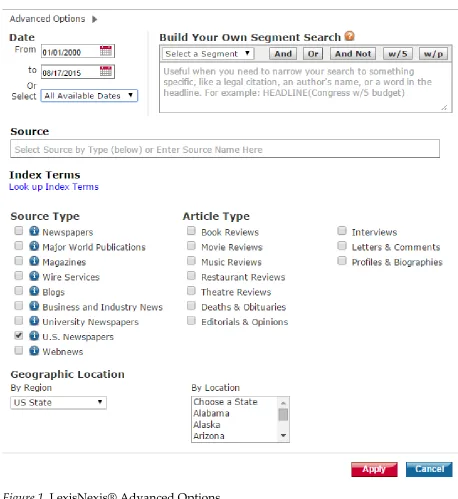
“All News Search” with advanced options selected as follows (see Figure 1):
Date: From 01/01/2000 to 08/17/2015
Source Type: U.S. Newspapers
After the advanced options were applied, the search terms were used individually in
the search box. The results were further refined through options available on the results
page: “Duplicate Options” was set to “On – High similarity” and “United States” was
selected under the “Geography” groups. The first 100 articles were collected to be
analyzed. This yielded 802 total articles (some had fewer than 100 results).
The first 100 articles for each search term were selected for a few reasons. First,
when sorted by relevance, the articles found on the first four pages of results should be
mostly relevant to the topic, and if any of the results are relevant they should appear on
using the database around the time of the search.
Procedures for Collecting Data
Matthes and Kohring (2008) provide an overview of the typical approaches to
framing that tend to have issues with validity and reliability. Approaches that code
whole frames at once, such as the hermeneutic, manual holistic, and deductive
approaches, either require pre-established frames or they use frames developed in a
nontransparent way. These approaches leave open the possibility of missing an
emerging frame either because of the lack of flexibility or the development of a coder
schemata that dictates how the researcher perceives the issue. The linguistic approach
also codes whole frames at once but focuses on specific words as the building blocks,
however this is highly complex and is difficult to do with large samples (Matthes &
Kohring, 2008). One way to deal with the complexity could be the computer-assisted
approach, or frame mapping, but this requires an assumption that words and phrases
have a singular meaning no matter the context. Matthes and Kohring (2008) propose
conceptualizing frames as clusters of frame elements and coding the individual frame
elements to improve reliability and validity. This method has three advantages for this
study. First, given the relative lack of frame analysis surrounding the issue of skill
problems, using a deductive approach with established frames would likely be
unreliable and overly complicated. In addition, such a method would be problematic
frames (Matthes, 2009). Second, it provides for higher reliability when compared to
using abstract, holistic frames (Matthes & Kohring, 2008). Finally, it allows emerging
frames to be easily identified.
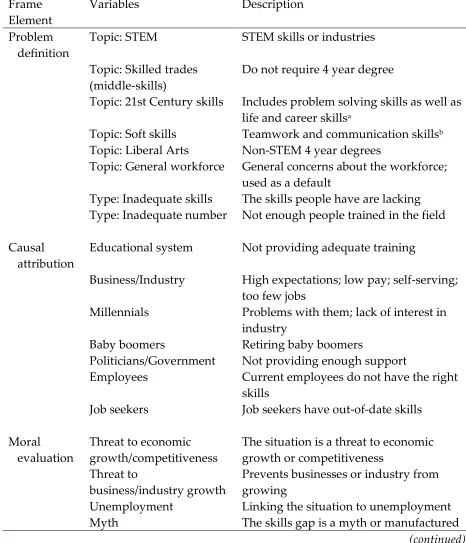
The frame elements coded were those identified by Entman (1993) and the
specific variables for each frame element can be seen in Table 3. The frame element
variables were developed out of a qualitative examination of the first 25 articles of each
search term. In total, 204 (161 unique related) articles were read in full and information
regarding the sources cited, the problems discussed (in relation to skills issues), and the
proposed solutions were recorded. The problem definition consisted of both the main
topic and type of problem that is discussed. The topics consisted of what types of skills
or jobs the article discussed; while the problem types consisted of the article discussing
an inadequate quality of skills of those in a certain field and/or an inadequate quantity
of people trained in a field. The causal attribution element differed from Matthes and
Kohring (2008) in that typically actors are seen as having a specific reason why they are
the cause such as the educational system not providing adequate training, businesses
having high expectations while offering low pay, or job seekers having out-of-date
skills. For the moral evaluation, the article presented the issue as a threat to economic
growth or competitiveness, a threat to business or industry growth, linked the issue to
unemployment, and/or presented the issue as fake. The solutions proposed or discussed
During the initial analysis to develop the coding scheme it was found that 17 of
the first 25 articles found under “labor supply” were either unrelated or difficult to
discern how they may relate to the topic. Given this, the remaining 75 articles collected
under this search term were not used in this study. The headlines and first two
paragraphs of each of the remaining 523 articles were coded for the frame elements
discussed above. Tankard (2001) has noted that it is appropriate for frame research to
use headlines and leads. Since part of this study is to understand what perspectives are
represented in popular press articles on skill problems, the following non-frame
elements were coded as well:
The author of the article, along with his/her affiliation and what segment
of society he/she represents (academics/education, business/industry,
politicians/bureaucrats, labor organization/worker, or other).
The publication venue and the type of news it is focused on
(general/popular, business, political, or education).
A fellow graduate student served as a second coder of 55 (11%) articles that were
used for the inter-rater reliability. Five of the articles were found to not be related by
both coders, and were excluded from the calculations as to not inflate the statistic
(although they could be seen as observations with zeros for all variables). Given that
most variables were coded as not present most of the time, this introduced kappa’s
statistics, such as Cohen’s κ and Scott’s π, yield very low or negative values (Gwet,
2008). Given this, Gwet's (2008) agreement coefficient (AC1) was selected due to its
ability to handle this situation. Wongpakaran, Wongpakaran, Wedding, and Gwet
(2013) suggest that benchmark scales developed for kappa can be used for the AC1
statistic. Eleven out of the twenty-nine variables fell within the “Good” benchmark and
the rest were in the “Very Good” benchmark on Altman’s scale (as cited in
Wongpakaran et al., 2013). The General Workforce and Skilled Trades codes had the
lowest AC1 values, 0.63 and 0.64 respectively. Additionally, the variables indicating the
problem type (inadequate skills and inadequate number) had AC1 values of 0.66 and
0.65.
Treatment of Data for Purposes of Analysis
The data gathered from the articles was used to identify the frames existing in
the popular press articles and those that are dominant within the sample. Each frame
element variable was computed as binary variables. Variables with frequencies less
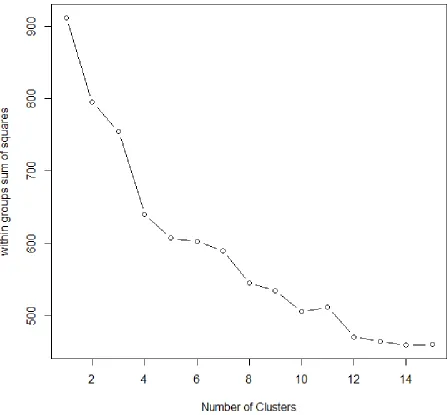
than 5% were excluded from the cluster analysis. The number of frames was
determined through the elbow criterion on a plot of the within group sum of squares.
The most salient frames were determined through a hierarchical cluster analysis using
the Ward method, which produces accurate clusters (Breckenridge, 2000, p. 281).
Additionally, chi-square tests were used to determine any significant difference in the
specific frames emerged directly from the articles in linking the skill problems
discussed and the solutions provided.
Results
After removing unrelated articles and articles that gave no clear indication of
being related in the sections that were coded (thus providing no codes), 396 articles
remained and were used for the cluster analysis. The variables for problem type
(inadequate quality of skills or an inadequate quantity of people trained) seemed to be
difficult to reliably distinguish between the two. While this may be an important
distinction for determining an appropriate solution as one can imagine these could have
different causes and different solutions, the two issues seem to intersect if the problem
is defined as “a lack of adequately trained people” for a given job/industry. Perhaps the
nebulous nature of what type of problem exists is an artifact of the skills gap reports
describing both problems (and their combination); therefore, they were excluded from
the analysis. The problem topic of general workforce was used as a default code when
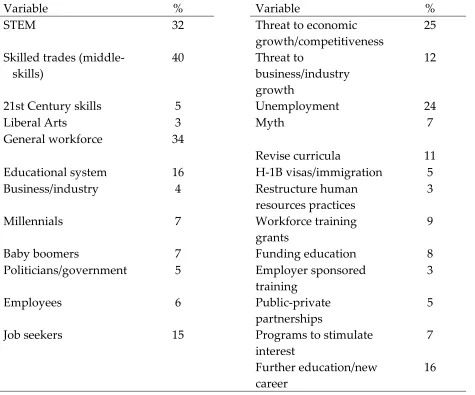
no specific group of skills, industry, or occupation was discussed. Table 4 indicates the
percentage of articles in the entire data set coded as containing each particular variable.
Variables present in less than 5% of articles were not included in the cluster analysis.
For the articles coded according to the coding scheme, the sum of squares were
as follows: 912.12 (one cluster), 795.15 (two clusters), 754.69 (three clusters), 640.45 (four
clusters), and 534.50 (nine clusters). One can see in Figure 2 that there is a leveling
between five and seven clusters; however, the slope increases slightly afterwards. Given
that one would have to go to eight clusters to get a further drop, five clusters was
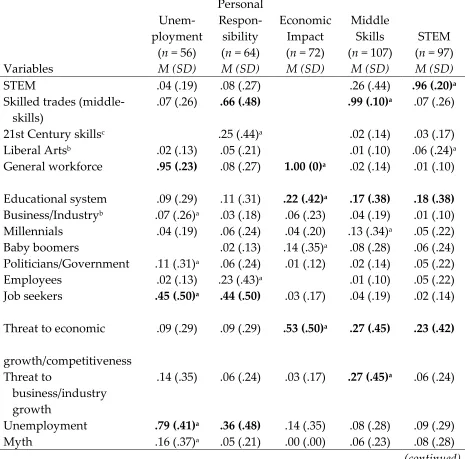
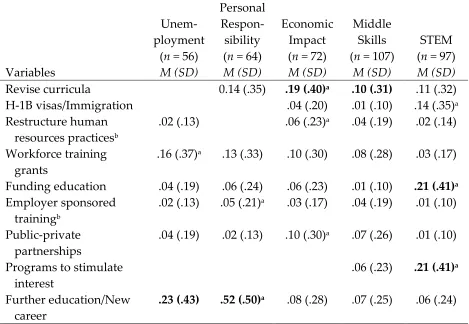
determined to be an appropriate amount. Table 5 depicts the mean values of all the
variables that were present in the articles coded. For the interpretations of these frames,
the highest means within a cluster indicate what the most important variables are (for
that cluster). Additionally, Table 5 indicates both the most prominent variable in each
frame element for each cluster as well as in which cluster each variable had the most
presence.
Identified Frames
The largest cluster, or frame, which consisted of 27% (n = 107) of the articles deals
with the shortage of people trained in the skilled trades or middle skills jobs
(M=0.99, SD=0.10). However, about one quarter of the articles also dealt with STEM
skills (M=0.26, SD=0.44). This frame tends to say the educational system
(M=0.17, SD=0.38) and millennials (M=0.13, SD=0.34) are responsible for the skills
gap (i.e., the difficulty employers are having in filling middle-skills jobs) by not
providing enough well trained people, and by either not being interested in the skilled
trades or lacking the skills, respectively. While the blame seems to be spread around,
this issue is seen as both a threat to economic growth and business or industry growth
somewhat focus on revising the curricula at the technical school/community college
level (M=0.10, SD=0.31). This frame is termed Middle Skills. It should be noted that
this was not a very cohesive frame, except for the identification of skilled trades and/or
middle skills being an issue, in that the most salient causal attribution and treatment
codes do not have a much greater presence than the other codes for those frame
elements.
The second largest frame (24%, n = 97) is concerned with a STEM skills gap
(M=0.96, SD=0.20). This is framed as a threat to economic growth (M=0.23, SD=0.42)
and seen as being caused by the educational system (M=0.18, SD=0.38). The solutions
proposed to solve the STEM gap are funding education, such as scholarships or funding
colleges and universities, and programs to stimulate interest in STEM fields and careers
(M=0.21, SD=0.41). Additionally, most of the occurrences of the H-1B visas and
immigration being a solution were in the STEM frame (M=0.14, SD=0.35).
The Economic Impact frame (18%, n = 72) is entirely concerned with the general
workforce lacking in skills being, at least partially, caused by an inadequate educational
system (M=0.22, SD=0.42). Although, the pending retirement of the baby boomers is
playing a role too (M=0.14, SD=0.35). This frame derives its name from the prevalence
of seeing the issue as a threat to economic growth or competitiveness
(M=0.53, SD=0.50). This frame proposes the solution of revising curricula
industries in the region.
The Personal Responsibility frame (16%, n = 64), like the Middle Skills frame,
identifies the lack of those trained for Middle Skills jobs as the dominant issue
(M=0.66, SD=0.48). However, it also contains concerns with 21st Century skills
(M=0.25, SD=0.44). This frame largely claims that job seekers have outdated or
inadequate skills for the jobs that are open (M=0.44, SD=0.50) as well as current
employees lacking certain skills (M=0.23, SD=0.43). Naturally, this is linked to
unemployment (M=0.36, SD=0.48). This frame is named Personal Responsibility
because the main solution proposed is using training and/or certificate programs
(M=0.52, SD=0.50). This includes older workers going back to school to either
upgrade their skills or to train for a new career.
The Unemployment frame (14%, n = 56) seems to contain the largest occurrences
of uncommon variables. This frame is dominated by concerns about the general
workforce (M=0.95, SD=0.23). The frame attributes this to the inadequacies of job
seekers (M=0.45, SD=0.50) but also has the highest occurrence of attributing the issue
to politicians or government (M=0.11, SD=0.31) as well as business and industry
practices (M=0.07, SD=0.26). This frame, more than any other, links the issue with
unemployment (M=0.79, SD=0.41), thus it is termed the Unemployment frame.
Additionally, this frame has the highest occurrence of articles that challenge the
common solution proposed by this frame is further education (M=0.23, SD=0.43)
along with workforce training grants (M=0.16, SD=0.37).
Authorship and Publication Venue
Based on the results of chi-square tests there was no significant difference in
author affiliation between the five frames with all affiliations taken into account
χ2(12, N=396) =13.94, p>.05, β=0.32. Table 6 shows the counts of journalist affiliation
for each frame as well as the chi-square statistics for each affiliation versus the total of
the other affiliations. It should be noted that due to the low occurrence of government
and labor affiliated authors, these were combined with the other category. For the
education and “other” affiliations, as well as the full table, some of the expected cell
counts were below five, possibly resulting in misleading results. However, only the
frequency of articles written by journalists test found a significant difference
χ2(4, N=396) =11.04, p<.05. As shown in Table 6, the number of articles written by
journalists in the Middle Skills frame is higher than expected and the number in the
Economic Impact frame is lower. Aside from these differences, it seems that the frames
identified are generally common across the author affiliations.
As with the author affiliations, the publication type, determined by the type of
news focused on by the publication venue, yielded very little difference between the
frames. The results of the chi-square tests, conducted the same way as the author
publication types had expected cell counts less than five. Overall, there was a
significant difference found for publication type χ2(12, N=396) =22.44, p<.05, β=0.09.
The only significant difference was found with the education focused news falling
mostly into the STEM frame χ2(4, N=396) =12.08, p<.05. While, having expected cell
counts that fall below five can be problematic as it breaks the assumptions of the test, it
seems to make sense that education focused news would fall under STEM given that the
frame calls for funding of education and it is particularly concerned with four year
degrees.
Discussion
The first three research questions can be answered by both the overall presence
of each variable and the dominant variables in the frames identified. The problems
discussed in the news articles seem to be spread fairly evenly across concerns about
STEM (32%), skilled trades/middle skills (40%), and the general workforce (34%). This is
reflected in the fact that each dominate the problem definition of the three largest
frames.
The most common causal agents identified in the articles are the educational
system (16%) for being inadequate and job seekers (15%) for having inadequate skills.
Each of the five identified frames’ causal attribution is dominated by one of these two
causal agents. Although, there seems to be fairly low percentages of all the causal agent
to economic growth and competitiveness (25%) and causing higher unemployment
(24%). As with the causal agents, these two moral evaluations dominate the five frames.
As far as these two frame elements are concerned, there are two major branches (such
that if there were only two frames identified, these would have likely been the dividing
line); the largest branch (Middle Skills, STEM, and Economic Impact frames) is
dominated by seeing the education system as the causal agent of the skill problems and
that it is threatening the health of the economy. The second branch (Personal
Responsibility and Unemployment frames) identifies the causal agents as the job
seekers themselves and in a way, keeping themselves unemployed.
As with causal agents, there seems to be relatively small percentages for every
treatment variable. However, the most common solutions are further education and/or
training programs for new careers or upgrading of skills (16%) and revising curricula
(11%). The former being primarily clustered in the Personal Responsibility and
Unemployment frames and the latter in the Middle Skills and Economic Impact frames.
The only frame to not focus on these solutions is the STEM frame, which instead focuses
on funding education (such as scholarships or grants to schools for facilities) and
programs to stimulate interest.
Workforce Report Influences on Salient Frames
The frames identified in this study resemble those found in the workforce reports
the educational system as well as implicit, if not explicit, calls for changing the
curriculum. ManpowerGroup's (2015) 10th Annual Talent Shortage Survey seems to play a
large role in all five identified frames, which confirms Cappelli's (2015) assertion that
they are likely the most widely cited. This is partially because it mentions all three of
the primary problem definitions as well as a lack of workplace competencies (or soft
skills), which are included in the 21st Century skills (Partnership for 21st Century
Learning, 2015). Additionally, attributing the cause of this to the job seekers’
inadequacies and a general lack of applicants is present in the Personal Responsibility
and Unemployment frames. Had there been a solid way to distinguish between
inadequate skills and an inadequate number of people, this may have added some more
description to this link (although both seem to be present in ManpowerGroup's (2015)
results). This influence might be rivaled by that of the Manufacturing Institute’s “Skills
Gap Report” series.
The frame containing the most articles, Middle Skills, seems almost directly
sourced from the “Skills Gap Report” series. Clearly the series, at least in the most
recent iteration, attributes a shortage of people trained for the skilled trades/middle
skills jobs (which includes manufacturing) to the educational system and to the younger
generations’ lack of interest or negative perceptions of the industry that is mirrored by
the Middle Skills frame (Giffi et al., 2015). Additionally, the lack of STEM skills
the frame as well. This frame, much like the report, views this situation as a threat to
both the industry and due to its asserted importance, the overall economy as well. The
threat to business growth concept is also presented in the 10th Annual Talent Shortage
Survey.
The Personal Responsibility frame seems to draw from the “Skills Gap Report”
series as well; not only in the sense that it is concerned with middle skills but, also that
problem solving skills are the second most deficient skills according to manufacturing
executives. Problem solving is listed as one of the 21st Century skills, hence this frame’s
inclusion of the corresponding problem definition variable (Partnership for 21st
Century Learning, 2015). While the Economic Impact frame does not contain concerns
about middle skills, it would seem it shares the idea that the impending retirement of
baby boomers will present a great obstacle for employers as Giffi et al. (2015) claim, as
well as the concerns about economic competitiveness.
A STEM skills gap, sometimes tied to concerns about middle skills occupations,
seems to be a widespread concern as it is discussed by both ManpowerGroup (2015)
and Giffi et al. (2015). However, the STEM frame largely seems to draw from Rising
Above the Gathering Storm. The relationship between STEM and economic
competitiveness is clearly outlined as a major reason to take an interest in STEM. In
order to increase STEM education, Rising Above the Gathering Storm proposes funding
interest.
Academic Critics
Some of the frame elements of the salient frames may not come directly from the
workforce reports discussed above; however, they largely have been identified by
academic critics as originating from elites. Peter Cappelli (2012), perhaps the most
outspoken critic of what he considers to be alarmist, skills gap claims, explained that
employers used workers as a scapegoat for the contradictorily high unemployment
when there were large number of open jobs. Essentially claiming that job seekers’
deficiencies were leading to their unemployment as the Personal Responsibility and
Unemployment frames would have us believe. Critics calling attention to this may in
fact be a reason why the unemployment frame had the highest proportion of articles
attributing the problem to businesses and industry due to their high expectations and
identifying the skills gap as a myth. The STEM frame had a few articles identifying the
skills gap as a myth or challenging its validity as well. This may be due to criticism of
the proposed solution of increasing H-1B visas and immigration. As mentioned earlier,
Hira et al. (2014) explain this idea as a self-serving attempt by tech industry leaders to
exert downward pressure on industry wages. In general, the STEM frame seems to be in
line with Teitelbaum's (2014) “alarm/boom/bust” cycle in raising the alarm about a
STEM gap and offering solutions that amount to the boom stage. Additionally, to some
stimulate interest in STEM.
Sources of Frames
The authorship and publication venue results showed very little difference
between the frames. However, here the nonsignificant results seem to fall in line with
the predictions of both framing theory and skills gap skeptics. The fact that few
academics are entering the conversation in popular media, and the lack of coverage in
education news outlets, is likely due to either a lack of academic research conducted on
the subject as identified by Cappelli (2015), or the reliance on scholarly papers rather
than press releases, which Benderly (2012) points out, are used by proponents of the
skills gap narrative.
To a large extent, all five of the salient frames identified in this study mirror the
frames suggested by the workforce reports and by extension, economic and political
elites. These results tend to confirm Cappelli's (2015) assertion that the discussion is
largely being driven by the workforce reports. What is somewhat surprising is the
relative lack of authors affiliated with a business or industry. While there was a decent
proportion of articles from outlets that focus on business and industry news, the
presumption was that the author was a journalist (or affiliated with the publication).
Given that the majority of articles were written by journalists, the findings confirm the
theorized influence of political actors, interest groups, and elites over the frames
directly weighing in on the public discussion may not be overly surprising if the
journalists are already using their frames, it would be a redundant effort to directly
make their frames salient.
Limitations
There are however, some limitations to this study. One being that the whole
frame in an article may take more than the title and first two paragraphs to develop.
This may have led to missing some combination of the variables that would make more
pronounced frames. At the outset, the intention was to distinguish between claims of
inadequate skills and an inadequate number of people trained in a field as they are two
distinct ideas. Contributing to the difficulty is that they co-occur frequently. Coding the
entire article may have resolved some of the ambiguity as to which they were talking
about. Additionally, most of the newspapers were not those with national circulation,
which may mean that these are less influential in the discussion.
Conclusion
The salient frames found in the newspaper articles, identified through cluster
analysis, align closely to those frames suggested by the workforce reports and both
political and economic elites. This study does not purport to be evidence whether or not
the claims about the existence of a STEM or middle skills gap are valid or if they are
myth as claimed by experts such as Peter Cappelli and Paul Krugman. That being said,
students, should be concerned that the public discussion seems extremely one sided.
Additionally, policy makers should be concerned with stumbling forward into the same
cycle identified by Teitelbaum (2014).
It would seem that the dearth of academic research has allowed the discussion to
be driven by, what is at best, methodologically flawed research and, at its worst,
intentionally deceptive, self-interested claims. This will tend toward policy
prescriptions that are either ineffectual or destructive. Therefore, I believe these results
indicate it is necessary to echo Cappelli's (2015), and to some extent, Hira's (2010), call
for more careful research on the skills gap to be conducted by academics. As far as
journalism is concerned, it would seem that few articles challenge the dominant frames
and, at least in the beginning of the articles, do not even cover the challengers of the
skills gap alarmists. Therefore, as far as communication scholars are concerned, we
should be training journalists in framing theory as suggested by Entman (1993) and
Davis and Kent (2013). Furthermore, since journalism is heralded as a watchdog of the
government, perhaps, at times, communication scholars need to act as a check on
journalism. No doubt, this does occur and should be continued and increased. Finally, if
there is indeed a widespread skills gap, solutions that threaten to turn higher education
into mere workforce development, with no other societal purpose to be served, should
be met with the utmost scrutiny, if not resistance.
framing of the skills gap in nationally circulated papers of record, as these are likely to
be more influential than local papers. Another way to extend this work might be to look
at the framing of the issue in academic research that uses the skills gap as a motivation
for the research as a way to reveal to what extent academics are also influenced by the
dominant frames of elites. This study shows that the hierarchical cluster analysis
approach, as suggested by Matthes and Kohring (2008), yields coherent frames even
when not coding the entire article (although it may have benefited from doing so).
Given this, it seems that future framing research would benefit from using this
References
Benderly, B. L. (2012). What Scientist Shortage? Columbia Journalism Review, 50(5), 19–20.
Breckenridge, J. N. (2000). Validating cluster analysis: Consistent replication and
symmetry. Multivariate Behavioral Research, 35(2), 261–285.
https://doi.org/10.1207/S15327906MBR3502_5
Bush, V. (1945). Science, the endless frontier: A report to the President. Washington, D.C.:
Govt. Print. Off. Retrieved from http://www.nsf.gov/od/lpa/nsf50/vbush1945.htm
Cappelli, P. (2012). Why good people can’t get jobs: The Skills Gap and what companies can do
about it. Philadelphia, PA: Wharton Digital Press.
Cappelli, P. (2015). Skill gaps, skill shortages, and skill mismatches: Evidence and
arguments for the United States. ILR Review, 68(2), 251–290.
https://doi.org/10.1177/0019793914564961
Committee on Prospering in the Global Economy of the 21st Century (U.S.), &
Committee on Science, Engineering, and Public Policy (U.S.). (2007). Rising above
the gathering storm: Energizing and employing America for a brighter economic future.
Washington, D.C.: National Academies Press. https://doi.org/10.17226/11463
Davis, D. K., & Kent, K. (2013). Journalism ethics in a global communication era: The
framing journalism perspective. China Media Research, 9(2), 71–82.
Entman, R. M. (1993). Framing: Toward clarification of a fractured paradigm. Journal of
Evans, K. L., Leinhardt, G., Karabinos, M., & Yaron, D. (2006). Chemistry in the Field
and Chemistry in the Classroom: A Cognitive Disconnect? Journal of Chemical
Education, 83(4), 655–655. https://doi.org/10.1021/ed083p655
Fair, J. D., Kleist, E. M., & Stoy, D. M. (2014). A Survey of Industrial Organic Chemists:
Understanding the Chemical Industry’s Needs of Current Bachelor-Level
Graduates. Journal of Chemical Education, 91, 2084–2092.
https://doi.org/10.1021/ed400570f
Giffi, C., Dollar, B., Drew, M., McNelly, J., Carrick, G., & Gangula, B. (2015). The skills
gap in U.S. manufacturing: 2015 and beyond. Deloitte & Manufacturing Institute.
Goffman, E. (1986). Frame analysis: An essay on the organization of experience. Boston, MA:
Northeastern University Press. (Original work published 1974)
Gwet, K. L. (2008). Computing inter-rater reliability and its variance in the presence of
high agreement. British Journal of Mathematical and Statistical Psychology, 61, 29–48.
Hira, R. (2010). U.S. policy and the STEM workforce system. American Behavioral
Scientist, 53(7), 949–961.
Hira, R., Stephan, P., Salzman, H., Teitelbaum, M., & Matloff, N. (2014, July). Bill Gates’
tech worker fantasy: Column. USA Today. Retrieved from
Kochan, T., Finegold, D., & Osterman, P. (2012). Who Can Fix the “Middle-Skills” Gap ?
Harvard Business Review, 90(10), 83–90.
Krugman, P. (2014, March 31). Jobs and skills and zombies. The New York Times, p. 21.
New York, NY.
Lowell, B. L., & Salzman, H. (2007). Into the eye of the storm: Assessing the evidence on
science and engineering education, quality, and workforce demand. Washington, D.C.:
Urban Institute. Retrieved from
http://www.urban.org/sites/default/files/alfresco/publication-pdfs/411562-Into-the-Eye-of-the-Storm.PDF
ManpowerGroup. (2015). 2015 talent shortage survey (Talent Shortage Survey).
ManpowerGroup.
Matthes, J. (2009). What’s in a frame? A content analysis of media framing studies in the
world’s leading communication journals, 1990-2005. Journalism & Mass
Communication Quarterly, 86(2), 349–367.
Matthes, J., & Kohring, M. (2008). The content analysis of media frames: Toward
improving reliability and validity. Journal of Communication, 58, 258–279.
https://doi.org/10.1111/j.1460-2466.2008.00384.x
Morrison, T., Maciejewski, B., Giffi, C., DeRocco, E. S., McNelly, J., & Carrick, G. (2011).
Boiling point? The skills gap in U.S. manufacturing. Deloitte & Manufacturing