Copyrightq1997, American Society for Microbiology
Functional Equivalence of Common and Unique Sequences in
the 3
9
Untranslated Regions of Alfalfa Mosaic Virus
RNAs 1, 2, and 3
CLEMENS M. A.VANROSSUM, FRANS T. BREDERODE, LYDA NEELEMAN,ANDJOHN F. BOL*
Institute of Molecular Plant Sciences, Gorlaeus Laboratories, Leiden University, 2300 RA Leiden, The Netherlands
Received 25 September 1996/Accepted 10 February 1997
The 3*untranslated regions (UTRs) of alfalfa mosaic virus (AMV) RNAs 1, 2, and 3 consist of a common 3*-terminal sequence of 145 nucleotides (nt) and upstream sequences of 18 to 34 nt that are unique for each RNA. The common sequence can be folded into five stem-loop structures, A to E, despite the occurrence of 22 nt differences between the three RNAs in this region. Exchange of the common sequences or full-length UTRs between the three genomic RNAs did not affect the replication of these RNAs in vivo, indicating that the UTRs are functionally equivalent. Mutations that disturbed base pairing in the stem of hairpin E reduced or abolished RNA replication, whereas compensating mutations restored RNA replication. In vitro, the 3*UTRs of the three RNAs were recognized with similar efficiencies by the AMV RNA-dependent RNA polymerase (RdRp). A deletion analysis of template RNAs indicated that a 3*-terminal sequence of 127 nt in each of the three AMV RNAs was not sufficient for recognition by the RdRp. Previously, it has been shown that this 127-nt sequence is sufficient for coat protein binding. Apparently, sequences required for recognition of AMV RNAs by the RdRp are longer than sequences required for CP binding.
Alfalfa mosaic virus is classified as the only member of the
Alfamovirus genus, belonging to the Bromoviridae. In our
pre-vious papers, alfalfa mosaic virus was abbreviated as AlMV. Following the recommendation of the International Commit-tee on Taxonomy of Viruses, we will use the abbreviation AMV in subsequent papers (15). Members of the Bromoviridae family of plant viruses share the property of having a tripartite genome consisting of messenger-sense single-stranded RNA molecules. RNA 1 and RNA 2 of these viruses each encodes a subunit of the viral RNA-dependent RNA polymerase (RdRp). In the case of AMV, these proteins are designated P1 and P2, respectively. RNA 3 can be translated into the putative movement protein (P3 in AMV), and from it a subgenomic mRNA (RNA 4) can be derived that can be translated into the viral coat protein (CP).
The RNAs of a virus belonging to the Bromoviridae typically share a homologous region of about 150 to 200 nucleotides (nt)
at their 39 ends. In members of the genera Bromovirus and
Cucumovirus, part of this homologous region can be folded
into a tRNA-like structure (TLS). Members of the Ilarvirus and
Alfamovirus genera lack this TLS. Instead, the 39homologous regions of these viruses are characterized by the presence of multiple predicted stem-loop structures flanked by AUGC se-quence motifs. These elements have been shown to serve as high-affinity binding sites for the CP. The presence of these CP binding sites correlates with a unique feature of AMV and the ilarviruses: the fact that a mixture of the genomic RNAs is not infectious to plants unless CP or its mRNA, RNA 4, is present in the inoculum. This phenomenon has been termed genome activation (1).
The 39untranslated regions (UTRs) of AMV RNAs 1 (163
nt), 2 (166 nt), and 3 (179 nt) contain a 39-terminal
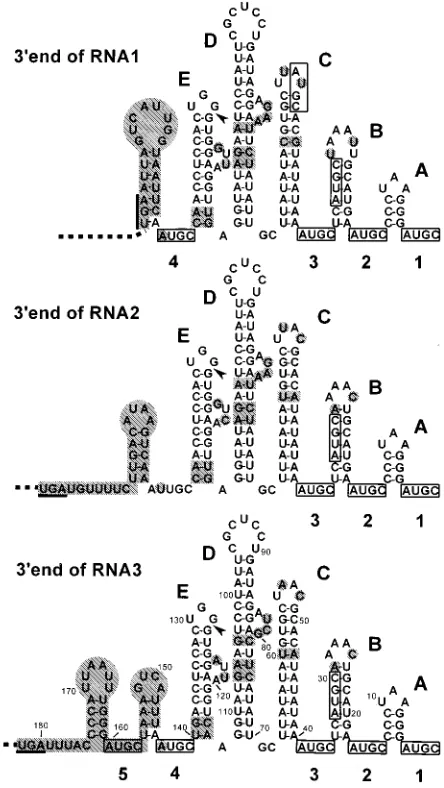
homolo-gous region of 145 nt. Despite nucleotide sequence variation at
22 positions in this 145-nt-long region, a nearly identical sec-ondary structure could be proposed for this common region in all AMV RNAs (13) (see Fig. 1). The observation that these nucleotide differences are strictly conserved during serial pas-sage of the virus could suggest that they have a specific effect on replication, translation, or encapsidation of the different AMV RNAs. Alternatively, the common regions could be seen
as functionally equivalent variants of the 39-terminal sequence
which cannot be freely exchanged between the different AMV RNA species in nature. To study their functional equivalence,
we have exchanged either the complete 39UTRs or the
ho-mologous regions of the three genomic RNAs. The replication of chimeric RNAs was analyzed in tobacco plants. In addition,
a deletion analysis was done to identify 39-terminal sequences
of RNAs 1, 2, and 3 involved in recognition of the RNAs by the solubilized AMV RdRp in an in vitro RNA polymerase essay.
The results showed that the 39common sequences of 145 nt as
well as the full-length UTRs of AMV RNAs 1, 2, and 3 can be exchanged without a detectable effect on RNA replication. Moreover, a mutational analysis underlined the importance for RNA replication of one of the stem-loop structures in the homologous region of 145 nt.
MATERIALS AND METHODS
Construction of mutant AMV cDNA clones.The cDNA clones of AMV RNAs 1, 2, and 3 contain DraIII restriction sites 127 bp from their 39ends. This site was used to exchange the sequence of the 39-most 127 nt between infectious cDNA clones of the genomic RNAs flanked by the cauliflower mosaic virus 35S pro-moter and nopaline synthase terminator (hereafter referred to as 35S/cDNAs) (17). These clones were digested with DraIII and KpnI, which cleaves in the vector sequence upstream of the CaMV 35S promoter, and the appropriate fragments were ligated to give mutants 1D2, 1D3, 2D1, 2D3, 3D1, and 3D2 (see Fig. 2). Mutant 1D2 contains the sequence upstream of the DraIII site from RNA 1 and the sequence downstream of this site from RNA 2, etc. The wild-type (wt) DNA 1 construct (designated 1 WT [see Fig. 2]) was used as the template in a PCR reaction primed by oligonucleotides 59TAACCCACCCAGTGGAGG TCAGCATTGAATTACC 39(complementary to nt 3492 to 3525 of RNA 1; boldface italics represent the DraIII restriction site, and the mutated nucleotides are underlined) and 59CCAATATCAAGCAAATAGCCCG 39(corresponding to nt 2637 to 2658 of RNA 1). The PCR product was digested with NcoI and
DraIII, and the resulting fragment was inserted in NcoI- and DraIII-digested * Corresponding author. Mailing address: Gorlaeus Laboratories,
Leiden University, Einsteinweg 55, 2333 CC Leiden, The Netherlands. Phone: 31-71-5274749. Fax: 31-71-5274340. E-mail: J.BOL@chem .LeidenUniv.nl.
3811
on November 9, 2019 by guest
http://jvi.asm.org/
plasmids 1WT and 1D3 to produce the constructs 1UG and 1UGD3, respectively (see Fig. 2).
Fusion of the bacteriophage T7 promoter sequence to AMV cDNAs 1 and 2 was accomplished by cDNA synthesis on partially purified RNA 1 or RNA 2. By using reverse transcriptase, single-stranded cDNA was produced, primed by the oligonucleotide 59CCTTTGTCTGAAGGGAGAGC 39(complementary to nt 269 to 288 of RNA 1). To this cDNA the oligonucleotide 59GGAAGCTTTAA TACGACTCACTATAGGTTTTTATCTTACA 39 (which contains a HindIII restriction site [in boldface italics]) was annealed, after which were added a T7 promoter, an extra G residue, and 14 nt corresponding to the 59end of AMV RNA 1 (underlined). Second-strand cDNA was synthesized by using reverse transcriptase. The double-stranded DNA was digested with HindIII and PstI. The fragment corresponding to the 59end of AMV RNA 1 was fused to the remaining cDNA 1 sequence derived from the infectious 35S/cDNA clone and inserted in HindIII- and SmaI-digested pUC 9 plasmid. In a similar way, the AMV cDNA 2 was fused to the T7 promoter (incorporating one extra G residue at the 59end of the viral sequence) and cloned into HindIII- and PstI-digested pUC 9. Deletion mutants of RNAs 1 and 2 (see Fig. 4) were constructed by transferring relevant restriction fragments, encompassing the deletions, from previously engineered deletion mutants in the corresponding 35S/cDNA con-structs (35). cDNA 1 deletion mutants are as follows (with the deleted nucleo-tides in brackets): 1-DPS (205 to 357), 1-DPAp (205 to 1107), 1-DHEn (1118 to 1424), 1-DEnBs (1425 to 2059), 1-DBsXb (2064 to 2464), and 1-DXbD (2469 to 3517). cDNA 2 deletion mutants are 2-DNXh (57 to 262), 2-DXhEn (266 to 406), 2-DEnA (408 to 1105), 2-DAEv (1110 to 1488), 2-DEvBg (1489 to 2297), and 2-DBgD (2302 to 2466).
Transcription plasmids in which the 39UTR of RNA 3 was replaced by that of RNA 1 or RNA 2 were constructed from T7-3K (see Fig. 4). In this construct, a
KpnI restriction site is located directly downstream of the CP open reading frame
(31). Oligonucleotides 59CTACGGTACCCATTGGTAATTCAATGCCAACC TCC 39and 59CTACCTGCAGCATCCCTTAGGGGCATTC 39(boldface italics indicate introduced KpnI and PstI restriction sites) were used in a PCR reaction to amplify the sequence corresponding to the 39UTR of AMV RNA 1, flanked by KpnI and PstI restriction sites. The PCR product was digested with KpnI and
PstI and inserted into the T7-3K plasmid digested with the same enzymes,
producing T7-3K1. The plasmid T7-3K2, containing the 39UTR from RNA 2, was constructed in the same way, using oligonucleotide 59CTACGGTACCCTT GACATAAGTCAAATTGCCAACC 39together with the oligonucleotide con-taining the PstI restriction site. Mutants T7-3DKD1, T7-3DKD2, and T7-3DKD were constructed by digesting plasmids T7-3K1, T7-3K2, and T7-3K, respectively, with KpnI and DraIII. Blunt ends were generated by using T4 DNA polymerase, after which the DNA was religated. In these mutants, the 39-terminal 127 nt of AMV RNA 1, 2, or 3 are placed directly behind the CP open reading frame. Mutants T7-3D1 and T7-3D2 were constructed by inserting the DraIII-PstI fragments from T7-3K1 and T7-3K2 in DraIII- and PstI-digested T7-3. T7-3D1 and T7-3D2 correspond to mutants 3D1 and 3D2 but contain the T7 promoter instead of the 35S promoter. Mutant T7-3UG was constructed by amplifying a 39-terminal fragment on AMV cDNA 3, using oligonucleotide 59CCTCCACTG
GGTGGATTAAGTTGAGGTATGAAG 39(corresponding to nt 2006 to 3039 of RNA 3; boldface italics represent a DraIII restriction site, and mutated nucleotides are underlined) in combination with the oligonucleotide comple-mentary to the 39end that contains a PstI site (described above). The PCR product was digested with DraIII and PstI and inserted in plasmid T7-3 (wt) digested with the same enzymes. All recombinant DNAs were checked by re-striction mapping and sequence analysis.
In vitro transcription.Plasmids containing AMV cDNAs fused to the T7 promoter were linearized with SmaI (for cDNA 1) or PstI (for cDNAs 2 and 3).
PstI sites were converted to blunt ends by treatment with T4 DNA polymerase.
In vitro transcription with T7 RNA polymerase was performed with 2mg of template DNA in a reaction volume of 100ml as described previously (29). RNA 1 transcripts carry two nonviral C residues at the 39terminus, and the RNA 1 and 2 transcripts have one nonviral G residue at the 59terminus. For inoculation of tobacco plants with wt or mutant RNA 3 transcripts, 20ml of the transcription mixture was used without further treatments. Transcripts were extracted with phenol-chloroform before being used as the template in the RdRp reaction.
Inoculation of plants.Nontransgenic Nicotiana tabacum cv. Samsun NN and transgenic P1, P2, and P12 plants were grown and inoculated with 35S/cDNA constructs or RNA 3 transcripts as described previously (17, 26). Each sample was inoculated on two plants, using three half-leaves per plant.
Analysis of viral RNA.Total RNA was extracted from infected leaves as described previously (30) and analyzed by Northern blot hybridization. Random-primed cDNA 3 or a mixture of random-Random-primed cDNAs 1, 2, and 3 was used as a probe (6). The amount of RNA loaded per slot corresponded to 5 mg of leaf material.
RdRp assay.Nicotiana benthamiana plants infected with AMV were used to
purify the AMV RdRp as described previously (18). Such a preparation is highly specific and is dependent on added AMV template RNAs for its activity. This enzyme was used to study minus-strand RNA synthesis on T7 transcripts of modified AMV cDNA constructs by incorporation of [a-32P]UTP followed by S1
nuclease treatment, electrophoresis of the products on agarose gels, and auto-radiography, all essentially as described previously (2, 9).
RESULTS
Exchange of the common regions of the 3*UTRs.Figure 1
illustrates that the 39homologous sequence in the AMV RNAs
extends 5 nt upstream of the region containing stem-loop structures A to E. Most of the sequence variations in this common region are located downstream of the DraIII restric-tion site in the cDNA corresponding to the loop of hairpin E.
This restriction site was used for exchange of the 127-nt 39
[image:2.612.327.549.71.465.2]-terminal sequence between the AMV RNAs. Figure 2 shows schematic representations of the putative structure of hairpin E in the mutant RNAs that are expressed from the chimeric AMV 35S/cDNAs. Sequences upstream and downstream of the DraIII site (marked D in Fig. 2) corresponding to RNAs 1, 2, and 3 are indicated as 1, 2, and 3, respectively. 35S/cDNAs corresponding to wt RNAs 1, 2, and 3 are designated 1WT, 2WT, and 3WT, respectively, in Fig. 2. The bottom of hairpin
FIG. 1. Schematic representation of the proposed secondary structure of the 39UTRs of the genomic RNAs of AMV. The structure prediction for the homologous region is based on the GCG computer program MFOLD. Shading indicates bases which are not identical in all three RNAs. The black bars indicate the stop codons of the P1, P2, and CP open reading frame in RNAs 1, 2, and 3, respectively. AUGC sequence motifs are boxed. The AUGC boxes involved in CP binding in RNA 3 are numbered, as are their counterparts in RNAs 1 and 2. Proposed stem-loop structures are labeled A to E. The arrowheads indicate the positions of unique DraIII restriction sites in the viral cDNAs. The nucleotides in the RNA 3 sequence are numbered from the 39end.
on November 9, 2019 by guest
http://jvi.asm.org/
E is closed by A-U and G-C base pairs in RNAs 1 and 2 and by G-C and U-A base pairs in RNA 3. Therefore, exchange of
the 39-terminal 127 nt between RNAs 1 and 2 (mutants 1D2
and 2D1) does not affect the base pairing in hairpin E. How-ever, in mutants 1D3 and 2D3, the two bottom base pairs of hairpin E are replaced by two A-C mismatches, whereas in mutants 3D1 and 3D2, two U-G base pairs are formed.
Tobacco plants were inoculated with a mixture of 35S/
cDNAs of the three genomic RNAs with 39-terminal sequences
of 127 nt derived from RNA 1 (1WT, 2D1, and 3D1), RNA 2 (1D2, 2WT, and 3D2), or RNA 3 (1D3, 2D3, and 3WT). 35S/cDNA 4, which enhances infection (17), was omitted in
these experiments to avoid the presence of different 39
-termi-nal sequences in the inoculum. Figure 3 shows the results of a Northern blot analysis of the accumulation of viral RNAs in
the inoculated leaves. Accumulation of RNAs with the 39
-terminal sequence of RNA 1 (lane 2) or RNA 2 (lane 3) is similar to accumulation of the wt RNAs (lane 1). However, no RNA accumulation was observed in the plants inoculated with
mutants containing the RNA 3-derived 39-terminal sequence
(Fig. 3, lane 4). This lack of biological activity could be due to a defect in mutant 1D3, in mutant 2D3, or in both mutants. To discriminate among these possibilities, transgenic tobacco plants transformed with the P1 gene (P1 plants) or P2 gene (P2 plants) were used. P1 plants support the replication of RNAs 2 and 3 when inoculated with wt 35S/cDNAs 2, 3, and 4 (17) (Fig. 3, lane 5). When the 35S/cDNA 2 in this inoculum was replaced by mutant 2D3, no RNA accumulation was observed (Fig. 3, lane 6). This demonstrates that mutant 2D3 is defective in replication. A similar assay on P2 plants was used to dem-onstrate that mutant 1D3 is also defective in replication. The P2 plants support replication of RNAs 1 and 3 when inoculated with wt 35S/cDNAs 1, 3, and 4 (17) (Fig. 3, lane 7). When the 35S/cDNA 1 in this inoculum was replaced by mutant 1D3, no RNA accumulation was observed (Fig. 3, lane 8).
Role of hairpin E in RNA accumulation. The observation that 35S/cDNA mixtures 1WT-2D1-3D1 and 1D2-2WT-3D2 induced wt levels of RNA accumulation in nontransgenic to-bacco showed that the mutants in these mixtures were repli-cation competent. In mutants 3D1 and 3D2, the two bottom base pairs of the putative hairpin E are replaced by U-G base pairs. The biological activity of these mutants was further con-firmed by inoculation of transgenic tobacco transformed with both the P1 and P2 genes (P12 plants). P12 plants support the replication of RNA 3 when inoculated with wt 35S/cDNA 3 (17) (Fig. 3, lane 11). When the P12 plants were inoculated with mutant 3D1 (Fig. 3, lane 12) or 3D2 (Fig. 3, lane 13), the mutant accumulated at wt levels. If the putative hairpin E plays a role in RNA accumulation, U-G base pairs at its base are apparently tolerated in the chimeric RNAs. To see if U-G base pairs at this position would affect the accumulation of a non-chimeric RNA, the two base pairs at the bottom of hairpin E in RNA 1 were changed into U-G base pairs in mutant 1UG (Fig. 2). When P2 plants were inoculated with a mixture of mutant 1UG and wt 35S/cDNAs 3 and 4, the mutant accumu-lated at wt levels (Fig. 3, lane 10).
The defect in the accumulation of mutants 1D3 and 2D3 could be due to the presence of two A-C mismatches at the bottom of hairpin E in these mutants. To test this possibility, these mismatches were changed into a G-C and an A-U base pair in mutant 1UGD3 (Fig. 2). When P2 plants were inocu-lated with a mixture of mutant 1UGD3 and wt 35S/cDNAs 3 and 4, the mutant accumulated at wt levels (Fig. 3, lane 9). This indicates that the predicted structure of hairpin E is correct and that this hairpin is essential to the accumulation of RNAs 1, 2, and 3. Moreover, the results demonstrate that the
com-mon 39-terminal sequences of the three RNAs are functionally
equivalent and can be exchanged as long as the secondary structure of hairpin E is not affected.
Deletion analysis of RNA 1 and 2 sequences recognized by the AMV RdRp in vitro. T7 RNA polymerase transcripts of
AMV cDNAs 1 and 2 with nonviral G residues at their 59ends
[image:3.612.80.274.67.296.2]showed a very low level of infectivity in plants or protoplasts when mixed with RNA 3 (34) but appeared to be active tem-plates for the purified AMV RdRp in an in vitro assay. To map the sequences recognized by the RdRp in RNAs 1 and 2, the deletion mutants shown in Fig. 4 were constructed. The labeled minus-strand RNA products synthesized in vitro by the RdRp
[image:3.612.326.545.69.161.2]FIG. 3. Accumulation of AMV mutants in tobacco plants inoculated with viral cDNA constructs. In lanes 1 to 4, nontransgenic tobacco plants were used. Inocula consisted of DNAs 1WT, 2WT, and 3WT (lane 1), DNAs 1WT, 2D1, and 3D1 (lane 2), DNAs 1D2, 2WT, and 3D2 (lane 3), or DNAs 1D3, 2D3, and 3WT (lane 4). In lanes 5 and 6, tobacco plants expressing the viral P1 protein were used; they were inoculated with DNAs 2WT, 3WT, and 35S/cDNA4 (4WT) (lane 5) or with DNAs 2D3, 3WT, and 4WT (lane 6). In lanes 7 to 10, plants expressing viral P2 protein were used; they were inoculated with DNAs 1WT, 3WT, plus 4WT (lane 7), DNAs 1D3, 3WT, and 4WT (lane 8), DNAs 1UGD3, 3WT, and 4WT (lane 9), or DNAs 1UG, 3WT, and 4WT (lane 10). In lanes 11 to 13, the results from P12 plants (which express both P1 and P2) are shown. Inocula contained DNA 3WT (lane 11), 3D1 (lane 12), or 3D2 (lane 13). The positions of RNAs 1 to 4 are indicated in the left margin. Abbreviations are explained in the text.
FIG. 2. Schematic representation of stem-loop structure E in wt and mutant AMV RNAs. Only the bases at the bottom of this structure are drawn; the other bases are represented by a line. The letter D indicates the position of the DraIII restriction site, which was used to construct the mutants. Boxed numbers indicate the viral RNA from which the sequence 59or 39to the DraIII site was derived. Bases in italics represent modifications achieved by site-directed mutagenesis.
on November 9, 2019 by guest
http://jvi.asm.org/
on RNA 1- and 2-derived templates are shown in Fig. 5A and B, respectively. In the absence of an added template, no RdRp activity is observed (Fig. 5, lanes 1). The wt RNA 1 and RNA 2 transcripts are copied by the RdRp into full-length minus-strand products (Fig. 5, lanes 2). Deletion of sequences be-tween nt 205 (PstI) and nt 2464 (XbaI) in RNA 1 had little or
no effect on template activity of the RNA in the RdRp assay (Fig. 5A, lanes 3 to 7), but deletion of nt 2469 to 3517 in
mutant 1-DXbD abolished template activity (Fig. 5A, lane 8).
This demonstrates that the 39-terminal 127-nt sequence
down-stream of the DraIII site at position 3517 of RNA 1 is not sufficient for recognition of the RNA by the RdRp. Similarly,
deletion analysis of RNA 2 showed that the 39-terminal 127 nt
of this RNA are not sufficient for recognition by the RdRp in vitro. Deletions in RNA 2 from nt 54 (NcoI) to nt 2297 (BglII) did not affect template activity (Fig. 5B, lanes 3 to 7), whereas deletion of the BglII-DraIII fragment (nucleotides 2302 to
2466, mutant 2-DBgD) abolished template activity.
Functional equivalence of 3* UTRs of RNAs 1, 2, and 3 in RNA synthesis in vitro and in vivo.To permit exchange of the
full-length 39 UTRs, KpnI restriction sites were engineered
[image:4.612.325.549.65.343.2]immediately downstream of the UGA stop codons of the P1, P2, and CP genes in AMV cDNAs 1, 2, and 3, respectively. The cDNA 3 clone used was pAL3, which contains a precise fusion of the cDNA to the T7 promoter (16). T7 RNA polymerase transcripts of this clone are infectious to P12 protoplasts and can be used as templates in the in vitro RdRp assay. The wt cDNA 3 clone and the derivative with the KpnI site down-stream of the CP gene are designated T7-3 (wt) and T7-3K, respectively, in Fig. 6. These clones were used to make the other constructs shown in Fig. 6. Minus-strand RNA products synthesized in vitro by the AMV RdRp on T7 RNA polymer-ase transcripts of these constructs are shown in Fig. 7A; Fig. 7B
FIG. 4. Schematic drawing of deletion mutants of RNA 1 and RNA 2, which were used as templates for minus-strand RNA synthesis by the AMV RdRp. Deletions (D) were made in cDNA copies of AMV RNAs 1 and 2, cloned behind the T7 promoter. The names of the mutants refer to the restriction sites used: P5PstI, S5SalI, Ap5ApaLI, H5HpaI, Bs5BspEI, Xb5XbaI, D5DraIII,
N5NcoI, Xh5XhoI, En5EcoNI, A5AgeI, Ev5EcoRV, and Bg5BglII.
[image:4.612.66.294.67.310.2]Deleted nucleotides are indicated by the numbers in parentheses. The position of the GDD motif in the P2 open reading frame is indicated.
FIG. 5. Autoradiogram of radiolabeled products of minus-strand RNA syn-thesis by AMV RdRp on in vitro-synthesized derivatives of AMV RNA 1 (A) or RNA 2 (B). (A) Lanes: 1, no added template RNA; 2, full-length RNA 1 transcript; 3, 1-DPS; 4, 1-DPAp; 5, 1-DHEn; 6, 1-DEnBs; 7, 1-DBsXb; 8, 1-DXbD. The position of RNA 1 is indicated in the left margin. (B) Lanes: 1, no added template RNA; 2, full-length RNA 2 transcript; 3, 2-DNXh; 4, 2-DXhEn; 5, 2-DEnA; 6, 2-DAEv; 7, 2-DEvBg; 8, 2-DBgD. The position of RNA2 is indicated in the left margin.
FIG. 6. Schematic representation of hybrid molecules derived from a tran-scription clone of AMV RNA 3. In mutants T7-3D1 and T7-3D2, the sequence downstream of the DraIII restriction site was replaced with the equivalent part of cDNA 1 or cDNA 2, respectively. Mutant T7-3K contains a KpnI restriction site just behind the CP open reading frame. In mutants T7-K1 and T7-K2, the whole 39noncoding region was replaced by that of cDNA 1 or cDNA 2, respec-tively. Mutants T7-KD, T7-KD1, and T7-KD2 were derived from the latter three mutants by deletion of the KpnI-DraIII restriction fragment. The numbers on the left refer to the lane numbers in Fig. 7. The table on the right summarizes the results as seen in Fig. 7, where1indicates levels at 100% of wt,1/2corresponds to levels of about 30% of wt, and2indicates that no synthesis or accumulation of RNA was observed.
on November 9, 2019 by guest
http://jvi.asm.org/
[image:4.612.118.238.506.658.2]shows the results of a Northern blot analysis of viral RNA accumulation in P12 protoplasts inoculated with these tran-scripts. The template activity in vitro and replication in vivo of the wt RNA 3 transcript are shown in lanes 2 of Fig. 7A and B, respectively. When the sequence downstream of the DraIII site in T7-3 (wt) was replaced by the corresponding sequences of cDNAs 1 and 2 in clones T7-3D1 and T7-3D2, respectively, the in vitro template activity of the transcripts was reduced sever-alfold (Fig. 7A, lanes 3 and 4). This reduction is probably due to the two U-G base pairs at the bottom of hairpin E in these chimeric RNAs. When the 2 bp present at this position in wt RNA 3 were changed into U-G base pairs to give mutant 3UG (Fig. 2), a similar reduction in template activity was observed (Fig. 7A, lane 11). However, the reduced activity of T7-3D1 and T7-3D2 in vitro did not affect accumulation of the chimeric RNAs in vivo (Fig. 7B, lanes 3 and 4). Introduction of the KpnI site in cDNA 3 resulted in mutation of two nucleotides down-stream of the stop codon (in italics) of the CP gene (UGAU UUACC to UGAGGUACC), but these mutations did not af-fect the template activity in vitro or inaf-fectivity in vivo of the RNA (Fig. 7, lanes 5). Replacement of the sequence
down-stream of the KpnI site in T7-3K by the full-length 39UTRs of
cDNAs 1 and 2 in clones T7-3K1 and T7-3K2, respectively, yielded chimeric transcripts with template activity in vitro and infectivity in vivo (Fig. 7, lanes 6 and 7) similar to that of wt RNA 3 (Fig. 7, lanes 2). Deletion of the sequence between the
KpnI and DraIII sites in T7-3K, T7-3K1, and T7-3K2 yielded
mutants T7-3DKD, T7-3DKD1, and T7-3DKD2, respectively
(Fig. 6). Transcripts of these deletion mutants showed no tem-plate activity in the in vitro RdRp assay and were not infectious to P12 plants (Fig. 7, lanes 8 to 10). This demonstrates that the
sequence of the 39-terminal 127 nt of either AMV RNA 1, 2, or
3 is insufficient for recognition of the viral RNAs by the RdRp in vitro or in vivo.
DISCUSSION
For the replication of a plus-strand RNA virus, the viral
RdRp (or components thereof) has to interact with 39-terminal
sequences in the viral RNA. These sequences have been
ana-lyzed in the greatest detail for plant viruses ending in a TLS. In addition to being recognized by the viral RdRp, such as TLS is recognized by host proteins that normally interact with tRNAs
(4). Here, we analyzed cis-acting sequences in the 39UTRs of
AMV. In the case of this virus, the 39termini of the RNAs are
recognized by both the viral RdRp and CP (12). By band shift
assays, the 39UTR of AMV RNA 3 was shown to contain two
independent CP binding sites, one located upstream of
nucle-otide 127 from the 39end and one found downstream of this
position (20). A CP binding site in the 39-terminal 39 nt of
RNA 3 has been characterized in further detail (8, 21). CPs of AMV and ilarviruses can be exchanged in the process of ge-nome activation (12). In parallel, ilarvirus RNAs sequenced so far end with hairpin structures flanked by AUGC motifs, like the AMV RNAs (21). Although partial sequence data are available for a number of ilarviruses, only for citrus leaf rugose virus has the complete genome been sequenced (7, 23, 24). In
the case of citrus leaf rugose virus, all viral RNAs have a 39
homologous region of 190 nt with putative motifs for CP
bind-ing at the 39end. However, apart from the CP binding motifs,
this 190-nt sequence bears no obvious resemblance to 39
-ter-minal sequences of RNAs of other ilarviruses or AMV. Our unpublished results show that tobacco streak ilarvirus RNA 4 was not recognized as a template by the AMV RdRp in vitro.
These observations might be explained by assuming that the 39
termini of AMV and ilarvirus RNAs contain common binding sites for CP and unique sequences recognized only by the homologous RdRp.
By using an AMV RdRp preparation from bean leaves, it
was shown previously that the 39-terminal 163 nt of AMV RNA
3 are efficiently recognized in vitro whereas a fragment of 120
nt at the 39 end was not sufficient for recognition (28). Our
present data show that the 39-terminal 127 nt from RNAs 1, 2,
and 3 are insufficient for recognition by the RdRp in vitro. The similarity in template activities of wt RNA 3 and mutants T7-3K1 and T7-3K2 (Fig. 7, lanes 2, 6, and 7) demonstrates
that the 39 UTRs of RNAs 1, 2, and 3 are recognized with
similar efficiencies by the RdRp in vitro. Together with the template activities of the deletion mutants of RNAs 1 and 2 shown in Fig. 5, the data indicate that sequences recognized by the RdRp in vitro in plus-strand AMV RNAs 1, 2, and 3 are
confined to the 39 UTRs. Recently, evidence was presented
indicating that the P1, P2, and CP genes play a cis-acting role in the replication of RNAs 1, 2, and 3, respectively (32, 35). Our results indicate that minus-strand RNA synthesis in vitro does not require cis-acting sequences at internal positions of the AMV plus-strand RNAs, as has been reported for
bacte-riophage QbRNA (14).
Inoculation of P12 plants with mutants T7-3DKD,
T7-3DKD1, and T7-3DKD2 confirmed that the 39-terminal region
of 127 nt of RNAs 1, 2, and 3 is not sufficient for RNA replication in vivo (Fig. 7B, lanes 8 to 10). Recently, it was shown that deletion of the sequence between the stop codon of
the CP gene and nucleotide 165 from the 39end of RNA 3 had
no effect on RNA 3 replication in vivo (31). Currently, we are analyzing the requirement for RNA replication of the common
sequence of 145 nt and unique upstream sequences in the 39
UTRs of RNAs 1, 2, and 3.
In AMV-infected tobacco plants, the ratio of accumulation of RNAs 1, 2, and 3 is characteristic for a given isolate.
Ex-changes of the common 39-terminal sequences of 145 nt (Fig.
3) had little effect on the relative accumulation of the viral
RNAs. Similarly, exchanges of the full-length 39UTR did not
affect the relative accumulation of RNAs 3 and 4 (Fig. 7). Thus, the 22 base substitutions that occur in the 145-nt se-quence probably do not regulate the ratio at which the AMV
FIG. 7. (A) Autoradiogram of radiolabeled products of in vitro minus-strand RNA synthesis by the AMV RdRp on in vitro-synthesized RNA 3 mutants. Lane 1, no added template; lanes 2 to 10, as indicated in Fig. 6. Lanes 11 to 13 show the results of a separate experiment using the following templates: lane 11, T7-3UG; lane 12, T7-3D1; and lane 13, T7-3D2. The position of RNA 3 is indicated in the left margin. (B) Northern blot showing the accumulation of viral RNAs in P12 plants inoculated with in vitro-synthesized RNA 3 mutants. Lane 1, mock inoculation; lanes 2 to 10, as indicated in Fig. 6. The blot was hybridized with a probe detecting RNA 3 and RNA 4. The positions of these RNAs are indicated in the left margin.
on November 9, 2019 by guest
http://jvi.asm.org/
[image:5.612.82.274.69.230.2]RNAs accumulate. This may be regulated by cis-acting ele-ments involved in initiation of plus-strand RNA synthesis on minus-strand AMV template RNAs. The observation that many of the 22 base substitutions reflect covariation in the stems of hairpins A to E indicates an important role of these hairpins in the life cycle of the virus. Our mutational analysis of hairpin E supports the notion that this stem-loop structure is essential for RNA replication in vivo.
In contrast to the base substitutions in the common 39
-terminal sequence of AMV RNAs, base substitutions in the
39-terminal TLS of the bromovirus brome mosaic virus (BMV)
do affect the ratio at which the three genomic RNAs accumu-late (3). In addition to exchanges of TLSs between genomic RNAs of one virus, these structures have also been exchanged between viruses of different genera. In vivo, the BMV RdRp
recognized the 39-terminal sequence of the cucumovirus
cu-cumber mosaic virus when present at the 39end of BMV RNA
3. In contrast, a hybrid BMV RNA 2 containing this 39
-termi-nal sequence from cucumber mosaic virus did not accumulate in tobacco protoplasts or plants (19). Furthermore, BMV RNAs containing the TLS of the tobamovirus tobacco mosaic virus (TMV) were not amplified in vivo, whereas the accumu-lation of a hybrid TMV RNA containing the BMV TLS showed that this construct was recognized by the TMV RdRp (11). Also, the RdRp of TMV strain L recognized the TLSs of other tobamoviruses (10). In the RNA of the tymovirus turnip
yellow mosaic virus, the 39TLS could be replaced by those of
related tymoviruses without loss of replication, but not by the TLS from BMV or TMV (25).
Swapping experiments have been done not only with plant
viruses with 39-terminal CP binding sites or TLSs but also with
39-terminal sequences of a plant virus with polyadenylated
RNAs. The two genomic RNAs (B-RNA and M-RNA) of the comovirus cowpea mosaic virus (CPMV) contain a
homolo-gous 39-terminal sequence of 65 nt preceeding the poly(A) tail.
This sequence can be folded in a Y-shaped structure followed by a U-A-rich hairpin, both of which are important for CPMV
RNA replication (5, 22). When the 39UTR of CPMV M-RNA
was replaced by the 39 UTR of B-RNA, the chimeric RNA
coreplicated efficiently with B-RNA in cowpea protoplasts (27).
Although the 39UTRs of AMV RNAs 1, 2, and 3 appear to
be functionally equivalent and can be exchanged without loss of replication, our recent experiments indicate that no such
exchanges of 59UTRs or even longer 59sequences of AMV
RNAs are possible (33). This indicates that initiation of plus-strand RNA synthesis and that of minus-plus-strand RNA synthesis are basically different processes.
REFERENCES
1. Bol, J. F., L. van Vloten-Doting, and E. M. J. Jaspars. 1971. A functional equivalence of top component a RNA and coat protein in the initiation of infection by alfalfa mosaic virus. Virology 46:73–85.
2. de Graaff, M., M. R. Man in ’t Veld, and E. M. J. Jaspars. 1995. In vitro evidence that the coat protein of alfalfa mosaic virus plays a direct role in the regulation of plus and minus RNA synthesis: implications for the life cycle of alfalfa mosaic virus. Virology 208:583–589.
3. Duggal, R., A. L. N. Rao, and T. C. Hall. 1992. Unique nucleotide differences in the conserved 39termini of brome mosaic virus RNAs are maintained through their optimization of genome replication. Virology 187:261–270. 4. Duggal, R., F. C. Lahser, and T. C. Hall. 1994. cis-acting sequences in the
replication of plant viruses with plus-sense RNA genomes. Annu. Rev. Phy-topathol. 32:287–309.
5. Eggen, R., J. Verver, J. Wellink, K. Pleij, A. van Kammen, and R. Goldbach. 1989. Analysis of sequences involved in cowpea mosaic virus RNA replica-tion using site-specific mutants. Virology 173:456–464.
6. Feinberg, A. P., and B. Vogelstein. 1984. A technique for radiolabeling DNA restriction endonuclease fragments to high specific activity. Anal. Biochem.
137:266–267.
7. Ge, X., and S. W. Scott. 1994. The nucleotide sequence of citrus leaf rugose
ilarvirus RNA-2. J. Gen. Virol. 75:2841–2846.
8. Houser-Scott, F., M. L. Baer, K. F. Liem, Jr., J. M. Cai, and L. Gehrke. 1994. Nucleotide sequence and structural determinants of specific binding of coat protein or coat protein peptides to the 39untranslated region of alfalfa mosaic virus RNA 4. J. Virol. 68:2194–2205.
9. Houwing, C. J., and E. M. J. Jaspars. 1986. Coat protein blocks the in vitro transcription of the virion RNAs of alfalfa mosaic virus. FEBS Lett. 209: 284–288.
10. Ishikawa, M., T. Meshi, Y. Watanabe, and Y. Okada. 1988. Replication of chimeric tobacco mosaic viruses which carry heterologous combinations of replicase genes and 39noncoding regions. Virology 164:290–293. 11. Ishikawa, M., P. Kroner, P. Ahlquist, and T. Meshi. 1991. Biological
activ-ities of hybrid RNAs generated by 39-end exchanges between tobacco mosaic and brome mosaic viruses. J. Virol. 65:3451–3459.
12. Jaspars, E. M. J. 1985. Interaction of alfalfa mosaic virus nucleic acid and protein, p. 155–221. In J. W. Davies (ed.), Molecular plant virology. CRC Press, Boca Raton, Fla.
13. Koper-Zwarthoff, E. C., and J. F. Bol. 1980. Nucleotide sequence of the putative recognition site for coat protein in the RNAs of alfalfa mosaic virus and tobacco streak virus. Nucleic Acids Res. 8:3307–3318.
14. Meyer, F., H. Weber, and C. Weissmann. 1981. Interactions of Qbreplicase with QbRNA. J. Mol. Biol. 153:631–660.
15. Murphy, F. A., C. M. Fauquet, D. H. L. Bishop, S. A. Ghabrial, A. W. Jarvis,
G. P. Martelli, M. A. Mayo, and M. D. Summers (ed.).1995. Virus taxonomy. Sixth report of the International Committee on Taxonomy of Viruses. Arch. Virol. Suppl. 10.
16. Neeleman, L., A. C. van der Kuyl, and J. F. Bol. 1991. Role of alfalfa mosaic virus coat protein gene in symptom formation. Virology 181:687–693. 17. Neeleman, L., E. A. G. van der Vossen, and J. F. Bol. 1993. Infection of
tobacco with alfalfa mosaic virus cDNAs sheds light on the early function of the coat protein. Virology 196:883–887.
18. Quadt, R., H. J. M. Rosdorff, T. W. Hunt, and E. M. J. Jaspars. 1991. Analysis of the protein composition of alfalfa mosaic virus RNA-dependent RNA polymerase. Virology 182:309–315.
19. Rao, A. L. N., and G. L. Grantham. 1994. Amplification in vivo of brome mosaic virus RNAs bearing 39noncoding region from cucumber mosaic virus. Virology 204:478–481.
20. Reusken, C. B. E. M., L. Neeleman, and J. F. Bol. 1994. The 39-untranslated region of alfalfa mosaic virus RNA 3 contains at least two independent binding sites for viral coat protein. Nucleic Acids Res. 22:1346–1353. 21. Reusken, C. B. E. M., and J. F. Bol. 1996. Structural elements of the
39-terminal coat protein binding site in alfalfa mosaic virus RNAs. Nucleic Acids Res. 24:2660–2665.
22. Rohll, J. B., C. L. Holness, G. P. Lomonossoff, and A. J. Maule. 1993. 39-Terminal nucleotide sequences important for the accumulation of cowpea mosaic virus M-RNA. Virology 193:672–679.
23. Scott, S. W., and X. Ge. 1995. The complete nucleotide sequence of RNA 3 of citrus leaf rugose and citrus variegation ilarviruses. J. Gen. Virol. 76:957– 963.
24. Scott, S. W., and X. Ge. 1995. The nucleotide sequence of citrus leaf rugose virus RNA 1. J. Gen. Virol. 76:3233–3238.
25. Skuzeski, J. M., C. S. Bozarth, and T. W. Dreher. 1996. The turnip yellow mosaic virus tRNA-like structure cannot be replaced by generic tRNA-like elements or by heterologous 39 untranslated regions known to enhance mRNA expression and stability. J. Virol. 70:2107–2115.
26. Taschner, P. E. M., A. C. van der Kuyl, L. Neeleman, and J. F. Bol. 1991. Replication of an incomplete alfalfa mosaic virus genome in plants trans-formed with viral replicase genes. Virology 181:445–450.
27. van Bokhoven, H., O. Le Gall, D. Kasteel, J. Verver, J. Wellink, and A. van
Kammen.1993. cis- and trans-acting elements in cowpea mosaic virus RNA replication. Virology 195:377–386.
28. van der Kuyl, A. C., K. Langereis, C. J. Houwing, E. M. J. Jaspars, and J. F.
Bol.1990. cis-acting elements involved in replication of alfalfa mosaic virus RNAs in vitro. Virology 176:346–354.
29. van der Kuyl, A. C., L. Neeleman, and J. F. Bol. 1991. Deletion analysis of
cis- and trans-acting elements involved in replication of alfalfa mosaic virus
RNA 3 in vivo. Virology 183:687–694.
30. van der Kuyl, A. C., L. Neeleman, and J. F. Bol. 1991. Complementation and recombination between alfalfa mosaic virus RNA 3 mutants in tobacco plants. Virology 183:731–738.
31. van der Vossen, E. A. G., L. Neeleman, and J. F. Bol. 1994. Early and late functions of alfalfa mosaic virus coat protein can be mutated separately. Virology 202:891–903.
32. van der Vossen, E. A. G., C. B. E. M. Reusken, and J. F. Bol. 1996. cis-preferential stimulation of alfalfa mosaic virus RNA 3 accumulation by the viral coat protein. Virology 220:163–170.
33. van Rossum, C. M. A., L. Neeleman, and J. F. Bol. Manuscript in prepara-tion.
34. van Rossum, C. M. A. Unpublished data.
35. van Rossum, C. M. A., M. L. Garcia, and J. F. Bol. 1996. Accumulation of alfalfa mosaic virus RNAs 1 and 2 requires the encoded proteins in cis. J. Virol. 70:5100–5105.