Article
Regression Based Performance Analysis of Composite
Light Weight Concrete
Sivakumar Anandan
Civil Engineering, King Khalid University, Kingdom of Saudi Arabia E-mail: [email protected]
Abstract. Low cost sustainable structural green concrete produced using lignocellulosic waste (coconut shell) and industrial waste (ground granulated blast furnace slag) was investigated in this study. Various cost effective pre-treatments were carried out on coconut shell such as cold water extraction, hot water extraction and lime water extraction to remove the extractives (hemicelluloses, phenols). This primarily enhances the interface bond strength leading to increased strength of concrete. Workability and compressive strength of the concrete incorporating untreated and pre-treated coconut shell was investigated systematically. Hot water extraction of coconut shell proved to be an effective method to improve the compressive strength of concrete when compared to other pre-treated coconut shell concrete mixes tested in this study. Among the various concrete mixes investigated a maximum compressive strength of 27.0 MPa was achieved using hot water extracted coconut shell incorporated concrete composites.
Keywords: Lignocellulosic waste, supplementary cementitious material, coconut shell, ground granulated blast furnace slag, m-sand, pre-treatment.
ENGINEERING JOURNAL Volume 20 Issue 5 Received 21 January 2015
1.
Introduction
Sustainable alternative construction materials from waste, is gaining popularity in construction due to environmental issues posed by conventional concrete. Instead of dumping these industrial and agricultural waste as landfill, it can be used effectively as a substitute material in concrete production, thereby reducing the cost of construction [1]. The use of supplementary pozzolanic materials such as ground granulated blast furnace slag (GGBFS), silica fume, rice husk ash, coal ash, wood ash can reduce the use of Portland cement, as well as produce a durable concrete [2, 3]. GGBFS is a by-product obtained from iron processing industry and replacement of cement with GGBFS has proved to increase the resistance against carbonation, sulphate attack, alkali silica reaction and chloride penetration [4].
Next to Portland cement, production of coarse aggregate is the major source responsible for 13-20% of total CO2 emission. Many efforts have been taken by researchers to promote the usage of waste materials in concrete and to reduce natural resource depletion [2]. In recent years coconut shell (CS) has been successfully used as coarse aggregate owing to its light weight and production of low cost concreting. These are primarily the waste material obtained from agricultural sector and around 15 billion nuts is produced annually in India. The discarded shells are used for handicraft making, in pharmaceuticals, as activated carbon and as fuel for boilers. Apart from this, vast amount of CS is yet to be utilized effectively. Coconut shell concrete (CSC) is classified under light weight concrete and has proven mechanical and durability properties in acceptable range on par with other light weight concrete [5, 6]. Since the composition of CS is comparable to hardwood and generally, hard wood is incompatible with cement. Pre-treatment is necessary to increase its compatibility. Wood materials generally contains soluble organic compounds such as hemicelluloses, starch and phenols known as extractives; insoluble compounds such as lignin, which retard the setting and strength development of cement and make the wood incompatible with cement [7]. It has been noted that cold water extraction dissolves tannins, gums, sugar and coloring matter whereas in addition, hot water extraction dissolves starch, increasing wood cement compatibility [8]. Analysis of CS showed: moisture 8%, ash 0.6%, ethanol extractive 4.2%, lignin 29.4%, hemicelluloses (pentosans) 27.7%, uronic anhydrides 3.5%, cellulose 26.6%, methoxyl 5.6%, nitrogen 0.11% and phenols 26.5% [9]. There was not much significant research carried out on pre-treatment of CS, but coconut coir was pre-treated by various methods like hot water extraction, alkali treatment, for making coir cement boards and to increase the compatibility with cement. Coconut coir possesses high lignin and low cellulose similar to coconut shell which makes them strong and durable. Also mechanical and durability properties of wood cement composites was improved by adding pozzolanic materials like fly ash, silica fume, GGBFS and metakaolin [10]. In addition pre-treatment was carried out by researchers on palm shell which is effectively used as light weight aggregate. Pre-treating palm shell with 20% poly vinyl alcohol (PVA) achieved a compressive strength of 32.84 MPa and with 5% slaked lime solution achieved a compressive strength of 17.87 MPa whereas untreated palm shell concrete achieved a compressive strength of 23.6 MPa [11]. Also replacing 30% of cement by GGBFS reduced the slump significantly in palm shell concrete. In contrast GGBFS increase the viscosity which resists the floating of light weight aggregate and also it prevented the bleeding in concrete [2].
Due to scarcity of river sand in recent years and its large scale usage poses threat to ground water protection, manufactured sand (M-sand) has been used successfully in construction as a suitable alternative, which is cost wise affordable than river sand. M-sand is produced by crushing rock for fine aggregate size in a well graded form. M-sand has angular and rough surface than compared to naturally weathered river sand. M-sand concrete has better mechanical and durability properties than river sand concrete [12].
2.
Need for This Study
3.
Experimental Study
3.1. Materials Used
3.1.1. CS as coarse aggregate
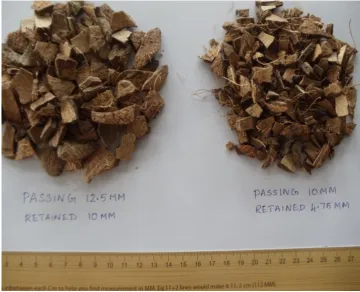
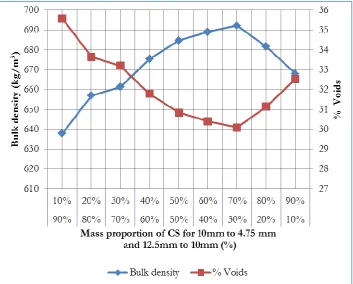
CS is collected from local source and was well seasoned by drying in sunlight to increase its resistance against insect and fungal attack since; it is an organic material like wood and prone to decomposition. Since CS is flaky and irregular in shape it cannot be broken into particular shape; hence it was randomly broken into smaller pieces and two size of CS was selected. Shell size passing through 12.5mm and retained on 10 mm; passing through 10mm and retained on 4.75mm was used as shown in Fig. 1. A good gradation of CS was achieved by adjusting the proportion of two size of CS in such a way to achieve minimum voids by packing density method. The concept behind packing density is that the voids created by larger size particle would be occupied by smaller size particle. In packing density method the smaller and larger size CS were mixed in different proportions by mass in a container of known volume and the bulk density was found. Since CS is flaky and curvy in nature, voids are formed in between large particles. The bulk density increases as we increase the mass proportion of smaller size CS, as the smaller size CS tends to occupy the voids formed by larger shell and after a particular proportion the bulk density starts decreasing as it reaches the optimum packing as shown in Fig. 2. Also the percentage voids for maximum bulk density is minimum, since maximum packing is attained as shown in Fig. 2. Maximum Bulk density was achieved for 70% of 10mm – 4.75mm size and 30% for 12.5mm – 10mm size of CS with minimum percentage voids as shown in Fig. 2. The physical properties of CS and M-sand were given in Table 1.
[image:3.595.116.477.377.669.2]Fig. 2. Packing density for two sizes of air dried CS.
Table 2. Physical and mechanical properties of CS and M-sand.
Physical and mechanical
properties CS M-sand
Loose air dried bulk density 692 kg/m3 1599 kg/m3
Moisture content 10.33 % -
Specific gravity 0.99 2.541
Water absorption (24 hours) 29.602 % 0.64 % Aggregate crushing value 1.597 % -
Aggregate impact value 3.937 % -
Fineness modulus 6.3 2.91
Bulking - 44 %
Sieve analysis - Zone II
3.1.2. M-sand as fine aggregate
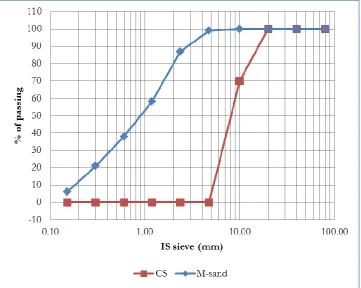
[image:4.595.122.476.79.363.2] [image:4.595.132.467.427.565.2]Fig. 3. Gradation curve for CS and M-sand.
3.1.3. GGBFS as mineral admixture
GGBFS with specific gravity of 2.9 was replaced by 0%, 25% and 50% by mass of binder.
3.1.4. Ordinary Portland cement
OPC of grade 53 with specific gravity of 3.15 was used throughout this experiment conforming to IS 12269-1987 [14].
3.1.5. Hyper plasticizer
Carboxylic ether plasticizer of specific gravity 1.15 was used by 1% mass of binder (B) i.e cement and GGBFS throughout the test in order to facilitate workability of fresh concrete mixes with water binder ratio of 0.35.
3.1.6. Water
Potable water (W) free from any contaminants was used in this study.
3.2. Mix Design and Experimental Methodology
[image:5.595.118.480.80.368.2]Table 2. Mix proportions used.
W/B CA / FA GGBFS % of ( kg/mCement 3) GGBFS (kg/m3) (kg/mM-sand 3) (kg/mCS 3) plasticizer Super (kg/m3)
Water (kg/m3) 0.35 0.28 0 540.54 0.00 938.10 262.67 5.41 189.19 0.35 0.28 25 401.35 133.78 938.10 262.67 5.35 187.30 0.35 0.28 50 264.91 264.91 938.10 262.67 5.30 185.44 0.35 0.33 0 540.54 0.00 872.92 288.06 5.41 189.19 0.35 0.33 25 401.35 133.78 872.92 288.06 5.35 187.30 0.35 0.33 50 264.91 264.91 872.92 288.06 5.30 185.44 0.35 0.38 0 540.54 0.00 816.21 310.16 5.41 189.19 0.35 0.38 25 401.35 133.78 816.21 310.16 5.35 187.30 0.35 0.38 50 264.91 264.91 816.21 310.16 5.30 185.44
3.2.1. Pre-treatment on CS
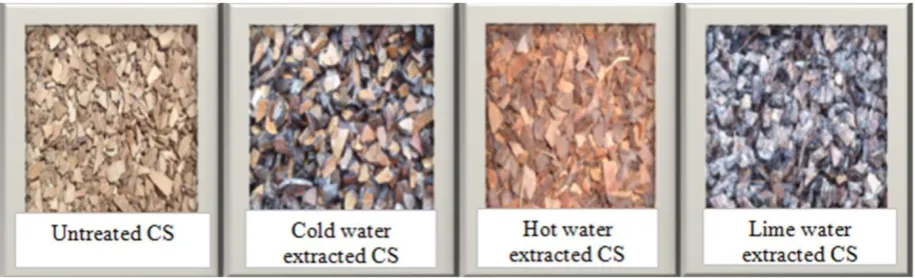
Various cost effective pre-treatment like cold water extraction, hot water extraction and lime water extraction was done on CS and was used for the selected mix. The physical appearance of the untreated and pre-treated CS was shown in Fig. 4.
Fig. 4. Physical appearance of untreated and pre-treated CS.
3.2.2. Cold water extraction
The CS was soaked in potable water for 24 hours, washed thoroughly and surface dried. Soaking in cold water for 24 hours dissolves the soluble extractives from CS.
3.2.3. Hot water extraction
The CS was kept in boiling water (100 degree Celsius) for 15 minutes and then extracted for air drying.
3.2.4. Lime water extraction
CS is soaked in 10% lime solution for 24 hours and then washed thoroughly to remove the excess lime and then surface dried since; excess lime causes unsoundness of concrete. Lime reacts with lignin, outer harder layer present in the CS and hydrolyze it thus making it non-reactive.
3.2.5. Casting and testing methodology
[image:6.595.92.504.92.244.2] [image:6.595.70.528.328.467.2]2000 kN capacity operated at a pace rate of 2.3 kN/sec as per IS 516-1959 [16]. The average compressive strength of three cubes was taken.
4.
Results and Discussion
4.1. Effect of GGBFS on Workability
The workability of CS incorporated concrete mixes with various percentage (0%, 25% and 50%) replacements of GGBFS was measured using slump cone test. A typical graph showing percentage replacement of GGBFS versus slump was plotted in Fig. 5 for C/F ratio of 0.28, which shows the reduction in workability as the percentage replacement of GGBFS increases. GGBFS being finer than cement requires more water for surface wetting and this may be the reason for reduction in slump which can be observed in Fig. 5. Also, it is inferred from the results provided in Table 3 that workability of cold water extracted and hot water extracted CS was more or less similar. Workability of air dried untreated CSC is slightly lower than cold water extracted CSC. Since untreated CS tends to absorb moisture from concrete which reduces the slump and also there is no availability of free moisture because of less water content, hence only marginal difference in workability was noticed. Also with the increase in C/F ratio the total surface area decreases with the increase in CS and workability increases because of less binder content occupied. The flaky particles of CS were also a factor leading to good workability. The workability of lime water treated CS in concrete was lesser than untreated CS and this may be due to the hydration of residual lime on CS and also the surface roughness caused by the leaching of CS by lime. Even then, the addition of GGBFS caused a reduction in workability a subsequent increase in the viscosity of the matrix leads to homogeneous distribution of CS in the concrete.
4.2. Compressive Strength of Untreated and Pre-Treated CSC
Fig. 5. Relationship between slump and % replacement of GGBFS for C/F-0.28.
[image:8.595.113.483.80.298.2] [image:8.595.99.497.339.556.2]Fig. 7. Relationship between 28 day density versus compressive strength.
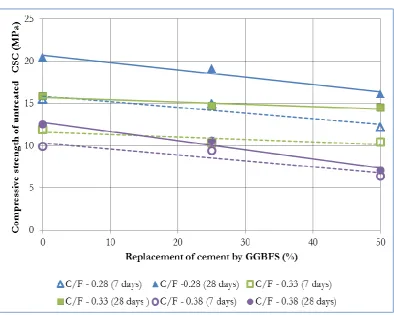
Replacement of cement with GGBFS in concrete showed an initial reduction; however marginal strength reduction was noticed at higher substitution of slag. With increase in curing period the reduction in compressive strength was slightly lower as noticed in Fig. 9. It can be drawn from the experimental results that there was not much difference observed for 25% GGBFS substituted concrete as compared to 50% GGBFS incorporated concrete mixes. This may be due to the faster hydration of GGBFS with Portland cement and thus higher addition can potentially leads to higher formation of calcium silicate hydrate gel.
4.3. Ultrasonic Pulse Velocity (UPV)
[image:10.595.70.554.96.400.2]Fig. 8. Relationship between 7 day compressive strength versus 28 day compressive strength.
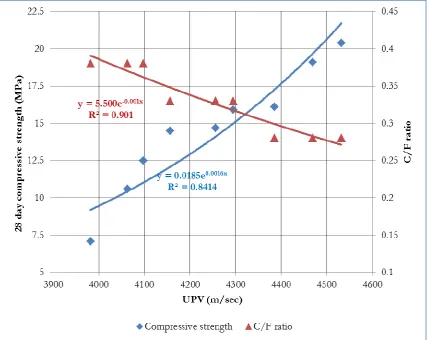
[image:11.595.85.511.81.349.2] [image:11.595.101.496.383.698.2]Fig. 10. Relationship between UPV versus compressive strength and C/F ratio of untreated CSC.
4.4. Empirical Relationship
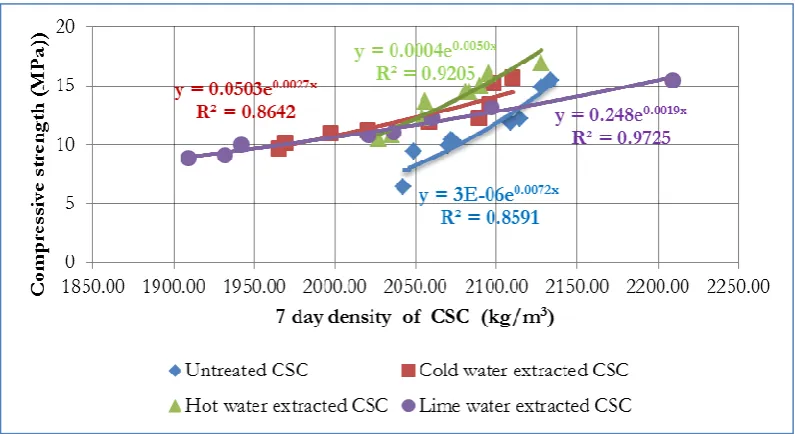
From the test results, a linear empirical relationship were computed between slump and percentage of GGBFS addition for C/F ratio of 0.28 (see Fig. 5). A regression coefficient of more than 0.8 was obtained for all the mix. An exponential relationship between density and compressive strength at 7 and 28 days was obtained and shown in Figs. 6 and 7. This evidently shows the correlation existing between the physical and mechanical characteristics of CSC. Also it can be noted from Figs. 6 and 7 that the empirical relationship obtained for various C/F ratios at 7 and 28 days does not show any significant difference and it can be concluded that it follows a similar trend till 28 days. Empirical relationship was drawn at 28 day compressive strength (f’cr) for untreated, cold water extracted, hot water extracted and lime water extracted CSC with an acceptable regression coefficient of 0.859, 0.768, 0.810 and 0.958 as given below:
Untreated CSC for various mixes at 28th day,
f’cr = 5 × 10-06e0.007ρ (1) Cold water extracted CSC for various mixes at 28th day,
f’cr = 0.276e0.002ρ (2)
Hot water extracted CSC for various mixes at 28th day,
f’cr = 0.001e0.0049ρ (3)
Lime water extracted CSC for various mixes at 28th day,
f’cr = 0.006e0.003ρ (4)
where, ‘ρ’ is the density of concrete at 28th day in kg/m3.
5.
Conclusions
From the experimental studies conducted, the following conclusions are drawn which exhibits the characteristics of CS replaced concrete composites.
Low cost structural light weight concrete was produced using agricultural waste CS; industrial waste GGBFS and M-sand.
Workability of the CSC decreases as GGBFS was replaced by 0%, 25% and 50% by mass of binder.
Of the various cost effective pre-treatment techniques like, cold water extraction, hot water extraction and lime water extraction performed on CS, hot water extraction was effective and a higher compressive strength of 27.0 MPa at 28 days was achieved.
Compressive strength properties were greatly affected by the decrease in density and increase in C/F ratio resulting in loss of strength.
Pre-treatment of CS showed convincingly improved strength properties due to the removal of organic retarders which affects the setting and hardening of cement.
Addition of GGBFS reduces the compressive strength. The compressive strength of CSC for mix M1 produced by replacing 25% of binder by GGBFS was in close vicinity to control concrete (CCM12) produced using 100% cement. Hence concrete with 25% replacement of GGBFS can be used successfully.
Since, CS has good impact and crushing strength, various other pretreatment methods can be used to increase its compatibility with mortar for enhancing interface bond strength.
Test results evidently exhibited CS as one promising material that can be used to substitute
aggregates in concrete. Also the sustainability of the material in the long run is another
compromising solution for alternative construction materials that can be a substitute for
conventional materials used in concreting.
References
[1] K. Gunasekaran, R. Annadurai, and P. S. Kumar, “Plastic shrinkage and deflection characteristics of coconut shell concrete slab,” Construction and Building Materials, vol. 43, pp. 203–207, 2013.
[2] P. Shafigh, M. Z. Jumaat, H. B. Mahmud, and U. J. Alengaram, “Oil palm shell lightweight concrete containing high volume ground granulated blast furnace slag,” Construction and Building Materials, vol. 40, pp. 231–238, 2013.
[3] A. Basheerudeen and S. Anandan, “Particle packing approach for designing the mortar phase of self-compacting concrete,” Engineering Journal, vol. 18, no. 2, pp. 127-140, 2014.
[4] B. S. Divsholi, T. Y. D. Lim, and S. Teng, “Durability properties and microstructure of ground granulated blast furnace slag cement concrete,” International Journal of Concrete Structures and Materials, vol. 8, no. 2, pp. 157–164, 2014.
[5] K. Gunasekaran, P. S. Kumar, and M. Lakshmipathy, “Mechanical and bond properties of coconut shell concrete,” Construction and BuildingMaterials, vol. 25, pp. 92–98, 2011.
[6] K. Gunasekaran, R. Annadurai, and P. S. Kumar, “A study on some durability properties of coconut shell aggregate concrete,” Materials and Structures, vol. 48, no. 5, pp. 1253-1264, 2013. doi: 10.1617/s 11527-013-0230-2
[7] S. R. Karade, “Developments in cement-bonded composite material technology,” In Proceedings of National Seminar on Modern Trends in Architectural and Civil Engineering Practices, 2007, pp. 57–64.
[8] T. E. Omoniyi and B. A. Akinyemi, “Hydration characteristics of bagasse in cement-bonded composites,” International Journal of Composite Materials, vol. 3, no. 1, pp. 1-6, 2013.
[9] S. Venkataraman, T. R. Ramanujam, and V. S. Venkatasubbu, “Antifungal activity of the alcoholic extract of coconut shell—Cocos nucifera Linn.,” Journal of Ethno Pharmacology, vol. 2, pp. 291-293, 1980. [10] S. R. Karade, “Cement bonded composites from lignocellulosic wastes,” Construction and Building
Materials vol. 24, pp. 1323–1330, 2010.
[12] P. Nanthagopalan and M. Santhanam, “Fresh and hardened properties of self-compacting concrete produced with manufactured sand,” Cement and Concrete Composites, vol. 33, pp. 353-358, 2011.
[13] Indian Standard Specification for Coarse and Fine Aggregates from Natural Sources for Concrete, IS 383-1970. [14] Indian Standard for Specification for 53 Grade OPC, IS 12269-1987.
[15] Standard Practice for Selecting Proportions for Structural Lightweight Concrete, ACI 211.2-1998. [16] Indian Standard for Methods of Test for Strength of Concrete, IS 516-1959.
[17] Methods of Non-destructive Testing of Concrete—Part 1: Ultrasonic Pulse Velocity, IS 13311-part 1-1992. [18] M. K. Yewa, H. Bin Mahmuda, B. C. Ang, and M. C. Yew, “Effects of heat treatment on oil palm