Structural Studies of the Adsorption of
Molecules on Cu(110)
Report submitted in accordance with the requirements of the
University of Liverpool for the degree of Doctor in Philosophy
By
Geoffrey Thomas
Department of Surface Science
University of Liverpool
i
Table of Contents
Abstract . . . . . . . . . . . . . . . v
Acknowledgements . . . . . . . . . . . . vi
Abbreviations . . . . . . . . . . . . . . . vii
1.
CHAPTER 1 – INTRODUCTION
. . . 11.1. THESIS AIMS . . . . . . . . . . . . 1
1.2. SURFACES AND THE ORIGINS OF LIFE . . . 3
1.3. RECENT DEVELOPMENTS IN SURFACE SCIENCE . . . 5
1.4. BIOLOGICAL MOLECULES . . . 6
1.5. METALLIC SURFACES . . . 7
1.5.1.The fcc (100) Surface . . . 9
1.5.2.The fcc (110) Surface . . . 9
1.5.3.The fcc (111) Surface . . . 10
1.6. ADSORPTION OF MOLECULES ON METALLIC SURFACES . . . 11
1.7. INTER-ATOMIC AND INTER-MOLECULAR BONDING . . . 12
1.8. MOLECULAR SELF-ASSEMBLY . . . 14
1.9. BIBLIOGRAPHY . . . 16
2.
CHAPTER 2 - THEORETICAL TECHNIQUES
. . . 212.1. DENSITY FUNCTIONAL THEORY (DFT) – A GENERAL OVERVIEW . . 21
2.1.1. Introduction – What Is Density Functional Theory? . . . 21
2.1.2. The Schrödinger Equation . . . 21
2.1.3. DFT – From Wave Functions To Electron Density . . . 22
2.1.4. The Exchange-Correlation Functional . . . 24
2.1.5. Limitations Of DFT . . . 24
2.1.6. Van der Waals Correction . . . 26
2.2. DENSITY FUNCTIONAL THEORY (DFT) – FOUNDATIONS . . . 27
2.2.1. Thomas-Fermi-Dirac Approximation . . . 27
2.2.2. Hohenberg-Kohn Theorems . . . 27
ii
2.3.1. Overview . . . 28
2.3.2. Kohn-Sham Variational Equations . . . 28
2.3.3. EXC, VXC . . . 29
2.4. THE EXCHANGE CORRELATION FUNCTIONAL . . . 30
2.4.1. Overview . . . 30
2.4.2. Local Spin Density Approximation (LSDA) . . . 30
2.4.3. Generalised-Gradient Approximation (GGA) . . . 31
2.5. VIENNA AB-INITIO SIMULATION PACKAGE (VASP) . . . 31
2.5.1. Overview . . . 31
2.5.2. Pseudopotentials . . . 31
2.5.3. Ultrasoft Pseudopotentials (USPPs) . . . 32
2.5.4. Reciprocal Space and K-Points . . . 32
2.5.5. Energy Cut-Offs . . . 33
2.5.6. Periodic Boundary Conditions . . . 33
2.5.7. Numerical Optimization . . . 34
2.5.8. Geometry Optimization . . . 34
2.5.9. Choosing K-Points . . . 35
2.5.10. Surface Relaxation/Energies . . . 36
2.6. SCANNING TUNNELING MICROSCOPY (STM) SIMULATION . . . . 36
2.7. X-RAY PHOTOELECTRON SPECTROSCOPY (XPS) SIMULATION . . . 40
2.8. BIBLIOGRAPHY . . . 43
3.
CHAPTER 3 – ADSORPTION OF THYMINE ON Cu(110)
. . . 463.1. INTRODUCTION . . . 46
3.2. THYMINE . . . 48
3.3. THE TAUTOMERIC PROPERTIES OF THYMINE . . . 49
3.4. PREVIOUS EXPERIMENTAL INVESTIGATIONS OF THYMINE ON Cu(110) . . . 51
3.5. EXPERIMENTAL DETAILS . . . 52
3.6. CURRENT EXPERIMENTAL INVESTIGATIONS OF THYMINE ON Cu(110) . . . 53
iii
3.8. THEORETICAL DATA AND ANALYSIS . . . 69
3.8.1. Overview . . . 69
3.8.2. Gas Phase Thymine And Hydrogen . . . 71
3.8.3. Isolated Thymine Bonded To Cu(110) Surface . . . 72
3.8.4. Phase 1 Structure . . . 77
3.8.5. Phase 2 Structure . . . 96
3.9. CONCLUSIONS . . . 113
3.10. BIBLIOGRAPHY . . . . . . . . . 114
4.
CHAPTER 4 – ADSORPTION OF MELAMINE ON Cu(110)
. . . 1184.1. INTRODUCTION . . . 118
4.2. MELAMINE . . . . . . . . . 119
4.3. THE MOLECULAR PROPERTIES OF MELAMINE . . . 122
4.4. EXPERIMENTAL DETAILS . . . . . . 125
4.5. CURRENT EXPERIMENTAL INVESTIGATIONS OF MELAMINE ON Cu(110) . . . 125
4.6. THEORETICAL DATA AND ANALYSIS . . . . . . 130
4.6.1. Overview . . . . . . . . . 130
4.6.2. Gas Phase Melamine And Hydrogen . . . . . . 131
4.6.3. Isolated Melamine Bonded to Cu Surface . . . 131
4.6.4. The Undeprotonated Simulations . . . 134
4.6.5. Single Deprotonated Simulations . . . 135
4.6.6. Double Deprotonated Simulations – Part 1 . . . . . 135
4.6.7. Double Deprotonated Simulations – Part 2 . . . 136
4.6.8. Tautomer Simulations – Part 1 . . . . . . 137
4.6.9. Tautomer Simulations – Part 2 . . . . . . 138
4.7. ADDITIONAL SIMULATIONS . . . . . . 139
4.8. CONCLUSIONS – PART 1 . . . . . . 140
4.9. CRYSTAL STRUCTURAL ARRANGEMENTS OF MELAMINE ON C(6x2) 142 4.9.1. Structural Simulation 1 . . . . . . 142
4.9.2. Structural Simulation 2 . . . . . . . . . . 143
iv
4.9.4. Structural Simulation 4 . . . . . . 144
4.9.5. Structural Simulation 4 – Minus Hydrogen Atom . . . 145
4.9.6. Structural Simulation 4 – Minus Hydrogen Atom - Tautomer 2 . . . 146
4.9.7. Structural Simulation 5 . . . . . . 146
4.9.8. Structural Simulation 6 . . . . . . 147
4.9.9. Structural Simulation 7 . . . . . . 148
4.9.10. Structural Simulation 8 . . . . . . 149
4.9.11. Structural Simulation 9 . . . . . . 149
4.9.12. Structural Simulation 10 . . . . . . 150
4.9.13. Structural Simulation 11 . . . . . . 151
4.9.14. Structural Simulation 11 – Minus Hydrogen – Version 1 . . . 151
4.9.15. Structural Simulation 11 – Minus Hydrogen – Version 2 . . . 152
4.9.16. Structural Simulation 11 – Minus Hydrogen – Version 3 . . . 153
4.9.17. Structural Simulation 12 . . . . . . 153
4.9.18. Structural Simulation 13 . . . . . . . . . . 154
4.9.19. Structural Simulation 14 . . . . . . 155
4.9.20. Structural Simulation 15 . . . . . . . . . . 155
4.9.21. Structural Simulation 16 . . . . . . . . . . 156
4.9.22. Structural Simulation 17 . . . . . . 157
4.10. CONCLUSIONS – PART 2 . . . . . . . . . . 157
4.11. BIBLIOGRAPHY . . . . . . . . . 159
v
Abstract
The adsorption of thymine and melamine on Cu(110) has been investigated using a
combination of experimental and theoretical techniques. These techniques have allowed the
development of an extensive picture of how these molecules may orient on this surface.
Many Density Functional Theory (DFT) calculations using the latest version of the Vienna
Ab-Initio Simulation Package (VASP) have allowed the production of a series of models
which have, in general, corroborated the experimental data. The additional utilisation of
semi-empirical techniques (like those used by Grimme), which seek to simulate long-range
inter-molecular vdW interactions, have allowed the creation of a firm foundation of, not only
how the individual molecules bond to the Cu(110) surface, but of how they arrange
themselves into long-range structures.
With thymine, two long-range phases were observed; a room temperature structure, which
aligned along the [001] direction in 1-D chains, one molecule thick and with the cyclic plane
roughly parallel to the [110] direction. The higher temperature phase occurred after annealing
between 350-400K and consisted of two distinct 1-D chains, two molecules thick and angled
at ~±20o to the [001] direction. In both cases the thymine was deprotonated at the N(1) atom.
With melamine, only the room temperature phase is discussed and this consisted of a 2-D
“hexagonal” structure arranged on a (6x2) unit cell.
Although structural relaxation techniques give good indications of the stability of the models,
the technique of Scanning Tunneling Microscopy (STM) simulation has been used
extensively with both thymine and melamine systems in order to verify their validity.
Although it is not yet possible to directly observe individual atoms in such small molecules it
is possible (with STM) to observe their electronic “footprint” and to then re-create this
observed image. The similarity of this “simulated STM” to the “experimental STM”
combined with a relaxed stable model is a strong indication that the model is in good
accordance with the observed (static) system. Combining this analysis technique with
experimental data, models are proposed for both the room temperature thymine and
vi
Acknowledgements
I would like to express my gratitude to a number of people who have helped me during my
PhD studies. Obviously my supervisors Prof. Rasmita Raval and Dr. George Darling who
have successfully managed to steer me through the past four (occasionally rocky) years
journey.
Dr. Sam Haq and Dr. Matt Dyer have also offered me a great deal of assistance with both the
experimental and theoretical aspects of this thesis.
Dr. Matt Forster, Dr. Andrew Mark and Dr. Israel Temprano have also offered me great deal
of help and I feel deserve a special mention as well as several other people (they know who
they are).
I have never been shy in asking for help from a variety of sources and have taken snippets of
information and experience from far too many people to mention here. However, this is my
way (I guess) of paying them back. It’s been a struggle for me to produce a piece of work on this level and, although far from being a masterpiece, I’m (reasonably) proud of it.
vii
Abbreviations
CCSD(T) - Coupled-Cluster with Single and Double and Perturbative Triple excitations
DFT - Density Functional Theory
DNA - Deoxyribonucleic acid
ES - Electrostatic
ER - Exchange-Repulsion
HOMO - Highest Occupied Molecular Orbital
LUMO - Lowest Unoccupied Molecular Orbital
Melamine - Mel/M
NASA - National Aeronautics and Space Administration
RAIRS - Reflection Absorption Infra-Red Spectroscopy
RNA - Ribonucleic acid
SPM - Scanning Probe Microscopy
STM - Scanning Tunneling Microscopy
Tantalum - Ta
Thymine - Thy/T
TPD - Temperature Programmed Desorption
vdW - van der Waal
VASP - Vienna Ab-Initio Simulation Package
1
1.
Chapter One ˗ Introduction
1.1.
Thesis Aims
Electronic devices based on inorganic semiconductors have been part of our daily lives for
over 60 years. However, now, in the beginning of the new millennium the increased
development and knowledge of organic semiconductors has led to a tendency to explore
alternative avenues than inorganic semiconductors and focus on the creation of electronic
devices based on organic molecules. In order to construct such hybrid molecular based
nanoscale devices, methods for the controlled fabrication of well-defined organic
nanostructures need to be developed. One of the most promising methods to date is the
“bottom-up” approach, wherein ordered structures with nanometre precision over an
extended large scale can be constructed. The concept of this approach is to exploit multiple
non-covalent interactions between pre-engineered molecules, which through their selective
recognition are able to form convergent assemblies. Due to the intermolecular interactions, a
dynamic equilibrium exists between the individual molecular components and the assembly
as a whole thus leading to thermodynamically controlled multi-stable systems, the
reversibility of which allows for the self-rearrangement and self-correction of the components
within the assembled structure. This so-called ‘self-healing’ contributes to the formation of
long-range ordered and defect-free systems, unachievable through conventional covalent
synthesis.
It is possible for organic molecules, such as DNA, to form highly-ordered ‘‘self-assembled’’
structures. Various factors are responsible for this but it is mainly their ability to form
relatively weak intermolecular bonds that are stable enough to hold them in place at room
temperature. Some research groups have predicted that understanding such a self-assembly
system opens a new avenue of research into the emergence of life. On top of this the
interaction of biologically-related molecules with surfaces is attracting increasing interest due
to its potential relevance to areas such as biocompatibility, biosensors and the fabrication of
novel biomaterials. However, typical biological molecules such as DNA and proteins are far
too complex to be investigated on surfaces at an atomic scale, although remarkably detailed
2
molecules on various different surfaces.
Thus, the investigations carried out in this thesis aims to add to this increasingly burgeoning
wealth of knowledge. The molecules investigated in this thesis were, unfortunately, too small
to be imaged as anything other than bright spots with scanning tunnelling microscopy (STM)
and therefore only their long˗range structures could be elucidated with this technique and not
their bonding orientations to either the surface or to one another. However, combining this
technique with the recently developed density functional theory (DFT) as well as the various
other experimental techniques available have resulted in the production of a cohesive picture
of how thymine forms both a room temperature 1-dimensional (1D) structure as well as a
separate and distinct high temperature 1D structure upon dosing on a copper (Cu) crystal
surface, both of which are described in chapter 3. Chapter 4 then continues by utilising these
same techniques to produce a description of a further system in which melamine forms a
stable 2˗dimensional (2D) room temperature upon dosing on the same copper (Cu) crystal
surface.
The experiments presented in this thesis were carried out in order to gain a better
understanding of the organisation and bonding of thymine and melamine on a Cu surface at
the single molecule level. This level of characterisation requires a detailed knowledge of the
chemical form, geometry, bonding points to the surface for each molecule in addition to the
intermolecular forces that stabilise the organisation. In order to obtain as detailed and reliable
an analysis as possible various techniques, both experimental as well as theoretical were
employed in tandem. The experimental techniques utilised the very latest developments in
ultra-high vacuum (UHV) in order to create an environment where both the metal surface as
well as the molecule under investigation could be scrutinised unimpeded by contamination.
This approach enabled the use of a powerful range of surface science techniques which
provide complimentary information in order to construct a detailed understanding of each of
the systems. STM, low energy electron diffraction (LEED), reflection absorption infra-red
spectroscopy (RAIRS), temperature programmed desorption (TPD) and X˗ray photoelectron
spectroscopy (XPS) experiments as well as various DFT calculations were all utilised in this
3
1.2.
Surfaces and the Origins of Life
The exciting and challenging field of surface science has sprung up, relatively recently, in
response to an increased demand, not only for greater efficiency in industrial processes, but
also for a greater understanding of biological processes. This has necessitated a much more
detailed understanding of how molecules interact with surfaces. Indeed, it is quite likely that
surfaces played an integral part in the evolution of life itself! Nucleic acids, the constituent
molecules that reside within both DNA and RNA, are categorised as both the information
carriers and storers of the necessary proteins required to construct all living things (both plant
and animal) on planet Earth.
The presiding theory in science today purports that the Earth’s early atmosphere contained
such molecules as methane, ammonia, carbon dioxide and water and, triggered by UV
radiation from the sun and lightning produced biomolecular monomers such as hydrogen
cyanide, amino acids, aldehydes and both 5 and 6˗membered ring molecules. It has been
suggested [1] that certain clays may have provided catalytic surfaces for polymerisation of
these monomers into cyclic bases. Thus, it is quite possible that surface processes played an
essential part in the initial formation of DNA and RNA.
However, in order to discuss the origins of life, one must first decide on a definition and
many scientists have adopted NASA’s [2]. This states that:˗
An organism is considered to be alive if it is a "self˗sustained chemical system capable of
undergoing Darwinian evolution," implying that it must have what we will call genetic
material and it must be possible for the genetic material to replicate and mutate [3].
Currently, most scientists believe that RNA molecules were capable of performing both
enzymatic activity and self˗replication. This is known as the “RNA world” scenario. Once
proteins are built they are then able to act as enzymes and catalyse various chemical
reactions. However, protein enzymes require that RNA strands first be present in order to
form them, this is known as “the chicken and the egg problem”. Therefore, the phosphate,
sugar and base groups must have bonded through abiotic (non˗biological) means. Thus far,
scientists have been unable to bind the phosphate to the sugar and base group using
conditions that were thought to have been present on the early Earth; this is a very active,
4
have been able to make extended chains of RNA, of up to 50 units (mers) in length, which
could then fold to perform catalytic activity, accelerating the ease of synthesis for future
molecules and initiating the RNA world [5].
When free nucleotides are combined in solution they do not react at all, so many scientists
have been searching for different types of activating groups and inorganic catalysts that may
have been involved in the first polymer bonding processes. Montmorillonite clay is one
material which facilitates this reaction and provides a medium in which the individual
activated RNA units combine to form larger chains [6]. In the case of montmorillonite clay,
the aluminium (Al+3) and silicon (Si+4) which have dissolved out of volcanic rock along with
oxygen and hydrogen form a three layer crystal structure. Composed of a silica layer, an
alumina layer, and another silica layer, these three˗layer crystals have a negative charge on
their faces. While the individual three layer crystals are very rigid, the whole multi˗layer
structure can be quite flexible. The surface between the layers is negatively charged, so it
attracts a large concentration of calcium (Ca2+), sodium (Na+), magnesium (Mg2+), copper
(Cu2+), iron (Fe2+) and other positively charged ions. The phosphate groups of individual
nucleotides, the polymers of which make up long strands of RNA, are negatively charged.
Theoretically, they are attracted to the positive pool in the fluid layer of the montmorillonite
clay. Entering into the layer, they repel the negative charges on the surfaces of the aluminate
layers, naturally positioning themselves in the middle of the positive layer and splitting the
distance between the two negative surfaces.
The reactions which can then occur between the nucleotides allow them to be held strongly in
position. This gives them the opportunity to form bonds between the monomers which are
attracted to the positive layer. This is about twice as strong as the attachment strength of just
one unit alone and as more and more nucleotides bond together, this linear relationship
continues. Therefore, because the longer strands are held to the clay more firmly than are the
individual nucleotides or shorter strands, it is possible that two longer strands would have a
higher probability of bonding with each other because of increased contact. Adding strength
to this theory is the fact that the dry ground˗up clay swells to fifteen times its volume when
5
1.3.
Recent Developments in Surface Science
Heterogeneous catalysis, pioneered by Paul Sabatier on hydrogenation and Fritz Haber on the
Haber process could be called the start of surface science [8]. Irving Langmuir was also one
of the founders of this field and the Langmuir adsorption equation is used to model
monolayer adsorption. Also, Gerhard Ertl in 1974 described for the first time the adsorption
of hydrogen on various metallic surfaces [9˗13]. More recent developments include Gerhard
Ertl's (2007 Nobel Prize in Chemistry winner) for his investigation of the interaction between
carbon monoxide molecules and platinum surfaces.
However, interest in studying chemical reactions at surfaces dates back to the nineteenth
century when scientists like Davy, Henry and Faraday began noticing catalytic effects on
platinum surfaces [14]. Dobereiner then introduced his tinderbox which enabled hydrogen
and oxygen to combine to yield a small flame. Thus, catalysis has been a mainstay of the
development of surface science ever since. However, more recently, advances in solid state
semiconductor electronics combined with the development of Ultra High Vacuum (UHV)
systems has further driven interest in the field. A vast array of spectroscopic techniques have
now been developed and combined with powerful ab˗initio modelling algorithms and
computers and it is now possible to carefully scrutinise how molecules bond and arrange onto
virtually any type of surface imaginable.
Not only is it possible to quantify different arrangements of chemisorbed molecules to a high
degree of accuracy but also physisorbed molecules as well. However, it is not just bonding
between the molecule and the surface that co˗ordinate how molecules arrange, but also
inter˗molecular bonding. This can manifest itself in various forms. Hydrogen bonding, van
der Waals (vdW) forces and surface reconstruction also have a part to play. Indeed, the
problem of how to accurately model vdW forces has become increasingly important in the
field of surface science and, although various techniques now exist, these are not without
6
1.4.
Biological Molecules
Biological molecules, or biomolecules, are organic molecules which consist primarily of
carbon, hydrogen, nitrogen, and oxygen, and, to a lesser extent, phosphorus and sulphur.
These are found in all living organisms and include large polymeric molecules (i.e. proteins),
polysaccharides and nucleic acids. It is possible for biomolecules to have complex structures
dictated by the functions for which they must perform. However, biomolecules (in living
organisms) are self˗organized, typically built from simple building blocks such as amino
acids, nucleic acids, lipids and sugars, and often function in a crowded intracellular
environment to initiate crucial biological functions. Therefore, understanding the molecules,
their assembly, and their interactions, is of paramount importance nowadays. There is also
much interest in new materials that can be derived by combining the biological molecules in
unusual ways, or by combining biological molecules with synthetic species, including
nanoparticles and inorganic surfaces.
These molecules are far too large for their surface interaction to be probed at an atomic scale
with any available methods. However, these molecules interact with surfaces through key
molecular components but even these 'small' molecules present a major challenge for surface
structure determination. Most surface science experiments have been performed on metal and
semiconductor surfaces; however, most methods to probe surface properties, that have been
developed, work only in very good ('ultra˗high') vacuum conditions (UHV). This is because
lowering the pressure of the gas (air) surrounding a surface lowers the rate at which
molecules arrive from the air and contaminate the surface, and therefore, ensuring this
process is slow enough to keep a sample clean for an hour or so, one needs to work in a
pressure of about one million˗billionth of an atmosphere (comparable to, but somewhat
higher than, the pressure in outer space).
The interaction with surfaces of biological molecules is important in medical screening for
disease, and in ensuring the body does not reject medical implants (e.g. artificial hip joints).
Therefore, the properties and processes of biomolecules at surfaces are of particular relevance
in such areas as medical implants [17,18]. Therefore, the challenge is to map out structures,
bonding mechanisms and dynamics of biomolecules at surfaces in the same way as has been
done for simpler molecules. These biomolecules are the building blocks of DNA and
7
yield greater understanding of how larger conglomerates also interact and bind to different
surfaces. Therefore, biomolecular interactions at surfaces are relevant in medical diagnosis,
however, to date, very few adsorption studies have been done [19˗23].
1.5.
Metallic Surfaces
At the microscopic level, most solid materials, with the exception of a few truly amorphous
specimens, can be considered to be a collection of single crystal crystallites. The surface
chemistry of the material as a whole depends upon the nature of the exposed surface of the
crystallites. Therefore, in principle, it is possible to understand the surface properties of any
material if the amount of surface exposed is known and have knowledge of the properties of
each surface plane (neglecting crystal defects). By studying well˗defined surfaces it is
therefore possible to understand the properties of a material. The commonly used technique is
to prepare macroscopic single crystals (1˗5cm) of metals and then cut them in a way as to
expose a specific area of interest.
A crystal structure is composed of a set of atoms arranged in a particular way and a lattice
exhibiting long-range order and symmetry [28]. Patterns are located upon the points of a
lattice, which is an array of points repeating periodically in three dimensions. The points can
be thought of as forming identical tiny boxes, called unit cells, that fill the space of the lattice.
The unit cell is given by its lattice parameters, which are the length of the cell edges and the
angles between them, while the positions of the atoms inside the unit cell are described by the
set of atomic positions (xi, yi, zi) measured from a lattice point. The lengths of the edges of a
unit cell and the angles between them are called the lattice parameters. The symmetry
properties of the crystal are embodied in its space group and represent a description of the
symmetry of the crystal [29]. A crystal's structure and symmetry play a role in determining
many of its physical properties, such as cleavage, electronic band structure, and optical
transparency.
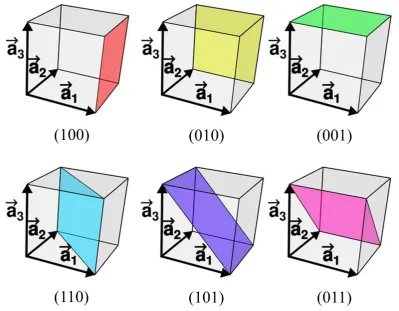
A system of nomenclature is used to categorize the structural forms of the crystal structures
of crystalline materials (see figure 1.1). Miller indices form a notation system in
crystallography for planes in crystal (Bravais) lattices. In particular, a family of lattice planes
8
each index denotes a plane orthogonal to a direction (h, k, ℓ) in the basis of the reciprocal lattice vectors. By convention, negative integers are written with a bar, as in 3 for −3. The
integers are usually written in lowest terms, i.e. their greatest common divisor should be 1.
Miller index 100 represents a plane orthogonal to direction h; index 010 represents a plane
[image:18.595.98.498.200.511.2]orthogonal to direction k, and index 001 represents a plane orthogonal to ℓ [27].
Figure 1.1 - Planes with different Miller indices in cubic crystals.
Most metals exist in only one bulk structural form, the most common ones being
body˗centred cubic (bcc), face˗centred cubic (fcc) and hexagonal close˗packed (hcp). For
each of these there are, in principle, an infinite number of possible surfaces which can be
exposed. However, in practice, only a limited number (so˗called “low˗index”) planes are
found to exist in significant quantities. Most of the technologically most important metals
possess the fcc structure (i.e. Pt, Rh, Pd, Ag, Au and Cu) and the low˗index faces are what are
9
1.5.1.
The fcc (100) Surface
The (100) surface is obtained by cutting the fcc metal parallel to the front surface of the fcc
cubic unit cell (see Figure 1.1a) this exposes a surface (the atoms in blue) with an atomic
arrangement of 4˗fold symmetry. The conventional birds˗eye view of the (100) surface (see
Figure 1.1b) is obtained by rotating the preceding diagram through 45° to give a view which
emphasises the 4˗fold (rotational) symmetry of the surface layer atoms. The second layer
atoms are visible through the holes in the first layer but would not be accessible to molecules
arriving from the gas phase.
Figure 1.2: Diagram of a (100) surface:˗ a) shows the slice (in blue) of the crystal and b) shows the surface generated.
1.5.2.
The fcc(110) Surface
The (110) surface is obtained by cutting the fcc unit cell that intersects the x and y axes but
not the z˗axis (see Figure 1.2). This exposes a surface with an atomic arrangement of 2˗fold
symmetry. The topmost layer is much less closely packed than on the (100) surface, i.e. the
distance between atoms is equal to twice the metallic (atomic) radius, but in the orthogonal
direction there is a substantial gap between the rows. This means that the atoms in the
underlying second layer are also, to some extent, exposed at the surface. b)
10
Figure 1.3: Diagram of a (110) surface, a) – shows the slice (in blue) of the crystal and b) shows the surface generated.
1.5.3.
The fcc (111) Surface
The (111) surface is obtained by cutting the fcc metal in such a way that the surface plane
intersects the x˗, y˗ and z˗ axes at the same value (see Figure 1.3). This exposes a surface
with an atomic arrangement of 3˗fold (apparently 6˗fold, hexagonal ) symmetry. This layer of
surface atoms actually corresponds to one of the close˗packed layers on which the fcc
structure is based. Since this is the most efficient way of packing atoms within a single layer,
they are said to be "close˗packed".
Figure 1.4: Diagram of a (111) surface:˗ a) shows the slice (in blue) of the crystal and b) shows the surface generated.
b) a)
11
1.6.
Adsorption of Molecules on Metal Surfaces
Adsorption of molecules at surfaces can be described, in general, by two classifications,
namely physisorption and chemisorption. A physisorbed molecule retains most of its
electronic structure upon adsorption and is only weakly bound to the surface. However, a
chemisorbed substance is much more strongly bound and the adsorbate’s electronic structure
is modified by the adsorption process [29]. Physisorbed molecules bond via dipole forces
(such as van der Waals forces) [30]. Chemisorbed molecules can bond via ionic or covalent
bonds [31,32]; ionic bonding results from broadened molecular orbitals (HOMO or LUMO)
crossing the Fermi level whereas covalent bonding occurs due to unoccupied molecular
orbitals overlapping (or hybridising) with partially filled d˗bands of transition metals.
Chemisorbed molecules bond, on average, an order of magnitude stronger than physisorbed
molecules and can significantly alter the electronic structure of the surface.
Adsorbed molecules must be sufficiently mobile in order to attain the lowest stabilisation
energy. Therefore, molecules must be able to diffuse across the surface and this process
depends upon a range of factors. These can be quantified by a diffusion co˗efficient, D(θ,T)
which represents the energy barrier the molecule must overcome in order to reach its final
state. This can be represented by the equation:˗
( )
(
)
(1.1)
Where D(T) is called the diffusion coefficient (cm2s˗1), EA is the activation energy
(KJmol˗1), T is the temperature (K) and D0 is the diffusivity (cm2s˗1), R is the gas constant
(KJmol-1T-1). Physisorbed molecules have lower diffusion activation energies and higher
mobility, whereas, chemisorbed molecules have higher diffusion activation energies and
12
1.7.
Inter˗Atomic and Inter˗Molecular Bonding
Inter˗molecular interactions play a crucial part in many surface chemical systems. Although
hydrogen bonding falls into this category, it is becoming increasingly apparent that an
understanding of dispersive forces is also necessary. The van der Waals force (or van der
Waals interaction) is the sum of the attractive and repulsive forces between molecules (or
between parts of the same molecule) other than those due to covalent bonds or to the
electrostatic interaction of ions with one another or with neutral molecules [24]. The term
includes:˗
The force between two permanent dipoles (Keesom force).
The force between a permanent dipole and a corresponding induced dipole (Debye force).
The force between two instantaneously induced dipoles (London force).
However, nowadays it is usually used to describe the totality of intermolecular forces
(excluding hydrogen bonds). Van der Waals forces are relatively weak compared to other
chemical bonds, but because they play a fundamental role in surface science systems it is
crucial to be able to accurately describe them. Van der Waals forces include attractions
between atoms, molecules, and surfaces. They differ from covalent and ionic bonding in that
they are caused by correlations in the fluctuating polarizations of nearby particles (a
consequence of quantum dynamics [25]). They are in detailed balance with electrostatic (ES)
and exchange˗repulsion (ER) interactions and, together, they control the structures of DNA
and proteins, the packing of crystals, the formation of aggregates, host˗guest systems and the
orientation of molecules on surfaces or in molecular films. Intermolecular forces have four
major contributions:˗
1) A repulsive component resulting from the Pauli Exclusion Principle that prevents the
collapse of molecules.
2) Attractive or repulsive electrostatic interactions between permanent charges (in the case
of molecular ions), dipoles (in the case of molecules without an inversion centre),
quadrupoles (all molecules with symmetry lower than cubic), and in general between
permanent multipoles. The electrostatic interaction is sometimes called the Keesom
13
3) Induction (also known as polarization), which is the attractive interaction between a
permanent multipole on one molecule with an induced multipole on another. This
interaction is sometimes called the Debye force after Peter J.W. Debye.
4) Dispersion (or London force, named after Fritz London), which is the attractive
interaction between any pair of molecules, including non˗polar atoms, arising from the
interactions of instantaneous multipoles.
Returning to nomenclature, different texts refer to different things using the term "van der
Waals force". Some texts mean by the van der Waals force the totality of forces (including
repulsion); others mean all the attractive forces (and then sometimes distinguish van der
Waals˗Keesom, van der Waals˗Debye, and van der Waals˗London); finally, some use the
term "van der Waals force" solely as a synonym for the London/dispersion force. However,
nowadays, the common trend is that biochemistry and biology books, more frequently than
chemistry books, use "van der Waals forces" as a synonym for London forces only.
All intermolecular/van der Waals forces are anisotropic (except those between two noble gas
atoms), which means that they depend on the relative orientation of the molecules. That is,
the electrostatic force can be attractive or repulsive, depending on the mutual orientation of
the molecules. When molecules are in thermal motion, as they are in the gas and liquid phase,
the electrostatic force is averaged out to a large extent, because the molecules thermally
rotate and thus probe both repulsive and attractive parts of the electrostatic force. Sometimes
this effect is expressed by the statement that "random thermal motion around room
temperature can usually overcome or disrupt them" (which refers to the electrostatic
component of the van der Waals force). Clearly, the thermal averaging effect is much less
pronounced for the attractive induction and dispersion forces.
The Lennard˗Jones potential is often used as an approximate model for the isotropic part of a
total (repulsion plus attraction) van der Waals force as a function of distance. Van der Waals
forces are responsible for certain cases of pressure broadening (van der Waals broadening) of
spectral lines and the formation of van der Waals molecules. The London van der Waals
forces are related to the Casimir effect for dielectric media, the former being the microscopic
description of the latter bulk property. The first detailed calculations of this were done in
14
Theoretically, the ER and ES effects can already be described relatively accurately at a
mean˗field (i.e. Hartree˗Fock, HF) level while the dispersive part is a pure electron
correlation effect [25,16]. In the framework of standard ab initio wave function theory [26] it
can be described by double excitations between occupied and virtual orbitals of the
supermolecule (coupled monomer single excitations). Accurate computations based on, for
example, coupled˗cluster methods like CCSD(T) [56], however, suffer from unacceptable
computation times even for medium˗sized systems, and can thus routinely be applied only to
benchmark studies of small complexes. Cheaper alternatives like second˗order Møller˗Plesset
perturbation theory (MP2) [28] on the other hand, are computationally simpler and thus more
widely used. However, especially for dispersive interactions, standard MP2 systematically
overestimates the binding energies and underestimates intermolecular equilibrium distances
[4,5].
Although today the most widely used theoretical approach to molecular structure, the density
functional theory (DFT) [6,7] includes electron correlation effects in an approximate manner,
it is now clear that almost all gradient˗corrected density functionals are unable to describe
dispersive interactions [8–10]. Although this problem now has become a very active field of
research [11,12], it seems to be very difficult to account for dispersion within the standard
Kohn–Sham picture of DFT. These nonlocal, long˗range electron correlations already appear
for the vanishing overlap of the electron densities of the fragments. Accordingly, they have
only a tiny effect on the electron density of the fragments that is furthermore buried by the
influences of the chemical environment.
All non˗empirical attempts to introduce van der Waals interactions in DFT inevitably end up
with methods that are at least as complex as the simplest wave function (i.e., MP2) methods.
Another empirical strategy to solve the problem is to modify [13] or to combine [14] existing
density functionals to reproduce, for example, the interaction potentials of rare gas dimers.
These approaches cannot be considered as successful in a sense that the modified functionals
are not applicable (transferable) for different systems (i.e., Ne2 vs. Kr2 vs. cytosine) [13]. The
recently proposed XLYP functional [14] has solely been tested on He2, Ne2, and H2O and
thus, its “real” performance cannot be judged. Therefore, the modelling of van der Waals
interactions using DFT is still a highly contentious one and is currently in a state of flux.
However, it is currently believed that the empirically (or so˗called Grimme) corrected is the
15
method [15,16]. Reasonably accurate results that are in good accordance with experimental
data have been obtained and this thesis utilises this method in accounting for all
inter˗molecular interactions.
1.8.
Molecular Self˗Assembly
Once adsorbed on the surface molecules may self˗assemble to produce patterned surfaces with periodic nanoscale structures [33˗34]. Due to the molecular resolution of Scanning
Probe Microscopy (SPM) it has been possible to demonstrate that many molecules have the
ability to form complex super˗structures on crystal surfaces. When these molecules are
thought of as ‘‘LEGO pieces’’ that can be attached to each other following certain rules it is
possible to generate many different structures [1]. This organisational behaviour is dependent
upon a fine balance between molecule˗surface as well as molecule˗molecule interactions.
This variability often results in a multitude of organised structures for a single molecular
species which can include one˗dimensional (1D) chains and two˗dimensional (2D) clusters
[33,34]. This variety has led to the creation of the field of supramolecular surface chemistry
and seeks to utilise chemical principles to create specific molecular architectures on various
(usually, but not exclusively) metallic surfaces. These principles involve:˗
1) Electrostatics (ion˗ion, dipole˗ion and dipole˗dipole interactions).
2) Hydrogen bonding.
3) Π˗Π stacking.
4) Dispersion/induction forces (i.e. van der Waals).
5) Hydrophobic and solvatophobic effects.
With the use of organic molecules, nucleic acids etc., which contain cyclic ring structures
with peripheral functional groups and atoms that can hydrogen bond (i.e. nitrogen, oxygen,
fluorine etc.) it is possible to produce 2D molecular structures that are bonded together by
hydrogen and/or Π bonds. By utilising relatively unreactive metals (e.g. Au, Ag, Cu etc.),
which hold the molecules in place, it is possible for them to form inter˗molecular bonds
16
although research is continuing to develop more advanced techniques [48˗54]. These
involve using Π˗Π stacking to direct large scale structures [48], using metal ions to act as
electron acceptors and thus bind as ligands [50,52] or metal˗organic frameworks [53]. This
has led to speculation that such 2D structures will find applications in molecular storage
[49,51] as well as novel new magnetic materials [54,55].
Although inter˗molecular interactions are utilised to direct the self˗assembly of surface
structures it is important not to forget that these structures must be held in place somehow.
Therefore, the role of the molecule˗substrate interaction must always be considered. The
desired strength of this is permanently set when choosing the type of metal and the crystal
cleave plane to be used. So, if you want the molecule to be weakly bound then Au is the
obvious choice. However, in order to fix molecules in place more firmly requires a more
reactive metal like Ni. However, an in˗depth understanding of a quantitative nature of this so˗called “adsorption footprint” is, at present, sadly lacking. It is for this reason that Cu, of
intermediate reactivity, is often used in investigations of this type. Thus, Cu is able to
securely hold most molecular structures firmly in place at room temperature but yet is still
able to allow individual molecules a high degree of mobility. On top of this, if the surface is
subjected to higher temperatures, then these said structures are then able to re˗arrange
themselves into further structures as well as to react with the surface.
1.9.
Bibliography
[1] S. Radel, M. Navidi. “Chemistry 2nd Edition.” West Publishing Company, 1994, 1158. [2] L. Vrolyk. “Clay and the Origins of Life.” New York Centre for Studies on the Origins
of Life (July, 2000).
[3] G. Zubay. “Origins of Life on the Earth and in the Cosmos.” San Francisco, Academic
Press, 2000, 168.
[4] W. J. Hagan. "Priming the Pre˗RNA World." Presentation July 27, 2000 at the New
York Centre for Studies on the Origins of Life.
[5] Dr. J. P. Ferris. "Montmorillonite Catalysis of RNA Oligomer Formation in Aqueous
Solution. A Model for the Prebiotic Formation of RNA." Journal of the American
17
[6] K. Rybij. “The ‘RNA World’ and the Polymerization of RNA Using Clay and Mineral
Catalysis.” Presentation July 13, 2000.
[7] Dr. I. E. Odom. "Sodium Montmorillonite and Calcium Montmorillonite: Properties
and Uses." Technical Data Sheet IC˗1001 28 Nov.90W. American Colloid Company
Industrial Chemical Division.
[8] H. Wennerström, S. Lidin. "Scientific Background on the Nobel Prize in Chemistry
2007 Chemical Processes on Solid Surfaces."
[9] H. Conrad, G. Ertl, E. E. Latta, (February 1974). "Adsorption of hydrogen on palladium
single crystal surfaces." Surface Science 41 (2), 435–446.
[10] K. Christmann, G. Ertl, T. Pignet, (February 1976). "Adsorption of hydrogen on a
Pt(111) surface". Surface Science 54 (2), 365–392.
[11] K. Christmann, O. Schober, G. Ertl, M. Neumann (June 1, 1974). "Adsorption of
hydrogen on nickel single crystal surfaces". The Journal of Chemical Physics 60 (11), 4528–4540.
[12] K. Christmann, R. J. Behm, G. Ertl, M. A. Van Hove, W. H. Weinberg. "Chemisorption
geometry of hydrogen on Ni(111): Order and disorder". The Journal of Chemical
Physics (May 1, 1979), 70 (9), 4168–4184.
[13] R. Imbihl, R. J. Behm, K. Christmann, G. Ertl, T. Matsushima. "Phase transitions of a
two˗dimensional chemisorbed system: H on Fe(110)." Surface Science, (May 2, 1982),
117, 257–266.
[14] J. M. Thomas and W. J. Thomas. “Principles and Practice of Heterogeneous
Catalysis.” VCH, (Oct 15, 1996).
[15] S. Grimme, J. Antony. “Density functional theory including dispersion corrections for
intermolecular interactions in a large benchmark set of biologically relevant
molecules”. Phys. Chem. Chem. Phys. (August 31, 2006), 8, 5287˗5293.
[16] S. Grimme. “Accurate description of van der Waals complexes by density functional
theory including empirical corrections”. J Comp. Chem. (April 29, 2004), 25, 1463˗1473.
[17] P. Chang, N. P. Lang, W. P. Giannobile. “Evaluation of Functional Dynamics during
Osseointegration and Regeneration Associated with Oral Implants: A Review”.
18
[18] N. Ferraz, J. Hong, M. Santin, M. Karlsson. "Nanoporosity of Alumina Surfaces
Induces Different Patterns of Activation in Adhering Monocytes/Macrophages".
Int. Journal of Biomaterials (2010), Article ID 402715, 8 pages.
[19] W. Gopel. “Biosensors and bioelectronics.” (1998), 13, 723.
[20] F. Allegretti, M. Polcik and D.P. Woodruff. “Quantitative Determination of the Local
Structure of Thymine on Cu(110) Using Scanned˗Energy Mode Photoelectron
Diffraction.” Surface Science (2007), 601(17), 3611˗3622.
[21] R. E. A. Kelly, L. N. Kantorovich. “Homopairing Possibilities of the DNA Base
Thymine and the RNA Base Uracil: An Ab Initio Density Functional Theory Study.”
J. Phys. Chem. B (2006), 110(5), 2249˗2255.
[22] W. Xu, R. Kelly, R. Otero, M. Schock. “Probing the Hierarchy of Thymine˗Thymine
Interactions in Self˗Assembled Structures by Manipulation with Scanning Tunnelling
Microscopy.” Small (2007), 3(12), 2011˗2014.
[23] A. McNutt, PhD thesis, University of Liverpool, 2002.
[24] IUPAC, Compendium of Chemical Terminology, 2nd ed. (the "Gold Book") (1997).
Online corrected version: (1994) "Van der Waals forces".
[25] A. A. Abrikosov, L.P. Gorkov, I.E. Dzyaloshinsky. “Methods of Quantum Field Theory
in Statistical Physics.” Dover Publications (1963–1975). ISBN 0˗486˗63228˗8.
Chapter 6 ˗ Electromagnetic Radiation in an Absorbing Medium.
[26] W. Kutzelnigg, W. Einfűhrung in die Theoretische Chemie: Band 2, Di chemische
Bindung; Varlag Chemie: Weinheim, 1978.
[27] T. Helgaker, P. Jørgensen, J. Olsen. “Molecular Electronic˗Structure Theory.”
J. Wiley: New York, 2000.
[28] D. Cremer, P. von Rague–Schleyer. “Encyclopaedia of Computational Chemistry.”
J. Wiley: New York, 1998, 3, 1706.
[29] A. Zangwill. “Physics at Surfaces.” Cambridge University Press, Cambridge, 1988.
[30] G. Attard, C. Barnes. “Surfaces.” Oxford University Press, 1988.
[31] N. D. Lang, A. R. Williams. “Theory of Atomic Chemisorption on Simple Metals.”
Phys. Rev. B., 1978, 18(2), 616˗636.
[32] R. Hoffman. “Reviews of Modern Physics.” 1988, p. 601, vol. 60.
[33] J. V. Barth, G. Costantini, K. Kern. “Engineering Atomic and Molecular
19
[34] J. V. Barth. “Molecular architectonic on metal surfaces.” Annu. Rev. Phys. Chem.
2007, 58, 375˗407.
[35] P. D. Beer, P. A. Gale, D. K. Smith. “Supramolecular Chemistry.” Oxford University
Press 1999.
[36] S. Weigelt, C. Busse, L. Petersen. “Chiral switching by spontaneous conformational
change in adsorbed organic molecules.” Nature Materials 2006, 5, 112˗117.
[37] C. Bombis, S. Weigelt, M. M. Knudsen. “Steering organizational and conformational
surface chirality by controlling molecular chemical functionality.” ACS Nano 2010,
4(1), 297˗311.
[38] M. Matena, A. Llanes˗Pallas, M. Enache. “Conformation˗Controlled Networking of
H˗Bonded Assemblies on Surfaces.” Chem. Comm. 2009, 24, 3525˗3527.
[39] N. Wintjes, J. Hornung, J. Lobo˗Checa. “Supramolecular Synthons on Surfaces:
Controlling Dimensionality and Periodicity of Tetraarylporphyrin Assemblies by the
Interplay of Cyano and Alkoxy Substituents.” Chem. Eur. J. 2008, 14(19), 5794˗5802. [40] F. Klappenberger, M. Canas˗Ventura, S. Clair. “Conformational adaptation in
supramolecular assembly on surfaces.” ChemPhysChem, 2007, 8(12), 1782˗1786. [41] L.A. Fendt, M. Stohr, N. Wintjes. “Modification of Supramolecular Binding Motifs
Induced by Substrate Registry: Formation of Self˗Assembled Macrocycles and
Chain˗like Patterns.” Chem. Eur. J. 2009, 15(42), 11139˗11150.
[42] A. Llanes˗Pallas, C. A. Palma, L. Piot. “Engineering of Supramolecular H˗Bonded
Nanopolygons via Self˗Assembly of Programmed Molecular Molecular Modules.”
J. Am. Chem. Soc. 2009, 131(2), 509˗520.
[43] A. Llanes˗Pallas, M. Matena, T. Jung. “Trimodular Engineering of Linear
Supramolecular Miniatures on Ag(111) Surfaces Controlled by Complementary Triple
Hydrogen Bonds.” Angew. Chem. Int. Ed. 2008, 47(40), 7726˗7730.
[44] M. Abel, V. Oison, M. Koudia. “Designing a New Two˗Dimensional Molecular Layout
by Hydrogen Bonding.” Chemphyschem. 2006, 7(1), 82˗85.
[45] K. W. Hipps, L. Scudiero, D. E. Barlow. “A self˗organized 2˗dimensional bifunctional
structure formed by supramolecular design.” J. Am. Chem. Soc. 2002, 124(10), 2126˗2127.
[46] W. Auwarter, A. Weber˗Bargioni, A. Schriffrin. “Self˗Assembly and Conformation of
20
[47] L. Gross, F. Moresco, P. Raffieux. “Tailoring Molecular Self˗Organization by
Chemical Synthesis: Hexaphenylbenzene, Hexa˗peri˗hexabenzocoronene, and
Derivatives on Cu(111).” Phys. Rev. B. 2005, 71(16), 165428. [48] P. J. Donovan, PhD Thesis, University of Liverpool, 2009.
[49] M. E. Kosal, J. Chou, S. R. Wilson. “A Functional Zeolite Analogue Assembled from
Metalloporphyrins.” Nat. Mater. 2002, 1(2), 118˗121.
[50] S. L. Tait, Y. Wang, G. Costantini. “Metal˗Organic Coordination Interactions in
Fe˗Terephthalic Acid Networks on Cu(100).” J. Am. Chem. Soc. 2008, 130(6), 2108˗2113.
[51] M. Eddaoudi, J. Kim, N. Rosi. “Hydrogen Storage in Microporous Metal˗Organic
Frameworks.” Science 2003, 300(5622), 1127˗1129.
[52] M. A. Lingenfelder, H. Spillmann, A. Dmitriev. “Towards Surface˗Supported
Supramolecular Architectures: Tailored Coordination Assembly of
1,4˗Benzenedicarboxylate and Fe on Cu(100).” Chem. Eur. J. 2004, 10(8), 1913˗1919. [53] M. J. Ingleson, J. Bacsa, M. J. Rosseinsky. “Homochiral H˗Bonded Proline Based
Metal Organic Frameworks.” Chem. Comm. 2007, 29, 3036˗3038.
[54] S. Chui, S. Lo, J. Charmant. “A Chemically Functionalizable Nanoporous Material
[Cu3(TMA)2 (H2O)3](n).” Science 1999, 283(5405), 1148˗1150.
[55] P. Gambardella, S. Stepanow, A. Demitriev. “Supramolecular Control of the Magnetic
Anisotropy in Two˗Dimensional High˗Spin Fe Arrays at a Metal Interface.”
Nat. Mater. 2009, 8(3), 189˗193.
[56] S. Wilson, “A critical analysis of the ‘CCSD(T)’ model for the study of electron
correlation effects in atoms and molecules.” Rutherford Appleton Laboratory,
21
2.
Chapter Two ˗ Theoretical Techniques
2.1.
Density Functional Theory (DFT) – A General
Overview
2.1.1.
Introduction – What Is Density Functional Theory?
Density functional theory is a phenomenally successful approach to finding solutions to the
fundamental equation that describes the quantum behaviour of atoms and molecules, the
Schrödinger equation, in settings of practical value. Although DFT has been used since the
1970s it was only in the 1990s when better approximations for the exchange and correlation
interactions were implemented that it became more widely used. Because it is much less
computationally costly than methods based on complex many electron wavefunction theories
(like Hartree˗Fock) it has become the main method used now in quantum chemistry. For a
good introduction to DFT see “The ABC of DFT” [12].
2.1.2.
The Schrödinger Equation
Let us imagine a situation where we would like to describe the properties of some
well˗defined collection of atoms – you could think of an isolated molecule or the atoms
defining the crystal of an interesting mineral. One of the fundamental things we would like to
know about these atoms is their energy and, more importantly, how their energy changes if
we move the atoms around. To define where an atom is, we need to define both where its
nucleus is and where the atom’s electrons are. In order to obtain a microscopic description of
the interactions taking place between molecules it is necessary to solve the many˗body
Schrödinger equation:˗
22
The three terms on the left side of this equation represent, in order, the kinetic energy of each
electron (with as the ‘Laplacian’), the interaction energy between each electron and the
collection of atomic nuclei and the interaction energy between different electrons (with V and
U representing the potential energy, r representing the distance between electrons as a vector
and i and j representing individual electrons). This combination of terms represents what is
known as the ‘Hamiltonian’ operator and represents a set of solutions, or eigenstates, of the
Hamiltonian. It is called the electronic wave function, which is a function of each of the
spatial co˗ordinates of each of the N electrons, so ( ). Each of these solutions,
(which is a complex number), has an associated eigenvalue, (which is a real number),
that satisfies the eigenvalue equation. The detailed definition of the Hamiltonian depends on
the physical system being described by the Schrödinger equation. Also, as the ground-state
energy is independent of time, this is what is known as the ‘time˗independent Schrödinger
equation’.
Although this gives a complete description of any system the problem is that the dimension
of the wave function grows very rapidly with the number of electrons. Therefore, a method of
simplifying the mathematics is required. DFT provides this simplification and the problem of
many˗electrons interacting is replaced with an effective potential. The many˗electron wave
function is replaced by the electron density thus reducing the problem from 3N dimensions to
one of just N electrons.
2.1.3.
DFT – From Wave Functions To Electron Density
Density functional theory rests on just two fundamental mathematical theorems proved by
Kohn and Hohenberg and the derivation of a set of equations by Kohn and Sham in the
mid˗1960s. The Kohn˗Sham equations provide the framework for finding the exact density
and energy of the ground state of a many˗body electron system using standard independent
particle methods. The first theorem, proved by Hohenberg and Kohn, is: The ground˗state
energy from Schrödinger’s equation is a unique functional of the electron density. The
theorem states that there exists a one˗to˗one mapping between the ground˗state wave function
and the ground˗state electron density. However, this theorem says nothing about what the
functional actually is. The second Hohenberg˗Kohn theorem defines an important property of
23 The electron density that minimizes the energy of the overall functional is the true electron
density corresponding to the full solution of the Schrödinger equation.
We can write down the functional described by the Hohenberg˗Kohn theorem in terms of the
single˗electron wave functions, ψi(r) which defines the electron density n(r). The energy functional can be written as:˗
E[{ψ
i}] = E
known[{ψ
i}] + E
XC[{ψ
i}]
(2.2)The “known” terms can be written as:˗
E
known[{ψ
i}] = ˗
∑ ∫ ∫ ( ) ( ) ∫ ∫( ) ( )
| |
(2.3)
The equation represents, in order, the electron kinetic energies, the Coulomb interactions
between the electrons and the nuclei, the Coulomb interactions between pairs of electrons,
and the Coulomb interactions between pairs of nuclei. The unknown term, EXC[{ψi }] is
called the exchange˗correlation functional.
Kohn and Sham showed that the right electron density can be expressed in a way that
involves solving a set of equations in which each equation only involves a single electron.
These have the form:˗
[
( )
( )
( )]
( )
=
( )
(2.4)The first two terms are known. The third term is called the Hartree potential and is defined
as:˗
V
H(r) = e
2
∫
( )| | (2.5)
This describes the Coulomb repulsion between the electron being considered in one of the
24
“functional derivative” of the exchange˗correlation energy:˗
V
XC(r) =
( )
( ) (2.6)
All this ultimately leads to a circular problem. In order to solve the Kohn˗Sham equations we
need to define the Hartree potential and to define the Hartree potential we need to know the
electron density. However, to find the electron density we must know the single˗electron
wave functions and to know these we must solve the Kohn˗Sham equations. Thus, we are led
to an iterative approach:-
1. Define an initial, trial electron density, n(r).
2. Solve the Kohn˗Sham equations to find the single˗particle wave functions, ψi(r). 3. Calculate the new electron density from step 2, nKS(r)=2∑ ( ) ( ).
4. Compare the calculated electron density, nKS(r), with the electron density used in solving the Kohn˗Sham equations, n(r). If the two densities are the same then this is the ground˗state electron density and can be used to compute the total energy.
5. Otherwise, the trial electron density must be updated using a chosen algorithm and the
iteration routine repeated.
The Kohn˗Sham equations are a set of Schrödinger˗like independent particle equations which
must be solved subject to the condition that the effective potential ( ) and the density n(r, σ) are consistent. This must be solved iteratively by providing an initial guess and using
this to calculate the effective potential ( ) which then enables us to solve the KS equation. This means we can calculate the electron density and we are able to see if this is
consistent with our initial guess. The loop then re˗iterates until the initial and final electron
densities are the same. Obviously, this is a very simplified approach but this iterative method
is used to solve the Kohn˗Sham equations until they are self˗consistent.
2.1.4.
The Exchange˗Correlation Functional
25
However, for a uniform electron gas it can be derived exactly [1]. In this situation, the
electron density is constant at all points in space; that is n(r) = constant. This approximation uses only the local density to define the approximate exchange˗correlation functional and is
called the local density approximation (LDA) [2]. However, this does not exactly solve the
true Schrödinger equation and the development of functionals that more faithfully represent
nature remains an active area of research [3].
A number of approximate functionals have now been developed that give good results in a
wide range of physical problems. The best known class of functional after the LDA uses
information about the local electron density and the local gradient in the electron density; this
approach defines a generalized gradient approximation (GGA) [4]. However, there are many
ways in which information from the gradient of the electron density can be included in a
GGA functional and there are a large number of these functionals. Two of the most widely
used of these are the Perdew˗Wang functional (PW91) [5] and the Perdew˗Burke˗Ernzerhof
functional (PBE) [6]. Dozens of other GGA functionals have also been developed which give
somewhat different results for any particular configuration of atoms. For this reason it is
important to specify which functional was used in any particular calculation.
2.1.5.
Limitations Of DFT
As successful as DFT calculations can be it must be understood that practical DFT
calculations are not exact solutions of the full Schrödinger equation. There are some
important situations for which DFT cannot be expected to be physically accurate. The first of
these situations where DFT has limited accuracy is in the calculation of electronic excited
states. This is due to the basic premise of Hohenberg˗Kohn that only applies to the
ground˗state energy. Standard DFT calculations with existing functionals have limited
accuracy for band gaps, with errors >1eV being common [21˗22]. However, this is currently