
A
-raf
0000099281
TNB load reading prediction I Muhamad Najmi Abu Bakar.
I
]
.TNB LOAD READING PREDICTION
Muhamad Najmi bin Abu Bakar
Bachelor of Power Electronics and Drive June 2012
A STUDY ON
TNB LOAD READING PREDICTION
MUHAMAD NAJMI BIN ABU BAKAR
This Report Is Submitted In Partial Fulfillment of Requirement for the Degree of
Bachelor in Electrical Engineering (Power Electronic and Drives)
Faculty of Electrical.Engineering
UNIVERSITI TEKNIKAL MALAYSIA MELAKA
l
I
J
"I hereby declared that I have read through this report entitle " A Study On TNB Load
Reading Prediction" and found that it has comply the partial fulfillment for awarding the
degree ofBachelor of Electrical Engineering (Power Electronic and Drives)"
Signature
Supervisor's Name
Date
ENCIK NORAZHAR BIN ABU BAKAR
....
...
:f-:5"/?./
~
1~
... · ... .l
J
I
I
I
"I hereby declared that this report is of my own work except for the excerpts that have been cited clearly in the references "
Signature
..
fo
...
.
... .
Name MUHAMAD NAJMI BIN ABU BAKAR
I
I
I
I
1
J
Dedicated to my beloved Parents, my siblings
Lectures and all my friends
For their love and sacrifice.
I
I
11
ACKNOWLEDGEMENT
In the name of Allah S.W.T, the most gracious and merciful, praise to Allah the lord of universe and may blessing and peace of Allah be upon his messenger Muhammad S.A.W. First, and foremost thank to Allah for giving me wellness and ideas to complete this project report. Without any of it, I smely cannot complete this project in the time given.
I would like to express my appreciation to my project supervisor, En .. Norazhar bin Abu Bakar for giving brilliant advices and guidance to me as well as provision of the valuable time management, encouragement and patience during the time period of completing this project.
Last but not least, I like to express my very thankful and send our grateful to my entire friend and my family for the moral and fmancial support. To those that I forget to
l
1
{
t
J
t
111
ABSTRACT
Nowadays there is a growing tendency towards improving the electricity system. Load
forecasting is a process of predicting the future load demands. The growth of development
in the country increases the demand on planning management and operations of the power
system supply. As electricity is a product that cannot be stored, it demands must be
· forecasted in order to ensure enough supply being di$tributed to_ consumers while not
generating load far exceeded that required. This project paper demonstrates the
development of forecasting modeling by the application of Matlab software. It covers the
load demand by the users in Penang. Hence, the load data from TNB has been used as
input to forecast load and the temperature data from Malaysia ·Meteorology Department
also had been used as forecasting factors. The forecasted load had been compared with
actual load data to get the minimum forecasting error and better accuracy. The neural
network modeling is able to make a prediction of what load would be in the next day. The
modeling showed that neural network was used widely and accurately in load forecasting.
J
J
IV
ABSTRAK
Sejak kebelakangan ini berlaku peningkatan ke arab. penambahbaikan sistem elektrik.
Ramalan beban adalah satu proses meramal permintaan tenaga elektrik di masa hadapan.
Pertumbuban pembangunan di negara ini meningkatkan lagi keperluan kepada pengurusan
perancangan serta operasi sistem bekalan kuasa. Tenaga elektrik adalah produk yang tidak
boleh disimpan, ia harus dianggarkan dalam usaha untuk memastikan bekalan yang
mencukupi untuk dibekalkan kepada pengguna di samping tidak menjana tenaga elektrik
yang jauh melebihi keperluan. Projek ini menghasilkan pembangunan model ramalan
meggunakan aplikasi perisian Matlab. Ia meliputi permintaan tenaga elektrik oleh
pengguna di Pulau Pinang. Oleh itu, data tenaga elektrik daripada TNB telah digunakan
sebagai input untuk meramalkan tenaga dan data suhu daripada Jabatan Meteorologi
Malaysia juga telah digunakan sebagai faktor ramalan. Beban ramalan telah dibandingkan
dengan data beban sebenar untuk mendapatkan ralat ramalan minimum dan ketepatan yang
lebih baik. Permodelan ini mampu untuk membuat ramalan beban yang akan digunakan di
hari berikutnya. Permodelan menunjukkan bahawa rangkaian ini telah digunakan secara
3
-4
2.5
2.4.3.6 Multi Layered Neural Network
2.4.3.7 Hidden Layer and Node
2.4.3.8 Hidden Neuron
2.4.3.9 Learning Rate 2.4.3.10Momentum Rate
Study the Related Journal
METHODOLOGY
3.1 Overview of Methodology
3.1.1 Do the research about the topic
(LiteratUre Review)
3.1.2 Data Gathering
3.1.3 Develop modeling in Matlab (Training)
3 .1.3 .1 Using Matlab 7 .12. 0 software
3.1.3.2 Assemble Training Data
3.1.3.3 Create Network or Data
3.1.3.4 Train Network
3.1.3.5 Simulation Process
3.1.3.6 Get Result Forecast
RESULT
4.1 Forecast Results of Power Consumption for Every
Month
4.1.1 Forecasting Results for January
4.1.2 Forecasting Results for February
4.1.3 Forecasting Results for March
4.1.4 Forecasting Results for April
4.1.5 Fore casting Results for May 4.1.6 Forecasting Results for June
4.1.7 Forecasting Results for July
4.1.8 Forecasting Results for August
4.1.9 Forecasting Results for September
.
©
Universiti Teknikal Malaysia Melaka10 10-11 11 11 12 12-15 16 16-17 18 18 18-19 20
21-22
23- 24
24-28
29
30
31
31
31- 33
33- 34
34- 36
36-37
38-39
39--,40 .
41- 42
42-43
44- 45
5
6
4 .1.1 0 Forecasting Results for October
4.1.11 Forecasting Results for November
4.1.12 Forecasting Results for December
ANALYSIS & DISCUSSION OF RESULT
5.1 Analysis for January Load Forecast
5.2 Analysis for February Load Forecast
5.3 Analysis for March Load Forecast
5.4 Analysis for April Load Forecast
5.5 Analysis for May Load Forecast
5.6 Analysis for June Load Forecast
5.7 Analysis for July Load Forecast
5.8 Analysis for August Load Forecast
5.9 Analysis for September Load Forecast
5.10 Analysis for October Load Forecast
5.11 Analysis for November Load Forecast
5.12 Analysis for December Load Forecast
5.13 The Mean Absolute Percentage Error for Each Month
SUMMARY AND CONCLUSION
6.1 6.2 6.3 Summary Conclusion Recommendation REFERENCES APPENDIX
45- 47
47-48 48-49 50 50-51 51-52 52-53 53-54 55 56-57 57-58 58-59 59
60- 61
61-62
viii
LIST OF TABLES
TABLE TITLE PAGE
4.1 Forecasting Results for January 31-32
4.2 Forecasting Results for February 33-34
4.3 Forecasting Results for March 35
4.4 Forecasting Results for April 36-37
4.5 Forecasting Results for May 38
4.6 Forecasting Results for June 39-40
4.7 Forecasting Results for July 41
4.8 Forecasting Results for August 42--43
4.9 Forecasting Results for September 44
4.10 Forecasting Results for October 45-46
4.11 Forecasting Results for November 47
4.12 Forecasting Results for December 48-49
5.1 Percentage Error for February 52
5.2 Percentage Error for March 53 5.3 Percentage Error for April
54
5.4 Percentage Error for June 56-57
5.5 .Percentage Error for July 58
5.6 Percentage Error for October 60
5.7 Percentage Error for November 62
5.8 The Mean Absolute Percentage Error for Each Month 63
lX
LIST OF FIGURES
NO
TITLE PAGE2.1 The model of neuron in hidden layer 8
2.2 None linear model of neuron 8
2.3 The types of transfer function 9
2.4 Single layered neural network 10
2.5 Multilayered neural network 10
2.6 A Generalized Network 14
2.7 The Structure of a Neuron 14
3.1 Flow Chart of Overall Methodology 17
3.2 Flow Chart of Develop Neural Network model in Matlab 19
3.3 Neural Network tool window 20
3.4 Neural Network tool window 20
3.5 Input and target data arranged 21
3.6 Input data created 21
3.7 Target data created 22
3.8 Netw·ork/data manager 22
3.9 Network or data Window 23
3.10 View ofNew Network 1 (2layers) 24
.3.11 Training info of the network 25
3.12 Training parameters of the network .25
3.13 Neural network training (nntraintool) 26
3.14 Performance (plot perform) 27
3.15 Regression (plot regression) 28
X
4.4
April Load Forecast37
4
.
5
May Load Forecast38
4.6
June Load Forecast40
4.7
July Load Forecast42
4
.
8
August Load Forecast43
4.9
September Load Forecast45
4.10
October Load Forecast46
4.11
November Load Forecast48
4.12
December Load Forecast49
5.1
Comparison Load Pattern on January50
5.2
Comparison Load Pattern on February51
5.3
Comparison Load Pattern on March52
5.4
Comparison Load Pattern on April 535.5
Comparison Load Pattern on May55
5.6
Comparison Load Pattern on June56
5.7
Comparison Load Pattern on July57
5.8
Comparison Load Pattern on August 585.9
Comparison Load Pattern on September5
9
5.10
Comparison Load Pattern on October60
5.11
Comparison Load Pattern on November61
5.12
Comparison Load Pattern on December6
2
5.13 Mean Percentage Absolute Error (MAPE)
64
LIST OF APPENDIX
NO TITLE
A Project Planning
PAGE
70
CHAPTER!
INTRODUCTION
1.0 Background
Tenaga Nasional Berhad (TNB) is the largest of electricity utility company in
Malaysia. Their core activities are in the generation, transmission and distribution of electricity. These activities ranging from system planning, evaluating, implementing and maintaining the systems. One of the requirements of the system planning is load
forecasting. Load forecasting is a prediction of power demand. It is important for electricity planning and to ensuring that there would be enough supply of electricity, where and when that power must delivered. The accurate forecasting of energy requirement is one of the most important factors of energy management for the future development of the country like Malaysia. It can give a better planning such as budget planning, maintenance scheduling, the reliability evaluation of the power system and many more. Many factors are related to load forecasting such as weather changes, temperature, season, population, number of electricity consumers and others. Load forecast also can divides in three catogeries that is Long Term Load Forecast (LTLF), Medium Term Load Forecast (MTLF) and Short Term Load Forecast (STLF).
1.1 Problem Statements
Load forecasting is an important component in the operation and planning of
electrical power generation conducted by Utilities Company. Many factors can influence the electricity usage. One of the factors is temperature changes and it made difficultly for TNB to predict power demand. It can affected the budget planning, maintenance and also
electricity blackout. In order to overcol?e this problem a predicting model can be used
2
based on history and forecast data. These data were analyzed to give better accuracy for future load demand. The electric utility company should have an appropriate model for load forecasting to ensure balance need among the utility and environment factors as well
as minimizing the operating cost. For this project, an algoritlun modeling will be developed to predict power demand based on temperature condition. A neural networks methods have been used to developed load forecasting modeling by using Matlab software.
Hopefully this project will give some benefits to the utility of Malaysia in order to improve load forecasting in Malaysia.
1.2 Objectives
1.2.1 To develop an algorithm model to predict power demand based on temperature
condition in Malaysia.
1.2.2 To investigate performance and accuracy of power demand prediction based on
temperature condition.
1.3 Scopes of The Project
The project will focusing on developing an algorithm by using MATLAB software.
It will be used to simulate and analyze forecasting load data. The result between forecasted
load and actual load data will be compared to fmd forecasting error. The variables
considered in this project are based on power demand and temperature changes data.The
focusing area for this project is in Penang, so that the load demand data from TNB has
CHAPTER2
LITERATURE REVIEW
Load forecasting is very important to use in the system and market operators,
transmission owners and any other market participants. It also can help an electric utility company such as Tenaga Nasional Berhad (TNB) to make decisions including on purchasing and generating electric power, load switching and infrastructure growth. Forecasting also can be divide into three categories that each category has a different time ranges. This is an important task to utility company for achieving the goal of optimal planning and operation of power system. The categories are Long Term Load Forecasting (LTLF), Mediwn Term Load Forecasting (MTLF) and Short Term Load Forecasting (STLF). Each category has a forecast method to development more accurate load forecasting.
2.1 Long Term Load Forecasting (LTLF)
The estimation may lead utility company to plan the generation and distribution schedule. It had been done for various lead times ranging from few seconds to more than a year. Long term load forecasting is an important issue in effective and efficient planning. Overestimation of power demand may lead to spending more money in building new power stations to supply this load. However, underestimation of load can cause troubles in supplying load from the available electric supplies, and produce a shortage in spinning reserve of the system that may lead to an insecure and defective system [2]. Long term load forecasting is the forecasting of future loads for a relatively large lead time (years
ahead). It includes the forecasts on the population changes, economic development, industrial construction and technology development (1]. In fact, there have a few published paper can be found on the long term situation. The reason of this case because the long term forecasting requires years of econo!llic and demographic data which may not be easy
4
to gather or access. Even when data is accessible, it was complexes in the sense that it is
affected by environmental, economical, political and social factors [2].
2.2 Medium Term Load Forecasting (MTLF)
Medium term load forecasting (MTLF) is also important to power system planning
and operations system. It was important for utilities for maintenance scheduling, power
demand management, purchasing planning and etc. The accurate MTLF can provide an
advantage in negotiations and assist in the development of bilateral contracts [3]. The time
range for MTLF to predict future load is from a few days to a year into the future. In these
periods, an accurate forecast of a power demand factors such as a temperature is also
important. Ignoring the ambient temperature forecasts and correlation among hourly loads
may cause result in inaccurate prediction. Thus, more accurate MTLF methods are
required. The end-use modeling, econometric modeling, and theii combinations are the
most often used methods for medium term load forecasting [ 1].
2.3 Short Term Load Forecasting (STLF)
Such as long and medium term load forecasting, this short term load forecasting is
also important for real time operation and control power system. Short term forecasts are
intended to be valid for only a few minutes to a few hours into the future and are needed by
electric utility operators [4]. This is because the quality of the short term hourly load
forecasting has a significant impact on the efficiency of operation. Many operational
decisions such as economic scheduling of the generating capacity, scheduling of fuel
purchase and system security assessment are based on such forecasts [5]. So, this kind of
forecasting has been widely studied in the last decades because the represents of a great
5
be analyzed therefore the main factors affecting the load can be identified. Some factors of
influencing the load that need to be considered in STLF are season, day type, weather and
electric price [1].
2.4 Forecasting Methods
There are many methods can be used in forecasting such as time series method,
fuzzy logic method, neural network method, regression method and others else. For this
project, Neural Network method will be applied in order to give a faster and accurate result
compared with other conventional method like Statistical, time series, perceptron. Matlab
software is used to develop this neural network model.
2.4.1 Neural Network
Neural networks, or artificial neural networks (ANN) as they are often called, refer
to a class of models inspired by biological nervous systems. The models are composed of
many computing elements, usually denoted neurons, working in parallel. The elements are
connected by synaptic weights, which are allowed to adapt through a learning process.
There are many types of neural network models, the common feature in them being
the connection of the ideas to biological systems. The models can be categorized in many
ways. One possibility is to classify them on the basis of the learning principle. A neural
network uses either supervised or unsupervised learning. In supervised learning, the
network is provided with example cases and desired responses. The network weights are
then adapted in order to minimize the difference between network outputs and desired
outputs. In unsupervised learning the network is given only input signals, and the network
weights change through a predefined mechanism, which usually groups the data into
clusters of similar data. The most common network type using supervised learning is a
feed-forward (signal transfer) network. The network is given an input signal, which is
transferred forward through the network. Eventually, an output signal is produced. The
network can be understood as a mapping from the input space to the output space, and this
6
mapping is defmed by the free parameters of the model, which are the synaptic weights
connecting the neurons [7,8].
2.4.2 Feed Forward Neural Network in Load Forecasting
Feed Forward Neural Network (FFNN) is the most popular neural network type and
most of the reported neural network loads forecasting models are based on it. The idea
behind the use of Feed Forward Neural Network models in load forecasting is simple: it is
assumed that future load is dependent on past load and external factors like temperature,
and the FFNN network is used to approximate this dependency. The inputs to the network
consist of those temperature values and past load values, and the output is the target load
values for example a load value of a certain hour, load values of many future hours, the
peak load of a day, the total load of a day etc. Therefore, the building of a Feed Forward
Neural Network model for load forecasting can be seen as a nonlinear system identification
problem [9].
The determining of the model structure consists of selecting the input variables and
deciding the network structure. The parameter estimation is carried out by training the
network on load data of the history. This requires choices concerning the learning
algorithm and appropriate training data. The model validation is carried out by testing on
load data, which has not been used in training. However, the modeling with neural
networks is different to modeling with linear system models. The nonlinearity and the great
adaptability of the network models make it possible to use specific indicators as input
variables. In the case of load forecasting, the hour of the day and day type of the target
hour, for instance, can be included as binary codes in the network input [1 0].
7
Another matter supporting neural network models is the relatively rapid changing of the characteristics in the load behavior. This is a problem with statistical models, because they cannot always keep up with the sudden changes in the dependencies of the load. For example, the beginnings of holiday seasons etc. can change the load behavior rapidly. As neural network models are in essence based on pattern recognition functions, they can in
principle be hoped to recognize the changed conditions without re-estimating the parameters. This requires of course that conditions corresponding to the new situation have been used in training, and that network inputs contain the information necessary for recognizing the conditions. On the other hand, a problem with Feed Forward Neural Network models is the black-box like description of the dependencies of the future values on the past behavior. The understanding of the model is very difficult; the common sense can hardly be applied in order to see how the outputs depend on inputs. The responding of the model to an input pattern, which is very different to any experienced during the learning, can be unexpected. This can happen in new conditions, even if the model is validated with test data [ 11].
2.4.3 Component of Neural Network
2.4.3.1 Input and Output Factor
Selection of input is the most important part that has an impact on the desired output. Neurons in the input layer are not neurons in processing elements (PEs) sense; they act as simple fan out devices which passes the input to the various neurons in the next (hidden) layer without doing any processing. Therefore, the number of input layer neurons is fl.Xed by the number of scalars in the input vector. As each neuron provides only a single output, the number of neurons required in the output layer will be equal to the number of scalars in the output vector. Improper selection of input will
cause divergence, longer learning time and inaccuracy reading that is
greater than 1.
2.4.3.2
2.4.3.3
8
Weighting factor
Relative weighting will be installing in each input and this weighting
will affected the impact the input as shown in Figure 2.1. Weights
determine the intensity of the input signal and are adaptive coefficients
within the network. To various input, the initial weight for PE can be
[image:22.595.97.545.29.813.2]modified and according to the network's own rules for modification.
Figure 2.1: The model of neuron in hidden layer [6]
Neuron model
Fundamental processing element of a neural network is a neuron.
The network usually consists of an input layer, some hidden layers and an
output layer. The model of a neuron is shown in Figure 2.2
\I
\ .
'>lli.II<LII.
r.
• J
2.4.3.4
9
Transfer function
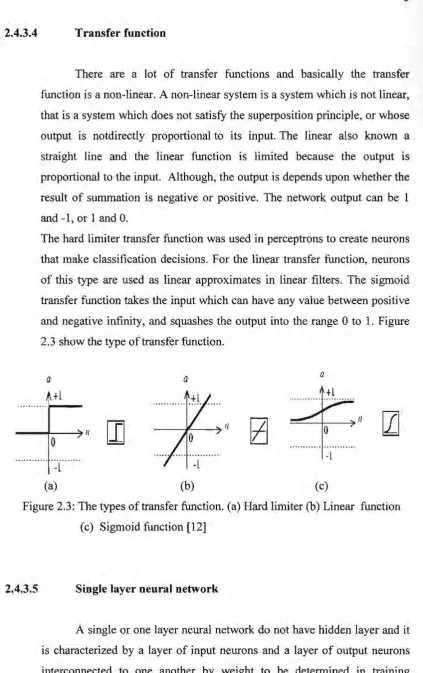
There are a lot of transfer functions and basically the transfer
function is a non-linear. A non-linear system is a system which is not linear,
that is a system which does not satisfy the superposition principle, or whose
output is notdirectly proportional to its input. The linear also known a
straight line and the linear function is limited because the output is
proportional to the input. Although, the output is depends upon whether the
result of summation is negative or positive. The network output can be 1
and -1, or 1 and 0.
The hard limiter transfer function was used in perceptrons to create neurons
that make classification decisions. For the linear transfer function, neurons
of this type are used as linear approximates in linear filters. The sigmoid
transfer function takes the input which can have any value between positive
and negative infinity, and squashes the output into the range 0 to 1. Figure
2.3 show the type of transfer function.
a a
+l
f
-0
~II
[ ]-l
(a) (b)
-l
[image:23.595.110.534.46.720.2](c)
Figure 2.3: The types of transfer function. (a) Hard limiter (b) Linear function
(c) Sigmoid function (12]
2.4.3.5 Single layer neural network
A single or one layer neural network do not have hidden layer and it
is characterized by a layer of input neurons and a layer of output neurons
interconnected to one another by weight to be determined in training
process. This single layer neural network cannot give an accurate result in
2.4.3.6
2.4.3.7
10
power system because these networks represent a linear system. Figure 2.4
show single layered neural network
Figure 2.4: Single layered neural network [13]
Multi layered Neural Network
Multilayer neural network consist of an input layer, an output layer
and hidden layer(s) between the input and output cell. This hidden layer interconnected with one another by weights to determine training process. Figure 2.5 show multilayered neural network.
!•lJ;'id
L,..l,.:r • ...-f.:... ... i t"C''..... <t:T• •, •
~YN
Figure 2.5: Multilayered neural network [13]
[image:24.595.103.557.52.842.2]![Figure 2.1: The model of neuron in hidden layer [6]](https://thumb-us.123doks.com/thumbv2/123dok_us/100817.9435/22.595.97.545.29.813/figure-the-model-neuron-hidden-layer.webp)
![Figure 2.4: Single layered neural network [13]](https://thumb-us.123doks.com/thumbv2/123dok_us/100817.9435/24.595.103.557.52.842/figure-single-layered-neural-network.webp)
