of models against a gold standard
.
White Rose Research Online URL for this paper:
http://eprints.whiterose.ac.uk/81657/
Article:
Brierley, C and Atwell, E (2007) Prosodic phrase break prediction: problems in the
evaluation of models against a gold standard. TAL Journal: Traitement Automatique des
Langues, 48 (1). 187 - 206. ISSN 1248-9433
[email protected] https://eprints.whiterose.ac.uk/ Reuse
Unless indicated otherwise, fulltext items are protected by copyright with all rights reserved. The copyright exception in section 29 of the Copyright, Designs and Patents Act 1988 allows the making of a single copy solely for the purpose of non-commercial research or private study within the limits of fair dealing. The publisher or other rights-holder may allow further reproduction and re-use of this version - refer to the White Rose Research Online record for this item. Where records identify the publisher as the copyright holder, users can verify any specific terms of use on the publisher’s website.
Takedown
If you consider content in White Rose Research Online to be in breach of UK law, please notify us by
Prosodic Phrase Break Prediction:
Problems in the Evaluation of Models
against a Gold Standard.
Claire Brierley - Eric Atwell
School of Computing, University of Leeds, Woodhouse Lane Leeds, LS2 9JT, U.K., {claireb, eric}@comp.leeds.ac.uk
ABSTRACT. The goal of automatic phrase break prediction is to identify prosodic-syntactic boundaries in text which correspond to the way a native speaker might process or chunk that same text as speech. This is treated as a classification task in machine learning and output predictions from language models are evaluated against a ‘gold standard’: human-labelled prosodic phrase break annotations in transcriptions of recorded speech - the speech corpus. Despite the introduction of rigorous metrics such as precision and recall, the evaluation of phrase break models is still problematic because prosody is inherently variable; morphosyntactic analysis and prosodic annotations for a given text are not representative of the range of parsing and phrasing strategies available to, and exhibited by, native speakers. This article recommends creating automatically-generated POS tagged and prosodically annotated variants of a text to enrich the gold standard and enable more robust ‘noise-tolerant’ evaluation of language models.
RESUME. L'objectif de la prédiction automatique des frontières entre syntagmes est d'identifier dans le texte les frontières prosodiques et syntaxiques qui correspondent à la manière dont un locuteur natif traiterait ou découperait ce texte en parlant. Ceci correspond à une tâche de classement en apprentissage automatique et les prédictions produites à partir des modèles de langage sont évaluées à l'aide d'un corpus de référence, c'est-à-dire un corpus de parole transcrite annoté manuellement par les frontières prosodiques entre syntagmes. Malgré l'utilisation de mesures rigoureuses comme la précision et le rappel, l'évaluation des modèles de frontières entre syntagmes reste problématique car la prosodie est intrinsèquement variable : l'analyse morphosyntaxique et les annotations prosodiques d'un texte donné ne sont pas représentatives de l'ensemble des stratégies d'analyse et de découpage possibles utilisées par les locuteurs natifs. Cet article recommande de générer automatiquement des variantes d'étiquetage morphosyntaxique et d'annotation prosodique d'un texte pour enrichir le corpus de référence et permettre une évaluation des modèles de langage plus robuste et tolérante au bruit.
KEYWORDS: Evaluation, prosody, supervised learning, statistical methods
MOTS-CLES : évaluation, prosodie, apprentissage supervisé, méthodes statistiques
1. Introduction
Prosodic phrasing is a universal characteristic of language (Ladd, 1996) and
refers to the way speakers of any given language process speech as a series of chunks: meaningful, stand-alone clusters of words which have some relationship to syntactic phrase structure, the ‘natural joints’ in sentences (Abney, 1995). The correlation and discrepancy between prosody and syntax is a continuing debate in the literature; but there does appear to be consensus on the fact that prosodic phrasing is simpler, shallower and flatter than syntactic structure. Abney (1992) proposes the unifying concept of performance structure, the way in which prosody and syntax interact in practice.
Performance structure in English is realised and perceived as a partnership between pitch accents and pauses which draws attention to these natural joints or boundaries in the speech stream. In text, prominent boundaries are marked by punctuation and it is second nature for us to associate different intonation and different degrees of pause with the various punctuation marks when reading that text aloud. Thus language models designed to predict prosodic phrase breaks from input text - for Text-to-Speech Synthesis applications, for example - will often use punctuation as a primary cue.
The goal of automatic phrase break prediction is, therefore, to identify natural joints in text which correspond naturally and intelligibly (these are the important criteria) to the way a native speaker might process or chunk that same text as speech. Once these boundaries have been discovered, the intervening text can be ‘animated’ with prosody - that is, given a suitable intonation contour. The shape of that synthetic contour and its faithfulness to fundamental frequency patterns in natural language will depend to some extent on how well accordance and anomaly at the prosody-syntax interface is understood.
Prosodic phrasing and intonation exhibit a dual purpose in speech: a chunking function to identify meaningful - and syntactically coherent - clusters of words and a highlighting function to emphasise salient items within clusters. In English, chunking and highlighting are often conflated (Peppe, 2006): prominent words tend to complete a phrase group and so occupy pre-boundary position. The convergence and non-convergence of these functions has consequences for the evaluation of language models that try to simulate them. How can a model distinguish between them when the empirical data from which the model is derived makes no such apparent distinction?
The incentive behind this question will be discussed in sections 4 and 5 of this
performance. The proposals for future work in section 6 include the idea of generating parallel tiers annotated with different prosodies for an existing corpus which will then serve as a new gold standard for the task of phrase break prediction.
2. Automatic phrase break prediction: overview of process
Techniques for automated prediction of prosodic phrase boundaries in text, typically for Text-to-Speech Synthesis (TTS) applications, can be deterministic or probabilistic. In either case, the problem of phrase break prediction is treated as a classification task and outputs from the model, as in other Natural Language Processing (NLP) applications such as part-of-speech (POS) tagging, are evaluated against a human-labelled ‘gold standard’ corpus (Jurafsky and Martin, 2000 p.308), also known as a ‘reference dataset’ in the speech research community. For prosody, this gold standard is a test set where original transcriptions of recorded speech in the speech corpus include prosodic annotations by experts. Annotation systems commonly used for phrase break prediction are ToBI - Tones and Break Indices (Beckman & Ayers, 1997) - where the break index tier distinguishes 5 levels of juncture between words on a scale of 0 - 4, and the British system exemplified in SEC - the Spoken English Corpus (Taylor and Knowles, 1988) - which identifies 3 levels: no boundary, minor phrase boundary, major intonational phrase (IP) boundary. Minor and major boundaries are assigned the pipe symbols: < | > and < || > respectively, and map to break indices 3 and 4 in ToBI. In Roach (2000), these same symbols denote tone unit boundary < | > and pause < || >.
2.1. Rule-based methods
A standard rule-based method commonly used in TTS is to employ some form of ‘chink-chunk’ algorithm which inserts a boundary after punctuation and whenever the input string matches the sequence: open-class or content word (chunk) immediately followed by closed-class or function word (chink), based on the principle that chinks initiate new prosodic phrases. Bell Labs speech synthesizer uses this kind of rule to identify low-level phrasal units or f-groups (Abney, 2006). Variants of this algorithm may seek to shuffle parts-of-speech (POS) between open and closed-class groupings; the chink-chunk algorithm proper (Liberman and Church, 1992) treats tensed verb forms as chinks and object pronouns as chunks for more natural phrasing.
number of syllables in an intonational phrase if there is no intervening punctuation.
2.2. Statistical methods
The leading study in the use of statistical methods for phrase break prediction is Taylor and Black’s Markov model (1998), trained and tested on MARSEC, the Machine Readable Spoken English Corpus (Roach et al, 1993) and used in Edinburgh’s Festival speech synthesis system (Black et al, 1999; Black, 2000). The training data for this supervised learning model is ‘text’ represented by a sequence of POS tags which include boundary tags. The model is structured such that states represent types of break - the desired classification outputs of break or non-break - and transitions represent likelihoods of phrase break sequences occurring. The model thus ‘learns’ the classification task by integrating two sets of information: the probability of a POS sequence, given juncture type, and the probability of a particular sequence of juncture types occurring. This extensive study actually goes on to compare the performance of both probabilistic and deterministic language models over six experimental settings, with a best score of 79% breaks-correct achieved with a higher order n-gram model and a more streamlined tagset obtained by post-mapping the output of the POS-tagger onto a smaller tagset of 23.
Busser et al (2001) compare the effectiveness of a Memory-Based Learning (MBL) approach to predicting phrase breaks in MARSEC to Taylor and Black’s (‘gold standard’) use of HMMs for the same purpose. MBL is a supervised-learning approach where classification of data is made on the basis of maximum similarity to items in memory. In this study, the set of feature values descriptive of phrase break contexts, and used as input to train the classifier is: the orthographic form of the word in question; its POS tag; its CFP-value (status as content word, function word or punctuation mark); and an expanded tag which gives the word itself if it is a function word and the POS tag otherwise. A fixed-width feature vector of two words both to the left and right of the focus position in question supplies the context from which to extrapolate the ‘minority’ class 1 (break) or more frequent class 0 (non-break i.e. ordinary juncture). The study involves converting Taylor and Black’s results over six experiments to the MBL metrics of precision, recall and F-score (see the discussion on performance measures in section 3) for the purposes of comparison and then experimenting with further optimization of these metrics, creating a different mix of information in the feature vectors via leave-one-out experiments and cross-validating against the training set. Busser et al report an improvement on the best HMM result for recall with a simple MBL algorithm which takes a limited context of one POS to the left and right of the focus position and assigns equal weighting to each of these positions.
constitute a reduced, optimal tagset for phrase break prediction. Read and Cox use what they term a flattened prosodic phrase hierarchy classification of break/non-break on datasets from the Boston Radio News Corpus (Ostendorf et al, 1995) and MARSEC, and to evaluate their phrase break prediction model, use Taylor and Black’s junctures correct measure, that is the percentage of non-breaks correctly predicted.
The statistical modelling technique known as CART (a Classification and Regression Tree) is used by Wang and Hirschberg (1991) to predict prosodic phrase boundaries from features that can be automatically generated from text. ‘Learning’ for this decision tree method includes training the splitting rules at each decision point in the tree to select the feature/value split which minimises prediction error rate in the training set. In this study, such features include: length of utterance in seconds and words; position of potential boundary site and distance from beginning and end of utterance; and syntactic constituents adjacent to the boundary site. An important additional feature used to compare the performance of the original model to an enhanced model which incorporates hand-labelled transcriptions in the data set (298 sentences of air travel information from DARPA, 1990) is accent status of <wi>, where <wi , wj> represents words either side of the boundary site. The best
performing variable set included information from prosodic annotations of pitch accent and prior boundary location, giving a success rate of 90% boundaries correct and a streamlined tree with only 5 decision points.
A related and more recent study (Koehn et al., 2000) builds on an augmented version of the above feature set (Hirschberg and Prieto, 1996) by adding syntactic information from a high accuracy syntactic parser. The ‘1996’ feature set consists of the following: a 4-word POS window and a 2-word accent window; the total number of words and syllables in the utterance; word distance from start and finish of the utterance in words, syllables and stressed syllables; distance from last punctuation mark and what punctuation, if any, follows the word; position of word in relation to, or within, a noun phrase; and finally, size and distance of word from start of noun phrase. The ‘2000’ feature set builds on the intuition that prosodic phrase breaks occur between large syntactic units {NP, VB, PP, ADJP, ADVP} and incorporates binary flags indicating which words initiate a major phrase or a sub-clause. The study reports a 90.8% prediction rate for boundary detection which is cross-validated using other machine learning algorithms: a boosting algorithm, a rule learner, a boosted decision tree classifier and an alternating decision tree method.
3. Evaluation metrics used in studies
accuracy and error measures discussed in Taylor and Black (1998) and presented in
Tables 1 and 2 below. % breaks-correct (true positives)
breaks correctly predicted / total number of breaks in test set % non-breaks-correct
(true negatives)
non-breaks correctly predicted /
total number of non-breaks in test set x 100 % junctures-correct (breaks + non-breaks) correctly predicted /
[image:7.595.125.473.303.381.2]total number of junctures in test set
Table 1. Accuracy measures for phrase break prediction
% insertion errors (1) (false positives)
breaks retrieved by model / total number of breaks in test set % insertion errors (2) breaks retrieved by model /
total number of junctures in test set x 100 % deletion errors
(false negatives)
breaks missed by model / total number of breaks in test set
Table 2. Error measures for phrase break prediction
Taylor and Black argue that breaks-correct is a better measure of algorithmic performance than junctures-correct because the latter includes non-breaks in the calculation and these are always more numerous.
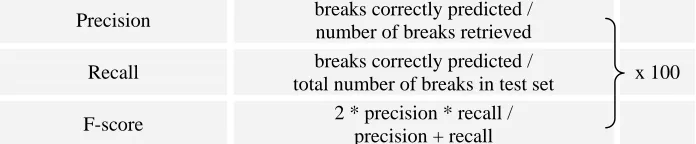
The second group of evaluation metrics employed in statistical NLP (and for phrase break prediction see the aforementioned: Koehn et al, 2000; Busser et al, 2001; Atterer and Klein, 2002) are taken from the field of Information Retrieval and are known as precision and recall. The latter corresponds exactly to the
breaks-correct measure, while the former equates to positive predictive value: in this case,
the proportion of correct (relevant) predictions out of all the predictions made. In practice it is usual to combine precision and recall into a single overall performance measure or F-score which tends to maximise true positives (Manning and Schütze, 1999) - in this case breaks-correct. Table 3 shows how precision, recall and F-score are interpreted for the task of phrase break prediction.
Precision breaks correctly predicted / number of breaks retrieved Recall breaks correctly predicted /
total number of breaks in test set x 100 F-score 2 * precision * recall /
[image:7.595.124.472.593.665.2]precision + recall
Phrase break prediction models are evaluated in terms of their ability to match boundary annotations in the test corpus. However, the long-term view is that the model will be able to generate intelligible and natural prosodic phrasing for any input text. It is hoped the model will have learnt the classification task well enough to make generalisations from the gold standard to the new domain. If it hasn’t, it runs the risk of imposing a prosody template (one speaker, one realisation, one moment in time) on unsuspecting text. Some models over-predict; but how many of their false insertions or false positives are nevertheless valid in terms of performance structure? How many missed boundaries or false negatives in a given model are significant omissions?
4. A gold standard for prosodic phrasing
Two publications discussed in this paper raise questions about the practice of evaluating a prosodic phrase break model against a gold standard; in both cases the iconic prosodic annotations in versions of the Spoken English Corpus. Taylor and Black (1998) state that performance figures obtained in such experiments should be ‘…treated with caution…’ because prosody itself is subjective: different speakers pause in different places; one speaker will vary their use of pauses; expert annotators differ in their perceptions. Similar comments about variability in human performance appear in Hirschberg (2002). Taylor and Black also point out that junctures differ in type: those junctures which coincide with weaker syntactic boundaries are more likely to be potential prosodic boundary sites (see also Abney, 1992; Abney, 1995). Atterer and Klein (2002) encapsulate all these reservations: ’…the very notion of evaluating a phrase-break model against a gold standard is problematic as long as the gold standard only represents one out of the space of all acceptable phrasings…’
4.1. Inter-annotator agreement
The ‘spaciousness’ of acceptable prosody can be demonstrated straightaway by the gold standard itself in Figures 1 and 2, a sample from Section C in Aix-MARSEC (Auran et al, 2004), an augmented version of the Spoken English Corpus with multi-level annotation tiers covering a range of segmental and suprasegmental features. The extract comes from a Reith Lecture and is illustrative because, while there is only one speaker, there are two alternative phrasings: this is one of the overlapping sections of prosodic annotation from Briony Williams and Gerry Knowles (approximately 9% of the corpus).
overall (35 instead of 29). Both annotators insert a boundary at every punctuation mark in the original raw text transcript - another acceptable phrasing, perhaps?
for some people | this statement of orthodox economic doctrine | may appear | too unqualified || since it fails to mention explicitly | security of supply || often | though not always | the case for self sufficiency is argued | with reference to a country's need to ensure security | by minimising dependence | on foreign sources || the outside world is seen | at best | as unreliable | and subject to instability | at worst | as actively hostile || from this fortress mentality | standpoint | autarchy | appears |
to be common prudence || two sets of measures | then suggest themselves | one is to
build up | domestic production of essentials | so as to reduce imports | to a minimum | the other | is to restrict exports | so as to ensure | that domestic supplies | are available | for domestic use ||
Figure 1. This is a sample of Gerry Knowles’ phrase break annotations for a BBC
recording of a Reith Lecture from the 1980s.
for some people | this statement of orthodox economic doctrine | may appear too unqualified || since it fails to mention explicitly | security of supply || often | though not always | the case for self sufficiency is argued | with reference to a country's need to ensure security | by minimising dependence on foreign sources || the outside world is seen at | best | as unreliable | and subject to instability | at worst | as actively hostile || from this fortress mentality standpoint | autarchy appears to be
common prudence || two sets of measures | then suggest themselves | one | is to
build up domestic production of essentials | so as to reduce imports | to a minimum || the other | is to restrict exports | so as to ensure | that domestic supplies | are available for domestic use ||
Figure 2. Briony Williams’ phrase break annotations for the same sample as Fig. 1.
Figure 3 shows both annotators largely in agreement on phrasing and on emphatic, bi-tonal accents (rise-falls) in a snapshot sentence from Figs. 1 and 2. The only area of dispute is whether or not to include a boundary after the word ‘…dependence…’
,often | though not `/always | the case for self sufficiency is `/argued | with
reference to a country's need to ensure se`/curity | by minimising dependence | on foreign sources
Figure 3. This is the corpus version, showing all prosodic phrase breaks noted by
Knowles and Williams and the pitch accent annotations on words preceding boundaries where the experts are in agreement.
often | though not always | the case for self sufficiency | is argued | with reference to a country's need | to ensure security | by minimising | dependence on foreign sources
Figure 4. This alternative phrasing is largely achieved within the performance
structure of the original - see discussion in section 4.2.
4.2. The space of acceptable phrasings
The emphatic combination of (high) chunking accent and boundary in the matching annotations in bold in Fig. 3 is typical of English. An emphasis-boundary pattern has now been engineered in Fig. 4 for the participle ‘…minimising |…’ (which gets a high level pitch accent from both annotators) and could enhance the infinitive construction ‘…to ensure security…’ if a boundary were to be placed before the noun.
new instance: [NP a country’s need] | [VP to ensure | security] new instance: [VP to ensure | security] [PP by minimising dependence] new instance: [PP by minimising | dependence] [PP on foreign sources]
Figure 5. Prosodic boundaries are shown in relation to the large syntactic units
{NP, VB, PP, ADJP, ADVP} featured in Koehn et al, (2000).
The difference between these new instances and the original template in Fig. 3 is
emphasise ‘doing’. Furthermore, even though they would be classed as false
insertions when compared to the corpus gold standard, they are definitely not wrong.
4.3. Different boundary types
Of course, that is not the end of the story. A new complication now arises in that these different types of boundaries - the chunkers higher up the syntax tree and the
highlighters lower down the tree - are not differentiated in the corpus. It would be
nice if they were analogous to major and minor boundary classifications and the symbols: < || > and < | >. This is not the case, however. Figures 6 and 7 show the same annotator (in this case Briony Williams) using different phrase break annotations to flag up major clause boundaries in a news bulletin and a lecture. The association of double pipes (ToBI’s break index 4) with major syntactic groupings, plus the use of pitch accent annotations without boundary reinforcement for highlighting in the first extract, seems much clearer.
there are ~two \,scanning machines || which give an `/X ray picture | on two tele`/vision *screens || of the _contents of `hand *baggage || when `/I've been through *Athens airport || and `that's about *two dozen `times in the past *two `/years || there's `/never been more than ~one se\,curity man on *duty || and ~he's \frequently reading a `newspaper || or ~chatting with _other `airport *staff ||
Figure 6. This is a sample of Briony Williams’ annotations of informal news
commentary from a BBC radio broadcast from the 1980s. It shows correspondence between major intonation unit boundaries and major clause boundaries.
the `/history | of ~British nuclear ,power programmes | ~over the past thirty ,years | >pro_vides a de~pressing e\xample | of ~unreflecting _centralism in `action || `stoutly rein`forced | _I may /add | by `/other forms | of _DIY`E || `one aspect of this ,centralism | is the i`/dea | which has been em~braced by su*ccessive British _governments of `/both parties | that a ,choice | `has to be made | at `/Cabinet level | of ~one par,ticular re`/actor system | for _future nuclear `power stations | in \Britain ||
Figure 7. Another sample annotation from Briony Williams shows minor intonation
unit boundaries being used to demarcate major clause boundaries.
5. Developing a syntax-driven model
experimenting with syntax-driven, rule-based models using nltk_lite’s regular expression chunk parser (Bird and Loper, 2006). The first model uses the discrete syntactic grouping of prepositional phrases to locate prosodic boundaries (see Brierley and Atwell, 2007 for a full account of experimental work here) and the current prototype recognises potential boundary sites via POS tag oppositions (in effect unweighted bigrams) observed from empirical data in Aix-MARSEC. Sample predictions from this prototype rule are illustrated in Figs. 8 and 9 for two reasons: to demonstrate some of the problems encountered when interpreting and evaluating outputs from prosodic phrase break models (even developmental models) against a corpus gold standard; and for interested readers familiar with the Natural Language Toolkit (NLTK) and the chunking tutorial in particular (Bird et al, 2007). The outputs themselves are similar to those of other CFP algorithms in that they capture low level phrasal units; but the rule is also able to match corpus phrasing which discriminates between function words (see bold items in Fig. 8), one objective of model design being to explore the conventional mapping of function words to chinks.
… cast/VBN their/POSS spell/NN | not/XNOT only/RB | on/IN our/POSS eminent/JJ professional/JJ colleague/NN Dr/NPT FitzGerald/NP | but/CC
also/RB | on/IN Mr/'NPT Howell/NP | who/WP himself/PPL | has/HVZ
a/AT First/OD Class/NNP degree/NN | in/IN Economics/NNP…
Figure 8. A representation of phrase break predictions from a syntax-driven rule
which finds boundaries in the corpus that occur between function words.
Raw predictions in Fig. 9 below show the rule working quite well on a sentence from the Reith Lecture transcript; the annotator here is Briony Williams. True positives (boundaries correct) are marked Z and false positives (false insertions) marked Y. Commas were deliberately stripped from input text and comma sites retrieved by the rule at major chunking boundaries are therefore given in bold. NLTK’s chunking tutorial referred to above recommends ‘…several rounds…’ of rule development and testing in order to create a good chunker. The data in Figs. 8 and 9 was obtained by running a simple chunking algorithm on part of the Reith Lecture transcript annotated by Briony Williams (1463 tokens); manually examining outputs and refining the rule; and running the revised rule on the same section and finally on a previously unexamined section - i.e. the remainder of the Reith Lecture transcript annotated by Gerry Knowles (2445 tokens). Scores were recorded as shown in Table 4.
('one', 'CD')
(INSERT_BOUNDARY: ('aspect', 'NN') ('of', 'IN')) Y ('this', 'DT')
('the', 'ATI')
(INSERT_BOUNDARY: ('idea', 'NN') ('which', 'WP')) Z ('has', 'HVZ')
('been', 'BEN')
(INSERT_BOUNDARY: ('embraced', 'VBN') ('by', 'IN')) Y ('successive', 'JJ')
('British', 'JNP')
(INSERT_BOUNDARY: ('governments', 'NNS') ('of', 'IN')) Y ('both', 'ABX')
(INSERT_BOUNDARY: ('parties', 'NNS') ('that', 'CS')) Z ('a', 'AT')
(INSERT_BOUNDARY: ('choice', 'NN') ('has', 'HVZ')) Z ('to', 'TO')
('be', 'BE')
(INSERT_BOUNDARY: ('made', 'VBN') ('at', 'IN')) Z ('Cabinet', 'NP')
(INSERT_BOUNDARY: ('level', 'NN') ('of', 'IN')) Z ('one', 'CD1')
('particular', 'JJ') ('reactor', 'NN')
(INSERT_BOUNDARY: ('system', 'NN') ('for', 'IN')) Z ('future', 'NN')
('nuclear', 'JJ') ('power', 'NN')
(INSERT_BOUNDARY: ('stations', 'NNS') ('in', 'IN')) Z ('Britain', 'NP')
[image:13.595.127.473.145.481.2]('.', '.')
Figure 9. Phrase break predictions from a rudimentary syntax-driven rule retrieve
sites of commas at major clause boundaries.
Annotator Precision Recall F-score
Test 1 BW 65.19% 59.03% 61.96%
Test 2 BW 66.76% 71.35% 68.98%
Test 3 GK 70.85% 61.04% 65.58%
Table 4. Sample P, R and F-scores from development tests on chunk parse phrase
break rule based on unweighted bigrams
[image:13.595.118.475.553.607.2]not so enlightening as close scrutiny of, and reflection on, raw outputs from the model as represented in Figs. 8 and 9 and discussed in sections 5.1 to 5.3 below. Many experimental accounts do not cover such details; and yet might it not be the case that these details give us insights into the nature of prosodic variability so that we can design better models?
5.1. Chunking versus highlighting
The examples in section 4 demonstrate how denser prosodic phrasing (highlighting) can be inserted into the existing chunk structure of a sentence. The rest of section 5 covers instances where prosody redistributes prominence, first by ignoring, and second by shifting chunk boundaries.
True positives in Fig. 9 above evidence a reliable rule-of-thumb when a major clause boundary and comma-site is retrieved before a subordinating conjunction: ‘…the idea | which has been embraced | by successive British governments | of both parties | that a choice | has to be made…’
This is generally a POS context where prosody, performance structure and syntax (Abney, 1992) are in agreement: a prosodic boundary generally occurs with a major clause boundary. Nevertheless, the mismatch between prediction and empirical evidence in Fig. 10 below shows the speaker making a different chunking choice for this POS context - glossing over a major syntactic boundary and favouring the highlighting over the chunking function of prosody by placing adjectives
‘…important…self-sufficient…’ in phrase-final position. Consequently,
predictions-by-rule quickly get out of sync with empirical phrasing (though not out of sync with naturalness) because they each start to take a different processing route through the sentence. As a final twist, however, predicted phrasing manages to regain contact with the original after coverage of the theme (everything before the copula) is complete (see bold items in Fig. 10).
Corpus phrasing:
‘…The idea that it’s important | for developing countries to become self-sufficient | in food | is widely | and uncritically accepted | not just in Brussels; | but from the orthodox economic standpoint | it’s without foundation…’
Predicted phrasing:
‘…The idea | that it’s important for developing countries | to become self-sufficient in food | is widely | and uncritically accepted | not just in Brussels | but from the orthodox economic standpoint | it’s without foundation…’
Figure 10. Predicted phrasing matches the corpus once the theme (everything
5.2. Prepositions versus verb particles
The prototype rule inserts a boundary before true prepositions, POS-tagged <IN>. This accounts for false inserts - but legitimate, if somewhat emphatic (‘Tony Blair style’) prosodic phrasing - in the following sentence fragment in Fig. 11. Corpus phrasing:
‘…the idea | which has been embraced by successive British governments of both parties | that a choice | has to be made…’
Predicted phrasing:
‘…the idea | which has been embraced | by successive British governments | of both parties | that a choice | has to be made…’
Figure 11. Predicted phrasing abides by the gold standard POS tagged version of
this sentence which classifies the function word ‘…by…’ as a preposition.
It will be noted from Fig. 9 that there are four empirically verified (true positive) phrase boundaries before prepositions in the section as a whole. Moreover, since the POS-tagged version of this text is itself a gold standard, and since this version classifies ‘…embraced by…’ as <VBN><IN> (a past participle followed by a preposition), we have a situation where two equally valid gold standards - tagged text versus prosodic annotation - are in conflict. This arises because the same speaker in this particular instance has realised ‘…embraced by…’ as one unit and,
via prosody, has in effect tagged the preposition as a verb particle: <VBN><RP>.
This rules out an intervening chunking prosodic phrase boundary and significant
chunking accent on ‘…embraced…’ Corpus annotation on the verb testifies to this:
em~braced is a level accent.
5.3. A conflict of standards?
Abney (1991) raises the thorny issue of prepositional phrase attachment, ‘…the most explosive source of ambiguity in parsing…’ The POS identity of ‘…embraced by…’ (see section 5.2 and Fig 12 below) is a case in point: is it <VBN><RP> or is it <VBN><IN>? If the function word by is tagged <RP>, it falls within the subcategorisation frame of the verb and is classed as an argument; whereas if it is tagged <IN>, its attachment is to the ensuing noun (‘…by successive British
governments…’) and its behaviour is that of an adjunct - see Merlo et al (2006) for
(1) [NP the idea] | [VP which has been embraced by] [NP successive governments] (2) [NP the idea] | [VP which has been embraced] | [PP by successive governments]
Figure 12. Alternative ‘chunk’ parsing strategies for sentence fragment.
The ‘blended category’ POS status (Manning and Schutze, 1999) of by in this instance is an opportunistic moment for the speaker to run with one of two different prosodies and two different parsing strategies as shown in Fig.12. Strategy (1) is the corpus version and strategy (2) is the version created by the POS-tagger. Since both versions are inherent in the plain text and both are equally valid, then perhaps such ‘conflicts’ can be resolved by generating POS tagged and prosodically annotated
variants for a given text? These parallel prosodic-syntactic realisations will then
enrich the gold standard and enable more robust, i.e. ‘noise-tolerant’, evaluation of language models and contribute to our understanding of linguistic phenomena, the goal of ‘speech science’ as defined by Huckvale (2002). Moreover, the idea of including variant annotations in a gold standard has been proposed and/or adopted in other areas of computational linguistics. It is well-established that two or more linguists may disagree on the analysis/annotation of a given sample of data (Shriberg and Lof 1991, Carletta 1996, Bayerl and Paul 2007); and sometimes both analyses can be legitimate. The MorphoChallenge2005 gold standard for evaluation of morphological analysis programs entered for the contest (Kurimo et al 2006) included occasional variant morphological segmentations; for example: pitchers can legitimately be analysed as pitch er s, OR pitcher s. Part-of-Speech taggers are normally expected to predict a single unambiguous PoS-tag for each word, but the gold standard Penn Treebank does allow for rare occasions when the Part of Speech is genuinely ambiguous (Santorini 1990, Marcus et al 1994, Atwell 2007); for example: The duchess was entertaining last night, the word entertaining is tagged JJ|VBG - Adjective OR Present Participle Verb. Similarly, a Multitreebank or collection of variant syntactic analyses of sentences can be used for comparative evaluation of rival parsing programs (Atwell, 1996), corpus linguists' parsing schemes (Atwell et al, 2000), and unsupervised machine learning Grammatical Inference systems (van Zaanen et al 2004).
6. Conclusions and further work
encapsulated in the prosodic annotations in the corpus. The quantifiable measures of success are then expressed as: boundaries-correct, recall, precision and f-score. It must be remembered, however, that what we really need from a phrase break prediction model is the ability to distinguish different types of boundary. One set of boundary types has something to do with length: there are major intonational phrases which are then made up of lower-level units, variously termed f-groups and
φ-phrases. Another set of boundary types may be described via the simplifying concepts of chunking and highlighting. Chunking boundaries may be said to correspond to syntactic joints and may be manifest at different levels in the syntax tree. It might be hypothesised that highlighting boundaries occur much lower down the tree and that they can even split up the individual constituents of low-level syntactic units. A further characteristic of English is that it likes to chunk and highlight at the same time.
Boundary annotations in the corpus gold standard (the ultimate performance measure) do not consistently make these distinctions between boundary types. The few samples discussed in this paper have already shown that the annotation symbol for minor intonation phrase units (< | >) is used variously at major syntactic clause boundaries, f-group boundaries and within f-groups. A machine learner which uses the accent-boundary association as part of its context may therefore give better performance. The co-occurrence of falling accent and new clause initiated by a coordinating conjunction, for example, is a useful pattern signifying a major intonational phrase boundary in English. Performance might also be enhanced by incorporating features from parallel annotation tiers such as those provided by the Aix-MARSEC Project.
The wider problem when comparing predicted versus annotated boundaries is that the corpus gold standard embodies all the inconsistencies of human performance. One such inconsistency is that no two prosodies are alike and different speakers will employ different chunking and highlighting strategies for the same string. An individual speaker will also vary their treatment of the same POS context. Despite the fact that speech corpora contain recordings of utterances from a range of speakers, each annotated transcript only represents one in the space of possible performance strategies for a given text. Phrasing models will miss some boundaries simply because they were not designed to recognise that type of boundary in the first place. They will also predict alternative phrasing to that of the corpus, resulting in so-called false insertions. Again, examination of the gold standard in section 4.2 of this paper shows that boundaries can be inserted without disrupting the speaker’s original processing route through a sentence.
and then running it on the target corpus. Alternative predictions emerging from this process in the form of extra or erased boundaries would then need to be verified for naturalness and intelligibility by human subjects.
Finally, sections 4 and 5 of this paper suggest that alternative prosodies might be explored and generated by incorporating the following in the design of models: differentiation between chunking and highlighting boundaries; differentiation between major and minor chunking boundaries; strategic modelling of different prosodies by targeting certain parts of speech - a verbs version, perhaps, as well as the more usual bias towards nouns (see section 4.1 in particular). Design-orientation of such phrase break models would then need to be factored into the per cent correct score. Overall, automatically-generated phrasing variants would be a natural extension to a multi-tiered corpus such as Aix-MARSEC; and passages like the one discussed in Fig. 6, which support these kinds of distinctions, would seem a good place to start. There are precedents for allowing alternative legitimate analyses in a gold standard corpus in other levels of linguistic research, for example in morphosyntactic analysis (Kurimo et al 2006), Part-of-Speech tagging (Santorini 1990, Atwell 2007), parsing (Atwell 1996), Grammatical Inference (van Zaanen et
al 2004). So, we should also allow for encoding of genuine ambiguity in a gold
standard corpus for evaluation of prosodic phrase break prediction models.
7. References
Abney S., “Parsing by Chunks.” In: Principle-Based Parsing: Computation and Psycholinguistics Berwick R.C., Abney S., Tenny, C., (eds.), Kluwer Academic Publishers, Dordrecht (1991)
Abney S., “Prosodic Structure, Performance Structure and Phrase Structure.” In: Proceedings, Speech and Natural Language Workshop, pp.425-428. Morgan Kaufmann Publishers, San Mateo, CA. (1992)
Abney S., “Chunks and Dependencies: Bringing Processing Evidence to Bear on Syntax.” In: Computational Linguistics and the Foundations of Linguistic Theory. CSLI. (1995)
Abney S., “Statistical Methods.” Encyclopedia of Cognitive Science.” Nature Publishing Group, Macmillian. (2002)
[Accessed December, 2006: http://www.vinartus.net/spa/publications.html]
Abney S., “Introduction to Computational Linguistics: Chunk Parsing.” PowerPoint presentation (2006)
[Accessed December 2006: www.cs.um.edu.mt/~mros/csa2050/ppt/chunking.ppt]
Atterer M., “Assigning Prosodic Structure for Speech Synthesis: a Rule-Based Approach.” In Proceedings of the First International Conference in Speech Prosody, SP2002 Aix-en-Provence, France (2002)
Atwell, E. "Comparative evaluation of grammatical annotation models" In Sutcliffe, R, Koch, H & McElligott, A (editors) Industrial Parsing of Software Manuals, pp. 25-46 Rodopi. (1996)
Atwell, E., Demetriou, G., Hughes, J., Schriffin, A., Souter, C., Wilcock, S., "A comparative evaluation of modern English corpus grammatical annotation schemes". ICAME Journal, vol. 24, pp. 7-23. (2000)
Atwell, E. “Development of tag sets for part-of-speech tagging” In: Lüdeling, A., Kytö, M., (editors) Corpus Linguistics: An International Handbook Mouton de Gruyter (2007)
Auran C., Bouzon C., Hirst D., “The Aix-MARSEC Project: An Evolutive Database of Spoken English.” Presented at Speech Prosody 2004, International Conference; Nara, Japan, March 23-26, 2004, Bel B., Marlien I., (eds) ISCA Archive (2004)
Bayerl P., Paul, K., “Identifying sources of disagreement: Generalizability theory in manual annotation studies”. Computational Linguistics, Vol. 33 No. 1 pp.3-8 (2007)
Beckman M.E., Ayers G.M., “Guidelines for ToBI Labelling.” Department of Linguistics, Ohio State University. (1997) [Accessed September, 2006: http://www.ling.ohio-state.edu/research/phonetics/E_ToBI/ToBI/ToBI.1.html]
Bird S., Loper E., nltk_lite v. 0.6.5 (2006) [Accessed September, 2006: http://nltk.sourceforge.net/lite/doc/api/nltk_lite-module.html]
Bird S., Curran J., Klein E., Loper E., Chunking (2007) [Accessed March, 2007: http://nltk.sourceforge.net/lite/doc/en/chunk.html]
Black A.W., Taylor, P., Caley R., “The Festival Speech Synthesis System: System Documentation Festival” version 1.4 (1999) [Accessed December, 2006: http://www.cstr.ed.ac.uk/projects/festival/manual/festival_17.html]
Black A.W., Taylor, P., Caley R., “Speech Synthesis in Festival: A Practical Course in Making Computers Talk” Festival version 2.0 (2000) [Accessed December, 2006: http://festvox.org/festtut/notes/festtut_toc.html
Brierley C., Atwell E., “Using nltk_lite’s chunk parser to detect prosodic phrase boundaries in the Aix-MARSEC corpus of spoken English” Research Report 2007.02, School of Computing, University of Leeds (2007)
Busser B., Daelemans W., van den Bosch A., “Predicting phrase breaks with memory-based learning.” 4th ISCA Tutorial and Research Workshop on Speech Synthesis, Edinburgh (2001)
Carletta, J., “Assessing agreement on classification tasks: the kappa statistic.” Computational Linguistics Vol. 22, No. 2, pp.249-254 (1996)
Hirschberg J., Prieto P., “Training intonational phrasing rules automatically for English and Spanish text-to-speech.” In Speech Communication, Volume 18, Number 3, May 1996, pp. 281-290(10) (1996)
Huckvale, M., “Speech Synthesis, Speech Simulation and Speech Science”, In Proc. International Conference on Speech and Language Processing, Denver, pp1261-1264 (2002)
Koehn P., Abney S., Hirschberg J., Collins, M., “Improving Intonational Phrasing with Syntactic Information.” In Proceedings of IEEE International Conference on Acoustics, Speech, and Signal Processing, Vol 3, pp. 1289-1290, Istanbul, June, 2000 (2000)
Kurimo M., Creutz M., Varjokallio M., Arisoy E., Saraclar M., "Unsupervised segmentation of words into morphemes - Challenge 2005: An Introduction and Evaluation Report" In: Kurimo, M, Creutz, M & Lagus, K (editors) Proceedings of the PASCAL Challenge Workshop on Unsupervised Segmentation of Words into Morphemes. (2006)
Ladd, R. Intonational Phonology Cambridge, Cambridge University Press. (1996)
Liberman M.Y., Church K.W., “Text Analysis and Word Pronunciation in Text-to-Speech Synthesis” In Advances in Speech Signal Processing Furui S., Sondhi, M.M., (eds) New York, Marcel Dekker, Inc. (1992)
Manning C.D., Schutze H., Foundations of Statistical Natural Language Processing Cambridge, Massachusetts The Massachusetts Institute of Technology (1999)
Marcus M.P., Santorini B., Marcinkiewicz M.A., “Building a Large Annotated Corpus of English: The Penn Treebank” Computational Linguistics, Vol. 19, No.2, Pages 313-330 (1994)
Merlo P., Ferrer E.E., “The Notion of Argument in Prepositional Phrase Attachment” Computational Linguistics, September 2006, Vol. 32, No. 3, Pages 341-378 (2006)
Ostendorf M., Price P.J., Shattuck-Hufnagel S., “The Boston University Radio News Corpus” Boston University, Technical Report ECS-95-001 (1995)
Peppe, S., Private Correspondence (2006)
Read I., Cox S., “Using part-of-speech for predicting phrase breaks.” In INTERSPEECH-2004 pp. 741-744 (INTERSPEECH-2004)
Roach P., Knowles G., Varadi T., Arnfield, S.C., “Marsec: A machine-readable spoken English corpus” Journal of the International Phonetic Association, vol. 23, no. 1, pp. 47—53 (1993)
Roach P., English Phonetics and Phonology: A Practical Course (3rd. edition) Cambridge, Cambridge University Press (2000)
Shriberg, L., Lof, G., “Reliability studies in broad and narrow phonetic transcription”, Clinical Linguistics and Phonetics, Vol. 5, No. 3, pp.225-279 (1991)
Taylor P., Black A.W., “Assigning Phrase Breaks from Part-of-Speech Sequences.” In Computer Speech and Language, 12(2) pp. 99-117 (1998)
Taylor L.J., Knowles G., Manual of Information to Accompany the SEC Corpus: The machine readable corpus of spoken English University of Lancaster (1988) [Accessed September, 2006: http://khnt.hit.uib.no/icame/manuals/sec/INDEX.HTM]
Van Zaanen M., Roberts, A., Atwell, E., “A multilingual parallel parsed corpus as gold standard for grammatical inference evaluation” In Kranias, L., Calzolari, N., Thurmair, G., Wilks, Y., Hovy, E., Magnusdottir, G., Samiotou, A., Choukri, K., (editors) Proceedings of LREC'04 Workshop on The Amazing Utility of Parallel and Comparable Corpora, pp. 58-61 European Language Resources Association (2004)