White Rose Research Online URL for this paper:
http://eprints.whiterose.ac.uk/10289/
Article:
Robertson, Zoe and Judge, Simon (2007) 'What's your name?' A case study.
Communication Matters Journal, 21 (3). pp. 30-33. ISSN 0969-9554
[email protected]
https://eprints.whiterose.ac.uk/
Reuse
Unless indicated otherwise, fulltext items are protected by copyright with all rights reserved. The copyright
exception in section 29 of the Copyright, Designs and Patents Act 1988 allows the making of a single copy
solely for the purpose of non-commercial research or private study within the limits of fair dealing. The
publisher or other rights-holder may allow further reproduction and re-use of this version - refer to the White
Rose Research Online record for this item. Where records identify the publisher as the copyright holder,
users can verify any specific terms of use on the publisher’s website.
Takedown
If you consider content in White Rose Research Online to be in breach of UK law, please notify us by
A Case Study
What’s Your Name?
ZOË ROBERTSON & SIMON JUDGE
Assistive Technology Team, Barnsley District General Hospital, Gawber Road, Barnsley S75 2EP, UK Email: [email protected] [email protected]
INTRODUCTION
We all know and appreciate the benefits of social interaction and peer support. Being in an environment with our peers and people who have similar abilities and needs as ourselves is reassuring and con-fidence building. We only have to look at the recent explosion in social networking on the internet to see that it is something which people value. As well as using these networks to communicate with existing friends it is also possible to join interest-specific groups and meet people this way. Even though people met through these groups are often strangers, the shared in-terest/ability means it seems safe to communicate with them. It is often daunt-ing to be in a new social and work environment until we are able to establish a common interest with people, and then this allows us to relax.
Social networks and peer support are ob-viously equally important to people with disabilities and interacting with people with similar disabilities or - as presented in this paper, similar aids - can be ex-tremely important. Communication aid users may feel isolated or frustrated by a lack of peers or role models since it can be difficult to establish this peer environ-ment if you are a minority group.
Previous work has illustrated the benefits of both social networks and role models
(Musselwhite 2005, Blackstone 2005, Clarke 2005). There has also been devel-opment of functions such as the ability to tell jokes (O’Mara and Waller 1999, 2003) or partake in small talk (Cantine) with a communication aid - so enhancing a per-son’s ability to interact in a more natural conversation.
This paper describes an initiative which has organised communication mornings within Doncaster, Rotherham and Barnsley to give students using commu-nication aids an opportunity to meet other users and interact in a real environment.
BACKGROUND TO COMMUNICATION MORNING
The first communication morning was held at Sandall Wood School in Doncaster and was set up by an innovative member of staff. At that time the staff member supported a student using a communica-tion aid who had solely attended mainstream school and a couple of stu-dents who had been integrated into mainstream from Sandall Wood School. When visiting them she found that they felt like they were ‘the only people in the world with a communication aid’ and for this reason wanted to give them an op-portunity to interact with other users.
For the initial communication morning users were invited from Sandall Wood and
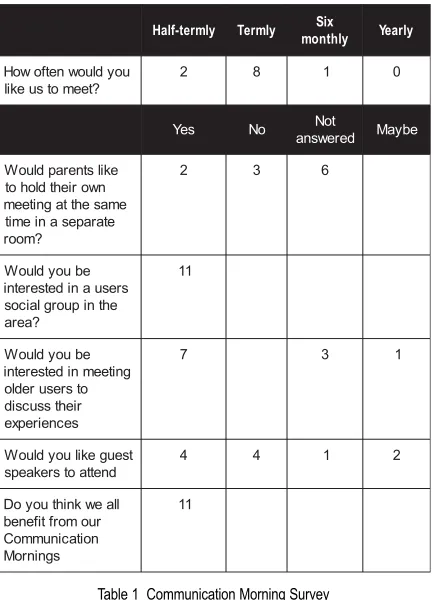
from mainstream schools within Doncaster. Along with the students, their parents, carers, speech and language therapists, teachers and anyone else in-volved were invited. This initial morning proved very successful - attendees were asked to complete a questionnaire and feedback was very positive. One student from mainstream continuously said ‘he’s got a talker like mine’! The results of the survey are shown in Table 1. Following this success, it was decided that communica-tion mornings would be held every half term and Speech and Language Therapists from Sheffield and Rotherham contacted the school to ask to participate. This led to a second morning and after that Rotherham offered to take on alternate mornings to share the load. Now invita-tions for the mornings are sent to all the relevant schools, students etc. in Doncaster, the schools in Rotherham and the speech and language therapists in Barnsley and Sheffield.
This paper focuses on the third communi-cation morning, held in Rotherham - the third morning was also attended by stu-dents from Barnsley as well as Rotherham and Doncaster.
STRUCTURE OF COMMUNICATION MORNING
ac-tivities were set up. The first of these was for the students as they arrived. The ac-tivity comprised of laminated pictures of the people who were attending and stu-dents picked up a sheet of pictures and then tried to find the people on the pic-tures and ask them some questions using their communication aids. This initial ac-tivity introduced the principle of the communication morning, encouraging the students to use their communication aids to communicate with new people.
The students could then choose which of the other activities to visit and there was time for them to have a go at all of them if they wanted to. The activities were as fol-lows:
Craft Activity
As the communication morning was held close to Easter the students had the option of making an Easter card or an Easter bonnet. In order to get the parts they needed to put together the card or bonnet they had to ask using their communication aids. They also had to make and communicate deci-sions, for example what colour of card they wanted. The resources to support the activities were very well put to-gether and included prompt sheets for Minspeak giving the key combinations for both the Pathfinder and the Van-tage and Vanguard. This aided vocabulary finding if some of the words were unfamiliar to the students. This gave a good opportunity to practice find-ing words in a real environment whilst enabling the students not to get stuck and hence not be able to communicate.
Game
The second activity was a game where each person took at turn at revealing a picture on the large computer screen using a large switch to progress the slides and reveal the picture. The stu-dents then had to guess what the picture was and shout out the answer when they knew it. The idea was that the fastest person to say the word was the winner. Again this promoted a fun environment where users could look for words which may not be so familiar to them and hence learn more vocabulary. In some cases the students would not necessarily have the exact word avail-able on their communication aid and in that situation they would try and find something similar, this was again good practice for communicating.
Lotto
The third activity was Lotto - each of the students playing had a Lotto board with a series of pictures on. The lotto caller had a pile of pictures face down
and would pick off the top of the pile and then show the picture to all the stu-dents playing. If the student had this picture on their lotto card they had to say what the pic-ture was using their communication aid and it was then marked off their card. As with normal lotto the aim was to be able to mark off all the pictures on your card. This activ-ity enabled students of different ages and ability to partake because expe-rienced, able users were asked to describe the pic-ture in more detail before they could mark it off. An example of this was that one of the pictures was of a bunch of flowers, some users were able to use their communication aid to say ‘flowers’ very quickly and so they were
then asked to say what colours the flowers were before being able to mark off the picture on their card.
As well as the structured activities there was a café stall set up enabling people to get drinks and snacks. The idea of this was again that the students would ask using their communication aids for the drinks and snacks and this was again well sup-ported with the list of options available indicating Minspeak key combinations.
VIEWS OF PEOPLE INVOLVED WITH THE COMMUNICATION MORNING
A number of participants in the morning were interviewed in order to get informa-tion about how they perceived the morning and what benefits they felt it brought.
Founder – As mentioned earlier the ini-tial idea for the morning had been to give often lone communication aid users in mainstream schools an opportunity to in-teract with other communication aid users, in a relaxed and safe environment. The students the founder was seeing in mainstream were often frustrated by hav-ing to use a communication aid rather than being able to talk like everyone else. Her main aims were to provide the stu-dents with an environment where they could meet other users and therefore re-alise that they were not alone and in addition to this provide an environment for more natural social conversation with peers and the development of friendships. The founder reported that she feels that for parents and carers it gives the
oppor-tunity to meet other parents and carers and also see other students with communica-tion aids as often parents feel isolated too. In addition she reported that the event provides an opportunity for professional interaction and enables idea sharing.
Speech and Language Therapist (SLT) – This was the first communication morn-ing that the SLT interviewed had attended. She reported that she had found out about the communication mornings from other SLTs in the area and also from attending the Trent AAC Special Interest Group. She works in a school in Barnsley and at the time had three users of high-tech AAC who have no direct peer group within school in terms of AAC due to them being different ages, genders and abilities. She felt this would be a good opportunity for these stu-dents to meet other users who may be more their peers in terms of AAC. One of the students had also had her communi-cation aid for a relatively short period of time and so it was felt that this would be a good opportunity for her to practice using it in a safe but more challenging environ-ment.
Having attended the event the speech and language therapist felt that the main ben-efits were that it presented social role models for the students and also gave an opportunity for genuine peer communica-tion. She also thought that there were benefits for the staff who attended to see how the various activities were set up, and to have a chance to discuss their experi-ences of organising such an event. This led to the teaching assistant who attended
y l m r e t -f l a
H Termly Six y l h t n o
m Yearly
u o y d l u o w n e t f o w o H ? t e e m o t s u e k il
2 8 1 0
s e
Y No Not
d e r e w s n
a Maybe
e k il s t n e r a p d l u o W n w o r i e h t d l o h o t e m a s e h t t a g n it e e m e t a r a p e s a n i e m it ? m o o r
2 3 6
e b u o y d l u o W s r e s u a n i d e t s e r e t n i e h t n i p u o r g l a i c o s ? a e r a 1 1 e b u o y d l u o W g n it e e m n i d e t s e r e t n i o t s r e s u r e d l o r i e h t s s u c s i d s e c n e i r e p x e
7 3 1
t s e u g e k il u o y d l u o W d n e t t a o t s r e k a e p s
4 4 1 2
[image:3.595.340.557.55.355.2]ll a e w k n i h t u o y o D r u o m o r f t i f e n e b n o it a c i n u m m o C s g n i n r o M 1 1
with the SLT being keen to attend future communication mornings and also offer to help to organise one. The main possi-ble improvement of the morning reported by the SLT was that it might have been helpful to group students on age or AAC experience, as one of the students she had taken along had wanted to meet more peo-ple her age.
Parent – The parent interviewed has at-tended all the communication mornings which have been held. She first found out of them as the founder of the communi-cation mornings would go into her son’s mainstream school twice a week to give him support with his communication aid and she would attend the lessons as well. She was excited by the prospect as, al-though for her son there was another person within his school using a commu-nication aid, she felt it would be good for him to experience being with a number of other communication aid users. She re-ported that her son really likes going to the communication mornings as there are lots of fun activities, other people who are the same as him and you get a drink and a biscuit. Having attended more than one morning he knows other students who are going to be there and has built up friend-ships with these people. She said “he will often make a beeline for the same child and they will talk about football”. She also said that she can tell that he is more con-fident when he is there.
From a parental point of view she reported that she feels that she also benefits a lot from the communication mornings. She is able to meet other parents who have stu-dents who are using a communication aid and who have common experiences, whereas in the school playground at her son’s school she can sometimes feel out on a limb because the other parents are not experiencing the same issues as she is. She said that they are “such a good idea” and that there are no negatives, only posi-tives. In an ideal world she would like the mornings to be more regular, but she ap-preciates that they take a lot of preparation.
Student – The student interviewed has at-tended all the communication mornings which have been held. He reported that he likes the things that there are to do, such as playing games and he likes hav-ing a biscuit and a drink. He said “I like to see everyone in hall, everyone has talkers the same as me”. He said that there is noth-ing he doesn’t like about the communication mornings. When asked if he had any other comments he said “little sad only me have talker happy when eve-ryone have talker”.
Another student commented, “I am embar-rassed and shy because I am different to
normal children but I am the same as other children at the communication morning”.
EVALUATION OF COMMUNICATION MORNING AGAINST THE CIRCLES OF COMMUNICATION CONCEPT
The Circles of Communication Partners concept was developed from Marsha For-est’s Circle of Friends (Musselwhite, 2005). The Circle of Friends comprises four cir-cles (Figure 1):
•
Circle 1 – The Circle of Intimacy – de-fined as ‘Those you cannot imagine living without.’ (Virginia Commonwealth Univer-sity)•
Circle 2 – The Circle of Friendship – defined as ‘Good friends. Those who al-most made the first circle.’ (Virginia Commonwealth University)•
Circle 3 – The Circle of Participation – defined as ‘People, organisations, net-works you are involved with’ (Virginia Commonwealth University).•
Circle 4 – The Circle of Exchange – de-fined as ‘People you pay to provide services in your life.’ (Virginia Common-wealth University)’This was used by Blackstone et al (Blackstone 1999) as the basis of Circles of Communication Partners which has five cir-cles (Figure 2). The circir-cles are as follows:
•
Circle 1 – defined as ‘Containing the augmented communicator’s life partners. These relationships exist “no matter what” and may include parents/guardians, spouse, siblings, children and grandchil-dren.’ (Blackstone 2001)•
Circle 2 – defined as ‘The people whom augmented communicators trust and with whom they spend time and share thoughts, feelings and ideas. Relationships in the second circle are heavily dependent upon language and communication skills.’ (Blackstone 2001)•
Circle 3 – defined as ‘Favourite neigh-bours, colleagues and acquaintances. These relationships are often dependent on mobility and require language skills for communication with a wide range of part-ners about a large number of topics. They reflect how active a person is able to be outside their home.’ (Blackstone 2001)•
Circle 4 – defined as ‘Including people who are paid to interact with the aug-mented communicator. The family doctor, dentist, neurologist, speech-language pa-thologist and occupational therapist as well as personal attendants, instructional assistants, teachers and others.’ (Blackstone 2001)•
Circle 5 – defined as ‘The universe of unfamiliar partners’ (Blackstone 2001)Intimacy
Friendship
Participation
Exchange
Life Partners
Friends
Acquaintances
Paid Partners
[image:4.595.218.556.437.580.2]Unfamiliar Partners
[image:4.595.217.557.578.771.2]Figure 1 Marsha Forest's 'Circle of Friends'
UPDATE FROM ROMANIA
Research has shown that people who use AAC tend to have a number of people in their first and fourth circles but reduced numbers in the other circles (Reinhart 2005). When reviewing the communication morning it was felt it would be useful to look at how it fits with the Communica-tion Circles. Dr Caroline Ramsey Musselwhite an Assistive Technology Spe-cialist had previously observed that ‘communicating with Unfamiliar Partners seems to be especially challenging and daunting for many AAC users’. With this is mind she had been involved in the set-ting up of monthly meeset-tings of a group of AAC users, their families and friends (Musselwhite, 2005). This had proved suc-cessful in enhancing interaction in all the five circles.
Considering the communication morning in Rotherham it had aspects which facili-tated all five circles - however it predominantly offered an environment to practice communication in the fifth and most challenging circle.
Parents were invited to the communica-tion morning and this enabled those in Circle 1 to experience the situation of see-ing other students ussee-ing AAC and pick up techniques for using the communication aid in more social environments. Often commu-nication aids are not used as much in the home environment as families have adapted to other ways of communicating, so giving parents the chance to see their children us-ing the aid in this environment is useful.
Some of the attendees of the communica-tion morning are friends and by attending the communication mornings together they are able to meet others but also per-haps able to communicate with each other in a slightly different environment. As this was the third communication morning, some of the students met students they had talked to at previous mornings (as re-ported by the parent who was interviewed). This aspect could be facili-tated with further communication mornings with regular attendees. One at-tendee used it as an opportunity to visit her old school and catch up with acquaint-ances and teachers etc. These factors illustrate the communication enabling in-teraction with Circle 3 people.
As previously highlighted, people who use AAC tend to have good experience of com-municating with people who fit into the fourth circle. A number of the students who attended the communication morning at-tended with staff from their schools and this gave a different environment for the staff to communicate with the students and also to speak to other staff and give ideas for activities to facilitate communication.
The communication morning definitely fa-cilitated communicating with people who
fit into the fifth circle. The students were encouraged to meet other students and communicate with them using their com-munication aids but also to communicate with the staff organising the activities etc. These mornings give an opportunity for the students to communicate with unfa-miliar people in a safe environment with lots of other people also practicing these skills. This enhances confidence as every-one is in the same situation.
As well as enabling the students to inter-act with strangers it also enables them to practice social skills, which is one of the four sets of skills which Janet Light (Light 2003) states that users of AAC must have in order to be competent communicators. These are skills such as eye-contact, turn-taking, responding and requesting objects or actions and this was encouraged by the facilitators of the activities.
PLANS FOR FUTURE COMMUNICATION MORNINGS
The success of the communication morn-ings has been evident and the students, staff and family members who attend seem to get a lot out of attending.
The plan with the mornings is for them to rotate around the three main areas (Doncaster, Rotherham and Barnsley). This will enable the organisational load to be shared and also provides variety in the mornings as the different places pro-vide different activities, etc.
One of the attendees from Barnsley told her speech and language therapist that she had not enjoyed it because the ma-jority of the students at the communication morning were younger than her. From this feedback it has been suggested that there could be a teenage area at the communication mornings and that it could be possible to invite role mod-els for this area or have more teenage activities in this area. A planned way to do this is to use web conferencing to link with other teenagers using communica-tion aids in different schools or colleges. One method being investigated is to use Skype and have an area of the communi-cation morning set up to do this. The idea with the web conferencing would be to enable this to happen more regularly than the communication mornings, for exam-ple one lunchtime a week to enable friendships to develop. à
Zoë Robertson,
Assistive Technology Clinical Specialist
Simon Judge
Senior Clinical Scientist
ACKNOWLEDGEMENTS
Wit thanks to: Janet Hinchcliffe, Sandall Wood School, Joan Marples, Newman School, Andrea Kirton, Clinical Lead Speech and Language Therapist, Greenacre School, parents and chil-dren from Sandall Wood School.
REFERENCES
Blackstone, S.W., Dowden, P., Hunt Berg, M., Soto, G, Kingsbury, E., Wrenn, M, Liborin, N. (2001). Augmented Communicators and their Com-munication Partners: A paradigm for successful outcomes. Conference Proceedings CSUN 2001.
Cantine, R. Small Talk is a Big Deal. Dynavox Systems LLC, Pittsburgh, PA.
Clarke, K., (2005). Role Models Working with Teenagers using AAC. Communication Mat-ters Vol. 19 No. 2 August 2005.
Light, J.C., (2003). Shattering the Silence, Devel-opment of Communicative Competence by Individuals who use AAC. Communicative Competence for Individuals who use AAC from Research to Effective Practice, Paul H Brookes Publishing Co. 2003, Chapter 1, p3-38.
All ISAAC Chapters worldwide were asked to raise awareness of AAC in October 2007.
In the UK, associate members of C o m m u n i c a t i o n M a t t e r s s p e n t much time and energy staging some great local events:
Terry Gibson, her son Michael Reed, Jake Lee and other families a n d f r i e n d s o r g a n i s e d A A C a w a r e n e s s e v e n ts i n C o u n t y Durham throughout October. BBC 'Inside Out' filmed Michael's talk and kids make sentences with flashcards and then spoke or wrote them on the Pathfinder or a laptop. Lisa Pitts and colleagues at King's College Hospital invited staff in the Paediatric and Acute departments of the hospital to a workshop to learn about AAC & low tech aids. Deborah McCluskey and Sharon Roberts, at Holbrook Primary School in Hampshire, produced and set up a display in the school's m e e t i n g r o o m , a n d o r g a n i s e d several day events to promote 'communication awareness' in the local community.
Eliada Pampoulou, of Widgit Software, and the staff of Southam P r i m a r y S c h o o l o r g a n i s e d activities for two Year 3 classes to experience how to communicate using means other than verbal communication. In Cyprus, Eliada also worked with a group of 9-13 years old able-bodied pupils and their teacher to play a game where symbols and signs were the main m e a n s o f c o m m u n i c a t i o n ; t h e p u p i l s t h e n w r o t e a b o u t t h e i r e x p e r i e n c e s a n d m a d e a Powerpoint presentation.
Visit www.isaac-online.org/ie to find
o u t w h a t h a p p e n e d w o r l d w i d e during the AAC Awareness Month.