This is a repository copy of
CAD and creativity: does the computer really help?
.
White Rose Research Online URL for this paper:
http://eprints.whiterose.ac.uk/1427/
Article:
Lawson, B. (2002) CAD and creativity: does the computer really help? Leonardo, 35 (3).
pp. 327-331. ISSN 1530-9282
https://doi.org/10.1162/002409402760105361
[email protected]
https://eprints.whiterose.ac.uk/
Reuse
Unless indicated otherwise, fulltext items are protected by copyright with all rights reserved. The copyright
exception in section 29 of the Copyright, Designs and Patents Act 1988 allows the making of a single copy
solely for the purpose of non-commercial research or private study within the limits of fair dealing. The
publisher or other rights-holder may allow further reproduction and re-use of this version - refer to the White
Rose Research Online record for this item. Where records identify the publisher as the copyright holder,
users can verify any specific terms of use on the publisher’s website.
Takedown
If you consider content in White Rose Research Online to be in breach of UK law, please notify us by
C
OMPUTER-A
IDEDD
ESIGN INA
RCHITECTUREComputer-aided design (CAD) has now been with us in a prac-tically useful form for perhaps a quarter of a century. This has generally been seen as progress towards a better way of de-signing architecture, and the exponents of CAD, including this author, have often argued that it should improve process and product in architecture. Sadly, remarkably little empiri-cal evaluation of such claims has actually been carried out. There are many aspects of the process of design that might be affected by the introduction of computers. The ability to vi-sualize in three dimensions and to simulate aspects of per-formance and the coordination and control of production information are all obvious examples. This article, however, restricts itself to the question of whether CAD has been demon-strated to enhance creativity in architectural design. It relies largely on anecdotal and experiential data and on analysis of the relevant characteristics of CAD. It finds CAD to be some ways short of supporting true creativity.
To develop this argument, I shall look at both architectural practice and education. I will from time to time rely on in-sights provided by some contemporary architects who are widely considered to be highly creative. In particular, I will rely on conversations I have had with Spanish architect and engi-neer Santiago Calatrava, who practices in France and Switzer-land, and Dutch architect Herman Hertzberger. Both these designers have made deliberate decisions not to use CAD as a creative design tool. Hertzberger’s thoughts seem of particu-lar relevance and importance, since not only has he designed many famous and even seminal buildings, he has published widely throughout his life and now teaches at the Berlage In-stitute in Amsterdam. He has written one of the most impor-tant books of recent times about learning to design, Lessons for Students of Architecture[1].
Central to the design process in architecture is the process of drawing. Drawings are used not only to communicate the results of architectural design to clients, users, legislators and constructors, but also, and more importantly here, as a cen-tral tool in the design process itself. Consider what Hertzberger has said about drawing during the design process:
A very crucial question is whether the pencil works after the brain or before. In fact what should be is that you have an idea, you think and then you score by means of words or drawing what you think. But it could also be the other way round: that while
drawing, your pencil, your hand is finding something, but I think that’s a dangerous way. It’s good for an artist but it’s nonsense for an archi-tect [2].
At first sight this position might ap-pear to be different from Donald Schön’s description of the way an ar-chitect “holds a conversation with the drawing” [3]. However, we can see that in reality Hertzberger seems to support Schön’s view when he explains: “You are influenced by what you are doing . . . and some-times inspired by a drawing . . . but
don’t let the pencil determine your thoughts, it must be the other way round” [4].
I think that Hertzberger is making one of many important distinctions to be found between art and design, namely, the extent to which image making is direct or indirect. In the vi-sual arts, computers may now be used directly in the genera-tion of images. Effectively, the artist who wishes to may now use the computer as an addition to the palette of techniques at his or her disposal. It is fascinating to see the kind of work that can be and is generated by artists and composers in this way. Often this work is both impressive and original. The Cre-ativity and Cognition conference series has revealed that many artists believe that they now have creative opportunities that they would not have had without the computer. Of course, at least two conditions are necessary for this kind of creativity. First, the computer program must offer new possibilities, rather than simply aping existing ones. Second, and we must never forget this, the program must be in the hands of an artist who can be creative in the medium.
G E N E R A L A R T I C L E
CAD and Creativity: Does the
Computer Really Help?
Bryan Lawson
A B S T R A C T
W
e are frequently told by its exponents that computer-aided design (CAD) liberates designers and gives them new ways of envisioning their work, but is this really true? CAD in architecture is examined to see to what extent it has enhanced creativity in design. This is partly done by applying a test of creativity advanced by contem-porary architect Herman Hertzberger. In this analysis, CAD is found somewhat wanting, and some suggestions are made as to why this might be so.C R E A T I V I T Y
A N D
C O G N I T I O N
Bryan Lawson, University of Sheffield, School of Architectural Studies, The Arts Tower, Western Bank, Sheffield S10 2TN, U.K. E-Mail: <[email protected]>. An earlier version of this paper was presented at the third Creativity and Cognition Conference, Loughborough University, U.K., 10–13 October 1999, and published in the
[image:2.612.328.568.601.719.2]Proceedings(New York: ACM Press, 1999; ISBN: 1-58113-078-3).
In 3D design, this can never be the case. Here, the computer is used to help produce some intermediate statement that in some ways describes the final ob-ject or gives instructions as to how to pro-duce it. In fact, there has always been a problem with design images in this pro-cess. They are not an end in themselves but often can become so. Indeed, design drawings and models are often exhibited in galleries as if they were art objects. The Royal Academy Summer Exhibition in London, for instance, has a gallery for ar-chitecture. This serves to increase con-fusion about the relationship between art and design.
I
NTEGRATION ANDD
ESIGNIn parallel with the development of CAD tools over the last quarter of a century, my research group has also continued to study the design process itself. In fact, we have made considerable progress in un-derstanding design as a process, though much still remains to be done [5]. Sev-eral key attributes of the design process seem important in the development of CAD: First, the overall complexity in-volved, in terms of the sheer number of different and ultimately irreconcilable dimensions of architectural problems. We know that architecture is expected to look beautiful, and hopefully to add meaning to and express the rituals of our lives. We expect it to facilitate our rela-tionships with others. We expect it to be technically sound and safe, to provide shelter and appropriately shelter us from the climate. The list could easily be fur-ther extended. However, what we also know about design is that this vast array of problems does not neatly suggest de-sign solutions. The point of good dede-sign is its integrative function. Good design is holistic. This principle is of course nei-ther new nor exclusive to architecture. George Sturt’s The Wheelwright’s Shop
showed it to apply even in vernacular de-sign [6]. Sturt showed how the simple device of making cartwheels dish-shaped solved many problems, some relating to maneuverability, some to structural sta-bility, some to legislative rules and so on. In architecture, even the humble window simultaneously has to afford a view and yet maintain privacy, provide daylight and yet keep out unwanted solar gain, maintain the weather enclosure of the ex-ternal skin and yet often provide a means of natural ventilation, and of course play a major role in the visual composition of the façade.
Resolving all these issues requires tremendous mental alacrity. To do this creatively and in an original way requires the most sophisticated cognitive skills. Again, I find the words of Herman Hertzberger help to clarify this point. Here, he describes the problem of merely designing the entrance to a school:
The problem is that you have certain mo-ments when many children have to [pass through], the problem also is that some-times you have a small number of people waiting, the problem is that sometimes it rains and then it is not very nice to sit there. The problem is . . . and so on. So you get this whole list of things that alto-gether represent the problem. And then you say well given all these things, the stair should not be too small, should not be too large, it should be covered over, it should not be . . . and so on. There are always these contradictions. This for me is creativity you know, finding solutions for all these things that are contrary, and the wrong type of creativity is that you just forget about the fact that sometimes it rains, you forget that sometimes there are many people, and you just make beautiful stairs from the one idea you have in your head. This is not real cre-ativity it is fake crecre-ativity! [7]
It has seemed to many of us likely that computers could and should be able to help us with this mental conjuring trick. In this sort of design, it is simply so easy to lose sight of one or more of the many issues under consideration and produce an imbalanced design. Designers worry about this greatly. Designers liken this ef-fort to juggling—the need to keep many balls in the air at once. It is also notable that many good designers like to draw on small sheets of paper when doing creative design work. This would seem to reflect their need to keep everything within their field of vision. In fact, they employ any devices they can to assist in the very intense periods of concentration re-quired. Of course, we also know that these periods are interspersed with long periods of more reflective thought and even background thought. Margaret Boden’s The Creative Mindshows this to be a common feature of creative processes [8].
CAD C
ANH
ELPC
REATIVITYSo why use a computer to aid in all this? Well, the argument goes, computers are simply much better than humans at some tasks. They are both quicker and more reliable at calculation than we are; they are also quicker at looking up informa-tion, for example. Potentially, they do not forget things, as we do. Certainly, they are
also much worse than we are at other tasks. They are poor at recognition, in-terpretation and the reconciliation of conflicting demands. One of the most fa-mous cinematic computers, HAL in
2001,demonstrates how their inflexibil-ity can lead to errors that humans would never normally make.
It is commonly thought that architec-tural design is done largely by drawing, and that we experience architecture far more through our visual senses than through any other. This is actually rather misleading, however, since in reality much architectural design is actually done through conversation both be-tween members of the design team and with their clients and others [9]. But be-cause that conversation is not recorded and the drawings are, we tend not to no-tice its importance. In fact, this impor-tance has largely been neglected by those who design CAD systems, too. The fact is that most computer applications in-tended to assist with architectural design involve an intensely graphical process. So where is the proof now after a consider-able number of years of using CAD in architecture that it actually enhances cre-ativity? Three simple examples, one each from education, practice and research, should encourage us.
First, a piece of experiential evidence: One student studying during the early days of CAD completed his first degree in architecture but was not given a suf-ficiently high mark to begin work on a second degree. His design work was functionally and technically competent but dull, unimaginative, formulaic and unattractive. He went to work for a year at a firm of architects using the CAD sys-tem developed by my own research group. He re-applied to the degree pro-gram, submitting excellent design work, was admitted and went on to win a final-year prize. In talking to him and looking at his work, I came to understand what had happened. He had a good 3D imag-ination but was poor at drawing and had therefore restricted himself to designing only forms and spaces that he could feel confident in drawing. The computer, however, had enabled him to represent much more complex forms, and he had flourished once he learned to master it. Architect Ian Ritchie used the same CAD system to help design his innovative gallery in the Natural History Museum in London. He claimed that he was able to generate a more sophisticated 3D form for this than he would have been able to in the same time using
conven-328
Lawson,CAD and CreativityC R E A T I V I T Y
A N D
tional manual drawing and that he would not have tried to use such complex forms without the CAD system [10].
Finally, in an interesting experiment, Robert Aish showed how a very simple CAD system could be used by non-architects to design buildings [11]. He also showed that the designs of a chil-dren’s nursery produced by nursery school teachers using CAD were rated more highly by a panel of other nursery school teachers than designs produced by architects. This certainly suggests that the creative imagination of non-designers could be unleashed by CAD, which effectively de-skilled the drawing process and certain simple evaluative procedures, so that designers could ex-press and explore ideas that their own drawing skills could not support.
CAD C
ANI
NHIBITC
REATIVITYThese three examples come from many years ago, and there has still been no major systematic investigation of the im-pact of CAD on contemporary design creativity. It is largely accepted on faith to be helpful, which is simply not good enough. There is plenty of evidence that CAD is now widely used in the profes-sion, but that is another matter alto-gether. Certainly, there is some evidence to support the idea that CAD now holds many advantages over manual drafting techniques involving project manage-ment and data coordination. However, there seems to be a growing body of ex-periential and anecdotal evidence that CAD might conspire against creative thought.
Many highly rated architects do not themselves use computers. Thus, while Ian Ritchie creates innovative structural form with CAD, Santiago Calatrava also creates highly original structural form, but does not use CAD. He uses CAD for finite element analysis but uses physical models for form generation. This is re-markable for two reasons. First, Calatrava is both an architect and an engineer and is clearly highly numerate and used to working with computers. Second, he cre-ates adventurous forms that are too dif-ficult to draw by hand, but he prefers making physical models to using com-puters. Many architects who would be viewed by their peers as creative tributors to the field have expressed con-cern about using CAD for design. Of course, this could be seen as a purely Luddite tendency. Let us again consult Hertzberger on this:
It took me forty years to find a way to have this communication [between] my brains and my paper . . . and I feel I’m now quite eloquent in my way of doing it. I need all my energy for my design, and I decided [not to learn to use CAD] like I decided not to learn the violin at my age [12].
Hertzberger may have his tongue slightly in his cheek here, but he is still making an important point. The medium through which a designer represents thought is central to his or her work pro-cess. Hertzberger has found a satisfactory way of working and cannot see benefits sufficient to outweigh the obvious bur-den of learning the new technique. But the most worrying recent evidence regarding CAD is that of student work. Remember that what students are doing in their work is developing their design process techniques. Increasingly, we have students learning from scratch to design with CAD rather than the manual draw-ing technique on which Hertzberger was brought up. Amongst those of us who examine such students, there is a grow-ing feelgrow-ing that a worrygrow-ing trend is de-veloping. Over the last few years, I have examined design in half a dozen uni-versities in three countries. In each case, I found examples of students combining impressive and convincing computer presentations with poor design. Such pieces of work seem to me to be exactly what Hertzberger meant when he talked of “fake” rather than “real” creativity. They may look extremely convincing, they might be original, but they are most certainly not good design.
Theoretically, it has always been possible to find excellent presentation combined with poor design. However, before the advent of CAD, it seldom happened in practice. This is probably because the vi-sual sensitivity needed to design and to draw well are so similar that it would be unlikely for a student to be skilled in one area but not in the other. Not so, it seems, with CAD and architectural design. This is exacerbated by other factors. First, we live in such a televisual age that any in-formation that looks televisual is auto-matically considered authoritative. Second, the complete mastery of such computer systems is still sufficiently rare and novel that we tend to admire it in the way we admire an animal taught to do tricks. So it is possible to put forward computer presentations that look attrac-tive and even dazzling, that seem au-thoritative, while the architecture so represented is really quite awful. A
num-ber of critics agree that we have recently seen national prizes given for work that prior to CAD would have stood no chance of attracting a design prize.
W
HATI
SG
OINGW
RONG?
Why is the work itself so bad? Is it possi-ble that we have failed to notice that such CAD systems are not neutral in this pro-cess, but that they actually encourage poor design? Of course, the software can-not intend anything, and certainly the de-velopers did not intend such results, but the effect remains. This phenomenon can also be illustrated with reference to the graphic design that proliferated with the advent of the Apple Macintosh com-puter. We started to see documents obvi-ously produced by people who owned a Mac, with its (at the time) revolutionary what-you-see-is-what-you-get interface and multiple fonts. These documents characteristically contained as many fonts as possible, apparently merely in order to exploit this new and wonderful facility. Of course, individuals trained in graph-ics would not make such a mistake, know-ing that the quality of a design is normally unlikely to be improved in this way. Today we have this problem in three dimen-sions. A small but significant and grow-ing proportion of student work all seems to exhibit similar common characteris-tics. Because it is possible to produce a certain kind of 3D form in a CAD pack-age, the student does so, bypassing that critical visual editing faculty that we try to inculcate in design schools. Even worse, some of these forms are relatively easy to generate in CAD but are hard to represent in manual perspective—for ex-ample, shell forms based on ellipsoidal sections, rotations of curved parabolic forms and so on. Perhaps this encourages students to believe that because they have drawn something infrequently seen, they are being creative.
Another problem is that the software is usually a generic 3D package that can only handle form in the abstract—it does not address or comprehend the con-struction or materiality of the objects rep-resented. Contrast this again with the work of Santiago Calatrava. Many of his original design drawings are freehand watercolors, but are approximately to scale. His staff, after they have applied all their sophisticated engineering software to these forms, often calculate them to be very near the size his original sketch showed. Calatrava knows about materials and their strengths, weaknesses and
C R E A T I V I T Y
A N D
structural characteristics. Now, it is quite possible today to take a position about ar-chitecture that relegates structure to a purely supporting role. Some may even argue this is how it should be. Others would be at odds with this idea. But what view one takes of architecture is unim-portant here. What is of concern is that the computer system, rather than a per-son with a philosophical position about architecture, is setting the design agenda. First, that must be a bad thing in itself. There are many issues that can rightly claim a place at the front of the queue when it comes to defining architectural form. Over the years, these have included geometrical proportional rules, the val-ues the design symbolically expresses, the primary functional requirements of the building, the technology used to con-struct it, the context supplied by its sur-roundings and so on. Completely absent, and appropriately so, from such a list are any influences from the design process itself. To allow a computer, only latterly a participant in that process, to come to the fore seems inappropriate. It has no relevance to the lives of the people who will relate to the building throughout its life. While I myself find the design pro-cess fascinating, the architectural expe-rience must nevertheless be ultimately all about product.
Second, it is worrying that this effect occurs without our intending it or even noticing it. Traditionally architects ad-vance theoretical positions about the in-fluences on their work and explain the reasoning behind their position. While it is certainly true that there is a great deal of post-hoc rationalization in such mate-rial, it also true that at its best it forms the very heart of the discourse through which architecture advances. If the com-puter is allowed to creep in unnoticed, then the whole debate is undermined.
H
OWC
AN THEC
OMPUTERG
ET IN THEW
AY?
The problem is that if the computer uses the wrong metaphor for describing de-sign features, it can inhibit the creative integration that design requires in order to be what Hertzberger calls “real” as op-posed to “fake” creativity. Creative de-signers often are able to work with multiple or parallel lines of thought, each of which involves its own design fea-tures. Such a phenomenon poses a prob-lem for the development of CAD interfaces [13]. Here I shall study this problem in more detail by examining just one significant mode of thought that is
commonly found in use by architects but missing from many CAD systems that they might try to use.
In our efforts to develop software that would enable architects to describe and manipulate roof forms, we discussed ex-isting software with architect colleagues and found general unhappiness with the commonly available solid modeling metaphor for the interface. Excellent work had been done to identify and un-derstand these forms and relate them to normal design procedures, such as the building of physical models [14]. How-ever, the building of a physical model is often itself a diversion from the creative thinking necessary to the design processes. Using software based on this type of metaphor, the user builds a com-plex 3D form by starting with a limited number of primitive geometric shapes, such as pyramids, wedges, blocks and so on. These are then operated upon by a series of collisions, modifications and the like, which relate to imagined real-world operations in a physical model shop.
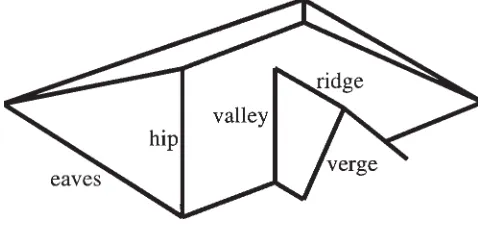
The reason for architects’ unhappiness with this process gradually became clear. Architects simply do not normally imag-ine their roof forms in this way. Using such a system requires them to translate their thoughts into the language of the computer before they can enter data and modify it. Architects characteristically model roof forms using well-established and -understood spatial concepts. In par-ticular, architects have a comprehensive language for the folds and edges that can be found in pitched roofs. The concepts of “eaves,” “verge,” “ridge,” “hip” and “valley” enable all pitched roof forms to be described. The “eaves” is a bottom edge and is normally but not always hor-izontal. A “verge” is a sloping edge such as is normally found in a gable. A “ridge” is a horizontal convex fold, and a “hip” any non-horizontal convex fold. A “val-ley” is any concave fold (Fig. 1). Archi-tects think and speak in these terms; one would be unlikely to hear them talking of collided wedges, pyramids and blocks. Why do architects use this particular way of imagining their roof forms? There seem to be two possible explanations, both of which are of interest. First, ar-chitectural roofs are not solids at all, but contain voids. In many, though not all, buildings, these voids are an important part of the spaces that the building exists to provide. In particular, the spaces below the roof can not only offer usable floor space, but also can be used to express form in a most interesting way. One has only to stand in a cathedral or a mosque
to see the significance of this. Second, ar-chitecture is not simply abstract geome-try but must be constructed out of real materials. This poses many problems, but there are two major ones worth consid-ering. These are how the structure holds everything up, transfers loads to the ground and remains stable, and how the roof keeps out the external environment and in particular disperses rainwater.
Why does the language of folds help here? In terms of internal space, it is the underside of the roof planes and their bounding edges and folds that visually de-fine the spaces. These folds and edges are where the main structural elements are likely to be and which will need support from below. The pattern of these folds is used to collect and transfer rainwater. In more detail, each type of fold or edge poses a particular set of construction problems, which are well understood in principle but which must be interpreted in each case. Each type of roofing mate-rial usually has a minimum and some-times a maximum pitch at which it must be used in defining roof angles.
What this illustrates is that architects must ultimately think about their build-ing not as an abstract solid form but as a collection of voids enclosed by surfaces that must have physical constructions. Design is very much a matter of integra-tion, and so these issues need to be in the mind of the architect early in the process [15]. Experienced designers know what sort of problems are likely to be involved and therefore intuitively and habitually use appropriate forms of representation. Our team eventually developed soft-ware that used these concepts of roof planes having a pitch angle and direc-tion, and surrounded by edges or folds that must be eaves, verges, ridges, hips and valleys. Now our first requirement was met, which was that the software use a representational system commonly used by actual designers themselves. But the motivation to use a CAD system must surely be that it adds some value to the process. In this case, our software also would go on to solve the equations of the 3D geometry of the resultant intersecting planes and complete the form absolutely accurately. It could also alert the archi-tects when the information was lacking in some way. This might be because it was incomplete and the geometry remained undefined or because there was conflict-ing information, allowconflict-ing for more than one single interpretation [16].
To do this work, however, the software needed to have prior knowledge about the concepts being used. For example,
330
Lawson,CAD and CreativityC R E A T I V I T Y
A N D
knowledge about the meaning of the var-ious types of edges and folds in roof planes, and about the rules that govern their behavior, was essential. Having this information, the computer could begin to interact like a genuine member of the design team, to understand the language and make inferences about information in order to produce new or revised in-formation. We have relatively simple technology today, in the form of object-oriented programming techniques that allow us to embed such knowledge in the data about objects held in a computer. We might expect to see this sort of soft-ware become more commonplace. Un-fortunately, there are other market forces at work that make it hard to create, de-velop and commercially maintain soft-ware for such a restricted clientele as the architectural profession. Increasingly, ar-chitects are using generic software that can address form only as abstract geom-etry. It is beginning to look as though CAD is by no means a neutral tool. Like all tools, it suggests being used in a cer-tain way. This threatens to set an agenda for architecture that is unhealthy and ir-relevant.
W
HERED
OW
EG
O FROMH
ERE?
So what do we do about this? First, we need more research into the effects of
CAD on design. Since Aish’s early work, few studies of significance have been pub-lished that ask critical questions about these tools and their effects. If one at-tends the conferences of those working the field or reads their proceedings, one finds almost no critical evaluation of the tools being described. The atmosphere of such conferences as the American Col-legiate Schools of Architecture (ACSA), European Computer Aided Architectural Design Education (ECAADE) and Com-puter Aided Architectural Design Re-search In Asia (CAADRIA), for example, is like that of a religious gathering. The faithful come together to reinforce their common belief in the wonderful bene-fits of CAD. There are without doubt many benefits to be gained from using computers in architectural design. How-ever, we have not fully demonstrated that it is universally promoting what Herman Hertzberger would call “real” as opposed to “fake” creativity.
References and Notes
1.H. Hertzberger, Lessons for Students of Architecture (Rotterdam, The Netherlands: Uitgeverij 010, 1991).
2.B.R. Lawson, Design in Mind(Oxford, U.K.: But-terworth Architecture, 1994).
3.D.A. Schön, The Reflective Practitioner: How Profes-sionals Think in Action(London: Temple Smith, 1983).
4.Lawson [2] p. 38.
5.B.R. Lawson, How Designers Think(Oxford, U.K.: Architectural Press, 1997).
6.G. Sturt, The Wheelwright’s Shop(Cambridge, U.K.: Cambridge Univ. Press, 1923).
7.Lawson [2] p. 42.
8.M. Boden, The Creative Mind: Myths and Mechanisms (London: Weidenfeld and Nicolson, 1990).
9.B. Lawson and S.M. Loke, “Computers. Words and Pictures,” Design Studies18(1997) pp. 171–184.
10.Lawson [2] p. 91.
11.Lawson [2] p. 38.
12.R. Aish, “Prospects for Design Participation,” De-sign Methods and Theories11(1977) pp. 18–27.
13.B.R. Lawson, “Parallel Lines of Thought,” Lan-guages of Design1(1993) pp. 357–366.
14.M. Van Norman, “A Digital Modelshop: The Role of Metaphor in a CAAD User Interface,” Design Com-puting1(1986) pp. 95–122.
15.See, for example, the work of Chuck Eastman on watching designers try to create bathrooms. C.M. Eastman, “On the Analysis of the Intuitive Design Process,” in G.T. Moore, ed., Emerging Methods in En-vironmental Design and Planning(Cambridge, MA: MIT Press, 1970).
16.J.P. Riley and B.R. Lawson, RODIN: A System of Modeling Three Dimensional Roof Forms (Brighton, U.K.: IPC Press, 1982).
Bryan Lawson is Dean of the Faculty of Ar-chitectural Studies at the University of Sheffield, U.K. He is both a qualified archi-tect and a psychologist. He leads the “processes” research group at Sheffield and has studied the design process and published widely on the nature of design thinking.
C R E A T I V I T Y
A N D