P H O T O N E U T R O N S T U D IE S IN M E D IU M -W E IG H T
E L E M E N T S
A t h e s i s s u b m itte d to
T h e A u s t r a l i a n N a tio n a l U n i v e r s i t y
f o r th e d e g r e e of
D o c to r of P h ilo s o p h y
by
G r a e m e E r n e s t C o o te
G
3-0
£37
( i ) PREFACE
The e x p e rim e n ts d e s c r i b e d i n t h i s t h e s i s w ere c a r r i e d
o u t on th e 1 .2 MeV C o c k c ro ft-W a lto n s e t and th e 33 MeV
e l e c t r o n s y n c h r o tr o n o f t h e A u s t r a l i a n N a ti o n a l U n i v e r s i t y .
The e x p e rim e n t d e s c r i b e d i n c h a p t e r 2 was c a r r i e d o u t
j o i n t l y w ith Mr. I . F . W r ig h t, and t h a t o f c h a p t e r 3 w ith
Mr. W rig h t and. D r. W. E. T u r c h i n e tz , w ith th e work s h a r e d
e q u a l ly i n e a c h c a s e . The is o m e r e x p e rim e n t o f c h a p t e r 5
was p e rfo rm e d j o i n t l y w ith D r. J . H. C a r v e r , th o u g h m ost o f
th e e x p e r im e n ta l work and d a t a a n a l y s i s was done by m y s e lf .
Mr. T. R. Sherwood a s s i s t e d w i t h some o f t h e e a r l y
e x p e r im e n ta l work and a n a ly z e d some o f th e d e c a y c u r v e s .
The g a lliu m e x p e rim e n t o f c h a p t e r 4 was done in d e p e n d e n tly .
The e x p e rim e n ts o f c h a p t e r 2 and 3 w ere d e s c r ib e d i n
th e f o llo w in g p a p e r :
" C ro ss S e c tio n s f o r th e (T>n) r e a c t i o n i n C u ^ , C u ^ , Z n ^ ,
121 141
Sb and P r , m easu red w ith m onochrom atic gamma r a y s "
Two p a p e r s on th e e x p e rim e n ts o f c h a p t e r 4 and c h a p t e r 5 a r e
i n p r e p a r a t i o n .
No p a r t o f t h i s t h e s i s h a s b e e n s u b m itte d f o r a d e g re e
a t any o t h e r u n i v e r s i t y .
(ii)
ACKNOWLEDGEMENTS
Many people gave practical help or advice during the
course of this work but I wish to single out those mentioned
belov/.
Mr. N. F. Bowkett gave excellent service in maintenance
of the H.T. set and associated equipment, and Mr. J. Gower
did the same for the electron-synchrotron.
Mr. M. J. Vernon carried out several chemical operations
and made some radioactive sources.
In the maintenance of electronic equipment, Mr. Dick
Graf was particularly long-suffering and patient.
Mr. I. V. Mitchell gave valuable assistance with
recalibration and operation of the synchrotron at a critical
stage of the work.
I am grateful to Dr. J. H. Carver, who gave helpful
advice during work on the synchrotron and on preparation of
a paper for publication. Useful discussions on recent
developments in photonuclear theory were held with Dr. D. C.
Peaslee, and Professor K. J. Le Couteur gave valuable advice
on interpretation of experimental results.
The work was carried out during the tenure of a Research
(iii)
PHOTONEUTRON STUDIES III MEDIUM-WEIGHT ELEMENTS
S U M M A R Y
This thesis describes four experiments on photoneutron
reactions in medium-weight nuclei, the first two carried out
with gamma radiation from (p,Y) reactions and the third and
fourth with bremsStrahlung from a 33 MeV electron synchrotron.
In chapter 1 is presented a brief review of photonuclear
reactions in the giant resonance region. Discussion is mainly
devoted to photon absorption, models for the giant resonance
and decay of the excited nucleus. Recent developments in
photonuclear theory are treated in more detail.
Chapter 2 describes a study, by the activation method, of
the (Y»n) excitation function of Cu , made with gamma rays of
energies 12.2, 14.8, 16*7 and 17*6 MeV from the Li^(p,Y) and
B (p,y) reactions. Residual activity and gamma ray intensity
were measured with Nal(Tl) scintillation spectrometers. The
object was to check the shape and absolute normalization of
this excitation function, which is often used as a standard
but about which conflicting reports have been made. The shape
of the curve obtained in this way is in good agreement with
bremsStrahlung measurements, but the present absolute cross
(iv) to difficulties in absolute ß-counting and in measurement
of X-ray intensities.
An extension of this work is described in chapter 3* It consisted of measurement, with the Li (p,Y) resonance radiation, of the (Y»n) cross sections of four other nuclei
63
relative to that of Cu "• Comparison with bremsStrahlung data is made using the experimental intensity ratio of the
14.8 and 17
»6
MeV components of the radiation. It is shown that early measurements using ß-counting of thick samples were sometimes in error by as much as a factor of 2, but thatrecent experiments utilizing 4^ ß-counting of thin samples are much more accurate.
In chapter 4 is described a measurement of competition between the (Y,n) and (Y,2n) reactions in Ga . From
determination of the yield curves by activation methods the excitation functions and for these reactions were obtained from their thresholds to
J1
MeV. The absorption cross sectiona^ +
0^ has its maximum at about 16.2 MeV and a v/idth P of 9 MeV; both results are consistent with the knovm systematics of the photonuclear process. The total integrated cross section toJO
MeV is 2.2 - 0.4 times that of the Cu ^(Y,n) reaction. Determination of the energy at which and are equal shows that for excitation by(v)
has a median energy of ^ 5*5 MeV, twice as high as can be
explained by evaporation from the excited nucleus. It is
deduced that at this gamma ray energy at least 40$ of the
first neutrons are emitted in a direct interaction with the
photon. Further aspects of the results show tentatively
that a recent suggestion, to the effect that even in a direct
interaction an exchange energy of ^ 7*5 MeV is left in the
nucleus, may not always be true.
The final experiment (chapter 5) consisted of the
measurement, for 15 nuclei, of the isomeric ratio in the
residual nucleus, after a (Y,n) reaction initiated by 30 MeV
bremsStrahlung. From these ratios and a recent application
of statistical theory, was deduced information on the
dispersion parameter a, which relates the density of energy
levels of spin J to that of levels with J = 0, and is closely
related to the moment of inertia of the excited nucleus.
Comparison is made with the corresponding quantity a derived
s
from shell theory. The ratio a/a is close to unity for A ^ 40
s
and levels off at ^ 0.6 for 100, with a transition region
in between. The moment of inertia of an excited nucleus (with
average excitation energy 4 - 5 MeV), is therefore close to the
shell model result for a light nucleus and falls to about 1 /3
of this in a heavy element. These results are discussed in
terms of nuclear structure theory and some further experiments
CONTEHTS
Page
Preface (i)
Acknowledgements (ii)
Summary (iii)
List of Diagrams (x)
List of tables (xii)
CHAPTER 1
Photonuclear Reactions
1. Introduction 1
2. Photon Absorption by the Nucleus 4
2.1 The Giant Resonance 4
2.2 Sum Rules 5
3« Models for the Giant Resonance 7
3*1 The Collective Models 8
3«2 The Independent-Particle Model 9
4. Photonuclear Reaction Products 12
5» Recent Advances in Photonuclear Theory 15
5»1 Relationship between Collective and
Independent-Particle Models 17
5»2 The Peak Energy of the Giant Resonance 18
5*3 Overtones of the Giant Resonance 23
5*4 Splitting of the Giant Resonance 25
6. The Present Experiments 27
CHAPTER 2
ö
3
62
Cross Section for the Cu '"(Y.n)Cu c Reaction, measured with monochromatic gamma-rays
(vi)
(vii)
Page
2
.
Experimental Method
33
2.1
General Techniques
33
2.2
Analysis of Gamma Ray Spectra
37
2
.2.1. Relative Intensities of the Gamma Rays
39
2.3
Edge penetration in collimator
40
2.4
Low-energy region of line-shape
42
3-7
Absolute Cross Section for the Li + p Radiation 45
3*1
Experimental Method
45
3.2
Analysis and Results
46
4.
Cross Section as a Function of Photon Energy
48
4.1
Experimental Method
48
4.2
Analysis and Results
49
5-
Discussion
51
5.1
Comparison with Previous Work
51
5.2
Conclusions
57
CHAPTER 3
Cross Sections for the (Y.n) Reaction in Cu ,
- 64
Zn , Sb
«,121and Pr141 measured with the Li? + n resonance radiation
1
.
Introduction
58
2
.
Experimental Method
59
3-
Analysis and Results
6 04.
Discussion
65CHAPTER 4
The (Y.n) and (Y.2n) Reactions in Ga^'
1. Introduction 68
2. Experimental Work
'JO
2.1
Relative yield curves
71
2.2 Measurement of Residual Activity 72
2.3
Normalization of Yield Curves
75
Results
74
(viii) P a g e
4. D i s c u s s i o n 77
4.1 P o s i t i o n and w i d t h of the G i a n t R e s o n a n c e 77
4.2 N e u t r o n e n e r g y s p e c t r u m 77
4.3 S o m e c o m p a r i s o n s w i t h o ther w o r k 81
4 .4 C o n c l u s i o n s 83
C H A P T E R 5
I s o m e r i c R a t i o s in (Y.n) R e a c t i o n s a nd the S p i n - d e p e n d e n c e
of Level D e n s i t y
1. I n t r o d u c t i o n 85
1.1 S p i n - d e p e n d e n c e of the L e v e l D e n s i t y a n d the
N u c l e a r M o m e n t of I n e r t i a 87
1.2 O u t l i n e of S t a t i s t i c a l T r e a t m e n t 89
2. T h e o r e t i c a l T r e a t m e n t 90
2.1 C o m p o u n d Staate 90
2.2 E v a p o r a t i o n of the N e u t r o n 91
2.3 N u m b e r of Cas c a d e G a m m a - R a y s 92
2 . 4 B r o a d e n i n g of spin d i s t r i b u t i o n b y g a m m a - r a y
c a s c a d e 94
2.5 P o p u l a t i n g of t h e I s o m e r i c L e v e l s 95
3. E x p e r i m e n t a l M e t h o d 97
3-1 D e c a y S chemes 99
3-2 A n a l y s i s of R e s u l t s 102
4. E x p e r i m e n t a l R e s u l t s 105
5. D i s c u s s i o n 108
5.1 C o m p a r i s o n w i t h o t h e r w o r k 108
5.2 V a r i a t i o n of a w i t h A 109
5-3 E f f e c t s of shell s t r u c t u r e 111
5.4 C o n c l u s i o n s 114
U x ) P age A ppendix A
A c t i v i t y in d u c e d i n a d i s k i r r a d i a t e d n e a r
a p o i n t s o u r c e 117
A ppendix B
C o r r e c t io n s f o r A n is o tr o p ic Gamma-ray
d i s t r i b u t i o n 119
A ppendix C
V a r i a t i o n i n y i e l d from a d is k due to a
sid e w a y s d is p la c e m e n t o f th e t a r g e t s p o t 121 A ppendix D
U n f o ld in g o f B re m sS tra h lu n g y i e l d c u rv e s 125 A ppendix E
Gamma r a y c a s c a d e i n th e n u c le u s 125
LIST ÜF DIAGRAMS
(»)
Figure Page
Chapter 2
1 Irradiation Geometry 34
2 Response Function of 5 in# Nal Crystal 37
3 Analysis of a Resonance Spectrum J>8
4 Analysis of a Non-resonance Spectrum 38
5 Line-shapes from the Lithium Radiation 39
11
6 Spectra from the B (p,Y) Reaction 39
7 Collimator Edge-effect 41
8 Contributions to Spectrum of the Lithium
Radiation 44
9 Low-energy Region of Line-shape 44
10 Test for Scattering by Collimator 45
11 Efficiency Calibration of Nal Crystals 46
12 Excitation Function from Successive Approxi
mations 58
13 Cross Section for C u ^ ( Y , n ) C u ^ 2 51
Chapter 3
14 Calculation of Self-absorption 61
Chapter 4
15 Nuclides near Gallium
'JO
16 Decay Schemes of G a ^ , G a ^ and G a ^ 71
17 Spectrum of G a ^ Radiation 73
18 Decay Curves and Yield Curves for G a ^ and G a ^ 74
19 The (Y>n) and (Y,2n) Excitation Functions for
Ga69
76
20 Comparison of Statistical Predictions with
experiment 80
Chapter 5
(.xi)
F i g u r e
22 (Y»n) R e a c t i o n L e a d i n g to a n I s o m e r i c P a i r 8 9
2 3 R o l e of a in d e - e x c i t a t i o n 9 6
2 4 I s o m e r i c R a t i o s f r o m T h e o r y and E x p e r i m e n t 97
2 3 M e a s u r e m e n t s of a 10 9
2 6 C o m p a r i s o n of c f r o m Experiment a n d S h e l l
T h e o r y 1 1 3
A p p e n d i x A
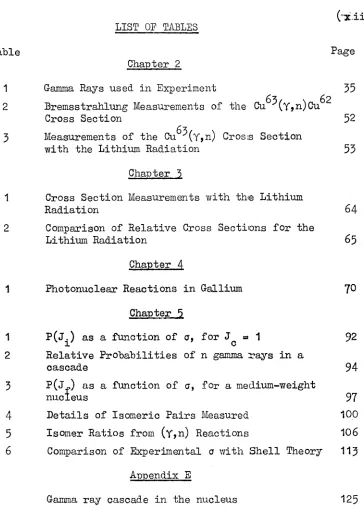
LIST OP TABLES
(-Xii)
Table Page
Chapter 2
1 Gamma Rays used in Experiment 35
2 Bremsstrahlung Measurements of the Cu°^(Y,n)Cu^
Cross Section 52
3 Measurements of the Cu ^(y>u) Cross Section
with the Lithium Radiation 53
Chapter :
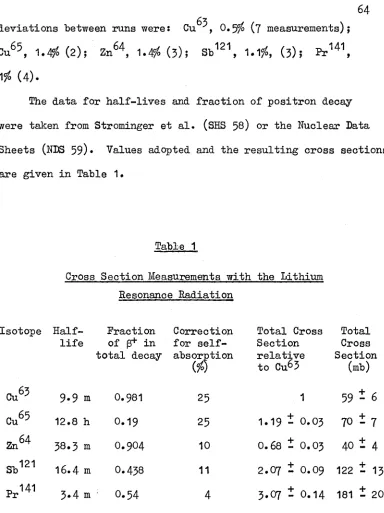
1 Cross Section Measurements with the Lithium
Radiation 64
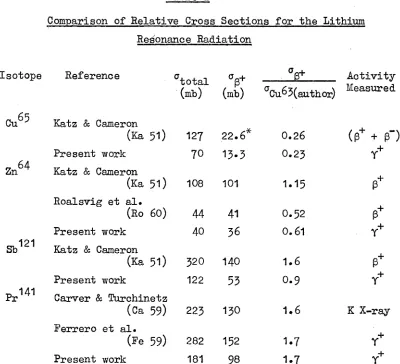
2 Comparison of Relative Cross Sections for the
Lithium Radiation 65
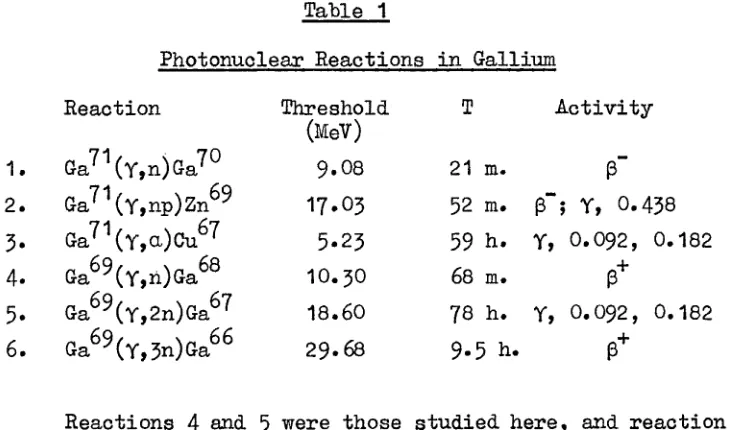
Chapter 4
1 Photonuclear Reactions in Gallium 70
1 P(j\) as a function of a, for = 1 92
2 Relative Probabilities of n gamma rays in a
cascade 94
3 P(jf) as a function of c, for a medium-weight
nucleus 97
4 Details of Isomeric Pairs Measured 100
5 Isomer Ratios from (Y,n) Reactions 106
6 Comparison of Experimental a with Shell Theory 1 1 3
Appendix E
[image:13.485.60.424.59.578.2]CHAPTER 1
PHOTONUCLEAR REACTIONS
1• Introduction
Nuclear photodisintegration, discovered by Chadwick and
Goldhaber in 1934, has had a useful part to play in the study
of the two-nucleon interaction and nuclear structure and
dynamics. Further experimental studies group roughly into
those of the deuteron, the light nuclei, and the heavier nuclei,
with photon energies ranging from a few MeV to the hundreds of
MeV needed to study meson effects. As energy is transferred to
the nucleus by electromagnetic forces the information obtained
is supplementary to that from the usual nucleon induced reactions.
Many detailed theoretical and experimental studies of
photodisintegration of the deuteron have been made, as it is one
of the simplest and best ways of investigating the neutron-proton
interaction, and can be carried out over a large energy range.
9
Measurements on slightly heavier nuclei, e.g. Be , can be compared
with detailed shell-model predictions. The roles played by ’’core"
and ’’valence” nucleons and "clustering” of the nucleons into
subunits can be studied. In the medium and heavy nuclei, the
investigation of systematic changes in the excitation and
de-excitation processes with photon energy, mass number and shell
structure leads to further knowledge of nucleon motions in the
2
The fundamental discovery in this field is that of the
"giant resonance" in the photon absorption by a nucleus.
Experiment has shown this to be a property of all nuclei, so
its cause must be quite fundamental. Early work showed that the
width of the resonance averaged about 6 MeV, that the peak energy
decreased regularly with the mass number A from
^
20 MeV forlight nuclei to 14 MeV for heavy nuclei such as lead, but that
the cross section integrated over photon energy increased with A.
The explanation of this third fact was an early success for the
theory. The giant resonance is so large that it must be mainly
due to E1 transitions in the nucleus; modification of the E1
"sum-rules" originally developed for the atomic photo-effect
showed that the integrated cross section should be proportional
to 2 5 or ~ A .
A
J
For the explanation of the position and width of the giant
resonance, two types of models for E1 absorption by the nucleus
were proposed. In the collective models, based on the
strong-interaction picture of the nucleus, the protons were supposed to
oscillate in some way against the neutrons. The quite different
weak-interaction view of the nucleus gave rise to the
independent-particle model of the giant resonance, in which photon absorption
raised just one nucleon to an excited state. Although these models
are quite different in conception recent work suggests they are
3
A photonuclear reaction is usually thought of as taking
place in two steps, photon absorption then the subsequent
de-excitation of the nucleus, though this division does not
always exist. Details of the excitation process are obtained
from relative yields of the various emitted particles, their
energy spectra and angular distributions. Such experiments have
shown that although absorption in the giant resonance region
usually produces an excited compound nucleus, in a few of the
interactions a nucleon is emitted directly. A complete theory
of photon absorption must explain how this occurs.
Although the proposed models have made possible useful
predictions of the main parameters of the giant resonance, some
of the assumptions made have been rather suspect. In particular,
the calculations of the peak energy seemed unsatisfactory.
However, recent advances in the understanding of the nucleus as
a many-body system have shown how thi3 fundamental problem may be
solved. The answer lies in understanding the link between the
independent-particle and collective aspects of the nucleon motions,
and the importance of correlations within the nucleus. It is
certain that photonuclear studies will continue to play a part in
the investigation of this aspect of the nucleus.
In sections 2, 3 and 4 of this chapter the photon absorption
and decay of the excited nucleus are treated in more detail. In
4
giant resonance, while section 6 discusses the relevance of the
present experiments to aspects of the photonuclear process.
2. Photon Absorption by the Nucleus
2.1 The Giant Resonance
Photon absorption in all nuclei occurs mainly in the giant
resonance, which shows that some very general property is involved.
The resonance is broad, with an average width P of about 6 MeV.
The width has been found to vary significantly with shell structure
(review, Fu 61), being narrowest (4 - 5 MeV) for nuclei with doubly
closed shells. Plausible explanations of this have been offered
(sections and 5*2), but these have been criticized (section 5*4)*
Although it is desirable to study the giant resonance by total
absorption, this difficult measurement has been done in only a few
cases (Du 59» Ko 59» Zi 60, Ca 60a) and with low accuracy; the
nuclear absorption is only a few per cent of the total absorption.
The alternative has been to measure the partial cross sections
(Y,n), (Y,p), (Y,2n) etc., either by direct particle detection or
by activation methods. It is rare that all of these have been
measured for a given nucleus. For light nuclei the (Y,n) and (Y,p)
cross sections are often comparable, but for medium nuclei neutron
emission predominates, with multiple neutron emission important for
heavy nuclei (Ca 58, Si 58)* Thus most studies of the magnitude
5
the photoneutrons (e.g. Mo 53)»
or
by measuring the residualactivity from the (Y,n) reaction (e.g. Be 54).
Such measurements, usually made with brems Strahlung X-rays,
have been beset by difficulties in absolute normalization and by
lack of resolution, but have shown a steady improvement. The
recent development of monochromatic Y-ray sources from the
annihilation in flight of energetic positrons (Se 60), promises
more accurate experiments in the future. In the meantime it has
been possible, in careful experiments with bremsStrahlung, to
detect fine structure in the giant resonances of light nuclei
(Ki 59» Mu 59» Th 6l) and demonstrate the splitting into two
broad peaks in those of distorted nuclei (Pu 58» Th 60).
The giant resonance may alternatively be studied by using
the detailed balance principle to relate measurements of the
inverse reaction. This has so far been restricted to the (Y»p)
and (p»Y) reactions in light nuclei (Ta 59» Ka 60). It also
seems possible to derive information from high-energy (p»P*)
scattering (Ka 59)•
2.2 Sum Rules
As excitation by an incident photon is an electromagnetic
process it is possible to apply "sum rules", and these have been
very important in the theory. They are able to predict properties
t hat k n o w l e d g e of those of the e x c i t e d s tates is not r e q u i r e d
The b a s i c s u m r u l e for the a t o m states (Le 60) that the total
o s c i l l a t o r s t r e n g t h for all p o s s i b l e E1 t r a n s i t i o n s f r o m the
6
g r o u n d to e x c i t e d states is equal to the n u m b e r of electrons,
i • e •
n Z . (Atom) (l)
W h e n a p p l i e d to t h e n u c l e a r case this m u s t be m o d i f i e d to a l l o w
for m o t i o n of the centre of m a s s of the n u cleus; the s um r u l e
b e c o m e s f = • (Nucleus) (
2
)F r o m this it is e a s y to show that the i n t e g r a l of the E1
a b s o r p t i o n cross s e c t i o n a o v e r p h o t o n energy, , is g i v e n
int J o
/\dE
= tedjdhW
\ M e / A(
3
)
0 . 0 6 0 N Z M e V - b a r n s .
A
The u p p e r l i m i t u is set at about 150 MeV, the m e s o n p r o d u c t i o n
t h r e s h o l d , as a b o v e this e n e r g y the si m p l e t h e o r y d o e s n ot hold.
The d e r i v a t i o n of (
3
) a s s u m e s the abs e n c e of a t t r a c t i v e e x c h a n g ef o r c e s in the nucleus, and a. , is i n c r e a s e d if t h e s e are included. int
L e v i n g e r a n d B e t h e (Le
50
) o b t a i n e d w i t h the u s e of a r e a s o n a b l eY u k a w a p o t e n t i a l w e l l
aint " 0 , 0 6 0 “ + 0,8 * U )
A
w h e r e x is t he f r a c t i o n of M a j o r a n a exchange f o r c e i n the n e u t r o n -
p r o t o n p o t e n t i a l . E q u a t i o n (
4
) has r e c e n t l y b e e n s h o w n to bei n c o r r e c t ( s e c t i o n 5*2); the exc h a n g e t e r m s h o u l d h a v e a n e x t r a
1
7
at the nucleon correlations after an E1 excitation. Comparison
of experimental results with equation (
4
) showed that within therather large uncertainties the giant resonance was primarily E1
in character.
The integrated cross section has also been obtained from
dispersion theory (Ge 54), a calculation which automatically
includes all multipoles and absorption mechanisms. Clark (Cl 61)
used the dipole sum rule to investigate the effect on ^ of a
repulsive core in the nuclear potential. He found that ^ was
considerably increased.
Other dipole sum-rules can be derived, and from them some
useful mean energies (Le
60
). For example, the fact that theharmonic-mean energy E^
m
J
adE^jj(
a/E)dE is closely equal to thepeak energy E^ was used by Carver and Peaslee (Ca 60) to obtain
an improved expression for E^ as a function of A (section 5*2).
Although use of the various sum-rules and mean energies
could in principle give information on the shape of the giant
resonance, present calculations have not been sufficiently accurate
to do so. The main use of sum rules has been to show which features
of the photonuclear effect are model-independent and must be shown
by all models proposed, and which may be unique to a given model.
3* Models for the Giant Resonance
resonance but provide no physical picture of what is happening;
models for the photon absorption process have therefore been
8
invented and it is hoped that experiment will show which is
closer to the truth.
For absorption in the giant resonance region two types of
model have been proposed: the collective or "long range correlation"
type based on the strong interaction picture of the nucleus, and
the independent particle model developed from the simplest type of
shell theory. For photon energies above about 40 M eV these are
replaced by the "high energy" model which assumes interaction with
a "quasi-deuteron" subunit in the nucleus. Above 150 MeV meson
effects must be considered.
3.1 The Collective Models
Goldhaber and Teller (Go 48) suggested three possible collective
mechanisms for E1 absorption. The first, in which the protons
oscillated about mean positions, has not been considered further;
the second, in which interpenetrating neutron and proton spheres
oscillated about their centre of mass, was developed by them and by
Fujita (Fu 56); a third which suggested oscillations in density
of proton and neutron fluids inside the spherical nucleus (the
"hydrodynamic model") was extended by Steinwedel et. al (St
$
0).
The second and third models were fairly successful in predicting
could, explain qualitatively the width of the resonance by
processes akin to "friction". Fujita (Fu 56) extended the
rigid-spheres model by suggesting how exchange forces could
increase E . m
An important prediction from the hydrodynamic model was
made by Danos (Da 58) and by Okamoto (Ok 58)* In this model a
nucleus of ellipsoidal shape can sustain oscillations of different
frequencies along its major and minor axes. Hence it was suggested
that the width of the giant resonance would increase with the
ellipticity of the nucleus, i.e. with the distance from doubly
closed shells. For very distorted nuclei the resonance should
split into two peaks, whose separation could be deduced from the
eccentricity of the nucleus. Careful work on the rare earth nuclei
(Fu 58, Th 60) and some lighter distorted nuclei (Sp 58) has
verified that splitting does occur, although it is not yet clear
if the relative intensities of the peaks agree with prediction
(Fu 6l).
9
5-2 The Independent Particle Model
The independent particle model (i.P.M.) is based on the quite
opposite assumption of independent nucleons in a common potential
well (Wi
5 6
, Wi 59)« The incident photon is assumed to excite onenucleon (usually from a closed shell) to an excited state, i.e. a
10
many n u c le o n s i n th e c o l l e c t i v e m o d e ls. A lth o u g h th e s h e l l
m odel l e v e l s a r e c o m p lic a te d and a p p a r e n tly h a p h a z a rd a t h ig h
e x c i t a t i o n e n e r g i e s , t h e E1 ty p e o f a b s o r p t i o n r e s t o r e s
s i m p l i c i t y t o a c o n s i d e r a b l e e x t e n t by s e l e c t i n g o n ly p a r t i c u l a r
t r a n s i t i o n s . W ilk in s o n shows t h a t m ost o f th e d i p o l e sum i s
ta k e n up by t r a n s i t i o n s o f th e ty p e
1s ——» 1 p , 1 p - —> 1 d e t c
and 2s ——^ 2 p , 2 p - 2 s , e t c
i . e . e l e v a t i o n o f n u c le o n s betw een s u c c e s s iv e m a jo r s h e l l s . T h ese
a r e th e a llo w e d one-quantum * t r a n s i t i o n s f o r t h e sim p le h a rm o n ic
o s c i l l a t o r p o t e n t i a l , f o r w h ich th e y a l l h a v e t h e same e n e r g y .
A lth o u g h t h i s d e g e n e ra c y i s rem oved i n more r e a l i s t i c p o t e n t i a l s
t h e t r a n s i t i o n e n e r g i e s a r e s t i l l s u f f i c i e n t l y e q u a l t o p ro d u c e
t h e g i a n t r e s o n a n c e . The re s o n a n c e e x h a u s ts th e d ip o l e sum s i n c e
t h i s i s t r u e o f t h e sim p le o s c i l l a t o r p o t e n t i a l . N u cleo n s i n lo w -
l y i n g c l o s e d s h e l l s c o n t r i b u t e t o th e d ip o l e sum by p r e v e n t i n g , b y
t h e P a u l i p r i n c i p l e , downward t r a n s i t i o n s from t h e h ig h e r s h e l l s .
T h is m odel c a n n o t be ta k e n to o l i t e r a l l y , s i n c e t h e r e a r e
th o u s a n d s o f compound n u c le u s l e v e l s i n s t e a d o f a few s h e ll- m o d e l
l e v e l s . The s p r e a d o f th e compound n u c le u s l e v e l s a b o u t a s h e l l
l e v e l i s one o f t h e f a c t o r s d e te r m in in g th e w id th o f th e g i a n t
r e s o n a n c e , an d was fo u n d by W ilk in s o n from t h e a b s o r p t i o n p a r t o f
11
the optical-model potential. The other important contribution
to
P
for spherical nuclei is the spread in energy of the singleparticle transitions.
Wilkinson (Wi 58) used the Nilsson level scheme for an
ellipsoidal potential well to show that the I.P.M. model could
satisfactorily explain the widening of the giant resonance in a
distorted nucleus. For strongly distorted nuclei the resonance
would split into two peaks, as previously predicted by the
hydrodynamic model* The correspondence between the predictions
of each is so close that there is no chance of discriminating
between the models on this basis.
The fundamental difficulty of the I.P.M. model is to obtain
the correct value for Em * This would be thought to equal the
average separation E of the shell model levels, but this is s
— 40 A ° MeV, only half the required amount. A small improvement
was made by adding to E the energy (/^ 2 MeV) needed to remove a s
nucleon from a d o s e d shell, but finally the only solution was
M to assume an ’’effective mass” for a nucleon given by M * — — .
This doubles the theoretical E g and makes it possible to say
E = E •
m s
However, the effective mass assumption was itself a step
towards a collective model, and was always rather suspect, and
direct measurements of E with (d,p) reactions (Sc 59» Co 60)
s
12
theory of the nucleus have not only given a better explanation
of the value of but have shown the relationship between the
two apparently incompatible types of model for the giant resonance.
These developments are described in section 5«
A significant advantage of the I.P.M. model is that it can
explain the small fraction of direct emission processes which are
found to occur (section 4). From its basic nature the collective
model cannot predict anything of this kind. The motion envisaged
in it is simple and its consequences easily calculated; the I.P.M.
model can make more detailed predictions but at the cost of much
computation.
The simple motions envisaged in both of these models last only
••22
a very short time (a few times 10“c sec.), and are soon broken
down by scattering within the nucleus.
4» Photonuclear Reaction Products
Study of the emitted particles has shown that in photonuclear
reactions in the giant resonance region an excited compound nucleus
is usually formed, but that in a small but significant fraction of
the interactions a particle is emitted directly. The I.P.M. model
is based on each interaction being a direct process, hence it can
easily explain direct emission?but it is not a natural part of the
13
I f th e e x c i t a t i o n e n e rg y i s s h a re d among a l l t h e n u c l e o n s ,
t h e d e c a y i s d e s c r ib e d by th e u s u a l compound n u c le u s t h e o r y
(B1 52)* F o r l i g h t n u c l e i th e decay may in v o l v e w e l l - s e p a r a t e d
r e s o n a n c e s , an d c a l c u l a t i o n s o f b r a n c h in g r a t i o s , e n e rg y s p e c t r a
an d a n g u l a r d i s t r i b u t i o n s u s e th e p r o p e r t i e s o f t h e e x c i t e d s t a t e s
and s e l e c t i o n r u l e s f o r a n g u la r momentum and p a r i t y . F o r h e a v i e r
n u c l e i , i n w hich th e r e a r e many o v e r la p p in g r e s o n a n c e s , t h e
s t a t i s t i c a l th e o r y i s u s e d (Le
5 9
t E r 6 0 ) . The p r o b a b i l i t y o fe m is s io n i s p r o p o r t i o n a l t o t h e d e n s i t y o f s t a t e s i n t h e r e s i d u a l
n u c le u s and a p e n e t r a b i l i t y f a c t o r f o r t h e g iv e n ty p e o f p a r t i c l e .
The m ain c h a r a c t e r i s t i c s o f th e d e c a y o f a compound n u c le u s
a r e th e f o ll o w i n g (B1 52) :
(1 ) A n g u la r d i s t r i b u t i o n s o f e m itte d p a r t i c l e s m ust a lw ay s oand
be s y m m e tric a l a b o u t 9 ° / f o r th e low e n e rg y p a r t i c l e s a r e
u s u a l l y i s o t r o p i c . I n a d d i t i o n i t c a n be shown (Le 6 0 ) t h a t
f o r E1 o r M1 e x c i t a t i o n t h e d i s t r i b u t i o n m ust be o f t h e form
a + b s i n 0 .
( 2 ) E m itte d n e u tr o n s h av e a ro u g h ly "M a x w ellian " e n e rg y
sp e c tru m p e a k in g a t t h e n u c l e a r t e m p e r a t u r e , ^ 1 o r 2 MeV.
(3)
The p r o to n e n e rg y d i s t r i b u t i o n p e a k s c l o s e t o th e b a r r i e rh e i g h t an d i s d e f i c i e n t i n low e n e rg y p a r t i c l e s , a s com pared
w ith t h e M axwell d i s t r i b u t i o n .
(4)
Y ie ld s o f c h a rg e d p a r t i c l e s s h o u ld i n g e n e r a l be muchl e s s th a n t h a t o f n e u tr o n s due t o t h e e f f e c t o f t h e Coulomb
14
In the lighter nuclei neutrons and protons are emitted in roughly
equal numbers, with the relative yield for a given nucleus
determined largely by the neutron and proton separation energies*
The large coulomb barrier in heavy nuclei reduces proton emission
to less than one per cent of the neutron yield. Emission of
deuterons and alpha particles is much less likely than that of
protons. For a sufficiently excited nucleus multiple nucleon
emission can occur, in particular the (Y,2n) and (Y»5n ) reactions*
Most photonuclear reaction products follow the compound
nucleus predictions. However, Hirzel and Waffler (Hi
47
)
showedthat for nuclei with Z >■ 45 photoproton yields were 100 or 1000
times greater than expected, showing that direct emission was
occurring in a small fraction of the interactions. This conclusion
has been confirmed by numerous experiments of other types: energy
spectra and angular distributions of photoprotons (Ta 60, Ba 60),
and photoneutrons (Au 59» As 60); relative branching ratio for
(Y,n) and (Y,2n), (Ca 58, Ca 58a); yields of alpha particles
(Ca 60a) • The most conclusive evidence comes from measured angular
distributions of fast photoprotons (Ba 60). For direct interactions
the E1 - E2 interference term produces a forward-peaked distribution
(Br 58) of the form
a + b sin 0 (1 + p cos 0),
where p ^ 1 for protons but ^ 0 for neutrons.
The Wilkinson model is able to predict the fraction of directly
15
a state in the continuum; because this state is not stationary
it has a width P + 2 W*, where
P
is the proton escape widthP
P
and W* the absorption term in the optical-model potential. The
proportion of these protons which escape directly is then
r P . Calculations on this basis show satisfactory agreement
P + 2W«
‘
P
with experiment*
The occurrence of both direct emission and compound nucleus
formation has been found in other types of nuclear reaction
(Er 60a). The series of events in the nucleus which form the
link between them is not yet completely understood.
5* Recent Advances in Photonuclear Theory
Understanding of the nucleus has been increased by further
knowledge of the many-body problem, which is fundamental also to
such diverse fields as plasma oscillations and superconductivity.
Correlations between the particles (nucleons or ions and electrons)
are of great importance in determining the properties of the system.
The further difficulty in the nuclear case is that the forces
involved are not well known and are quite different from
electromagnetic forces.
Such studies were used by Bohr and others (Bo 55) in the
development of the "unified model" for the low-lying excited states
of many nuclei. These states arise from collective
16
together. The quite different type of collective motion in
which the neutrons move oppositely to the protons, the "dipole
state" of nuclei, has been effectively studied only recently
and the theory is still developing. The theory in both of these
cases arose from improvements to the independent particle model,
and has been in no way related to any classical model, although
the results are often surprisingly similar*
There have been three recent approaches to the dipole state
or giant resonance problem: (l) Particular nuclei have been
treated, using detailed experimental data for shell level positions
etc., and a full treatment of configuration mixing; (2) General
features of the dipole state for both nuclei and "nuclear matter"
have been derived from many-body theory; (3) Sum rules have been
applied to obtain general relations applying to all nuclei* Each
approach has had something useful to say, and the main examples
of each will be briefly described.
The giant resonance will be discussed under two main heads:
the relationship between different models of its nature, and
calculation of its position for any given nucleus. The two aspects
are naturally very closely related. Such developments have
suggested revisions in other regions of photonuclear theory. Thus
in section 5*3 we discuss "overtones" of the giant resonance,
related to the direct emission process, and in section 5*4 a recent
17
5*1
R e la tio n s h ip betw een C o lle c tiv e and I n d e p e n d e n t- P a r tic le
Models
The s i n g l e - p a r t i c l e and c o l l e c t i v e models o f th e g ia n t
re s o n a n c e seemed to be c o m p le tely d i f f e r e n t .
However i n an
im p o r ta n t p a p e r, B rin k (Br
57
)showed t h a t f o r th e sim p le harm onic
o s c i l l a t o r (S .H .O .) p o t e n t i a l th e y were i d e n t i c a l , and were
p ro b a b ly n o t g r e a t l y d i f f e r e n t f o r r e a l n u c l e i .
He began by
showing t h a t th e E1 o p e r a to r
f o r a n u c le u s c o u ld be e x p re sse d
i n two e q u iv a le n t form s:
Q-j
=
e
( r ^ - R)
(1 )
= e M E ,
( l - H * - V ,
(2)
where R i s th e r a d iu s v e c to r o f th e c e n tr e o f mass o f th e n u c le u s ,
Rz and R^ a re s i m i l a r l y d e fin e d f o r th e p ro to n s and n e u tro n s ,
r e s p e c t i v e l y , and r^ i s th e r a d iu s v e c to r o f th e i ’ t h p ro to n i n
th e n u c le u s .
In form ( l ) ,
i s th e sum o f o n e - p a r t i c l e o p e r a to r s
and c o n n ec ts n u c le a r wave f u n c tio n s d i f f e r i n g a t m ost by th e s t a t e
o f one p a r t i c l e .
In th e second form , however, i t i s e x p re sse d in
term s o f th e c o l l e c t i v e c o o rd in a te r , so a lr e a d y we have a
s u g g e s tio n o f c o l l e c t i v e m o tio n .
He t r e a t e d th e c ase o f th e S.H .O . p o t e n t i a l , f o r which th e
c o o rd in a te r i s s e p a r a b le .
By a n a ly z in g th e H a m ilto n ia n i n t o f o u r
p a r t s he showed t h a t a f t e r an E1 a b s o r p tio n th e wave f u n c tio n f o r
th e e x c ite d s t a t e was
18
Here and contain only the relative coordinates of the
protons and neutrons respectively. Thus , represents a
collective motion of all the protons against all the neutrons in
which the proton and neutron internal motions remain undisturbed,
i.e. it is the Goldhaber-Teller oscillation of two interpenetrating
spheres. Hence the E1 absorption produces just that linear
combination of single-particle excitations which corresponds to
the collective vibration.
Brink took a step away from this idealized case by introducing
a more realistic potential; the collective state becomes a
superposition of single-particle states which now have slightly
different energies. Their relative phases are not preserved and
they get out of step in a time , thus the collective motion is
n
quickly dissipated into incoherent single particle modes. Brink*s
achievement has therefore been to show that the collective and
single-particle description is contained in the same wave function.
Developments described in the following section confirm Brink's
conclusions, and go further by suggesting how such effects arise
in the nucleus.
5*2 The Peak Energy of the Giant Resonance
Elliott and Flowers (El 57) carried out a detailed shell-model
calculation in intermediate coupling for the doubly closed-shell
16
nucleus 0 , taking full account of configuration mixing. They
19
1 J .1 t o 25» 1 MeV, a lm o s t a l l o f t h e d i p o l e s t r e n g t h was
c o n c e n t r a t e d i n t h e tw o h i g h e s t t r a n s i t i o n s a t 2 2 .6 and. 25» 1 MeV,
i n good a g re e m e n t w ith th e e x p e r im e n ta l v a lu e f o r o f 23»5 MeV.
H ow ever, t h e d i s t r i b u t i o n i n s t r e n g t h o f th e s e tw o l e v e l s i s th e
r e v e r s e o f t h a t p r e d i c t e d , and i t i s fo u n d t h a t a b o u t h a l f th e
i n t e g r a t e d c r o s s s e c t i o n l i e s above 25 MeV (Pu 6 1 ) .
A c a l c u l a t i o n o f t h e f r e q u e n c y o f c o l l e c t i v e o s c i l l a t i o n s
i n n u c l e a r m a t t e r was made by B ru e c k n e r and T h ie b e r g e r (B r 6 0 ) ,
i n an a t t e m p t t o c l a r i f y t h e r e l a t i o n s h i p b etw een t h e c l a s s i c a l
and in d e p e n d e n t p a r t i c l e c a l c u l a t i o n s . They showed t h a t
o s c i l l a t i o n s o f n e u tr o n and p r o to n d e n s i t i e s ( o f t h e hy d ro d y n am ic
m odel ty p e ) w ere p o s s i b l e , w ith t h e c o l l e c t i v e m o tio n l e a d i n g to an
i n c r e a s e o f 15$ i n th e f r e q u e n c y o v e r t h e s i n g l e - p a r t i c l e c a l c u l a t i o n .
T h is h a p p e n e d b e c a u s e t h e s i n g l e - p a r t i c l e e n e r g i e s i n g e n e r a l depend
on th e f l u c t u a t i o n i n n e u tr o n - p r o t o n d e n s i t i e s t y p i c a l o f t h e
c o l l e c t i v e o s c i l l a t i o n s , an im p o r ta n t c o n t r i b u t i o n to t h e e n e rg y o f
th e c o l l e c t i v e mode w h ich had been o m itte d i n p r e v io u s d i s c u s s i o n s .
I t was n o t p o s s i b l e t o e x t r a p o l a t e t h e i r r e s u l t t o f i n i t e n u c l e i ,
b u t i t seem ed c l e a r t h a t t h e c o l l e c t i v e e f f e c t c o u ld l e a d t o an
i n c r e a s e o f t h e e ig e n v a lu e above th e s i n g l e - p a r t i c l e r e s u l t . I t
a p p e a r s (Ca 6 0 ) t h a t t h i s r e s u l t d o e s a p p ly t o n u c l e i , b u t i t i s
n o t th e m a jo r e f f e c t t h a t i s r e q u i r e d .
20
N i ^ , C u ^ and C u ^ . They showed that account of the
residual pair interactions, and more accurate estimates of the
nucleon binding energies in closed shells, yielded E^ values in
good agreement with experiment, without introduction of an
effective mass less than M. However, the calculations seem rather
unsatisfactory, as at no stage do they allow for the collective
properties of E1 transitions. This has been shown by other
treatments (see below) to be the factor which basically determines
Em , hence their good agreement with experiment may be rather
fortuitous.
Brown and. Bolsterli (Br 59) pointed out that the shell spacing
E and the resonance energy E would not be equal, since in the
s m
dipole absorption a hole is formed in the lower shell. Using a
schematic model they showed that coherent effects due to the
particle-hole interaction should push the dipole transition to
higher energies, though they could not say by how much.
The relation between the many-body and single-particle
aspects in nuclei was discussed further by Brown and Thouless
(Br 60a). They describe in more detail how the collective types
of excitations in nuclei are built up from single-particle
excitations through the nucleon-nucleon interaction. They
emphasize that although the mechanism is the same in both finite
and infinite systems the consequences are very different in the
two cases. Thus the shell structure of the nucleus causes the
21
an d g u a r a n t e e s t h a t t h e minimum e n e rg y i s q u i t e h ig h , w h e re a s i n
n u c l e a r m a t t e r t h e e n e r g i e s form a c o n tin u o u s s p r e a d and b e g in
a t z e r o i f t h e r e i s no e n e rg y g a p . T hus, q u a n t i t a t i v e and i n some
c a s e s q u a l i t a t i v e f e a t u r e s o f t h e c o l l e c t i v e phenom ena d ep en d on
th e f i n i t e n a t u r e o f t h e p ro b le m .
I n a more d e t a i l e d s tu d y o f th e d ip o l e s t a t e i n n u c l e i , Brown
e t a l . (B r 61a) p e rfo rm e d c a l c u l a t i o n s i n j j c o u p lin g w ith z e r o
-16 40
ra n g e f o r c e s f o r 0 an d Ca • C om parison w ith t h e f i n i t e - r a n g e 16
c a l c u l a t i o n s o f E l l i o t t and F lo w e rs (E l 57) f o r 0 showed t h a t th e
z e r o - r a n g e c a l c u l a t i o n s re p r o d u c e d w e ll n o t o n ly q u a l i t a t i v e b u t a l s o
q u a n t i t a t i v e f e a t u r e s . They w ere a b l e t o show t h a t th e d ip o l e s t a t e
i s q u i t e s t a b l e a g a i n s t p e r t u r b a t i o n s , s u g g e s tin g t h a t p r e s e n c e o f
v a l e n c e n u c le o n s w ould h av e l i t t l e e f f e c t , a s lo n g a s t h e i r
c o n t r i b u t i o n t o t h e d i p o l e t r a n s i t i o n a m p litu d e was s m a ll.
The b a s i c c o n c l u s i o n s o f th e above group o f t h r e e p a p e r s may
b e su m m arized: t h e p a r t i c l e - h o l e i n t e r a c t i o n c o n c e n t r a t e s th e
d i p o l e - s t r e n g t h i n t h e u p p erm o st s t a t e s , and s h i f t s upw ard t h e i r
e n e r g i e s .
B r e n ig (B r 6 l) made a d e t a i l e d q u a n tu m -m e c h a n ic a l s tu d y o f
t h e hyd ro d y n am ic m o d e l. He showed t h a t th e c l a s s i c a l e x p r e s s io n
f o r Em was v a l i d o n ly f o r e x tre m e ly s t r o n g i n t e r a c t i o n s .
C a rv e r and P e a s le e (Ca 60) u s e d t h e s u m -ru le a p p ro a c h . They
22
e q u a l . The su m -ru le e x p r e s s io n i s known t o y i e l d E^ = E^ + E ^,
w here E^ a r i s e s from th e d i r e c t p a r t o f t h e two n u c le o n f o r c e
and Ex i s s p e c i a l t o t h e E1 o p e r a t o r and t h e c h a rg e exch an g e
com ponent o f n u c l e a r f o r c e s . They show t h a t t o f i r s t o r d e r E^
i s in d e p e n d e n t o f A. Eg and E^ a r e found t o be r e l a t e d by
E = E - | (E - E j + 0 .1 5 E , + E
s m L N m h y d x j
w here t h e f a c t o r 0 .1 5 comes from th e work o f B trueckner ( p . 19)«
A f i t to e x p e r im e n ta l r e s u l t s f o r E^ a s a f u n c t i o n o f A shows
t h a t t h e f i r s t two te rm s i n th e b r a c k e t a c c i d e n t a l l y c a n c e l ,
l e a v i n g t h e im p o r ta n t r e s u l t
E ^ E + E •
m s x
P r e v io u s c a l c u l a t i o n s h av e n e g l e c te d E^. so have b e e n u n a b le t o
o b t a i n E^ c o r r e c t l y . From e x p e r im e n ta l r e s u l t s f o r s p h e r i c a l
n u c l e i th e y o b ta in
Em = [ ( 4 ° ± 6 ) A~' + 7 -5 + I . 5J MeV.
= E + s
A
The i n t e r p r e t a t i o n o f t h e ex change te rm
A
i s t h a t i t i s e n e rg ys h a r e d among th e o t h e r n u c le o n s when one n u c le o n i s e x c i t e d , and
i s t h e r e f o r e n o t a v a i l a b l e i n g e n e r a l f o r a d i r e c t e m is s io n p r o c e s s .
T h e ir fu n d a m e n ta l r e s u l t i s th u s t h a t E i s o b ta in e d fro m E
m s
n o t by m u l t i p l i c a t i o n by a c o n s ta n t f a c t o r a s i n t h e W ilk in s o n
t r e a t m e n t , b u t by a d d i t i o n o f t h e c o n s ta n t te rm The e f f e c t i v e
m ass i s i n th e p r e s e n t c a s e t r e a t e d as a d e r iv e d q u a n t i t y and i s
fo u n d to be ( 1 .2 ± 0 .2)M ; t h i s l a r g e v a lu e i s a t t r i b u t e d t o t h e
23
The fact that does not vary with A, as does E^, allows
an improved fit to the A-dependence of c n ^ . They obtain
j a
dE ^ 0.015 A J j + 0.18A*
J MeV-bns.Thi3 can be compared with the Levinger-Bethe expression (section
2.2) in which the bracketed terms were £ 1 + 0.8 xj , with x
constant.
Their treatment may be related to that of Brown by ascribing
E^ to coherent interactions between particle-hole pairs formed by
E1 excitation. It therefore arises from the charge-exchange part
of the nuclear potential*.
5*5 Overtones of the Giant Resonance
An interesting development (Ca 6l) of the coherent shift
picture of the giant resonance suggests the possible importance
of higher resonances than the first, (the Movertones”)• In the
shell model picture E1 excitation may in principle excite nucleons to
the next, Jrä. next, 5th next .... shells in agreement with parity
conservation. Such transitions have been called one quantum-, three
quantum-, etc. jumps. For the simple harmonic oscillator potential
the transition energies are in the ratio W.s W T : VL ... = 1:3s5 • ••»
I 3 j
24
b u t t h e m a tr ix e le m e n ts f o r jumps h ig h e r th a n t h e f i r s t a r e z e r o .
C a l c u l a t i o n s by W ilk in s o n (Wi % ) f o r a s q u a r e - w e ll p o t e n t i a l
s u g g e s te d t h a t d w | dWü; f/o. Such e s t i m a t e s o f h ig h
t r a n s i t i o n en e rg y and low c r o s s s e c t i o n c a u s e d h i g h e r t r a n s i t i o n s
t o be ig n o r e d i n th e a n a l y s i s o f e x p e r im e n ta l d a t a . However, a s i t
i s now r e a l i z e d ( s e c t i o n 5»2) t h a t a b o u t h a l f o f a r i s e s from th e
c o h e r e n t s h i f t , th e new e s t i m a t e f o r i s much lo w e r . Im proved
c a l c u l a t i o n s f o r show t h a t e f f e c t s o f 3-quantum jum ps may be
i m p o r t a n t , e s p e c i a l l y i n t h e d i r e c t e m is s io n o f n u c le o n s .
The e n e rg y o f th e g i a n t r e s o n a n c e i s g iv e n by ( s e c t i o n 5*2)
W, = E + A
1 s
^ 40 A" 3 + 7 . 5 MeV.
From a s i m i l a r a rg u m e n t, W_ s h o u ld be
w_ = 3 2 +
3
3 ^ s w
= 120 A” ® +
S.
The te rm i s assum ed t o be s i m i l a r i n n a t u r e t o A b u t s m a l le r ;
a f i r s t e s ti m a t e s u g g e s ts
S
= 3 - 2 MeV. Thus W f a l l s n e a r25 MeV f o r h e a v y n u c l e i w hich i s much l e s s th a n 3 ^ 40 MeV)
w h ich was p r e v i o u s l y s u g g e s te d .
As t h e exchange e n e r g yA i s assum ed t o be s h a r e d among a
num ber o f n u c le o n s , i t i s now b e l ie v e d t h a t a 1-quantum t r a n s i t i o n
c a n n o t p ro d u c e d i r e c t e m is s io n o f a n u c le o n , th o u g h i t w i l l
n a t u r a l l y c o n t r i b u t e t o e v a p o r a tio n p r o c e s s e s . H ence d i r e c t
25
of transition strengths for a square-v/ell potential and a
modified oscillator potential suggest that 3-quantum transitions
could contribute up to 3°^ of the E1 absorption cross section.
A study of the (Y,p) peak energies of Cs, I, W, and Hg
suggests the 3-Huantum transitions dominate the (Y,p) cross
section for these nuclei, but for lighter nuclei such as Ti the
1-quantum transitions dominate. They find some confirming
evidence in fast neutron emission studies and inelastic scattering
of 185 MeV protons at small angles* A rough estimate suggests
that the quasi-deuteron effect predominates over 3-quantum
transitions for E^. ^ 60 MeV.
These writers conclude that although there is little doubt that
3-quantum transitions do occur, their relative importance is not yet
known. The preliminary calculations show no conflict with
experimental results. There is a need for further cross-section
measurements above the giant resonance, to search for the
three-quantum peak.
5*3 Splitting of the Giant Resonance
Peaslee (Pe 61) has extended the coherent shift calculations
of E^ and puts forward a new explanation of the splitting of the
giant resonance. He postulates that in the formula E = E + /\ ,
m s
for a given nucleus A can have two possible values ^ ^ and
thus major peaks will occur at E = E +
A„
and E = E + ,26
with separation
<5 = A ^
- In contrast to previousexplanations, the splitting is not directly related to the
shape of the nucleus in its ground state, and the predictions
of relative intensities and variation of
S
with A are ratherdifferent.
Former theories for the splitting (sections ^»1 and 3*2)
are criticized on several grounds. The E1 splitting is a function
of the excited state, and it is very unlikely that the nuclear
shape at 20 MeV excitation is the same as that of the ground
state. One experimental result (Fu 60) seems especially significant;
165
the peak splittings of the neighbouring rare earths Ho and Er
are pronounced and almost identical, but Er contains 77i° of nuclei
with J = 0. This shows that the shape of the ground state cannot
be a major cause of the splitting.
On the other hand the q u a n t i t y A is a property of the E1 excited
state and not of the ground state. Further, as the excited state
must have J ^ 1 the objection to the Er result does not apply.
The splitting can be related much more directly to the internucleon
potential, from which all nuclear properties must eventually come.
Splitting of the giant resonance into two major peaks is now
identified with incomplete shell closure, and their relative
intensity is closely related to F, the fractional filling of the
last major shell. The quantity i = ^ ~*~2 should equal 1 at
II + I
2
27
remains roughly constant; thus at a closed shell the lower
peak is presumed to be still there but with vanishing intensity.
This differs from the hydrodynamic model predictions of a constant
value of J for i and a value of 8 which increases with
ground-state deformation. Present experimental data do not seem
accurate enough to show which theory is more correct.
Peaslee predicts that quadrupole distortion of the excited
state will produce fine-structure peaks, with their number
increasing linearly with A. Quadrupole deformation of the ground
state, the fundamental cause of splitting in former theories, is
suspected of reducing the separation of the main peaks rather than
enhancing it.
This new development in the theory adds further interest to the
study of peak splitting, and emphasizes the need for increasingly
accurate experiments.
6. The Present Experiments.
The experiments described in this thesis fall into three groups.
Chapters
2
and 3 describe(Y,n)
cross section measurementsusing monochromatic gamma rays from nuclear reactions, with the object of checking the normalization of previously published data.
It is hoped that these measurements will assist in the comparison
of integrated cross sections with the sum-rules (section 2.2).