Wodehouse, A. and Breslin, C. and Eris, O. and Grierson, H. and Ion, W.
and Jung, M. and Leifer, L. and Mabogunje, A. and Sonalkar, N. (2007) A
reflective approach to learning in a global design project. In: 9th
International Conference on Engineering and Product Design Education,
2007-09-13 - 2007-09-14. ,
This version is available at
https://strathprints.strath.ac.uk/5646/
Strathprints is designed to allow users to access the research output of the University of Strathclyde. Unless otherwise explicitly stated on the manuscript, Copyright © and Moral Rights for the papers on this site are retained by the individual authors and/or other copyright owners. Please check the manuscript for details of any other licences that may have been applied. You may not engage in further distribution of the material for any profitmaking activities or any commercial gain. You may freely distribute both the url (https://strathprints.strath.ac.uk/) and the content of this paper for research or private study, educational, or not-for-profit purposes without prior permission or charge.
Any correspondence concerning this service should be sent to the Strathprints administrator: [email protected]
The Strathprints institutional repository (https://strathprints.strath.ac.uk) is a digital archive of University of Strathclyde research outputs. It has been developed to disseminate open access research outputs, expose data about those outputs, and enable the
INTERNATIONAL CONFERENCE ON ENGINEERING AND PRODUCT DESIGN EDUCATION
13-14 SEPTEMBER 2007, NORTHUMBRIA UNIVERSITY, NEWCASTLE UPON TYNE, UNITED KINGDOM
A REFLECTIVE APPROACH TO LEARNING IN A
GLOBAL DESIGN PROJECT
Andrew WODEHOUSE1, Caroline BRESLIN1, Ozgur ERIS2, Hilary GRIERSON1, William ION1, Malte JUNG3, Neal JUSTER1, Larry LEIFER3, Ade MABOGUNJE3, Neeraj SONALKAR3
1
University of Strathclyde, James Weir Building, 75 Montrose Street, Glasgow, G1 1XJ, Scotland
2
Franklin W. Olin College of Engineering, Olin Way, Needham, MA 02492-1200 3
Center for Design Research (CDR), Stanford University, 424 Panama Mall, Stanford, CA 94305-2232
ABSTRACT
This paper describes a three-week project run jointly between the University of Strathclyde, Scotland, Franklin W. Olin College of Engineering, MA and Stanford University, CA. The purpose of this class was to provide students with an understanding of the technological and organisational issues involved in global product development teams, and to provide an experience which would prepare them for work in such environments. Reflective learning techniques were applied, including reviews of relevant literature, analyses of case studies, and a critical review of the completed project. The main result of this approach was that students had a more considered attitude towards the project process than in typical, more output-focussed student design assignments. This was crucial given the cultural and pedagogical variations across institutions. The Global Team Design Project was successful, particularly for the first year of implementation, and provides a potential framework that other institutions could employ in similar project classes.
Keywords: Global design, product development, reflective learning
1 INTRODUCTION
Design is now a global activity. many companies are multi-national or linked to international networks, with centres of expertise distributed globally. Product development teams are often made up of members based in different locations, and it is
therefore critical for today’s design engineers to be aware of the issues raised by working in this format. Global design project experience has been shown to provide a rich cultural experience, in addition to the opportunity to employ design management strategies and use technological support tools which are increasingly relevant in these global design environment [1, 2]. The paper addresses both the technical and pedagogical issues associated with the implementation of such a project, and the subsequent benefits experienced by both the students and institutions alike. The Global Team Design Project was run as part of the following classes at each institution:
University of Strathclyde – 56521 Global Design
Stanford University – ME397 Design Theory and Methodology - Distributed Design with Digital Libraries
An existing class for students at Stanford’s Center for Design Research
Olin College – 2260 Distributed Engineering Design
A new optional class for undergraduate students
The institutions involved have a history of work in the area of distributed design [3-5] and in this project many of the ideas and technologies previously developed such as shared workspaces, team forming and digital libraries were put into practice. The organisational and logistical issues associated with developing international project classes have been previously highlighted [6]. In light of this, a key differentiating factor for the class was to encourage a more reflective learning approach within a problem-based learning (PBL) context across the three institutions. Reflection has been advocated by the likes of Schön [7] as a crucial aspect of assimilating information and establishing independent learning styles. In the context of PBL, it was hoped to engage
teams in ‘reflection-in-action’, thereby encouraging students to take responsibility and overcome the inevitable cultural and logistical issues which would arise, and at the same time increasing awareness of the class learning objectives. This paper therefore outlines the project structure in more detail, and the emerging issues on student learning.
2 CLASS DESCRIPTION
The focus of the new Global Design class at Strathclyde was the nature and management of distributed design, and the technology used to support global design activity. Lectures took place around these topics, students were asked to review and discuss relevant literature, and several case studies were presented and analysed. Students then put the theory into practice by working in globally distributed design teams as part of the class. The Global Design class was run in 2006/2007 for the first time over the first 8 weeks of the first semester. The collaborative Global Team Design Project was a three-week element in the middle of this class run in conjunction with Stanford and Olin, whereby teams made up of both USA and UK students worked together on a design project. Each student team was given the same design brief to design a coffee cup holder. The teams were expected to explore the issues related to this task that would apply in both the USA and the UK to develop a design solution to carry multiple coffee cups effectively and safely.
2.1 Structure
In PBL, learning is shifted from the teacher to activities, encouraging students to engage in their own learning by developing interests, asking questions and solving problems [8]. The concept behind delivering short lectures and discussing case studies was that the student teams would then have the opportunity to develop deep learning by engaging in the global team project. Having provided this theoretical framework, as well as a practical introduction to the tools available, through classes at each institution, students gathered research information; undertook concept design work and developed
structured questionnaires, reflective feedback sessions and video-taped presentation sessions. Assessment was carried out through a critical project review which was written individually and retrospectively by each student, and an exam at the end of the class. Both these elements were worth 50% of the final mark.
2.2 Format
The class format was a short lecture followed by case studies (some by visiting lecturers) and then tutorial tasks – all relating to the weekly topic. A further tutorial was held later in the week. There were 16 students participating in the class, forming 6 teams – 3 Strathclyde-Stanford teams and 3 Strathclyde-Olin teams. Each team was assigned a UK and USA coach, both of whom could be contacted by any member of the team, regardless of location. The global project consisted of three stages: 1 – Research (scoping the project problem); 2 – Concept development (developing and evaluating ideas); 3 – Prototyping (developing and testing final prototype).
2.3 Environment
Global Design classes at Strathclyde were held in DMEM’s new Digital Design and
Manufacture Studio (DDMS). This is a flexible working space with a large screen, projector and PolyCom video conference unit in a presentation area. There are individual PCs with digital camera software for desktop video conferencing and tables
and chairs which can be configured as required in ‘break out’ areas.
3 ENCOURAGING A REFLECTIVE APPROACH
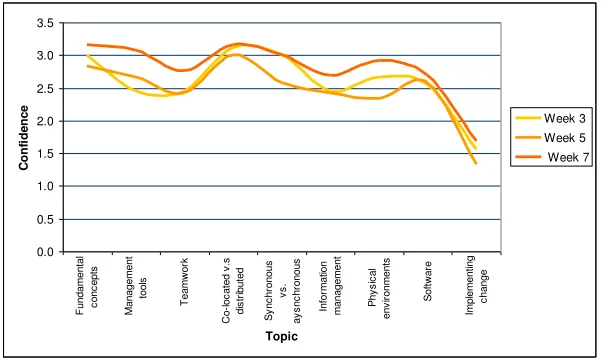
This section outlines the reflective approach to PBL in the class structure and assessment, and describes the effect this had on student learning. In PBL, there are recognised difficulties with team assessment and maintaining progress [10]. At Strathclyde, therefore, students were given milestones and made aware that an individual critical review of their project would be required. In the review, students were expected to explore, analyse and interpret the technological and organisational issues raised by the global team experience. Although the design of the product was not being marked directly, the outcome was to be seen as a way of illustrating successes and failures in the design process. In addition to this, confidence logs were distributed at regular intervals throughout the class, which required students to consider what they had learnt and how they were progressing in particular areas of distributed design.
3.1 Feedback
overall, although there are clearly areas where there was less confidence, notably in teamwork, information management and implementing change.
[image:5.468.84.386.68.247.2]0.0 0.5 1.0 1.5 2.0 2.5 3.0 3.5 F u n d a m e n ta l c o n c e p ts M a n a g e m e n t to o ls T e a m w o rk C o -l o c a te d v .s d is tr ib u te d S y n c h ro n o u s vs. a y s n c h ro n o u s In fo rm a tio n m a n a g e m e n t P h y s ic a l e n v ir o n m e n ts S o ft w a re Im p le m e n tin g c h a n g e Topic C o n fi d e n c e Week 3 Week 5 Week 7
Figure 1: Confidence logs
Using these results, along with observation in class and feedback from the critical reviews, arising issues have been broadly categorised relating to technology and organisation. These are outlined below. Some of the main issues raised included: team size; choice of communication tools; location to store information; cultural issues; and strategies to cope with the time difference.
3.2 Technological issues
The global design teams were expected to use a range of technologies to support their collaborative work. Although certain tools such as LauLima were provided (all students participating in the class signed up to LauLima and teams were encouraged to create a homepage using the wiki technology), they were free to explore new tools or use others with which they were already familiar. Student teams at Strathclyde were able to sign out a web camera to allow them to desktop videoconference; Strathclyde staff had sought permission from the Open University to use the online FlashMeeting (flashmeeting.open.ac.uk) service for the duration of the project. The tools and services used as part of the Global Design class to carry out collaborative work included:
LauLima: Learning Environment and Digital Library (http://onlinelearning.dmem.strath.ac.uk/laulima)
External file sharing tools such as YouTube (www.youtube.com)
Messaging tools such as MSN Messenger (.webmessenger.msn.com) and Campfire (www.campfirenow.com) real-time group chat tool
Google Documents (docs.google.com)
Thinkature (thinkature.com) real-time collaboration tool
Other wiki systems, SocialText (www.socialtext.com)
FlashMeeting online desktop videoconferencing service
PolyCom (www.polycom.com) video conferencing system
Teams’ use of particular tools generally resulted from one of the members having prior
experience of using it. This resulted in a somewhat haphazard distribution. Most teams found the PolyCom to be preferable to FlashMeeting in terms of synchronous
communication because there it was a more ‘immersive’ environment. There was a
lower than expected utilisation of the personal video conferencing facilities, despite these offering a greater degree of flexibility in terms of location and times of use. In retrospect, the teaching staff identified a lack of familiarity and understanding of how
best to make use of them on the students’ part as being responsible for this, and in future
years more attention would be given to these technologies beforehand. The teams which emphasised use of FlashMeeting and PolyCom tended to use the synchronous sessions to try and manage their project workflow. This led to very intense sessions where they would be both bringing their cross-Atlantic counterparts up to speed with and also trying to decide upon ideas. Teams which utilised a range of tools, including asynchronous, shared workspaces and file storage areas such as LauLima and YouTube, were able to pass over work and focus video conferences on decision-making. Although information management was an area where the teams had less confidence, (as noted in the reflective reports) individuals tended to recognise where their information and communication strategies worked or failed and developed a better understanding of the tools. The teams which used a range of tools, and had group buy-in to them, tended to perform better, having more flexibility in their working patterns.
3.3 Organisational issues
It was found that the short project timescales put a great deal of pressure on the teams in terms of information communication. In future years, it would be desirable to run the project over a longer period to allow patterns of synchronous and asynchronous working to form more definitively and for students to engage more deeply in PBL learning. For the Strathclyde-Stanford teams this problem was particularly acute; due to the larger time difference it was harder to arrange video conferences when everyone was available. The cultural experience afforded by such a class is one of its most valuable aspects, but one which can also be problematic. It was found that students at Strathclyde had a more managed approach to the design process than their American counterparts and despite the assurances that the reflective report would be a ringfenced assessment, teams got frustrated due to the different focus at different institutions. In future classes, it would be necessary to further encourage students to embrace and seek to bridge these cultural divides, as well as having matching assessment at both ends. Additionally, assessment would ideally take place across teams rather than each individual – this was employed in the first year only so that students were not disadvantaged. Teams that did not implement a strict project plan in the initial week of the project suffered. This was a valuable lesson, and they were encouraged to address and alter working practice as part of their reflective approach to the project. This, however, was something teams generally found difficult – if a working pattern had been set but not adhered to, frustration often mounted rather than alternatives being sought. This aspect of implementing change was something students had indicated they were less comfortable with in the confidence logs and is an aspect worth emphasising in future cohorts. Again, this is something a reflective approach to the project should encourage.
4 CONCLUSIONS
particularly for the first year of implementation, and Strathclyde is committed to offering Global Design to students on an annual basis. The main result of the reflective learning approach adopted was that students had a more considered and professional attitude towards the project process than in typical, more output-focussed assignments. This could be enhanced further, and it may be desirable in future years to have fixed reflective sessions when the confidence logs are distributed, making it a more formal part of the class. In summary, the institutions involved had the opportunity to exchange educational ideas, share resources and build links for future classes. The students who participated not only achieved the learning objectives of developing an understanding of the organisation and management of distributed design, but also gained valuable experience for future design work and employment. These findings will be relevant for other institutions considering a distributed project class.
REFERENCES
[1] Sheppard, K., Dominick, P. and Aronson, Z. Preparing engineering students for the new business paradigm of international teamwork and global orientation. International Journal of Engineering Education, 2004, 20(3), 475-483. [2] Bohemia, E. Working Collaboratively in Today's Global Environment: A Global
Product Development Course? IE&PDEDelft, the Netherlands, 2004). [3] Milne, A. and Winograd, T. The iLoft Project: A Technologically Advanced
Collaborative Design Workspace as a Research Instrument. International Conference on Engineering DesignStockholm, Sweden, 2003).
[4] Ion, W.J., Thomson, A.I. and Mailer, D.J. Development and Evaluation of a Virtual Design Studio. EDE '99, pp. 163-172Glasgow, Scotland, 1999). [5] Sclater, N., Grierson, H., Ion, W.J. and MacGregor, S.P. Online collaborative
design projects: overcoming barriers to communication. International Journal of Engineering Education, 2001, 17(2), 189-196.
[6] Herder, P.M. and Sjoer, E. Group-based learning in internationally distributed teams: an evaluation of a cross-Atlantic experiment. 33rd ASEE/IEEE Frontiers in Education ConferenceBoulder, CO, 2003).
[7] Schön, D. The Design Studio: An Exploration of its Traditions and Potentials. (RIBA Publications Limited, London, 1985).
[8] Thomas, J.W. A Review of Research on Project-Based Learning. (The AutoDesk Foundation, San Rafael, California, 2000).
[9] Pugh, S. Total Design. (Addison-Wesley, Reading, 1991).
[10] Esche, S.K. Project-Based Learning (PBL) in a course on mechanisms and machine dynamics. World Transactions on Engineering and Technology Education, 2002, 1(2), 201-204.
Acknowledgements
This project is being evaluated as part of the Digital Libraries for Distributed Innovative Design Education and Teamwork (DIDET) collaboration between the University of Strathclyde and Stanford University (www.didet.ac.uk).
Contact Information:
Andrew WODEHOUSE, University of Strathclyde
James Weir Building, 75 Montrose Street, Glasgow, G1 1XJ, Scotland [email protected]