This is a repository copy of Quantification of wettability characteristics for carbonates using different salinities.
White Rose Research Online URL for this paper: http://eprints.whiterose.ac.uk/139506/
Version: Accepted Version
Article:
Al-Khafaji, A and Wen, D orcid.org/0000-0003-3492-7982 (2019) Quantification of wettability characteristics for carbonates using different salinities. Journal of Petroleum Science and Engineering, 173. pp. 501-511. ISSN 0920-4105
https://doi.org/10.1016/j.petrol.2018.10.044
[email protected] https://eprints.whiterose.ac.uk/
Reuse
This article is distributed under the terms of the Creative Commons Attribution-NonCommercial-NoDerivs (CC BY-NC-ND) licence. This licence only allows you to download this work and share it with others as long as you credit the authors, but you can’t change the article in any way or use it commercially. More
information and the full terms of the licence here: https://creativecommons.org/licenses/
Takedown
If you consider content in White Rose Research Online to be in breach of UK law, please notify us by
Quantification of Wettability Characteristics for Carbonates
under Different Salinities
Arije Al-Khafaji1, Dongsheng Wen3,1*
1 School of Chemical and Process Engineering, University of Leeds, UK. 3 School of Aeronautic Science and Engineering, Beihang University, Beijing,
100191, China.
E-mail: [email protected]
Abstract
Low salinity water flooding has received strong interest recently. Several laboratory studies have shown that injecting low salinity water can improve oil recovery in carbonate reservoirs through wettability alteration. However, consistent mechanistic clarification behind this alteration has not emerged yet. This work investigates systematically the key parameters that govern the complex interactions of rock/brine/crude oil in carbonate reservoirs. The effects of salinity are studied in outcrop-calcite and subsurface-dolomite rocks saturated with three types of dead oil from Norwegian and North Seale. Zeta potential, oil/brine interactions by means of the IFT, ion-substitution-adsorption using infrared spectrometer apparatus, and contact angle were experimentally investigated. The results show that the salinity effect is more salient at the liquid/rock interface than the liquid-liquid interface. There is a clear reduction of contact angle as the formation water was diluted twice while its influence on the interface tension is small. The salinity effect was more pronounced for dolomite particles, showing different results for different crude oils used. This suggests that the wettability alteration of carbonate rock is an intricate phenomenon that influenced not only by the salinity, but also on the rock mineralogy and the chemical composition of crude oil. A combination of three possible mechanisms, including multiple ion exchange, EDL expansion (electrokinetics repulsive), and salting-out are discussed to illustrate the mechanism of wettability alteration during low salinity injection.
Key words: low salinity flooding, enhanced oil recovery, carbonate reservoir, wettability, interfacial tension, adhension force
Increasing recovery factor from high-temperature carbonate reservoirs is the main aim of using various enhanced oil recovery techniques as over half (50%) of the world's oil reserves are carbonate typies [8]. It should, however, be noted that the ultimate oil recovery from these reservoirs is generally less than that of sandstone reservoirs as many of them are preferentially oil wet with low matrix permeability [4]. Recently, low salinity flooding has been suggested as a promising technique that can improve oil recovery (IOR) in carbonate reservoirs [31,32,40,41,43].
Wettability alteration from oil wet to intermediate wet has been demonstrated by some researchers as a plausible mechanism which affects significantly on IOR during low salinity water flooding in carbonates [1,28]. Many theories concerning the wettability alteration upon low salinity flooding have been suggested, but none of them is commonly accepted. For example, the results from the spontaneous and forced core flooding tests revealed that the potential determining ions (SO42-,Ca2+ and Mg2+ could act as wettability
modifying agents and alter the core to a favorable wet condition [3,6,41]. In addition, Mahani et al. [23] and Nasralla et al. [26] stated that the electrical double layer (EDL) expansion was likely to be the primary mechanism for IOR during low salinity injection.It proposed that when the rock surface was exposed to a low saline solution, the EDL was formed due to the ion exchange between a charged rock surface and an electrolyte solution. Consequently, the interaction between EDL and oil-brine interface help to detach the hydrophobic layer from the surfaces, which can contribute to the wettability alteration of carbonate rocks to a favorable state.
oil may also contribute to the variation of IFT values upon exposure to saline solutions. Clearly extensive work is still needed to probe experimentally the oil/brine interactions.
The amount and type of the amphipathic components in the crude oil have been considered as one of the other key parameters that could contribute to the wettability alteration and strongly affect the potential of low salinity flooding for both carbonate and sandstone rocks. Hence, the adsorption of these compounds from crude oil onto rocks is considered an essential pre-condition for the influence of low salinity flooding to enhance oil recovery [9,29,36]. Buckley et al. [10] studied the interactions between sandstone rock and specific crude oils with varying range of asphaltene fractions, acid number, and base number. They found that an ionic interaction (either attractive, repulsive, or both) between oppositely charged acidic and basic sites at the oil/water and solid/water interfaces can lead to wettability alteration.
It is clear that complex interactions occur between rock/brine/crude oil, leading to wettability alteration. However, elucidating precisely how wettability modification occurs has not recognized yet. Additionally, the impact of oil composition and rock mineralogy on wettability alteration under different saline conditions has not been investigated. This work aims to provide a fundamental investigation of wettability alteration by using different saline solutions, and crude oils with various chemical compositions, as well as outcrop calcite/subsurface dolomite samples. Firstly, the electrostatic charges of natural carbonate particles in a wide range of salinity are identified. Then the crude oil/ brine interactions are assessed by measuring the oil/brine interfacial tension, followed by the evaluation of ion-substitution-adsorption into the carbonate molecules by the infrared spectrometry method. Finally, detailed contact angle measurements were performed at high temperature.
2.1 Rock Sample
Homogenous Estaillades limestone outcrop rock and dolomite subsurface rock were used in zeta potential, Infra-Red Spectroscopy, and contact angle tests. The core samples were supplied by the Shell Ltd. The average permeability and porosity of outcrop rock are 100 md and 25 %, respectively. Subsurface rock has a range of permeability between 30-380 md, and 25-28% of porosity. The average grain density is 2.74 g/cc, measured by Micromeritics Acupyc-1330. X-ray Diffraction (XRD) analysis was carried out by an XRD Bruker D8 Diffractometer to quantify the minerals composition of carbonate rock (See Table 1). No clay minerals were detected in the sample.
Table 1. Mineral composition of carbonate samples detected by XRD
Sample Calcite CaCO3 %
Dolomite
CaMg(CO3)2 %
Anhydrite
CaSO4 %
Clay
Minerals %
Outcrop rock 94 6 0 0
Subsurface rock 0 74 26 0
2.2 Brines
In this study, the synthetic seawater (SW) and artificial formation water (FW) were used as the base brines. All brines were prepared in the lab by mixing deionized water (Milli-Q, resistivity 18.2 M .cm) with reagent grade
salts, which supplied by Merck and Sigma with a purity grade 99%. The
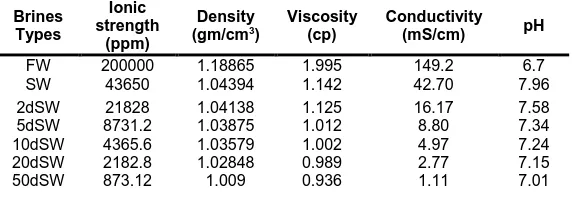
all prepared brines were characterized by measuring density, viscosity, conductivity, and pH. Table 3 illustrates the details of physical properties for different brines.
Table 2. The composition of high salinity and low salinity brines
Table 3. Physical properties of high salinity and low salinity brines
2.3 Crude Oils
Three kinds of dead crude oil were supplied by Lundin and Shell companies from oil fields in Alta and the North Sea, respectively. A Malvern Bohlin Rheometer and Micromeritics Acupyc-1330 were used to measure
Salts FW SW 2dSW 5dSW 10dSW 20dSW 50dSW
NaCl 124.5 26.5 13.25 5.3 2.65 1.33 0.53
4
SO
2
Na 0.43 4.10 2.05 0.82 0.41 0.20 0.08
O
2
.2H
2
CaCl 57.79 1.54 0.77 0.31 0.15 0.08 0.03
O
2
.6H
2
MgCl 16.87 11.41 5.70 2.28 1.14 0.57 0.23
3
NaHCO 0.40 0.11 0.05 0.02 0.01 0.005 0.002
TDS (g/L) 200 43.65 21.82 8.73 4.37 2.18 0.873
Ionic strength
(ppm)
200000 43650 21828 8731 4366 2183 873
Brines Types Ionic strength (ppm) Density ) 3 (gm/cm Viscosity (cp) Conductivity (mS/cm) pH
FW 200000 1.18865 1.995 149.2 6.7
SW 43650 1.04394 1.142 42.70 7.96
2dSW 21828 1.04138 1.125 16.17 7.58
5dSW 8731.2 1.03875 1.012 8.80 7.34
10dSW 4365.6 1.03579 1.002 4.97 7.24
20dSW 2182.8 1.02848 0.989 2.77 7.15
[image:6.595.156.442.403.503.2]viscosity and density. SARA fractionation was used to analyze the bulk composition of oils with respect to saturates, aromatics, and asphaltenes. The mass ratios of N, S, and O were determined by an Elemental Analyzer (Thermo EA2000). The physiochemical properties of crude oils are given in Table 4.
Table 4. Physiochemical properties of crude oils
Specification Crude Oil A
Crude Oil B
Crude Oil C
Specific gravity at 25 °C, gm/cm3 0.827 0.835 0.933
°API 39.5 38 20
Dynamic viscosity at 20 °C, cp 5.5 7.4 50 Dynamic viscosity at 50 °C, cp 2.94 4.5 28 Total acid number (TAN), mg KOH/g 0.25 0.46 2.54 Composition (wt%)
Saturates 73.7 64.53 32.25
Aromatics 22.75 28.81 44.91
Asphaltenes 0.21 0.47 11.13
Elemental analysis (wt%)
Nitrogen 0.6 0.88 1.06
Sulphur 0 0.19 0.32
Oxygen 2.74 5.12 10.33
2.4 Zeta Potential Measurements
A Colloidal Dynamics Zeta-Probe, which measures the dynamic mobility of charged colloidal suspensions at different frequencies in the MHz range, was used to determine the zeta potential of the calcite and dolomite brines suspensions.To prepare suspensions, 2% weight of outcrop-calcite and subsurface-dolomite powder were added to various brine solutions under magnetic stirring to maintain homogeneity and left one day to reach equilibrium. It is worth pointing out that the calcite particles aging in different suspensions have a specific
surface area (SSA) varied between 1.9 and 2.3 m2/g,
[image:7.595.253.494.664.836.2]surface area of about 4 m2/g, determined by Quantachrome Nova 2200. A
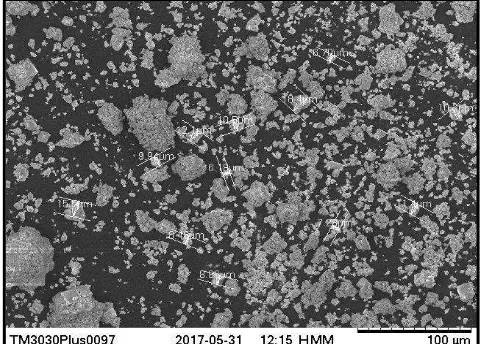
typical scanning electron microscopy (SEM) was used to image the fresh calcite and dolomite particles before exposure to various salt solutions. From Figure 1, the outcrop-calcite and subsurface-dolomite particles show anisotropic microstructure and heterogeneity in the grain size. In addition, there is a difference in the appearance of the two types of particles examined, hence an aggregation was observed in subsurface rock which can be attributed to the presence of anhydrite, detecting by XRD analysis.
Figure 1. SEM image of A) Fresh calcite particles. B) Fresh
dolomite particles.
The zeta potential measurements of various suspensions were conducted at a constant pH value of 8, typical of carbonate reservoir conditions. 0.1 mole/L for HCl and NaOH solutions was used to adjust the pH of suspensions. All the zeta potential measurements were conducted at ambient temperature. Three runs were carried out for each
sample with five cycles’ measurement for each run, and an average value of
zeta potential was evaluated within this range. The standard deviation of repeated zeta potential measurements is about 0.5 mV.
2.5 Interfacial Tension and Contact Angle Measurements
CAM 200-KSV equipment was used to determine the interfacial tension and static contact angle of dead crude oil with different saline solutions. It is an accurate equipment which depends on the drop-shape analysis technique by using LED light source.
2.5.1 Interfacial Tension Measurements
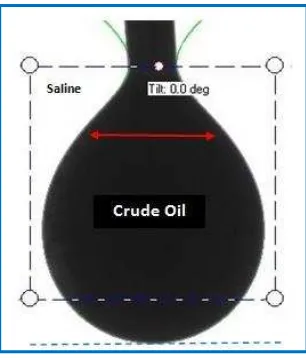
For IFT measurements of oil-brine system, a hooked (U-shape) needle with outer diameter of 0.7 mm was fitted with a micro syringe that filled with low density fluid (i.e. crude oil) and immersed in an optically clear thermal cell filled with the aqueous phase. Then the crude oil droplet was injected upwards, and a stable pendent oil droplet was recorded by a camera (Figure 2). The same drop size (12 µl) was used for all experiments. Previous studies showed that an identical IFT value was obtained if the drop volume falls within the range of 7 µl to 30 µl [11]. A pendent drop shape was then processed by the software to fit the Young-Laplace equation, and the IFT values were determined. The equilibrium IFT value was observed after about 30 minutes. The measurements were repeated several times for each oil/brine system and similar trends were yielded with the standard deviation of about ±2 unit. All the interfacial measurements were conducted at high temperature (80°C) and atmospheric pressure.
2.5.2 Contact Angle Measurements
[image:9.595.209.362.368.547.2]The contact angle meter (CAM 200-KSV) equipment was used to determine the static contact angle. For a good estimation of contact angle, 10 core slices with the thickness of 0.5 cm were extracted from selected low permeability core plugs (outcrop and subsurface) to avoid the imbibition of the liquid when the drop attached to the rock surface. The rock slices were then ground using silicon carbide grinding discs- 600 grit and a finer 1200 grit to reduce the roughness of the surface. Next, the rock plates were saturated with synthetic formation water (200000 ppm) under vacuum pressure and left
Figure 2. Schematic diagram of crude oil droplet at the tip of inverted
for 4 days. The rock slices were then dried in the oven for 48 hours at 60 °C. Finally, the rock plates were aged in the oil for 8 weeks to restore the wettability of the substrates (3 rock plates for crude oil A, 3 rock plates for crude oil B, and 3 rock plates for crude oil C). After aging, the slices were washed with alcohol to detach the oil from the surface and left to dry in the air.
Figure 3. Schematic diagram of contact angle measurements.
3. Results and Discussion
3.1 Zeta Potential of Calcite and Dolomite as a Function of Brine
Composition
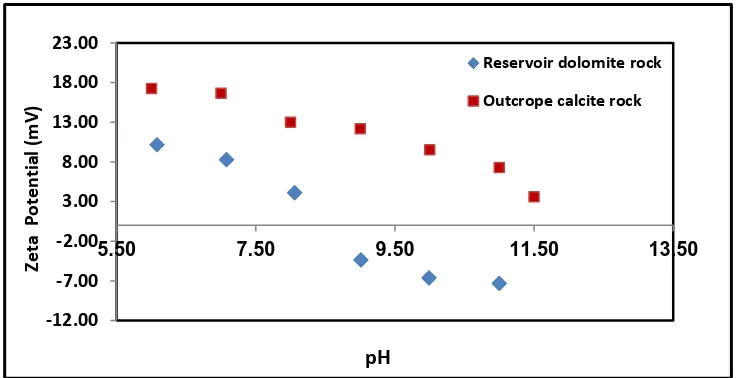
The zeta potential of calcite and dolomite particles in deionized water was examined first over a wide range of pH (6.5-11.5) values as a reference test. From Figure 4, it can be clearly seen that positive zeta potential values were reported for outcrop-calcite particles throughout the pH range covered. This might be commonly linked to the high concentration of the Ca2+ ion in the
surface lattice. On the other hand, the sensitivity of zeta potential of dolomite particles to pH is stronger . The isoelectric point (IEP) was observed at pH 8.5, beyond this point the zeta potential of dolomite particles are positive as a result of an increase in the magnesium species. Previous studies stated that the IEP values of the pure dolomite are within the range of pH 6.3-8 [24,27].
In addition, a high pH would increase the concentration of CO32-, HCO-3
and OH-, leading to a less positive charge for calcite surface [14, 23]. Thus, as
illustrated in Figure 4, the magnitude of the positive surface charge is decreased clearly (from +17.27 mV to +3.2mV) with an increase of pH value, making the calcite surface less positive. For dolomite, it has been reported that at high pH value the concentration of Mg2+ (OH)+ will be less than that of
HCO3-, and thus the electrokinetics of dolomite particles become more
negative [12].
study. This result is consistent with the finding from Mahani et al. [23] that the zeta potential for different types of carbonate particles in high salinity water is positive due to the high concentration of (Ca2+ and Mg2+) ions, leading to a
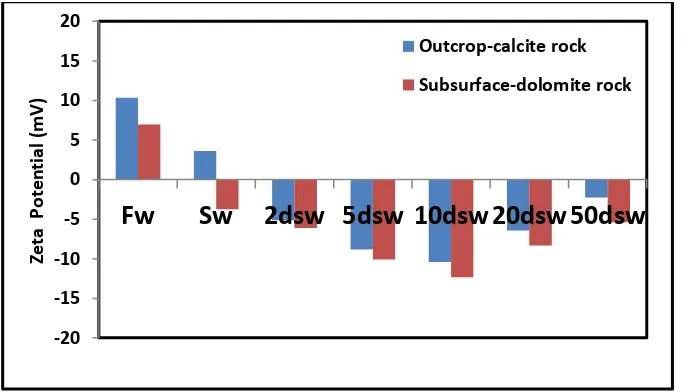
shrinkage of the EDL and shift of the zeta potential to positive value. In comparison, the zeta potential of calcite particles in sea water was less positive than the formation water (+3.6 mV) at the same pH value, while the value overturned to negative (-3.73 mV) for dolomite particles. This could be attributed to the reduction in the total dissolved solids (43650 ppm) and an increase of the concentration of the SO42- ion in sea water, which is consistent
with the previous studies [3,16,17].
[image:12.595.108.478.322.511.2]
Figure 4. Zeta potential of calcite and dolomite particles in deionized
water
The results also reveal that the magnitude of the negative charge generally increases as the salinity and ionic strength of suspensions decreases up to 10 times dilution. For instance, the zeta potential of calcite and dolomite particles in two twice-diluted seawater are -5.12 mV and -6.09 mV, respectively, and it reaches to -10.62 and -12.3 mV at 10 times dilution. It is logical that as the salinity of suspension decreases, the adsorption of Mg2+
and Ca2+ ions surrounding the particles decreases with continuous adsorb of
SO42-. This leads to the expansion of the EDL and an increase in the
magnitude of the negative surface charge [23]. However, further brine dilution
-12.00 -7.00 -2.00 3.00 8.00 13.00 18.00 23.00
5.50 7.50 9.50 11.50 13.50
Reservoir dolomite rock
Outcrope calcite rock
causes more reduction in the concentration of SO42- and therefore less
negative charge is observed, i.e., a zeta potential of -2.24 mV and -5.4 mV are obtained for calcite and dolomite suspensions, respectively at 50 times dilution. Al Alotaibi et al. [1] also confirmed that, less negative charges were observed by using aquifer water without sulphate at certain pH.
It is also evident from the results that, the subsurface dolomite particles are more negatively charged than outcrop calcite particles. This could be linked to the presence of anhydrite in the crystalline lattice of dolomite rock as detected by XRD, which may have shifted the zeta potential to more negative charge. Another possible explanation could be that the dolomite particles have large specific area (4 m2/g) compared to that of calcite (see section 2.4).
[image:13.595.129.471.521.717.2]Therefore, we expect the reaction surface of dolomite molecules will be larger and consequently, high negative surface charges have been reported. A study performed by Vdovic [38] shows that a significant difference in the zeta potential values was observed for the two synthetic calcite samples, having different surface area. His conclusion is that the specific surface area and grain size could affect the magnitude of electric charge or energy stored on the calcite surface.
Figure 5. Averaged zeta potential of calcite and dolomite particles in
different salinity solutions at pH 8
-20 -15 -10 -5 0 5 10 15 20
Fw
Sw
2dsw 5dsw 10dsw 20dsw 50dsw
3.2 Interfacial Tension Measurements
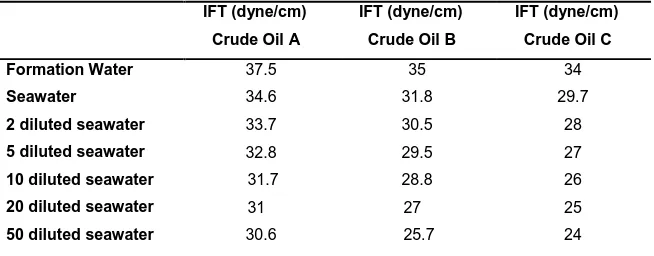
[image:14.595.136.463.506.634.2]IFT measurements were carried out between different dead crude oils and compound aqueous phases to examine the impact of salinity and the presence of polar organic components in crude oil on the IFT variation. The averaged values of equilibrium IFT are summarized in Table 5. It is obvious that the IFT values decreased steadily as the salinity of water declined. Hence replacing formation water with seawater promotes IFT drop by about 2.9, 3.2, and 4.3 units for crude oils A, B and C, respectively. Further reduction of 4-6 units were observed when seawater was changed to 50dSW for the three kinds of crude oils used. This can be attributed to the salting-out effect, so at a very high salt concentration, the solubility of polar organic components of oil in aqueous phase decreases, causing an increase in the IFT value [15,31]. On the other hand, minor IFT decrease (0.4-1 dyne/cm) was obtained under different dilution proportion of seawater. This trend is in line with previously discussed work by Yousef et al. [40].
Table 5. Equilibrium IFT values of different brines and crude oils
examined.
IFT (dyne/cm)
Crude Oil A
IFT (dyne/cm)
Crude Oil B
IFT (dyne/cm)
Crude Oil C
Formation Water 37.5 35 34
Seawater 34.6 31.8 29.7
2 diluted seawater 33.7 30.5 28
5 diluted seawater 32.8 29.5 27
10 diluted seawater 31.7 28.8 26 20 diluted seawater 31 27 25 50 diluted seawater 30.6 25.7 24
when the oil solvent character changed. It has previously been reported that the hetero-atoms play a vital role on interfacial activity since they can transfer from bulk and accumulate in the oil-water interface acting as a weak to moderate ionic surfactant [18,21,37]. It should, however, be noted that the activation of the acidic species causes more reduction in IFT values compared with activation of basic species [10]. This means that more acidic components present in the interface region the positive IFT contribution will be obtained. The results acquired in this study are consistent with Skauge et al. [30] findings that a significant reduction in IFT values was reported for oil with highest acid number.
Given the minor decrease in the IFT values for all of the crude oils tested, we expect that the changes in the IFT of the crude oil/brine system would not contribute to any considerable alterations in the wetting conditions when brine composition is changed.
3.3 Infrared Absorbance of Calcite and Dolomite
Many Pervious studies proposed that wettability alteration of carbonates during low salinity flooding is mostly because of the adsorption of potential determining ions into the positively charged rock surface, i.e., mutual interactions between Ca2+, SO
42-, and Mg2+ occurred at the rock surface
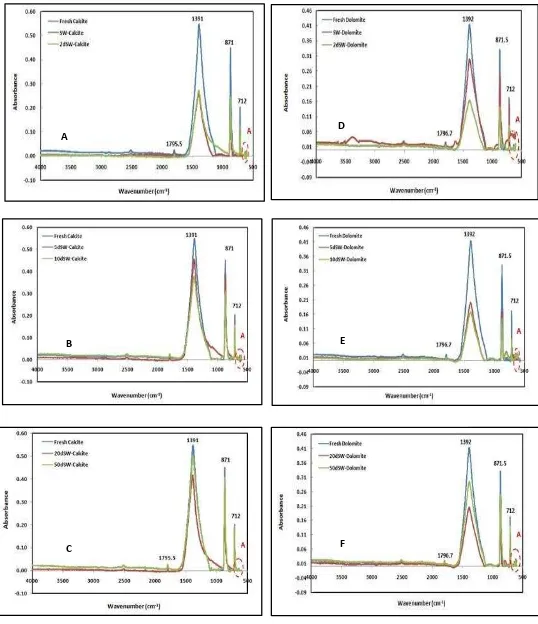
[6,35,43]. To validate this hypothesis and to explain the complex rock-brine interactions, IFR absorbance of fresh calcite and dolomite particles prior to contacting with saline solutions was first measured. From Figure 6, it can be clearly seen that the same general pattern of the IR spectrum was observed for the particles before and after treatment. However, there is a variation in the intensity of absorbance between the fresh and aged particles.
It is also obvious that there is a substantial decrease in the intensity of C-O stretching vibration at 1392 cm-1 as well as in that of the bands located at
the 871 cm-1 and 712 cm-1. This might be due to the chemical substitution of
the CO3- and Ca2+ ions by the anions and cations that adsorbed from brines
A (See Figure 6), can give an indication that the sulphate adsorption was happened on the mineral surface after treated with seawater and different diluted versions of sea water [34]. This conclusion is confirmed by zeta potential measurements presented in section 3.1, i.e., an increase in the magnitude of the negative surface charges was observed when the salinity decreased up to 10 times dilution. On the other hand, region A in Fig. 6C specifies that no sign of SO42- bending band in the range of 620-680 cm-1
when the calcite minerals exposed to 20dSW and 50dSW. It seems likely that no sulphate molecules are adsorbed on the mineral surface as the sulphate concentration is further decreased. These results are again consistent with our zeta potential measurements that treated calcite with 20dSW and 50dSW showed less negative charges compared with other diluted versions of seawater. Austad et al. [5] and Alshakhs [3] argued that multiple ion exchange (MIE) is only happened by brine with a high concentration of Mg2+, and SO42-,
i.e., specific brine composition is required for the ion-substitution mechanism. For dolomite particles, Figure 6D, E, and F show that SO42- bending
band at 620-680 cm-1, region A, is relatively more intense for treated dolomite
surface compared with that of treated calcite surface. A possible explanation for this observation could be that the treatment of dolomite surface with various saline solutions can lead to the adsorption of sulphate ion on the surface, as dolomite mineral contained anhydrite in their crystalline lattice (See section 2.1),which could cause a further increase in the intensity of the SO42- bending band of dolomite compared to the calcite. In addition,
inspection of Figures 6D, E, and F indicates that there is a symmetric vibration band at the wave number of 842 cm-1 for all treated dolomite particles, which
is referred to the MgCl2 ion [34]. This gives sufficient evidence that
Figure 6. Infrared spectra of fresh and treated calcite and dolomite particles. A
B
C
D
E
3.4 Contact Angle Alteration as a Function of Rock Mineralogy, Brine
Salinity, and Oil Composition.
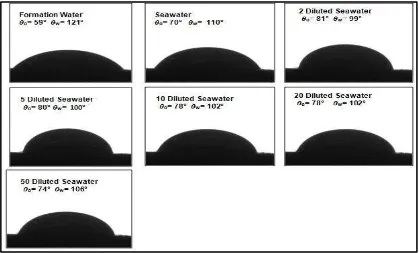
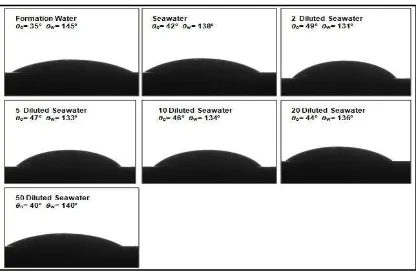
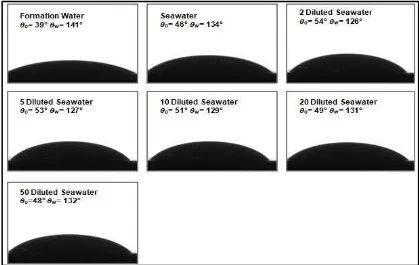
The impact of high and low salinity solutions on the wettability alteration of the calcite and dolomite plates aged with different types of dead crude oil is investigated in this section. Figures 7 through 12 show the contact angle images of aged dolomite and calcite substrates upon exposure to formation water, seawater, and different diluted versions of seawater for the crude oil A, B and C, respectively. The results revealed that an overall decrease by about 7 to11 degrees in the water contact angle was detected as the salinity of the solution decreases up to twice-diluted seawater.
For crude oil A, it is clear from Figure 7 that a weakly oil-wet with the water contact angle of 121° was recorded when the aged dolomite substrate was subjected to formation water. Subsequently, a decrease in the water contact angle to 110° was reported after exposure to seawater. A similar trend was observed by Mahani et al. [23] who noted that a change of 5-17° in the contact angle was observed when switching from formation water to seawater. The most obvious decrease in the contact angle value to 99° was for the dolomite plate upon exposure to twice-diluted seawater, which reveals that the rock substrate is changed to intermediate-wet [4]. On the other hand, an insignificant effect on the contact angle was recorded when using further dilution of sea water, as the contact angle showed almost a fixed trend to end up with the value of 106°.
interaction between ionized acidic and basic sites could be happened, resulting in an oil-wet surface [1,10]. Again, the dolomite surface changed to weakly intermediate-wet when twice diluted seawater was used with the average water contact angle of 109°.
For the calcite/brine/oil system, as can be seen in Figures 10 and 11, there was a decrease in the water contact angle for crude oil A and B when the formation water replaced by seawater and twice-diluted seawater, producing less oil-wet surface. These results are consistent with the findings from the experimental work performed by Lashkarbolooki et al. [22] that formation water with high salinity (202070 ppm) was not able to modify the wettability of carbonate rock surface while Persian Gulf water with a salinity of 43336 ppm could change the wettability to a less oil-wet condition. It should, however, be noticed that the calcite/crude oil B regime showed more hydrophobic surface than calcite/crude oil A system upon exposure to investigated brines. These results may have been linked to the difference in the solvent character of crude oil A and B with respect to their polar components, as outlined before (See Table 4), and to the effect of surface properties.
It is also obvious that the contact angle of dolomite/calcite and crude oil C remain within the strongly oil-wet condition upon exposure to saline solutions. As shown in Figures 9 and 12, dolomite and calcite plates showed a strong oil-wet surface with the water contact angle of 145° and 151°, respectively when formation water was used. The contact angle decreased then slightly when the dolomite and calcite substrates were exposed to seawater and twice-diluted seawater, but both surfaces are still within a strong oil-wet condition.
Based on the results of this work, we found that the wettability is likely to be affected by three factors, including minerals composition of the rock, brine concentration, and chemical composition of the crude oil. To better understand the role of each factor and to explain the main cause of wettability alteration and oil release, we evaluate the dispersive adhesion tension ( A)
using Young's equation [4]:
A= os- ws= ow cos (1)
where os and ws are the interfacial tension between oil/water and solid surface, dyne/cm. ow is the measured oil/brine interfacial tension, dyne/cm.
is the measured contact angle between oil/brine interface and the solid surface. The calculated values are plotted versus various saline solutions, Figures 13 and 14.
From Figure 13, it is apparent that a sharp decrease in the adhesion tension was obtained when switching from formation water to seawater and then to twice-diluted seawater. While, Figure 14 showed that the slope of adhesion curves for calcite is less steep than that of dolomite upon exposure to similar saline solutions for three oils examined, suggesting a high adhesion force for calcite surface. This results in a more hydrophobic surface for calcite surfaces in comparison with the dolomite surfaces, hence a smaller low salinity effect. These results are qualitatively consistent with previously discussed zeta potential and infrared absorbance data. Thus, we found that the variation in adhesion values may have been linked to the difference in the rock characteristics of calcite and dolomite minerals with respect to the content of anhydrite (section 2.1).
charges of carbonate particles to negative values . As a result, the repulsion force is likely to be increased and consequently, the affinity of polar oil components into the rock surface would decrease. The researcher group in British Petroleum [19,20] suggested that the cause of an increment in oil recovery by specific brine composition (i.e., containing a high concentration of SO42-, Ca2+ and Mg2+) can be traced back to the multi-ionic exchange, which
results in a detachment of organic polar components from the surface by divalent cations.
The second suggested mechanism is the electrical double layer and DLVO theory, which illustrates the competitive interactions between repulsive electrostatic forces and van der Waals attractive forces. At a low electrolyte concentration and a relatively high surface charge density, the repulsive energy of the EDL plays a vital role in the interactions between rock/brine/oil interfaces. A thin water film on the rock surface becomes stable and thicker (i.e., positive disjoining pressure), thereby receding the three-phase contact line and preventing oil to contact the surface [7]. The findings of zeta potential measurements, described in section 3.1, can give an indication of the occurrence of EDL expansion. As the surface charges of dolomite and calcite rock become more negative when the salinity of suspensions decreases up to 10 times dilution, the expansion of EDL causes considerable change in the rock wettability, evidenced by the reduction in adherence tendency of oil components to the surface.
It is also clear that the adhesion tension of dolomite and calcite rocks for crude oil C is relatively higher than of crude oil A and B, resulting in a high degree of oil-wetting. As mentioned earlier, crude oil C contained the highest concentration of polar organic components, which can be ionized in the presence of water to give a positive and negative?? oil/water interface. Thus, it is supposed that the ionizable acidic and basic components at the oil/water interface could be adsorbed at the carbonate surface, and the strongest interactions between these polar atoms and polar surface site may occur, i.e, adhesive force will compensate the repulsive force, leading to preferentially oil-wet surface and low wettability alteration for the rock/brine/crude oil C regime [9]. The contact angle results support that the observed wettability alteration is mostly due to the rock/brine/oil interactions. Our current findings expand many prior work [1-3,10, 28,40,42].
Figure 8. Contact angle images of dolomite rock with crude oil B and formation water, seawater, and different dilution of seawater.
[image:23.595.90.506.403.676.2]Figure 10. Contact angle images of calcite rock with crude oil A and formation water, seawater, and different dilution of seawater.
[image:24.595.88.507.408.673.2]Figure 12. Contact angle images of calcite rock with crude oil C and formation water, seawater, and different dilution of seawater.
Figure 13. Adhesion tension of dolomite substrates as a function of
[image:25.595.125.461.433.634.2]4. Conclusions
This work is conducted to provide insightful information on the carbonate surface/brine/oil interactions and to gain a better understanding of the wettability alteration mechanisms.
o The overall zeta potential measurements demonstrate that as
the salinity and ionic strength of suspensions decreases up to 10 times dilution, the magnitude of the negative charges increases. The dolomite surface, containing some amount of anhydrite, is more negatively charged than the pure calcite surface.
o The IFT experiments show that there is a general trend of IFT
reduction as the salinity of water is decreased. However, the reduction is small, which suggests that low salinity water flooding has an insignificant effect on fluid-fluid interactions compared to fluid-rock interactions.
o The IFR test shows that some sulphate ions are adsorpted on
[image:26.595.129.479.68.285.2]calcite and dolomite surfaces, which affects the net surface charges of carbonate particles.
Figure 14. Adhesion tension of calcite substrates as a function of
o The results of contact angle measurements show that a
dramatic change in the contact angle was detected for dolomite substrates when the salinity is decreased twice from the formation water , whereas the alteration for the calcite substrates was smaller. Further decrease in the salinity shows an insignificant effect on the contact angle behavior
o Different effects on the contact angle were obtained for three
kinds of dead crude oil examined for the same rock/brine system, suggesting that the wettability alteration of carbonate rock under high temperature is influenced by the rock mineralogy, the concentration of brine, and the chemical composition of crude oil existing in the porous media.
o Three possible mechanisms, including multiple ion exchange,
EDL expansion (electrokinetics repulsive), and salting-out are suggested for the wettability alteration during low salinity injection. However exact cause is hard to detect, which requires further detailed studie.
ACKNOWLEDGMENT
The work is supported by the European Research Council (ERC-2014-CoG, Project reference: 648375) and Shell Ltd.
References
1. Alotaibi, M.B and Nasr-El-Din, H.A. Electrokinetics of Limestone and Dolomite Rock Particles. SPE Reservoir Evaluation and Engineering 2011,594-603.
2. AlShaikh, M., and Mahadevan, J. Impact of Brine Composition on Carbonate Wettability: A Sensitivity Study. SPE Saudi Arabia Section Technical Symposium and Exhibition, Al-Khobar, Saudi Arabia, April 2014.
3. Alshakhs, M.J. and Kovscek, A.R. Understanding the Role of Brine Ionic Composition on Oil Recovery by Assessment of Wettability from Colloidal Forces. Advances in Colloid and Interface Science 2016, 233, 126-138.
4. Anderson, A. & William, G. Wettability Literature Survey-Part 1: Rock/Oil/Brine Interactions and the Effects of Core Handling on Wettability. Society of Petroleum Engineer 1986, 38 (11), 1125-1127.
5. Austad, T., Shariatpanahi, S.F., Strand, S., Black, C.J.J, and Webb, K.J. Conditions for a Low-Salinity Enhanced Oil Recovery (EOR) Effect in Carbonate Oil Reservoirs. Energy & Fuels 2012, 26, 569-575.
6. Austad, T., Strand, S., Madland, M., Puntervold, T. and, Korsnes, R. Seawater in Chalk: An EOR and Compaction Fluid. SPE International Petroleum Technology Conference, Dubai, U.A.E 2007.
7. Awolayo, A., Sarma, H., and AlSumaiti, A.M. A Laboratory Study of Ionic Effect of Smart Water for Enhancing Oil Recovery in Carbonate Reservoirs. SPE EOR Conference at Oil and Gas West Asia, Muscat, Oman, April 2014.
8. Ayirala, S.C. and Yosef, A.A. A State-of-the-Art Review to Develop Injection-Water-Chemistry Requirement Guidelines for IOR/EOR Projects. SPE Production and Operations 2015, 30(1),26-42.
9. Buckley, J.S and Liu,Y. Mechanisms of Wetting Alteration by Crude Oils. Journal of Petroleum Science and Engineering 1998, 3 (1),54-61.
10. Buckley, J.S and Liu,Y. Some Mechanisms of Crude/Brine/Solid Interactions. Journal of Petroleum Science and Engineering 1996, 20,155-160.
12. Chen, G. and Tao, D. Effect of Solution Chemistry on Flotability of Magnesite and Dolomite. International Journal of Mineral Processing 2004,74(1-4), 343-357.
13. Derrick, M.R., Stulik, D., and Landry, J.M. Infrared Spectroscopy in Conservation Science. Los Angeles, CA: The Getty Conservation Institute 1999.
14. Gomari, R. Different Approaches to Understand Mechanism of Wettability Alteration of Carbonate Reservoirs. SPE Europec/Eage Annual Conference and Exhibition, Amsterdam, Netherlands, 2009.
15. Kaliyugarasan, J. Surface Chemistry Study of Low Salinity Water Flood. Master Thesis 2013, Petroleum Technology-Reservoir Chemistry, Center for Integrated Petroleum Research (Uni CIPR), Department of Chemistry, University of Bergen.
16. Karimi, M., Al-Maamari, R.S., Ayatollahi, S., and Mehranbod, N. Impact of Sulphate Ions on Wettability Alteration of Oil-Wet Calcite in the Absence and Presence of Cationic Surfactant. Energy & Fuels 2016, 30, 819-829.
17. Kasha, A., Al-Hashim, H., Abdallah, W., Taherian, R. and Sauerer, B. Effect of Ca+2, Mg+2 and SO42- Ions on the Zeta Potential of Calcite
and Dolomite Particles Aged with Stearic Acid. Colloids and Surfaces A: Physicochemical and Engineering 2015, 482, 290-299.
18. Kummar, B. Effect of Salinity on the Interfacial Tension of Model and Crude Oil Systems. Master Thesis 2012, University of Galgary.
19. Lager, A., Webb, K.J., Black, C.J.J., Singleton, M. and Sorbie, K.S. Low Salinity Oil Recovery An Experimental Investigation1. Petrophysicists and Well Log Analysts 2008,49(1).
20. Lager, A., Webb, K.J., Collins, I.R. LoSal Enhanced Oil Recovery: Evidence of Enhanced Oil Recovery at the Reservoir Scale. Tulsa, 19-23 April 2008, SPE 113976-MS.
21. Lashkarbolooki, M., Riazi, M., Ayatollahi, S. and Hezave, A.Z. Synergy Effects of Ions, Resin, and Asphaltene on Interfacial Tension of Acidic Crude Oil and Low-High Salinity Brines. Energy & Fuels 2016, 165,75-85.
23. Mahani , H. , Keya, A. L., Berg, S., and Nasralla The Effect of Salinity, Rock Type and pH on the Electrokinetics of Carbonate-Brine Interface and Surface Complexation Modeling. SPE Reservoir Characterization and Simulation Conference and Exhibition, Abu Dhabi, UAE, 2015.
24. Marouf, R., Marouf-Khelifa, K., Shott, J., Khelifa,A. Zeta Potential Study of Thermally Treated Dolomite Samples in Electrolyte Solutions. Microporous and Mesoporous Materials 2009,122, 99–104.
25. Mohanty, K. K., & Chandrasekhar, S. Wettability Alteration with Brine Composition in High Temperature Carbonate Reservoirs. SPE Annual Technical Conference and Exhibition, New Orleans, Louisiana, USA, September 2013.
26. Nasralla, R.A., Bataweel, M.A. and Nasr-El-Din, H.A. Investigation of Wettability Alteration by Low Salinity Water. In Offshore Europe, Aberdeen, UK, 2011.
27. Pokrovsky, O.S., Schott,J., Thomas,F. Dolomite Surface Speciation and Reactivity in Aquatic Systems. Geochimica Cosmochimica Acta, 1999, 63, 3133-3143.
28. Romanuka, J., Hofman, J., Ligthelm, D. J., Suijkerbuijk, B., Marcelis, F., Oedai, S., Austad, T. Low Salinity EOR in Carbonates. SPE Improved Oil Recovery Symposium, Tulsa, Oklahoma, USA, April 2012.
29. Sayyouh ,M.H. , Hemeida , A.M. , Al-Blehed ,M.S., Desouky ,S.M. Role of Polar Compounds in Crude Oils on Rock Wettability. Journal of Petroleum Science and Engineering 1991, 6 (3), 225-233.
30. Skauge, A., Norsk Hydro, Standal, S., Boe, S.O., Skauge, T., and Blokhus, A.M. Effects of Organic Acids and Bases, and Oil Composition on Wettability. Society of Petroleum Engineers 1999.
31. Standal, S. Partition Coefficients and Interfacial Activity for Polar Components in Oil/Water Model Systems. Journal of Colloid and Interface Science 1999, 212(1), 33-41.
32. Strand, S., Hognesen, E.J., and Austad, T. Wettability Alteration of Carbonates: Effects of Potential Determining Ions (Ca+2 and SO
4-2)
and Temperature. Colloids and Surface A: Physicochemical and Engineering Aspects 2006, 275, 1-10.
34. Stuart, B.H Infrared Spectroscopy: Fundamentals and Applications. New York: John Wiley and Sons Ltd 2004.
35. Tabrizy, V.A, Hamouda, A.A., and Denoyel, R. Influence of Magnesium and Sulfate Ions on Wettability Alteration of Calcite, Quartz, and Kaolinite: Surface Energy Analysis. Energy and Fuels 2011, 25, 1667-1680.
36. Tang, G.O. and Morrow, N.R. Influence of Brine Composition and Fines Migration on Crude Oil / Rock Interactions and Oil Recovery. J.Pet.Science 1999, 24, 99-111.
37. Varadaraj, R, Brons, C. Molecular Origins of Heavy Oil Interfacial
Activity Part 1: Fundamental Interfacial Properties of Asphaltenes
Derived from Heavy Crude Oils and their Correlation to Chemical Composition. Energy & Fuels 2007, 21(1),195-198.
38. Vdović, Neda. Electrokinetic Behaviour of Calcite—The Relationship with Other Calcite Properties. Chemical Geology 2001,177(3),241-248.
39. Xu, W. (2005) Experimental Investigation of Dynamic Interfacial Interactions at Reservoir Conditions. MSc. Thesis. Louisiana State University, Louisiana.
40. Yousef, A.A., Al-Saleh, S., Al-Kaabi,A. and Al-Jawfi, M. Laboratory Investigation of Injection-Water Salinity and Ionic Content on Oil Recovery from Carbonate Reservoirs. Society of Petroleum Engineers 2011, 578-593.
41. Zhang, P., Tweheyo, M.T., Austad, T. Wettability Alteration and Improved Oil Recovery in Chalk: The Effect of Calcium in the Presence of Sulfate. Energy & Fuels 2006, 20, 2056-2062.
42. Zhang, Y. and Sarma, H. K. Improving Waterflood Recovery Efficiency in Carbonate Reservoirs through Salinity Variations and Ionic Exchanges: A Promising Low-Cost “Smart-Waterflood” Approach. Abu Dhabi International Petroleum Exhibition and Conference, Abu Dhabi, U.A.E., November 2012.