Amendments to thesis titled
Pitch Modification Techniques for Sampled Voice
□ Chapter 2, ppl9, 20, 21, 23, figure captions: the Hanning window is a misnomer and should be called the Hann window after von Hann who proposed its use in Astronomy.
□ Chapter 4, p33: A more comprehensive literature review could include a search of patent references. This would include some of the commercial pitch shifters and time scalers in the review. An example is A.M Agnello, “Pitch changer with glitch minimizer”, US patent 4464784, 1984.
□ Chapter 4, p33: Note that the literature review does not include any analog pitch shifting techniques such as the “Springer Machine”.
□ Chapter 4, p33, last paragraph: Time domain techniques may, of course, be quite computationally expensive due to, for example, repeated autocorrelation searching. This complexity is still less than that of the frequency domain algorithms presented herein, such as the iterative approach of Griffin and Lim [2]. □ Chapter 4, p40, last paragraph: In order to achieve a real signal in the time
domain, it is necessary that the magnitude and phase have certain symmetry properties. These cannot be imposed directly on an arbitrary MSTFT without destroying the formant structure of the synthesis signal and hence losing the individuality and recognisability of the voice signal. The search phase is necessary to find a real signal with both the required frequency domain characteristics and a formant shape preserved from the original signal.
□ Chapter 6, p82, last paragraph: Shepard tones need not use constantly varying pitches. It is possible to make a 12 tone equal tempered version of the Shepard illusion.
□ Chapter 6, p82, last paragraph: The suggestion of using Schroeder’s “tricks” to pitch shift speech is problematic because they require special fractal waveforms. □ Chapter 6, p83, first paragraph: The final sentence should read “It seems to be self
Sampled Voice
A thesis submitted fo r the degree o f Master o f Engineering
Michael Brooks
B.E. (Honours), University of Sydney
Telecommunications Engineering Group
Research School of Information Sciences and Engineering The Australian National University
Declaration
The contents of this thesis are the result of original research and have not been submitted to any other university or institution for the purpose of obtaining a postgraduate degree. The direction of the research presented herein has benefited greatly from the guidance offered by my supervisors, Dr. Rodney A. Kennedy and Dr. Bob Williamson.
Altering the way someone sounds when singing or speaking has been the subject of increasing scrutiny over the past twenty years. Modification algorithms based on transforms such as the Discrete Fourier Transform and the Cepstrum have been popular with academic researchers, but computationally efficient time domain techniques are most widely used in commercially available implementations. This thesis attempts to orientate the reader with respect to the disparate array of proposed methodologies, and considers some new procedures for varying the pitch of human singing and speech.
One of the most widely sought after modifications to speech is that of altering the rate of articulation without reducing the intelligibility or the personal characteristics of the original speaker. Conversely, when modifying the pitch of a human voice, either singing or talking, these more nebulous personal characteristics, sometimes referred to as “naturalness”, are often more disturbed than the intelligibility. Published work revolves around the Phase Vocoder, which models the production apparatus of the human species, but it is found that attention to subjective evaluation is lacking.
Two new techniques for modifying the pitch of a voice by means of low complexity time domain structures are proposed, developed and implemented. The first is based on a filter bank interpretation of the Fourier Transform, implemented in the time domain as a set of FIR filters. Several methods for generating the set of filters are compared and the best performing method is incorporated into a system for the real-time transformation of sung pitch by a time-varying rate. The proposed system is computationally efficient and capable of acceptable quality, especially when compared to techniques from the literature.
Table of Contents
CHAPTER 1 - INTRODUCTION...1
1.1. Thesis Scope...I 1.2. Thesis Overview... 3
1.3. Thesis Contributions... 7
CHAPTER 2 - BACKGROUND... 9
2.1. Introduction... 9
2.2. Modelsof Speech Production... 9
2.3. The Short Time Fourier Transform... 11
2.4. Time Frequency Representations... 14
2.5. Deconvolution... 17
2.6. Issues... 24
CHAPTER 3 - GENERAL FORMULATION OF SPEECH SCALING ...27
3.1. Speech Production... 27
3.2. Time Scalingof Speech... 29
3.3. Pitch Scalingof Speech... 31
CHAPTER 4 - LITERATURE REVIEW... 33
4.1. Introduction... 33
4.2. Model Based Methods... 37
4.2.1. Time Domain Implementations...37
4.2.2. Frequency Domain Implementations...38
4.3. Non-Model Based Methods... 50
4.3.1. Time Domain Implementations...50
CHAPTER 5 - AN INVESTIGATION INTO ALTERNATIVE SCALING METHODS... 59
5.1. Introduction... 59
5.2. Filter Banks... 60
5.2.1. Arbitrarily Located Bandpass Filters...60
5.2.2. Harmonically Related Bandpass Filters...69
5.2.3. QMF Based Techniques for Filter Bank Creation...71
5.2.4. Lowpass Modulation Implementation...75
5.2.5. Future Direction...76
5.3. Adaptive Codebooks... 78
APPENDIX A: DEVELOPMENT ACCOUNT... 91 APPENDIX B: SKETCH PROOF OF PERFECT RECONSTRUCTION IN MODFILT PITCH SYSTEM... 96 APPENDIX C: DISK INDEX... 100
Chapter 1 - Introductio n
1.1.
Thesis Scope
Devices designed to modify the perceived characteristics of the human voice have been commonplace in the entertainment industry for centuries. It is only in relatively recent years that science and engineering have attempted to understand the mechanics of production, the limits of intelligibility and, in the modern era, the psychology of perception of modified voice signals.
Two manifestations of the human voice are considered in this thesis: speech and singing. Samples of both are subjected to modifications in playback rate, and to modifications in pitch. For the first vocal phenomenon considered, that of speech, the ability for a listener to comprehend the meaning of speech subjected to a modification is considered most important. Singing, the other vocal exercise examined, attaches less importance to the intelligibility of the treated voice and more to the perceived pitch of the sung note. Nevertheless, assessments of quality are inherently subjective.
A wide range of solutions have been proposed over the last twenty years to the practical implementation of time scaling and pitch modification of sampled signals, in particular speech. It is the intention of this thesis to assess the state of the field, and to propose several new algorithms for pitch scaling speech and singing. The proposed methods are compared with high quality algorithms from the literature. In particular, real-time, time-domain solutions exhibiting high quality are sought.
Both time-scaling and pitch-scaling of speech will be considered, with algorithms proposed only for the purpose of altering the perceived pitch of a voice. To this end, samples of human speech and singing are employed to assess the quality of the methods.
temporal features of the signal. Here it is desirable to retain the intelligibility, the formant structure, to some degree, but most applications of pitch modification are intended for use on sung vocal performances and so the naturalness, or prosody, of the voice is most important. So, too, is the relation between the vocal pitch and the notes of any accompanying instruments.
Some common applications of pitch scaling include correcting the pitching of singers in recording studios and karaoke machines which correct the singer as they sing. Other applications which have been suggested or are in development are systems designed to allow normal conversation between deep-sea divers in a helium atmosphere, improving the quality of speech synthesis systems such as text-to-speech systems and improving the perceived “humanness” of excitation systems for laryngectomy patients.
A complementary modification is time scaling the voice waveform. One of the problems associated with time scaling speech may be illustrated by the well known “chipmunk” effect which occurs when speech recorded at one speed is replayed at another, higher speed. The speech will sound higher in pitch and as the factor is increased, the intelligibility of the signal is severely degraded. To generalise, the task of time scaling speech is to alter the playback rate of a sampled waveform without altering the pitch content of the signal and without degrading its intelligibility.
Introduction
envelope of the signal. These two effects are characterised in the most common model of speech production discussed briefly in Section 2.
We shall concentrate our efforts on investigating real-time time-domain techniques for altering the perceived fundamental frequency of a sung vowel. The sung vowel is a distillation of that portion of human speech from which the pitch is determined by the listener’s brain. These voiced sections are modelled by sampling a human male singing the 5 long vowels at discrete pitches. These samples are used to assess the efficacy of a method by comparing the modified pitch-scaled signal with a sample of the same singer singing naturally at the target pitch.
Many of the algorithms which have been proposed in the literature for performing these modifications are, as we shall see, not based explicitly on the assumption that the signal is human speech. Even in cases where this assumption is made, the model of speech production can quite adequately serve as a model for other audio sources, such as musical instruments. The speech production model consists of an excitation source concatenated with a slowly time-varying filter, and is the basis of many speech processing algorithms in coding, speech recognition and other fields. It can, with little or no modification, be seen to model single instruments such as the guitar (strings as excitation, body as filter) quite well. Modelling the sounds of multiple instruments, known as polyphonic signals, can be far more demanding, however.
The next section provides a more detailed overview of the structure of the thesis as a whole.
1.2.
Thesis Overview
implementations. Specific aims and contents will be detailed next, and Section 1.3 which follows has a point form summary of the main contributions of this thesis.
Chapter 1 - Introduction
Thesis Scope
A brief explanation of what time and pitch scaling of speech is. Some examples of applications for both modification methods. An explanation of the motivation behind the project and some of its goals.
Thesis Overview
The structure of the thesis explained. The section you are reading now.
Thesis Contributions
The main contributions of the thesis.
Chapter 2 - Background
Models of Speech Production
The most commonly used speech production model, the source/filter model, is introduced. Some example snippets of speech waveform are examined with reference to the model. The peculiarities of various methods of examining speech signals are noted; an example being the effect of the shape of the window used to segment the speech. A discussion of various examples of the frequency response of the vocal tract filter and the excitation waveforms. Introduction to the quasi-stationary assumption.
The Short Time Fourier Transform
Introduction
Time Frequency Representations
Discussion of the general form of joint time-frequency transforms, of which the STFT is a good example. It has been suggested that by making the transform itself adaptive to the local characteristics of the signal the uncertainty inherent in the use of the STFT can be minimised. By developing this technique, the validity of the quasi-stationary assumption may be compromised. In this case, the STFT, which treats the sampled speech as a time series of independent, one-dimensional spectral snapshots is inappropriate.
Deconvolution
An exposition of various methods for deconvolving the vocal tract filter response from the excitation waveform. Linear prediction and its uses in speech coding. Homomorphic deconvolution and the cepstrum. Improved cepstral liftering. Pitch scaling is usually carried out on the excitation waveform alone.
Issues
A recap of the preceding sections main points. A block diagram of the general form for speech processing implementations. Particular attention is given to the similarity of speech coding methods to speech modification methods. Some of the implementation limitations and assumptions of the previous sections are discussed.
Chapter 3 - General Formulation of Speech Scaling
With acknowledgments to Moulines and Laroche [6], a general formulation of speech modification describing the various methods is developed along with a consistent notation.
Chapter 4 - Literature Review
Chapter 5 - An Investigation into Alternative Scaling Methods
Filter Banks
The general case of a bank of uniformly spaced filters, used to isolate signals which may be modulated to alter their frequency response. The approach is refined to improve the quality, but requires explicit extraction of pitch from the original. The results of these experiments are included on the accompanying disk. Finally, a complete pitch- modification system is presented and discussed. References sampled waveforms and source code on the accompanying diskette.
Adaptive Codebook Modification
Inspired by the method of pitch extraction in the speech-coding field, a method is assessed using the Long Term Predictor technique in conjunction with Linear Predictive Coding to modify the pitch of the excitation. This method proves less successful than the filter bank approach but yields some useful insight into the use of the LPC method of deconvolving source from filter.
Chapter 6 - Summary and Conclusion
Introduction
1.3.
Thesis Contributions
We list the main contributions of this thesis:
□ A comprehensive review of the available publications relating to time and pitch scaling voice signals is reported. Several of the published techniques have been implemented by the author, and the results of applying these algorithms to various input sentences and sung vowels are included on an accompanying disk and used in subjective comparisons with the new techniques which are introduced later.
□ The filterbank interpretation of the Fourier Transform is used as a basis for investigating time domain approaches to pitch scaling. Two techniques are developed for shifting discrete segments of the frequency domain by either filtering their complex envelopes, and shifting each to a new target centre frequency or by using Single Side Band modulation directly on each sub-band output from the filter bank.
□ It is discovered that tracking the pitch of the source is essential to ensuring a subjectively acceptable result at pitch scaling factors between Vi and 2. This is confirmed with reference to the variety of published techniques, most of which embed a pitch extraction operation explicitly or implicitly.
2.1.
Introduction
The purpose of this background chapter is to demonstrate a simple model of speech production and to examine how the various components and parameters of a segment of speech may be obtained using frequency domain and cepstrum techniques. This material forms the basis for the discussion of previously published voice modification techniques which follows in Chapter 4, and covers the range of assumptions which underpin the new work in Chapter 5.
Many of the concepts in this chapter will be familiar to readers, but it is suggested that at least the final section of this chapter, Section 2.6, be read in order to understand some of the distinctions between the various published methods, and also the directions taken in developing new pitch modification techniques.
2.2.
Models of Speech Production
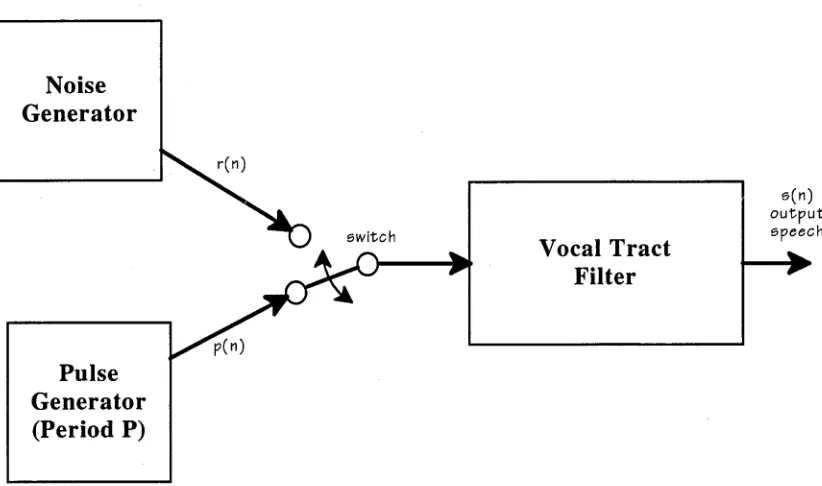
We begin by outlining the model of the physical aspects of speech production used most often in signal processing applications. Basically, the vocal tract forms an acoustic transmission system which, during speech production, is subjected to at least two different forms of excitation signals. These are specifically
• Voiced sounds produced by the periodic opening and closing of the glottis. These are commonly vowel sounds such as the “a” in “sand”. These are the sounds responsible for the perceived pitch of a signal.
Background
up to 20 ms typically. The vast majority of the literature treats speech in this “quasi stationary” manner. This model of speech production is illustrated in Figure 2-1 below.
ou tp u t speech switch
Pulse Generator
(Period P) Noise Generator
[image:15.525.43.454.110.353.2]Vocal Tract Filter
Figure 2-1: The most basic model of speech production process. A time-varying vocal tract filter is alternately excited by either a noise source (for sibilants) or a
pulse generator (for vowels).
If a sampled speech signal is of a short enough time interval to be considered stationary but is still long enough to contain sufficient pitch information, the entire signal can be represented by the following convolution:
s[>z] = v[n]* p[n] for 0< n < L - 1 ( 2. 1)
where L is the segment length in samples, v[n] is the impulse response of the vocal tract and p[n] is either the periodic, pulsed excitation of a voiced speech segment or the random noise excitation of unvoiced speech.
were voiced results in only minor artefacts. The most important of these is the introduction of a periodic “hum” in aperiodic, noisy sections of the speech. This issue is found predominantly in segmented-in-time techniques and is discussed later.
2.3.
The Short Time Fourier Transform
In a pair of fundamental papers in 1981, Portnoff [23, 24] laid the theoretical basis for the representation of a speech signal in terms of its short-time Fourier transform. Starting with the speech production model outlined above, he developed a relationship between the parameters of a speech waveform and the Fourier transform of the speech. The quasi-stationary assumption is again applied and the vocal tract is modelled as a linear, time-varying transfer function.
Rather than assuming a time invariant filter, the vocal tract is characterised by its time- varying unit-sample response, t(n,m), which is defined as the response of the system at time n to a unit sample applied m samples before, at time (n-m).
Defining the Fourier transform of this sample response, with respect to the second index, m , and with the symbols for the independent frequency variable, CD, and the square root of minus one, j, taking their usual places, to be
oo
T2(n,co)= Y dt(n,m)e~JOM
m= - o o( 2.2)
Portnoff showed that voiced segments of speech, x(n), can be represented as a linear combination of harmonically related complex exponentials. In equation ( 2.2 ), the
Background
If we define the local pitch period of a pulsed excitation signal in the neighbourhood of
n to be P(n), then using the convolution of equation (2.1 ), Portnoff showed how quasi stationary voiced speech may be represented as a sum of complex exponentials, thus
Pin)-i ( 2.3 )
x(n)=
^ck(n)ejk<t>{n)
k=owith coefficients Ck(n) given by
1 ™ (2 .4 )
e*
(n) = —
T2(n,kn(n))eJk*'‘
Pin)
such that the terms Q(n) and (f)(n) are functions depending only on P(n), the instantaneous, or local pitch period.
A non-voiced speech waveform is represented by its “time-varying power spectrum”,
Sx{n,co) = al\T2(n,cof
( 2 .5 )where the crM is the second moment of the zero-mean stationary white noise process modelling the non-voiced excitation waveform. Portnoff showed that the time varying power spectrum can be written in a Fourier transform pair with the autocorrelation function Rx of the speech as follows,
Sx{n,(0)
=The short-time Fourier transform (STFT) of a discrete signal, can then be defined as the sum
X 2(n,co)= ^ h ( n - m)x(m)e Jb'm
m=-oo
( 2.7)
where x(n) is the voiced speech signal from ( 2.3 ) and h(n) is the analysis window restricting the input speech signal to a segment of limited duration over which the signal can be considered stationary. Portnoff further demonstrated that the voiced and unvoiced representations presented above in equations ( 2.3 ) and ( 2.5 ) can be extracted directly from the STFT. Importantly, he uses both narrow- and wide-band approaches to the analysis of speech with respect to the bandwidth of the window- transfer function. This generalises the effect of the window transfer function bandwidth to cases where it is both greater and less than the fundamental pitch frequency of the speech. He noted that voiced and unvoiced speech exhibit similar narrov/-band instantaneous amplitude and frequency components, but finds that the major difference between the two speech modes is the different underlying harmonic structures. In the unvoiced case there is a lack of discernible form as opposed to the regular inter harmonic maxima found in voiced speech.
Background
2.4.
Time Frequency Representations
In his book, Riley [25], takes an even more general approach to time-frequency representations of speech than does Portnoff. In fact, he calls into question the validity of the quasi-stationary assumption for speech. Riley demonstrates that speech is not always quasi-stationary, even during voiced segments.
The short-time Fourier transform has fundamental limitations as discussed by de Bruijn [27]; these limitations are known as the uncertainty principle. The basis of the argument is that a sampled waveform must have a long enough duration for adequate frequency resolution, but be short enough to allow adequate time resolution. Namely, given the Fourier transform pair
h(x)
<=> (2.8)if the variances of the two sequences are
var|/z(x
)|2
= (Ax
) 2
var|//(fo
)|2
= (A
co
) 2then the variances are related by the inequality
Ax A co > —
2
(2.9)
(2.1 0)
In fact, there are classes of signals for which no window length for the STFT is adequate. One set of such signals are called chirps, and are of the form
jm t2 (2.1 1)
x{t) - e
2
where the modulus, m, causes the instantaneous frequency to increase linearly with time. For sufficiently large m, the quasi-stationary assumption breaks down. In fact, the human voice can and does produce sounds of this nature.
Riley also makes use of neuro-physiological work which has found that a large amount of auditory nerve endings in the mammalian cochlear do not respond optimally to continuous tones but instead to a swept tone within particular range of frequency slope. Linguistics has also shown that the movement of formant frequencies are important - their transitions and discontinuities contain important semantic content. That is, the human ear exhibits a directional resolution, which varies with time and pitch frequency.
Thus, in many applications the approach of Portnoff, treating the sampled speech as a time series of independent, one-dimensional spectral snapshots is inappropriate. Instead we should consider any analysis of speech as a joint time-frequency representation of the signal.
Background
Because of the limitations of the spectrogram, namely the implication of the uncertainty relation on the simultaneous time and frequency resolution, solutions are sought for other representations which may better approach the optimal resolution.
If we define the marginals of an arbitrary signal representation F x(t, co) to be
1 °°
Ti\{t)
= — fFx(t,co)dco
— OO
Y ° °
k
2(°)) = — j
Fx(t,w)dt
(2.1 3)
then, by ( 2.9 ) and ( 2.10 ), “perfect” time and frequency resolution can be achieved provided these marginals, or projections, satisfy the following relations.
K {{t) = \ x { t f
k 2 (c o) = |X (co)|2
(2.1 4)
One time-frequency representation which satisfies the criteria of equation ( 2.14 ) is the Wigner distribution,
Wx(f, to) = f e Jmx(t + t/ 2 )x* ( - r / l y f r
(2.1 5)
Speech transforms could, in principle, be made to behave optimally in the local direction of movement for particular formants so that they may be recognised more easily during feature extraction. The features concentrated on are time discontinuities and time frequency ridges, and the application is intended to be useful in speech recognition tasks.
The representations presented are of limited interest when considered for real-time analysis of speech. However, the discussion of the quasi-periodic nature of speech and the departure of the signal from this assumption are of direct impact on the suitability of segmented-in-time approaches to the analysis of speech.
2.5.
Deconvolution
As promised, our analysis proceeds assuming that the segment of speech to be analysed is voiced. When the signal is segmented in time, the production model becomes invalid at the edges of the analysis interval because of pulses falling outside the interval. At the start of the window, the voice waveform may be non-zero, a boundary effect unlike any natural response of the human vocal articulators. The effect of this discontinuity can be lessened by applying a tapering window (w[n]) to the interval. Several different types of windows are commonly used, Hamming and Hanning windows being examples from the literature [29, 30].
Background
Pw[n] =
w
(2.1 7)In order to achieve a characterisation of the sampled speech signal in terms of the vocal tract filter v[n] and the excitation signal p[n], it is necessary to isolate one from the other. If we were to undo the convolution of ( 2.16 ) we could separate the filter response from the windowed excitation as long as the stationarity assumption holds over the window length. As will be seen later, many techniques exist for achieving this separation, including linear prediction methods. The discussion here follows the approach of Oppenheim and Schafer [29] in using a method known as homomorphic deconvolution to demonstrate the separation of the vocal tract response from its excitation.
Homomorphic deconvolution may be implemented by making use of the properties of the so-called cepstrum transformation. The cepstrum for a sequence x[n] with Fourier
transform X(eJm) is defined as
Using the cepstrum defined ( 2.18 ), it can be shown that the convolution ( 2.16 ) may be mapped into an addition operation in the cepstrum domain. That is
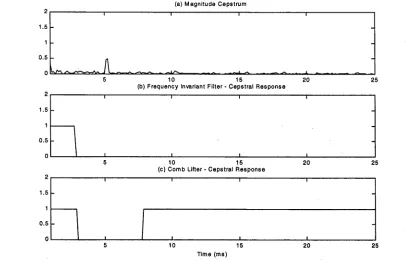
The analysis in Oppenheim and Schafer [29] goes on to show that for speech, the periodic excitation will show up as a peak in the cepstrum domain at the pulse interval period. This can then be isolated by subtraction. These concepts will be illustrated with an example.
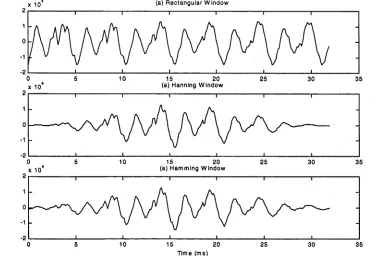
Figure 2-2 following shows 256 samples of speech sampled at 8 kHz. The section (2.1 8)
original speech (or to use the parlance, rectangularly windowed speech), while the remaining plots demonstrate the application of two popular window weighting functions, the Hamming and Hanning windows.
[image:24.525.94.470.152.408.2]x 10* (a) Rectangular Window
Figure 2-2: A voiced section of speech is shown subjected to various window functions, (a) is the original, rectangularly windowed speech waveform, (b) shows
the effects of the Hanning window, while (c) is the result of a Hamming window. Note the zeroed sections, or pedestals, at either end of the Hanning window.
Background
(a) Rectangular Window Power Spectrum
3000 3500 4000
1500 2000 2500
(b) Hanning Window Power Spectrum
0 500 1000 1500 2000 2 500 3 000 3 5 0 0 4 000
10° L--- 1--- 1--- 1---
1---1---0 500 1000 1500 2000 2 500 3000 3500 4 000
[image:25.525.41.448.62.341.2]Frequency (Hz)
Figure 2-3: Power spectra for windowed speech from Figure 2-1. (a) shows the magnitude spectrum of the rectangular window, (b) is the Hanning window spectrum and (c) is the Hamming window. The inter-harmonic spacings show a
fundamental pitch of -200 Hz, corresponding to a 5 ms pitch period as demonstrated by the peak to peak time differences in Figure 2-2.
Leaving aside the discussion of the merits of one window shape over another, and continuing with the Hamming windowed example, the possibilities of decomposing a speech segment into the constituent parts of our model are now demonstrated. The complex log of the Fourier transform of the segment is calculated and the inverse DFT is formed.
(a) Magnitude Cepstrum
2
1.5
1
0.5
0
2
1.5
1
0.5
0
10 15
(c) Comb Lifter - Cepstral Response
[image:26.525.68.478.68.335.2]Time (ms)
Figure 2-4: Magnitude cepstrum and lifters used in deconvolution. In (a), the Hanning windowed magnitude spectrum, from Figure 2-3 (c) has been transformed into the cepstrum domain. The lifter in (b), together with the complementary high pass lifter, is used to separate the 5ms pitch information (the
peak) from the vocal tract response. The lifter proposed by Abe et al. ([20]) is shown in (c).
Background
(a) Hamming Window Spectrum
4 000
3 2 000 :
(b) Spectrum Envelope
0 500 1000 1500 2000 2 500 3 000 3 500 4000
(c) Difference Spectrum
3000 3 500
2000
[image:27.525.49.471.63.330.2]Frequency (Hz)
Figure 2-5: The spectrum of the Hamming windowed signal from Figure 2-3 (c) is repeated for comparison in (a). The “smoothed” vocal tract response is shown in
(b) and the harmonic frequency content of excitation is shown in (c). The spectrum envelope and the excitation were separated by means of the lifter from
Figure 2-4 (b).
The smoothed vocal tract response or spectrum envelope clearly shows the poles (or formants) of the filter characteristic with peaks at approximately 300, 1500 and 2500 Hz. These formants are considered to be the “carriers” of the information content of the speech segment. The semantic meaning of speech is contained in the movement (in the frequency domain) of the formants. The spectrum of the excitation displays a fundamental at ~200Hz (for the period of 5ms) with evenly spaced harmonics thereafter.
However, in tasks involving the fundamental pitch of the excitation waveform, a clearer estimate of the excitation spectrum is required. A method for implementing this is proposed by Abe et al.[21], as part of a scheme for modifying the fundamental pitch of sampled speech. They propose a comb lifter to extract the excitation spectrum and the form of this lifter is shown at the bottom of Figure 2-4. The results in the frequency domain of applying the comb lifter appear in Figure 2-6 with the extracted excitation spectrum shown in the bottom plot. The excitation spectrum appears to be almost sinusoidal, indicating that only the pitch frequency and its harmonics were extracted.
(a) Hamming Window Spectrum
1500 2 000 2 500
(b) Comb Filtered Spectrum Envelope 3500 4000
0 500 1000 1500 2 000 2 5 0 0 3 0 0 0 3 500 4000
(c) Difference Spectrum
3000 3500
2000
Frequency (Hz)
[image:28.525.48.478.251.721.2]2 500
Figure 2-6: The Hanning windowed spectrum from Figure 2-3 (c) is again repeated for comparison purposes. The smoothed vocal tract response (b) and the frequency content of excitation (c) here were obtained with the comb lifter of
Background
2.6.
Issues
Modification algorithms, similarly to other signal processing systems, are commonly presented in terms of the following simple model, known as the analysis/synthesis model. A preliminary analysis stage is followed by a modification step and finally the signal is resynthesised. This model is shown in block diagram form in Figure 2-7.
modified speech original speech
Analysis Modification Synthesis
Algorithm
Figure 2-7: The analysis-synthesis model of speech processing. The initial analysis step usually involves the characterisation of the signal in terms of a production
model. After modification of certain signal characteristics or parameters (like pitch), a synthesis step attempts to reproduce a “natural” sounding voice.
Typically, the analysis stage segments the signal in the time-domain into what are known as analysis frames. The modification is performed on these analysis frames individually and in the last step, the output signal is synthesised by some form of inverse of the analysis step. We describe implementations adopting this approach as having segmented-in-time architectures.
These terms and concepts are directly analogous to those in the speech coding analysis, transmission and synthesis model. Similarly to that case, we require that the signal should be stationary over a single analysis frame. This is often referred to as the quasi stationary assumption. In general, both the vocal tract filter and the excitation source are assumed to be stationary over this period, often 20ms.
In addressing an alternate pitch-shifting algorithm in Chapter 5, we shall look to a different view of the Fourier transform than the one presented above. Specifically, we shall examine the interpretation of a set of filters (or filter-bank) as calculating the frequency response of the signal on a sample-by-sample basis. These filters may be implemented in the time-domain, leading to a segmented-in-frequency architecture.
Chapter 3 - General Formulation of
Speech Scaling
3.1.
Speech Production
In most engineering models of human speech production the speech waveform is represented as the convolution of a time-varying linear filter and an excitation signal. The excitation sequences used are different if we are considering the voiced or unvoiced parts, but we will concentrate on the voiced part as it is the most important section with regard to pitching and pitch perception.
For voiced speech then, the excitation is expressed as a sum of narrow-band signals with harmonically related instantaneous frequencies, usually complex exponentials with unit amplitude. The instantaneous fundamental frequency is given at time n by
2
KJ(n)
(3.1)
where the local pitch period is P(n) and is varying slowly with n. The exponentials are summed to form the excitation thus:
P{ n) ~ 1 ( 3.2 )
e(n) = £ e x p
[j(<t>k(n))]
k= 0
m- 0
-I
P{m)
Ink
(3.3)
The time-varying filter representing the vocal tract articulation is commonly defined in terms of the Fourier transform of its impulse response which are shown in polar form in equation ( 3.4).
G(n,(o)cxp(jy/(n,a>))
(3.4)G(n,co) and n/(n,co) are referred to as the time-varying amplitude and phase of the vocal tract system.
Given these definitions, the voiced speech segment may be shown to be
Pi n) - 1
x(n) =
£ G (n ,ö )t (n))xexp[yX0*(n)+ •/'(«,«*))]
k= 0 P(n) -\
= ]T
Gk( n ) x e x p [ j 6
k()]
k= 0
(3.5)
General Formulation of Speech Scaling
3.2.
Time Scaling of Speech
The object of time scaling the human voice is to cause the rate of articulation to change without the spectral content being affected. Consider a time-varying relation between the time instants in the original signal, t, and the time instants in the time scaled version, t ’\
t' = D ( t
) <3-6 >t
= j ß ( r ) d r
0
The second part of this is an integral definition based on the time-varying modification
rate, ß(t). The relation amounts to specifying a mapping between time in the original signal and time in the modified signal. Where the modification rate is constant, D(t)
becomes simply ßt.
Using this time scale in the parametric quantities of ( 3.5 ), we have the modified pitch contour, expressed in the modified time-scale, n \ given by ( 3.7 ). D l{.) denotes the inverse mapping from the modified time-scale back to the original time-scale.
P'(n') = P{D~\n'))
(3.7)The new pitch contour is a time-warped version of the original. Equation ( 3.8 ) shows the modified vocal tract magnitude response.
Gt'
{n') = G(D~' {n’\ cot
(D
~1
(»'))) ( 3 ‘8 }ft (»') = ft (»')+v'(ö'V),
Ink
P(D~l (n')y
(3.9 )
The instantaneous source frequencies are similarly translated in time.
n'
<K(n') =
I
2
nk
P { D ~ \ m
))
m=0
(3.10)
For the simple case of time scaling by a constant factor, t, the system parameters reduce to the following set of equations.
P ' ( n ' ) = P ( n' / t )
(3.11)G'k(n') = G(n'/t,cok(n'/t)) (3.12)
2 nk
ek(n
) = </>,(« ) + y/(n/t, )Pin jt)
(3.13)
v 2nk (3.14)
m=0P(m/t)
Throughout the remainder of the text, we consider the time scaling rate to be a constant
General Formulation of Speech Scaling
3.3.
Pitch Scaling of Speech
The scaling of the pitch of a voiced signal is defined as altering the perceived fundamental frequency without affecting the spectral envelope or its time evolution. If we define a mapping of pitch periods in terms of a slowly time varying, always positive function a(n), such that
then we have the local pitch frequency being increased if a(n) > 1; the signal’s pitch is
decreased when a(n) < 1. An ideal pitch scaling operation would require the modifications to the speech parameters as follows.
The pitch contour is scaled by the time-varying factor.
The amplitudes of the excitation harmonics are sampled at the shifted pitch harmonic frequencies
( 3.15 )
a ( r i )
P'(n') = a ( n ' ) P ( n ' )
( 3.1 6)G'(n') = G(n',a(n')cok(n'))
(3.1 7)d{ in') = K
(«') +
y/'(n',a(n')cok
(«'))
<3-18)
Finally, the excitation harmonics are scaled by the pitch factor.
</>*(/?') “ ^ C C ( m ) C Q k ( m )
In scaling pitch, it may be seen that the vocal tract system amplitudes and phase must be recalculated at the new excitation frequencies and so must be estimated explicitly. This is in contrast to the time scaling case where the filter system response was unchanged.
If the scaling factor is a constant, p, then the model parameters become
P ' ( n ' ) =
pP(n')
(3.2 0)G'k ( n ' ) = G ( n ' , p c o k ( n' ) ) (3.2 1)
Q'k ( « ') = <p'k ( n’) + pa>k (« ')) (3.2 2)
n' (3.2 3)
m=0
Throughout the remainder of the text, we consider the pitch scaling rate to be constant
Chapter 4 - Literature Review
4.1.
Introduction
A problem which presents itself in reviewing the literature in the audio processing field is that many of the methods in common use in recording studios are housed in commercial equipment. Because the methods themselves are considered to be the intellectual property of the commercialising party the techniques are rarely allowed into the public domain by way of journal publication or peer review.
One advantage obtained by commercial developers is the imperative placed on subjective evaluation of competing methods. It is the contention of this review of the academic literature that in most cases the assessment processes used are inadequate. It is, unfortunately, beyond the scope of this thesis to address an issue which would require a large group of subjects in double blind tests at this stage. These tests should be designed to use comparative scales such as those described in Thorpe and Sheldon
[19] and make use of control groups and impartial test supervisors.
A tabulation of the most important papers from the literature is included below. Each contribution is presented chronologically with details of distinguishing criteria for comparison purposes. A discussion of the criteria used in the table follows.
M ethod T ransform D om ain
Speech Specific Param etric or Non-Param etric Polyphonic or N on-Polyphonic
E xplicit Pitch Extraction
Mai ah [3] (1979) Time Domain Yes Non-parametric Monophonic Yes Portnoff [24] (1981) Frequency Domain Yes Non-parametric Monophonic Yes Seneff [33] (1982) Frequency Domain Yes Non-parametric Monophonic Yes Griffin & Lim [2] Frequency Domain
Yes |
Non-parametric
Polyphonic No
(1984) Roucos & Wilgus [32]
Time Domain Yes Non-parametric Polyphonic No (1985) Quatieri & McAulay [36] (1986)
Frequency Domain
Yes Parametric Polyphonic No
Abe, Tamura & Kuwabara Cepstral Domain Yes Non-parametric Monophonic No [20](1989) Lent [18]
(1989)
Time j Domain
No
Non-parametric
Polyphonic Yes
d'Alessandro [1] (1991)
Frequency Domain
Yes Parametric Monophonic Yes
Moulines & Charpentier [5] (1992)
Time & Frequency Domains Yes Non-parametric Monophonic Yes Seiyama, Takagi, Cepstral Domain Yes Non-parametric Monophonic Yes Umeda & Miyasaka [28](1992) Yim & Pawate [34] (1996)
H Time Domain
No
Non-parametric
Polyphonic Yes
Literature Review
A problem caused by modifying waveforms in the STFT domain is that the resulting Modified Short Time Fourier Transform (MSTFT) may not correspond to a real-valued time-domain signal when the inverse transform is applied. Griffin & Lim [2] offer a solution (albeit an iterative and complex one), and theirs is the most cited paper in the field. Their solution to minimising a distance measure on the Short Time Fourier Transform Magnitude (STFTM) is guaranteed to converge to a, possibly non-global, minimum. Roucos and Wilgus [32] take the approach a step further, eliminating the need for an STFT at all. This is discussed in more detail below.
The second column in the table illustrates whether the proposed method is specific to speech signals or not. This is based on the observation of the use of the quasi-stationary source/filter model in the algorithm presented. Although this model may be valid for single instruments as well, the literature contains no conclusive demonstration of this. In only two cases was testing carried out on signals other than monophonic (single source) human speech: Lent [18], and Quatieri and McAulay [36].
A sub-class of the speech specific methods are those approaches using parametric models of the human speech production apparatus. These are those of d’Alessandro [1] and Quatieri and McAulay [36], as shown in column 3. Both papers employ similar parametric models, where speech is represented as the sum of sinusoids with slowly time-varying amplitudes and instantaneous frequencies. The parameters are found by use of the STFT and a rule based transformation performed on the parameters. Other models incorporating stochastic components also exist. A thorough comparison with non-parametric approaches is yet to be published.
The final column explores whether the technique in question requires the fundamental harmonic of the excitation signal (hereafter referred to as the pitch of the signal) to be determined as part of the algorithm. Virtually all of the approaches use a fixed window for their time or STFT domain modifications and the pitch of the signal generally needs to be estimated during this frame. This leads to a resolution problem, where the frame needs to be long enough to cover several pitch periods, but short enough so that the pitch does not vary too much during the frame. As pitch varies quite a lot in one persons speech, and significantly between the sexes and different languages, this presents a significant problem to solve.
A better solution, it seems, is to dispense with the fixed frame altogether and, using the extracted pitch, create the analysis frame centred on the maximum signal (corresponding to the glottal pulse) and with a frame width equal to an integral multiple of the pitch period. These pitch synchronous methods (Moulines and Charpentier [5]) are quite low in complexity and are also high quality. They reduce artefacts caused by poor frame positioning with respect to temporal aspects of the speech signal but require accurate pitch calculation and frame placement with respect to the glottal maximum.
Literature Review
4.2.
Model Based Methods
4.2.1. Time Domain Implementations
4.2.1.1. Malah
In 1979, David Malah published the seminal paper for parametric methods in the time and pitch scaling fields. Although the method is non-parametric itself, it provides the basis for several later contributions (Quatieri and McAulay [36] and d’Alessandro [1]).
Malah demonstrated that by choosing STFT basis functions such that they form a bank of filters equally spaced in the frequency domain, the desired pitch scaling can be performed by scaling the instantaneous frequencies of the output of each filter and recombining to form the output signal. Time scaling may then be performed by altering the playback rate. Note that no separation of excitation and vocal tract characteristics is performed, and this certainly would affect the intelligibility of the output speech. It appears that no further work has been carried out on this technique, so further investigation is certainly warranted.
By employing several assumptions, such as FIR filter implementations and choosing a suitable windowing function, Malah developed an approximation to the parametric modification, which may be implemented wholly in the time-domain and requires only one multiplication and two additions per output sample. Malah reported only informal claims of acceptable quality in scaling speech. The algorithm appears to be very sensitive to accurate pitch extraction and requires the scaling factors to be recalculated as the pitch of the original signal changes.
4.2.2. Frequency Domain Implementations
4.2.2.1. Seneff
The initial work on joint time-frequency representations of speech carried out by Portnoff [23, 24] included an algorithm for using the STFT to parameterise a model of speech production, similar to Malah's [2] in the use of band-pass filters equi-spaced in the STFT domain. Unlike Malah, the parameters were explicitly extracted in the STFT domain and altered before playback to achieve the desired modification. This technique was computationally costly and of questionable quality requiring a complex phase unwrapping procedure. Subsequent contributions built on this formulation of the specific properties of the STFT, but not on the parametric solution proposed. The first to add to Portnoff s work was Seneff [33] in 1982.
Seneff presented an approach which does not require that the individual pitch periods be extracted. In using a static analysis frame and performing all modifications in the STFT domain, she avoided having to determine the pitch explicitly (Portnoff required that instantaneous frequencies and phases for the fundamental and all its harmonics be calculated). This significantly reduced the complexity of the algorithm although the phase spectrum still needs to be unwrapped and modified.
Literature Review input speech sift Unwrap Inveerse
s i f t
Hanning Window Phase Spectrum Extract Envelope
Expand or Contract
Expand or Contract
Polar to Rectangular Magnitude
Spectrun
[image:43.525.61.483.60.303.2]output speech
Figure 4-1: Block diagram of Seneff’s algorithm. STFT frames are split into their phase and magnitude components with each modified separately. The phase component is unwrapped and pitch modified. The magnitude component has the
“smoothed” envelope extracted before undergoing the pitch modification step. The modified phase and magnitude, and the unmodified vocal tract response, are
combined and returned to the time domain.
Original
Spectrum
Expanded Spectrum
Compressed Spectrum
d\scarded section
[image:44.525.40.453.59.328.2]copy section
Figure 4-2: The problem of spectral remapping and Seneffs solution. When p>l, interpolation methods result in discarded information. When pitch lowering (pel)
is performed, then a section in the upper part of the spectrum is left blank. Seneff’s proposal was to copy some of the baseband spectrum into the blank area.
No analytic justification is provided for this operation, and the approach is repeated in all of the derivative literature. It will be referred to as the expansion-contraction
Literature Review
the MSTFT to ensure the inverse transform provides a real signal in the time-domain. This has little foundation and is further examined in Chapter 5.
Twelve test sentences of 2 second duration were modified and informal listening tests used to judge the quality of the output speech. No intelligibility tests were performed, but spectrographic and spectral analyses were carried out.
4.2.2.2. Griffin and Lim
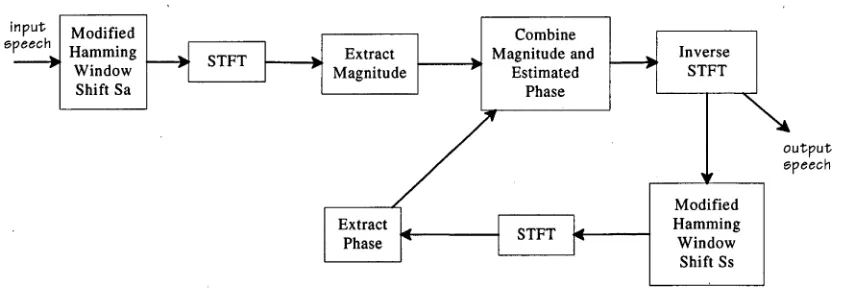
In 1984, Griffin and Lim [2] , proposed a solution to the problem of the invalidity of the MSTFT, and which gives a real-valued signal in the time domain from an arbitrary STFT magnitude. The proposal is included in a paper describing a system to time scale speech signals based on Portnoff s STFT work.
The method outlined for time scaling a signal involves using the STFT to determine the spectral characteristics at time instants on the original signal, and then recreating the spectral characteristics at different time instants in the output signal. It is, in fact, the FD-PSOLA technique of Moulines and Charpentier [5] but with a fixed analysis and synthesis frame and a pitch asynchronous placement of those frames with respect to the original signal. Figure 4-3 illustrates the system in block diagram format.
Of greater interest is the generalised technique used to generate the output time series from the modified STFTM. Note that the magnitude only is used, phase information is effectively discarded and reconstructed by the iterative synthesis step.
Figure 4-3: Block diagram of Griffin and Lim’s modification algorithm. The overlapping STFT frames are analysed and synthesised at different shift lengths to
realise the time expansion by a factor t=Ss/Sa. The iteration loop consists of the rewindowing the output speech and combining the STFT phase with the
magnitude response of the original speech.
The synthesis frame shift must be at least 1/4 the size of each frame (Oppenheim and Schafer [29]), so in the case of the time scaling algorithm the iterative technique attempts to reduce the phase inconsistencies between successive frames as discussed above. The technique, however, has powerful uses for any modified STFTM and has gained a widespread use despite its complexity and slow convergence.
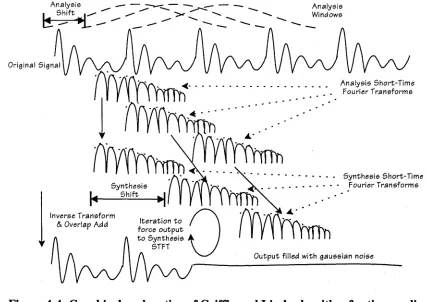
Figure 4-4 illustrates the method with reference to each frame for the case of time- expansion of a signal. Note that the shift between successive analysis frames, Sa, is scaled by the desired time-scaling factor to calculate the synthesis shift value, Ss. The iterative process for producing the output signal is then performed at the new synthesis instants.
Literature Review
Analysis Analysis
Windows
Original Signal
Analysis Short-Time Fourier Transforms
Synthesis Short-Time Fourier Transforms Synthesis
Shift
inverse Transform
& Overlap Add Iteration to force output to Synthesis
STFT
[image:47.525.56.482.59.361.2]Output filled with gaussian noise
Figure 4-4: Graphical explanation of Griffin and Lim’s algorithm for time-scaling. The synthesis step is performed in an iterative fashion with the STFT overlap add
occurring at a different shift length than in the analysis step.
The STFT phase computed from the output array synthesis frame, is combined with the unmodified STFT magnitude of the original analysis instants to produce a modified STFT which is guaranteed to be real. Griffin and Lim showed that this iteration converges to minimise a distance measure in the STFT domain between the desired STFT response and the actual output STFT response.
This algorithm presented for time scaling speech has been implemented in a C++ program and using MATLAB M-files by the author. The source code, and the results of time-scale modifications, for both speech and singing, are included on the accompanying disk. Please refer to Appendix C for an index of files on the disk.
on the unsealed file. The complexity of this algorithm is very high typically requiring 100 iterations to achieve acceptable quality.
4.2.2.3. Abe
Abe and his associates [20, 21] presented a refinement of the Seneff method for pitch scaling signals. Again, the interpolation method of the expansion/contraction method is used in the STFTM domain with spectral copying used to replace the high frequency components left blank when the pitch is compressed. In Seneff [33], however, the phase had to be explicitly determined and unwrapped with a scaling operation applied separately to that applied to the magnitude. The procedure is complex and critical to the success of the Seneff method; it is replaced here by a shift correction applied in the time domain prior to the overlap-add procedure. Interestingly, although they cite Roucos and Wilgus [32] (the SOLA method) there is no evidence of them using a cross-correlation to evaluate the required shift value. Instead, they imply that the shift is simply related to the pitch modification factor.
input
speech STFT
Extract Spectrum Envelope
J Compression vLy H or Expansion
output speech
A
Adjust Phase by Window
Shift
Reconstruct with Iterative
[image:48.525.43.467.371.545.2]Method
Figure 4-5: Block Diagram of Abe’s algorithm. This method is a combination of Seneffs spectral expansion/compression and the Griffin and Lim iterative synthesis
Literature Review
envelope. Abe and associates make use of liftering (see section 2.5 for more details) in the cepstral domain with a high order comb type lifter. This approach is designed to produce an excitation spectrum which is continuous, presumably resulting in higher quality modifications. The system is shown as a block diagram in Figure 4-5.
Analysis Analysis
Windows
Original Signal
Analysis Short-Time Fourier Transforms
< *
Break into excitation* * * spectrum & envelope
■ - - . Syn thesis Short-Time
- - - • Fourier Transforms
. * ’ (excitation modified and recombined with envelope) Synthesis
Shift
Inverse Transform
& Overlap Add Iteration to
force output to Synthesis
STFT
[image:49.525.55.486.164.450.2]Output filled with gaussian noise
Figure 4-6: Graphical explanation of the algorithm of Abe et al. The analysis STFT frames have the excitation independently modified and then recombined at
the synthesis rate. Time scaling can be performed simultaneously by making Ss vary from Sa.
Formal subjective tests were carried out with eight untrained subjects. The subjects rated the modified speech on a five point system compared to the original speech. A different method for synthesising speech was also compared to the original and the results showed a clear preference for the new method.
4.2.2.4. Other Parametric Approaches
McAulay and Quatieri [36] make use of time varying sinusoidal generators to model the speech production process of the excitation signal. Fixed length frames of 20ms length are used to segment input speech and the STFT is used to extract the parameters. Each sinusoidal frequency “track” contains components due to both the excitation and the vocal tract response. Homomorphic deconvolution was used to estimate the vocal tract contributions to the model parameters and a new method based on the Hilbert transform is used to estimate the phase contributions from the magnitude spectrum. By assuming that the vocal tract transfer function is minimum phase, the system magnitude and phase response form a Hilbert transform pair. If the phase estimate is derived from the logarithm of the magnitude estimate, the separation of vocal tract and excitation phase is greatly simplified. This minimum phase condition is an approximation because the vocal tract transfer function may contain zeros outside the unit circle in the z-plane [36].
Literature Review
input speech
magnitude
Phase STFT
Magnitude
Homomorphic Vocal Tract
Estimation
Frequency Estimation (Peak picking)
Sampled at Selected Frequencies
Vocal Tract Vocal Tract Excitation Excitation Excitation
[image:51.525.65.482.58.388.2]Magnitude Phase Magnitudes Phases Frequencies
Figure 4-7: Block diagram of parametric analysis phase. Magnitude and phase are separated, and a vocal tract deconvolution is performed on the STFT magnitude.
Specific parameters are then calculated for use in a parametric synthesis step, shown in Figure 4-8.
Excitation Frequencies Excitation
Magnitudes
Vocal Tract
Phase ExcitationPhases
\ ^''interpolated
\ vocal tract
interpolated phase sinusoidal
magnitude interpolated
vocal tract magnitude
[image:52.525.42.461.59.336.2]^ output speech Cubic Interpolation Sine-Wave Generation Frequency Matching Linear Interpolation
Figure 4-8: Block diagram of parametric synthesis step. A bank of sine wave generators, their fundamental frequencies, phases and amplitudes having been extracted from the STFT produce the output speech. Pitch scaling is achieved by changing the sine wave frequencies, and this necessitates an interpolation in order
to find the new sine wave amplitude as dictated by the original vocal tract response.
One advantage of this approach is that non-uniform variations in time and pitch scale factors may be easily implemented. That is the modification factors may also change with time. This method is ideally placed to implement this.
Literature Review
A related method is outlined by d’Alessandro [1]. This method is based on the Elementary Waveform Speech Model (EWSM) and requires knowledge of the spectral envelope to segment the STFT domain into different “harmonic regions” corresponding to the inter-formant intervals. Different waveforms are used to model the speech in each formant interval, for example, sinusoidal waveforms are used in the baseband (the lowest spectral region) and a technique utilising peak-picking gives the individual sinusoidal parameters as in McAulay and Quatieri [36]. A somewhat more complex method is used to model the higher spectral regions. The modifications proposed run into modifying locations and characteristics of individual formants, topics outside the scope of this survey.
In 1992, Quatieri and McAulay [35] suggested improvements to their original 1986 paper. They noted the objectionable “reverberant” quality introduced by frequency- domain-based transformation systems (also noted and demonstrated in the Griffin and Lim system above) and proposed methods to reduce this effect. The problem is blamed on the inability of frequency-domain systems to maintain the temporal structure of the original speech, in effect dispersing the modified waveform. The same sinusoidal model explained above is used, although the analysis frame is spaced at 10 ms and set to 2.5 times the average pitch period. This differs greatly from the original method as explicit pitch extraction is now required. In addition, the attempt to minimise the dispersion effect is to mark “pitch pulses” as those moments when the various sinusoids add in phase and to preserve the temporal location in the time-scaled version by ensuring that the sinusoids again add in phase at the time-scaled “pitch pulse” instant. This is remarkably similar to those methods employed by the PSOLA technique and by Abe et al [21] to preserve phase relationships.
4.3.
Non-Model Based Methods
4.3.1. Time Domain Implementations
4.3.1.1. Lent
In an article in the Computer Music Journal in 1989 Lent [18] proposed a computationally efficient technique which preserves formant characteristics. This heuristic algorithm included the ability to either time or pitch shift the sampled signal. The nature of the algorithm lends itself only to monophonic, or single source, pseudo- periodic sources.
The method proposed is similar to the later approach of Valbret, et al. [11] in attempting to synchronise the analysis frames with the periodic excitation source. In contrast to the approach of Valbret though. Lent provides no analysis of his method, the method of finding pitch markers is simplistic in the extreme and analysis frames are limited to a single pitch period. The claimed high quality of the modified waveforms is not evident from the investigations we have carried out. Pitch and time scaled samples are provided on the accompanying disk to illustrate this.