This is a repository copy of Estimates near the origin for functional calculus on analytic semigroups.
White Rose Research Online URL for this paper: http://eprints.whiterose.ac.uk/128698/
Version: Accepted Version
Article:
Chalendar, I, Esterle, J and Partington, JR orcid.org/0000-0002-6738-3216 (2018) Estimates near the origin for functional calculus on analytic semigroups. Journal of Functional Analysis, 275 (3). pp. 698-711. ISSN 0022-1236
https://doi.org/10.1016/j.jfa.2018.03.012
(c) 2018 Elsevier Inc. All rights reserved. Licensed under the Creative Commons Attribution-Non Commercial No Derivatives 4.0 International License
(https://creativecommons.org/licenses/by-nc-nd/4.0/).
Reuse
This article is distributed under the terms of the Creative Commons Attribution-NonCommercial-NoDerivs (CC BY-NC-ND) licence. This licence only allows you to download this work and share it with others as long as you credit the authors, but you can’t change the article in any way or use it commercially. More
information and the full terms of the licence here: https://creativecommons.org/licenses/
Takedown
If you consider content in White Rose Research Online to be in breach of UK law, please notify us by
Estimates near the origin for functional
calculus on analytic semigroups
I. Chalendar
∗, J. Esterle
†and J.R. Partington
‡January 9, 2018
Abstract
This paper provides sharp lower estimates near the origin for the functional calculusF(−uA) of a generatorAof an operator semigroup
defined on a sector; here F is given as the Fourier–Borel transform of
an analytic functional. The results are linked to the existence of an identity element in the Banach algebra generated by the semigroup. Both the quasinilpotent and non-quasinilpotent cases are considered, and sharp results are proved extending many in the literature.
Mathematics Subject Classification (2000): Primary: 47D03, 46J40,
46H30 Secondary: 30A42, 47A60
Keywords: strongly continuous semigroup, functional calculus, Fourier–
Borel transform, analytic semigroup, maximum principle.
1
Introduction
The purpose of this paper is to prove results concerning norm estimates in an-alytic semigroups which complement the results proved in [3] for semigroups
∗Universit´e Paris Est Marne-la-Vall´ee, 5 bd Descartes, Champs-sur-Marne, 77454
Marne-la-Vall´ee, cedex 2, [email protected].
†IMB, UMR 5251, Universit´e de Bordeaux, 351 cours de la Lib´eration, 33405 Talence
Cedex, France. [email protected].
‡School of Mathematics, University of Leeds, Leeds LS2 9JT, U.K.
defined on R+. For good references on analytic semigroups we recommend
the books [4, 11]: we note that analytic semigroups of operators are norm-continuous in the open sector of the plane on which they are defined, and thus also act as semigroups by multiplication on the Banach algebra that they generate. Thus we may easily pass from the language of operators to the language of Banach algebras.
In [1] the following result was proved for semigroups defined on the right-hand half-plane C+. Here, ρ denotes the spectral radius of an operator, and
Rad denotes the radical of an algebra.
Theorem 1.1. Let (T(t))t∈C+ be an analytic non-quasinilpotent semigroup
in a Banach algebra. Let AT be the closed subalgebra generated by(T(t))t∈C+
and let γ >0. If there exists t0 >0 such that
sup t∈C+,|t|≤t0
ρ(T(t)−T((γ+ 1)t))<2
then AT/RadAT is unital, and the generator of (π(T(t))t>0 is bounded, where π:AT → AT/RadAT denotes the canonical surjection.
This can be seen as a lower estimate for a functional calculus in AT, determined by F(−A) =T(t)−T((γ+ 1)t), where F :s→e−s−e−(γ+1)s is the Laplace transform of the atomic measure δ1−δγ+1.
This approach was taken in [3] for semigroups defined on R+, and very
general results were proved for both the quasinilpotent and non-quasinilpotent cases, providing extensions of results in [5, 6, 9] and elsewhere. For a detailed history of the subject, we refer to [2].
In Section 3 we derive results in the non-quasinilpotent case, using the properties of the characters defined on the algebra AT, putting Theorem 1.1 in a much more general context. Note that the results we prove are sharp, as is shown in Example 3.6.
Finally, the more difficult case of quasinilpotent semigroups is treated in Section 4, adapting the complex variable methods introduced in [3]. Here there are additional technical difficulties involved in defining the functional calculus, since we now work with measures supported on compact subsets of
C.
2
Analytic semigroups and functional
calcu-lus
For 0 < α < π/2 let Sα denote the sector
Sα :={z ∈C+ :|argz|< α}.
LetH(Sα) denote the Fr´echet space of analytic functions onSα, endowed with the topology of local uniform convergence; thus, if (Kn)n≥1 is an increasing sequence of compact subsets of Sα with ∪n≥1Kn =Sα, we may specify the topology by the seminorms
∥f∥n:= sup{|f(z)|:z ∈Kn}.
Now let ϕ :H(Sα)→C be a continuous linear functional, in the sense that there is an index n and a constantM >0 such that |⟨f, ϕ⟩| ≤M∥f∥n for all
f ∈H(Sα). These are sometimes known as analytic functionals [8]. We define the Fourier–Borel transform of ϕ by
FB(ϕ)(z) =⟨e−z, ϕ⟩,
for z ∈ C, where e−z(ξ) = e−zξ for ξ ∈ Sα. This is an analogue of the
If ϕ ∈ H(Sα)′, as above, then by the Hahn–Banach theorem, it can be extended to a functional on C(Kn), which we still write as ϕ, and is thus given by a Borel measure µ supported onKn.
That is, we have
⟨f, ϕ⟩= ∫
Sα
f(ξ)dµ(ξ),
whereµ(which is not unique) is a compactly supported measure. For exam-ple, if ⟨f, ϕ⟩=f′(1), then
⟨f, ϕ⟩= 1 2πi
∫
C
f(z)dz
(z−1)2, (1)
where C is any sufficiently small circle surrounding the point 1. Note that
FB(ϕ)(z) = ∫
Kn
e−zξdµ(ξ),
and thus it is an entire function of z satisfying supRez>r|FB(ϕ)(z)| →0 as
r → ∞. We shall sometimes find it convenient to use the alternative notation
FB(µ).
Now let T := (T(t))t∈Sα be an analytic semigroup on a Banach space X,
with infinitesimal generator A. Let ϕ ∈H(Sα)′ and letF =FB(ϕ). We may thus define, formally to start with,
F(−A) =⟨T, ϕ⟩= ∫
Sα
T(ξ)dµ(ξ),
which is well-defined as a Bochner integral in AT. It is easy to verify that the definition is independent of the choice of µ representing ϕ.
Moreover, ifu ∈Sα−β, where suppµ⊂ Sβ and 0 < β < α, then we may also define
F(−uA) = ∫
Sβ
T(uξ)dµ(ξ),
since uξ lies in Sα.
3
The non-quasinilpotent case
For a semigroup (T(t))t∈Sα with generator A, we write AT for the
commu-tative Banach algebra generated by the elements of the semigroup, and AbT for its character space (Gelfand space).
The following result is proved for semigroups onR+ in [3, Lem. 3.1] (see
also [5, Lem. 3.1] and [1, Lem. 3.1]). It enables us to regard A itself as an element of C(AbT) by defining an appropriate value χ(A) =−aχ for each
χ∈AbT.
Lemma 3.1. For a strongly continuous and eventually norm-continuous semigroup (T(t))t>0 and a nontrivial character χ ∈ AbT there is a unique
aχ ∈ C such that χ(T(t)) = e−taχ for all t > 0. Moreover, the mapping
χ 7→ aχ is continuous, and χ(F(−uA)) = F(uaχ) in the case that F is the Laplace transform of a measure µ on R+.
A similar result holds for analytic semigroups, with the same proof, where now F is the Fourier–Borel transform of a distribution (defined above).
The following theorem extends [1, Thm. 3.6]
Theorem 3.2. Let 0 < β < α < π/2. Let ϕ ∈ H(Sα)′, induced by a symmetric measureµ∈Mc(Sβ)such that ∫S
βdµ(z) = 0, and letF =FB(ϕ).
Let (T(t))t∈Sα = (exp(tA))t∈Sα be an analytic non-quasinilpotent semigroup
and let AT be the subalgebra generated by (T(t))t∈Sα. If there exists t0 > 0
such that
sup t∈Sα−β,|t|≤t0
ρ(F(−tA))< sup z∈Sα−β
|F(z)|, (2)
thenAT/RadAT is unital and the generator ofπ(T(t))t∈Sα is bounded, where
π :AT → AT/Rad(AT) denotes the canonical surjection.
Clearly there exists a d > 0 such that the maximum value of F on each ray Rθ is attained at a point z such that Rez ≤d.
By Lemma 3.1, the hypotheses of the theorem, including non-quasinilpotency, imply that for each χ ∈ AbT there exists aχ ∈ C such that χ(T(t)) = e−aχt for all t ∈Sα, and hence χ(F(−tA)) = F(aχt). Moreover, we know from (2) that
|F(aχt)|< sup z∈Sα−β
|F(z)|
for all t ∈Sα−β with |t| ≤t0.
If for any point t in the sector {t ∈Sα−β : |t| ≤ t0} we have Reaχt > d, and |argaχt| ≥α−β, then
|F(λaχt)| ≥ sup z∈Sα−β
|F(z)|
for some real λ between 0 and 1, giving a contradiction. In particular, if
|argaχt0| ≥α−β, then Reaχt0 ≤d.
Now suppose that 0 ≤ γ = argaχt0 < α−β (the other case is sim-ilar); then we know that Re(aχt0ei(α−β−γ)) ≤ d; writing aχt0 = reiγ and
aχt0ei(α−β−γ) =rei(α−β), we deduce that Reaχt0 ≤dcosγ/cos(α−β). Hence, in all cases, we obtain Reaχt0 ≤d/cos(α−β) and
|χ(T(t0))| ≥exp(−d/cos(α−β)),
and this holds for every χ ∈AbT. Hence AbT is compact. Now by [10, Thm. 3.6.3, 3.6.6], we conclude thatAT/RadAT is unital. Since the algebra gener-ated by the norm-continuous semigroup (π(T(t))t>0 is dense in AT/RadAT, the generator of this semigroup is bounded.
Corollary 3.3. Let 0 < β < α < π/2. Let ϕ ∈ H(Sα)′, induced by a measure µ ∈ Mc(Sβ) such that ∫S
βdµ(z) = 0, and let F = FB(ϕ). Let
(T(t))t∈Sα = (exp(tA))t∈Sα be an analytic non-quasinilpotent semigroup and
let AT be the subalgebra generated by (T(t))t∈Sα. If there exists t0 > 0 such
that
sup t∈Sα−β,|t|≤t0
ρ(F(−tA)Fe(−tA))< sup z∈Sα−β
|F(z)||Fe(z)|,
thenAT/RadAT is unital and the generator ofπ(T(t))t∈Sα is bounded, where
π :AT → AT/Rad(AT) denotes the canonical surjection.
A similar proof gives the following result.
Theorem 3.4. Let 0 < α < π/2. Let ϕ ∈ H(Sα)′, induced by a symmetric measure µ ∈ Mc(Sα) such that ∫Sαdµ(z) = 0, and let F = FB(ϕ). Let (T(t))t∈Sα = (exp(tA))t∈Sα be an analytic non-quasinilpotent semigroup and
let AT be the subalgebra generated by (T(t))t∈Sα. If there exists t0 > 0 such
that
ρ(F(−tA))<sup x>0
|F(x)|,
for all 0< t≤t0, thenAT/RadAT is unital and the generator of π(T(t))t∈Sα
is bounded, where π:AT → AT/Rad(AT) denotes the canonical surjection.
Proof. The proof is similar to that of Theorem 3.2, and we adopt the same notation. We cannot have Reaχt0 > d for any χ∈AbT, as then there would be a λ∈(0,1) with
|χ(F(−λt0A))|=|F(λaχt0)| ≥sup x>0
|F(x)|.
We conclude that |χ(T(t0))| ≥ exp(−d) for all χ ∈ AbT. The proof is now concluded as before.
Corollary 3.5. Let 0 < α < π/2. Let ϕ ∈ H(Sα)′, induced by a measure
µ ∈ Mc(Sα) such that ∫Sαdµ(z) = 0, and let F = FB(ϕ). Let (T(t))t∈Sα =
(exp(tA))t∈Sα be an analytic non-quasinilpotent semigroup and let AT be the
subalgebra generated by (T(t))t∈Sα. If there exists t0 >0 such that
ρ(F(−tA)Fe(−tA))<sup x>0
|F(x)|2,
for all 0< t≤t0, thenAT/RadAT is unital and the generator of π(T(t))t∈Sα
is bounded, where π:AT → AT/Rad(AT) denotes the canonical surjection.
Example 3.6. In the Banach algebra A = C0[0,1] consider the semigroup
T(t) :x7→xt for t ∈S
α. Clearly there is no convergence as t approaches 0. For x ∈ (0,1] (which can be identified with the Gelfand space of A) let
F =FB(µ) and
F(−tA)(x) = ∫
Sα
xtξdµ(ξ) = ∫
Sα
etξlogxdµ(ξ),
where µ∈Mc(Sα), supposing that ∫
Sαdµ(z) = 0and that F is real forx >0.
Thus F(−tA)(x) =F(−tlogx) and
ρ(F(−tA)) =∥F(−tA)∥= sup x∈(0,1]
|F(−tlogx)|= sup r>0
|F(tr)|.
Clearly
sup t∈Sα,|t|≤t0
ρ(F(−tA)) = sup t∈Sα
|F(z)|
for all t0 >0. This shows that the hypothesis (2) of Theorem 3.2 is sharp.
Remark 3.7. In [3, Thm. 3.3] it is shown that if F is the Laplace transform of a real compactly-supported measure µ with ∫0∞dµ= 0, then the condition
ρ(F(−ukA))<sup t>0
|F(ukt)|
and for every χ ∈AbT there is a p such that χ(Pn) = 1 for all n ≥p), such that each semigroup (PnT(t))t>0 has a bounded generator.
The directly analogous result for analytic semigroups does not hold. For example, we may consider a modification of Example 3.6, by taking A =
C0[0,1] and the semigroup T(t) : x → xt = exp(tlogx) for x ∈ (0,1] and
t ∈Sπ/2 with generatorA, say. Let F(z) = e−z−e−2z =FB(δ1−δ2). Now let
ω = exp(iπ/6)and defineTe(t) = T(ωt). Thus Te(t) is an analytic semigroup in Sπ/3, with generator Ae= ωA. Define Fe(z) = F(z/ω), the Fourier–Borel transform of a measure supported in Sπ/3. Now, for u >0,
ρ(Fe(−uAe)) = ρ(F(−uA)) = ρ(xu −x2u) = 1/4;
however,
sup t>0
|Fe(tu)|= sup{|F(tu/ω)|:t >0}>1/4,
by the maximum principle applied to F on the sector Sπ/6 (numerically, the supremum is about 0.29).
4
The quasinilpotent case
We suppose throughout this section that (T(t))t∈Sα is a nontrivial strongly
continuous semigroup of uniformly bounded quasinilpotent operators acting on a Banach space (X,∥.∥).
4.1
Preliminary results
We shall need the following theorem from complex analysis, which was proved in [3, Thm. 2.2].
Theorem 4.1. Let f :C+ →C be a continuous bounded nonconstant
func-tion, analytic on C+, such that f([0,∞)) ⊂ R, f(0) = 0, satisfying the
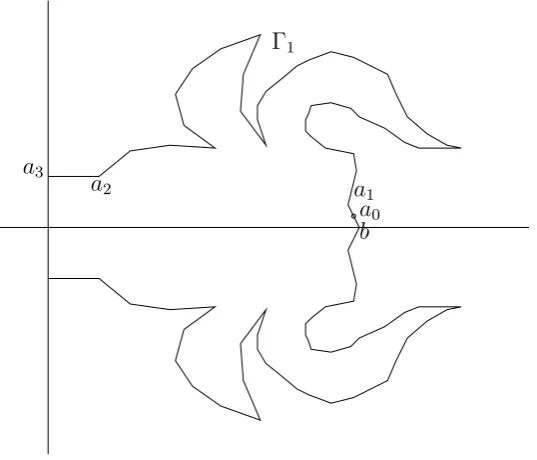
Suppose that b > 0 is such that f(b) ≥ |f(x)| for all x ∈ [0,∞). Then there exista1, a2 ∈C+, a0 ∈(b, a1)anda3 ∈iRwithImaj >0forj = 1,2,3, and Ima2 = Ima3, and a simple piecewise linear Jordan curve Γ1 joining a1 to a2 in the upper right half-plane {z ∈ C : Rez > 0,Imz > 0} and δ > 0 such that
(i) |f(z)| ≥ f(b) +δ|z −b|m for all z ∈ [b, a
1], where m (even) is the smallest positive integer with f(m)(b)̸= 0;
(ii) |f(z)|>|f(a0)| for all z ∈Γ1∪[a2, a3].
a2
a3
Γ1
a1
a0
[image:11.595.174.443.285.515.2]b
Figure 1: The curve given in Theorem 4.1
Moreover, the following formula is easily derived.
Lemma 4.2. Let (T(t) = (etA))
t∈Sα be an analytic semigroup on Sα, and
let ϕ ∈ H(Sα)′ be a functional represented by a measure µ supported on a compact set K ⊂Sα, so that we have
⟨f, ϕ⟩= ∫
K
Assume that supt∈Sβ∩D(0,1)∥T(t)∥ < +∞ for every β ∈ [0, α), so that the Bochner integral ∫
K
T(sζu)e(s−1)ζλζ dµ(ζ)
is well-defined in B(X) for every ζ ∈ K, λ ∈ C, and u∈ C with uK ⊂ Sα.
Then, for F =FB(ϕ) we have
F(−uA)−F(λ)I = (uA+λI) (∫ 1
0 [∫
K
T(sζu)e(s−1)ζλζdµ(ζ) ]
ds
)
.
Also, if x∈D(A), we have
F(−uA)x−F(λ)x= (∫ 1
0 [∫
K
T(sζu)e(s−1)ζλζdµ(ζ) ]
ds
)
(uA+λI)x.
Proof. Using Fubini’s theorem and the fundamental theorem of the calculus, we have
∫ 1
0 [∫
K
T(sζu)e(s−1)ζλζdµ(ζ) ]
ds = ∫
K
(uA+λI)−1(T(ζu)−e−ζλI)dµ(ζ)
= (uA+λI)−1(F(−uA)−F(λ)I),
from which the result is clear.
Corollary 4.3. Let (T(t) = (etA))
t∈Sα be a bounded analytic semigroup on
Sα. Then there exists a constant C >0 such that
∥(F(−uA)−F(λ)I)(uA+λI)−1∥ ≤C
∫
K
|ζ|d|µ|(ζ),
for all u with uK ⊂Sα and |λ| ≤1.
Proof. This follows immediately from Lemma 4.2 since|e(s−1)ζλ|is uniformly bounded for ζ ∈K and s∈[0,1].
We shall require one further preliminary result, which is well-known for
Lemma 4.4. Let (T(t))t∈Sα be bounded analytic quasinilpotent semigroup
with generator A, and let 0 < β < α. Then ∥(A +zI)−1∥ is uniformly bounded on the set
{
z∈C: π
2 −(α−β)≤ |argz| ≤π }
.
Proof. It is standard that ∥z(A+zI)−1∥is bounded in the given set for any bounded analytic semigroup. Moreover, quasinilpotency implies that A is invertible and then ∥(A+zI)−1∥ is bounded near 0.
4.2
Estimates for quasinilpotent semigroups
The following theorem is a version of [3, Thm. 2.5] for analytic semigroups. The proof is based on the same ideas from complex analysis with several significant modifications. For 0 < β < π/2 let
Vβ :={z ∈C+:|argz| ≤β}.
Theorem 4.5. Let(T(t))t∈Sα be a nontrivial bounded semigroup of
quasinilpo-tent operators and let F be the Fourier–Borel transform of a symmetric mea-sure µsupported on a compact set K ⊂Vβ for some β with 0< β < α, such that ∫K dµ= 0.
Then there is an η >0 such that
∥F(−uA)∥>sup t>0
|F(t)|
for all u∈Sα−β with |u| ≤η.
Proof. Note thatF is real on the positive real axis, since µis symmetric. Let
b > 0 be such that|F(x)| ≤ |F(b)| for all x≥ 0. By considering −µinstead of µ, if necessary, we may suppose that F(b)>0.
By Corollary 4.3
F(−uA)(uA+λI)−1≥F(λ)(uA+λI)−1−C
∫
K
for u∈Sα−β and |λ| ≤1, and hence
∥F(−uA)∥ ≥ |F(λ)| − C ∥(uA+λI)−1∥
∫
K
|ζ|d|µ|(ζ).
Suppose that there exists au∈Sα−β with|u|<1 such that∥F(−uA)∥ ≤
F(b), and consider the simple Jordan curve
Γ := [b, a1]∪Γ1∪[a2, a3]∪[a3, a3]∪[a3, a2]∪Γ1∪[a1, b],
where Γ1, a1, a2, a3 are defined as in Theorem 4.1, taking f =F (see Figure 1).
We now make various estimates of∥(uA+λI)−1∥forλ on three different parts of Γ.
1) By (i) of Theorem 4.1, forλ∈[b, a1]∪[a1, b] we have
F(b)≥ ∥F(−uA)∥ ≥ |F(λ)| − C ∥(uA+λI)−1∥
∫
K
|ζ|d|µ|(ζ)
≥ F(b) +δ|λ−b|m− C ∥(uA+λI)−1∥
∫
K
|ζ|d|µ|(ζ).
Hence we obtain
(uA+λI)−1≤ C δ|λ−b|m
∫
K
|ζ|d|µ|(ζ). (3)
2) By (ii) of Theorem 4.1, forλ∈Γ1∪[a2, a3]∪[a3, a2]∪Γ1 we have
F(b)≥ ∥F(−uA)∥ ≥ |F(λ)| − C
∥(uA+λI)−1∥ ∫
K
|ζ|d|µ|(ζ)
≥ |F(a0)| −
C
∥(uA+λI)−1∥ ∫
K
|ζ|d|µ|(ζ).
It follows that
(uA+λI)−1≤ C |F(a0)| −F(b)
∫
K
|ζ|d|µ|(ζ). (4)
3) By Lemma 4.4 there is a constant C′ > 0 depending only on the
semigroup such that
(
A+ λ
uI
)−1 ≤C
for λ∈[a3, a3]⊂iR.
We can now provide estimates for the quantity (λ−b)m(A+ λ uI
)−1 for λ on Γ. Let R= maxλ∈Γ|λ−b|.
By (3)
(λ−b) m
(
A+λ
uI
)−1 ≤ C|u| δ ∫ K
|ζ|d|µ|(ζ)
for all λ ∈[b, a1]∪[a1, b]. By (4)
(λ−b) m
(
A+ λ
uI
)−1 ≤
C|u|Rm
|F(a0)| −F(b) ∫
K
|ζ|d|µ|(ζ)
for all λ ∈Γ1∪[a2, a3]∪[a3, a2]∪Γ1.
By (5)
(λ−b) m
(
A+λ
uI
)−1 ≤C
′Rm
for all λ∈[a3, a3].
Since 0<|u| ≤1, for allz ∈Γ∪int Γ we have
(
A+ z
uI
)−1 ≤
M |z−b|m,
by the maximum modulus principle, where
M = max (
C δ
∫
K
|ζ|d|µ|(ζ), CR
m
|F(a0)| −F(b) ∫
K
|ζ|d|µ|(ζ), C′Rm
)
.
Since by hypothesisF(0) = 0, there is an r∈(0, b) such that
sup
|z|≤r
|F(z)|< F(b).
Now if z ∈ D(0, r) with Rez > 0, we have |z−b| ≥ b−r, and thus we have (
A+ z
uI
)−1
≤ |z−Mb|m ≤
M
(b−r)m. (6)
Also, by Lemma 4.4 there is an M′ >0 such that
sup z∈E
(A+zI)−1≤M′,
where
E ={z ∈C: π
2 −(α−β)≤ |argz| ≤π } . Hence (
A+z
vI
)−1
≤M′ (7)
for Rez ≤0 andv ∈Sα−β.
Now, since by Liouville’s theorem the function λ 7→ (A+λI)−1 is unbounded on C, and so there is a λ∈C with
(A+λI)−1>max {
M′, M
(b−r)m }
.
It follows that there is an η >0 such that for all u∈ Sα−β with |u| ≤ η we
have
(
A+z
uI
)−1
>max {
M′, M
(b−r)m }
for some z =λu∈D(0, r). Note that z ∈C+ by (7).
This contradicts (6), and it follows that
∥F(−uA)∥> F(b) for all u∈Sα−β, |u| ≤η.
This may be seen in the context of the result of Hille [6] (see also [7, Thm. 10.3.6]) that if lim supt→0+t∥AT(t)∥ < 1/e, then A is bounded, and hence the semigroup cannot be quasinilpotent. There is a further discussion of this example in [1, Thm. 3.12, Thm 3.13].
We have a corollary for measures that are not necessarily symmetric. If µ is now a complex compactly-supported measure, with Fourier–Borel transform F, then we write Fe(z) =F(z); then Fe is also an entire function, indeed, the Fourier–Borel transform of µ.
Corollary 4.7. Let (T(t))t∈Sα be a nontrivial bounded analytic semigroup
of quasinilpotent operators and let F be the Fourier–Borel transform of a measure µ supported on a compact set K ⊂Vβ for some β with 0< β < α, such that ∫K dµ= 0.
Then there is an η >0 such that
∥F(−uA)Fe(−uA)∥ ≥sup t>0
|F(t)|2
for all u∈Sα−β with |u| ≤η.
Proof. The result follows on applying Theorem 4.5 to the real measure ν :=
µ∗µ, whose Fourier–Borel transform satisfies
FB(ν)(s) = F(s)Fe(s).
Acknowledgements
References
[1] Z. Bendaoud, I. Chalendar, J. Esterle, and J. R. Partington. Distances between elements of a semigroup and estimates for derivatives. Acta Math. Sin. (Engl. Ser.), 26 (2010), no. 12, 2239–2254.
[2] I. Chalendar, J. Esterle and J.R. Partington, Dichotomy results for norm estimates in operator semigroups,Operator Semigroups meet Com-plex Analysis, Harmonic Analysis and Mathematical Physics. Ed. by W. Arendt, R. Chill and Y. Tomilov, Operator Theory: Advances and Ap-plications, Vol. 250, Birkh¨auser, 2015.
[3] I. Chalendar, J. Esterle, and J. R. Partington. Lower estimates near the origin for functional calculus on operator semigroups.J. Funct. Anal. 269 (2015), no. 6, 1620–1635.
[4] K.-J. Engel and R. Nagel, One-parameter semigroups for linear evolution equations. Graduate Texts in Mathematics, 194. Springer-Verlag, New York, 2000.
[5] J. Esterle and A. Mokhtari. Distance entre ´el´ements d’un semi-groupe dans une alg`ebre de Banach. J. Funct. Anal., 195 (2002), no. 1, 167–189.
[6] E. Hille, On the differentiability of semi-group operators.Acta Sci. Math. (Szeged), 12 (1950), 19–24.
[7] E. Hille and R. S. Phillips, Functional analysis and semi-groups. Third printing of the revised edition of 1957. American Mathematical Society Colloquium Publications, Vol. XXXI. American Mathematical Society, Providence, R. I., 1974.
[9] N. Kalton, S. Montgomery-Smith, K. Oleszkiewicz and Y. Tomilov, Power-bounded operators and related norm estimates. J. London Math. Soc. (2) 70 (2004), no. 2, 463–478.
[10] C. E. Rickart. General theory of Banach algebras. The University Se-ries in Higher Mathematics. D. van Nostrand Co., Inc., Princeton, N.J.– Toronto–London–New York, 1960.
[11] A. M. Sinclair, Continuous semigroups in Banach algebras. London Mathematical Society Lecture Note Series, 63. Cambridge University Press, Cambridge-New York, 1982.
[12] D.C. Struppa, Fourier–Borel transform. Encyclopedia of Mathematics. http://www.encyclopediaofmath.org/index.php?