Shan‐Hu Lee1,2 , Hamish Gordon3 , Huan Yu4 , Katrianne Lehtipalo5,6 , Ryan Haley1, Yixin Li7, and Renyi Zhang7,8
1Department of Atmospheric Science, University of Alabama in Huntsville, Huntsville, AL, USA,2Department of
Environmental Science and Engineering, Fudan University, Shanghai, China,3School of Earth and Environment,
University of Leeds, Leeds, UK,4Department of Atmospheric Science, School of Environmental Studies, China University of Geosciences, Wuhan, China,5Institute for Atmospheric and Earth System Research/Physics, Faculty of Science,
University of Helsinki, Helsinki, Finland,6Finnish Meteorological Institute, Helsinki, Finland,7Department of Chemistry, Texas A&M University, College Station, TX, USA,8Department of Atmospheric Sciences, Texas A&M
University, College Station, TX, USA
Abstract
New particle formation (NPF) represents thefirst step in the complex processes leading to formation of cloud condensation nuclei. Newly formed nanoparticles affect human health, air quality, weather, and climate. This review provides a brief history, synthesizes recent significant progresses, and outlines the challenges and future directions for research relevant to NPF. New developments include the emergence of state‐of‐the‐art instruments that measure prenucleation clusters and newly nucleated nanoparticles down to about 1 nm; systematic laboratory studies of multicomponent nucleation systems, including collaborative experiments conducted in the Cosmics Leaving Outdoor Droplets chamber at CERN; observations of NPF in different types of forests, extremely polluted urban locations, coastal sites, polar regions, and high‐elevation sites; and improved nucleation theories and parameterizations to account for NPF in atmospheric models. The challenges include the lack of understanding of the fundamental chemical mechanisms responsible for aerosol nucleation and growth under diverse environments, the effects of SO2 and NOxon NPF, and the contribution of anthropogenic organic compounds to NPF. It is also critical to develop instruments that can detect chemical composition of particles from 3 to 20 nm and improve parameterizations to represent NPF over a wide range of atmospheric conditions of chemical precursor, temperature, and humidity.Plain Language Summary
In the atmosphere, invisible to the human eye, there are many microscopic particles, or“nanoparticles,”that affect human health, air quality, and climate. We do not fully understand the chemical processes that allow thesefine particles to form and be suspended in the air nor how they influence heatflow in Earth's atmosphere. Laboratory experiments,field observations, and modeling simulations have all shown different results for how these particles behave. These inconsistencies make it difficult to accurately represent the processes of new particle formation in regional and global atmospheric models. Scientists still need to develop instruments that can measure the smallest range of nanoparticles and tofind ways to describe particle formation that allow for differences in temperature, humidity, and level of pollution.1. Introduction
Atmospheric aerosols, which are defined as liquid or solid particles suspended in air, have profound impacts on the Earth‐atmosphere system. The aerosol effects include air quality, human health, ecosystem, weather, and climate, all of which have important societal implications (IPCC, 2013; NASEM, 2016). For example, aerosol particles absorb and scatter incoming solar radiation in the atmosphere, leading to important conse-quences for the Earth's energy budget. This effect, commonly referred to as aerosol‐radiation interaction, contributes importantly to cooling (by scattering) or warming (by absorption) in the atmosphere (IPCC, 2013; Peng et al., 2016; Y. Wang et al., 2013). By acting as cloud condensation nuclei (CCN) and ice nuclei, aerosols also play an important role in controlling cloud formation/development, precipitation efficiency, and the albedo, frequency, and lifetime of clouds (Albrecht et al., 1989; Fan et al., 2018; Li et al., 2008; Rosenfeld et al., 2008; Seinfeld & Pandis, 2016; Twomey, 1974). These effects are often referred to collectively as aerosol‐cloud interactions, which are also critical to radiative transfer in the atmosphere. Presently, the ©2019. The Authors.
This is an open access article under the terms of the Creative Commons Attribution‐NonCommercial‐NoDerivs License, which permits use and distri-bution in any medium, provided the original work is properly cited, the use is non‐commercial and no modifi ca-tions or adaptaca-tions are made. Key Points:
• Recent progresses include development of instruments and observations of multicomponent nucleation and NPF at various locations
• There is a lack of understanding of fundamental chemical mechanisms responsible for NPF in diverse environments, especially in megacities
• There is a need to develop NPF parameterizations to represent a wider range of pollutants, temperature and humidity
Correspondence to:
S.‐H. Lee, [email protected]
Citation:
Lee, S.‐H., Gordon, H., Yu, H., Lehtipalo, K., Haley, R., Li, Y., & Zhang, R. (2019). New particle formation in the atmosphere: From molecular clusters to global climate.
Journal of Geophysical Research: Atmospheres,124, 7098–7146. https:// doi.org/10.1029/2018JD029356
Received 17 NOV 2018 Accepted 16 MAY 2019
aerosol effects associated with aerosol‐radiation interaction and aerosol‐cloud interaction represent the largest uncertainty in predictions of anthropogenic forcing on climate (IPCC, 2013). In addition, fine aerosols (i.e., particulate matter smaller than 2.5μm or PM2.5) constitute a key component of air pollution on local and regional scales, since high concentrations of PM2.5not only cause visibility degradation but also negatively impact human health (EPA, 2004). More than 3 million premature deaths each year worldwide have been attributed to exposure tofine PM, representing one of the greatest risks to public health (Lim et al., 2012). There is increasing evidence that exposure tofine aerosols not only causes acute and chronic diseases but also exacerbates adverse health effects of gaseous criteria pollutants, including ozone (O3), sulfur dioxide (SO2), carbon monoxide (CO), and nitrogen oxides (NOx= NO + NO2; Kimmel et al., 1997; Künzli et al., 2005). In addition, it has been suggested that ultrafine particles likely exert the most severe health effects, since small particles are more likely to be deposited in the pulmonary region and to penetrate into bloodstream than large particles (Anderson et al., 2012; Araujo et al., 2008; Hamra et al., 2014; NASEM, 2016; Oberdorster et al., 2004; Schlesinger et al., 2006).
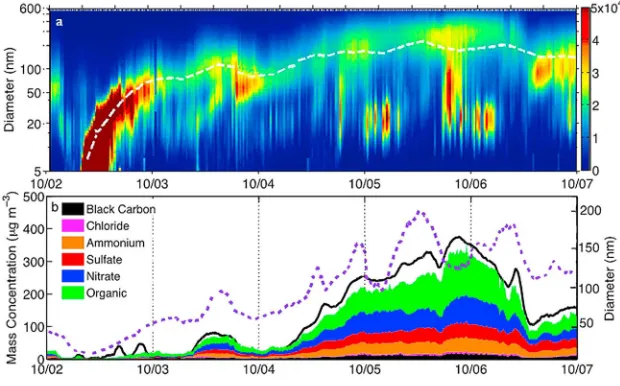
[image:2.612.218.528.92.285.2]Aerosol particles are either emitted directly into the atmosphere (referred to as primary particles) or pro-duced in the atmosphere via gas‐to‐particle conversion (referred to as secondary particles; Seinfeld & Pandis, 2016). In addition, primary and secondary aerosols undergo chemical and physical transformations and are subjected to transport, cloud processing, and removal from air (Zhang et al., 2015). New particle formation (NPF), which is characterized by a sudden burst of high concentrations of subnanometer‐sized (1–3 nm) particles in the atmosphere followed by their growth (Figure 1), represents a major source for tro-pospheric aerosol population. NPF events have been observed under diverse environmental conditions, including urban locations, forested areas, marine/coastal regions, and the remote or free troposphere (Kerminen et al., 2018; Kulmala, Vehkamäki, et al., 2004; Z. Wang et al., 2017). Atmospheric observations show that about 10% to 60% of the NPF events lead to CCN formation and the average enhancement factors in CCN concentrations due to NPF range from 0.5 to 11 depending on the location (Asmi et al., 2011; Dameto de España et al., 2017; Kerminen et al., 2018; Kuang et al., 2009; Laakso et al., 2013; Lihavainen et al., 2003; Rose et al., 2017; Shen et al., 2016; Sihto et al., 2011; Z. B. Wang, Hu, Sun, et al., 2013; Yu et al., 2014; Yue et al., 2011). Global modeling predictions also show that NPF contributes around half of the CCN population in the troposphere (Gordon et al., 2017; Merikanto et al., 2009; Yu et al., 2014; Yu & Luo, 2009; Yue et al., 2011). NPF has been shown to be also associated with severe haze events in Chinese megacities (Figure 1), producing a large number of nanoparticles that subsequently grow into submicron‐sized particles (e.g., CCN size) even under polluted environments (Guo et al., 2014).
Figure 1.Aerosol nucleation and growth during a pollution episode (2–7 October, 2013) in Beijing. (a) Temporal evolutions of particle number size distribution and mean diameter (white dashed curve). (b) PM2.5mass concentration (black solid line),
mean diameter (purple dashed line), and PM1(particulate matter smaller than 1.0μm) chemical composition. The
NPF occurs in two stages (Kulmala et al., 2013; Zhang, 2010). Thefirst step involves the formation of a cri-tical nucleus during the phase transformation from vapor to liquid or solid. The second step is the growth of the critical nucleus to a larger size (>2–3 nm) that competes with removal by preexisting aerosols. The nucleation process results in a decrease in both enthalpy and entropy (i.e.,ΔH< 0 andΔS< 0). A free‐energy barrier (i.e.,ΔG=ΔH−TΔS> 0) needs to be overcome before the phase transition becomes spontaneous. An additional limitation in the growth of nanoparticles is related to highly elevated vapor pressures over small clusters and nanoparticles. This phenomenon is commonly known as the Kelvin or curvature effect, which imposes another major restriction in the growth of freshly nucleated nanoparticles.
The mechanisms for nucleation have been widely investigated in many interdisciplinary areas, including biomedicine, catalysis, fuel cell, magnetic data storage, agriculture, and solar cells, because of the broad applications of nanoparticles (Thanh et al., 2014). These nanoparticles have unique magnetic, optical, elec-tronic, and catalytic properties, which are size‐dependent and distinct from the bulk materials. Nucleation is generally defined as the creation of molecular clusters prior to spontaneous formation of a new phase from vapor, liquid, to solid transition (Lamer & Dinegar, 1950). Formation of the new phase without heterogene-ities occurs through randomfluctuations in vapor density, generating molecular clusters that grow or decay by gaining or losing a monomer. Cluster growth occurs via a reversible, stepwise kinetic process for single or multicomponent systems. Several theoretical frameworks have been developed to describe the rates and mechanism by which clusters grow or decay. The phenomenological classical nucleation theory (CNT) con-siders the thermodynamics and kinetics of nucleation, by evaluating the change in Gibbs free energy (ΔG) for the formation a cluster of radiusr(Flood, 1934; Reiss, 1950),
ΔG¼−nkTlnS′þ4πr2σ; (1)
whereS′=p/pSis the saturation ratio,pis the vapor pressure,pSis the saturation pressure over a plane
sur-face, andσis the surface tension. The CNT utilizes the capillarity approximation, that is, assuming that the cluster possesses identical particle density, surface tension, and equilibrium vapor pressure as the bulk. For a spherical cluster, the number of moleculesnis related to its radiusn= (4/3)πr3/vl, wherevlis the volume of
a single molecule. The free energy reaches a maximum at the critical nucleus
ΔG*¼4π
3 σr
*2
¼163π σ3ν2l kTlnS′
2: (2)
TheΔG* also corresponds to the minimum free energy required to form stable clusters. The critical radius (r*) is defined as the minimum size at which a cluster survives evaporation
r*¼ 2σνl
kTlnS′: (3)
The critical nucleus is in a metastable state between the vapor and liquid, since addition of a monomer leads to spontaneous growth, while removal of a monomer results in decomposition of the critical nucleus. The nucleation rate (J), which is defined as the number of stable clusters formed per unit volume per unit time (N), is expressed by an Arrhenius type equation,
J¼dN
dt ¼Joexp −
ΔG* kT
; (4)
whereJois the preexponential factor relevant to gaseous kinetics. Major uncertainties of CNT lie in several
simple assumptions, including that the critical nucleus has a spherical shape and its physical properties are identical to those of the bulk phase. However, many of the problems with CNT (Girshick & Chiu, 1990; Olenius & Riipinen, 2017; Wilemski & Wyslouzil, 1995; Yu, 2003) can be overcome, for example, with improved modeling of sulfuric acid hydrates (Noppel et al., 2001; Vehkamäki et al., 2002) or quantum che-mical calculations (Du et al., 2009; McGrath et al., 2012).
d½ Ci
dt ¼k þ
i−1½Ci−1½Ai−1−k−i½ −Ci kþi½ Ci½ þAi ki−þ1½Ciþ1; (5)
whereAi−1denotes a monomer species to be added to the clusterCi−1at the (i−1)th step,k−i andkþi represent the evaporation and growth rate
constants of the cluster, respectively, and [Ci] and [Ai] denote the
concen-trations of the cluster and monomer at the stepi, respectively. Under the steady‐state condition, the cluster concentrations of different sizes become time‐independent, since the net rate to form each cluster is con-stant.Jis related to the growth (kþi) and evaporation (k−i) rate constants
for each cluster, which are typically calculated from the gas‐kinetic colli-sion rate and the cluster stability (i.e., the free‐energy change for cluster formation), respectively. Several kinetic approaches have been developed to calculate cluster distributions andJby obtaining the rate constants of formation and decomposition of clusters without explicit expressions of the formation energy and surface tension of clusters. In addition, the dynamical nucleation theory treats nucleation on the basis of multistep binary collisions between nucleating molecules and clusters (Schenter et al., 1999). Furthermore, microscopic schemes, including molecular dynamics and Monte Carlo calculations, have been employed to predict the structure and free energy of cluster formation according to thefirst principles (Seinfeld & Pandis, 2016; Zhang et al., 2012).
The nucleation theorem is a thermodynamic expression to correlate the nucleation barrier height to the change in log vapor concentration (Kashchiev, 1982). The kinetic formulation of the nucleation theorem, which can be derived by differentiating the steady‐stateJ(equation (4)) at constant temperature, is readily generalized from a single component to a multicomponent system with a similar form (Oxtoby & Kashchiev, 1994)
∂lnJj
∂lnS′j¼
∂lnJj
∂lnnj¼
g*jþδj; (6)
whereδj=Jj/ J(i.e., 0≤δj≤1) andJi,S′j,nj, andg*jare the nucleation rate, the saturation ratio, the monomer
number concentration, and the critical monomer number (in monomeric units), respectively, for speciesj. The kinetic nucleation theorem has been widely applied to infer molecular compositions of the critical nucleus on the basis offield and laboratory measuredJ and vapor concentrations (McGraw & Zhang, 2008; McMurry et al., 2005) but must be applied with care (Ehrhart & Curtius, 2013; Malila et al., 2015; Vehkamäki et al., 2012).
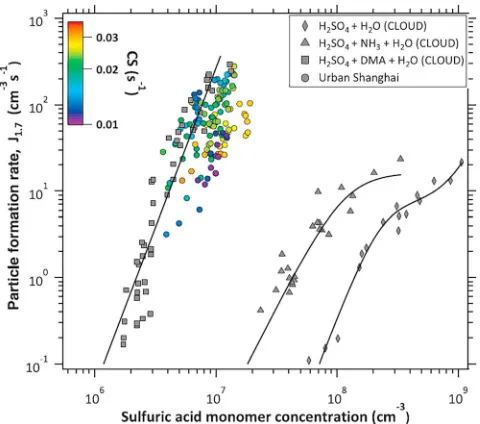
Extensive efforts have been made to elucidate the fundamental mechanisms relevant to atmospheric NPF on the basis offield measurements, laboratory experiments, and theoretical calculations (Kulmala et al., 2013; Zhang et al., 2012). Recentfield studies include ambient measurements of ultrafine particles down to the size ~1 nm, gaseous concentrations of nucleating precursors (such as sulfuric acid H2SO4, ammonia NH3, and amines), and prenucleation clusters (e.g.,Yu & Lee, 2012 ; Zhao et al., 2011 ; Zheng et al., 2015). For example, L. Yao et al. (2018) recently showed NPF in a very polluted Chinese megacity, Shanghai (Figure 2). They measured particle number size distributions down to ~1.2 nm, along with sulfuric acid vapor, sulfuric acid clusters (trimer and tetramer), and sulfuric acid‐dimethylamine (DMA) clusters with up to four molecules of sulfuric acid and two molecules of DMA. Also, numerous laboratory experiments were conducted using a
[image:4.612.43.283.89.301.2]flow reactor to monitor nucleation at afixed time or a reaction chamber to follow the evolution of nucleation (Yu, McGraw, & Lee, 2012; Zhang et al., 2009; Zhao et al., 2011). Notably, a major infrastructure, the Cosmics Leaving Outdoor Droplets (CLOUD) chamber, was established at CERN, Switzerland. The CLOUD experiment aims to understand aerosol nucleation and subsequent particle growth by integrating advanced instrumentation for measuring gases and aerosols with a high energy physics accelerator (proton synchrotron; Kirkby et al., 2011; Riccobono et al., 2014; Tröstl et al., 2016). In addition, theoretical investiga-tions of aerosol nucleation were carried out to determine the stability and dynamics of prenucleation clusters
Figure 2.Measured particle formation rates for 1.7‐nm particles (J1.7) as a
using thermodynamic data from quantum chemical calculations (Xu & Zhang, 2012), the Atmospheric Cluster Dynamics Code (ACDC) model (McGrath et al., 2012; Olenius et al., 2013; Zhao et al., 2009), and kinetic modeling calculations (Lovejoy et al., 2004; Yu, 2010, 2011).
NPF is intrinsically connected to gasphase chemistry, since many of the chemical species relevant to aerosol nucleation and growth are produced from photooxidation of atmospheric trace gases, including SO2and volatile organic compounds (VOCs),
SO2þOH→HSO3; (R1)
HSO3þO2→SO3þHO2; (R2)
SO3þH2OþM→H2SO4þM; (R3)
VOCsþOH or Oð 3Þ→→highly oxygenated molecules HOMsð Þ: (R4)
The critical role of photochemistry in NPF is also reflected by the fact that most NPF events occur during the day, while nocturnal NPF is also observed (Junninen et al., 2008). Sulfuric acid is considered the most pre-valent nucleating species because of its low vapor pressure under typical atmospheric conditions (Sipila et al., 2010; Zhang et al., 2012). Also, sulfuric acid is prone to form hydrogen bonding with many atmospheri-cally important compounds, including water, basic species (i.e., ammonia and amines), and organic acids. This ability to form hydrogen bonding renders sulfuric acid an ideal candidate to participate in nucleation. In particular, the prenucleation clusters exist in a state that is distinct from the liquid phase, and the veryfirst step of nucleation (i.e., the formation of a dimer) is driven mainly by hydrogen bond. Field measurements showed that gaseous sulfuric acid in concentrations of greater than approximately 105molecules/cm3is necessary for observable NPF in the atmosphere (Erupe et al., 2010; McMurry et al., 2005; Nieminen et al., 2009). In addition, several other nucleating precursors have been implicated for NPF under diverse environments, including ions (Kirkby et al., 2011; Kirkby et al., 2016), ammonia/amines (Almeida et al., 2013; Glasoe et al., 2015; Jen, Zhao, et al., 2016; Kirkby et al., 2011; Kürten et al., 2014; Yao et al., 2018; Yu & Luo, 2014a; Yu, McGraw, & Lee, 2012), HOMs (Ehn et al., 2014; Jokinen et al., 2015; Tröstl et al., 2016), other organic compounds (Metzger et al., 2010; Zhang et al., 2004), and iodine oxides (O'Dowd et al., 2002; Sipilä et al., 2016).
Currently, the mechanism and chemical species responsible for atmospheric NPF are still highly uncertain. In particular, consistent chemical mechanisms to explain NPF under diverse atmospheric conditions are still lacking. Also, available results of NPF from laboratory experiments,field measurements, and theoretical cal-culations are often conflicting, regarding the identity of the chemical species responsible for aerosol nuclea-tion and growth under diverse ambient condinuclea-tions. These inconsistencies are partially attributed to difficulties in detecting the nucleating precursor species and the chemical composition of clusters and freshly nucleated nanoparticles by analytical instrumentation and in calculating large prenucleation clusters by reliable theoretical methods.
The present review provides a synthetic view of NPF in the atmosphere, by emphasizing the most recent advances made in the understanding of nucleation and growth of atmospheric nanoparticles from laboratory experiments,field measurements, and modeling studies. The review is organized according to the following outline. Section 2 emphasizes on recent development of analytical instruments to measure the size and che-mical composition of prenucleation clusters and nanoparticles. Recent progresses on atmospheric NPF from laboratory studies,field observations under various environments, and NPF parameterizations in atmo-spheric models are discussed in sections 3–5, respectively. Section 6 presents an overview on the outstanding questions, challenges, and directions for atmospheric NPF research. Appendix A contains a list of acronyms.
occurring under extremely polluted conditions. Kerminen et al. (2018) review recentfindings of NPF from
field observations in different atmospheric regions. Semeniuk and Dastoor (2018) discuss NPF parameteri-zations used in regional air quality models. The present review focuses on the latest progress in development of new instruments, laboratory observations of multicomponent nucleation, andfield observations of NPF at under various ambient conditions and discusses the critical needs for the development of physically based NPF parameterizations in atmospheric models.
2. Development of New Instruments
Measuring aerosol sizes, especially those including newly formed clusters, is necessary for NPF studies but very challenging. Great progress has been made recently in this direction. Chemical analysis of nucleation precursors is extremely important, as nucleation is a nonlinear process. In this section, we discuss analytical methods used to detect major nucleation precursors, sulfuric acid, ammonia and amines, and newly nucleated gas phase clusters, both charged and neutral.
2.1. Sizing of Nanoparticles
Understanding NPF requires reliable instrumentation capable of the detection of forming clusters as well as their precursors. Measurement of particle concentrations and size distributions down to a few nanometers, preferably down to ~1.5‐nm mobility diameter (Kulmala et al., 2012), is especially important, because this information is needed to identify NPF events and retrieve parameters describing particle formation pro-cesses, for example, formation and growth rates (GR).
The most common particle size spectrometer is Differential or Scanning Mobility Particle Sizer (D/SMPS), which consists of a neutralizer, a Differential Mobility Analyzer (DMA), and a particle counter. D/SMPS have been widely used in atmospheric measurements, but large deviations still exist in individual instru-ment performances especially in the sub‐10‐nm size range (Wiedensohler et al., 2012). Much progress has been thus made in recent years to develop instruments optimized for the measurement of smallest size par-ticles (e.g., down to ~1 nm).
High‐Resolution DMA (HR‐DMA) was developed to accurately size particles and clusters down to the mole-cular sizes. Several studies characterized the performance of HR‐DMAs down to ~1 nm (Brunelli et al., 2009; J. K. Jiang et al., 2011; Kangasluoma et al., 2016; Steiner et al., 2010; M. R. Stolzenburg et al., 2018). For atmo-spheric measurements, sufficiently high transmission of small particles through the DMA is required, since concentrations of these small particles are generally low.
An important factor limiting the size range in a particle spectrometer is lower activation efficiencies of Condensation Particle Counters (CPCs) at smaller sizes. The minimum size of water‐ or butanol‐based CPCs is typically ~2–3 nm before they are homogenously nucleated by the workingfluid. Instruments using diethylene glycol (DEG) as the workingfluid can reach even smaller sizes without homogenous nucleation (Iida et al., 2009). Several particle counters using DEG have been developed (Kuang et al., 2012; Vanhanen et al., 2011), but all of them require a second stage growth chamber, where small particles grow to the optical sizes to be detected by light scattering.
More recent particle size spectrometers that combine HR‐DMAs and low cutoff particle counters can detect particle sizes smaller than 2 nm. These instruments include D/SMPS systems with DEG‐based CPC (J. Jiang et al., 2011; Kangasluoma et al., 2018), as well as the DMA‐train (Stolzenburg et al., 2017) that consists of several DMAs in parallel set to different cutoff sizes. The main disadvantage of these new instruments is low counting efficiencies of particles at small sizes, due to low charging probabilities, low transmission effi -ciencies through the DMA, and diffusion losses throughout the system.
Other types of size spectrometers include Air Ion Spectrometer (AIS) that detects naturally charged ions using electrometer (Mirme & Mirme, 2013). Neutral cluster and Air Ion Spectrometer (NAIS) can measure particle size distributions of total aerosol particles (including charged and neutral) above ~2 nm, using cor-ona discharge (Mirme & Mirme, 2013). Ion spectrometers often use largeflow rates to reduce particle losses, but the associated electric noise can be an issue at low particle concentrations.
signals at low concentrations of particles. The scanning Particle Size Magnifier (PSM, Vanhanen et al., 2011) has been used to inversely derive particle size information down to ~1 nm, by continuously changing the supersaturation ratio of the DEG workingfluid to activate a different size fraction of sub‐3‐nm particles at a time (Kangasluoma et al., 2015; Lehtipalo et al., 2014). Another approach is to use pulse‐height analysis to resolve the original particle sizes based on measured droplet size distributions (Kuang, 2018; Sipila et al., 2009). The main limitation of both aforementioned methods is that activation of particles inside the CPC is sensitive to chemical composition of particles (Kangasluoma et al., 2014; Wimmer et al., 2013), so for atmospheric aerosols with unknown chemical compositions, this issue can make analysis more challenging.
2.2. Chemical Analysis of Nucleation Precursors
Atmospheric observations and laboratory studies of NPF have shown that Chemical Ionization Mass Spectrometer (CIMS) is a powerful tool for sulfuric acid measurements. The CIMS is based on the ion‐ molecular reaction using nitrate ions (NO3) as reagent (Eisele & Tanner, 1993) at atmospheric pressure. In general, the detection limit of CIMS is at 105cm−3or even lower, with an integration time of 1 min, with the overall uncertainty of ~60% (Benson et al., 2008; Benson et al., 2009; Eisele & Tanner, 1993; Erupe et al., 2010; Kürten et al., 2012; Petäjä et al., 2009).
Nitrate ions (and their higher order clusters) are produced in aflow annular to the sampleflow by exposing a parts per million by volume mixture ppmv of nitric acid in air to a commercial X‐ray source (<10 KeV) or a 210Po radiation source. During this process, hydroxyl (OH) radicals can also form from water molecules by the ionization source, and if they react with SO2, they can produce artifact sulfuric acid molecules. To reduce such artifacts, an electricfield is applied in the ion‐molecule reaction region so that only charged nitrate ions, as opposed to OH radicals,flow in to the reaction region to react with sulfuric acid molecules (Eisele & Tanner, 1993). Calibration of sulfuric acid is made based on the known concentrations of OH, produced from ultraviolet photolysis of water molecules, by converting the OH radicals to sulfuric acid in the presence of excessive SO2 concentrations (Kürten et al., 2012; Sjostedt et al., 2007; Tanner & Eisele, 1995; Young et al., 2008).
It is possible that strong base compounds, by clustering with sulfuric acid, can affect the detection of sulfuric acid in CIMS (Kurten et al., 2011). However, Rondo et al. (2016) recently investigated the effects of amine‐ sulfuric acid clustering on the detection of sulfuric acid with CIMS and concluded that the nitrate‐CIMS can measure sulfuric acid monomers efficiently even in the presence of amines.
An atmospheric pressure ionization‐ion drift‐CIMS was developed to measure ambient sulfuric acid and its clusters (Zheng et al., 2010; Zheng et al., 2011). The application of the drift tube facilitates controlled ion‐ molecule reactions, with the advantages to detect and quantify gases without the necessity of calibrations using authentic standards and to effectively prevent unwanted cluster formation (Fortner et al., 2004; Ji et al., 2017; Zhao et al., 2004; Zhao et al., 2005; Zhao & Zhang, 2004). The atmospheric pressure ionization‐ion drift‐CIMS exhibits the advantages over the low pressure ion drift‐CIMS and atmospheric pressure ionization‐CIMS, by improving the detection sensitivity by 3 orders of magnitude and a factor of 3, respectively (Zheng et al., 2010).
Amines have been measured with offline analytical methods based on gas chromatography, high‐ performance liquid chromatography, and ion chromatography, coupled withflame ionization detectors, mass spectrometry, ultraviolet detectors, fluorescence detector, or electrochemical detectors (Ge et al., 2010). The advantage of these offline techniques is that the detection limit can be improved by an enhanced analyte preconcentration (e.g., absorption in water or adsorption on solid sorbents), but the preconcentra-tion with the prolonged sampling time also raises several technical issues. High‐performance liquid chroma-tography and ion chromachroma-tography methods often involve amine absorption in water; and water contains amines as impurities (Erupe et al., 2011; Yu, McGraw, & Lee, 2012). Nevertheless, DMA has been measured by the ion chromatography method in CLOUD chamber experiments with an extremely low detection limit at the sub‐parts per trillion by volume (pptv) level (Praplan et al., 2012).
protonated water ions as reagent to measure various amines and ammonia. H. Yu and Lee (2012) applied protonated ethanol and acetone ions as reagent to detect amines and ammonia together, and this ion‐ molecule reaction scheme later was applied for amine measurements also by other groups (Yao et al., 2016; Yao et al., 2018). Either quadrupole mass spectrometry or high‐resolution time offlight mass spectro-meter (HR‐TOF‐MS) has been used as detector. These CIMS can provide detection limits of pptv or sub‐pptv for amines and several tens pptv of ammonia, with the time resolution of 1 min (You et al., 2014).
The main challenge of measuring amines and ammonia is to make reliable background measurements to ensure the measured signals truly represent the concentrations of amines and ammonia. Background mea-surements should“shield out”the effects of artifact signals rising from the desorption of amines and ammo-nia from the sampling inlets and the effects of ambient conditions such as relative humidity (RH) and temperatures and other atmospheric species on ammonia and amine signals (Hanson et al., 2011; You et al., 2014; Yu & Lee, 2012). Thus, the zero air used in background measurements should be different from the zero air typically generated from a commercial“zero air generator,”because the latter can show signifi -cantly lower background signals, and thus, measurements can showhigherconcentrations of amines than the actual values. Also, because sensitivities are dependent on the background signal levels, frequent in situ calibrations are needed (You et al., 2014).
Reliable measurements of gas phase precursors such as sulfuric acid, organics, ammonia, and amines with sufficiently low detection limits and high time response are needed for future studies. Measurements should provide the robust calibration and stability during the long‐term operation and be reproducible under differ-ent atmospheric conditions with varying temperatures, RH, and air pressures.
2.3. Chemical Analysis of Charged and Neutral Clusters
Prenucleated clusters containing sulfuric acid have been measured by CIMS (Eisele et al., 2006; Froyd & Lovejoy, 2003; Froyd & Lovejoy, 2004; Hanson & Eisele, 2000; Zhao et al., 2010; Zhao et al., 2011). Recently, chemical composition of atmospheric clusters (e.g., beyond tetramers) has been measured with Atmospheric Pressure ionization‐Time of Flight mass spectrometer (APi‐TOF; Junninen et al., 2010) and Chemical Ionization‐Atmospheric Pressure Ionization‐Time of Flight mass spectrometer (CI‐APi‐TOF; Jokinen et al., 2012), both based on the HR‐TOF‐MS technique. The APi‐TOF is in fact an HR‐TOF‐MS which is attached to an Atmospheric Pressure interface (APi). In this case, no chemical ionization is applied to the sampleflow, and it detects ions that naturally form in the atmosphere. The APi‐TOF can be configured to measure either positive or negative ions.
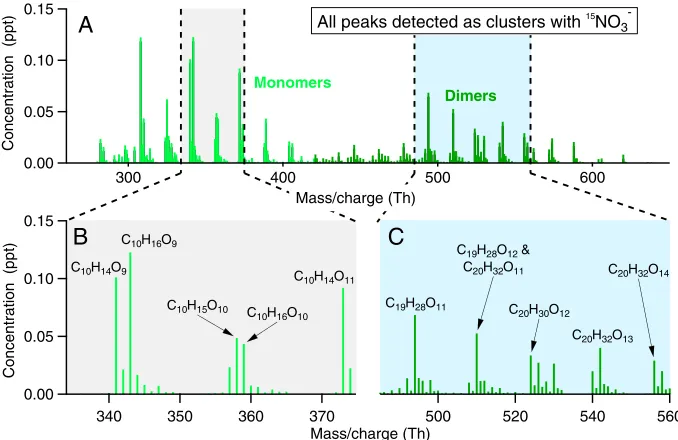
The use of the HR‐TOF‐MS improves ion transmission by up to 2 orders of magnitude over a typical quad-rupole mass spectrometry operated in m/z scanning mode. Complete mass spectra can be acquired at rates greater than 100 Hz with mass resolving power between 3,000 and 7,000 m/z and mass accuracy better than 10 ppm. The nitrate CI‐APi‐TOF detects sulfuric acid, aminium, ammonium, iodic acid, and HOMs (Jokinen et al., 2012; Kürten, Bergen, et al., 2016; Sipilä et al., 2016). The CI source for the nitrate CI‐APi‐TOF is based on the Eisele and Tanner (1993) described in section 2.2. The quantification of HOM concentrations has been achieved using the same calibration factor for the sulfuric acid detection, under the assumption that HOMs are detected near the collision limit and have the same transmission efficiencies as sulfuric acid. The lack of direct calibration and peak identifications of HOM species is the major technical issue for CI‐ APi‐TOF. Figure 3 shows mass spectra taken by CI‐APi‐TOF duringα‐pinene ozonolysis reactions in the Jülich Plant Atmosphere chamber, indicating a series of monomers and dimers of HOMs formed from bio-genic VOC (BVOC) ozonolysis reactions (Bertram et al., 2011; Brophy & Farmer, 2015; Ehn et al., 2014; Veres et al., 2008).
The large variety of oxidized organic compounds poses specific challenges for instrumentation, as different ion chemistries used in the CIMS instruments measure different subgroups of organic compounds. For com-pleteness, different techniques and ion chemistries should be used in parallel, ideally, but it is not straight-forward to integrate or intercompare the mass spectrometer data obtained from different instruments. Also, the current mass spectrometers still suffer from fragmentation and thermal decomposition of clusters and particles during the sampling and measurement, which hinders the accurate quantification of organic species.
With the recent instrumentation development, we are now able to measure the chemical composition (e.g., molecular mass, although without chemical identities) of newly nucleated clusters (Jokinen et al., 2012; Junninen et al., 2010). There are several instruments that were designed to measure chemical composition of sub‐20‐nm particles (Gomez‐Hernandez, 2015; Horan et al., 2017; Smith et al., 2004), but these instru-ments have been primarily used for particles larger than ~20 nm. Thus far, chemical analytical techniques that cover the particle size range from ~3 to 20 nm are mostly missing, because these particles are difficult to ionize, have extremely low mass concentrations, and are very diffusive. There have been some indirect methods used for chemical analysis of this size range particles, for example, Tandem DMA (Laaksonen et al., 2008; Petäjä et al., 2005). Understanding the chemical composition of particles from 3 to 20 nm parti-cles is essential for understanding the growth mechanisms of new partiparti-cles and their effects on CCN formation.
Atmospheric sensors currently used for chemical analysis and size distribution measurements are very costly and labor consuming to operate and troubleshoot. Due to their high costs, deployment of these instruments at a wide range of atmospheric locations, especially in developing countries and remote locations, is not fea-sible. Due to various technical issues in their operation, they are usually not suitable for long‐term, online measurements, especially at mountain‐top sites and onboard the aircraft. Development of low‐cost, portable, and reliable instruments that can provide detailed size information of clusters and nanoparticles is needed.
3. Nucleation and Growth Mechanisms: New Results From Laboratory Studies
[image:9.612.203.542.90.310.2]Laboratory nucleation observations conducted under well‐controlled experimental conditions are needed to test and constrain nucleation theories, but nucleation experiments are extremely difficult to perform. The major technical challenges include difficulties in measuring very low concentrations of nucleation precur-sors and the chemical composition of newly formed particles in the size range from the critical clusters
(~1.5 nm) up to ~10‐nm particles. Experiments often suffer various contaminations of nucleation precursors, especially relatively high concentrations of amines and ammonia that originate from deionized water. For example,flow tubes (e.g., made by Pyrex) typically contain the pptv and tens pptv level of base compounds depending on RH, even after very deliberate cleaning processes (Erupe et al., 2011; Yu, Dai, et al., 2017; Yu, McGraw, & Lee, 2012), with some exceptions (Glasoe et al., 2015; Hanson et al., 2017). As nucleation is a nonlinear process and theJare extremely sensitive to the temperature, RH, and concentrations of nucleation precursors, it is difficult to obtain consistent data from different experimental setups. The chamber experi-ment results are also difficult to interpret, because wall loss of nucleation vapors (Pierce et al., 2008; Zhang et al., 2014), clusters (Ehrhart & Curtius, 2013; Kürten et al., 2015; McMurry & Li, 2017), and particles (Pierce et al., 2008) must be accounted for the accurate calculation ofJandGR. Nucleation studies have been made with fastflow reactors (Ball et al., 1999; Benson et al., 2011; Berndt et al., 2010; Brus et al., 2010; Hanson & Lovejoy, 2006; Lovejoy et al., 2004; Young et al., 2008; Zhang et al., 2004), expansion cloud cham-bers (Katz, 1970), environmental smog chamcham-bers (Metzger et al., 2010; Riccobono et al., 2012), real plant chambers (Hao et al., 2009; Joutsensaari et al., 2005; Mentel et al., 2009), and recently at CERN in the large environmental chamber CLOUD (Almeida et al., 2013; Kirkby et al., 2016; Kürten et al., 2014; Lehtipalo et al., 2016; Tröstl et al., 2016). The advantage of CLOUD is that it has extremely low concentrations of impu-rities and is equipped with a large number of state‐of‐the‐art aerosol and chemical instruments through col-laborations. Even the CLOUD chamber still suffers from the contamination of base compounds at high RH and high temperature conditions due to desorption of base compounds from the stainless steel walls (Kürten, Bianchi, et al., 2016). In this section, we highlight key scientificfindings from the recent laboratory experiments of nucleation and early growth.
3.1. Base‐Stabilization Nucleation
Sulfuric acid is the most important atmospheric nucleation precursor, and base compounds such as ammo-nia and amines also enhance nucleation of sulfuric acid. This is because base compounds can reduce the vapor pressure of sulfuric acid and thus stabilize critical clusters. Low molecular mass alkyl amines were shown to be stronger stabilizing agents for sulfuric acid clusters than ammonia by laboratory experiments and quantum chemistry (Jen et al., 2014; Kurtén et al., 2008; Yu, McGraw, & Lee, 2012).
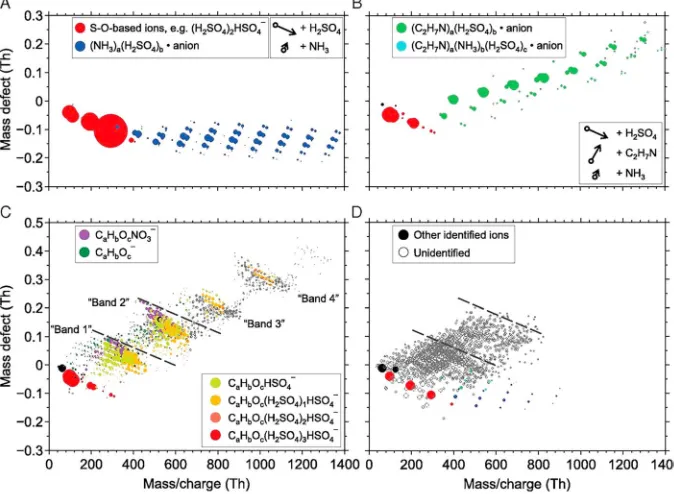
Ammonia and amines have been observed in small sulfuric acid clusters in both the laboratory and the atmosphere (Almeida et al., 2013; Bianchi et al., 2014; Hanson & Eisele, 2002; Kirkby et al., 2011; Kürten et al., 2014; Schobesberger et al., 2015; Yao et al., 2018; Yu, McGraw, & Lee, 2012). Figure 4 shows an approx-imate 1:1 molar ratio of sulfuric acid and ammonia (or DMA) in newly formed clusters at the atmospheri-cally relevant gaseous [NH3]/[H2SO4] concentration ratios of 10–500 (Bianchi et al., 2014; Schobesberger et al., 2015). While amines can strongly enhance theJ(Almeida et al., 2013; Glasoe et al., 2015), studies show there is a saturation effect ofJor dimer concentrations with a further increase in DMA concentrations, for example, when exceeding 5 pptv DMA at temperatures between 278 and 300 K (Almeida et al., 2013; Chen et al., 2012; Jen et al., 2014; Kürten et al., 2014). With 5–32 pptv or higher concentrations of DMA, formation of neutral sulfuric acid dimers reaches the kinetic limit with a power dependence ofJon [H2SO4] of 2, indi-cating highly stable clusters with negligible evaporation (Almeida et al., 2013; Kürten et al., 2014). This is equivalent to the notion that the critical cluster size is smaller than the dimer.
(Almeida et al., 2013). These results imply that base compounds in these very polluted cities can be impor-tant for aerosol nucleation, but the effects of other chemical species such as biogenic and anthropogenic organics also cannot be excluded.
Amines also have an important effect onGRof new particles. Recently, Lehtipalo et al. (2016) observed that when 5 to 70‐pptv DMA was present in the CLOUD chamber, theGRof 2 nm particles was a factor of ~10 higher than that could be expected based on the mass flux calculated from the apparent sulfuric acid concentrations and cocondensation of DMA. It was thus concluded that the dominant growth mechanism is acluster‐clustercollision process, instead of sulfuric acidmonomer‐clustercollision. Thisfinding has an important atmospheric implications especially in a highly polluted atmosphere. In the past, the higherGR
could not be explained by sulfuric acid condensation and were often attributed to additional contribution from some unidentified organics (Yu, Ren, & Kanawade, 2017).
Laboratory observations show that the enhancement of nucleation is dependent on the proton affinity of base compounds (Berndt et al., 2014; Glasoe et al., 2015; Yu, McGraw, & Lee, 2012). The enhancement of nucleation is also stronger by ammonia and an amine together, compared to ammonia or an amine com-pound alone (Berndt et al., 2014; Glasoe et al., 2015; Yu, McGraw, & Lee, 2012). Considering many common emission sources (Ge et al., 2010) and the copresence of amines and ammonia in the atmosphere (You et al., 2014; Yu & Lee, 2012), such synergetic effects have important atmospheric implications. Systematic labora-tory studies are needed to understand the role of different amines and the synergetic effects on sulfuric acid nucleation. Amines undergo rapid oxidation reactions in the atmosphere (Finlayson‐Pitts & Pitts, 2000). Studies have shown that some oxidation products such as imines are very efficient in aerosol nucleation and secondary organic aerosol (SOA) formation (Nielsen et al., 2011). Future studies are required to under-stand how oxidation products of amines affect aerosol nucleation and growth.
3.2. HOMs Formed From VOCs Oxidation Reactions
[image:11.612.204.541.93.340.2]Although sulfuric acid and bases are known to be the key precursors for NPF, sulfuric acid alone, or even together with base compounds, cannot explain atmospheric observations in most part of the continental
boundary layer. The importance of organic vapors in particle formation, and most certainly in particle growth, has long been discussed (e.g., Riipinen et al., 2012, and references therein). R. Zhang et al. (2004) for thefirst time showed that organic compounds such as benzoic acid can enhance sulfuric acid nucleation, due to hydrogen bonding between sulfuric acid and benzoic acid molecules. Metzger et al. (2010) showed trimethylbenzene (in the absence of ozone or OH) enhances sulfuric acid nucleation.
For organic compounds to participate in particle formation and in the early stage of growth, they need to have extremely low saturation vapor pressures as well as high enough concentrations to overcome the Kelvin barrier and condense on nanometer‐sized aerosol particles or form clusters by themselves. Saturation vapor pressures of oxidation products of VOCs span over many orders of magnitude and can be classified into the VOC, intermediate VOC, semi‐VOC (SVOC), low volatility organic compound (LVOC), and extremely low VOC (ELVOC) (Donahue et al., 2011). For example, log saturation vapor con-centrations (C* in μg/m−3) of ELVOC, LVOC, and SVOC may range approximately from −10 to 3 (Schobesberger et al., 2013). ELVOC and LVOC together are usually denoted broadly as HOMs, although there are some cases where (E)LVOC and HOMs are not necessarily the same (Bianchi et al., 2019).
HOMs are produced from organic peroxides formed from oxidation reactions of BVOCs and anthropogenic VOCs (AVOCs), via autoxidation reactions involving successive intramolecular H‐shift followed by O2 addi-tion (Berndt et al., 2016; Crounse et al., 2011; Crounse et al., 2013; Ehn et al., 2014; Ehn et al., 2017). HOMs contain a wide range of chemical functional groups such as peroxides, hydroperoxides, carbonyls, and per-carboxylic acids. Due to their high O/C ratios (close to unity), they have sufficiently low volatilities to con-tribute to aerosol nucleation and growth. Several studies have quantified HOM yields from monoterpenes (Ehn et al., 2014; Ehn et al., 2017; Jokinen et al., 2015), isoprene (Jokinen et al., 2015), and AVOCs (e.g., alkyl benzenes; Molteni et al., 2018; Praske et al., 2018; S. Wang et al., 2017). The exact formation pathways and properties of HOMs are still under investigation (Berndt et al., 2016; Bianchi et al., 2019; Ehn et al., 2017).
Schobesberger et al. (2013) have shown that HOMs (e.g., C10H12–16O2–10) formed from OH oxidation reac-tions of pinanediol (C10H18O2, afirst generation oxidation product of monoterpenes) interact with sulfuric acid to form monomers to tetramers (Figure 4), and these HOMs can enhance J for sulfuric acid. Subsequently, Riccobono et al. (2014) derived thatJin the same nucleation system are dependent on sulfuric acid with the second power and on HOMs linearly. Ehn et al. (2014) have demonstrated the formation of HOMs from ozonolysis ofα‐pinene and derived that theJare dependent on sulfuric acid linearly and on HOMs with the second power. They also showed that growth of particles in the size range between 5 and 50 nm can be explained exclusively with ELVOC (without LVOCs and SVOCs). On the other hand, theflow tube experiments by Berndt et al. (2014) showed that HOMs produced from ozonolysis of monoterpenes do not enhance sulfuric acid nucleation. Kirkby et al. (2016) claimed that nucleation can proceed from HOMs (fromα‐pinene ozonolysis) alone, assisted by ions. Tröstl et al. (2016) showed thatGRof 5 to 50 nm particles cannot be explained by HOMs alone, suggesting that LVOCs that are not measured by the nitrate‐CIMS and some additional SVOCs may be also involved in the growth. Hao et al. (2009) have shown that oxidation of real plant‐derived VOCs by OH can produce very different nucleation and growth rates than oxidation by O3. These discrepancies imply that HOMs formed from different precursors and different pathways under differ-ent conditions (e.g., differdiffer-ent VOCs and differdiffer-ent oxidants such as O3vs. OH vs. NO3) can contribute to aero-sol nucleation and growth in different ways.
Recently, Lehtipalo et al. (2018) and McFiggans et al. (2019) showed that the exact mixture of precursors is crucial in determining particle formation rates in the systems involving HOMs and other compounds. But how AVOCs and BVOCs interact together to affect aerosol nucleation and growth has not been investigated. This is especially relevant in extremely polluted regions in the tropics and subtropics where there are also strong biogenic emissions of BVOCs. Understanding these multicomponent nucleation sys-tems of mixed chemical species requires comprehensive instrumentation and coordinated laboratory and
filed studies.
on NPF and on photochemical ozone production from the real plant BVOC emissions. At high NOx conditions (e.g., [BVOC]/[NOx] < 7 and [NOx] > 23 ppb), NPF was suppressed. Instead, photochemical ozone formation was observed at higher OH and lower NOxconcentrations. At the same time, NOxhad little effect on the mass concentration of SOA. Other studies, on the other hand, indicate a strong increase in biogenic SOA due to NOx(e.g., Shrivastava et al., 2019). It is possible that organonitrate HOMs (HOM‐ ONs), which are formed from biogenic vapors in the presence of NOx, are much less efficient in forming particles than other HOMs (Lehtipalo et al., 2018), probably due to their higher volatilities, but they might still be efficient in the aerosol growth. Future studies are required to understand the relative roles of HOMs versus HOM‐ONs on aerosol nucleation and growth.
3.3. Stabilizing Ions
Ions can enhance nucleation, especially when neutral nucleation is weak. This is because charged clusters coagulate faster than neutral clusters and in turn stabilize the critical clusters and reduce the Gibbs free‐ energy barrier for cluster formation (Seinfeld & Pandis, 2016). Researchers have used different terms for ion nucleation, such as ion‐induced nucleation (IIN; Laakso et al., 2004; Lovejoy et al., 2004; Modgil et al., 2005) and ion‐mediated nucleation (IMN; Yu, 2010; Yu & Luo, 2014b; Yu & Turco, 2000; Yu & Turco, 2001; Yu et al., 2008), but in this review we use a more general term“ion nucleation”to include both IIN and IMN.
Earlier ion nucleation studies were performed in the laboratory and showed in general thatJare enhanced by charges (Kim et al., 1997; Wilhelm et al., 2004). Lovejoy and colleagues performedflow tube experiments of ion nucleation for the binary homogeneous nucleation of sulfuric acid and water system (Froyd & Lovejoy, 2003; Froyd & Lovejoy, 2004; Lovejoy et al., 2004). They measured the thermodynamics for growth and evaporation of prenucleated sulfuric acid cluster ions and incorporated these data into a kinetic aerosol model to yield quantitative predictions of the rate of ion nucleation. This IIN parameterization was tested and constrained by the temperature, RH, SO2, OH and H2SO4concentrations, and aerosol size distributions measured in a wide range of conditions from the ground level to the upper troposphere and lower strato-sphere (Lee et al., 2003), which enabled the model to parameterize the atmospheric conditions using more realistic parameters for atmospheric nucleation. The model predicts that the negative ion nucleation is more important than positive ion nucleation and that ion nucleation of sulfuric acid and water mechanism is an efficient source of new particles in the middle and upper troposphere. However, the model does not gener-ally predict the nucleation events observed in the boundary layer.
The recent CLOUD measurements quantified the enhancement of ion nucleation compared with neutral nucleation for several chemical systems (Kirkby et al., 2011). For the sulfuric acid and water binary nuclea-tion, ions are more important at higher atmospheric temperatures than lower temperatures (Duplissy et al., 2016). For the ammonia‐ternary nucleation, the contribution of ion nucleation is small at temperatures between 208 and 248 K when ammonia is present at several pptv or higher, but the presence of ions significantly enhancesJfor higher temperatures independent of ammonia levels (Kürten et al., 2016). Ion nucleation of sulfuric acid and ammonia was recently suggested to drive NPF in the coastal Antarctica (Jokinen et al., 2018).
For the case of ternary sulfuric acid and DMA, the contribution of ion nucleation is generally small, refl ect-ing the high stability of sulfuric acid‐DMA clusters and indicating that galactic cosmic rays exert only a small influence on their formation (Almeida et al., 2013). Ion nucleation is also less important when HOMs are mixed with sulfuric acid and ammonia (Lehtipalo et al., 2018; Riccobono et al., 2014). The current conclu-sion from the CLOUD experiments is that although ions can be involved in nucleation in large parts of the atmosphere, the dependence on ion concentrations and thus variation in ionization rates are weak (Dunne et al., 2016).
showed that NPF is entirely absent in these pristine forests even with strong emissions of BVOCs (Rizzo et al., 2018).
3.4. Temperature and RH Dependencies
Temperature and RH are the key thermodynamics parameters of aerosol nucleation and growth (Seinfeld & Pandis, 2016).Jis a function of Gibbs free‐energy barrier and temperature. At lower temperatures, the Gibbs free‐energy barrier is lowered, and the critical cluster becomes smaller. RH is also the saturation ratio and the chemical activity of water. In the atmosphere, temperature and RH vary greatly depending on altitude, latitude, season, and the time of the day. Therefore, to simulate NPF correctly in the atmosphere, bothJand
GRas a function of temperature and RH should be understood.
Duplissy et al. (2016) conducted binary homogeneous nucleation of sulfuric acid and water, with and with-out ions in the CLOUD chamber, at temperatures from 207 to 299 K, and RH between 11% and 58%. At lower temperatures, both ion nucleation and neutral binary nucleation are at the kinetic regime, while at higher temperatures,J is strongly dependent on [H2SO4], indicating there are high Gibbs free‐energy barriers. Kürten, Bianchi et al. (2016) showed the temperature dependence of ternary nucleation in the CLOUD chamber, at conditions with temperatures from 208 to 298 K, [H2SO4] between 105and 109cm−3, and ammonia mixing ratios up to ~1,400 pptv. At 208 K,Jexceeded the threshold of 1 cm−3s−1at a [H2SO4] of ~3 × 106cm−3for the binary case and at [H2SO4] of ~5 × 105cm−3for the ternary case with 5 pptv of ammonia. Kürten, Bianchi et al. (2016) showed that ternary nucleation involving ammonia could be an important mechanism for nucleation in the polluted boundary layer when temperatures are not too high (e.g., 278 K).
Yu, Dai, et al. (2017) performedflow tube experiments of sulfuric acid aerosol nucleation, at temperatures ranging from 248 to 313 K, RH from 1% to 79%, and under minimal base concentrations (ammonia < 23 pptv, methylamine < 1.5 pptv, and DMA < 0.52 pptv). Yu, Dai, et al. (2017) provided for thefirst time the temperature and RH dependence of bothJandGR.Jshows the following dependence within the experimen-tal conditions:
J¼1041:8½RA3½RHe−2:4×10⁴T (7)
where RA is the saturation ratio (or relatively acidity) of sulfuric acid.GRis independent of temperature below 290 K but significantly decreases at temperature above 290 K, while RH has a moderate effect onGR.
Recent studies have shown that oxygenated organics formed from BVOCs can grow newly nucleated parti-cles in a wide range of troposphere temperatures (D. Stolzenburg et al., 2018). This is because gas phase auto-xidation reactions involved in the formation of HOMs usually have strong temperature dependencies, with higher reaction rates at higher temperatures (Frege et al., 2018), whereas nucleation is favored at lower tem-peratures. Despite the low reaction rates, Bianchi et al. (2016) observed high concentrations of HOMs during NPF at a high‐elevation site with low temperatures, with an average temperature of−5 °C at noontime. At present, however, there is still no clear evidence from atmospheric observations which demonstrates“causal effects”of temperature and RH on NPF.
3.5. Thermodynamics Measurements
4. NPF Observations in Various Environments
Hundreds of measurements have been made over the world during the past decades on various platforms, such as at ground level, on aircraft, and at high mountain sites (Chu et al., 2019; Kerminen et al., 2018; Kulmala, Vehkamäki, et al., 2004; Z. Wang et al., 2017; Yu, Ren, & Kanawade, 2017; Zhang et al., 2012). Measurement locations varied from clean rural sites to polluted urban sites to extremely polluted megacities, from tropics to polar regions, and from coastal sites to forested regions. These measurements in general show a distinctive seasonality with higher NPF frequency in spring and higherGRduring the summer, with some exceptions (Nieminen et al., 2018). These observations show quite conclusively that sulfuric acid (e.g., at the mid‐105cm−3level or higher) is required to initiate nucleation under most of the atmospheric conditions, although NPF does not always take place even at high sulfuric acid conditions. In many studies, the reported sulfuric acid concentrations were not measured but have been calculated from SO2and radiation using the statistical correlation of Mikkonen et al. (2011), for example. WhileJhas a strong correlation with sulfuric acid, it usually has a much weaker correlation (sometimes even an anticorrelation) with base compounds, such as ammonia and amines (Erupe et al., 2010; Kürten, Bergen, et al., 2016; McMurry et al., 2005), despite evidence from laboratory studies that base compounds are enhancingJ(Almeida et al., 2013; Jen et al., 2014; Kirkby et al., 2011; Yu, McGraw, & Lee, 2012). Field observations also show an opposite diurnal cycle of NPF and HOMs (Bianchi et al., 2017; Kürten, Bianchi, et al., 2016; Rose et al., 2018; Yan et al., 2016), suggesting that the role of HOMs in NPF is not well‐understood.
One of the most important future studies is to conduct long‐term measurements of NPF at diverse locations to understand how different NPF processes dominate under different atmospheric conditions. The majority of measurement sites with at least 1 year time series of aerosol size distributions are located in Europe, while long‐term data from Asia, North America, and the Southern hemisphere are very limited (Nieminen et al., 2018). For example, in North America, long‐term observations NPF have been conducted at limited loca-tions (Hallar et al., 2015; Kanawade et al., 2012; Sullivan et al., 2018). Simultaneous measurements of aerosol size distributions and chemical analysis of the precursors are especially scarce. Many of the existing time ser-ies are too short to study the seasonal variation and trends of NPF over long time periods. Several studser-ies showed that dominant nucleation and growth mechanisms can vary even at the same site depending on the availability of precursor vapors (Bianchi et al., 2016; Hodshire et al., 2016), indicating that long‐term observations are needed before drawing conclusions about the prevailing nucleation mechanisms.
4.1. Atmospheric Observations of HOMs and Their Implications on NPF
The longest semicontinuous HOM measurements from the boreal forest area were conducted with a nitrate‐ CIMS at Station for Measuring Forest Ecosystem–Atmosphere Relations SMEAR II station in Hyytiälä in the southern Finland (Bianchi et al., 2017; Yan et al., 2016). These measurements show that HOMs (containing up to 40 carbons) are relatively abundant, with maximum total HOM concentrations during the spring, with concen-trations more than 1 order of magnitude larger than those of sulfuric acid. The concenconcen-trations of HOMs were usually higher during the night, whereas HOM‐ONs were higher during the daytime. For example, HOM dimers show the opposite diurnal trend to sulfuric acid (i.e., a maximum at the night and a minimum during the day).
Furthermore, these measurements indicate that it is not possible to explain the measuredGRwith the mea-sured sulfuric acid (106cm−3) and HOMs (107cm−3) in the atmosphere, since they together can explain only a small fraction of the measuredGR(up to tens of nanometers per hour), even assuming that HOMs also con-dense on new particles with the collision‐limited process (Bianchi et al., 2017; Yan et al., 2016). Hence, it is likely that a large fraction of oxidized organics (especially LVOCs and SVOCs) are not currently measured with the nitrate CI‐APi‐TOF, and alternative techniques are needed for their detection.
environments is not known, but it is possible that there are not enough other low volatile vapors (e.g., HOM‐ ONs) available to grow the HOM clusters.
During the day, a large fraction of HOMs found in the boreal forest contains one or two nitrate groups (i.e., HOM‐ONs; Bianchi et al., 2017; Yan et al., 2016). The role of HOM‐ONs in particle formation is still under debate. Field studies show good correlation between some of the HOM‐ONs and particle formation (Jokinen et al., 2017). Laboratory studies, on the other hand, indicate that HOM‐ONs are in general more volatile and thus less likely to form particles than nonnitrate HOMs, at least on their own (Lehtipalo et al., 2018).
Atmospheric observations show sometimes distinctive shrinkage (as opposed to growth) events of newly formed particles, usually associated with high temperatures (Alonso‐Blanco et al., 2017; Cusack et al., 2013; Salma et al., 2016; Skrabalova et al., 2015; Yao et al., 2010; Young et al., 2013; Zhang et al., 2016). These observations imply that SVOCs are also involved in the growth of new particles. However, apparent shrinkage of the mean diameter of a particle population can also be caused by spatial variations in vapor pro-duction andGR(Kivekäs et al., 2016).
4.2. Ion Nucleation
Observations of atmospheric ions and their connection to nucleation has been reviewed by Hirsikko et al. (2011). Air ions are ubiquitous in the lower troposphere (Horrack, Mime, et al., 1998; Horrack, Salm, et al., 1998). Prenucleated ion clusters have been measured, and the results in general show that negative clusters play more important roles in aerosol nucleation in lower troposphere than positive ions (Eisele, 1988; Eisele et al., 2006; Eisele & Hanson, 2000). Large ions, both positive and negative, containing inorganic and organic components, were also observed in the upper troposphere (Eichkorn et al., 2002). S. H. Lee et al. (2003) showed that ion nucleation is important in the upper troposphere and lower stratosphere, while other studies have not seen such effect (Mirme et al., 2010).
Based on long‐term measurements of ions made in the boreal forest in the southern Finland, Kulmala et al. (2013, 2000) concluded that the contribution from ions is negligible in the boreal forest. On the other hand, IMN modeling simulations showed that ion‐ion recombination plays critical roles for aerosol nucleation in the boreal forest (Yu, 2011; Yu & Turco, 2008). Recent observations also suggest that ion nucleation may play a role in the formation of large clusters during the nighttime in the boreal forest (Junninen et al., 2008; Rose et al., 2018). A multisite study has shown that boundary layer ion formation rates are in general 1–30% of the corresponding totalJdepending on the location (Manninen et al., 2010). Ion nucleation is generally more important in the chemical systems when there are no other species available to stabilize the forming clusters (Wagner et al., 2017). The role of ions in different nucleation schemes and under different atmospheric con-ditions remains to be quantified.
4.3. NPF in Extremely Polluted Conditions
There is a conventional wisdom that NPF should not occur under high concentrations of preexisting aero-sols, because nucleation precursors condense on preexisting particles and small particles are scavenged by high concentrations of large particles. Thus, the large condensation sink (CS, which is proportional to the total surface area of preexisting aerosols) should suppress NPF. However, very frequent NPF has been observed in extremely polluted megacities, as also summarized by Chu et al. (2019). Figure 2 shows NPF takes place under highCSconditions in urban Shanghai (Yao et al., 2018). In particular, theGRis also higher than those found in many places around the world with much lowerCS(Table 1). In this section, we discuss the primary quantities used to characterize atmospheric NPF events, occurrence frequency,J,GR, new par-ticle number concentration (N), andCS, in polluted environments.
The observedCSis on the order of 0.01 to 0.1 s−1in polluted urban locations (Table 1), which are 1 or 2 orders of magnitude higher than those in rural or remote environments (Kulmala, Vehkamäki, et al., 2005). Nucleation measurements at ~1 nm show thatJvalues in three megacities, Mexico City, Nanjing, and Shanghai, for example, are 2 orders of magnitude higher than those observed in the boreal forest (Kulmala et al., 2013). A global comparison of sub‐3‐nm particle number concentrations (Nsub‐3) further
indicates thatNsub‐3in polluted megacities could be up to 2 orders of magnitude higher than in clean and
urban locations in general tends to be higher than in rural or remote environments (Kulmala et al., 2004) but are usually still within the same order of magnitude.
Long‐term measurements of NPF showed diverse temporal variations in different urban locations. The annual averaged frequencies of NPF in Beijing (40%) and Nanjing (44%) of Northern China (Qi et al., 2015; Wu et al., 2008) are clearly higher than in the Pearl River Delta region in the southern China (13%; Wang, Hu, Mogensen, et al., 2013) and Pune (26%) and Kanpur (14%) in India (Yue et al., 2015). Distinct sea-sonal variations of NPF events were also observed. For example, NPF in Beijing was characterized by high frequencies during the spring and winter than the summer. In comparison to the boreal forest, the Helsinki urban atmosphere also showed a less distinctive seasonal difference in Nsub‐3between winter
and summer (Kontkanen et al., 2017). The fundamental reasons for these differences imply the balance between factors that contribute to or suppress NPF and growth.
Unlike regional NPF in a large‐scale uniform air mass, NPF in polluted urban areas is dominated and com-plicated by local sources like industrial plumes (Sarnela et al., 2015) and vehicle emissions (Alanen et al., 2015; Karjalainen et al., 2016). Spatial variations of nucleation and growth in inhomogeneous air masses thus lead to different evolution patterns of the particle size distribution observed at afixed monitoring loca-tion (Kivekäs et al., 2016). Dai et al. (2017) observed that NPF events in Nanjing were sometimes connected to AVOC plumes emitted from nearby industrial areas. In those local NPF events, nucleation was estimated to occur within a distance of ~50 km upwind of the observation site. As a result, further growth beyond 20 nm was not followed at their measurement site.
Correlation analysis between NPF and chemical and environmental variables provides indirect evidence of the NPF mechanisms. There is strong evidence that NPF events at polluted urban locations are linked to sulfuric acid (Kanawade et al., 2014; Kontkanen et al., 2017; Mönkkönen et al., 2005; Nie et al., 2014; Shen et al., 2016; Xiao et al., 2015). Particle formation rates have been shown to be positively correlated with concentrations of ammonia (Xiao et al., 2015) in Shanghai and amines (Yao et al., 2016) (e.g., Figure 2). Nie et al. (2014) and Xie et al. (2015) also proposed that heterogeneous photochemistry between SO2and NO2induced by dust storm and biomass burning particles may produce sulfate and nitrous acid (HONO). HONO produces additional gas-eous oxidant OH upon photodissociation, which enhances the atmospheric oxidation capacity and the prob-ability of NPF. This heterogenous reaction mechanisms need to be verified in future laboratory studies.
[image:17.612.36.577.114.269.2]The relationship of NPF to temperature is not consistent at different locations. Positive correlations between NPF and temperature were observed in Shanghai (Xiao et al., 2015), Kanpur (Kanawade et al., 2014), and Singapore (Betha et al., 2013), whereas negative correlations were observed in Nanjing (Yu et al., 2016). On the basis of the correlation analysis, several studies modeled the power law dependence of measured for-mation rates on measured/modeled sulfuric acid and organic vapors under polluted atmospheric conditions (Beijing and Nanjing; X. Huang et al., 2016; J. Wang & Wexler, 2013; Z. B. Wang et al., 2015; Z. B. Wang et al., 2011). By doing so, different nucleation schemes of monomolecular nucleation, heteromolecular nucleation, or a combination of both were proposed.
Table 1
A Summary of Formation Rate (J), Growth Rate (GR) in >3‐nm Sizes, and Condensation Sink (CS) Reported in Highly Polluted Environments
Location
J
(cm−3s−1)
GRin >3‐nm
sizes (nm/hr) CS(s−1) Reference
Mexico City, Mexico J1 9–5,000 0.5–9.0 M. Chen et al. (2012) and Dunn et al. (2004) Nanjing, China J1.4 92–2,500 5.5–10.1 0.016–0.033 H. Yu et al. (2016)
Shanghai, China J1.34 112–271 4.5–38.3 0.03–0.10 Xiao et al. (2015) Beijing, China J3 3.3–81.4 0.1–11.2 0.006–0.06 Wu et al. (2007) Beijing, China J3 2.2–34.5 2.5–15.3 0.027 ± 0.021 Z. B. Wang et al. (2013) New Delhi, India J3 3.3–13.9 11.6–18.1 0.05–0.34 Mönkkönen et al. (2005)
Pune, India J5 3.5–13.9 6.1–7.6 0.0162 ± 0.007 Kamra et al. (2015) and Kanawade et al. (2014) Kanpur, India J5 0.4–3.2 5.2–13.3 0.0333 ± 0.008 Kanawade et al. (2014)
Resolving highJandGRunder highCSconditions will require coordinatedfield studies that employ a large set of chemical and aerosol instruments at several different urban sites, along with comprehensive measure-ments of trace gas species and meteorological parameters. Finding out the potential chemical precursors that are responsible for NPF in urban areas, as well as the synergetic effects between inorganic and organic pre-cursors and between BVOCs and AVOCs, under different oxidation conditions will help to understand the NPF mechanisms in megacities.
4.4. Coagulation Removal Versus Fast Growth in Polluted Areas
It would be tempting to argue that NPF frequently observed in highly polluted environments is due to the abundant supply of low volatile vapors that may outcompete coagulation scavenging by preexisting aerosol particles. However, calculations using the Kerminen‐Kulmala equation (Kerminen & Kulmala, 2002) still yield extremely low survival probabilities of 10−4–10−17for 1.5 nm clusters to grow to 3 nm, under the con-ditions with highCS/GRratios typically found in polluted environments (Kulmala et al., 2017). This indi-cates that new particle formation should not occur in highly polluted environments, based on the current knowledge of NPF.
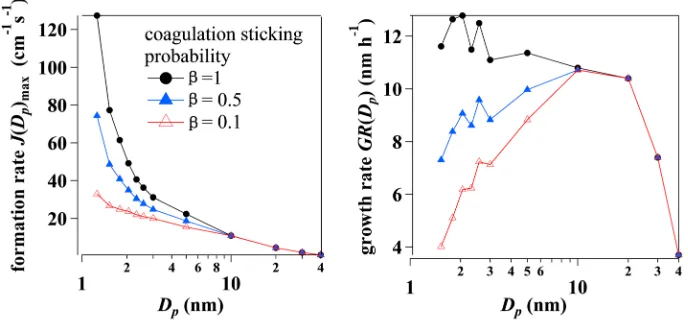
From the perspective of the survival probability and the aerosol population dynamic balance, respectively, Kulmala et al. (2017) and Dai et al. (2017) suggested that the detectable NPF under the highly polluted con-ditions can be explained only if the coagulation sticking probability (ß) of molecular clusters with preexisting particles is considerably less than 1, or theGRof 1‐to 3‐nm particles is much faster than typical values pro-vided by the currentGRmeasurement methods or a suitable combination of both. As demonstrated in Figure 5 (right panel), the estimatedGRfrom the aerosol dynamic balance drastically varies with different coagulation sticking probabilities ranging from 0.1 to 1. The evidence from the survival probability and the aerosol population dynamic balance thus strongly imply thatCS/GRvalues derived from the conven-tional estimation methods (Kulmala et al., 2012) may be overestimated by a factor of ~20 for sub‐3‐nm par-ticles in the highly polluted urban atmosphere of Nanjing (Kulmala et al., 2017; Yu et al., 2016).
Theoretical and experimental data of coagulation probabilities between clusters and particles are not avail-able at present. The coagulation sticking probabilities may be considerably less than 1, considering the fact that high kinetic energy of small particles of sub‐10 nm can cause the particle“bounce‐off”(Hollander et al., 1995; Narsimhan & Ruckenstein, 1985). In other words, it is possible that small clusters, at least in extremely polluted environments where most of preexisting particles are freshly emitted from primary sources, can overcome the heterogeneous nucleation barrier before being incorporated into the bulk particulate phase (Kulmala et al., 2017).
The high“apparent”CS/GRratios found in highly polluted environments can also be due to the underesti-mation ofGRin the sub‐3‐nm size range. If clusters are charged, condensationflux of vapors onto charged clusters is expected to be enhanced. On the other hand, Lehtipalo et al. (2016) found no enhancement effects of charges onGR, in the presence of amines. Also, multiphase chemical processes, such as solvation effects (Kulmala et al., 2004), surface adsorption (J. Wang & Wexler, 2013), and heterogeneous chemical reactions (Zhang & Wexler, 2002) between organic activating vapors and clusters (Zhang & Wexler, 2002), could help to overcome the Kelvin effect and facilitate the faster condensation of activating vapors onto 1 to 3 nm par-ticles. In addition, the contribution of self‐coagulation of clusters to the growth under highly polluted con-ditions may need to be reevaluated, although calculated cluster‐cluster collision rates are usually negligible based on the current knowledge (Yao et al., 2018).
4.5. NPF in Coastal Regions
NPF has been long observed in the coastal regions of Ireland, Scotland, France, Australia, Antarctica and China (Bigg & Turvey, 1978; Flanagan et al., 2005; Huang et al., 2010; O'Dowd et al., 2002; Saiz‐Lopez et al., 2012; Wiedensohler et al., 1996; Y. Hu et al., 2019). The North Atlantic Aerosols and Marine Ecosystems Study NAAMES campaign has elucidated the contribution of NPF involving sulfur to CCN con-centrations in the marine atmosphere (Sanchez et al., 2018). In addition to sulfuric acid, methanesulfonic acid (MSA) formed from oxidation of dimethyl sulfide (DMS) may contribute to NPF, as shown by CNT cal-culations (Kreidenweis et al., 1989), quantum chemical calcal-culations (Bork et al., 2014; Wen et al., 2018), and