Rochester Institute of Technology
RIT Scholar Works
Theses
5-2019
Structure Preserving regularizer for Neural Style
Transfer
Krushal Kyada
Follow this and additional works at:https://scholarworks.rit.edu/theses
Recommended Citation
Structure Preserving regularizer for Neural Style Transfer
by
Krushal Kyada
A thesis submitted in partial fulfillment of the
requirements for the degree of Master of Science
in Electrical Engineering
Department of Electrical and Microelectronic Engineering
Kate Gleason College of Engineering
Rochester Institute of Technology
May, 2019
Approved by :
Dr. Eli Saber, Thesis Advisor
Dr. Majid Rabbani, Committee Member
THESIS RELEASE PERMISSION
ROCHESTER INSTITUTE OF TECHNOLOGY
Kate Gleason College of Engineering
Title of Thesis:
Structure Preserving regularizer for Neural Style Transfer
I, Krushal Kyada, hereby grant permission to Wallace Memorial Library
of R.I.T. to reproduce my thesis in whole or in part. Any reproduction will
not be for commercial use or profit.
Signature
Acknowledgments
I wish to thank the multitudes of people who helped me. I would
first like to thank my thesis advisor Dr.Eli Saber of Kate Gleason College of
Engineering at Rochester Institute of Technology. The door to Prof Saber
office was always open whenever I ran into a trouble spot or had a question
about my writing He consistently allowed this report to be my own work, but
steered me in the right direction whenever he thought I needed it.
I take this opportunity to express gratitude to all of the Department
faculty members for their help and support. I also thank my parents for the
unceasing encouragement, support and attention.
Abstract
The aim of the project is to generate an image in the style of the image
by a well-known artist. The experiment will use artificial neural networks to
transfer the style of one image onto another. In Computer Vision context:
capturing the content invariant that is the style of an image and applying it
on the content of another image. Initially captures the tensors that we need
from the content and style image and then we pass the input image which will
initially be an image with noise and our algorithm will try to minimize the
loss between the input and content image and that between input and style
image thus capturing the essence of both the images into one. The traditional
method of style transfer generated image has an artistic effect that is the model
successfully capture the style of the image but does not preserve the structural
content of the image. The proposed method uses a segmented version of images
to faithfully transfer the style to semantic similar content. Also, a regularizer
term modified in loss function that helps in avoiding style spill over and have
Table of Contents
Acknowledgments iii
List of Tables vii
List of Figures viii
Chapter 1. Introduction 1
1.1 Problem Definition . . . 1
1.2 Contribution . . . 2
1.3 Organization . . . 3
Chapter 2. Literature Review 5 2.1 Basics of Neural Networks . . . 5
2.2 Activation function . . . 8
2.3 Artistic Stylization Rendering . . . 10
2.3.1 Stroke based Stylization . . . 10
2.3.2 Texture based Stylization . . . 12
2.3.3 Image Analogy Stylization . . . 12
2.4 Neural Art . . . 13
2.5 Texture Synthesis Stylization . . . 15
Chapter 3. Methods 17 3.1 Content and Style Loss . . . 18
3.2 Suppress style loss . . . 20
3.3 Structural preservation . . . 21
3.4 Semantic Segmentation for Style Transfer . . . 27
Chapter 4. Implementation 32
4.1 Overview of Semantic images . . . 33 4.2 Network Architecture . . . 36
Chapter 5. Results 44
Chapter 6. Conclusion and Future Work 50
6.1 Local Edge preserving . . . 50 6.2 Use of Semantic Segmentation . . . 51 6.3 Future Work . . . 53
List of Tables
List of Figures
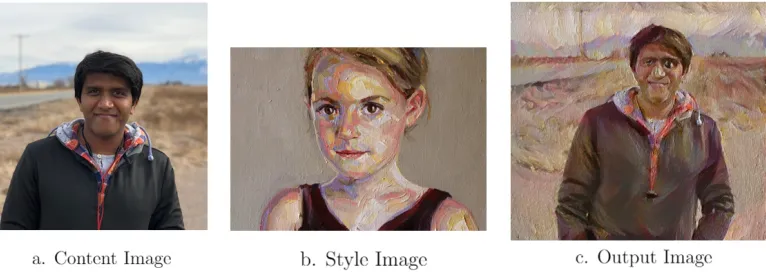
1.1 Neural art style transfer . . . 2
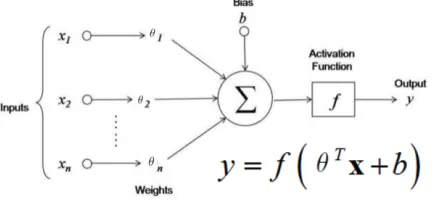
2.1 Single neuron . . . 6
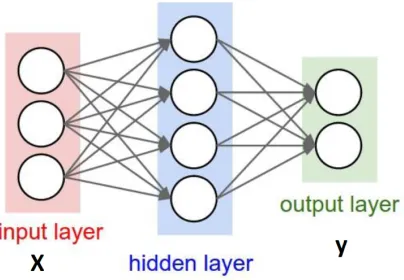
2.2 General MLP architecture . . . 8
2.3 Stylization rendering techniques based on [24] . . . 11
2.4 Neural art style transfer . . . 15
3.1 Overview of loss function calculation . . . 17
3.2 Gatys style transfer framework . . . 18
3.3 18 gain maps which contain high frequency component . . . . 25
3.4 Gaussian filtered gain mask . . . 25
3.5 Example of Style spillover . . . 27
4.1 Left: Input image. Right: It’s semantic segmentation . . . 33
4.2 Low resolution version of the segmented mask for visual pur-pose. Mask shape is same as the original image with 1 channel 34 4.3 The one hot encoded mask for each class label . . . 34
4.4 Low - resolution semantic segmented mask overlay on target image. . . 35
4.5 Features visualization of VGG network. . . 39
4.6 Features visualization of VGG network. . . 40
4.7 VGG19-16 layers of convolution and ReLU activation, separated by 5 pooling layers and 3 fully connected layers in end . . . 42
5.1 Flow chart of Style image generation . . . 44
5.2 Input Image ( Content and Style ) . . . 45
5.3 Segmented version of Input Images ( Content and Style ) . . . 45
5.4 Reconstructed Output image . . . 46
Chapter 1
Introduction
1.1
Problem Definition
Humans have mastered the skill of visual art, developed primarily for
aesthetics or beauty by combining the natural elements reproduced using
painting, drawing and other fine art media. With the current advancement
of using artificial intelligence, the computers trained using machine learning
algorithm can have near-human performance for object and face recognition
task.
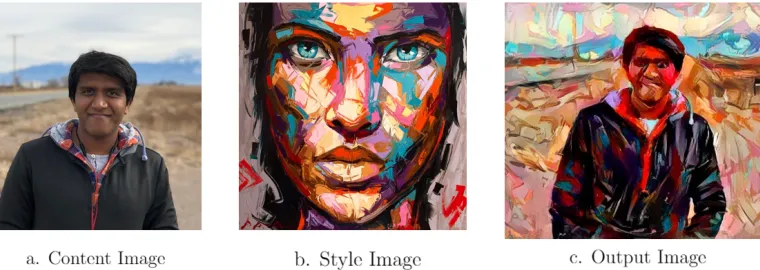
Style transfer is a popularly studied sub field in computer vision.
Ar-tificial system based on a deep neural network that creates artistic images
based on reference style of painting while maintaining the key contents of the
reference photograph. For example, style transfer can be used to transform a
face portrait photograph into a painting of same face in the style of oil paint
portrait used as reference. The complexity of this problem is quite evident a
model that uses neural representations to separate and recombine content and
style of arbitrary images.
These models do not generalize well to style transfer between two
Figure 1.1: Neural art style transfer
effect is a complex concept that cannot easily be formulated mathematically.
For example, by appropriately choosing the reference style photo we can
trans-form the input content image look like it has been taken on different time of
day, or illumination, or weather, or that it has been reconstructed with a
different purpose. As such, the problem can be broken down into two main
components. The first component is to constrain the transformation from the
input to the output by locally affine combination in color space,while the
sec-ond component deals with faithfully transfer of style to appropriate region
without having style spillover.The separation of these two tasks can allow the
problem to be more easily addressed in smaller more manageable pieces.
1.2
Contribution
The main contribution of this thesis includes a modification in the loss
matting matrix transformation.This helps to avoid the painting like effects by
preventing spatial distortion and constraining the transfer operation to happen
only in color space. The reconstructed image does have straight edges,content
structure pattern not become wiggly or regular textures,the output still mo
more look like a painting but rather have a photo - realistic effect.
The other key contribution is how to avoid the global style
transforma-tion, the challenge is to match the semantic similar region in content image
and reference style images, thereby having the faith fullness in the style
trans-fer. Because the style spills over into mismatch elements of the input image
will generating artifacts like building texture in the sky and this is not feasible
for photo - realistic images.
The intermediate contributions of this paper include is style loss
sup-pression. That is to create balance of the content and style loss for
recon-structing image. This improvement in tuning parameter benefited so that the
model was able to adapt an overall style and content representation.
1.3
Organization
The organization of this thesis will be as follows: in order to address
the first problem of photo realism in style transfer techniques , a history of
previously utilized rendering techniques will be explained briefly in order to
build a substantial background for the newer methods used. Among these
most advance patter recognition algorithms known as neural networks. This
concept of artificial neural networks will be introduced and explained in order
to more properly allow the method of neural stylization to be increasingly
understandable. Within this section,a subset will described about which these
mathematical abstractions.
Next,a newly developed loss function and segmentation method will
be describe thoroughly to show the improvements and benefits of using. The
methods will all be thoroughly explained for their strengths and weaknesses
in the area of providing this segmentation approach in loss function and the
computational complexity of the overall algorithm. After the previous sections
have been covered, the reader should have a more complete understanding of
the concepts involved in the underlying methodology. Finally,the results of the
experiments are explained, the important improvements of using segmentation
in neural style transfer systems. A few conclusions will be drawn about these
results in relation to recent advances in the field of machine intelligence which
will complete the overall understanding of the impact of this research and
Chapter 2
Literature Review
Specific class of Neural networks are to used render the style of image,
that is Convolution Neural Networks (CNN). To understand the basic of
Con-volution Neural network lets start with Simpler Neural Network first. And
next we will look over an adjustment utilized for image classification. Finally
we will define the problem statement of the style transfer, methodology and
the approach.We will also discuss how to use transfer learning, where model
once trained can be used to solve similar kind of problem.
2.1
Basics of Neural Networks
Different type of data is produced daily, and stored continuously. The
source of data can be science: genomics, astronomy, materials science, particle
accelerators or from network of sensors : traffic, weather measurements. The
most common in recent time is e-commerce, social networks, etc. This kind
of data is not in complete random form, the data depending upon the source
have a data structure. This structural data helps to predict or gain knowledge
of the unforeseen conditions. For example predicting weather condition from
As the data structure becomes more complex, it is difficult to design an
algorithm to predict the values. This predicting algorithm can be characterizes
as a function approximation process. That is, for a given function in x, we
have to find approximation function of x which depend on parameter Θ. Such
that for all the values of x in approximated function is close or almost equal
to given function
y =f∗(x)
f∗(x)≈f(x;θ)
This function approximation is loosely defined to have characteristic similar
to neuron in human brain. According to neuro-science, human brain is a huge
network of such neuron which computes the weighted sum of impulsive signal
coming from the nerves and the outputs are connected to subsequent neuron.
This function approximation is a simplified version of biological network of
[image:15.612.209.426.491.599.2]neuron and thus was know as Artificial Neural Network ( ANN ).
Figure 2.1: Single neuron
ac-tivation function which is non-linear in nature. This function applies its
acti-vation function to the weighted sum of inputs and depending upon the type
of activation function its output spiking is passed on to next node. The
func-tions used are mostly sigmoid or tanh faction. Nonlinear funcfunc-tions are used
to restrict the output of the neuron within the range. Lately most common
activation function used is Rectified Linear Units (ReLU) which clams the
negative values to zeros and the positive values remain unchanged. An early
concept ANN developed in 1950s by Frank Roesnblatt was referred as
percep-tron algorithm. Later, this function approximations was created by composing
several functions figure.
f(1), f(2) and f(3) for 3 layer network.
f(1) is the input layer, f(2) is the hidden layer and f(3) is output layer
Equivalent function is represented as : f(x) =f(3)(f(2)(f(1)(x)))
This complex combinations of multiple function approximations is called as
Multi-layer feed-forward network or Multi-layer Perceptrons (MLPs). In late
1970s with the development of back-propagation algorithm this MLPs models
were trained.
The general architecture of MLP model consist of an input layer, hidden
layers and output layer figure . Input layer learns the details as a linear
com-bination of input information related to higher order function. Hidden layer
Figure 2.2: General MLP architecture
being more abstract than lower (input) layers. As the size and number of
hid-den layers increases, the networks capacity to model re-presentable functions
increases. In recent years, various network topology, regularization techniques
and validation methods helped to improve the model. As the advancement
in Machine learning community leads to breakthrough models helps to get
cutting edge performance in numerous patter recognition task.
2.2
Activation function
A neural network is a complex mesh of artificial neurons that imitates
how the brain works. Activation functions are an extremely important feature
of the ANNs. They take in input parameters with its associated weights and
biases then we compute the weighted sum of the activated neurons. Our
activation function gets to decide which neurons will push forward the values
neuron is relevant for the gives task or the values can be dropped.
Linear function is the simplest form of activation function. The input
value is the weighted sum of the output from the preceding layer or the raw
input values of the neurons in a layer. Since, the activation function is linear in
nature no matter how many hidden layers we used the final output is nothing
but a linear transformation of the input. All the hidden layers can be converted
in one linear transformation function.
Also the derivative of the linear function is constant value, our model
is not learning as the error term is no longer dependent on the input term.
Therefore, linear activation functions are not fit to handle complex data
struc-ture. This mean that feed-forward network can approximate as a function
with a help of a continuous bounded non linear activation function.
Gradi-ent based learning is used to optimize this continuous bounded function with
the help of metric using cost function or loss function associated for universal
approximation.
But the non linearity of the activation function does not guarantee the
convergence of the cost function to global minimum, there are chance that it
may get stuck on local minimum. This make the training of neural network
more difficult to converge at times. With the recent advance optimizing
2.3
Artistic Stylization Rendering
In recent year with the advancement in computing capacity of the
com-puters this has revolutionized computer vision application. With increase in
computer graphics the style transfer algorithm have become an interesting
problem and being quickly exploded into active research. Most of the research
was utilized using the texture synthesis and developing an artistic tool that
significantly enhance the aesthetic quality and diversity like artist produce
their work.
Artistic stylization rendering refereed to non photo-realistic rendering
the technique focus primarily on reproducing physical brush strokes, pen and
ink strokes, texture of object, simple and complex patterns, regional style
characteristic. Depending upon the characteristic focused, several different
techniques and methodologies are proposed for synthesis of artistic
styliza-tion. The relative new research interest other than stroke-base and regional
technique is emerging that is know as texture example base rendering.
2.3.1 Stroke based Stylization
Primitive image stylization rendering attempts to emulate a very
spe-cific style, and cover the whole image with spespe-cific stroke learned. Early stroke
based methods stimulate artist techniques like hatch marks, stripes, tiles. This
patterns were learned based on local stroke algorithm or global stroke
paint-Figure 2.3: Stylization rendering techniques based on [24]
ing like image. Local stroke base method takes into consideration specific
spatial neighborhood to generate stroke and angle. In 1997 Litwinowiez
pro-posed a fully automated version of utilizing rectangular brush stroke of various
size using Sobel gradient to clip the strokes. Global stroke base method
op-timize the stoke placement that is similar to realistic canvas image avoiding
the overlapping and misplacement of curved strokes. High level of detailing
and aesthetically pleasing image is obtained with global stroke optimization.
Such algorithm have attracted significant attention and have produced some
[image:20.612.136.490.124.355.2]2.3.2 Texture based Stylization
Unlike stroke base rendering which stimulate a set of simple particular
artistic practice, to incorporate different possible artistic stylization techniques
texture base rendering was developed. This particular stylization technique
compares the image and a texture features from the style image. This
signif-icantly expands the stylization possibilities because now the model does not
emulate a single pattern but a composite patterns of different aspect from
the style image is reproduced. Similar to stroke base rendering, texture base
rendering also reproduce the image which focus particularly on colour transfer
and texture transfer. The colour transfer is based on approximate
match-ing of histogram between input and texture base image. Thereby replicatmatch-ing
the mean and variance along the colour space. With the histogram matching
and optimizing the spatial gradient the important aesthetic aspect like hue,
brightness and intensity is preserved. The methods mostly capture the
tex-ture patches from the style image and ignore the stroke or artistic effect which
helps in generating photo-realistic images.
2.3.3 Image Analogy Stylization
One of the example based texture replicating techniques was a
styl-ization using Image Analogy. This was one of the first primitive techniques
which used combination of machine learning and texture base matching. The
the corresponding aesthetic depiction. This transfer of texture in the images
finds the closes matching pixels between reference content image and the
im-age where texture patters are to be extracted, using nearest neighborhood
algorithm. This mapping using texture example image conserve consistency
with nearby pixels in the stylized image. Basically for this method two images
are being used for mapping process one that is being transformed and other
the artistic texture to be extracted from that image. An important drawback
of Image analogy is utilization of the same image for the texture extraction
this severely restrict the domain of the stylizing aspect of image. Mostly this
methods end up copying the texture learned and patched with minimum global
difference for stylizing image.This have given inspiration to researchers to
uti-lize the expansion in machine learning to expand the scope of style transfer
ability. With the recent development of different neural network algorithms
the style transfer have gain popularity for image synthesis.
2.4
Neural Art
Most of the style transfer algorithm using example based rendering
technique uses generation of texture patter and colour shifts. Local style
trans-fer algorithm that using spatial colour mapping can easily leaned the time of
that day using one example had generate a synthetic image with different day
in time,weather, or maybe seasonal change. This algorithms requires more
which utilities Convolution neural network.This CNN perform better than
hu-man for specifically trained class of problems like object recognition or object
detection. CNN are neural network that are loosely inspired by neuron in
hu-man brain and similar to huhu-man visual system of classifying, segmenting. The
method proposed in this approach uses content and style image passed along
the sequential hierarchical layers of CNN architecture. Convoluting filters
sep-arate and optically combine content and style from two completely different
images. CNN are trained for image recognition have the ability to detect
var-ious variety of feature like edge, stroke , brush while generating the aesthetic
side. And object detection from edges and labeling the object help to build or
understand the structure of image. CNN extract this features via hierarchical
layers and the content and style of image can be build by the combination of
these layers can be separated.
First approach of using CNN by Leon Gatys was to leverage the
hier-archical extraction to generate texture from the example images avoiding the
replicating approach and synthesizing the style image based on image analogy
approach combine with CNN. To avoid this replicating and synthesising
tech-niques, the idea that styles of the image are represented by the gram matrix
of the content images activation from network. This might be the possible
solution for the texture stitching problem. The gram matrix generation
pri-marily abstract texture based on the minima reached. This was the basic
Figure 2.4: Neural art style transfer
The algorithm was successful in adapting the style on new image because the
neural network architecture of increasing hierarchical have ability to separate
the content activation and style aesthetic activation. This optimal balance of
activation map generation preserve the content of the input reference image
and the style image by just inheriting specific activation.
2.5
Texture Synthesis Stylization
The neural style algorithm used Gram matrices and other work with
the similar foundation was developed but this time with Markov random fields
for style image reconstruction. Gram matrix generated using activation maps
maintain the correlation of filer channels and missed the local spatial
informa-tion. However, Markov fields were able to preserve the local spatial information
but requires extra computation for embedding global spatial information. This
him with proper modification puts forward a novel texture based stylization
solution to synthesize the style image. The scale of the object in content and
style image played a crucial role to avoid the patch texture stitching.
Also, one more addition of semantic segmentation helps to reproduce a
sophisticated results. When g segmentation, the algorithm converse the
con-tent object of image that are segmented. User can also provide segmented
texture to the original image with the object segmented and stylize the object
with in that boundary with that texture. Current methods that are being
developed lately are just scratch on the neural network ability to render the
style. With this rapid advancement in machine learning and computer vision
field there are possibility of synthesis the image which never existed in real
world. As such we are being mostly using image or single image base
styl-ization, however it is possible to implement on video as well by taking in to
consideration the time frame of the video and matching the sequence of
styliza-tion between frames. Such complex problems were once thought abstract, but
with emerging mythologies and computation capacity it is possible to surpass
Chapter 3
Methods
Using neural network to transfer the style from one image to another
has gain more popularity in recent years. Style transfer algorithm is improved
by combing several work in deep learning field. It was started by Gatys et al
who introduced a novelty idea of using convolution neural network to
trans-fer artistic style from one painting to another picture. To improve the style
transfer algorithm for using real image rather than painting images we used
combination of CNN and along with that segmenting the images based on
[image:26.612.195.447.463.614.2]foreground and background as shown in figure 3.1.
3.1
Content and Style Loss
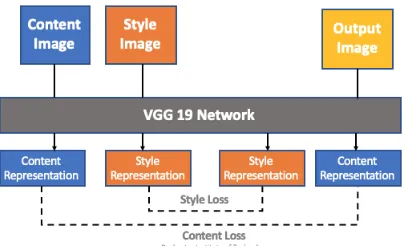
Gatys et al in 2015 introduce the concept of style transfer. The main
finding of this paper was image can be represented as combination of style
and content. The idea was to use deep neural network that can preserve the
colour, texture and different object or structure in feature map generated by
network. Then using this feature maps, stylized image is created by minimizing
the content and style loss function. Mathematically, the earlier layer of the
network extract the colour and texture so they are associated with style loss.In
deeper layer the feature map preserve the information about object or structure
in the image. Then output image is created such that it have the same or
closed activation as that of content of the image and style activation close to
[image:27.612.208.411.426.550.2]activation that by the style image.
Figure 3.2: Gatys style transfer framework
This can be mathematically formulated as to construct an imageOwith
lth for content image C, style image S, and output image O, is represented as
Cl, Sl and Ol respectively. The dimensional of these feature maps isNl×Ml.
With the features extracted from CNN layers that are used for content
representation. The content of the image can be represented as the
combina-tion of this feature maps. While reconstructing the image, the content feature
maps of output image should be close to the content representation of input
image. And thus the content loss function is the mean square difference of the
content feature maps from output image and input image.
Losscontent =
1 2
X
i,j
(Fl[O]−Fl[I])2ij
The idea is to minimise this loss function so that the content feature of output
is close to input image.
Similar to the content of the image, the style of the image is not
repre-sented as combination of feature maps. But the style of image is reprerepre-sented as
how the feature maps are related to each other. The corresponding correlation
of feature maps is mathematically defined using the gram matrix. The
gram-matrix is a dot product for the vector of the feature activation of a style-layer.
Gl[O] =Fl[O]·Fl[O]T gram matrix for output image.
Gl[S] =Fl[S]·Fl[I]S gram matrix for output image.
As the content loss is define, the style is the difference of gram matrix
generated by the style activation of output image and that of input style image.
Lossstyle=
1 2
X
This loss is minimized so that the output image have style close to input image.
The global loss function define as weighted sum of content and style
loss.Theα andβ and the weight factor used as hyper parameter for
maintain-ing content : style ratio.
Losstotal =αLosscontent+βLossstyle
3.2
Suppress style loss
For reference, the original algorithm of style transfer presented in by
Gays el al denotes Fl as the output of convolution layerl−th for the network
where the input image is I and style image represented as S and the output
image generatedO.
The algorithm tries to minimize the loss function defined as
Losstotal = L
X
l=1
{αlLosslcontent+βlLosslstyle}
whereL is the total number of convolution layer. αl and βl are the weighting
factors for content and style reconstruction, respectively. To improve the loss
function to prevent the unexpected texture appearing in background from the
style image. A trade off factor Γ is introduce to suppress the style loss. This
is an attempt to make the style layer to be more aware of the content. So the
loss function is modified as :
Losstotal = L
X
l=1
αlLosslcontent+ Γ L
X
l=1
Losslcontent = 1 2NlDl
X
i,j
(Fl[O]−Fl[I])2ij
Losslstyle= 1 2NlDl
X
i,j
(Gl[O]−Gl[S])2ij
This gives an extra parameter that is used to suppress the styling of the image
based upon theNlfilter. This vectorized feature maps are used to calculate the
inner products Gl[.] =Fl[.]·Fl[.]T this is called as Gram matrix. Gram matrix
with the correlation helps the feature collect the style in the region which has
high response. With Γ the style transfer in the region with more features
were modified more strongly than the region in the image with less features
like background. This modified loss function introduce more non-linearity and
take more time for convergence.
3.3
Structural preservation
There are several factors that can be used to improve the stylization
technique. One of the scope is preserving the structure of the objects in
the input image. A VGG-19 style convolution network which is trained on
the Imagenet Data set for classification purpose leverages the hierarchy of
decomposing the image into feature component like texture, edge and objects.
In order to fine tune the process of producing photo-realistic image we can
exploit the fact that the original input image is a photograph itself. So we
can include a constraint which is not depend on the output style image being
input image. We discover that we should not lose the structural or photo
realistic property in the loss function and avoid the distortion introduce by
the new constraint.
In order to address the above problem, locally affine image colour
trans-formation is used instead of global colour transtrans-formation pallet. In this way,
each and every output patch is an affine function that takes the input RGB
values to map corresponding equivalent value in output. This can be
accom-plished by each patch having a different locally affine function transformation
and thereby introducing spatial variation. To understand more why we need
different transformation function for every patch lets consider an edge patch.
The set of relative combinations of the RGB channels ranges a wide set of
varieties but the edge itself cannot move since it is found at the same put in
all channels.
In the original algorithm described in Gatys et. al , the loss function
is complex and the painterly distortion added is not being traced this make
it difficult to remove. Few of the reasonable approach that can be used to
incorporate the idea of preserving structure. Shih et al. introduce the idea of
using local transfer feature. The paper introduce the style transfer function
modified that work in successfully transferring style from head shot portrait
to another head shot portrait. That is mostly used for head shot that are
digitally retouched which extract texture,lighting and local colour features.
face landmark template but fail when used on landscape, Following work done
by Shih et al. , Laffont et al. in 2013 to cater the style function for landscape
as well. The approach is to use the time-lapse video of various scenes and
synthesize a plausible image at a different time of the day from a input image.
The use of data drive algorithm helps to extract high feature variation in colour
appearance of a scenes thought-out the day from video. The paper propose
a method of local affine transformation, that synthesize the new colour data
while retaining input image details. The style loss function adapts the local
regression to fit the colour value from input image and style output colour.
Laplacian pyramid with n level is used to generate a multi-scale decomposition
to generate this local gain maps.
Lossl =
(
I−I⊗G(2), if l = 0 I⊗G(2l)−I⊗G(2l+1), if l >0
and residual
R[I] =I⊗G(2n).
Gain map are defined as
Gainl=
Lossl[O]
Lossl[I]
and O is expressed in terms of I and Gain as :
O =Loss0[O] +Loss1[O] +...+Lossn−1[O] +R[O]
The factor unknown is a set of gain maps : Gainl. So to solve for gain maps, we
perform gradient decent on gain maps using the following chain which involve
the total loss that is being redistributed forl-th layer.
dLosstotal
dGainl
= dLosstotal dO ×
dO dGainl
whereLosstotal is the Neural Style loss function. And we use the assumption
that the gain maps are not dependent on each others. Therefore,
dO Gainl
= (
Lossl[I], if l < n
R[I], if l =n
and dLosstotal
dO it is same as mentioned in Gatys et al. neural style optimizer. As
we are using using 6 layers for calculating the style loss ( n = 5 ) and we have
RGB channel each. Total 18 gain maps are generated along with the output
image ( (n + 1 )× 3 for each RGB channel in 6 layers ).
This gain maps generated contains high frequency component as shown
in figure 3.3. To unitize this multi-scale gain maps for local affine regression
we apply band-limited constraint by applying Gaussian filter on multi-scale
gain maps (show in figure 3.4).
Figure 3.3: 18 gain maps which contain high frequency component
O=Loss0[I]×Gaussian(Gain0) +Loss1[I]×Gaussian(Gain1) +...+
Lossn−1[I]×Gaussian(Gainn−1) +R[Oh]
Figure 3.4: Gaussian filtered gain mask
One of the iteration is using non-overlapping local affine patches for
optimiza-tion. Input image is divided into non- overlapping patches of window size W.
The output of each patch is Pk[O] is a combination of input image Pk[I] and
[image:34.612.125.512.376.508.2]on each and every patch.
Pk[O] =AkPK[I]
Using non-overlapping patches, the lack of neighbouring pixel in patch results
in artifacts at the boundary of patches. So instead of converting the local affine
model, we express the input RGB values as Matting Laplacian as introduced
by Levin et al. Using local affine model restrict the output colour values for
small part of image, estimating the foreground and background colour based
on nearby pixel. Whereas laplacian matrix helps to eliminate the foreground
and background thereby just solving quadratic cost function. This allow us
to express the gray-scale matte that is a global optimal matte a sparse linear
system of equation. This matting laplacian can be minimized with standard
linear sparse function penalized by least-square that only depends on the input
image I and the system of sparse linear function as MI. The cost function
includes a regularization term to penalize the output for locally affine
trans-formation. For a given image I with N pixels the vectorized output for each
channelc can be formulated as :
Lossmask =
3 X
c=1
Vc[O]TMlVc[O]
The matting laplacian matrix Ml is a symmetric positive definite matrix. So
while optimizing using the gradient-based back propagation the derivative with
respect to output is computed as
dLossmask
dVc[O]
The matrix needs the smoothness in gain maps thereby assuming smoothness
in background and foreground colours. This gives colour distribution for each
segment, instead of global colour matte.
3.4
Semantic Segmentation for Style Transfer
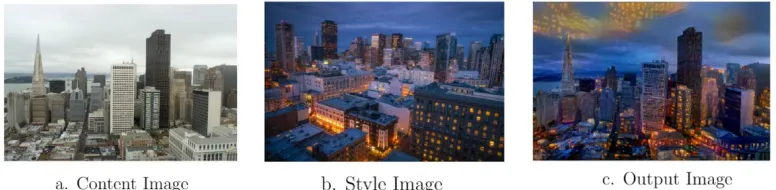
The style loss proposed in Gatys Neural style paper is expressed in
terms of Gram Matrix, the drawback of using the style loss is that entire
image is used to compute gram matrix. Gram matrix consist of vector used for
affine transformation from input RGB colour value to congruent RGB values
for output image. It is nothing but a victories values that encodes the neural
firing response for the colour distribution. Since this is computed all over the
input image, the gram matrix fails to adapt the variation in the semantic of the
image. Thereby resulting in style spilling or content miss match for example
the texture noise distortion starting to appear in sky for the reference style
[image:36.612.121.509.502.597.2]image as seen in figure 3.5.
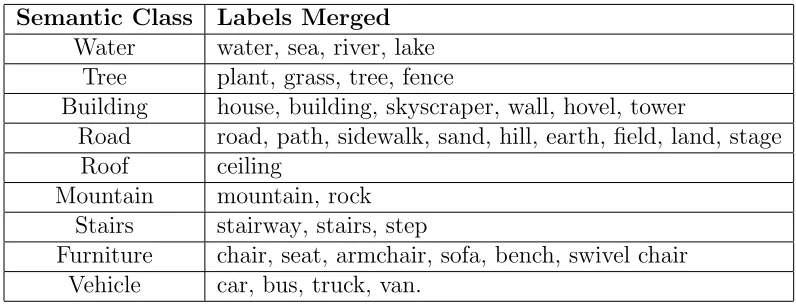
Semantic Class Labels Merged
Water water, sea, river, lake Tree plant, grass, tree, fence
Building house, building, skyscraper, wall, hovel, tower
Road road, path, sidewalk, sand, hill, earth, field, land, stage Roof ceiling
Mountain mountain, rock Stairs stairway, stairs, step
[image:37.612.115.513.115.267.2]Furniture chair, seat, armchair, sofa, bench, swivel chair Vehicle car, bus, truck, van.
Table 3.1: Merged Classes for DilatedNet Semantic Segmentation
To address the problem of style spillover, the input and output image
are segmented based on Dilated net. The DeepLab : Semantic Image
Seg-mentation generate the segmented image with 150 categories. The semantic
segmented mask of input and reference style image are generated for set of
common labels. This mask prevent the transfer of colour and texture from
semantically different region.This way, the sky region from the input image
will be styled based on the sky in the reference style image, without any noise
from other parts of the reference image. To make the segmented mask more
simpler and clean, the semantic class label in dilated net are being merged as
table 3.1
Also, there may occur that some of the semantic labels are only present
in input image,so to avoid the missing semantic label category while style
matching, the input image semantic labels are chosen from the list of labels in
segmentation point, but most of them is avoided with help of merging of the
class label in general equivalent context.
The table 3.2 for mask colour used creating segmentation mask for the
above class.
Color Variable RGB Value Hex Value
White 255 255 255 ffffff Grey 128 128 128 808080 Light blue 000 255 255 00ffff
[image:38.612.190.443.232.384.2]Purple 255 000 255 ff00ff Yellow 255 255 000 ffff00 Red 255 000 000 ff0000 Green 000 255 000 00ff00 Blue 000 000 255 0000ff Black 000 000 000 000000
Table 3.2: Colour mask for semantic segmentation
For faithfully transfer of style to the related content, mask from
seg-mented image is created. To create a MaskM withknumber of segments,first
we generate ak mask of size that of Image (H×W). Thesei−th mask have
1 in every pixel with i− th segment and 0 everywhere else. So the mask
generated have dimension as (H, W, k)
The segmented mask created is added as an addition channel to the
input image and reference style image respectively. Therefore the neural style
augmented style loss is formulated as :
Losslstyle+=
C X c=1 1 2N2 l,c X ij
(Gl,c[O]−Gl,c[S])2ij)
Fl,c[O] =Fl[O]Ml,c[I]
Fl,c[S] =Fl[S]Ml,c[S]
where C is the number of channels in the semantic segmented mask
Ml,c[·] denotes the channelc of the segmentation mask in layerl
Gl,c[·] is the gram matrix corresponding to Fl,c In order to synthesises image
that match the styling image we obtain Gram matrices from the style
rep-resentation of different layer l. This feature represented as Jl. The mask is
down-sampled to match the shape of the style representation. This mask layer
is multiplied by each channel. This way k mask version of feature
representa-tion are used to compute k segment-wise Gram Matrices.
3.5
Photo realistic Image Stylization loss function
Unlike other style transfer algorithm, our photo realistic image
styliza-tion algorithm takes 4 images instead of 2 images as shown in figure. Content
image,style image with their semantic segmented image. This semantic
seg-mented image are resize to form mask of feature mapping. First the style
and content image are fused with the respective mask, and a mixed image of
content image size is used to iterate over the network to generate the output.
are used to evaluate the style and content loss, but this time a regularizer as
well to compute gram matrix. Thus a mixed style image is synthesised by
minimizing the total loss function.The total loss contributed over all layer L
can be formulated as :
Losstotal = L
X
l=1
αlLosscontent+ Γ l=1 X
L
βlLossstyle++λLossmask
where L is the total number of convolution layers in the VGG-19 model and
l indicates the l −th convolutional layer of the VGG-19 layer. Γ is a factor
that controls the weight of style loss. αl and βl are the weight to configure
content and style layer preference respectively. λ a factor that controls the
regularization.
Losslcontent = 1 2NlDl
X
i,j
(Fl[O]−Fl[I])2ij
Losslstyle+ =
C X c=1 1 2N2 l,c X ij
(Gl,c[O]−Gl,c[S])2ij
Lossmask =
3 X
c=1
Chapter 4
Implementation
In this chapter, we will detail the type of neural network that can be
used to transform input image to reference style image. Since the algorithm
uses neural network which are universal function approximator, we can train
the network with particular style image and transfer that to any input image.
This is formulated as:
y=f∗(S, I) = arg max
O
αlLosscontent[O, I]+ΓβlLossstyle+[O, S]+λLossmask[O]
a function to approximate, where I is input image, S is style image and y is
the output image. The styling using this function approximator comes at the
cost of training the network every time one need the new style. Training the
network and getting the activation for particular style requires heavy
compu-tation and time. So instead of training the network for particular style image,
we can use the network which was design to solves different application, this
is called as transfer learning. Since,for our algorithm we are using input
con-tent image, reference style image along with the semantic segmented version of
the respective images. Lets first understand how convolution neural network
implementing the loss function.
4.1
Overview of Semantic images
The goal of semantic image segmentation is to label each pixel of an
image with a corresponding class of what is being represented. For the purpose
of style transfer, we don’t need to separate the object of the same class.That
is if the object of same class appears, the semantic mask does not distinguish
between them rather generate a whole mask for same class irrespective to the
number of occurrence. Figure 4.1 An example of semantic segmentation, where
[image:42.612.121.505.381.568.2]class labels for each pixel in the image is predicted.
Figure 4.1: Left: Input image. Right: It’s semantic segmentation
Simple our goal is to take input image(Height×W idth) whether RGB
mask where each pixel is an integer value for the class label predicted.The
[image:43.612.141.487.183.286.2]output mask generated is of shape (Height×W idth×1 )
Figure 4.2: Low resolution version of the segmented mask for visual purpose. Mask shape is same as the original image with 1 channel
The target mask of each class label is created by using one hot
encod-ing.Depending upon the number of class present in the image, that many mask
are generated. As shown in figure 4.3
Figure 4.3: The one hot encoded mask for each class label
[image:43.612.177.450.425.592.2]by taking argmax for each depth-wise pixel vector.An example of mask
over-laying the target image is show in figure . The mask represent the region of
[image:44.612.122.502.211.381.2]an image where a specific class object is present in target image.
Figure 4.4: Low - resolution semantic segmented mask overlay on target image.
The image segmentation model have encoder-decoder structure. The
input image is down-sample with respect to spatial resolution. This low
res-olution feature mapping make is highly efficient to discriminate the different
classes. And later this feature representation is up-sample to produce
full-resolution semantic prediction. Down-sampling a feature helps to broadens
the receptive field for filtering. Followed by transpose convolution is the most
popular method for developing upscale feature map. Dilated convolution is the
alternate approach for preserving the full spatial dimension with wide field of
4.2
Network Architecture
Neural network are mostly designed for image classification, when
com-pared to CNN they generate image transformation not the classification. So for
image transformation problem we need to modify the existing neural network.
Therefore, image transformation networks are entirely convolutional network,
that is we will need the fully connected later at the end of the network and
the other layers can be converted to convolutional layers. This modification
in the network significantly reduces the number of parameters required to be
trained for transformation purpose, using fully connected layer at the end of
the network allow us to implement the style transfer on any size of the image.
Usually Convolutional network architecture have very similar common
characteristic irrespective of the final goal. Initial part of the network have
large number of filters which help to reduce the size of image. Lastly since
we need the image generated to be of full - resolution, the number of filters
decreases to 3 channel (RGB) image.
Convolutional neural network are a category of neural network that
have proven very effective in object recognition and classification task. CNN’s
have arguably surpassed human level of performance in various computer
vi-sion related problem like identifying faces, objects and traffic signs.
An interesting ability of CNN is to well replicate and optimize
system-atic abstraction of a hierarchy of features with increasing complexity from raw
with-ing images but later these are used for object detection and segmentation. So
the network have developed some internal independent representation of
im-ages ,this property is extensively used for image generative application. Gatys
et. al utilize this internal independent representation in generative manner to
automatically extract the style and image content relation and transfer it over
the whole new image. One of the first implementation of style transfer using
CNN used the idea of texture synthesis. The idea is using natural behaviour
of CNN, extracting the activation from the hierarchy of the layers that process
the image. This convolutional layers in CNN represents the collection of filters
that being used to perform convolution operation with the input sample size.
For image recognition problem the CNN are helps to detect and differentiate
various features like texture, edges and parts of object. Reconstruction from
each layer’s filters provides intuition about the type of information extracted.
At early layers, limited data turns out to be progressively imperative down
to the dimension of individual pixels. Conversely, higher layers inside a CNN
progressively represent objects and their global arrangement.
This unique hierarchical abstraction aspect of CNN from VGG allow
the optimizations of low level features of style and content details from the
pixel level information in shallow layers. And as we do deeper into the network
these convolutional layers are able to represent much larger scale features like
object and global arrangement. A VGG style CNN which are pre-trained on
this convolutional layer. In terms of computer-vision aspect, the image that
traverse through different layers and reduced in size is referred as
feature-maps. These feature maps are built by the data extracted from the image as
the network process it over with different filters, each designed for different
details. For the human eye, these feature maps can look progressively like
scrawls or arbitrary obscured lines as they get further into the layers.But for
neural network these feature maps highlight accurately the shapes and patters
contained in a picture which are at that point utilized to recognize content.The
algorithm is implemented on VGG-19 architecture. The pre-trained VGG-19
As the name implies VGG-19 architecture, it has 19 convolutional layers
[image:49.612.152.481.192.379.2]that are separated by 5 max pooling. The architecture is shown in figure 4.6
Figure 4.6: Features visualization of VGG network.
Each max- pooling layers are soft reset where the process of extracting
data into feature maps is repeated without the previous information, with each
max pooling layer starting with a smaller, more optimized image than the last.
VGG network is characterized by using smaller filter and deeper network. The
purpose of using stack of three 3×3conv3 with stride of 1,these layers has same
effective receptive field as one 7x7conv layer. This make network deeper that
eventually add more non-linearity and fewer parameters: 3×(32C2) vs. 72C2
for C channels per layer. This significantly reduce the parameters handled
by max−pooling layer. So we are using feature maps extracted from the
VGG-19 network. The network is normalized by scaling the weights such that
the mean of activation for each convolutional filter over images and filter is
equal to one. This is possible only because the network uses only rectifying
linear activation functions without any normalization or pooling over feature
maps. The approach mentioned in methods sections, there are several
param-eters that can be fine tuned for the visually appealing results. We are focusing
on the following αl : Weight factor for content loss layer
βl : Weight factor for style loss layer Γ : Weight of Style Loss
λ : Factor that controls the regularization In our implementations
initializa-tion is done depending upon the part of the network that extract content and
style. Sice the content is extracted from the lsat few layers, αl = 1 for rest of
the layersconv4 2 andαl= 0. And the style is extracted from the intinal
lay-ers βl = 15 for conv1 1, conv2 1, conv3 1, conv4 1 and conv5 1 and βl = 0 for
all other layers. λ = 10000 and Γ = 100 The most important parameters is
the layers used for the computation of style loss, and their associated weights.
For calculating the matting laplacian matrices we used the Matlab
im-plementing given by Levin et al. and implemented the torch and tensor flow
version of Neural Style transfer that is publicly available. In neural style
algo-rithm the output transfer image O can be initialized using one of the following
random noise, the content image or the style image. Initializing output image
slight change in style with more iteration for remarkable difference. If we
ini-tialize output image as style image tends to get the most of the colour, texture
but major structure of the content image is destructed there by no
photo-realistic effect instead more of distortion. Initializing with random noise is
the sweet spot between the other two choice and helps to get eye pleasing
Chapter 5
Results
I implemented neural style transfer in PyTorch using the open source
code from the PyTorch’s github repository. The code was modified to
incorpo-rate the changes in loss function along with that semantic segmented images
[image:53.612.126.512.369.541.2]are also used as inputs to the network. Using the two input image for content
Figure 5.1: Flow chart of Style image generation
and style, the semantic segmented mask is generated. This segmented mask
are resized to shape of input image and concatenated as additional channel
extraction, the each loss is calculated as define in previous section. Then using
the masked feature maps the output image is modified at each iteration until
[image:54.612.120.512.210.338.2]the loss is minimized.
[image:54.612.127.513.393.517.2]Figure 5.2: Input Image ( Content and Style )
Figure 5.3: Segmented version of Input Images ( Content and Style )
Figure 5.3 are semantic segmented venison for the input image. The
segmented mask for each image is generated based on the number of semantic
class found in image. The mask is combination of true ( 1 ) and false ( 0 )
concatenated as additional channel to input images for feature mask mapping.
Figure 5.4: Reconstructed Output image
Above figure 5.4 is output generated for the input images used in figure
5.2. The figure 5.3 is the segmented version of the input images. In the output
image observe the colour of the tree changing from green to yellow. The yellow
colour is adapted from the style image having yellow color trees. The colour
of mountain is too changed, its darker in shade. The reflection of sky is also
Observe the change in colour of sky, the illumination of sun adapted
from the style image. Also, the texture of water maintain. The idea of colour
transformation and avoiding geometric transformation is successfully achieved
Figure 5.5: Failed Case
There results showed in figure 5.5 are not photo realistic. The input
image are not semantically similar, that is content image contains mountain
whereas style image consist of fruits, glass filled with colored water. So the
model tries to capture the foreground and background colors while
Chapter 6
Conclusion and Future Work
The methods is effective algorithm for having photographic effect in
output style image, rather than having artistic pattern effect in the result
image. Using the traditional style transfer algorithm generated a distorted
image, where the global style of the image is captured,and losing any localize
style.
6.1
Local Edge preserving
Approach used in traditional style transfer algorithm successfully
cap-ture the overall style, but missed the local drastic effect. Also while suppressing
the style loss to capture the localized pattern, we need to make sure this does
not add up to the distortion of the edge or regular pattern in the image. That
is the style transform should be more effective in choosing the global colour
pallet for image colourization and preserving the skeleton to the content
im-age. However using global colour pallet will again result in capturing just
global style, and cannot model the spatially varying effect. A few techniques
to tackle the similar problem, uses local affine colour transform. That is
using affine colour transform helps in preserving the spatially varying effect.
Thus using the gain maps helps to prevent the spatially varying distorting and
thereby achieving photo effect not painting effect.
6.2
Use of Semantic Segmentation
The existing style transfer methods when applied to images from the
real world face difficulty in handling the complex structure. It is occurred that
transfer of the visual elements from the style image is often done to irrelevant
place in the content image. In order to achieve photo-realistic results the style
transfer should consider the semantics of the image. While transferring the
style, the composition of image and selection the pattern to be associated plays
a crucial role. We do not want the building structure to have sky patterns,
that it the colour change or texture from background and foreground should
be transfer respectively, thereby avoiding the distorted artifacts. Addressing
this problem, one plausible proposed method is use a input neural patch
gen-erated by using semantic map overlay on the image and match them similar
neural patch generated from semantic map for the style image. This
seman-tic segmentation matching of content and style image helps to minimize the
chance style getting transfer to inappropriate region.
Specifically considering the guided style transfer methods using
seman-tic segmentation, more advanced techniques used for semanseman-tic labelling find it
and style image get paired incorrectly mainly because either the label category
is missing in style image or its associated to closest class label. This synthesize
a styled image with patch of style repeated at undesirable place.
To achieve faithfulness of semantic style transfer we can adapt the style
transfer gram matrix to capture the complete spatial distribution of the
ref-erence style image. With the help of gram matrix that have complete spatial
distribution, we can avoid the semantic label from style image being ignored.
However, in some case there are very few semantic labels that is this elements
are largely present in reference style image and input image with there are
more semantic labels. In such case synthesize image have style spillover. In
the proposed method adapts the state of the art semantic segmentation
meth-ods and generated semantic mask. Along with the input content image and
reference style image semantic segmented version of both image is passed as
any extra channel to the image. This preserve the elements capture in the
style image and the structure of content image with appropriate multiple
ob-ject categories label. This future combine with the generative model for image
style transfer shows that the high level of semantic segmented information
improves the faithfulness of style transfer. This is possible mainly because of
the separate style loss is formulated for each semantic label in the mask and
thereby implemented in augmented style loss function. For each layer
convo-lution layer the the binary mask for content and style image is used to split
6.3
Future Work
Traditional style transfer methods, the model have artistic quality more
and compromise on the photo realistic effect. The proposed method aims to
preserve structure, improve photo realistic quality of the output image giving
faithfulness in transferred style. Through the use of semantic segmentation,
laplacian matrix and other several adaption the model is able to deal with
photo -realistic image that are well match the original style, while preserving
the texture information from the content image.
Pre-training of VGG -19 with Image-net data set allow us to extract
the content and style layers which help to calculate the loss function at each
iteration. Further, there are approach where VGG-19 is pre-trained with style
images and output style image is generated in one pass. A method like this
can be used to generate photo- realistic image in one iteration itself.
The current segmentation method supports up to 150 categories and
through which the categories are further merged into classes for the purpose
of making it more easier to use. These classes mainly are very broad
cate-gories of the object being segmented. With the use of classes, image is not
segmented with finer details. The idea of subcategories or sub segmenting will
help include more classes and improve the segmentation of image. This
im-provement is segmentation algorithm will definitely demonstrate imim-provement
in style transfer algorithm.
two input image to network, segmented version of the image is provided as an
additional channel of the input images. Further, the model can be completely
automated by including segmentation in the pipeline of the output image
gen-eration. This segmentation included in pipeline will help to make the whole
process independent of the user interaction, which can be used for various
different applications.
Also with the development of the new architecture in machine learning
field, the architecture like VGG-19 becomes very slow for the image generation.
Also the approach is attractively minimizing the loss function for image
gen-eration, the new architecture with the generative model can be used for style
generations. This model are called as Generative Adversarial Network (GAN)
currently this model are used to generate image based on rough frame of
doo-dle provide. That is the model required a very basic outline of a scene before
filling in their rough sketch with natural textures like grass, clouds, forests,
or rocks. The results are not photo realistic but the idea that computer can
use the trained generative model to reconstruct the outline doodle image into
somewhat realistic image is outstanding. And thus the GAN network can be
Bibliography
[1] Forest Agostinelli, Matthew Hoffman, Peter Sadowski, and Pierre Baldi.
Learning activation functions to improve deep neural networks. 12 2014.
[2] Marcin Andrychowicz, Misha Denil, Sergio Gomez Colmenarejo,
Matthew W. Hoffman, David Pfau, Tom Schaul, and Nando de
Fre-itas. Learning to learn by gradient descent by gradient descent. CoRR,
abs/1606.04474, 2016.
[3] Alex J. Champandard. Semantic style transfer and turning two-bit
doo-dles into fine artworks. CoRR, abs/1603.01768, 2016.
[4] Jia-Ren Chang and Yong-Sheng Chen. Batch-normalized maxout
net-work in netnet-work. CoRR, abs/1511.02583, 2015.
[5] Liang-Chieh Chen, George Papandreou, Iasonas Kokkinos, Kevin
Mur-phy, and Alan L. Yuille. Deeplab: Semantic image segmentation with
deep convolutional nets, atrous convolution, and fully connected crfs.
CoRR, abs/1606.00915, 2016.
[6] J. Deng, W. Dong, R. Socher, L. Li, and and. Imagenet: A large-scale
hierarchical image database. In 2009 IEEE Conference on Computer
[7] M.B. Dillencourt, H. Samet, and M. Tamminen. A general approach to
connected-component labeling for arbitrary image representations.
Jour-nal of the ACM (JACM), 39(2):253–280, 1992.
[8] Vincent Dumoulin, Jonathon Shlens, and Manjunath Kudlur. A learned
representation for artistic style. CoRR, abs/1610.07629, 2016.
[9] M. Dushkoff, R. McLaughlin, and R. Ptucha. A temporally coherent
neural algorithm for artistic style transfer. In 2016 23rd International
Conference on Pattern Recognition (ICPR), pages 3288–3293, Dec 2016.
[10] Alexei A. Efros and William T. Freeman. Image quilting for texture
synthesis and transfer. In Proceedings of the 28th Annual Conference on
Computer Graphics and Interactive Techniques, SIGGRAPH ’01, pages
341–346, New York, NY, USA, 2001. ACM.
[11] Dumitru Erhan, Yoshua Bengio, Aaron Courville, and Pascal Vincent.
Visualizing higher-layer features of a deep network. Technical Report
1341, University of Montreal, June 2009. Also presented at the ICML
2009 Workshop on Learning Feature Hierarchies, Montr´eal, Canada.
[12] Farnoush Farhadi, Vahid Partovi Nia, and Andrea Lodi. Activation
adaptation in neural networks. CoRR, abs/1901.09849, 2019.
[13] J. Fier, M. Luk, O. Jamrika, M. adk, Y. Gingold, P. Asente, and D. Skora.
with temporal noise control. Computer Graphics Forum, 33(4):1–10,
2014.
[14] Jacob R. Gardner, Matt J. Kusner, Yixuan Li, Paul Upchurch, Kilian Q.
Weinberger, and John E. Hopcroft. Deep manifold traversal: Changing
labels with convolutional features. CoRR, abs/1511.06421, 2015.
[15] L. A. Gatys, A. S. Ecker, and M. Bethge. Image style transfer using
convolutional neural networks. In 2016 IEEE Conference on Computer
Vision and Pattern Recognition (CVPR), pages 2414–2423, June 2016.
[16] Xavier Glorot, Antoine Bordes, and Yoshua Bengio. Deep sparse
recti-fier neural networks. In Geoffrey Gordon, David Dunson, and Miroslav
Dudk, editors,Proceedings of the Fourteenth International Conference on
Artificial Intelligence and Statistics, volume 15 of Proceedings of Machine
Learning Research, pages 315–323, Fort Lauderdale, FL, USA, 11–13 Apr
2011. PMLR.
[17] Paul Haeberli. Paint by numbers: Abstract image representations.
SIG-GRAPH Comput. Graph., 24(4):207–214, September 1990.
[18] S. Hong, S. Kwak, and B. Han. Weakly supervised learning with deep
convolutional neural networks for semantic segmentation: Understanding
semantic layout of images with minimum human supervision. IEEE
[19] Xun Huang and Serge J. Belongie. Arbitrary style transfer in real-time
with adaptive instance normalization. CoRR, abs/1703.06868, 2017.
[20] Justin Johnson. neural-style. https://github.com/jcjohnson/
neural-style, 2015.
[21] Justin Johnson, Alexandre Alahi, and Fei-Fei Li. Perceptual losses for
real-time style transfer and super-resolution. CoRR, abs/1603.08155,
2016.
[22] Tero Karras, Samuli Laine, and Timo Aila. A style-based generator
architecture for generative adversarial networks. CoRR, abs/1812.04948,
2018.
[23] Diederik P. Kingma and Jimmy Ba. Adam: A method for stochastic
optimization. CoRR, abs/1412.6980, 2015.
[24] J. E. Kyprianidis, J. Collomosse, T. Wang, and T. Isenberg. State of the
”art: A taxonomy of artistic stylization techniques for images and video.
IEEE Transactions on Visualization and Computer Graphics, 19(5):866–
885, May 2013.
[25] Pierre-Yves Laffont, Zhile Ren, Xiaofeng Tao, Chao Qian, and James
Hays. Transient attributes for high-level understanding and editing of
[26] Pierre-Yves Laffont, Zhile Ren, Xiaofeng Tao, Chao Qian, and James
Hays. Transient attributes for high-level understanding and editing of
outdoor scenes. ACM Transactions on Graphics (proceedings of
SIG-GRAPH), 33(4), 2014.
[27] A. Levin, D. Lischinski, and Y. Weiss. A closed form solution to natural
image matting. In2006 IEEE Computer Society Conference on Computer
Vision and Pattern Recognition (CVPR’06), volume 1, pages 61–68, June
2006.
[28] Y. Li, Z. A. Bandar, and D. Mclean. An approach for measuring
seman-tic similarity between words using multiple information sources. IEEE
Transactions on Knowledge and Data Engineering, 15(4):871–882, July
2003.
[29] Yijun Li, Ming-Yu Liu, Xueting Li, Ming-Hsuan Yang, and Jan Kautz.
A closed-form solution to photorealistic image stylization. CoRR,
ab
![Figure 2.3: Stylization rendering techniques based on [24]](https://thumb-us.123doks.com/thumbv2/123dok_us/62748.5881/20.612.136.490.124.355/figure-stylization-rendering-techniques-based-on.webp)