White Rose Research Online URL for this paper:
http://eprints.whiterose.ac.uk/149814/
Version: Accepted Version
Proceedings Paper:
Magallanes-Castaneda, J., van Gemeren, L., Wood, S. et al. (1 more author) (Accepted:
2019) Analyzing time attributes in temporal event sequences. In: IEEE VIS 2019
Proceedings. IEEE Visualization 2019, 20-25 Oct 2019, Vancouver, BC, Canada. IEEE .
(In Press)
© 2019 The Authors. For reuse permissions, please contact the Author(s).
[email protected]
https://eprints.whiterose.ac.uk/
Reuse
Items deposited in White Rose Research Online are protected by copyright, with all rights reserved unless
indicated otherwise. They may be downloaded and/or printed for private study, or other acts as permitted by
national copyright laws. The publisher or other rights holders may allow further reproduction and re-use of
the full text version. This is indicated by the licence information on the White Rose Research Online record
for the item.
Takedown
If you consider content in White Rose Research Online to be in breach of UK law, please notify us by
Analyzing Time Attributes in Temporal Event Sequences
Jessica Magallanes*
Department of Computer Science INSIGNEO Institute forin
silicoMedicine University of Sheffield Sheffield, United Kingdom
Lindsey van Gemeren
Sheffield Teaching Hospitals NHS Foundation Trust INSIGNEO Institute forin
silicoMedicine University of Sheffield Sheffield, United Kingdom
Steven Wood
Sheffield Teaching Hospitals NHS Foundation Trust INSIGNEO Institute forin
silicoMedicine University of Sheffield Sheffield, United Kingdom
Maria-Cruz Villa-Uriol†
Department of Computer Science INSIGNEO Institute forin
[image:2.612.80.538.85.394.2]silicoMedicine University of Sheffield Sheffield, United Kingdom
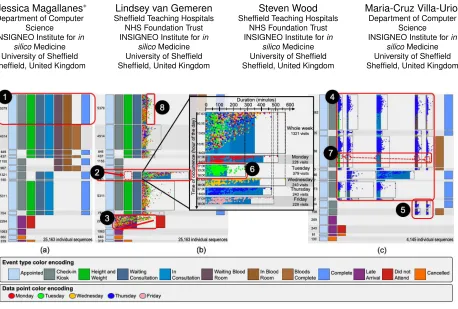
Figure 1: Three different configurations for the Sequential and Time Patterns overview using the Rheumatology dataset. (a) Sequential and Time Patterns overview where all events are encoded as point events. (b) The events ”In Consultation” and ”Late Arrival” are expanded for analysis. The expanded events show the proposed event encoding for time attributes, which allow to identify trends and outliers with respect to duration and time of occurrence. For a selected sequence, the event ”In Consultation” is broken down into days of the week for further exploration. (c) The Sequential and Time patterns overview is filtered to show only the events happening on Thursdays. The highlighted numbers represent findings which are explained in the taxonomy of findings proposed.
ABSTRACT
Event data is present in a variety of domains such as electronic health records, daily living activities and web clickstream records. Current visualization methods to explore event data focus on discov-ering sequential patterns but present limitations when studying time attributes in event sequences. Time attributes are especially impor-tant when studying waiting times or lengths of visit in patient flow analysis. We propose a visual analytics methodology that allows the identification of trends and outliers in respect of duration and time of occurrence in event sequences. The proposed method presents event data using a single Sequential and Time Patterns overview. User-driven alignment by multiple events, sorting by sequence simi-larity and a novel visual encoding of events allows the comparison of time trends across and within sequences. The proposed visual-ization allows the derivation of findings that otherwise could not be obtained using traditional visualizations. The proposed methodol-ogy has been applied to a real-world dataset provided by Sheffield
*e-mail: [email protected] †e-mail: [email protected]
Teaching Hospitals NHS Foundation Trust, for which four classes of conclusions were derived.
Index Terms: Human-centered computing—Visualization—Visu-alization techniques; Human-centered computing—Visual analytics; Applied computing—Health care information systems
1 INTRODUCTION
Event logs are routinely recorded in a variety of domains such as electronic health records, daily living activities and web clickstream records. The analysis of event data can provide valuable insights into processes and the behaviour of individuals.
Existing visualization techniques focus on the visual encoding of sequential patterns, but present limitations when representing time attributes. Firstly, the time of occurrence is not explicitly encoded in the overview of sequences. Secondly, the duration of events (if visualized) is encoded using the average value. Exclusively representing average duration means that individuals with unusual durations (outliers) are easily missed and, therefore, overlooked. The exact time at which individual events occur might not be of interest alone, but when combined with other variables, trends in time can be obtained to provide deeper insights. For example, visualizing time attributes is essential in the context of health care delivery. Waiting times and lengths of stay are key performance indicators required
to optimize the use of resources whilst maximizing the quality of patient care.
We propose a generic methodology which is able to integrate the extraction and interactive visualization of sequential and time patterns from temporal event data. The identification oftime patterns
is facilitated by a novel visual encoding capable of representing duration and time of occurrenceat event level. At sequence level, a set of the most relevant unique sequences is obtained first, then sorted by sequence similarity, and finally visually aligned to obtain
sequential patterns.
The proposed methodology allows users to interact with the data and focus their analysis on common patterns or on anomalous situa-tions that might be of interest. We have applied the methodology to a real-world dataset in the healthcare domain, and present a taxonomy of findings that can be generalized to other application domains. The contributions of the present work are:
• Visual encoding of time attributes at event level: a novel visual encoding which aggregates the duration and time of occurrence of events.
• Integration of time and sequential patterns into a single overview:our approach allows the analysis of patterns that combine time attributes and the sequential order of event se-quences.
2 RELATEDWORK
2.1 Visual analytics of Temporal Event Sequences
A variety of visual analytic techniques for event data have been proposed. Typically, an overview of the main sequential patterns is provided as a tree-like view, encoding sequences by frequency and average duration [16, 22]. Other existing views include: icicle plots [13, 16], sankey diagrams [18, 22], transition matrices [23], state transitions graphs [11, 20], and list of glyphs [5]. Various techniques have addressed the identification of sequential patterns either by using frequent sequence mining (FSM) [10, 14, 18] or clustering methods [5, 8, 22].
The overview of sequential patterns can be manipulated using a wide range of operations which are application-dependent.
In general, these operations can be grouped into three categories: transformations, queries and alignment. Transformations allow the simplification of the data overview [16], for example either by merg-ing similar event types into a smerg-ingle one or by removmerg-ing records that are not of interest. Queries allow the filtering of data being visual-ized according to a set of events or temporal constraints of variable complexity. Existing strategies include: visual queries [17], regular expressions [4] or milestone events [7, 13]. Alignment of event sequences by a selected event, target the exploration of the subset of events happening right before and after the alignment point. Typi-cally, only one event can be selected as alignment point [5, 16, 22], although more recently Eventpad [4] implemented a Multiple Se-quence Alignment (MSA) strategy in which the user is able to modify the gap cost in the algorithm proposed by Bose et al. [3].
2.2 Overview of time attributes
Existing visual analytics methods mainly focus on visualizing the sequential order of the events [16, 18, 22]. Currently, the visual encoding of time attributes is limited. Time of occurrence is always implicit in the sequential ordering of the sequences. However, no explicit time attributes (e.g. 3pm, Monday, May, 2019) are fully visually encoded in the overview.
Generally, a separate secondary view is required to review the time of occurrence for a selected record. ActiviTree [20] visualizes the distribution of sequences across the time of the day, using a secondary view. In LifeLines2 [21], the distribution of the frequency of selected records through time is visualized using a histogram (i.e. the number of occasions a particular event happens on a specific
date). Events within a time range before and after an alignment point can also be analyzed. However, this method does not aggregate sequences, and frequency distribution is only shown for the selected event.
TimeSpan [15] uses stacked bar charts to indicate the duration of events related to a stroke treatment process, a line chart is used to study trends in duration through monthly intervals. However, they assume that sequences do not vary in the ordering of events, meaning sequential patterns are not included.
In methods where the duration of events is visually encoded, the width of an event is scaled proportionally to the average duration. This approach ignores the distribution of the duration and the pres-ence of outliers. Duration outliers can be defined as observations with a duration which appears to be inconsistent with the remainder of the data [2]. Previous literature [20] indicates the importance of identifying infrequent sequences as outliers, but no emphasis has been made to pinpoint duration outliers.
Some techniques offer the possibility of filtering events by their duration. Eventflow [16] allows querying event sequences after spec-ifying a time window (e.g. displaying only events with a duration above thirty minutes), while Eventpad [4] provides a histogram to inspect event attributes separately. However, this information is not encoded in the sequential patterns overview.
3 TIME ATTRIBUTES AT EVENT LEVEL
Event data refers to a set of time-stamped events, where anevent
can be expressed as what happened (event type), when (time of occurrence), for how long (duration), and who was involved ( identi-fier). For eachidentifier, an ordered list of events can be obtained (event sequence); and for the complete set of event sequences in a dataset, theunique sequencescan be extracted by grouping those event sequences sharing the same ordered set of events exactly.
We propose a novel visual encoding to represent time attributes at event level, allowing the identification of trends and outliers with regard to duration and time of occurrence. The proposed approach also allows exploring time of occurrence at multiple time scales, and several levels of detail for the duration of events.
3.1 Visualizing duration and time of occurrence
The proposed visual encoding of events is inspired in boxplots [19]. For univariate data, boxplots have proved excellent to understand a whole sample of observations. They present multiple benefits: highlight of outliers, resistance to extreme values, representation of variability and skewness of the sample.
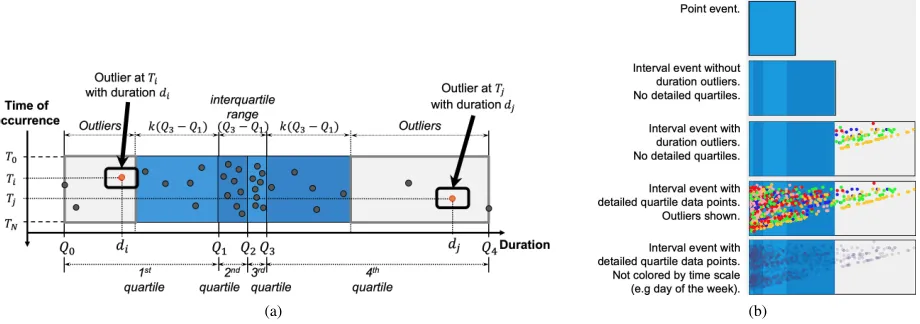
Anevent boxaggregates events of a particular type (see Fig. 2a), itsheightis proportional to the number of records, and itswidth
proportional to the maximum variation (Q4−Q0) in duration. An event box is composed byquartilesanddata points.
Quartiles are represented as colored sub boxes delimited by a duration valueQi. In this case,Q0is the minimum duration andQ4 the maximum duration.Q1,Q2andQ3correspond to the 25th, 50th and 75thpercentile respectively. Each data point in the visualization represents an individual event occurrence. Depending on their du-ration, data points can be either considered asoutliersorquartile points.
Using Tukey’s [6] definition, outliers are identified as data points outside the range:
[Q1−k(Q3−Q1),Q3+k(Q3−Q1)],
where(Q3−Q1)is the interquartile range and traditionallyk=1.5. Opposite to outliers, quartile points are visually identified as those within the colored sub boxes.
Data points are placed along thehorizontalaxis according to their duration, and placed in theverticalaxis according to their time of occurrence. The scale of theverticalaxis is given by the rangeT0to
(a) (b)
Figure 2: (a) Proposed visual encoding of an event box which is used to aggregate events. Data points represent individual event occurrences. Quartiles are delimited by duration ranges, whereQ0is the minimum duration andQ4the maximum. Data points are located in the horizontal axis according to duration and in the vertical axis according to time of occurrence. (b) Example of an event box at five different levels of detail. Hiding or showing quartile and outlier data points, and changing the colour of the data points, result in different levels of detail.
of occurrence being visualized. This arrangement of data points allows the study of the distribution of duration as well as time of occurrence over a given period of time.
3.2 Time of occurrence at multiple time scales
The proposed visual encoding can be customized to show time at multiple scales. The units for the time of occurrence (vertical axis) shown in Fig. 2a can be adjusted to show the time interval[T0,TN], as either hours of the day, days of the week, months, or even years. The use of color adds a further dimension to the visualization. For example the vertical axis can represent the hour of the day, with a range starting fromT0=8amtoTN=5pmat 1-hour intervals; whilst data points can be simultaneously colored according to the day of the week (i.e. data points in red occur on Mondays and blue on Fridays). Combinations of multiple time scales between the vertical axis and the data point color are possible.
3.3 Levels of detail in the duration of events
In terms of duration, events are typically categorized into either point or interval events [17].
The proposed event box visualization can be customized to show, hide or modify the detail of data points. This allows to produce the following levels of detail (see Fig. 2b):
• Point event: event details are fullycollapsedto reduce visual clutter.
• Interval event without duration outliers: duration outliers (if any) are hidden.
• Interval event with duration outliers: outliers (if any) are shown.
• Interval event, detailed quartiles: data points inside colored sub boxes are shown.
• Interval event, no detailed quartiles: data points inside colored sub boxes are hidden.
• Interval event not colored by time scale: Data points are col-ored using transparency, so that the volume of the points is observed.
The above will be used to help reducing the visual clutter during the analysis of data that will be discussed in the following section. Transforming events into point or interval events allow to focus the analysis of duration in selected events. Sometimes the user might be interested in the occurrence of an event without being interested in
its duration. A point event will provide context without having to remove it from display.
4 TIME ATTRIBUTES ACROSS SEQUENCES
Our methodology is able to seamlessly integrate the extraction and interactive visualization of sequential and time patterns from tempo-ral event data.
4.1 Sequential and Time Patterns overview
Sequential and time patterns are integrated in a single overview, which is built in four steps: 1) the unique sequences that explain most of the variability in the original dataset are selected, resulting in the removal of unique sequences with relatively low frequency; 2) the selected unique sequences are sorted by similarity using complete-link agglomerative hierarchical clustering [9] and the Lev-enshtein edit distance [12]; 3) sequences are aligned by multiple events as selected by the user; 4) the events in each unique sequence are represented using the visual encoding in Fig. 2a. This type of overview allows comparison of time attributes across sequences. Fig. 1 presents three configurations of this overview for the same dataset using different visualization settings and filters.
4.2 Multiple alignment and user interaction
The present methodology allows users to interact with the data and focus their analysis on common patterns or on anomalous situations that might be of interest. A variety of interaction mechanisms are offered to manipulate and explore the overview of Sequential and Time Patterns:
• User-driven multiple alignment:When new alignment events are selected, sequences are re-sorted by the similarity to the alignment events and by similarity within sequences. • Manipulation of event encoding to reduce visual clutter:User
can change the level of detail of selected events as per Sect. 3.3. • Filter by date:Records can be filtered by date range or specific
days of the week. The data points described in Fig. 2a can be colored according to the day of the week.
• Breaking down a unique sequence:A unique sequence can be subdivided according to the day of the week or other criteria.
5 CASE STUDY ANDTAXONOMY OF FINDINGS
[image:4.612.78.538.64.226.2]of this dataset, four main classes of findings were identified. We propose a taxonomy of findings which can be generalized to other application domains.
5.1 Case study
The understanding of patient flow is an area where good data analysis is critical [1]. Waiting times, lengths of stay and clinical pathways are key aspects to the study of patient flow.
In this work, we used one year of real-world patient flow data from a Rheumatology outpatient clinic (Sheffield Teaching Hospitals - NHS Foundation Trust, Sheffield, United Kingdom). On average, the Department has an approximate annual load of 9000 patients and 25000 appointments. Patient visits at this clinic are routinely tracked using an in-house workflow tracking system, where the clinical staff (e.g nurses, receptionist, consultants) input the current state of a patient according to the service being provided. The produced event logs are used by the hospital to obtain basic statistics about the quality of care being delivered, particularly focusing on the study of waiting times and lengths of visit.
[image:5.612.79.272.327.367.2]Our analyses offered the possibility of delving into the raw event logs to extract key insights about patient flow within the clinic (see specific dataset details in Table 1). These are being used to gain a better understanding of how the department operates and to suggest strategies about how to optimize the delivery of care.
Table 1: Characteristics of the Rheumatology dataset.
No. event Total no. No. unique Time
types sequences sequences period
18 26,455 161 1 year
5.2 Taxonomy of findings and examples
The generic taxonomy of findings is presented in this section. This taxonomy comprises four classes of findings. Examples for each class are provided using the Rheumatology dataset.
Class I - Discovering main sequential patterns: The user can visually identify the main and most representative sequential patterns in the Sequential and Time Patterns overview. Examples of this class are:
• The most frequent unique sequence is the clinical pathway Ap-pointed→Check-in Kiosk→Height and Weight→Waiting Consultation→In Consultation→Waiting Blood Room→ In Blood Room→Complete (Finding 1 in Fig. 1a).
Class II - Impact of an event in the duration of subsequent events: The proposed sorting and alignment methodology allows detecting differences and relations among sequences. The variation in the duration of specific events across sequences could be related to the presence or absence of certain events. For example, the sequences ”ABCDE” and ”BCDFG”, share the subsequence ”BCD”. This class of finding suggests that if the duration of ”BCD” varies between the two sequences, that variation might be associated to the occurrence of the event ”A”. This finding should require further investigation to explain the situation.
Examples of this class are:
• The time of the event In Consultation is considerably longer when the event Height and Weight does not occur in that se-quence (Finding 2 in Fig. 1b). When we interviewed the clini-cal staff, they indicated that those patients, without Height and Weight, visit the clinic to undergo longer day-case procedures rather than conventional consultations. A day-case procedure will likely include a consultation plus extra activities such as intravenous infusion of drugs, X rays and other imaging tests; hence the long duration of this event.
Class III - Trends in duration with regard to time of occur-rence: The proposed visualization allows to identify trends of du-ration through time. For example, if the dudu-ration increases as the time elapses or if high durations occur only in the early hours or a specific day. Examples of this class are:
• In Finding 3 in Fig. 1b, the duration of the late arrival event decreases as the day goes by; meaning that the amount of minutes that patients are late are higher in the morning than towards the end of the day. The highest durations (4th quartile and outliers) are concentrated in the morning (between 9:00 and 12:00). This requires a further investigation of morning appointments, revising the reasons for morning late arrivals.
Class IV - Temporal distribution of time attributes: The pro-posed visualization helps identifying what is the ”normal” duration of an event, as well as identifying the distribution of points through time of occurrence. Examples of this class are:
• Distribution of time of occurrence: On Thursdays, the visits to the clinic feature a higher concentration before noon (Finding 4 in Fig. 1c). However, the visits for which the purpose is exclusively a blood test occur in the afternoon (Finding 5 in Fig. 1c).
• Distribution of duration: On Tuesdays, consultation times are significantly shorter, which suggests that the clinic running on that day might be dealing with less complex pathologies (Finding 6 in Fig. 1b).
• Unusual times of occurrence: On Thursdays, the majority of patients visit the clinic in the mornings. Nevertheless, a reduced number of patients are seen in the afternoons (Finding 7 in Fig. 1c). Investigating that cohort of patients would be of interest.
• Unusual duration: The present method allows for the identifi-cation of patients that stay in an event for an unusual amount of time. Patients that have stayed in an event for an unusual time are represented as outlier data points in the proposed visualiza-tion, these are visually identified as points outside the colored sub boxes (e.g. see highlighted outliers in Fig. 1, Finding 8).
6 DISCUSSION ANDCONCLUSION
This paper proposes a generic methodology to analyze time attributes in event data, at event level and across event sequences. A Sequential and Time Patterns overview visualization is built after extracting the most relevant unique sequences. To simplify the exploration of temporal relations among sequences, unique sequences are sorted by similarity and aligned by multiple events selected by the user.
To facilitate the understanding of how events relate across se-quences and within sese-quences, a novel visual encoding of duration and time of occurrence is embedded in the Sequential and Time patters overview. This encoding enables users to gain valuable in-sights in to how events distribute with regard to time attributes. To make this possible, users are able to interact with the data at multiple levels of detail and time scales using a single overview.
Based on the presented case study in the healthcare domain, a taxonomy of findings generalizable to other applications has been proposed. The four classes of conclusions presented have already opened the possibility of identifying patterns of interest that should be further investigated to support hospital service improvement.
REFERENCES
[1] M. Bardsley, A. Steventon, and G. Fothergill. Untapped potential: Investing in health and care data analytics. The Health Foundation, 2019.
[2] V. Barnett and T. Lewis. Outliers in statistical data. John Wiley & Sons Ltd., 3nd edition edition, 1994.
[3] R. J. C. Bose and W. van der Aalst. Trace alignment in process mining: opportunities for process diagnostics. InInternational Conference on Business Process Management, pages 227–242. Springer, 2010. [4] B. C. Cappers and J. J. van Wijk. Exploring multivariate event
se-quences using rules, aggregations, and selections.IEEE Transactions on Visualization & Computer Graphics, (1):1–1, 2018.
[5] Y. Chen, P. Xu, and L. Ren. Sequence synopsis: Optimize visual summary of temporal event data.IEEE transactions on visualization and computer graphics, 24(1):45–55, 2018.
[6] M. Frigge, D. C. Hoaglin, and B. Iglewicz. Some implementations of the boxplot.The American Statistician, 43(1):50–54, 1989. [7] D. Gotz and H. Stavropoulos. Decisionflow: Visual analytics for
high-dimensional temporal event sequence data.IEEE transactions on visualization and computer graphics, 20(12):1783–1792, 2014. [8] S. Guo, K. Xu, R. Zhao, D. Gotz, H. Zha, and N. Cao. Eventthread:
Visual summarization and stage analysis of event sequence data.IEEE transactions on visualization and computer graphics, 24(1):56–65, 2018.
[9] J. A. Hartigan. Clustering algorithms. 1975.
[10] B. C. Kwon, J. Verma, and A. Perer. Peekquence: Visual analytics for event sequence data. InACM SIGKDD 2016 Workshop on Interactive Data Exploration and Analytics, volume 1, 2016.
[11] H. Lam, D. Russell, D. Tang, and T. Munzner. Session viewer: Visual exploratory analysis of web session logs. 2007.
[12] V. I. Levenshtein. Binary codes capable of correcting deletions, in-sertions, and reversals. InSoviet physics doklady, volume 10, pages 707–710, 1966.
[13] Z. Liu, B. Kerr, M. Dontcheva, J. Grover, M. Hoffman, and A. Wilson. Coreflow: Extracting and visualizing branching patterns from event sequences. InComputer Graphics Forum, volume 36, pages 527–538. Wiley Online Library, 2017.
[14] Z. Liu, Y. Wang, M. Dontcheva, M. Hoffman, S. Walker, and A. Wilson. Patterns and sequences: Interactive exploration of clickstreams to understand common visitor paths.IEEE Transactions on Visualization and Computer Graphics, 23(1):321–330, 2017.
[15] M. H. Loorak, C. Perin, N. Kamal, M. Hill, and S. Carpendale. Times-pan: Using visualization to explore temporal multi-dimensional data of stroke patients.IEEE transactions on visualization and computer graphics, 22(1):409–418, 2016.
[16] M. Monroe, R. Lan, H. Lee, C. Plaisant, and B. Shneiderman. Temporal event sequence simplification.IEEE transactions on visualization and computer graphics, 19(12):2227–2236, 2013.
[17] M. Monroe, K. Wongsuphasawat, C. Plaisant, B. Shneiderman, J. Mill-stein, and S. Gold. Exploring point and interval event patterns: Display methods and interactive visual query.University of Maryland Technical Report, 2012.
[18] A. Perer and F. Wang. Frequence: interactive mining and visualization of temporal frequent event sequences. InProceedings of the 19th international conference on Intelligent User Interfaces, pages 153–162. ACM, 2014.
[19] J. W. Tukey.Exploratory Data Analysis. Addison-Wesley, 1977. [20] K. Vrotsou, J. Johansson, and M. Cooper. Activitree: Interactive
visual exploration of sequences in event-based data using graph sim-ilarity.IEEE Transactions on Visualization and Computer Graphics, 15(6):945–952, 2009.
[21] T. D. Wang, C. Plaisant, B. Shneiderman, N. Spring, D. Roseman, G. Marchand, V. Mukherjee, and M. Smith. Temporal summaries: Sup-porting temporal categorical searching, aggregation and comparison.
IEEE transactions on visualization and computer graphics, 15(6):1049– 1056, 2009.
[22] K. Wongsuphasawat and D. Gotz. Exploring flow, factors, and outcomes of temporal event sequences with the outflow visualiza-tion. IEEE Transactions on Visualization and Computer Graphics,
18(12):2659–2668, 2012.