This is a repository copy of
Coping with multiple enemies : pairwise interactions do not
predict evolutionary change in complex multitrophic communities
.
White Rose Research Online URL for this paper:
http://eprints.whiterose.ac.uk/147590/
Version: Published Version
Article:
McClean, Deirdre, Friman, Ville-Petri orcid.org/0000-0002-1592-157X, Finn, Alain et al. (1
more author) (2019) Coping with multiple enemies : pairwise interactions do not predict
evolutionary change in complex multitrophic communities. Oikos. ISSN 0030-1299
https://doi.org/10.1111/oik.06586
[email protected] https://eprints.whiterose.ac.uk/ Reuse
This article is distributed under the terms of the Creative Commons Attribution (CC BY) licence. This licence allows you to distribute, remix, tweak, and build upon the work, even commercially, as long as you credit the authors for the original work. More information and the full terms of the licence here:
https://creativecommons.org/licenses/
Takedown
If you consider content in White Rose Research Online to be in breach of UK law, please notify us by
www.oikosjournal.org
OIKOS
Oikos
–––––––––––––––––––––––––––––––––––––––– © 2019 he Authors. his an Open Access article Subject Editor: Silke Langenheder
Editor-in-Chief: Dries Bonte Accepted 13 June 2019
00: 1–12, 2019
doi: 10.1111/oik.06586Predicting the ecological and evolutionary trajectories of populations in multispecies communities is one of the fundamental challenges in ecology. Many of these predictions are made by scaling patterns observed from pairwise interactions. Here, we show that the coupling of ecological and evolutionary outcomes is likely to be weaker in increasingly complex communities due to greater chance of life-history trait correlations. Using model microbial communities comprising a focal bacterial species, Bacillus subtilis, a bacterial competitor, protist predator and phage parasite, we found that increasing the number of enemies in a community had an overall negative efect on B. subtilis population growth. However, only the competitor imposed direct selection for B. subtilis trait evolution in pairwise cultures and this efect was weakened in the presence of other antagonists that had a negative efect on the competitor. In contrast, adaptation to parasites was driven indirectly by correlated selection where competitors had a positive and predators a negative efect. For all measured traits, selection in pairwise communities was a poor predictor of B. subtilis evolution in more complex communities. Together, our results suggest that coupling of ecological and evolutionary outcomes is interaction-speciic and generally less evident in more complex communities where the increasing number of trait correlations could mask weak ecological signals.
Keywords: bacteria, community ecology, community interactions, competition, eco-evolutionary processes, evolution, microcosms, parasitism, predation
Introduction
Species do not exist in isolation, but rather are embedded in a complex network, linked to other species through a diverse set of trophic and non-trophic interactions (hompson 2005). he ecological and evolutionary dynamics of many focal species have been detailed using both theory and empirical approaches, yet we have remarkably little insight into the efects of community complexity on shaping these dynamics
Coping with multiple enemies: pairwise interactions
do not predict evolutionary change in complex
multitrophic communities
Deirdre McClean, Ville-Petri Friman, Alain Finn, Letal I. Salzberg and Ian Donohue
D. McClean (https://orcid.org/0000-0002-5857-9081) (deirdre.mcclean @ed.ac.uk), Centre for Immunity, Infection and Evolution, Univ. of Edinburgh, Edinburgh, UK, and: Centre for Synthetic and Systems Biology, School of Biological Sciences Univ. of Edinburgh, Edinburgh, UK. – V.-P. Friman, Dept of Biology, he Univ. of York, York, UK. – A. Finn and I. Donohue, Dept of Zoology, School of Natural Sciences, Trinity College Dublin, Ireland. – L. I. Salzberg, Smurit Inst. of Genetics, School of Genetics and Microbiology, Trinity College Dublin, Ireland.
(Lytle 2001, Koskella and Brockhurst 2014, Barraclough 2015). Predicting the outcome of these interactions on the density and traits of a given species within a multi-species community is vital for understanding the long-term efects of environmental and biotic change on the biodiversity and stability of communities (Yoshida et al. 2003, Johnson and Stinchcombe 2007, Post and Palkovacs 2009, Lawrence et al. 2012, Loreau and Mazancourt 2013, Donohue et al. 2016, Mrowicki et al. 2016, Kordas et al. 2017). Strong, consis-tent interspeciic interactions also have the poconsis-tential to impose heavy selection pressures on species (Koskella et al. 2011, Lawrence et al. 2012, Friman and Buckling 2013), with signiicant implications for evolutionary trajectories (Yoshida et al. 2003). his predicts that the selection pres-sures facing an organism in a complex multi-species sys-tem are likely to be contingent upon the composition of that community and, moreover, that the addition or loss of species may dampen or promote evolutionary responses to individual selection pressures (de Mazancourt et al. 2008, Collins 2011, Betts et al. 2015).
Predation (Sherr and Sherr 2002, Friman and Buckling 2013, O’Connor et al. 2013, McClean et al. 2015), para-sitism (Vos 2009, Penczykowski et al. 2016) and competi-tion (Gause 1934, Hardin 1960, Foster and Bell 2012, Friman et al. 2014) are three major sources of antagonistic interactions for organisms. hese interactions act to reduce population densities both directly, by increasing mortality and reducing recruitment, and indirectly, through compe-tition for space and resources (Donohue et al. 2017). How these diferent types of interactions separately and, impor-tantly, collectively afect the population densities of focal spe-cies and trait evolution is still relatively unexplored. First, it is possible that increasing the number of antagonistic interac-tions in the community will have additively negative efects on the population density of the focal species. Alternatively, increasing the number of antagonists could weaken efects on focal species if they show negative efects on each other via, for example, intraguild predation (Friman et al. 2016). Further, the number and type of interactions could also afect the rate and trajectory of focal species evolution. Selection pressures exerted by multiple antagonistic interactions may, for example, result in tradeofs in terms of evolutionary out-comes (Stearns 1989, Friman et al. 2013, 2016). Adaptations that may be beneicial in one context may be harmful in another, reducing the itness beneit and, by extension, the rate of evolutionary change (Stearns 1989, hompson 1994, Friman et al. 2013, Garland 2014). For example, predation tends to slow down the rate of host–parasite interactions (Friman et al. 2013) and selection by multiple predator spe-cies can change the evolutionary trajectory of prey via trade-ofs and correlated selection (Friman et al. 2016). his is because, even though predators (Pernthaler 2005, Estes et al. 2011, O’Connor et al. 2015) and parasites (Kutz et al. 2005, Hudson et al. 2006) exert strong selection for prey survival, the targets and mechanisms under predator and parasite selection are likely to difer. Similarly, evolution of defence
against one antagonist might lead to increased susceptibility to another (Friman et al. 2009).
In addition to predatory and parasitic enemies, competi-tive interactions are a pervasive force of selection and can be indirect or direct, mediated by shared resources or, in the case of bacteria, through antimicrobials (Wang et al. 2017) or bac-teriocins (Ghoul et al. 2015). Recent evidence from bacte-rial communities suggests that interference competition and parasitism can act synergistically to suppress bacterial growth due to evolutionary tradeofs, where one selection pressure makes focal species more susceptible to the other (Wang et al. 2017). Furthermore, evolving resistance to strong antagonis-tic interactions has often been shown to come at a itness cost (Tollrian 1995, Sheldon and Verhulst 1996, Van Buskirk 2000, MacLean et al. 2004) that might limit the level of resis-tance or adaptation to the abiotic environment (Scanlan et al. 2015). While most of the evidence to date suggests that para-sites, predators and competitors impose strong selection that often leads to clear itness tradeofs, trait correlations may also be positive or neutral (Wright and Westoby 1999, Ackerly and Cornwell 2007, Chamberlain et al. 2014). Adaptations selected in one ecological context might therefore have unex-pected consequences in other ecological contexts.
Pairwise interactions such as those among competing spe-cies have been shown to predict those in more complex com-munities within single trophic levels (Foster and Bell 2012, Rivett et al. 2016). However, little is known about how dif-ferent interactions across trophic levels within a community alter evolutionary trajectories. A recent study (Friman et al. 2016) conducted with multiple predatory protists and a focal bacterial prey suggests that increasing the number of antagonists in a community can weaken pairwise evolution-ary dynamics by increasing antagonism between diferent predator species. Similarly, the presence of both specialist and generalist consumers has been shown to change both coexis-tence and defence evolution in two competing prey species (Hiltunen et al. 2017). Here, we explore whether predictions from diferent types of antagonist pairwise interactions scale in communities with increasing complexity. To this end, we manipulated the composition of multitrophic microbial microcosm communities and examined how community complexity moderates the dynamics of a focal bacterium spe-cies – Bacillus subtilis – and, critically, its ability to evolve resistance to parasites (bacteriophage SPP1) and predators (Paramecium caudatum) and to compete for resources with another bacterium (Serratia marcescens). We also examined whether prior exposure to multiple enemies modiied B. sub-tilis growth adaptation in abiotic environments in the absence of other species.
We found that increasing the number of enemies in a community had an overall negative efect on B. subtilis den-sity. However, only competitors imposed direct selection for
B. subtilis trait evolution in monocultures, while parasites and protists exterted indirect correlated selection for B. subtilis
coupled in more complex communities due to increased chance of coincidental life-history trait correlations.
Material and methods
Experimental design
Our experiment consisted of seven sets of species combina-tions of Bacillus subtilis (NCIB3610) with 1) SPP1 phage parasite in isolation; 2) Paramecium caudatum, a gener-alist (Johnson 1936, hurman et al. 2010, Banerji et al. 2015) bacterial predator in isolation; 3) Serratia marcescens
(ATCC 29632), a competitor of B. subtilis, in isolation; 4)
P. caudatum and SPP1 phage; 5) S. marcescens and SPP1 phage; 6) S. marcescens and P. caudatum; and 7) S. marcescens,
P. caudatum and SPP1 phage, resulting in a total of seven experimental treatments, each replicated seven times.
Community assembly
Culture methods followed closely McClean et al. (2015), Lawler and Morin (1993), and Leary et al. (2012). Microcosms consisted of loosely capped 200 ml glass bottles with 15 g glass
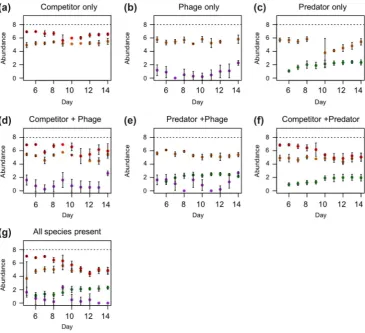
[image:4.595.118.484.343.676.2]microbeads providing spatial habitat structure. he beads were added to provide potential refuge for the microbial species, in particular the bacteria, to allow for longer term persistence of a multispecies community. he provision of spatial com-plexity also allows the species to interact in a more natural, heterogenous environment. Each microcosm received 100 ml medium consisting of one protist pellet per 1 l spring water and two wheat seeds to provide a slow release nutrient source. No other nutrients were added to the microcosms. All media were sterilised before use. Microcosms were maintained at 22°C and under a 12:12 h light:dark cycle. Nutrients in the microcosms were replenished on day 9 with a replacement of 7 ml of the microcosm volume with fresh sterile medium and one additional sterile wheat seed. his volume was suf-icient to support the microbial community without creating an excessively large disturbance to community dynamics. he density of B. subtilis did not reach carrying capacity when co-cultured with antagonists in our selection experiment (Fig. 1), which suggests that the bacterial populations were continuously dividing and producing genetic variation for selection to act upon. Paramecium caudatum were obtained from Blades Biological UK. Bacterial strains and SPP1 phage were taken from frozen laboratory stock cultures.
P. caudatum washing protocol
he P. caudatum protist cultures used for this experiment were laboratory cultures and, therefore, though not inocu-lated with any bacterial populations, were not entirely sterile. To account for this, P. caudatum cultures were washed with sterile media before addition to the microcosms to minimise contamination. In addition, the remaining media from the washing process (minus P. caudatum) was combined, mixed thoroughly and a similar volume to the protist treatments was added to all microcosms to ensure that any bacteria present in the medium had an equal chance of colonising each microcosm in every treatment. We identiied a single bacterial contaminant from this protist media, Klebsiella sp., which colonised all microcosm units in this manner in low frequencies and was treated as a standard ‘background’ mem-ber of the community (McClean et al. 2015). Densities of
Klebsiella sp. did not vary with experimental treatment over the course of the experiment (repeated measures ANOVA; F2,46 = 1.23, p = 0.3).
Bacterial and phage cultures
Bacterial strains of B. subtilis (NCIB3610) and S. marcescens
(ATCC 29632) were grown overnight from single clones in a tryptone yeast (TY) medium (Luria–Bertani broth supple-mented with 10 mM MgSO4 and 100 M MnSO4 after
auto-claving (Wach 1996)), diluted into fresh TY medium at an optical density at 600 nm (OD600) ~ 0.03 and grown at 37°C until late exponential phase (OD600~ 1.0), at which time 1 ml of each bacterial culture was inoculated into 100 ml micro-cosm medium, as required for experimental treatments. he point of addition of the bacteria is considered as experimental day 0 with community sampling taking place on day ive. A sample of both the B. subtilis and S. marcescens cultures were also frozen at −80°C in glycerol (50% vol/vol) as the ancestral populations for later evolutionary comparisons. Microcosms were left for 48 h at 37°C to facilitate growth of the bacteria prior to addition of the phage. In our experimental media and growth conditions the doubling time of B. subtilis was approximately 1.5 h. his resulted in our bacterial cultures attaining approximately 32 generations before the antagonist species were added to the microcosms. his allowed selection to act also on initial standing variation generated by de novo mutations in our populations (Sun and Yasbin 2002, Kivisaar 2003, Pybus et al. 2010). he mutation rate in wild type
B. subtilis has been estimated at approximately 1 × 10³ per generation (Schroeder et al. 2017). Based on our doubling time and population density estimates, potentially 224 000 mutations therefore appeared during the experiment to pro-vide genetic variation for selection to act upon, though this number was likely lower in our experiment due to antagonist species constraining bacterial growth. 1 ml of a 10−3 dilution
(in sterile phosphate bufer saline (PBS)) of the phage stock solution (1.7 × 10⁴ pfu ml−1) was added to each microcosm
as required (day two). Microcosms were then left for a fur-ther 24 h at 37°C to facilitate bacterial growth and ensure suicient numbers before the addition of the bacterivorous
P. caudatum. On day three microcosms were inoculated with washed P. caudatum (approx. 50–70 individuals), as required for experimental treatments. Communities were then allowed to equilibriate at 22°C for 48 h. Data collection began at this point on experimental day ive and continued for ten days thereafter (day 14).
Community sampling and population density measurements
Samples of bacteria, phage and protists were taken daily after carefully homogenising microcosms by shaking. A 0.1 ml sample was taken to count protist numbers using stereo and compound microscopes. Bacterial densities were measured through direct colony counts (identiied by colony morphol-ogy) on plates from appropriately diluted samples. Phage numbers were measured through direct plaque counts on plates from appropriately diluted samples. Prior to plating, 3 ml of standard TY medium was inoculated with a stock of ancestral B. subtilis and incubated at 37°C for a minimum of 4 h or until an OD600 of 0.9–1.0 was achieved; 200 µl of
the B. subtilis culture was added to 10 ml tubes followed by 200 µl of the microcosm sample, mixed gently by hand and incubated at 37°C for 15 min. Next, 3 ml of soft agar (0.5%) was added to each tube, swirled, and then poured onto pre-set 1.5% TY agar plates and incubated overnight at 37°C. he number of plaques on each plate was then counted.
Measuring evolutionary changes in the life-history traits of focal species B. subtilis
Eight colonies of our focal species, B. subtilis, were isolated from each replicate microcosm via agar plating on the inal day of the experiment after microcosms were homogenised and vortexed to strip bioilm and ensure representative sam-pling. he resistance of B. subtilis was then assessed against the ancestral populations of SPP1 phage (n = 8 replicate pop-ulations per microcosm), ancestral S. marcescens competitor (n = 3 populations per microcosm) and ancestral predatory P. caudatum (n = 3 populations per microcosm). Bacterial trait evolution in response to competitors (Harrison et al. 2008, Koch et al. 2014), predators (Hahn et al. 1999, 2000, Matz and Matz 2002, Vos et al. 2009) and phages (Hall et al. 2011, Dennehy 2012, Wright et al. 2018) can emerge within few days due to inherently strong selection pressures. We thus chose a relatively short time frame to focus on evolutionary adaptation of our focal bacterium against antagonists in our experiment.
Competitive ability
he competitive ability of B. subtilis from each evolution-ary treatment was assessed against the ancestral S. marcescens
proportions of the two bacterial species on agar plates based on diferences in colony morphologies.
Predator defence
he strength of predator defence evolution of B. subtilis
from each treatment was assessed through bioilm forma-tion, which is frequently used as a proxy of bacterial defence strategy based on bacterial cell aggregates that cannot be consumed by protists because they are too large or attached to surfaces (Böhme et al. 2009, Chavez-Dozal et al. 2012, Friman et al. 2015). To this end, evolved and ancestral
Bacillus bacteria were grown in 96-well plates containing 200 ml of microcosm medium at 22°C with the addition of approximately 10 washed P. caudatum cells. After 24 h,
P. caudatum cell number was counted and bioilm measured (Böhme et al. 2009, Chavez-Dozal et al. 2012, Friman et al. 2015), as follows. he liquid medium was irst decanted and all unattached cells removed through a water rinse. Next, 100 µl of 0.1% crystal violet solution was added to the wells to stain the bioilm attached on microplate well walls. he wells were then left for 15 min and rinsed with deionised water. Plates were left to dry overnight before 125 µl of 30% acetic acid (in water) was added to each of the wells and incu-bated at room temperature for 15 min to solubilize the crystal violet. he supernatant from each well was then transferred to wells in a new plate. Bioilm production was quantiied by measuring absorbance at 540 nm using 30% acetic acid as a blank.
Phage parasite defence
We used short-term growth assays in liquid media to assess the resistance of B. subtilis populations to the ancestral SPP1 phage (Moulton-Brown and Freman 2018). To this end, 10 µl of evolved B. subtilis isolates from each treatment was added to 200 µl microcosm media in 96-well plates and allowed to grow independently for 20 h at 22°C in both the presence and absence of 10 µl of the ancestral SPP1 phage (10−4 titre).
Bacterial density was then quantiied by measuring the OD600 to attain a proxy of parasite defence (the higher the OD, the higher the phage resistance). Resistance was thus measured as reduction in density due to the parasite compared to when the B. subtilis populations were grown alone without the parasite.
Adaptation to the growth media
We compared growth of evolved and ancestral B. subtilis
isolates to assess whether the populations from diferent ecological contexts difered in their adaptation to the growth medium (Scanlan et al. 2015), or whether adaptations against diferent enemies might have incurred costs in terms of trad-eofs with growth (Friman et al. 2014, 2015, 2016). We mea-sured diferences in two bacterial growth parameters that are indicative of their ability to compete for resources: maximum growth (population density after 15 h of growth, by which time they had reached stationary phase), and maximum growth rate (that is, maximum rate of population growth per hour). Briely, ancestral and evolved B. subtilis isolates were
grown independently over 15 h (OD600 measured at 10 min
intervals) in the microcosm medium using 96-well plates to assess diferences in growth parameters.
Statistical analyses
All densities were log (x + 1)-transformed prior to analysis to reduce bias caused by diferent population sizes. All population density analyses were performed on the time series data to take into account density luctuations throught the experiment using repeated measures analysis of variance (ANOVA) and Tukey honest signiicant diference (HSD) post hoc tests. hese analyses were used to assess popu-lation density changes in each of B. subtilis, S. marcescens,
P. caudatum and SPP1 phage according to community com-plexity. ANOVA and t-tests were used to examine the evo-lution of resistance in B. subtilis isolates from each of our microcosm communities against each of the competitor (based on density ratios), predator (bioilm density) and para-site (based on density). Finally, we used one-sample t-tests to test whether the ecological or evolutionary outcomes from two-species communities could reliably predict the outcomes in more complex communities. Predicted values were cal-culated as the mean (± SE) across antagonist monoculture treatments. For example, the predicted value for the com-petitor + parasite treatment was estimated by adding up the replicate values observed in competitor alone and parasite alone treatments and calculating their combined mean. All analyses were carried out in R ver. 3.4.4 (< www.r-project. org >). All data are available as Supplementary material Appendix 1.
Data deposition
Data are available from the Dryad Digital Repository: < http:// dx.doi.org/10.5061/dryad.303jg54 > (McClean et al. 2019).
Results
Population density dynamics of the focal species
B. subtilis
he density of Bacillus subtilis varied signiicantly with the number of enemy species present in the community (repeated measures ANOVA: F2,46 = 8.07, p <0.01; Fig. 1), while
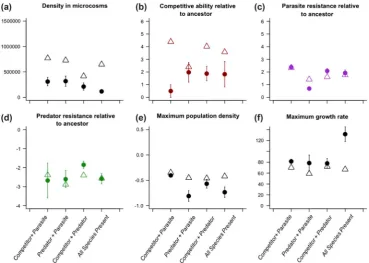
in multispecies communities was consistently lower than that predicted based on densities observed in two species co-cultures (Supplementary material Appendix 1 Table A1, Fig. 2a). Together, these results demonstrate that pairwise communities did not predict the density regulation efects observed in the three-enemy community.
Population density dynamics of competitor, parasite and predator
he bacterial competitor species S. marcescens reached higher population densities compared to B. subtilis when co-cultured in the absence of other antagonists (Fig. 1a). his is indicative of competitive advantage. However, when either the special-ist parasite of B. subtilis (phage SPP1), a generalist predator species (P. caudatum), or both, were added to the microbial community, this competitive advantage was diminished, as evinced in a greater reduction in Serratia marcescens relative to
B. subtilis densities (repeated measures ANOVA: F2,25 = 10.34,
p < 0.001; Tukey contrasts; two enemies – one enemy and three enemies – one enemy, p < 0.05 in all cases; Fig. 1). his suggests that the presence of parasites and predators, either separately or together, evened out the competitive diference between the two competing bacterial species.
Phage parasite densities varied with community richness (repeated measures ANOVA: F2,25 = 4.1, p < 0.05). Parasite density was unafected by the presence of other antagonists
(Tukey contrasts: three enemies – parasite, p = 0.8; two ene-mies – parasite, p = 0.1; Fig. 1b, g), except in the presence of both the competitor and predator of B. subtilis, which decreased parasite density relative to either species present in isolation (Tukey contrasts: three enemies – two enemies, p < 0.05; Fig. 1). Parasite densities dropped below the detect-able limit by the end of the experiment (Fig. 1g) in the pres-ence of both competitor and predator (Tukey contrasts: all species present – every other parasite treatment, p < 0.05 in all cases; Fig. 1). his suggests that the competitor and predator had relatively small efects on parasite densities in communities containing two enemies but additive negative efects in three-antagonist communities.
Although predator densities in general increased over time, they did not vary with antagonist richness (repeated mea-sures ANOVA, F2,25 = 0.63, p = 0.5; Fig. 1). hus, the preda-tor was the least afected by the presence of other interacting antagonistic species in the community.
Evolution of B. subtilis competitive ability and resistance against parasite and predator
Evolutionary change in the competitive ability of B. subtilis
was assessed by comparing the growth of ancestral and evolved
[image:7.595.110.480.378.641.2]B. subtilis clones in direct competition with the ancestral competitor species, S. marcescens, at the end of the experi-ment. We found that the competitive ability of B. subtilis
increased only if it had been exposed to S. marcescens in the absence of other antagonists (Fig. 3a; ANOVA: F6,19 = 4.58, p = 0.005; Tukey contrasts; p <0.05 for each treatment compared to B. subtilis + S. marcescens alone, except for
B. subtilis + SPP1 phage parasite, where p = 0.08). he pres-ence of any other enemy limited the evolution of B. subtilis
competitive ability and no diference was observed relative to the ancestral strain (Tukey HSD; p > 0.05 between all other treatment pairs, Fig. 3a). he observed changes in
B. subtilis competitive ability were lower than predicted based on pairwise co-cultures, except for the predator–parasite treatment (Supplementary material Appendix 1 Table A1, Fig. 2b). hese results therefore indicate that evolutionary changes in B. subtilis competitive ability were weakened in the presence of additional species.
Evolution of resistance to the parasite was measured as the diference in the growth of ancestral and evolved B. subtilis isolates in the presence and absence of the ancestral SPP1 phage (Fig. 3b, Supplementary material Appendix 1
Fig. A1). Overall, resistance to the ancestral parasite var-ied strongly depending upon community composition (ANOVA: F6,38 = 7.46, p < 0.001; Fig. 3b). Prior exposure to the parasite alone did not afect B. subtilis resistance to the ancestral parasite (t-test; t8.14 = 0.98, p = 0.35; Fig. 3b,
Supplementary material Appendix 1 Fig. A1). In contrast, the correlated evolutionary response to S. marcescens alone led to high ancestral parasite resistance (t-test; t7.3 = 5.1, p = 0.001; Fig. 3b, Supplementary material Appendix 1 Fig. A1), while this efect disappeared with the addition of other antagonists (t-tests; parasite: t11.03 = 0.57, p = 0.58; predator: t9.9 = 0.74, p = 0.48; Fig. 3b, Supplementary material Appendix 1 Fig. A1). Moreover, prior exposure to the predator alone (t-test; t8.89 = −3.7, p < 0.01; Fig. 3b, Supplementary mate-rial Appendix 1 Fig. A1), or in combination with the phage parasite (t-test; t9.52 = 8.58, p < 0.001; Fig. 3b, Supplementary material Appendix 1 Fig. A1), reduced B. subtilis resistance to the parasite. When all three enemy species were present together, there was no efect on B. subtilis resistance to the
Predator resistance relative to ancestor Competitor
only All species
present
Competitor + Predator
Phage only Predator
only Competitor
+ Phage Predator + Phage
Direction of evolutionary changerelative to ancestral B. subtilis
a)
b)
C)
Parasite resistance relative to ancestor Competitive ability
relative to ancestor
[image:8.595.126.468.321.621.2]0 1 2 3 4 5 –5.0 –2.5 0.0 2.5 5.0 –5.0 –2.5 0.0 2.5 5.0
Figure 3. he efect of community composition on B. subtilis evolution relative to the ancestral strain (solid line). (a) Competitive ability of B. subtilis isolates, measured as the ratio of B. subtilis to S. marcescens (dashed line indicates a 1:1 ratio, solid line represents ancestral resis-tance). (b) Relative resistance on B. subtilis to parasite across treatment groups. Resistance to phage SPP1 was measured as the diference in growth (optical density) of B. subtilis in the presence or absence of the ancestral phage parasite. he solid line represents the resistance of ancestral B. subtilis and the resistance of our experimental treatment isolates relative to ancestral parasite resistance. (c) Growth of B. subtilis isolates in the presence of the predator P. caudatum (measured as log10 optical density of bioilm production). Solid line indicates resistance
ancestral SPP1 parasite (t-test; t9.99 = 1.27, p = 0.23; Fig. 3b,
Supplementary material Appendix 1 Fig. A1). No major diferences were observed between predicted and observed parasite resistance values largely because only weak parasite resistance was observed in general (Fig. 2). However, when both predator and parasite were present together, the resis-tance of B. subtilis was lower than expected based on pairwise co-culture predictions (Supplementary material Appendix 1 Table A1, Fig. 3c). Together, these results suggest that both competitors and predators exerted opposing, correlated selection for B. subtilis parasite resistance and that they can-celled the efect of each other out in competitor–predator co-cultures.
Resistance to the predatory protist P. caudatum was mea-sured as the diference in the extent of bioilm formation between ancestral and evolved B. subtilis isolates in the presence and absence of a stock culture of P. caudatum. As expected, all isolates produced a greater amount of bioilm in the presence of the predator (Fig. 3c, Supplementary material Appendix 1 Fig. A2). However, all evolved isolates produced less bioilm than the ancestral B. subtilis strain in the pres-ence of the predator (solid line on Fig. 3c), and no difer-ence in bioilm formation was observed between evolved isolates from diferent antagonist communities (ANOVA: F5,34= 0.77, p = 0.58; Fig. 3c, Supplementary material
Appendix 1 Fig. A2). As a result, only weak predator resis-tance evolution and a good agreement between predicted and observed evolutionary outcomes was observed, except for the competitor–predator treatment, where observed evolution-ary changes were less than those predicted (Supplementevolution-ary material Appendix 1 Table A1, Fig. 2d).
Determining B. subtilis adaptation to the growth media and the cost of defence
We quantiied the growth of ancestral versus evolved B. subtilis isolates to assess whether populations from diferent antagonist communities difered in their adaptation to the growth medium and to identify the potential cost of resis-tance. None of the evolved selection lines showed improved growth relative to the ancestral B. subtilis strain, which suggests that no adaptation to the growth media occurred and that changes are likely due to some costs of resistance (Supplementary material Appendix 1 Fig. A3a). he maxi-mum population density of evolved B. subtilis isolates was unafected by previous evolutionary history with either the competitor S. marcescens or parasite (ANOVA; main efect of S. marcescens: F1,38 = 0.64, p = 0.43; main efect of SPP1 phage: F1,38 = 1.5, p = 0.23; Supplementary material Appendix 1 Fig. A3a). he maximum population density of B. subti-lis was, however, reduced signiicantly if it had previously been exposed to antagonist communities that included the predator (ANOVA; main efect of P. caudatum: F1,38 = 36.12, p < 0.001; Supplementary material Appendix 1 Fig. A3a). his reduction was strongest in the predator–parasite treat-ment. Consistent with this, observed maximum densities were lower than predicted in more complex communites that
included the predator (Supplementary material Appendix 1 Table A1, Fig. 2e).
he growth rate of evolved B. subtilis isolates was much lower than the ancestral strain (Supplementary material Appendix 1 Fig. A3b) and only B. subtilis that had evolved in the presence of all three enemies had growth rates com-parable with the ancestral strain. In general, reduction in
B. subtilis growth rate was lower in antagonist communities that included the S. marcescens competitor species (ANOVA; main efect of S. marcescens: F1,38 = 16.44, p < 0.001; Tukey contrasts p <0.05; Supplementary material Appendix 1 Fig. A3b) and P. caudatum predator (ANOVA; main efect of
P. caudatum: F1,38 = 8.21, p = 0.007; Tukey contrasts p < 0.05;
Supplementary material Appendix 1 Fig. A3b). In contrast, the presence of the SPP1 phage parasite had no clear efect on
B. subtilis growth rate (ANOVA; main efect of SPP1 phage: F1,38 = 2.54, p = 0.12; Supplementary material Appendix 1
Fig. A3b). Due to similar evolutionary trajectories in pair-wise co-cultures, good agreement was found between predicted and observed evolutionary outcomes (Fig. 3). However, the observed reduction in B. subtilis growth rate was much less than predicted in the three-antagonist com-munity (Supplementary material Appendix 1 Table A1, Fig. 2f ). Together, these results suggest that evolved isolates had generally lowered maximum growth and growth rates compared to the ancestral strain and that these changes were driven mainly by the presence of the predator.
Discussion
We found that pairwise interactions, both within and among trophic levels, did not reliably predict either ecological interactions or evolutionary outcomes in multispecies com-munities. While increasing the number of enemies in a community had an overall negative efect on the densities of our focal bacterium, Bacillus subtilis, only the competi-tor imposed direct selection for B. subtilis trait evolution in pairwise cultures. Further, this efect was weakened in the presence of other antagonists that had a negative efect on the competitor. As a result, ecological (population density) and evolutionary (trait evolution) outcomes were coupled only in the case of B. subtilis competitive ability. In case of both ecological and evolutionary outcomes, selection in pairwise communities was a poor predictor of outcomes in more complex communities, and often led to over-predictions. Overall, our indings indicate that the coupling of eco-evolutionary outcomes is both trait- and interaction-speciic and harder to predict in more complex communities where the increasing number of trait correlations can mask weak ecological interactions and directional selection.
Only the competitor bacterium Serratia marcescens
selected for clear evolutionary change in B. subtilis in single-enemy monocultures. Under experimental conditions,
evolutionary change in B. subtilis, where isolates from the competitor monoculture treatment demonstrated much greater competitive ability towards their ancestral competi-tor in comparison to both ancestral B. subtilis and evolved
B. subtilis isolated from multi-enemy co-cultures. In contrast, neither the parasitic phage nor predatory protist caused such a magnitude of evolutionary change against ancestral enemies in B. subtilis. One explanation for this is that the duration of the experiment was not suiciently long for the resis-tance to sweep through B. subtilis bacterial populations and become ixed. he nutrient concentration of our experimen-tal conditions was also relatively low, which has been shown previously to slow down both parasite (Friman et al. 2015) and predator (Friman and Laakso 2011) resistance evolution. In contrast, however, nutrient stress has also been shown to favour mutations in stationary phase B. subtilis (Sun and Yasbin 2002, Kivisaar 2003, Pybus et al. 2010), which would promote adaptation. In the case of predator resistance evo-lution, we observed a very strong plastic defence response (bioilm), which decreased with evolved compared to ances-tral B. subtilis strains. While this is indicative of defence evolution, it was uniform among antagonist treatments, sug-gesting that it was driven independently of the presence of the predator (e.g. through adaptation to growth media or spatial environment). In support of this, it has been shown previously that the glass beads used in this experiment can harbour large populations of bacteria (Moulton-Brown and Friman 2018) and that bioilm growth mode can increase the survival of the bacteria in the presence of the protist predator (Böhme et al. 2009, Chavez-Dozal et al. 2012, Friman et al. 2015). It is also possible that bioilm growth could have pro-tected bacteria from phages plastically by masking phage receptors (Veening et al. 2008), while it has previously been shown that bacteria can regulate phage resistance plastically via quorum sensing signaling (Høyland-Kroghsbo et al. 2013). he fact that phage densities were quite low in our experimental system suggests that bacteria were able to defend themselves against parasites very efectively and that this was potentially driven by genetic, plastic or both defence mechanisms (Friman et al. 2008, Lopez-Pascua and Buckling 2008). In future, it would be interesting to characterise bioilm formation on the beads during the selection experi-ment (Moulton-Brown and Friman 2018) and to resequence evolved bacterial clones to identify potential genetic and epigenetic changes underlying the trait evolution.
he observed competitive advantage and selective force of the competitor bacterium on B. subtilis was weakened sub-stantially in the presence of other enemies. he presence of either predator or parasite, alone or in combination, led to a reduction in S. marcescens density, negating the efect of the competitor on driving selection in B. subtilis competitive ability. Alternatively, it is possible that selection by parasites or predators somehow conlicted with the selection by com-petitors. For example, the presence of multiple enemies can weaken the respective efects via tradeofs where selection by one antagonist makes the focal species more susceptible to
the other antagonists (Friman et al. 2009). his is, however, an unlikely explanation in our study, as selection by the com-petitor alone did not appear to make B. subtilis more suscep-tible to the predator or parasite. Bacteria also display plastic responses to antagonistic interactions such as predation via epigenetic mechanisms (Veening et al. 2008) and via modify-ing their growth strategy through the formation of bioilm. For example, growing as bioilm aggregates has been shown to protect against protist grazing (Matz and Kjelleberg 2005). his could provide additional phenotypic explanation for our results, though further mechanistic studies incorporating genomic sequencing would be needed to demonstate this.
We found no evidence of evolutionary change in
B. subtilis response to either predator or parasite in monocul-tures. In contrast, adaptation to the parasitic bacteriophage was driven indirectly by selection in multispecies communi-ties, where the presence of competitors had a positive, and predators a negative, efect. he density of parasites was lowest in the presence of both other antagonists but this does not appear to have altered the strength of their evolutionary selective pressure on B. subtilis. his implies that adaptations conferring a competitive advantage against S. marcescens also conferred a level of resistance against bacteriophage SPP1. here are several potential mechanisms through which bac-teria may develop resistance against both a competitor and a bacteriophage parasite simultaneously. For instance, the production of extra-cellular compounds – including matri-ces and competitive inhibitors – are known to confer both competitive advantages (Hibbing et al. 2010) and resistance (Labrie et al. 2010) against host-speciic bacteriophage para-sites. Only plastic defensive response to predation through bioilm production was observed and this was not afected by antagonist community composition. When both competi-tor and predacompeti-tor were present together, with or without the parasite, the resistance of B. subtilis to the ancestral parasite was similar to that of the ancestral B. subtilis. As the predator appeared to feed non-preferencially on all bacteria present, it had a negative efect on the densities of both B. subtilis and
S. marcescens, which likely evened out some of the com-petitive interactions between the two species. In addition, it is likely, though not measured directly here, that preda-tion selected for S. marcescens defence evolution, which may have altered competitive interactions between the bacteria (Hiltunen et al. 2017). Together, these results suggest that competitors and predators impose opposing selection but that, when present in the community together, cancel each other out, indicating cryptic evolution (Yoshida et al. 2007).
Our focal bacterium, B. subtilis, adapted diferentially to the growth media depending on the species that it was co-cultured with. he presence of single enemies did not increase or reduce the maximum growth obtained by the B. subtilis
predators and parasites had additive negative efects on the growth of the bacterium. We also found that all populations of single- or two-enemy communities had lower growth rates than the ancestral strain. In contrast, the presence of all three enemies at once led to increased growth rates in the growth medium relative to the other populations. It has been shown previously that evolution of defencive traits can impose costs in terms of reduced growth rates (Ford et al. 2016, Ashby et al. 2017). he efects of community complexity on a given spe-cies depend upon the growth environment that they ind themselves in, how each species is adapted to it and, thus, the relative costs of defencive resistance evolution. However, we found that resistance evolution did not increase clearly with community complexity and is thus unlikely to explain the lowest growth rate cost in the most complex community.
Neither ecological nor evolutionary outcomes of our focal bacterium B. subtilis could be predicted reliably based on pair-wise interactions. We found that observed densities of B. sub-tilis populations in complex communities were consistently lower than predicted from pairwise cultures across all treat-ments. his is suggestive of synergistic interactions among enemy communities. Similarly, the evolutionary outcomes of B. subtilis were more varied and often in disagreement between observed and predicted outcomes in general. he greatest magnitude of evolutionary response in monoculture was observed with the compeitior bacterium S. marcescens, an efect that was no longer observed with increasing com-plexity. his suggests that the greater the magnitude of pair-wise interactions, the greater the extent to which increased complexity can modify that response in natural communities.
he coupling of eco-evolutionary outcomes were trait-speciic – evolutionary changes in the competitive ability of B. subtilis were linked strongly with ecological dynamics, whereas the evolution of parasite resistance did not exert a clear ecological signal. When species are dealing with a single or few strong interactions it might be expected that ecological dynamics are tightly coupled with evolutionary trajectories, such that relative species densities may indicate the strength of selection. Ecological parameters such as biomass are used frequently to elucidate shifts in evolutionary outcomes (such as changes in the ability to resist parasites) within populations (Yoshida et al. 2007). Shifts in a population’s evolutionary strategy in terms of growth rates and resistance to enemies have the potential to greatly alter the ecological interactions within a community. Detecting such evolutionary signals of change within a population in diferent ecological contexts is of great importance for predicting the impact of chang-ing environments and biodiversity loss. When considerchang-ing the impact of global change on species evolution, our results suggest that competitive interactions may play a far stron-ger role than appreciated previously. Competition in micro-bial communities is a known driver of many species traits (Schluter et al. 2015, Ashby et al. 2017, Niehus et al. 2017) and our study shows that exploitative competitive interac-tions may be even more important for predicting responses to other biotic stressors than strong trophic interactions.
In conclusion, our indings demonstrate that predicting ecological and evolutionary dynamics of complex systems based on pairwise interactions is extremely challenging. If we are to better predict eco-evolutionary outcomes in large mul-tispecies ecosystems, we must endeavor to scale up empirical experiments to incorporate a greater range of more realistic interaction networks, incorporating multiple trophic levels. Moreover, our results suggest that selection in one context can have unexpected consequences for species interactions in another context due to negative and/or positive trait correla-tions. It is thus crucial to try to understand targets of selec-tion more mechanistically in order to predict how diferent selection pressures might shape species evolution in complex communities. Incorporating these approaches into current eco-evolutionary dynamics frameworks will help to achieve much greater insight into the evolution and mechanisms of trait correlations and, therefore, enhance our capacity to understand and predict species response to global change in complex communities.
Acknowledgements – We thank in particular Britt Koskella for early discussions and later comments on the manuscript. We also thank Kevin Devine, Peter Staford and Alison Boyce for help with constructing microbial communities.
Funding – DM was supported by by the EU INTERREG IVA Cross-border Programme managed by the Special EU Programmes Body under the project ‘Development of targeted ecological modelling tools for lake management; DOLMANT’ (ref. no: 002862), and the Wellcome Trust supported Centre for Immunity, Infection and Evolution (WT095831). VF is supported by the Wellcome Trust (reference no. 105624) through the Centre for Chronic Diseases and Disorders (C2D2) at the University of York.
Author contributions – DM and VF contributed equally to this paper. DM, VF, ID and AF designed the experiment. DM, AF and LIS carried out the experiment, DM performed the analyses. DM, VF and ID lead the writing. All authors contributed to discussions and the writing of the manuscript.
References
Ackerly, D. D., and Cornwell, W. K. 2007. A trait-based approach to community assembly: partitioning of species trait values into within- and among-community components. – Ecol. Lett. 10: 135–145.
Ashby, B. et al. 2017. Competing species leave many potential niches unilled. – Nat. Ecol. Evol. 1: 1495.
Banerji, A. et al. 2015. Density- and trait-mediated efects of a parasite and a predator in a tri-trophic food web. – J. Anim. Ecol. 84: 723–733.
Barraclough, T. G. 2015. How do species interactions afect evolu-tionary dynamics across whole communities? – Annu. Rev. Ecol. Syst. 46: 25–48.
Betts, M. G. et al. 2015. Pollinator recognition by a keystone tropical plant. – Proc. Natl Acad. Sci. USA 112: 3433–3438. Böhme, A. et al. 2009. Protists with diferent feeding modes change
bioilm morphology. – FEMS Microbiol. Ecol. 69: 158–169. Chamberlain, S. A. et al. 2014. How context dependent are species
Chavez-Dozal, A. et al. 2012. Predation response of Vibrio ischeri bioilms to bacterivorus protists/phagotrophic protozoa. – Appl. Environ. Microbiol. 79: 553–558.
Collins, S. 2011. Competition limits adaptation and productivity in a photosynthetic alga at elevated CO2. – Proc. R. Soc. B 278:
247–255.
de Mazancourt, C. et al. 2008. Biodiversity inhibits species’ evolutionary responses to changing environments. – Ecol. Lett. 11: 380–388.
Dennehy, J. J. 2012. What can phages tell us about host–pathogen coevolution? – Int. J. Evol. Biol. 2012: 396165.
Donohue, I. et al. 2016. Navigating the complexity of ecological stability. – Ecol. Lett. 19: 1172–1185.
Donohue, I. et al. 2017. Loss of predator species, not intermediate consumers, triggers rapid and dramatic extinction cascades. – Global Change Biol. 23: 2962–2972.
Estes, J. A. et al. 2011. Trophic downgrading of planet Earth. – Science 333: 301–306.
Friman, V. P. and Buckling, A. 2013. Efects of predation on real-time host–parasite coevolutionary dynamics. – Ecol. Lett. 16: 39–46.
Friman, V. P. and Laakso, J. 2011. Pulsed-resource dynamics constrain the evolution of predator–prey interactions. – Am. Nat. 177: 334–345.
Friman, V. P. et al. 2008. Availability of prey resources drives evolution of predator–prey interaction. – Proc. R. Soc. B 275: 1625–1633.
Friman, V. P. et al. 2009. Predation on multiple trophic levels shapes the evolution of pathogen virulence. – PLoS One 4: e6761.
Friman, V. P. et al. 2014. Rapid prey evolution can alter the structure of predator–prey communities. – J. Evol. Biol. 27: 374–380.
Friman, V. P. et al. 2015. Bacterial adaptation to sublethal antibiotic gradients can change the ecological properties of multitrophic microbial communities. – Proc. R. Soc. B 282: 20142920. Friman, V. P. et al. 2016. Relative importance of evolutionary
dynamics depends on the composition of microbial predator– prey community. – ISME J. 10: 1352.
Ford, S. A. et al. 2016. Microbe-mediated host defence drives the evolution of reduced pathogen virulence. – Nat. Commun. 7: 13430.
Foster, K. R. and Bell, T. 2012. Competition, not cooperation, dominates interactions among culturable microbial species. – Curr. Biol. 22: 1845–1850.
Garland, T. 2014. Tradeofs. – Curr. Biol. 24: 60–61.
Gause, G. F. 1934. Experimental analysis of Vito Volterra’s mathematical theory of the struggle for existence. – Science 79: 16–17.
Ghoul, M. et al. 2015. Bacteriocin-mediated competition in cystic ibrosis lung infections. – Proc. R. Soc. B 282: 20150972. Hahn, M. W. et al. 1999. Bacterial ilament formation, a defense
mechanism against lagellate grazing, is growth rate controlled in bacteria of diferent phyla. – J. Appl. Environ. Microbiol. 65: 25–35.
Hahn, M. W. et al. 2000. Role of microcolony formation in the protistan grazing defense of the aquatic bacterium Pseudomonas sp. MWH1. – Microb. Ecol. 39: 175–185.
Hall, A. R. et al. 2011. Host–parasite coevolutionary arms races give way to luctuating selection. – Ecol. Lett. 14: 635–642. Hardin, G. 1960. he competitive exclusion principle. – Science
131: 1292–1297.
Harrison, F. et al. 2008. Interspeciic competition and siderophore-mediated cooperation in Pseudomonas aeruginosa. – ISME J. 2: 49–55.
Hibbing, M. E. et al. 2010. Bacterial competition: surviving and thriving in the microbial jungle. – Nat. Rev. Microbiol. 8: 15–25.
Hiltunen, T. et al. 2017. Evolutionary contribution to coexistence of competitors in microbial food webs. – Proc. R. Soc. B 284: 20170415.
Høyland-Kroghsbo, N. M. et al. 2013. A quorum-sensing-induced bacteriophage defense mechanism. – mBio 4: e00362-12. Hudson, P. J. et al. 2006. Is a healthy ecosystem one that is rich in
parasites? – Trends Ecol. Evol. 21: 381–385.
Johnson, W. H. 1936. Studies on the nutrition and reproduction of Paramecium. – Physiol. Zool. 9: 1–14.
Johnson, M. T. and Stinchcombe, J. R. 2007. An emerging synthe-sis between community ecology and evolutionary biology. – Trends Ecol. Evol. 22: 250–257.
Kivisaar, M. 2003. Stationary phase mutagenesis: mechanisms that accelerate adaptation of microbial populations under environmental stress. – J. Environ. Microbiol. 5: 814–827. Koch, G. et al. 2014. Evolution of resistance to a last-resort
antibiotic in Staphylococcus aureus via bacterial competition. – Cell 158: 1060–1071.
Kordas, R. L. et al. 2017. Herbivory enables marine communities to resist warming. – Sci. Adv. 3: e1701349.
Koskella, B. and Brockhurst, M. A. 2014. Bacteria–phage coevolution as a driver of ecological and evolutionary processes in microbial communities. – FEMS Microbiol. Rev. 38: 916–931.
Koskella, B. et al. 2011. he costs of evolving resistance in heterogeneous parasite environments. – Proc. R. Soc. B 279: 20112259.
Kutz, S. J. et al. 2005. Global warming is changing the dynamics of Arctic host–parasite systems. – Proc. R. Soc. B 272: 2571–2576.
Labrie, S. J. et al. 2010. Bacteriophage resistance mechanisms. – Nat. Rev. Microbiol. 8: 317–327.
Lawrence, D. et al. 2012. Species interactions alter evolutionary responses to a novel environment. – PLoS Biol. 10: e1001330. Lawler, S. P. and Morin, P. J. 1993. Food web architecture and
population dynamics in laboratory microcosms of protists. – Am. Nat. 141: 675–686.
Leary, D. J. et al. 2012. he impact of environmental variability and species composition on the stability of experimental micro-bial populations and communities. – Oikos 121: 327–336. Loreau, M. and Mazancourt, C. 2013. Biodiversity and ecosystem
stability: a synthesis of underlying mechanisms. – Ecol. Lett. 16: 106–115.
Lopez-Pascua, L. D. C. and Buckling, A. 2008. Increasing productivity accelerates host–parasite coevolution. – J. Evol. Biol. 21: 853–860.
Lytle, D. A. 2001. Disturbance regimes and life-history evolution. – Am. Nat. 157: 525–536.
Matz, C. and Kjelleberg, S. 2005. Of the hook – how bacteria survive protozoan grazing. – Trends Ecol. Evol. 13: 302–307. Matz, J. K. and Matz, C. 2002. Predation as a shaping force for
the phenotypic and genotypic composition of planktonic bacteria. – Anton. Leeuwen. 81: 413–434.
McClean, D. et al. 2015. Single gene locus changes perturb complex microbial communities as much as apex predator loss. – Nat. Commun. 6: 8235.
McClean, D. et al. 2019. Data from: coping with multiple enemies: pairwise interactions do not predict evolutionary change in complex multitrophic communities. – Dryad Digital Repository, <http://dx.doi.org/10.5061/dryad.303jg54>.
Moulton-Brown, C. E. and Friman, V. P. 2018. Rapid evolution of generalised resistance mechanisms can constrain the eicacy of phage-antibiotic treatments. – Evol. Appl. 11: 1630–1641. Mrowicki, R. J. et al. 2016. Temporal variability of a single
population can determine the vulnerability of communities to perturbations. – J. Ecol. 104: 887–897.
Niehus, R. et al. 2017. he evolution of siderophore production as a competitive trait. – Evolution 71: 1443–1455.
O’Connor, N. E. et al. 2013. Distinguishing between direct and indirect efects of predators in complex ecosystems. – J. Anim. Ecol. 82: 438–448.
O’Connor, N. E. et al. 2015. Nutrient enrichment alters the consequences of species loss. – J. Ecol. 103: 862–870.
Penczykowski, R. M. et al. 2016. Understanding the ecology and evolution of host–parasite interactions across scales. – Evol. Appl. 9: 37–52.
Pernthaler, J. 2005. Predation on prokaryotes in the water column and its ecological implications. – Nat. Rev. Microbiol. 7: 537–546.
Post, D. M. and Palkovacs, E. P. 2009. Eco-evolutionary feedbacks in community and ecosystem ecology: interactions between the ecological theatre and the evolutionary play. – Phil. Trans. R. Soc. B 364: 1629–1640.
Pybus, C. et al. 2010. Transcription-associated mutation in Bacillus subtilis cells nder stress. – J. Bacteriol. 192: 3321–3328. Ratsak, C. et al. 1996. Efects of protozoa on carbon mineralization
in activated sludge. – Water Res. 30: 1–12.
Rivett, D. W. et al. 2016. Resource-dependent attenuation of species interactions during bacterial succession. – ISME J. 10: 2259–2268.
Scanlan, P. D. et al. 2015. Coevolution with bacteriophages drives genome-wide host evolution and constrains the acquisi-tion of abiotic-beneicial mutaacquisi-tions. – Mol. Biol. Evol. 32: 1425–1435.
Schluter, J. 2015. Adhesion as a weapon in microbial competition. – ISME J. 9: 139–149.
Schroeder, J. W. et al. 2017. Mutagenic cost of ribonucleotides in bacterial DNA. – Proc. Natl Acad. Sci. USA 114: 11733–11738.
Sheldon, B. C. and Verhulst, S. 1996. Ecological immunology: costly parasite defences and tradeofs in evolutionary ecology. – Trends Ecol. Evol. 11: 317–321.
Sherr, E. B. and Sherr, B. F. 2002. Signiicance of predation by protists in aquatic microbial food webs. – Anton. Leeuwen. 81: 293–308.
Stearns, S. C. 1989. Tradeofs in life-history evolution. – Funct. Ecol. 3: 259–268.
Sun, H.-M. and Yasbin, R. 2002. Adaptive, or stationary-phase, mutagenesis, a component of bacterial diferentiation in Bacillus subtilis. – J. Bacteriol. 184: 5641–5653.
hompson, J. N. 1994. he coevolutionary process. – Univ. of Chicago Press.
hompson, J. N. 2005. Coevolution: the geographic mosaic of coevolutionary arms races. – Curr. Biol. 15: 992–994.
hurman, J. et al. 2010. he ilter-feeding ciliates Colpidium striatum and Tetrahymena pyriformis display selective feeding behaviours in the presence of mixed, equally-sized, bacterial prey. – Protist 161: 577–588.
Tollrian, R. 1995. Predator-induced morphological defenses: costs, life history shifts, and maternal efects in Daphnia pulex. – Ecology 76: 1691–1705.
Van Buskirk, J. 2000. he costs of an inducible defense in anuran larvae. – Ecology 81: 2813–2821.
Veening, J. W. et al. 2008. Bistability, epigenetics and bet-hedging in bacteria. – Annu. Rev. Microbiol. 62: 193–210.
Vos, M. 2009. Why do bacteria engage in homologous recombination? – Trends Microbiol. 17: 226–232.
Vos, M. et al. 2009. Local adaptation of bacteriophages to their bacterial hosts in soil. – Science 325: 833.
Wach, A. 1996. PCR-synthesis of marker cassettes with long lanking homology regions for gene disruptions in S. cerevisiae. – Yeast 12: 259–265.
Wang, X. et al. 2017. Parasites and competitors suppress bacterial pathogen synergistically due to evolutionary tradeofs. – Evolution 71: 733–746.
Wright, I. J. and Westoby, M. 1999. Diferences in seedling growth behaviour among species: trait correlations across species, and trait shifts along nutrient compared to rainfall gradients. – J. Ecol. 87: 85–97.
Wright, R. C. et al. 2018. Cross-resistance is modular in bacteria– phage interactions. – PLoS Biol. 16: e2006057.
Yoshida, T. et al. 2003. Rapid evolution drives ecological dynamics in a predator–prey system. – Nature 424: 303–306.
Yoshida, T. et al. 2007. Cryptic population dynamics: rapid evolution masks trophic interactions. – PLoS Biol. 5: e235.