ftMMISSION OF THE EUROPEAN COMMUNITIES
___ j
Proposal for a
COUNCIL DIRECTIVE
COM(82) SOS final
Brussels, 9 September 1982
introducing Community measures for the control of foot-and-mouth disease
(submitted to the Council by the Commission)
Foot and mouth disease is a serious contagious disease which spreads rapid~.
It affects all bi-ungulate domestic and wild animals. It has a high morbidity with dramatic consequences on animals and their productivity.
A study of the evolution of foot and mouth disease in the Community shows that the situation is generally relatively satisfactor,y, but it m~ var,r from one Iember State to the other often in relation with the control measures undertaken when the disease appears, thus producing important barriers to intra-Community trade.
For these reasons, the object of the present draft directive is to assure the effectiveness and the harmonization of control measures against foot and mouth disease in the Community. For this purpose, it is particularly necessar,r to
provide forj a rapid di~osis of the disease and the identification of virus-type involved b,y the responsible national laboratories, the elimination of outbreaks of the disease b,y the slaughter of infected animals or those likely to transmit the disease and the application of rigorous disinfection and
control measures at holdings suspected to be contaminated.
This draft is the basis for a Community action for establishment and
Foot-and-mouth disease is a virulent, infectious epizootic disease which it is extremely difficult to prevent spreading. It affects all cloven-hoofed animals, both domestic and wild. In its acute form it tends to be fatal mainly to young
animals. In all cases it has a very serious effect on the productivity of live-stock farms, and the economic future of animals which recover is jeopardized. All in all, FMD is one of the greatest threats to livestock farming and a major obstacle to trade in livestock and livestock products.
It should also be noted that the FMD virus (Picornavirus Aphthae) breaks down into 7 different immunological types known at present (0, A, C, SAT1, SAT 2,
SAT3 and Asia), within which there are sub-types and varieties which often hamper prevention work and lead to the possibility of a breakdown in the immunity of animals infected with types or varieties against which any vaccine used does not give enough protection.
Of these different types only
o,
A and C have been identified in Europe. However, there are some varieties of these types in various parts of the world which have not so far appeared in the Community.I. Development of FMD
In studying the development of FMD in the ten Member States now making up the Community, we have to include a period which is long enough to give an idea of the epizootiology of the disease, which also has to be seen in its European context. Nor can the situation in other neighbouring countries be ignored. The subtle ways in which the disease spreads and the time the virus can survivre,
Generally speaking, over the last ten years (1971-1981) the incidence of disease has been kept very low both in the Member States (except Greece in 1972) and in neighbouring countries. Of the latter, however, Turkey and to a lesser extent Spain and Portugal have encountered problems.
1. Development and present situation in the Member States
Table I annexed hereto, concerning the development of FMD in the Member States, confirms the low incidence of the disease, especially if we ignore the special situation in Greece in 1972-1973, when Europe was seriously threatened by an epizootic in the Middle East and Turkey. Setting up a vaccination buffer zone in Turkish Thrace and in the Greek prefecture of Eyros saved the situation.Generally speaking the number of outbreaks recorded in the Community has been less than 100. In 1974, a relatively high total of 188 outbreaks was reported, this being due mainly to an accident in vaccine manufacture (62 outbreaks in Belgium) and a
localized occurrence in France (89 outbreaks>. The rate at which outbreaks occur and the type of virus involved, which is different from one series of outbreaks to another, show that in all cases the appearance of the disease has been acci-dental and sporadic. The long periods with no outbreaks at all demonstrate the complete disappearance of the wild FMD, which is the determining factor in making the disease a permanent feature of a territory. It should be noted that during the period under consideration Ireland, Denmark (1), Luxembourg and the United Kingdom were free of FMD.
2. Control and prevention in the Member States
In no case has FMD in the Community reached epizootic proportions : the measures adopted in the Member States as soon as the disease has accidentally appeared have enabled it to be confined to a particular region or sector and its spread avoided, both within countries and in the Community as a whole, even though trade has become freer and has increased. The measures adopted by the Member State when a case of the disease occurs differ appreciably, even though a country
such as Denmark, has changed its basic approach. Generally speaking, the national
rules in all Member States provide for slaughter of susceptible animals on the
farm where the disease is discovered, but the precise scope of this slaughtering
is not the same in all Member States, as it takes into account the practice of
systematic annual vaccination of some livestock.
On the basis of whether preventive vaccination is practiced and precesily what
livestock is slaughtered, the methods of combatting the disease may be divided
into four groups
(a) Ireland and the United Kingdom, and Denmark since 1977 :
These three countries ban vaccination on their territory. Control measures
are based on immediate slaughter of animals of species susceptible to FMD
and the destruction of the carcases, and on the application of strict
animal health protection measures within a particular radius around the
farm and surveillance measures in a larger area;
(b) Greece, and Denmark up to 1977
As regards slaughter and animal health measures, the same principles apply
here as in Ireland and the United Kingdom. There is no systematic annual
preventive vaccination, but all livestock of susceptible species within
a given radius of the infected farm is vaccinated in order to protect farms
in that area and avoid secondary outbreaks. It should be··noted that Greece
has a buffer zone in the prefecture of Evros, along the frontier with
Turkey, in which all ruminants are vaccinated against virus 0 and A22.
(c) France and Luxembourg :
These two countries practice annual vaccination of all cattle of more than
4 or 6 months. If the disease breaks out on a farm (breakdown of immunity,
or appearance in non-vaccinated stock such as young cattle, pigs, etc) all
livestock of susceptible species is slaughtered and destroyed, whether
If necessary vaccination of all animals of susceptible species within a given radius of the farm is undertaken (ring vaccination) in order to protect or help protect farms in the threatened area;
(d) Belgium, Italy, the Netherlands and the Federal Republic of Germany :
These countries practice annual vaccination of all cattle over 4 months. If the disease breaks out on a farm, animal health protection measures are applied but not all animals of susceptible species on the farm are slaughtered and
destroyed. Only so called receptive animals are slaughtered, and this excludes vaccinated livestock, which is kept on the farm. Generally speaking, cattle which have been vaccinated in two successive years are regarded as having sufficient immunity. However, vaccinated cattle which show symptoms of the disease (breakdown of immunity) are slaughtered and destroyed. This is supple-mented by vaccination or revaccination of all animals of susceptible species
within a given radius of the infected farm (ring vaccination).
In addition, since a number of vaccinated animals which may healthy carriers of the virus are kept on the farm and may spread the disease, the period during which animal health protection measures are applied is appreciably lengthened.
The vaccine used in the Community is trivalent types
o,
A and C, inspected by the competent authorities of each Member State.3. Developmen~ and present situation in neighbouring non-Community countries
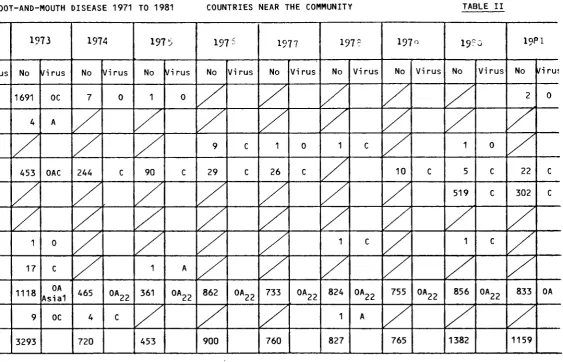
Table II annexed hereto, concerning the development of FMD in certain neighbour-ing countries shows that the present situation and development of the disease there may by and large be considered as similar to that in the Member States. This applies to Bulgaria, the German Democratic Republic (1), Switzerland,Sweden,
Czechoslovakia and Yugoslavia, where the disease has broken out only sporadically
and accidentally. In Austria a serious epizootic occured in 1973 : the Austrian
authorities had at that time given up systematic p~entive vaccination and this allowed the disease to spread dramatically before suitable countermeasures could be taken (1 691 outbreaks). The situation was quickly restored by the following year, after a vaccination campaign.
On the other hand the present situation and development of the disease are much more serious in two areas : the Iberian peninsula and the part of south-eastern
Europe in close contact with the Middle East.
From the epizootiological point of view, the Iberian peninsula has to be conside-red as a single whole, in view of the relationship between Spain and Portugal,
which includes trade across the frontier. The two countries have met serious difficulties : there has been enzootic FMD in Spain with a large number of out-breaks in 1971 (510), 1972 (371), 1973 (453) and 1974 (244). After a major
epi-zootic in 1971 (1 058 outbreaks) Portugal was free of the disease until 1980, when it broke out again (519 outbreaks).
The second area is directly connected with Turkey and with FMD in Asia and the Middle East. The situation in Turkey as a whole (several hundred outbreaks each year) means that there is a permanent threat of contamination of European Turkey
(Thrace)including contamination by exotic viruses from Asia.
This is why the Community is making a financial contribution, together with other European countries, to the measures advocated by the European Commission for the
Control of Foot-and-Mouth Disease (FAO) and the International Office of Epizootics to maintain a vaccination buffer zone along Turkey's borders with Greece and Bulgaria.
number of Middle Eastern countries. The risk is all the greater as the resources
for combatting the disease in these areas and in the countries near to the
Commu-nity vary appreciably.
4. Control and prevention in neighbouring countries
Not all the countries practice a policy of eliminating all affected livestock
when the disease breaks out. The methods used vary from keeping the animals on
the farm until the symptoms disappear, together with measures to isolate the
farm, as in Turkey and Portugal; to slaughter of all animals of susceptible
species, as in Sweden. A number of countries, such as Spain, follow a policy
similar to that of the Member States in slaughtering susceptible animals.
The situation regarding vaccination also varies greatly, from a total ban as
in Sweden to systematic annual vaccination as in Switzerland, Czechoslovakia,
the German Democratic Republic and Spain. Intermediate solutions are compulsory
vaccination in certain areas, as in Austria, Bulgaria or Turkey, or voluntary
vaccination, as in Portugal. The vaccine used is mainly trivalent against types
0, A and
c.
Some countries, however, use monovalent vaccine, depending on the degree of risk, the epidemiological development of the disease and the virusconcerned.
The FAO's European Commission for the Control of Foot-and-Mouth Disease
advo-cates better coordination in Europe of the control and prevention of FMD.
It is indeed difficult to say in advance what the consequences would be if a
major epizootic spread from the permanent sources of infection, and
II. Approaches to a common policy
A Community policy on foot-and-mouth disease has to take account not only of the disease as it exists in the Member States but also of the European
and wider international context, as the Community is close to and has trade links with a number of non-Community countries.
Implementation of such a policy is in line with the basic principles of the
common market, having regard to the disease's effects on farm incomes and the way of trade in livestock and livestock products, both because of the risk of spreading the virus and in view of the differing conceptions lying behind the
Member States' control and prevention methods. Some Member States have a policy of preventing FMO by systematic vaccination of species of livestock susceptible to the disease, while others forbid the use of any FMO vaccine and do not allow imports of vaccinated livestock or fresh meat of vaccinated animals.
If we look at the way the disease has developed over the past ten years in the countries now composing the Community, we see that the general incidence of the disease is low and that it would be possible to harmonize, in the first instance, the measures to be taken by the Member States when the disease breaks out, in order to limit the consequences at both national and Community levels by avoiding the spread of the virus through trade. Without embarking on a
de-bate of the principles of systematic prevention by vaccination, we may say that the risk of spread through healthy carries (vaccinated animals kept on farms where the disease had broken out)could be limited by eliminating sources of infection through slaughter and destruction of animals of susceptible species
infected, where there must be restrictions and surveillance during sufficient
time over and above the incubation period of the disease, in order to ensure
that there are no secondary outbreaks. According to the policy followed by
the particular Member State, animal health measures may be reinforced by setting
up a vaccination barrier covering all animals of susceptible species in the area
concerned. The disease being a contagious one, the need for immediate action
should be emphasized, and certain restrictions and surveillance measures should
be adopted as soon as the presence of the disease is suspected rather than when
it is confirmed. The vaccines used in emergencies should be as innocuous and as
effective as necessary and should comply with harmonized, Community-wide control
criteria for manifacture. The application of these reinforced measures in the
implementation of the provisions concerning imports from non-Community countries,
as adapted to the situation in the Community, should help in the total
elimina-tion of the disease.
When sufficient time has elapsed, and in the light of the results of experience
in this first phase, it will be possible to look at the future development of
the Community policy on FMD. This should take full account of what happens in
neighbouring countries, so that we can fully assess the risks of contamination
and dejine the conditions of this policy in the Community's European and wider
international.
The action of the European Commission for the Control of Foot-and-Mouth Disease
must be supported and continued, and the initial phase of harmonization
The accidental infections which occurred in the United Kingdom in 1981 and more
recently still in Denmark, after many years of freedom from the disease,
under-line the major risk of contamination from neighbouring countries; in both cases, although the competent authorities in the two countries were not able to determi-ne the precise origin of the infection, they regarded it as very likely that the virus had been brought by the wind, in view of the weather over the few days
pre-ceding the first outbreak.
Moving on to a second, more long-term phase will raise the question of prevention
of FMD by systematic annual vaccination of livestock of susceptible species, as practised by some Member States. The long period of absence of the disease which
should result from measures to eliminate sources of FMD will lead people to consi-der systematic vaccination as useless and expensive and will be an argument in favour of its progressive abandonment. However, we should point out the main conditions which would need to be met if such an approach were to be envisaged:
a) the abandonment of systematic annual vaccination should not mean a ban on the use of vaccine in emergencies (vaccination of animals of susceptible
species in areas threatened by an outbreak of the disease>;
b) if they have to resort to emergency vaccination, Member States should be certain of being able to obtain immediately the necessary quantities of a suitable vaccine meeting all the requirements involved;
c) protection against possible contaminationfrom outside the Community should
be reinforced in the light of the development of the disease in other European countries, especially those bordering the Community, and this might go as far as setting up buffer zones for the areas most threatened;
e) Member States which still had vaccine production plants on their territory would have to reinforce safety measures in order to avoid any escape of virus, both during manufacture and during tests for innocuousness and effectiveness.
1971 1972 1973 1974 1975 1976 1977 1978 197o 192'0 19Pl
Member
No Virus No Virus No Virus No Virus No ~irus
State No Virus No Virus No Virus No Virus No Virus No Vi rU!
B 2
1/
/
62 0 21 0 1 0/
V
~
V
V
'
DK
V
' /
V
V
V
V
.
/
V
V
V
[ /
FR 8
oc
2 0 1 0 89c
2 0V
/
1c
21 0V
18oc
GR 27 OAC 330 OA22 317 0 14 OA 1 0 1 A22 3 A22
V
V
/
6 0NL 21
oc
7 0V
3 0 2 0V
1 AV
V
V
V
IR
V
i /
V
V
/
/
/
/
~
V
V
IT 15 OAC 9 0 13 AC 5
oc
31 OAC 61c
18 OAC 43 OAC 4 OA 1 A 2 0LUX
/_
/
V
/
V
V
V
V
V
V
/
FRG 9 OAC 22 OAC 9 OAC 14
c
13 0 5c
2c
3c
/
3 0V
U.K.
/
V
V
1/
V
V
V
V
V
2 0 [image:15.856.88.778.49.393.2]1971 1972 1973 1974 197') 197
s
1977 197? 197 () 19?J 19Pl COUNTRY No Virus No Virus No ~irus No Virus No ~irus No Virus No Virus No Virus No Virus No Virus No ~irwAustria
/
/
1691oc
7 0 1 0V
V
/
/
V
2 0Bulgaria
/
7
4 AV
/
V
1/
/
/
V
/
G D R 3 0
/
/
V
V
9c
1 0 1c
/
1 0V
Spain 510
oc
371 AC 453 OAC 244c
90c
29c
26c
1/
10c
5c
22c
Portugal h058 0
V
V
V
V
IV IV
V
V
519c
302c
Sweden
V
V
/
V
V
IV IV
V
V
V
V
Swi tzer lu
V
IV
1 0V
V
V
V
1c
V
1c
IV
Czechoslo
1/
11c
17c
V
1 A7
V
~
V
V
V
vakia
Turkey 267 OA 1361 OA 1118 OA 465 OA22 361 OA22
Asia1 862 OA22 733 OA22 824 OA22 755 OA22 856 OA22 833 OA
Yugosla-/
12c
9oc
4c
V
V
V
1 AV
1/
IV
via [image:16.852.205.769.72.434.2]introducing Community measures for the control of foot-and-mouth disease
THE COUNCIL OF THE EUROPEAN COMMUNITIES,
Having regard to the Treaty establishing the European Economic Community, and in particular Article 43 thereof,
Having regard to the proposal from the Commission,
Having regard to the Opinion of the European Parliament,
Having regard to the Opinion of the Economic and Social Committee,
Whereas one of the Community's tasks in the veterinary field is to improve the state of health of Livestock, thereby increasing the profitability of stockfarming; Whereas such action should also help to remove those remaining barriers to trade between Member States in live animals and fresh meat which are caused by
differences in their respective animal health situations;
Whereas an outbreak of foot-and-mouth disease can quickly take on epizootic proportions, causing mortality and disturbances on a scale Liable to reduce sharply the profitability of farming of pigs and ruminants as a whole;
Whereas action m~st be taken as soon as the presence of the disease is suspected so that immediate and effective control measures can be implemented as soon as its presence is confirmed;
Whereas diagnosis of the disease and identification of the relevant virus must be carried out under the auspices of responsible Laboratories the co-ordination of which must be ensured by a Laboratory appointed by the Community; Whereas the vaccine used for emergency vaccination must be verified both for efficacy and safety under the auspices of a Laboratory appointed by the
Community, and whereas special coordinated measures must be implemented where virus types or variants are detected against which the vaccines usually used in the Community do not provide sufficient protection;
Whereas a procedure for close cooperation between the Member States and the Commission must be provided for,
Article 1
This Directive introduces Community measures for the control of foot-and-mouth disease, whatever the type of virus concerned.
Article 2
For the purposes of this Directive, the following definitions shall apply (a) "animal of a susceptible species" means any domestic or wild ruminant or
swine,
(b) "holding" means any establishment (agricultural or other), situated in the territory of a Member State, in which animals of susceptible species are kept or bred;
(c) "animal suspected of being infected with foot-and-mouth disease" means any animal of a susceptible species showing clinical symptoms, post-mortem
Lesions, or reactions to Laboratory tests indicating the possible presence of foot-and-mouth disease;
(d) "animal infected with foot-and-mouth disease" means any animal of a susceptible species
- in which clinical symptoms or post-mortem Lesions of foot-and-mouth disease have been officially ascertained,
or
- in which the presence of foot-and-mouth disease has been officially ascertained following a Laboratory examination;
Article 3
Member States shall ensure that the presence or the suspected presence of foot-and-mouth disease are compulsorily and immediately notifiable to the competent authority.
Article 4
1. Where a holding contains one or more animals suspected of being infected with foot and mouth disease, Member States shall ensure that the official
veterinarian immediately sets in motion official means of investigation to confirm or rule out the presence of the said disease, in particular by taking the necessary samples for Laboratory examination.
As soon as the suspected infection is notified, the competent authority shall have the holding placed under official surveillance and shall in particular order that
- a census be made of all categories of animals of susceptible species on the holding, and that, in respect of each of these categories, the number of animals already dead or Liable to be infected be recorded; the census must be kept up to date to take account of animals born or dying during the suspect period; the information in the census must be produced on request and be
liable to verification at each visit,
- all animals of susceptible species on the holding be kept in their Living quarters or some other place where they can be isolated; - no animals of susceptible species enter or Leave the holding,
- no animals of other species enter or Leave the holding without an authorization issued by the competent authority,
failing authorization issued in each case by the competent authority, all
no milk Leave the holding and, where it is used on the holding, that proper heat treatment be applied,
- the movement of persons to or from the holding be made subject to authorization by the competent authority,
- the movement of vehicles to or from the holding be made subject to authorization by the competent authority,
- appropriate means of disinfection be used at the entrances and exits of buildings housing animals of susceptible species and of the holding itself, - an epizootiological inquiry be carried out in accordance with Article 7 and 8.
2. The competent author1ty shall have power to extend the measures provided for in paragraph 1 to holdings adjoining the relevant holding should their Location, their configuration, or contacts with animals from the relevant holding give reason to suspect possible contamination.
3. The measures referred to paragraphs 1 and 2 shall not be Lifted until the suspicion of foot-and-mouth disease has been officially refuted.
Article 5
1. In cases where the presence of foot-and-mouth disease has been officially confirmed, Member States shall ensure that :
(a) the official veterinarian takes adequate samples for Laboratory examination when the confirmation of disease has not been preceded by a period of
suspicion.
(b) the competent authority, in addition to the measures Listed in Article 4(1) requires that
- after slaughter the animals referred tp above be destroyed under official supervision in such a way that there is no risk of dispersion of the foot-and-mouth virus,
- meat of animals of susceptible species slaughtered during the period between the probable introduction of the disease to the holding and the
implementation of official measures be, wherever possible, traced and destroyed under official supervision in such a way as to avoid any risk of dispersion of the foot-and-mouth virus,
- the carcases of animals of susceptible species which have died on the holding be destroyed under official supervision in such a way as to avoid any risk of dispersion of the foot-and-mouth virus,
- all substances such as wool or waste Likely to be contaminated, such as feedingstuffs, dung, etc., be destroyed or treated in such a way as to ensure the destruction of any foot-and-mouth virus present; this treatment must be carried out in accordance with the instructions of the official
veterinarian,
-milk and milk products be destroyed in such a way as to avoid all risk of dispersion of the foot-and-mouth virus,
after elimination of the animals of susceptible species, the buildings used for housing the animals, their surroundings and the vehicles used for transporting them and all equipment Likely to be contaminated be cleaned and disinfected in accordance with Article 10,
- no animals of susceptible species be reintroduced to the holding within at Least 15 days after completion of the cleaning and disinfection
operations carried out in accordance with Article 10,
- an epizootiological inquiry be carried out in accordance with Articles 7 and 8.
Article 6
1. In the case of holdings which consist of two or more separate production units and in order that fattening of susceptible species of animal may be completed, the competent authority may derogate from the first and second indents of Article 5(1)(b) as regards healthy production units on a holding which is infected provided that the official veterinarian has confirmed that the structure and size of these production units and the operations carried out there are such that the production units provide completely separate facilities for housing, keeping and feeding, so that the virus cannot spread from one production unit to another.
The same measures, and the possibility of derogating from the requirements of the sixth indent of Article 5(1)(b) may be extended to holdings producing milk, provided that in addition milking in each unit is usually carried out completely separately.
Where recourse is had to paragraph 1, the Member States shall draw up detailed rules for applying it in the Light of the animal health guarantees which can be given. They shall notify the Commission thereof.
3. A decision may be taken, in accordance with the procedure Laid down in
Article 7
The epizootiological inquiry shall deal with :
- the Length of time during which the foot and mouth disease may have existed on the holding before being notified or suspected,
- the possible origin of the foot-and-mouth disease on the holding and the identification of other holdings on which there are animals of susceptible species which may have become infected from the same source,
-the movement of persons, vehicles, animals, carcases, meat, material or agents Likely to have carried the virus to or from the holdings.
Article 8
1. Where the official veterinarian finds, or considers on the basis of confirmed data, that foot-and-mouth disease could have been introduced from other
holdings on to the holding referred to in Article 4, or from the Latter
holding on to other holdings, as a result of the movement of persons, animals, vehicles or in any other way, those other holdings shall be placed under
official surveillance in accordance with paragraph 3, and this surveillance shall not be Lifted until the suspicion of foot-and-mouth disease in relation to the holding referred to in Article 4 has been officially refuted.
2. Where the official veterinarian finds, or considers on the basis of confirmed data, that foot-and-mouth disease could have been introduced on to the
Where the official veterinarian finds, or considers on the basis of confirmed data, that foot-and-mouth disease could have been introduced from the holding referred to in Article 5 on to other holdings as a result of the movement of persons, animal~; or vehicles or in any other way, those other holdings shall become subject to the provisions of Article 4,.
3.The purpose of the official surveillance shall be to detect immediately any suspicion of foot-and-mouth disease, to make a census of animals of a
susceptible species, to check their movements and, where appropriate, to implement any or all of the measures provided for in Article 4(1).
Article 9
1,. Once the diagnosis of foot and mouth disease has been officially confirmed, the Member States shall ensure that the competent authority establishes,
around the infected holding, a protection zone based on a minimum radius of two kilometres and a surveillance zone based on a minimum radius of ten kilometres, endeavouring to include in one of the two zones a slaughterhouse capable of receiving the animals from the protection zone,. The establishment of zones must take account
of natural boundaries and control facilities,.
2,. (a) The following measures shall be applied in the protection zone :
- a census shall be carried out of all the holdings having animals of a susceptible species, these holdings being visited periodically,
-the movement of animals of susceptible species on public or private roads, excludir,g means of access within holdings, shall be prohibited,
- animals of susceptible species may be removed from the holding on which they are kept only to be transported directly under official
supervision for the purpose of immediate slaughter to the slaughterhouse defined in paragraph 1 .. Such transport may be authorized
by the competent authority only after the official veterinarian has
carried~t an examination of all the animals of susceptible species on
the holding and confirmed that none of the animals is suspected of being infected with foot-and-mouth disease,
- itinerant service for breeding shall be prohibited, artificial insemination shall be prohibited,
- the transport of animals of susceptible species in transit is prohibited except for transit by major highways or main-Line railways.
(b) The measures applied in the protection zone shall be maintained until at Least 15 days after elimination of all animals of susceptible species on the holding referred to in Article 5 and the execution on this holding of the cleaning and disinfection operations in accordance with Article10. However, the measures set out in paragraph 3 for the surveillance zone shall remain in force in the protection zone.
3. (a) The following measures shall be applied in the surveillance zone :
- a census shall be made of all holdings which have animals of susceptible species,
-the movement of animals of susceptible species on public roads is prohibited, -the transport of animals of susceptible species within the surveillance
zone shall be subject to authorization issued by the competent authority, -animals of susceptible species may be removed from the surveillance zone
only under official control,and during the 15 days following the date of establishment of this zone only to a slaughterhouse for immediate slaughter. Such removals shall be authorized by the competent authority only after examination by the official veterinarian of all the animals of susceptible species on the holding has ruled out the presence of animals suspected of being infected with foot-and-mouth disease,
- itinerant service for breeding shall be prohibited,
- fairs, markets, shows and other gatherings of animals shall be prohibited. (b) The measures in the surveillance zone shall be kept in force until at Least
30 days after the elimination of all the animals of susceptible species on the holding referred to in Article 5 and the execution on this holding of the cleaning and disinfection operations in accordance with Article 10.
Article 10 The Member States shall ensure that :
- the disinfectants to be used and their concentrations are officially approved by the competent authority,
1. The Member States shall ensure that
- Laboratory examinations carried out in order to detect the presence of foot-and-mouth disease, if necessary and especially on the first appearance of disease, show the
type and sub-type and, where appropriate, the variant of the relevant virus, - the examinations are carried out by a national Laboratory in accordance with
Annex I,
- the type or sub-type and, where appropriate, the variant of the relevant virus, are confirmed, if necessary, by a reference Laboratory assignated by the Community, - Liaison between the national Laboratories defined in the second indent is
ensured by a Laboratory designated by the Community.
2. The Council, acting on a proposal from the Commission, shall designate the Laboratories referred to in the third and fourth indents of paragraph 1 and shall determine their powers and the conditions of their operation.
Article 12
1. Without prejudice to existing Community provisions in this field, Member States shall inform the Commission and the other Member States about the epizootiology and development of the disease in accordance with Annex II.
2. Annex II may be amended in accordance with the procedure Laid down in Article 17.
Article 13 Member States shall ensure that :
- when animals of susceptible species are moved out of the holding on which they are kept, they are identified so as to enable the holding of origin, or the holding from which they have been transported,and their movements to be traced rapidly. However, for certain animals, and in certain circumstances, having regard to the health situation, the competent authority may authorize other ways of rapidly identifying the holding of origin or the holding from which the animals have been transported and of rapidly tracing the animals' movements. The
- all persons engaged in the transport or marketing of animals of susceptible species are able to supply the competent authority with information concerning the movements of animals which they have transported or marketed, and to
furnish proper evidence concerning such information; the same obligation shall be incumbent upon all persons keeping such animals in respect of
entering or Leaving their holdings.
Article 14
animals
1. When foot-and-mouth disease is diagnosed on a holding, the measures to control the disease may be supplemented by the vaccination of animals of susceptible species on holdings threatened with contamination in a territorial area specified by the competent authority.
2. In the case referred to in paragraph 1, the Member State shall ensure that : (a) without prejudice to national arrangements where such arrangements provide
for the preventive vaccination against foot-and-mouth disease of any or all of the animals of susceptible species on part or all of the national
territory, the vaccination or re-vaccination of animals of susceptible species on the holdings referred to in Articles 4 and 5 is prohibited; (b) serum injection is prohibited;
(c) the anti foot-and-mouth disease vaccine used and the method of use are in accordance with the rules established under the procedure provided for in Article 17;
(d) the vaccine used is verified by the competent authority under the aegis of a specialized institute designated by the Community;
(e) any vaccine imported from a non-member country meets the requirements set out under (c) and is verified as indicated under (d).
4. On a proposal from the Commission the Council shall designate the laboratory referred to in paragraph 2(d) and shall decide upon its powers and conditions of operation.
Article 15
Should foot-and-mouth disease assume alarming proportions on the territory
of a Member state, and,despite the measures taken, particularly in ap~Lication of Article 14, the e~idemic take on an extensive character and extend widely outside the Limits of the vaccinated zone, it may be decided in accordance
1-!ith the procedure laid down in Article 16, at the request of that MembE>r State and
where justified by an assessment of the situation, to permit derogations from certain provisions of Article 5, to the extent of a selective reductio~ of the slaughter an~ destruction of susceptible animals in the holdings where the d1sease occurs. In th1s case, the conditions of application for the measures which are decided upon shall be established if necessary according to the same procedure.
Article 16
1. Where the procedure Laid down 1n th1s Article is to be followed, the matter shall without delay be referred by the chairman, either on his own initiative or at the request of a Member State, to the Standing Veterinary Committee (hereinafter referred to as "the Committee") set up by the Council Decision of 15 October 1968.
2. Within the Committee the votes of the Member States shall be weighted as Laid down in Article 148(2) of the Treaty. The chairman shall not vote.
3. The representative of the Commission shall submit a draft of the measures to be adopted. The Committee shall deliver its opinion on these measures within two days. Opinions shall be delivered by a majority of forty-five votes.
4. The Commission shall adopt the measures and shall implement them immediately, where they are in accordance with the opinion of the Committee. Where the measures are not in accordance with the opinion of the Committee, or if no opinion is delivered, the Commission shall without delay submit to the Council a proposal on the measures to be taken. The Council shall adopt the measures by qualified majority.
Article 17
1. Where the procedure Laid down in this Article is to be followed, the matter shall without delay be referred by the chairman, either on his own initiative or at the request of a Member State, to the Committee.
2. Within the Committee the votes of the Member States shall be weighted as Laid down in Article 148(2) of the Treaty. The chairman shall not vote.
3. The representative of the Commission shall submit a draft of the measures to be adopted. The Committee shall deliver its opinion by a date which the Chairman may set in the Light of the urgency of the matters submitted for examination. Opinions shall be delivered by a majority of forty-five votes. 4. The Commission shall adopt the measures and shall implement them immediately,
where they are in accordance with the opinion of the Committee. Where the measures are not in accordance with the opinion of the Committee, or if no opinion is delivered, the Commission shall without delay submit to the Council a proposal on the measures to be taken. The Council shall adopt the measures by qualified majority.
If the Council has not adopted any measures within three months of the date on which the matter is referred to it, the Commission shall adopt the proposed measures and shall implement them immediately unless the Council has voted against the said measures by a simple majority.
Article 18
On the basis of a report, containing proposals. where appropriate, on the experience gained in controlling foot-and-mouth disease, the Council shall review the
Article 19
Member States shall bring into force the Laws, regulations and administrative provisions necessary to comply with this Directive on 1 July 1983.
Article 20
This Directive is addressed to the Member States.
The national foot and mouth Laboratories are as follows
Belgium and Luxembourg
Denmark
Italy
United Kingdom and Ireland
France
Greece
Germany
Netherlands
Institut national de recherches veterinaires, Groeselenberg 99, 1180 Bruxelles
Statens veterinaere Institut for Virusforskning, Lindholm
Istituto zooprofilattico sperimentale della Lombardia e della Emilia Romagna- Brescia
Animal virus research institute Pirbright Woking - Surrey
Laboratoire national de pathologie bovine Lyon
Institute for foot and mouth disease Aghia Paraskevi Attikis
Bundesforschungsantalt fur Viruskrankheiten der Tiere; Tubingen
EPIZOOTIOLOGICAL INFORMATION
1. Within 24 hours of notification of the first outbreak of foot and mouth disease, the Member State concerned must forward the following information to the Commission and the other Member States :
- the date on which the disease was suspected; - the date on which the disease was confirmed
type, sub-type and, as appropriate, variant of the relevant virus (where such information is not yet available at the time of notification, it must be sent as soon as possible);
- Location of the holding infected, distance of the nearest Livestock holdings; - number of animals by species on the holding;
- for each species, number of animals found to be infected and the Level of morbidity of the disease.
2. The information specified in paragraph 1 must be followed as soon as possible by a report stating the following :
the date on which the animals of susceptible species on the holding were slaughtered and destroyed;
-any available information concerning the possible origin of the disease or the origin of the disease if this has been ascertained.