This is a repository copy of
Distributional cost-effectiveness analysis: a tutorial
.
White Rose Research Online URL for this paper:
http://eprints.whiterose.ac.uk/136239/
Version: Published Version
Monograph:
Asaria, Miqdad orcid.org/0000-0002-3538-4417, Griffin, Susan
orcid.org/0000-0003-2188-8400 and Cookson, Richard Andrew
orcid.org/0000-0003-0052-996X (2013) Distributional cost-effectiveness analysis: a
tutorial. Discussion Paper. CHE Research Paper . Centre for Health Economics, University
of York , York, UK.
[email protected] https://eprints.whiterose.ac.uk/
Reuse
Items deposited in White Rose Research Online are protected by copyright, with all rights reserved unless indicated otherwise. They may be downloaded and/or printed for private study, or other acts as permitted by national copyright laws. The publisher or other rights holders may allow further reproduction and re-use of the full text version. This is indicated by the licence information on the White Rose Research Online record for the item.
Takedown
If you consider content in White Rose Research Online to be in breach of UK law, please notify us by
Distributional Cost-Effectiveness Analysis:
A Tutorial
Distributional cost-effectiveness analysis:
a tutorial
Miqdad Asaria
Susan Griffin
Richard Cookson
Centre for Health Economics, University of York, UK
Background to series
CHE Discussion Papers (DPs) began publication in 1983 as a means of making current research material more widely available to health economists and other potential users. So as to speed up the dissemination process, papers were originally published by CHE and distributed by post to a worldwide readership.
The CHE Research Paper series takes over that function and provides access to current research output via web-based publication, although hard copy will continue to be available (but subject to charge).
Acknowledgements
The authors would like to thank Tony Culyer, Mark Sculpher, Karl Claxton and Nigel Rice for their input as part of the project steering group, the participants in the two workshops held as part of the project, and the health economics study group attendees (HESG) where this work was presented.
The work was undertaken by the authors as part of the Public Health Research Consortium. The Public Health Research Consortium is funded by the Department of Health Policy Research Programme. The views expressed in the publication are those of the authors and not necessarily those of the Department of Health. Information about the wider programme of the PHRC is available from www.phrc.lshtm.ac.uk
Disclaimer
Papers published in the CHE Research Paper (RP) series are intended as a contribution to current research. Work and ideas reported in RPs may not always represent the final position and as such may sometimes need to be treated as work in progress. The material and views expressed in RPs are solely those of the authors and should not be interpreted as representing the collective views of CHE research staff or their research funders.
Further copies
Copies of this paper are freely available to download from the CHE website
www.york.ac.uk/che/publications/ Access to downloaded material is provided on the understanding that it is intended for personal use. Copies of downloaded papers may be distributed to third-parties subject to the proviso that the CHE publication source is properly acknowledged and that such distribution is not subject to any payment.
Printed copies are available on request at a charge of £5.00 per copy. Please contact the CHE
Publications Office, email [email protected], telephone 01904 321405 for further details.
Centre for Health Economics Alcuin College
University of York York, UK
www.york.ac.uk/che
Abstract
Distributional cost-effectiveness analysis (DCEA) is a framework for incorporating health inequality concerns into the economic evaluation of health sector interventions. In this tutorial we describe the technical details of how to conduct DCEA, using an illustrative example comparing alternative ways of implementing the NHS Bowel Cancer Screening Programme (BCSP). The two key stages in DCEA are (A) modelling social distributions of health associated with different interventions and (B) evaluating social distributions of health with respect to the dual objectives of improving total population health and reducing unfair health inequality. As well as describing the technical methods used, we also identify the data requirements and the social value judgements that have to be made. Finally, we demonstrate the use of sensitivity analyses to explore the impacts of alternative modelling assumptions and social value judgements.
Keywords
1.
Introduction
When designing and prioritising preventive interventions, health care decision makers often have concerns about reducing unfair health inequality as well as improving total population health. However, the economic evaluation of such interventions is typically conducted using methods of cost-effectiveness analysis (CEA) which focus exclusively on maximising total population health. These standard methods of CEA do not provide decision makers with information about the health inequality impacts of the interventions evaluated, or the nature and size of any trade-offs between improving total population health and reducing unfair health inequality.
To address these shortcomings we have developed a framework for incorporating health inequality
CEA tributional cost- DCEA DCEA
for health sector decisions concerning the design and prioritisation of any type of health care intervention with an explicit health inequality reduction objective potentially including treatments as well as preventive health care such as programmes of health promotion, screening, vaccination, case finding, primary and secondary prevention of chronic disease, and so on. However, like standard CEA, it focuses exclusively on health benefits and opportunity costs falling on the health sector budget. DCEA therefore does not provide a fully general framework of distributional economic evaluation for evaluating the health and income inequality impacts of cross-government public health programmes with important non-health benefits and opportunity costs falling outside the health sector budget.
The DCEA framework has two main stages: (A) modelling social distributions of health associated with each intervention, and (B) evaluating social distributions of health. The main steps in the modelling stage are:
A1. estimating the baseline health distribution;
A2. modelling changes to this baseline distribution due to the health interventions being compared, allowing for the distribution of opportunity costs from additional resource use;
A3. adjusting the resulting modelled health distributions for alternative social value
judgements about fair and unfair sources of health variation;
And the main steps in the evaluation stage are:
B1. using the estimated distributions to quantify the change in total population health and unfair health inequality due to each intervention;
B2. ranking the interventions based on dominance criteria; and finally
B3. analysing any trade-offs between improving population health and reducing unfair
health inequality, allowing for alternative specifications of the underlying social welfare function.
test (gFOBT) kit in the mail and are expected to complete the test by collecting 3 stool samples over a period of a few days and post them back for laboratory analysis. Those individuals testing positive are invited for further diagnostic testing (follow up colonoscopy) and, where appropriate, treatment.
2.
METHODS
2.1
Stage A: Modelling Social Distributions of Health
2.1.1 Estimating the baseline health distribution
The first step in DCEA is to describe the baseline distribution of health, taking into account variation in both length and health related quality of life. This baseline distribution will need to include the full general population, and not just the population of recipients of the intervention. This is for two reasons. First, the full general population is typically the relevant population for characterising policy concern with health inequality. Second, within the context of a national, budget constrained system such as the NHS, additional resources used by recipients of an intervention will displace activities that could have been provided to anyone within the full general population.
This baseline distribution of health should be able to describe variation in health among multiple different subgroups in the population as defined by relevant population characteristics, allowing for the correlation structure between these various characteristics. The relevant population characteristics include not only dimensions of direct equity concern (e.g. income, ethnicity) but also characteristics necessary to estimate expected costs and effects and which may or may not generate further equity concern (e.g. sex). The latter of these is standard for any CEA, while the former we discuss further throughout this tutorial. The health metric we use in this context is quality adjusted life expectancy (QALE) at birth, though other suitable health metrics could also be used such as disability adjusted life expectancy at birth or age-specific QALE so long as they are measured on an interpersonally comparable ratio scale suitable for use within CEA.
The population characteristics of interest in this case study those by which a substantial variation in uptake of the BCSP was observed are sex, area level deprivation and area level ethnic diversity. The first step in estimating our population QALE distribution is to estimate life expectancy (LE) according to each of these characteristics. Area level deprivation in the BSCP evaluation studies was measured based on index of multiple deprivation (IMD 2004) quintiles, and area level ethnic diversity was based on the percentage of people in the area originating from the Indian Subcontinent, again split into quintiles (Weller, 2009). National statistics data are available by sex and deprivation level/social class but are not available by our particular measure of ethnic diversity. We therefore did not include correlations with ethnic diversity in our estimation of the baseline health distribution and instead, for the purposes of the analysis, assumed its distribution is independent of deprivation and sex.
Data on LE by IMD quintile and sex is published directly by the Office of National Statistics (ONS, 2013). However, for the purposes of our analysis we also require the underlying mortality rates used to estimate these figures in order to incorporate them in the decision analytical model where all-cause mortality is separated from colorectal cancer specific mortality. Unfortunately, these underlying mortality rates are not available by IMD quintiles. So to ensure we remain consistent between our baseline QALE distribution and QALE distributions associated with the various implementations of the BSCP produced by our model, we use ONS mortality rates by social class (ONS, 2007) to proxy those by IMD, and apply the mapping between social classes and IMD quintiles given in Table I.
comparison that while the mapped values are on the whole reasonably close to the published values, they begin to diverge for the more deprived areas.
Table I. Mapping between IMD quintiles and social class Deprivation (IMD
Quintile)
Social Class
Q1 (Least Deprived) I&II (Professional occupations & Managerial and technical occupations) Q2 I&II (Professional occupations & Managerial and technical occupations)
Q3 IIIN (Skilled non-manual occupations)
Q4 IIIM (Skilled manual occupations)
[image:11.595.66.532.237.389.2]Q5 (Most Deprived) IV&V (Partly-skilled occupations & Unskilled Occupations)
Table II. Comparison between mapped and published LE by IMD quintile
Sex
Deprivation (IMD Quintile)
LE by Mapped IMD Quintiles (years)
LE Published IMD Quintiles (years)
Difference
(Mapped Published)
Male Q1 (Least Deprived) 80.4 80.0 0.4
Q2 80.4 78.6 1.8
Q3 79.2 77.3 1.9
Q4 77.7 75.4 2.3
Q5 (Most Deprived) 76.2 72.2 4.0
Female Q1 (Least Deprived) 83.7 83.2 0.5
Q2 83.7 82.3 1.4
Q3 82.6 81.5 1.1
Q4 81.1 80.1 1.0
Q5 (Most Deprived) 80.3 77.9 2.4
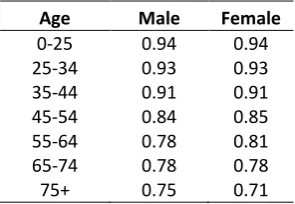
We next adjust these life expectancies for morbidity. To do this we adjust for age and sex by applying the relevant weights from the published EQ-5D Norms (Kind, Hardman, & Macran, 1999) for each age range (reproduced in Table III) and aggregate to give and age and sex adjusted QALE. Taking the example of a male in the least deprived IMD quintile group (Q1) we can read from Table II that their estimated life expectancy is 80.4 years. Using the weights in Table III we estimate the QALE for individuals in this subgroup as:
24*0.94 + (35-25)*0.93 + (45-35)*0.91 + (55-45)*0.84 + (65-55)*0.78 + (75-65)* 0.78 + (80.5-75)*0.75 = 69.8 QALYs
Table III. QALY weights by age and sex based on EQ-5D norms
Age Male Female
0-25 0.94 0.94
25-34 0.93 0.93
35-44 0.91 0.91
45-54 0.84 0.85
55-64 0.78 0.81
65-74 0.78 0.78
75+ 0.75 0.71
[image:11.595.224.372.550.652.2]Table IV. Using LE and DFLE to calculate QALE adjustment factors by IMD
Sex
Deprivation (IMD
Quintile) LE DFLE Ratio DFLE/LE
QALE Adjustment Factor
Male Q1 (Least Deprived) 80.0 67.3 0.84 1.03
Q2 78.6 64.3 0.82 1.00
Q3 77.3 63.4 0.82 1.00
Q4 75.4 59.7 0.79 0.96
Q5 (Most Deprived) 72.2 54.2 0.75 0.91
Female Q1 (Least Deprived) 83.2 67.8 0.81 1.02
Q2 82.3 65.7 0.80 1.00
Q3 81.5 64.9 0.80 1.00
Q4 80.1 61.8 0.77 0.97
Q5 (Most Deprived) 77.9 57.2 0.73 0.92
Applying the adjustment factor to our QALE estimate for our male from IMD Q1 gives a refined QALE estimate taking into account area level deprivation of:
69.8 * 1.03 = 72 QALYs
[image:12.595.177.419.356.496.2]Similar calculations for the other subgroups yield the QALE estimates in Table V.
Table V. QALE by sex and deprivation
Sex Deprivation (IMD Quintile) QALE
Male Q1 (Least Deprived) 72.2
Q2 70.5
Q3 69.1
Q4 66.6
Q5 (Most Deprived) 60.2
Female Q1 (Least Deprived) 74.8
Q2 73.1
Q3 71.8
Q4 69.2
Q5 (Most Deprived) 63.2
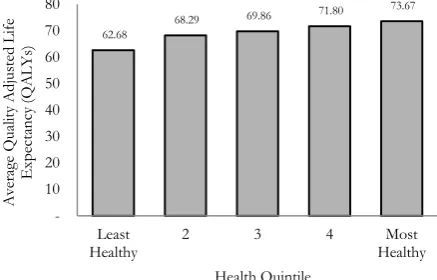
Ordering the subgroups by QALE from least healthy to most healthy and adjusting for the size of each subgroup we are able to create a population distribution of QALE at birth taking into account differential mortality and morbidity by age, sex and area level deprivation. A summary of this QALE distribution by health quintile is shown in Figure 1. This forms the baseline health distribution that we will use in our analysis.
Figure 1: Baseline health distribution
62.68
68.29 69.86 71.80
73.67 10 20 30 40 50 60 70 80 Least Healthy
2 3 4 Most
[image:12.595.187.406.599.739.2]2.1.2 Estimating the distribution of health changes due to the interventions
In order to evaluate changes in the baseline health distribution that could be attributed to the use of alternative interventions, it is necessary to know how the costs and effects of the intervention differ between the relevant subgroups, and how the opportunity costs of any change in resource use differ by those same subgroups.
Having estimated a baseline health distribution we next turn to modelling how this health distribution is impacted by the BSCP and alternative ways of promoting increased uptake of the BSCP. We do this using an existing cost effectiveness model of the BSCP that simulates the natural history of CRC and the impact of screening and treatment on this natural history (Whyte & Stevens, 2011; Tappenden et al., 2007). We adapt the model to look at the distributional health impacts of four different screening strategies:
I. N “
II. “ “ BC“P
III. T “ ng plus a targeted enhanced reminder letter (personal GP
signed letter and tailored information package) sent only to those living in the most income deprived small areas (IMD4 and IMD5) as well as to those living in areas with the highest proportion of inhabitants from the Indian Subcontinent (IS5).
IV. U “ GP
endorsed reminder letter to all eligible patients).
Impacts are first estimated by subgroup and then combined to evaluate the impact of the screening strategies on the overall social distribution of health.
There are a number of parameters in the model that can vary by subgroup, including:
1. Disease prevalence, severity, mortality rate and natural history - we assume in our case study that bowel cancer specific parameters are constant across our population subgroups. The evidence available (National Cancer Intelligence Network, 2004) broadly supports this assumption, though more detailed data at the subgroup level would be required to validate this assumption.
2. Uptake of the intervention the impact of gFOBT uptake by subgroup is the key difference between the various implementations of the screening programme. We discuss in detail below how this parameter is estimated for each subgroup. We also estimate the uptake of follow up colonoscopy by subgroup for those people that are invited back for further investigation after being screened.
3. Direct costs associated with the intervention - we assume the direct costs related to treating a given stage of bowel cancer do not vary by subgroup (though the chance of incurring these costs and the screening related costs by subgroup may vary under the different implementations of the screening programme). This seems to be a plausible assumption in the absence of more detailed cost data at the subgroup level.
4. Opportunity costs from displaced activities - Opportunity costs are in the base case analysis assumed to be shared equally among all population subgroups, this assumption is explored in sensitivity analyses discussed later in this tutorial.
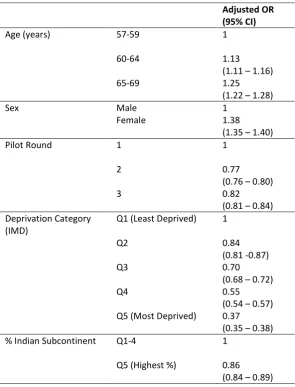
Quality adjustment of health gains to reflect morbidity we apply the subgroup specific adjustments to quality adjust health gains resulting from the screening programme in a similar manner to that which they were applied to estimate the baseline health distribution. The population QALE distribution under no screening corresponds to our baseline health distribution as calculated in the previous section. In our analysis of the BSCP we include an additional variable area level proportion of population from the Indian Subcontinent (IS) which we were unable to incorporate into our estimation of the baseline health distribution. We assume that this IS variable is distributed independently of IMD and sex, and that it has no independent effect on baseline QALE i.e. subgroups are adjusted for other cause mortality and quality adjusted only according to their IMD and sex and these adjustments are not effected by their IS. We next adjust the BSCP uptake parameters by subgroup. Table VI shows logistic regression results looking at gFOBT uptake in the three rounds of the BCSP pilot (Weller, 2009). We use this data in combination with the proportion of invitees in each category by variable, also reported in the pilot evaluation, to get weighted average odds ratios (OR) for uptake that can be applied in the model.
Table VI. Regression results of gFOBT uptake from evaluation of BCSP pilot
Adjusted OR (95% CI)
Age (years) 57-59 1
60-64 1.13
(1.11 1.16)
65-69 1.25
(1.22 1.28)
Sex Male 1
Female 1.38
(1.35 1.40)
Pilot Round 1 1
2 0.77
(0.76 0.80)
3 0.82
(0.81 0.84) Deprivation Category
(IMD)
Q1 (Least Deprived) 1
Q2 0.84
(0.81 -0.87)
Q3 0.70
(0.68 0.72)
Q4 0.55
(0.54 0.57) Q5 (Most Deprived) 0.37
(0.35 0.38)
% Indian Subcontinent Q1-4 1
Q5 (Highest %) 0.86
(0.84 0.89)
OR = 0.34/(1-0.34) * (1.38 /0.82) * 1.13 * 0.86 * (1/0.37) * (1/0.86) = 2.71
P = OR/(1+OR) = 0.73
[image:15.595.93.502.244.530.2]A similar regression analysis was reported analysing the effect of these same variables on the uptake of follow up colonoscopy. Data were also published in the pilot study evaluation regarding the numbers of people in each category for each variable in the study. However, cross-tabulations or correlations between the variables were not available and we therefore assumed that each variable was independently distributed to calculate the proportion of the population in each subgroup. Table VII shows our calculated gFOBT uptake, follow up colonoscopy uptake, and the proportion of the population by each subgroup.
Table VII. gFOBT uptake, follow up colonoscopy uptake and proportion of population by subgroup
Sex % Indian Sub-Continent (IS)
Deprivation (IMD Quintile)
gFOBT Uptake (%)
Colonoscopy Uptake (%)
Population Proportion (%)
Male Q1-4 Q1 (Least Deprived) 66 86 6
Q2 62 84 9
Q3 58 80 10
Q4 52 79 8
Q5 (Most Deprived) 42 77 6
Q5 (Highest) Q1 (Least Deprived) 63 87 1
Q2 59 85 2
Q3 54 81 3
Q4 48 79 2
Q5 (Most Deprived) 38 75 2
Female Q1-4 Q1 (Least Deprived) 73 85 6
Q2 70 83 9
Q3 66 79 10
Q4 60 77 8
Q5 (Most Deprived) 50 76 6
Q5 (Highest) Q1 (Least Deprived) 70 86 1
Q2 66 83 2
Q3 62 79 3
Q4 56 78 2
Q5 (Most Deprived) 46 76 2
Using these parameters in the model provides the total costs and health gains due to the BSCP under the standard screening approach.
We next turn to modelling the remaining two implementations of the screening programme. Both implementations augment the standard screening programme with additional reminders. We derive indicative estimates of costs and impacts on screening uptake of these reminder strategies from similar interventions studied in the screening literature (Shankaran et al., 2007; Hewitson et al., 2011), applying plausible exchange rates and inflation rates to the figures to get costs and assuming all subgroups receiving the interventions have equal additive increases in uptake. The values used in the model for costs and impacts on gFOBT uptake for each of the strategies are given in Table VIII.
Table VIII. Costs and impact on gFOBT uptake of reminder strategies
Strategy Cost per recipient Increase in gFOBT uptake per recipient Universal
reminder Targeted
£3.50 6%
[image:15.595.115.469.703.763.2]In order to estimate total costs and health effects the model is evaluated for a representative cohort of the population in our case a cohort of 1 million 30 year olds, as was used in the original analysis of the BSCP in the model we inherited. The size of each subgroup is given by the population proportions calculated in Table VII. We sum the costs across all subgroups, and convert these to health opportunity costs using a threshold value of £20,000 per QALY. These health opportunity costs are then apportioned equally to each individual in the population allowing the model to characterise net health gains in each subgroup. For example, the total costs for the standard screening programme over the lifetime of the cohort of 1 million patients came to £72 million. Converting this to health opportunity costs at the rate of £20,000 per QALY gives us 3,600 QALYs of health opportunity costs. Women who live in areas with a low percentage of the population from the Indian Subcontinent (IS Q1-4), and which also fall within deprivation quintile IMD Q3, make up 10% of the population. So we allocate 10% of this total health opportunity cost to them i.e. 360 QALYs. This is then subtracted from the total health gains due to the BCSP in this subgroup to give the net health effect of the BCSP on this subgroup.
[image:16.595.80.515.341.710.2]The assumption of equally distributed opportunity cost is convenient, but not evidence based. So we explore alternative assumptions in sensitivity analysis, focusing on two extreme cases where all opportunity costs are allocated to the least healthy and the healthiest subgroups, respectively.
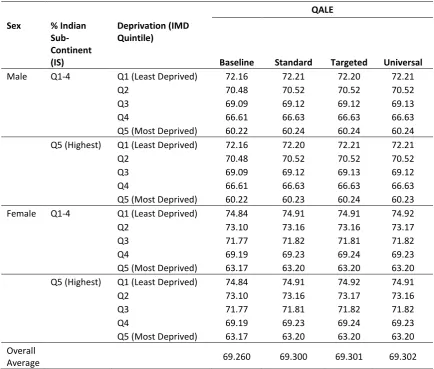
Table IX. QALE distribution by subgroup under each strategy
QALE
Sex % Indian Sub-Continent (IS)
Deprivation (IMD Quintile)
Baseline Standard Targeted Universal
Male Q1-4 Q1 (Least Deprived) 72.16 72.21 72.20 72.21
Q2 70.48 70.52 70.52 70.52
Q3 69.09 69.12 69.12 69.13
Q4 66.61 66.63 66.63 66.63
Q5 (Most Deprived) 60.22 60.24 60.24 60.24
Q5 (Highest) Q1 (Least Deprived) 72.16 72.20 72.21 72.21
Q2 70.48 70.52 70.52 70.52
Q3 69.09 69.12 69.13 69.12
Q4 66.61 66.63 66.63 66.63
Q5 (Most Deprived) 60.22 60.23 60.24 60.23
Female Q1-4 Q1 (Least Deprived) 74.84 74.91 74.91 74.92
Q2 73.10 73.16 73.16 73.17
Q3 71.77 71.82 71.81 71.82
Q4 69.19 69.23 69.24 69.23
Q5 (Most Deprived) 63.17 63.20 63.20 63.20
Q5 (Highest) Q1 (Least Deprived) 74.84 74.91 74.92 74.91
Q2 73.10 73.16 73.17 73.16
Q3 71.77 71.81 71.82 71.82
Q4 69.19 69.23 69.24 69.23
Q5 (Most Deprived) 63.17 63.20 63.20 63.20
Overall
Average 69.260 69.300 69.301 69.302
variables are dealt with in the PSA are given in Table X. All the results presented are produced by running the model probabilistically and averaging over 1000 iterations of the model.
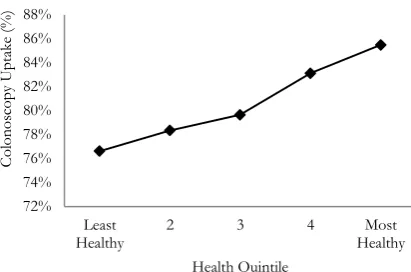
[image:17.595.72.283.200.343.2]The resulting health distributions estimated for each screening implementation are described below. Figure 2a shows the gFOBT uptake by health quintile for each strategy and Figure 2b shows the colonoscopy uptake by health quintile. QALE for each subgroup calculated from our adjusted model is given in Table IX and these are presented for our cohort by health quintile in Figure 3a and Figure 3b allowing us to better appreciate the relative impacts of the strategies.
[image:17.595.309.515.204.340.2]Figure 2a: gFOBT uptake distribution by strategy Figure 2b: colonoscopy uptake distribution
[image:17.595.82.515.395.539.2]Figure 3a: Health compared to no screening (per million of population invited for screened)
[image:17.595.297.515.398.535.2]Figure 3b: Health compared to standard screening (per million of population invited for screening)
Table X. Distributions and parameter values used in PSA for additional parameters added to model
Parameter Explanation
gFOBT and colonoscopy uptake
Uncertainty on these calculated in PSA assuming ln(OR) distributed
normally. The variance covariance matrices for the uptake regressions were not available to us so we drew each coefficient independently and
combined to create uptake probabilities.
Mortality rates Adjusted for uncertainty by the underlying model.
Quality adjustment Used beta distribution with the mean and standard error values as reported in the UK EQ-5D norms.
Cost of reminders As no data was given on the uncertainty we assume a 10% standard error and used this to draw values from the appropriate gamma distributions. Impact of reminders on
uptake
Reported mean and standard errors values used to draw from the appropriate beta distributions.
0 2000 4000 6000 8000 10000 12000 14000 16000 Least Healthy
2 3 4 Most
Healthy In cr em en ta l P o p u la ti o n Q A L Y s C o mp ar ed t o N o Sc re en in g Health Quintile
standard targeted universal
-200 -100 0 100 200 300 400 500 600 700 800 Least Healthy
2 3 4 Most
Healthy In cr em en ta l P o p u la ti o n Q A L Y s C o mp ar ed t o St an d ar d Sc re en in g Health Quintile
targeted universal
40% 45% 50% 55% 60% 65% 70% 75% 80% Least Healthy
2 3 4 Most
Healthy gF O B T U p ta k e (% ) Health Quintile
standard targeted universal
72% 74% 76% 78% 80% 82% 84% 86% 88% Least Healthy
2 3 4 Most
[image:17.595.79.515.604.766.2]2.1.3 Adjusting for social value judgements about fair and unfair sources of inequality
The distributions of health estimated thus far represent all variation in health in the population.
H
is due to individual choice or unavoidable bad luck. In such cases the health distributions should first
[image:18.595.197.400.400.696.2]
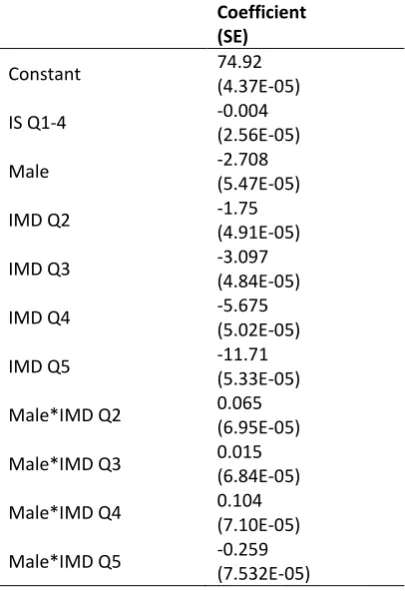
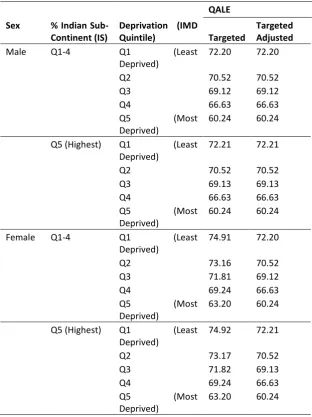
inequality. Social value judgements need to be made about whether or not health variation associated with each of the population characteristics is deemed fair. In our example we have three variables to consider: sex, IMD and ethnicity. We might make the value judgement that differences in health due to sex are fair, while differences in health due to IMD and ethnicity are unfair this is one of eight possible value judgements that we can make on fairness in this example. One way of adjusting our modelled health distributions for this value judgement is by using direct standardisation (Fleurbaey & Schokkaert, 2009). To do this we run a regression on our QALE distribution weighting the subgroups by the proportion of the population they represent to find the association between each variable and QALE. An example of such a regression is given in Table XI. We then use reference values for those variables deemed fair (i.e. sex in this case) while leaving the other variables to take the values they have in the relevant subgroups and predict out an adjusted QALE distribution. In this example we use male as the reference value for sex and predict out the QALE distribution as shown in Table XII. This distribution represents only the variation in health deemed unfair by the social value judgement made. Reference values used in the adjustment process are typically population averages for continuous variables while for categorical variables the most commonly occurring category is typically used with sensitivity analysis performed on the impact of alternative choices of reference category.
Table XI. Fairness adjustment regression
Coefficient (SE)
Constant 74.92
(4.37E-05)
IS Q1-4 -0.004
(2.56E-05)
Male -2.708
(5.47E-05)
IMD Q2 -1.75
(4.91E-05)
IMD Q3 -3.097
(4.84E-05)
IMD Q4 -5.675
(5.02E-05)
IMD Q5 -11.71
(5.33E-05)
Male*IMD Q2 0.065
(6.95E-05)
Male*IMD Q3 0.015
(6.84E-05)
Male*IMD Q4 0.104
(7.10E-05)
Male*IMD Q5 -0.259
Table XII. Fairness adjusted health distribution reference sex = male
QALE
Sex % Indian Sub-Continent (IS)
Deprivation (IMD
Quintile) Targeted
Targeted Adjusted
Male Q1-4 Q1 (Least
Deprived)
72.20 72.20
Q2 70.52 70.52
Q3 69.12 69.12
Q4 66.63 66.63
Q5 (Most
Deprived)
60.24 60.24
Q5 (Highest) Q1 (Least
Deprived)
72.21 72.21
Q2 70.52 70.52
Q3 69.13 69.13
Q4 66.63 66.63
Q5 (Most
Deprived)
60.24 60.24
Female Q1-4 Q1 (Least
Deprived)
74.91 72.20
Q2 73.16 70.52
Q3 71.81 69.12
Q4 69.24 66.63
Q5 (Most
Deprived)
63.20 60.24
Q5 (Highest) Q1 (Least
Deprived)
74.92 72.21
Q2 73.17 70.52
Q3 71.82 69.13
Q4 69.24 66.63
Q5 (Most
Deprived)
63.20 60.24
2.2
Stage B: Evaluating Social Distributions of Health
2.2.1 Comparing interventions in terms of total health and unfair health inequality
Table XIII. Inequality measures calculated for four screening strategies
Relative Inequality Indices no screening standard targeted reminder
universal reminder
Relative Gap Index (ratio) 0.17527* 0.17592 0.17586 0.17596
Relative Index of Inequality (RII) 0.18607* 0.18674 0.18668 0.18678
Gini Index 0.03101* 0.03112 0.03111 0.03113
A I 0.00171* 0.00172 0.00172 0.00172
A I 0.01330* 0.01337 0.01337 0.01338
A I 0.06253* 0.06281 0.06279 0.06283
Absolute Inequality Indices no screening standard targeted reminder
universal reminder
Absolute Gap Index (range) 10.98604* 11.03064 11.02726 11.03325
Slope index of inequality (SII) 12.88747* 12.94123 12.93691 12.94438
K I 0.20281* 0.20430 0.20416 0.20439
K I 0.87801* 0.88429 0.88371 0.88467
K I 4.56391* 4.58739 4.58587 4.58883
* indicates the most equal strategy
2.2.2 Ranking interventions using dominance rules
The first step in comparing distributions is looking to commonly used distributional dominance rules, as these allow strategies to be ranked with minimal restriction to the form of the underlying social welfare function. In terms of standard economic dominance rules we can note from Table IX that no-screening and standard no-screening are strictly dominated in the space of QALE by the universal reminder strategy that is, no sex-IMD-ethnicity subgroup is less healthy and at least one subgroup is healthier. However, this rule does not account for the level of inequality. When ranking distributions based on mean health and the level of health inequality, it is possible to use alternative economic dominance rules provided by Atkinson (Atkinson, 1970) and Shorrocks (Shorrocks, 1983). These dominance rules apply when mean health is higher and inequality is lower for almost any measure of inequality. Both rules are based around the Lorenz curve (Lorenz, 1905), a tool to analyse relative inequality constructed for health distributions by ordering the population from least healthy to most healthy and plotting the cumulative proportion of population health against the
A L
distributions; this means that the Lorenz curves for the distributions do not cross and the more equal distribution has at least as much mean health as the less equal distribution. In other words, a distribution is dominated if it has higher inequality and the same or lower amount of mean health.
On these criteria the standard screening strategy is dominated by the targete “
theorem tests for generalised Lorenz dominance, wherein the Lorenz curve is multiplied by the mean health. A distribution is dominated if the generalised Lorenz curve lies wholly below that of an alternative intervention. Under this criterion, both the targeted and universal reminder strategies dominate the no screening option. This leaves us to compare the universal reminder and targeted reminder strategies. While the universal reminder produces a higher average QALE overall and benefits the less deprived quintiles more, the targeted reminder is the more equal strategy on every measure listed in Table XIII and benefits the most deprived quintiles more. In our example, the
generalised Lorenz curves for these two distributions cros “
2.2.3 Analysing trade-offs between total health and health inequality using social welfare indices
Having used distributional dominance to eliminate no screening and standard screening, in order to rank the remaining two strategies it is necessary more fully to specify an underlying social welfare function. A number of alternative social welfare indices have been proposed that could be used to characterise the dual objectives of increasing total health and reducing health inequality. A common feature of such functions is the need to specify the nature of and level (or value) of inequality aversion. The inequality aversion parameters in these functions describe the trade-off between total health and the level of health inequality, i.e. the amount of total health that a decision maker would be willing to sacrifice in order to achieve a more equal distribution. An intuitive way to depict this trade-off is to calculate for any social welfare function the equally distributed equivalent health (EDE) and compare this to the mean health offered by the distribution.
In this example we will use two social welfare indices closely linked to the dominance rules applied above: the Atkinson index (Atkinson, 1970) to evaluate the distributions in terms of relative inequality and the Kolm index (Kolm, 1976) to evaluate the distributions in terms of absolute inequality. The EDE for these social welfare indices can be calculated as follows using the inequality
aversion parameters
Atkinson Social Welfare Index: Kolm Social Welfare Index:
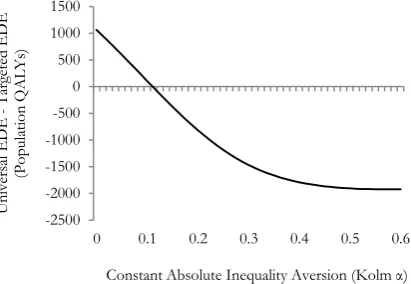
Figure 4a and Figure 4b show the difference in EDE health between the two strategies across different levels of inequality aversion for the relative and absolute social welfare indices respectively. With zero inequality aversion the EDE represents the mean health, and we see that the universal strategy offer 1000 more population QALYs compared to the targeted strategy. For
inequality aversion levels greater than
implying that the decision maker would be willing to sacrifice those 1000 population QALYs in order to achieve the lower level of inequality.
Figure 4a: Sensitivity to level of relative inequality aversion
Figure 4b: Sensitivity to level of absolute inequality aversion
2.3
Sensitivity analysis
There are a number of sensitivity analyses we can run to explore the impact of making alternative assumptions in our modelling on our choice of preferred strategy. Tables XIV and XV present the results, respectively, of exploring (1) the impacts of alternative assumptions around the distribution
-2500 -2000 -1500 -1000 -500 0 500 1000 1500
0 4 8 12 16 20 24 28 32 36 40
U n iv er sa l E D E T ar ge te d E D E (P o p u la ti o n Q A L Y s)
Constant Relative Inequality Aversion (Atkinson )
-2500 -2000 -1500 -1000 -500 0 500 1000 1500
0 0.1 0.2 0.3 0.4 0.5 0.6
U n iv er sa l E D E T ar ge te d E D E (P o p u la ti o n Q A L Y s)
[image:21.595.314.520.502.644.2]of opportunity costs, and (2) the impacts of alternative social value judgements about which inequalities are considered unfair.
Table XIV. Sensitivity to alternative opportunity cost distributions All opportunity cost borne by
least healthy subgroup
All opportunity cost borne by healthiest subgroup Social Welfare
Indices
no
screening standard
targeted reminder
universal reminder
targeted reminder
universal reminder
Mean Health 69.25969 69.30006 69.30127 69.30233* 69.30127 69.30233*
Atkinson EDE
69.14152 69.18056 69.18147 69.18252* 69.18286 69.18373*
Atkinson EDE
68.33888 68.36800* 68.36610 68.36734 68.37799* 68.37769
Atkinson EDE
64.92865* 64.91468 64.89302 64.89892 64.95627* 64.95350
Kolm EDE
69.05688 69.09486 69.09556 69.09660* 69.09793 69.09866*
K EDE 68.38168 68.41112* 68.40958 68.41074 68.42046* 68.42020
K EDE 64.69578* 64.68086 64.65951 64.66532 64.72148* 64.71879
* indicates the strategy yielding the highest social welfare
Table XV. Sensitivity to alternative social value judgements
Social Value Judgment Preferred Strategy based on Social Welfare Index
IMD
Ethnic
Diversity Sex
Atkinson
EDE
Atkinson
EDE
Atkinson EDE
Kolm EDE Kolm EDE Kolm EDE
Fair Fair Fair U U U U U U
Fair Unfair Fair U U U U U U
Fair Fair Unfair U U U U U U
Fair Unfair Unfair U U U U U U
Unfair Fair Fair U U T U U T
Unfair Unfair Fair U U T U U T
Unfair Fair Unfair U U T U U T
Unfair Unfair Unfair U U T U U T
U = universal reminder, T = targeted reminder
[image:22.595.65.535.360.511.2]3.
Conclusion
DCEA is a framework for incorporating health inequality concerns into the cost-effectiveness analysis of health care interventions. It aims to help cost effectiveness analysts provide decision makers with useful quantitative information about the health inequality impacts of health care interventions, and the nature and size of trade-offs between the dual objectives of improving total health and reducing health inequality. It also aims to help cost effectiveness analysts accommodate different value judgements about health inequality made by different decision makers and stakeholders.
Social value judgements about health inequality are complex, context-dependent and contestable. For this reason, DCEA does not prescribe in advance any particular set of social value judgements about health inequality. A number of social value judgements need to be made when implementing the DCEA framework, in particular regarding which dimensions of inequality are deemed unfair and the nature and strength of inequality aversion. The framework makes these social value judgements explicit and transparent, and lends itself well to checking the sensitivity of conclusions based upon alternative plausible social value judgements. DCEA thus aims to provide decision makers with useful quantitative information about health inequality impacts that can help to inform a deliberative decision making process, by showing how different social value judgements might or might not lead to different conclusions.
DCEA is intended to be a general and flexible analytical framework that allows a diverse range of specific methods and techniques to be applied at different stages of the analysis. In particular, the evaluation stage can in principle employ any kind of equity weighting and/or multi-criteria decision analysis to analyse trade-offs between improving total health and reducing health inequality, and is not restricted to application of the specific Atkinson and Kolm social welfare functions described in this tutorial.
References
Atkinson, A. B. (1970). On the measurement of inequality. Journal of Economic Theory, 2(3), 244
263. Retrieved from http://faculty.ucr.edu/~jorgea/econ261/atkinson_inequality.pdf
Fleurbaey, M., & Schokkaert, E. (2009). Unfair inequalities in health and health care. Journal of
Health Economics, 28(1), 73 90. doi:10.1016/j.jhealeco.2008.07.016
Hewitson, P., Ward, a M., Heneghan, C., Halloran, S. P., & Mant, D. (2011). Primary care endorsement letter and a patient leaflet to improve participation in colorectal cancer screening:
results of a factorial randomised trial. British Journal of Cancer, 105(4), 475 80.
doi:10.1038/bjc.2011.255.
Johnson, B., & Blackwell, L. (2007). Review of methods for estimating life expectancy by social class
using the ONS Longitudinal Study (pp. 28 36).
Kind, P., Hardman, G., & Macran, S. (1999). UK Population Norms for EQ-5D. Retrieved from
http://www.york.ac.uk/media/che/documents/papers/discussionpapers/CHE Discussion Paper 172.pdf
Kolm, S.-C. (1976). Unequal inequalities. I. Journal of Economic Theory, 12(3), 416 442.
doi:10.1016/0022-0531(76)90037-5.
Lorenz, M. O. (1905). Methods of Measuring the Concentration of Wealth. Publications of the
American Statistical Association, 9(70), 209 212.
National Cancer Intelligence Network. (2004). Cancer Incidence by Deprivation, 1995-2004 (pp.
1995 2004). Retrieved from http://www.ncin.org.uk/view.aspx?rid=73
ONS. (2007). Longitudinal Study age-specific mortality data 1972-2005 (supplementary tables).
Retrieved from
http://www.ons.gov.uk/ons/rel/health-ineq/health-inequalities/trends-in-life- expectancy-by-social-class-1972-2005/longitudinal-study-age-specific-mortality-data-1972-2005--supplementary-tables-.xls
ONS. (2013). Inequalities in disability-free life expectancy by area deprivation: England, 2001-04 to
2007-10. Retrieved from http://www.ons.gov.uk/ons/rel/disability-and-health-measurement/sub- national-health-expectancies/inequality-in-disability-free-life-expectancy-by-area-deprivation--england--2003-06-and-2007-10/rft-inequalities-in-disability.xls
Shankaran, V., McKoy, J. M., Dandade, N., Nonzee, N., Tigue, C. a, Bennett, C. L., & Denberg, T. D. (2007). Costs and cost-effectiveness of a low-intensity patient-directed intervention to promote
colorectal cancer screening. Journal of Clinical O Official Journal of the American Society of
Clinical Oncology, 25(33), 5248 53. doi:10.1200/JCO.2007.13.4098.
Shorrocks, A. F. (1983). Ranking Income Distributions. Economica, 50(197), 3. doi:10.2307/2554117
Tappenden, P., Chilcott, J., Eggington, S., Patnick, J., Sakai, H., & Karnon, J. (2007). Option appraisal
of population-based colorectal cancer screening programmes in England. Gut, 56(5), 677 84.
Weller, D. (2009). Evaluation of the 3rd Round of the English bowel cancer screening Pilot Report to
the NHS Cancer Screening Programmes (Vol. 44). Retrieved from
http://www.cancerscreening.nhs.uk/bowel/pilot-3rd-round-evaluation.pdf
Whyte, S., & Stevens, J. (2011). Re-appraisal of the options for colorectal cancer screening Report for
the NHS Bowel Cancer Screening Programme, 1 61. Retrieved from