This is a repository copy of
A Rule Chaining Architecture Using a Correlation Matrix
Memory
.
White Rose Research Online URL for this paper:
http://eprints.whiterose.ac.uk/88231/
Version: Submitted Version
Book Section:
Austin, Jim orcid.org/0000-0001-5762-8614, Hobson, Stephen John, Burles, Nathan John
orcid.org/0000-0003-3030-1675 et al. (1 more author) (2012) A Rule Chaining Architecture
Using a Correlation Matrix Memory. In: Artificial Neural Networks and Machine Learning –
ICANN 2012. Lecture Notes in Computer Science . SPRINGER-VERLAG BERLIN , CHE ,
pp. 49-56.
https://doi.org/10.1007/978-3-642-33269-2_7
[email protected] https://eprints.whiterose.ac.uk/
Reuse
Items deposited in White Rose Research Online are protected by copyright, with all rights reserved unless indicated otherwise. They may be downloaded and/or printed for private study, or other acts as permitted by national copyright laws. The publisher or other rights holders may allow further reproduction and re-use of the full text version. This is indicated by the licence information on the White Rose Research Online record for the item.
Takedown
If you consider content in White Rose Research Online to be in breach of UK law, please notify us by
Using a Correlation Matrix Memory
James Austin, Stephen Hobson, Nathan Burles, and Simon O’Keefe
Advanced Computer Architectures Group, Department of Computer Science,
University of York, York, YO10 5GH, UK
{austin,stephen,nburles,sok}@cs.york.ac.uk http://www.cs.york.ac.uk
Abstract. This paper describes an architecture based on superimposed distributed representations and distributed associative memories which is capable of performing rule chaining. The use of a distributed repre-sentation allows the system to utilise memory efficiently, and the use
of superposition reduces the time complexity of a tree search to O(d),
where d is the depth of the tree. Our experimental results show that
the architecture is capable of rule chaining effectively, but that further investigation is needed to address capacity considerations.
Keywords: rule chaining, correlation matrix memory, associative mem-ory, distributed representation, parallel distributed computation
1
Introduction
Rule chaining is commonly used in artificial intelligence, for searching a set of rules to determine if there is a path from the starting state to the goal state. This paper presents the Associative Rule Chaining Architecture (ARCA), which performs rule chaining using correlation matrix memories (CMMs)—a type of simple associative neural network [1]. Biologically inspired systems can provide effective alternatives to classical systems. Rule chaining is thought to be per-formed by the brain, and so an approach that uses neural networks has the potential to efficiently solve this problem.
2 A Rule Chaining Architecture Using a Correlation Matrix Memory
1.1 Rule Chaining
Rule chaining may be approached using forward chaining or backward chaining; the choice of which to use is application specific. The approach we describe here uses forward chaining, although there is no reason that the same techniques could not be used to implement backward chaining.
In forward chaining, starting with an initial set of conditions, all of the rules are searched to find one for which the antecedents match the conditions. The consequents of that rule can then be added to the current state, and the state is checked to decide if the goal has been reached. If the goal state is not yet reached, then the system will iterate. Finally, if all of the branches have been searched without finding the goal state, then the search will complete as a failure. A common way to implement such a search would be with depth-first search. This technique has time complexityO(bd), where b is the branching factor and d is the depth of the tree. Our technique offers the possibility of significantly improving on this complexity.
1.2 Correlation Matrix Memories (CMMs)
The CMM is a simple neural network consisting of a single layer of weights, where the input and output neurons are fully connected. In this work a sub-class of CMMs is used, known as binary CMMs [5], where these weights are binary.
Binary CMMs use simple Hebbian learning [6]. Learning to associate one binary vector with another is thus an efficient operation, and requires only local updates to the CMM. This training is formalised in Equation 1, whereM is the resulting CMM (matrix of weights),xis the set of input vectors, y is the set of output vectors, andnis the number of training pairs.
M =
n
X
i=1
xTiyi (1)
A recall operation is performed as shown in Equation 2. It is essentially a matrix multiplication between the transposed input vector and the CMM. The matrix multiplication produces a non-binary output vector, to which a threshold functionf must be applied in order to produce the final output vector.
y=f(xTM) (2)
There are various thresholding functions that may be applied during recall. The choice of which function to use depends on the application, and on the data representation used. Willshaw thresholding is used in ARCA, where any output bit with a value at least equal to the (fixed) trained input weight is set to one [5] (the weight of a vector is the number of bits within it that are set to one).
2
Associative Rule Chaining
challenge is thus to maintain the separation of each state throughout the search, without needing to separate out the distributed patterns.
Table 1. An example set of rules with a binary rule vector allocated to each, and tokens with their binary representations
Rule Rule vector Token Binary representation
r0:a→b 10100 a 1001000
r1:a→c 01010 b 0100100
r2:b→p 10001 c 0010001
r3:c→q 01001 p 0100001
q 0010100
As an example, consider a single CMM containing the rules given in Table 1. In a conventional system, the search would evaluate each of these rules in turn. When using a CMM, however, input of token a would match two rules simul-taneously and result in both b and c being superimposed in the output. After applying a threshold, the output would be 0110101—the superposition of vectors
b andc. However, given this encoding, this is ambiguous as it could instead be the superposition of vectorspandq.
2.1 Architecture
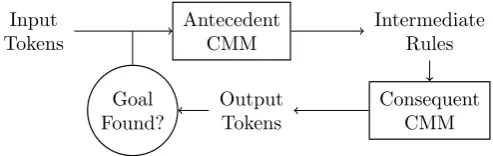
To resolve this difficulty, each rule is assigned a unique “rule vector”, existing in a separate vector space to the token vectors. ARCA separates the antecedents and consequents of the rules into two CMMs, using the rule vector to connect them. The basic rule chaining is performed by a simple state machine formed with two CMMs, as shown in Fig. 1.
Input Tokens
Antecedent CMM
Intermediate Rules
Consequent CMM Output
Tokens Goal
Found?
Fig. 1.Block diagram of the Associative Rule Chaining Architecture (ARCA)
The first CMM is trained with the associations between the superimposed antecedents of a rule and the rule vector. This means that the rule should fire if the tokens in the head of each rule are present in an input.
4 A Rule Chaining Architecture Using a Correlation Matrix Memory
with a length equal tonr∗ntwherenrandntare the lengths of a rule and token
respectively. The associations between this tensor product and the rule vector are then stored in the CMM. This means that when a rule fires from the an-tecedent CMM, the consequent CMM will produce a tensor product containing the output tokens bound to the rule that caused them to fire.
[image:5.595.144.475.289.483.2]2.2 Recall
Fig. 2 shows the recall process performed on part of the continuing example. To begin the recall, an initial state T Pin is created by forming the tensor (outer)
product of any initial tokens with a rule vector. In the diagram we initialise the search with two tokensb andc, bound to the appropriate rules.
T Pin
r0 b r1 c r0 b r1 c
T Prule
Antecedent CMM r0 r2 r1 r3 r0 r2 r1 r3
2∗T Pout1
C on se q u en t C M M r2 p r2 p
2∗T Pout2
r3 q
r3 q
T Poutput
S u m th en th re sh ol d r2 p r3 q
r2+r3
p+q
Fig. 2.A visualisation of the recall process within ARCA. The tensor products contain different token vectors bound to rule vectors. Each column is labelled at the top with the tokens contained within the column. The position of each column is defined by the positions of the bits set to one in the rule vector to which the token is bound, and this is labelled at the base of the column. The remainder of the tensor product consists solely of zeros. The vector weight is 2, and hence each column appears twice.
The first stage of recall is now to determine which rules are matched by the tokens in the current state. To do this, each column of T Pin is recalled from
the antecedent CMM in turn. The result of each column recall is a vector that contains the rule vectors representing any of the matched rules. The recalled vectors form the columns of an intermediary tensor productT Prule.
To continue the recall, each column ofT Prule is recalled from the consequent
is effectively a reshaped tensor product containing the consequents of a rule, bound to the rule that fired them. Therefore each recalled column will result in an entire tensor product of equal dimensions to the original input—T Pout1
andT Pout2. Note that each of these tensor products will be recalled twice, once
for each column in T Prule. We wish to reduce these to a single tensor product
ready to iterate, and so we sum them to form a non-binary tensor product before applying another threshold.
As can be seen in the diagram, any rule will appear in T Prule a number
of times equal to the weight of a rule vector. Thus, the consequents bound to that rule will appear in the same number of T Pouts. When these are summed,
the weight of a rule vector can therefore be used as a threshold to obtain the final output—a single binary tensor product. Note that in the example we can observe thatT Poutput containsp:r2 and q:r3 (where “:” means “bound to”),
precisely the result we would expect.
The final stage of recall, before the system iterates, is to check whether the search is completed. Firstly we can check whether any rules have been matched, and therefore whether the search should continue. This is achieved by checking whetherT Poutputcontains any non-zero values. IfT Poutputconsists solely of
ze-ros, then no rules have been matched and hence the search is completed without finding a goal state.
IfT Poutput is not empty, then we must check whether a goal state has been
reached. This is achieved by treating T Poutput as a CMM. The superposition
of the goal tokens is used as an input to this CMM, and the threshold set to the product of the number of goal tokens and the weight of those tokens. If the resulting binary vector contains a rule vector, then this indicates that this rule vector was bound to the goal token and so we can conclude that the goal state has been reached.
3
Time and Space Complexity
We have demonstrated that ARCA is able to search multiple branches of a tree in parallel, while maintaining separation between them. This means that the time complexity of a search becomes O(d), where d is the depth of the tree. Contrasted with a depth-first approach with a time complexity ofO(bd), where b is the branching factor, this is a notable improvement.
6 A Rule Chaining Architecture Using a Correlation Matrix Memory
Finally, it should also be noted that as the size of a CMM increases, so does the time required to perform operations on it.
4
Experiments
In order to show ARCA working on search trees, and to determine at what point the method fails, a number of experiments have been performed. ARCA has been implemented in MATLAB, and applied to a variety of problems. For each experiment a tree of rules was generated with a given depth dand maxi-mum branching factorb. These rules were then learned by the system, and rule chaining was performed on them.
The experiments have been performed over a range of values for d, b, and the memory required to implement the CMMs in ARCA, E. This allows some limited comparison between the system and a depth-first search.
Search trees were constructed in an iterative manner, beginning with the root token, which was also used as the starting token for the recall process. Further layers of the tree were then added, with the total number of layers being d. In the simple case of b = 1, this produces a chain of rules A → B, B → C, etc.
In the case of b > 1, the number of children of a given node was uniformly randomly sampled from the range [1, b]. This results in a tree with maximum branching factor b which is more realistic than one in which all nodes have exactly bchildren.
E is determined by the token and rule vector lengths nt and nr, with the
required memory being nrnt+n2rnt. To simplify the experiment, the weight
of all vectors was set to log2n (rounding down), where n is the vector length.
This value gives a sparse representation, and should provide good performance in the CMMs [7]. For each value of d, b, and E, the following experiment was performed:
1. Generate a rule tree with depthdand maximum branching factorb. 2. Train ARCA with the generated rules, with codes being generated by Baum’s
algorithm [2]. For each iteration, the starting Baum code was determined randomly.
3. Take the root of the rule tree as the starting token, and select a token in the bottom layer of the tree as the goal token.
4. Perform recall in ARCA with the given starting and goal tokens. 5. Note whether the recall was successful.
6. Repeat the previous steps 100 times.
This gives a success rate for recall in ARCA, for a given combination ofd,
! "
# $ % # $ %
& & &' &# & &$
! "
# $ % & '
( (# ($ (& ( (# ($
! " #
$ % %$ # #$ $ & &$ '
[image:8.595.161.455.109.610.2]$ $# $& $( $ $# $&
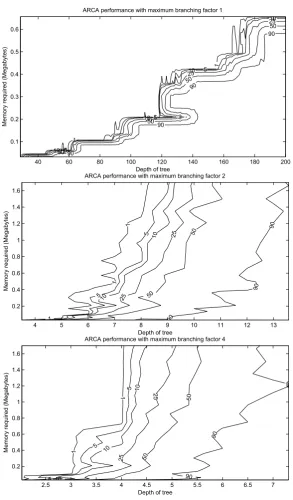
Fig. 3.Contour plots showing the recall error performance for ARCA where the branch-ing factor is 1 (top), 2 (middle), and 4 (bottom). Contours summarise the recall error at various depths and memory requirements, effectively showing the percentage of re-calls which are in error for a given size of CMM and depth of tree. Discontinuity in the
8 A Rule Chaining Architecture Using a Correlation Matrix Memory
The graphs in Fig. 3 are contour plots showing the recall error rates for the ARCA architecture for a given depth of search tree and memory requirement. They clearly demonstrate that the ARCA system is capable of performing rule chaining in a fully distributed, superimposed manner. However they also show a decrease in performance as the branching factor increases. This is to be ex-pected given the explosion in the number of rules that occurs, and is similar to that experienced by traditional methods such as depth-first search—leading to their time complexity ofO(bd). In this case, however, the explosion leads to
exponentially increasing memory requirements rather than running time.
5
Conclusions and Further Work
This paper has introduced a novel architecture capable of performing forward chaining by examining multiple branches of a tree simultaneously. Experimenta-tion has shown that the architecture is capable of rule chaining effectively, but the capacity considerations warrant further investigation.
The choice of the length of vectors used to represent tokens and rules in ARCA are very important, as these define the memory requirement. While both of these values must be large enough to allow all of the tokens and rules in the system to be represented, further work is required to understand the effect that varying the lengths separately has on recall performance. In addition, the weight chosen may not be optimal and so this needs further investigation.
Finally, in this examination of ARCA we have only considered the case where each rule has a single symbol as the antecedent; arity one rules. This allowed a clear and simple examination of the architecture, but the system will be extended to handle multiple arity rules in further work. We are considering looking into applying the technique to games, initially simple ones such as tic-tac-toe.
References
1. Kohonen, T.: Correlation Matrix Memories. In: IEEE Transactions on Computers, pp. 353–359. IEEE Computer Society, Los Alamitos (1972)
2. Baum, E.B., Moody, J., Wilczek, F.: Internal Representations for Associative Mem-ory. Biol. Cybernetics 59, 217–228 (1988)
3. Austin, J.: Parallel Distributed Computation in Vision. In: IEE Colloquium on Neural Networks for Image Processing Applications, pp. 3/1–3/3. (1992)
4. Kustrin, D., Austin, J.: Connectionist Propositional Logic: A Simple Correlation Matrix Memory Based Reasoning System. In: Emergent Neural Computational Ar-chitectures Based on Neuroscience, pp. 534–546. Springer, New York (2001) 5. Willshaw, D.J., Buneman, O.P., Longuet-Higgins, H.C.: Non-holographic
Associa-tive Memory. Nature 222, 960-962 (1969)
6. Ritter, H., Martinetz, T., Schulten, K., Barsky, D., Tesch, M., Kates, R.: Neural Computation and Self-Organizing Maps: An Introduction. Addison Wesley, Red-wood City (1992)