R E S E A R C H
Open Access
Clinical analysis of selected complement-derived
molecules in human adipose tissue
Wojciech B
ł
ogowski
1*, Marta Budkowska
2, Daria Sa
ł
ata
2, Karol Serwin
3, Barbara Do
łę
gowska
2, Marek
Ł
okaj
4,
Piotr Prowans
4and Teresa Starzy
ń
ska
1Abstract
Background:It has been suggested that action of complement cascade [CC]-derived anaphylatoxins/molecules may represent a missing link between obesity and metabolic disorders. However, to date, the direct biochemical/
immunomodulatory composition of the human AT environment remains poorly understood. In this study, we examined plasma and AT (subcutaneous and visceral/omental) levels of selected CC-derived anaphylatoxins/molecules, and adipsin as well as verified their associations with immune and stem cells chemoattractant - stromal-derived factor-1 (SDF-1). Methods:A total of 70 (35 subcutaneous and 35 omental) AT samples were obtained from patients undergoing elective surgery. Plasma and AT-derived interstitial fluid levels of C3a, C5a, C5b-9/membrane attack complex (MAC), complement factor D (adipsin) were measured using ELISA.
Results:AT levels of all examined substances were significantly lower than the corresponding levels in the plasma (in all cases P < 0.0000001). Moreover, in subcutaneous AT, robust C3a and adipsin concentrations were observed, whereas high levels of C5b-9/MAC were detected in the visceral depots. In addition, we established the correlations between analyzed molecular substances and body composition, BMI and/or the adiposity index of the examined patients. Conclusions:Our study demonstrated for the first time that significantly reduced levels of complement-derived
molecules were present in human AT than in the peripheral blood, and that these factors are associated with the metabolic status of examined individuals. Moreover, in human AT, various associations between complement-derived molecules and SDF-1 levels exist.
Keywords:Adipose tissue, Complement cascade, Obesity
Background
Human adipose tissue (AT) is a very dynamic organ that profoundly contributes to the regulation of several (patho-) physiological processes, including embryonic development, systemic endocrine/metabolic homeosta-sis, and immunomodulation. This orchestration by AT on such diverse processes may be mediated by its mo-lecular properties. For example, AT synthesizes and/or secretes numerous hormones, cytokines, and growth factors into peripheral blood, which act on an autocrine, paracrine, and/or peripheral level to influence systemic homeostasis in humans [1-4].
From the clinical standpoint, accumulation of visceral/ omental AT (central obesity) is strongly associated with presence of several metabolic abnormalities, such as glu-cose intolerance, hyperglycemia, hypertriglyceridemia
and/or other features of “metabolic syndrome”. The
exact mechanisms responsible for this link are neither fully examined nor understood. However, it has been suggested that action of various compounds of the innate immune system (mainly complement cascade [CC]-derived anaphylatoxins/molecules) may represent a missing link between obesity and metabolic disorders [5-8]. Indeed, various genetic studies have shown that animal and human AT express CC genes in different depots, and this is strongly related to the systemic metabolic status. In addition, AT is believed to be an im-portant source of selected CC-derived anaphylatoxins/ molecules and adipsin, which genetic expression seems * Correspondence:[email protected]
1
Department of Gastroenterology, Pomeranian Medical University in Szczecin, ul. Unii Lubelskiej 1, 71-252, Szczecin, Poland
Full list of author information is available at the end of the article
to differ between subcutaneous and visceral/omental depots [9-12]. Unfortunately, several translational issues still remain to be clarified; these include need for verifica-tion/analysis of: (i) the exact biochemical concentrations of complement-derived substances in the human AT en-vironment, (ii) their relation to the systemic/peripheral levels, and (iii) their potential associations with the human metabolic status/body composition.
In addition, in recent years it has become evident that AT environment may also offer potential niches for bone marrow (BM)-derived immune and/or (hematopoietic) stem/progenitor cells (SCs) [13]. This phenomenon is believed to be also supported by potential action of selected complement cascade (CC)-derived anaphylatoxins and molecules [14]. Namely, they may act as chemoattrac-tants, stimulate the release of powerful bioactive lipids and enhance homing signals of stromal-derived factor-1 (SDF-1) and its receptor (CXCR4) that are essential for the successful directing and anchoring of immune and stem cells to the target tissues [15,16]. In our previous study, we have demonstrated that SDF-1 levels in human AT are significantly lower than in plasma; higher levels of this chemoattractant are observed in visceral/omental AT, as well as, these are associated with several parameters de-scribing human metabolic status [17]. Currently, there is no data indicating, whether in human AT any associations between levels of the CC-derived substances and SDF-1 occur. Therefore, we addressed all of these issues by com-prehensively analyzing the levels of the terminal panel of CC-derived molecules (C3a, C5a, and C5b-9), and com-plement factor D (adipsin) in human subcutaneous and visceral/omental AT. Furthermore, we verified how the levels of these substances differed between lean, over-weight, and obese subjects, as well as, their associations with previously reported SDF-1 values. Our hypothesis was that different depots of human AT possess signifi-cantly different levels of CC-derived molecules and these molecules are associated with the metabolic status/body composition of an individual and SDF-1 levels.
Material and methods Patients and medical procedure
We recruited 35 healthy patients who underwent elec-tive surgery at the Department of Plastic, Endocrine and General Surgery of the Pomeranian Medical University in Szczecin between January 2011 and January 2012. Patients with signs of active inflammation, autoimmune systemic diseases, liver dysfunction, and/or current hor-monal abnormalities were excluded from the study. None of the patients were under hormonal medication, had significantly gained/lost weight in the 3 months be-fore surgery, or had evidence of metabolic diseases other than obesity. Liver disease and thyroid dysfunction were specifically excluded by biochemical workup. All patients
underwent detailed clinical phenotyping in a fasted state (12 h, overnight). Their body weight was measured in light clothing and approximated up to the nearest 0.1 kg; their height was measured using a stadiometer with
the subjects standing barefoot. Further, the subjects’
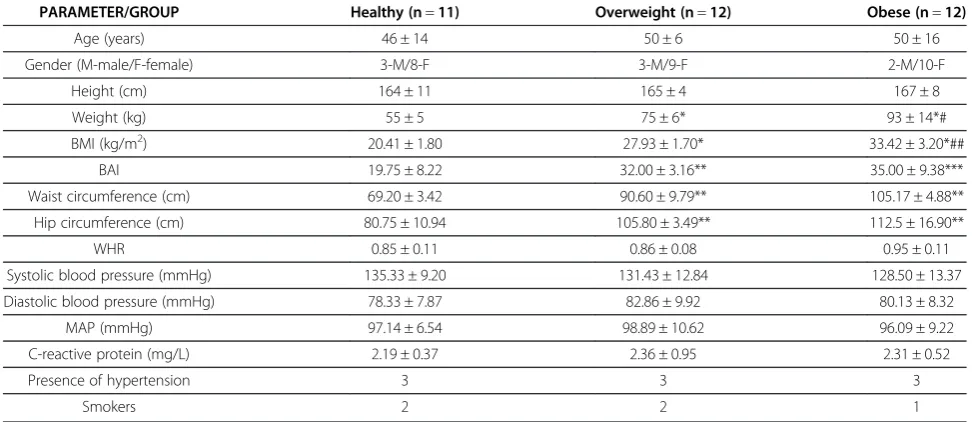
body mass and adiposity indexes (BMI and BAI, respect-ively) were calculated according to standard formulas [18]. Waist circumference (expressed in cm) was mea-sured at the narrowest point between the lowest rib and the iliac crest, and the waist-to-hip ratio (WHR) was cal-culated. Blood pressure was measured in the supine pos-ition on the right arm after rest (for at least 15 min). A standard sphygmomanometer of appropriate cuff size was used, and the first and fifth phases were recorded. Values used in this analysis were the average of 3 readings taken at 5-min intervals. In addition, all the patients under-went general biochemical blood tests. They were classified according to their BMI values as lean (19–25 kg/m2), overweight (25–30 kg/m2), or obese (≥30 kg/m2). General characteristics of the study subjects, together with a statis-tical comparison of their features between the analyzed groups, are presented in Table 1.
AT samples were collected from subcutaneous and omental/visceral depots during elective surgical proce-dures (laparoscopic cholecystectomy). Both AT samples were obtained from the abdomen using sterile surgical equipment, without diathermy/coagulation and with par-ticular attention to avoid contamination with blood. The subcutaneous samples were taken from the upper midline of the abdomen, halfway between the xiphoid process and the umbilicus. The intra-abdominal AT samples were collected from the major omentum in the upper right quadrant of the abdominal cavity, in close proximity to the front wall of the liver. AT samples were excised at the beginning of the operations, placed on ice, and trans-ported to the laboratory. The time between the excision of an AT sample, its evacuation from the abdominal walls, and its placement on ice was consistent and never longer than 35 s.
Biochemical assays of complement-derived substances and adipsin in plasma and fat interstitial fluid (FIF) Blood samples were collected from every patient in a fasted state (12 h, overnight), and these samples were
immediately centrifuged (10 min, 1000 ×g, 4°C). The
plasma obtained was transferred to a fresh tube and stored at−80°C until further assessment.
In order to extract FIF, AT samples were processed according to previously described methods and proto-cols [4,17,19,20]. Plasma and AT-derived FIF
concentra-tions of complement-derived anaphylatoxins and
ELISA kits (distributed by BD Bioscience and R&D Systems) according to the manufacturers’instructions.
Statistical analysis
For comparison of the mean parameter values between the
examined groups Mann–Whitney test was performed.
Differences between concentrations of analyzed parameters in different AT depots, as well as, between plasma and selected AT fraction were assessed by Wilocoxon’s paired test. The strength of correlations between examined clinical and molecular parameters was calculated using Spearman’s rank test. Statistical analysis was performed using SPSS statistical analysis software. Statistical significance was defined when p values were less than 0.05.
This study protocol was approved by the Bioethical Committee of the Pomeranian Medical University in Szczecin, and patients provided informed written con-sent for participation after the purpose of the study was explained to them.
Results
In our study significant differences were found between lean individuals and overweight/obese patients in terms of weight, BMI, BAI, as well as, waist and hip circumfer-ence values (Table 1). Moreover, our obese patients had significantly higher values of weight and BMI parameters than subjects classified to overweight group.
Plasma and AT levels of the terminal panel of complement anaphylatoxins and molecules (C3a, C5a, C5b-9/MAC)
Complement C3a, C5a, and C5b-9/MAC levels are depicted on Figure 1. Our study demonstrated that no
statistically significant differences occur in terms of plasma complement C3a, C5a and C5b-9/MAC levels between lean, overweight and obese individuals. However, there was a tendency towards decrease in systemic C3a levels in obese patients (P = 0.09 in comparison to healthy and overweight group). Nevertheless, AT concentrations of C3a were significantly lower than those circulating in peripheral blood (P < 0.0000001 in all cases), and were around 2-times higher in subcutaneous than visceral depots in all examined groups (Figure 1a). In comparison to lean and overweight subjects, significantly higher levels of this complement anaphylatoxin were found in subcuta-neous fraction of adipose tissue derived from obese indivi-duals (P < 0.05 for both). Interestingly, we have observed a set of significant correlations between subcutaneous C3a levels and clinical features of examined patients, such as BMI (r = 0.31, P < 0.05), waist and hip circumference (r = 0.44 and r = 0.47, P < 0.05 respectively).
Relatively analogical results were found in terms of com-plement C5a analysis (Figure 1b). Namely, AT levels of this anaphylatoxin were significantly lower than those observed in peripheral blood; however, in all groups
simi-lar concentrations were observed in both–subcutaneous
and visceral adipose depots. Interestingly, in our study we have observed a negative correlation between systemic C5a levels and WHR parameter (r =−0.49, P < 0.04), as well as, visceral/omental C5a concentrations were corre-lating with such parameters as age (r =−0.68, P < 0.002) or height (r = 0.43, P < 0.04).
[image:3.595.55.542.101.312.2]Interestingly, although AT-derived FIF levels of C5b-9/ MAC were also found to be significantly lower than in plasma, statistically higher concentrations of this com-plement molecule were present in omental fraction than
Table 1 General characteristics of individuals enrolled in the study (mean ± standard deviation)
PARAMETER/GROUP Healthy (n=11) Overweight (n=12) Obese (n=12)
Age (years) 46 ± 14 50 ± 6 50 ± 16
Gender (M-male/F-female) 3-M/8-F 3-M/9-F 2-M/10-F
Height (cm) 164 ± 11 165 ± 4 167 ± 8
Weight (kg) 55 ± 5 75 ± 6* 93 ± 14*#
BMI (kg/m2) 20.41 ± 1.80 27.93 ± 1.70* 33.42 ± 3.20*##
BAI 19.75 ± 8.22 32.00 ± 3.16** 35.00 ± 9.38***
Waist circumference (cm) 69.20 ± 3.42 90.60 ± 9.79** 105.17 ± 4.88**
Hip circumference (cm) 80.75 ± 10.94 105.80 ± 3.49** 112.5 ± 16.90**
WHR 0.85 ± 0.11 0.86 ± 0.08 0.95 ± 0.11
Systolic blood pressure (mmHg) 135.33 ± 9.20 131.43 ± 12.84 128.50 ± 13.37
Diastolic blood pressure (mmHg) 78.33 ± 7.87 82.86 ± 9.92 80.13 ± 8.32
MAP (mmHg) 97.14 ± 6.54 98.89 ± 10.62 96.09 ± 9.22
C-reactive protein (mg/L) 2.19 ± 0.37 2.36 ± 0.95 2.31 ± 0.52
Presence of hypertension 3 3 3
Smokers 2 2 1
in subcutaneous depots (Figure 1c). In addition, over-weigh and obese subjects had significantly lower visceral/ omental C5b-9 concentrations in comparison to lean indi-viduals (P < 0.005 and P < 0.03, respectively), however, its subcutaneous levels were comparable between all exam-ined groups. In our study, visceral/omental C5b-9 levels were strongly correlated with such clinical features as BMI (r =−0.58, P < 0.004), waist and hip circumference (r =−0.65, P < 0.005 and r =−0.47, P < 0.05, respectively), as well as, MAP values (r =−0.38, P < 0.05).
Complement factor D/adipsin levels
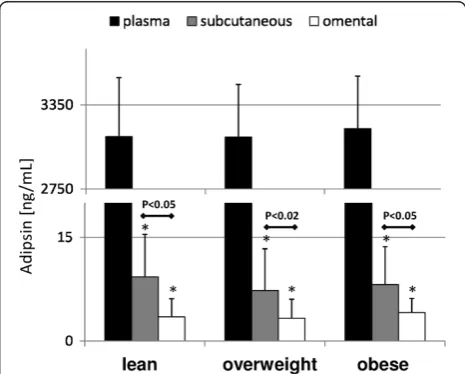
Analogically to the results obtained during analysis of the terminal panel of complement cascade anaphylatoxins/ molecules, also plasma adipsin levels were found to be comparable between examined groups of patients, and its concentrations detected in both AT depots were signifi-cantly lower than in peripheral blood (Figure 2). Interest-ingly, significantly higher adipsin levels were found in subcutaneous fraction of AT, and these were comparable between all groups of analyzed patients. Plasma adipsin concentrations were correlated with patients’age (r =−0.47, P < 0.03), BAI (r =−0.63, P < 0.005) and WHR values (r = 0.55, P < 0.02). Adipose tissue levels of complement fac-tor D were also associated with plasma C3a concentrations (r = 0.38, P < 0.05 for both).
CC-derived anaphylatoxins/molecules and chemoattractant for immune/stem cells–SDF-1
Finally, we verified whether observed systemic and/or AT levels of examined CC-derived anaphylatoxin/mole-cules are associated with levels of chemoattractant for bone marrow-derived cells, such as SDF-1 (that we reported previously by us [17]). Results of our analyses demonstrated that AT SDF-1 levels were inversely
asso-ciated with C5b-9/MAC levels in both – subcutaneous
(r =−0.31) and visceral (r =−0.30) fractions (P < 0.05 for both). No other significant associations between exa-mined CC-derived substances and SDF-1 were observed.
Discussion
In recent years, much effort has been put into discovering the diverse roles of CC anaphylatoxins/molecules. Their actions appear to be crucial for the regulation of several processes that extend beyond immunomodulation. CC influence in successful human (embryonic/prenatal) devel-opment, organ regeneration, and/or SC homing in various tissues/organs has been especially highlighted in some previous reports [15,16,21-24]. Therefore, we examined the biochemical-immunological composition of the human AT environment. To this end, we performed a comprehensive analysis of AT levels of the terminal panel of complement-derived anaphylatoxins/molecules and those of the complement factor D/adipsin. Further-more, we verified their potential association with SDF-1, which is a well-known chemoattractant for immune and (hematopoietic) stem cells.
[image:4.595.59.538.91.225.2]a
b
c
Figure 1Mean values of plasma and adipose tissue levels of complement C3a (a),C5a (b) and C5b-9/MAC (c) in healthy,overweight and obese individuals,and their statistical comparison between examined groups.* p < 0.0000001 (vs plasma level in appropriate group).
Figure 2Mean values of plasma and adipose tissue levels of factor D/adipsin in healthy,overweight and obese individuals,
and their statistical comparison between examined groups.
[image:4.595.305.538.497.684.2]In our study, we found that the levels of all examined factors in the AT were drastically lower than in the peripheral blood. In particular, C3a and adipsin levels in both AT depots were approximately 250- to 1000-fold
lower than their corresponding concentrations in
plasma. In contrast, relatively high C5a levels were detected in both AT fractions, and these levels were found to be only 10-fold lower than those detected in the peripheral blood. Moreover, levels of only a select few of these substances significantly differed between patients with varying status of weight gain; however, these variations were in relatively narrow ranges. These results indicate that while the biochemical composition of the human AT environment seems to be affected by changes in the metabolic profile of the individual, a rela-tively comparable constellation of immunomodulatory compounds exist within its environment.
In addition, our results showed depot-specific differences in AT-derived FIF levels of the examined complement anaphylatoxins/molecules. We found that approximately 2-fold higher levels of complement C3a and adipsin are present in the subcutaneous fraction of human AT, whereas visceral/omental depots possessed higher levels of C5b9-MAC. Several authors previously showed that AT depot-specific changes may occur in the genetic expression of CC-derived substances in animals or humans, and these changes are associated with as well as may vary according to the metabolic status of an individual [7,11,12]. The results of our study indirectly support these previously reported findings because we observed several significant differences in the levels of CC-derived substances between subcutaneous and visceral/omental fractions of AT, and, to a certain extent, these differences were associated with parameters such as BMI, BAI, and/or WHR values. Never-theless, the precise nature of these associations remains to be elucidated in further laboratory and/or clinical studies.
We would also like to highlight our observation that in human AT strong correlations between selected complement-derived molecules (mainly C5b-9/MAC) and SDF-1 are observed. This cross-talk between C5b-9/ MAC and SDF-1 signaling is already known to be very important for successful mobilization of various SCs and lymphocytes from BM and proper homing to target tissues [15,16]. Whereas the exact molecular mechan-isms of this association have not been discovered, results from recent experimental studies suggest an indirect interaction between these two molecules. For example, C5b-9/MAC has been proved to activate intracellular MAPp44/42and AKT signaling in murine hematopoietic SCs, and even though the action of MAC does not upre-gulate the expression of the CXCR4 receptor on BM-derived SCs, it may stimulate SDF-1 release in the BM stroma and increase adhesiveness of SCs to “niches” in the target homing tissue [25]. We speculate that because
of the fact that SDF-1 levels are relatively high in human AT and are strongly associated with selected complement-derived molecules, it is possible that actions of these molecules may influence and promote the homing of im-mune cells and hematopoietic SCs in human AT, and thereby contribute to development of“obesity-associated” inflammation within AT environment. Nevertheless, this phenomenon requires further investigations.
Finally, a recent study showed that various complement-derived substances can also significantly influence
AT-derived SC homeostasis in experimental in vitro culture
conditions [26]. To our knowledge, our study is the first one on human AT that delivers explicit information about the direct (changes in the) estimated“ranges”of biochem-ical levels of complement-derived substances in lean and overweight/obese subjects. Thus, our results undoubtedly assist other principal investigators allowing them to adjust their experimental approaches to mimic real (patho-) physiological conditions that occur in human AT. How-ever, it is important to highlight that those can be slightly different from the exact CC concentrations present in AT
environment due to potential “release” of complement
molecules from lysed adipocytes during technical proces-sing of AT samples in our study.
Conclusions
In summary, our study shows that (i) within the human AT environment lower levels of complement-derived anaphylatoxins/molecules and adipsin are present than the levels in the peripheral blood, (ii) differences in the concentrations of these factors are found between fat depots, and (iii) these substances appear to be associated with the metabolic status/body composition of an individ-ual. Finally, our study highlights that complement-derived molecules and SDF-1 are associated in various ways in human AT. Further clinical studies are necessary to verify their role in the regulation of various hematopoietic cells homeostasis and homing in human AT.
Abbreviations
AT: Adipose tissue; BAI: Body adiposity index; BM: Bone marrow; BMI: Body mass index; CC: Complement cascade; FIF: Fat interstitial fluid;
MAC: Membrane attack complex; SC(s): Stem cell(s); SDF-1: Stromal-derived factor-1.
Competing interests
The authors declare that they have no competing interests.
Authors’contributions
WB: designed the study, collected clinical data, performed statistical analysis, wrote and revised the manuscript; MB, DS, KS, BD: adapted biochemical protocols and performed biochemical analyses; MŁ, PP: operated included patients and collected perioperatively adipose tissue samples; TS: revised the manuscript drafts and helped in creation of a final version of the article. All authors have read and approved the final manuscript.
Acknowledgement
no role in the study design, nor influenced decision to publish the received results.
Author details
1Department of Gastroenterology, Pomeranian Medical University in
Szczecin, ul. Unii Lubelskiej 1, 71-252, Szczecin, Poland.2Department of Laboratory Diagnostics and Molecular Medicine, Pomeranian Medical University in Szczecin, Szczecin, Poland.3Department of Physiology, Pomeranian Medical University in Szczecin, Szczecin, Poland.4Department of
Plastic, Endocrine and General Surgery, Pomeranian Medical University in Szczecin, Szczecin, Poland.
Received: 5 December 2012 Accepted: 9 January 2013 Published: 9 January 2013
References
1. Ouchi N, Parker JL, Lugus JJ, Walsh K:Adipokines in inflammation and metabolic disease.Nat Rev Immunol2011,11:85–97.
2. Błogowska A, Rzepka-Górska I, Krzyżanowska-Świniarska B:Body composition, dehydroepiandrosterone sulfate and leptin concentrations in girls approaching menarche.J Pediatr Endocrinol Metab2005,
18:975–983.
3. Kim ST, Marquard K, Stephens S, Louden E, Allsworth J, Moley KH:
Adiponectin and adiponectin receptors in the mouse preimplantation embryo and uterus.Hum Reprod2011,26:82–95.
4. Błogowski W, Serwin K, Sałata D, Budkowska M, Dołęgowska B,Łokaj M, Prowans P, Starzyńska T:Plasma and adipose tissue levels of selected growth/inhibitory factors, proteolytic enzymes and sphingosine-1-phosphate in humans.Eur J Inflamm2012,10:279–288.
5. Fernandez-Real JM, Ricart W:Insulin resistance and chronic cardiovascular inflammatory syndrome.Endocr Rev2003,24:278–301.
6. Pickup JC, Crook MA:Is type II diabetes mellitus a disease of the innate immune system?Diabetologia1998,41:1241–1248.
7. Volp AC, Barbosa KB, Bressan J:Triacylglycerols and body fat mass are possible independent predictors of C3 in apparently healthy young Brazilian adults.Nutrition2012,28:544–550.
8. Lim J, Iyer A, Suen JY, Seow V, Reid RC, Brown L, Fairlie DP:C5aR and C3aR antagonists each inhibit diet-induced obesity, metabolic dysfunction, and adipocyte and macrophage signaling.FASEB J2012. doi:10.1096/fj.12-220582. in press.
9. White RT, Damm D, Hancock N, Rosen BS, Lowell BB, Usher P, Flier JS, Spiegelman BM:Human adipsin is identical to complement factor D and is expressed at high levels in adipose tissue.J Biol Chem1992,
267:9210–9213.
10. Gabrielsson BG, Johansson JM, Lonn M, Jernås M, Olbers T, Peltonen M, Larsson I, Lönn L, Sjöström L, Carlsson B, Carlsson LM:High expression of complement components in omental adipose tissue in obese men.Obes Res2003,11:699–708.
11. Moreno-Navarrete JM, Martinez-Barricarte R, Catalan V, Sabater M, Gómez-Ambrosi J, Ortega FJ, Ricart W, Blüher M, Frühbeck G, Rodríguez de Cordoba S, Fernández-Real JM:Complement factor H is expressed in adipose tissue in association with insulin resistance.Diabetes2010,59:200–209. 12. Samaras K, Botelho NK, Chisholm DJ, Lord RV:Subcutaneous and visceral
adipose tissue gene expression of serum adipokines that predict type 2 diabetes.Obesity2010,18:884–889.
13. Han J, Koh YJ, Moon HR, Ryoo HG, Cho CH, Kim I, Koh GY:Adipose tissue is an extramedullary reservoir for functional hematopoietic stem and progenitor cells.Blood2010,115:957–964.
14. Błogowski W, Ratajczak MZ,Żyżniewska-Banaszak E, Dołęgowska B, Starzyńska T:Adipose tissue as a potential source of hematopoietic stem/ progenitor cells.Obesity2012,20:923–931.
15. Marquez-Curtis LA, Turner AR, Sridharan S, Ratajczak MZ, Janowska-Wieczorek A:The ins and outs of hematopoietic stem cells: studies to improve transplantation outcomes.Stem Cell Rev2011,7:590–607. 16. Kintscher U, Hartge M, Hess K, Foryst-Ludwig A, Clemenz M, Wabitsch M,
Fischer-Posovszky P, Barth TF, Dragun D, Skurk T, Hauner H, Blüher M, Unger T, Wolf AM, Knippschild U, Hombach V, Marx N:T-lymphocyte infiltration in visceral adipose tissue: a primary event in adipose tissue
inflammation and the development of obesity-mediated insulin resistance.Arterioscler Thromb Vasc Biol2008,28:1304–1310.
17. Błogowski W, Serwin K, Budkowska M, Sałata D, Dołęgowska B,Łokaj M, Prowans P, Starzyńska T:Clinical analysis of systemic and adipose tissue levels of selected hormones/adipokines involved into bone marrow-derived stem cells mobilization in healthy and obese subjects.J Biol Regul Homeostat Agents2012,26:607–615.
18. Bergman RN, Stefanovski D, Buchanan TA, Sumner AE, Reynolds JC, Sebring NG, Xiang AH, Watanabe RM:A better index of body adiposity.Obesity 2011,19:1083–1089.
19. Celis JE, Moreira JMA, Cabezo T, Gromov P, Friis E, Rank F, Gromova I:
Identification of extracellular and intracellular signaling components of the mammary adipose tissue and its interstitial fluid in high risk breast cancer patients.Mol Cell Proteomics2005,4:492–522.
20. Gimble JM, Katz AJ, Bunnell BA:Adipose-derived stem cells for regenerative medicine.Circ Res2007,100:1249–1260.
21. Bulla R, Bossi F, Fischetti F, De Seta F, Tedesco F:The complement system at the fetomaternal interface.Chem Immunol Allergy2005,89:149–157. 22. Mastellos D, Germenis AE, Lambris JD:Complement: an inflammatory
pathway fulfilling multiple roles at the interface of innate immunity and development.Curr Drug Targets Inflamm Allergy2005,4:125–127. 23. Blaber SP, Webster RA, Hill CJ, Breen EJ, Kuah D, Vesey G, Herbert BR:
Analysis of in vitro secretion profiles from adipose-derived cell populations.J Transl Med2012,10:172.
24. Chen YL, Chang CL, Sun CK, Wu CJ, Tsai TH, Chung SY, Chua S, Yeh KH, Leu S, Sheu JJ, Lee FY, Yen CH, Yip HK:Impact of obesity control on circulating level of endothelial progenitor cells and angiogenesis in response to ischemic stimulation.J Transl Med2012,10:86. 25. Ratajczak MZ, Kim CH, Abdel-Latif A, Schneider G, Kucia M, Morris AJ,
Laughlin MJ, Ratajczak J:A novel perspective on stem cell doming and mobilization: review on bioactive lipids as potent chemoattractants and cationic peptides as underappreciated modulators of responsiveness to SDF-1 gradients.Leukemia2012,26:63–72.
26. Hareendran S, Sathishkumar S, Abbas S, Mackay AM, Rajan P:A novel composition for the culture of human adipose stem cells which includes complement C3.Cytotechnology2010,62:389–402.
doi:10.1186/1479-5876-11-11
Cite this article as:Błogowskiet al.:Clinical analysis of selected complement-derived molecules in human adipose tissue.Journal of Translational Medicine201311:11.
Submit your next manuscript to BioMed Central and take full advantage of:
• Convenient online submission
• Thorough peer review
• No space constraints or color figure charges
• Immediate publication on acceptance
• Inclusion in PubMed, CAS, Scopus and Google Scholar
• Research which is freely available for redistribution