Rochester Institute of Technology
RIT Scholar Works
Theses
Thesis/Dissertation Collections
5-1-2009
Evaluating the effect of peer feedback on the quality
of online discourse
Timothy D. Wells
Follow this and additional works at:
http://scholarworks.rit.edu/theses
This Thesis is brought to you for free and open access by the Thesis/Dissertation Collections at RIT Scholar Works. It has been accepted for inclusion in Theses by an authorized administrator of RIT Scholar Works. For more information, please [email protected].
Recommended Citation
Evaluating Peer Feedback
1
The Rochester Institute of Technology
Department of Communication
College of Liberal Arts
Evaluating the Effect of Peer Feedback on the Quality of Online Discourse
Timothy D. Wells
A Paper submitted
in partial fulfillment of the Master of Science degree
in Communication & Media Technologies
Evaluating Peer Feedback
2
The following members of the thesis committee approve
the thesis of Timothy D. Wells on April 21, 2009
Bruce Austin, Ph.D
Chairman and Professor of Communication
Department of Communication
Rudy Pugliese, Ph.D.
Professor of Communication
Coordinator, Communication & Media
Technologies Graduate Degree Program
Department of Communication
Susan B. Barnes, Ph.D.
Professor of Communication
Department of Communication
Thesis Advisor
Clinton Wallington, Ph.D.
Evaluating Peer Feedback
3
EVALUATING THE EFFECT OF PEER FEEDBACK ON THE
QUALITY OF ONLINE DISCOURSE
Name: Timothy D. Wells
Department: Communication
College: Liberal Arts
Degree: Master of Science in Communication & Media Technologies
Term Degree Awarded: Spring 2009 (20083)
Abstract
This study explores the effect on discussion quality of adding a feedback mechanism that
presents users with an aggregate peer rating of the usefulness of the participant's contributions in
online, asynchronous discussion. Participants in the study groups were able to specify the degree
to which they thought any posted comment was useful to the discussion. Individuals were
regularly presented with feedback (aggregated and anonymous) summarizing peers' assessment
of the usefulness of their contribution, along with a summary of how the individuals rated their
peers. Results indicate that continuous, anonymous, aggregated feedback had no effect on either
the students' or the instructors' perception of discussion quality.
Keywords:
Evaluating Peer Feedback
4
Table of Contents
Abstract ... 3
Keywords: ... 3
Are online discussions effective?... 5
Does peer feedback influence the quality of discussion? ... 6
What motivates a person to contribute to a discussion? ... 7
Does peer feedback have any negative consequence? ... 7
Research Question and Hypothesis ... 8
Theory-Based Web Design
... 8
Cognitive Dissonance Theory ... 9
Planning Theory ... 9
Web Design ... 10
Method ... 13
Participant Feedback ... 15
Faculty Review ... 17
Results ... 17
Participant Perception of Quality ... 17
Reviewer Assessment of Quality ... 19
Limitations
... 21
Future Research
... 22
[image:5.612.78.542.103.493.2]References ... 24
Table of Figure ... 27
Appendix A: Invitation to Potential Volunteers ... 28
Appendix B: IRB Review of Research Involving Human Subjects ... 30
Appendix C: Discussion Group Transcripts ... 33
Discussion Group I (with micro-feedback) ... 33
Discussion Group II (without micro-feedback) ... 36
Discussion Group III (with micro-feedback) ... 42
Evaluating Peer Feedback
5
Evaluating the Effect of Peer Feedback on the Quality of Online Discourse
Web conferences with online discussions are being used in many educational and
business settings (Barnes, 2003). Earlier communication research focused on the literal postings
and message exchange of the discussions. Advances in the sophistication of Web conferences
have the potential for adding dimensions to online communication. For example, commercial
sites are encouraging visitors to input their opinions or ratings of their products and services.
These simple inputs are aggregated and presented to visitors as consumer ratings or measures of
“trust.” The effect of these features has not been studied in the context of online discussion. The
current study adds to the understanding of online discourse by exploring the effect of aggregated
peer feedback on the quality of the discussion. The author sets out to determine if adding a new
dimension of peer feedback to an online discussion has a constructive effect.
In designing this study, the author reviewed the research literature for insight into the
following questions: Are online discussions effective? Does peer feedback influence the quality
of discussion? What motivates a person to contribute to a discussion?
Are online discussions effective?
Assessment of online discussion in educational settings have found that in
computer-mediated discussions students have more frequent interactions with teachers, and group output
was similar to or greater than the output in traditional discussion groups (Phillips & Santoro,
1989). Outcomes of group decision making improves when online discussions focus on issue
evaluation and task completion (Salazar, 1994). However, there is research suggesting that
online decision support improves the quality of the solution; it may also reduce the perception of
Evaluating Peer Feedback
6
While the quantity of interactions is larger, the quality of the discourse is not necessarily
better. Content analysis of discussion output shows most messages are questions and expansion
on other postings with few comments suggesting integration or resolution (Garrison, 2001).
Angeli et al. (2003) looked for evidence that online conference systems fostered quality
discourse. They found most of the exchanges were based on personal experiences and did not
suggest well-supported reasoning. The authors suggest that future research on interactivity
should study motivational and affective variables in distance education methods. The current
study seeks to further understanding in this area.
Does peer feedback influence the quality of discussion?
Feedback from peers has been shown to influence group task performance. Ogilvie and
Haslett (1985) found that the effectiveness of feedback depends on the dynamism and
assertiveness of the message. Both the content and the form of the feedback were significant in
judging effectiveness. Other studies show that the level of activity and perception of peer's
engagement influence the group decision-making process (Contractor, 1996). Studies comparing
group efforts to reach consensus using computer-mediated communication versus face-to-face
communication find that computer-assisted groups have difficulty coordinating their interaction
(Poole, 1993). This has been attributed to lack of informational feedback and absence of social
cues and norms (Kiesler, 1984). In a study of the use of a Web conference with mandatory peer
review of classroom assignments, by Warren and Rada (1999) report some correlation between
volume of messages and cognitive level of the comments. The authors suggest that
computer-mediated communication system should be modified to encourage peer assessment. The current
Evaluating Peer Feedback
7
What motivates a person to contribute to a discussion?
Research suggests that participation in online discussions is related to self-efficacy. The
perception that others value a contributor's information influences the degree of participation
(Kalman, 2002). Higgins, Flower and Petraglia (1992) report a correlation between the quality of
student's work and amount of reflective conversation within the group. Thick interpersonal
dialogue and social exchange tend to motivate the creation and support of online communities
(Kruse, 2001).
The current study explores these ideas by encouraging participants to share their
perception of others' contributions. It tests these ideas by determining whether adding this
reflective information has any effect upon the perceived quality of the discussion.
Does peer feedback have any negative consequence?
While there is evidence that feedback and reflective communication have many positive
effects, there is also evidence that peer feedback has negative consequence. Cox's (1999) work
shows how co-worker communication has the ability to motivate the exit of other workers. The
Reduced Social Cues Theory discussed by Kiesler, Siegel, and McGuire (1984) suggests that
lack of social cues and the condition of anonymity tend to weakening of social norms allowing
for depersonalization of peers.
In the present study, participants might be overly harsh in their ratings of other's
comments and react negatively to what might be perceived as unjust or hostile criticism.
Participants were surveyed to gauge how the feedback was perceived and how the feedback
Evaluating Peer Feedback
8
Peer feedback may have negative consequences, but there is evidence that training can
improve the likelihood of more positive effects. Zhu (1995) showed that training students in peer
response was effective at improving group interaction. The current study presents participants
with tutorials on the use of the peer feedback function.
Research Question and Hypothesis
The study examines the relationship between peer feedback and perceived quality of
online discussions. Is the perceived quality of an online discussion affected by aggregated,
anonymous peer feedback on the relative usefulness of the individual's contributions? All
subsequent references to this feedback mechanism will use the term “micro-feedback.”
The study's hypothesis is “In an online asynchronous discussion, the perceived quality of the
discussion will be higher within an environment that integrates peer feedback.”
Theory-Based Web Design
To explore the research question, the author constructed a Web-based discussion forum.
The discussion conference presented multiple topics. Each topic had a threaded discussion where
participants could post their ideas and respond to one another's postings. The unique feature was
an invitation to rate postings. When participants in the study group read another person's posting,
they were invited to indicate how useful the comment was to the discussion. Participants could
click on a four-point scale ranging from ”Not Useful” to “Very Useful.”
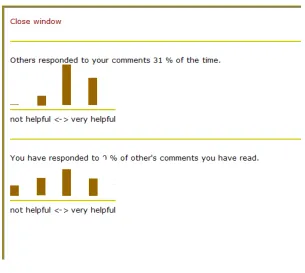
Feedback was presented in the study group each time a participant signed onto the
conference. Two simple bar graphs were displayed: one showing the distribution of other's
Evaluating Peer Feedback
9
The design of the research environment was informed by Festinger's cognitive dissonance
theory and Berger's planning theory.
Cognitive Dissonance Theory
In any discussion, participants are likely to encounter specific comments that contradict
or disparage their previous remarks. After posting any given idea, a colleague may post a reply
expressing a conflicting point of view. By providing additional feedback aggregating all of the
peers' ratings of relative usefulness, the individual may face the added dissonance of information
suggesting that, in general, others in the group are not finding value in his or her comments.
Cognitive dissonance theory suggests that an individual will try to reduce the dissonance by
ignoring or dismissing the dissonant communication (Festinger, 1957). The theory suggests that
the individual may seek new information to try to outweigh the dissonance. The individual may
actually change his/her own beliefs so the communication is no longer an irritant. The Web
forum was designed to exploit the potential for cognitive dissonance. The dissonance occurs if
the displayed bar graphs are inconsistent with the participant's perception of their relative
contribution. If the participant feels he or she is contributing positively to the discussion, but the
feedback indicates his/her peers do not agree, the individual might resolve the dissonance by
trying to provide more helpful comments. The individual may also resolve the dissonance by
quitting the conference entirely or simply ignoring the feedback.
Planning Theory
Charles Berger's planning theory suggests a similar scenario. Planning theory asserts that
Evaluating Peer Feedback
10
believes the goal is important, the individual persists with a different strategy. The tendency is to
alter the goal at a more concrete level rather than an abstract level. Participation in the Web
forum is the goal. Specifically, the goal takes the form of the set of questions posed to the
participants at the beginning of the conference. Peer feedback suggesting the participant is not
meeting the goal of active participation is evidence that the goal is not being achieved. Planning
theory suggests that the participant will look to specific, concrete changes of plan. Posting
additional and more useful comments to the discussion is a specific plan adjustment that moves
the participant toward his/her goal.
Web Design
The environment created to support this study allowed the author to divide a conference
into topics, each topic having its own discussion area.
The discussion is presented as a list of messages. Clicking on a message displays the full
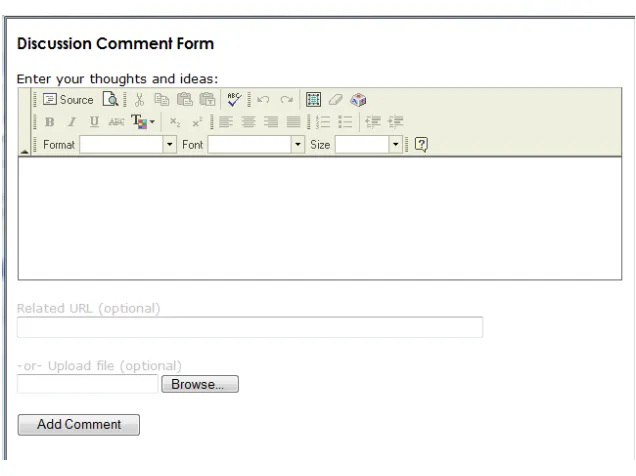
text in a separate window. Participants added messages to the discussion through a form. The
Evaluating Peer Feedback
11
Figure 1 Threaded Discussion and Message Rating Scale
Figure 2 Discussion Comment Form
The researcher could specify whether a discussion would include micro-feedback
[image:12.612.107.425.364.602.2]Evaluating Peer Feedback
12
bottom each message. When a participant reads another's message, he or she has the opportunity
to provide feedback by clicking on a scale ranging from “not helpful” to “very helpful.”
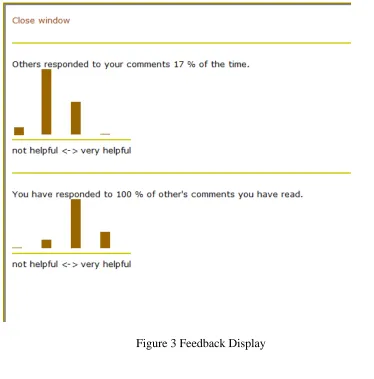
These message-specific micro-evaluations are never displayed. Rather, they were
[image:13.612.105.479.185.564.2]aggregated and presented to the participant as a summary in the form of bar graphs.
Figure 3 Feedback Display
One graph shows the distribution of other's responses to the participant's messages. This
graph reflects all micro-evaluations of all the individual's messages. The other graphs shows the
distribution of the participant's reviews of other's messages allowing individuals to see the
relative distribution of reviews of other's postings from very critical to very complimentary.
Evaluating Peer Feedback
13
Method
Students at Rochester Institute of Technology were asked to participate in an online
discussion on the relationship between technology and society. Thirty-one student volunteers
were randomly assigned to one of four discussion conferences – creating discussions groups of
seven or eight participants. Two of the conferences included the micro-feedback mechanism and
two did not. Each participant was provided a tutorial on the conference environment including
instruction on how to post comments and select a topic, and (if they were members of the study
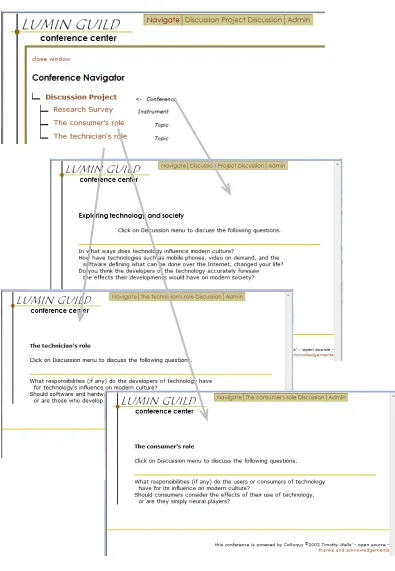
group) a description of the micro-feedback display. Each conference consisted of three
discussion topics. Topics were seeded with open-ended question, each topic with its own
discussion area.
Exploring Technology and Society
In what ways does technology influence modern culture?
How have technologies such as mobile phones, video on demand, and the software
defining what can be done over the Internet, changed your life?
Do you think the developers of the technology accurately foresaw the effects their
developments would have on modern society?
The Technician's Role
What responsibilities (if any) do the developers of technology have for technology's
influence on modern culture?
Should software and hardware developers consider the effect of their work, or are
those who develop technology simply neutral players?
The Consumer's Role
What responsibilities (if any) do the users or consumers of technology have for its
influence on modern culture?
Evaluating Peer Feedback
14
[image:15.612.107.502.94.665.2]The participants navigate to the discussion areas via menu selection.
Evaluating Peer Feedback
15
The discussion conferences were open for three weeks. After the open discussion period,
participants were asked to complete a survey asking to what extent they agreed with statements
about the conference.
Participant Feedback
All participants were also asked to respond to the following statements about the quality
of the discussion:
o
I felt good about the quality and depth of the discussion.
o
The actual content of the discussion was not meaningful.
o
I learned a lot from the discussion.
Volunteers in the conferences where the micro-feedback mechanism was enabled were
also asked about rating other's messages and viewing the bar graphs:
o
The discussion summary made me more aware of what I was writing.
o
I liked seeing the overall response to my part of the discussion.
o
Knowing that others were evaluating my postings made me uncomfortable.
o
I liked seeing that my comments were seen as useful to other participants.
o
When I saw some of my comments were not very useful I wanted to quit.
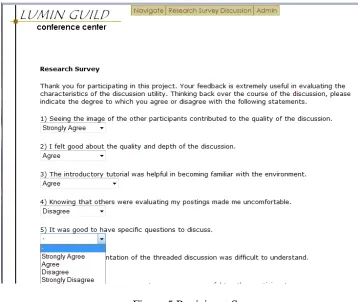
All participants were presented with statements about the user interface, the specificity of
the topics discussed, the display of participant's photos, and the mechanics of reading and
replying to messages:
o
Seeing the image of the other participants contributed to the quality of the discussion.
o
The introductory tutorial was helpful in becoming familiar with the environment.
Evaluating Peer Feedback
16
o
The outline presentation of the threaded discussion was difficult to understand.
o
Email notification of discussion changes helped keep the conference active.
o
Knowing that others could see my image made me uncomfortable.
o
I would prefer more general topics to explore in the discussion.
o
The email notification was bothersome.
o
The discussion outline was an effective way of presenting the threaded discussion.
o
What other features would have added to the quality of the discussion?
All participant surveys were conducted via a web form built into the conference
[image:17.612.107.465.351.653.2]environment.
Evaluating Peer Feedback
17
Faculty Review
Six faculty members assessed the quality of the discussion. The discussion transcripts
from the Web conferences were extracted. Nicknames used by the student participants during the
discussion were replaced with gender-neutral names. The transcripts of the four discussions were
printed and distributed to the faculty members along with a survey asking the degree to which
the reviewer agreed with the following statements:
o
The discussion reflects a high degree of insight into the topic.
o
The discourse was effective at exploring the topic.
o
The participants were helpful to each other in exploring the topic.
o
I would be pleased if this discussion had occurred in my classroom.
Results
Participant Perception of Quality
The total number of individual messages in each discussion group ranged from 21 to 36.
On average, each participant posted four comments. The average length of a comment was
approximately 100 words. The transcripts of the discussions are included in Appendix C.
The participant's survey results (i.e. questions relating to the perceived quality of the
discussion) were analyzed to see if the answers suggested different populations. The values
assigned to answers in the survey were:
No Response
= 1
Strongly Agree
= 2
Agree
= 3
Disagree
= 4
Evaluating Peer Feedback
18
In the averages that follow, values between 2 and 3.4 indicate agreement with the
statement. Values between 3.5 and 5 indicate disagreement with the statement.
To the questions related to discussion quality:
Question 1: "I felt good about the quality and depth of the discussion."
with feedback
without feedback
Average 3.3
3.3
Std. Deviation
0.48
0.48
Mann-Whitney
u = 50 p = 0.48
Question 2: "The actual substance of the discussion was not meaningful."
with feedback
without feedback
Average 3.7
3.9
Std. Deviation
0.48
0.74
Mann-Whitney
u = 38 p = 0.19
Question 3: "I learned a lot from the discussion."
with feedback
without feedback
Average 3.4
3.5
Std. Deviation
0.97
0.85
Mann-Whitney
u = 55.5 p = 0.35
Mann-Whitney Tests were computed for each of the survey questions. Mann-Whitney
was used because the dependent variable (the perception of discussion quality) constituted an
Evaluating Peer Feedback
19
The simple averages show a very slight indication toward higher perception of quality for
discussions in the groups where the micro-feedback feature was enabled. However, there was no
significant difference between the responses from the participants in the micro-feedback
environment and the responses from the participants in the control environment.
Reviewer Assessment of Quality
Similarly, the evaluations of the faculty member's reviews showed little difference in the
perceived quality of the discourse between the two groups. The values assigned to answers in the
reviewer's survey were:
Strongly Agree
= 4
Agree
= 3
Disagree
= 2
Strongly Disagree = 1
In the averages that follow, values between 1 and 2.5 indicate disagreement with the
statement. Values between 2.6 and 4 indicate agreement with the statement.
"The discussion reflects a high degree of insight into the topic."
with feedback
without feedback
Average 3.25
2.9
Std. Deviation
0.45
0.29
Mann-Whitney
u = 49.5 p = 0.102
"The discourse was effective at exploring the topic."
with feedback
without feedback
Average 3.0
2.8
Std. Deviation
0.60
0.72
Evaluating Peer Feedback
20
"The participants were helpful to each other in exploring the topic."
with feedback
without feedback
Average 3.25
3.3
Std. Deviation
0.62
0.58
Mann-Whitney
u = 66.5 p = 0.29
"I would be pleased if this discussion had occurred in my classroom."
with feedback
without feedback
Average 3.17
2.9
Std. Deviation
0.72
0.79
Mann-Whitney
u = 59 p = 0.72
The Mann-Whitney analysis of the question reflecting the degree of insight showed no
significant difference between the two groups (i.e. the U value approached the lower limit). None
of the other questions showed significant differences either.
The author concludes that neither the participant's responses nor the reviewer's responses
reflect evidence in support of the study's hypothesis. Thus, the hypothesis “In an online
asynchronous discussion, the perceived quality of the discussion will be higher within an
Evaluating Peer Feedback
21
Limitations
The study did have limits that may have influenced the outcome. Both of the theories
cited earlier in support of the Web forum's design, discuss the importance of the participant
being aware of (or engaged in) the event.
There is no evidence that the participants perceived that the pattern of responses was an
expectation. Several participants expressed concern that they did not know how to respond to the
bar graphs. They did not know if the pattern they were seeing was of interest (let alone what the
patterns might suggest for future action). The author included definitions in the tutorial provided
to every participant, but no statement was included to define goals or expectations. Future
research could explore ways to establish expectations. For example, instructions could include a
statement that the data in the bar graphs is significant and the participant should work to create a
[image:22.612.106.411.417.690.2]graph similar to this:
Evaluating Peer Feedback
22
The first graph is skewed to the right indicating the peer group finds the individual's
contributions to be constructive. The second graph indicates that the individual is as likely to be
critical as to be complimentary. Clearer description of the feedback might help establish a goal of
engaged participation with the display as a measure of progress toward that goal.
The subject of the discussion also has an effect. Several participants commented that the
topic was too general for specific, in-depth dialogue. A conversation on a subject of current
academic coursework may yield different results from an open conversation about the effect of
technology on society. If all participants were taking the same course, and the questions related
directly to material in course assignments, greater motivation could be anticipated for active
engagement in the discussion along with attention to the quality of the discourse.
Future Research
Future research should address the limitations discussed in the previous section. In
addition, future research should explore the effect of more direct and obvious feedback. For
example, the information could have been presented in the form of a relative ranking, showing
where the individual ranked relative to other participants. Seeing that other participants (even if
they are nameless in the display) were being ranked higher (or lower) may have an effect on an
individual's participation.
The current study focused on the perception of quality in online discussion. Future
research should broaden the dimensions of quality to include content analysis of the transcripts
Evaluating Peer Feedback
23
Several participants in the current study commented that there was not enough time for
the discussion to develop. An aim of future research should be to gain greater understanding of
how the quality of an online discussion changes over time. The discussion postings in the current
study showed little evidence of relationship building. Participants generally liked the idea of
seeing a photograph of the author as he/she was reading and responding to a posting.
However, a broader investigation of discourse quality needs to include some measure of
the degree of participation. The current study did not measure behavior. The software built for
the study did capture events that might reflect behavioral differences. The system recorded the
number of messages posted and the number of participants who opened the messages
(presumably to read them). The record indicates a low rate of participants reading the posted
messages. An ideal condition might be that every participant read every message (100%). The
four groups observed had far lower rates of reading other's messages (44%, 55%, 66%, and 75%
respectively). Future research could explore the relationship between degrees of
activity/participation and measures of quality.
Forums designed deliberately to encourage more personal, team-building information
Evaluating Peer Feedback
24
References
Angeli, C., Valanides, N., & Bonk, C. (2003, January). Communication in a web-based
conferencing system: The quality of computer-mediated interactions.
British Journal of
Educational Technology 34
(1), 31-43.
Barnes, S. (2003).
Computer-mediated communication: Human-to-human communication Across
the Internet
. Boston: Allyn and Bacon.
Benbunan-Finh, R., & Hiltz, S. (1999). Impact of asynchronous learning networks on individual
and group program solving.
Group Decision and Negotiation, 8
(Sept 1999), 409-426.
Berger, C. (2008). Planning theory of communication: Goal attainment through communicative
action. In Baxter, L., Braithwaite, D. (Eds.),
Engaging theories in interpersonal
communication
(pp. 89-102). Thousand Oaks, CA: Sage Publications.
Contractor, N., Seibold, D., & Heller, M. (1996, June). Interactional influence in the structuring
of media use in groups: Influence in members' perceptions of group decision support system
use.
Human Communication Research. 22
(4), 451-481.
Cox, S. (1999, Spring). Group communication and employee turnover: How coworkers
encourage peers to voluntarily exit.
Southern Communication Journal. 64
(3), 181-192.
Festinger, L. (1957).
A theory of cognitive dissonance
. Stanford, CA: Stanford University Press.
Garrison, D., Anderson, T., & Archer, W. (2001). Critical Thinking, Cognitive Presence, and
Evaluating Peer Feedback
25
Higgins, L, Flower, L., & Petraglia, J. (1992, January). Planning text together: The role of
critical reflection in student collaboration.
Written Communication, 9
(1), 48-84.
Kalman, M.., Monge, P., Fulk, J., & Heino, R. (2002, April). Motivations to resolve
communication dilemmas in database-mediated collaboration.
Communication Research, 29
(2), 125-154.
Kiesler, S., Siegel, J., & McGuire, T. (1984). Social Psychological Aspects of
Computer-Mediated Communication.
American Psychologist, 39
(10), 1123-1134.
Kruse, S. (2001). Creating communities of reform: Continuous improvement planning teams,
Journal of Educational Administration, 39
(4), 359-383.
Ogilvie, J., & Haslett, B. (1985). Communicating peer feedback in a task group.
Human
Communication Research, 12
(1, Fall), 79-98.
Phillips, G., & Santoro, G. (1989, April). Teaching group discussion via computer-mediated
communication .
Communication Education, 38
(2), 151-161.
Poole, M., Holmes, M., Watson, R., & DeSanctis, G. (1993, April). Group decision support
systems and group communication: A comparison of decision making in computer-supported
and non-supported groups.
Communication Research, 20
(2), 176-213.
Salazar, A., Hirokawa, R., Propp, K., Julian, K., & Leatham, G. (1994, June). In search of true
causes: Examination of the effect of group potential and group interaction on decision
Evaluating Peer Feedback
26
Warren, K., & Rada, R. (1999, April). Manifestations of Quality Learning in
Computer-Mediated University Courses.
Interactive Learning Environments, 7
(April), 57-80.
Zhu, W. (1995, October). Effects of training for peer response on students' comments and
Evaluating Peer Feedback
27
Table of Figure
Figure 1 Threaded Discussion and Message Rating Scale ... 11
Figure 2 Discussion Comment Form ... 11
Figure 3 Feedback Display ... 12
Figure 4 Discussion Navigation ... 14
Figure 5 Participant Survey ... 16
Evaluating Peer Feedback
28
Evaluating Peer Feedback
30
Appendix B:
IRB Review of Research Involving Human Subjects
R·I·T
Rochester Institute of TechnologyInstitutional Review Board For the-Protection of Human Subjects in Research 54- Lomb MemOlial Drive
Ro~hester,New York 14623-560 Phone:_585 -475-7983
~585-7990
Email: mmk~cip~
FormA
Request for IRB Review of Research Involving Human Subjects
To be completed by investigator after reading the RlT Policy for the Protection of Human Subjects in Research, which may be found in the Institute Policies and Procedures Manual, Section C5.0, or on http://www.research.rit.edu (select Policies button). Send completed form to Marsha Konieczny,
Senior Administrative Assistant, RlT Institutional Review Board, 1260 Carlson Building. Research requests initiated within NTID should be forwarded to Roberl Whitehead, Chairperson, 1309 Carey.
1. Investigator's Name: Timothy Wells
2. Investigator's SSN:
Phone Number: x5-7136
Investigator Email: [email protected]
3. Campus Address: Bldg 70Rm2617
4. Date Submitted: January 29,2003
5. If student, name of Faculty Supervisor: Prof Rudy Pugliese
6. Faculty Phone: x5-5925 Faculty Email: [email protected]
7. Project Title: Evaluating the Effect ofContinuous Peer Feedback in On-Line Discussions
8. Project Start Date:
9. Project Sponsor: D None
l8J
Thesis MS Communication&Media Technology10. Status of project: D Submitted on _ _: D Funding pending D Funding confilmed
11. Does the investigator have a financial relationship with the sponsor? DYes
l8J
No. If yes, please read RlT policy: C4.0 - CONFLICT OF INTEREST POLICY PERTAlN1NG TO EXTERNALLY FUNDED PROJECTS. Complete the Investigators Financial Disclosure Form and attach that to this Form A. All information will be kept confidential.12. Description of criteria and subject selection procedures, including number, sources, etc.: Students in
winter quarter classes will be asked to volunteer to review a web-based discussion conference. The only
criteria is willingness to participate in a discussion related to their course and complete a survey.
Evaluating Peer Feedback
33
Appendix C: Discussion Group Transcripts
Discussion Group I (with micro-feedback)
Exploring Technology and Society
In what ways does technology influence modern culture?
How have technologies such as mobile phones, video on demand, and the software defining what can be done over the Internet, changed your life?
Do you think the developers of the technology accurately foresaw the effects their developments would have on modern society?
> Dale: In what ways does technology influence modern culture? Technology has a major influence on modern culture as proven by history. Take for example, the evolution of technology, which includes the early forms of communication that started with hand gestures, moved towards a vocal form of communication, to writing, to the printing press (books, magazines, newspapers) to the radio, to the TV, to computers, to the Internet. Additionally, technology not only influenced modern culture intellectually, but it also physically; it influences our efficiency (increases thru put), it also reduced the amount of work in our personal lives for example, household chores (cooking, cleaning, washing clothes, etc.) How have technologies such as mobile phones, video on demand, and the software defining what can be done over the Internet, changed your life? Technology has brought the world much closer, greatly reduced time lapses between people communicating over great distances. The Internet, however, has the greatest personal impact on me because it made on-line learning possible, and brought world knowledge to my fingertips. I have never been interested in doing research that required me to visit a library, now thanks to the Internet; I can do all my research from my computer both at home and on the go. Do you think the developers of the technology accurately foresaw the effects their developments would have on modern society? No, I do not believe it was possible for anyone to accurately foresee the effects technology would have on modern society. Weather forecasters can barely predict tomorrow’s weather with all their high-tech equipment. Therefore, it is not possible to accurately predict an outcome of an idea / technological advancement. However, I sure there was some indications some technologies would be better off than others.
> Regan: I just bought a new cell phone this week, the nokia 3650. This phone does everything; infrared, camera, video recorder, mp3 player, gprs data(web), and you can even make a call on it. When signing up for this discussion forum I wondered how would I get my pic uploaded. Well, I used the phone to take my picture, then I sent it to my computer via email from the phone. Wow, was that easy. This is just an example of how
powerful technology has become in our society. Developers see that each step of the way the impact of new technologies have on the everday life. This keeps the developers dreaming up new technologies that they foresee as evolving and making our lifes more efficient. Determining if developers can foresee the effects of Internet applications is difficult. What they might foresee as the benifit may end up being used totally different by users. But the end result is the same, modern society continues to evolve with new developments in technology. Regards, Regan Holmes
= > Tracy: I just bought a new cell phone this week, the nokia 3650. This phone does everything; infrared, camera, video recorder, mp3 player, gprs data(web), and you can even make a call on it. When signing up for this discussion forum I wondered how would I get my pic uploaded. Well, I used the phone to take my picture, then I sent it to my computer via email from the phone. Wow, was that easy. --- I guess the question is how much you will use all these features in two weeks time. They are cool now, but many of these toys we buy end up doing what their predecessors did years before, because that's all we use them for... = = > Ashton: I agree with Tracy with how fast our technology is changing many of these “new” features within a
couple of months are outdated.
= = > Avery: I agree, features un-used are useless? Regarding the topic in general, the effect on Modern society is pervasive and seems to be relentless. Are we all becoming victimized by "gadget glut?" Do we really need all of this STUFF? it is really neat, I for one dont want to go back to the Pioneer days (and I dont mean the electronics company). But I am cautious to bye for the sake of having the newest gadget for the sake of having it...
Evaluating Peer Feedback
34
crimes....the list goes on and on. With all the convience that technology offers, it also opens many doors to negative cultural impacts that society is just now beginning to address. For example, there are still laws pending with regards to copyright protection, ordering drugs via the web, and many other activities that, for the moment, are legal because the law has yet to catch up with the technology of the times. As such, I do not think that the developers could have had a real notion of how these technologies would impact modern culture
> Tracy: In what ways does technology influence modern culture? One need only go to the movies on a Friday night to see that technology influences culture. The cell phone ringing that interupts the movy will show you that we are a technology based society. Technology has had a major influence on modern culture. From
communications to transportation, we have developed o the back of technology. The industrial revolution, and it's important to our history shows the over-reliance that we have... How have technologies such as mobile phones, video on demand, and the software defining what can be done over the Internet, changed your life? Communications technology has changed the world. Look around when they open a plane's door and see everyone 'checking in'. We are always in touch with the house, the office and even the markets. Do you think the developers of the technology accurately foresaw the effects their developments would have on modern society? No, I do not believe it was possible for anyone to accurately foresee the massive impact of the
availability of information. The internet, for instance, has som much information that we can't possibily imagine it's scale.
> Ashton: In what ways dose Technology influence modern culture? Technology influences modern culture because it enables people to communicate around the world, creating more of a globilized society. While technology makes life more convenient, entertaining and expands our contacts but it can also create social isolation. One theory that has arises with the increasing influence of technology is Technorealism. This theory emphasis the importance that we think critically about the role that technology tools and interfaces play in modern human culture, evolution and everyday life. Because technologies come loaded with both intended and unintended social, political, and economic leanings making them not free of biases. Every technological tool offers a different way of seeing the world and a specific ways of interacting with others making it important for each of us to consider the biases of various technologies. All around us, information is moving faster, becoming cheaper to acquire and the benefits are clear. But we must not confuse this flow of acquiring and distributing of
information we should recognize how information is becoming an enormously powerful social forces Understanding technologies strengths and weakness is an important part of being an involved citizen but we should not let them substitute for our own basic cognitive skills of awareness, perception, reasoning, and judgment..
Evaluating Peer Feedback
35
The Technician's Role
What responsibilities (if any) do the developers of technology have for technology's influence on modern culture? Should software and hardware developers consider the effect of their work, or are those who develop technology
simply neural players?
> Regan: I wouldn't say that developers have a particular responsibility to modern culture. Developers are inventors, they have an idea and find a way to build that idea. As far as effects of their work, they might think that what they are building should be used in a particular way, but in the end the users decide acceptance and usability of the technology. Since they can not force users to use the technology in a particular way, they are a neutral player. Regards, Regan Holmes
= > Avery: I think I would disagree, Developers/Inventors, etc... have a responsibility to modern culture. The impact of "things invented" is real and warrants some degree of thought. For example, the invention of a nuclear bomb. In this case, the "root invention/discovery" (the energy given off as a result of splitting atoms) was Mr. A.E. himself. In fact, he probably didn’t even consider the use of this information beyond a proof. So, his level of "responsibility" is relatively low when compared to those in Los Alamos who actually put the information to destructive use. But then again, who is to say that the information might not have been put to destructive use anyway, and by us controlling the information we in a way minimized the destructive power? But onto a more recent "cultural impact/responsibility" the invention of the "WEB BROWSER." What an impact indeed, I remember the day when you would need a special client side application and a very specific computer to dial into so you could "get on the NET." When the browser came about (Sometime in '93 or so???) the WWW was born and the way we look at the world has forever changed. Now, we all have so much freedom of movement across the WWW landscape it is truly amazing. But just as with Atomic energy, the implementation is either good or evil. Bottom line is that I know of, but cannot remember the name of the organization, who’s members take an oath of "responsible and ethical Engineering." I for one do not believe, people who engineer or develop anything can claim a passive roll in the shaping of modern culture. Check out the link regarding Ethical Engineering Practices for more information. Thanks,
= > Julian: Hi Regan. I wonder if you would feel the same way if we were talking about the cloning issue? Or about development of new nuclear, chemical or biological warfare? I'm not attacking you. I just know some really talented folks who have turned down particular jobs because they didn't agree with the intended (or even unintended) use of the technology they would be involved in. I just think it goes too far to say that developers are neutral players. I think we each need to rememeber we live in a society that we are a part of and we have to be able to deal with the consequences of our actions.
> Dale: I belief the developers have a responsibility to both their technology and modern culture. One of their responsibilities should include, for example, a user friendly “man- to-machine” interface because without that, the end user will reject the technology and the technology is likely to fail or at least not reach its potential. Thus, a new technology might never get off the ground. However, implementing user-friendly designs cost money and despite the fact that developers may want to produce the best technology, their designs might be hampered by their financial backers, rendering them a neutral player.
The Consumer's Role
What responsibilities (if any) do the users or consumers of technology have for its influence on modern culture? Should consumers consider the effects of their use of technology, or are they simply neural players?
> Julian: What responsibilities (if any) do the users or consumers of technology have for its influence on modern culture? I believe that the consumer has at least as much responsibility as the developer. Consumer's make these personal decisions daily. Should I take advantage of legal abortion procedures? Should I use contraception? Should I allow my loved one to live on respiratory machines? By consumer's using the technology, we are saying it's OK to develop these kinds of technology. If businesses move towards fewer face-to-face conferences and replace with virtual conferences, then we say that this replacement of personal contact is OK. Our actions as consumers give the green or red light to the inventors and those who fund them. We have the ultimate
responsibility, don't we??
Evaluating Peer Feedback
36
Discussion Group II (without micro-feedback)
Exploring Technology and Society
In what ways does technology influence modern culture?
How have technologies such as mobile phones, video on demand, and the software defining what can be done over the Internet, changed your life?
Do you think the developers of the technology accurately foresaw the effects their developments would have on modern society?
> Carmen : In what ways does technology influence modern culture? How have technologies such as mobile phones, video on demand, and the software defining what can be done over the Internet, changed your life? Do you think the developers of the technology accurately foresaw the effects their developments would have on modern society? The general ÒstriveÓ is to make live easier/more convent. Unfortunately, there have been no dramatic new technologies in many years. Yes, advancements have been made, but thereÕs been nothing new in a long time. Mobile phones still have many ÒdeadÓ areasÉto many to make them replacement for conventional phones, but the incentive is there. ItÕs cheaper to use a cell phone to make long distance calls and I don know people that have, more or less, replaced their home phone with their mobile. ItÕs easily done if youÕre in an area for it. Computers still have a ways to go and as far as speed, usability and portability. However, as usual, only Apple is making any advancement towards the betterment of the technology and bringing it all together. Their Òdigital hubÓ focus and their iLife applications make it very easy to ÒplayÓ and share: pictures, videos, music, phone, and PDA information. I think the growth of the Internet took many by surprise. One would be hard pressed to site another technology that has spread as quickly. From finding information on ANYTHING you wish, to providing a quick and easy gateway to keeping touch with anyone, anywhere; it has provided so many conveniences that itÕs hard to imagine living with out it at this point. In my case, as an example, it has allowed me to go back to school at a good college that I wouldnÕt have normally been able to attend. The ÒdistanceÓ learning fits perfectly into my life, and as a new fat her and part owner of a business, there is simply no way (and no d esire) IÕd be physically able to ÒgoÓ to school at this point .
Evaluating Peer Feedback
37
hardware will double each year, has held steady for about 24 years. The ways in which this affects our society, however would have been nearly impossible to envision.
= > Carmen : One of the best things is that I can find what would be otherwise obscure and difficult to find items very quickly and easily on the WWW. I can buy exotic spices for Indian food without having to order a special catalogue or drive a great distance to a specialty store. I book rental cars on the Internet, and research vacations on the Internet. Finally, I do lots and lots of research on the Internet. The availability of information is fantastic! Very, very true...for someone like yours truly, who absolutely hates crowds and malls, online shopping is a dream and as Bernie said, finding normally hard to find items is a breeze...
> Brook: How have technologies such as mobile phones, video on demand, and the software defining what can be done over the Internet, changed your life? I think the biggest technology that has changed my life has been my cell phone, and I honestly don't know how I lived my life without one for so long. Not only can I call anyone I want, regardless of where I may be, but I can get up to date information on practically anything I want. If I'm bored one night and decide to go to the movies, I can look up show times on my phone. If I want to know the weather of someplace I may be driving to, I can look that up to. Probably the biggest way my phone has changed my life is that its so great if I get lost driving somewhere. I can either call someone up to help me find my way, or go to mapquest.com and get detailed instructions. The Internet is probably the second biggest thing that has changed my life. It allos me to remain in contact with friends and family through e-mail and instant messenger. I can also pretty much find any item I woould like to purchase over it, and get information on any subject I like. The Internet is great because it can be used in so many ways...I can pay my bills online, talk to people that are far away, look up information for school or just play a game. It's great.
= > Carey: I agree with Brook. Both cell phones and Internet have great importance in my life, and I honestly could not imagine living without them. I would have to say that for me, the Internet has probably had a larger impact. What is easy to forget is that the Internet is used for so many things that we don't see. Even when we aren't sitting at a computer in a web browser, the Internet has great impacts on our lives. It has allowed for networking across the globe without the cost of a private line. ATM's, credit card machines, faxes, printing, banking, voice over IP... just a few things which can now be accomplished with the internet, which at one time was done through more expensive and inneficient methods. My cell phone is great, but I've been noticing that lately it's been becomming more of a timepiece than a communication device. Perhaps that's just because it's outdated equipment (I can't wait to get my new color-screen, Java enabled, WAP polyphonic ringtone yadayadayada phone soon!), but maybe it's also because I generally don't talk on the phone much. AIM has become such a prominent form of communication for college students that I swear, many have forgotten that the phone exists. I've experienced several times where people say "well, you weren't online" as an excuse for not telling
somebody something, or not inviting them to come to a party, go out to eat, etc. Has it become too much work to pick up a phone and dial it? It's like if the person is not logged in, or has an away message up, they are temporarily non-existent and cannot be contacted in any way shape or form. I notice this mindset getting stronger and stronger, and personally it is beginning to scare me. Why are we placing less and less value on hearing a person's voice and seeing their face? Is it simply more convinient to be able to talk to a bunch of people at once, while doing your own thing on the web, playing minesweeper, or who knows what? Certainly the developers of the internet did not have this in mind. In actuallity, they were more worried about building a superior defense network than even considering the possibility that their development could change society forever.
= = > Bernie: I've experienced several times where people say "well, you weren't online" as an excuse for not telling somebody something, or not inviting them to come to a party, go out to eat, etc. Has it become too much work to pick up a phone and dial it? It's like if the person is not logged in, or has an away message up, they are temporarily non-existent and cannot be contacted in any way shape or form. I notice this mindset getting stronger and stronger, and personally it is beginning to scare me. Why are we placing less and less value on hearing a person's voice and seeing their face? Is it simply more convinient to be able to talk to a bunch of people at once, while doing your own thing on the web, playing minesweeper, or who knows what? Certainly the developers of the internet did not have this in mind. Wow! I haven't seen anything like this, although I am a non-traditional student. I am a distance-learner, though, and I've never had anyone use the excuse that "I wasn't on-line." This is something of a disturbing trend. I do use the Internet to email friends that I would otherwise call, and in some sense, it offers a certain economy of communication. I would never, however, use it as an excuse NOT to get in touch with someone! Bernie
Evaluating Peer Feedback
38
production, cheaper production, communications, information, marketing and a host of other consequences related to technology.
> Loren: How have technologies such as mobile phones, video on demand, and the software defining what can be done over the Internet, changed your life? All of the above technologies impact my job and my career development. I am the Director of System Engineering, so having a mobile phone allows me to stay in touch with the office and operations all the time. Video on demand allows me to have video conferences with our other sites and with Vendors, eliminating some travel from my schedule. The software defining the Internet allows me to attend RIT. Additional benefits from the software defining the Internet include consumerism, research and discovery, and knowledge transfer.
> Loren: Do you think the developers of the technology accurately foresaw the effects their developments would have on modern society? I believe some did and some didn't. I believe the benefits realized by most
technologies and implementation wasn't foreseen. It took the innovators to apply the technologies for the rest of the world to see it's power. I believe this is still true today.
> Kim: In what ways does technology influence modern culture? In the very broad sense or scope, I would say in just about every way. I absolutely can't imagine going back to the days of not having voicemail, email, teleconferencing abilities etc. It seems that we can get so much morDdone that we did previously. Having said that, this technology has also place a demand to get more time in a shorter amount of time, thereby increasing the demand and workload.
= > Carmen : I would say in just about every way. I absolutely can't imagine going back to the days of not having voicemail, email, teleconferencing abilities etc. It seems that we can get so much morDdone that we did previously. Having said that, this technology has also place a demand to get more time in a shorter amount of time, thereby increasing the demand and workload. I too could not imagine going back to those days...and as technology has allowed for it, we as users of it, have learned to multitask as well. I'm not so sure that more things get done that way, but it sure feels like we get more accomplished...
= = > Brook: I think the ability of how well you are able to multi-task by using technology depends entirely on the individual using it and the circumstance. I know people who can have the radio on, be on AIM, and do their homework with no problems, by not really being distracted by the mediums. On the other hand, although I can have various things going on while I do my homework and still get it accomplished, when faced with the choice of either chatting or working on a problem, I choose to chat. Technology in my opinion, is a double edged sword. Although some of it can help you be more efficient, like Palms, they can also be the biggest distractions in the world.
= = = > Carmen : Well put Brook ... I'm one of those who usually have multiple things going, but I do have to be wary of outside distractions if I'm trying to get any comprehensive reading done. Otherwise, I'm sunk...:-)
The Technician's Role
What responsibilities (if any) do the developers of technology have for technology's influence on modern culture? Should software and hardware developers consider the effect of their work, or are those who develop technology
simply neural players?
> Loren: What responsibilities (if any) do the developers of technology have for technology's influence on modern culture? I don't believe that the developers of technology have any responsibilites for the influence of their development. The technology has a life cycle that is initiated by the developer but is carried on by innovators. Should software and hardware developers consider the effect of their work, or are those who develop
technology simply neural players? By default the developers are neutral players because they cannot realize the extent of their development.
= > Carey: I may have to disagree with you here. Developers DO carry some responsibility for technology's
Evaluating Peer Feedback
39
products, or decide to be innovative themselves, then technology would probably not advance very well, and the influence would not be a good one. The Microsoft developers who came up with the concept of the start menu and taskbar have led to a whole new OS UI approach that has been remodeled in several OS's ( In linux , KDE, Gnome, IceWM ), and even Mac OSX uses the concept of having all of your open applications available at the bottom of the screen. Who is responsible for this? It is definately not the CEO's of Microsoft. To say that developers take have no responsibility means that they can write sloppy code, come up with lousy CAD designs, and not put any extra effort into making their new idea something that will be useful to society. The developers DO have a concept of what their product will be used for, or else they would not be making it. Sure, they may not know the extent of how their work will affect others, but that is inevitable. It could in fact be immoral to not consider the extent of one's work. What if your project is going to be used to kill thousands of test subjects in South Dakota to see the effects of radiation poisoning? What if your software controls the automated subway system in the Atlanta Airport? Would it be acceptable to allow a bug which could cause a physical crash, injuring hundreds? It IS up to the developer to think about these things. The CEO's and innovators cannot look at the code or interpret CAD designs to know if these things are safe, or going to work. Being a blind puppet is no way to develop technology for our future.
= = > Cory: Carey's right. If the developers of technology had no influence on modern culture, everything would go to hell. It's developers vested interest in their products which help lead the way in influencing culture. In regards to whether developers should consider the effect of their work is a very difficult question. The atom bomb was used to virtually wipe out two cities in Japan and has continued to have both positive and negative effects on culture. The development of the bomb saved millions of lives by preventing a full scale invasion into Japan, but if the scientist developing it knew how much destruction that were about to cause, would they have done it? I don't think they would have. Sometimes it's truly better to be neutral in instances such as this. "In November 1954, five months before his death, Einstein summarized his feelings about his role in the creation of the atomic bomb: "I made one great mistake in my life... when I signed the letter to President Roosevelt recommending that atom bombs be made; but there was some justification - the danger that the Germans would make them."" = = > Bernie: Carey, I agree with your points regarding the responsibility of the developers. Although there are often
outcomes with technology that are not predictable, when they become evident, it is the responsibility of the developer to fix it (a reason why Microsoft is constantly producing patches for their software). Bernie = = = > Loren: Developers develop products that fit a need. The consumers determine the requirements and vote
with their buying power. The developer cannot determine their success just by a great development effort. If no one purchases the results, the product will die. The point of Microsoft issue patches is in response to consumer demand for quality products and the success of innovators to circumvent Microsoft's development process. If the innovators didn't crack the code, Microsoft wouldn't be fixing it.
Evaluating Peer Feedback
40
they made it "secure" and copyright protected alright, with...what was it, like 4-bit encryption that can be hacked in less than an hour? Great job. So, the DVD prospered, then...uh oh...these things aren't very secure after all, but, now we're stuck with them and have all kinds of wonderful movie pirating and bootlegging available on the internet today. Sure would have saved a lot of court costs, and fraud if the developers had put a little more thought into their product before releasing it.
= = = = = > Loren: You bring up some interesting points Carey. I believe a majority of development is the result of corporate investment or ownership. There is some independent development in the market place that does get adopted by the main stream population but, this is rare. Your example of a money transfer device is a good idea but, like you said it has some downside. Many people won’t adopt it just because of the security reason you stated. What is missing from this process is the role that corporations play in the marketing of ideals and products. A consumer would never see the device if a retailer didn’t market it. There are non-traditional channels available but, the chance of success through those channels is minimal. If you bypass the consumer acceptance, there is a good chance you won’t get the product right the first time, the second time or you will run out of money before you get the chance to do it right. This new device would require a standard communication protocol that the financial industry will adopt. Let’s say you develop that standard and get 10 institutions to accept it, but only .0003 % of the US population ever use those institutions and their average transactions our under $10. With some consumer polling you could start to identify who the players in the industry are and why there are the players. Now let’s say you did get the device built right the first time and you develop standards that were adopted by most major financial institutions and they want to by 500, 000 devices to get you going and to replace the monetary system. How will you produce them? You’ll need to contract with one or more manufacturers who will want to negotiate with you on price, material, shipping etc… You are not a corporation so you will need a lawyer, a bank to get funding, accountants to manage the financials, etc… This is getting complicated so Microsoft steps in and offers you $10,000,000 for the rights to your device. Wait you forgot to get it patented, so they take it like they did DOS. Let’s say Bill Gates feels bad for you and said, we’ll give you the $10,000,000 and they purchase the rights. They embed it in Windows and it is now theirs. It no longer owned by the developer, it is owned by corporate America. So even when you do develop a great product or idea, you might not own it for long. Maybe the developers of the DVD were not responsible for the end product. Maybe the technology was released well before the developers wanted it released. Maybe the technology was purchased and needed to be release to market immediately to pay for it. As you can see, I don’t agree that the developers retain total responsibility for products released to market. Many times, the developers do not have a say on the release.
= = > Loren: Carey - those who developed cell phones did not have a vision to deliver a pocket sized
communication device when it was created 30 years ago. The goal was to permit wireless communication. Distance was not a goal of the creater, it was more driven by competition than technology vision. The orignal phones weighed over three pounds. It would be the like saying the television was created to allow us to watch football games on a six inch screen while we are sitting at a soccer came. Technology allowed portability for both devices, but the present day configurations where never dreamed of by the inventor.
= = = > Carey: "the present day configurations where never dreamed of by the inventor" is an awfully strong assumption. Who's to say that such things weren't dreamed of by the inventor? Hey, Dick Tracey had a watch phone, and you can actually buy those now. Sure, back then, it was not even concievably possible to make such a device given the technology of the time, but people had the concepts already in their minds. When the Wright brothers developed the airplane, maybe they didn't have the ideas of supersonic jet fighters, massive cargo planes, or even private jets. But they did think "It would be great to fly"..and certainly they thought "it would be great if anybody could fly"... and even more so "if they could fly fast". And if they could just get the technology started, make the initial breakthrough, then their dreams could possibly one day come true.
= = = = > Loren: "The present day configurations where never dreamed of by the inventor" is not an assumption, it is reflection of the inventor. Martin Cooper placed the first cell phone call in 1973 and it took 10 additional years to take it to market. Even with the backing of large corporation and a great idea, it still took 10 years. His vision in 1973 didn't include a 3 oz cell phone....
Evaluating Peer Feedback
41
players? Same deal, and therefore they are neural players. It's like blaming media (video games, movies, music, Marilyn Manson...) for "brainwashing" kids...give me a break...
= = > Brook: I agree with Carmen. I hate hearing about all these issues that people have with media, blaming it for things that people do. It seems that media has become a scapegoat for actions taken in todays society. Parents especially, seem to love blaming music and video games for acts of violence or disobedience taken by their children. I am aware that in todays society, both parents are usually full time workers and cannot be with their children 24/7, but they need to find a way to control what their kids watch or buy. The developers of technology and media don't, and in my opinion, shouldn't have to worry about what the message of a song or a video game or anything, may be, or how something will be used. If that was the way it should be, I wouldn't hesitate in saying that not many things would have ever been invented, because someone always has a problem with something.
= = = > Carmen : because someone always has a problem with something. Aint that the truth? Good points Cathrine and I too am very concerned about the ever growing "it's not my fault" society. Sorry, but if YOU did it, Own It! And pay the consecquenses for it. As a