Multiagent Resource Allocation with Sharable Items:
Simple Protocols and Nash Equilibria
Stéphane Airiau
Ulle Endriss
Institute for Logic, Language and Computation
University of Amsterdam
ABSTRACT
We study a particular multiagent resource allocation prob-lem with indivisible, but sharable resources. In our model, the utility of an agent for using a bundle of resources is the difference between the valuation of that bundle and a con-gestion cost (or delay), a figure formed by adding up the individual congestion costs of each resource in the bundle. The valuation and the delay can be agent-dependent. When the agents that share a resource also share the resource’s control, the current users of a resource will require some compensation when a new agent wants to use the resource. We study the existence of distributed protocols that lead to a social optimum. Depending on constraints on the valua-tion funcvalua-tions (mainly modularity), on the delay funcvalua-tions (e.g., convexity), and the structural complexity of the deals between agents, we prove either the existence of some se-quences of deals or the convergence of all sese-quences of deals to a social optimum. When the agents do not have joint con-trol over the resources (i.e., they can use any resource they want), we study the existence of pure Nash equilibria. We provide results for modular valuation functions and relate them to results from the literature on congestion games.
Categories and Subject Descriptors
I.2.11 [Artificial Intelligence]: Distributed Artificial In-telligence—Multiagent Systems
General Terms
Algorithms, Economics, Theory
Keywords
Multiagent Resource Allocation, Congestion Games
1.
INTRODUCTION
The generic problem of allocating a set of resources to a group of agents is a key problem in multiagent systems [3]. Some independent dimensions of a resource allocation prob-lem are the type of resources (e.g., resources can be divisible or not, sharable or not), the allocation procedure (e.g., auc-tions or distributed mechanisms), and the criteria used to
Cite as:Multiagent Resource Allocation with Sharable Items: Simple Protocols and Nash Equilibria, S. Airiau and U. Endriss,Proc. of 9th Int. Conf. on Autonomous Agents and Multiagent Systems (AAMAS 2010), van der Hoek, Kaminka, Lespérance, Luck and Sen (eds.), May, 10–14, 2010, Toronto, Canada, pp. XXX-XXX.
Copyrightc 2010, International Foundation for Autonomous Agents and Multiagent Systems (www.ifaamas.org). All rights reserved.
specify what makes an allocation optimal (e.g., maximising utilitarian or egalitarian social welfare, obtaining an envy-free division). Hence, there are many classes of problems to study inmultiagent resource allocation (MARA).
Thus far, a great effort has been spent on distributed allo-cations of indivisiblenonsharableresources [4, 5, 6, 7, 8]. In this setting, a resource is owned by an agent, and an agent receives a valuation for owning a set of resources. Synergies between resources can be taken into account, which plays an important role in the results. To improve an allocation, agents can exchange resources (sometimes in combination with a monetary transfer). This line of research has identi-fied protocols that converge to optimal allocations for cer-tain classes of valuation functions. In some cases, simple protocols (e.g., involving only two agents and one resource at a time) are sufficient, while more complex protocols are required in others. Simple protocols exist, for instance, for maximising utilitarian social welfare [5] and for finding envy-free divisions [4]. The goal of this paper is to extend this line of research to the case of indivisible resources that are
sharable, as many resources are by their very nature sharable (for example, roads, supercomputers).
The problem of sharing a set of resources is not new, and has received much attention in the game theory liter-ature. In particular, congestion games [11] feature agents that share a set of resources and obtain utility for each re-source they use. For a rere-source, the utility obtained is a function of the number of agents using that resource. This class of games is of particular interest, as congestion games have the property of possessing pure-strategy Nash equilib-ria. In the seminal paper by Rosenthal [11], agents using the same resource receive the same payoff, and this payoff de-pends only on the number of agents that use that resource. Milchtaich [9] extended the model by allowing the payoffs to be player-dependent, but the existence of pure-strategy Nash equilibria is guaranteed only when each of the agents uses a single resource.
simple protocols that lead to a socially optimal outcome, and we will restrict ourselves to utilitarian social welfare to define what constitutes a social optimum. Our second goal is to identify instances of our model in which the existence of a pure-strategy Nash equilibrium can be guaranteed.
Section 2 defines the model of MARA we shall be working with and recalls a number of relevant results from the liter-ature. In Section 3, we present our results regarding simple protocols that permit (or even guarantee) convergence to a socially optimal allocation when individually rational agents negotiate; and in Section 4, we present our results concern-ing the existence of Nash equilibria.
2.
THE MODEL
In this section, we introduce our model of MARA with sharable items; but first, we recall some details regarding the MARA framework with nonsharable items. Then we briefly discuss one specific issue arising in the context of sharable resources: the question of control of the resources.
2.1
MARA with Nonsharable Items
A MARA problem with indivisible nonsharable items [5, 8] is defined as a triplet (N,R,V), whereN ={1,2, . . . , n}is a finite set ofagents,Ris a finite set ofresources (oritems), andV=hv1, . . . , vniis a profile ofvaluation functionswhere
∀i ∈ N, vi : 2N →R. An allocation is a partition of the
set of resources between the agents. A solution to a MARA problem is an allocation that satisfies certain properties. For example, we may want a solution to maximise utilitarian so-cial welfare (i.e., the sum of the valuations of all agents), or be envy-free (no agent wants to swap resources with any other agent). In a framework where agents can use money, a payment function is a vector p = hp1, ..., pni such that
P
i∈Npi = 0. When pi > 0, agent i must make a
pay-ment. When pi < 0, agent ireceives a payment. A deal
δ = (σ, σ′) is a transformation from an allocation σ to an allocationσ′. A 1-deal is a deal involving the exchange of a single resource between two agents. A dealδ = (σ, σ′) is
individually rational (IR)if there exists a payment function psuch that ∀i∈ N,vi(σ′)−vi(σ)> pi, except for agents
iwithσ(i) =σ′(i) for whompi= 0 is also permitted. The
following theorem applies to problems of this kind [8, 12]:
Theorem 1. For allocation problems with nonsharable
items, any sequence of IR deals will eventually result in an allocation with maximal utilitarian social welfare.
One drawback is that IR deals may be complex and involve many agents and resources. For modular valuation func-tions, satisfying v(S ∪S′) = v(S) +v(S′)−v(S∩S′) for any sets S, S′ ⊆ R, however, simple deals involving only two agents and one resource are sufficient to reach a social optimum, as shown by the following theorem [5, 8]:
Theorem 2. For allocation problems with nonsharable
items, if all valuation functions are modular, then any se-quence of IR 1-deals will eventually result in an allocation with maximal utilitarian social welfare.
2.2
MARA with Sharable Items
We now introduce a variant of the above MARA framework where resources are sharable. This is the framework we shall be working with for the remainder of this paper. A MARA
problem with indivisible sharable items is defined as a tuple hN,R,(Σi)i∈N,(di,r)i∈N,r∈R,(vi)i∈Ni, and we present each
term of the tuple in the following:
• N ={1,2, . . . , n}is a finite set ofnagents. • Ris a finite set ofmresources (oritems).
• Σi is the set of strategies of agenti: it is a subset of
the power-set ofR, i.e.,∀i∈ N, Σi⊆2R. We will also
refer to a strategy as a bundle. We denote by Σ the joint strategy space or the set of all allocations, i.e., Σ = Q
i∈NΣi. We will call σ ∈ Σ astrategy profile
or anallocation, i.e.,σ=hσ1, . . . , σni where∀i∈ N,
σi∈Σi. We shall use the terms strategy profile (from
the congestion game literature) and allocation (from the MARA literature) interchangeably.
• di,r : {1, . . . , n} → R is the delay perceived, or cost
experienced by agent i when using resource r. The delay depends only on the number of agents that use r. Letnr(σ) be the number of agents that use resource
r in allocation σ, i.e., nr(σ) = |{i ∈ N | r ∈ σi}|.
The delay ofrexperienced by agentiin allocationσ is then di,r(nr(σ)). We shall assume that the delay
is a nondecreasing function in the number of agents using the resource, i.e., di,r(k+ 1) ≥ di,r(k) for all
k∈N. This models situations where an agent always prefers not to share the resource. When other agents also use the resource, the delay increases or remains the same. A (delay) functiondisconvex ifd(k+ 2)− d(k+ 1)≥d(k+ 1)−d(k) for allk∈N; it isconcave
ifd(k+ 2)−d(k+ 1)≤d(k+ 1)−d(k) for allk∈N; and it islinear if it is both convex and concave. That is, ifdis linear, then there exists anα∈Rsuch that d(k) =k·αfor allk∈N.
• vi: Σi→Ris thevaluation function for agenti: for
each strategyσi∈Σi, i.e. for a bundleσi of resources
used by agenti, vi(σi) is the utility of using the set
σi, irrespective of the congestion. To simplify
presen-tation, we shall assume that all valuation functions are
normalised, i.e.,vi(∅) = 0 for all agentsi∈ N (this
as-sumption does not affect any of our results). For mod-ularvaluation functions (as defined in Section 2.1), we sometimes writevi(r) forvi({r}).
Now, theutility of agentiin profileσis defined as
ui(σ) = vi(σi)−
X
r∈σi
di,r(nr(σ)).
That is, agentireceives a benefit from using the resources of the bundleσi, but this benefit is reduced by the effects of
the congestion.
We say that a MARA problem with sharable resources is
symmetric when, for any given resource, all agents experi-ence the same delay, i.e.,∀i∈ N di,r=dr.
Observe that the original MARA framework can be sim-ulated within the MARA framework with sharable items: using a delay function with a very high delay for n ≥ 2, it will not be rational for an agent to share any item (for example,di,r(1) = 0 and∀k≥2,di,r(k)>maxσi∈Σivi(σi),
assuming positive valuation functions).
When the valuation functions are modular, we get a con-gestion game with the delay function of resourcerfor agenti beingd⋆
i,r(k) =vi({r})−di,r(k), i.e., a player-specific game
of each agent, and that decides on the allocation. Agents need to communicate and are allowed to exchange resources. As before, a deal δ = (σ, σ′) is a pair of allocations. We consider the following types ofsimple deals:
• add(i, r): agent iadds to its bundle a single resource it is not currently using. Forr /∈σi, agentiwill have
σi∪ {r}after theadd(i, r) action.
• drop(i, r): agentidrops a resource it currently uses. i.e., after the drop, agentiwill useσi\ {r}.
• swap(i, j, r): agentiswaps the use of resourcer with agent j, i.e., agent i drops the use ofr and agent j adds the resource.
• 1-deal: a deal that concerns a single item, but possibly multiple agents.
With nonsharable resources, the utility of agents not taking part in the deal does not change. With sharable resources, the utility of agents currently using a resource that is part of the deal can be affected.
Deals may be coupled with monetary side payments. As in Section 2.1, apayment functionis a vectorp=hp1, ..., pni
such thatP
i∈Npi = 0. A dealδ = (σ, σ′) is individually rational (IR)if there exists a payment functionpsuch that ∀i∈ N,ui(σ′)−ui(σ)> pi, except for agents iunaffected
byδfor whompi= 0 is also permitted. Here, an agentiis unaffectedby a dealδ= (σ, σ′) ifσ(i) =σ′(i) and|{j∈ N | r∈σ(j)}|=|{j∈ N |r∈σ′(j)}|for allr∈σ(i). Note that an agentithat does not change its bundle may still receive a payment (from agents starting to use resourcesiuses) or may make a payment (to agents that stop using resourcesi uses). Side payments are important as they make it possible for a single agent to start using a resource when the bundles of the other agents remain the same. Otherwise, with a congestion increase, the agents already using that resource would suffer an unacceptable loss in utility.
2.3
Resource Control
With nonsharable resources, agents have complete control over the resources they own. For example, if agentiwants to use a particular resource owned by agentj,jmust agree to give up the item toi. With sharable resources, the notion of control is less clear. We can differentiate two variants.
In the first variant, agents are free to use any resource they wish. This means that there is no mechanism to prevent an agent from starting to use a resource. This relates to strategic games with self-interested agents.
In the second variant, agents must receive the consent of the agents using a resource before starting to use that resource. If the agents are rational, they will not accept that a new agent uses the resource if the delay function is strictly increasing. The only way to get access to a resource is either to compensate the current users with a side payment, or to perform a swap: to free other resource(s) that is (are) also used by the current users.
In this paper, we study both variants. In Section 3, we as-sume that agents accept and allow deals only when they are beneficial, in particular, all agents owning a resource must agree before allowing another agent to use that resource. We study mechanisms that lead to allocations maximising util-itarian social welfare. In Section 4, we assume that agents are non-cooperative and are free to use any resource they want. In that context, we investigate the problem of the existence of a pure-strategy Nash equilibrium.
Note that we could also assume that each resource has a
single owner, who permits other agents to use the resource. This is the case studied in the work of Bachrach and Rosen-schein [2], in which an owner knows the private production function of the resource and other agents can bid to use it. The goal of that work is to find protocols where no agent has an incentive to lie (e.g., the owner of a resource should not lie about the production function). In our work, we assume that the resources are initially allocated to the agents, and they have to find an optimal allocation to use them.
3.
OPTIMISING SOCIAL WELFARE
We now investigate a MARA problem with the following properties: (1) the resources are indivisible and sharable; (2) agents using a resource also share the control of that re-source; and (3) side payments between agents are allowed. In the following, we shall seek to identify protocols that lead to an allocation that maximises utilitarian social welfare, i.e., that maximise the function sw(σ) = P
i∈Nui(σ) (in
the remainder of the paper, we will mostly just write “social welfare”). We will show that we can guarantee convergence of sequences of arbitrarily complex deals. We will also show that a sequence of deals involving a single resource is suffi-cient when the valuation functions are modular. Then, we will present results in which we allow only certain types of simple deals. We will prove the existence of some path in some cases, and convergence of all paths in others.
3.1
General Convergence Results
We first show that Theorems 1 and 2 from Section 2.1 also apply to the framework with sharable resources. Closely following the approach familiar from the framework with nonsharable resources [8], we first establish an important lemma showing that side payments can be arranged in such a way that a given deal is beneficial for all the agents involved if and only if that deal increases social welfare.
Lemma 3. A dealδ= (σ, σ′)is IR iffsw(σ)< sw(σ′). Proof. The proof of Lemma 1 in [8] goes through: That an IR deal necessarily increases social welfare is shown by summing the inequalitiesui(σ′)−ui(σ)> piover all agents
and noting that the sum of the payments must be zero. To prove that a deal is IR when social welfare increases, one can check that the following function is a valid payment function: pi=ui(σ′)−ui(σ)−(sw(σ′)−sw(σ′))/n.
It is now easy to prove the counterpart of Theorem 1:
Theorem 4. Any sequence of IR deals will eventually
re-sult in an allocation of resources with maximal social welfare.
Proof. The proof is very close to the corresponding proof in [8]: the number of allocations is finite and, by Lemma 3, any IR deal increases social welfare and any improvement in social welfare corresponds to an IR deal; so we must even-tually reach an allocation maximising social welfare.
Theorem 5. If all valuation functions are modular, then
any sequence of IR 1-deals will eventually result in an allo-cation with maximal social welfare.
Proof. The set of resources and agents is finite, hence there is a finite number of allocations. Moreover, any IR deal strictly increases social welfare (see Lemma 3). Hence, the search for an allocation with maximal social welfare must terminate in a finite number of deals. As termination is guaranteed, we now must ensure there always exists an IR 1-deal from a suboptimal allocation.
Let σ and σ⋆ be two allocations such that σ⋆ maximise
social welfare and sw(σ) < sw(σ⋆). We denote by δ σi,r
the characteristic function that returns 1 when resource r is in σi and 0 otherwise. We can write the social
wel-fare ofσ as: sw(σ) = P
i∈N
“
vi(σi)−Pr∈σidi,r(nr(σ))
”
= P
r∈R
P
i∈Nδσi,r(vi({r})−di,r(nr(σ))). This
expres-sion shows that the utility generated by at least one resource must increase for social welfare to increase. Hence, a deal involving that single resource must exist for improving so-cial welfare. In addition, by Lemma 1, this deal will be IR, which proves the theorem.
Theorem 5 is independent from any assumptions regarding the delay functions; only the valuation functions are required to be modular. Under this condition, by means of a sequence of deals concerning asingle resource each, it is possible to reach an allocation that maximises social welfare. However, each deal may involvemany agents at the same time.
It is not always possible to decompose a complex deal into a sequence of only add- or only drop-deals: swap-deals are sometimes needed. For example, consider the following resource allocation problem with two agents i and j and one resourcer: the valuation functions are vi(r) = 4 and
vj(r) = 6 and both agents have the same delay function
defined by dr(1) = 2 and dr(2) = 5. Let us assume that
agentiusesr, obtaining a utility of 4−2 = 2. The action add(j, r) is not rational as the utility of agentiwould drop to 4−5 =−1 and agentj would receive 6−5 = 1, which is not sufficient to compensate the drop of agent i. Only swap(i, j, r) would be rational: agentj would get a utility of 6−2 = 4, which is enough to compensate the drop of utility of agenti(who loses 2 units of utility).
We now may ask whether Theorem 5 can be strengthened by only allowing certain types of 1-deals, in particularadd-, drop-, andswap-deals.
3.2
ADD-Deals only from Empty Allocation
Let us first consider the case of protocols that only permit add-deals. Clearly, for this case we cannot hope for a con-vergence theorem, even under the strongest assumptions on the delay functions, and even if the initial allocation is the empty allocation. A simple counterexample would be the case where an agent who has low (but above zero) valuation for a resource r claims that resource first, after which no sequence of add-deals could possibly still lead to an opti-mal allocation (assuming there are many slower agents who place a higher valuation onr).For the case of MARA with nonsharable items, in the face of failure of convergence by means of simple IR deals, Dunne et al. [7] and Dunne and Chevaleyere [6] have studied the problem of checking whether it is at least the case that a sequence of deals of the desired type leading to an optimal allocationexists for a given scenario (the cited works
anal-yse the computational complexity of this kind of problem). This is an interesting question also for our framework: For a given allocation problem, does there exist a sequence of IR add-deals leading from the initial allocation to an optimal allocation? Maybe somewhat surprisingly, we will be able to give a positive answer to this question whenever the initial allocation is the empty allocation and all delay functions are nondecreasing and convex (symmetry is not required). We first prove the following lemma:
Lemma 6. For allocation problems with a single resource r, if all delay functions are nondecreasing and convex, and if sw(σ)< sw(σ⋆) and N
⊂N⋆ for two allocations σ and
σ⋆ with corresponding sets N =
{i ∈ N | r ∈ σi} and
N⋆={i∈ N |r∈σ⋆
i}, then there exists an agentj∈N⋆\N such that the dealadd(j, r)will be IR in allocationσ.
Proof. We will show thatadd(j, r) is IR for any agent j∈argmaxi{vi(r)−di,r(|N|)|i∈N⋆\N}. Fromsw(σ⋆)>
sw(σ) we get:
X
i∈N⋆
vi(r)−di,r(|N⋆|) >
X
i∈N
vi(r)−di,r(|N|)
Letℓ=|N⋆
\N|. Simplifying above inequality, and dividing byℓyields:
1 ℓ
X
i∈N⋆\
N
vi(r)−di,r(|N|) >
1 ℓ
X
i∈N⋆
di,r(|N⋆|)−di,r(|N|)
Given our choice ofj, this entails:
vj(r)−dj,r(|N|) >
1 ℓ
X
i∈N⋆
di,r(|N⋆|)−di,r(|N|)
As each di,r is convex, we have 1ℓ[di,r(|N⋆|)−di,r(|N|)]≥
di,r(|N|+ 1)−di,r(|N|) for any agenti; and thus:
vj(r)−dj,r(|N|) >
X
i∈N⋆
di,r(|N|+ 1)−di,r(|N|)
Now we subtractdj,r(|N|+ 1)−dj,r(|N|) on either side of
the inequality:
vj(r)−dj,r(|N|+ 1) >
X
i∈N⋆\{j}
di,r(|N|+ 1)−di,r(|N|)
As each di,r is nondecreasing, the term di,r(|N|+ 1)−
di,r(|N|) is nonnegative for all i, and we can subtract it
from the righthand side any number of times. Note that N ⊆N⋆
\{j}. Thus:
vj(r)−dj,r(|N|+ 1) >
X
i∈N
di,r(|N|+ 1)−di,r(|N|)
The lefthand side of this inequality is the utility gain ofjfor addingrto her bundle in allocationσ; the righthand side is the loss in utility of the agents already holding r. That is, above inequality expresses that the dealadd(j, r) will be IR in allocationσ.
The existence of anadd-path from the empty allocation to an optimal allocation now follows almost immediately:
Theorem 7. If all valuation functions are modular and
all delay functions are nondecreasing and convex, then there exists a sequence of IR add-deals leading from the empty
Proof. We have seen earlier that inmodulardomains we can let agents negotiate over resources on an item-by-item basis. So it suffices to prove the claim for scenarios with just a single resourcer.
Let σ⋆ be an optimal allocation and let N⋆ =
{i∈ N | r ∈ σ⋆
i} be the set of agents holding r in that allocation.
Now consider any suboptimal allocationσwithN⊂N⋆for
N ={i∈ N |r ∈σi}. By Lemma 6, there exists an agent
j∈ N⋆
\N such that the deal add(j, r) is IR fromσ. As the initial allocation (i.e., the empty allocation) satisfies the conditions required for Lemma 6 to apply and as any new allocation produced this way satisfies the same conditions, this shows that there always exists a finite sequence of IR add-deals leading from the initial allocation toσ⋆.
Note that this result doesnot suggest any obvious protocol forfinding such an optimal sequence. The reason is that it will be difficult for the agents to find out which agentj should claimrat any given stage: in the proof (of Lemma 6), jis defined as an agent belonging to the setN⋆
\N, which is unknown to the agents.
The restriction to convex delay functions in Theorem 7 is
necessary: If (some) agents have strictly concave delay func-tions, then we can systematically construct examples where there exists no IRadd-path from the empty to an optimal allocation. For instance, suppose there are a single resource rand three agents with the same valuation functionvwith v(r) = 5 andv(∅) = 0, and the same concave delay function drwithdr(1) = 0 anddr(k) = 3 fork >1. Then, if no agent
claimsr, social welfare will be 0; if one agent claimsr, social welfare will be 5; if two agents do, it will be 2·(5−3) = 4; and if all three claimr, it will be 3·(5−3) = 6 (maximal). But the full allocation cannot be reached from the empty al-location via an IRadd-path, since adding the second agent would result in a loss of social welfare and thus not be IR (cf. Lemma 3). This situation is reminiscent of themaximality theoremsof Chevaleyre et al. [5], who amongst other things show that no class of valuation functions strictly including the modular functions will permit convergence by means of IR 1-deals (for allocation problems with nonsharable items).
3.3
DROP-Deals only from Full Allocation
Next, we present a similar result for protocols that only allow for IR drop-deals. Here we are able to establish a path-existence property if we start from thefull (rather than the empty) allocation. Again, the core of the argument is in a technical lemma:Lemma 8. For allocation problems with a single resource r, if all delay functions are nondecreasing and convex, and if sw(σ) < sw(σ⋆) andN
⊃N⋆ for two allocations σ and
σ⋆ with corresponding sets N = {i ∈ N | r ∈ σ i} and
N⋆=
{i∈ N |r∈σ⋆
i}, then there exists an agentj∈N\N ⋆ such that the dealdrop(j, r) will be IR in allocationσ.
Proof. The proof is similar to that of Lemma 6; so we only give a compressed version here. We will show that drop(j, r) is IR for any agentj∈argmin
i{vi(r)−di,r(|N|)|
i∈N\N⋆
}. Letℓ=|N\N⋆
|. Fromsw(σ⋆)> sw(σ), after
some rewriting and dividing byℓ, we get:
1 ℓ
X
i∈N⋆
di,r(|N|)−di,r(|N⋆|) >
1 ℓ
X
i∈N\N⋆
vi(r)−di,r(|N|)
Given our choice ofj, this entails:
1 ℓ
X
i∈N⋆
di,r(|N|)−di,r(|N⋆|) > vj(r)−dj,r(|N|)
As eachdi,r is convex, we havedi,r(|N|)−di,r(|N| −1)≥
1
ℓ[di,r(|N|)−di,r(|N
⋆|)] for alli; and as eachd
i,r is nonde-creasing, we have di,r(|N|)−di,r(|N| −1)≥0 and we can
add this term any number of times on the lefthand side:
X
i∈N
di,r(|N|)−di,r(|N| −1) > vj(r)−dj,r(|N|)
The righthand side of this inequality is the utility lost by agentjif she dropsr; the lefthand side is the cost saved by the other agents holding r. That is, this inequality states that the dealdrop(j, r) is IR inσ.
Theorem 9. If all valuation functions are modular and
all delay functions are nondecreasing and convex, then there exists a sequence of IR drop-deals leading to an allocation
with maximal social welfare from the full allocation.
Proof. The claim follows from Lemma 8 in the same way as Theorem 7 did follow from Lemma 6.
3.4
Mix of ADD/DROP/SWAP-Deals
We now turn our attention to more powerful protocols, with the aim of deriving convergence rather than just path-existence theorems. An important first result shows that if we allow all of our three simple types of deals (add,drop, and swap), then we can get convergence from any initial allocation, albeit under stronger restrictions on the delay functions (namely, we now require symmetry):
Theorem 10. If all valuation functions are modular and
all delay functions are symmetric as well as nondecreas-ing and convex, then any sequence of IR add-,drop-, and swap-deals will converge to an allocation with maximal
so-cial welfare.
Proof. As we are operating in modular domains, it suf-fices to prove the claim for allocation problems with a sin-gle resource r. Letσ be any suboptimal allocation and let N ={i∈ N |r∈σi}. All we need to prove is that there
ex-ists an IRadd-,drop-, orswap-deal starting fromσ. This will show that even when the protocol is restricted to these deal types, we can never get stuck in a suboptimal alloca-tion; and as social welfare improves with every IR deal (cf. Lemma 3), we must eventually reach an optimal allocation. To simplify the presentation, we shall assume that no two agents give the same value to r, i.e., vi(r) 6= vj(r)
when-everi6=j, but the proof easily extends to the general case. Define for eachk ≤nthe allocation σk as follows: r
∈ σk i
if and only if #{j ∈ N | vj(r) > vi(r)} < k, i.e., this is
the allocation where thektop agents (in terms of valuingr) obtain r. Observe that, since the delay functions are sym-metric, amongst all allocations assigning exactlykagents to r, allocationσkhas maximal social welfare.
Now, letk=|N|be the number of agents holdingrin the current allocationσ. We distinguish three cases:
(1) σ6=σk: Then there exists an agentjwithr6∈σ jsuch
that vj(r) > vi(r) for some agent iwith r ∈σi, i.e.,
(2) σ = σk and there exists a k⋆ > k with sw(σk⋆) >
sw(σ): Then we must haveN⊂N⋆forN⋆=
{i∈ N | r∈σ⋆
i}, because in both allocations thektop agents
obtain r. Thus, as delay functions are nondecreasing and convex, Lemma 6 applies and we can infer that there exists an IRadd-deal.
(3) σ = σk and there exists a k⋆ < k with sw(σk⋆) >
sw(σ): Then we must have N ⊃ N⋆. Thus, as
de-lay functions are nondecreasing and convex, Lemma 8 applies and there exists an IRdrop-deal.
There are no further cases, so we are done.
This result is stronger than Theorem 5 in the sense that it relies on a simpler class of deals (never involving more than two agents at a time); it is weaker in the sense that it requires stronger (but not unreasonable) restrictions to the range of admissible delay functions. Compared to Theorems 7 and 9, Theorem 10 establishes again a convergence property, rather than just the existence of a path.
The symmetry assumption in Theorem 10 is necessary:
For example, ifv1(r) = 10 andd1,r(k) = 6k, andvi(r) = 5
anddi,r(k) = k fori∈ {2,3}, then the optimal allocation
where agents 2 and 3 holdris not reachable from the allo-cation where only agent 1 holdsrby means ofadd-,drop-, andswap-deals alone. Convexity is also a necessary condi-tion (see the example at the end of Seccondi-tion 3.2).
3.5
Mix of ADD/SWAP-Deals with Control
Finally, we want to explore convergence for protocols using just two of our simple deals, namelyaddandswap. As we shall see, in this case we can prove convergence (from the empty allocation) if we add an additional “control compo-nent” that allows agents to avoid certain dead-ends. We shall suggest two such control mechanisms for this setting. Both results will heavily rely on the following technical lemma:Lemma 11. For allocation problems with a single resource r, if all delay functions are symmetric as well as nondecreas-ing and convex, then any sequence of IR add- and swap
-deals starting from the empty allocation will converge to an allocation with maximal social welfare, provided no add
-deals are applied once k⋆ agents are holding r, where k⋆is the maximum number of agents holdingr in any allocation with maximal social welfare.
Proof. Inspection of the proof of Theorem 10 shows that as long as the number of agents currently holdingris at most k⋆, either an IRadd- or an IRswap-deal will be available
(or an optimal allocation has already been reached). Pro-vided we never apply anadd-deal once k⋆ agents hold r, this condition will continue to be satisfied. The claim of the lemma follows.
The next theorem shows that there are natural protocols for which the (seemingly cumbersome) precondition for the applicability of Lemma 11 is satisfied:
Theorem 12. If all valuation functions are modular and
all delay functions are symmetric as well as nondecreasing and convex, then any sequence of IR add- and swap-deals
starting from the empty allocation will converge to an allo-cation with maximal social welfare, provided add-deals are
only applied when noswap-deal is IR.
Proof. Due to modularity, we can restrict attention to allocation problems with a single resourcerand Lemma 11
becomes applicable. Let k⋆ be the maximal number of
agents holding r in an optimal allocation. All we need to show is that once k⋆ agents do hold r, no add-deal will
ever be applied. But this is clearly so if add-deals are only applied when no moreswap-deals are IR.
In allocationσ, we say that an IR dealδ= (σ, σ′) isgreedy
with respect to a set ∆ of deals applicable inσ, if it pro-duces maximal social surplus of all the deals in ∆; that is, if sw(σ′) ≥ sw(σ′′) for allσ′′ ∈∆. A sequence of greedy
deals of a given type is a sequence of deals for which the next deal is always the deal maximising social surplus over all applicable deals of the given type.
Theorem 13. If all valuation functions are modular and
all delay functions are symmetric as well as nondecreasing and convex, then any sequence of greedy IRadd- andswap
-deals starting from the empty allocation will converge to an allocation with maximal social welfare.
Proof. Restricting once again attention to scenarios with a single resource r (permissible due to modularity), letk⋆be the maximal number of agents holdingrin an
op-timal allocation. We need to show that whenever a greedy protocol chooses an add-deal, then the number of agents currently holdingris still less thank⋆. By Theorem 12, the
only critical case we need to account for is when there are both IRadd- andswap-deals available.
To simplify presentation, assumevi(r)6=vj(r) whenever
i6=j(this restriction is not crucial and the proof generalises easily). Let σ be the current allocation, letN ={i∈ N | r ∈σi}, and let k=|N|. Let j ∈argmini{vi(r)|r ∈σi}
be the agent placing the lowest value on r amongst those holdingrinσ; and letj′ = argmaxi{vi(r)|r6∈σi}be the
agent putting the highest value onrof thosenot holdingr. Then the best possibleswap-deal isswap(j, j′, r). It in-creases social welfare by a margin ofvj′(r)−vj(r). The best
possibleadd-deal isadd(j′, r). It increases social welfare by vj′(r)−(k+ 1)·dr(k+ 1) +k·dr(k). Hence, under a greedy
protocol, anadd-deal will only be chosen if:
vj(r)−(k+ 1)·dr(k+ 1) ≥ −k·dr(k)
Now, letNkbe the set of the topkagents in terms of valuing
r. Asjvaluedrthe least of all thek+ 1 agents inN∪ {j′},
we know thatj6∈Nk, and we can rewrite above inequality
as follows: X
i∈Nk∪{
j}
vi(r)−dr(k+ 1) ≥
X
i∈Nk
vi(r)−dr(k)
The lefthand side of this inequality is the social welfare gen-erated if thek+ 1 agents inNk∪ {j}holdr; the righthand
side is the social welfare for the best possible allocation in which k agents hold r. That is, there are allocations in whichk+ 1 agents claimrthat are at least as good as the best allocation in whichk agents do. Hence,k⋆> k, which
means that under a greedy protocol, anadd-deal will only ever get applied ifk⋆has not yet been reached. The claim
then follows from Lemma 11.
It is possible to derive corresponding results for protocols allowing fordrop- and swap-deals only, starting from the full allocation. We omit the details here for lack of space.
4.
NON-COOPERATIVE MARA
In the MARA framework with nonsharable resources, the user of a resource had full control over it. With sharable resources, the previous section dealt with situations where the agents that share the use of a resource also share its control: the acceptable deals are IR, i.e., all the agents in-volved in a deal either benefit or are indifferent. In this section, we consider situations where no such control exists: an agent is free to use any resource it likes. In particular, if an agent can gain utility by using an additional resource (even if this means that other agents will suffer a decrease of their utility), the agent will add the resource.
A first question that arises concerns the existence of a Nash equilibrium: is there an allocation where each agent, assuming no other agent changes its bundle, has no incentive to use a different bundle. If the answer is negative, agents will never agree on an allocation. If the answer is positive, the problem will be for the agents to converge to such an allocation. For this study, the interesting actions are the ones performed by asingle agent, i.e, an addition or a drop of a set of resources, or a combination of both.
Formally, a strategy profile σ = hσ1, . . . , σni is called
a pure-strategy Nash equilibrium (pure NE) if ∀i ∈ N,
∄σi′ ⊆ R with σ′i 6= σi such that ui(σ′) > ui(σ), where
σ′=hσ, . . . , σi−1, σi′, σi+1, . . . , σni.
The existence of a pure NE is a key property of conges-tion games, as shown by the title of Rosenthal’s seminal pa-per, “A class of games possessing pure-strategy Nash equilib-ria” [11]. In his model, the delay function of a given resource is the same for all agents. The agents, however, can have different strategies, i.e., they may be restricted to use cer-tain bundles. Milchtaich [9] introduced player-specific delay functions, and proved the existence of NE when the strate-gies of the players are restricted to a set of singletons (i.e., an agent can only use one resource). Ackermann et al. [1] showed that the matroid property is a sufficient and maxi-mal property on the structure of the player’s strategy space for guaranteeing the existence of a pure NE.
Note that in our framework, we do not have any restriction on the strategies of the agents: each agent can access and use any of the resources. Rationality may restrict the set of strategies, e.g., it may not be rational to use some bundles of resources as this would lead to a negative utility for all possible congestions.
4.1
Examples
In the most general case for a MARA problem with sharable resources, there may not exist a pure NE. We consider the example in Table 1, adapted from Milchtaich [10], with two agents and six resources. Agents have the same delay func-tion when they share a resource, and different when they use it on their own. For any bundle other than the ones indi-cated in the table the agents do not get any valuation. One can check that there is a cycle of best responses: when 2 uses{b, d}, the best response of 1 is to usef; if 1 usesf, 2’s best response is to use{a, c}; when 2 uses{a, c}, 1 should in turn use{a, d, e}; and finally, when 1 uses{a, d, e}, 2 should use{b, d}. Hence, there is no pure strategy NE.
Furthermore, when a pure NE does exist, the
correspond-resource a b c d e f v1({a, d, e}) = 100 d1,r(1) 20 45 48 20 16 65 v1({f}) = 100
d2,r(1) 24 45 48 28 32 130 v2({b, d}) = 100
[image:7.612.316.553.52.96.2]di,r(2) 28 45 48 30 48 195 v2({a, c}) = 100
Table 1: Example of game with no pure NE
ing allocation need not have maximal social welfare. For ex-ample, consider the following symmetric problem with two agents 1 and 2 and a single resourcer: v1(r) = 4,v2(r) = 3, d(1) = 0 andd(2) = 2. The social optimum is when agent 1 uses the resource, with a value of 4−0 = 4. However, agent 2 has an incentive to also useras it can get 3−2 = 1 instead of 0. In that situation, however, the social welfare drops to 4−2 + 3−2 = 3, and agent 1 has no incentive to drop the resource. Hence, a suboptimal allocation is a NE.
4.2
MARA with Pure Nash Equilibria
In the following, we focus our attention on MARA problems possessing pure-strategy Nash equilibria. The first fact cov-ers games where the cost of congestion is smaller than the valuation of a bundle; hence, the allocation where all agents use all resources is a pure NE.
Fact 14. Every allocation game in which marginal
valua-tion always exceeds delay, i.e., in whichvi(σ∪{r})−vi(σ)>
di,r(k)for anyk≤n (for alli∈ N,σ⊆ R,r∈ R \σ), has got a pure NE.
Proof. The allocation where every agent claims every resource is a NE in this kind of game. (In fact, above in-equality only needs to hold fork=n.)
In order to prove a result for MARA problems with modular valuation functions, we first prove a lemma regarding allo-cation games where the set of resources is a singleton. The result is not surprising in view of the results of Milchtaich [9] and Ackermann et al. [1].
Lemma 15. Every allocation game with a single resource
and with nondecreasing delay functions has got a pure NE.
Proof. Let A0 =N and fork ≥1, letAk ={i∈ N | vi(r)−di,r(k) ≥ 0}, i.e., Ak is the set of agents having
nonnegative utility when k agents are using the resource. Let k⋆ = max
{k ∈ [0, n] | |Ak| ≥ k}. Let A be a set
of k⋆ agents such that A
k⋆+1 ⊆ A ⊆ Ak⋆. Such a set A
exists because|Ak⋆| ≥k⋆by construction;A
k⋆+1⊆A
k⋆ by
nondecreasingness of the delay functions and|Ak⋆+1| ≤k⋆
by maximality ofk⋆. We claim that the allocation where all
agents inAuse the resource is a pure NE. Ifi∈A, agenti gets a nonnegative utility, hence,ihas no incentive to drop the resource. Ifi /∈A, theni /∈Ak⋆+1. Consequently, agenti
would not get positive utility if it added the resource.
We are now ready to present a theorem for allocation prob-lems with modular valuation functions.
Theorem 16. Every allocation game with modular
valu-ation functions and nondecreasing delay functions has got a pure NE.
Proof. For each resource r∈ R, Lemma 15 guarantees the existence of a pure NEσr. Letσbe the allocation where
the strategy of each agentiis the union of strategies inσr(i).
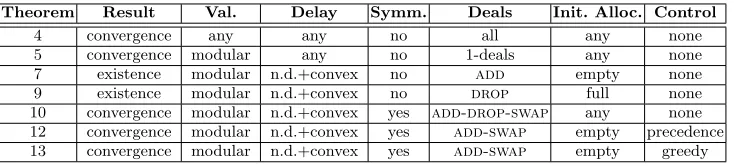
Theorem Result Val. Delay Symm. Deals Init. Alloc. Control 4 convergence any any no all any none 5 convergence modular any no 1-deals any none 7 existence modular n.d.+convex no add empty none
9 existence modular n.d.+convex no drop full none
10 convergence modular n.d.+convex yes add-drop-swap any none
12 convergence modular n.d.+convex yes add-swap empty precedence
[image:8.612.125.492.52.135.2]13 convergence modular n.d.+convex yes add-swap empty greedy
Table 2: Summary of convergence and path-existence results
The fact that the agents are allowed to use any resource and the modularity of the valuation functions make it possible to treat the problem issue by issue. In other words, we have a collection of independent 1-resource congestion games with player-specific valuation functions.
5.
CONCLUSION
We have introduced a powerful and flexible model of multi-agent resource allocation with sharable items. The model integrates features from models developed in two differ-ent strands of the literature: the distributed approach to resource allocation in multiagent systems and congestion games studied in game theory. Most of our technical con-tributions focus on specific instances of the general model, particularly (but not exclusively) the case of allocation prob-lems with agents that have modular valuation functions.
Our first set of results concerns conditions for the conver-gence to a social optimum by means of simple negotiation protocols. As for the previously studied case of nonsharable resources, we have seen that convergence can always be guar-anteed when arbitrarily complex deals are available, and that deals involving just one resource suffice in modular do-mains. Unlike for nonsharable resources, in our scenario the latter type of deal may involve more than two agents, which calls for a finer analysis: we have been able to show that deals involving one resource and at most two agents suffice when the delay functions meet certain conditions and that the protocols can be further simplified by assuming that agents are greedy in the sense of making the most profitable deal first. We have proved theexistence of a path to an op-timum under weaker conditions. These results, summarised in Table 2, complement existing ones on convergence for dif-ferent MARA scenarios and deepen our understanding of the area as a whole.
Our second set of results concerns the existence of pure-strategy Nash equilibria. In particular, we have been able to show that when valuation functions are modular (a strong condition) and when delay functions are nondecreasing (a very common and unproblematic assumption), then such an equilibrium will always exist. This ties in nicely with exist-ing results in the literature on congestion games.
Most of our results apply to particular instances of the general model for multiagent resource allocation with sharable items, by imposing relevant restrictions on valua-tion funcvalua-tions, delay funcvalua-tions, or both. Future work should seek to explore further such instances. For instance, we may ask what types of protocols can guarantee convergence to a social optimum if the class of potential valuation func-tions is neither the class of modular funcfunc-tions nor the class of all set functions. We may also investigate conditions for convergence to allocations that are optimal in the sense of maximising the utility of the weakest agent (egalitarian
so-cial welfare) or in the sense of being envy-free. Regarding the existence of pure Nash equilibria, it would be interesting to see how far we can generalise the two classes of games for which we have obtained positive results without losing the guarantee of the existence of a pure Nash equilibrium.
6.
REFERENCES
[1] H. Ackermann, H. R¨oglin, and B. V¨ocking. Pure Nash equilibria in player-specific and weighted congestion games.Theoretical Computer Science, 410(17):1552 – 1563, 2009.
[2] Y. Bachrach and J. S. Rosenschein. Distributed multiagent resource allocation in diminishing marginal return domains. InProc. 7th International Conference on Autonomous Agents and Multiagent Systems (AAMAS-2008), 2008.
[3] Y. Chevaleyre, P. E. Dunne, U. Endriss, J. Lang, M. Lemaˆıtre, N. Maudet, J. Padget, S. Phelps, J. A. Rodr´ıguez-Aguilar, and P. Sousa. Issues in multiagent resource allocation.Informatica, 30:3–31, 2006. [4] Y. Chevaleyre, U. Endriss, S. Estivie, and N. Maudet.
Reaching envy-free states in distributed negotiation settings. InProc. 20th International Joint Conference on Artificial Intelligence (IJCAI-2007), 2007.
[5] Y. Chevaleyre, U. Endriss, and N. Maudet. Simple negotiation schemes for agents with simple preferences: Sufficiency, necessity and maximality.Journal of Autonomous Agents and Multiagent Systems, In press. [6] P. E. Dunne and Y. Chevaleyre. The complexity of
deciding reachability properties of distributed negotiation schemes.Theoretical Computer Science, 396(1–3):113–144, 2008.
[7] P. E. Dunne, M. Wooldridge, and M. Laurence. The complexity of contract negotiation.Artificial Intelligence, 164(1–2):23–46, 2005.
[8] U. Endriss, N. Maudet, F. Sadri, and F. Toni. Negotiating socially optimal allocations of resources.
Journal of Artificial Intelligence Research, 25:315–348, 2006.
[9] I. Milchtaich. Congestion games with player-specific payoff functions.Games and Economic Behavior, 13(1):111–124, 1996.
[10] I. Milchtaich. Social optimality and cooperation in nonatomic congestion games.Journal of Economic Theory, 114(1):56–87, 2004.
[11] R. W. Rosenthal. A class of games possessing
pure-strategy Nash equilibria.International Journal of Game Theory, 2:65–67, 1973.