Representing Utility Functions via Weighted Goals
∗Joel Uckelman1, Yann Chevaleyre2, Ulle Endriss1,andJ´erˆome Lang3
1Institute for Logic, Language and Computation (ILLC)
University of Amsterdam
2
Laboratoire d’Analyse et Mod´elisation de Syst`emes pour l’Aide `a la D´ecision (LAMSADE) Universit´e Paris-Dauphine
3
Institut de Recherche en Informatique de Toulouse (IRIT) Universit´e Paul Sabatier, Toulouse
Received 26 September 2008, revised 26 January 2009, accepted ??? Published online ???
Key words Preference representation, computational complexity, computational social choice.
We analyze the expressivity, succinctness, and complexity of a family of languages based on weighted propo-sitional formulas for the representation of utility functions. The central idea underlying this form of preference modeling is to associate numerical weights with goals specified in terms of propositional formulas, and to com-pute the utility value of an alternative as the sum of the weights of the goals it satisfies. We define a large number of representation languages based on this idea, each characterized by a set of restrictions on the syntax of formulas and the range of weights. Our aims are threefold. First, for each language we try to identify the class of utility functions it can express. Second, when different languages can express the same class of utility functions, one may allow for a more succinct representation than another. Therefore, we analyze the relative succinctness of languages. Third, for each language we study the computational complexity of the problem of finding the most preferred alternative given a utility function expressed in that language.
c
2008 WILEY-VCH Verlag GmbH & Co. KGaA, Weinheim
1
Introduction
Preferences play an important role in many areas. Whenever someone needs to make a decision or choose between several alternatives, their choices will be guided by their preferences over the alternatives available to them. Similarly, when a group needs to make a decision, that decision should be informed by a suitable aggregation of the individual preferences of its members. Preferences are therefore at the core ofsocial choice theory[1], which studies mechanisms for collective decision making; and computational aspects of preference representation are central to the field ofcomputational social choice[2].
We can distinguishordinal fromcardinal preferences. An ordinal preference is a binary relation over the domain of alternatives, which is typically assumed to be transitive and complete, although this need not be the case. Such an ordinal preference relation allows us to check whether one alternative is “better” than another. Cardinal preferences are utility functions mapping alternatives to a suitable scale, often the reals. When the number of alternatives that we need to rank or over which we need to define a utility function is relatively small, then the choice oflanguagefor representing preferences is not crucial. However, the set of alternatives often has a combinatorial structure. For instance, if we need to decide on an allocation of (indivisible) goods to agents, then each agent will have preferences over the alternative subsets they may receive, the number of which is exponential in the number of goods. Similarly, when we elect the members of a committee, the number of alternative constellations is exponential in the number of seats available. In general, acombinatorial domainis the
∗ This paper is based on and extends work presented at the 10th International Conference on Principles of Knowledge Representation
Cartesian product of several finite domains (often binary domains). Choosing an alternative from a combinatorial domain means choosing a value for each dimension of the domain. It is these kinds of situations in which we require languages that allow for a compact representation of preferences.
Several such languages have been developed and analyzed in the literature, both for the representation of utility functions and for the representation of ordinal preference relations. Languages for the succinct representation of ordinal preferences include formalisms for makingceteris paribusstatements, which range from very expressive languages [3] to syntactical restrictions such as CP-nets [4], where a weaker expressivity is compensated for by the availability of efficient elicitation and optimization techniques. They also include languages based on conditional logics, prioritized logics, and prioritized constraint satisfaction problems (see e.g., Lang [5] for an overview). Languages for the succinct representation of utility functions include graphical models [6, 7, 8, 9], decision trees [10], valued constraint satisfaction problems [11], and bidding languages for combinatorial auctions [12, 13, 14].
In this paper we analyze languages for the representation of utility functions based on weighted propositional formulas, or weighted goalsfor short, an approach which originates in penalty logic [5, 15]. This family of languages is suitable for modeling preferences over combinatorial domains that are the Cartesian product of several binary domains, each represented by a propositional variable. The central idea is to associate numerical weights with goals specified in terms of propositional formulas, and to compute the utility value of an alternative as a function of the weights of the goals it satisfies. For example, the weighted goal(p∧q,4)expresses that our decision maker ascribes a value of4to making bothpandqtrue. Similarly,(¬r,7)means that makingr
false has value7. There are several different ways in which we could aggregate the weights of the goals satisfied by an alternative to compute the utility of that alternative. In this paper we concentrate on what is arguably the most natural choice for such an aggregation operator, namely summation, though maximization is also a viable alternative [16, 17]. We note here that weighted goals can also be used to model ordinal preferences, for instance by interpreting weights as indicators for the relative importance of goals and by ranking alternatives in terms of the most important goal they violate [5, 18]. However, in the present paper we are only interested in modeling utility functions.
Weighted goals are a framework for defining an entirefamily of languages. The choice of aggregator is one choice that we need to make. A further choice concerns the range of formulas that we wish to admit as goals. For instance, we may not want to allow for negation or we may only permit formulas that do not exceed a certain length. Finally, we could impose restrictions on the range of weights to be used. For instance, we may allow weights to be drawn from the reals, the positive reals, or even just very small sets such as{0,1}. Each choice of aggregator, restriction on formulas, and restriction on weights gives rise to a different language, and we can study and compare their properties.
In this paper we investigate three important properties of such languages: expressivity, succinctness, and complexity. We briefly introduce each of these here:
• Expressivity: Can our language of choice represent all functions belonging to a given class of utility func-tions which interests us? Not all languages are equally expressive and not all applicafunc-tions require full ex-pressivity. Excess expressivity is often undesirable, because highly expressive languages tend to be compu-tationally more demanding to reason about. We are interested incorrespondence resultsbetween languages and classes of functions. For instance, a very simple result which we present shows that the language we obtain by restricting formulas toliteralscan express allmodularutility functions, and only those. An inter-esting property closely related to expressivity isuniquenessof representation. A language has the uniqueness property with respect to a given class of utility functions if it has no more than one way of representing any function from that class. Syntactically rich languages often lack the uniqueness property, which may be considered wasteful.
• Succinctness:How much space do we require to encode a given utility function in a given language? If two languages can both express all functions from a given class of utility functions of interest, but one can do so using less space than the other, then the former language may be preferred. In fact, this definition is too restrictive. We will call languageLat least assuccinctas languageL0if any utility function expressible in
exponentially larger than it is inL, thenLis strictly more succinct thanL0. IfL0has the uniqueness property,
then this kind of result is particularly easy to prove, as it is sufficient to provide a concrete representation inL0.
• Complexity: What is the computational complexity of certain tasks, such as comparing two alternatives or finding a most preferred alternative, when preferences are expressed in a given language? We will define the MAX-UTILproblem, the decision problem of checking whether there exists an alternative that exceeds a particular given utility level K (this problem is of course closely related to the problem of finding an alternative that maximizes utility, hence the name). As we shall see, the complexity of MAX-UTILranges from linear to NP-complete, depending on the language.
Other important properties of preference representation languages, which we shall not address in this paper, are cognitive relevanceandelicitation friendliness. The former concerns the proximity of the formal representation language to the way in which humans represent their preferences. Elicitation is the process of constructing a representation of a preference structure by querying a decision maker, and some languages may fare better than others in this respect.
The remainder of this paper is organized as follows: Section 2 introduces the framework of weighted goals for the representation of utility functions. We also briefly discuss alternative languages, in particular the family of so-called OR/XOR bidding languages developed in the area of combinatorial auctions. Each of the subsequent sections is devoted to a property of representation languages. Section 3 takes up the question of which utility functions are representable in any given language. In Section 4, we compare languages as to their space efficiency, and in Section 5 we consider the complexity of answering some queries on goalbases.
2
Languages
In this section we define the languages for representing utility functions that are the object of study in this paper and introduce some basic notation. We also briefly discuss related work. (More related work is reviewed in the conclusion.)
2.1 Basic Definitions and Notation
We are interested in utility functions declared over combinatorial domains that are the Cartesian product of several binary domains. A generic representation of this kind of domain is the set of all possible models for propositional formulas over a fixed language with a finite number of propositional variables (the dimensionality of the combinatorial domain).
Definition 2.1(Utility Functions and Models) A utility function is a mappingu: 2PS →R, wherePSis a fixed, finite set of propositional variables. Amodelis a setM ∈2PS. We writePSnto indicate that|PS|=n.
LetLPSbe the language of propositional logic overPS. In principle, we may allow any kind of propositional
connective. The technical results in this paper apply to formulas that contain only the connectives¬,∧, and∨. We comment briefly on the use of additional connectives in the conclusion.
Definition 2.2(Weighted Goals and Goalbases) Aweighted goalis a pair(ϕ, w), whereϕis a formula in the languageLPSandw∈R. Agoalbaseis a finite multisetG={(ϕi, wi)}iof weighted goals.
Goals are typically required to be satisfiable formulas, but for the languages studied in this paper this does not affect expressive power (whether unsatisfiable formulas are allowed could potentially affect complexity, and we comment on this issue in Section 5). When a particular goalbase is under consideration, we writewϕto mean the weight of formulaϕin that goalbase.For(G)is the set of formulas inG.
Definition 2.3(Generated Utility Functions) A goalbaseGand an aggregation functionF : 2R→
Rgenerate
a utility functionuG,F mapping each modelM ⊆ PStouG,F(M) =F({w: (ϕ, w)∈GandM |=ϕ}). In this paper, we restrict ourselves toF = Σ, the summation function, and often omitFhereafter. In particular, this means that
uG(M) =
X
which is to say that the value of a model is the sum of weights of formulas made true in that model. For example, ifPS={p, q, r}, then the goalbaseG1={(p∨q∨r,2),(p∧q,1),(p∧r,1),(q∧r,1),(p∧q∧r,−2)}generates
the utility functionu:X 7→min(3,2·|X|).
Definition 2.4(Goalbase Equivalence) Two goalbasesGandG0are equivalent with respect to an aggregation
functionF(writtenG≡F G0) iff they define the same utility function. That is,G≡F G0iffuG,F =uG0,F.
Goalbases provide a framework for defining different languages for representing utility functions. Any re-striction we might impose on goals (e.g., we may only want to allow clauses as formulas) or weights (e.g., we may not want to allow negative weights) and any choice we make regarding the aggregatorF gives rise to a different language. An interesting question then is whether there are natural goalbase languages (defined in terms of natural restrictions) such that the utility functions they generate enjoy simple structural properties. (This is indeed the case, as seen in Section 3.3.)
Definition 2.5(Languages and Classes of Utility Functions) LetΦ ⊆ LPS be a set of formulas,W ⊆ R
a set of weights, andF an aggregation function. ThenL(Φ, W, F)is the set of goalbases formed by formulas inΦwith weights fromW to be aggregated by F, andU(Φ, W, F)is the class of utility functions generated by goalbases belonging toL(Φ, W, F). More generally, we writeU(L)to mean the class of utility functions generated by goalbases in the languageL.
As mentioned before, we treat the case whereF = Σin this paper, and hereafter omitF from our notation where it causes no ambiguity.
Regarding weights, we will study the restriction to the positive reals (R+) as well the general case(R). For
complexity questions we will restrict attention to the rationals (Q). The next definition summarizes the types of
restrictions we consider for formulas.
Definition 2.6(Types of Formulas) We define the following types of formulas:
• Anatomis a member ofPS.
• Aliteralis an atom or its negation.
• Aclauseis a disjunction of literals.
• Acubeis a conjunction of literals.
• ApositiveXis a satisfiable formula of typeX that con-tains no negations.
• Astrictly positiveXis a non-tautologous positiveX.
• Ak-Xis anXwith at mostkoccurrences of atoms. When discussing positive clauses, positive cubes, and positive formulas, we frequently abbreviate these to pclauses, pcubes, and pforms, respectively. Additionally, we call strictly positive cubes and strictly positive formulasspcubesandspforms, respectively. (The termspclausesis redundant because every positive clause is fal-sifiable.) Atoms are1-spclauses,1-spcubes, and1-spformulas (and also1-pclauses,1-pcubes, and1-pformulas), while literals are1-clauses,1-cubes, and1-formulas. Clauses, cubes, and formulas areω-clauses,ω-cubes, and
ω-formulas, respectively, which is to say that the formulas may be of any finite length.1Note thatV
∅=>and
W
∅ = ⊥, from which follows that>is the unique0-pcube and⊥the unique0-clause. The notationX+>
indicates the set of formulasX∪ {>}(e.g., pclauses+>is the set containing all pclauses along with>).
2.2 Related Languages
Goalbase languages and variations thereof have been considered in many places and used for a number of appli-cations, sometimes under a different name [5, 13, 15, 16, 18, 19, 20, 21, 22].
Boutilier and Hoos [13], for instance, suggest a variant ofL(pforms,R+,Σ)as a means for communicating
bids in a combinatorial auction. There are two differences between their language andL(pforms,R+,Σ). First,
they also allow for the logic connective XOR, which we do not consider here. Including additional connectives can improve succinctness, and so is attractive from a pragmatic point of view, but it does not make an important difference as far as the basic principles of the approach are concerned. Second, Boutilier and Hoos [13] also allow for weights to be assigned to subformulas of goals. The utility of a set of goods is then computed as the sum of the weights of all the subformulas satisfied. This does allow us to express some utility functions more concisely, but it does not affect succinctness in the technical sense to be defined later in this paper (to be precise, goalbase size decreases by at most a quadratic factor), nor does it affect the expressivity of the language.
1 Strictly speaking, we should write, e.g.,(< ω)-cubes instead ofω-cubes, but we abuse notation for the sake of brevity and because all
Another important group of languages for modeling cardinal preferences are the OR/XOR family of bidding languages for combinatorial auctions [12]. While these languages also use logical connectives, the connectives are interpreted differently there. In the OR language, a set of atomic bidshB, pi, each consisting of a bundle of goods and a price, is taken to represent a function that maps any set of goodsX to the maximal sum of prices that is achievable by accepting any set of non-overlapping bids so thatXcovers all the goods mentioned in those accepted bids. The OR language is often the basis for bidding languages used in practice. A problematic feature of this language is that even the basicevaluation problem—the problem of computing the value assigned to a given set of goods according to the bid expression of a single bidder—is NP-hard. In contrast to this, the evaluation problem clearly is easy for any of our goalbase languages: given a modelXand a goalbaseG, computinguG(X) only requires one model checking operation for each goal inG.
In the XOR language [12, 14], the auctioneer may accept at most one atomic bid per bidder. This means that the value of a set of goodsX is the highest price attached to any of its subsets within the atomic bids submitted. This is equivalent toL(pcubes,R+,max)in our framework. A disadvantage of this language is that it is not
concise for most interesting classes of valuation functions. Finally, combinations of XOR and OR (such as OR-of-XORs) have also been considered in the literature.
3
Expressivity
The language restrictions introduced in the previous section allow us to define a host of different languages. In this section we study the expressivity of these languages. We first state some simple equivalences between goalbases. We then define the notion of a language having unique representations and establish two uniqueness results. Finally, we prove a number of correspondence results that allow us to (almost) fully classify the languages identified with respect to the classes of utility functions they define.
3.1 Equivalences
Recall that two goalbasesGandG0areequivalent(G≡ΣG0) if they generate the same utility function (i.e., if
uG=uG0). The following equivalences are, for convenience, stated as they are used later on, and not necessarily
in their most general form.
Fact 3.1 Given a goalbaseG, formulasϕ, ϕ1, . . . , ϕk, ψ, χ, and weightw ∈R, the following equivalences
hold:
G∪ {(ϕ∧ ¬ψ, w)} ≡ G∪ {(ϕ, w),(ϕ∧ψ,−w)} (1)
G∪ {(ϕ∨ ¬ψ, w)} ≡ G∪ {(>, w),(ϕ, w),(ϕ∨ψ,−w)} (2)
G∪ {(ϕ∧(ψ∨χ), w)} ≡ G∪ {(ϕ∧ψ, w),(ϕ∧χ, w),(ϕ∧ψ∧χ,−w)} (3)
G∪ {(ϕ∨(ψ∧χ), w)} ≡ G∪ {(ϕ∨ψ, w),(ϕ∨χ, w),(ϕ∨ψ∨χ,−w)} (4)
G∪ {(ϕ1∧ · · · ∧ϕk, w)} ≡ G∪ {(¬ϕ1∨ · · · ∨ ¬ϕk,−w),(ψ, w),(¬ψ, w)} (5) G∪ {(ϕ1∨ · · · ∨ϕk, w)} ≡ G∪ {(¬ϕ1∧ · · · ∧ ¬ϕk,−w),(ψ, w),(¬ψ, w)} (6) G∪ {(>, w)} ≡ G∪ {(ϕ, w),(¬ϕ, w)} (7) All of the above are easily verified by considering all possible combinations of truth values forϕ, ψ, χ.
3.2 Uniqueness
Some languages have a unique way of expressing a given utility function, while others allow for several alternative representations. The next definition makes this notion of uniqueness precise.
Definition 3.1 A utility functionuisrepresentedin a languageLif there exists a goalbaseG∈ Lsuch that
L(cubes,R), for instance, does not have unique representations: The two goalbases {(>,3),(p,2)} and {(p∧q,5),(p∧ ¬q,5),(¬p∧q,3),(¬p∧ ¬q,3)}both define the same utility function (forPS={p, q}).
Theorem 3.2 L(pcubes,R)has unique representations.
P r o o f. Given any utility functionu, the weight of each positive cube is uniquely determined: We must have
w> =u(∅), because>is the only positive cube satisfied by∅, and furthermorewVX =u(X)−P
Y⊂XwVY
for any nonempty setX.
The recursive definition of the weights given in the proof of Theorem 3.2 can be turned into a direct rule for computing weights by using the so-calledM¨obius inversion[23, 24]:
wVX =
X
Y⊆X
(−1)|X\Y|·u(Y) (8)
Theorem 3.3 L(pclauses,R)has unique representations.
P r o o f. Letube any utility function represented by positive clauses with weightswW
X(with nonempty sets X ⊆ PS). Then for anyY ⊆ PS,u(Y)must be equal to the sum of the weightswWXfor whichXandY have
a nonempty intersection:
u(Y) = X
X∩Y6=∅
wWX =
X
∅⊂X⊆PS
wWX −
X
∅⊂X⊆PS\Y
wWX = u(PS) −
X
∅⊂X⊆PS\Y wWX
This shows that each weightwWXis uniquely determined: For singletonsX ={p}, by settingY =PS \ {p}in
above equation, we obtainwp =u(PS)−u(PS \ {p}). For general setsX, usingY =PS \X, we then obtain wWX=u(PS)−u(PS \X)−P
∅⊂X0⊂XwWX0.
Now, unraveling the recursive definition of the weights given in the proof above, we can also provide a direct rule for computing weights inL(pclauses,R), similar to the M¨obius inversion:
wWX =
X
Y⊆X
(−1)|X\Y|+1·u(PS \Y) (9)
Furthermore, we have the following corollary because no positive clause is a tautology:
Corollary 3.4 L(pclauses+>,R)has unique representations.
3.3 Correspondences
We now address the following question: What class of utility functions can we model using a given language? As much as possible we will strive for exact characterization results that establish the correspondence between a natural goalbase language and a commonly used class of utility functions.
An important class of utility functions are thek-additive functions[24]. LetPS(k)be the set of all subsets ofPS with at mostkelements. A utility functionuisk-additive if there exists a mappingm : PS(k) → R
such thatu(X) =P{m(Y) :Y ⊆X andY ∈ PS(k)}for each setX ⊆ PS. The concept ofk-additivity has
been applied in various places, including fuzzy measure theory [24], combinatorial auctions [25], and distributed multiagent resource allocation [26]. For example, if the variables inPSare used to model whether an agent owns certain resources, thenk-additive utility functions naturally model situations where synergies among different resources are restricted to bundles of at mostkelements.
For the next proof, and indeed much of the paper, we will make frequent use of the fact that wheneverΦ⊆Φ0 andW ⊆W0, thenU(Φ, W)⊆ U(Φ0, W0).
Theorem 3.5 U(k-pcubes,R), U(k-cubes,R), U(k-pclauses +>,R), U(k-clauses,R), U(k-pforms,R),
P r o o f. Inspection of the definition ofk-additivity shows that it is simply a notational variant of the language based on positive cubes of length≤k. That is,U(k-pcubes,R)is the class of allk-additive utility functions. By
language inclusion, we have the following:
U(k-cubes,R) ⊆ U(k-forms,R) ⊇ U(k-clauses,R)
⊆ ⊆ ⊆
U(k-pcubes,R) ⊆ U(k-pforms,R) ⊇ U(k-pclauses +>,R)
Taken together, equivalences (1) and (3) from Fact 3.1 can be used to transform any goalbase inL(k-forms,R) into an equivalent goalbase in L(k-pcubes,R). (Use (3) to eliminate all disjunctions, then (1) to elimi-nate all negations. While these equivalences add more formulas, they never add longer formulas.) Thus,
U(k-pcubes,R) =U(k-forms,R).
Equivalences (2) and (4) from Fact 3.1 can be used to transform any goalbase inL(k-forms,R)into an equiva-lent goalbase inL(k-pclauses +>,R). (Use (4) to eliminate all conjunctions, then (2) to eliminate all negations.) Thus,U(k-pclauses,R) =U(k-forms,R). In summary, we see that each of the six classes must be equal to the class ofk-additive functions.
The next lemma clarifies the effect that the ability to express tautologies in a language has on the class of utility functions that can be defined. Roughly speaking, any utility functionuexpressible in a language based on strictly positive formulas must benormalized, i.e., will satisfyu(∅) = 0.
The (affine) translationtcof a utility functionuis the map such thattc(u(X)) =u(X) +cfor allX ⊆ PS. A propertyP isinvariant under translationif, for all utility functionsu,c∈R, andX ⊆ PS,uhas propertyP
ifftc(u)has propertyP.
Lemma 3.6 FixΦas a strictly positive set of formulas andPa property of utility functions which is invariant under translation. ThenU(Φ, W)is the class of normalized utility functions with propertyPiff U(Φ∪ {>}, W) is the class of utility functions with propertyP.
P r o o f. (⇒) Suppose thatU(Φ, W)is the class of normalized utility functions with propertyP. First, we show that every uG ∈ U(Φ∪ {>}, W) has property P: FixuG ∈ U(Φ∪ {>}, W). G\ {(>, w) : w ∈ W} ∈ L(Φ, W)and souG\{(>,w):w∈W}has propertyP by hypothesis. uG =tw(uG\{(>,w):w∈W})and so by
invarianceuGhas propertyP.
Next, we show that every u with property P is in U(Φ∪ {>}, W): Fix u with property P. tu(∅)(u) is
normalized and has propertyPby invariance, sotu(∅)(u)∈ U(Φ, W)by hypothesis. LetGrepresenttu(∅)(u)in
L(Φ, W). ThenG∪ {(>, u(∅))} ∈ L(Φ∪ {>}, W)anduG∪{(>,u(∅))}=u.
(⇐) Suppose thatU(Φ∪ {>}, W)is the class of utility functions with propertyP. First, we show that every
uG ∈ U(Φ, W)is normalized and has propertyP: FixuG ∈ U(Φ, W). Normalization follows due toΦbeing strictly positive.G∪{(>, w)} ∈ L(Φ∪ {>}, W)for anyw∈W, and by hypothesisuG∪{(>,w)}has propertyP.
uG∪{(>,w)}=tw(uG), and so by invariance has propertyP.
Next, we show that every normalizeduwith propertyPis inU(Φ, W): Fixunormalized and with propertyP. For anyw ∈ W,tw(u)has propertyP by invariance and so is inU(Φ∪ {>}, W). LetGrepresenttw(u)in L(Φ∪ {>}, W). Since Φ is strictly positive, (>, w) ∈ G. ThenuG\{(>,w)} = t−w1(tw(u)) = u, and so u∈ U(Φ∪ {>}, W).
Next we explore the class ofk-additive utility functions for specific values ofk. It is a well-known fact that anyutility function isk-additive for some k ∈ N(certainly fork = |PS|). (This is why we refer to general functions asω-additive.) Our next result is therefore an immediate corollary of Theorem 3.5.
Corollary 3.7 U(pcubes,R), U(cubes,R), U(pclauses +>,R), U(clauses,R), U(pforms,R), and U(form,R)are equal to the class of all utility functions.
Another special case of interest is the class of1-additive utility functions, better known as themodularutility functions. An alternative way of characterizing this class is to define a utility functionuas modular ifu(X∪Y) =
Corollary 3.8 U(literals,R) and U(atoms+>,R) are the class of all modular utility functions, and U(atoms,R)is the class of all normalized modular utility functions.
P r o o f. The set of 1-pcubes is equal to the set of atoms together with >. Therefore, by Theorem 3.5,
U(atoms+>,R) is the class of all modular functions. The class of 1-cubes is equal to the class of literals together with>. But by equivalence (7) of Fact 3.1, literals alone have the same expressive power as literals together with>. Hence, again by Theorem 3.5,U(literals,R)is the class of all modular functions. The fact that U(atoms,R)is the class of all normalized modular utility functions follows from Lemma 3.6.
For the remainder of this section we consider languages where the set of weights is restricted to the positive reals. Clearly, the utility functions that can be so expressed will benonnegative, i.e.,u(X)≥0for allX⊆ PS. The question is whether we can expressallnonnegative utility functions in this manner.
Theorem 3.9 U(cubes,R+)andU(form,R+)are the class of all nonnegative utility functions.
P r o o f. Clearly everyu ∈ U(form,R+)(and hence also everyu ∈ U(cubes,R+)) is nonnegative. For the
converse, suppose thatuis nonnegative. Then define
G=n^M∧^{¬p:p∈ PS \M}, u(M):M ⊆ PS andu(M)6= 0o and observe thatuG=uand thatGcontains only positively-weighted cubes.
That is, general formulas as well as cubes are fully expressive over nonnegative utility functions when weights are required to be positive. As we shall see next, the same is not true for clauses.
Theorem 3.10 U(clauses,R+)is a proper subset of all nonnegative utility functions.
P r o o f. L(clauses,R+)⊂ L(form,
R+), so by Theorem 3.9,U(clauses,R+)contains only nonnegative
util-ity functions. The utilutil-ity functionuoverPS ={p, q}withu({p, q}) = 1andu(X) = 0for anyX 6={p, q}
demonstrates that the inclusion is strict. The following five constraints must be satisfied for there to be a
G∈ L(clauses,R+)which representsu:
wp+wq+wp∨q+w¬p∨q+wp∨¬q+wp∨¬p= 1 (10)
wp+w¬q+wp∨q+wp∨¬q+w¬p∨¬q+wp∨¬p= 0 (11)
w¬p+wq+wp∨q+w¬p∨q+w¬p∨¬q+wp∨¬p= 0 (12)
w¬p+w¬q+w¬p∨q+wp∨¬q+w¬p∨¬q+wp∨¬p= 0 (13)
wϕ≥0for all clausesϕ (14)
Together, constraints (11), (12), (13), and (14) forcewϕ= 0for every clauseϕ, contradicting (10).
L(clauses,R+)seems not to characterize a natural class of functions. For (strictly) positive formulas with
positive weights, on the other hand, we do obtain nice correspondences. A utility functionuismonotoneif, for allX, Y ⊆ PS,u(X)≤u(Y)wheneverX ⊆Y.
Theorem 3.11 U(spforms,R+)is the class of all normalized monotone utility functions.
P r o o f. No strictly positive formula is a tautology, so everyu∈ U(spforms,R+)is normalized, and because
all weights and formulas are positive, it is also monotone.
For the converse: Let u be an arbitrary normalized monotone utility function. We construct a G ∈ L(spforms,R+)for whichuG=uas follows. Define a sequence of utility functionsu1, . . . , unso that
uk(X) = max{u(X0) :X0 ⊆X and|X0| ≤k}.
In this way,u1 = maxa∈Xu({a})andun =u. Additionally, we defineu0(X) = 0for allX, for convenience.
Observe that we can use the theseuito decomposeusuch thatu=P n
k=1(uk−uk−1), and so if we can construct
abbreviateuk−uk−1tou∗k. To constructGk, a goalbase foru∗k, letX0 =∅andhX1, . . . , X(n k)
ibe the set of size-ksubsets ofPS, ordered so thatu∗k(Xi)≤u∗k(Xj)fori < j. Then let
Gk=
(
(n k)
_
j=i
^
Xj, u∗k(Xi)−u∗k(Xi−1)
: 1≤i≤ n k
)
from which it can easily, though tediously, be checked that uGk = u
∗
k. (For example, if PS = {a, b, c}and u(a)≤u(b)≤u(c), thenG1={(a∨b∨c, u(a)),(b∨c, u(b)−u(a)),(c, u(c)−u(b))}. View itemsa,b, andc
as substitutes, but withbconferring a bonus overa, andca further bonus overb. This is the structure which can be seen inG1. Higher-orderGis capture this same idea, but for sets of items larger than singletons.)
Finally, letG =Sn
k=1Gk. NowuG = u, since for eachk,uGk =u
∗
k and
Pn
k=1u∗k = un = u. Finally, observe that every formula inGis strictly positive; and all the weightsu∗k(Xi)−u∗k(Xi−1)are nonnegative by
virtue of the ordering declared over theXi.
Note that in the preceding theorem, we could also addnonnegativeas a property, because normalization and monotonicity together imply nonnegativity. An application of Lemma 3.6 yields the following corollary.
Corollary 3.12 U(pforms,R+)is the class of all nonnegative monotone utility functions.
A utility function u is supermodular if u(X ∪Y) ≥ u(X) +u(Y)−u(X ∩Y)for all X, Y ⊆ PS. Supermodularity (and its counterpart, submodularity, defined below) are widely used concepts in the economics literature [28]. Supermodularity seems not to correspond directly to a natural goalbase language, but we can characterize a large subclass.
Theorem 3.13 U(pcubes,R+) is the class of all nonnegative utility functions satisfying the constraint
P
Y⊆X(−1)|X\Y|·u(Y)≥0for allX ⊆ PS.
P r o o f. ThatU(pcubes,R+)is the class of all nonnegative utility functions satisfyingP
Y⊆X(−1)| X\Y|·
u(Y)≥0immediately follows from the fact that the weight of any positive cube is determined by the M¨obius inversion as stated in equation (8).
Note that the property corresponding to U(pcubes,R+) implies nonnegativity, monotonicity, and
super-modularity. Nonnegativity and monotonicity follow from Corollary 3.12. For supermodularity, suppose that
G∈ L(pcubes,R+). Then uG(X∪Y) =
X
Z⊆X∪Y
wVZ =
X
Z⊆X wVZ+
X
Z⊆Y
wVZ−
X
Z⊆X∩Y
wVZ+
X
Z⊆X∪Y Z*X,Y
wVZ
≥ X
Z⊆X
wVX+
X
Z⊆Y
wVZ−
X
Z⊆X∩Y
wVZ=uG(X) +uG(Y)−uG(X∩Y),
which is equivalent to the supermodularity condition.
The utility functionu : X 7→ max(1,|X|)shows that there are supermodular utility functions that are not inU(pcubes,R+). As can easily be checked, ifPS = {p, q, r}, then expressinguin terms of positive cubes
requires the use of a negative weight: wp∧q∧r = −1. The previous theorem holds also forU(spcubes,R+)if
“nonnegative” is replaced with “normalized”.
The dual of the supermodularity property is submodularity. A utility functionuissubmodularifu(X∪Y)≤ u(X) +u(Y)−u(X∩Y)for allX, Y ⊆ PS.
Theorem 3.14 U(pclauses,R+) is the class of all nonnegative utility functions satisfying the constraint
P
Y⊆X(−1)
|X\Y|+1·u(PS \Y)≥0for allX ⊆ PS.
Note that the property corresponding to U(pclauses,R+) implies monotonicity, normalization, and
sub-modularity. Normalization and monotonicity follow from Theorem 3.11. To show submodularity, let G ∈ L(pclauses,R+) and letX, Y ⊆ PS. For positive clausesϕ, X ∪Y |= ϕ together withX 6|= ϕ implies Y |=ϕ. Furthermore,X 6|=ϕimpliesX∩Y 6|=ϕ. Therefore:
{(ϕ, w)∈G:X∪Y |=ϕandX6|=ϕ} ⊆ {(ϕ, w)∈G:Y |=ϕandX∩Y 6|=ϕ}
As all the weightsware positive, we immediately obtain the required inequality characterizing submodularity, namelyuG(X∪Y)−uG(X)≤uG(Y)−uG(X∩Y).
An example which confirms that not all submodular utility functions belong toU(pclauses,R+)is the
func-tion u : X 7→ min(2,|X|)for PS = {p, q, r}. On the one hand, uis submodular, on the other we must have wp∨q∨r = −1 if we are to express u using positive clauses. The previous theorem holds also for U(pclauses+>,R+)if “normalized” is replaced with “nonnegative”.
The kind of functions characterized by Theorem 3.13 are also known asbelief functions, while those charac-terized by Theorem 3.14 are known asplausibility functions(when the functions are restricted to[0,1]) [29, 30].
3.4 Summary
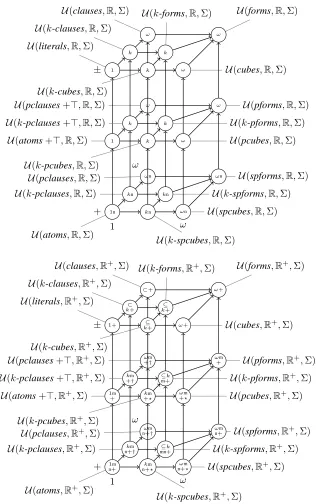
Our correspondence results are summarized in Table 1. We have not analyzed the interplay of bounding the length of formulas and restricting weights to positive reals in detail. By Theorem 3.5, any language restricting the length of formulas to at mostkatoms can only generatek-additive utility functions. The opposite direction is less clear. While inspection of the proofs of Theorems 3.13 and 3.14 show that these results extend to the
k-additive case in the expected manner, this is not so for Theorems 3.9 and 3.11. For instance, we do not know whetherU(k-cubes,R+)is the class of all nonnegativek-additive functions or only a subclass thereof.
4
Succinctness
In this section, we consider how space efficient languages are relative to one another. In order to do so, we first provide a definition of goalbase size so that we have grounds for comparison.
Definition 4.1(Formula Length and Goalbase Size) Thelength of a formulaϕis the number of occurrences of atoms it contains. Thesize of a weighted goal(ϕ, w)is the length ofϕplus the number of bits needed to store
w(that is,logwbits). Thesize of a goalbaseG, written assize(G), is the sum of the sizes of the weighted goals inG.
Often we consider families of utility functions{un}n∈Nwheren =|PSn|. Suppose that we have a corre-sponding family of goalbases{Gn}n∈Nfor whichun =uGn. Unless the number of bits required to represent the weights inGngrows superexponentially inn, the size contributed by the weights can be safely ignored when considering howsize(Gn)grows withn, sincelogcp(n)is polynomial innfor fixed constantscand polynomials p. Every family of utility functions considered here has weights which are independent ofn, and so we disregard the size of the weights in our succinctness results. (Superexponential growth in weights affects all languages equally.)
Frequently one language contains shorter representations of some utility functions than does another language. Here we offer a definition of relative succinctness to make this notion precise. This definition is similar to ones given by Cadoli et al. [31] and Coste-Marquis et al. [18]. Because we wish to compare languages which differ in expressive power, we define succinctness over only the expressive overlap of the languages being compared. This leads to some counterintiutive results for languages with little expressive overlap and makes the comparative succinctness relation intransitive, but it also permits us to make comparisons where the expressive overlap is substantial, though not total.
Definition 4.2(Succinctness) Let L(Φ, W, F) andL(Ψ, W0, F0) be goalbase languages and U a class of
utility functions for which every member is expressible in both languages. ThenL(Φ, W, F)U L(Ψ, W0, F0)
iff there exists a functionf :L(Φ, W, F)→ L(Ψ, W0, F0)and a polynomialpsuch that for allG∈ L(Φ, W, F), ifuG,F ∈ UthenuG,F =uf(G),F0andsize(f(G))≤p(size(G)).
ReadL U L0 as: L0 is at least as succinct asLover the classU. WhenL0 is strictly more succinct than
ωn U(pclauses,R,Σ)
ω
ω
U(pclauses+>,R,Σ)
ω
U(clauses,R,Σ)
ωm n+†
U(pclauses,R+,Σ)
ω
ωm
+†
U(pclauses+>,R+,Σ)
⊂+
U(clauses,R+,Σ)
1n
U(atoms,R,Σ) 1
+ kn
U(k-spcubes,R,Σ)
ωn U(spcubes,R,Σ) ω
kn
U(k-pclauses,R,Σ) kn U(k-spforms,R,Σ)
ωn U(spforms,R,Σ)
1
U(atoms+>,R,Σ) k
U(k-pcubes,R,Σ) 1
U(literals,R,Σ)
±
ω U(pcubes,R,Σ) k
U(k-cubes,R,Σ)
ω U(cubes,R,Σ)
k
U(k-pclauses+>,R,Σ) k
U(k-clauses,R,Σ)
k U(k-pforms,R,Σ) ω U(pforms,R,Σ) k
U(k-forms,R,Σ) ω
U(forms,R,Σ)
1m n+
U(atoms,R+,Σ)
1
+ km
n+?
U(k-spcubes,R+,Σ) ωm
n+? U(spcubes,R+,Σ)
ω
km n+†
U(k-pclauses,R+,Σ) mn⊆k+ U(k-spforms,R
+,Σ) ωm
n+ U(spforms,R+,Σ) 1m
+
U(atoms+>,R+,Σ) +km?
U(k-pcubes,R+,Σ)
1+
U(literals,R+,Σ)
±
ωm
+? U(pcubes,R+,Σ) ⊆
k+
U(k-cubes,R+,Σ)
ω+ U(cubes,R+,Σ)
km
+†
U(k-pclauses+>,R+,Σ) ⊂ k+
U(k-clauses,R+,Σ)
⊆k
m+ U(k-pforms,R+,Σ) ωm
+ U(pforms,R+,Σ)
⊆ k+
U(k-forms,R+,Σ)
ω+
U(forms,R+,Σ)
Expressivity Each node represents one lan-guage, and an arrow from one node to another indicates that the tail language is included in the head language. Within each node, the expressivity of the language is given, according to the key below:
1 1-additive (modular) k k-additive
ω ω-additive (general) n normalized
+ nonnegative m monotone
? plausibility function † belief function ⊂ proper subset of ⊆ subset of
[image:11.612.86.402.90.594.2]Where ⊆ (or ⊂) is indi-cated, the language represents a (proper) subset of the class of utility functions with the given properties. In all other cases, the language represents exactly the class of utility func-tions with the given properties. The x-axis (increasing to the right) is thecubesaxis, along which allowable cubes grow from length1up to ω; they -axis (increasing into the page) is the clauses axis, also run-ning from1to ω. The z-axis (decreasing upward) is the pos-itivityaxis and has three steps: strictly positive, positive, and general. Each language in the lower graph is a sublanguage of the corresponding language with general weights in the up-per graph, but we have omitted these arrows for clarity.
Table 1 Summary of Expressivity Results
super-polynomially better inL0—we writeL ≺
U L0. When we have nonstrict succinctness in both directions,
we write L ∼U L0; when we have nonstrict succinctness in neither direction, i.e., incomparability, we write
L ⊥U L0. Whenever a succinctness relation appears unsubscripted (i.e., without an explicit class of comparison),
Fact 4.1 For all languagesL1,L2,L3:
1. IfL1⊆ L2, thenL1 L2.
2. IfL1 L2andL3⊆ L1, thenL3 L2.
3. IfL1⊆ L2⊆ L3andL1≺ L2 L3, thenL1≺ L3.
4. IfL1⊥ L2andL1∪ L2⊆ L3, thenL1,L2≺ L3.
5. IfL1∼ L2andU(L1) =U(L2), thenL1 L3iffL2 L3, where ∈ {∼,,,,≺,⊥}.
Note that Fact 4.1.2 is useful contrapositively also, for derivingresults for superlanguages. For Fact 4.1.3, it would be inadequate to require thatL1 L2≺ L3instead, since it could happen thatL1is too small to represent
the utility functions which causeL2 ≺ L3. Fact 4.1.5 expresses the notion that if two languages are equal in
succinctness and expressivity, then they stand in the same succinctness relation with any third language.
In the rest of this section, we prove many pairwise succinctness results in order to have as full a picture as possible of the qualities of the languages introduced in Section 3. All known succinctness results among these languages are summarized in Table 2 at the end of this section.
4.1 Some Basic Succinctness and Equivalence Results
Many succinctness and equivalence results can be arrived at merely by knowing the expressivity of the languages being compared and the basic properties of the succinctness relation contained in Fact 4.1.
Theorem 4.3 For any fixedk, arbitrary set of formulasΨ, and arbitrary sets of weights W and W0: If Φ⊆k-forms, thenL(Φ, W) L(Ψ, W0).
P r o o f. There are only O(nk)formulas of lengthk or less, and so any utility functionurepresentable in L(Φ, W)cannot have a representation more than polynomially larger than the best one inL(forms,R). Hence,
L(Φ, W) L(forms,R). Furthermore,L(forms,R)⊇ L(Ψ, W0), and so by Fact 4.1.2 we have thatL(Φ, W) L(Ψ, W0).
From Theorem 4.3, it follows that all k-languages are pairwise equally succinct. For example,
L(k-spcubes,R)∼ L(k-forms,R+).
Next, we establish the relationships between positive and strictly positive languages:
Lemma 4.4 IfΦis a strictly positive set of formulas, thenL(Φ, W)∼ L(Φ∪ {>}, W).
P r o o f. L(Φ, W) L(Φ∪ {>}, W)by inclusion. For the converse: FixG∈ L(Φ∪ {>}, W). IfGdoes not contain>, thenG∈ L(Φ, W)also. IfGcontains>, combine all occurrences(>, w1), . . . ,(>, wk)into a single(>,Pk
i=1wi). IfP k
i=1wi= 0, then remove>to again produce a goalbase in both languages. If instead> now has nonzero weight, thenuGis not representable inL(Φ, W), sinceuGis not normalized and by Lemma 3.6 only normalized utility functions can be represented using strictly positive formulas (letPbe the null property). Therefore, anyurepresentable in both languages has exactly the same representations in both.
Theorem 4.5 L(pforms, W) ∼ L(spforms, W), L(pcubes, W) ∼ L(spcubes, W0), and
L(pclauses+>, W)∼ L(pclauses, W0).
P r o o f. WhenW =W0, the result is a direct consequence of Lemma 4.4, giving us the first equivalence. By
Theorem 3.2,L(pcubes,R)has unique representations, from which follows that its sublanguages do also, and so any utility function representable in bothL(pcubes, W)andL(spcubes, W0)has the same representation in both, yielding the second equivalence. By Corollary 3.4, the same holds forL(pclauses+>, W)andL(pclauses, W0), giving the third equivalence.
Theorem 4.6 L(spcubes,R+)∼ L(pclauses,R+).
P r o o f. Every utility function expressible in L(spcubes,R+)is supermodular, while every utility function
expressible inL(pclauses,R+)is submodular. Letube such a utility function. The only nonnegative utility
4.2 Equivalence via Goalbase Translation
It is sometimes possible to show that two languages are equally succinct by applying a size-preserving translation to the goalbases in both directions.
Lemma 4.7 LetΦandΨbe sets of formulas. IfΦ⊇cubes orΦ⊇clauses,Ψ⊇cubes orΨ⊇clauses, and Φ∪Ψ⊆cubes∪clauses, thenL(Φ,R)∼ L(Ψ,R).
P r o o f. Suppose thatG∈ L(Φ,R). Enumerate(ϕi, wi)∈G. We construct an equivalent goalbaseG0. Let G0=G
Gi+1=
(
(Gi\ {(ϕi, wi)})∪ {(¬ϕi,−wi),(>, wi)} ifϕi ∈/ Ψ
Gi otherwise
and letG0=G|G|.
The transformation produces an equivalent goalbase: By equivalences (5) and (6) from Fact 3.1,Gi≡Gi+1
for alli, soG=G1≡G2≡ · · · ≡G|G|−1≡G|G|=G0.
The transformation produces a goalbase in the appropriate language: Suppose thatϕ∈Φ. The setΨcontains at least every clause or every cube. Ifϕis a clause, then¬ϕis (equivalent to) a cube, and vice versa. Hence at least one ofϕand¬ϕare inΨ. >is both a cube (V
∅) and a clause (p∨ ¬p), so> ∈ Ψregardless. Thus
G0∈ L(Ψ,R).
The transformation produces a goalbase as succinct as the original: Ifϕis a cube, thenϕrequires the same number of atoms and binary connectives as as¬ϕ(written as a clause); similarly, ifϕis a clause. The only increase in size betweenGandG0can come from the addition of>, so we have that|G0| ≤ |G|+ 1.
Therefore,L(Φ,R) L(Ψ,R). By the same argumentL(Φ,R) L(Ψ,R). SoL(Φ,R)∼ L(Ψ,R).
Theorem 4.8 L(cubes,R)∼ L(clauses,R).
P r o o f. Follows immediately from Lemma 4.7.
4.3 Strict Succinctness and Incomparability by Counterexample
The most straightforward method for showing that one language is not more succinct than another is to produce a family of utility functions whose representations grow exponentially in one but merely polynomially in the other. Here we define two families of utility functions which will be used repeatedly for demonstrating strict succinctness and incomparability results.
Definition 4.9 Letu∀nandu∃nbe the utility functions overPSnwhere
u∀n(X) =
(
1 ifX =PS
0 otherwise and u
∃
n(X) =
(
1 ifX6=∅
0 otherwise.
Theorem 4.10
L(pclauses,R),L(pclauses+>,R)≺ L(clauses,R)
L(spcubes,R),L(pcubes,R)≺ L(cubes,R)
P r o o f. L(pcubes,R) L(cubes,R)since every pcube is a cube. Consider the family of utility functions
u∃n, which may be represented in cubes as
n
(>,1),^{¬p:p∈ PS},−1o
the length of which increases linearly withn.u∃nmay be represented in pcubes as
n^
X, wVX
:∅ ⊂X ⊆ PSo where wVX =
(
1 if|X|is odd
Every pcube except>receives a nonzero weight, and and by Theorem 3.2 this representation is unique. For any
n,2n−1pcubes are weighted, so the size of the representation increases exponentially withn.
ForL(pclauses+>,R) ≺ L(clauses,R), replace “∃”, “∧”, “pcubes”, “cubes”, and “Theorem 3.2” in the
above proof with “∀”, “∨”, “pclauses+>”, “clauses”, and “Theorem 3.3”, respectively.
Theorem 4.11 L(pcubes,R),L(spcubes,R)⊥ L(pclauses,R),L(pclauses+>,R).
P r o o f. (⊀) The family of utility functions u∃n is represented uniquely and linearly as {(
W
PS,1)} in pclauses. When representingu∃nin pcubes, the weightswVX = (−1)|X|+1, so the unique representation there
assigns nonzero weights to2n−1distinct pcubes.
() The family of utility functionsu∀nis represented uniquely and linearly as{(
VPS,1)}in pcubes, but the
representation in pclauses is exponential, as shown in the proof of Theorem 4.10.
Theorem 4.12
L(pclauses,R),L(pclauses+>,R)L(spcubes,R+),L(pcubes,R+) L(spcubes,R),L(pcubes,R)L(pclauses,R+),L(pclauses+>,R+)
P r o o f. The first part is demonstrated by theu∀nfamily of functions, the second part by theu∃nfamily.
Corollary 4.13
L(spcubes,R)≺ L(forms,R) L(pclauses,R)≺ L(forms,R)
L(pcubes,R)≺ L(forms,R) L(pclauses+>,R)≺ L(forms,R)
P r o o f. Immediately from Fact 4.1.3 and Theorem 4.10.
Corollary 4.14
L(spcubes,R)≺ L(pforms,R) L(pclauses,R)≺ L(pforms,R) L(pcubes,R)≺ L(pforms,R) L(pclauses +>,R)≺ L(pforms,R)
P r o o f. Immediately from Fact 4.1.4 and Theorem 4.11.
4.4 Strict Succinctness, Nonconstructively
It is difficult to demonstrate that a language which lacks unique representations is less succinct than another language, because the exhibition of a single exponentially growing family of utility functions (as above) does not preclude the existence of better representations in the same language. Here, we take a nonconstructive approach to produce the following strict succinctness result:
Theorem 4.15 L(cubes,R)≺ L(forms,R).
To prove this theorem, we will introduce the Fourier transform on Boolean domains, using the same notation as in [32]. Then, to apply the Fourier transform on cubes, we will need two lemmas. The first one will show how the size of cubes relates to their degree. The second lemma will show that a function which approximates parity accurately necessarily has a high degree.
For eachS ⊆ PS, theparity functionχS : 2PS → {−1,1} is defined asχS(X) = (−1)|S∩X|. Because these functions form an orthonormal basis for the space of real functions on2PS, any functionf : 2PS →Rcan
be represented as a linear combination with respect to this basis. This is known as theFourier-Walsh expansion:
f(X) = X
S⊆PS
ˆ
f(S)χS(X),
where thefˆ(S)∈Rare the Fourier coefficients, which are computed as follows: ˆ
f(S) = 1 2n
X
X⊆PS
for allS ⊆ PS. The degree of a functionf is the cardinality of the largest subset ofS with a nonzero Fourier coefficient:deg(f) = max{|S|: ˆf(S)6= 0}.
Lemma 4.16 IfG∈ L(k-cubes,R), then the degree ofuGwill be at mostk.
P r o o f. Let us first show the lemma under the condition thatGcontains a single cube of at mostkliterals. Lety ∈ PS be any variable not present in that cube. For allS ⊆ PS such thaty ∈ S, the Fourier coefficients ˆ
uG(S)are the following:
ˆ
uG(S) =
1 2n
X
X⊆PS, y /∈X
uG(X)χS(X) +
1 2n
X
X⊆PS, y∈X
uG(X)χS(X)
= 1 2n
X
X⊆PS\{y}
χS(X) uG(X)−uG(X∪ {y})
= 0.
Therefore, ifuˆG(S)= 06 thenScontains only variables present in the cube, thus|S| ≤k. Thus, the degree ofuG is at mostk. Suppose now thatGcontains more than one cube. Then,uGcan be seen as a linear combination of utilities each generated by single cubes. Because the Fourier transform is linear (in other words, iff =g+h
thenfˆ= ˆg+ ˆh), the degree ofuGis also bounded byk.
The next lemma is familiar from the literature on bounding the complexity of Boolean circuits. The proof is inspired by the lecture notes of L. Trevisian [33, Lemma 4].
Lemma 4.17 There are some constantsc >0andn0>0(such constants are completely independent fromn)
such that, ifn≥n0, then given any functiong: 2PS →Rthat agrees with the parity functionχPSon at least34
of2PS, the degree ofgwill be at leastc√n.
P r o o f. Letg : 2PS → Rbe a function that agrees withχPS on at least a 34 fraction of2PS. Lettbe the
degree ofg. LetA ={X ⊆ PS | g(X) =χPS(X)}, which by definition has the property|A| ≥ 342nwhere
n=|PS|. Clearly, for anyS ⊆ PSandX ∈A, we haveχS(X) =χPS(X)χPS\S(X) =g(X)χPS\S(X). Note that the functionχS(X)has a degree equal to|S|, but can be replaced overAbyg(X)χPS\S(X), which has a degree of at mostt+n−|S|. Consequently, any functionχSoverAwith|S| ≥ n2can be replaced by its Fourier-Walsh expansion, which is a linear combination over the set of functionsF={χS0 |S0 ⊆ PS,|S0| ≤t+n
2}.
The Fourier transform guarantees that any functionf : A→ Rcan be written as a linear combination over {χS |S⊆ PS}. But because each of these functionsχSoverAcan itself be decomposed overF,f :A→Rcan
be written as a linear combination overFas follows:f(X) =P
S⊆PS,|S|≤t+n 2
αS·χS(X), withαS ∈R. The
number ofαScoefficients isP t+n
2
k=0
n k
. However, because the set of functionsf :A→Rforms a vector space
over the reals of dimension|A|, the number ofαS coefficients must be at least 342n. This leads to the inequality
Pt+n2
k=n 2
n k
≥ 2n
4 which, after applying Stirling’s approximation and some basic formula manipulation, becomes
t= Ω(√n).
We are now in position to prove Theorem 4.15.
P r o o f. (Theorem 4.15.) In the first part of the proof, we will show that the functionχPScan be polynomially
represented inL(forms,R), and in the second part, we will show that this is not the case forL(cubes,R). Let
us prove the first part. It is known that the parity function can be written as a Boolean AND/OR formulaϕparity
containing at mostn2literals [34, p. 100]. We can then build the goalbaseG= {(>,−1),(ϕ
parity,2)}which
generatesχPSwith a polynomial number of literals.
Let us now prove the second part. More precisely, we will show that in order to representχPSinL(cubes,R),
at least2Ω(
√
n)cubes are required. Consider a goalbaseG={(ϕ
i, αi)}iwhereϕiare cubes (possibly containing negative literals). LetGlowbe all the pairs(ϕi, αi)ofGsuch that the number of literals inϕi is strictly lower thanc√n, where the constantcis being chosen as in Lemma 4.17. LetGhigh = G\Glow. LetuGlow be the utility function generated byGlow. Together with Lemma 4.16, we can now apply Lemma 4.17 which implies
thatuGlowdisagrees withχPSon at least a
1
4 fraction of2
PS. In order foru
that this compensation requires a very large number of cubes. Let us thus evaluate the fraction of2PSwhich can be affected by the cubes ofGhigh. Because each cube has at leastc
√
nliterals, at most2n−c
√
ninterpretations
will be affected by each of these cubes. Thus, to affect 14 fraction of 2PS,Ghigh will need to have at least
2n 4
2n−c√n = 2
c√n−2cubes.
Corollary 4.18 L(clauses,R)≺ L(forms,R).
P r o o f. Follows immediately from Theorems 4.8 and 4.15, Fact 4.1.5, and Corollary 3.7.
Elkind et al. [22] give a succinctness result in their Example 1 and Theorem 1 which compares the basic marginal contribution nets (MC-nets) of Ieong and Shoham [21] with general MC-nets. Because basic MC-nets are effectively goalbases inL(cubes,R)and general MC-nets are goalbases inL(forms,R), we can adapt their
proof to arrive at another nonconstructive succinctness result:
Theorem 4.19 L(cubes,R+)≺ L(forms,R+).
P r o o f. L(cubes,R+) L(forms,
R+) by inclusion. For strict succinctness: Enumerate PS2n = {x1, x2, . . . , x2n−1, x2n}and define the family of utility functions
u2n(X) =
(
1 ifx2i−1∈Xorx2i∈X, for all1≤i≤n
0 otherwise.
The goalbase{((x1∨x2)∧ · · · ∧(x2n−1∨x2n),1)}representsu2n∈ L(spforms,R+)linearly.
Becauseu2n is nonnegative, it has a representationG ∈ L(cubes,R+). If (ϕ, w) ∈ Gandw > 0, then
for each1 ≤ i ≤n,ϕcontains at least one ofx2i−1 andx2ias a literal: Suppose otherwise, and let X be a state whereX |=ϕbutx2i−1andx2i are false. Thenu2n(X)≥wsinceGcontains no negative weights; but u2n(X) = 0, and sow= 0, contrary to assumption. Next, consider the statesXwhereu2n(X) = 1and for any stateZ⊂X,u2n(Z) = 0. For any two such minimal nonzero statesX, Y, they must differ on at least two atoms p, q. (IfXandY differed on only one atom, thenX ⊂Y orY ⊂X, contradicting minimality.) Therefore, every (ϕ, w)∈Gsuch thatX |=ϕcontains a literalpbut notqand vice versa for every(ψ, w0)∈Gsuch thatY |=ψ. Since each minimal state has at least one(ϕ, w)which is true there but in no other minimal state, and there are 2nsuch minimal states,|G| ≥2n, and sosize(G)∈O(2|PS|).
Note that the bulk of this proof shows thatL(spforms,R+)
L(cubes,R+). This, combined with the
contra-positive of Fact 4.1.2, produces many of theresults seen in Table 2.
4.5 Summary
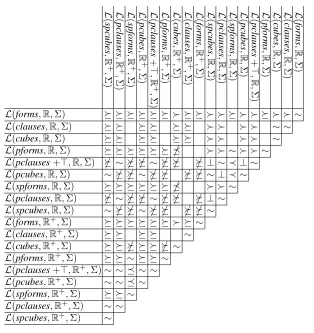
Our succinctness results are summarized in Table 2. The table contains many more results than are proved in the text, but in all cases these are straightforward consequences of results which do appear in the text. (E.g.,
L(spcubes,R) ≺ L(clauses,R).) There are many open questions (any cell which contains neither≺,, nor ∼ has something yet to be resolved). All open questions involve at least one language which lacks unique representations. Most cases in which nothing is known involve a language which uses positive formulas or general formulas. We suspect that resolving these questions will require difficult proofs, as the one for Theorem 4.15 which shows thatL(cubes,R)≺ L(forms,R).
L ( spcubes , R + , Σ) L ( pclauses , R + , Σ) L ( spforms , R + , Σ) L ( pcubes , R + , Σ) L ( pclauses + > , R + , Σ) L ( pforms , R + , Σ) L ( cubes , R + , Σ) L ( clauses , R + , Σ) L ( forms , R + , Σ) L ( spcubes , R , Σ) L ( pclauses , R , Σ) L ( spforms , R , Σ) L ( pcubes , R , Σ) L ( pclauses + > , R , Σ) L ( pforms , R , Σ) L ( cubes , R , Σ) L ( clauses , R , Σ) L ( forms , R , Σ)
L(forms,R,Σ) ∼
L(clauses,R,Σ) ∼ ∼
L(cubes,R,Σ) ∼
L(pforms,R,Σ) ∼ ∼
L(pclauses+>,R,Σ) ∼ ∼ ⊥ ∼ ≺ ⊥ ∼
L(pcubes,R,Σ) ∼ ∼ ∼ ⊥ ≺ ∼
L(spforms,R,Σ) ∼
L(pclauses,R,Σ) ∼ ∼ ⊥ ∼
L(spcubes,R,Σ) ∼ ∼ ∼
L(forms,R+,Σ) ∼
L(clauses,R+,Σ) ∼
L(cubes,R+,Σ) ∼
L(pforms,R+,Σ) ∼ ∼ L(pclauses+>,R+,Σ)∼ ∼ ∼ ∼ L(pcubes,R+,Σ) ∼ ∼ ∼ L(spforms,R+,Σ) ∼
L(pclauses,R+,Σ) ∼ ∼
[image:17.612.152.466.87.420.2]L(spcubes,R+,Σ) ∼
Table 2 Summary of Succinctness Results. Entries to be read row first. Empty cells are open questions.
5
Complexity
In this section, we analyze the effect that restrictions on goalbases have on the complexity of answering questions about the utility functions they represent, focusing specifically on the problem MAX-UTIL—finding a model which produces maximal utility, expressed as a decision problem.2
Definition 5.1 (MAX-UTIL) The decision problem MAX-UTIL(Φ, W, F)is defined as: Given a goalbase
G∈ L(Φ, W, F)and an integerK, check whether there is a modelM ∈2PSwhereuG(M)≥K.
MAX-UTILis clearly in NP for the unrestricted language, since whetheruG(M)≥Kis polynomially check-able, and is NP-hard via a reduction from MAXSAT[36]. In this section, we consider the difficulty of MAX-UTIL for more restrictive languages. Note that if we permit goalbases to contain unsatisfiable formulas, then MAX -UTILtrivializes to SAT, since deciding the problem in the general case will involve determining what (if any) models make a formula true. Therefore, in the cases where we show NP-completeness, we do soeven in the case where goalbases contain only satisfiable formulas. In contrast, in the cases where we show that MAX-UTIL∈P, we do so without this restriction. As above, we deal only withF = Σas our aggregator, and so omitF in what follows.
2 For all of the languages we consider, solving the decision problem M
5.1 Hardness Results
We first present results on languages for which MAX-UTILis still NP-hard, despite the restrictions imposed.
Theorem 5.2 MAX-UTIL(k-cubes,Q+)is NP-complete fork≥2, even if goalbases contain only satisfiable
formulas.
P r o o f. The decision problem MAX k-CONSTRAINTSAT is defined as: Given a setC of k-cubes inPS
and an integer K, check whether there is a model M ∈ 2PS which satisfies at leastK of thek-cubes inC. MAX-UTIL(k-cubes,Q+)is a weighted version of MAXk-CONSTRAINTSAT, which is NP-complete fork≥2 [37, LO12, Appendix B].
In the remaining NP-completeness results, we do not state that formulas need be satisfiable, as these languages do not contain unsatisfiable formulas.
Theorem 5.3 MAX-UTIL(k-clauses,Q+)is NP-complete fork≥2.
P r o o f. MAX-UTIL(2-clauses,Q+)is a weighted version of the well-known NP-complete problem M
AX 2-SAT[36], and hence is contained in MAX-UTIL(k-clauses,Q+)fork≥2.
Theorem 5.4 MAX-UTIL(k-spcubes,Q)is NP-complete fork≥2.
P r o o f. We show NP-hardness fork= 2by reduction from MAX2-SAT[36], using a construction previously employed to show NP-hardness of the winner determination problem in combinatorial auctions when bids are encoded usingk-additive functions [26]. LetSbe a set of 2-clauses and letK≤ |S|. MAX2-SATasks whether there exists a subsetS0ofSwith|S0|=Kthat is satisfiable. We construct a goalbaseGas follows:
• For any positive clause(p∨q)∈S, add the weighted goals(p,1),(q,1), and(p∧q,−1)toG.
• For any clause(p∨ ¬q)∈Swith one negative literal, add(>,1),(q,−1), and(p∧q,1)toG.
• For any clause(¬p∨ ¬q)with two negative literals, add(>,1)and(p∧q,−1)toG.
Clearly, there exists a satisfiableS0 ⊆ S with|S0| = K iff there exists a modelM such thatuG(M) ≥ K. We are not yet done, becauseGis not a goalbase instrictlypositive cubes. LetG0be the result of removing all occurrences of(>,1)fromG. Ifdis the number of nonpositive clauses inS, thenuG0(M) =uG(M)−dfor
any modelM. Hence, MAX2-SATforS will succeed iff there exists a modelM such thatuG0(M)≥K−d.
Therefore, MAX-UTIL(2-spcubes,Q)must be at least as hard as MAX2-SAT.
Theorem 5.5 MAX-UTIL(k-pclauses,Q)is NP-complete fork≥2.
P r o o f. The proof works by reduction from MAX2-SAT, just as for Theorem 5.4, except that now we con-structGas follows:
• For any clause of the formp∨q, we simply add(p∨q,1)toG.
• For any clause of the formp∨ ¬q, we add(>,1),(p,1), and(p∨q,−1)toG.
• For any clause of the form¬p∨ ¬q, we add(>,1),(p,−1),(q,−1), and(p∨q,1)toG.
5.2 Easiness Results
For two languages (and all their sublanguages) we can obtain easiness results.
Theorem 5.6 MAX-UTIL(pforms,Q+)∈P.
P r o o f. Since all weights are positive, whichever state makes the most formulas true is optimal. Because all formulas in the language are positive, we are guaranteed that every formula we encounter is satisfiable. In particular, the statePS, in which all atoms are true, makes every positive formula true, and hencePS is al-ways an optimal state. (In fact,PS is the maximal optimal state. There might also be optimal states making fewer atoms true.) This means that the algorithm which checks whetheru(PS)≥Kdecides every instance of MAX-UTIL(pforms,Q+); furthermore, finding the value of any single state is linear.
Theorem 5.7 MAX-UTIL(literals,Q)∈P.
P r o o f. Fix a goalbaseG∈ L(literals,Q). Keep for each atompa number∆p, the difference between the
sum ofp’s positive occurrences and sum ofp’s negative occurrences seen so far. (Initially∆p= 0.) Iterate over the formulas inG, updating the deltas as we go. (Thus, on seeing(¬p,5), we subtract 5 from∆p.) On reaching the end of the goalbase, define a model M = {p : ∆p > 0}. M will be the minimal optimal model. (The maximal optimal model is{p: ∆p ≥0}.) This algorithm is linear in the sum of the size of the goalbase and
PS.
5.3 Summary
To summarize the results in this section, Theorems 5.2, 5.3, 5.4, and 5.5 show that MAX-UTILis NP-complete for any language which containsL(2-pclauses,Q),L(2-spcubes,Q),L(2-cubes,Q+), orL(2-clauses,
Q+). This
covers every language mentioned in this paper exceptL(pforms,Q+)andL(literals,
Q)and their sublanguages,
which are all in P.
6
Conclusion
We have examined the properties of various goalbase languages for representing utility functions, concentrating on (1) the expressivity of different languages by characterizing the classes of utility functions they can represent; (2) the relative succinctness of pairs of languages over their expressive intersection; and (3) the computational complexity of finding the most preferred alternative when a utility function is encoded using a goalbase language (the MAX-UTILproblem). Our results can provide useful guidelines for application designers to help them select a preference representation language with the appropriate characteristics.
Concerning the complexity of the MAX-UTILproblem, we have been able to offer a complete picture by clas-sifyingalllanguages that can be defined in our framework as rendering MAX-UTILeither NP-complete or trivial. For expressivity our results are close to being complete: Many goalbase languages directly correspond to natural classes of utility functions, independently used in many different fields. Only for a handful of languages our results are either not complete characterizations (e.g., Theorem 3.10) or the characterizing property is somewhat artificial (e.g., Theorem 3.13). Finally, we have been able to establish a good number of relative succinctness results and we have presented different techniques for deriving such results. Here, however, there still remain some open questions. Maybe the most interesting of these concerns the relative effect, in terms of succinctness, of dropping either negation or one of the two binary connectives. For instance, it would be particularly interesting to establish the relative succinctness of, say, positive formulas and general cubes. Answering one or two of the remaining open questions would most likely allow us to resolve most of the others as well.