School of Mathematics and Physics
Fairly Amenable Semigroups
Joshua Thomas Deprez, BComp-BSc (Hons)
May 21, 2014
Supervisor: Dr Des FitzGerald
Abstract
Amenability developed alongside modern analysis, as it is a central property lacking in a group used to show, for example, the Banach-Tarski paradox (Wagon, 1993). e rst working de nition was given by von Neumann (1929), in terms of nitely-additive measures. A number of useful theorems are capable of being shown using this basic de nition.
e rst modern de nition of amenability was given by M. M. Day (1957), whose concept involved invariant means. For groups this coincides exactly with the von Neumann condition: each invariant mean corresponds to an invariant nitely-additive measure, corresponding via Lebesgue integration. is advance was signi cant as it opened the door to the application of abstract harmonic analysis, xed-point theo-rems, and an industry of consequences. Amenable groups support almost-invariant nite means, and via decomposition this is culminated as the Følner condition, a statement about nite sets. Abelian groups are amenable as a simple consequence of the Markov-Kakutani xed-point theorem. A theorem of B. E. Johnson (1972) led to the development of amenable Banach algebras and C*-algebras, neatly encoding amenability in the mechanics of cohomology theory.
While amenability is directly generalisable from groups to semigroups, the two key de nitions do not correspond in the same way as they do for groups: extracting a nitely-additive measure from a le-invariant mean yields what might be called a lepreimage-invariantmeasure, and for groups these merely correspond to the in-verse elements. A simple but surprising consequence of Day’s de nition of amenabil-ity is that semigroups with a zero element are both le and right amenable (Day, 1957). Yet they cannot support a (totally) invariant nitely-additive measure (van Douwen, 1992, p231). On the other hand, all semigroups with more than one dis-tinct le zero are not le amenable (Paterson, 1988), and in particular there are many nonamenable nite semigroups, which is another contrast to the group case: all -nite groups are amenable. is standard de nition of amenability for semigroups
is therefore unintuitive and, perhaps, unsatisfactory. Restricting to better-behaved classes of semigroups, such as the inverse semigroups, does little to improve this.
e rst new result of the present work is that there is a weakening of invari-ance that can be used in the context of nitely-additive measures to generalise group amenability to semigroups in a different way. For a semigroupS, a nitely-additive measureµ ∈ [0, 1]P(S)will be called lefairly invariantif, for alls ∈ SandA ⊆ S
such that λs|A is an injection,µ(sA) = µ(A). When a semigroup supports such a nitely-additive measure, then it is lefairly amenable. Fair amenability is a gen-eralisation of group amenability, and retains some of the useful theorems. Some of the results shown using this formulation include: a semigroup is le fairly amenable when it satis es a weakened Strong Følner Condition, nite semigroups are all fairly amenable, semigroups with involution are either fairly amenable on both the le and the right or not at all, adjoining a zero does not cause a non-fairly amenable semi-group to become fairly amenable, directed unions of fairly amenable semisemi-groups are fairly amenable, and a variety of examples which are fairly amenable or not fairly amenable.
e name “amenable” is, as the story goes, supposed to be a pun, since amenable groups support invariantmeans. us an important question for fair amenability is, what condition for a mean is equivalent to the fair invariance of the corresponding nitely-additive measure? One approach is to ip the duality between the convolu-tion acconvolu-tion inℓ1(S)and the dual action inℓ∞(S)upside-down: attempt convolution in ℓ∞(S) and the dual action inℓ1(S). In this scenario, the curious will consider such ill-de ned expressions as0∗χS. Fortunately, wherever the convolutionpartial
action ofsonϕ∈ ℓ∞(S), i.e. s∗ϕ, is well-de ned and bounded, then the integral with respect to a le fairly-invariant measure can be readily computed. It is shown that a semigroupSle fairly amenable if, and only if, there exists a meanmsuch that
m(ϕ) = m(s∗ϕ)for alls ∈ Sandϕ ∈ ℓ∞(S)such thats∗ϕ ∈ ℓ∞(S). Hence the nomenclature “fairly amenable” is justi ed as a pun also.
Declarations
Declaration of Originality
is esis contains no material which has been accepted for a degree or diploma by the University or any other institution, except by way of background information and duly acknowledged in the esis, and to the best of my knowledge and belief no material previously published or written by another person except where due ac-knowledgement is made in the text of the esis, nor does the esis contain any material that infringes copyright.
Authority of Access and Statement regarding
pub-lished work contained in the Thesis
Chapter 5 has been sent in a reduced form for potential publication in the journal Semigroup Forum, though at this writing it has not yet been accepted. At such time that a journal holds the copyright for content, access to the material should be sought from them in accordance with their policies.
e remaining non-published content of the esis may be made available for loan and limited copying and communication in accordance with the Copyright Act 1968.
……… ………
Joshua omas Deprez Date
Acknowledgements
Firstly and most importantly, a heartfelt thank-you to my supervisor Dr Des FitzGer-ald for his continued patience and wisdom during the project, the coffees and lunches at the Staff Club, and his very forgiving nature.
I thank the Head of School Professor John Dickey, and Mathematics head Pro-fessor Larry Forbes, for helping to grease the wheels of the Graduate Research Office. anks also to Dr Barry Gardner for his participation.
I thank those responsible for my participation in the Australian Postgraduate Award scheme: rstly, the Australian Government for funding the scholarship, and the University Scholarships Office for accepting my application.
anks to the Graduate Research Office, and also apologies: for putting up with my passive-aggressive emails and somewhat non-standard paperwork.
I thank the School of Mathematics & Physics as a whole for furnishing me with an office that I could safely ignore for long periods of time. A shout-out to my most excellent office mates: Stephen Walters and Melissa Humphries, and the extremely occasional Tony Fitzpatrick.
A huge thanks to my friends Paris Butt eld-Addison and Jon Manning, whose office in town tended to be more convenient than my university office (both for in-ternet access and proximity to quality coffee).
I thank the Victorian Algebra Group and Australian Mathematical Society for thrice subsidising my travel costs to and from the annual Victorian Algebra Confer-ence.
In a way, this work is the culmination of much more than just three-and-a-half years of reasearch, but additionally many years of schooling and undergraduate study as well. It is a testament to the quality of the public education system. I would like to thank all the motivating and engaging teachers I have had over the years. Finally, to anyone who suggested I could have done better if I had a private school background instead: I wouldn’t have changed a thing.
Contents
Abstract i
Declarations iii
Acknowledgements iv
List of Tables viii
List of Figures ix
1 Introduction 1
1.1 What is amenability? . . . 1
1.2 Preliminaries . . . 3
1.2.1 A remark about proofs . . . 3
1.2.2 Semigroups, groups, self-actions . . . 3
1.2.3 Function spaces . . . 5
1.2.4 Ultra lters and ultralimits . . . 7
2 Amenability and Groups 11 2.1 Finitely-additive measures . . . 11
2.2 Invariant means . . . 16
2.3 Almost-invariant nite means . . . 21
2.4 Følner criteria . . . 23
2.4.1 Variations on Følner criteria . . . 25
2.5 Amenability and growth . . . 29
2.6 Classical amenability results for groups . . . 33
2.6.1 ompson’s groupF . . . 36
2.7 Topological group amenability . . . 40
2.7.1 Topological Følner criterion . . . 41
3 Amenability and Banach algebras and C*-algebras 43 3.1 Banach algebra amenability . . . 43
3.2 C*-algebraic amenability . . . 45
3.3 Banach algebras again . . . 47
3.4 e weak containment property . . . 48
4 Amenability and Semigroups 50 4.1 Semigroups with nitely-additive measures . . . 50
4.2 Semigroups with means . . . 52
4.2.1 Breakdown between de nitions . . . 54
4.3 Classical amenability results for semigroups . . . 55
4.3.1 Følner conditions and a theorem of Frey . . . 55
4.3.2 Semigroups and nite means . . . 58
4.3.3 More standard results . . . 59
4.3.4 Cancellative and reversible semigroups . . . 61
4.4 Amenable inverse semigroups . . . 63
4.4.1 Weak containment and inverse semigroups . . . 66
5 Fairly Amenable Semigroups 71 5.1 De nitions . . . 71
5.2 Consequences . . . 75
5.2.1 Groups and Følner criteria . . . 75
5.2.2 Basic consequences . . . 76
5.2.3 Subsemigroups . . . 79
5.2.4 Green’s relations . . . 79
5.2.5 Direct products . . . 81
5.2.6 Quotients of semigroups . . . 84
5.2.7 Completely 0-simple semigroups . . . 85
5.2.8 Semigroups with involution . . . 94
5.2.9 Clifford semigroups . . . 95
5.2.10 Directed unions of semigroups . . . 97
5.3 Further examples . . . 98
5.3.1 Graph inverse semigroups . . . 99
5.3.3 Free inverse semigroups . . . 106
5.3.4 Summary . . . 107
5.4 Motivations for fair amenability . . . 108
5.4.1 Measure ratios . . . 110
6 Fairly Invariant Means for Semigroups 112 6.1 e convolution partial action . . . 113
6.2 Integratings∗f . . . 119
6.3 Modi ed convolution . . . 122
6.4 ⊛-invariant means . . . 129
6.5 Generalised convolution . . . 134
6.5.1 Generalised semigroup convolution . . . 135
6.5.2 Restricted means and functions . . . 135
7 Making Other Conditions Fair 140 7.1 Preimage invariance . . . 140
7.2 Inner amenability . . . 144
7.2.1 Inner⊛- and∗-invariance . . . 145
7.3 Results yet to be shown . . . 148
7.3.1 Bi-∗-invariant means? . . . 149
7.3.2 Almost fairly invariant nite means? . . . 150
7.3.3 Fairly amenable Abelian semigroups? . . . 152
7.3.4 Other outstanding questions . . . 153
List of Tables
2.1 Other notations for thenaturalordualactions. . . 18
2.2 Summary of the variations on Følner criteria for discrete groups. ϵ, ϵ0 > 0, thea1. . . an, gare elements ofG, andF, Fi, K, Sare nite subsets ofG. . . 27
2.3 Examples of groups in different growth classes . . . 31
2.4 Important examples of nitely-generated groups. . . 39
5.1 Amenability versus fair amenability on different semigroups. . . 108
List of Figures
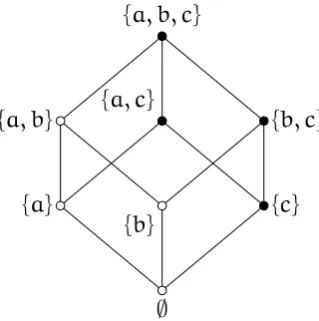
1.1 An ultra lter ( lled points) on the nite set{a, b, c}. . . 8
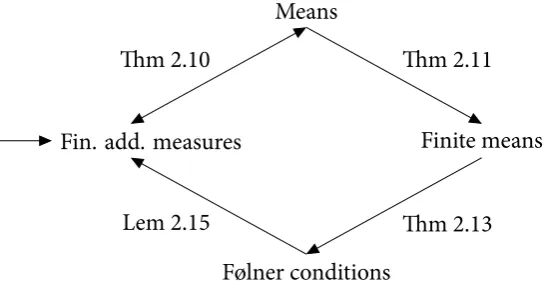
2.1 e journey of the rst half of this chapter. . . 11 2.2 An overview of the sets mentioned in the functional approach to
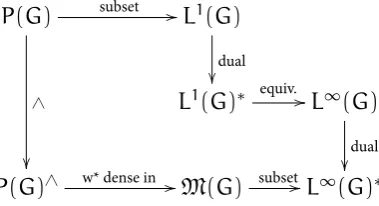
topological amenability. We nd a mean inM(G)as a weak* cluster point of a sequence inP(G)∧, and can use various analytic machin-ery along the way. . . 41
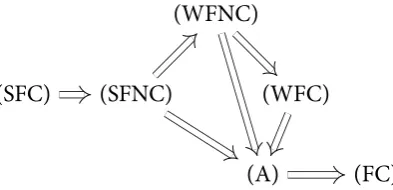
4.1 Implications that have been shown between the le Følner-type con-ditions and le amenability (A) of a semigroup. Additionally, (FC)
̸⇒(A) and (A)̸⇒(WFC) in general. (Yang, 1987) . . . 57
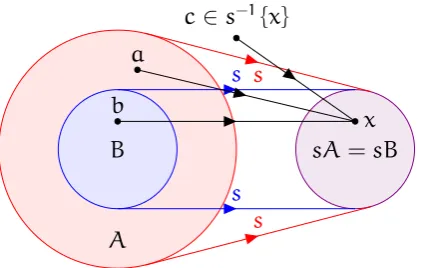
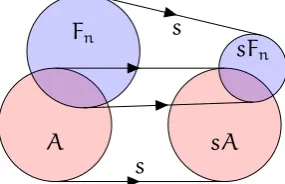
5.1 For every setAand elementsthere is some subsetBsuch thatsA=
sBandsacts injectively onB. . . 75 5.2 If s acts injectively on A, then it also does so onA ∩ Fn, and so
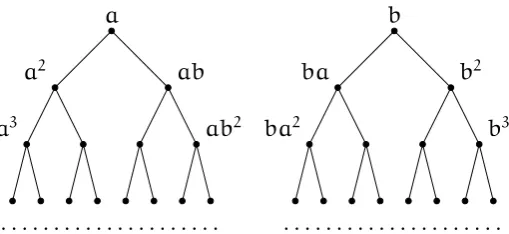
|A∩Fn|=|sA∩sFn|. . . 76 5.3 e right Cayley graph for the free semigroup on two generators
{a, b}+. . . 99 5.4 Part of the le Cayley graph of the bicyclic monoidB. . . 100 5.5 Derivingqjpk□
n△□nin the bicyclic monoid. . . 100 5.6 From the le, the 1-rose, 2-rose, and 10-rose. e free categories
over these are simply the free monoids on 1 generator, 2 generators, and 10 generators, respectively. . . 103 5.7 e arrowsx,y,u, andvform a commutative square. If for any other
pair of arrowsx′andy′with common domain form a commutative square withuandvthere exists a unique arrow fromd(x′)→d(x)
(dashed), thenxandyare apullbackofuandv. . . 103
5.8 e product of two elements in(C×C)/∼,[a, b]and[c, d], is de-ned to be[ax, dy]when there exists a pullbackx, yofb, c, and 0 if there is no such pullback. . . 104
6.1 e result of the dual le action of 0 on somef∈ℓ∞(S). . . 113 6.2 e result of the le∗-action of 0 on somef∈ℓ1(S). . . 113 6.3 Some example cases where the convolution partial action of0is not
well-de ned onℓ∞(S). . . 114 6.4 Diagram accompanying Lemma 6.2. . . 116 6.5 An example ofs∗χA ≥χsA.χsA ≤χsA1+χsA2, whereA=A1 ·∪A2
andsacts injectively onA1andA2but notAas a whole. . . 118 6.6 e result of the le⊛-action of 0 on somef∈ℓ∞+(S). . . 123 7.1 e setss−1A,A, andsAin relation tos−1sAandss−1AwhenAis a
general subset ofS(containing boths-divisible and non-s-divisible elements). . . 141 7.2 A maximal subsetB′ofBsuch thatAis uniquely les-divisible with
Chapter 1
Introduction
1.1 What is amenability?
Unwisely, I began seeking answers to this question in a pale blue book titled “Amenabil-ity” by Paterson (1988). I write “unwise” (perhaps unfairly to Paterson as he was per-haps aiming at a higher audience than myself), but perper-haps merely unwise for me, as within a few pages of the introduction I realised I had been bamboozled with a sufficiently broad array of vaguely familiar background concepts to render the full notion of amenability unclear. It seemed it all had something to do with functionals, Lebesgue integration, measures, groups and semigroups and topologies, the Haar measure, the Borel subsets, function spaces, Banach algebras, C*-algebras, von Neu-mann algebras, virtual and approximate diagonals, cohomology, injective and pro-jective tensor products, strong and weak convergence, nuclearity…But just what is it?
e heart and soul of amenability is the idea ofinvariance of content. By “content”, we usually mean more tangible concepts such as volume and mass. Invariance is a most natural concept to consider, as it appeals to the intuition in a variety of ways. For example, we know from real-world experience that merely moving an ordinary tangible, physical object does not alter its mass or its volume. Only when the object undergoes certain deformations do these quantities change. us, we can say that the content of a tangible object is invariant under rigid motion: translation and rotation. e Banach-Tarski paradox, and its precursors such as the Hausdorff paradox, showed that our usual formalisations for the ideas of volume, translation and rota-tion have very non-intuitive consequences. is paradox was a very forceful
stration, since it takes place within R3, which we intuitively consider to be a rea-sonable approximation of the tangible universe, and uses rotations and translations, which we intuitively consider to be volume- and mass-preserving operations. e conclusion of the Banach-Tarski paradox is that any bounded non-empty set inside
R3can be decomposed into subsets, and these subset “pieces” translated and rotated, and recombined to formany other bounded set insideR3. An image to hold in mind that is oen described at this point is of a pea split up and reassembled into a ball the size of the sun!
It was known that paradoxes of this nature only occurred in spaces of dimension 3 or higher, which indicated that perhaps it was some fault ofR3, or the fault of the groupG3which models the group of rotations and translations of points inR3. is is true, but obscures the real problem. von Neumann (1929), who presented the rst de nition of amenability, noted that the Banach-Tarski paradox is an issue of a group-theoretic nature, and was not limited to eitherR3orG3. e group that is genuinely central to the paradox, thefree group on two generatorsdenotedF2, simply has a structure that circumvents any reasonable de nition of invariant volume. us
F2is said to beparadoxical. Its embedding inG3extends the problem into the form of the Banach-Tarski paradox. It then happens thatF2is not amenable because it is paradoxical, andvice-versa.
ere is now a multitude of de nitions for amenability. For the case ofgroups, all the de nitions effectively coincide and follow from each other, which is why they may all be considered to be de nitional conditions. is concord provides a useful array of tools for determining the property of amenability for a given group, as well as a broad set of nice analytic properties that hold for the amenable groups. ese varying de nitions of amenability are introduced in Chapter 2.
1.2
Preliminaries
1.2.1 A remark about proofs
Many of the proofs contained in this thesis follow a presentation style that aims to improve validity. In these I have aimed to emulate thehierarchical structure advo-cated by Lamport (2012). ese proofs may seem unusual, and would appear out of place in journals that would prescribe a particular formatting. While it was tempt-ing to stick to the safety of a more classical, conventional style, I reasoned that there would be no better place to give the concept a run than a thesis containing both standard results, and original results.
1.2.2 Semigroups, groups, self-actions
Recall the following basic de nitions.
De nition 1.1 Asemigroupis a setStogether with a binary operation·:S×S→S, usually denoted with concatenation, such that·is associative, i.e.
a·(b·c) = (a·b)·c for alla, b, c∈S.
UsuallySstands for both the semigroup and the underlying set. An identity element
1 is such that1x = x1 = x for all x ∈ S. We shall writeS1 to meanS with an
identity adjoined if necessary. IfS=S1thenSis amonoid. Similarly, a zero element
0satis es0x = x0 = 0for allx ∈ S, and again similarly, writeS0 to meanSwith
a zero adjoined if necessary. Note that this should not be confused with semigroups where0could be an additive identity: applying the previous statements strictly,N0 is the semigroup of positive natural numbers with a zero element adjoined, and with regards to addition, that zero behaves like−∞. On the other hand,N∪{0}is the Abelian monoid of natural numbers with0being the identity element.
IfA⊆Sands ∈S, thensA:= {sa:a∈A}andAs:= {as:a∈A}. is is a special case of the product of sets: for anyA, B⊆S,AB:={ab:a∈A, b∈B}.
notationA−1shall mean the set consisting of the inverse of each element ofA, i.e.
A−1 :={a−1:a∈A}.
For a setX, the semigroupTXdenotes thetransformation semigroupofX, con-sisting of all mapsf : X → Xwith respect to composition of functions. A special and important subgroup of TX is SymX, thesymmetric groupof X, consisting of all bijections fromXto itself with composition.
De nition/eorem 1.2 LetSbe a semigroup, and de ne the maps
λs(x) :=sx, ρs(x) :=xs for alls, x∈S.
e maps λ : s 7→ λs and ρ : s 7→ ρs are known as the le regular and right
regular representations, respectively. For alls ∈ S, λs and ρs are elements ofTS, and soλandρare homomorphisms fromStoTS, though they are not necessarily faithful. However, these representations can be used to demonstrate such results as the following.
• e semigroup S is faithfully embedded within some transformation semi-group, in particular,TS1.
• IfSis a group, then it is faithfully embedded in thhe symmetric group SymS, and this result is known as Cayley’s theorem.
• IfSis an inverse semigroup, then it is faithfully embedded in the symmetric inverse monoidIX, i.e. the Wagner-Preston theorem.
(Not shown here.) □
us it is always natural to imagine a group assymmetries(bijections), a semi-group as transformations, an inverse semigroup aspartial symmetries. e repre-sentationsλ, ρprovide examples ofself-actions—actions ofSon itself. ese may be extended to actions ofSon the power setP(S), i.e. λs(A) =sAforA⊆S. We may also speak of the preimage underλs of a setA, beingλ−s1(A) = {t:λs(t)∈A} =
{t:st∈A}. For notational convenience, I shall use, wherever it is not confusing to do so, the shorthand
for alls ∈SandA⊆S. IfSis a group thens−1AandAs−1are unambiguous, since in that instance{s−1t:t ∈A} ={t:st∈A}, similarly on the right.
1.2.3
Function spaces
While this work is not aimed at providing a comprehensive account of modern anal-ysis and representation theory, it will be useful to recall some salient ideas. For a thorough account of Banach spaces, see Allan (2011). For understanding amenabil-ity the basic de nitions require, at minimum, no regard to topology.
De nition 1.3 LetSbe a set, and consider the functions fromStoK(denotedKS.
Kstands for eitherRorC). Forf, g ∈ KSthe additionf+gde ned pointwise is an Abelian group, and functions can be scaled by any scalarλ∈K, so,KSis avector
spacein which the functions are the vectors.
Recall the following important subspaces ofKS. Letf∈KS.
• ℓ1(S)is the space of absolutely summable functions onS:
f∈ℓ1(S) ⇔ ∥f∥1:= ∑
s∈S
|f(s)|<∞.
• More generally,ℓp(S)(for0 < p < ∞) is the space ofp-th power summable functions:
f∈ℓp(S) ⇔ ∥f∥p :=
[ ∑
s∈S
|f(s)|p
]1/p
<∞.
• ℓ∞(S)is the space of bounded functions:
f∈ℓ∞(S) ⇔ ∥f∥∞:= sup s∈S
|f(s)|<∞.
It is a straightforward exercise to demonstrate that these are subspacesofKS, that
∥·∥1,∥·∥p,∥·∥∞are allnorms, thatℓ
1(S), ℓp(S), ℓ∞(S)are norm-complete (Banach
spaces), and that when Sis nite they all coincide with KSand all three norms are equivalent. A special case isp=2: ℓ2(S)is aHilbertspace having theinner product
⟨·,·⟩given by
⟨f, g⟩:=∑
s∈S
Again, it is straightforward to verify this is an inner product and that it yields the norm ∥·∥2 (given by ∥x∥2 = ⟨x, x⟩1/2). Usefulness of the “inner product” given above extends beyondℓ2(S), and so, if outside the context of any other given Hilbert space, we shall leave⟨·,·⟩de ned as above wherever the right-hand side converges.
IfSis a semigroup, then the semigroup structure can interact with the elements of these function spaces in a variety of ways. Fors∈S, one common approach is to multiply on the le or right bysbefore applyingf∈KS, and this is called the(dual) action ofsonf:
(sf) (x) :=f(sx), (fs) (x) := f(xs).
One must have a grasp of the space ofbounded linear operatorsB(E, F)consisting of linear mapsT :E→Fsatisfying
∥T∥:=sup x̸=0
∥Tx∥F
∥x∥E <∞,
and the special case of thedualof a spaceE, denotedE∗, whereE∗ := B(E,K). An example of a functionalΣ∈ℓ1(S)∗is
Σ(f) :=∑
s∈S
f(s) for allf∈ℓ1(S).
Isometric isomorphism is the standard for considering when two spaces are to be regarded as equivalent.“Taking the dual” is then sometimes involutive (ℓp(S)∗∗ ≡
ℓp(S)if1 < p <∞) and sometimes not (e.g.ℓ1(S)∗∗is not isometrically isomorphic toℓ1(S)), but that is not the most that can be said.
eorem 1.4 e dual space ℓ1(S)∗ can be, and almost always is, identi ed with
ℓ∞(S), andℓ1(S)iscanonicallyisometrically embedded inℓ1(S)∗∗ ≡ℓ∞(S)∗.
Proof (sketch) For eachϕ∈ℓ∞(S)de ne the correspondingϕˆ ∈ℓ1(S)∗by
ˆ
ϕ(f) :=∑
s∈S
f(s)ϕ(s) =⟨ϕ, f⟩.
is implies that for a givenϕˆ there exists aϕgiven byϕ(s) = ϕˆ(δs). Similarly, for eachf∈ℓ1(S)de ne the correspondingfˆ∈ℓ1(S)∗∗by
ˆ
is works for embedding any linear spaceEinE∗∗. Note that there may existfˆ∈ ℓ1(S)∗∗ for which there is no correspondingf. It is then a matter of verifying the
isometric isomorphism. □
For any two real-valued functionsfandg, let the conditiong ≤ fbe assumed to be taken pointwise, i.e. g(t)≤f(t)for allt.
De nition 1.5 Given anf∈ℓ∞(S)such thatf≥ 0, if there exists a nite index set
I, a collection{Ai}i∈Iof subsets ofS, and collection{ai}i∈Iof positive real numbers such that
f=∑
i∈I
aiχAi,
thenfis a (n-step) simplefunction. Note that ftakes at mostndistinct values in its range. e collection of sets{Ai}i∈Imay be assumed, without loss of generality, to be pairwise disjoint, since any simple function can be re-expressed with pairwise disjoint sets: useI=f(S), and for eachi ∈IuseAi =f−1({i})andaibe the value in the singleton setf(Ai).
1.2.4 Ultrafilters and ultralimits
Finally, a useful tool for resolving some problems is the ultralimit. Even in seemingly benign situations, ordinary sequential limits can fail to exist, and one solution is to take an ultralimit instead. Ultralimits are closely related to non-standard analysis, and a good introduction was posted by Tao (2010). Certain unnamed mathemati-cians may consider ultralimits to be the “fairy godmothers of mathematics,” but the basic ultralimit construction described below is simultaneously useful and devoid of much mystery.
De nition 1.6 A lterFon a setXis a collection of subsets ofXsatisfying the fol-lowing properties:
(F1) ∅∈/ F(this mostly serves to exclude the “improper” lterP(X)).
(F2) IfA∈Fthen every supersetBis also inF(it isupwards-closed).
(F3) IfAandBare inF, thenA∩B∈F.
. .
∅. {a}
.
{b}
.
{c}
.
{a, b}
.
{a, c}
.
{b, c}
.
[image:19.595.204.364.103.264.2]{a, b, c}
Figure 1.1: An ultra lter ( lled points) on the nite set{a, b, c}.
If a setA /∈Fthen every subset is also not inF. To see this, suppose some subset
B⊆Ais inF: by (F2), this implies thatA∈F, contradictingA /∈F.
De nition 1.7 Anultra lterUis a lter that satis es the further property that for anyA⊆X, eitherAorX\Ais inU.
SinceAandX\Aare disjoint, by the above, precisely one of them is in any ultra-lter onX. It is not possible to include more sets in an ultra lter without it failing to be a lter, so there is no lter nerthan an ultra lter.
Lemma 1.8 ere are two disjoint kinds of ultra lters on a setX: theprincipal ultra-lters, containing exactly one singleton set{x}wherex ∈ X, and thenon-principal
orfreeultra lters, which contain no nite sets at all.
Proof If an ultra lterUonXcontains any nite setF, we may see that it necessarily contains a singleton set, and is therfore principal, as follows. Assume that{x} ∈/ U
for allx∈X. In particular{f}∈/ Ufor eachf∈F. usX\ {f}∈Ufor allf∈F, and by property (F3) we thus haveF∩(X\ {f}) = F\ {f} ∈ Ufor allf ∈ F. Inductively each element ofFcan be removed, one at a time, until none remain, at which point
it contradicts (F1). □
only be contained within a free ultra lter. e Ultra lter Lemma is also a conse-quence of the Axiom of Choice. However, the Axiom of Choice does not follow from the Ultra lter Lemma, so UL is a weakening of AC. One useful consequence of the Ultra lter Lemma is the Hahn-Banach theorem, but again, the converse does not hold.
Since free ultra lters do not contain any nite sets, by de nition they must con-tain all co nite sets. e lter consisting of co nite sets, theFréchet lter, is therefore contained in any free ultra lter. Conversely, any ultra lter containing the Fréchet lter is a free ultra lter. e Fréchet lter itself is not usually an ultra lter: consider two in nite sets which are complements, and so neither is co nite.
De nition 1.9 Given any sequence of real or complex numbers{xn}and a free ul-tra lterUoverN, if for some valuexand eachϵ > 0, we have
{n:|xn−x|≤ϵ}∈U,
thenxis the (unique)ultralimitof the sequence with respect toU, written
x=lim
U xn or x=U- limxn.
is generalises to sequences in any metric space(X, d)by
x =lim
U xn ⇔ {n:d(xn, x)≤ϵ}∈U.
Note that if we try to do the same thing with a principal ultra lter, then we allow the ultralimit to take the value of the sequence at a single point. For the ultralimit and ordinary limits to coincide, one must require a free ultra lter.
Some authors sometimes require, for ultralimits, that the ultra lterU over N used, instead of explicitly being required to be “free”, is required to contain every interval[n,∞)for eachn∈N.
Lemma 1.10 An ultra lterUonNis free if, and only if, it contains every interval of the form[n,∞)for eachn∈N.
Proof A free ultra lter contains all co nite sets, including as examples the intervals of the form[n,∞).
To show the converse, suppose an ultra lterUcontains every interval[n,∞)for
{k}say, and therefore does not containN\ {k} = [1, k)∪[k+1,∞). Since subsets of sets not in a lter are also not in the lter, this implies[k+1,∞)is not inU. is
contradicts the requirement that every[n,∞)∈U. □
Ultralimits provide a resolution to the problem of de ning a unique limit for a sequence that fails to converge due to having multiple limit points, effectively by choosing one of the limit points. Intuitively, a free ultra lter will contain a set of in-dexes corresponding to one of the convergent subsequences, but none of the others, as they will necessarily be indexed by sets in the complement of the index set of the chosen subsequence. If a sequence is bounded, then by the Bolzano-Weierstrass the-orem there is at least one convergent subsequence, so an ultralimit is always de ned on bounded sequences.
But not only do ultralimits assign a value for the limit of a not-necessarily-convergent sequence, they do so in a completely consistent way when the same free ultra lter is used.
Lemma 1.11 Let{xn}n∈N,{yn}n∈Nbe two sequences andUa free ultra lter overN. en
lim
U (xn+yn) =limU xn+limU yn where the ultralimits exist.
Justi cation is is a speci c case of the transfer theorem, stating all operations involving nitely many standard objects can be carried over into the non-standard universe (of ultralimit objects), which is a special case of the formalisation known as
Chapter 2
Amenability and Groups
e core idea of amenability is that of an invariant structure: some set of quanti-ties that remains unchanged under some action. e rst coherent conception of amenability was as a condition on a group that precludes the group generating a Banach-Tarski-style paradox.
2.1 Finitely-additive measures
e rst de nition follows De nition 10.1 from Wagon (1993). Despite its lengthy pedigree (von Neumann, 1929), it endures as a useful de nition (for example, Akhme-dov et al., 2009).
De nition 2.1 (Amenability–) LetGbe any group, andµ : P(G)→ R+. We say
.. Fin. add. measures .
m 2.10
.
Means
.
m 2.11
. Finite means
.
m 2.13 .
Følner conditions .
[image:22.595.148.421.533.675.2]Lem 2.15
Figure 2.1: e journey of the rst half of this chapter.
thatµis
(i) nitely-additiveif for all disjoint subsetsA, B⊆S,µ(A ·∪B) = µ(A) +µ(B),
(ii) le-invariant ifµ(gA) = µ(A)for allA ⊆ G, g ∈ G. similarly,µis right-invariantifµ(Ag) = µ(A), and
(iii) aprobability measureifµ(G) = 1. etotal measureofµis the quantityµ(G).
We say the groupGisle amenableif there exists a non-negative nitely-additive le-invariant probability measureµ. Similarly,Gisright amenablewhere there exists a
µthat is right-invariant. IfGis neither, it isnon-amenable.
Put more intuitively, if elements of a group represent motions or rotations, and subsets of the group are “pieces” that can be moved or rotated (by the usual self-action), then amenability guarantees at least one notion of “area” or “volume” of pieces that is invariant with respect to whatever motions a piece is subjected to. Finite additivity ensures that the measure captures the notion of the “fraction of space” the piece takes up within the whole group. Expecting invariance for the action of every element is compatible with the notion of an action being a bijection, with bijections preserving set cardinality.
We require mere niteadditivity instead of countable additivity because for in -nite groups it is easy to show that such a measure cannot exist (Wagon, 1993).
Some basic facts about (not necessarily invariant) nitely-additive measures:
• IfA ⊆ Bthenµ(B) = µ(A) +µ(B\A), and sinceµ ≥ 0, it follows that
µ(A)≤ µ(B), i.e.µismonotone. Obviouslyµ(A) ≤µ(B)does not neces-sarily implyA⊆B.
• For any setsA, B,µ(A) +µ(B) =µ(A∪B) +µ(A∩B), i.e.µsatis es the principles of inclusion-exclusion, similar to set cardinality.
• Sinceµ(G) =1,µ(∅) =0.
Finally, ready examples of nitely-additive measures (but that aren’t necessarily invariant in any way) on a setXis built from any ultra lter onX. Given an ultra lter
UonX, simply set
µ(A) := χU(A) =
1 ifA∈U
Principal ultra lters correspond to point masses, since for some element x ∈ X,
χU({x}) = 1, i.e. all the mass is concentrated on the pointx. WhereXis in nite, measures created from free ultra lters in this way are examples ofdiffusemeasures:
µis diffuse if, for all nite setsF⊆X,µ(F) =0. (van Douwen, 1992)
Lemma 2.2 If a groupGis le amenable, then it is also right amenable, and vice-versa.
Proof Letµbe le invariant, and consider the nitely-additive measureνde ned byν(A) :=µ(A−1). enνis right invariant:
ν(Ag) =µ((Ag)−1) =µ(g−1A−1)=µ(A−1) =ν(A),
for anyA⊆G, g∈G, as required. □
Not every le invariant measure is also right invariant, but a le invariant measure and a right invariant measure can be combined to form one which is both le and right invariant (bi-invariant).
Lemma 2.3 SupposeGis le and right amenable with nitely-additive measuresµ
andν, respectively. ere exists a bi-invariant nitely-additive measureξ.
Proof De neξby setting (Wagon, 1993, p148)
ξ(A) :=
∫
t∈G
µ(At−1)dν
i.e. integrate the map t 7→ µ(At−1) with respect toν. Showing that ξ is a bi-invariant nitely-additive probability measure onGis omitted here, but the idea is
demonstrated in eorem 4.14. □
us, by combining Lemmas 2.2 and 2.3, any groupGis seen to be eitheramenable
ornon-amenable.
Example 2.4 1. Every nite groupGis amenable. To nd aµ, take thecounting measuregiven by
µ(E) = |E|
|G|,
2. (UL)(Z,+)=∼ F1is amenable. Consider setting for all subsetsE,
µ(E) =
??
lim n→∞
|E∩[−n, n]|
2n+1 .
is looks promising: all nite subsets therefore have measure 0, but this does not contradict µ(Z) = 1 becauseµis only nitely additive. For in nite E, this expression captures the notion of the amount of spaceEtakes up within
Z, which by the limit remains invariant under any (necessarily nite) motion.
However, there is no guarantee that the limit exists. e sequence is bounded and therefore not divergent, but it is not necessarily convergent. For instance, consider
E=Z∩(· · · ∪(−2n+1,−2n]∪ · · ·(−8,−4]∪(−2,−1]
∪[1, 2)∪[4, 8)∪[16, 32)∪ · · · ∪[2n, 2n+1)∪ · · ·).
e sequence with termsxn = |E∩2n[−+n,n1 ]|in this case does not converge asn→
∞, but does have more than one limit point. It is bounded, so by the Bolzano-Weierstrass theorem it contains at least one convergent subsequence, so one such subsequence can be chosen using an ultralimit: x a free ultra lterUon
N, and de neµusing the ultralimit
µ(E) =U- lim n→∞
|E∩[−n, n]|
2n+1 .
ere are in nitely many different free ultra lters onN, and so there are in-nitely many different measuresµthat demonstrate the amenability ofZ.
3. All compact groups are amenable. is follows from Haar measure theory: if a group is compact, all subsets are compact, and therefore the Haar measure (being an invariant countably-additive measure with nite total measure) is de ned on all subsets of the group and satis es the required properties.
for amenability. en sinceF2 =Sa ·∪aSa−1(similarly withb),
1=µ(F2)
=µ({1} ·∪Sa ·∪Sb ·∪Sa−1 ·∪Sb−1)
=µ({1}) +µ(Sa) +µ(Sb) +µ(Sa−1) +µ(Sb−1)
=µ({1}) +µ(Sa) +µ(Sb) +µ(aSa−1) +µ(bSb−1)
=µ({1}) +µ(Sa ·∪aSa−1) +µ(Sb ·∪bSb−1)
=µ({1}) +µ(F2) +µ(F2)
≥2,
a contradiction. HenceF2cannot be amenable.
5. If a group is amenable, then every subgroup is also amenable. If the subgroup has non-zero measure, this can be demonstrated by scaling the existing mea-sure by a constant. (e zero-meamea-sure case is more involved: see eorem 2.30.) erefore every group containing a non-amenable group such asF2is itself non-amenable.
6. IfGis an in nite amenable group with measureµ, thenµis diffuse.
Proof Suppose there exists some nite setF ⊆Gsuch thatµ(F) = k > 0.
Gis in nite, therefore there are in nitely many rotated, disjoint copies of F
insideG. By invariance, each copy has the same measurek. Finally, by nite-additivity, the disjoint union of any selection of⌈1/k⌉of these copies has mea-sure greater than 1, contradictingµ(G) =1.
e example ofF2is used as the foundation for the Banach-Tarski paradox, by translating the self-action into an action onR3in a manner that permits emulating the “measure-doubling.”
2.2
Invariant means
Various functions can be integrated with respect to various nitely-additive mea-sures. Importantly, invariance of a nitely-additive measure µ can translate into a notion of invariance of the integral operation with respect toµ. SupposeGis an amenable group with nitely-additive measureµ. Since every subset ofGis assigned a measure, i.e. P(G)is measurable byµ, then construction of the Lebesgue integral with respect toµdoes not necessarily involve discussion of non-measurable sets or
σ-algebras, which simpli es some matters. However, asµis merely nitelyadditive, certain expected properties of integrals (e.g. the Monotone Convergence eorem) do not follow (Wagon, 1993, p.147). A widely-cited book that includes a chapter on integrating with respect to measures that are not necessarily countably additive is the popular Dunford and Schwartz, 1958.
Integrals are examples of linear operators. In particular, when taking the integral with respect to someµ ∈ [0, 1]P(G), the integral of some bounded functionfyields
amean valueof facross its domain. is leads to the question of what constitutes a “mean value” in a generalised setting. Some properties to consider are as follows. e mean value of a constant function is equal to that constant. Iffis non-negative everywhere on its domain, then so too is its mean. Finally, if we sum two functions
f+g, then the mean of the sum should be the sum of the means, or more accurately, means should be linear.
Day (1957) altered the discourse of amenability by focusing on such a set of linear operators, themeans, and this is why he later co-opted the word “amenable”.1A mean
mis simply a linear functional with certain properties (described below). Since mean values are an arithmetic idea, we are only really interested in nding the means of bounded real- or complex-valued functions, i.e. those members of the Banach space
ℓ∞(G), and hencem∈ℓ∞(G)∗.2
Integrating with respect to a nitely-additive measure provides an example of a mean, and it is possible to go the other way. Each set A corresponds to some
{0, 1}-valued functionχA, which can be given by settingχA(x) := |A∩{x}|for all
x. Given a mean m, one may de ne a nitely-additive probability measure µby settingµ(A) := m(χA)for all setsA. e main question is then how invariance
1It is customary (Day, 1983; Paterson, 1988, p1; Runde, 2002, p34; Kaimanovich, 2009, p55; Wirze-nius, 2012, p1) to mention the term “amenable” was introduced by Day as a pun.
properties transfer between the two contexts.
is additional machinery may seem like an extra hassle. However, in the con-text of linear functionals and Banach algebras, we can exploit the fruits of harmonic analysis, and so questions about invariant measures become questions of existence of cluster points and weak convergence.
e following closely mirrors Day (1957), and is expounded upon in detail for the bene t of later observations.
De nition 2.5 (Means) LetGbe a group.
1. Ifm ∈ℓ∞(G)∗satis es
inf
g∈Gϕ(g)≤m(ϕ)≤supg∈Gϕ(g) for allϕ∈ℓ ∞(G)
thenmis called amean. Note this does not make sense for complex-valued
ϕ, and the consideration of complex-valuedϕis a wrinkle that won’t be given much consideration in the present work, but the de nition of a mean is ade-quately generalised by the following. Ifmsatis es
(i) m(χG) =1,
(ii) whenever ϕ(t) ≥ 0 for allt ∈ G, thenm(ϕ) ≥ 0 (i.e. m is non-negative),
thenmis a mean (Day, 1957; Tao, 2009).
2. Ifm ∈ℓ1(G)is non-negative,mis nitely supported, and∥m∥1 =1, thenm
is called a nite mean.
Remark 2.6 A nite meanmcan be viewed as a (non- nite) meanmˆ via the canon-ical embedding of ℓ1(G)withinℓ∞(G)∗, i.e. settingmˆ (ϕ) := ⟨m, ϕ⟩for allϕ ∈
ℓ∞(G)(Tao, 2009).
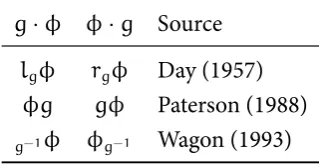
e groupGcould conceivably act on ℓ∞(G)in many ways, but here we care about two actions in particular. e rst de nes invariance of means, which in turn is used to de ne amenability. Forg∈Gandϕ∈ℓ∞(G), letg·ϕandϕ·gdenote the le and right actions ofgonϕrespectively, which are given by
g·ϕ ϕ·g Source
lgϕ rgϕ Day (1957)
ϕg gϕ Paterson (1988)
[image:29.595.204.364.102.184.2]g−1ϕ ϕg−1 Wagon (1993)
Table 2.1: Other notations for thenaturalordualactions.
In the past, different notation has been used for this action (Table 2.1). Note in particular that for allg, t∈GandA⊆G,
{
g−1·χA
}
(t) =χA
(
g−1t)=χgA(t).
De nition 2.7 (Amenability–) A meanmis said to bele-invariantifm(g·ϕ) =
m(ϕ)for all ϕ ∈ ℓ∞(G), g ∈ G, and likewise, isright-invariant if m(ϕ·g) =
m(ϕ).
If a le-invariant mean exists for a given groupG, thenGisle-amenable. Like-wise,right-amenable,amenable,non-amenable.
Before demonstrating that the two de nitions of amenability described above are equivalent, it is worth mentioning the second interesting action of a (semi)group.
De nition 2.8 Onℓ1(G)we have theconvolutionoff1, f2 ∈ℓ1(G)given as usually de ned:
(f1∗f2) (x) :=
∑
t∈G
f1(t)f2
(
t−1x).
e convolution operator ∗induces another action of eachg ∈ Gon the le and right of the larger spaceℓ∞(G). For allg ∈Gandϕ∈ℓ∞(G), de ne
g∗ϕ :=χ{g}∗ϕ, ϕ∗g :=ϕ∗χ{g}.
is is the same as merely identifyinggwithχ{g}. Note, however, convolution doesn’t work inℓ∞(G)in general. For example, ifGis an in nite group,χG∗χGis in nite everywhere.
For a groupG, the two actions above describe the same thing, in the sense that
In particular, for allg, t∈GandA⊆G,
{g∗χA}(t) =
{
g−1·χA
}
(t) =χA
(
g−1t)=χgA(t).
But ·and∗ are also mutually dual, which is shown as follows. Traditionally,ϕ ∈ ℓ∞(G) is canonically identi ed with someϕˆ ∈ ℓ1(G)∗ andvice-versa, and conse-quentlyℓ1(G)∗ is identi ed withℓ∞(G). is is done by setting
ˆ
ϕ(f) =∑
t∈G
f(t)ϕ(t) =⟨f, ϕ⟩, ϕ(g) =ϕˆ(χ{g}
)
for allf∈ℓ1(G), g∈G. An action onℓ∞(G)is dual of some other action onℓ1(G)
if they correspond via the canonical identi cation.
Lemma 2.9 e le∗action onℓ1(G)and the le·action onℓ∞(G)are duals of one another, i.e. for allg∈G,f∈ℓ1(G), andϕ∈ℓ∞(G),
⟨ϕ, g∗f⟩=⟨g·ϕ, f⟩.
Proof
⟨ϕ, g∗f⟩=∑
t∈G
(g∗f) (t)ϕ(t)
=∑
t∈G
f(g−1t)ϕ(t)
=∑
t∈G
f(t)ϕ(gt)
=∑
t∈G
f(t) (g·ϕ) (t)
=⟨g·ϕ, f⟩,
as required. □
Similarly, if we try to apply the∗action onℓ∞(G), the dual inℓ1(G)is again the · action.
Since the convolution action∗has a convenient name (“convolution”), the other action·is sometimes called thedualaction, or thenaturalaction.
Importantly, Lemma 2.9 strongly links amenability from the perspective ofℓ∞(G)
one includes convolution. Perhaps amenability can be thought of as solely a Banach algebra property? More on that later.
e following would be expected by the use of the same term for two different conditions.
eorem 2.10 e two de nitions of amenability above (De nitions 2.1 and 2.7) are equivalent.
Proof LetG be a group. Suppose thatG supports an invariant nitely-additive measureµ. Letmbe de ned by setting
m(f) :=
∫
G
fdµ
for allf∈ℓ∞(G). It is straightforward to verify thatminherits the properties listed in De nition 2.7:
1. mis a linear functional.
P: Forf1, f2 ∈ℓ∞(G)andλ∈C,
m(f1+λf2) =
∫
G
(f1+λf2)dµ
=
∫
G
f1dµ+λ
∫
f2dµ
=m(f1) +λm(f2).
2. m(χG) =
∫
G1dµ=1. 3. mis non-negative.
P: For a non-negativef ∈ ℓ∞(G), the integral is a supremum of sums of non-negative simple functions only, and is therefore non-negative.
4. mis invariant.
P: is will not be shown in full, as similar working will be used in detail in later chapters. e key idea is that for every setA⊆G,
m(χA) =
∫
G
χAdµ=µ(A)
by de nition, and therefore
m(g−1·χA
)
=m(χgA)
=µ(gA)
=µ(A)
It is then a matter of verifyingmis invariant at each step of the integral construc-tion up to arbitrary funcconstruc-tionsf∈ℓ∞(G)(and it is).
Conversely, supposeGsupports an invariant meanm. For all setsA⊆G, de ne
µ(A) :=m(χA). It is straightforward to verify the properties listed in De niton 2.1 as follows:
1. µ(G) =m(χG) =1. 2. µis nitely additive.
P: For any disjoint setsA, B⊆G:
µ(A ·∪B) =m(χ(A·∪B) )
=m(χA+χB)
=m(χA) +m(χB) ∵linearity ofm
=µ(A) +µ(B),
as required. 3. µis invariant.
P: For anyg∈G, A ⊆G:
µ(gA) = m(χgA)
=m(g−1·χA
)
=m(χA) ∵mis invariant
=µ(A),
as required. □
Note thatm(A)is oen used as shorthand form(χA).
2.3 Almost-invariant finite means
Most other avours of amenability are based upon the following. An argument of Namioka (1964), itself a re nement of an argument going back to Følner (1955), relates the in nite means to almost-invariance: collections of nite means which become invariant in some kind of limit. is was helpfully summarised in notes by Tao (2009) and his proof is eshed out below, with a minor simpli cation.
eorem 2.11 IfGis an amenable group, then for every x ∈ Gandϵ > 0there exists a nite meanνsuch that
Proof is is shown by contradiction. LetΦ(G)denote the space of nite means. Assume thatGis amenable with a meanm∈ℓ∞(G)∗, and that there exists anx ∈G
andϵ > 0such that for every nite meanν∈Φ(G),∥ν−x∗ν∥1≥ϵ.
1. e set{(ν−x∗ν) :ν∈Φ(G)}is convex inℓ1(G)and bounded away from{0}. P:Φis convex, and this translates to the elements of the formν−x∗ν. e set is bounded away from0by hypothesis.
2. ere exists a functional ρ ∈ ℓ1(G)∗ such that ρ(ν−x∗ν) ≥ 1for all nite meansν.
P: e previous step demonstrates the two disjoint convex subsets ofℓ1(G) required for applying the Hahn-Banach separation theorem.
3. ere exists a function r ∈ ℓ∞(G) such that⟨ν,(r−x·r)⟩ ≥ 1for all nite meansν.
P: It follows from the established identi cationℓ1(G)∗ ≡ ℓ∞(G)that there is anr∈ℓ∞(G)satisfyingρ(ν) =⟨r, ν⟩, and then
1≤ρ(ν−x∗ν)
=⟨r, ν−x∗ν⟩
=⟨r, ν⟩−⟨r, x∗ν⟩
=⟨r, ν⟩−⟨x·r, ν⟩
=⟨r−x·r, ν⟩.
4. (r−x·r)≥1pointwise.
P: Useν=χ{t}for eacht ∈G: then
⟨
r−x·r, χ{t}
⟩
= (r−x·r)(t). 5. e meanmis not le invariant, contradicting the assumption thatGis amenable.
P: Applyingmto the previous step, we get
m(r) −m(x·r) =m(r−x·r)≥m(1) =1,
which shows thatmis not invariant under the action ofxonr. □ Remark 2.12 While the proof ends by specialising all nite means toχtfor allt ∈S, one necessarily involves nite means at the beginning sinceΦ(S)is the convex hull of{χt:t ∈S}, which is not, itself, convex.
e above theorem can be strengthened slightly by introducing a nite setK. is straightforward improvement gives: ifGis amenable then for every niteK⊆Gand
(ν−x∗ν))∈ℓ1(G)S.
Such a strengthened condition is more useful for demonstrating that a group is
notamenable than it is in showing a groupisamenable.
2.4 Følner criteria
Using a “layer-cake decomposition” of the nite means, eorem 2.11 above can be reduced to a statement about nite sets, known as aFølner criterion.
eorem 2.13 IfGis an amenable group, then for allx ∈Gandϵ > 0there exists a nite setFsuch that
|xF△F|
|F| ≤ϵ.
Proof Brief sketch: By taking the layer-cake decomposition of the required nite meanν, we can see at least one of the layer setsEkis a nite set satisfying the Følner condition.
Fix anx∈Gand anϵ > 0.
1. By eorem 2.11, there exists a nite meanνsuch that
∥ν−x∗ν∥1≤ϵ.
2. Since supp(ν)is nite andνis bounded, we may x a layer-cake decomposition ofν, i.e. xnnested nite setsE1 ⊂E2 ⊂ · · · ⊂ Enand positive nite numbers
c1, . . . , cnsuch that
ν=
n
∑
i=1
ciχEi.
In this case,x∗νwill have the layer-cake decompositionx∗ν=∑ni=1ciχxEi. 3. ∑ni=1ci|Ei|=1.
P: By de nition∥ν∥1=1, so
1=∥ν∥1 =∑
t∈G
ν(t) =
n
∑
i=1
ci|Ei|.
4. For eachk∈{1, . . . , n}andx∈S,|ν(t) − (x∗ν)(t)|≥ckfor allt ∈xEk△Ek. P: Since theEi are nested, if t /∈ Ek thenν(t) ≤
∑k−1
i=1 ci. en either
t ∈ Ei\xEiand soν(t) =
∑k
i=1ciand(x∗ν)(t) ≤
∑k−1
i=1 ci, ort ∈ xEi\Eand soν(t)≤∑ik=−11ciand(x∗ν)(t) =
∑k i=1ci. 5. Using steps 3 and 4,
n
∑
i=1
ci|xEi△Ei|≤ ∥ν−x∗ν∥1 ≤ϵ=ϵ· n
∑
i=1
6. us for at least onek∈{1, . . . , n},
|xEk△Ek|≤ϵ|Ek|,
so the nite setEkis the required set. □
Remark 2.14 Similarly to eorem 2.11, eorem 2.13 can be slightly improved: if a groupGis amenable, then for all nite setsK ⊆ Gandϵ > 0there exists a nite setFsuch that|xF△F|/|F|≤ϵfor allx∈K.
Note that since eachx∈Gacts in a bijective manner onG,
2|F\xF|=|F△xF|=2|xF\F|
for any nite setF⊆ G, and therefore|xF△F|can be replaced with either|F\xF|or
|xF\F|.
To close the loop with invariant measures and means, we need to show that if a group satis es the Følner condition, then it is amenable, which Lemma 2.15 accom-plishes.
Lemma 2.15 For any countable groupG,Gis amenable if and only if there exists a sequence{Fn}n∈N(aFølner sequence) of nite subsets ofGthat “eventually coverG”, i.e. for everyh∈G,his also inFjfor allj > ifor somei, and that satisfy
lim n→∞
|Fn△gFn|
|Fn|
=0 for eachg∈G.
Proof e proof that an amenable group always has a Følner sequence is an easy consequence of eorem 2.13: takeϵ = n1. is provides then-th nite set of the sequence,Fn.
Conversely, intuitively we want to use a sequence with the term
xn(A) =
|A∩Fn|
|Fn|
in a limit, but as demonstrated earlier, the limit may not exist. Again, x a free ul-tra lterUonNcontaining the intervals[n,∞)for eachn ∈ N. en set up the
nitely-additive measureµby using the ultralimit
µ(A) :=lim
U xn(A) =limU
|A∩Fn|
|Fn|
1. e ultralimit, and henceµ, always exists.
P: e sequence is bounded, so by the Bolzano-Weierstrass eorem there exists a convergent subsequence. See Chapter 1.
2. µis a nitely-additive probability measure. 2.1. µ(S) = 1
P:xn(S) = ||FnFn|| =1for alln.
2.2. µ(A ·∪B) =µ(A) +µ(B)for all disjointA, B⊆S. P: SupposeA∩B=∅. en
µ(A∪B) =lim U
|(A∪B)∩Fn|
|Fn|
=lim U
|A∩Fn|+|B∩Fn|
|Fn|
=lim U
|A∩Fn|
|Fn|
+lim U
|B∩Fn|
|Fn|
∵Lemma 1.11
=µ(A) +µ(B).
3. µis invariant.
P: :et{Fn}n∈Nbe the Følner sequence. Letxn′ = |gA∩Fn|/|Fn|. Note that
|A∩B|=|g(A∩B)|=|gA∩gB|for any setsA, B⊆Gandg∈G. en,
|xn′ −xn|=
|gA∩Fn|
|Fn|
−|A∩Fn|
|Fn|
=|gA∩Fn|
|Fn|
−|gA∩gFn|
|Fn|
= ||gA∩Fn|−|gA∩gFn||
|Fn|
≤ |gA∩(Fn△gFn)|
|Fn|
≤ |Fn△gFn|
|Fn|
→0asn→ ∞
by hypothesis (Følner criterion), thereforeµ(A) =µ(gA)for anyg, A. □
2.4.1 Variations on Følner criteria
An alternative Følner criterion, and in fact one of the most popular in modern liter-ature, is described in the next theorem.
Picking apart the components of this theorem:
• e setSensuresFis arbitrary large and eventually covers all ofG.
• e setKrotates the a copy of the setF, one for eachk∈K.
• e quantity|FK\F|therefore measures how much more ofGcan be covered by rotatingFabout in nitely many directions. When the elements in Kare short (say, a set of generators), this is approximately the size of the boundary ofFasFbecomes large.
• It follows that the ratio|FK\F|/|F|is approximately the ratio between the sur-face area and the volume ofF, asFbecomes large.
An advantage to the Følner Criterion is that it is relatively easier to show a group is amenable than with the primal de nition, since one simply shows the existence of a Følnersequence(of Følner sets). However, it is oen impractical to use it for showing a group isnotamenable. As asserted by Akhmedov (2009), one would have to argue that given a smallϵthere are noϵ-Følner sets (see Examples 2.19 and 2.20). Følner’s original results are stated below, with minor rewording from the original paper (Følner, 1955).
eorem 2.17 (Følner’s necessary condition) A necessary condition that a groupG
is amenable is that for everykin the interval0 < k < 1, and arbitrary, nitely many, elementsa1, . . . , anfromG, there exists a nite subsetEofGsuch that
|E∩Eai|≥k|E| for i =1, . . . , n.
(Not shown here)
eorem 2.18 (Følner’s sufficient condition) A sufficient condition that a groupG
is amenable is that there exists a numberk0in the interval0 < k0 < 1such that for arbitrary, nitely many, not necessarily different, elementsa1, . . . , anfromGthere exists a nite subsetEofGsuch that
1 n
n
∑
i=1
|E∩Eai|≥k0|E|.
Condition Source
∀ϵ, a1. . . an∃F:|F∩Fai|≥ϵ|F| Følner (1955)
∃ϵ0∀a1. . . an∃F:n−1
∑n
i=1|F∩Fai|≥ϵ0|F| Følner (1955) limi→∞|gFi△Fi|/|Fi|=0
[image:38.595.126.449.102.201.2]∀ϵ, K, S∃F:S⊆F,|FK\F|/|F|< ϵ Akhmedov (2009)
Table 2.2: Summary of the variations on Følner criteria for discrete groups. ϵ, ϵ0 >
0, thea1. . . an, gare elements ofG, andF, Fi, K, Sare nite subsets ofG.
Følner remarks that, for groups, each condition implies the other.3
Example 2.19 Zis amenable, but this time we’re going to prove it with Følner sets. In particular, we’ll use the sequence{Fn}n∈NwhereFn = [−n, n]∩Z. is will suffice as a Følner sequence for all elementsk∈Z. en
lim n→∞
|(k+Fn)△Fn|
|Fn|
= lim n→∞
|[−n+k, n+k]△[−n, n]|
2n+1
= lim n→∞
2k 2n+1
=0.
Example 2.20 F2we know is not amenable, nevertheless it is worth using it to demon-strate a Følner criterion. To show this group is non-amenable this way is not intuitive, and here Lemma 2.15 is repeated by stealth.
SupposeF2 is amenable and has the generating set{a, b}. erefore it satis es the Følner condition: for eachϵ > 0and nite setK⊆F, there is a niteFsatisfying
|xF△F| < ϵ|F|for allx ∈ K. LetK = {a, b, a−1, b−1}and recall the sets Sa,Sb,
3Percolation theory also begain in the 1950s. e concept ofdensity is very similar in nature to the kind of measure obtained via the Følner condition: a subsetSof the integer latticeZd has
densityαwhen for every increasing sequence of nite rectangles{Rn}eventually covering all ofZd,
the following limit exists (Burton and Keane, 1989):
α= lim
n→∞
|S∩Rn|
|Rn| .
Sa−1, andSb−1given as previously. Note that for any nite setF,
a(F\Sa−1) =a(F∩({1}∪Sa∪Sb∪Sb−1))
=aF∩Sa
thus for allϵ > 0there exists a nite setFsuch that
|F|−|F∩Sa−1|=|F\Sa−1|
=|a(F\Sa−1)|
=|aF∩Sa|
≤||aF∩Sa|−|F∩Sa||+|F∩Sa|
=|(aF△F)∩Sa|+|F∩Sa|
≤|aF△F|+|F∩Sa|
≤ϵ|F|+|F∩Sa| ∵Følner cond. by assumption. is can be repeated fora−1,b, andb−1. Summing together each inequality gives
4|F|−∑
x∈K
|F∩Sx−1|≤4ϵ|F|+
∑
x∈K
|F∩Sx|
∴ 4|F|−|F|≤4ϵ|F|+|F|
∴ 1
2 ≤ϵ,
2.5
Amenability and growth
e concept of growth in relation to groups is said to have rst appeared in the mid 1950s (Grigorchuk, 1991), and as it turned out, growth is highly relevant to amenabil-ity theory.
e Følner criterion indicates that amenability is intimately related to growth in a group. As remarked above, within the Cayley graph of the group, the increasing nite sets F have “volume” |F| and “surface area”|∂F| ≈ |FK\F|. For an increas-ing sequence of compact solids in some space, intuitively, the rate of change of the surface area is proportional to the derivative of the rate of change of the volume. An amenable group necessarily has that ratio converging to zero for all Følner sequences, but there may be non-Følner sequences where this is not the case. e Følner condi-tion therefore provides sequences that describe a lower bound for the growth of the group. For any non-amenable group there is some sequence for which the ratio does not converge to zero, indicating a function for the volume proportional to its own derivative: an exponential.
Oen, the sequence of open balls of radiusnin the Cayley graph of the group functions as a Følner sequence. e growth rate of a group is based on this sequence.
De nition 2.22 (Growth rate for groups) Letw ∈ FS. Eachwis the product of some nite number of generators from the symmetrised generating setS∪S−1:
w:=
n
∏
i=0
smiki .
De ne|w|to beword length ofw,
|w|=
n
∑
i=0
|mi|.
If1is the identity ofFS, then|1|=0. Eachwcorresponds to a vertex in the Cayley graphΓ(FS), or alternatively, a unique path starting at the origin/1vertex. It is easy to use the word length to de ne a metric on the Cayley graph.
LetG=⟨S|R⟩be nitely-presented, i.e.S, Rare nite and
1→⟨R⟩FS →F S
ϕ
is exact4. ϕis surjective, so for anyx ∈ G, there is at least one (and usually more
than one)w∈FSsuch thatwϕ=x.
We are concerned with the number of elements of Gwith smallest word with lengthn. In case an element ofGhas multiple words of lengthn, we need to pick only one. In other words, if[x] = ϕ−1({x})denotes the equivalence class of words inFSequal toxunder the quotient, then for allx ∈G,|x|:=minw∈[x]|w|.
LetBn(G, S) = {x∈G:|x|≤n}, i.e. the lled ball of radius ncentred at the
originin the groupGrelative to the generating setS. (GandSdetermineR.) For simplicity letB(n)denoteBn(G, S)whereG, Sare determined from the context. egrowth function ofGrelative toSis
g(n) :=|Bn(G, S)|=|B(n)|
Clearly everyg(n)is monotone non-decreasing.
Let∼be the equivalence relation on functionsa, b:R→Rwherea∼bif there exists a nite constantCsuch thata(n/C) ≤b(n) ≤a(Cn)asnbecomes large.
∼ captures the notion that constant factor differences in growth are insubstantial, similar to big-Oh notation in complexity.
egrowth class ofGis one ofconstant/polynomial/exponentialif the equivalence class of functions containing the functiong : n 7→ |B(n)|also contains a constan-t/polynomial/exponential function. (e classes are disjoint!) e growth class ofG
isintermediateif it exceeds any polynomial, but is exceeded by any exponential (as
nbecomes large). A theorem (not proven here) is that the growth class forGdoes not depend on the choice of generatorsS.
Alternatively we could formulate the above in terms of
Sn(G, S) ={x∈G:|x|=n}=B(n)\B(n−1).
Some examples for different growth classes are in Table 2.3.
e constant, polynomial, and intermediate classes are grouped together as subex-ponential, including all functions exceeded by the exponential class for largen. is grouping is natural considering this next result.
eorem (AC) 2.23 Finitely-generated groups which have subexponential growth