Quantum Homomorphic Encryption for Polynomial-Sized Circuits
MSc Thesis(Afstudeerscriptie) written by
Yfke Dulek
(born May 14, 1992 in Leiden, the Netherlands)
under the supervision of dr. Christian Schaffner, and submitted to the Board of Examiners in partial fulfillment of the requirements for the degree of
MSc in Logic
at the Universiteit van Amsterdam.
Date of the public defense: Members of the Thesis Committee:
May 13, 2016 prof. dr. Ronald de Wolf (chair)
prof. dr. Harry Buhrman dr. Serge Fehr
A
BSTRACT
We present a new scheme for quantum homomorphic encryption which is compact and allows for efficient evaluation of arbitrary polynomial-sized quantum circuits. Building on the frame-work of Broadbent and Jeffery [BJ15] and recent results in the area of instantaneous non-local quantum computation [Spe15], we show how to construct quantum gadgets that allow perfect correction of the errors which occur during the homomorphic evaluation of T gates on en-crypted quantum data. Our scheme can be based on any classical (leveled) fully homomorphic encryption (FHE) scheme and requires no computational assumptions besides those already used by the classical scheme. The size of our quantum gadget depends on the space complexity of the classical decryption function – which aligns well with the current efforts to minimize the complexity of the decryption function.
Our scheme (or slight variants of it) offers a number of additional advantages such as ideal compactness, the ability to supply gadgets “on demand”, circuit privacy for the evaluator against passive adversaries, and a three-round scheme for blind delegated quantum computa-tion which puts only very limited demands on the quantum abilities of the client.
A
CKNOWLEDGEMENTS
First and foremost, I would like to thank my supervisor Christian Schaffner, who invested an enormous amount of time, effort and patience not only into helping me with this project, but also into involving me in academic life by inviting me to talks and meetings, introducing me to lots of people and allowing me to travel to meet even more. He was dedicated to help me get the most out of the experience, and I am grateful that he is happy to keep guiding me through the next four years.
Of course Florian Speelman, who acted as a second supervisor in a lot of ways, also deserves gratitude. When I got confused, he could often pin down exactly what it was that I did not understand yet, and could explain it to me in layman’s terms.
Next, I would like to thank the members of the thesis committee, Ronald de Wolf, Harry Buhrman and Serge Fehr, for taking the time to read through my work and come up with valuable remarks and challenging questions.
A huge thanks also goes out to all my friends and family, who have been there over the past years to support me and celebrate with me, and who have had to listen to a lot of quantum talk over the last couple of months. A special thanks to Ruben for devotedly plowing through a draft version of this thesis, and to my parents for never ever doubting me, not even for a second.
C
ONTENTS
List of symbols and abbreviations v
1 Introduction 1
1.1 Contributions . . . 2
1.2 Organization of this thesis . . . 3
2 Quantum computation 5 2.1 Preliminaries . . . 5
2.2 The Pauli group . . . 8
2.3 The Clifford group . . . 12
2.4 Universal quantum computation . . . 17
3 Homomorphic encryption 19 3.1 Classical homomorphic encryption . . . 19
3.2 Quantum homomorphic encryption . . . 21
3.3 Security . . . 22
3.4 QHE for Clifford circuits . . . 23
4 Computation through teleportation 27 4.1 Quantum teleportation . . . 27
4.2 Barrington’s theorem . . . 29
4.3 Instantaneous non-local quantum computation . . . 30
4.4 Conditional computation gadgets . . . 33
5 A teleportation-based quantum homomorphic encryption scheme 37 5.1 Definition of the scheme TP . . . 37
5.2 Security of TP . . . 40
5.3 Circuit privacy of TP. . . 44
5.4 Quantum power required forTP.KeyGen . . . 49
6 Conclusion 51 6.1 Future work . . . 52
References 53
L
IST OF SYMBOLS AND ABBREVIATIONS
N+ the positive natural numbers 27
C the complex numbers 5
≡ equality operator: (x≡y) = 1 if and only ifxandyare equal 40
∈R a uniformly randomly selected element 12
NC1 the class functions computable by a logarithmic-depth Boolean circuit of fan-in 2
20
η(·) a negligible function 20
(n1n2· · ·nk) a k-cycle (permutation) 27
[k] the set {1, ..., k} 27
k-PBP k-permutation branching program 27
x[i] ith element of a bitstringx∈ {0,1}n, defined for 1≤i≤n 5
|c| absolute value of a number c 5
kvk norm of a vector v 5
kUk1 trace norm of a matrix 5
k · k♦ diamond norm 44
·† complex conjugate of a matrix or vector 5
Tr(·) trace of a matrix 5
Id/I identity matrix of dimension d 5
U(d) set of unitary matrices of dimension d 5
0n,m/0 null matrix/vector 5
⊗ tensor product operator (for vectors and matrices) 6
|ψi,|ϕi pure quantum states 6
ρ, σ mixed quantum states 7
{|0i,|1i} the computational basis 6
{|+i,|−i} the Hadamard basis 6
{|Φ+i,|Φ−i,|Ψ+i,|Ψ−i} EPR pairs, Bell pairs 25 ρ(X) mixed quantum state based on a classical random variable X 8
Ui/Uij single-/two-qubit gate U applied to quantum register i (and
j), identity on all other registers
7
C(Q)ij conditional Pauli gate Q, target wirej, conditioned on wirei 16
X,Y,Z the Pauli group generators 8
H,P,CNOT the Clifford group generators 12
T the single-qubit T gate (non-Clifford) 7
Pn the n-qubit Pauli group 9
Pn± the n-qubit Pauli group based on only ±I,±X,±Z,±Y 11
Cn the n-qubit Clifford group 12
C?
LIST OF SYMBOLS AND ABBREVIATIONS
(F)HE classical (fully) homomorphic encryption 1 Q(F)HE quantum (fully) homomorphic encyption 22 (Q)HE.KeyGen the key generation procedure of a (Q)HE scheme 19
(Q)HE.Enc the encryption procedure of a (Q)HE scheme 20
(Q)HE.Eval the evaluation procedure of a (Q)HE scheme 20
(Q)HE.Dec the decryption procedure of a (Q)HE scheme 20
HE.Reci→j the recryption procedure of a classical homomorphic
encryp-tion scheme from key setiinto key setj
21
κ security parameter 19
pk classical public key 19
sk classical secret key 19
evk classical evaluation key 19
ρevk quantum evaluation key 21
e
x/ex[i] the encrypted version of a (classical) stringx, with respect to theith key set
21
CL a scheme for QHE for Clifford circuits 24
EPR the entanglement-based quantum homomorphic encryption scheme proposed in [BJ15]
24
AUX the auxiliary-state-based quantum homomorphic encryption scheme proposed in [BJ15]
24
TP the teleportation-based QFHE scheme defined in this thesis 2
TP(`) the scheme TP, but with all classical information about the lastL−`gadgets removed
39
GenGadget the quantum algorithm that generates a conditional compu-tation gadget
32
UseGadget the quantum algorithm that applies a conditional computa-tion gadget to an input qubit
32
ComputeKeys the classical algorithm that computes the Pauli error on the state after use of a conditional computation gadget
32
gf,C(x) classical information accompanying the conditional
computa-tion gadget
32
gi shorthand forgHE.Dec,P†(ski) 36 γr(gf,C(x)) quantum state forming the conditional computation gadget 32 Γpki+1(ski) theTgate gadget for the scheme TP 36 q-IND-CPA quantum indistinguishability w.r.t. chosen plaintext attacks 23
A adversary in security games 22
PubKcpaA,S(κ) the quantum CPA indistinguishability experiment with re-spect to the schemeS and adversaryA
22
PubKcpaA,S−mult(κ) the multiple-message quantum CPA indistinguishability ex-periment with respect to the schemeS and adversaryA
23
ΞcSpa,r the encryption action of the challenger inPubKcpaA,S(κ), based on randomnessr
C
H
A
P
T
E
R
1
I
NTRODUCTION
Homomorphic encryption enables the processing of data by operating directly on the encryption of the data, without having to decrypt first. Rivest, Adleman and Dertouzous were the first to observe the possibility of manipulating encrypted data in a meaningful way, rather than just storing and retrieving it [RAD78]. A scheme that would allow the evaluation ofany function on the encrypted data was considered the holy grail of modern cryptography. After some partial progress [GM84,Pai99,BGN05,IP07] over the years, a breakthrough was made in 2009 when Gentry presented the first fully homomorphic encryption (FHE) scheme [Gen09]. Since then, FHE schemes have been simplified [VDGHV10] and based on fewer and more standard assumptions [BV11]. The exciting developments around FHE have sparked a large amount of research in other areas such as functional encryption [GKP+13b,GVW13, GKP+13a, SW14] and obfuscation [GGH+13].
In the 1980s, a new research area emerged as the possibility of a computational model based on quantum mechanics was proposed [Fey82, Ben82]. Developing quantum computers is a formidable technical challenge, so it currently seems likely that quantum computing will not immediately be available for everyone and that quantum computations will have to be outsourced. Given the importance of classical1 FHE for “computing in the cloud” [NLV11], it is natural to wonder about the existence of encryption schemes which can encryptquantum data in such a way that a server can carry out arbitrary quantum computations on the encrypted data (without interacting with the encrypting party2). The best currently known schemes for quantum homomorphic encryption only allow for efficient evaluation of a strict subset of all possible quantum operations [RFG12, Lia13, TKO+14, OTF15, BJ15] and are therefore not fully homomorphic. Generally, operations from the so-calledClifford group [Got98] tend to be efficiently executable in a homomorphic setting, whereas the evaluation of operations that fall outside of this group tends to be more demanding. In order to perform arbitrary quantum operations, however, it is necessary to be able to evaluate at least one type of non-Clifford
1Here and throughout this thesis, “classical” stands for “non-quantum”. 2
1.1. CONTRIBUTIONS
operation, for example the operation called the T gate. In this thesis, we are concerned with the following question:
Is it possible to construct a computationally secure quantum homomorphic scheme that allows for efficient evaluation of arbitrary polynomial-sized quantum circuits?
Building upon previous work by Broadbent and Jeffery [BJ15], we are able to answer the above question in the affirmative.
1.1
Contributions
In this thesis, we present a new scheme TP (as abbreviation for teleportation) for quantum fully homomorphic encryption which is efficient for circuits containing polynomially many T
gates. The scheme is leveled in the sense that an upper bound to the number ofTgates needs to be known beforehand. The scheme is secure against chosen plaintext attacks from quantum adversaries, as formalized by the security notionq-IND-CPA security described by Broadbent and Jeffery [BJ15].
Like the schemes proposed in [BJ15], our scheme extends a known scheme that is homo-morphic only for Clifford operations. In this Clifford scheme, the input quantum state is encrypted with a quantum one-time pad (see Section 2.2.1), and the keys to this pad are in turn encrypted using a classical FHE scheme. Any computational assumptions required for that classical scheme are inherited by the Clifford scheme.
We extend the Clifford scheme by supplying auxiliary quantum states to the evaluating party which we call quantum gadgets and which aid in the evaluation of the Tgates. The size of a gadget in TPdepends only on (a certain form of) the space complexity of the decryption function of the classical FHE scheme. This relation turns out to be very convenient, as classical FHE schemes are often optimized with respect to the complexity of the decryption operation. As a concrete example, our scheme can be instantiated with the classical FHE scheme by Brakerski and Vaikuntanathan [BV11], resulting in a quantum scheme where each evaluation gadget consists of a number of quantum bits which is polynomial in the security parameter. This is in sharp contrast to the scheme proposed by Broadbent and Jeffery [BJ15], which requires auxiliary states that grow doubly exponentially in size with respect to the number of layers of T gates in the circuit.
After a T gate is evaluated on a quantum state that is encrypted with a quantum one-time pad, the result might contain an error, depending on the key with which the state was encrypted. Since the evaluator is not allowed to know this key, he does not know whether an error is present on the state and whether it needs to be corrected. Instead, he holds a classical fully homomorphic encryption of the key, which he can use in combination with the gadget in order to correct the error if it was present. In the process, the encrypted quantum state is teleported “through the gadget” [GC99], and the quantum part of the gadget is consumed. This quantum part consists of a number of entangled pairs of quantum bits that are prepared in a way that depends on the secret key of the classical FHE scheme.
On a high level, the use of an evaluation gadget corresponds to an instantaneous non-local quantum computation3 of the classical decryption function, where one party holds the
3
1.2. ORGANIZATION OF THIS THESIS
secret key for the classical FHE scheme and the other party holds a classical encryption of the key to the encrypted quantum state. Together, this information determines whether a correcting operation needs to be performed on the quantum state or not. Recent results by Speelman [Spe15] show how to perform such computation with a bounded amount of entan-glement. These techniques are crucial ingredients for our construction and are the reason why thegarden-hose complexity [BFSS13] of the decryption procedure of the classical FHE scheme is related to the size of our gadgets.
Apart from the definition of the scheme TP and the proof of its security against chosen plaintext attacks, we describe two variations onTP. The first variation provides circuit privacy to the evaluator in the semi-honest setting, allowing him to hide which circuit he evaluated on the data. The second variation shows how the quantum gadgets can be prepared using only very basic quantum operations, with the help of a (possibly malicious) third party. This variation is useful in a setting where a computationally less powerful client wants to delegate a quantum computation to a more powerful server.
The majority of the content of this thesis is based on a recent article by Dulek, Schaffner and Speelman [DSS16]. Additionally, this thesis contains a more in-depth analysis of the structure of the Clifford group, which plays a central role in the presented scheme because of the way it interacts with the quantum one-time pad. This analysis can be seen as a separate contribution that, although it does not contain any new results, may serve as an introductory resource on the Clifford group.
1.2
Organization of this thesis
C
H
A
P
T
E
R
2
Q
UANTUM COMPUTATION
We start by defining the basic features of a quantum computer: the structure of the most basic data building block, the qubit, and the types of operations that can be performed on this data are introduced in Section 2.1. This section should not be regarded as a complete introduction into quantum computation: for a more thorough treatment, the reader is referred to, for example, [NC00]. In Sections 2.2 and 2.3, we will gradually build up the Clifford group of quantum operations via the structurally simpler Pauli group, and explore some of its properties. In particular, we will consider how the unitaries in the single-qubit Clifford group rotate the Bloch sphere. This helps us to better understand in what way the Clifford operations interact with the Paulis and each other. We will see that a non-Clifford gate (such as theTgate) is needed to be able to perform all quantum operations with arbitrary precision.
2.1
Preliminaries
2.1.1
Notation
We assume familiarity with basic notions in linear algebra and use this subsection to establish some notation. Throughout this thesis, new concepts and their notation will be introduced: for an overview, see the list of symbols and abbreviations at the beginning of this document.
If U is a complex matrix, let U† denote its complex transpose, and let Tr(U) denote the trace of the matrix. kUk1:= Tr
√
U U† denotes the trace norm ofU. Write I
d for the identity
matrix of dimension d, and 0n,m for the null matrix (or vector, ifm= 1) of dimensionn×m.
If the dimensions are clear from the context, we might write I or0. U(d) denotes the set of all unitary matrices of dimensiond.
Let |c|denote the absolute value of a complex number c ∈C. If v is a vector of complex numbers, letkvk denote its norm, i.e. the square root of the sum of its squared entries.
Finally, if x∈ {0,1}n, letx[i] denote theith bit ofx, for 1≤i≤n. We use this notation
instead of the more conventionalxi in order avoid confusion with the notation for a list of bit
2.1. PRELIMINARIES
2.1.2
Quantum states
Quantum data consists ofquantum bits, orqubits, that can be described by vectors
α β
∈C2
(or in any two-dimensional complex Hilbert space) which are unit vectors, i.e. |a|2+|b|2 = 1.
Defining the computational basis states
|0i:=
1 0
, |1i:=
0 1
,
(written in Dirac notation) allows us to describe a qubit using the notation α|0i+β|1i: this reflects the idea that the basis states|0iand|1ican be thought of as analogues to the classical bits 0 and 1, and the values α and β can be regarded as the 0-amplitude and 1-amplitude, respectively. If both amplitudes are non-zero, then we say that the qubit is in a superposition between |0i and |1i. Two states that are in equal superposition are
|+i:= √1 2|0i+
1 √
2|1i and |−i:= 1 √
2|0i − 1 √
2|1i.
These two states form the Hadamard basis. In general, we write|ψi or|ϕi to denote a (pure) quantum state of one or more qubits.
When measuring a qubit in the computational basis, only two outcomes are possible: |0i is observed with probability |α|2, and|1iwith probability|β|2. For this reason it is important
that|α|2+|β|2 = 1. After a measurement, the qubit collapses to the observed value. It is also
possible to measure a qubit in a different basis, for example in the Hadamard basis{|+i,|−i}. Since any qubit can be written as a linear combination of|+iand|−i, both of these basis state can be assigned an amplitude, whose square equals the probability of observing that outcome. When combining multiple (uncorrelated) qubits, their joint state is the tensor product of the individual states. For example, the tensor product |ϕi1⊗ |ψi2 (or|ϕi1|ψi2, or |ϕψi12) of two qubits |ϕi=α1|0i+β1|1i in register 1 and |ψi=α2|0i+β2|1iin register 2 is
α1 β1 ⊗ α2 β2 =
α1α2
α1β2
β1α2
β1β2
=α1α2|00i12+α1β2|01i12+β1α2|10i12+β1β2|11i12.
The subscripts specify to which registers or wires the states belong. Whenever this is clear from the context, we leave out those subscripts.
An n-qubit state thus has dimension 2n. Not all n-qubit states can be written as a tensor product of their component qubits: states that cannot be separated into such a product are called entangled (see Section 4.1).
2.1.3
Quantum operations
2.1. PRELIMINARIES
operation should be aunitary matrix, meaning that its complex conjugate is also its inverse:
U U†=U†U =I. (Note that as a consequence, any such matrix must be square.) An additional property of norm-preserving or unitary matrices that we will use in this work is that their rows all have length 1 and are pairwise orthogonal [Wol01]. The same holds for the columns of the matrix.
Similarly to the subscripts for quantum states, we use the notation Ui to denote a
single-qubit quantum operation that is applied to the state in the ith register out of a total of n
registers. That is, Ui is the n-qubit unitary I⊗(i−1)⊗U ⊗I⊗(n−i), whereI is the single-qubit
identity operation I2. Similarly, Uij denotes a two-qubit gate U applied to registers i and j
only.
In principle, any unitary matrix in C2n×2n is a valid quantum operation on an n-qubit
quantum state. However, just like classical operations are ultimately built up fromAND,OR
andNOTgates, we prefer to think of quantum operations as circuits built up from some small set of basic gates. This reflects the way an actual quantum computer could be constructed, and introduces a measure for the complexity of an operation in terms of the size of the circuit required to perform the operation. Note however that with a finite set of basic gates we can only build countably many different quantum circuits, while the number of unitary matrices over complex numbers is uncountable. The trick is to find a set of basic gates that can approximate any unitary matrix arbitrarily well, i.e. up to some arbitrarily small error.
There are different possible choices for such a set of basic quantum gates [Wol01]. In this thesis, we will work with the gates in the 2-qubit Clifford group (see Section 2.3) extended with the single-qubit gate
T=
1 0 0 eπi/4
.
This set of basic gates can approximate any unitary operation using polylogarithmically many gates in the desired error bound by the Solovay-Kitaev theorem [DN05].
2.1.4
Pure versus mixed states
When working with partial information, we cannot always describe a quantum state completely. From the point of view of an observer, the state may be in a number of possible states |ψii,
each with probability pi. Such amixed state may be described with the density operator
ρ:=X
i
pi|ψiihψi|
wherehψi|denotes the conjugate transpose of the vector|ψii. If|ψiiis a vector of length 2n, the
density operator will be a 2n×2nmatrix. In general, a density operator is a positive-definite
matrix ρ such that Tr(ρ) = 1. We will denote mixed states withρ orσ. Note that this state is not a vector, but a matrix: when a unitary transformation U is applied to a mixed state ρ, the result isU ρU†, obtained through matrix multiplication. The composition of several mixed states can still be described by the tensor product of the individual states. When measuring a mixed state ρ, the probability of observing basis element |bi is given by Tr(hb|ρ|bi).
It is important to note that a mixture of pure states is not the same as a superposition of those states. Consider, for example, the pure quantum state|+i= √1
2(|0i+|1i) that is in equal
2.2. THE PAULI GROUP
measured in the computational basis, yields |0ior|1iwith equal probability. When measured in the Hadamard basis, however, the pure states yields |+iwith certainty, whereas the mixed states yields |+i or|−iwith equal probability, since 12(|0ih0|+|1ih1|) = 12(|+ih+| + |−ih−|). This example also shows that a single density operator (in this caseI2/2, thecompletely mixed
state) can often be interpreted in multiple ways, as several different mixtures of pure states. This observation lies at the heart of the quantum one-time pad (see Section 2.2.1).
Adopting the notation from [BJ15], we sometimes writeρ(X) to denote the mixed quantum stateP
xPrX(x)· |xihx|for a classical random variableX.
2.1.5
Visualizing single qubits in the Bloch sphere
When trying to visualize a single-qubit pure stateα|0i+β|1iwith complex amplitudesα=aeϕi
and β =beψi, we seem to run into the problem of having to visualize four degrees of freedom, sincea, b, ϕ, ψare all real numbers. However, since the global phase of a qubit is unobservable by measurement [NC00], we may choose not to let our visualization display it. By doing so, we may always assume that ϕ= 0 since if not, we can multiply the state globally by e−ϕi to get the statea|0i+be(ψ−ϕ)i|1i and treatψ−ϕas a single variable. Similarly, we may assume thata≥0. On top of these assumptions on the values ofaandϕ, the constraint|a|2+|b|2= 1
ensures the existence of some θ ∈(−π
2,
π
2] such that a = cosθ and b = sinθ. Hence, we can
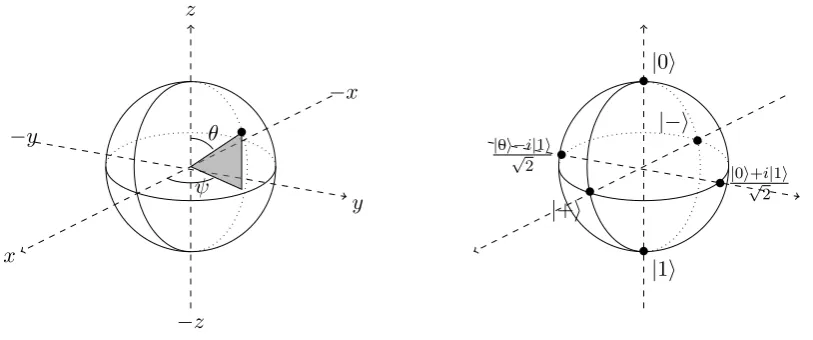
write any single-qubit pure state as cosθ|0i+ sinθeψi|1i, which can be visualized on a two-dimensional space in three dimensions, specifically the surface of the Bloch sphere orPoincar´e sphere [NC00], as follows. Define thex,y, and z coordinates as follows:
x:= sin 2θcosψ y:= sin 2θsinψ z:= cos 2θ.
Since |x|2 +|y|2 +|z|2 = 1, these points all lie on the surface of the unit sphere. Figure 2.1
shows examples of pure states visualized in the Bloch sphere.
The Bloch-sphere representation nicely extends to mixed states as well. Letρbe some state P
ipi|ψiihψi|, where each of the pure states |ψii is represented on the Bloch sphere by some
vectorr~i of length 1. Thenρis represented in the open interior of the Bloch sphere, the Bloch
ball, by the average vectorP
ipir~i [OM08]. The completely mixed stateI2/2 is represented by
the vector of length 0, exactly at the point of origin of the Bloch ball. This can be seen by (for example) considering a uniform mixture of the pure states |0i and |1i, whose vectors (along the positive and the negative zaxis, respectively) cancel each other out when averaged.
2.2
The Pauli group
Apart from the identity gate I, some of the most basic operations one can perform on a single qubit are the bit flip X, the phase flip Z, and a complex combination Y of both flips:
X=
0 1 1 0
Z=
1 0 0 −1
Y=
0 −i
i 0
.
2.2. THE PAULI GROUP
z
y
x
−z
−y
−x
•
ψ θ
•|0i
• |1i
•|0i√+i|1i
2
•
|0i−√i|1i
2
• |−i
[image:17.595.84.491.114.284.2]• |+i
Figure 2.1: Left: the Bloch sphere plus the construction for the vector of an arbitrary single-qubit pure state cosθ|0i+ sinθeψi|1i. Right: six examples of common pure states as plotted on the Bloch sphere. Their positions can be verified by checking their individual (θ, ψ) values: (0,0) for|0i; (π2,0) for|1i; (π4,0) for|+i; (π4, π) for|−i; (π4,π2) for √1
2(|0i+i|1i); and (
π
4, 3π
2 )
for √1
2(|0i −i|1i).
Z|1i=−|1i. While this phase flip does not seem to make an observable difference because a global phase is not observed in a measurement, it does when working with superpositions of states, for exampleZ|+i=|−iand vice versa. One can verify the following useful identities:
Y=iXZ
X2 =Y2 =Z2 =I (self-inverse)
XZ=−ZX (X andZ anti-commute)
The four operationsI,X,Z, andYare known as thePauli matrices. Together with multiplica-tive factors±1 and±i, they form a group under multiplication:
Definition 2.1. The single-qubit Pauli group P1 is the matrix multiplication group over the
set
{±I,±iI,±X,±iX,±Z,±iZ,±Y,±iY}.
The n-qubit Pauli group Pn is the matrix multiplication group over the set1 {Q(1)⊗ · · · ⊗Q(n)|Q(i)∈ P1}
The Pauli group plays a key role in the stabilizer formalism [NC00] and can be used for basic encryption of quantum states (see Section 2.2.1). We establish some properties of the Pauli group that provide insight into its structure. These properties will mainly be useful for analyzing the Clifford group in the next section.
Lemma 2.2. The Pauli group Pn is generated by{Xi,Zi,Yi |1≤i≤n}.
1
The subscript inQ(i)is simply an index. We use this notation instead ofQito in order to distinguish from
2.2. THE PAULI GROUP
Proof. For the single-qubit Pauli group P1, we need to show that it is generated by X, Z
and Y. By matrix multiplication, one can check that I = XX, iI = XYZ, −I = XYXY, and −iI = XZY. All other elements of P1 are easily generated by combining one of these four
identity-like operators with the appropriate generator. For example, −iX= (−iI)X.
For the general n-qubit Pauli group Pn, clearly it is enough to generate all elements of the set {Qi | Q∈ P1,1 ≤i ≤n}; any other element Q(1)⊗ · · · ⊗Q(n) is simply the product
of (Q(1))1 through (Q(n))n. However, by the same arguments used for the single-qubit Pauli
group, any operator Qi can be generated using onlyXi,Zi and Yi.
We now consider how each single-qubit Pauli operation manipulates the points on the Bloch sphere. It turns out that the generatorsX,YandZrepresent exactly 180◦ rotations around the
x,yandzaxes respectively [Gle05]. For example, applyingXto some state cosθ|0i+sinθedi|1i
results in the state cos(π2 −θ)|0i+ sin(2π−θ)e−di|1i (up to a global phase): a reflection in the
z and yaxes, or equivalently a 180◦ rotation around thex axis. Indeed, the elements that are exactly on the xaxis (|+i and |−i) are left invariant under theXoperation.
Note that using only these 180◦ rotations, a qubit |0i or|1i can never leave the computa-tional basis, and similarly |+iand |−iwill never leave the Hadamard basis. Note furthermore that since the global phase is not visible in the Bloch sphere representation, the rotation around the y axis can be generated by subsequent rotations around the zand x axes, since Y=iXZ. So if we are not interested in the global phase, we can drop Y as one of the generators of the Pauli group.
The following lemma shows that the only gate that commutes individually with all elements of the Pauli group is the identity gate (up to a global phase).
Lemma 2.3. The centralizer of then-qubit Pauli group with respect to the group of all complex-valued unitary 2n×2n matrices U(2n), defined as
{U∈U(2n)| ∀A∈ Pn:UA=AU},
is equal to the set {cI⊗n|c∈C,|c|= 1}.
Proof. Trivially, for all |c| = 1, cI⊗n is a centralizer element. To show that all centralizer elements are of this form, we proceed by induction on n.
Forn= 1, suppose thatU∈U(2) is an element of the centralizer ofP1. Then in particular,
UZ=ZU, and therefore (writinguij for the entry in rowiand columnj ofU)
u11 −u12
u21 −u22
=UZ=ZU=
u11 u12
−u21 −u22
.
We observe that u12= −u12 and conclude that u12 = 0. Similarly, u21 = 0. Using the same
technique on the equation UX=XU, we can deduce that u11=u22. SinceU is a unitary, and
so all its columns must have length 1, U can only be of the form cIwith|c|= 1.
Forn >1, a similar technique is used. Suppose that U∈U(2n) is a centralizer element of Pn. Then for all Q∈ Pn−1, U(Z⊗Q) = (Z⊗Q)U. We shall considerU as a block matrix of
four (not necessarily unitary) matrices, namely:
U=
A B
C D
2.2. THE PAULI GROUP
Then we can deduce, like in the case for n= 1, that
AQ −BQ
CQ −DQ
=U(Z⊗Q) = (Z⊗Q)U=
QA QB
−QC −QD
From the above, we see that for allQ∈ Pn−1, it must be that−BQ=QB. In particular, this
holds forQ=I⊗(n−1), and so we have thatB =−B =0. Similarly, we can deduce thatC=0. Because U is unitary, its rows and columns must all have norm 1. Since B = C = 0, these blocks do not contribute to the norms of the rows and the columns, and so it must be thatA
andDthemselves are unitary. Combining this information with the fact thatQA=AQfor all
Q∈ Pn−1, we can conclude that A is a centralizer element of Pn−1 with respect toU(2n−1),
and so (by induction hypothesis) it must be that A = cI⊗(n−1) for some c ∈ C with |c|= 1. Similarly, D=c0I⊗(n−1) for somec0∈Cwith|c0|= 1. Now we know that U is of the form
cI⊗(n−1) 0 0 c0I⊗(n−1)
It remains to show that c=c0. We do so by observing that because (X⊗I⊗(n−1))U =U(X⊗
I⊗(n−1)),
0 c0I⊗(n−1) cI⊗(n−1) 0
=
0 cI⊗(n−1) c0I⊗(n−1) 0
.
Hence,U=cI⊗n for some|c|= 1, which is what we set out to show.
So, the identity operator is the only unitary that commutes with all Pauli elements. How-ever, the other Paulis themselves also show interesting commutating behavior with respect to the Pauli group:
Lemma 2.4. Let Q∈ Pn be such that Q6∈ {±I⊗n,±iI⊗n}. Then Qcommutes with exactly half
of the elements of Pn, and anti-commutes with the other half.
Proof. We show this by induction on n. For n = 1, this can be checked by hand (either by matrix multiplication or by composing rotations of the Bloch sphere): Xcommutes with Iand
X, but anti-commutes with Z and Y. Similarly, Z commutes with {I,Z} but anti-commutes with {X,Y}, and Y commutes with {I,Y} but anti-commutes with {X,Z}. If some or all of these operators are modified by scalars from {±1,±i}, commutation is not affected.
Forn >1, writeQ=Q0⊗S for someQ0∈ Pn−1 andS ∈ P1. By the induction hypothesis,
exactly half of the elements of Pn−1 commute with Q0: call this set Q0. Similarly, by the
argument above, exactly half ofP1 commutes with S: call this setS. Then all elements of
Q :={R0⊗R|R0 ∈Q0, R∈S} ∪ {R0⊗R|R0 ∈ Pn−1−Q0, R∈ P1−S}
commute with Q, since (Q0⊗S)(R0⊗R) =Q0R0⊗SR, and the pairs Q0, R0 and S, R either both commute or both anti-commute. Q makes up exactly half of the elements of Pn.
Note that the proof of Lemma 2.4 also shows that any n-qubit Pauli operator Q 6∈ {±I⊗n,±iI⊗n} commutes with exactly half of the Paulis in the set Pn± :={Q(1)⊗ · · · ⊗Q(n) |
2.3. THE CLIFFORD GROUP
2.2.1
Quantum one-time pad
Using only Pauli operators, we can build a simple yet effective encryption scheme known as the quantum one-time pad [AMTW00]: if a uniformly random Pauli operator is applied to some qubit, the resulting state is fully mixed to anyone that does not have knowledge of which Pauli is applied.
Analogous to the classical one-time pad, where a plaintext bitbis hidden by choosing some
b0 ∈R{0,1} and computingb⊕b0 for the ciphertext, the quantum one-time pad is applied to
some single-qubit mixed stateρby pickingtworandom bitsa, b∈R{0,1}uniformly at random and computing the state (XaZb)ρ(XaZb)† to be the ciphertext. As long as a, b remain secret,
this random Pauli operator completely hides the content of any ρ= α β γ δ , since X
a,b∈0,1
1 4(X
aZb)ρ(XaZb)†
= 1 4
ρ+XρX†+ZρZ†+ (XZ)ρ(XZ)† = 1 4 α β γ δ + δ γ β α +
α −β
−γ δ
+
δ −γ
−β α
= 1 2
α+δ 0
0 α+δ
which, because α+δ= Tr(ρ) = 1, equalsId/2, the completely mixed state.
We can also see that the quantum one-time pad results in the completely mixed state by considering what it does to a (pure or mixed) state represented in the Bloch ball by coordinates (x, y, z). Then X represents a rotation around the x axis, effectively mapping the state to (x,−y,−z). Similarly, Z maps the state to (−x,−y, z), and XZ (which is equal to Y up to a global phase) maps the state to (−x, y,−z). Averaging over these four vectors results in a vector with entries (0,0,0), which represents the completely mixed state.
2.3
The Clifford group
In this section we consider a somewhat larger group of operations known as the Clifford group. It is defined as the set of operations that commute with the Pauli group as a whole:
Definition 2.5. The n-qubit Clifford group Cn is the normalizer of Pn with respect to U(2n). That is,
Cn:={U∈U(2n)| PnU=UPn}.
Clifford operators commute with the entire Pauli group in the sense that left multiplication of the Pauli group results in the same set of operators as right multiplication. This is a more relaxed notion than the centralizer of the Pauli group, since the Clifford operators do not need to commute individually with every Pauli operator. ForU to be a Clifford operation, we only require that for every Q∈ Pn, there existssome Q0∈ Pn such thatQU=UQ0.
What does the setCnlook like? One can verify by hand that at least the following operations
are included in the single- and two-qubit Clifford groups:
H= √1 2 1 1 1 −1 P= 1 0 0 i CNOT=
1 0 0 0 0 1 0 0 0 0 0 1 0 0 1 0
2.3. THE CLIFFORD GROUP
The size ofCn grows quickly with n, but as we will see, the set always remains finite (up to a global phase). We can associate the Clifford elements with permutations on the Paulis in the following way:
Lemma 2.6. For any A ∈ Cn, let πA: Pn → Pn be the function defined by πA(Q) := AQA†.
πA is a permutation onPn. Furthermore,πAis a linear map that preserves the group structure
of Pn.
Proof. We need to show that πA is a bijection on Pn. To see thatπA is injective, suppose for
Q, Q0 ∈ Pn that AQA† =AQ0A†. It follows that Q= A†AQA†A = A†AQ0A†A =Q0. Since the domain and codomain of πA are finite and of equal size, injectivity immediately implies
bijectivity. Hence, πA is a permutation onPn.
To verify that πA preserves addition, simply observe thatA(Q+Q0)A†=AQA†+AQ0A†.
Similarly for scalar multiplication: AcQA†=cAQA†, soπAis a linear map. πApreserves the
Pauli group structure sinceAQQ0A†=AQA†AQ0A†.
Because πA is a permutation for any A ∈ Cn, we can view every element of the Clifford
group as a permutation of the Paulis. It is natural to ask whether (1) different Clifford operations represent different permutations on Pn, and (2) whether all permutations on Pn
are represented by at least one Clifford operation. In the rest of this section, we will first show that all Cliffords do represent unique permutations by showing that two Cliffords that induce the same permutation cannot differ by more than a global phase. Then we will see that only a specific set of permutations is represented by the Clifford group, and that for the single-qubit case this set corresponds to the rotational symmetries of a cube.
Lemma 2.7. Let A, B∈ Cn. If πA=πB, then A=cB for some c∈C with modulus 1.
Proof. Suppose that for all P ∈ Pn, AP A† =BP B†. Then for all P ∈ Pn, B†AP A†B =P,
and soB†A is in the centralizer of then-qubit Pauli group. From Lemma 2.3, it follows that
B†A=cI⊗n for somec∈C with|c|= 1, and soA=cB.
Next, we consider the second question: which permutations on Pn are represented by the
Cliffords? First, note that because πA preserves the group structure of Cn (see Lemma 2.6),
the wayπAacts on the generators ofPncompletely determines the values ofπA on the rest of
the group. For example for a single-qubit CliffordA,πA(Y) =iπA(X)πA(Z), becauseY=iXZ.
The following lemma helps us to reduce the number of permutations we need to consider.
Lemma 2.8. Let A∈ Cn. Then the following restrictions on the values of πA(Xn) and πA(Zn)
hold:
(i) πA(Xn), πA(Zn)∈ Pn±\{±I⊗n}.
(ii) πA(Xn) andπA(Zn) anti-commute.
Proof.
(i) We prove thatπA(Xn)∈ Pn±\{±I⊗n}– the argument forπA(Zn) is identical. First, note
that for all c ∈ {1,−1, i,−i}, πA(cI⊗n) =cI⊗n, so all identity-like matrices are mapped
2.3. THE CLIFFORD GROUP
Next, suppose toward a contradiction thatπA(Xn) =±iQfor someQ∈ Pn±. This would
result in
I⊗n=πA(I⊗n) =πA(XnXn) =πA(Xn)2 = (±iQ)2 = (±i)2I⊗n=−I⊗n,
a contradiction. Hence, the only possible images for Xn underπAare the elements from
Pn±\{±I⊗n}.
(ii) This holds because Xn and Zn anti-commute, andπA preserves the group structure (see
Lemma 2.6):
πA(Xn)πA(Zn) =πA(XnZn) =πA(−ZnXn) =−πA(ZnXn) =−πA(Zn)πA(Xn).
It can even be verified that any permutation that satisfies the restrictions in Lemma 2.8 determines a (unique) Clifford operatorA∈ Cn [Ozo08]. We do so in Section 2.3.2.
2.3.1
The single-qubit Clifford group
C
1We first focus on the single-qubit Clifford group C1: it is relatively small and we can therefore
study its structure explicitly. Combining Lemmas 2.7 and 2.8, we see that the single-qubit Clifford group C1 contains (at most) 6×4 = 24 unique elements, up to scalar multiplication.
This is because there are six possible values forπA(X) (namely, the elements of{±X,±Y,±Z}),
and four remaining possibilities for πA(Z) (the half of P1± that anti-commutes with πA(X)).
We will show that the Clifford group does indeed contain all the operators that induce these 24 possible permutations.
Lemma 2.9. Suppose for some A∈ C1 thatπA(X) =Q, and πA(Z) =Q0. Then
(i) πAX(X) =Q andπAX(Z) =−Q0. (ii) πAZ(X) =−Q andπAZ(Z) =Q0.
(iii) πAY(X) =−Q andπAY(Z) =−Q0.
Proof. These identities can be verified by straightforward computation. For example,πAX(Z) =
AXZXA†=πA(XZX) =−πA(XXZ) =−πA(Z).
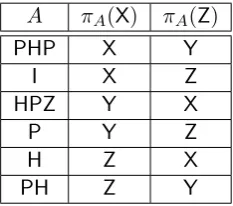
Table 2.2 explicitly lists the six Clifford operators that represent the permutationsπA(X)∈
{X,Y,Z}andπA(Z)∈ {X,Y,Z}\{πA(X)}. We can find all 24 permutations by right-multiplying
these operators with the Paulis as described in Lemma 2.9.
Like Pauli operators, each of the resulting 24 elements of the single-qubit Clifford group corresponds to a rotation of the Bloch sphere. These rotations are determined by the permuta-tions listed in Table 2.2. For example, thePoperator maps thexaxis onto theyaxis, maps the
2.3. THE CLIFFORD GROUP
A πA(X) πA(Z)
PHP X Y
I X Z
HPZ Y X
P Y Z
H Z X
[image:23.595.225.342.112.215.2]PH Z Y
Figure 2.2: Six single-qubit Clifford operations and the permutations they induce on the Pauli group, as fixed by the permutations of the generators X and Z. From these six Cliffords, the entire groupC1 can be generated by right-multiplying with Paulis.
z
y
x
−z
−y
−x •
• 90◦
•
• 180◦
(a) (b) (c)
Figure 2.3: (a): the isometry between the Bloch sphere under Clifford rotations and the orientation-preserving rotation group of the cube. (b) and (c): the generators of the Clifford group (P and H, respectively) as corresponding to the generators of the cube rotation group.
In order to establish the generators of C1, we note that the single-qubit Clifford group also
corresponds to the (orientation-preserving) symmetry group of the cube in the following way. Draw the smallest possible cube around the Bloch sphere so that the axes of the sphere run through the centers of the six cube faces (see Figure 2.3(a)). Then every order-preserving rotation of the cube corresponds to a Clifford operation, and vice versa (see Table 2.2). Specif-ically, Figures 2.3(b) and 2.3(c) show the rotations induced by P and H, respectively. These two rotations are known generate the entire orientation-preserving symmetry group of the cube [Arm88], soPandHtogether generate the entire single-qubit Clifford group (up to global phase). This isometry also helps to see why there are 24 elements in C1: the cube face
[image:23.595.40.535.296.484.2]2.3. THE CLIFFORD GROUP
2.3.2
The multi-qubit Clifford group
C
nThe general n-qubit Clifford group becomes very large very fast. The goal of this subsection is to establish the size of Cn, and along the way we will see that Cn is generated by just H,P
and CNOT. We start by verifying that any permutation on the Pauli group that preserves its structure as in Lemma 2.8 can be associated with a Clifford operator:
Lemma 2.10. Let f : Pn → Pn be a permutation such that f(Xn), f(Zn) ∈ Pn±\{±I}, and
f(Xn) anti-commutes with f(Zn). Then there exists an A ∈ Cn such that f =πA. Moreover,
A is a product of onlyH,P and CNOT operations.
Proof. This is again a proof by induction onn. Forn= 1, the statement was verified by hand in Section 2.3.1.
Forn >1, we will build up the Clifford operationA†in several steps, and show thatπA†◦f
is the identity permutation. It then immediately follows that f =πA.
First, letR∈ Pnbe the result off(Xn). Then R=R(1)⊗ · · · ⊗R(n−1)⊗R(n)forR(i)∈ P1.
As we have seen in Section 2.3.1, there exists a single-qubit CliffordB such thatπB(R(n)) =X,
and hence,πI⊗(n−1)B(R) =R(1)⊗ · · · ⊗R(n−1)⊗X. ThisB can be constructed from justHand
P, like all single-qubit Cliffords.
For any single-qubit Pauli Q, defineC(Q)ij to be the controlled version ofQ with control
bit iand target bitj. One can verify that for any Pauli Q,
πC(Q)ij(Xi⊗Ij) = (Xi⊗Qj) and πC(Q)ij(Zi⊗Ij) = (Zi⊗Ij).
Moreover, such controlled-Q gates are Cliffords and can be easily built using only CNOT, H
and single-qubit Pauli operations (which, in turn, can be built from H and P) [NC00]. Let
CX :=Qni=1−1C(R(i))ni. Then clearly, πC(R(i))ni(Xn) =πI⊗(n−1)B(f(Xn)). Thus, π(C(R(i))ni)−1 ◦
πI⊗(n−1)B◦f leaves Xn fixed.
Using roughly the same technique, we can find a Clifford that also inverts the effect of f on Zn, while leaving Xn fixed: let S(1) ⊗ · · · ⊗ S(n−1) ⊗S(n) ∈ Pn be the result of
π(C(R(i))ni)−1(πI⊗(n−1)B(f(Zn))). Again, there exists a single-qubit Clifford B0 such that πB0
(leaves Xfixed and) maps S(n) 7→Z. Then, defining CZ :=Qin=1−1C(S(i))ni, we can check that
HCZHmaps Zn7→S(1)⊗ · · · ⊗S(n−1)⊗Z, while leavingXn fixed.
From the above, we conclude that the permutation induced by
A0 :=H(CZ)−1H(I⊗(n−1)⊗B0)(CX)−1(I⊗(n−1)⊗B),
which can be built entirely from H, P and CNOT, inverts the permutation f simultaneously on the Paulis Xn and Zn. All other Pauli generators may still be arbitrarily permuted by this
permutation, but at least the group structure is respected by the permutation πA0◦f because
of Lemma 2.6. Hence, by the induction hypothesis, there exists some Clifford D ∈ Cn−1, a
product ofH,PandCNOTgates, such thatπD⊗I◦πA0◦f is the identity permutation. Defining A:= (A0)†(D⊗I)† completes the proof.
As a corollary of Lemmas 2.6, 2.7 and 2.10, all Cliffords can be generated by H, P and
CNOT. Lemma 2.6 states that all Clifford operations A give rise to a permutationπA on the
2.4. UNIVERSAL QUANTUM COMPUTATION
We now construct a recursive formula for the size of then-qubit Clifford group. To do this, we show that a certain subgroup of Cn is isomorphic to Cn−1, and then count the number of
cosets of this subgroup inCn.
Lemma 2.11. Let C?
n:= {A∈ Cn|πA(Xn) =Xn, πA(Zn) =Zn} be the set of n-qubit Cliffords
that leave the generators Xn andZn fixed. Then Cn? is isomorphic to Cn−1.
Proof. Define f : Cn−1 → Cn? by f(A) := A⊗I. Clearly, this is a homomorphism because
f(AB) =AB⊗I= (A⊗I)(B⊗I) =f(A)f(B). To see that it is an isomorphism, we need to show that it is a bijection as well.
Injectivity off follows immediately from the observation that iff(A) =f(B), thenA⊗I=
B⊗I, and henceA=B. For surjectivity, let A ∈ C?
n. Then by definition of Cn?,AXn =XnA and AZn=XnA. Like
in the proof of Lemma 2.3, we can deduce from these equations that A must be of the form
A0 ⊗Ifor some A0 ∈ U(2n−1). Because A ∈ Cn, it must be the case thatA0 ∈ Cn−1. Hence,
there exists an A0 ∈ Cn−1 such thatf(A0) =A.
Lemma 2.12. The size of then-qubit Clifford group is |Cn|= 2(4n−1)4n|Cn−1|.
Proof. For every A ∈ Cn, AC?
n is a (left) coset of Cn? in Cn. We argue that if two n-qubit
CliffordsAandB give rise to permutations that act identically on{Xn,Zn}, then ACn? =BCn?.
Because πA(Xn) = πB(Xn), we have that πB†A(Xn) = Xn, and similarly that πB†A(Zn) = Zn.
By the same argument as in the surjectivity proof of Lemma 2.11, it follows that there exists a C ∈ Cn−1 such that B†A = I⊗C. For this C, we have that B(I⊗C) = B(B†A) = A =
A(I⊗I⊗(n−1)), and henceBC?
n∩ACn? 6=∅. Because the (left) cosets of a group always form a
partition of that group, this means that BC?
n=ACn?.
From the above argument, we see that every structure-preserving permutation on the Pauli group can be associated with exactly one coset of Cn−1∼=Cn? inCn. From Lemmas 2.4 and 2.8,
it follows that the number of possible images forXn and Zn under such a permutation is
|Pn±− {±I⊗n}| ·1 2|P
±
n|= (2·4n−2) 4n= 2(4n−1)4n.
The result of the lemma now follows from Lagrange’s Theorem.
From Lemma 2.12, we can derive the closed formula |Cn|= 2n
2+2nQn
j=1(4j−1). The size
of Cn thus grows exponentially inn, but always remains finite if we ignore the global phase.
2.4
Universal quantum computation
For universal quantum computation, we want to be able to perform arbitrary quantum opera-tions, or at least approximate them up to some arbitrarily small error. In the single-qubit case, this means approximating arbitrary rotations of the Bloch sphere, or equivalently mapping the |0i state to any point on the Bloch sphere. From the analysis in Section 2.3, it is clear that the Clifford group is not sufficient for this task.
2.4. UNIVERSAL QUANTUM COMPUTATION
be constructed with two consecutive T gates. The Solovay-Kitaev theorem even states that the number of operators needed for this approximation is quite small: polylogarithmic in the desired error bound [NC00]. If we want to do universal quantum computation on n qubits, the operations H, T and CNOT are enough. This set of basic gates is often referred to as the standard set or the Clifford+T set, because the Cliffords can be generated using only T2,H,
and CNOT (see Section 2.3.2).
We conclude this chapter by stating a number of useful gate equalities (up to a global phase), which can be verified by hand, either by matrix multiplication or by composing the rotations on the Bloch sphere:
T2 =P P2 =Z HXH=Z PZ=ZP PX=XZP TX=PXT TZ=ZT
and some equalties that cannot be visualized in three dimensions:
C
H
A
P
T
E
R
3
H
OMOMORPHIC ENCRYPTION
Usually, encrypted data can only be stored and later retrieved, and in order to manipulate the data one would have to decrypt it first. Homomorphic encryption allows the evaluation of a function on the plaintext by manipulating the ciphertext in some related way, using an evaluation key. By definition, this means that the encryption is malleable by anyone who knows the evaluation key, which can be an undesirable property in some contexts. The homomorphic property is an advantage in other contexts, for example when outsourcing computations to an untrusted party. This advantage is especially evident in a quantum setting, where a possible future scenario is the existence of a limited number of powerful quantum computers that carry out quantum computational tasks on data from clients.
This chapter provides formal definitions of (classical and quantum) homomorphic encryp-tion schemes and the security condiencryp-tions for such schemes. In the current work, we only consider homomorphic encryption in a public-key setting. For a more thorough treatment of these concepts, and how they can be transferred to the symmetric-key setting, see [BJ15].
3.1
Classical homomorphic encryption
A classical homomorphic encryption scheme HE consists of four algorithms: key generation, encryption, evaluation, and decryption. The key generator produces three keys: a public key and evaluation key, both of which are publicly available to everyone, and a secret key which is only revealed to the decrypting party. Anyone in possession of the public key can encrypt the inputs x1, . . . , x`, and send the resulting ciphertexts c1, . . . , c` to an evaluator who evaluates
some circuit C on them using the evaluation key. The evaluator sends the result to a party that possesses the secret key, who should be able to decrypt it toC(x1, . . . , x`).
More formally, HE consists of the following four algorithms which run in probabilistic polynomial time in terms of their input and parameters [BV11]:
(pk,evk,sk)←HE.KeyGen(1κ) where κ is the security parameter. Three keys are generated:
3.1. CLASSICAL HOMOMORPHIC ENCRYPTION
encrypted state. The keys pk and evk are announced publicly, while sk is kept secret. The length of the keys is a fixed polynomial in κ. Longer keys generally increase the input size of the computationally hard problem that a potential attacker needs to solve, essentially making the encryption more secure.
c←HE.Encpk(x) for some messagex from a message space Mκ (in this thesis, we will work
with message space Mκ ={0,1}). This probabilistic procedure outputs a ciphertext c,
using the public key pk.
c0 ←HE.EvalCevk(c1, . . . , c`) uses the evaluation key to output some ciphertextc0 which should
decrypt to the evaluation of circuitCon the decryptions ofc1, . . . , c`. We will often think
ofEvalas an evaluation of a functionf instead of some canonical circuit forf, and write
HE.Evalfevk(c1, . . . , c`) in this case.
x0←HE.Decsk(c0) outputs a message x0 ∈ Mκ, using the secret key sk when presented with
the output of the evaluation function.
In principle, HE.Encpk can only encrypt single bits. When encrypting an n-bit message x ∈
{0,1}n, we encrypt the message bit-by-bit, applying the encryption procedure n times. We
sometimes abuse the notation HE.Encpk(x) to denote this bitwise encryption of the string x.
For HE to be a homomorphic encryption scheme, we require correctness in the following sense:
Definition 3.1. A scheme is correctfor a set of circuitsS if for any circuitC∈ S, there exists a negligible1 functionη such that, for any input x,
Pr[HE.Decsk(HE.EvalCevk(HE.Encpk(x)))6=C(x)]≤η(κ).
Strictly speaking, the definition of a homomorphic encryption scheme allows part of the evaluation work to be deferred to the decryption phase, resulting in a trivial scheme where the evaluator only appends instructions for the circuit C, and the decrypting party applies the described circuit tox directly after decrypting it. To discourage the design of such schemes, it is often required that the scheme is compact, meaning that the complexity of the decryption function should not depend on the size of the circuit:
Definition 3.2. A scheme is compactif there exists a polynomialp(κ)such that for any circuit
C and any ciphertext c, the complexity of applying HE.Dec to the result of HE.EvalC(c) is at most p(κ).
In practice, all proposed FHE schemes aim to make the decryption function as simple as possible, and usually provide decryption in NC1, the class of logarithmic-depth Boolean circuits of fan-in 2. This class is contained in the class of log-space computable functions.
A scheme that is both correct for all circuits and compact, is called fully homomorphic. If it is only correct for a subset of all possible circuits (e.g. all circuits with no multiplication gates) or if it is not compact, it is considered to be asomewhat homomorphic scheme. Finally, a leveled fully homomorphic scheme is (compact and) homomorphic for all circuits up to a variable depth L, which is supplied as an argument to the key generation function [Vai11].
Early homomorphic encryption schemes were only somewhat homomorphic: they usu-ally only implemented a single operation (addition or multiplication) [RSA78, GM84,Pai99].
1
3.2. QUANTUM HOMOMORPHIC ENCRYPTION
Later on it became possible to combine multiple types of operations in a limited way [BGN05,
GHV10,SYY99]. Gentry’s first fully homomorphic encryption scheme [Gen09] relied on several non-standard computational assumptions, among which assumptions about quantum compu-tational power, needed even for security againstclassical attackers. Subsequent work [BGV12,
BV11] has relaxed these assumptions or replaced them with more conventional assumptions such as the hardness of learning with errors (LWE), which is also believed to be computa-tionally hard for quantum attackers. It is impossible to completely get rid of computational assumptions for a classical FHE scheme, since the existence of such a scheme would imply the existence of an information-theoretically secure protocol for private information retrieval (PIR) [KO97] that breaks the lower bound on the amount of communication required for that task [CKGS98,Fil12].
In this thesis, we assume for clarity of exposition that for all classical homomorphic schemes, it is possible to immediately decrypt after encrypting (without doing any evaluation), even though this is not guaranteed by definition. However, it suffices to evaluate the identity operation before decrypting, so any scheme that is homomorphic for a set containing the identity operation can be safely assumed to have this property.
We will use the notationxeto denote the result of runningHE.Encpk(x): that is,Decsk(ex) =
xwith overwhelming probability. In our construction, we will often deal with multiple classical key sets (pki,ski,evki)i∈Iindexed by some setI. In that case, we use the notationxe
[i]to denote
the result of HE.Encpki(x), in order to avoid confusion. Recall from Section 2.1.1 that (e.g.) pki does not refer to theith bit of the public key: for this, we use the notation s[i].
When working with multiple key sets, it will often be necessary to transform an already encrypted message ex[i] into an encryption
e
x[j] using a different key set j 6=i. To achieve this
transformation, we define the procedureHE.Reci→j that can always be used for thisrecryption
task as long as we have access to an encrypted versionskfi
[j]
of the old secret keyski. Effectively,
HE.Reci→j homomorphically evaluates the decryption of ex
[i]:
HE.Reci→j(xe
[i]) :=HE.EvalHE.Dec
evkj
f ski
[j]
,HE.Encpkj(xe
[i]).
Some homomorphic encryption schemes define a different, more efficient recryption proce-dure [Gen09], but the above definition shows that recryption is possible for any classical ho-momorphic encryption scheme.
3.2
Quantum homomorphic encryption
A quantum homomorphic encryption schemeQHE, as defined in [BJ15], is a natural extension classical definition, and differs from it in only a few aspects. The secret and public keys are still classical, but the evaluation key is allowed to be a quantum state. This means that the evaluation key is not necessarily reusable, and can be consumed during the evaluation procedure. The messages to be encrypted are qubits instead of bits, and the evaluator should be able to evaluate quantum circuits on them.
All definitions from Section 3.1 carry over quite naturally to the quantum setting (see also [BJ15]):
(pk, ρevk,sk)←QHE.KeyGen(1κ) whereκis the security parameter. In contrast to the classical
3.3. SECURITY
σ ←QHE.Encpk(ρ) produces, for every valid public keypkand input stateρfrom some message
space, a quantum cipherstate σ in some cipherspace.
σ0 ←QHE.EvalCρevk(σ) represents the evaluation of a circuit C. If C requires n input qubits, then σ should be a product of n cipherstates. The evaluation function maps it to a product ofn0 states in some output space, wheren0 is the number of qubits thatC would output. The evaluation key ρevk is consumed in the process.
ρ0 ←QHE.Decsk(σ0) maps a single stateσ0 from the output space to a quantum stateρ0 in the
message space. Note that if the evaluation procedure QHE.Evaloutputs a product of n0
states, then QHE.Decneeds to be runn0 times.
The decryption procedure differs from the classical definition in that we require the decryption to happen subsystem-by-subsystem. This is fundamentally different from the more relaxed notion of indivisible schemes [BJ15] where an auxiliary quantum register may be built up for the entire state, and the state can only be decrypted as a whole. In this work, we only consider divisible schemes, where decryption happens qubit-by-qubit.
Yu, P´erez-Delgado and Fitzsimons [YPDF14] showed that perfectly information-theoreti-cally secure quantum fully homomorphic encryption (QFHE) is not possible, unless the size of the encryption grows exponentially in the input size. Thus, any scheme that attempts to achieve information-theoretically secure QFHE has to leak some proportion of the input to the server [AS06,RFG12] or can only be used to evaluate a subset of all unitary transformations on the input [RFG12,Lia13,TKO+14]. Like the multiplication operation is hard in the classical case, the hurdle in the quantum case seems to be the evaluation of non-Clifford gates. A recent result by Ouyang, Tan and Fitzsimons provides information-theoretic security for circuits with at most a constant number of non-Clifford operations [OTF15].
Schemes that are based on computational assumptions have only recently been thoroughly investigated by Broadbent and Jeffery. In [BJ15], they give formal definitions of QFHE and its computational security, and they propose two schemes that achieve homomorphic encryption for nontrivial sets of quantum circuits, which we discuss in Section 3.4. Instead of trying to achieve information-theoretic security, they build their schemes based on a classical FHE scheme and hence any computational assumptions on the classical scheme are also required for the quantum schemes. Such computational assumptions allow bypassing the impossibility result from [YPDF14], and help to work toward a (quantum) fully homomorphic encryption scheme.
3.3
Security
The notion of security that we aim for is that ofindistinguishability under chosen-plaintext at-tacks, where the attacker may have quantum computational powers (q-IND-CPA). This security notion was introduced in [BJ15, Definition 3.3] (see [GHS15] for a similar notion of the security of classical schemes against quantum attackers) and ensures semantic security [ABF+16]. We restate it here for completeness.
Definition 3.3. [BJ15] The quantum CPA indistinguishability experiment with respect to a schemeQHEand a quantum polynomial-time adversaryA = (A1,A2), denoted byPubKcpaA,QHE(κ),
3.4. QHE FOR CLIFFORD CIRCUITS
1. KeyGen(1κ) is run to obtain keys (pk, sk, ρevk).
2. Adversary A1 is given (pk, ρevk) and outputs a quantum state on M ⊗ E.
3. For r ∈ {0,1}, let ΞcQHEpa,r : D(M) → D(C) be: ΞcQHEpa,0(ρ) = QHE.Encpk(|0ih0|) and
ΞcQHEpa,1(ρ) = QHE.Encpk(ρ). A random bit r ∈ {0,1} is chosen and ΞcQHEpa,r is applied
to the state in M (the output being a state in C).
4. Adversary A2 obtains the system in C ⊗ E and outputs a bit r0.
5. The output of the experiment is defined to be 1 if r0 =r and 0 otherwise. In caser=r0, we say that A wins the experiment.
KeyGen
(1
κ)
pk Revk
pk A1 M
E
ΞcQHEpa,r C
A2 r0
ΞcQHEpa,0: M |0iMEncpk C
[image:31.595.114.451.282.346.2]ΞcQHEpa,1: M Encpk C
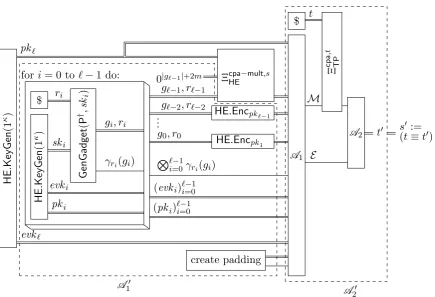
Figure 3.1: [BJ15, Figure 1, reproduced with permission of the authors] The quantum CPA indistinguishability experiment PubKcpaA,QHE(κ). Double lines represent classical information flow, and single lines represent quantum information flow. The adversary A is split up into two separate algorithmsA1andA2, which share a working memory represented by the quantum
state in register E.
The game PubKcpaA,QHE(κ) is depicted in Figure 3.1. Informally, the challenger randomly chooses whether to encrypt some message, chosen by the adversary, or instead to encrypt the state |0ih0|. The adversary has to guess which of the two happened. This quantum indistinguishability experiment can also straightforwardly be defined for a classicalHEscheme: in this case, all wires are classical, and the functionality ΞcHEpa,r determines whether or not the chosen message is replaced by a (classical) zero. The adversary still has quantum power.
If an adversary cannot win the indistinguishability game with more than negligible advan-tage, the encryption procedure is considered to be q-IND-CPA secure:
Definition 3.4. [BJ15, Definition 3.3] A (classical or quantum) homomorphic encryption scheme S is q-IND-CPA secure if for any quantum polynomial-time adversary A = (A1,A2)
there exists a negligible function η such that:
Pr[PubKcpaA,S(κ) = 1]≤ 1
2+η(κ).
Analogously to PubKcpaA,S(κ), in the game PubKcpaA,S−mult(κ), the adversary can give multiple messages to the challenger, which are either all encrypted, or all replaced by zeros. Broadbent and Jeffery [BJ15] show that these notions of security are equivalent.
3.4
QHE for Clifford circuits
3.4. QHE FOR CLIFFORD CIRCUITS
but in [BJ15] it was first written down and proven q-IND-CPA secure. Because our scheme
TPwill be defined as an extension of this scheme, we give an informal overview here. A more formal definition can be found in [BJ15], or extracted as a special case ofTP (see Chapter 5) for zero T gates.
The Clifford scheme (CL) is built upon some classical FHE scheme HE. A message qubit is encrypted with a quantum one-time pad (see Section 2.2.1), and the classical keys to this pad are sent along as classical information, encrypted usingHE.Enc. Arbitrary Clifford circuits can now be evaluated gate-by-gate by applying each gate to the encrypted quantum state and, using the commutation rules for the Clifford group with the Pauli group, update the keys via homomorphic evaluation. For example, to evaluate a phase gate P on the (encrypted) state
XaZb|ψi, perform the gate to get the resulting state
PXaZb|ψi=XaZa⊕bP|ψi,
which is an encryption of P|ψi, but with different keys. The evaluator can use HE.Eval to (homomorphically) compute encryptions of these new keys a and a⊕b from the encryptions of a and b. For the update rules for all nontrivial Clifford gates, see Appendix A.1. After all gates have been evaluated, decryption is performed by first decrypting the (updated) keys to the quantum one-time pad, and then removing this pad from the output state.
The evaluation procedure ofCL works perfectly for all Clifford gates, because these gates commute with the Pauli group. The CL scheme can be regarded as analogous to additively homomorphic encryption schemes in the classical setting. The challenge, like multiplication in the classical case, is to perform non-Clifford gates such as the T gate. If we try to evaluate a
T gate in this way on a stateXaZb|ψi, we end up with the state
TXaZb|ψi=PaXaZbT|ψi
which is not a quantum one-time pad encryption of T|ψi. After the application of the T
gate, an error Pa has appeared on the encrypted state. If a is known, this error can easily be corrected by applying P† whenever a= 1. However, the evaluating party only has access to some encrypted version ea of the key a, and hence is not able to decide whether or not to apply a correction. The value of a is also not known in advance to the key generating party or encrypting party (because it depends on which quantum operations have been evaluated on the input state so far), and so it cannot be supplied to the evaluator in an encrypted form.
3.4. QHE FOR CLIFFORD CIRCUITS
![Figure 3.1: [BJ15, Figure 1, reproduced with permission of the authors] The quantum CPAindistinguishability experiment PubKcpaA ,QHE(κ)](https://thumb-us.123doks.com/thumbv2/123dok_us/8383456.321205/31.595.114.451.282.346/figure-figure-reproduced-permission-authors-cpaindistinguishability-experiment-pubkcpaa.webp)