Technical
measures
of dust prevention
and suppression
•
•
1n m1nes
Synthesis Report
on Research carried out within the framework of the Second Programme
1964- 1970
ON RESEARCH CARRIED OUT WITHIN THE FRAMEWORK
o.
I.~.; ~-,. 7.J
3
COMMISSION OF THE EUROPEAN COMMUNITIESI ,
~echnical
measures
-::/
of dust prevention
and suppression
in
mine~
Synthesis Report
on Research carried out within the framework of the Second Programme 1964- 1970
·-:/
Directorate General for Social Affairs
Edited by the Directorate General for "Dissemination of Information"
Centre for Information and Documentation - CID Luxemburg, 1972 ~
~ EUR 4851 d,f,i,n,!-~~
1.
1.1 1.1.1 1.1.2
1.2
1.2.1 1.2.1.1
1.2.1.3
1.2.1.5 1.2.2
DUST SUPPRESSION General research
Effectiveness of water in dust suppression Use of additives to water to improve wet dust suppression
Development and use of dedusters
Development of suspended-particle filters Dust suppression in the face
Coal face infusion General investigations
Infusion methods from the face Longwall infusion
Advance remote infusion
5 5
6
8
11
14
15
15
16
20
21
23 Investigations with additives to the infusion water 25
Infusion shotfiring 26
Dust suppression on winning equipment and machines 31 Dust suppression in plough workings 31 Dust suppression with drum-shearers 33 Additional dust suppression measures in the face 37
Caving 37
Pneumatic storing 39
Roadheading using shotfiring 44
Dust suppression with mechanised roadheading 48
Dust suppression during transport 54
Dedusting at face-roadway junctions and loading
points 54
1.3.2.2 Use of evaporation-retardants in winning and other
operations 54
Removal of dust sediments in roadways 56
Other aspects of dust suppression during transport 60
2. INVESTIGATIONS TO ASSESS DUSTINESS 63
2.1 ~operties of dust 64
2.1.1 Light scatter measurement of dust particles 64
2 .1.2 Semi-conductor properties 69
2.1.3 Behaviour of dust in mine ventilation systems 72
2.2 Development of devices and methods for dust
measurement 77
2.2.1 Sampler to determine concentrations 77
2.2.2 Instruments to establish size consist 79
2.2.3 Methods of determining types of minerals 83
Results of dust research 85
Comparative measurements using different measuring
devices 85
Identification of minerals and size distribution 87
RESEARCH INTO PNEUMOCONIOSIS
{pneumoconiosis and environmental factors) 90
Methods and historical evolution 90
Results of epidemiological research 94
3.2.1 Etfect of dust exposure 94
3.2.2 Effect of other factors 99
1. DUST SUPPRESSION
Research in the field of technical measures of dust prevention and suppression in mining have gained increasing
importance over the past years+). This resulted from the incre~se in the concentration of workings and output in mining and also from the introduction of new methods and machines generating extensive dust. In order to be able to suppress the anticipated dust generation in the future and, going beyond this, to reduce the incidence of dust in workings, ·the known methods of combating dust must be made more effective and be adapted to changing mining techniques. In addition, new methods of combating dust have to be developed especially in relation to such machines and methods ·for which the traditional methods do not suffice so as to ensure permissible dust condi-tions in workings. This applies for example to road-heading machines.
1.1 General research
This heading covers those resea~ch projects whose results have a general application and may therefore be used with almost all underground techniques.
Some of this research was concerned with further improving the effectiveness of water to precipitate sus-pended dust using finely diffused water drops a~d by in-creasing the water content of dust in loosened or con-veyed product to facilitate its oinding~ The purpose of this was to ensure a minimal amount of suspended dust being generated during winning and conveying the product and thus entering the airstream or being stirred up by it.
The effect of water in dust suppression is to be im-proved by wetting agents or other additives. Should it prove impossible to achieve satisfactory improvements even with these additional methods, the suspended dust will have to be aspirated and precipitated in dedusters. This applies particularly to roadheading machines. It is with this
ob-ject in view that extensive research and development was undertaken.
1.1.1 Effectiveness of water in dust suppression
A certain quantity of water, with adequate time to become effective, is needed for a satisfactory wetting of the product in order to prevent the generation and stirring of dust. Both these factors depend on the properties of the water and the type and size distribution of the pro-duct. E~rlier research of the Steinkohlenbergbauverein, Essen,+; into dust generation with pneumatic stowing has
shown that water contents of betv1een 4 and 6% of weight of the stowed product suffice to largely prevent the stir-ring up of dust, even given high relative velocities as between particles of product and blown air, such as occur in the stowing pipe. Pre-condition for this, however, is the thorough wetting of the product.
A good deal less promising was the precipitation of suspended dust in the air stream, judging by the results of theoretical and practical research into water drops. The effectiveness of the flat-jet sprays often used for this purpose has been investigated by the Steinkohlen-bergbauverein, Essen, in a series of tests by the HOAG Bergbau (now Bergbau AG Oberhausen), (Research project
6251-13/1/002); this was done for relatively fine stone dust ( 40% weight
<:
3 ..Urn) which can occur in shot firing, pneumatic stowing and occasionally.with cutting winningoperations.
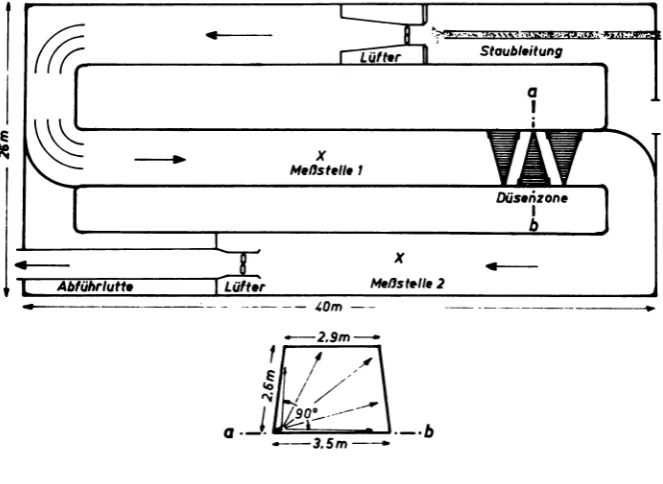
Figure 1 shows the test procedure in diagrammatic form. The cross-section of the dust tunnel is
7.5
m2• Shale-dust - according to DIN 70 (German Standard) - was blown out in front of the fan through a dust feeder pipe, creating an average air stream velocity of up to 0.6 m/s in the tunnel. Sets of 2, 3 or 4 flat-jet sprays of tne Lechler Company, Stuttgart, were inset into the road in ~~ch a way that the water drops reached every part of the tunnels' cross-section, but without acting against one another. Measuring devices were placed 12 m in front of and 24 m behind the jet area; these were tyndalloscopes and BAT 1 fine dust filters. The tests provided the following results of value to practical methods:- The degree of effectiveness of dust precipiation de-creases sharply with the reduction in the diameter of dust particles. It is, for example, reduced with an average air stream velocity of 0.6 m/s from 85% for particles of 5~m to 20% for particles of l}Um diameter size with a water flow pressure of 18.5 kp/cm2 in 2 flat-jet sprays with drill hole diameters of 4 mm.
- In order to obtain a satisfactory effect in dust preci-pitation it is necessary to ensure a flow pressure of at least 10 kp · cm2 , but preferably of 20 kp. /cm2 •
By adding wetting agents to the jet water the effective-ness in bringing down the fine suspended dust is improved by very lit~le. Wetting agents therefore, appear to be of little practical value in these conditions.
Due to the very high specific water consumption needed to obtain a satisfactory degree of effectiveness this spraying method should only be used in very limited spaces, viz: at the point where suspended dust enters the air stream with shearer drums.
The effectiveness of water drops to bring down suspended dust can only be incre~sed by a very large increase in the relative velocities between water drops and dust particles. This occurs, for exa~ple, with dedusters working on the Venturi principle. With these, relative velocities of about 100 m/s are encountered.
1.1.2 Use of additives to water to improve wet dust suppression
A large number of agents may be added to water with the object of possible improve~ent in the dust conditions.
These agents can be classified into
4
groups depending on their physical properties and modus operandi:Wetting agents achieving quicker and ~ore effective wet-ting of the dust by reducing the surface tension as com-pared with normal '.Vater. Important fields of application are, for example, the spraying of loosened product with drum shearers, drilling with water flushing and coalface infusion.
Agents which reduce the evaporation rate of the water. Water used in dust suppression evaporates easily when the sprayed product is markedly warmer that the sur-rounding air. The consequent increase in moisture of the ventilation air can lead to adverse climatic conditions in warm pits.
- Agents which markedly increase the viscosity of the water. These can be used with coalface infusion in order to facilitate winning in seams which are firm and not much loosened by fissures. This also means that less dust is-produced.
There is a large number of wetting agents and floc-culants which are largely used in the soap and detergents industry. They can be subdivided into anion-active,
cation-active and non-ionic substances.
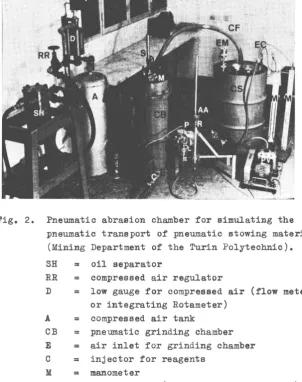
Many of these substances have been tested by the Clinica del Lavoro, Milan, and the Turin Polytechnic for their suitability for use in drilling with water flushing and for pneumatic stowing (Research project 6251-25/4/021). For this purpose two models were used, a flotation cell and an abrasion chamber (Fig. 2),tn-which it was possible to reproduce the dust binding processes for the above mentioned fields of application. If one co~pares the re-sults of the laboratory tests with the operating tests mentioned below,+) no satisfactory agreement among the results can be found. The differences are probably due in part to the measuring conditions in an operating test being a good deal less clear than with a laboratory test, while on the other hand, the influence of important factors cannot be adequately allowed for in a laboratory test. These incluJe the type of SLITiace of the product
being treated, the properties of the water used, the ac-curacy of dosage of the wetting agents and finally the time the water takes to become effective when treating the product.
Nevertheless, the laboratory tests did enable those of the many available substances which held out any prospect of success to be identified. They also helped to establish the optimal percentages in which to add these substances for the operating test. For most substan-ces this lies between 0.01 and O.l%~occasionally very slightly above this. This information is important in establishing the likely cost of the use of wetting agentso
From the results of the tests known to date with additives, including those whose results were negative -and these have often not been published - the following conclusions can be drawn for future work:
In investigating the interaction between the surface properties of solids and the specific properties of the additives in watery solution it should be noted that water often has natural additives. These are either in the water in the natural way or they are separated out of the treated product during use. This applies, for example, to salts from coal and the surrounding rock in seams in the Ruhr coalfield.
-From the results of this basic research a number of models may be developed for the experimental establish-ment of the suitability of additives for certain methods of dust suppression.
- The development of simple and reliable feed regulators for the additives is needed for carrying out operating tests in underground workings.
have to be investigated. They may be directly inhaled with the sprayed water and suspended dust or they may reach the lungs from the suspended dust generated by winning as is the case, for example, after coalface infusion where wetting agents have been used. These substances may have neutral, impairing or helpful ef-fects in view of the changes in the dust-affected lung when combining with the inhaled dust.
1.1.3 Development and use of dedusters
In many underground workings it is becoming more and more important to aspirate the dusty air stream and to precipitate the dust so as to ensure acceptable dust conditions in the workings. Requirements for such dedusters are, in addition to satisfactory dedusting, primarily: appropriate size, low maintenance and unquestionably safe operation.
The known types of dedusters are divided according to their separating principle into four groups, electrically separating dedusters, gravity dedusters, filtering de-dusters and wet dedus~ers; of these the electrically se-parating dedusters of standard design and operation have only a limited scope of application in mining operations. The method described in Section 1.1.4, as yet only exa~~ned in the laboratory, does offer the prospect of such electri-cal dedusters being used undergrolmd as well. The most usual form of gravity-ope:ated ded.usters is the cyclone, although its dedusting effect within the range of fine dusts is very limited. It is~ therefore, li~ited in its use to precipitating coarse dust, by being used as prelim-nary deduster fo~ filter de~usters. One ~pplicatiou of this kind is the removal of sedimentud dust +}. On account +) BAUSR H. D.: Da,relopment and use of equipment to aspirate
of the low effectiveness in the fine dust range the rotary current deduster, a high-performance gravity deduster, has also not so far found wider application in underground workings.
At fixed dust sources, such as in the shaft area, at loading points and crushers, where there is usually suffi-cient space, filter dedusters are used successfully. These dedusters have high degrees of effectiveness in the fine dust range, are reliable and need little maintenance~ However, the loading out of dry dust is sometimes a
problem.
The designed size follow from the small specific filter surface involved, which should not exceed 2 m3 per m2 of filter surface per minute with fine dust, and from the cleansing operation of the filters, which re-quires an enlargement of the filter surface.
When using filter dedusters to precipitate dusts liable to fire and explosion, such as coal dust, exten-sive safety precuations are necessary. These apply to measures to monitor the temperature and to extinguish in the event of fireo
For dedusting in cramped space conditions and with fine dust concentrations wet-operating dedusters have
come into general use. In these the dust particles are brought into contact with water drops at air stream ve-locities of between 50 and 100 m/s. The resultant sus-pension medium is separated in an installed drip or medi~ separator using gravity forces.
is achieved. The drop spectrum and the location and type of water feed into the crude gas stream are of gr·eat importance; sometimes the use of air-water jets can be of advantage.
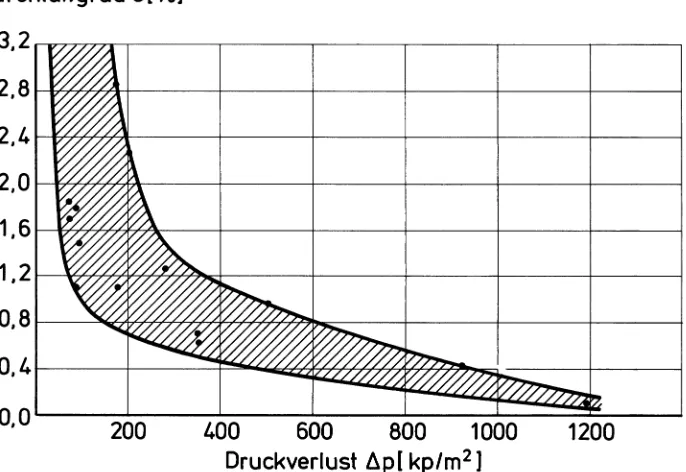
Test rig trials at the Steinkohlenbergbauverein, Essen, (Research project 6251-24/1/004) have shown that, as seen in Figure 3, there is a clear in~erdependence between the separating performance and the energy expended with this type of wet dedusters
+).
In this way it is possible, by increasing the stream velocity, to reduce the designed size of the deduster.The amount of air that has to be aspirated under-ground is usually between 100 and 400 m3/min. The amount of water needed for this is between 30 and 200 1/min and can in most cases not simply be fed from the deduster at the point of use. For this reason extensive research has been done to create a recirculation system at the
deduster. In the present state of this work the water produced in the medium separator is caught in container and pumped either directly to the jets or to a main water tank. In the latter case the medium is drained off by another pump and sprayed into the contact zone. To avoid the sedimentation of solids in the main water tank, continuous strong turbulence has to be produced in the liquid. This is achieved by the appropriate laying of the recirculation pipes.
+) Becker H., Breuer H. and Engels LoH.: Wet dedusters. Development, test rig trials, operating experience. In: Results of investigations in the field of dust suppres-sion and combatting silicosis in coalmining. (Silicosis Report: North Rhine-Westphalia). Volo?., Detmold,
The solid matter in the medium, which has been se-parated in the deduster, is drained out of the system either by pumping away a certain quantity of the medium or
through a "hydro-cyclone". The feed-in of fresh water is
done by automatic float valves. This completes the water recirculation system; but as various underground operations have shown, it still requires a lot of maintenance and is too costly. Simpler methods should be sought. Instead of the water recirculation system a water throughput method is used and the medium drained directly out of the system through pipelineso
1.1.4 Development of suspended-particle filters
The Silicosis Research Institute, Bochum (Research project 6251-24/1/075), has developed a fine dust filter in which the dust is separated in an electrical field which is inhomogeneouso +) It is built up between layers of wire mesh which are covered with a synthetic material as an insulator. The direction of the field is changed by reversing the polarity at 30 second intervals.
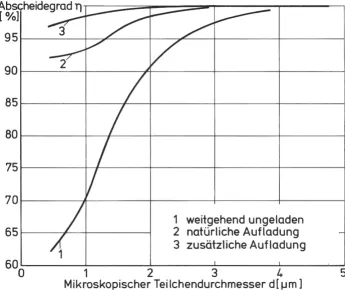
With a laboratory filter a separation of 92% was achieved with an initial flow velocity of 10 cm/s for coal dust particles of l.um size diameter. The degree of separation depends on the electric charge of the dust particles. According to Figure 4 even particles with small charges are still separated up to 7~'o under the above-mentioned conditions.
+) Walkenhorst,
w.:
Considerations and investigations regarding the filtration of dusty gases with special reference to electrical forces.The use of this method in workings liable to firedamp requires special safety precautions. According to· the regulations on intrinsically safe electrical installations in the Federal Republic, the electrical energy stored in a condenser may not be greater than
2.e•lo-4
Wzo The pro-posed arrangement is a condenser of 600·v,
which therefore has a maximum capacity of 1~56~10-9 F; its resistance at the above voltage has to be at ·least4:lo·
5S1.
The intention is to use this type of de-dusting in dust masks, for clearing spaces by filtration and certain tasks underground.
1.2 Dust suppression in the face
Research to improve dust suppression measures in the face have included the further development of coal face infusion, improvement in the effectiveness of pulsed-infu-sion shotfiring, methods of dust supprespulsed-infu-sion with winning equipment and machines in workings using stripping and cutting coal winning and dust suppression when stowing.
1.2.1 Coal face infusion
In seam infusion the objective was to perfect existing methods +) and to develop new techniques and to carry for-ward the development of equipment for coal face infusion which would be better suited to new requirements. Research involved infusion from the face or from roadways or from roadways parallel to the working· (advance remote infusion).
In particular, research was done to determine the differing effectiveness and techniques as between continu-ous and discontinucontinu-ous infusion.
Laboratory and subsequent practical tests in mines have improved the knowledge of the effectiveness of certa~
additives to the infusion water such as wetting agents and salts. Similar tests were carried out using "tracers" to determine the waters flow direction and distribution in the seam.
Basic questions relating to the behaviour of water in the coalface during discontinuous infusion were resolved with the aid of a mathematical model which embodied all the findings of practical tests. Since the results of infusion depend on the operating parameters and given geological conditions, research was ·carried out into the effects of compressive stress on the coalface and·~-ii\tc>the sU!tiioility of infusion of seams with water-bearing surrounding rocx and high gas emission.
1.2.1.1 General investigations
Investigations of the Facu1 te Polytec:b..nique, I.'Ions, .(Research project 6251-/11-2-026)+), have made a valuable contribution to the study of the swelling of surrounding rock. The research programme included petrographic investi-gations of thin sections of rock, of the phyllitic matrix (ground matrix consisting of silicas) by means of diffe-rential thermal analysis and X-ray diffraction analysis.
The different physical properties of rocks v1ere studied: moisture absorption with the aid of angle of contact
measurement, the specific internal surface according to the nitrogen adsorption method (B.E.T. method) and micro-porosity an~ fissuration by mercury porosimetry. The per-+) F. Robaszinski: (Recherches sur la protection des epontes
meability of samples, in the form of drill cores of 22 mm in
diameter and at least 20 mm in length, was measured by a specially constructed 11permeameter11 designed for pressures up to 200 Kg/cm2• Lastly, the compressive strength of rocks was determined on the Schreiner method (Amsler apparatus) based on the breaking load obtained on penetration by a rod of 5 mm2 area.
To establish the chemical properties of rock, the ex-change capacity of cations was measured using the ammonium acetate saturation method, the amount of retained ammonium being determined by the Kjelldal micro-distiller. Certain shales were also examined by infra-red rays.
These studies have shown that the swelling of rocks under water impact is at its maximum when the quartz content is minimal and when the rock consists of open illite or is interstratified with layers of high china-clay content (20 to
50%).
Swelling also occurs when the exchange between cations and the internal surface is high (8 to 10m2/g). Swelling and lift can also be expected when pores admitting water have a diameter of several microns.The use of water-repellant additives, and those de-rived from the amino group, to infusion water has been con-sidered as a possible way of reducing the swelling of sur-rounding rock. Phenomena superficially resembling lift are, however, produced by pressures caused by winning. These can largely be reduced by improving infusion and by judi-cious technical measures in winning and support.
A Steinkohlenbergbauverein research project (6251-11-1-007) vras devoted to infusion methods in very gassy coal.
It showed that the effect of infusion on normal methane emissiun is hardly measurable, bearing in minu that 90~·~ of methane is linked to the coal by aJsorption.
but also on the types of winning; they can be markedly grea-ter than the quantity of methane expelled from the coal
pores following infusion.
According to certain findings of the Institut
d'Hygiene des Mines de Hasselt (Research project 6251-11-2-032), there may be a relation between the c~oride con-tent of coal and its permeability, the latter controlling the emission of methane from the free pore area or its "trapping" in the seam.
The Institut d'Hygiene des Mines, in collaboration with the Institut National des Industries Extractives of Liege, is engaged in a study on this subject: "advance remote infusion in the seam and its effect on the behaviour of methane".
In the first experimental working the methane desorp-tion indices (V1 indices), measured over two months prior to the treatment of the panel and during six months fol-lowing the start of advance remote infusion, have changed from 0.50 to 0.25 cm3 /lOg on average. Advance remote infu-sion, therefore, slows down methane desorption during winning operationso
When water is injected into very gassy seams it is found that infusion pressure is constant most of the time, occasionally increasing. Since methane expansion is pos-sible after infusion is completed, special safety measures shov~d be taken to prevent accidents and the flow back of water from the seam.
A sphere of research important for successful infusion is the distribution of water in the seam, as is also the study of binding between water and coal. Here, both
The distribution of water in the seam was investigated
by means of moisture tests on coal samples taken from the seam (drillings or channel samples) or on conveyors in the face. In the latter case the size consist is usually 0-10 mm.
Results derived from drillings in the seam are often not sig-nificant, because the amount of water which enters the bore-hole is disproportionately high due to the methane pressure variation's in the borehole. This feat-lire_hail_:trequentiy_· been noted during the study of other problems, particularly in measurement of methane contents in coal.
In a s~udy of the Silikose-Forschungsinstitut at Bochum (Research project 6251-11-1-074) it was found that there is a relation between pressures in the overlying strata and the coals susceptibility to drilling and infusion.
The slow-down in drilling speed resulting from the depth of the borehole does not only depend on "increasing coal resistance". To an important extent it is caused by the increasing weight of the drill-rods and the increasing distance the drillings have to travel.
In the trials done from the face, using a carriage-mounted drilling machine, a considerably greater reduction in drilling speed was noted in the middle part of the face than in the top or bottom third. This is probably due to
the fact that here roof pressure and abutment pressure induce greater fissuration of the coal.
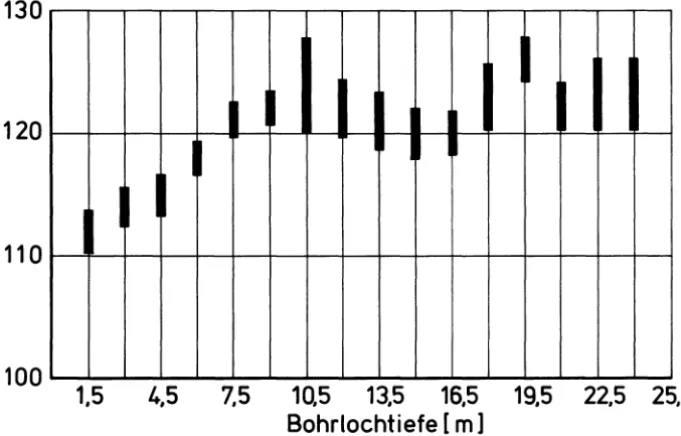
Recorded drilling ti:nes in the same borehole are r::a.xi-mum ones; Figure 6 shows two maxir::a.xi-mum times at depths of 10.5 m and 19.5 m.
This feature of sea~ stre3c during drilling is not al-ways folmd so clearly when infusion presBure is measured. Certain findings of the Institut d'Hygi€me des ~.:ines
In all infusion tests special attention was focussed
on damage to surrounding rock. It was found that high infusion pressures - which sometimes prove necessary when infusion with high water throughput has to be done due to lack of time - are a disadvantage, and for this reason alone further work should be done on continuous infusion methods.
1.2.1.2 Infusion methods from the face
Infusion techni~ues from the face are grouped in the Federal German Republic into shallow infusion, deep-hole infusion and remote infusion. In both France and Belgium they are defined as infusion in the zone of macro-fissura-tion or infusion in the zone of micro-fissuramacro-fissura-tion.
With infusion at small or medium depths (zone of macro-fissuration) water is injected under pressure through bore-holes perpendicular to the face and regularly spaced along
~be entire length of the face. With remote infusion (beyond the zone of macro-fissuration) two boreholes a day at the most are infused, whose length is at least that of a weeks' rate of advance in winning. The main difficulty lies in drilling in coal, across zones of considerable stress, creating great and sometimes insurmountable dif-ficulties in faces with rapid advance.
Research carried out in Belgium (Research Project 6251-11-2-030) and in the Federal German Republic (Research projects 6251-11-1-45 and 6251-11-1-007) have shown the effectiveness of this tecP~ique and led to an improvement in drilling and re~ote infusion equipment.
project 6251-11-3-066) aimed at replacing this
discon-tinuous method by a low pressure infusion method •. To this end two different techniques were used: one called the "multi-probe", the other, permanent infusion.
Multi-probe infusion has been used since 1966 in the Nord and Pas-ce-Calais coalfield; several probes are con-nected at one time to the same infusion pump and infusion takes place during several consecutive stiifts. Ylater flow as between all the holes is kept approximately equal by inserting a flow-reducer into each probe (this may be a membrane); infused waterflow is generally between 5 and 10 1/min.
With permanent infusion, a method being studied since 1967, the infusion holes, from 12 to 15m deep, are con-nected to the face water supply. Infusion is under low pressure - 1 1/m approximately for each hole. Applied ini-tially to faces being worked by pneumatic picks, this technique is equally suited to plough faces if the holes can be drilled high to clear the ploughs actiono It is, however, scarcely applicable to drum shearer faces.
Further development in infusion equipment has concen-trated on the improvement of electric pumps (Research project 6251-11-1-007), essential to effective infusion from the face in mechanised faces. For remote infusion new drilling equipment (Research project 6251-11-1-074) and feed regulators for inflision with additives (Research project 6251-11-1-077) have been·improved.
1.2.1.3 Infusion rarallel to the face
opportunity of infusing as from the two gate roads; the Z-face, with at least one road driven before the exploi-tation of the panel begins, is also suitable for infusion by holes drilled parallel to the face+). Infusion from gateroads presents an enormous advantage compared with conventional infusion from the face: it in no ways impedes work in the face and can be carried out during winning shifts.
Studies into its suitability and effectiveness have been carried out in different geological conditions ~~d differing types of exploitation by the following bodies: Stofinstituut van de Gezamenlijke Steenkolenmijnen,
Lim-burg (Research Project 6251-11-6-058); l'Institut d'Hygiene des Mines de Hasselt (Research Project 6251-11-2-030);
CERCHAR (Research projects 6251-11-3-062 and 6251-11-3-066); Steinkohlenbergbauverein (Research project 6251-11-1-JO?).
The dust-binding effect ~rovided by this method is particularll( good--and--consistent :-The-infused-water is- · introduced into the coalface at a continuous rate and is usually only halted at weekends. Since the flow of in-fused water is considerably less (2 to 8 1/~n per hole) than in discontinuous infusion from the face, the stresses created in the seam and surrounding rock are considerably reducedo
The drilling of infusion holes - at intervals of 15 to 60 m, 15 to 80 m deep, is generally effected by carriage -mounted drilling machines equipped with banded bits
ensuring good flushing of fine drillings by ·water or compressed air. The sealing of the probe - soMetimes a simple plastice hose - is effected by cementing the hole.
+)Becker H.: Silicosis Re~ort- North Rhine-~estphnlia
Depending on the inclination of the hole or the methane content of the seam, special cement mixtures and cementing devices have to be used.
Infusion by a hole parallel to the face may continue for several weeks with interruptions during weekends. This is why the sealing of the probe is very important, all the more so because stoppages may also result from winning requirements. Tests have shown that in such conditions inflatable probes (which have become general· for infusion at right angles to the face) are not
re-commended and are virtually impossible to re-use several times since their recovery is very difficult.
During a first stage infusion is effected by com-pressed air pumps; the flow is regulated by simple, hand-operated valves. Since a large quantity of water (up to 200 m3) is injected, the operation has to be closely monitored by regular measurements of pressure and flow. In France infusion is also practised with low pressures by connecting the probes to the mine water supply.
Pressure is about 10 to 20 bars which produces a through-put of about 1 1/rnin. To achieve the best results with this method infusion must be started long before the passage of the face (one to three months), but the water is better distributed in the coal if infusion is carried out under high pressure over a short period.
1.2.1.4 Advance remote infusion
Very extensive study and research into the
infusion has been carried out in Belgium+)CResearch pro-ject 6251-11-2-032). This method has also been tested in the German Federal Republic by the Steinkohlenbergbau-verein (Research project 6251-11-1-007) and in the Nether-lands by the Stofinstituut at Heerlen (Research project 6251-11-6-057). Compared with all other techniques advance remote infusion has the advantage of being completely in-dependent of winning cycles, enabling a panel to be treated before winning is begun and all benches making it up to be reached, provided it is correctly carried out. Its ap-plication does presuppose a regular stratification without
serious geological faults (at least in the panel to be treated). The studies have also shown that in certain cir-cumstances this method of dust suppression is very effective and that the opportunity of applying it depends largely on good drilling and keeping the holes well sealed, as should also be done with infusion parallel to the face. r~onitoring of the pumping installations is vital since they may be located in rarely visited sites. For this reason it is essential to use infusion pumps requiring little maintenance and equipped with special lubricating devices. In the Belgian tests, in addition to infusion holes (or adduction holes) outlet holes (or relaxation holes) were frequently drilled to ensure one flow direc-tion for the water and to protect the roadway running above the seam.
+) Lavallee, H.: Assessment of certain features of deep deposits using advance remote infusion in seams of water absorbent coal. Annales des Mines de Belgique, 1969, 11, pp. 1173-1263.
Degueldre G. and Lavallee H.: Deep infusion in zones of microfissuration. Advance remote infusion or infusion of a panel prior to winning.
Interesting variants of the normal advance remote in-fusion have been tried, particularly where, for reasons imposed by winning requirements, the roadways from which the holes were executed had to be dismantled or equipment withdrawn, which involved the moving back of the pumping station to another site. Another procedure consisted of drilling "ballistic holes" from the gateroads, i.e. dril-ling holes in the roof of the seam which would
intentiona-ly be diverted to reach the seam at certain fixed points (this latter variant, it has to be admitted, is not compa-tible with the rapid advances of mechanised faces).
1.2.1.5 Investigations with additives to the infusion water
Due to more rapid daily advances (winning and loading out ever larger tonnages and the consequent introduction of ever more powerful machines) it has become necessary to try to increase the effectiveness of infusion by adding to the water certain substances to form a solution which would have better wetting and poorer evaporation
proper-ties.+)
The basic characteristics of these additives have al-ready been examined (Section 1.1.2). The "quality" of the water therefore has a special importance particularly since mine water often contains salts in solution (for example, chlorides), the proportion of which modifies the wetting properties and the tendency oft he water to eva-porate. For this reason, when the effectiveness of addi-tives is being studied, it is essential to control the co~position of the solutions used. Bearing in mind the difficulties already mentioned in Section 1.1.2 of feed of additives, it is also necessary to maintain systematic
+) Bauer H. D.: Infusion with calcium chloride additives. Bergfreiheit 35 (197o) 2 • pp. 26-33.
and regular dust measurements to recognise properly the fluctuations due to infusion conditions.
Two long series of measurements have been carried out in the German Federal Republic with a view to com-paring exactly the dust conditions with or without addi-tion o~ Oa 012 with infusion parallel to the face (Research project
-6251-ll.;.l;.077r;---The use of evaporation-inhibitors - in the form o~ Oa 012 solutions - tends to improve the air and assist dust suppression in faces with large outputs where the deterioration of climatic conditions and dust production are mainly due to the transport of the product won. In order to achieve a noticeable improvement in the climate, solutions of over 10% Ca 012 have to be used.
The Institut d'Hygiene des Mines (Research project 6251-22-2-034/001) found that by infusing solutions of about 10% Ca Cl 2 from ·tiia face and achieving "humidifica-tion" of the coal between 5 to 20% lower than that ob··-tained with water alone, dust suppression improved by 1~ at least. In the same face with an output of 80 tonnes per hour, increases in absolute humidity and air enthalpy were reduced to such an extent that the practical effect
achiev-ed was-comparable to that of a refrigeration plan opera-ting at 125,000 units per hour in a 100 m long face.
In the German Federal Republic, "Relatin" and the experimental product L 9001 of the firm Henkel were used as highly viscous and structurally strong infusion liquids in order to build up higher infusion pressures. It was possible to demonstrate the basic suitability of infusion with highly viscous liquids; the development of equipment, particularly the blender, is not yet completed (Research project 6251-11-1-007).
1.2.2 Infusion shotfiring
shot-firing in coal and rock+). When a shot is fired the deto-nation pressure is normally propagated directly through the wall of the borehole and the gas pressure used to loosen the material. In infusion shotfiring the pressure can be better transmitted by the infused water. To keep the empty spaces in the coal in the vicinity of the bore-hole constantly filled, the coalface is infused and the
shot fired during infusion. The technique is thus a com-bination of infusion at low pressure with shotfiring.
In difficult working conditions effectiveness needs to be increased by prior high-pressure infusion to cre-ate the wide wcre-ater distribution required for shotfiring. This was demonstrated in tests of the Steinkohlenbergbau-verein, Essen (Research project 6251/13/1/009) in seams of high-volatile coal and a gas coal seam.
Compared with standard shotfiring infusion shotfiring has a number of advantages:
- dust production in shotfiring is effectively reduced;
- resulting from the different course of the gas pressure phase due- ~o cooling of the explosion gases, the coal remains loosened and standing or it falls only into the conveyor track;
- the reduced shotfiring fumes produced make the method usable even while coal winning is in progress.
With infusion shotfiring a special explosive has to be used which is waterproof and can be detonated under wat~r pressure. For example, the explosive permitted for this method in the German Federal Republic must be detona-ted_when completly immersed in water, since otherwise
ignition of CH
4
mixtures might occur. To check on this immersion in water at the moment of firing the Steinkohlenbergbauverein, Essen (Research project 6251-13/1/ 009) tested various methods. Pirst, the fact that a measurable water pressure exists in the zone of the bore-hole to be charged suggested that water immersion could be checked by means of a pressure gauge, but the water pressure in the borehole proved to be so variable that this method is not satisfactory. Other developments used float switches. This system failed where borehole incli-nations and water pressures varied. Then the difference in electrical resistance between air and water were used to monitor the water content of the borehole. This system itself proved suitable but due to basic objections the Mining Inspectorate& permission was not given.
At present the water pressure in front of the bore-hole and the water flow in the feed to each borebore-hole are established during and after firing the shot using a flow indicator. In a new technique water immersion of the explosive is ensured by sheathing it in a type water-containing ampoule. This technique has not yet been applied in the ECSC.
Studies by the Steinkohlenbergbauverein, Essen (Research project 6251-13/1/009) have shown that infusion shotfiring can be successfully employed to overcome
starting up in mechanised faces and in plough faces with hard coal or not easily ploughable rock inclusions, in cutting coal in stable holes of faces and in rise headings. In some cases it was also used tobreak up roof coal in faces with drum shearer-loaders to prevent hold-ups in conveying caused by unduly large pieces of coal.
after,l~£. Dust concentration in this trial was reduced by some 50%. It proved to be more economic and safer to fire shots singly rather than several simultaneously.
Application in steep and semi-steep formations re-quires a special technique involving detonator chords to make the method practicable. Such detonators are not allowed for these purposes in coalmining.in the Federal Republic.
In rock the method can only be used if there is ade-quate water distribution when infusing. Since this rarely occurs the method is of little value to-blasting in rock.
Infusion shotfiring has been widely employed in Bel-gium and France. In BelBel-gium the Institut d'Hygiene des Mines, Hasselt, went on to investigate the use of this method in seams liable to sudden gas outbursts (Research
6251-11/2/031). In the German coal industry it is used far less frequently and is now scarcely employed due to the high outlay in men and materials.
In the Research projects 6251-ll/l/007.of the Stein-kohlenbergbauverein, Essen, and 6251-11/1/045 of the Sili-koseforschungsinstitut, Bochum,the possibility of using tracers in the infusion water was studied in order to cla-rify the processes involved in coal wetting. In the investi-gation of radioactive substances, inorganic and organic dyes, salts and wetting agents in the coalface and in la-boratories it was found that apparently only salts, wetting agents and the organic dye "uranin" lend themselves to this purpose because with all other substances adsorption to coal is too great. Even with these three it has as yet proved impossible to provide quantitative indication about water distribution in the coalface.
dust. CERCHAR, Paris (Research projects 6251-il/3/066-and 6251-11/3/062) has investigated pulsed infusion+) - a method aiming to loos~n ~he coal - with room and pillar working and developed it to the point of practical appli-cation.
+) Labus, K.: Advances in coalfac~ infusion due to the high-pressure pulsed infusion method. Gltickauf 105
(1969) 17, pp. 814/19.
Documents techniques des Charbonnages de France: Infu-sion shotfiring or water-assisted shotfiring, N° 7, 1968, pp. 377-95.
Bigourd, J.: Safety of water infusion shotfiring, Docu-ments Techniques des Charbonnages de France, 1966,--N°12
Coou
J.,
Bigourd J., Giltaire M.: Shotfiring in Water. Revue de l'lndustrie Minerale, 47(1965) No 9 (Sept.) Explosives for shotfiring under water pressure. Paper _presented at the 36th International Congress ofIndus-trial chemistry (Brussels, September 1966).
Cochet B.: Shotfiring under water pressure and with rams. Doc. Techn. des Charbonnages de France (1965), N° 8, pp. 4o5-7.
loss and Verne: New methods of shotfiring under water pressure. Revue de l'Industrie rJinerale, July 1964, pp. 593-612.
Brassac Group: Shotfiring tests under water pressure in steep workings. Doc. Techn. des Charbonnages de France, N° 12 (1963), pp. 743-7.
Nord and Pas-de-Calais Coalfield: Shotfiring under water pressure in the Valenciennes group. Documents Techniques, N° 4, 1962, pp. 129-48. Explosifs, N° l, 1963,
1.2.3 Dust suppression on winl~ng equipment and machines
1.2.3.1 Dust suppression in plough workings
Spraying of the plough track will be increasingly important in the future, being an auxiliary method where-ever coalface infusion cannot be employed. In winning faces producing much dust it is sometimes. used as an addi-tional dust suppression method.
Research into~plough faces with different spraying systems, with the focus on automated spraying, has been carried out in the German Federal Republic (Research pro-ject 6251-12/1/043, Silikose-Forschungsinstitut, Bochum), the Netherlands (Research project 6251-21/6/051, Stof-instituut, Limburg) and in France (Research project 6251-12/3/064, CERCHAR, Paris).
Activation of the valves in plough track spraying was first based on the conveyors' movement to allow the plough to pass. This principle was chosen because it could be used with all plough installations except the "Gleithobel".
Some problems were created by dirty and corrosive underground water. It was also found that this type of plough track spraying could hardly be used with soft, ea-sily ploughable coal as the movement of the conveyor did not suffice to trip the spraying system.
In France, a continuous spraying method has been widely adopted using jets spaced.the length of the ar-moured flexible conveyor (CERCHAR publication n° 1734). A valve which the plough operator can operate, or an electric valve linked to the plough drive, enables spr~ing to take place only while the coal is being won.
higher pressure occuring in the pusher ram during pas-sage of the plough could be used to trip the sprays. This was discontinued because the pressure in the pusher ram is already so high that the 10 Kp/cm2 increase in pres-sure required to trip the sprays is not available.
High-pressure pumps operated by compressed air are often used to activate the pusher rams. Switches on the pumps cause strong pressure variations in the hydraulics system so that the pressure change in the pusher ram can-not be definitely attributed to the passage of the plough.
Then a spray tripp~ng device was developed, which was independent of the pressures in the pusher ram, in which tripping was mechanical. This device was also un-reliable in operation because the lever tripping arrange~ mentment became clogged, mainly by dirt.
The lever arrangement is replaced in a new develop-ment by magnetic force transmission, producing a consi-derable improvement in tripping and consequently greater reliability in the spraying system.
Some basic consideration of the effectiveness of plough track spraying is indicated to direct further de-velopment. This should establish whether ·-the-effect- of spraying is due to the wetting of the loosened coal on the conveyor or to cleansing of the air stream by dif-fused water drops. Solution of this problem will no doubt also influence the design of spraying systems and finally resolve the suitability of automated plough track spraying.
Particularly noteworthy is the research carried out in the United Kingdom to spray the plough from the plough body itself, thereby opening up a different prospect of automation.
Dust suppression with drum shearers
Research into dust suppression in winning opera-tions with drum cutter loaders had three tasks:
- improving the winning and loading process of coal to re-duce dust production,
improving the effectiveness of spraying systems,
- installation of dedusters on the winning machine.
In an experimental working the Steinkohlenbergbau-verein, Essen (Research project 6251-12/1/008) investigated the speed-of the machine, cutting width and rotation speed of the drum, nature of the coal cut and quantity of ven-tilation air as factors affecting the production of fine dust at the drum cutter
loader+~
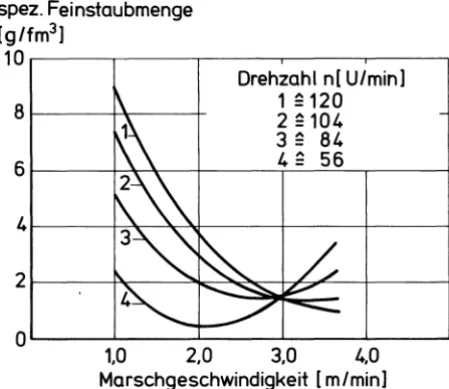
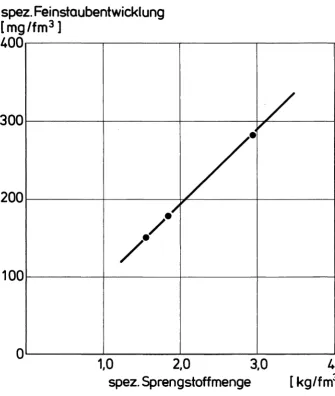
It was found that with constant machine speed but increased drum rotation speed the production of fine dust increases considerably (see Figure 7a). Reason for this is reduced depth of web and consequent greater degradation of the coal. Dust pro-duction increases when the loosened amount of coalis so large that it cannot be rapidly discharged by the drum, leading to further serious degradation.Like increasing machine speed and depth of web, in-creased cutting depth also leads to reduced fine dust production, as can be seen in Figure ?b.
Particularly difficult dust conditions occur when the surrounding rock is cut, especially in the roof. The resulting rock dust is usually very fine.
The ventilation stream in this experimental working lay between 600 and 1100 m3/:nin. With increases in ven-tilation and consequent greater venven-tilation velocity in the face, the fine dust concentration rose from 100
at 600 m3 /min to 175 at 1100 m3 /min, as can be seen in Figure 8a,curve 4. No water was, however, being used for dust suppression in the face. As the ventilation velocity increased, more and more dust was raised from the loosened product.
Other investigations in workings with ploughs and drum cutter loaders have shown that wet dust suppression (coalface infusion, spraying), reflected in the moisture content of the transported product, is of extreme impor-tance to the formation of fine dust+) (figure 8b).
With coarse dust an even better effect was obtained with a reduction in concentration of up to 95%, if the use of internal spraying had increased the initial moisture from between 2 to 3% weight to 6% with cut product of <:10 mm.
CERCHAR, Paris (research project 6251-12/3/064) developed a new external spraying device which can be directed towards points of dust production during ope-rations.
Underground tests of the Steinkohlenbergbauverein, Essen (Research project 6251-12/1/008) with this device, together with other systems of internal and external spraying, have shown that an adequate water pressure in the jets is an essential condition for effective dust suppression with drum cutter loaders.
These tests achieved a water pressure of between 15 and 20 Kp/cm2 in the jets by the use of pumps in the machines• water supply system.
Comparative tests with internal spraying with water emission through perforated picks from the body of the machine showed no significant differences in effective-ness.
In a fat coal working of the Saarbergwerke AG, Saar-brticken, the Silikoee-Forschungsinstitut, Bochum (Re-search project 6251-12/1/071), the effectiveness of wet-ting agents as additives to the sprayed water was tested on anEW 170 L drum cutter loader of Eickhoff, Bochum. Using 100 1/min water throughput containing about 091%
wetting agents the tyndallometric fine dust concentra-tion could be reduced by roughly 30~. This compared with spraying with a water throughput of 200 1/min but without wetting additives+).
Special investigations were aimed at developing de-vices to dedust drum cutter loaders.
At the start of this programme CERCHAR, Paris (Re-search project 6251-12/3/064) developed a dust filter for a drum cutter loader, type Sl6, using oil-soaked metal shavings as filtering material.
The Silikose-Forschungsinstitut, Bochum (Research pro-ject 6251-12/1/044) first tried aspiration without de-duster on such a machine in iron ore mines. These showed that an aspirated partial ventilation stream of 100 m3/min was sufficient to trap most of the dust, the ventilation velocity being below 1 m/s in the face. Dedusting was effected by a rotating current device, made up of several components, of the Rtiskamp firm, Bayreuth; this however captured too small an airstream - at 60 m3/min - and its performance was reduced by intake of coarse dust. It could be established that the "insulation" of the drum is parti-cularly important so as to limit the quantity aspirated. In order to clarify aspiration conditions with drum cutter loaders the Steinkohlenbergbauverein, Essen (Research pro-ject 6251-12/1/008) built a 1:10 scale model of a face.
In addition, a drum cutter loader, EW 170 L of Eick-hoff, was provided with an aspiration device consisting of an intake duct and a fan. This was to determine the re-quired amount to be aspirated and the number and positioning of the aspirating points (Research projects of the Silikose-Forschungsinstitut, Bochum (6251-12/1/073) and the Stein-koh1enbergbauverein, Essen (6251-12/1/008).
As part of this research extensive testing investi-gations were made of the "Rotovent" deduster o-f the firm Holter & Co., Gladbeck, various modifications giving
im-proved performance. Details are given in section 1.3.2.3. At the end of the research period an aspiration device equipped with a "rotovent" deduster for a double-drum cu-ter loader, EDW 170 L of Eickhoff, was completed and sub-mitted to testing trials.
The design of dedusting devices involved the solu-tion of special problems. The length of the device had to be kept as short as possible and any structural changes in the winning machine had to be kept to a minimum. Use of the deduster requires a following "trailer"+) which en-tails a greater length of stable hole in the face. Power supply for a dedusting system is difficult in workings with a voltage of 500, because the power required lies between 50 and 70 Kw and can thus curtail the winning capacity of the machine. Generally speaking the employment of wet dedusters with drum cutter loaders requires special mea-sures to ensure water supply and remove the resultant slurry. The release of clean air should not stir up the dust; a reduction in fan noise is also important.
Underground trials will begin at the end of 1971.
1..2.4 Additional dust suppression measures in the face
One of the results of the need for concentrated wor-kings and increased output has been multi-shift coal winning. This means a build-up in dust production in winning and filling the worked out area+>. The latter operation means high ash contents and usually also relatively high quartz contents in the fine dust.
In caving attention should be paid that the stirring up of dust is avoided when the roof coal comes down. An
important measure here is the·· spraying of the caving area. In pneumatic stowing it is important to avoid degradation and abrasion of the product in the pneumatic pipe as also stirring up dust from the stowed material in its impact on the slope. Reduced dust production is achieved chiefly b,y choice of suitable stowing material, wetting of stowing material and stowing area before pneumatic stowing begins and by improvements in the layout and operation of pneuma-tic stowing installations.
1 • 2. 4 .l Caving
The possible great influence of caving on dust levels in the face was shown in the Netherlands coal industry
(Research project 6251-21/6/051, Stofinstituut, Limburg) with the aid of dust measurements in 15 faces with pneuma-tic pick exploitation, winning and withdrawal occur1ng at different times. Although the concentration during with-drawal was on average only
50%
of the values during win-ning, the weight ratio for particles <5.J~m in the total dust was higher by about a factor of 1,4, the ash content by about 2 and the quartz content by a factor of >3 higher than with dust produced during winning.Measurements showed the need to reduce considerably the dust levels in the caving area during withdrawal by effective measures.
Development of an automatic spraying system, depen-dent for its operation on the counter-pressure of the conveyor on the pneumatic pusher rams during plough pas-sage, was abandoned once hydraulically operated pusher rams came into general use. With those the low compressi-bility of the hydraulic liquid produces no displacement or one too slight to trip the spraying system+J.
Since 1968, theref~re, a new spraying system has been developed in which the caving area is automatically and intensively sprayed during_forward movement of the frames, i.e. at a point in time and in a zone representing the major dust source. This automatic process avoids the spray-ing installations not bespray-ing started, the system bespray-ing stopped prematurely and excess water being sprayed.
The spraying installation is firmly linked to the
hy-draulic powered supports. The operating valve is connected to the high-pressure emulsion system of the supports and to the water supply. The jets are attached to its outlet.
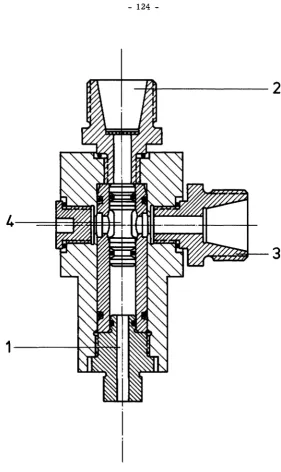
Details of the operating valve can be seen in Fig. 9. The emulsion for the support is fed through piping (1) to
the valve, the water supply is connected at {2), the feed to the jets is shown at
(3).
While the support is under pres-sure the emulsion-presses upwards against the lever {4) which presses a ball (5) into the duct for the.water sup-ply. When the support unit is moved the emulsion pressure drops causing the water pressure to press the ball down-ward thereby feeding the jets.If necessary a time-lag mechanism can be built in so that spraying can continue for a time after the support unit has been moved.
Since this system of spraying has clearly proved suc-cessful, its employment in other coalfields is recommended.
In future special attention should be given to the dust created when operating powered supports by rock fal-ling on to the lowered roof bars during advance and being crushed small when these are pressed against the roof, the resultant dust being exposed to the ventilation stream during the next lowe~ing.
1.2.4.2 Pneumatic stowing
Dust suppression during pneumatic stowing was already the subject of extensive research in the 1st Research Programme+) on a test rig of the Steinkohlenbergbauverein, Essen, and in underground workings which yielded useful indications how to reduce dust formation, during pneumatic stowing++). These helped to improve dust conditions consi-derably. The most important measures of dust suppression with pneumatic stowing may be recapitulated here in view
of the fact that some of the new research is based on these results.
+) ECSC - High Authority. Technical Measures of Dust Pre-vention and Dust Suppression in Mine~, Vol.
I.
Series on Occupational Hygiene and Medicine, Luxembourg. Publi~cations Department of the European Communities 3890/1/66/1
(I), 1966,
pp.34-36.
++) Breuer H.: Investigating the causes of dust forma~ion
The specific consumption of stowing air in Nm3 per m3 stowing material is to be kept as low as possible. This prevents the formation of suspended dust through further degradation during transport of the product in the
stowing line and when making impact on the slope of the stowing material.
- The stowing material must not be too coarse. As the up~ per size of the particles in the stowing material in-creases, stowing air consumption, dust formation and wear on the stowing line increases.
The stowing material such as sandstone, which is strong-ly dust-forming, should either not be used or onstrong-ly with less dust-forming material.
The stowing material must be sufficiently moist during transport to the stower and prior to pneumatic stowing. With an upper particle· size of 60 mm a water content of between 4 and 6% weight is sufficient.
The three latter requirements can be met by sound or-ganisation in preparing the stowing material. The most important measure is to keep the stowing air consumption as low as possible and this is difficult since it depends on frequently changing factors such as quantity and nature of the stowing material, length and condition of the pneu-matic stowing line. To ensure this, fully autopneu-matic devices to control the stowing air consunption should be used.
Part of the new research is devoted to the question whether the results obtained for stowing material in
coal-mining can be applied to other material, for example, in iron ore mining. To this end tests were carried out by the Turin Polytechnic+) on a laboratory scale with a narrow
size range of stowing material from the Toscana pyrites mines (granite, shaie, marly limestone, limestone) (Research project 6251-21/4/019) with the following fin-dings:
- Dust formation during transport of material resulting from abrasion increases as -the-average-~partiCle -si.-ze-o:t the stowing material decreases.
- The quartz content of the fine dust produced by abrasion is very different from that of the initial material, the size consist of the material used having an apparent effect on this as well. This is particularly true of shale whose quartz content in the dust is markedly higher than in the original material.
- The addition of a little water to the dry material increa-ses dust formation to a peak figure, but reduces sharply with increased watering until it reaches a value which is below that of dry material.
- The addition of tension-altering substances to the water in concentrations of 0.01 to 0.1% reduces dust formation by approximately 15 to 25%. Such a reduction has also been demonstrated in an operational test in a pyrites mine U.Sing the wetting agent "Flokal".
- Wetting agents have differing degrees of selective ef-fects on the dust binding of minerals contained in dust. It is, therefore, quite possible that a reduction of the overall fine dust concentratiun is linked to a rise in quartz content.
- The surrounding rock of Ruhr coals (argillaceous shales) used for comparison showed considerably higher dust for-mation than the stowing material from the Italian
pyrites mines.
contra-diet the results obtained in coalmining. The latter had shown that preferably small sized stowing material, whose diameter is suited to the diameter of the pneumatic
stowing line, should be used. Small sized material clearly often contains a high percentage of dust-like material, which must be well wetted to prevent it entering into sus-pension. If this is not done, dust formation is increased to a level where the degradation effect of the material during pneumatic stowing no longer affects dust formation. On the other hand the well wetted, dust-like part of the stowing material makes an important contribution to level-ling out the speed of movement of the different sized material on the pneumatic stowing pipe. The lower the rela-tive velocity of individual particles of material is
compared with the stowing air, the rarer will the collision of these particles be in the pneumatic stowing pipe, a collision which otherwise leads to degradation and dust formation.
It is worth noting here that in the Saar+) coalfield fine dust formation during pneumatic stowing has been re-duced by about the same percentage as in the above-men-tioned test in the Toscana pyrites mines by the addition of wetting agents to the spraying water.
A different approach to improving dust conditions during pneumatic stowing to complement the above-mentioned measures was made by the Silikose-Forschungsinstitut, Bochum (Research project 6251-21/1/038). The assumption was that the addition of a paste trade name "Tratex"