White Rose Research Online
[email protected]
Universities of Leeds, Sheffield and York
http://eprints.whiterose.ac.uk/
This is an author’s draft of a paper due to be published in
Education for
Information
.
White Rose Research Online URL for this paper:
Published paper
Developing reflective practice in LIS education: The
SEA-change model of reflection
Barbara Sen
∗Information School, The University of Sheffield, Regent Court, 211 Portobello St, Sheffield S1 4DP, UK
Received November 2010 Revised January 2011
This paper presents the SEA-change model of reflection. It was developed to support the growing interest in reflective practice within the library domain. The model was developed from experience gained teaching and training reflective writing to students and practitioners within librarianship. The model was tested using data gathered from the reflective journals of 22 MA Librarianship students, who submitted 116 reflective journal entries from October 2007 to May 2008. The model has three core process elements: a consideration of the situation (S); consideration of the evidence used during the practice of reflection (E); and action (A) needed as a result of what has been learnt from the reflective process. An earlier study identified significant benefits that could be gained from engaging in reflective writing, particularly in relation to student learning outcomes, self-development and empowerment. These outcomes, identified as change or the need for change are integrated into the SEA-change model. Reflection is discussed in relation to teachers or mentors applying a progressive “de-scaffolding” approach to learning support in order to facilitate student autonomy. Further validation of the model is recommended in a range of different settings. The model provides a framework for the teaching, support and guidance of reflective practice.
Keywords: Reflection, reflective writing, teaching and learning
1. Introduction
“Full fathom five thy father lies; Of his bones are coral made; Those are pearls that were his eyes:
Nothing of him that doth fade, But doth suffer a sea-change Into something rich and strange. “
From Ariel’s Song – The Tempest. William Shakespeare 1564–1616 Muir [1] refers to Ariel’s song positing that the “sea-change” metaphor reminds us that natural processes are “strange and unpredictable.” The sea-change metaphor in this paper has been applied to the natural mental process of reflection as defined by Moon [2].
∗Corresponding author: Information School, The University of Sheffield, Regent Court, 211
Porto-bello St, Sheffield S1 4DP, UK. Tel.: +44 114 222 2635; Fax: +44 114 278 0300; E-mail: b.a.sen@ sheffield.ac.uk.
“Reflection is a form of mental processing – like a form of thinking – that we use to
fulfil a purpose or to achieve some anticipated outcome. It is applied to relatively complicated or unstructured ideas for which there is not an obvious solution and is largely based on the further processing of knowledge and understanding and possibly emotions that we already possess.”
The reflection can reveal sometimes rich yet strange or bewildering emotions and unpredictable outcomes as participants learn about themselves and others they engage with as a result of the reflective process. The reflective process can be devel-oped and maintained to support continuous learning and personal and professional development [3–5].
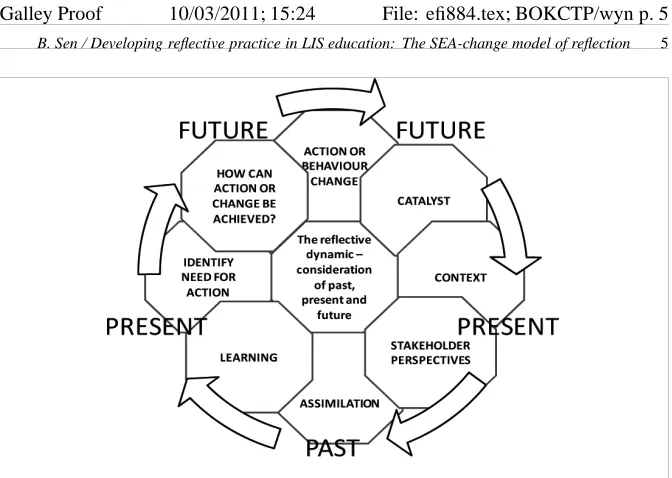
Reflection occurs as the result of a trigger that could be an event, or the influence from someone, or an action [2,6]. There are differing views and perspectives on reflection offered within the literature [2,7]. Sch ¨on [8], is considered a classic scholar on reflective practice, and distinguishes between “reflection in action” and “reflection on action”. “In action” occurs during an experience or event; “on action” looks back at a past experience or event. The idea of past, present, and future, a chronological consideration is developed by Wilson [9] with “reflecting-on-future” as a means of exploring potential, and by Ertmer and Newby [10] who state that, “reflection is critical for transforming the knowledge gained in and on action into knowledge available for action.” These views of reflection encompassing the past, present and future is what we term the reflective dynamic . This dynamism is achieved when deep level analytical reflection occurs through possible different combinations of evidence and experience from past, and present, and thoughts are projected to the implications for future behaviour and practice. Deeper learning has a relationship with reflective practice [11,12], and is more likely to occur when participants engage in what is termed as deep reflection, analytical reflection or critical reflection [13, 14]. Encouraging deep reflection in students in an educational environment requires the support of a tutor. There is a need to develop a relationship of trust as written reflections can contain sensitive and personal content. Reflective writing is a skill that is developed, so training and guidance is required as students develop their skills [2]. In the process of reflecting on our experiences as tutors, encouraging reflective practice in others, critically examining students’ reflective writing, and observing the way students learn, we developed a model to contextualise the dynamic nature of reflection and the levels of reflection. The model was then tested against student reflections gathered over a period of two taught semesters. This paper builds on a previous study which analysed student writings as part of an assignment, and identified key outcomes from reflective practice [15].
2. Context for developing the model
a written reflective diary as part of their module on the “Management of Library and Information Services.” Module evaluations received positive student comments and the exercise was developed over time as the tutors gained experience in supporting the students in their reflective tasks. In marking the writing it seemed that themes were emerging, so in the following year, ethics approval was gained to carry out analysis of the content.
A mixed methods approach was taken to this original data analysis. It consisted of a qualitative analysis of the reflective writings to identify themes, and some quantitative statistics illustrating the relationships between reflective writing and identifiable outcomes [15].
Thirty one students were registered on INF6005 “Management for LIS” during the academic year 2007–2008. Twenty two students agreed to allow their reflections to be used for this research (71% take-up). There were 7 male and 15 female students, who were all mature students (i.e. over 21 years of age). The students submitted a total of 116 reflective journal entries over an eight month period across two semesters from October 2007 to May 2008. Prior to the exercise, all students were unfamiliar with reflective writing. The reflective journal, which asks students to reflect on their own development as a manager, is one of the assessments for the module. This assignment is worth 30% of the total module mark. The students are required to submit short reflections (approximately 250 words) throughout the duration of the module. The fewest number of journal entries submitted by a student was 4, the most was 7. The average (mode) number of journal entries per student was 5. The word count for the reflection ranged from 141 words to 597 words, with a mean average word count of 324 words.
Word length guidance was applied in accordance with University regulations though students could supply additional material through uploaded files. Additional file material was not analysed within this study as it generally comprised of support-ing evidence rather than additional reflective material. The reflective journal entries were submitted electronically via WebCT, the virtual learning environment used in the University. After each posting students received tutor feedback on the quality of their reflective writing based on Moon’s [14] four levels of reflective writing (see Table 1 for an outline of the levels). The students had been introduced to Moon’s [14] levels of reflective writing and other theories on reflection prior to being asked to submit work to their reflective management journals. They had also been given tutor support, lectures and practical workshops on reflection and reflective writing.
3. Development and testing of the model
Table 1
Moon’s [14] four levels of reflective writing Moon’s (2007) four levels of reflective writing.
Level 1 – Descriptive writing
Descriptive and contains little reflection. May tell a story but generally from one point of view
Level 2. – Descriptive writing with some reflection
A descriptive account that signals points for reflection while not actually showing much reflection. What little reflection there is lacks depth.
Level 3 – Reflective writing (1)
Description, but it is focused, with particular aspects accentuated for reflective comment. Shows some analysis, some self-questioning.
Level 4 – Reflective writing (2)
Clear evidence of standing back from the event. Shows deep reflection. Self-questioning but the views and motives of others are also taken into account. Observation that learning has been gained.
recognition of the need for self-development; actual self-development; critical re-view; own processes of mental functioning; decision making; and emancipation and empowerment. A second researcher analyzed a sample of the texts to ensure
relia-bility in the assessment of the content. Statistical relationships were then established between the reflective writing categories and outcomes described above. Evidence was found that significant benefits can be gained from reflective practice particularly in relation to student learning outcomes, self-development, and empowerment [15].
This paper builds on the original analysis by presenting a model developed as a result of the thematic analysis of data (as outlined above), four years of teaching and training of library students and library professionals, subsequent academic reflective practice and discussion. The model theorises the reflective process from the trigger for reflection through to the outcomes of reflection. The model was developed to support ongoing teaching and learning, and use of reflection in the higher education context.
At this stage, a qualitative approach was used. Firstly there was engagement in academic discussion around the reflective process, and teaching and learning. This was particularly valuable in sharing knowledge, experience, and exploring issues and academic theories. Sharing ideas from these discussions influenced the development of the model, which was used together with the literature, as an initial framework for thematic analysis of the data from the student reflections. Next, themes were mapped onto the framework to test its reliability. Finally, the model was refined in further academic discussion, and tested by mapping data against the model, followed by further reflected discussion.
Limitations
The students’ reflective writing was constrained to a word count which could restrict creative output. However, in management, writing has to be concise. The discipline requires points to be made in a succinct way. Thus the constrained word count was not incompatible with the discipline.
Fig. 1. The Reflective Dynamic integrated with the SEA-change model of reflection. (Colours are visible in the online version of the article; http://dx.doi.org/10.3233/EFI-2010-0884)
in their reflective writing as students learn the process and mature in their ability to reflect. Having different quality of written output is useful to ensure breadth across the study. It could be argued that the students had been coached to write in a par-ticular way. They had been supported in writing deeply and exposed to a variety of different academic sources and theories. The model was also not developed until some years after the writing had taken place, this ensures that the model did not drive the teaching or research, and influence the data. The data came first, and the model emerged as a result of the data analysis.
It is possible that unintentional tutor bias has influenced the student output. The model needs to be tested further against other reflective outputs produced in different environments were the tutor support is not likely to bias output towards the model. This was an academic exercise and as a result may bias the writing towards academic outcomes.
4. Outcomes, of the development and testing
The model presented here was initially the outcome of academic discussion, and reflection on experience in teaching reflective practice. The model consists of the
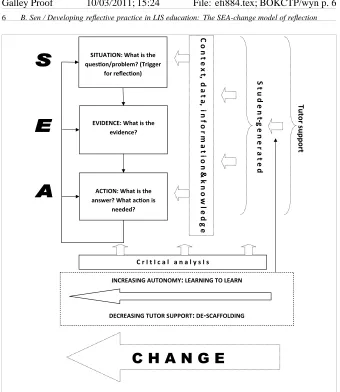
reflective dynamic (Fig. 1), and the SEA-change model of reflection (Fig. 2). The
Fig. 2. The SEA-Change model of reflection..
process that consist of (1) the situation, (2) the evidence, and (3) the resulting action or actions. Within each phase is a number of elements, eight in all; context, evidence, perspectives, assimilation of the evidence, learning, identifying the need for action or change, identifying what that action or change might be, following through with the action or change.
The SEA-change model is first presented showing the differences and omissions that can be identified throughout the reflective process when both deep reflection and low level reflection occur, together with the role that the tutor or mentor can play in supporting students or mentees (Table 2).
Table 2
The SEA-change model of reflection SEA-change
process phases
Deep reflection pro-cess
Low level reflection some elements of the process missing
Tutor or mentor role
S- SITUATION Trigger and/or cata-lyst – clearly defined and understood.
Trigger or catalyst – often not clearly de-fined or understood.
The tutor or mentor can pro-vide the trigger or catalyst through curriculum or training content, asking questions, pro-moting inquiry.
Context – Contextu-al consideration ful-ly considered.
Context – not always fully considered.
Support critical reflection. En-courage honest y in consider-ing the context and in describ-ing the situation effectively. Critical (analytical
or deep) reflection of multiple perspec-tives.
Often the reflec-tive focus only on self – not on multiple perspectives.
Point this out to the student or participant. Support critical reflection from multiple per-spectives if appropriate to en-courage seeing other points of view within the context of the situation.
E-EVIDENCE Assimilation of the evidence from the past or present.
Evidence not fully assimilated.
Support if needed through tea-ching, discussion, group work, writing, giving sensitive feed-back. Encourage the partici-pants to question why things ha-ppened how they did. Learning process
based on
eviden-ce, new knowledge
or understanding acquired.
Learning at a basic level.
Reflective process often stops here.
Support if needed through tea-ching, discussion, group work, writing, giving sensitive feed-back. Encourage the partic-ipants to question what they have learned from the events. A-ACTION Need for action
identified based on above
Often overlooked OR
Reflective process stops here
Support if needed through tea-ching, discussion, group work, writing, giving sensitive feed-back. Encourage the partic-ipants to be open and honest about the need for change. What action or
change is needed? Future.
Often overlooked OR
Reflective process stops here
Provide positive advice and en-couragement about what that change might be. Support if needed through mentorship. Action or change in
behaviour, or the situation,
Often overlooked OR reflective pro-cess stops here
Support if needed through men-torship. Help the participants to identify how they can make any changes, or encourage change in others.
to consider the context in terms of the reflective requirement: is the reflection for personal development; an official requirement e.g. an assessment or professional development requirement, or other reasons?. When looking at the context it is important to identify others involved in the situation, glean information from multiple sources and view the situation from multiple perspectives and this facilitates deeper learning and a greater understanding of the issues [13,18]. Moon (2007) notes that those who engage in low level reflection are less likely to consider multiple perspectives, and focus on the self, that is just one perspective.
5. Validation of the sea-change model through testing
An analysis of the content of the students’ reflections was carried out to identify evidence of each of the elements of the proposed SEA-change model within each reflection. For example, the following statement from student S19 shows clear evidence of having learnt from the process of reflection based on evidence from a past experience:
“What I learned from this was the value of building on experience in an organic way. We worked so well together because we now knew each other so well, we were friends and had worked with each other before. ”S19.4
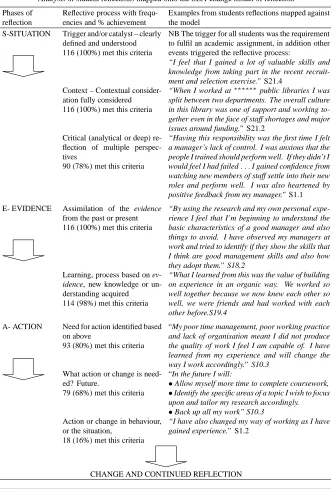
Version two of the model presented here in Table 3 shows frequencies and examples of student reflections mapped onto it from an analysis of the 116 student reflections. The majority of the student reflections were deeply reflective and analytical show-ing evidence of deep learnshow-ing. From the frequencies and percentages, it can be seen that students sometimes failed to follow their reflections through as deeply as they might. This was true of the three main phases of the proposed reflective process (Sit-uation, Evidence, Action) within the SEA-change model. As the phases progressed the number of students who showed evidence of deeper reflection decreased. The elements that the students engaged with least were considering multiple perspectives in the “situation” phase, being clear about what action was needed for change, and following with that action or change in the “action” phase.
The reflection given below (Table 4- An example of analytical reflective writing) when compared to Table 2 and Table 1 Moon’s [14] four levels of reflective writing (Table 1), can be seen to reach Level 4 with clear evidence of deep analytical reflection, which includes evidence of the consideration of others, and learning having taken place based on the experience or evidence, with a need for change identified. This reflection (Table 4) illustrates the stages and elements of the SEA-change model of reflection.
Table 3
Analysis of student reflections mapped onto the SEA-change model of reflection Phases of
reflection
Reflective process with frequ-encies and % achievement
Examples from students reflections mapped against the model
S-SITUATION Trigger and/or catalyst – clearly defined and understood 116 (100%) met this criteria
NB The trigger for all students was the requirement to fulfil an academic assignment, in addition other events triggered the reflective process:
“I feel that I gained a lot of valuable skills and knowledge from taking part in the recent recruit-ment and selection exercise.” S21.4
Context – Contextual consider-ation fully considered 116 (100%) met this criteria
“When I worked at∗∗∗∗∗∗public libraries I was
split between two departments. The overall culture in this library was one of support and working to-gether even in the face of staff shortages and major issues around funding.” S21.2
Critical (analytical or deep) re-flection of multiple perspec-tives
90 (78%) met this criteria
“Having this responsibility was the first time I felt a manager’s lack of control. I was anxious that the people I trained should perform well. If they didn’t I would feel I had failed. . .I gained confidence from
watching new members of staff settle into their new roles and perform well. I was also heartened by positive feedback from my manager.” S1.1
E- EVIDENCE Assimilation of the evidence from the past or present 116 (100%) met this criteria
“By using the research and my own personal expe-rience I feel that I’m beginning to understand the basic characteristics of a good manager and also things to avoid. I have observed my managers at work and tried to identify if they show the skills that I think are good management skills and also how they adopt them.” S18.2
Learning, process based on
ev-idence, new knowledge or
un-derstanding acquired 114 (98%) met this criteria
“What I learned from this was the value of building on experience in an organic way. We worked so well together because we now knew each other so well, we were friends and had worked with each other before.S19.4
A- ACTION Need for action identified based on above
93 (80%) met this criteria
“My poor time management, poor working practice
and lack of organisation meant I did not produce the quality of work I feel I am capable of. I have learned from my experience and will change the way I work accordingly.” S10.3
What action or change is need-ed? Future.
79 (68%) met this criteria
“In the future I will:
•Allow myself more time to complete coursework, •Identify the specific areas of a topic I wish to focus upon and tailor my research accordingly. •Back up all my work” S10.3
Action or change in behaviour, or the situation,
18 (16%) met this criteria
“I have also changed my way of working as I have gained experience.” S1.2
Table 4
An example of deep reflective writing mapped onto the SEA-change model of reflection Process phases An example of analytical reflective writing
SITUATION
Trigger – academic assignment. Context – service quality exer-cise identified.
Evidence of self – questioning and critical analysis.
Multiple perspectives acknowl-edged with some consideration of others involved, the group, and the assessor, though this could be developed.
EVIDENCE
Evidence assimilated through observation, and listening.
Learning has taken place. The need for action is identi-fied – to play down the desire to control.
ACTION
Ways to action that change in the future have been identified, though the opportunity has not yet arisen for that change to happen.
“I have been thinking this month about ‘managing myself in a
group dynamic’. This has come to my attention because of the service quality group exercise. I have become aware that I like to take a dominant role in groups, and started to think about whether this was an effective way to behave. I have occasionally confused ‘leadership’ with ‘getting my own way’ – which is about needing control, an aggressive and inflexible trait. I recognised a need to experiment in sharing control of the direction of the group, and manage the uncomfortable feelings created in me.
In practice, this meant taking a step back and exploring new ways of working, to listen more, and to allow others to take charge and set the agenda. During group meetings I actively listened, collaborated with, and challenged the ideas of others. This ranged from discussions about sharing the workload to structuring the final presentation. I felt at times that the group was drifting and I should control it. However I was able to restrain myself, and let the group ideas unfold organically. This proved an exciting and unpredictable experience. The success of this less dictatorial approach was demonstrated by the presentation coming together in the end without me needing to force the situation; and positive feedback from the presentation assessor.
I learnt that the ‘need to control’ is an obstacle to group work. I recognised how I should have faith in the collective, and not always to take sole responsibility for the group’s success – even though this will remain my natural (and sometimes appropriate) instinct. In future I will be more aware of the dynamics of the group, and be more willing to explore and to ‘run’ with the ideas of others. I will refer to this journal entry before future group work, and experiment further in acting out different roles within the group.” S3.2
having taken place. As a result, of the lack of analysis, the writer has not identified any need for change or personal development, so no recommendations are made for future action. The writing illustrates what fails to happen when a student has failed to engage with the reflective process (See Table 2).
These are just two examples that have been selected from the 116 reflective journal entries, as these illustrate particularly well the concepts within the model when mapped to different levels of reflection. The highest and lowest levels of reflection have been selected to illustrate clearly the ends of the spectrum of reflective writing, and different levels of reflection.
6. Discussion of reflection in education and tutor support
Table 5
An example of low level reflective writing mapped onto the SEA-change model of reflection Process phases An example of descriptive/non analytical reflective writing SITUATION
Trigger – academic assignment.
Context – Identified as previous work experience.
No
evidence of self-questioning or critical analysis. The content is purely descriptive of the writ-er’s own situation. No consid-eration of others.
EVIDENCE
The description shows no evi-dence of assimilation of these past events, and shows no evi-dence of deep reflective learn-ing from these experiences.
ACTION
The need for action has not been identified, or any subse-quent actions.
“I was a Chief Librarian for more than 5 years in a small academic library in∗∗∗∗(country name). I used to supervise 1 librarian and
2 assistant librarians for daily tasks in frontline, subscriptions, and cataloguing. As Chief Librarian in my previous work, I had to plan for the budget once a year, make decisions for purchases, and negotiate the various vendors’ agents. I designed a website in my previous job. I used to give regular presentations to the graduate students in the institute I previously worked for. This presentation was posted to the library website for online tutoring. Please refer to http://∗∗∗∗∗∗∗∗∗∗∗∗∗(URL given). I used the library website
to broadcast the library resources and services. I also used emails to draw customers’ attention to the library new promotions. I once designed a questionnaire to investigate customer satisfaction about the library. I used to collect the impact factors, since impact factors and publisher’s reputation are very important with regard to the quality of journals. I used to collect a lot of usage statistics on e-resources for the purpose of cost-effective analyzing. At my previous work, I had to analyze the cost and usage statistics for e-resources once a year, and see if the purchase was cost-effective, in order to provide evidence for the budget of the next year.”S22.1
to other teaching and learning concepts, and tutor support in the reflective process. It is acknowledged that there are many variables in the reflective learning pro-cess [19]. Each situation will be different, even for the same individual, each learning experience can be different in many ways, e.g. different tutors, different leaning groups, prior knowledge, available resources [20,21]. These variables need to be taken into account in the reflective process, hence the importance in deeper reflection of understanding the context and taking into consideration multiple per-spectives [20]. The capabilities of each individual will be different, they may not have levels of criticality, or the motivation that allows them to engage deeply so will engage in it at a surface level. They will end up “going through the motions” without deep reflective learning outcomes. As Student 3 comments:
“Sometimes with competing demands there can be a tendency to panic and get
stuck into the theory superficially – at the expense of making learning personal and reflective.”
Moon [2] discusses how this support can be given, and presents a range of practical advice for tutors and mentors that include starting by giving students as clear definition of what “being reflective” means. Other suggestions include giving examples of good and bad reflective writing, generating discussions, using tools to aid students to reflect deeply, and to see things from different viewpoints. All these suggestions have been incorporated into our teaching and support of reflective practice. Students commented on the value of such support:
“The session concluded with a reflective exercise. I found the session to be extremely helpful in that it gave me practice reflecting on experiences that I have had in the past, but also by giving me ideas which I will be able to pass along to future colleagues, and employees: in particular on continuing education.” S8.3
“The second session I attended was a lengthy session on reflective writing. . .we
were asked to work with a partner to discuss a recent experience that we had learned something from and to ask questions to each other as if in the role of a mentor. This method of asking questions to help someone else reflect is one that I plan to employ when employed in management as it will help other library staff to reflect on their experiences.” S9.2
“One of the talks we received was on reflective writing. I found this talk useful in understanding the importance of reflection and reflective writing in my further career particularly when going for chartership. I feel I have a better insight into the importance of reflection as a key managerial skills throughout my professional life.” S6.1
The need for support and guidance is further confirmed in the literature; Mann et al. [13] carried out a systematic review of 29 studies and found that “guidance and
supervision are key to reflection”.
As students build their confidence and skills, they move to the state of autonomous learners and develop the ability to experiment with different approaches.
“ I feel I have learnt a great deal about myself which I hope to reflect on throughout my professional career.” S2.4
“I enjoyed the idea of using web 2.0 techniques, which would create a more dynamic and participative form of reflection.”. S15.1
The increased confidence experienced, encourages students to take charge of their own learning and development. The students themselves commented on the benefits they had experienced through the reflective exercise.
“The process of reflection has heightened my awareness of the skills I am currently obtaining from the MA program, and has highlighted ways in which these can be transferred to future employment.” S6.3
“On reflection, all of this will be of immeasurable benefit to my management development.” S9.2
From these, and previous quotes, it can be seen that the students have developed a “rich” understanding of their environment and considered their situations in ways that they may not have done without engaging reflectively. For some the reflective process was “strange” at the outset, and sometimes highlighted uncomfortable emotions as they explored difficult issues, and prompted them to assess their situation.
In a formal learning situation, the tutor or mentor can offer support at different stages of the reflective process and play an important role in encouraging deep learning, and engaging and encouraging students with their reflective capabilities, and development (Table 2).
When students first embark on a new learning situation they are often dependent learners [24]. Dependence refers to a learning situation where information is used di-rectly by the student to inform the problem, the solution, and/or the reasoned evidence supporting the solution. The goal is to increase student confidence and autonomy so that they reach a learning situation in which the student finds information, and/or processes information to autonomously generate knowledge of what is the problem, the solution, and/or the reasoned evidence supporting the solution [25]. A goal of higher education is to enable and facilitate movement on the part of the student from dependence to autonomy [25]. Such development is termed here learning to learn, Fig. 2 below.
The reflective process is critical to the learning process with students reflecting on their actions past and present and taking that learning forward. The need to develop the students’ reflective capabilities can be overlooked. The importance that the tutor or mentor can have in that situation can be overlooked [20,26]. Figure 2 shows possible relationships between reflection, learning, and tutor support showing a pedagogical approach with de-scaffolding as the student moves from being dependent to being increasingly autonomous [22,27].
7. Conclusions
We have presented the SEA-change model of reflection, the idea of a reflective dynamic that consider the model in terms of past, and present experiences, and possible future developments, and we have offered integrated models of reflection together with pedagogical approaches to learning and teaching support. All these models have been developed from the extent literature, experience in engaging with reflective practice, and an analysis of students reflections. The SEA-change model has been tested against actual students’ reflections, which illustrate its application in a practical context, and validate the model.
The model confirms that there are different levels of reflection. The examples of reflective writing illustrate these levels.
What has been identified is a model that illustrates the reflective process and identifies ways in which a scaffolding and de-scaffolding approach can be taken by tutors and mentees to support student learning and development through the reflective process.
Understanding the reflective process and how to support deep reflection is impor-tant in understanding the value of reflection in personal and professional develop-ment, and academic learning within the library domain, and supporting increasing autonomous learning.
This paper contributes to the body of research and literature devoted to under-standing reflective practice. The development of reflective practice is increasingly present in academic study, professional development, staff appraisal, and profession-al practice. Understanding the reflective process and how to support those engaged in reflective practice is an important contribution.
8. Recommendations
Longitudinal research would be valuable to develop the model further and link it to learning outcomes. It would also be useful to research which different forms of support are most useful to students so that teaching and guidance can be improved. Following on from this, specific tutor or mentor tools could be developed.
Another area for further investigation could be the possible triggers for reflection to enable a deeper understanding of the reflective process and factors affecting it.
Acknowledgements
Acknowledgements go to the students on the MA Librarianship programme at the University of Sheffield who each year engage with the reflective writing exercise and show their sensitivity when they share they thoughts and experiences. We are proud of the standard of work they achieve and are encouraged when such bright people are entering the profession.
References
[1] K. Muir, The Shakespeare Survey 24: Shakespeare: Theatre Poet, Cambridge University Press, Cambridge, 2002 pp. 106.
[3] P. Khan et al., The role and effectiveness of reflective practices in programmes for new academic staff: A grounded practitioner review of the research literature. Manchester: University of Manch-ester/Higher Education Academy. Manchester, 2006.
[4] B. Taylor, Reflective practice: A guide for nurses and midwives, 2nd ed., Open University Press, Maidenhead, 2006.
[5] M. Watson, Building your portfolio: The CILIP guide. London: Facet. London, 2008
[6] D. Kolb, Experiential learning: Experience as the source of learning and development, Prentice Hall. Englewood Cliffs, NJ, 1984.
[7] T. Ghaye and S. Lillyman, Reflection: Principles and practice for healthcare professionals, Quay Books, Dinton. 2000.
[8] D. Sch¨on, The reflective practitioner. Basic Books, New York, 1983.
[9] J. Wilson, Reflecting-on-the-future: a chronological consideration of reflective practice, Reflective
Practice 9(2) (2009), 177–184.
[10] P.A. Ertmer and T.J. Newby, The expert learner: Strategic, self-regulated, and reflective,
Instruc-tional Science 24(1) (1996), 1–24.
[11] T. Bourner, Assessing reflective learning, Education + Training 45(3) (2003), 267–272.
[12] D. Leung and D. Kember, The relationship between approaches to learning and reflection upon practice, Educational Psychology 23(1) (2003), 61–71.
[13] K. Mann, J. Gordon and A. MacLeaod, A. Reflection and reflective practice in health professions education: a systematic review, Advances in Health Science Education Theory and Practice 14(4) (2009), 595–621.
[14] J. Moon, Getting the measure of reflection: Considering matters of definition and depth, Journal of
Radiotherapy in Practice 6(4) (2007), 191–200.
[15] B.A. Sen, Reflective writing: a management skill, Library Management 31(1/2) (2010), 79–93. [16] D. Boud, R. Keogh and D. Walker, Reflection: Turning experience into learning. Routledge,
Abingdon, 1985.
[17] R. Pockett and R. Giles, Critical reflection: generating theory from practice. Darlington Press, Sydney, 2008.
[18] C. Gustafsson and I. Fagerberg, Reflection. The way to professional development? Journal of
Clinical Nursing 13(3) (2004), 217–280.
[19] J. Mezirow, Fostering critical reflection in adulthood: A guide to transformative and emancipatory
learning. Jossey-Bass, San Francisco, 1990.
[20] D. Boud and D. Walker, Promoting reflection in professional courses. The challenge of context,
Studies in Higher Education 23(2) (1998), 192–206.
[21] N. Hatton and D. Smith, Reflection in teacher education – towards definition and implementation,
Teaching and Teacher Education 11(1) (1998), 33–49.
[22] S. Lajoie, Extending the scaffolding metaphor, Instructional Science 33(5–6) (2005), 541–557. [23] K.D. Simons and D.J. Klein, The impact of scaffolding and student achievement levels in a
problem-based learning environment, Instructional Science 35(1) (2007), 41–72.
[24] N. Ford, Educational informatics, Annual Review of Information Science and Technology 42(1) (2008), 497–544.
[25] V.A. Clifford, The development of autonomous learners in a university setting, Higher Education
Research and Development 18(10) (1999), 115–128.
[26] B.G. Barnett, Developing reflection and expertise. Can mentors make a difference? Journal of
Educational Administration 33(5) (2005), 45–59.