This is a repository copy of
Structural Diversity of Copper(I)-N-Heterocyclic Carbene
Complexes; Ligand Tuning Facilitates Isolation of the First Structurally Characterised
Copper(I)-NHC Containing a Copper(I)-Alkene Interaction
.
White Rose Research Online URL for this paper:
http://eprints.whiterose.ac.uk/80683/
Version: Accepted Version
Article:
Willans, CE and Lake, BRM (2013) Structural Diversity of Copper(I)-N-Heterocyclic
Carbene Complexes; Ligand Tuning Facilitates Isolation of the First Structurally
Characterised Copper(I)-NHC Containing a Copper(I)-Alkene Interaction. Chemistry - A
European Journal, 19 (49). 16780 - 16790. ISSN 0947-6539
https://doi.org/10.1002/chem.201301896
[email protected]
https://eprints.whiterose.ac.uk/
Reuse
Unless indicated otherwise, fulltext items are protected by copyright with all rights reserved. The copyright
exception in section 29 of the Copyright, Designs and Patents Act 1988 allows the making of a single copy
solely for the purpose of non-commercial research or private study within the limits of fair dealing. The
publisher or other rights-holder may allow further reproduction and re-use of this version - refer to the White
Rose Research Online record for this item. Where records identify the publisher as the copyright holder,
users can verify any specific terms of use on the publisher’s website.
Takedown
If you consider content in White Rose Research Online to be in breach of UK law, please notify us by
Structural Diversity of Copper(I)-N-Heterocyclic Carbene
Complexes; Ligand Tuning Facilitates Isolation of the First
Structurally Characterised NHC Containing a
Copper(I)-Alkene Interaction
Benjamin R. M. Lake
[a]and Charlotte E. Willans*
[a][a] B. R. M. Lake, Dr. C. E. Willans, School of Chemistry, University of Leeds, Woodhouse Lane, Leeds, LS2 9JT, UK. Fax:
(+44) 1133436565. E-mail: [email protected]
Abstract
The preparation of a series of imidazolium salts bearing N-allyl substituents, and a range of
substituents on the second nitrogen atom with varying electronic and steric properties, is reported. The
ligands have been coordinated to copper(I), with the resulting copper(I)-NHC complexes being
thoroughly examined both in solution and in the solid state. The solid state structures are highly
diverse, and exhibit a range of unusual geometries and cuprophilic interactions. The first structurally
characterised copper(I)-NHC complex containing a copper(I)-alkene interaction is reported. An
N-pyridyl substituent, which forms a dative bond with the copper(I), stabilises an interaction between the
metal centre and the allyl substituent of a neighbouring ligand, to form a 1D coordination polymer. The
stabilisation is attributed to the pyridyl substituent increasing the electron density at the copper(I)
centre, which enhances the metal(d)-to-alkene( *) back-bonding. In addition, non-charge-transfer
components appear to have a role in copper(I)-alkene stabilisation, as further increase in the Lewis
basicity of the ligand disfavours copper(I)-alkene binding.
Introduction
The binding of alkenes to copper(I) has been proposed as an important step in a variety of chemical processes, for
example, in alkene aziridination and cyclopropanation, and in conjugate additions to , -unsaturated ketones.[1-5] Furthermore, in nature, it is believed that the formation of a copper(I)-ethylene adduct in the ETR 1 plant protein is a key step in the regulation of several aspects of the plant life cycle.[6] As the bonding is relatively weak, many systems take advantage of the reversible binding nature of copper(I)-alkenes. Other potential applications in which the strength of the copper(I)-alkene bond may play an important role include separation chemistry, in which alkenes are selectively separated from crude organic feedstock,[7] and in molecular sensing to detect the presence of alkenes.[8] As metal-carbonyl bonding is similar to metal-alkene bonding, applications such as separation
chemistry and sensing may also take advantage of the reversible binding of copper(I)-carbonyls.
The interaction of alkenes with copper(I) ions has been studied and reported in several papers. Most of the complexes examined involve copper(I)-L-(ethylene), in which L is a chelating nitrogen-donor ancillary ligand.[9-11] Several copper(I)-tris(pyrazolyl)borate-ethylene complexes have been isolated and structurally characterised.[2, 12, 13]
It has been found that decreasing the Lewis basicity of the specific ligand by introducing fluoroalkyl
under reduced pressure, while its methylated analogue oxidises upon exposure to air.[2] This finding is counter-intuitive when considering the different levels of back-bonding in the complexes. Recently, York and co-workers published a DFT study on the impact of ancillary ligand basicity on copper(I)-ethylene binding interactions.[14] They report that both charge-transfer and non-charge-transfer components are affected by the basicity of the
ligand. While copper ethylene back-bonding increases with increasing ligand basicity, polarisation and frozen density terms simultaneously become less favourable, resulting in little overall binding energy changes with alteration of ligand basicity.
Some reported reactions in which a copper(I)-alkene interaction is postulated use copper(I)-N-heterocyclic carbene (NHC) complexes.[15, 16] To the best of our knowledge, interaction of an alkene with a copper(I)-NHC
complex has not been previously observed in the solid state. The strong -donating property of NHCs may result in low favourable polarisation and a more repulsive frozen density term. Understanding the nature of the copper(I)-NHC interaction and its effect on copper(I)-alkene binding is imperative in the development of copper(I)-copper(I)-NHC complexes for use in catalytic processes which rely on alkene coordination to the copper centre. Herein, we report on the syntheses and full characterisation of copper(I)-NHC complexes in which the NHC ligands contain an alkene substituent. The first structurally characterised copper(I)-NHC containing a copper(I)-alkene interaction is described.
Results and Discussion
A potential strategy for the stabilisation and examination of a copper(I)-alkene interaction in a copper(I)-NHC complex is to use a hemilabile alkene substituent on the NHC ligand itself. Imidazolium ligand precursors 1a-1e were prepared using established procedures, and fully characterised (Figure 1) (see ESI).[17-19] All of the ligands
possess either one or two N-allyl substituents, and have a variety of substituents with different steric and electronic properties on the second nitrogen atom.
Copper(I)-NHC complexes can be synthesised using a range of methods including i) deprotonation of an imidazolium salt using a strong base followed by coordination to a metal,[20-22] ii) transmetallation from the corresponding silver(I)-NHC,[23] iii) deprotonation of the imidazolium and coordination in situ using a basic metal precursor[24] and iv) electrochemical reduction of the imidazolium and metal coordination.[25, 26] Reaction of compound 1b with a base (tBuOK) in the presence of CuBr resulted in the desired product, in addition to two allyl rearrangement products (see ESI).[27] As the allyl substituents appear to be sensitive to strong bases, the coordination of ligands 1a-1e to copper(I) was therefore achieved via deprotonation and coordination in situ using copper oxide (Scheme 1).
Complexes 2a-2e were fully characterised using NMR spectroscopy, mass spectrometry and elemental analysis, which all support formation of complexes of the type Cu(NHC)Br. Complexes 2a, 2b, 2d and 2e were further examined using X-ray crystallography. Complex 2a crystallises as a centrosymmetric ( -Br)2-bridged
dimer (Figure 2). The central (CuBr)2 core is slightly asymmetric, with Cu-Br bond lengths of 2.44 and 2.46 Å
respectively. The (CuBr)2 core forms a plane with a torsion angle of approximately 24° with respect to the plane
defined by the benzimidazol-2-ylidene rings. The Cu-C bond length, at 1.91 Å, is normal for this type of complex.[24, 25, 28]
2.28 Å).[24, 25, 28] This indicates that the cuprophilic interaction does not significantly modify the electronic properties of the copper(I) centres.
Complex 2d crystallises with a rather unusual distorted trigonal coordination geometry as a Cu(NHC)2Br-type
complex (Figure 4). This type of complex has been observed previously in only two other examples.[21, 33] The structure is somewhat unexpected, especially given that elemental analysis gives a ratio of 1:1 NHC:CuBr. Due to the labile nature of copper(I)-NHCs, it is possible that transmetallation occurs during crystallisation giving 1 mole equivalent of the Cu(NHC)2Br and 1 mole equivalent of CuBr. The trigonal geometry is surprising, especially
considering the steric bulk of the mesityl wingtip groups. The bulky mesityl groups act to widen the C-Cu-C bond angle (151.1°), which in turn decreases the C-Cu-Br bond angles (103.3° and 105.6°) and also forces the bromide further from the copper(I) centre (Cu-Br = 2.62 Å) in order to relieve steric congestion. This value for the Cu-Br bond is rather long compared to literature precedent, and may also be caused to some extent by the strong -donor effect of the two NHCs coordinated to the copper(I) centre. The Cu-C bond lengths, at 1.93 and 1.94 Å, are slightly elongated with respect to the values observed in the previous structures, though compare favourably with those reported previously by Albrecht (1.930(2) Å)[21] and Lavoie (1.935(3) Å) for their Cu(NHC)2X (X = halide)
complexes.[33]
The copper(I) centre in complex 2e is 2-coordinate with an approximately linear geometry (172.1°) (Figure 5). The Cu-C and Cu-Br bond lengths, at 1.92 and 2.28 Å, are within typical ranges for this type of complex. The 2-methoxyphenyl ring is twisted with respect to the plane defined by the NHC ring by approximately 47°. This
would act to prohibit -overlap between the methoxyphenyl and NHC rings, resulting in the highly -electron donating OMe group having little electronic effect on the NHC.
The steric properties of the ligands of 2a-2e have been varied, which results in a range of interesting structures that differ significantly around the copper(I)-centres. However, it has not facilitated any copper(I)-alkene coordination. The ligand precursors described vide infra were therefore appended with 2-pyridyl N-substituents. It was anticipated that this would modulate the electronic properties of the NHC, in addition to providing the opportunity for metal chelation. The complexes formed from these ligands are fascinating in their own right. Moreover, they allowed the isolation of the first example of a structurally characterised copper(I)-NHC containing a copper(I)-alkene interaction.
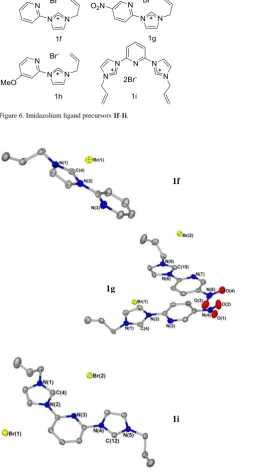
Ligand precursors 1f-1i were prepared and fully characterised using NMR spectroscopy, mass spectrometry and elemental analysis.[34, 35] These ligands offer the possibility of chelation by binding to the metal centre through both the carbenic carbon and pyridyl nitrogen, with ligand 1i having two potential NHC donors. In the solid-state structures of imidazolium salts 1f, 1g and 1i, the pyridyl and imidazolium rings lie almost coplanar, which acts to
increase -overlap between the two (Figure 7). This significant -overlap between the two aromatic systems results in a particularly low-field shift of the imidazolium C2 proton resonances in the 1H NMR spectra, with that of compound 1g being observed at 12.22ppm (300 MHz, CDCl3). There is a strong anion- interaction between the
N-C-N -cloud and a neighbouring bromide anion in these ligand precursors, which all fall well below the sum of the van der Waal’s radii (3.36 Å in 1f, 3.31 Å and 3.32 Å in 1g and 3.29 Å in 1i). Anion- interactions are much less common than cation- interactions, and this interaction is facilitated by the particularly electron-poor (and positively charged) N-C-N bond of the imidazolium due to the effect of the electron-withdrawing pyridyl substituents on the imidazolium ring. The presence of anion- interactions in these structures may facilitate the use of imidazolium salts as anion-binders.[36, 37]
Reaction of Cu2O with ligand precursors 1a-1e led to the formation of analytically pure copper(I)-NHC
complexes 2a-2e. However, reaction of 1f with Cu2O at reflux in dichloromethane, in the presence of 4Å
rearrangement reactions to occur, but is strong enough so that deprotonation of 1f can occur. After work-up, a yellow solid was obtained (2f’) which was fully characterised by 1H and 13C{1H} NMR spectroscopy, high-resolution MS and elemental analysis. 1H NMR spectroscopy revealed the complete loss of the low field imidazolium proton resonance, and a broad low field resonance at 183.7 ppm (126 MHz, CD3CN) in the 13C{1H}
NMR spectrum strongly suggested that a copper(I)-NHC complex had been formed. Elemental analysis shows that, instead of a Cu(NHC)Br complex, 2f’ was a bis-NHC [Cu(NHC)2Br] complex (Figure 8). This is also hinted
at in the high-resolution MS, where the dominant molecular ion corresponds to [Cu(NHC)2]+. However, great care
should be taken when interpreting the ESI+ mass spectra of copper(I)-NHC complexes, since their labile nature can lead to ligand scrambling resulting in the appearance of bis-NHC species in samples of pure mono-NHC compounds. This ligand scrambling behaviour is well documented for silver(I)-NHC complexes.[38] Complex 2f’ is proposed to be an ionic complex on the basis of its poor solubility in common organic solvents (e.g. dichloromethane, chloroform, tetrahydrofuran), but its slightly better solubility in the more polar acetonitrile.
A different approach was required to synthesise the Cu(NHC)Br complex of ligand precursor 1f. Reaction of an excess of Ag2O with 1f in anhydrous dichloromethane, in the presence of 4Å molecular sieves, led to the
formation of a dark suspension which, after filtration, removal of the solvent and recrystallisation, yielded the silver(I)-NHC complex Ag2f (Scheme 2).
Characterisation of Ag2f by 1H NMR spectroscopy indicated the loss of the imidazolium proton resonance, and formation of the silver(I)-NHC complex was confirmed by the 13C{1H} NMR spectrum which showed a low field resonance at 181.6 ppm (75 MHz, CDCl3). Ag2f crystallises as [Ag(NHC)2]
+
AgBr2
-, where the C-Ag-C bond lies almost perpendicularly to the Br-Ag-Br bond. The two silver centres are linked by a weak argentophilic interaction (see ESI). Given the decomposition observed during the reaction of 1f with Cu2O, transmetallation
from Ag2f to copper(I) was performed under strictly inert conditions (Scheme 2).
Complex 2f was characterised by 1H NMR spectroscopy, high-resolution MS and elemental analysis. The 1H
NMR spectrum showed that the resonances of many of the ligand protons were broadened considerably in comparison to Ag2f and 2f’. The protons most affected by the spectral broadening included all but one of the pyridyl protons, the backbone NHC protons and the allylic methylene protons. One of the pyridyl protons and the alkenic protons retain reasonably sharp resonances (Figure 9).
A similar observation was made previously for a related complex by Danopoulos.[24] The broadening is attributed to non-rigidity in solution, although it is suggested that an equilibrium involving mono and bis-NHC complexes could be contributing to broadening. It is notable that the protons whose resonances are most broadened are those in closest proximity to the metal coordination environment (i.e. nearest the carbenic carbon and pyridyl nitrogen). On this basis, it is proposed that the spectral broadening is caused by coordinative lability at the copper(I) centre, which may invoke mono and bis-NHC complexes as well as mono-NHC dimers. Indeed, from a slightly different ligand, Danopoulos was able to characterise two different complexes (a dimer and a polymer) in the solid state which could be formed selectively by varying the crystallisation conditions.
angles of 130.74°, 115.30° and 112.60°) and the pyridyl nitrogen occupying the apical position. Significant distortion of an idealised trigonal pyramidal geometry occurs, in part, due to the geometric restriction imposed by the 5-membered chelate ring, which has a bite angle of 74.9° as defined by the C-Cu-N angle. The chelate ring itself is essentially planar. Notably long bonds are observed between the NHC and copper centre (1.97 Å) and between the pyridyl nitrogen and copper (2.50 Å), which may be a consequence of the copper centre trying to optimise orbital overlap with both donors. The Cu-Br bond, at 2.44 Å, is relatively long with respect to the terminal Cu-Br bonds described for complexes 2b and 2e (2.28 / 2.28 and 2.28 Å) but compares well with the bridging Cu-Br bonds of 2a (2.44 and 2.46 Å). This lengthening may result from a need to reduce steric clashing around the 4-coordinate copper(I) centre, and also the possible increase in electron density at the copper(I) centre by having three other donor moieties bound to the metal.
Alkene coordination in complex 2f results in a pronounced lengthening of the alkenic C-C bond from 1.33 Å (1f) to 1.37 Å (2f). The coordination of the alkene to the metal centre appears to have been facilitated by the addition of the pyridyl group to the NHC ligand, which acts as both an ancillary donor and also as a modifier of the electronic properties of the NHC donor. With this in mind, it is unsurprising then that many of the structurally characterised copper(I)-alkene complexes reported thus far contain chelating N-donor ligands such as tris(pyrazolyl)borate.[2, 39] The exact role of the pyridyl in enabling alkene coordination to the metal centre in this case is unclear however; it may be altering the properties of the copper(I) centre directly by coordination to it, or it may be indirectly affecting the copper(I) centre by modifying the donor ability of the NHC (decreasing the energy of the LUMO).
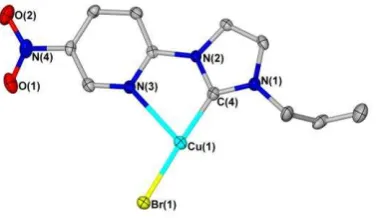
Slight modification of 1f by the addition of a nitro group to the pyridyl ring (trans with respect to the imidazolium ring) gave 1g. The intermediate silver(I)-NHC complex Ag2g was found to be much less soluble than Ag2f, but analysis by 1H NMR spectroscopy indicated loss of the imidazolium proton resonance. Complex Ag2g was used to synthesise the corresponding copper(I)-NHC complex without further purification or analysis. Full characterisation of 2g by 1H and 13C{1H} NMR spectroscopy, high-resolution MS and elemental analysis indicated the presence of analytically pure Cu(NHC)Br. Broadening of certain resonances was observed in the 1H NMR spectrum of 2g. However, it should be noted that the broadening is not nearly as pronounced as that for 2f, possibly indicating that 2g is a much less labile complex. Single crystals suitable for X-ray diffraction analysis were grown by the slow evaporation of a concentrated solution of 2g in acetonitrile (Figure 11).
Complex 2g crystallised as a monomer, with the coordination environment around the copper(I) centre best described as distorted T-shaped. A similar coordination environment has been reported previously by Danopoulos.[24] The extended structure of 2g shows that alkene coordination is switched off by addition of the nitro group, with the closest approach of an alkene to the copper(I) centre occurring at a distance of 5.23 Å. The alkenic C-C bond at 1.32 Å is shorter than in complex 2f (1.37 Å), and closer in length to the ligand precursor 1g (1.33 Å). The Cu-C and Cu-Br distances, at 1.91 and 2.29 Å respectively, are entirely within the range expected for a linear Cu(NHC)Br complex, as is the C-Cu-Br bond angle (176.8°). The Cu-N bond length on the other hand is extremely long (2.56 Å), implying the presence of a weak interaction at best between the pyridyl nitrogen and copper(I) centre. The fact that this bond is lengthened with respect to the Cu-N bond of 2f (2.50 Å), despite the lower coordination number of 2g, suggests that the primary effect of adding the nitro group has been to inductively withdraw electron density away from the pyridyl nitrogen atom, making it a poorer donor to the metal centre.
Complex 2h was found to crystallise as a monomer, analogously to complex 2g, with the coordination environment around the copper(I) centre being distorted T-shaped. The Cu-C (1.91 Å) and Cu-Br (2.27 Å) distances are very comparable to those found in complex 2g, while the Cu-N distance is markedly shortened in this complex (2.31 Å) with respect to 2g (2.56 Å) and indeed, 2f (2.50 Å). This indicates that the ability of the pyridyl to act as a -donor is significantly enhanced as a result of the para-methoxy group, which in turn leads to a much stronger interaction between the pyridyl nitrogen and copper(I) centre. Surprisingly, the extended structure of 2g does not show any interaction between the copper(I) centre and an alkene, with the closest approach occurring at a distance of 4.09 Å. The short Cu-N distance is likely to destabilise the filled frontier orbital at the copper(I) centre, which would be expected to stabilise copper(I)-alkene coordination through increased copper(I) ethylene back-bonding. The absence of alkene coordination in this complex indicates that non-charge-transfer components may be playing a role, with polarisation and frozen density terms becoming less favourable with increased electron density on the metal centre.
To examine the effect of an extra NHC donor on copper(I) coordination, a symmetrical bis-NHC analogue of 1f was synthesised (1i). Complexation of 1i to copper(I) was attempted using the procedure described for the synthesis of 1f’, rather than going via the silver(I)-NHC complex, since bis-imidazolium salts are known to require more forcing conditions when reacting with Ag2O.
[40]
The solubility of the product was reasonably poor, although
1
H and 13C{1H} NMR spectra with good signal to noise ratios could be obtained at elevated temperatures (333.6 K) with a large number of scans. The 1H NMR spectrum illustrates the presence of only one ligand environment and also the loss of the imidazolium proton. Unlike the spectra for complexes 2f-2h, the spectrum of the product is sharp, perhaps indicating that this complex is less labile than complexes 2f-2h. The 13C{1H} NMR spectrum shows a characteristic low field resonance at 181.9 ppm (126 MHz, CD3CN, 333.6 K), indicating the formation of a
copper(I)-NHC complex. The high-resolution mass spectrum was dominated by a peak at m/z 354.08, which was found to correspond to a [Cu2L2]2+ fragment. Single crystals suitable for X-ray diffraction analysis were obtained
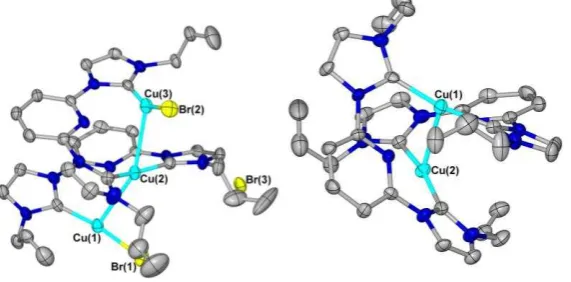
by cooling a saturated solution of the product from 333 K to ambient temperature in anhydrous acetonitrile. The solid state structure shows a formulation of (Cu3(NHC)2Br3) for 2i (Figure 13).
Complex 2i was found to crystallise as a ligand-supported cuprophilic trimer. Cuprophilic trimers with similarities to 2i have been described previously in the literature,[41] although many of these occur as
C3-symmetric triangular copper(I) clusters.[42-44] The geometries (excluding possible cuprophilic interactions) about all three of the copper(I) centres are best described as distorted linear, with bond angles of 171.0°, 164.6° and 156.9°. The Cu-C and Cu-Br bond lengths are within typical ranges for copper(I)-NHC complexes. The distances between the three copper(I) centres are 2.87 Å and 2.78 Å, and thus possibly represent weak cuprophilic interactions. It is notable in the structure that pyridyl coordination does not occur, with the closest copper(I)-pyridyl interaction occurring between Cu(3) and N(8) at a distance of 2.64 Å. This presumably results from the conformational restriction imposed by the ligand on the positions of the copper(I) centres (i.e. away from the pyridyl nitrogens), but may also result from the withdrawal of electron density away from the pyridyl nitrogen atoms by the NHC rings, making the pyridyls poorer donors. Twisting of the NHC rings with respect to the pyridyl rings occurs to varying degrees (torsion angles between 10.3° and 31.8°), which would act to decrease -overlap between the NHC and pyridyl rings. Possibly as a result of the lack of coordination by the pyridyls to the copper(I) centre in 2i, no alkene coordination is observed; it appears that all three copper(I) centres are coordinatively saturated in this complex.
An explanation for the dominant ion in the high resolution mass spectrum being a [Cu2L2]2+ fragment, in
highly symmetric NMR data. Elemental analytical data is indicative of a 3:1 mixture of 2i:2i’ in the final product. The stability of 2i’ is a somewhat surprising result, especially given the tendency of copper(I)-NHC complexes bearing non-bulky N-substituents (i.e. allyl) to decompose, reforming imidazolium salts and unidentifiable copper(II)-containing detritus. The formation of a copper(I)-NHC over any other species suggests that the 16-membered metallacycle contained within 2i’ is highly stable, even on prolonged exposure to air and moisture. The remarkable stability of 2i’ makes it an interesting candidate for use in catalysis.
Conclusion
A series of copper(I)-NHC complexes with N-allyl substituents and varying steric and electronic properties have been described. The complexes exhibit a range of fascinating structures, with copper(I)-alkene coordination in the solid state being observed in one of the complexes (complex 2f). There are two possible explanations for this observation; i) the co-planar pyridyl group withdraws electron density from the carbenic carbon, thus reduces electron density on the copper(I) centre and increases polarisation effects between the metal and the alkene, ii) the co-planar structure naturally enforces the pyridyl-N atom towards the copper(I) centre to form a dative bond. This dative bond, although weak, increases the electron-richness of the copper(I) centre, which increases the affinity of copper(I) to alkene through its enhanced metal(d)-to-alkene( *) back-bonding ability. The addition of a nitro group to the pyridyl substituent significantly increases the pyridyl Cu-N bond length in complex 2g (compared to 2f), which switches off the interaction between the copper(I) centre and an alkene. This would suggest that
metal(d)-to-alkene( *) back-bonding is the dominant effect in these complexes, and increasing the electron richness of the metal centre serves to stabilise copper(I)-alkene coordination. However, increasing the electron richness of the metal centre further, through the addition of a methoxy group to the pyridyl moiety (complex 2h), does not result in a copper(I)-alkene interaction, which is interesting considering the relatively short Cu-N bond. This indicates that non-charge-transfer effects cannot be ruled out, and that low favourable polarisation and repulsive frozen density terms have come into effect.
The coordination of pyridyl, NHC and alkene in one ligand to the same copper(I) centre would result in high angular strain, hence the metal centre instead bonds to a nearby alkene to form a 1D coordination polymer. Complex 2f is an extremely interesting candidate for catalytic processes in which binding of alkenes to the copper(I) centre is proposed. Furthermore, applications such as separation chemistry, gas purification or sensing, which rely on the reversible nature of a copper(I)-alkene (or copper(I)-carbonyl), could make use of this ligand system. These binding interactions are clearly more complex than simply increasing the basicity of the ligand to stabilise alkene coordination, with both charge-transfer and non-charge-transfer components requiring consideration. This is in agreement with York’s recent studies on copper(I)-alkene binding using DFT calculations.[14]
Experimental Section
General: Where stated, manipulations were performed under an atmosphere of dry argon by means of standard Schlenk line or Glovebox
techniques. The gas was dried by passing through a twin-column drying apparatus containing molecular sieves (4Å) and P2O5. Anhydrous solvents
were prepared by passing the solvent over activated alumina to remove water, copper catalyst to remove oxygen and molecular sieves to remove
any remaining water, via the Dow-Grubbs solvent system. Deuterated chloroform, acetonitrile and DMSO were dried over CaH2, cannula filtered or
distilled, and then freeze-pump-thaw degassed prior to use. All other reagents and solvents were used as supplied.
1H and 13C{1H} NMR spectra were recorded on either a Bruker DPX300 or a Bruker AV500 spectrometer. The values of chemical shifts are
given in ppm and values for coupling constants (J) in Hz. Assignment of some 1H NMR spectra was aided by the use of 2D 1H1H COSY
experiments and the assignment of some 13C{1H} NMR spectra was aided by 13C{1H} dept 135 experiments. Mass spectra were collected on a
Bruker Daltonics (micro TOF) instrument operating in the electrospray mode. Microanalyses were performed using a Carlo Erba Elemental
Analyser MOD 1106 spectrometer. X-ray diffraction data were collected on either a Bruker Nonius X8 diffractometer fitted with an Apex II
structures were solved by direct methods using SHELXS-97 and refined by full-matrix least squares on F2 using SHELXL-97, interfaced through
the program X-Seed. Molecular graphics for all structures were generated using POV-RAY in the X-Seed program.
[1,3-Bisallylbenzimidazol-2-ylidene] copper(I) bromide (2a): A Schlenk flask was charged with 1,3-diallylbenzimidazolium bromide (0.42 g, 1.5 mmol), Cu2O (0.43 g, 3.0 mmol) and 4Å molecular sieves. These were dried and degassed thoroughly in vacuo. Anhydrous dichloromethane (30
ml) was added via cannula and the mixture was stirred at reflux for 24 hours. After this time, the mixture was allowed to cool and was filtered
under inert conditions. The solvent was removed from the filtrate in vacuo to give the product as a white solid. Yield: 0.30 g, 0.88 mmol, 59 %.
Single crystals suitable for X-ray diffraction analysis were grown by the slow evaporation of a concentrated solution of the product in chloroform.
1H NMR (500 MHz, CDCl3) 7.46 – 7.42 (m, 2H, bimH), 7.41 – 7.36 (m, 2H, bimH), 6.04 (ddt, J = 17.0, 10.3, 5.7 Hz, 2H, CH=CH
2), 5.36 (dd, J
= 10.3, 0.8 Hz, 2H, HC=CHH(cis)), 5.29 (dd, J = 17.0, 0.8 Hz, 2H, HC=CHH(trans)), 5.06 (d, J = 5.7 Hz, 4H, NCH2). 13C NMR (126 MHz, CDCl3)
186.1, 133.8, 131.9, 124.1, 119.5, 111.82, 51.5. HRMS (ESI+): m/z calcd for [M – Br]+: 261.0448; found: 261.0440. Anal. calcd for
C13H14BrCuN2: C 45.69, H 4.13, N 8.20; found: C 45.40, H 4.30, N 7.90.
[1-Allyl-3-methylimidazol-2-ylidene] copper(I) bromide (2b): A Schlenk flask was charged with 1-allyl-3-methylimidazolium bromide (0.60 g, 3.0 mmol), Cu2O (0.85 g, 5.9 mmol) and 4Å molecular sieves. These were dried and degassed thoroughly in vacuo. Anhydrous dichloromethane
(40 ml) was added via cannula and the mixture was stirred at reflux for 80 hours. After this time, the mixture was allowed to cool and was filtered
under inert conditions. The solvent was removed from the filtrate in vacuo to give the product as a white solid. Yield: 0.39 g, 1.5 mmol, 50 %.
Single crystals suitable for X-ray diffraction analysis were grown by the slow evaporation of a concentrated solution of the product in
dichloromethane. 1H NMR (300 MHz, CDCl3) 6.λ1 (s, 1H, imH), 6.λ1 (s, 1H, imH), 5.λ4 (ddt, J = 16.3, 10.2, 6.0 Hz, 1H, CH=CH
2), 5.36 – 5.20
(m, 2H, HC=CH2), 4.72 (d, J = 6.0 Hz, 2H, NCH2), 3.83 (s, 3H, CH3). 13C{1H} NMR (75 MHz, CDCl3) 178.1, 132.6, 122.0, 120.7, 11λ.8, 53.8,
38.4. HRMS (ESI+): m/z calcd for [M – Br]+: 185.0135; found: 185.0145. Anal. calcd for C
7H10BrCuN2: C 31.65, H 3.79, N 10.55; found: C 31.30,
H 3.80, N 10.10.
[1,3-Bisallylimidazol-2-ylidene] copper(I) bromide (2c): A Schlenk flask was charged with 1,3-allylimidazolium bromide (0.54 g, 2.4 mmol), Cu2O (0.67 g, 4.7 mmol) and 4Å molecular sieves. These were dried and degassed thoroughly in vacuo. Anhydrous dichloromethane (35 ml) was
added via cannula and the mixture was stirred at reflux for 24 hours. After this time, the mixture was allowed to cool and was filtered under inert
conditions. The solvent was removed from the filtrate in vacuo to give the product as a pale yellow oil. Yield: 0.35 g, 1.2 mmol, 51 %. 1H NMR
(300 MHz, CDCl3) 6.λ3 (s, 2H, imH), 5.λ5 (ddt, J = 16.6, 10.2, 6.0 Hz, 2H, CH=CH2), 5.31 (dd, J = 10.2, 0.9 Hz, 2H, HC=CHH(cis)), 5.26 (dd, J =
16.6, 0.9 Hz, 2H, HC=CHH(trans)), 4.73 (d, J = 6.0 Hz, 4H, NCH2). 13C{1H} NMR (75 MHz, CDCl3) 177.8, 132.6, 120.8, 120.0, 54.0. HRMS
(ESI+): m/z calcd for [M – Br]+: 211.0291; found: 211.0280. Anal. calcd for C
9H12BrCuN2: C 37.35, H 4.20, N 9.70; found: C 37.06, H 4.15, N
9.61.
[1-Allyl-3-mesitylimidazol-2-ylidene] copper(I) bromide (2d): A Schlenk flask was charged with 1-allyl-3-mesitylimidazolium bromide (0.32 g, 1.0 mmol), Cu2O (0.30 g, 2.1 mmol) and 4Å molecular sieves. These were dried and degassed thoroughly in vacuo. Anhydrous dichloromethane
(20 ml) was added via cannula and the mixture was stirred at reflux for 60 hours. After this time, the mixture was allowed to cool and was filtered
under inert conditions. The solvent was removed from the filtrate in vacuo to give the product as a clear oil, which slowly crystallised on standing.
Yield: 0.24 g, 0.64 mmol, 62 %. Single crystals suitable for X-ray diffraction analysis were grown by the vapour diffusion of pentane in to a
concentrated solution of the product in dichloromethane. The structure showed a complex of the type [Cu(NHC)2Br]. 1H NMR (300 MHz, CDCl3)
7.10 (d, J = 1.7 Hz, 1H, imH), 6.95 (s, 2H, ArH), 6.87 (d, J = 1.7 Hz, 1H, imH), 6.03 (ddt, J = 15.8, 10.2, 5.8 Hz, 1H, CH=CH2), 5.35 (dd, J = 10.2,
0.7 Hz, 1H, HC=CHH(cis)), 5.26 (d, J = 15.8 Hz, 1H, HC=CHH(trans)), 4.85 (d, J = 5.8 Hz, 2H, NCH2), 2.31 (s, 3H, p-CH3), 2.00 (s, 6H, o-CH3). 13C
NMR (75 MHz, CDCl3) 17λ.0, 13λ.5, 135.2, 134.7, 132.7, 12λ.5, 122.5, 120.7, 11λ.7, 53.λ, 21.2, 17.λ. HRMS (ESI+): m/z calcd for [M – Br + MeCN]+: 330.1026; found: 330.1024. Anal. calcd for C
15H18BrCuN2. CH2Cl2: C 44.13, H 4.57, N 6.57; found: C 44.60, H 5.00, N 6.10.
[1-Allyl-3-(2-methoxybenzene)imidazol-2-ylidene] copper(I) bromide (2e): A Schlenk flask was charged with 1-allyl-3-(2-methoxybenzene)imidazolium bromide (0.58 g, 2.0 mmol), Cu2O (0.57 g, 4.0 mmol) and 4Å molecular sieves. These were dried and degassed
thoroughly in vacuo. Anhydrous dichloromethane (30 ml) was added via cannula and the mixture was stirred at reflux for 74 hours. After this time,
the mixture was allowed to cool and was filtered under inert conditions. The solvent was removed from the filtrate in vacuo to give the product as a
yellow oil, which slowly crystallised on standing. Yield: 0.41 g, 1.2 mmol, 58 %. Single crystals suitable for X-ray diffraction analysis were grown
by the slow evaporation of a concentrated solution of the product in dichloromethane. 1H NMR (300 MHz, CDCl3) 7.51 (dd, J = 8.0, 1.4 Hz, 1H,
ArH), 7.41 (td, J = 8.0, 1.4 Hz, 1H, ArH), 7.18 (d, J = 1.7 Hz, 1H, imH), 7.06 (t, J = 8.0 Hz, 2H, ArH), 7.01 (d, J = 1.7 Hz, 1H, imH), 6.04 (ddt, J =
16.5, 10.3, 6.0 Hz, 1H, CH=CH2), 5.42 – 5.30 (m, 2H, HC=CH2), 4.85 (d, J = 6.0 Hz, 2H, NCH2), 3.85 (s, 3H, OCH3). 13C{1H} NMR (75 MHz,
CDCl3) 178.6, 153.1, 132.5, 130.4, 128.4, 127.5, 123.4, 121.2, 120.0, 11λ.8, 112.5, 56.0, 54.2. HRMS (ESI+): m/z calcd for [M – Br]+: 277.0397;
found: 277.0360. Anal. calcd for C13H14BrCuN2O: C 43.65, H 3.94, N 7.83; found: C 44.00, H 4.40, N 7.35.
[1-Allyl-3-(2-pyridyl)imidazol-2-ylidene] copper(I) bromide (2f): 1-Allyl-3-(2-pyridyl)imidazolium bromide (0.23 g, 0.85 mmol) and Ag2O
(0.13 g, 0.55 mmol) were added to a Schlenk flask along with 4Å molecular sieves. To these was added anhydrous dichloromethane (30 ml) and the
dark suspension was stirred overnight in the absence of light. After this time, the dark suspension was filtered and the solvent removed in vacuo to
stirring, solid CuBr was added (0.13 g, 0.93 mmol). Immediately, the solution began to turn yellow with the concomitant formation of a pale yellow
precipitate (AgBr). The suspension was stirred for 2 hours and then filtered to remove the insoluble AgBr / CuBr. The solid was washed with
dichloromethane until the filtrate ran clear. The solvent was removed from the filtrate in vacuo to yield the product as a yellow crystalline powder.
Yield: 0.20 g, 0.62 mmol, 73 %. Single crystals suitable for X-ray diffraction analysis were grown on standing of a dilute solution of the product in
dichloromethane / pentane (1:2). 1H NMR (300 MHz, CDCl3) 8.55 (br s, 1H), 8.08 (br s, 1H), 7.91 (t, J = 7.7 Hz, 1H), 7.80 (br s, 1H), 7.37 (br s,
1H), 7.10 (br s, 1H), 6.12 – 5.94 (m, 1H, CH=CH2), 5.39 (d, J = 10.0 Hz, 1H, CH=CHH(cis)), 5.36 (d, J = 17.0 Hz, 1H, CH=CHH(trans)), 4.88 (br s,
2H, NCH2). – definite assignment of the aromatic resonances to either pyridyl or backbone imidazolylidene protons is hampered due to spectral
broadening. HRMS (ESI+): m/z calcd for [M – Br + MeCN]+: 289.0509; found: 289.0517. Anal. calcd for C
11H11BrCuN3: C 40.20, H 3.37, N
12.78; found: C 39.90, H 3.30, N 12.50.
[1-Allyl-3-(2-(5-nitro)pyridyl)imidazol-2-ylidene] copper(I) bromide (2g): 1-Allyl-3-(2-(5-nitropyridyl)imidazolium bromide (0.31 g, 1.0 mmol)
and Ag2O (0.19 g, 0.82 mmol) were added to a Schlenk flask along with 4 Å molecular sieves. To these was added anhydrous dichloromethane (30
ml) and the mixture was stirred in the absence of light at ambient temperature for 72 hours. After this time, the mixture was filtered through celite
and the solid washed with copious dichloromethane. The combined filtrate was collected and reduced in volume to 30 ml. Addition of diethyl ether
(100 ml) led to the precipitation of the Ag-NHC complex as white needles. The Ag-NHC complex (0.082 g, 0.20 mmol) and CuBr (0.056 g, 0.39
mmol) were added to a Schlenk flask in a Glovebox. To these was added anhydrous dichloromethane (25 ml). The resulting suspension was stirred
at ambient temperature in the absence of light for 3.5 hours. After this time, the suspension was filtered to remove AgBr / CuBr and the pale orange
filtrate collected. Anhydrous pentane (40 ml) was added to the stirring filtrate and a crystalline red solid formed, which was collected by filtration
and dried in vacuo. Yield: 0.046 g, 0.12 mmol, 63 %. Single crystals suitable for X-ray diffraction analysis were grown by the slow evaporation of
a concentrated acetonitrile solution of the product. 1H NMR (300 MHz, CDCl3) λ.38 (br s, 1H, pyH), 8.72 (dd, J = 8.8, 2.6 Hz, 1H, pyH), 8.59 (br
d, J = 8.8 Hz, 1H, pyH), 7.97 (br s, 1H, imH), 7.16 (br s, 1H, imH), 6.05 (ddt, J = 16.3, 10.2, 6.1 Hz, 1H, CH=CH2), 5.50 – 5.38 (m, 2H, CH=CH2),
4.92 (d, J = 6.1 Hz, 2H, NCH2). 13C{1H} NMR (126 MHz, CDCl3) (some of the 13C resonances are not observed due to broadening) 145.2, 135.1,
131.5, 121.4, 119.8, 114.4, 55.4. HRMS (ESI+): m/z calcd for [M – Br + MeCN]+: 334.0360; found: 334.0371. Anal. calcd for C
11H10BrCuN4O2: C
35.36, H 2.70, N 14.99; found: C 35.45, H 2.65, N 14.75.
[1-Allyl-3-(2-(4-methoxy)pyridyl)imidazol-2-ylidene] copper(I) bromide (2h): 1-Allyl-3-(2-(4-methoxy)imidazolium bromide (0.16 g, 0.54 mmol) and Ag2O (0.081 g, 0.35 mmol) were added to a Schlenk flask along with freshly-activated 4 Å molecular sieves. To these was added
anhydrous dichloromethane (25 ml) and the mixture was stirred in the absence of light at room temperature for 2.5 hours. After this time, the
mixture was filtered through celite and the solvent removed in vacuo to yield the crude product as an off-white, oily solid. Recrystallisation from
acetone/pentane gave Ag2h as a white solid. Yield = 0.17 g, 0.43 mmol, 80 %. Ag2h (0.15 g, 0.37 mmol) and CuBr (0.059 g, 0.41 mmol) were
added to a small Schlenk flask in a Glovebox. To these was added anhydrous dichloromethane (25 ml). The suspension formed was stirred at room
temperature in the absence of light for 16 hours. After this time, the suspension was filtered to remove AgBr/CuBr and the yellow filtrate collected.
The solvent was removed in vacuo to give the product as a yellow crystalline solid. Yield: 0.11 g, 0.31 mmol, 84 %. 1H NMR (300 MHz, CDCl3)
8.31 (br s, 1H), 7.82 (br s, 1H), 7.78 (br s, 1H), 7.07 (br s, 1H), 6.88 (br s, 1H), 6.14 – 5.94 (m, 1H, CH=CH2), 5.45 – 5.32 (m, 2H, CH=CH2), 4.86
(br s, 2H, NCH2), 4.02 (s, 2H, OCH3). HRMS (ESI+): m/z calcd for [M – Br + MeCN]+: 319.0615; found: 319.0615.
1,1'-(2,6-Pyridyl)-bis(3-allylimidazol-2-ylidene) copper(I) bromide (2i): An ampoule was charged with 1,1’ -(2,6-pyridyl)-bis(3-allylimidazolium) bromide (0.15 g, 0.33 mmol), CuBr (0.10 g, 0.66 mmol) and Cs2CO3 (1.1 g, 3.3 mmol). These were dried and degassed
thoroughly in vacuo. Anhydrous acetonitrile (15 ml) was added and the suspension was heated at 50°C for 1.5 hours. After this time, the mixture
was allowed to cool to ambient temperature, filtered and the solvent removed in vacuo to give the crude product as a yellow solid. The product was
recrystallised from acetonitrile / diethyl ether. Yield: 0.10 g, 0.10 mmol, 60 %. Single crystals of 2i suitable for X-ray diffraction analysis were
grown by cooling of a saturated solution of the product from 333 K to ambient temperature in anhydrous acetonitrile ([Cu3Br2L2]Br.MeCN). Single
crystals of 2i’ suitable for X-ray diffraction analysis were grown by the slow evaporation of a concentrated solution of the product in moist
acetonitrile ([Cu2L2]2Br.2H2O). 1H NMR (500 MHz, CD3CN, 333.6K) 8.28 (t, J = 8.0 Hz, 2H, pyH), 7.81 (d, J = 2.0 Hz, 4H, imH), 7.73 (d, J =
8.0 Hz, 4H, pyH), 7.23 (d, J = 2.0 Hz, 4H, imH), 5.72 – 5.61 (m, 4H, CH=CH2), 5.02 (d, J = 10.3 Hz, 4H, HC=CHH(cis)), 4.93 (d, J = 16.5 Hz, 4H,
HC=CHH(trans)), 4.40 (d, J = 4.5 Hz, 8H, NCH2). 13C{1H} NMR (126 MHz, CD3CN, 333.6 K) 181.λ, 150.6, 145.1, 134.0, 124.5, 120.0, 11λ.λ,
114.7, 55.4. HRMS (ESI+): m/z calcd for [Cu2L2]2+: 354.0774; found: 354.0787. Anal. calcd for C136H136Br11Cu11N40 (3:1 2i:2i‘): C 41.79, H 3.51,
N 14.33; found: C 41.60, H 3.45, N 13.85.
Acknowledgements
Financial support for this research has been provided by the Royal Society, BP and University of Leeds.
References
[1] P. Brandt, M. J. Sodergren, P. G. Andersson, P. O. Norrby, J. Am. Chem. Soc. 2000, 122, 8013.
[2] H. V. R. Dias, H. L. Lu, H. J. Kim, S. A. Polach, T. Goh, R. G. Browning, C. J. Lovely, Organometallics 2002, 21, 1466.
[4] B. F. Straub, I. Gruber, F. Rominger, P. Hofmann, J. Organomet. Chem. 2003, 684, 124.
[5] P. J. Perez, M. M. Diaz-Requejo, Comprehensive Organometallic Chemistry III 2007, 2, 153.
[6] F. I. Rodriguez, J. J. Esch, A. E. Hall, B. M. Binder, G. E. Schaller, A. B. Bleecker, Science 1999, 283, 996.
[7] T. Suzuki, R. D. Noble, C. A. Koval, Inorg. Chem. 1997, 36, 136.
[8] B. Esser, T. M. Swager, Angew. Chem.-Int. Edit. 2010, 49, 8872.
[9] H. V. R. Dias, J. Wu, European Journal of Inorganic Chemistry 2008, 509.
[10] H. V. R. Dias, C. J. Lovely, Chem. Rev. 2008, 108, 3223.
[11] X. L. Dai, T. H. Warren, Chem. Commun. 2001, 1998.
[12] J. S. Thompson, R. L. Harlow, J. F. Whitney, J. Am. Chem. Soc. 1983, 105, 3522.
[13] V. A. K. Adiraju, J. A. Flores, M. Yousufuddin, H. V. R. Dias, Organometallics 2012, 31, 7926.
[14] N. C. Pernicone, J. B. Geri, J. T. York, Theoretical Chemistry Accounts 2012, 131.
[15] J. C. Y. Lin, R. T. W. Huang, C. S. Lee, A. Bhattacharyya, W. S. Hwang, I. J. B. Lin, Chem. Rev. 2009, 109, 3561.
[16] L. Dang, H. Zhao, Z. Lin, T. B. Marder, Organometallics 2008, 27, 1178.
[17] F. E. Hahn, C. Holtgrewe, T. Pape, Z.Naturforsch.(B) 2004, 59, 1051.
[18] F. E. Hahn, B. Heidrich, T. Pape, A. Hepp, M. Martin, E. Sola, L. A. Oro, Inorg. Chim. Acta 2006, 359, 4840.
[19] G. Occhipinti, V. R. Jensen, K. W. Tornroos, N. A. Froystein, H. R. Bjorsvik, Tetrahedron 2009, 65, 7186.
[20] S. Diez-Gonzalez, E. D. Stevens, N. M. Scott, J. L. Petersen, S. P. Nolan, Chem.-Eur. J. 2008, 14, 158.
[21] G. Venkatachalam, M. Heekenroth, A. Neels, M. Albrecht, Helv. Chim. Acta 2009, 92, 1034.
[22] S. Diez-Gonzalez, E. C. Escudero-Adan, J. Benet-Buchholz, E. D. Stevens, A. M. Z. Slawin, S. P. Nolan, Dalton Trans. 2010, 39,
7595.
[23] X. L. Hu, I. Castro-Rodriguez, K. Meyer, J. Am. Chem. Soc. 2003, 125, 12237.
[24] A. A. D. Tulloch, A. A. Danopoulos, S. Kleinhenz, M. E. Light, M. B. Hursthouse, G. Eastham, Organometallics 2001, 20, 2027.
[25] B. R. M. Lake, E. K. Bullough, T. J. Williams, A. C. Whitwood, M. A. Little, C. E. Willans, Chem. Commun. 2012, 48, 4887.
[26] E. K. Bullough, M. A. Little, C. E. Willans, Organometallics 2013, 32, 570.
[27] C. Holtgrewe, C. Diedrich, T. Pape, S. Grimme, F. E. Hahn, Eur. J. Org. Chem. 2006, 3116.
[28] P. L. Arnold, Heteroatom Chemistry 2002, 13, 534.
[29] R. D. Kohn, G. Seifert, Z. D. Pan, M. F. Mahon, G. Kociok-Kohn, Angew. Chem.-Int. Edit. 2003, 42, 793.
[30] A. Sundararaman, L. N. Zakharov, A. L. Rheingold, F. Jakle, Chem. Commun. 2005, 1708.
[31] J. P. Zhang, Y. B. Wang, X. C. Huang, Y. Y. Lin, X. M. Chen, Chem.-Eur. J. 2005, 11, 552.
[32] G. M. Chiarella, D. Y. Melgarejo, A. Rozanski, P. Hempte, L. M. Perez, C. Reber, J. P. Fackler, Chem. Commun. 2010, 46, 136.
[33] A. C. Badaj, S. Dastgir, A. J. Lough, G. G. Lavoie, Dalton Trans. 2010, 39, 3361.
[34] H. Y. Gong, B. M. Rambo, E. Karnas, V. M. Lynch, J. L. Sessler, Nat. Chem. 2010, 2, 406.
[35] M. J. McPhillie, R. Trowbridge, K. R. Mariner, A. J. O'Neill, A. P. Johnson, I. Chopra, C. W. G. Fishwick, Acs Medicinal Chemistry
Letters 2001, 2, 729.
[36] E. K. Bullough, C. A. Kilner, M. A. Little, C. E. Willans, Org. Biomol. Chem. 2012, 10, 2824.
[37] C. E. Willans, K. M. Anderson, L. C. Potts, J. W. Steed, Org. Biomol. Chem. 2009, 7, 2756.
[38] J. C. Garrison, W. J. Youngs, Chem. Rev. 2005, 105, 3978.
[39] C. Martin, J. M. Munoz-Molina, A. Locati, E. Alvarez, F. Maseras, T. R. Belderrain, P. J. Perez, Organometallics 2010, 29, 3481.
[40] A. A. D. Tulloch, A. A. Danopoulos, S. Winston, S. Kleinhenz, G. Eastham, J. Chem. Soc.-Dalton Trans. 2000, 4499.
[41] B. Liu, Q. Q. Xia, W. Z. Chen, Angew. Chem.-Int. Edit. 2009, 48, 5513.
[42] B. Liu, Y. Zhang, D. C. Xu, W. Z. Chen, Chem. Commun. 2011, 47, 2883.
[43] V. J. Catalano, L. B. Munro, C. E. Strasser, A. F. Samin, Inorg. Chem. 2011, 50, 8465.
[44] C. Chen, H. Y. Qiu, W. Z. Chen, J. Organomet. Chem. 2012, 696, 4166.
Figure 1. Imidazolium ligand precursors 1a-1e.
Figure 2. Molecular structure of 2a. Ellipsoids are shown at 50% probability level. Hydrogen atoms have been omitted for clarity.
Figure 3. Molecular structure of 2b. Ellipsoids are shown at 50% probability level. Hydrogen atoms have been omitted for clarity.
[image:12.595.173.287.432.565.2] [image:12.595.147.296.608.705.2]Figure 5. Molecular structure of 2e. Ellipsoids are shown at 50% probability level. Hydrogen atoms have been omitted for clarity.
Figure 6. Imidazolium ligand precursors 1f-1i.
Figure 7. Molecular structure of imidazolium salts 1f, 1g and 1i. Ellipsoids are shown at 50% probability level. Hydrogen atoms and solvent
molecules (acetonitrile molecules in compound 1g, and a water molecule and an acetonitrile molecule in compound 1i) have been omitted for
clarity.
1g
[image:13.595.91.349.234.707.2]Figure 8. Suggested structure of complex 2f’.
Figure 9. 1H NMR spectrum (4.4 – 8.8 ppm region) of complex 2f (300 MHz, CDCl 3).
Figure 10. Molecular structure of 2f (top) and 1-dimensional polymer propagated by coordination of the copper(I) centre of one unit to the alkene of
a neighbouring unit (bottom) . Ellipsoids are shown at 50% probability level. Hydrogen atoms have been omitted for clarity.
[image:14.595.99.345.373.573.2] [image:14.595.117.308.633.742.2]Figure 12. Molecular structure of 2h. Ellipsoids are shown at 50% probability level. Hydrogen atoms have been omitted for clarity.
Figure 13. Molecular structure of 2i (left) and 2i’ (right). Ellipsoids are shown at 50% probability level. Hydrogen atoms and bromide anions in 2i’
have been omitted for clarity.
Scheme 1. Synthesis of copper(I)-NHC complexes 2a-2e.
Figure for Table of Contents
Text for Table of Contents
Although alkene coordination has been proposed in copper(I)-NHC catalysed reactions, this type of interaction has not been previously observed. By careful ligand tuning, the first alkene coordination to a copper(I)-NHC is reported, which is significant in the design of new NHC ligands for copper catalysis. Our studies indicate that both charge-transfer and non-charge-transfer components have an effect on copper(I)-alkene coordination.
Keywords