This is a repository copy of Working at the microscope: analysis of the activities involved
in diagnostic pathology.
White Rose Research Online URL for this paper:
http://eprints.whiterose.ac.uk/74329/
Article:
Randell, R, Ruddle, RA, Quirke, P et al. (2 more authors) (2012) Working at the
microscope: analysis of the activities involved in diagnostic pathology. Histopathology, 60
(3). 504 - 510 . ISSN 0309-0167
https://doi.org/10.1111/j.1365-2559.2011.04090.x
[email protected] https://eprints.whiterose.ac.uk/ Reuse
See Attached
Takedown
If you consider content in White Rose Research Online to be in breach of UK law, please notify us by
This is the pre-peer reviewed version of the following article:
Randell, R., Ruddle, R., Quirke, P., Thomas, R. and Treanor, D. Working at the microscope: analysis of
the activities involved in diagnostic pathology. Histopathology. In press.
The article will be published in final form at http://www.wiley.com/bw/journal.asp?ref=0309-0167
Authors: Rebecca Randella, Roy A. Ruddleb, Phil Quirkea, Rhys Thomasb and Darren Treanorac
Title: Working at the microscope: analysis of the activities involved in diagnostic pathology
Affiliations and addresses:
a
Leeds Institute of Molecular Medicine, University of Leeds, Wellcome Trust Brenner Building, St.
J U H L LS TF UK
b
School of Computing, University of Leeds, LS2 9JT, UK
cS J U H L T H NHS T
Corresponding author:
Rebecca Randell
Email: [email protected] Telephone: 0113 3438509
Running title: Working at the microscope
2 Aims: To study the current work practice of histopathologists in order to inform the design of digital microscopy systems.
Methods and results: 4 gastrointestinal histopathologists were video recorded as they undertook their routine work. Analysis of the video data shows a range of activities beyond viewing slides involved in reporting a case. There is much overlapping of activities,
The order and timing of activities varies
according to consultant.
3 Introduction
Technological advances mean that it is now possible to completely digitise glass slides and display them on a computer screen. While digital pathology was originally predominantly seen as a tool for remote primary diagnosis or expert referral,1 whole slide imaging (WSI) makes possible the use of digital slides for routine clinical practice.2 This could result in significant benefits in the delivery of patient care by, for example, enabling the streamlining of workflows.3 However, use of digital pathology is currently largely restricted to education and external quality assessment (EQA) schemes, partly because of the current time cost associated with use of digital slides. One study estimates that it takes 60% longer to perform diagnoses using digital slides.4
We have been studying the work practice of histopathologists with the aim of developing a digital microscope that allows diagnoses to be made as quickly as with a conventional microscope, making it realistic to use digital pathology within routine clinical practice. A number of studies have considered the process through which pathologists examine a slide using a microscope.5-8 However, to inform design, it is necessary to understand the work of diagnosis within its real-world context, an understanding not provided by existing studies. To address this, we have video recorded pathologists working at their microscopes in the context of their routine work. Our study sought to answer the question W by understanding how time at the microscope is spent and how the various activities involved in working at the microscope are ordered and interleaved.
Materials and methods
Data collection
Four consultant gastrointestinal pathologists working at Leeds Teaching Hospitals NHS Trust participated with approximately 2, 4, 10 and 20 years experience at consultant level.
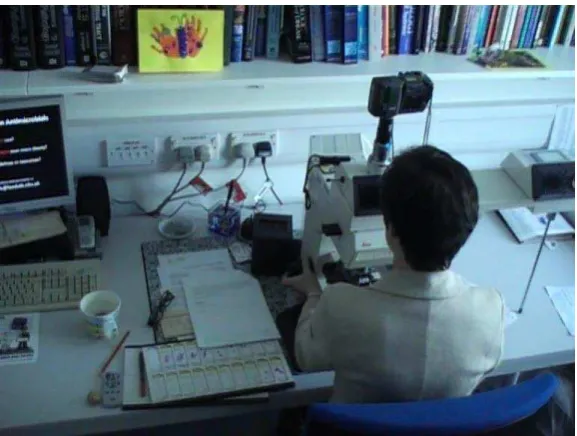
The pathologists were videoed in their offices undertaking their normal work. The video camera was set up by the researcher at the beginning of the session and the researcher then left the room, with the pathologist able to stop the video by remote control when they wanted. The video camera was placed on a tripod behind the pathologi
4 [Figure 1 should be placed approximately here]
In order to capture as realistically as possible the activities within the office, participants were asked to report cases in the usual way. The only exception to this was that two of the pathologists (Consultant 2 and Consultant 4) who normally use headsets with microphones to dictate were asked to report using a handheld dictaphone, in order to make it easier to identify when dictation was occurring. However, Consultant 2 continued reporting with a headset for practical reasons.
Analysis
Using Transana software, sections of video were indexed with descriptive codes, according to what was happening (e.g. viewing slides, dictating, looking at the clinical details). A
to coding was taken, determining appropriate codes as the analysis was conducted, as opposed to applying predefined codes.9 The data from Transana were imported into Excel in order to analyse the amount and percentage of time spent in different activities for the reporting of each case that was video recorded.
As the raw data showed considerable overlap between activities, two versions of the analysis were undertaken. Firstly, we considered only what was determined to be the predominant activity (defined as the activity taking the primary focus of the participant at any one time. For example, if the pathologist had viewed all the slides and then dictated his report while continuing to look at one slide on the microscope, we treated dictation as the predominant activity. If while viewing the slides on the microscope the pathologist made a momentary glance back to the paperwork for the case, we considered viewing slides to be the predominant activity. We then reran the analysis considering all activities occurring at any one time. This gives a better idea of the extent to which different resources (e.g. slides, paperwork) are used and referred to during reporting and does not rely on a subjective judgement of what is the predominant cognitive activity.
Findings
A total of 41 cases were video recorded. Six were long cases (3-47 slides (median 6) of complex resections), 18 were short cases (1-13 slides (median 2) with simple diagnoses) and 17 were gastrointestinal biopsies (1-4 slides, median 2). There was variability in the type of cases reported
5 2 did not report any long cases, while all other consultants except from Consultant 4 reported only one long case. Only Consultants 1 and 3 reported all 3 case types.
Time taken to complete a case varied from 1 minute 30 seconds to 56 minutes 19 seconds. The average duration for a case was 7 minutes 17 seconds and the median was 8 minutes 20 seconds. However, the mean duration for a case varied according to the type of case. As could be expected, mean duration for long cases was significantly greater than for GI biopsy cases or short cases, although mean duration per slide was fairly consistent (see Figure 2).
[Figure 2 should be placed approximately here]
How time was spent
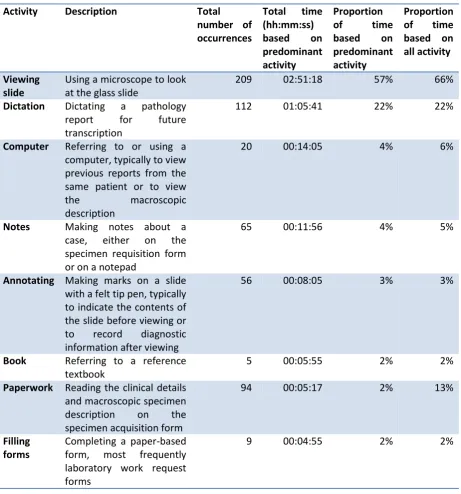
Based on analysis of the predominant activity, t
viewing slides, accounting for 57% of the time (see Table 1). The other main activity was dictating
reports, accounting for 22% T
activities as part of completing a case which, while they did not take up a significant amount of the throughout the cases. A frequently observed activity was that of making handwritten notes, accounting for 4 O
case, all pathologists recorded the diagnosis on the front of the request form. However, there were various other forms of handwritten notes: underlining of details on the paperwork prior to viewing the slides, notes made on the clinical details and on pads of paper while looking at the slides, presumably to support the subsequent dictating of the report, and notes on post-it notes then placed on the tray of slides, possibly requesting a second opinion from a colleague. Annotating slides
accounted for 3 T
order to assist navigating between different islands of tissue, while the slide was on the microscope to highlight features of interest, or after having viewed the slide. Referring to paperwork accounted
for only 2 ith other activities, occurring
a total of 94 times and ranging from a momentary glance lasting less than two seconds to just over 2 minutes.
[Table 1 should be placed approximately here]
6 spent in referring to paperwork, increasing from 2% to 13%, indicating that referring to paperwork is a task that is frequently done while also undertaking other activities. This is discussed further below.
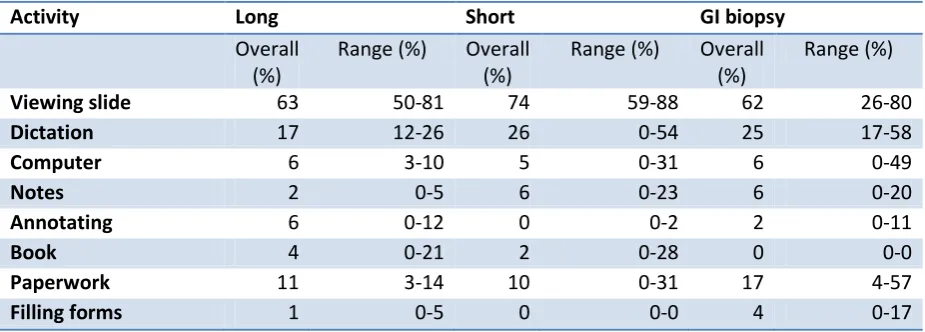
How time was spent varied according to case type (see Table 2). Based on analysis of overlapping activity, for short cases the proportion of time spent viewing slides was greater but a smaller proportion of time was spent annotating slides and no time was spent filling in forms. Time spent dictating varied, with a smaller proportion of time spent dictating long cases. With the long cases, the proportion of time spent in other activities (such as annotating slides and referring to books) increased.
[Table 2 should be placed approximately here]
How time was spent also varied according to the consultant. The proportion of time spent viewing slides, based on analysis of overlapping activity, varied from 58% to 77%, while time spent dictating varied from 17% to 33%. Consultant 2 did not use the computer at all, possibly undertaking all work at the computer either before or after the reporting session. Elsewhere we have highlighted the way in which some consultants choose to integrate the work at the computer and at the microscope, while others keep these two aspects of their work quite separate.10 Consultant 2 has a practice of keeping a notebook with the reference number and diagnosis of every case she sees, and as a result she spent 13% of her time making notes.
Overlapping of activities
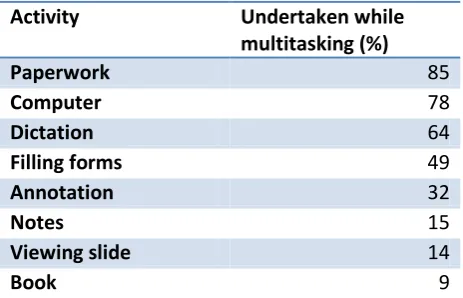
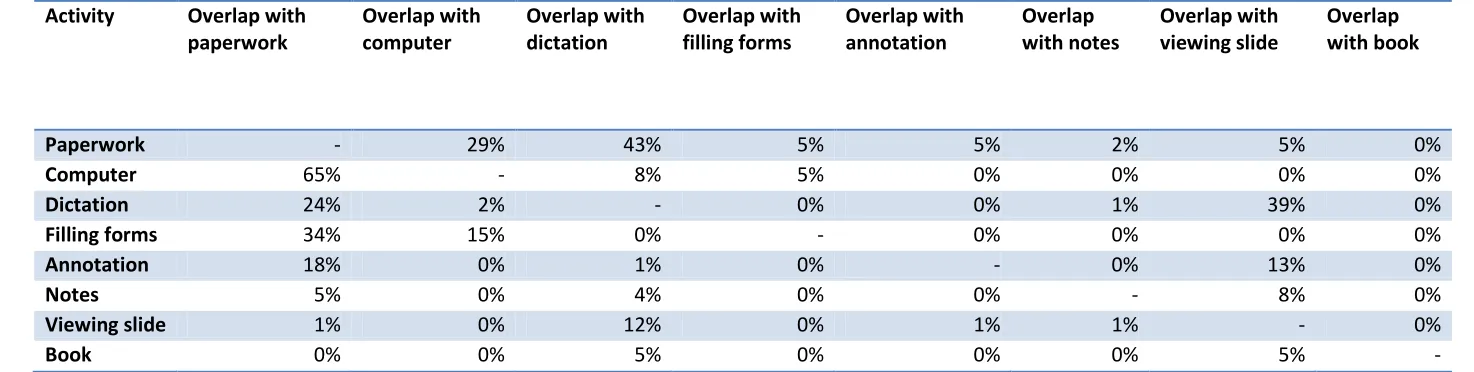
Referring to paperwork, using the computer, and dictating the report are the activities that most frequently occurred while another activity was being undertaken (see Table 3). Referring to paperwork most commonly overlapped with dictation, as the pathologists would read from the clinical details on the paperwork when beginning their reports (see Table 4). Dictation most commonly overlapped with viewing the slide and referring to paperwork. The extract from the timeline for Consultant 3 illustrates the overlapping of these three activities (see Figure 3). Using the computer most commonly overlapped with referring to paperwork, as the pathologists would use
the accession number
laboratory information system.
7 [Table 4 should be placed approximately here]
[Figure 3 should be placed approximately here]
Order of activities
The timelines show how dictation and paperwork are interspersed with viewing slides (Figures 3 5). Different patterns concerning when dictation began, and how it was interspersed with viewing slides, were observed. Consultant 1 dictated at the beginning and end of reporting each case, referring to the paperwork while dictating the clinical details at the beginning of reporting a case and looking at the slides when dictating at the end of reporting a case (see Figure 4). Like Consultant 1, Consultant 2 dictated at the beginning reporting each case, referring to the paperwork while dictating the clinical details, but then continued to move between viewing the slides and dictating (see Figure 5). In contrast, Consultants 3 and 5 tended to dictate only at the end of reporting a case (see Figure 3). The extract from the timeline for Consultant 3 also shows him repeatedly returning to the paperwork, in contrast to the pattern of Consultants 1 and 2.
[Figure 4 should be placed approximately here]
[Figure 5 should be placed approximately here]
Interaction features
Apparent from the videos w pathologist
microscope. The pathologists controlled the microscope, in terms of navigating the slide, changing magnification, and focusing, without looking at what they were doing, allowing them to keep their visual attention focused on the slide. They also frequently placed the slide on the microscope or took it off the microscope without looking at what they were doing. This supports multitasking, allowing them, for example, to be referring to the paperwork while placing the slide on the microscope or to be looking at the next slide in the tray while taking the slide off the microscope.
W pathologists to focus on viewing the slide,
the videos showed the pathologists frequently moving from viewing the slide through the microscope and glancing elsewhere, such as to refer to paperwork, before returning to the view the slide again. In talking to pathologists about the use of the microscope, often mentioned is the sense
8 suggest that pathologists frequently switch between being immersed in a slide and referring to other media.
Discussion
Implications for design
The findings highlight the range of activities involved in reporting a case, of which the viewing of
V .
When considering not only reporting time, this figure is likely to be a overestimation, due to the amount of time that is spent organising and prioritising cases prior to reporting.10 The implication of this is that digital microscopy systems should support not just the viewing of digital slides but also the other activities that are interweaved with that work. When viewing slides is the predominant activity for only 57% of the p , it limits the amount of time savings that can be made simply through improving the speed with which the pathologist is able to view the slide. If the additional activities are not taken into account and supported, we run the risk that any time savings in the time taken to view a slide will be outweighed by extra time taken in carrying out the surrounding activities.
Presently, pathologists use a microscope and a computer, as well as referring to a number of paper-based media, which has inherent expense and inefficiency. Apparent from looking at the findings is how many of the activities involved in reporting a case could easily be transferred to the computer. While use of the computer as a predominant activity only takes up 4% of the pat
the move to electronic patient records, we can imagine that referring to paperwork and filling in requests for additional work will in the future be computer-based. Similarly, use of digital dictation is increasing. Such changes would mean that for 43% of the time pathologists will be using, or at least referring to information held on, the computer. Thus, additional benefits of digital pathology are the amalgamation of two tools into one and the removal of paper-based processes.
The findings highlight that there is much overlapping of activities and that pathologists need to be able to refer to other media while viewing slides. Of particular importance is the provision of support for both dictating and referring to paperwork while viewing slides. The way in which the microscope enables the pathologists to easily move between being immersed in viewing the slide and not raises the question of what information should be displayed on a digital microscope and the layout and nature of the display. While the obvious solution is to provide all information relating to a case via
9 slide. An alternative is to have multiple displays, one for viewing slides and one for accessing other information relating to the case, as is currently done in radiology.11 The potential and impact of a range of approaches should be explored experimentally.
The ease with which pathologists interact with the microscope suggests that, for digital microscopy systems to be acceptable to pathologists, they should allow the same or a similar level of ease of
use. Li digital microscopy systems should allow the
pathologist to remain focused on the task, rather than focusing their attention on interacting with the technology. At the same time, the different patterns of working suggest the need for digital microscopy systems that are flexible, that pathologists are able to adapt to suit their practice.
Limitations
The findings presented here provide an understanding of the pathologist
in terms
that work. The methods used allowed us to capture naturalistic data with minimum disruption for the participants. What the use of video did not allow us to do was to capture some of the detail of what was happening, such as exactly what element of the paperwork they were referring to and the
what they were doing and why, and thus we have had to make assumptions about such details. We have subsequently gone on to carry out naturalistic observations, sitting with pathologists in their office as they undertake their work, in order to gather such detail. This has been reported elsewhere.10
Acknowledgements
We would like to thank the pathologists at Leeds Teaching Hospitals NHS Trust who enabled us to undertake this work by agreeing to participate in the study. This report is independent research commissioned by the National Institute for Health Research. The views expressed in this publication are those of the author(s) and not necessarily those of the NHS, the National Institute for Health Research or the Department of Health. The authors acknowledge the support of the National Institute for Health Research, through the Comprehensive Clinical Research Network.
Competing interests None to declare
References
1. Wells CA, Sowter C. Telepathology: a diagnostic tool for the millennium? The Journal of Pathology 2000;191;1-7.
10 3. Gilbertson J, Yagi Y. Histology, imaging and new diagnostic work-flows in pathology. Diagnostic Pathology 2008;3;S14.
4. Treanor D, Quirke P. The virtual slide and conventional microscope - a direct comparison of their diagnostic efficiency. Annual Meeting of the Pathological Society of Great Britain and Ireland. Glasgow, 2007.
5. Crowley RS, Naus GJ, Stewart J, III, Friedman CP. Development of Visual Diagnostic Expertise in Pathology - An Information-processing Study. J Am Med Inform Assoc 2003;10;39-51.
6. Krupinski EA, Tillack AA, Richter L et al. Eye-movement study and human performance using telepathology virtual slides. Implications for medical education and differences with experience. Human Pathology 2006;37;1543-1556.
7. Tiersma ESM, Peters AAW, Mooij HA, Fleuren GJ. Visualising scanning patterns of pathologists in the grading of cervical intraepithelial neoplasia. J Clin Pathol 2003;56;677-680. 8. Treanor D, Lim CH, Magee D, Bulpitt A, Quirke P. Tracking with virtual slides: a tool to study diagnostic error in histopathology. Histopathology 2009;55;37-45.
9. Miles MB, Huberman AM. Qualitative data analysis: an expanded sourcebook. 2nd ed. ed. Thousand Oaks, California: SAGE Publications, 1994.
10. Randell R, Ruddle RA, Thomas R, Treanor D. Diagnosis at the microscope: a workplace study of histopathology. Cognition, Technology & Work In press.
11
Activity Description Total
number of occurrences
Total time (hh:mm:ss) based on predominant activity
Proportion
of time
based on predominant activity
Proportion of time based on all activity
Viewing slide
Using a microscope to look at the glass slide
209 02:51:18 57% 66%
Dictation Dictating a pathology report for future transcription
112 01:05:41 22% 22%
Computer Referring to or using a computer, typically to view previous reports from the same patient or to view
the macroscopic
description
20 00:14:05 4% 6%
Notes Making notes about a case, either on the specimen requisition form or on a notepad
65 00:11:56 4% 5%
Annotating Making marks on a slide with a felt tip pen, typically to indicate the contents of the slide before viewing or to record diagnostic information after viewing
56 00:08:05 3% 3%
Book Referring to a reference textbook
5 00:05:55 2% 2%
Paperwork Reading the clinical details and macroscopic specimen description on the specimen acquisition form
94 00:05:17 2% 13%
Filling forms
Completing a paper-based form, most frequently laboratory work request forms
[image:12.595.69.531.94.589.2]9 00:04:55 2% 2%
12
Activity Long Short GI biopsy
Overall (%)
Range (%) Overall (%)
Range (%) Overall (%)
Range (%)
Viewing slide 63 50-81 74 59-88 62 26-80
Dictation 17 12-26 26 0-54 25 17-58
Computer 6 3-10 5 0-31 6 0-49
Notes 2 0-5 6 0-23 6 0-20
Annotating 6 0-12 0 0-2 2 0-11
Book 4 0-21 2 0-28 0 0-0
Paperwork 11 3-14 10 0-31 17 4-57
[image:13.595.67.530.97.263.2]Filling forms 1 0-5 0 0-0 4 0-17
13
Activity Undertaken while
multitasking (%)
Paperwork 85
Computer 78
Dictation 64
Filling forms 49
Annotation 32
Notes 15
Viewing slide 14
[image:14.595.67.299.97.246.2]Book 9
Activity Overlap with paperwork
Overlap with computer
Overlap with dictation
Overlap with filling forms
Overlap with annotation
Overlap with notes
Overlap with viewing slide
Overlap with book
Paperwork - 29% 43% 5% 5% 2% 5% 0%
Computer 65% - 8% 5% 0% 0% 0% 0%
Dictation 24% 2% - 0% 0% 1% 39% 0%
Filling forms 34% 15% 0% - 0% 0% 0% 0%
Annotation 18% 0% 1% 0% - 0% 13% 0%
Notes 5% 0% 4% 0% 0% - 8% 0%
Viewing slide 1% 0% 12% 0% 1% 1% - 0%
[image:15.842.50.787.98.284.2]Book 0% 0% 5% 0% 0% 0% 5% -