Extensible Automated Constraint Modelling
Ozgur Akgun
[email protected]University of St. Andrews
Ian Miguel
[email protected]University of St. Andrews
Chris Jefferson
[email protected] University of St. AndrewsAlan M. Frisch
[email protected]University of York
Brahim Hnich
[email protected] Izmir University of EconomicsAbstract
In constraint solving, a critical bottleneck is the formulation of an effective constraint model of a given problem. The CONJUREsystem described in this paper, a substantial step forward over prototype versions of CONJUREpreviously re-ported, makes a valuable contribution to the automation of constraint modelling by automatically producing constraint models from their specifications in the abstract constraint specification language ESSENCE. A set of rules is used to re-finean abstract specification into a concrete constraint model. We demonstrate that this set of rules is readily extensible to increase the space of possible constraint models CONJURE
can produce. Our empirical results confirm that CONJURE
can reproduce successfully the kernels of the constraint mod-els of 32 benchmark problems found in the literature.
Introduction
This paper attacks the problem of overcoming themodelling bottleneckthrough automating the constraint modelling pro-cess. In constraint solving, a critical bottleneck is the for-mulation of an effective constraint model of a given prob-lem. This is considered to be one of the key challenges fac-ing the constraints field (Puget 2004), and one of the princi-pal obstacles preventing widespread adoption of constraint solving. Without help, it is very difficult for a novice user to formulate an effective (or even correct) model of a given problem. Recently, a variety of approaches have been taken to automate aspects of constraint modelling, including: ma-chine learning (Bessiere et al. 2006); case-based reason-ing (Little et al. 2003); theorem provreason-ing (Charnley, Colton, and Miguel 2006); automated transformation of medium-level solver-independent constraint models (Rendl 2010; Nethercote et al. 2007; Van Hentenryck 1999; Mills et al. 1999); and refinement of abstract constraint specifi-cations (Frisch et al. 2005a) in languages such as ESRA (Flener, Pearson, and ˚Agren 2003), ESSENCE (Frisch et al. 2008),F (Hnich 2003) or Zinc (Marriott et al. 2008; Koninck, Brand, and Stuckey 2010).
We focus on the refinement-based approach, in which a user writesabstractconstraint specifications that describe a problem above the level at which modelling decisions are
Copyright c2011, Association for the Advancement of Artificial Intelligence (www.aaai.org). All rights reserved.
given co,ca: int
letting item be new type of size co letting nat be domain int(1..)
given vol,val: function (total) item → nat find x: set of item
maximising i : x . val(i) such that ( i : x . vol(i)) ≤ ca
Figure 1: The knapsack problem, given in ESSENCE
made. Abstract constraint specification languages, such as ESSENCE, and to a lesser extent Zinc, support abstract
de-cision variables with types such as set, multiset, function, and relation, as well asnestedtypes, such as set of sets and multiset of functions. Problems can typically be specified very concisely in this way, as demonstrated by the exam-ple in Fig. 1. However, existing constraint solvers do not support these abstract decision variables directly, so abstract constraint specifications must berefinedinto concrete con-straint models.
CONJURE was introduced in prototype form by Frisch et al. (2005a). It was able to refine a fragment of ESSENCElimited to nested set and multiset decision vari-ables into models in ESSENCE, a solver-independent mod-elling language. Subsequent work (Mart´ınez-Hern´andez and Frisch 2007; Mart´ınez-Hern´andez 2008), considered issues involved in automatically channelling among different rep-resentations of abstract variables. The subject of this paper is CONJURE1.0, a major step forward over the previously reported prototypes (henceforth CONJURE 0.X). We sum-marise its contributions:
Coverage of ESSENCE: CONJURE 1.0 is able to refine
all ESSENCE specifications. Whereas CONJURE 0.X
demonstrated that refinement could handle types with un-bounded nesting, CONJURE1.0 confirms that refinement can handle all features of ESSENCE.
Extensible Domain-specific Rule Language: The rules used by CONJURE 1.0 are expressed in a new domain-specific declarative language. In contrast each CONJURE
straightforward addition of new rules to extend the space of possible constraint models CONJUREcan produce.
Refinement at a Finer Grain: CONJURE 0.X performed refinement at the level of an individual constraint. This greatly inflates the size of the rule base unnecessarily. Moreover, it requires constraints to be flattened prior to refinement – that is decomposing nested expressions into atomic constraints through the introduction of auxiliary variables As we will show, this process can mask the structure of the original specification and lead to weaker models. By contrast, CONJURE1.0 rewrites expressions rather than essentially entire constraints, which both re-duces the number of rules required and allows us to ex-ploit specification structure to the benefit of the models generated.
Extensive Evaluation: Our working hypothesis is that the kernels1of constraint models generated by experts can be automatically generated by refining a problem’s specifi-cation. The much broader coverage of ESSENCEafforded by CONJURE1.0 has allowed us to test this hypothesis in much greater detail than previously.
Background
ESSENCE (Frisch et al. 2008) is a language for specifying combinatorial (decision or optimisation) problems. It has a high level of abstraction to allow users to specify problems
withoutmaking constraint modelling decisions, supporting decision variables whose types match the combinatorial ob-jects problems typically ask us to find, such as: sets, mul-tisets, functions, relations and partitions. First introduced by the language is its support for thenestingof these types, allowing decision variables of type set of sets, multiset of sets of functions, etc. Hence, problems such as the So-cial Golfers Problem (Harvey 2001), which is naturally con-ceived of as finding a set of partitions of golfers subject to some constraints, can be specified directly without the need to model the sets or partitions as matrices.
An ESSENCE specification (see (Frisch et al. 2008) for full details), such as that in Fig. 1, identifies: the parame-ters of the problem class (given), whose values are input to specify the instance of the class; the combinatorial objects to be found (find); and the constraints the objects must sat-isfy to be a solution (such that). An objective function may also be specified (min/maximising) and, for conci-sion, identifiers may be declared (letting).
Today’s constraint solvers typically support decision vari-ables with atomic types, such as integer or Boolean, have limited support for more complex types like sets or multi-sets, and no support for nested complex types. Hence, ab-stract specifications are refined by modelling abstract de-cision variables as constrained collections of variables of unnested primitive types. CONJURE1.0, like CONJURE0.X, employs a system of rules to refine ESSENCEspecifications into constraint models in ESSENCE (Rendl 2010), a lan-guage derived from ESSENCE mainly by removing
facili-1
By which we mean to exclude advanced features of models, such as symmetry breaking and implied constraints.
ties for abstraction and adding facilities common to existing constraint solvers and toolkits. From ESSENCE a tool such as TAILOR(Rendl 2010) can be used to translate the model into the format required for a particular constraint solver.
An abstract specification typically can be implemented by many alternative concrete constraint models. CONJUREis intended to generate these alternatives by providing multiple refinement rules for each abstract type, corresponding to the various ways in which a decision variable of that type can be modelled. Furthermore, for each way of modelling the decision variables there can be multiple rules to generate al-ternative models for a constraint on those variables. Conse-quently, CONJUREoften generates many alternative models for an input specification. We aim to encode each rule that for some problem is used in the generation of some good (or perhaps reasonable) model. Given a problem specification and a set of rules the system generates all possible models. If we have encoded a sufficient set of rules, then the kernels of all good (or reasonable) models of the problem should be contained within the set of models. In future, we will inves-tigate restricting this set to goodmodels and the selection of either one recommended model or a portfolio of models with complementary strengths.
The C
ONJURE1.0 Architecture
CONJURE1.0 is structured like a compiler. Its pipeline starts with parsing, validating the input, and type-checking. After these foundation phases, it prepares the input specification for, and performs, refinement, and does some housekeeping:
1. Parsing 2. Validation
- Are all identifiers defined?
- Check consistency of declarations. e.g. a function vari-able cannot be declared both total and partial.
3. Type Checking 4. Refinement 5. Model Presentation
Phases 1–3 are foundational, while Phase 5 aids perspicu-ity. Phase 4 is the core of the refinement process, and is the focus of the remainder of the paper. It consists of multiple reentrant levels: following each rule application the process returns to Phase 4i) in case the result of the rule requires the attention of any of the other levels. We summarise Phase 4:
4i) Partial Evaluation CONJURE 1.0 contains a partial evaluator for ESSENCE. This not only simplifies the out-put models, but also saves the system from applying rules to expressions that can be evaluated readily.
4ii) Representation Selection Refinement of an abstract expression depends crucially on the representation of the abstract decision variables and parameters it involves. Hence, it is natural2 to select decision variable repre-sentations first. This also simplifies the generation of channelling constraints (Level iii) considerably. Typically
structural constraints are added to the variables in the
2
concrete representation to ensure that the abstract variable is properly represented. For example, if a set of cardinal-itynis represented by a matrixMcontainingnelements then the structural constraintalldifferent(M)needs to be added.
4iii) Auto-Channelling Since different occurrences of a variable can have different representations, constraints are necessary to maintain consistency among these dif-ferent representations. Such constraints are called chan-nelling constraints (Cheng et al. 1999). Following previous work (Mart´ınez-Hern´andez and Frisch 2007; Mart´ınez-Hern´andez 2008), channelling constraints are generated simply by constraining the different represen-tations of each abstract variable so that they represent the same abstract object. The resultant equality constraints are refined in the same way as any other constraint in the problem specification.
4iv) Expression Refinement Having decided on the repre-sentation of each abstract decision variable, it remains to refine the expressions that contain them. Transforma-tions are applied to expressions in a bottom-up manner; namely, smaller expressions constructing larger ones are dealt with earlier in the process. We preserve the ability to apply transformations to larger expressions before their components using rule precedences. Every expression transformation has an associated precedence level and a transformation at a higher precedence level is guaranteed to be applied before those with at relatively lower prece-dence level by the refinement process.
In order to produce multiple models, refinement branches in two places in Phase 4: Representation Selection and Ex-pression Refinement. Depending on the rules available in the rule base, each abstract decision variable and each ex-pression can be refined in several alternative ways.
A Rule Language for Refinement
To represent the rules at the heart of CONJURE1.0, we de-signed a new domain-specific language3 that provides all and only the facilities we require, rather than use a general system like Cadmium (Duck, Koninck, and Stuckey 2008). CONJUREis run by inputting an ESSENCEspecification and a set of rules. This arrangement facilitates the straightfor-ward addition of new rules to extend the space of models CONJUREcan produce, as the next section demonstrates.
All CONJURErules adhere to a single template:
<pattern> [; <output>]* [where <guards>] [letting <local identifiers>]
A rule rewrites an expression that matches against
pattern, producing one or more outputs provided the
guards are satisfied. A pattern is very similar to an
ESSENCE domain or expression, but may contain meta-variables, identifiers which will be bound to domains or ex-pressions once the pattern matching is performed. To illus-trate, the expressionx∪y =z∩tcan be matched against
3
As noted, CONJURE0.X’s rules were written as fragments of Haskell. Some primitive rules, such as those dealing with partial evaluation, are built into CONJURE1.0 for efficiency.
the expression patterna=b, whereais bound tox∪yand
bis bound toz∩t. It can also be matched againsta∪b=c, whereais bound tox,bis bound toyandcis bound toz∩t. Both the expressions and patterns use the common operator precedences. Pattern matching on domains, used exclusively by the representation selection rules, operates similarly. The domainset of int(x..y+z)can be matched against the do-main patternset of int(a..b), whereais bound toxand b is bound toy+z. The same domain can also be matched against the domain patternset of t, where t is bound to the domain int(x..y+z). Notice, in both ESSENCE and the refinement rule language used by CONJURE, identifiers can refer to both expressions and domains.
Local identifiers are used for concision and to identify new variables created by the refinement process. Based upon this template, the CONJURErule base contains three types of rule:
Representation Selection Rules label an occurrence of an abstract decision variable in a constraint expression with one of its possible refinements, and add structural con-straints to the model associated with that refinement.
Vertical Rules rewrite an expression, reducingits level of abstraction. The expression is rewritten with respect to the labels associated with its constituent variables by the representation selection rules.
Horizontal Rules rewrite an expression withoutchanging its level of abstraction. These rules are used to reduce the number of vertical rules required. It is important to de-crease the number of vertical rules required, since vertical rules need to be given per representation whereas horizon-tal rules are independent of representation and are only given once and used for all representations.
Thanks to the horizontal rules, expressions involving any ESSENCEoperator are transformed to equivalent expres-sions containing a smaller set of operators. This transfor-mation enables us to use far fewer vertical rules and still be able to refine all valid expressions written in the input language.
The rule language defines a few operators, used mostly for accessing properties of their arguments. The operators used in this paper and their semantics are briefly defined here. Rule language operators are executed at the time of rule application.
refn can be used in both vertical rules and representation selection rules.
• In a vertical rule, it accepts an abstract decision variable or a parameter as the argument and returns the refined version.
• In a representation selection rule, it used without any arguments and returns the refined version of the ab-stract variable or parameter to which the rule is applied.
indices returns a k-tuple containing the ranges of the in-dex values of a k-dimensional matrix. The usual tuple projection operator ([]) can be used to access individual elements of the returned value.
:: is an infix operator to check type constructor matching. Accepts two arguments, an expression and a type con-structor name and returns a Boolean value.
domSize accepts a finite domain as an argument, and re-turns the number of elements in this domain.
We will explain and illustrate the operation of each of the three types of rule by means of an example involving the refinement of the following simple ESSENCEspecification:
given x,y : int(0..9)
find f : function (total) int(0..9) → int(0..9) such that f(x) = y, |preimage(f,x)| = y
This specification contains two constraints and a single abstract decision variablef, a total functionfmapping dig-its to digdig-its.preimage(f,x)is the set of all values that are mapped toxbyf.
This is a trivial problem, but it serves to illustrate the re-finement process. After parsing, validation and type check-ing, CONJUREarrives at the refinement phase.
Representa-tion selecRepresenta-tion rules are the first to be applied, in Phase 4ii. Consider the following pair of representation selection rules for total functions, which encode one- and two-dimensional matrix representations of a function respectively.
function (total) fr → to ; Matrix1D
; matrix indexed by [fr] of to where fr :: int
function (total) fr → to ; Matrix2D
; matrix indexed by [fr,to] of bool ; ∀ i : fr . (( j : to . refn[i,j]) = 1) where fr :: int, to :: int
These rules output the identifiers for the representation (Matrix1DandMatrix2D), the variables in the representa-tion and the structural constraints on these variables, if any. The operatorrefnreturns the refined version of the abstract variable to which the representation selection rule is applied. The 1-d matrix is indexed by the domain of the original function whose elements are decision variables with domain equal to the range of the original function. Hence,f(i)=v is represented by assigning the ith element of the matrix
v. Since the matrices supported by ESSENCE are indexed
by integers, there is a guard requiring that the function has an integer domain. There is no such guard on the range of the function — it might have an arbitrarily complex type, in which case the 1-d matrix will be further refined.
The 2-d matrix is indexed by the domain and range of the original function, hence both are required to have an integer domain. Each element of the matrix is a Boolean variable
andf(i) = vis represented asm[i,v] = true. This rule
has a third output, a structural constraint that ensures the function is total. This is not necessary in the 1-d representa-tion because each variable must be assigned a value.
In the constraints in the specification, there are two occur-rences off. Either of the two rules above may fire on either occurrence, hence refinement branches four ways. We will focus on a single branch in which the 1-d rule has fired on the occurrence in the first constraint, and the 2-d rule has fired on the occurrence in the second. Since the same ab-stract variable is being represented in two different ways, a channelling constraint is required, and is added in Level iii, giving the intermediate specification:
given x,y: int(0..9)
find f : function (total) int(0..9) → int(0..9) find f1: matrix indexed by [int(0..9)] of int(0..9) find f2: matrix indexed by [int(0..9),int(0..9)] of bool such that
f#Matrix1D(x) = y,
|preimage(f#Matrix2D,x)| = y,
∀ i: int(0..9) . ((j: int(0..9) . f2[i,j]) = 1), f#Matrix1D = f#Matrix2D
For demonstration purposes, occurrences of f in unre-fined expressions are labelled using a hash sign with their chosen representation. For instance in the above intermedi-ate problem specificationf#Matrix1Dmeans the instance of decision variablefwith representationMatrix1D. The vertical rules use the labels to refine these expressions with respect to their chosen representations. To illustrate, con-sider this vertical rule for function application, where the 1-d matrix representation has been selected for the function:
f(i) ; refn(f)[i]
where f :: function, repr(f) = Matrix1D
Here, refn(f#Matrix1D) returns the corresponding
concrete variable,f1. Similarly,repr(f)returns the identi-fier for the representation chosen, corresponding to the first output of the representation selection rules. Following the application of the above rule, the first constraint is rewritten to:
f1[x] = y
We now consider an example of a horizontal rule:
|s| ; i : s . 1 where s :: set
This rule replaces the cardinality operator with a summa-tion counting the elements in the set, eliminating the need for a dedicated vertical rule for cardinality. This horizontal rule doesn’t result in a poorer model compared to a dedicated vertical rule, it simply decreases the number of vertical rules required. Following its application, the second constraint becomes:
(i : preimage(f#Matrix2D,x) . 1) = y,
The following is a vertical rule to refine quantification over inverse function application:
i : preimage(f,j) . k ; i : r . m[i,j] * k where f :: function, repr(f) = Matrix2D letting m be refn(f), r be indices(m)[1]
Note the introduction of local identifiers,mandr, for con-cision. This rule operates in the context of the selection of
theMatrix2Drepresentation, transforming the sum over the
i : int(0..9) . f2[i,x] = y
Partial evaluation has removed the redundant1. Finally, we demonstrate the refinement of the channelling constraint between the two representations of the same abstract deci-sion variable. The following horizontal rule removes the need for a vertical rule between every pair or representations for function variables. It transforms an equality between two functions to a universal quantification over the intersection of values being mapped by these two functions and imposing equality on the actual mappings.
a = b ; (defined(a) = defined(b))
∧ ∀ i : defined(a) . (a(i) = b(i)) where a :: function, b :: function
When applied to the last constraint a is substituted by
f#Matrix1Dandbis substituted byf#Matrix2D. The first
component of the conjunction is then evaluatedtrue and subsequently removed from the conjunction. Furthermore,
defined(f#Matrix1D)is replaced withint(0..9)asf
is a total function. Eventually, the channeling constraint is transformed to the following.
∀ i : int(0..9) . (f#Matrix1D(i) = f#Matrix2D(i))
The vertical rule for handling function application is al-ready given forMatrix1D. The following is a similar rule
forMatrix2D.
f(i) ; j : r . m[i,j] * j
where f :: function, repr(f) = Matrix2D letting m be refn(f), r be indices(m)[1]
After the function applications are refined,
∀ i: int(0..9). (f1[i] = ( j: int(0..9). f2[i,j] * j)) This expression is now in normal form, namely, no other rule is applicable to it. The final model generated is:
given x,y: int(0..9)
find f1: matrix indexed by [int(0..9)] of int(0..9) find f2: matrix indexed by [int(0..9),int(0..9)] of bool such that
f1[x] = y,
( i: int(0..9) . f2[i,x]) = y,
∀ i: int(0..9) . (( j: int(0..9) . f2[i,j]) = 1), ∀ i: int(0..9). f1[i] = ( j: int(0..9). f2[i,j] * j)
CONJUREautomatically removes the find fstatement whenfno longer occurs in any of the constraints.
The output of CONJURE is ESSENCE annotated with somemetadata. The metadata enables any solution to an instance of an ESSENCE model to be automatically re-expressed as a solution to the original ESSENCE specifica-tion. The metadata are inserted to the output model file as line comments and tools dealing with ESSENCE input are simply expected to ignore them.
The C
ONJURERule Base and Its Extension
Refining ESSENCE specifications is a complex task. In or-der to cover the entire ESSENCElanguage, CONJUREmust be able to cope with arbitrarily nested expressions of de-cision variables with arbitrarily nested abstract types. In order to deal with this complexity, CONJURE0.X resortedtoflatteningan input specification: decomposing nested ex-pressions into atomic constraints through the introduction of auxiliary variables. A refinement rule was then provided for each flat constraint (for the fragment of ESSENCEthat CON
-JURE0.X considered). However, the flattening process can mask the structure of the original specification and lead to weaker models as the following example demonstrates.
Consider the constraint:(a ∪ b) ⊆ (c ∩ d). Flatten-ing this constraint gives the constraintsaux0 = a ∪ b,
aux1 = c ∩ d, aux0 ⊆ aux1 containing two auxiliary
set variables. This is expensive: each auxiliary set variable incurs the cost of a set of concrete variables and constraints to represent it. This cost increases considerably if the sets have nested types. If we do not flatten, we can use horizon-tal rules to rewrite the expression to a far more efficient pair of quantified expressions:
∀ i : a . (i ∈ c ∧ i ∈ d), ∀ i : b . (i ∈ c ∧ i ∈ d)
As we have seen, therefore, CONJURE 1.0 refines at a
finer grainthan CONJURE0.X, refining expressions rather than entire constraints, hence eliminating the need for flat-tening. Even so, a large number of rules are ostensibly re-quired to refine all of ESSENCE. The key to reducing this number are the horizontal rules, which rewrite expressions into a form for which we have a vertical rule, as per the car-dinality horizontal rule in the previous section. Horizontal rules arerepresentation independent— a horizontal rewrite of an expression is valid irrespective of the concrete repre-sentation of its constituent variables. Hence, the horizontal rules reduce the set of vertical rules required and the set of horizontal rules does not grow as new representations are added.
Using horizontal rules we have been able to reduce the set of rules required for each ESSENCE type. For each repre-sentation of an abstract type, a reprerepre-sentation selection rule is required as well as a small set of vertical rules. For set, multiset, relation, and partition variables, one vertical rule per quantifier is necessary. For functions, vertical rules are required for function application, quantification over the in-verse of the function and quantification over the ‘defined’ el-ements of a partial function. Consequently, at present CON
-JURE1.0 has 37 representation selection rules, and 96 verti-cal and horizontal rules.
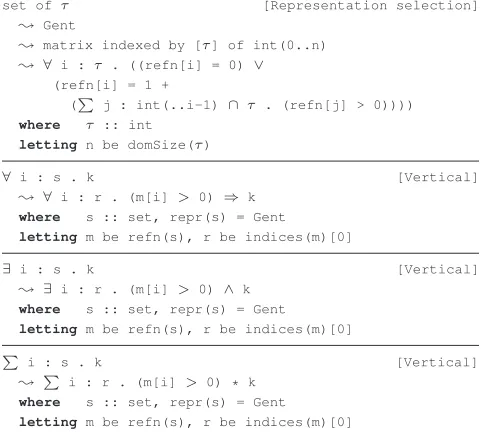
The use of horizontal rules to keep vertical rules to a min-imum also reduces the effort of adding new representations to the system. To illustrate, consider adding rules to sup-port the Gent representation of sets (Jefferson 2007). The properties of this representation are irrelevant — this exam-ple is chosen as being a non-trivial, unusual representation of a set typical of a representation one might wish to add to those already present in the rule base. In brief, a setS
of integers drawn from some range d is represented by a matrixg, indexed byd, of decision variables with domain
0..n, wherenis either the fixed or the maximum cardinal-ity of S. Element i is in S iffg[i] is non-zero. Further-more, the non-zero elements ofg are required to be in as-cending order. If, for example,S = {1,2,4}, drawn from
set of τ [Representation selection] ; Gent
; matrix indexed by [τ] of int(0..n) ; ∀ i : τ . ((refn[i] = 0) ∨
(refn[i] = 1 +
( j : int(..i-1) ∩ τ . (refn[j] > 0)))) where τ :: int
letting n be domSize(τ)
∀ i : s . k [Vertical]
; ∀ i : r . (m[i] > 0) ⇒ k where s :: set, repr(s) = Gent letting m be refn(s), r be indices(m)[0]
∃ i : s . k [Vertical]
; ∃ i : r . (m[i] > 0) ∧ k where s :: set, repr(s) = Gent letting m be refn(s), r be indices(m)[0]
i : s . k [Vertical]
[image:6.612.53.296.54.272.2]; i : r . (m[i]> 0) * k where s :: set, repr(s) = Gent letting m be refn(s), r be indices(m)[0]
Figure 2: The four refinement rules sufficient to integrate the Gent representation of sets into CONJURE.
Gent representation fully into CONJURE 1.0 (Fig.2), such that any of the set operators available in ESSENCE can be refined. In this respect, CONJURE1.0 is clearly superior to Conjure 0.X, which would require a distinct rule for every operator and for every combination of representations of the arguments of that operator. We estimate that CONJURE0.X would require up to 85 rules to add the Gent representation in addition to the existing two set representations. Adding a fourth representation to CONJURE0.X would require even more rules.
Evaluation
A milestone achieved uniqely by CONJURE1.0 is full cover-age of ESSENCE: it has at least one variable representation
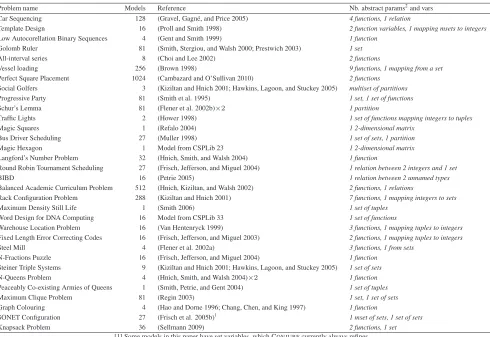
rule for every abstract variable type, and rules for the oper-ators defined on them. We now test the hypothesis that the kernels of constraint models written by experts can be au-tomatically generated by refining a problem’s specification. We wrote specifications for a diverse set of 32 benchmark problems drawn from the literature and refined them with CONJURE. Table 1 presents the results: the number of gen-erated models, papers that contain a kernel CONJURE1.0 generate and the abstract parameters and variables involved in the problem. Papers containing nkernels generated by CONJURE 1.0 are labelled×n. Notice the variety of de-cision variable types involved in the benchmark problems, representing a proof that the current collection of rules, the rewrite rule language, and the Conjure system as a whole is capable of refining a variety of abstract problem specifica-tions into concrete models.
The number of models generated for a problem specifi-cation depends on the number of representation options for the involved abstract decision variables. For instance, the
Maximum Density Still Lifecontains a set decision variable
whose elements are tuples and currently the system has only one variable selection rule that matches this type. Problems such asMagic Hexagononly contain decision variables that are concrete, so do not require refinement. We did find pa-pers containing kernels which we are currently unable to generate, for example forLangford’s Number Problemand
Maximum Density Still Life. These come from complex re-formulations of the problem. In each of these cases, an al-ternative ESSENCEspecification would allow CONJUREto generate the missing kernel.
Further research is necessary to improve the quality of generated models. This is not surprising since producing a good model is well known to be difficult even by human modellers. We have established that good rewrite rules are applicable to many problems and we hope as our refinement rules database improves further, we will produce better mod-els for all problems.
The following is an example where a specific rule helps producing better models. A common method of iterating over pairs of distinct elements in a set is to use an expres-sion like∀i,j: s.(i = j) ⇒k. Constraints of this form
arise in many problems, includingGolomb rulerandSocial golfers. Our standard rules would refinei = jusing the representation chosen for the elements ofs, which can lead to a complex constraint. However, ifsis represented with the explicit representation theni=jis true if and only ifi andjare represented by different elements of the matrix in the refinement. This leads to the rule:
∀ i,j : s . (i = j) ⇒ k ;
∀ i’,j’ : r . (i’ = j’) ⇒ k {i → m[i’],j → m[j’]} where s :: set, repr(s) = Explicit
letting m be refn(s), r be indices(m)[0]
The substitution operator used in the above rule is a part of the rule language:a {b → c}replaces every occurrence ofbfound inawithc.
Conclusion and Future Work
We have presented the CONJURE1.0 automated constraint
modelling system and demonstrated its ability to reproduce the kernels of the constraint models of 32 benchmark prob-lems found in the literature. It achieves full coverage of the ESSENCElanguage via a new domain-specific rule lan-guage, whose features include: fine-grained refinement to avoid the need for flattening, which, as we have demon-strated, can impair the models produced; horizontal rules that normalise expressions to reduce considerably the total number of rules necessary for refinement; easy extensibility. In future we of course wish to go beyond model kernels to produce full models of the same quality as those found in the literature, including symmetry breaking and implied constraints. CONJURE’s flexible rule-based architecture is
Table 1: Runnning CONJUREon benchmark problems.
Problem name Models Reference Nb. abstract params2and vars
Car Sequencing 128 (Gravel, Gagn´e, and Price 2005) 4 functions, 1 relation
Template Design 16 (Proll and Smith 1998) 2 function variables, 1 mapping msets to integers
Low Autocorellation Binary Sequences 4 (Gent and Smith 1999) 1 function
Golomb Ruler 81 (Smith, Stergiou, and Walsh 2000; Prestwich 2003) 1 set
All-interval series 8 (Choi and Lee 2002) 2 functions
Vessel loading 256 (Brown 1998) 9 functions, 1 mapping from a set
Perfect Square Placement 1024 (Cambazard and O’Sullivan 2010) 2 functions
Social Golfers 3 (Kiziltan and Hnich 2001; Hawkins, Lagoon, and Stuckey 2005) multiset of partitions
Progressive Party 81 (Smith et al. 1995) 1 set, 1 set of functions
Schur’s Lemma 81 (Flener et al. 2002b)×2 1 partition
Traffic Lights 2 (Hower 1998) 1 set of functions mapping integers to tuples
Magic Squares 1 (Refalo 2004) 1 2-dimensional matrix
Bus Driver Scheduling 27 (Muller 1998) 1 set of sets, 1 partition
Magic Hexagon 1 Model from CSPLib 23 1 2-dimensional matrix
Langford’s Number Problem 32 (Hnich, Smith, and Walsh 2004) 1 function
Round Robin Tournament Scheduling 27 (Frisch, Jefferson, and Miguel 2004) 1 relation between 2 integers and 1 set
BIBD 16 (Petrie 2005) 1 relation between 2 unnamed types
Balanced Academic Curriculum Problem 512 (Hnich, Kiziltan, and Walsh 2002) 2 functions, 1 relations
Rack Configuration Problem 288 (Kiziltan and Hnich 2001) 7 functions, 1 mapping integers to sets
Maximum Density Still Life 1 (Smith 2006) 1 set of tuples
Word Design for DNA Computing 16 Model from CSPLib 33 1 set of functions
Warehouse Location Problem 16 (Van Hentenryck 1999) 3 functions, 1 mapping tuples to integers
Fixed Length Error Correcting Codes 16 (Frisch, Jefferson, and Miguel 2003) 2 functions, 1 mapping tuples to integers
Steel Mill 4 (Flener et al. 2002a) 3 functions, 1 from sets
N-Fractions Puzzle 16 (Frisch, Jefferson, and Miguel 2004) 1 function
Steiner Triple Systems 9 (Kiziltan and Hnich 2001; Hawkins, Lagoon, and Stuckey 2005) 1 set of sets
N-Queens Problem 4 (Hnich, Smith, and Walsh 2004)×2 1 function
Peaceably Co-existing Armies of Queens 1 (Smith, Petrie, and Gent 2004) 1 set of tuples
Maximum Clique Problem 81 (Regin 2003) 1 set, 1 set of sets
Graph Colouring 4 (Hao and Dorne 1996; Chang, Chen, and King 1997) 1 function
SONET Configuration 27 (Frisch et al. 2005b)1 1 mset of sets, 1 set of sets
Knapsack Problem 36 (Sellmann 2009) 2 functions, 1 set
[1] Some models in this paper have set variables, which CONJUREcurrently always refines.
[2] Since CONJUREoperates at the problem class level, problem parameters need to be refined as well as decision variables.
Acknowledgements
Ozgur Akgun is supported be a Scottish Informatics and Computer Science Alliance (SICSA) scholarship. This re-search is supported by UK EPSRC grant no EP/H004092/1.
References
Bessiere, C.; Coletta, R.; Koriche, F.; and Sullivan, B. O. 2006. Acquiring constraint networks using a SAT-based ver-sion space algorithm. InAAAI 2006, 1565–1568.
Brown, K. N. 1998. Loading supply vessels by forward checking and unenforced guillotine cuts. In17th Workshop of the UK Planning and Scheduling SIG.
Cambazard, H., and O’Sullivan, B. 2010. Propagating the Bin Packing Constraint Using Linear Programming. InCP 2010. 129–136.
Chang, C.-M.; Chen, C.-M.; and King, C.-T. 1997. Using integer linear programming for instruction scheduling and register allocation in multi-issue processors.Computers and Mathematics with Applications34(9):1 – 14.
Charnley, J.; Colton, S.; and Miguel, I. 2006. Automatic generation of implied constraints. InProc. of ECAI 2006, 73–77. IOS Press.
Cheng, B.; Choi, K. M. F.; Lee, J. H. M.; and Wu, J. C. K. 1999. Increasing constraint propagation by redundant mod-eling: an experience report. Constraints4(2):167–192. Choi, C., and Lee, J. 2002. On the pruning behaviour of minimal combined models for permutation csps. InCP 2002 Workshop on Reformulation.
Duck, G. J.; Koninck, L. D.; and Stuckey, P. J. 2008. Cad-mium: An implementation of acd term rewriting. InICLP, 531–545.
Flener, P.; Frisch, A. M.; Hnich, B.; Kiziltan, Z.; Miguel, I.; and Walsh, T. 2002a. Matrix modelling: Exploiting common patterns in constraint programming. Inthe Inter-national Workshop on Reformulating CSPs, 27–41.
Flener, P.; Frisch, A. M.; Hnich, B.; Kiziltan, Z.; Miguel, I.; Pearson, J.; and Walsh, T. 2002b. Breaking row and column symmetries in matrix models. InCP 2002, 462–476. Flener, P.; Pearson, J.; and ˚Agren, M. 2003. Introduc-ingESRA, a relational language for modelling combinatorial problems. InLOPSTR 2003, 214–232.
Frisch, A. M.; Hnich, B.; Miguel, I.; Smith, B. M.; and Walsh, T. 2005b. Transforming and refining abstract con-straint specifications. In6th Symposium on Abstraction, Re-formulation and Approximation, 76–91. Springer.
Frisch, A. M.; Harvey, W.; Jefferson, C.; Mart´ınez-Hern´andez, B.; and Miguel, I. 2008. Essence: A constraint language for specifying combinatorial problems. Con-straints 13(3)268–306.
Frisch, A. M.; Jefferson, C.; and Miguel, I. 2003. Con-straints for breaking more row and column symmetries. In
CP 2003, 318–332.
Frisch, A. M.; Jefferson, C.; and Miguel, I. 2004. Symmetry breaking as a prelude to implied constraints: A constraint modelling pattern. InECAI 2004, 171–175.
Gent, I. P., and Smith, B. 1999. Symmetry breaking during search in constraint programming. InECAI’2000, 599–603. Gravel, M.; Gagn´e, C.; and Price, W. L. 2005. Review and Comparison of Three Methods for the Solution of the Car Sequencing Problem. Journal of the Operational Research Society56(11):1287–1295.
Hao, J.-K., and Dorne, R. 1996. Empirical studies of heuris-tic local search for constraint solving. InCP ’96. 194–208. Harvey, W. 2001. Symmetry breaking and the social golfer problem. InProceedings Sym01: Symmetry in Con-straints, co-located with CP 2001, 9–16.
Hawkins, P.; Lagoon, V.; and Stuckey, P. J. 2005. Solving set constraint satisfaction problems using ROBDDs.J. Artif. Intell. Res. (JAIR)24:109–156.
Hnich, B.; Kiziltan, Z.; and Walsh, T. 2002. Modelling a balanced academic curriculum problem. InCP-AI-OR-2002, 121–131.
Hnich, B.; Smith, B. M.; and Walsh, T. 2004. Dual mod-elling of permutation and injection problems. J. Artif. Int. Res. (JAIR)21:357–391.
Hnich, B. 2003. Thesis: Function variables for constraint programming.AI Commun16(2):131–132.
Hower, W. 1998. Revisiting global constraint satisfaction.
Information Processing Letters66(1):41–48.
Jefferson, C. 2007. Thesis: Representations in Constraint Programming. Ph.D. Dissertation, University of York. Kiziltan, Z., and Hnich, B. 2001. Symmetry breaking in a rack configuration problem. Inthe IJCAI-2001 Workshop on Modelling and Solving Problems with Constraints.
Koninck, L. D.; Brand, S.; and Stuckey, P. J. 2010. Data independent type reduction for zinc. InModRef10.
Little, J.; Gebruers, C.; Bridge, D. G.; and Freuder, E. C. 2003. Using case-based reasoning to write constraint pro-grams. InCP, 983.
Marriott, K.; Nethercote, N.; Rafeh, R.; Stuckey, P. J.; de la Banda, M. G.; and Wallace, M. 2008. The design of the zinc modelling language.Constraints 13(3).
Mart´ınez-Hern´andez, B., and Frisch, A. M. 2007. The au-tomatic generation of redundant representations and chan-nelling constraints. InTrends in Constraint Programming. ISTE. chapter 8, 163–182.
Mart´ınez-Hern´andez, B. 2008.Thesis: The Systematic Gen-eration of Channelled Models in Constraint Satisfaction. Ph.D. Dissertation, University of York.
Mills, P.; Tsang, E.; Williams, R.; Ford, J.; and Borrett, J. 1999. EaCL 1.5: An easy abstract constraint optimisation programming language. Technical report, University of Es-sex, Colchester, UK.
Muller, T. 1998. Solving set partitioning problems with constraint programming. InPAPPACT98.
Nethercote, N.; Stuckey, P. J.; Becket, R.; Brand, S.; Duck, G. J.; and Tack., G. 2007. Minizinc: Towards a standard CP modelling language. InProc. of CP 2007, 529–543. Petrie, K. 2005. Constraint Programming, Search and Sym-metry. Ph.D. Dissertation, University of Huddersfield. Prestwich, S. 2003. Negative effects of modeling tech-niques on search performance. Annals of Operations Re-search118:137–150. 10.1023/A:1021809724362.
Proll, L., and Smith, B. 1998. Integer linear programming and constraint programming approaches to a template design problem.INFORMS J. on Computing10:265–275.
Puget, J.-F. 2004. Constraint programming next challenge: Simplicity of use. InPrinciples and Practice of Constraint Programming - CP 2004, 5–8.
Refalo, P. 2004. Impact-based search strategies for con-straint programming. InCP 2004, volume 3258. 557–571. Regin, J.-C. 2003. Using constraint programming to solve the maximum clique problem. InCP 2003, 634–648. Rendl, A. 2010.Thesis: Effective Compilation of Constraint Models. Ph.D. Dissertation, University of St. Andrews. Sellmann, M. 2009. Approximated consistency for the au-tomatic recording constraint. Comput. Oper. Res.36:2341– 2347.
Smith, B. M.; Brailsford, S. C.; Hubbard, P. M.; and Williams, H. P. 1995. The progressive party problem: In-teger linear programming and constraint programming com-pared. InCP ’95, 36–52.
Smith, B. M.; Petrie, K. E.; and Gent, I. P. 2004. Models and symmetry breaking for peaceable armies of queens. In
Integration of AI and OR Techniques in CP for COP. 271– 286.
Smith, B. M.; Stergiou, K.; and Walsh, T. 2000. Using aux-iliary variables and implied constraints to model non-binary problems. In 17th National Conference on AI, 182–187. AAAI Press.
Smith, B. 2006. A dual graph translation of a problem in life. InCP 2002, volume 2470. Springer Berlin / Heidelberg. 89–94.