COMMISSION
OF THE EUROPEAN
COMMUNITIES
JOINT RESEARCH CENTRE
Ispra Establishment
Italy
COMMUNICATION
Category 1.3
Nr 3659
C v - ' L / ^ >
ELL/
r ' ■
I
. . .
EUR
7485
■ .
Copy
N2
20I
WARNING
The information contained in this document is
communicated confidentially by the Commission of the European Communities to Member States, personsand undertakings and should not be passed on to third parties.
(Euratom-Treaty, Article 13, and Regulation (EEC) No. 2380/74 of the Council of Ministers).
Management
of Nuclear Materials and
Radioactive Waste
PROGRAMME PROGRESS REPORT
Programme Progress Report JRC Ispra January-June 1979
MANAGEMENT OF NUCLEAR MATERIALS AND RADIOACTIVE WASTE
Abstract
This document is the progress report of the programme Management of Nuclear Materials and Radioactive Waste of the Joint Research Centre for the period January-June 1979.
The programme consists of three projects.
The main achievements during the reporting period were the following : Project 1 - Evaluation of the long-term hazard of radioactive waste disposal The study for the application of the risk analysis methodology, developed at the JRC, to quantify the probabilistic value of the geological barrier in the Boom (Belgium) clay formation has been completed.
Radiation damage studies and leaching tests have been carried out on borosilicate glasses to assess the value of the barrier provided by waste conditioning.
A set of experiments on the migration of plutonium and americium in columns of the soil which overlies typical clay formations, have been completed.
The Integral Experiment on the plutonium waste measurement system of the Dounreay Nuclear Power Development Establishment (DNPDE) is progressing. Project 2 - Chemical separation and nuclear transmutation of actinides
In the field of the chemical separation of the actinides from high activity waste (HAW) the studies on the OXAL process have been completed. Several experiments have been carried out on fully active laboratory scale, for the denitration of HAW and for the solvent extraction process using HDEHP.
For the assessment on the nuclear transmutation of actinides, results have been obtained concerning reactor physics calculations in various types of reactors, temperature profile calculations in FBR for fuel elements containing by-product actinides and risk assessment for the radioactivity release from nuclear plants. Project 3 - Decontamination of reactor components
Studies on the physico-chemical structure of oxide layers and on the efficiency and mechanism of chemical decontamination have been carried out.
JOINT RESEARCH CENTRE
Ispra Establishment
Italy
Management
of Nuclear Materials and
Radioactive Waste
PROGRAMME PROGRESS REPORT
BEMÆRK
Den viden, som rummes i dette dokument, meddeles som fortrolig fra Kommissionen for de europæiske Fællesskaber til Medlemsstater, per-soner og virksomheder og ma ikke videreaives til trediemand. (Euratom-traktatens artikel 13 og Minersterrådetsforordning(EUF) N° 2380/74). Hverken Kommissionen for de Europæiske Fælleskaber eller nogen, som optræder på Kommissionens vegne er ansvarling for den eventuelle brug af information, som er indeholdt i det følgende.
ZUR BEACHTUNG
Die in diesem Dokument enthaltenen Kenntnisse werden von der Kom-mission der Europäischen Gemeinschaften den Mitgliedstaaten, Per-sonen und Unternehmen der Gemeinschaft vertraulich mitgeteilt und dürfen nicht an Dritte weitergegeben werden. (Euratom-Vertrag, Arti-kel 13, und Beschluss des Ministerrates (EWG) Nr. 2380/74).
Weder die Kommission der Europäischen Gemeinschaften noch Perso-nen, die im Namen dieser Kommission handeln, sind für die etwaige Verwendung der nachstehenden Informationen verantwortlich.
NOTICE
The information contained in this document is communicated confi-dentially by the Commission of the European Communities to Member States, persons and undertakings and should not be passed on to third parties. (Euratom-Treaty, Article 13, and Regulation (EEC) No. 2380/74 of the Council of Ministers).
Neither the Commission of the Europæn Communities nor any person acting on behalf of the Commission is responsible for the use which might be made of the following information.
AVERTISSEMENT
Les connaissances contenues dans le présent document sont communi-quées confidentiellement par la Commission des Communautées euro-péennes aux Etats membres, personnes et entreprises et ne peuvent être transmises â des tiers. (Traité Euratom, article 13, et règlement (CEE) N° 2380/74 du Conseil de Ministres).
Ni la Commission des Communautés européennes, ni aucune personne agissant au nom de la Commission, n'est responsable de l'usage qui pourrait être fait des informations ci-après.
AVVERTIMENTO
Le cognizioni contenute nel presente documento sono comunicate con-fidenzialmente dalla Commissione delle Comunità europee agli Stati membri, persone ed imprese e non debbono essere trasmesse a terzi. (Trattato Euratom, articolo 13, e regolamento (CCE) N° 2380/74 del Consiglio dei Ministri).
Né la Commissione delle Comunità europee, né alcuna persona che agisca per suo conto, è responsabile dell'uso che dovesse essere fatto delle informazioni che seguono.
OPMERKING
De kennis, die in dit document is vervat, wordt door de Commissie van de Europese Gemeenschappen vertrouwelijk aan de Lid-Staten, per-sonen en ondernemingen medegedeeld en mag niet aan derden worden doorgegeven. (Euratom-Verdrag, artikel 13, en het besluit van de Mi-nisterraad (EEG) No. 2380/74).
CONTENTS
1. Introduction 3
2. Projects 7
2.1 Evaluation of Long Term Hazard of
Radioactive Waste 7
Waste Hazard Analysis 7
Long Term Stability of Conditioned Waste 9
Interaction of Actinides with the Environment 11
Actinides Monitoring 13
2.2 Chemical Separation and Nuclear
Transmutation of Actinides 17
Chemical Separation of Actinides 17
Assessment Studies on Nuclear
Transmutation of Actinides 21
Actinides Cross-Section Measurements 26
2.3 Decontamination of Reactor Components 29
3. Conclusions 33
1.
The safe and economic management of the radioactive waste, produced in the exploitation of nuclear
energy at an industrial level, requires a considerable effort of R&D.
The Joint Research Centre (JRC) started work in the field of radioactive waste management in 1973.
This programme is part of the activity of the JRC in the field of Nuclear Safety which includes also the
programme Reactor Safety and the programme Plutonium Fuel and Actinide Reasearch. The staff
allocated to the programme for 1979 consists of 62 research men, corresponding to about 6% of the
total JRC-staff. The programme is carried out at the Ispra Establishment with a participation of the
Karlsruhe Establishment.
The JRC programme Management of Nuclear Materials and Radioactive Waste has been organized
into three projects:
Evaluation of Long-Term Hazard of Radioactive Waste Disposal
It comprises essentially the identification and the evaluation of the long-term hazard of the permanent
storage of radioactive waste in geological formations. This type of storage is considered at present to
be the most appropriate to solve the problem of radioactive waste.
Chemical Separation and Nuclear Transmutation of Actinides
The objective is to obtain a better appreciation of this advanced strategy for managing radioactive
waste by separating the actinides responsible for long-term risk from the bulk of the fission products
and by their transmutation in nuclear reactors.
Decontamination of Reactor Components
The objective is to study the nature of the contaminated layers and the application of various
decontamination techniques in order to optimize the decontamination procedures required for the safe
operation and for the decommissioning of nuclear reactors.
The Commission of the European Communities started in 1975 an Indirect Action on Radioactive
Waste Management. In this Indirect Action, which is conducted by means of contracts with national
laboratories, various aspects of waste conditioning technologies are studied and a large coordinated
action for the study of waste disposal in various types of geological formations was established.
2. PROJECTS
2.1. Evaluation of Long Term Hazard of Radioactive Waste Disposal
The long-term hazard of radioactive waste disposal In geological formations, which is largely due to the presence of actinides, is studied by the barrier approach based on the evaluation of the barriers provided between the disposed waste and man.
The barriers considered are the following:
- Segregation provided by disposing the waste in a deep geological formation
- Long-term stability of the waste conditioned in glass and bitumen
- Retention of actinides by geological media - Ecological distribution pattern of actinides.
The evaluation of the long-term hazard requires the development and application of waste hazard analytical mo-dels and experimental studies for the quantification of the values of the different barriers.
In the field of model development we are passing from generalized models in which the data are arbitrarily set on the basis of scientific considerations, to a more applied type of development in which the data are collected on specific experimental sites.
Concerning the experimental studies on the long-term stabi-lity of the conditioned waste, both radiation damage studies on glasses and studies on the leaching of vitrified and bituminized waste are in progress.
Experimental studies on actinides distribution in the environment relate to the chemico-physical interactions be-tween leached actinides and geological media. The inter-actions between the actinides and the biosphere are studied essentially by means of theoretical models, taking ad-vantage of the large amount of experimental data generated by the indirect action programme Radiation Protection.Joint actions have been set up to strengthen the links between the two programmes.
A study on actinide monitoring is also included in this project : this study is important both for safety reasons and for optimizing the waste management.
3. Data collection and model application, to assess containment failure probabilities and radioactivity doses toman
4. Sensitivity analysis, to get information on the relative importance of the various parameters.
The barriers identified are the following:
1. Segregation afforded by the geological formation itself, in which the radioactive waste has been buried. This barrier is treated, in our approach, as a binary system, which only can be either in functional or in failed state. A probabilistic approach is therefore used to model it; to this purpose, we utilize the Fault Tree Analysis (FTA) technique, through which release probabilities as a function of time can be obtained.
2. Physical and chemical stability of the wastes; this barrier takes account of the leachability and physical integrity of the conditioned materials and consequent availability of radionuclides towards transport by water.
3. Geochemical retention of isotopes during their transport by water through porous underground media; this barrier may cause large delays in radioactivity appearance at the land surface; Its modeling relies upon mathematical treatment of the retention phenomena which accompany the solution migration through soil columns.
4. Environmental mobility and biological availability of radioelements; this barrier Is particularly effective for most of the long-lived alpha-emitters; it is modeled in our approach through the definition of an environmental system composed of compartments in equilibrium, each transfer being governed by constant coefficients. For the first semester of 1979 the planned activities were: A. to complete the test of the FTA to a real site through an
application to the Belgian clay formation of Boom B. to conclude the comparison of the long-term risks linked
to two different nuclear fuel cycle strategies, as described in the previous Programm Progress Report3
C. to start the application of the deterministic section of the model to the Boom clay formation.
Waste Hazard Analysis
OBJECTIVES
Aim of the study is to develop and test a methodology to assess the long-term risk linked to the disposal of radioactive wastes into deep geological formations.
Our methodology, which was illustrated in previous reports1-3, is based on the following steps:
1. Identification of any barrier able to prevent, decrease or delay the radioactivity flow towards the biosphere 2. Modeling of the barriers in such a way that either a
probabilistic or a deterministic quantitative description of the behaviour of each barrier against radioactivity escape can be drawn
RESULTS
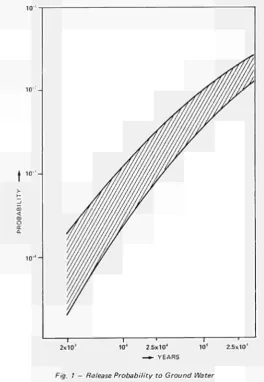
A The probabilistic safety analysis of a waste repository in the Belgian clay formation has been performed in close collaboration with the CEN/SCK, Mol; release probabilities to three different receptors (groundwater, land surface and atmosphere) were estimated over four different time periods (2,000, 25,000,100,000 and 250,000 years).
The overall release probabilities to groundwater are shown as a function of time in Fig. 1; because of obvious uncertainties in geology predictive capabilities, a probability band has been drawn. Faulting phenomena are among the principal mechanisms having the potential to cause releases to groundwater, while direct releases to land surface may be linked to various glacial phenomena; in the short term, different kinds of human actions may be important.
2.5x10s
Fig. 1 — Release Probability to Ground Water
The following conclusions were reached:
1. The long-term risk linked to the once-through strategy is much higher than that due to the recycle strategy; in fact in the latter option, the plutonium destruction largely exceeds the build-up of transplutonium isotope:·..
2. In both strategies the risk would be governed mainly by inhalation of plutonium isotopes, if the release occurs within a few thousands years after repository closure; on the other hand, if the release should occur after more than 105 years, 226Ra will be the risk-governing isotope .
3. The dose-rates to individuals appear to be rather small, even in the worst case. Some actions having the capability to decrease even further the long-term risk of radioactive wastes and decrease the uncertainty connected with the quantification of the risk, were identified (Table I).
Table II shows critical parameters and problem areas which are suggested for additional study in the coming programmes.
C Discussions have been held with CEN/SCK, Mol In view of the application of the deterministic section of our model to the Boom clay formation. A collaboration contract is in preparation.
COLLABORATION WITH EXTERNAL ORGANIZATIONS
The collaboration with the CEN/SCK, Mol has already been mentioned.
The contracts of the indirect action programme Radiation Protection (DG XII) relevant for waste hazard analysis are reported in the section «Interaction of Actinides with the Environment».
The overall failure probabilities appear to be low enough (about 10"7 per year) to offer a good margin of safety. As a
matter of fact, it is worth noting that the annual failure probability is not a constant, as the Integral probability tends asymptotically to unity; however, for geological short time periods, a nearly constant annual probability may be considered.
A report is now being prepared, in collaboration with the CEN/SCK, Mol.
B The comparison of long-term risks linked to throwaway and plutonium recycle strategies, as described in the previous Programme Progress Report3 has been
completed4.
CONCLUSIONS
Although several problem areas do exist at present affecting the accuracy of the evaluations, it is apparent both from probabilistic and from deterministic studies that the long-term disposal of radioactive waste presents a very large margin of safety; therefore it seems possible to conclude that the problems linked with radioactive waste management - although not completely solved - have not the potential to hamper the development of nuclear energy at industrial levels.
This conlusion is in a fair agreement with the results obtained from similar studies performed in different countries.
Table I — Suggested Actions to Decrease the Long-Term Risk of Radioactive Wastes
Statement
I
II
III
IV
Throwaway strategy implies larger long term risks than plutonium recycle strategy Plutonium inhalation governs the risk for releases occurring within 50,000 years Ingestion of Ra2 2 6 governs the risk for
releases occurring after 100,000 years
In the Pu-recycle strategy cladding hulls could bear larger fractions of irradiated fuel than assumed in the reference case
Element of concern
Pu
Pu
Ra
Pu Ra
Suggested actions or options
Plutonium destruction by recycle
Minimization of plutonium content in wastes from reprocessing and refabrication plants Minimization of plutonium content in waste. Delayed reprocessing of MOX-fuels to maximize the decay of Cm2 4 2
[image:14.595.30.295.32.415.2]Table II — Critical Parameters and Problem Areas I II III IV V VI
Leach rates and surfacetovolume ratio of vetri fied high level wastes; their evolution with time. Conditioning techniques for medium and low level alphawaste.
Phenomena governing the geochemical retention, physicochemical state of leached out elements in groundwater, with emphasis on plutonium.
Physicochemical state of actinides in surface water; their distribution between water and sedi ments.
Equilibrium concentration of actinides in surface soil; their downward migration, resuspension processes.
Environmental behaviour and aging phenomena concerning Pu, Am and Ra.
PLANNED ACTIVITIES
As a logical continuation of the probabilistic assessment already performed, also the deterministic section of our methodology will be validated through an application to the Belgian clay formation of Boom, in collaboration with the CEN/SCK, Mol.
REFERENCES
1. F. GIRARDI, G. BERTOZZI, M. D'ALESSANDRO : «Longterm risk assessment of radioactive waste disposal in geological formations», Report EUR 5902,1978.
2. G. BERTOZZI, M. D'ALESSANDRO, F. GIRARDI, M. VANOSSI : «Safety assessment of radioactive waste disposal into geological formations; a preliminary application of Fault Tree Analysis to salt deposits», Report EUR 5901,1978.
3. Management of Nuclear Materials and Radioactive Waste Programme Progress Report of the JRC, JulyDecember, 1978, No. 3584, p.7.
4. F. GIRARDI, G. BERTOZZI, G. BIGNOLI : «Comparison of long term risk of alternative strategies for the nuclear fuel cycle and of different waste categories», Technical Note Nr. 1.07.03.79.49, April 1979 (to be published as EUR Report).
Long Term Stability of Conditioned Waste
The aim of this study is to obtain information on long term behaviour of conditioned high and mediumlevel waste in the framework of the studies of Waste Hazard Analysis. The planned activities for the first semester of 1979 were the following :
preparation of a new series of capsules (BONI III) for radiation damage measurement in glasses
verification of the validity of accelerated tests of radiation damage on vitrified HAW
continuation of leaching tests on glasses continuation of leaching tests on bitumen
RESULTS
Radiation damage on glasses
The'results obtained with the capsules BONI I and BONI II have shown the validity of the damage simulation by fission fragments. The highest dose received by the samples was 0.36 dpa corresponding to a damage period for vitrified HAW of about 105 years.
It seems worthwhile to use this simulation technique to reach an equivalent time of the order of 1 million years. Previous experiments have shown that a source of error was the temperature distribution inside the cylindrical glass sample. In fact the glass cylinders ( 0 = 10 mm) with the highest U235 content (1.76 w%) had a surface temperature of 50°C and a central temperature of about 75°C. In order to reduce the inhomogeneity In temperature, annular samples will be used in the new irradiation experiments.
The capsules will be irradiated in the HFR reactor at Petten for about 8 months in order to reach about 1.2 dpa. The capsules have been prepared and delivered to Petten. The irradiation will start in June.
A paper1 on the simulation of radiation damage in glasses
has been presented at the International Symposium on Ceramics in Nuclear Waste Management (Cincinnati).
Verification of the validity of accelerated tests of radiation damage in vitrified high activity waste
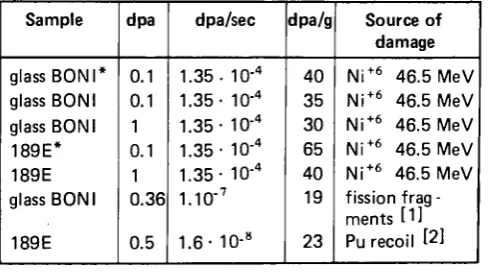
Results of stored energy measurements, performed at the JRC Ispra, on borosilicate glasses irradiated with heavy ions are compared in Table I with the results obtained on similar glasses irradiated with internal sources (fission fragments at Ispra1, Pu recoil at Harwell2.
Differences in the stored energies measured in different samples irradiated with heavy ions, may be due to the effect of the metal coating deposited on the irradiated surface of some of the samples. In fact the metal coating keeps the irradiated surface near the temperature of the sample holder, i.e. the temperature of the cooling water, while the uncoated surface is at a higher temperature due to the low thermal conductivity of the glass. Differences in the results obtained using external or internal irradiation may be due to an imperfect control of the temperature and/or to a different distribution of the damage.
In spite of these uncertainties the data reported in Table I make it possible to draw the following conclusions:
A saturation effect is evident at the dose of 0.1 dpa. The use of displacement per atom (dpa) as a unit of dose
seems appropriate for the radiation damage of glasses, since the values of stored energies for glass samples of BONI type as obtained by external irradiation and fission fragment internal Irradiation, are comparable at a comparable number of calculated displaced atoms. When considering the large variation of dpa/sec (a factor
of 103 10* between external and internal irradiations)
the dose rate does not appear to have a considerable influence on the measured stored energy. Detailed results of this work are reported in Reference l.
Table I — Measurements of Stored Energy in Borosilicate Glasses
Sample
glass BONI* glass BONI glass BONI 189E* 189E glass BONI 189E dpa 0.1 0.1 1 0.1 1 0.36 0.5 dpa/sec
1.35. 104
1.35 ■ IO"4
1.35 ■ 104
1.35· 104
1.35· 104
1.10'7
1.6· 108
dpa/g 40 35 30 65 40 19 23 Source of damage
Ni+ 6 46.5 MeV
N i+ 6 46.5 MeV
N i+ 6 46.5 MeV
N i+ 6 46.5 MeV
N i+ 6 46.5 MeV
fission frag ments t i l Pu recoil 12]
[image:15.595.43.284.54.235.2] [image:15.595.301.546.649.787.2]Concerning the fundamental aspects of irradiation damage, annealing studies of heavy ions irradiated silica glasses have been pursued more systematically by means of optical methods. In order to separate in the absorption spectra the band due to displacement (B2) from that due to ionization
(E',) a best fit program was employed. The result is illustrated in Fig. 1. These results allow us to determine the ratio between the displacement defects and defects due to the bond breakage in a heavy ions irradiated silica glass.
0.8
>
1-£ 0 . 6
LU
□
_ J < (J
κ ΟΛ Ο
0.2
• Experimental points Best fit
— Components of the spectrum
/ / / / •
J
/ % ·** //.V
A
//Ν /
/ /
·.
/ / ·.·' E
/ / .·■■' ι ' " .
,..£-f
y' \
1 1 ' 1 ' 1 <■ Γ"" r* ι =*■»2 3 4 5 6
hv(e\J)
Fig. 1 — Absorption Spectra of Heavy Ion Irradiated Silica
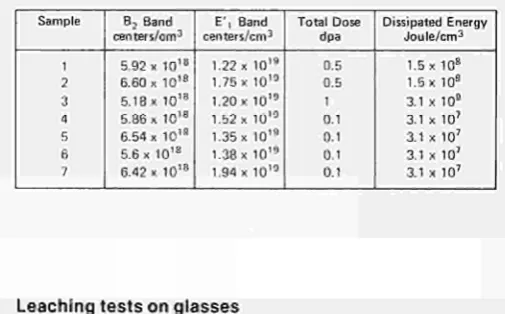
This isa very important parameter to evaluate the complex role ofionization energy in the production of defects during irradiation. In Table II the number of color centers due to displacement (B2 band) Is reported together with the number
of color centers due to ionization (ΕΊ band) as a function of
displacements per atom and of total energy dissipated. A saturation effect Is evident.
The research will be pursued in the direction of defining the type of the introduced defects, their distribution in the bulk and their annealing properties.
Table II Defects Measured by Optical Absorption in Heavy Ion Irradiated Silica Sample 1 2 3 4 5 6 7
B2 Band
centers/cm3
5.92 χ 101 8
6.60 χ 1 0 '8
5.18X 101 8
5.86 χ 1 0 '8
6.54 χ 101 8
5.6 χ 101 8
6.42 χ 101 8
E', Band centers/cm3
1.22 χ 1 0 '9
1.75 χ 1 0 '9
1.20 χ 101 9
1.52 χ 101 9
1.35 χ 101 9
1.38x 101 9
1.94 χ 1 0 '9
Total Dose dpa 0.5 0.5 1 0.1 0.1 0.1 0.1 Dissipated Energy Joule/cm3
1.5 χ 10s
1.5 χ 108
3.1 χ 108
3.1 χ 107
3.1 χ 107
3.1 χ 107
3.1 χ 107
Tests were performed at 80°C and 50°C. Fig. 2 shows the results obtained at up to 5,000 hours of leaching.
The comparison between measurements in pure water and in water conditioned by clay, shows that the leaching rates are quite similar in the experiments at 80°C and are slightly lower in water conditioned by clay in the experiments at 50°C.
A paper 3 on the leaching tests in pure water has been
presented at the International Symposium on Ceramics in Nuclear Waste Management (Cincinnati).
2 0 1b 10 5 -Θ + Θ + 80 °C 50 °C Θ Θ + + Θ + Θ + Θ + Θ + Θ + -ι Θ Θ τ
1000 2000 3000 4000
TIME (h)
[image:16.595.30.286.153.404.2]5000
Fig. 2— Weight Losses of Glass Samples Leached by Water Condi tioned with Clay
Leaching tests on bitumen
The tests performed on bitumen loaded with 40% NaN03
have shown an extensive swelling. As a consequence the surface exposed to the leaching water has increased considerably.
The amount of Na which is leached at the beginning follows a regular curve of the parabolic type. When the swelling begins to be important the amount leached increases rapidly.
The most reasonable explanation of such a swelling is the retention of large amounts of water in the loaded bitumen. NaN03 is strongly hygroscopic so that around the grains
which are embedded into the bitumen, bubbles of water, which have diffused through the bitumen, coalesce. Another test using Ce2(N03)3 is in progress. Even Ce2(N03)3 is
hygroscopic but not so strongly as NaN03. This test will
allow to decide if it is wise to try to formulate a model of long-term leaching for bitumen conditioning hygroscopic material. Further tests on oxide powders (Fe203, Ce02) will
begin shortly.
COLLABORATION WITH EXTERNAL ORGANIZATIONS
The collaboration with AERE, Harwell, concerning irradiation experiments and theoretical investigations, has been continued.
A collaboration has been started with the University of Modena concerning examination by SEM (scanning electron microscope) of heavy ion irradiated samples.
Leaching tests on glasses
In order to test glasses in water typical of a clay repository, the extractor previously used for leaching tests with pure water was modified. The condensed water enters into a vessel containing a clay suspension under agitation. Through a filter the water enters then into the vessel where the glass is located. The clay is changed every 2 weeks in order to have a constant water compositon.
10
CONCLUSIONS AND PLANNED ACTIVITIES
Radiation damage on glasses
The investigations on radiation damage are being conducted by means of tests on borosilicate glasses and of more fundamental studies on silica.
[image:16.595.296.551.169.278.2] [image:16.595.35.288.557.714.2]This is a first proof of the validity of the accelerated tests of radiation damage on vitrified high activity waste.
For the second semester of 1979 the following activities are planned in the field of radiation damage:
- Irradiation of capsules, containing borosilicate glasses, in the HFR reactor at Petten.
- Measurements, by means of optical and electron microscopy techniques, of a series of heavy ions irradiated Si02 samples with the following aims:
1. to study the annealing effect at different temperatures
2. to study the distribution of the damage in the irradiated area after irradiation and annealing (voids, clusters, precipitates).
Some preliminary evidence for the presence of strongly deformed areas along the heavy ions path in irradiated silica samples, obtained by scanning electron microscopy, is particularly encouraging to examine these aspects of the damage.
Leaching tests
The leaching tests on borosilicate glasses, using water conditioned by clay, have shown only slight differences in the leaching rates respect to the previous tests performed with pure water.
The leaching tests using water conditioned by clay will be completed during the second semester of 1979.
In the second semester of 1979 leaching tests will be continued on bitumen conditioned with different materials.
REFERENCES
1. M. ANTONINI, F. LANZA, A. MANARA: «Simulation of radiation damage in glasses», Paper presented at the International Symposium on Ceramics in Nuclear Waste Management, Cincinnati (Ohio), 30 April - 2 May, 1979.
2. A.R. HALL, J.T. DALTON, Β. HUDSON, J.A.C. MARPLES: «Development and radiation stability of glasses for highly radioactive wastes», Proc. of the Symposium on Management of Radioactive Wastes from the Nuclear Fuel Cycle, Vol. II,p. 3, IAEA, Vienna 1976.
3. F. LANZA, E. PARNISARI: «Evaluation of long term leaching of borosilicate glass in pure water», Paper presented at the International Symposium on Ceramics in Nuclear Waste Management, Cincinnati (Ohio), 30 April - 2 May 1979.
Interaction of Actinides with
the Environment
OBJECTIVES
The objective of this study is to obtain a better understanding of the interaction of actinides with geological media and aquatic systems following their eventual leaching from vitrified high level waste stored in geological formations.
For the first half 1979, the planned activities were the following:
a) Continuation of long-term column experiments on actinide migration
b) Initiation of theoretical studies to model the interaction between leached out nuclides and geological media c) Development and application of analytical techniques for
the determination ofactinide chemical forms in aquatic media.
RESULTS
A Migration experiments have been continued on columns filled with glauconite sand sampled from the Antwerp sands overlaying the Boom clay formation in Belgium
A water pathway has been established which flows over the alpha-bearing glass (238Pu and 241Am) prepared in the
laboratory and then through the columns containing soil samples.
The set-up adopted has been illustrated in the previous Programme Progress Report (July-December 1978). First results have been resented in reference 1. In the experiments a water composition typical of the main aquifer of the region has been utilized.
The output from the column is periodically sampled for in activity and at the end of the experiment the actinide profile within the column is determined.
For the analysis of the soils, each 180 mm column was sliced into thin sections. Americium activity was determined by gamma counting; in the case of plutonium, chemical separation was perfomed and the α-activity counted by liquid scintillation spectrometry.
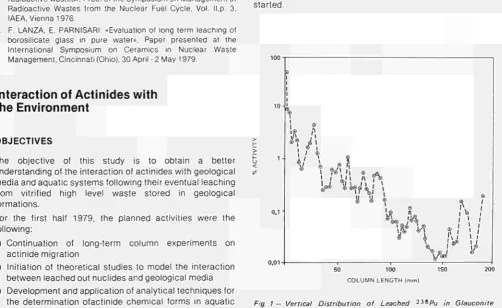
Figures 1 and 2 show the 238Pu and 241Am activity profiles of
the soil columns after three months of percolation of the leached solution. On the basis of reported distribution coefficients, assuming a reversible ion exchange mechanism, the activity should have been confined in the first few millimeters of the column. However, a continuous small activity output was found to occur and the column profile shows that the long-term interaction between the leachate and the column cannot be described by a simple ion exchange mechanism.
The physico-chemical nature of the migrating species is being studied; the formation of neutral or anionic complexes might explain the existence of mobile chemical forms of transuranic nuclides.
During the present report period, 237Np spiked borosilicate
glasses have also been prepared and migration experiments started.
[image:17.595.47.550.478.786.2]COLUMN LENGTH (mm)
Fig. 1— Vertical Distribution of Leached 2 3 8Pu in Glauconite
Sand; Three Months Percolation Experiment
Fig. 2
COLUMN LENGTH (mm)
Vertical Distribution of Leached Am in Glauconite Sand; Three Months Percolation Experiment
Β A theoretical study to assess the chemical forms of plutonium in groundwater has been undertaken. On the basis of thermodynamic data on equilibrium constants, different chemical species of plutonium can be shown to be present in natural waters, as a function of redox potential, pH and chemical composition of the medium. In the different valence states they can form a great variety of soluble complexes with the inorganic anions, which are commonly present in groundwater; among them, the most important are the carbonates because of their great stability.
The study2 very clearly indicated that an accurate
knowledge of such types of complexes Is of great importance if reliable modelling of plutonium migration is to be undertaken. The most important equilibrium constants for which reliable values are not yet available are those of Pu (III) and Pu (IV) species with carbonates
C Parallel to these theoretical calculations analytical methods for the estimation at very low concentration of actinide valence states are being developed. These methods should be applied in connection with point B, to the characterization of physico-chemical forms of actinides in leached solutions. The same techniques should be used In order to follow the evolution of chemical species of actinides in selected aquatic ecosystems.
A combination of techniques is being studied for the determination of plutonium (III), (IV) and (VI) and americium (III). These Include the use of filtration, cation and anion resins, calcium fluoride columns and solvent extraction by thenoyltrif luoroacetone (TTA).
Experiments were carried out using the gamma emitting
237Pu isotope*.The production of the different oxidation
states was carried out using classical procedure. The chemical forms produced (III), (IV) and (VI) were then chemically purified so that the initial species of the isotopes was known. Testing and development of the various techniques described below were then carried out using these solutions.
Solvent extraction with TTA
It has been shown3 that the oxidation states of tracer
quantities of plutonium in aqueous media can be determined using 2-thenoyltrifluoroacetone. This procedure was tested using different chemical forms of 237Pu in water samples (20
ml) containing approximately 1 nC, activity (37 Bq) i.e. ~ 10~14 molar solutions. A parallel study was started with 241Am
[image:18.595.301.550.250.431.2](III). Extraction was carried out using 0.4 M TTA dissolved in xylene. The results obtained agree closely with literature values and are shown in Table 1. For extraction carried out at pH 4.3 sufficient ammonium acetate was added to render the final solution > 10 M with respect to acetate. The acetate complexes the (VI) ions and prevents them being extracted. It was noted that Am (III) behaved as Pu (III), being extracted at pH 4.3 but not at pH 0.3.
Table I — Percentage Extraction of Plutonium and Americium by 0.4 M Thenoyltrifluoracetone in Xylene Under Different Con ditions of pH, from 1 Day Old Samples
Chemical species Pu III Pu IV Pu VI Am III pH 4.3* 0.3 4.3* 0.3 4.3* 0.3 4.3* 0.3 Distilled water 100 8 94 97 7 11 91 2 Fresh water 93 5 98 96 10 5 90 1 Seawater 93 7 98 80 20 8 92 1
* The donation of this isotope lor the analytical method development work by the Biologische Anstalt Helgoland, Hamburg, is gratefully acknowledged.
12
* Aqueous solution > 1 0 M in ammonium acetate pH Adjusted w i t h HCl acid
Shaking time about 10 mins.
Adsorption on CaF2 and ion exchange with resins
Initial studies on the behaviour of different Pu valence states on cation and anion exchange resins and CaF2
columns for aqueous solutions having hydrogen ion concentrations in the range pH 1 - 12 are underway. Calcium fluoride columns containing the crystallized salt (200 - 400 mesh) were used to compare the chemical form of plutonium to those obtained by TTA solvent extraction techniques. It appears possible to distinguish between Pu (IV) and (VI) without altering the natural conditions of the solution. Detailed results will be reported at a later date.
Application of chemical speciation techniques to the study of the behaviour of actinides in simulated aquatic environments
The interest and applicability of the chemical speciation techniques described above to studies of the behaviour of actinides in aquatic environments is being tested in a comparative study on the behaviour of Pu and Am in vitrified form vs. the behaviour of Pu and Am added as a solution. Two different sources of actinides have been simulated containing 237Pu and 241Am. In two aquariums actinide
the experiment. Growth and reproduction of all components of the aquarium occurred, one of the best indices for comparison to a natural system.
The uptake, distribution and behaviour of plutonium and americium were followed for a period of three months. Samples of each compartment of microcosms were measured approximately every 10 days. Using the analysis train described in the previous section, the evolution of the chemical forms originating from the two different source terms was followed in the aquariums.
Although the water activities are low in the aquariums containing the contaminated glass, measurable quantities were detected throughout the three months period. The formation of soluble forms having both positive and negative charges can be deduced by their absorption on the ¡on exchange resins. In each case a nonnegligeable fraction of non charged forms could also be detected. This was particularly noticeable in the case of contamination originating from 241Am glass.
The fact that the formation of soluble forms of actinides can be identified and that differences occur between not only the radioelements but also perhaps due to the source term underlines the importance of characterizing the species in the environment.
The development of separation techniques and their further application will continue.
COLLABORATION WITH EXTERNAL ORGANIZATIONS
In the framework of the collaboration between the JRC Waste Management Programme and the DG XII Radiation Protection Programme a number of contracts of particular interest for risk evaluation studies have been outlined.
1) Institute of the Association EURATOMITAL, Wageningen, The Netherlands :
«Behaviour of radiocontaminants in soils and vegetation of specific sites»
2) Commissariat à l'Energie Atomique, Centre d'Etudes Nucléaires de Cadarache, France :
«Transfer of plutonium in the environment» 3) Université Catholique de Louvain, Belgium :
«Translocation of radionuclides absorbed by the roots (redistribution) and subsequent release from leaves into the atmosphere (biological resuspension)»
4) Biologische Anstalt Helgoland, Hamburg, FRG :
«Investigation of the distribution of actinides in marine and estuarine environments»
5) Radiobiology Dept. SCK/CEN Belgian Nuclear Center : «Biological availability of transuranics in freshwater systems»
6) Delta Institute for Hydrobiological Research Yerseke, The Netherlands :
«Plutonium in the RhineMeuseScheldt Delta: analysis of estuari sediment, saltmarsh and vegetation samples» 7) Ministry of Agriculture, Fisheries and Food, Lowestoft
Laboratory, U.K. :
«Distribution and behaviour in the marine environment of radionuclides of waste disposal significance from the utilization of nuclear energy»
Discussions have also been held with scientists of the CNEN Fiascherino Laboratory, Italy (chemical speciation of actinides in aquatic systems); CEA Cadarache, France (in situ study of actinides in marine environment) and CEA FontenayauxRoses, France (assessment of accidental or continuous lowlevel discharge of radioactivity into the environment).
These contracts are expected to provide the necessary data to validate the environmental models used in longterm waste hazard evaluations.
CONCLUSIONS AND PLANNED ACTIVITIES
The programme on actinide interaction with the environment is now well established and is following closely the timing of the planned objectives. However, owing to the complexity of the development work necessary for the columns under pressure this project is at present in abeyance.
In the second half of 1979 the subsequent points are foreseen:
Continuation of column migration experiments with 238Pu, 241Am and 237Np.
Results for experimental periods up to six months should then be available.
Continuation of theoretical modelling studies.
A more detailed investigation both on the development of analytical techniques and valence states evolution will be performed.
REFERENCES
1. A. AVOGADRO, C.N. MURRAY, A. DE PLANO : «Laboratory experimental development for the study of transuranlc migration in porous media», Proceedings ΝΕΑ/CEC Workshop on the migration of longlived radionuclides In the geosphere, Brussels, 2931 Janaury 1979.
2. A. SALTELLI, A. AVOGADRO, G. BERTOZZI : «Assessment of plutonium chemical forms in groundwater», Proceedings ΝΕΑ/CEC Workshop on the migration of longlived radionuclides in the geosphere, Brussels, 2931 January 1979.
3. S.C. FOTI, C. FREILING : «The determination of the oxidation states of tracer uranium, neptunium and plutonium in aqueous media», Talanta, 11, 385392,1964.
Actinides Monitoring
OBJECTIVES
The study aims at the development of a methodology for plutonium waste monitoring. For the reporting period theoretical and experimental work is planned concerning development of reference Instruments and methods. Moreover mathematical modeling of the Pu waste measurement system of the Dounreay Nuclear Power Development Establishment (DNPDE) was foreseen.
RESULTS
Integral Experiment
In the frame of a collaboration programme an integral experiment is in execution at the Pu waste measurement system of the Dounreay Nuclear Power Development Establishment. The first Progress Report on the integral experiment has been prepared1.
The most important achievements during the reporting period are the following:
a) Delayed neutron measurement technique with a 14 MeV neutron generator.
In this technique the waste item is irradiated for 2 min. and after 5 sec. waiting time the delayed neutrons are counted for 1 min. The detection process of these neutrons is modelled by means of Monte Carlo calculations with the TRIPOLI 02 code in the framework of a subcontract with the University of Lyon. The calculations help to understand the neutron transport in the prompt and delayed neutron domain.
In addition the calculation with the TRIPOLI 02 code provides few group constants which are required for a simple interpretational model. This model, developed at Ispra, includes:
- A set of mathematical expressions for fission rate, prompt and delayed neutron production, etc.
- Calibration procedures
- Corrections for self-shielding and matrix effects. b) Passive neutron assay.
The effective escape probabilities have been determined for the NDA4 monitor of the Dounreay Pu waste measurement system. The measurements with polyethylene and graphite blocks have been carried out at Dounreay and interpreted at the JRC Ispra. Data were obtained on:
- mean escape probability - escape probability spectra
- escape probabilities from item surfaces.
It should be mentioned that the results are sensitive to thermal neutron absorption properties of the sample. This effect could be eliminated by cadmium shielding of the detector assembly as provided in the EURATOM modular system.
Reference Monitor for Passive Neutron Assay
In addition to the already existing and prevalently applied correlation methods (V.D.C., autocorrelation) a more exacting pulse to pulse time correlation analysis was elaborated. This method allows the complete reconstruction of the detected neutron multiplicity.
The time distribution of two successive pulses of the first, second,... order are measured.
A mathematical model was developed for theoretical prediction of the measured time distributions. The model is based on probability theory and on the assumption that the correlated fission neutrons decay in the ground-mode (described by a single exponential function). The theoretical predictions are fitted to the measured time distributions, varying the detected neutron multiplicity parameters. Both hardware and software development on the signal processing unit has been continued. All of the purchased units were delivered. This new computerized system will be completed and set up in the next few months.
Parts of the upgraded detector system are under construction. When these parts are ready, an extensive series of measurements will be started in order to find an optimum for the efficiency and the flattening of the spatial response of the neutron detector assembly.
Reference Monitor for Passive Gamma Assay
The γ-spectrometer consists of a Ge(Li) detector (10% efficiency). The detector pulses are fed to a multichannel analyzer coupled to a PDP 11/5 computer. The measured spectra are analyzed by computer programs.
After the assembling and testing of the apparatus an extensive series of measurements have been started in order to determine the basic properties of the spectrometer: - the energy resolution is about 2 keV at 1.33 MeV
14
- the intrinsic photo-peak efficiency falls from 10 to 1 between 100 keV and 2 MeV
- the Ge(Li) detector can be treated as a point detector. That is the measured intensity falls according to I = l0
(1/4 7rd2).
- the attenuation follows rigorously the theoretical prediction, that is, the measured intensity falls according to I = lo exp (- μ@Ι). The attenuation coefficient of polyethylene was measured.
- same measurements have been carried out along a line at 21 ° away from the detector axis. Both the point source characteristics and the intrinsic efficiency did not show any change.
It follows that the escape probability from a waste item to a point spectrometer in case of homogeneous material and uniform source distribution is given by:
-ƒ (1/4πα2!
ν exp (-yUpl)dV
An essential part of the theoretical analysis In Chapter III of our Guide2 «Passive Gamma Assay» is based on Mercur-3
calculations which uses this expresssion. Thus these calculations can be regarded as valid.
Active Neutron Assay
Chapter V of our Guide «Active Neutron Assay» has been written. It is going to be published as a EUR report2. Design
parameter studies on the Reference Monitor for Active Neutron Assay were started recently at the University of Lyon in the frame of a collaboration programme.
The calculations will be carried out by means of the TRIPOLI 02 code.
A technical meeting of specialists (International Meeting on Monitoring of Pu-Contaminated Waste) will be held on 25-28 September 1979 at the JRC Ispra. The aim of the meeting is to assess progress and to establish the direction of future work in the evaluation of practical systems for monitoring plutonium contaminated waste. The waste systems include both solid and liquid waste and systems which contain either high or low level gamma activity. The meeting seeks to promote an international exchange of information and results relevant to the sucessful implementation of Pu waste monitoring systems.
The four day meeting will include sessions for oral presentation, followed by sessions of working groups to assess the state of the art in particular areas of interest. The subjects for the working groups will be established after the contributed papers have been received. The findings of the working groups will be presented in a final plenary session. Individual contributions should cover specific fields of the Pu-waste monitoring complex or should outline national activities and programmes.
COLLABORATION WITH EXTERNAL ORGANIZATIONS
Collaboration contract with the Dounreay Nuclear Power Development Establishment (DNPDE) on an Integral Experiment.
Contract with the Institut de Physique Nucléaire (University of Lyon) for design parameter study of the Reference Monitor for Active Neutron Assay.
CONCLUSIONS
As far as the progress in interpretation of active and passive neutron measurement in the Integral Experiment at Dounreay is concerned, we think that we resolved the fundamental problems in an adequate manner. Therefore we shall be able to apply our interpretation model as soon as calibration measurements are executed and real waste measurements started.
The gamma spectrometer was operated all the time except during a short shut down period. The unit will be equipped with a fast printing unit in the near future. More progress was made than expected in the experimental verification of the Interpretation model for passive gamma-assay.
The development of the upgraded reference monitor for passive neutron assay has been continued. Good progress was reached in the field of the active neutron assay as far as the theoretical model is concerned.
PLANNED ACTIVITIES
For the second semester 1979 the following activities are planned:
1) Integral Experiment
Continuation of the bench-mark and calibration measurements. Starting of measurements on real waste. 2) Passive Neutron Assay
Set up and test of the upgraded signal processor unit. Optimallzation experiments for the upgraded detector unit. Theoretical investigations of the pulse to pulse time correlation analysis.
3) Passive Gamma Assay
Continuation of the experimental verification of the interpretation model.
4) Active Neutron Assay
Design parameter study of the Reference Monitor.
REFERENCES
1) G. BIRKHOFF : First Progress Report on Dounreay Integral Experiment (Contract No. 256-78-PIPGE), March 1979.
2) Monitoring of Plutonium Contaminated Solid Waste Streams. A Technical Guide for Design and Analaysls of Monitoring Systems.
Chapter I:
G. BIRKHOFF, A. NOTEA : «Planning of Monitoring Systems» EUR 5635 (1977)
Chapter I I :
G. BIRKHOFF, L. BONDAR, A. NOTEA : «Principles and Theory of Radiometric Assay» EUR 5636 (1977)
Chapter III
G. BIRKHOFF, A. NOTEA: «Passive Gamma Assay» EUR 5637 (1977) Chapter IV:
G. BIRKHOFF, L. BONDAR : «Passive Neutron Assay» EUR 6027 (1978) Chapter V: G. BIRKHOFF: «Active Neutron Assay» (To be published in 1979)
2.2. Chemical Separation and Nuclear Transmutation of Actinides
If the separation of the actinides from fission products is demonstrated to be possible, it will open up a number of alternative waste management options in which the disposal of actinides, largely responsible for the long-term risk, and fission products can be considered separately. One option which would provide an ultimate solution for actinide wastes is the transmutation to short-lived isotopes by neutron bombardment in reactors.
In the framework of the activity of the OECD Nuclear Energy Agency in the field of radioactive waste, the Commission has been chosen as leading organization for the studies on the chemical separation and nuclear transmutation of actinides.
The activity of the JRC in this field includes experiments on the chemical methods required for actinides separation from HAW and assessment studies on the possibility of actinides transmutation in nuclear reactors.
For the chemical separation of actinides from HAW, oxalate precipitation (OXAL Process) and solvent extraction by HDEHP and TBP are being investigated.
The assessment studies include, in addition to the reactor physics aspects, the implications of the nuclear transmutation on the nuclear fuel cycle (actinide fuel element design, modifications in the nuclear plants, increase of cost and risk).
In order to improve the accuracy of the reactor physics calculations a programme of neutron cross section measurements is carried out.
The JRC activities are planned in such a way as to have a maximum of information emerging in the second half of 1979. It is, in fact, intended to prepare for the beginning of 1980 a major report dealing with a critical evaluation of the feasibility of the chemical separation and nuclear transmutation of actinides.
RESULTS
Denitration Experiments
Fully active laboratory scale experiments were carried out using HAW solutions prepared at Ispra from U02 fuel
samples irradiated at 26,000-36,000 MWd/t and cooled for 4 years.
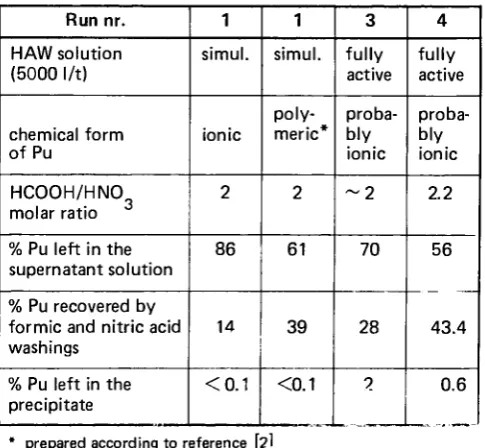
[image:23.595.302.545.292.516.2]In Table I are reported results of denitration tests carried out on simulated and fully active HAW solutions (5000 l/t) according to option 2 of the HDEPH process scheme1.
Table I — Behaviour of Pu During Denitration of Unconcentrated HAW Solutions by Formic Acid
Run nr. HAW solution (5000 l/t) chemical form of Pu HCOOH/HNO molar ratio % Pu left in the supernatant solution % Pu recovered by formic and nitric acid washings
% Pu left in the precipitate 1 simul. ionic 2 86 14
< 0 . 1 1 simul. poly-meric* 2 61 39 <0.1 3 fully active proba-bly ionic ~ 2 70 28 2 4 fully active proba-bly ionic 2.2 56 43.4 0.6
prepared according to reference Í2Í
Chemical Separation of Actinides
OBJECTIVES
The experimental studies on the feasibility of the HAW partitioning by OXAL, HDEHP and TBP processes were continued.
For the reporting period it was planned:
- to conclude denitration tests under simulated conditions (5000 l/t and concentrated HAW) and on fully active laboratory scale (5000 l/t HAW)
- to conclude HDEPH batch-extraction tests on fully active laboratory scale
- to continue the experiments on the separation of the actinides from RE on fully active laboratory scale
- to continue the engineering assessment of the proposed HAW partitioning processes as well as of the conceptual design of a partitioning plant.
By operating the denitration of simulated HAW with a HCOOH/HNO3 molar ratio of about 2, it seems possible to maintain almost quantitatively the Po in the extractable form. The following mechanism is tentatively proposed to explain the Pu behaviour during denitration: the lower retention of Pu into denitration precipitates at pH = 2 may be due to the reduction of Pu (IV) to Pu (III), even if Pu is initially present under polymeric form. This reduction is probably promoted by the formic acid decomposition in presence of Pd and Rh black acting as catalysts. Preliminary results of fully active runs (Table I) are comparable with those of simulated solutions although some Pu was lost to the precipitate. The higher Pu fraction adsorbed on the precipitate separated in the run N. 3 was probably due to the incomplete dissolution of Pu formate by the4MHN03wash.
The behaviour of Am and Cm was similar to that observed for Pu. Experiments are still in progress to optimize the operating conditions.
Denitration experiments on concentrated HAW solutions (about 500 l/t), as proposed by option 2 of the TBP process scheme3, were carried out until now using only simulated
solutions. The low acidity value required for the separation
of the actinides from HAW could be reached by means of the denitration process provided an accurate acidity control is carried out during the process. The latter appears however to be a rather critical operation due to the accurate measurements to be remotely operated and requiring specially developed ι instrumentations.
As an alternative procedure a partial denitration up to about 0.5-1 M HNO3 followed by a final adjustment to the required acidity value (0.1-0.2 Μ HN03) can be carried out.
By operating the denitration of the concentrated HAW solution (4-5 M HN03) with HCOOH/HNO3 molar ratios in the
range 1.3-1.5 a denitrated HAW solution, 1.5-0.6 M in nitric acid, is finally obtained.
Results from two tracer runs are reported in Table II. They show that, as in the case of unconcentrated HAW, even if polymeric Pu is added to the HAW, the latter is converted almost quantitatively during the HAW denitration to an extractable form. The acidity of resulting denitrated HAW solution has been further reduced to O.1-0.2 Μ HN03 by
addition of calculated amounts of AI(OH)2N03 together with
the usual salting agents ( AI(N03)3 and NaN03 ) required for
TBP extraction. Fully active runs are scheduled for the second half of 1979.
In view of a possible utilization on an industrial scale, TBP and n-dodecane were substituted to mesitylene for experiments on fully active HAW.
Pu, Am and Cm separation yields, which appear to be sufficiently high considering that they correspond to a single extraction stage, confirm the values obtained with simulated solutions.
Solvent Extraction Experiments
HDEHP Process
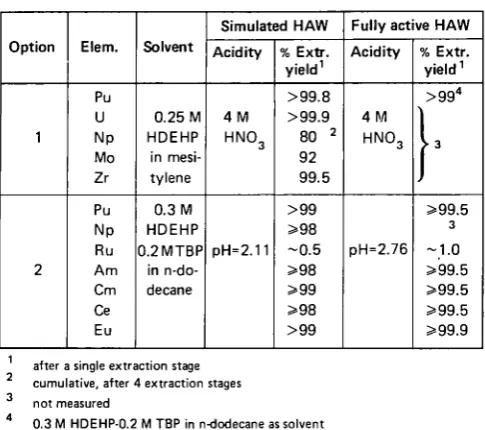
[image:24.595.302.545.65.280.2]Batch extraction tests on fully active laboratory scale have been continued. Typical results, obtained for the HDEHP process and reported in Table III, do not show significant differences between extraction tests performed on simulated and fully active HAW solutions.
Table III - Percent Separation Yields Obtained from HDEHP Batch Extraction Tests on Simulated and Fully Active HAW Solutions Option 1 2 Elem. Pu U Np Mo Zr Pu Np Ru Am Cm Ce Eu Solvent 0.25 M HDEHP in mesi tylene 0.3 M HDEHP 0.2MTBP in n-do decane Simulated HAW Acidity 4 M HNO3 pH=2.11 % Extr. yield1 >99.8 >99.9 80 2
92 99.5
> 9 9 » 9 8 - 0 . 5 » 9 8 » 9 9 » 9 8 > 9 9
Fully active HAW Acidity 4 M HNO3 pH=2.76 % Extr. yield1
> 9 94
► 3
>
»99.53
- 1 . 0 »99.5 »99.5 »99.5 »99.9
after a single extraction stage cumulative, after 4 extraction stages not measured
0.3 M HDEHP-0.2 M TBP in n-dodecane as solvent
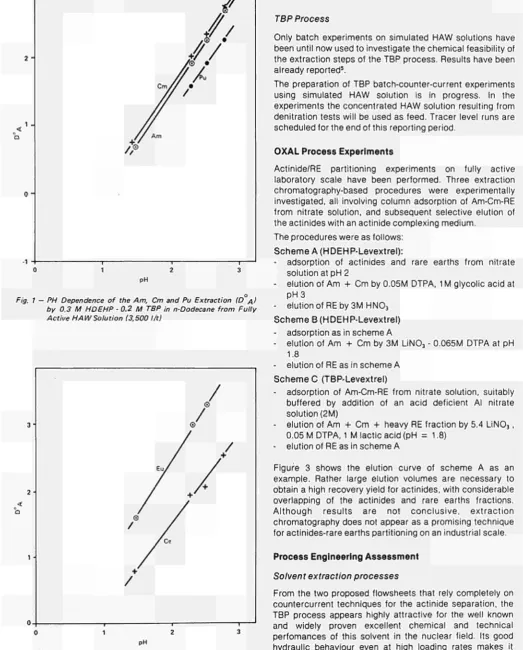
The pH dependence of the actinide and lanthanide extraction by the HDEHP/TBP solvent has been experimentally tested on fully active laboratory scale. In Figures 1 and 2 the measured values of distribution coefficients (D,,0) of Pu, Am, Cm and Ce, Eu are plotted
versus pH values. The shape of resulting Isotherms shows the considerable influence of the pH variation on the extraction degree which is practically of the same order of magnitude for all the considered elements.
As to the back-extraction of loaded HDEHP/TBP solvent (option 2), only simulated HAW solutions have been so far tested. Results have been reported in reference 4. Hot cell batch extraction experiments are continuing.
[image:24.595.45.540.575.785.2]Instead of continuous countercurrent experiments, initially planned, HDEHP batch-countercurrent experiments have been started under simulated conditions to better precise some extraction and back-extraction parameters such as phase ratios, minimum number of stages of extraction/back-extraction and scrubbing steps etc.
Table II — Behaviour of Pu, Am, Eu and Ce During the Denitration of Concentrated HAW Solution by Formic Acid
HAW concentration factor Initial acidity , ,, Final acidity ( M / I )
HCOOH/HNO3 molar ratio
chemical form of Pu
% element in the supernatant solution
% element recovered by formic and nitric acid wash
% element left in the precipitate
13.6 4.6 0.64 1,5 polymeric Pu 91.1 7.4 1.5 Am 94.6 5.38 0.02 Eu 82.8 7.18 0.02 13.5 4.7 1.12 1.5
For this purpose an extraction system based on interchangeable extraction units has been developed at the Ispra laboratories with the aim of essentially reducing the volumes of organic and aqueous phases involved in each counter current experiment.
Fig. 1 — PH Dependence of the Am, Cm and Pu Extraction (D A) by 0.3 M HDEHP ■ 0.2 M TBP in n-Dodecane from Fully Active HAW Solution (3,500 l/t)
Fig. 2- pH Dependence of the Ce and Eu Extraction (D A) by 0,3 M HDEHP ■ 0.2 M TBP in n-Dodecane from the Fully Active HAW Solution (3.500 l/t)
Preliminary results indicated that Am (and RE) can be separated almost quantitatively from the simulated HAW solution (5000 l/t) using four extraction stages (O/A = 1) with two aqueous scrub stages (O/A - 0.5). More than 99% of Am can be subsequently stripped from the loaded HDEHP-TBP solvent using five back extraction stages (O/A
= 4) with two organic scrub stages (O/A = 1).
TBP Process
Only batch experiments on simulated HAW solutions have been until now used to investigate the chemical feasibility of the extraction steps of the TBP process. Results have been already reported5.
The preparation of TBP batch-counter-current experiments using simulated HAW solution is in progress. In the experiments the concentrated HAW solution resulting from denitration tests will be used as feed. Tracer level runs are scheduled for the end of this reporting period.
OXAL Process Experiments
Actinide/RE partitioning experiments on fully active laboratory scale have been performed. Three extraction chromatography-based procedures were experimentally investigated, all Involving column adsorption of Am-Cm-RE from nitrate solution, and subsequent selective elution of the actinides with an actinide complexing medium.
The procedures were as follows:
Scheme A (HDEHP-Levextrel):
- adsorption of actinides and rare earths from nitrate solution at pH 2
- elution of Am + Cm by 0.05M DTPA, 1M glycolic acid at pH3
- elution of RE by 3MHN03
Scheme Β (HDEHP-Levextrel) - adsorption as in scheme A
- elution of Am + Cm by 3M LiN03 - 0.065M DTPA at pH
1.8
- elution of RE as in scheme A
Scheme C (TBP-Levextrel)
- adsorption of Am-Cm-RE from nitrate solution, suitably buffered by addition of an acid deficient Al nitrate solution (2M)
- elution of Am + Cm + heavy RE fraction by 5.4 LiN03,
0.05 M DTPA, 1 M lactic acid (pH = 1.8) - elution of RE as in scheme A
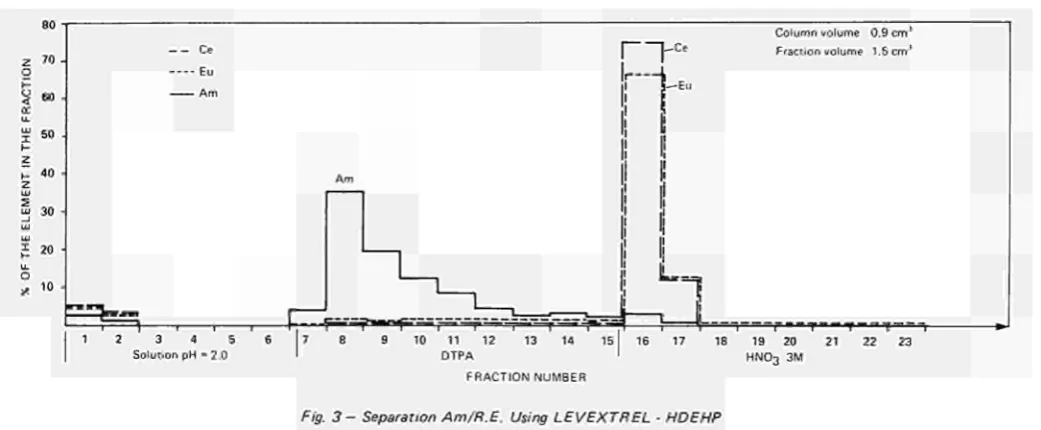
Figure 3 shows the elution curve of scheme A as an example. Rather large elution volumes are necessary to obtain a high recovery yield for actinides, with considerable overlapping of the actinides and rare earths fractions. Although results are not conclusive, extraction chromatography does not appear as a promising technique for actinides-rare earths partitioning on an industrial scale.
Process Engineering Assessment
Solvent extraction processes
From the two proposed flowsheets that rely completely on countercurrent techniques for the actinide separation, the TBP process appears highly attractive for the well known and widely proven excellent chemical and technical perfomances of this solvent in the nuclear field. Its good hydraulic behaviour even at high loading rates makes it suitable for the processing of concentrated solutions. This process is therefore proposed to treat HAW after concentration to about 0.5 m3/t U.
[image:25.595.29.553.110.761.2]T - - T -mT
18 19 20 21 22 23 HNO3 3M
FRACTION NUMBER
Fig. 3- Separation Am/R.E. Using LEVEXTREL - HDEHP
In each of the two extraction-back-extraction steps for exhaustive high valent actinides and Am/Cm/RE separation, overall flowrates of about 1/20 of those of the corresponding Purex HA co-decontaminatlon cycle would be required, resulting in considerable savings for equipment and plant layout. If reprocessing is performed after relatively short cooling an interim storage of the HAW is however required to allow for a sufficient FP decay. Virtually no active Zr/Nb should be present, since these elements are heavily extracted in the exhaustive extraction step, whereas in the Am/Cm/RE separation an advanced decay of Ce-144 would limit the radiation damage.
The latter step can be performed in all three proposed orocesses only at high pH, i.e. at low nitric acid concentrations. Denitration with formic acid in a batch mode operation is proposed.
This step must be considered critical as to corrosion risks on the equipment and to process control, to avoid on one side the reaction to run out of control (feed rates and temperature) and on the other side to reach too high a pH at the end (heavy precipitation). The TBP process requires at this point the addition of Al and Na nitrates as salting agents to enhance the Am-Cm extraction. The apparent draw-back of this process turns out as an advantage for the denitration step, since the latter can be stopped at about 0.5-1 M residual HN03 and this solution can then be adjusted to low
free acidity by introducing the salting agents as an acid deficient Na-ΑΙ nitrate solution. Operating on concentrated HAW the added amount of these salts Is fairly well compatible with that required in the glass making step. Therefore any undue dilution of the fission products is excluded.
Another unit operation required in this process is the separation of solids (feed clarification). The chemical conditions worked out should provide at least in the denitration step for an alpha-free precipitate ready for vitrification. The very straight targets (overall DF of the FP actinides 103) would however require a very thorough
washing of these precipitates, leading to important volumes of wash solution and to complex operation procedures. The analytical control for characterization of practically each batch of precipitate would be necessary in order to avoid the carry over of alpha contamination by a sub-standard batch. Certainly there Is no reasonable way today to achieve this. It appears therefore advisable to consider these precipitates a priori alpha contaminated and to foresee their treatment together with other contaminated solids from the reprocessing operation like dissolver sludges etc. In this case the precipitates can simply be separated without washing.
20
The only serious draw-back of TBP in a waste management scheme including transmutation is the impossibility to separate the rare earths from the actinides. For this final ste of partitioning other techniques or solvents must be applied. The most popular among the latter for such a purpose is HDEHP, the solvent proposed by the JRC Ispra for the other, alternative countercurrent solvent extraction partitioning process.
Conceptually this process is very similar to the TBP process. Therefore only the main differences are pointed out here. They concern:
The flow rates. The treatment of unconcentrated HAW means about 10-fold higher aqueous flow rates. The factor for the organic extradant is still more unfavourable taking into account the limited loading capacity of the HDEHP with respect to TBP. The consequences on equipment dimensions and plant layout appear evident.
- This process is foreseen for DIRECT HAW partitioning, i.e. for potentially short cooled HAW containing still considerable levels of 95Zr and 95Nb. Both elements are
strongly extracted by HDEHP, a fact that will lead to heavy radiation damages, hence to operational difficulties and to a separation efficiency's reduction. - No salting is required. Therefore any possibility of a less
extended denitration with a final pH adjustment is excluded.
- Selective back-extraction operations on the loaded organic phase are required in the last step. In order to remove the RE In the second stripping section to the required specifications for residual alpha contaminants, it is essential that in the first stripping section Am-Cm have been back-extracted quantitatively and that residual Pu and Np are kept also quantitatively in the organic layer. Retention and/or entrainment phenomena would seriously compromise the feasibility of this process.
OXAL Process
[image:26.595.36.557.26.241.2]