
Hit scrape click drag: analysis and application of compositional methods at the intersection of conserved and emergent technologies
319
0
0
Full text
(2) HIT SCRAPE CLICK DRAG: ANALYSIS AND APPLICATION OF COMPOSITIONAL METHODS AT THE INTERSECTION OF CONSERVED AND EMERGENT TECHNOLOGIES. A thesis submitted with a DVD in fulfillment of the requirements for the award of the degree of. Doctor of Philosophy. at. James Cook University. by. MATTHEW HILL B.A (Macquarie Uni), B.A (Cont. Mus)(Southern Cross Uni), Dip. Ed (Uni of Melbourne), B.Mus (Hons) (James Cook Uni). 2007 School of Creative Arts.
(3) STATEMENT OF ACCESS. I, the undersigned, the author of this work, understand that James Cook University will make this thesis available for use within the University Library and, via the Australian Digital Theses network, for use elsewhere.. I understand that, as an unpublished work, a thesis has significant protection under the Copyright Act and I do not wish to place any further restriction on access to this work.. ………………………………………... ……………………... (……………………………). i.
(4) STATEMENT OF SOURCES DECLARATION. I declare that this thesis is my own work and has not been submitted in any form for another degree or diploma at any university or other institution of tertiary education.. Information derived from the published or unpublished work of others has been acknowledged in the text and a list of references is given.. ………………………………………... ……………………... (…………………………..). ii.
(5) ACKNOWLEDGEMENTS This research would not have been possible without the generosity and support of family, friends, colleagues and supervisors. Firstly, to my wife Lisa Jacka, for providing care, motivation and perspective throughout, listening with enthusiasm, introducing me to the wonderful world of computers, providing ongoing technical support for all manner of computer related troubles, editing video and creating the DVD, and proofreading. My children, Gabriella and Cassandra, for encouraging efficiency in my work practices, providing constant grounding and perspective, and (Gabriella) for being the sound source and inspiration for the Electronic Study.. I am very grateful to my mother Marie de Monchaux for enthusiastically supporting my interest in music making, for child minding, cake making, and for providing a most suitable rehearsal venue for the major works. To Martin and Gillian Jacka for providing the ideal ‘finish your thesis’ environment in Adelaide, including the seaside house, child minding, dinners, beetroot dip, and a daily interest in my progress. To my sisters Angela and Patricia for reading sections of the thesis, and providing support and perspective throughout my candidature. To my brother Barry, my first and ongoing musical collaborator, for contribution to the major works as a performer, coordinator of the NSW contingent, and assistance in ensuring the smooth running of rehearsals.. To all the musicians involved, for their commitment and energy, Ian Brunskill, David Brammah, Rebecca McHutchison, Cleis Pearce and Simon Self, and also to Matthew Curnock for Torakina and the use of Old Pucker. To Michael Worthington for sensitivity and expertise. To Vicki Salisbury at Umbrella Studio for offering the venue for performance and recording of the major works, publicity and support. I am grateful iii.
(6) to Michael Whiticker and Bob Passmore for enabling numerous performance opportunities over the past three years and supporting live improvised music, and to David Salisbury for the Nemo experience, motivation and interest throughout. To Jack Sweetman for the tasteful aesthetic and swift realisation of the DVD cover.. Finally, my supervisors: to Diana Davis for a passion for the right word and fondness for a good figure; to Steven Campbell for technical assistance, compositional inspiration and the pursuit of precision; and, to Malcolm Vick for eagerly stepping in and expertly expediting completion.. iv.
(7) ABSTRACT The creation of music incorporating emergent technologies has occurred throughout history across a range of styles. In the past fifty years advances in electronic and, more recently, digital technologies have led to a range of new music making practices. Most recently, rapid advances in computer technology have enabled the results of complex digital manipulations of sound to be heard in real time, allowing the computer to become a powerful live performance and composition tool. As new technologies emerge, new musical forms based on various levels of synthesis of pre-composed and improvisation based composition methods are developed. This research seeks to identify, define, categorise, explore and develop compositional methods in which traditional composition techniques and emergent technologies intersect.. The research has historical, analytical and personal practice components and is situated in the fields of music analysis, music technology and composition. The deficiencies of existing analytical methodologies are discussed with particular reference to emergent technologies, music creation, recording practice, and interdisciplinary theoretical issues. A text-based, parametric analysis method is developed and applied to thirty-six selected key works in electronic/electroacoustic, improvised, rock and electronic dance music (EDM) genres. The works analysed originate from the USA, Europe and the UK and span the past seventy years. The analytical method considers the processes, shaping factors (i.e., contextual or extramusical elements) and inputs (i.e., textual or musical elements) involved in the creation of works and is intended to address both conserved and emergent technological elements. Observations made by the researcher are included alongside those from the literature.. v.
(8) The detailed analyses of the thirty-six selected key works are included as an Appendix, with a summary mapping of genre terrain included in the thesis. Whilst some generalisations about works within genres and between genres are made, the compositional methods identified constitute a complex and diverse set of music making practices. In general terms, in electronic, rock and EDM genres, traditional roles of composer, performer, producer and engineer are blurred, with individual artists moving between such roles. In improvised works a distinction between performer/composer and engineer is apparent. In more specific terms, the use of historically emergent sound sources distinguishes most of the electronic works at a timbral level. In some cases in the electronic genre, the sound source is an important conceptual driver for the structure of the works. In other genres, emergent sound sources often lead to an expansion of existing forms or used to supplement, or substitute for, traditional instrumentation.. The research makes a direct and explicit link between music analysis and music creation. The insights gained from the analyses are applied to the creation of eight new musical works: four genre-specific studies and four major works. Recordings of the practical works are presented, alongside video documentation of the rehearsal, performance and recording of the major works, on an accompanying DVD. A compartmentalised and hybridised approach to composition is utilised, drawing directly from the parametric analysis method. The practical works feature both solo and group ensembles and incorporate traditional instrumentation and digitally sampled and synthesised elements. A range of individual and collaborative ‘top down’ and ‘bottom up’ processes are explored. A computer based performance instrument (CBPI) is developed using the software Max/MSP. The CBPI embeds compositional elements identified in the analyses (relating to sound source, sound processing, rhythm, pitch, vi.
(9) texture, and spatial elements), and is utilised in the creation of the major works. The compositional approach crystallises and extends many aspects of past personal practice. The eight practical works represent some of the possibilities of both the CBPI and the analysis/creation model.. vii.
(10) TABLE OF CONTENTS ACKNOWLEDGEMENTS ........................................................................................ III ABSTRACT.................................................................................................................... V LIST OF TABLES ...................................................................................................... XII LIST OF FIGURES ...................................................................................................XIV CHAPTER ONE: INTRODUCTION ........................................................................... 1 1.1 Technology and Music Creation...................................................................................................... 1 1.2 Music Creation and Music Analysis ................................................................................................ 4 1.3 Rationale for Research..................................................................................................................... 7 1.4 Research Questions and Aims of Research ..................................................................................... 8 1.5 Organisation of the Study ................................................................................................................ 9. CHAPTER TWO: FIELD AND PERSPECTIVE: TECHNOLOGY AND PERSONAL PRACTICE............................................................................................. 10 2.1 Defining Technology ...................................................................................................................... 10 2.2 Technology in Music: Overview of History and Practice ............................................................. 13 2.3 Relationship Between Music and Technology............................................................................... 16 2.4 Research Position: Filter of Personal Practice.............................................................................. 20 2.4.1 Environment ............................................................................................................................. 21 2.4.2 Education ................................................................................................................................. 24 2.4.3 Performance / Composition ...................................................................................................... 25 2.4.4 Filter of Personal Practice Summary ........................................................................................ 30. CHAPTER THREE: MUSIC ANALYSIS: DIMENSIONS AND DIRECTIONS . 32 3.1 Introduction.................................................................................................................................... 32 3.2 Dimension 1: Musical Frame......................................................................................................... 38 3.3 Dimension 2: Spatial Frame .......................................................................................................... 42 3.4 Dimension 3: Specialist Knowledge............................................................................................... 45 3.5 Dimension 4: Validity..................................................................................................................... 50. viii.
(11) 3.6 Direction 1: Music Analysis and Emergent Technologies ............................................................ 56 3.7 Direction 2: Linking Analysis and Creation ................................................................................. 60 3.8 Summary ........................................................................................................................................ 62. CHAPTER FOUR: METHODOLOGY ..................................................................... 64 4.1 Directions from the Literature ...................................................................................................... 64 4.2 Scope of Research........................................................................................................................... 66 4.3 Theoretical Underpinnings ............................................................................................................ 70 4.3.1 Identification of Key Works in Selected Genres......................................................................... 70 4.3.2 Development of Analytical Methodology................................................................................... 70 4.3.3 Analysis of Selected Key Works................................................................................................. 73 4.4 Development of Creative Works.................................................................................................... 78 4.4.1 Creation of Genre Specific Studies............................................................................................ 78 4.4.2 Development of a Computer Based Performance Instrument .................................................... 79 4.4.3 Creation of Major Works .......................................................................................................... 79 4.4.4 Analysis – Creation Model........................................................................................................ 79. CHAPTER FIVE: ANALYSIS OF COMPOSITIONAL METHODS IN SELECTED ART MUSIC GENRES .......................................................................... 82 5.1 Electronic Works............................................................................................................................ 82 5.1.1 Identifying Key Works............................................................................................................... 82 5.1.2 Applying Analytical Methodology ............................................................................................. 83 5.1.3 Ascertaining Compositional Methods / Mapping Genre Terrain ............................................... 83 5.1.4 Applying Compositional Methods / Development of Genre Study .............................................. 88 5.1.5 Realisation of Electronic Study ................................................................................................. 92 5.2 Improvised Works.......................................................................................................................... 95 5.2.1 Identifying Key Works............................................................................................................... 95 5.2.2 Applying Analytical Methodology ............................................................................................. 95 5.2.3 Ascertaining Compositional Methods / Mapping Genre Terrain ............................................... 97 5.2.4 Applying Compositional Methods / Development of Improvised Study .................................... 108 5.2.5 Realisation of Improvised Study.............................................................................................. 115. CHAPTER SIX: ANALYSIS OF COMPOSITIONAL METHODS IN SELECTED POPULAR MUSIC GENRES ................................................................................... 118 6.1 Rock Works .................................................................................................................................. 118 6.1.1 Identifying Key Works............................................................................................................. 118 6.1.2 Applying Analytical Methodology ........................................................................................... 118 6.1.3 Ascertaining Compositional Methods / Mapping Genre Terrain ............................................. 120 6.1.4 Applying Compositional Methods / Development of Rock Study.............................................. 127 6.1.5 Realisation of Rock Study ....................................................................................................... 133 6.2 Electronic Dance Music Works ................................................................................................... 137 6.2.1 Identifying Key Works............................................................................................................. 137 6.2.2 Applying Analytical Methodology ........................................................................................... 137 6.2.3 Ascertaining Compositional Methods / Mapping Genre Terrain ............................................. 140. ix.
(12) 6.2.4 Applying Compositional Methods / Development of EDM Study ............................................. 145 6.2.5 Realisation of EDM Study....................................................................................................... 149. CHAPTER SEVEN: DEVELOPMENT OF A COMPUTER BASED PERFORMANCE INSTRUMENT........................................................................... 154 7.1 Introduction.................................................................................................................................. 154 7.2 CBPI Overview............................................................................................................................. 162 7.3 Development of Sound Source Modules ...................................................................................... 166 7.3.1 ‘Groove’ Module .................................................................................................................... 166 7.3.2 ‘Wave’ Module ....................................................................................................................... 176 7.4 Development of Modulation, Automation and Control Modules ............................................... 179 7.4.1 ‘Source/Mod Matrix’ Module.................................................................................................. 179 7.4.2 ‘Peak Amplitude Reporting’ Module....................................................................................... 180 7.4.3 ‘LFO’ Module......................................................................................................................... 182 7.4.4 Playback Speed Automation Modules ..................................................................................... 182 7.4.5 ‘Random’ Module................................................................................................................... 186 7.4.6 ‘Tempo’ Module ..................................................................................................................... 187 7.4.7 Audio Output and Input Modules ............................................................................................ 188 7.4.8 External Control via MIDI Controller .................................................................................... 189 7.5 System Testing.............................................................................................................................. 191 7.5.1 Module Function .................................................................................................................... 192 7.5.2 Exploration of Sonic Outcomes of Modules............................................................................. 193 7.5.3 Exploration of Optimum Control Means ................................................................................. 193 7.5.4 Live Performance ................................................................................................................... 194. CHAPTER EIGHT: DEVELOPMENT OF MAJOR WORKS............................. 196 8.1 Key Shaping Factors .................................................................................................................... 196 8.2 Key Inputs .................................................................................................................................... 200 8.3 Development of Works................................................................................................................. 206 8.3.1 “Hit”...................................................................................................................................... 207 8.3.2 “Scrape” ................................................................................................................................ 214 8.3.3 “Click”................................................................................................................................... 222 8.3.4 “Drag”................................................................................................................................... 231 8.4 Live and Recorded Performances................................................................................................ 239. CHAPTER NINE: REFLECTIONS, DIRECTIONS AND IMPLICATIONS..... 243 9.1 Identification and Exploration of Compositional Methods at the Intersection ......................... 243 9.1.1 Compositional Methods: Processes and Shaping Factors ....................................................... 244 9.1.2 Compositional Methods: Inputs .............................................................................................. 247 9.1.2.1 Sound.............................................................................................................................. 247 9.1.2.2 Rhythm............................................................................................................................ 249 9.1.2.3 Pitch and Dynamics ........................................................................................................ 250 9.1.2.4 Spatial Elements, Programmatic Association and Structure ............................................ 251 9.1.2.5 Interaction, Score and Presentation Mode....................................................................... 253. x.
(13) 9.2 Applications of Analytical Methodology ..................................................................................... 254 9.3 Reflections on Analysis/Creation Model ..................................................................................... 258 9.4 Computer Based Performance Instrument (CBPI) .................................................................... 259 9.5 Reflections on Practical Works.................................................................................................... 260 9.5.1 Processes................................................................................................................................ 260 9.5.2 Sonic Outcomes ...................................................................................................................... 261 9.6 Directions and Implications ......................................................................................................... 263 9.6.1 Music Analysis........................................................................................................................ 263 9.6.2 Music Technology................................................................................................................... 265 9.6.3 Music Creation ....................................................................................................................... 267 9.6.4 Music Education..................................................................................................................... 268. REFERENCES............................................................................................................ 270 DISCOGRAPHY ........................................................................................................ 297 APPENDIX A: ANALYSIS METHODS SUMMARY... ACCOMPANYING CD:A1 APPENDIX B: DETAILED ANALYSES OF SELECTED KEY WORKS ........................................................................................... ACCOMPANYING CD:A14 APPENDIX C: MAX PATCHES, MAX/MSP RUNTIME, DEMONSTRATION VERSIONS OF MAJOR WORKS......................................... ACCOMPANYING CD. xi.
(14) LIST OF TABLES Table 2.1. Personal Practice Summary .......................................................................... 31 Table 4.1. Analysis Template.......................................................................................... 74 Table 5.1. Selected Key Works in Electronic Genre....................................................... 82 Table 5.2. Resonances Observed Between Factors Shaping Selected Key Works and Factors Shaping the Creation of the Electronic Study ........................................... 88 Table 5.3. Elements of Personal Interest and Elements of Electronic Study.................. 89 Table 5.4. Selected Key Works in Improvised Genre ..................................................... 95 Table 5.5. Resonances Observed Between Factors Shaping Selected Key Works and Factors Shaping the Creation of the Improvised Study........................................ 108 Table 5.6. Elements of Personal Interest and Elements of Improvised Study .............. 109 Table 6.1. Selected Key Works in Rock Genre ............................................................. 118 Table 6.2. Resonances Observed Between Factors Shaping Selected Key Works and Factors Shaping the Creation of the Rock Study.................................................. 127 Table 6.3. Elements of Personal Interest and Elements of Rock Study ........................ 128 Table 6.4. Key Works Selected in Electronic Dance Music Genre............................... 137 Table 6.5. Resonances Observed Between Factors Shaping Selected Key Works and Factors Shaping the Creation of the EDM Study ................................................. 145 Table 6.6. Elements of Personal Interest and Elements of EDM Study........................ 146 Table 7.1. Relationship Between Storehouse of Elements of Interest from Analyses and Development of CBPI ........................................................................................... 157 Table 7.2. CBPI Modules and Sub-modules, Function(s) and Incorporated Compositional Method(s) ..................................................................................... 164 Table 7.3. Source/Modulation Matrix........................................................................... 180 Table 7.4. External Control Mapping of CBPI............................................................. 190 xii.
(15) Table 8.1. Resonances Observed Between Factors Shaping Selected Key Works Analysed and Factors Shaping the Creation of the Major Works........................ 197 Table 8.2. Selected Elements of Interest and Elements of “Hit”.................................. 207 Table 8.3. Selected Elements of Interest and Elements of “Scrape”............................ 214 Table 8.4. Selected Elements of Interest and Elements of “Click” .............................. 222 Table 8.5. Selected Elements of Interest and Elements of “Drag” .............................. 231. xiii.
(16) LIST OF FIGURES Figure 1.1. The creation of a musical work. .................................................................... 5 Figure 3.1. Analytical perspectives of existing analytical methodologies. .................... 32 Figure 3.2. Issues in musical analysis: The continua. .................................................... 35 Figure 3.3. Issues in musical analysis: Key dimensions in relation to selected analytical methodologies......................................................................................................... 37 Figure 3.4. Issues in musical analysis: Key dimensions in relation to selected contemporary analytical methodologies. ................................................................ 58 Figure 4.1. Research schema.......................................................................................... 64 Figure 4.2. Overview of personal influences categorised according to genre. .............. 67 Figure 5.1. The creation of a musical work: Features of electronic works highlighted. 87 Figure 5.2. Electronic Study: Relationship of various parameters to control signal and programmatic association. ...................................................................................... 93 Figure 5.3. Electronic Study: Max/MSP realisation flow chart. .................................... 94 Figure 5.4. The creation of a musical work: Features of improvised works highlighted. .............................................................................................................................. 107 Figure 5.5. Improvised Study: form diagram. .............................................................. 112 Figure 5.6. Improvised Study: Basic audio and control flow chart.............................. 115 Figure 5.7. Improvised Study: Interaction mode flow chart. ....................................... 116 Figure 6.1. The creation of a musical work: Features of rock works highlighted........ 126 Figure 6.2. Rock Study: Rhythm section excerpt (for sax solo and coda). .................. 130 Figure 6.3. Rock Study: Saxophone choir at 4’00”...................................................... 130 Figure 6.4. Rock Study: Vocal lead sheet. ................................................................... 131 Figure 6.5. Edit window of Pro Tools session for Rock Study. ................................... 136 Figure 6.6. The creation of a musical work: Features of EDM works highlighted...... 144 xiv.
(17) Figure 6.7. Edit window of Pro Tools session for EDM Study.................................... 152 Figure 7.1. Overview of CBPI development process................................................... 154 Figure 7.2. CBPI performance interface. ..................................................................... 163 Figure 7.3. Front panel of 'groove' module. ................................................................. 166 Figure 7.4. ‘Groove module’: Sub-module flow chart................................................. 168 Figure 7.5. Patcher p groove: Hidden detail................................................................. 169 Figure 7.6. Patcher p panning options: Manual mode.................................................. 170 Figure 7.7. Patcher p panning options: Cycle mode..................................................... 170 Figure 7.8. Patcher p panning options: Curve mode. ................................................... 171 Figure 7.9. Patcher p panning options: Random mode. ............................................... 172 Figure 7.10. Patcher p panning options: Notein mode................................................. 173 Figure 7.11. Patcher p notein control: Range, root key and keyboard split.................. 174 Figure 7.12. Patcher p notein control: MIDI to frequency conversion and amplitude outputs................................................................................................................... 175 Figure 7.13. Front panel of ‘wave’ module.................................................................. 176 Figure 7.14. Patcher p wave: Excerpt of hidden detail. ............................................... 178 Figure 7.15. Hidden detail of ‘read once’ mode in ‘wave’ module. ............................ 179 Figure 7.16. Front panel of ‘Peak amplitude reporting’ module.................................. 180 Figure 7.17. Hidden detail of patcher p peakamp. ....................................................... 181 Figure 7.18. Front panel of ‘LFO’ module................................................................... 182 Figure 7.19. Front panel of ‘harmony tables’ module.................................................. 183 Figure 7.20. Hidden detail of patcher p harmony tables.............................................. 184 Figure 7.21. Front panel of ‘interact’ module. ............................................................. 185 Figure 7.22. Front panel of ‘random’ module. ............................................................. 186 Figure 7.23. Hidden detail of ‘random’ module........................................................... 187 xv.
(18) Figure 7.24. Front panel of ‘tempo’ module. ............................................................... 187 Figure 7.25. Hidden detail of internal sync portion of patcher p sync. ........................ 188 Figure 7.26. Hidden detail of external sync portion of patcher p sync. ....................... 188 Figure 7.27. Front panel of ‘control’ module............................................................... 191 Figure 8.1. “Hit”: Graphic form chart. ......................................................................... 210 Figure 8.2. “Hit”: Section B notated parts.................................................................... 211 Figure 8.3. “Hit” section A: Approximate ‘wave’ modules’ settings. ......................... 212 Figure 8.4. “Hit” section A: Approximate ‘groove’ module settings. ......................... 213 Figure 8.5. “Scrape”: Graphic form chart. ................................................................... 217 Figure 8.6. “Scrape”: Notated parts.............................................................................. 218 Figure 8.7. “Scrape”: Drum samples pattern, section B, part 1.................................... 219 Figure 8.8. “Scrape”: Drum samples pattern, section B, part 2.................................... 219 Figure 8.9. “Scrape”: ‘Wave’ module settings............................................................. 220 Figure 8.10. “Scrape”: ‘Groove’ module settings. ....................................................... 221 Figure 8.11. “Click”: Graphic form chart..................................................................... 225 Figure 8.12. “Click”: Section B melody....................................................................... 225 Figure 8.13. “Click”: Drum sample pattern. ................................................................ 226 Figure 8.14. “Click”: ‘Groove’ and ‘wave’ module settings for section A.................. 228 Figure 8.15. “Click”: ‘Peakamp’ module settings........................................................ 230 Figure 8.16. “Drag”: Graphic form chart. .................................................................... 234 Figure 8.17. “Drag”: Notated parts. ............................................................................. 236 Figure 8.18. “Drag”: Drum sample patterns................................................................. 237 Figure 8.19. “Drag”: Initial settings of ‘wave’ modules. ............................................. 238. xvi.
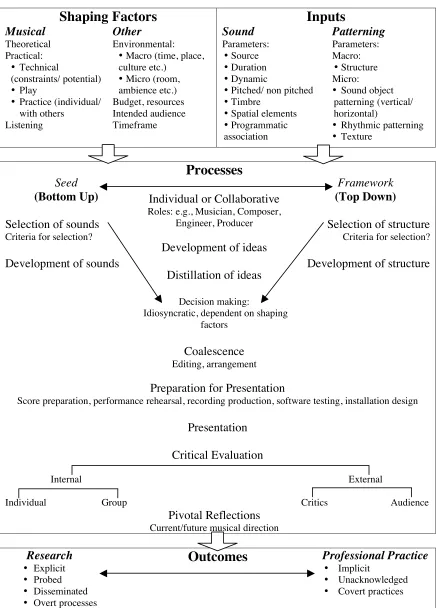
(19) CHAPTER ONE INTRODUCTION. 1.1 Technology and Music Creation. Throughout history, technological developments have contributed to musical creation at the levels of production, storage and reception. At the level of production, technology has provided means for the creation, control and capturing of sounds through the development of acoustic, mechanical, electronic and digital musical instruments, amplification, sound processing and recording equipment. Furthermore, theoretical systems regarding particular aspects of music (for example, rules of harmony) have been developed to provide a framework for the creation of new musical works. In broader terms, a range of work practices surrounding music creation have developed, enabling, for example, the division of roles between composer, conductor and performer in the Western art music model, the collaborative producer, engineer and band model in rock, or the solo composer/producer model in electroacoustic or electronic dance music genres.. At the levels of storage and reception, technological developments have disrupted the physical, spatial and temporal aspects of music performance and reception. Since the advent of sound recordings, the presence of a performer is no longer required for a listener to experience music. With global distribution networks, much of the world’s recorded music becomes accessible at any time given the appropriate means. Whilst various traditional forms of reception remain (e.g., the concert hall, festival stage, nightclub etc.), recorded music permeates much of life (at least in Western developed countries) in the form of musak, radio, television and internet or individualised by the. 1.
(20) Walkman or more recently, the Mp3 player. From the perspective of a music creator, the impact and/or shaping of technological developments is directly apparent at the level of production and more indirectly apparent at the levels of storage and reception.. Over time, some of the developed technologies (at all levels) continue to be utilised in the creation of musical works and may be termed conserved technologies. Hence particular compositional and improvisational practices incorporate conserved technological composition methods (herein conserved methods). At the level of production, conserved methods can be broadly categorised as being either pre-compositional (predominant in Western art music, rock and electronic dance music), improvisational (predominant in jazz), or a fusion of the two (such as in Third Stream jazz, or works of art music composers that incorporate improvisation). At the levels of storage and reception, a distinction can be made between presentation as live performance or recording.. At any given time in history, emergent technologies1 are developed that may be incorporated into the creation of musical works via emergent technological composition methods (herein emergent methods). Current emergent methods have stemmed from advances in digital audio technology. In the last fifteen years, rapid increases in computer processing speeds and storage capacities have enabled the results of complex digital manipulations of sound to be heard in real time, allowing the computer to become a powerful live performance and composition tool. With this technology, new electroacoustic musical forms have emerged that are based on various levels of synthesis of precomposed and improvisation-based composition methods. 1. I am grateful to Andrew Brown for pointing out the particular scientific meaning of “emergent” relating to epiphenomena that arise indirectly out of dynamic conditions described as complex systems. The term is currently used in research in computer music, however, I use the term “emergent” in relation to its generic meaning, i.e., new, and/or becoming more widely utilised. The terms “emergent technologies” and “conserved technologies” were developed by Steven Campbell.. 2.
(21) Musical works created with emergent technologies often incorporate conserved technologies and are thus considered to be at the intersection of conserved and emergent methods. A recent example is the work of Interface (Curtis Bahn and Dan Truman) (Bahn & Truman, 2001). Interface incorporate emergent technologies (e.g., forms of digital processing and instrument design) whilst utilising many conserved technologies (e.g., acoustic instrument technique, MIDI, free improvisation and chamber music presentation). An historical example is the work of Miles Davis (1926– 1991). Davis, throughout his career, was often situated at this intersection, incorporating emergent technologies (e.g., bebop, cool jazz, modal jazz, fusion, use of electronic instruments, studio editing, studio effects and rhythm programming) whilst utilising many conserved methods typical of jazz (e.g., instrumentation, small combo ensembles, form – head and solos, live performance in clubs, concert halls and outdoor stages and recordings presented on record and compact disc). These emergent technologies utilised by Davis are now all considered conserved technologies.. Since 1997 my own composition and performance history has been situated at this intersection. My solo album The Spider (1997) featured a range of composition methodologies. including. conserved. methods. (e.g.,. acoustic. and. electronic. instrumentation, modal pitch elements, solo and group improvisation and MIDI sequencing) in addition to emerging methodologies drawn from electronic dance music genres (e.g., breakbeat samples and use of a digital sampler). Since 1999, in the group amphibian (my collaboration with Barry Hill, Robert Walsh and Michael Worthington) traditional instrumentation (i.e., drumkit, double bass, keyboards) has been augmented by the use of digitally manipulated field recordings both in live and recorded presentations. My honours research (Hill, 2003) explored the combination of traditional. 3.
(22) instrumentation with timbral, spatial and programmatic manipulations of field recordings using proprietary software developed within Max/MSP.. Examination of the compositional methods utilised in my own works discussed above has the potential to offer some insight into how selected emergent methods can be incorporated into musical works. However, a thorough examination of how conserved and emergent technologies have been, and can be, utilised requires a differently focused investigation and one which goes beyond personal practice. At this broader level, a key question emerges at this point: how do some emergent methods, over time, become conserved methods, augmenting or replacing previously conserved elements whereas others do not survive over time? More specifically, how does a composer/music creator incorporate emergent technologies into musical works that are of continued interest to other composers/music creators? In order to answer this, it is necessary to examine the links between music creation and compositional methods by investigating the factors that shape the creation of a musical work.. 1.2 Music Creation and Music Analysis. The creation of a musical work is the result of a complex interplay of factors influencing the actions and decision-making processes of the individuals involved. These factors range from the particular techniques surrounding music making (e.g., music theory, technical performance issues and the limits/potential of equipment) to broad social, economic and cultural contexts which impact in some way on the nature of such creations. Figure 1.1 presents an overview of the shaping factors, inputs, processes, and outcomes involved in the creation of a musical work.. 4.
(23) Shaping Factors. Inputs. Musical. Other. Sound. Patterning. Theoretical Practical: • Technical (constraints/ potential) • Play • Practice (individual/ with others Listening. Environmental: • Macro (time, place, culture etc.) • Micro (room, ambience etc.) Budget, resources Intended audience Timeframe. Parameters: • Source • Duration • Dynamic • Pitched/ non pitched • Timbre • Spatial elements • Programmatic association. Parameters: Macro: • Structure Micro: • Sound object patterning (vertical/ horizontal) • Rhythmic patterning • Texture. Processes. Seed (Bottom Up). Individual or Collaborative. Selection of sounds. Roles: e.g., Musician, Composer, Engineer, Producer. Criteria for selection?. Framework (Top Down) Selection of structure Criteria for selection?. Development of ideas. Development of sounds. Distillation of ideas. Development of structure. Decision making: Idiosyncratic, dependent on shaping factors. Coalescence Editing, arrangement. Preparation for Presentation Score preparation, performance rehearsal, recording production, software testing, installation design. Presentation Critical Evaluation Internal Individual. External Group. Critics. Audience. Pivotal Reflections Current/future musical direction. Research • • • •. Explicit Probed Disseminated Overt processes. Outcomes. Professional Practice • Implicit • Unacknowledged • Covert practices. Figure 1.1. The creation of a musical work (Adapted from Davis, 1995).. 5.
(24) The emphasis on particular shaping factors (top left of Figure 1.1) will vary according to a given work and is connected to musical style. While the shaping factors determine the process by which a musical work is created, it is the organisation of particular inputs (top right of Figure 1.1) which provide the primary surface of a completed musical work. As with the shaping factors, the emphasis of particular inputs will vary according to a given work and is also connected to musical style. The various processes listed are not discrete categories and there is often fluidity between, for example, a bottom up or a top down approach.. Figure 1.1 provides a useful starting point for the examination of the impact of technology on music creation. If the various shaping factors, inputs, and processes given in the figure could be identified for a range of works, an accurate and relatively comprehensive picture of conserved and emergent methods could be given. While this type of examination is the task of music analysis, it seems reasonable to ask to what extent extant music analysis practices provide insight into the range of factors listed in Figure 1.1. Further, are extant analytical practices appropriate for works incorporating emergent technologies? In the context of these questions, a survey of current literature (see Chapter Three) reveals the following issues:. •. A lack of specific and/or explicit connection between musical analysis and musical creation;. •. A tendency of musical analysis practice to become an end in itself, unrelated to other musical pursuits (e.g., production, performance, composition, education);. •. An inadequacy of established analytical methods to deal with the processes and outputs of emergent technologies; and,. 6.
(25) •. Dispute as to the appropriate focus for analysis – musical work as an autonomous object and/or musical work within a broader context (e.g., psychological, sociological, cultural setting).. These issues present a challenge for the music creator/researcher seeking to identify, analyse, define, categorise and explore and develop composition methodologies at the intersection. Without suitable analytical tools compositional methods may be identified, analysed, defined and categorised, but the link to music creation, the exploration and development of such methodologies, may remain at a subliminal level. In other words, using existing analytical means develops an intuitive knowledge of how music works. However, an explicit and probed link between analysis and creation may remain unrealised. This is compounded by the difficulties presented by the proliferation of emergent methods (deriving primarily from electronic and digital technologies over the past seventy years) and the inability of many existing analytical methods to address such methodologies. This challenge constitutes the rationale for this research.. 1.3 Rationale for Research. The rate of change and the proliferation of emergent technologies in the past seventy years have precipitated a need to identify, analyse, define, categorise, explore and develop compositional methods in which traditional composition techniques and emergent technologies have intersected. Existing means of musical analysis are inadequate for this task and require expansion due to an inability for many established analytical methods to deal with the processes and outputs of emergent technologies, and the lack of a specific and/or explicit link between analysis and music creation.. 7.
(26) 1.4 Research Questions and Aims of Research. In order to address the issues raised above the following questions focus this research:. 1. What compositional methods have been developed via compositional and improvisation practices at the intersection between conserved and emergent technological compositional methods? 2. What is the potential for selected compositional methods, which exist at the intersection of conserved and emergent methods, to be applied to the creation of new musical works utilising current emergent technologies?. The aim of the research, then, is threefold:. 1. To identify and analyse a range of compositional and improvisation practices at the intersection between conserved and emergent technological compositional methods as the basis for the development of an analytical methodology capable of application to the creation of new musical works. 2. To develop a series of works utilising selected compositional and improvisational strategies from this intersection that exemplify the application of analysis to music creation. 3. To develop a computer based performance instrument compatible with the exemplar works in (2) encompassing conserved and emergent technological compositional methods and improvisation practices.. 8.
(27) 1.5 Organisation of the Study. Chapters Two and Three constitute the literature review, and focus on technology, personal practice and analysis. The methodology for the research is presented in Chapter Four. The examination of compositional methods in four genres (electronic music, improvised music, rock and electronic dance music), including discussion of a practical study for each genre, is provided in Chapters Five and Six. Chapter Seven presents the development of the computer based performance instrument using Max/MSP. Chapter Eight presents a discussion of the development and realisation of the major works. Concluding remarks are presented in Chapter Nine.. A DVD and a CD accompany the written thesis. The DVD (DVD-Video format) contains audio recordings of the genre studies and major works alongside video documentation of the rehearsal, performance and recording of the major works. The CD contains three appendixes. Appendix A contains summary tables of fifteen analytical methods discussed in Chapter Three. Appendix B contains the detailed analyses of the thirty-six works discussed in Chapters Five and Six. Appendix C contains demonstration versions of the major works and the Max/MSP patches used in the electronic and improvised studies and for the computer based performance instrument with accompanying audio files (i.e., actual samples used in works).. 9.
(28) CHAPTER TWO FIELD AND PERSPECTIVE: TECHNOLOGY AND PERSONAL PRACTICE. In order to begin an examination of compositional methods at the intersection between conserved and emergent technological methodologies, it is important to define technology and to explore the nature of the interaction between music and technology. Central to this interaction is the role of the music maker. The first part of this chapter (2.1, 2.2 and 2.3) provides an overview of the field of technology: offering a definition of technology, and a model for understanding the interaction between music and technology. The second part of this chapter (2.4) presents an overview of the position of the researcher in relation to both music and technology, providing the perspective from which the research is conducted.. 2.1 Defining Technology. Definitions of technology commonly broaden from a mere consideration of material products to include the ways in which human knowledge and activity evolves around such material products. From a sociological perspective, Earle and Fopp (1999) define technology as “the application of cultural knowledge through the creation of material items and processes to service the perceived needs of society” (p. 100). Writing in the field of science and technology studies (STS), McGinn (1991) outlines four possible meanings of technology which further develop the notion of technology as activities and knowledge:. • As Technics. … [i.e.,] material products of human making or fabrication. …. 10.
(29) • As Technology. … [i.e.,] the complex of knowledge, methods, materials, and if applicable, constituent parts (themselves technics) used in making a certain kind of technic (at a certain point in time). … • As a Form of Human Cultural Activity. … [i.e.,] a distinctive form or kind of human practice – e.g., technologists – a category including craftspeople and machinists as well as professional engineers – as practitioners. … • As a Total Societal Enterprise. … [i.e.,] the complex of knowledge, people, skills, organisations, facilities, technics, physical resources, methods, and technologies that, taken together and in relationship to one another, are devoted to the research, development, production, and operation of technics (pp. 14-15).. Applying these understandings to the field of music, a range of meanings for the term ‘music technology’ can be given which encompass the material objects involved in the production, storage and distribution of music (e.g., instruments, recording equipment, storage devices such as scores, vinyl LPs, compact discs, etc.) at the narrow end, through to the incorporation of the development of knowledge and activities surrounding music making as a whole. Much of the literature in music and technology traverses this range of meanings. For example, Moore (1992) defines technology as “the sum total of ways by which practical and aesthetic goals are realised” (p. 329). He suggests that contemporary music technology rests on “the four pillars of music notation, music theory, psychoacoustics and sound recording” (p. 331). Music notation and sound recording are examples of a narrower definition, whereas music theory and psychoacoustics are concerned with broader knowledge and activities.. 11.
(30) Frith (1996) and Théberge (1997) expand understandings of technology to include discussion of evolving social practices accompanying changes in the means of production, storage and distribution, most notably through the twentieth century. Frith (1996) begins with a ‘most basic’ definition of technology as “the ways in which sounds are produced and reproduced” (p. 226) and then considers various social practices which emerge for the listener. He identifies three social effects of the technology of sound recording: ubiquity (i.e., music is everywhere, no longer just for special occasions), quantity (i.e., music from all sources, past and present, equally available) and individualisation of experience (i.e., the ‘Walkman’ effect).. Théberge (1997) is primarily concerned with the perspective of the music maker and uses the term ‘technology’ in many ways. For example, he incorporates the notion of ‘technique’ to describe not only performance/compositional technique but “in its full sense as the organisation of means – material and social – employed for musical ends” (Théberge, 1997, p. 160). Following Frederickson, Théberge describes ‘social technology’ (i.e., hierarchies, hiring practices, conventions, patterns of work within particular parts of industry – symphony orchestras, recording studios etc.) and ‘machine technologies’ (i.e., musical instruments, recording devices etc.). Following Foucault’s notion of a ‘technology of sex’, Théberge uses the term ‘technologies of music’ to encompass “discourses, institutions and practices – aesthetic, scientific, pedagogical, legal, or economic – that ‘produce’ representations of music that have concrete ideological or material effects on music-making” (p. 160).. For Théberge copyright law is an example a ‘legal technology’ which not only assigns authorship, defines legal and economic rights and impacts on profits of individuals and. 12.
(31) companies “but also [defines] the limits of legitimate musical/creative activity” (p. 161). To such a wide panorama of ‘technologies’, Gilbert and Pearson (1999) add the ‘chemical technologies’ involved in the reception of music, for example in the production of the drug MDMA (Ecstasy) and the impact this had on the development of electronic dance music styles.. In this research, the emphasis is on the relationships between music making and emergent tools, processes and knowledge. To simultaneously capture and distinguish between both the narrower and more traditional understandings, referring to more material aspects of technology, and also the broader understandings, which include the more social aspects of technology, two terms are used. Firstly, the term ‘music technology’ is intended to refer to the material objects involved in the production, storage and reproduction of music. Secondly, the term ‘technologies of music’ (following Théberge, 1997) is intended to include consideration of the various processes, activities and knowledge involved in music making.. 2.2 Technology in Music: Overview of History and Practice. From both perspectives, a narrow ‘technology as material object’ and a broad ‘technology as activities/knowledge’, technology has been inseparable from music creation and performance throughout human history. This history can be traced in relation to both the narrow sense of technology (with the first objects hit, scraped or blown) and the broader sense (with the social activities, structures and knowledge which have developed accordingly). Cutler (1984) and Frith (1996) divide the history of music technology into three stages marked by the oral, written and recorded. 13.
(32) (corresponding to ‘folk’, ‘art’ and ‘popular’) modes of music production, storage and reproduction. At each stage major technological shifts, in both narrow and broad senses, occur. In the oral/‘folk’ mode, music is produced, stored and reproduced in the human body. In the written/‘art’ mode music is stored in the score, enabling an “imaginary existence” (Frith, 1996, p. 227) of the music and a division between composer and performer, fostering the rise of the Renaissance ideal of the artist as genius and the contemplative audience. In the recorded/‘pop’ mode music is stored and retrieved mechanically, electronically or digitally. This removes barriers of time and space for the listener and commodifies music.. Whilst these three stages provide a useful overview, Middleton (1990) suggests that such compartmentalisation overlooks the complexity of actual music practices through history where. Western music as a whole, since at least the late Middle ages, is best seen as a ‘total system’. Diachronically there are no simple antitheses; rather there is a continuum with certain quantum jumps, often marked by – among other factors – changing relationships between oral and written inputs or by new kinds of notation (p. 82).. Middleton illustrates this point with two examples, highlighting the move from figured bass to completely written parts in the late eighteenth century, and noting Rossini’s scoring of previously improvised vocal ornamentation.. 14.
(33) For Middleton (1990), the development of recording technology does not necessarily mean a return to ‘oral’ methods of music making; the situation is more complex and resists a totalizing historical schema. Middleton asks us to consider what differences follow from, for example, Elvis Presley initially working from printed song copies and reworking them in the studio, as opposed to Lennon and McCartney bringing orally worked out ideas that are then transformed/supplemented through literate means by producer George Martin (pp. 82-3). Such examples illustrate how the development of a particular set of music technologies (e.g., recording technologies) has led to a multiplicity of practices.. Another music technology, the digitization of means of production, storage and distribution, has accelerated the proliferation of various musical practices. As Born (2005) notes:. If music notation and recording were the means by which musical ideas, and then sounds, became spatially mobile – released, or alienated, from both place and copresence – then digital media have accelerated those processes. With centrifugal force, and more easily than in its commodity forms, music is scattered, flung via the internet in near-real time from any point of creation and departure to any number of points of destination (p. 25).. In terms of production (i.e., music creation) digitization offers new modes of collaborative creativity which derive from the “immaterial form of code” (Born, 2005, p. 26). Prior to the binary representation of music, material objects such as a score or recording provided a somewhat final notion of the ‘work’. The reproducibility afforded by digital technologies. 15.
(34) enables the “recurrent decomposition, composition and recomposition by a series of creative agents” (p. 26), a process she refers to as “relayed creativity” (p. 26). The use of vinyl samples or ‘breaks’ by hip-hop artists prior to the widespread adoption of digital samplers in the early 1990s provides a precursor to this practice.. As Gilbert and Pearson (1999) point out, it is not just the ‘leading edge’ items of technology that result in new or shifting musical practices. They argue that it is important to acknowledge and examine the way technology has ‘permeated’ various musical practices, including the innovative recycling and ‘misuse’ of ‘low’ technology items, for example the reclaiming of the turntable as an instrument in hip-hop, and the use of 1970s analogue synthesisers in the development of techno and house in the 1980s. A similar reappraisal of the potential of ‘old’ technology occurred in the eventual acceptance of guitar feedback as a desirable musical element in the realm of popular music. The invention of the solid body guitar in 1950 was a response to this problem of unwanted feedback in the original hollow-body design. However, by the time Jimi Hendrix performed his feedback laden version of “The Star Spangled Banner” at Woodstock in 1969 (on a solid body guitar) it was clear that a “social reconstruction” of feedback had occurred (McSwain, 2000).. 2.3 Relationship Between Music and Technology. Prior to the application of electronics to music, Moore (1992) suggests that the development of music technology was evolutionary, with new instruments, forms of notation etc., emerging in response to perceived musical needs. However, with electronics, change became revolutionary as the range of possibilities for new sounds. 16.
(35) rapidly exploded. This view is echoed by Wishart (1992) who suggests that the developments in electronic, and more recently digital technology throughout the twentieth century have led to “a much more intense relationship between music and technology” (p. 565). He points to various problems and possibilities for music and technology. Problems include commercial pressures, confusion between technical and musical excellence and scientific versus artistic imperatives. Possibilities include aspects of music education, score production, instrument building and the construction of ‘meta-instruments’, i.e., controlling a broader range of timbre/sound production in addition to pitch.. The potential for individual and/or collective music makers to negotiate such ‘problems and possibilities’ presented by changes in music technology can be viewed in terms of the broader theoretical notion of agency. Taylor (2001) describes agency as “an individual actor’s or collective capacity to move within a structure, even alter it to some extent” (p. 35). According to Taylor, the notion of agency addresses the relationship between humans and technology in a more complex and useful manner than the traditional poles of technological determinism (i.e., technology directly transforming the user) and voluntarism (i.e., technology as a neutral tool).. Subsumed. within. the. general. notion. of. agency. are. debates. surrounding. traditionalist/revisionist approaches to technology and a structural/functional distinction between understandings of music software. Moore (1992) distinguishes the approach of the traditionalist and revisionist: the former seeks to maintain existing artistic goals/aesthetic whilst using new technologies, whereas the latter seeks to find new. 17.
(36) artistic possibilities with new technologies.2 According to Moore the commercial imperative for manufacturers of music technology has led to a proliferation of devices that serve a traditionalist approach. An example of this is the relative success of Robert Moog’s keyboard interface for a voltage-controlled synthesiser in comparison to Donald Buchla’s less familiar touch control surface.3. Regarding music software, a distinction can be seen in terms of the user having a structural or functional mental model of the software application. The structural approach emphasises knowledge of how a system actually operates whereas the functional approach emphasises knowledge of how to use the system (Kirk & Hunt, 1999). Favouring a structural approach, Jean-Claude Risset suggests that “the easier a system is to use, the more limited are its possibilities” (cited in Chadabe, 1997, p. 258). Barry Truax, who only uses software that he creates himself, claims “that most people are unaware of how commercial software colors their musical process and causes standardization” (cited in Chadabe, 1997, p. 258). Others, such as Laurie Spiegel see the benefits of the functionalist model offered by many ‘off the shelf’ products. She suggests that such products enable more people to enjoy and make satisfying music without the necessity of high levels of theoretical or technical knowledge. Furthermore without having to focus on minutiae of, for example, ‘how to make notes’, the music maker is freed up to address higher-level aesthetic concerns (Spiegel cited in Chadabe, 1997, p. 332).. 2. There is a parallel between voluntarist and traditionalist perspectives, both incorporating the notion of technology as a neutral tool. However, it is difficult to draw a comparison between determinist and revisionist as these terms imply opposing levels of individual agency. 3 The relative success of Moog’s design and eventual market adoption of the synthesiser as ‘glorified keyboard’ model is seen by Pinch and Trocco (2000), in terms of a social construction of technology theory, as a result of Moog’s role as an engineer, seeking to succeed commercially and responding to feedback from a range of musicians, whereas Buchla was primarily a musician and interested in the creation of new sounds.. 18.
(37) Related to this structural/functional distinction is the issue of distinctive forms of practice emerging through the use of emergent music technologies. Théberge (1997) discusses the differences between a drummer and a drum machine programmer and argues that traditional instrument practice leads to the development of certain sensitivities which are otherwise bypassed when musical results are achieved quickly. Théberge (1997) suggests that many contemporary popular musicians are, therefore, ‘consumers’ of various technological products (drum machines, synthesiser presets etc.). This consumption model could also be extended to a range of more traditional musical practices. For example current models of jazz education encourage the learning of particular harmonic frameworks, scales, melodic patterns etc., and in the broader context of technologies of music the consumption of these is comparable to Théberge’s contention. Furthermore, the selection of a traditional instrument (with a relatively fixed timbre) is analogous to the consumption of a particular synthesiser ‘preset’.. Clearly then, the relationship between music and technology (or more importantly, for this research, music makers and technology) is complex and can be understood in a variety of ways and on a number of levels. Taylor’s (2001) understanding of agency offers a theoretical framework which addresses this complexity. Following Ortner, Taylor adopts ‘practice theory’ as a useful model which enables the consideration of the ‘positionality of individual agents’ in relation to aspects such as “social class, age, geographical location, gender, sexual orientation, religion, race, ethnicity, cultural capital and so on” (p. 37).. In the context of this research, the notion of positionality provides a useful framework within which to consider an individual’s (or group’s) music making practices in relation to. 19.
(38) technology. For example, the terms emergent technology and emergent technological compositional method (from section 1.4) are, to a certain extent, relative to the particular user. The use of turntables and other ‘low technology’ items by hip-hop and electronic dance music artists cited above reflects the particular positionality of certain music makers that contrasts, for example, the positionality of the electronic musician/researcher at Institut de Recherche et Coordination Acoustique/Musique (IRCAM). For the purposes of this research, both can be considered to be dealing with emergent technologies and creating emergent technological compositional methods. It is the intention of this research to investigate a number of particular music making positionalities, including my own, which is presented in the following section.. 2.4 Research Position: Filter of Personal Practice4. In my own case, the contexts of life – upbringing, education, musical experience and work – appear to have shaped both my musical practice, and my practice as a musicianresearcher in this thesis, in a wide range of complex ways. In order to explore my own positionality and to make explicit the perspective from which the research is conducted, I offer an overview of the following: my musical environment to date, previous musical education, performance and composition experiences. The section culminates in the development of a ‘filter of personal practice’ framework for the analytical and creative work to follow.. The rationale for such an exposition is grounded in practice-led research where the positivist paradigm (i.e., the notion of the detached, objective researcher) is rejected. As. 4. Steven Campbell invented the concept of the “filter of personal practice”.. 20.
(39) Gray (1996) suggests: “In the role of the practitioner-researcher subjectivity, involvement, reflexivity is acknowledged; the interaction of the research with the research material is recognised” (p. 13). Emmerson (2001) reinforces this notion from an artistic position: “Even scientists have long since abandoned the Newtonian idea that the observer is somehow outside the system observed. All artists have a point of view and cannot feign objectivity” (p. 20).. According to Davis (2003), for the creative artist-researcher the traditional literature review “also typically involves locating the genesis of one’s practice, an identification of pivotal theoretical and other influences on practice, as well as a critical analysis of current dilemmas/stalemates etc., in the practice” (p. 19).. 2.4.1 Environment. I grew up in a large middle class family, living initially in suburban Canberra before moving, at age seven, to a small farm on the outskirts. My parents both performed nonprofessionally, my father having a repertoire of about three stride-style arrangements for piano (including “Sunny Side of the Street” and “Ain’t Misbehaving”), my mother a range of folk and popular songs sung with guitar accompaniment. Having lived in Colombia, South America for a large portion of her own childhood, some of her repertoire was in Spanish. The family all had private instrument lessons and I was thus exposed to the daily practice of elder siblings preparing for Australian Music Examinations Board (AMEB) exams on piano, clarinet and/or piano accordion. The listening preferences of my five elder siblings dominated the selection of music heard on the family stereo and included a steady diet of 1970s and 1980s mostly guitar driven. 21.
(40) rock music (e.g., Crosby, Stills, Nash and Young, Bruce Springsteen, Bob Dylan, Rolling Stones, David Bowie, The Angels, Cold Chisel, Midnight Oil etc.). The popular music show Countdown was a prime fixture for weekend television viewing. Emerging from the shadow of my siblings, my own teenage and early twenties listening incorporated a more contemporary line-up of rock acts (including The Police, U2, The Smiths, REM, Talking Heads, The Pixies, Pavement, Fugazi, The Clash etc.) with some ‘retro’ 1960s rock interests (e.g., Hendrix, The Doors, Velvet Underground).. Attending live performances was an integral part of my own reception of music. While at high school I attended numerous ‘big name’ rock concerts at large venues (e.g., the Sydney Entertainment Centre and Canberra’s equivalent, the Indoor Sports Stadium) and numerous smaller gigs at pub/club venues in Canberra. After finishing school I moved to Sydney for three years (1988-90) where I frequently saw local live rock bands in inner city pubs (e.g., Landsdown, Hopetoun, Sandringham and Annandale Hotels). This period saw the rise of the electronic dance music (EDM) scene in Sydney and although at the time this music/scene did not appeal, many friends attended rave parties and I thus received a second-hand view. At this time my listening expanded beyond mostly guitarbased rock, to include some EDM and ambient music (e.g., Brian Eno), the latter a result of listening to the eponymous JJJ radio program presented by Arnold Frollows.. For two years (1991-92) I lived in New York and experienced a major shift in my listening habits largely through exposure to recorded and live music at the venue and record label, The Knitting Factory, where I worked as an intern. Unbeknown to me the club was at that time a focal point for the ‘downtown’ experimental and improvised music scene and regular performers included John Zorn, Bill Frisell, Wayne Horvitz,. 22.
(41) and The Jazz Passengers. In exchange for menial unpaid daytime work in the venue/label office I was able to attend concerts for free and was thus exposed to highly skilled improvising musicians, playing energetic and eclectic original music, which appealed to my indie-rock sensibilities. Tracking down recordings of these artists led me, unwittingly into the realm of jazz.. My recorded music listening for the ensuing seven years (1992-99) involved largely a chronologically reverse trawl through a potted history of jazz, beginning with the Knitting Factory artists, moving through contemporary jazz and fusion (e.g., John Scofield, Pat Metheny, Davis circa. Bitches Brew), 1950s and 60s Bop (e.g., John Coltrane, Sonny Rollins, Bill Evans, Herbie Hancock) and stopping at Charlie Parker. I attended numerous contemporary jazz gigs in Sydney (1993–94), such as those presented by the Sydney Improvised Music Association, in Lismore (NSW) and Brisbane (1995-97), and in Melbourne (1998-99).. In 1999 I began playing with the group amphibian with whom listening became a quasi research activity as the group deliberately sought to absorb elements of interest from a range of styles. Practicing with this group often involved playing along to various funk, rhythm and blues and EDM albums (e.g., James Brown, Stevie Wonder, Underworld, St. Germain and Destiny’s Child). In 2003 I moved to Townsville and whilst researching an Honours degree I listened to a range of electronic and electroacoustic works in the art music tradition (e.g., by Stockhausen, Schaeffer, Xenakis, etc.). Teaching in orchestration and Western art music survey courses at university (2003–05) foregrounded this tradition and again listening became a research activity, this time necessary for teaching purposes.. 23.
Figure
+7

Outline
Performance / Composition
Dimension 1: Musical Frame
Dimension 3: Specialist Knowledge
Dimension 4: Validity
Direction 1: Music Analysis and Emergent Technologies
Analysis of Selected Key Works
Applying Compositional Methods / Development of Improvised Study
Applying Compositional Methods / Development of Rock Study
Applying Compositional Methods / Development of EDM Study
Development of Sound Source Modules
Related documents