Delivering on
Child Poverty:
what would it take?
A report for the
Department for Work and Pensions
by Lisa Harker
November 2006
Delivering on Child Poverty:
what would it take?
A report for the
Department for Work and Pensions
by Lisa Harker
Presented to Parliament by
the Secretary of State for Work and Pensions
by Command of Her Majesty
November 2006
© Crown copyright 2006
Contents
1. Background to the report
... 52. Executive summary
... 7Recommended action ... 10
3. The scale of the task
... 11Where we are now and where we need to be ... 11
What would it take to get there? ... 12
What needs to change?... 15
4. A New Deal for Parents
...
16Childcare... 1
Flexible working ... 5
Aligning support for parents ... 16
Lone parents... 22
Parents with disabilities ... 26
Ethnic minority families ... 28
5. Work First Plus
...
36Improving skills... 6
Job entry, retention and progression ... 8
Additional measures for London... 4
6. Extending the reach
...
47Supporting the in-work poor ... 47
Reaching parents via Children’s Centres ... 51
7. The contribution of other policies
...
53Benefit levels ... 5
Potential benefit reforms... 55
Child support ... 57
8. Delivery
...
599. Getting to 2010 and beyond
... 611. Background to the report
In June 2006, I was asked to provide some scrutiny and challenge to the Department for Work and Pensions’ child poverty strategy and report to the Secretary of State with my recommendations by early October. In the limited time available, it has not been possible to undertake a thorough review of the Department’s strategy. However, in this report I am able to provide some guidance on:
• what it would take to reach the 2010 child poverty target and get on track for meeting the 2020 target;
• how much more can be achieved through Welfare to Work programmes and what contribution various reforms could make; and
• the gap that needs to be met by other policies.
The terms of reference limited the scope of this work to the areas of policy and service delivery that are within the remit of the Department for Work and Pensions. Although the Department is responsible for helping parents to participate in work – a key aspect of tackling child poverty – the Government’s overall child poverty strategy cannot be viewed through the lens of a single department. As set out in the Government’s 2004 Child Poverty Review, improving financial support for families, reforming public services to enhance children’s life chances and supporting parents in their parenting role are also critical elements of this strategy. Nevertheless, for the purposes of this report, I have focused on the contribution of the Department for Work and Pensions to tackling child poverty.
I am very grateful to officials in the Department for Work and Pensions who have assisted me with my work.
The Government’s commitment to eradicate child poverty represents one of the most important goals of our time. I hope that this report will provide a valuable contribution to the debate about how such a goal could
be reached.
Lisa Harker
About the author
2. Executive summary
Despite being a wealthy nation, with a strong economy and the highest employment rate among the G8, the UK has comparatively high levels of child poverty. Around one in five children are living in relative poverty1
– among the 25 European Union countries only Italy, Portugal and the Slovak Republic have higher levels. Changes during the 1980s, when the gap between rich and poor grew faster in the UK than almost any other industrialised country, are still reflected in the shape of our society today. Despite significant increases in support for families with children in recent years, income inequality remains high, driven by high levels of wage and wealth inequality. The benefits of our rich society – in the distribution of income and employment opportunities – are not evenly shared.
Against this backdrop, the Government has made significant progress on reducing child poverty. The number of children in poverty has fallen by 700,000 – a 2 per cent decline – since 1998/99. The UK’s child poverty rate is now at a 15-year low. But despite this progress, the Government missed its interim target to reduce child poverty by a quarter between 1998/99 and 2004/05 and with current policies is unlikely to meet the 2010 target to halve child poverty.
The Department for Work and Pensions has played a key role in reducing child poverty to date, primarily through supporting individuals into
employment. What began with a focus on tackling youth unemployment has now developed into support for a wide range of groups via a suite of Welfare to Work programmes. The benefits and employment agencies have been brought together into one system, Jobcentre Plus, with a strong focus on providing individuals with a personal adviser who can broker a package of support. There has been an emphasis on helping lone parents back to work, as the family group in which children are at most risk of poverty. And with unemployment levels falling, increasingly attention has turned to the ‘inactive’ – those out of work who are not registered as unemployed.
But to make further progress towards reaching the 2010 target, and ultimately eradicating child poverty by 2020, further reforms are required. Jobcentre Plus is the agency charged by the Government to reduce worklessness and this will remain its core focus. But to meet the child poverty targets, its Welfare to Work programmes need to be more attuned to the particular needs of parents. Beyond the New Deal for Lone Parents, parents participating in Welfare to Work programmes are not automatically
1 Poverty is defined as living in a household with below 60 per cent median income before
housing costs.
identified as parents and their family commitments not taken into account. In future, Welfare to Work support needs to take account of the increasing involvement of fathers in children’s lives, the converging aspirations of men and women in the labour market and the juggling of work and family commitments which many parents negotiate daily.
This would represent the next step in the personalisation of Welfare to Work support, moving beyond categorising jobseekers according to their benefit entitlement (which channels individuals into separate programmes according to the benefits they are claiming) towards viewing jobseekers in the wider context of their family and building a flexible package of support to meet their particular needs. It would require both more consistency in the support offered to all parents, regardless of the Welfare to Work programme they participate in, and greater flexibility in the wider support available to jobseekers. Defining a ‘core offer’ of support for all parents – a New Deal for Parents – would be one way to start to deliver such an aspiration.
The nature of the support available for jobseekers also needs to change. Welfare to Work programmes have rightly adopted a ‘work first’ approach, given the strong evidence that gaining a job offers individuals better long-term prospects than simply acquiring training. But a work first approach is not sufficient to end child poverty, since nearly half of children in poverty now live in a family where someone is already in employment. To thrive in today’s rapidly changing labour market, parents need guidance, support and skills to progress in work. A system which encourages parents to take any job rather than one that offers them good long-term prospects, or leads to parents ‘cycling’ between having a job and being out of work, is neither efficient nor effective in tackling child poverty.
What’s more, many children in poverty live with parents who have no contact with Welfare to Work programmes – either because they are not participating in programmes or because they are in low-paid work. Helping single earners to progress in work, or supporting non-working partners of single earners (potential second earners) to move into work, will play a crucial part in the next stage of tackling child poverty.
This implies some changes to the way that Jobcentre Plus works – a clearer ‘family’ focus, more flexible packages of support and a wider ‘customer’ reach. This should not distract from the priorities already facing Jobcentre Plus but could contribute, for example, towards reaching an 80 per cent employment rate and supporting more Incapacity Benefit claimants into work. Such changes are also very much in keeping with other proposals to increase the level of local discretion, flexibility and degree of personalisation of Welfare to Work programmes. But the
changes outlined in this report both deepen and widen the level of support that would be available and it may not be possible, or desirable, for
Such changes will not be sufficient on their own to enable the Government to reach its child poverty targets. The Government will need to provide adequate financial support for families as well as help to support parents into work. And the major drivers of poverty – such as high levels of wage and wealth inequality – remain considerable impediments towards reaching the 2020 child poverty target, suggesting that far greater
changes to the distribution of wealth, earnings and opportunities in society will be necessary before child poverty is finally eradicated. But establishing a modern employment service, which is better attuned to the needs of parents and the demands of the labour market, would enable more parents to move into jobs that fit with their family commitments and help them to better progress in work – offering families the best chance of an effective and sustainable route out of poverty.
Executive summary
9
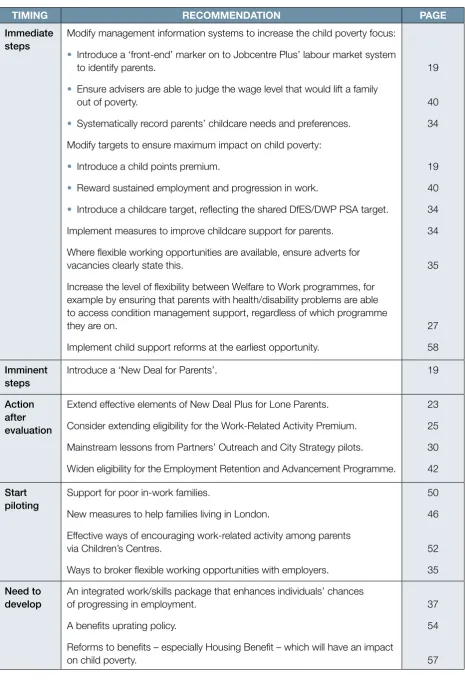
Table 1: Recommended action
TIMING RECOMMENDATION PAGE
Immediate steps
Modify management information systems to increase the child poverty focus:
• Introduce a ‘front-end’ marker on to Jobcentre Plus’ labour market system to identify parents.
• Ensure advisers are able to judge the wage level that would lift a family out of poverty.
• Systematically record parents’ childcare needs and preferences.
Modify targets to ensure maximum impact on child poverty:
• Introduce a child points premium.
• Reward sustained employment and progression in work.
• Introduce a childcare target, reflecting the shared DfES/DWP PSA target.
Implement measures to improve childcare support for parents.
Where flexible working opportunities are available, ensure adverts for vacancies clearly state this.
Increase the level of flexibility between Welfare to Work programmes, for example by ensuring that parents with health/disability problems are able to access condition management support, regardless of which programme they are on.
Implement child support reforms at the earliest opportunity.
19 40 4 19 40 4 4 5 27 58 Imminent steps
Introduce a ‘New Deal for Parents’. 19
Action after evaluation
Extend effective elements of New Deal Plus for Lone Parents.
Consider extending eligibility for the Work-Related Activity Premium.
Mainstream lessons from Partners’ Outreach and City Strategy pilots.
Widen eligibility for the Employment Retention and Advancement Programme.
2 25 0 42 Start piloting
Support for poor in-work families.
New measures to help families living in London.
Effective ways of encouraging work-related activity among parents via Children’s Centres.
Ways to broker flexible working opportunities with employers.
50 46 52 5 Need to develop
An integrated work/skills package that enhances individuals’ chances of progressing in employment.
A benefits uprating policy.
Reforms to benefits – especially Housing Benefit – which will have an impact on child poverty.
7
54
. The scale of the task
Where we are now and where we need to be
Child poverty has fallen substantially in recent years – some 700,000 children have been lifted out of poverty since 1998/99. Given that child poverty rates tripled during the 1980s and then remained persistently high during the 1990s, this sharp fall in child poverty has been a remarkable achievement. The child poverty rate is now at a 15-year low and the UK no longer has the highest child poverty rate in the European Union. Nevertheless, the progress has not been sufficient to reach the Government’s target to reduce child poverty by a quarter between 1998/99 and 2004/05 – a crucial milestone in the Government’s efforts to eradicate child poverty within a generation. The failure to meet this target also makes the task of reaching the next milestone – a 50 per cent reduction by 2010 – more difficult.
A further 1.1 million children need to be lifted out of poverty between 2004/05 and 2010/11 in order to meet the 2010 target.2 However,
projections suggest that, if no further action is taken on policy, the child poverty rate is unlikely to fall significantly. Simply sustaining the progress so far will be challenging. Child poverty is measured in relative terms; it is defined in relation to median income which changes over time. The number of children in poverty could rise by up to 100,000 per year as a result of median income growth between now and 2010, so in practice the number needed to be lifted out of poverty may be higher than 1.1 million.
2 The PSA target is to halve the number of children in relative low-income households between
1998/99 and 2010/11. There were .4 million children in poverty in 1998/99; the target for 2010 is 1.7 million. Relative low-income households are defined as those with income below 60 per cent of contemporary equivalised median income before housing costs. The Government has also set a target (although not a PSA target) of there being fewer than 1 million children living in absolute low income by 2010/11. In addition, the Government has made a commitment to set an additional target to halve the number of children suffering a combination of material deprivation and relative low income (at 70 per cent of median income before housing costs) – to provide a wider measure of children’s living standards.
Graph 1: Number of children in poverty:
trend and forecast
2010/11 2009/1
0
2004/0 2005/06 2006/07 2007/082008/09
5
2001/0 2002/03 2003/04 2
1998/99
1999/20002000/01
3.5
2.0 2.5 3.0
Number of childr
en (million)
Forecast
Trajectory required to reach
1.5 2010 child poverty target
1.0
0.5
0
Source: Chung R et al, 2006, Family Resources Survey 2004/05, Office for National Statistics.
Note: Poverty is defined as living in a household with income below 60 per cent of the median after housing costs. The forecast is based on the Department for Work and Pensions’ simulation model. It includes take-up modelling.
What would it take to get there?
Work undertaken for the Joseph Rowntree Foundation has estimated that the 2010 target could be met if a further £4. billion per annum was invested in benefits and tax credits. While this has revealed the scale of the task, there is wide recognition that relying solely on benefit/tax credit increases to reduce child poverty would be undesirable since, for many families, an income through paid employment offers a more effective and sustainable route out of poverty.
At the same time, the 2010 and 2020 targets cannot be met by increases in employment alone. For example, if we relied solely on employment to halve the number of children in lone-parent families living in poverty, we would need to reach a lone-parent employment rate of around 86 per cent by 20104 (which would require the UK to leap from having one of the
lowest to one of the highest lone-parent employment rates in Europe). Even if the current 70 per cent lone-parent employment target was reached by 2010, the percentage of dual-earner couple families would need to rise from 57 per cent to 65 per cent and couple unemployment would need to fall from 5 per cent to 4 per cent if the 2010 target is to be met.5 Although such changes in employment rates appear small, they
would represent a dramatic shift in recent trends (see graph below) and assume that all the increase in the couple employment rate benefits poor couples. In other words, it would require a 20 per cent increase in the employment rate of poor couples with children and one or no earner in just four years.
Graph 2: Changes in employment rates for
couples with children required to meet the
2010 child poverty target
200 2008 2009 2010 7 2006
200 2002 2003 2004 2005 1 1997 1998 1999 2000
70
20 30 40 50 60
Employment rate (%)
10
0
Both working Both working (target) Single earner Single earner (target) Not working Not working (target)
Source: Labour Force Survey January–March 2006 (SN 5369), Office for National Statistics.
Note: This graph illustrates the scale of change required to reach the 2010 child poverty target if the strategy relies solely on increases in employment. It assumes a 70 per cent lone-parent employment rate by 2010.
4 This is an estimate: 1.1 million children need to be lifted out of poverty by 2010. Thirty-nine per
cent of poor children currently live in one-parent families, so at least 429,000 children in lone-parent families need to be lifted out of poverty. If this was achieved solely through entries into work, it would require a 29 percentage point rise in the lone-parent employment rate – each 1 per cent rise is equivalent to lifting approximately 15,000 children out of poverty.
5 These are rough estimates – we can only estimate the child poverty impact of increasing the
number of dual-earner couples.
It is therefore obvious that a combination of a higher employment rate and enhanced benefit/tax credit support will be necessary. The key question is therefore: what balance of employment support and benefit/tax credit support would maximise the chances of meeting the 2010 and 2020 targets?
The contribution that employment has made to reducing poverty since 1997 has decreased over time. Indeed, while substantial gains in employment were seen between 1997 and 2001, since 2001 most of the fall in child poverty can be attributed to increases in tax credits.6
Continuing with current Welfare to Work policy is, therefore, very unlikely to achieve a significant reduction in child poverty by 2010 or 2020. The Government has made considerable progress in supporting parents into work – there has been an 11. per cent increase in lone-parent
employment since 1997, for example. Progress may have recently slowed: the spring 2006 lone-parent employment rate is unchanged on spring 2005 and the partnered mothers’ employment rate fell over the same period. Nevertheless, there are strong grounds for believing that parental employment rates could rise further. The UK has a high proportion of children living in workless households (15. per cent). There remains a 15 percentage point difference in the lone-parent and partnered mother employment rates. The UK has low lone-parent labour market participation and low proportions working full time compared with European Union counterparts. And the employment patterns for two-parent families also suggest room for change – while 69 per cent of all couple families where someone is in work are dual earning, only 24 per cent of poor couples where someone is in work are dual earners.7
6 Brewer M, Goodman A, Shaw J and Sibieta L, 2006, Poverty and inequality in Britain,
Institute for Fiscal Studies.
Chart 1: Who’s poor?: child poverty by family
type and economic status
Couple, one or more
working part time 9% Lone parent, not working 32%
Couple, one working full time and one not working 13%
Lone parent, working part time 5% Couple, self-employed 15% Lone parent, working full time 2%
Couple, both working full time 1% Couple, one working full time and one working part time 4%
Couple, both not working 19%
Source: Department for Work and Pensions, 2006, Households Below Average Income 1994/5–2004/05,
Corporate Document Services.
What needs to change?
To increase parental employment rates, the Department for Work and Pensions would need to:
• align the package of support that parents get across Department for Work and Pensions programmes;
• maximise the chances of every parent currently supported via Welfare to Work programmes to find employment (see pages 16 to 21);
• improve the package of support that parents get – to increase the effectiveness of the support provided to parents and meet the needs of particular groups (see pages 22 to 46);
• extend support both to those not currently participating in Welfare to Work programmes and to the in-work poor, to reach the 48 per cent of children in poverty who are living in a household where someone is already in work (see pages 47 to 52); and
• consider the contribution of other policies to reducing child poverty (see pages 5 to 58).
4. A New Deal for Parents
Aligning support for parents
The New Deal for Lone Parents has been successful at helping lone parents into work8 partly because the support it offers has, by definition,
taken into account both individuals’ job-seeking and parenting needs. However, other jobseekers do not, as a matter of course, have their parenting responsibilities taken into account when they take part in Welfare to Work programmes. Parents on other New Deals are not
automatically offered help with finding childcare or a job that fits with their caring commitments.9 This is despite the fact that, given the decline in
one-earner households, most parents now have to adapt their working patterns because of family commitments.
Furthermore, Jobcentre Plus does not routinely record whether a jobseeker has parenting responsibilities and its target structure does not reflect the Department’s ambition to reduce child poverty by helping parents in both one- and two-parent families into work.
Aligning support for lone and couple parents would ensure that Welfare to Work support is better tailored to meet all parents’ needs. There are 2.7 million children living in families who are in receipt of unemployment, low income or disability benefits,10 the vast majority of whom will be living
in poverty and all of whom are children of ‘customers’ of the Department for Work and Pensions (although only a minority are participating in New Deals – see page 51).
Many parents on existing New Deal programmes are not identified as such. Only 58 per cent of parents on New Deal programmes have access to the New Deal for Lone Parents. Of the remaining 42 per cent, half are on the New Deal for Disabled People.
8 Some 450,000 lone parents moved into work between October 1998 and February 2006.
9 One survey found that childcare was cited as a barrier to work by around 5 per cent of
participants on the New Deal for Disabled People (Department for Work and Pensions Research Report No. 69) but we do not know whether this is an accurate reflection of need because this information is not collected routinely.
10 This includes Income Support, Jobseeker’s Allowance, Incapacity Benefit, Disability Living
Chart 2: Parents on New Deal programmes
New Deal for Young People 6% New Deal for Disabled People 21%
New Deal 25 Plus 9% New Deal 50 Plus 5% New Deal for Partners 1%
New Deal for Lone Parents 58%
Source: DWP tabulation tool, February 2006, and author’s estimates derived from benefit and survey data.
Welfare to Work support should become more attuned to the needs of both couple and lone-parent families because:
• the employment patterns of lone parents and couples with children both need to change substantially if child poverty is to fall;
• 40 per cent of children in poverty are living in couple families where someone is working – so parents in couples are moving from welfare to work but not escaping poverty;
• understanding the barriers to work that parents face is hampered by the fact that they are not viewed as parents when they participate in most Welfare to Work programmes; and
• a modern welfare to work system should mirror the society we have – in which fathers are increasingly involved in children’s day-to-day lives and where parents make decisions about their working patterns as a family. Parents seeking employment do not have identical needs – the
support they receive will always need to be tailored to their particular circumstances. But parents do share some common requirements: a job that enables them to balance their work and caring responsibilities, access to childcare (if appropriate) and a sufficient income to lift their family out of poverty.
To have the best chance of both increasing parental employment and tackling child poverty, all jobseekers who are parents should have their family responsibilities taken into account when they are offered support with finding and securing employment. Any parent who is receiving support on Welfare to Work programmes should be offered:
• personal adviser support with preparation for work and job search – alongside a flexible menu of support to cater for individual needs pre- and (in some cases) post-employment;
• help with securing appropriate childcare (see page 1); and
• support with finding employment that enables parents to balance their work and family commitments (see page 5).
This should be available to all parents, including all couple parents who are participating in New Deals/Pathways to Work,11 all partners of benefit
recipients – who should be encouraged to participate in New Deal
programmes – and, ultimately, in-work poor couples if access to support is widened to include potential second earners in low-income families (see page 47).
The ultimate vision would be of an integrated service that is responsive to the needs of individuals. It would require a combination of a more uniform approach in terms of the core support that parents receive, together with greater flexibility in the menu of support available for all jobseekers. If advisers were to adopt a ‘family focus’, they would be better placed to help jobseekers overcome barriers to work resulting from family commitments and to encourage partners of benefit claimants to participate in New Deal programmes.12 By viewing jobseekers’ needs
in the context of their family, advisers would be able to support both jobseeker and his or her partner, with no presumption about who should go into work first. This would help to encourage each member of a couple to achieve his or her potential and enhance individual autonomy and life chances for women and men.
Establishing a family focus for Jobcentre Plus would require something of a culture shift that would need to be reinforced by appropriate targets and management information. It would not have to consist of a separate programme – rather a minimum entitlement of support for all parents. It would require the support on offer to parents to be strengthened, and recommendations about how to do this are set out in the remainder of this report. Such changes require additional spend but it may also be possible to make more effective use of existing resources.
11 Where delivery of Pathways to Work is being contracted out to the private and voluntary sector,
contracts are not specifying how support should be delivered. However there will be a need to ensure that providers are aware of the value of having a family focus.
12 Currently partners of benefit claimants are able to participate in the New Deal for Partners – a
A parent package (New Deal for Parents) would be attractive and easy to communicate to parents. It would offer support to both fathers and mothers – reflecting the fact that in today’s society there is a more equal sharing of parenting responsibilities.
Recommendations
1. Jobcentre Plus should introduce a ‘front-end marker’ on to its labour market system to enable staff to identify parents in all its programmes at the earliest opportunity.
2. Jobcentre Plus’ target structure should reflect the
Department’s commitment to tackling child poverty by having an additional ‘child points premium’ which offers extra points for outcomes for those with children irrespective of the main client group to which they belong.
3. All parents on Welfare to Work programmes should be eligible for a core package of support: a New Deal for Parents.
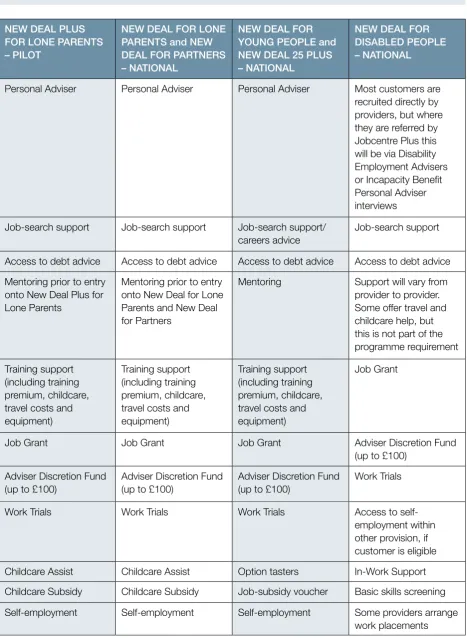
Table 2: Support offered under various New Deal
programmes
NEW DEAL PLUS FOR LONE PARENTS – PILOT
NEW DEAL FOR LONE PARENTS and NEW DEAL FOR PARTNERS – NATIONAL
NEW DEAL FOR YOUNG PEOPLE and NEW DEAL 25 PLUS – NATIONAL
NEW DEAL FOR DISABLED PEOPLE – NATIONAL
Personal Adviser Personal Adviser Personal Adviser Most customers are
recruited directly by providers, but where they are referred by Jobcentre Plus this will be via Disability Employment Advisers or Incapacity Benefit Personal Adviser interviews
Job-search support Job-search support Job-search support/
careers advice
Job-search support
Access to debt advice Access to debt advice Access to debt advice Access to debt advice
Mentoring prior to entry onto New Deal Plus for Lone Parents
Mentoring prior to entry onto New Deal for Lone Parents and New Deal for Partners
Mentoring Support will vary from
provider to provider. Some offer travel and childcare help, but this is not part of the programme requirement
Training support (including training premium, childcare, travel costs and equipment)
Training support (including training premium, childcare, travel costs and equipment)
Training support (including training premium, childcare, travel costs and equipment)
Job Grant
Job Grant Job Grant Job Grant Adviser Discretion Fund
(up to £100)
Adviser Discretion Fund (up to £100)
Adviser Discretion Fund (up to £100)
Adviser Discretion Fund (up to £100)
Work Trials
Work Trials Work Trials Work Trials Access to
self-employment within other provision, if customer is eligible
Childcare Assist Childcare Assist Option tasters In-Work Support
Childcare Subsidy Childcare Subsidy Job-subsidy voucher Basic skills screening
Self-employment Self-employment Self-employment Some providers arrange
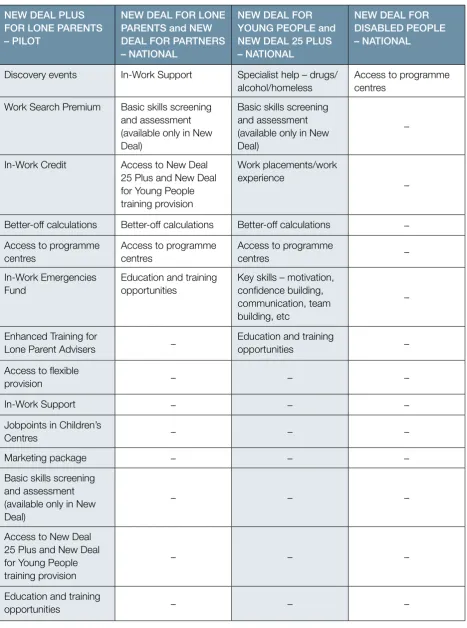
Table 2: Support offered under various New Deal
programmes
(continued)
NEW DEAL PLUS FOR LONE PARENTS – PILOT
NEW DEAL FOR LONE PARENTS and NEW DEAL FOR PARTNERS – NATIONAL
NEW DEAL FOR YOUNG PEOPLE and NEW DEAL 25 PLUS – NATIONAL
NEW DEAL FOR DISABLED PEOPLE – NATIONAL
Discovery events In-Work Support Specialist help – drugs/
alcohol/homeless
Access to programme centres
Work Search Premium Basic skills screening
and assessment (available only in New Deal)
Basic skills screening and assessment (available only in New Deal)
–
In-Work Credit Access to New Deal
25 Plus and New Deal for Young People training provision
Work placements/work experience
–
Better-off calculations Better-off calculations Better-off calculations –
Access to programme centres
Access to programme centres
Access to programme
centres –
In-Work Emergencies Fund
Education and training opportunities
Key skills – motivation, confidence building, communication, team building, etc
–
Enhanced Training for
Lone Parent Advisers –
Education and training
opportunities –
Access to flexible
provision – – –
In-Work Support – – –
Jobpoints in Children’s
Centres – – –
Marketing package – – –
Basic skills screening and assessment (available only in New Deal)
– – –
Access to New Deal 25 Plus and New Deal for Young People training provision
– – –
Education and training
opportunities – – –
Lone parents
We know that the package of support for lone parents will need to be strengthened if their employment rate is to rise significantly. Current projections suggest that the lone parent employment rate will reach 64 per cent by 2010. Further welfare reform proposals may enable the Government to reach a lone parent employment rate of around 66 per cent – but this is still short of the 70 per cent target. It would also require a step-change in current trends – the lone parent employment rate would need to rise three times as fast in the next five years as it did in the last five if the 70 per cent target is to be met.
The Department is currently piloting an enhanced, integrated package of support for lone parents in five areas in England (with two further pilots in Scotland and Wales due to begin in October 2006). This package combines an advance payment for job search (Work Search Premium), some help with childcare, a guaranteed clear gain from work (via the In-Work Credit and tax credits) and support in work (from the In-Work Emergencies Fund and In-Work Support).
Further roll-out of this integrated package of support needs to be informed by evidence of its impact; evaluation of the programme’s impact will not be published until December 2006. The evaluation will indicate whether the programme as a whole is more effective than the sum of its parts. Nevertheless, the emerging qualitative evidence suggests some elements of the package (for example, In-Work Credit) may be working better than others (for example, childcare support).
If the New Deal Plus for Lone Parents was expanded from 10 per cent of lone parents on Income Support to all lone parents, we would expect the lone parent employment rate to rise by 2– per cent.1 While this would
be an important step forward – and could lift up to 40,000 children out of poverty – it would clearly fall short of meeting the 70 per cent employment target. Other measures to strengthen support for parents looking for work and to enhance retention and progression – as discussed elsewhere in this report – will be necessary.
Recommendation
4. On the basis of evaluation evidence, the effective elements of the New Deal Plus for Lone Parents should be rolled out nationally.
Rights and responsibilities
If a stronger package of support for lone parents was in place and lone parents genuinely had access to affordable childcare and work that fits with their family commitments, there would be grounds for extending conditionality. The UK is out of step with many other countries in having relatively weak conditionality in their system for lone parents. Strengthening lone parents’ responsibility to prepare for a return to work would be a logical next step.
The Department has already signalled that it will introduce six-monthly (rather than annual) work-focused interviews for lone parents who have been on benefit for at least a year and whose youngest child is aged below 11, and quarterly work-focused interviews for lone parents whose youngest child is aged 11 or over. But beyond this, any further extension of work-focused interviews may prove ineffectual. Nevertheless, given that less than one in five join the New Deal for Lone Parents following a work-focused interview,14 more attention does need to be paid to addressing
the reasons for non-participation.15
1 Gregg P, Harkness S and Macmillan L, 2006, Welfare to work policies and child poverty: a
review of issues relating to the labour market and economy, Joseph Rowntree Foundation – they estimated a 2 per cent increase.
14 Lessof et al, 200, New Deal for Lone Parents evaluation: findings from the quantitative survey
p 97, Department for Work and Pensions Research Report No. 147.
15 The Department is currently conducting research into the reasons for non-participation in
the New Deal for Lone Parents. It has identified several reasons including lack of awareness, attitudes towards parenting and childcare, financial concerns and, in some cases, the lack of an explicit invitation to participate in the programme.
However, stronger forms of conditionality – along the lines already expected for Jobseeker’s Allowance claimants – could undermine the success of the New Deal for Lone Parents which has been built on the basis of positive, supportive engagement with parents. There would also be resistance to such a proposal, particularly in light of the reassurances made in the welfare reform Green Paper.
An alternative approach, and one that would not require a leap from ‘soft’ conditionality under the work-focused interview approach (which requires lone parents to come to quarterly/six-monthly meetings to discuss
returning to work) to ‘hard’ conditionality under the Jobseeker’s Allowance system (which requires claimants to ‘sign on’ fortnightly and demonstrate that they are looking for work), would be to look at ways of encouraging work-related activity and job preparation. This is effectively being explored under the Work-Related Activity Premium pilots (see page 55).
This premium will consist of a £20 addition to Income Support for lone parents who have been out of work for at least six months, have a child aged 11 years or older and are undertaking work-related activity (which may include training, taking steps to sort out a debt or managing a health condition, for example). It will be available on an opt-out basis – lone parents will be eligible for the additional payment unless they specifically decline to prepare for a return to the labour market by undertaking work-related activities. The premium potentially offers a way to incentivise efforts to prepare for a return to work without penalising those who are not ready to take a job. The pilots will determine the impact of offering a payment
on an opt-out basis. On the basis of this evidence the Department should then look at whether a payment of this sort should be rolled out nationally – either on a voluntary or mandatory basis – to all lone parents with school-age children.
Whatever the next steps, there would be a need to ensure that suitable, affordable childcare was available before any extension of conditionality. By 2010, under the ten-year childcare strategy, some out-of-school childcare will be offered by all schools between 8am and 6pm but the nature and quantity of the out-of-school care will be determined by
schools and will not necessarily meet demand. From 2008 local authorities will have a statutory duty to secure sufficient childcare for working parents. One way of making that duty ‘real’ would be to link any conditionality for parents to it. In other words, if parents were able to show that out-of school provision in their area was not suitable for their needs, they would not be penalised for failing to take up employment.
Recommendations
5. On the basis of evaluation evidence, consideration should be given to extending eligibility for the Work-Related Activity Premium to all lone parents of school-age children on a voluntary or mandatory basis.
6. Any further extension of conditionality should be linked with fulfilment of the forthcoming local authority childcare duty to secure sufficient childcare for working parents.
Parents with disabilities
One in three children in poverty – between 700,000 and 850,000 – has a parent with a self-reported disability or long-standing health condition.16
But because Welfare to Work programmes are primarily built around benefit entitlement, parents with disabilities can miss out on receiving appropriate support. Only around 200,000 children in poverty whose parent has a disability or long-standing health condition will have a parent eligible for Pathways to Work.17 It seems substantial numbers of parents
of children in poverty currently receive inadequate support for managing their disability/health conditions and this could be a major barrier to entering work.
Many of these parents are in couple families. But there are also 264,000 lone parents who are not working and have a self-reported, long-standing health condition.18 Survey evidence seems to suggest that very few have
accessed the Pathways to Work pilot – most are directed to New Deal for Lone Parents where they will receive little help with managing their health/ disability.
16 Lyon N, Barnes M and Sweiry D, 2006, Families with children in Britain: Findings from the 2004
Families and Children Study (FACS), Department for Work and Pensions Research Report No. 40, Corporate Document Services.
17 By December 2006, 40 per cent of new and repeat Incapacity Benefit claimants will have
access to Pathways to Work – all Incapacity Benefit claimants will be eligible from April 2008.
18 Labour Force Survey.
From October 2007, private and voluntary sector providers will deliver Pathways to Work for 60 per cent of Incapacity Benefit claimants. Contracts with providers will reward outcomes rather than dictating process, but it will be important for the contracts to incentivise efforts to tackle child poverty.
But given the number of parents with a health condition/disability who are not eligible for Pathways to Work, it will also be necessary to widen access to help. This could be achieved by extending eligibility for
Pathways to Work or by introducing some condition management support within the New Deal for Lone Parents. This would help to increase lone parent employment and therefore reduce child poverty. For example, if all lone parents with a disability (as defined under the Disability Discrimination Act) and 20 per cent of lone parents with a work-limiting health condition participated in the Pathways to Work programme, an estimated 7,600 lone parents would move into work over and above those expected to anyway – which would increase the overall lone parent employment rate by nearly 0.5 per cent.
Recommendation
7. The Department for Work and Pensions should widen access to help for parents with health conditions and disabilities.
Ethnic minority families
Reaching the child poverty targets requires particular efforts to reduce the level of poverty among certain ethnic minority groups. One in five children in poverty are from ethnic minority communities and rates of poverty among Black African, Pakistani and Bangladeshi children are now more than double the rate among white children.19
The high rate of child poverty among ethnic minority families is closely linked to labour market disadvantage. Much higher than average unemployment rates continue to be seen among some ethnic minority groups; this will become even more significant to overall child poverty rates as ethnic minorities are projected to account for half the growth in the working-age population up to 2011.
The ethnic minority employment gap is too often dismissed as resulting from ‘cultural’ differences when there is clear evidence of the significant barriers that ethnic minority groups face in entering and progressing in work. For example, a recent report from the Equal Opportunities
Commission found that the potential contribution of Pakistani, Bangladeshi and Black Caribbean women to the labour market was not being realised because of structural barriers and discriminatory attitudes. It is these factors – rather than the attitudes of the women themselves – that is driving high unemployment, lower pay, poor prospects and labour market ethnic minority and gender segregation.20 Some of this will be for the
Department to resolve but in the context of a wider cross-government effort to tackle discrimination and champion equality, diversity and human rights.
Many of the issues highlighted in this report – such as the need to improve skills, extend access to childcare and strengthen efforts to improve retention and advancement in work – have particular relevance for families from ethnic minorities. The Government has established the Ethnic Minority Employment Task Force to tackle the main factors in ethnic minority employment disadvantage. Initiatives such as Fair Cities, Ethnic Minority Outreach, Partners’ Outreach and the new City Strategy pilots aim to close the ethnic minority employment gap.
But the evidence about the nature of child poverty in ethnic minority families suggests that mainstream employment programmes (including New Deals and Pathways to Work) also need to be more attuned to the needs of ethnic minorities, and the lessons from various initiatives used to inform them.
19 Households Below Average Income statistics, and analysis by Platt L, 2006, Ethnicity and child
poverty, research for the Ethnic Minority Employment Task Force, www.emetaskforce.gov.uk
20 Equal Opportunities Commission, 2006, Moving on up? Bangladeshi, Pakistani and Black
Research recently commissioned by the Department for Work and Pensions has shown that:21
• Measures to tackle poverty among lone-parent families benefit Black Caribbean and Black African children in poverty, more than two-thirds (69 per cent) of whom are living in lone-parent families. But there are twice as many children in poverty living in Bangladeshi/Pakistani families, only 14 per cent of whom are living in lone-parent families.
• Measures to tackle in-work poverty need to address the particularly high risk of low pay among Pakistani and Bangladeshi families – nearly half of children in Pakistani and Bangladeshi families reliant on a single full-time earner are in poverty compared to just 12 per cent of children in white families. The particularly low levels of pay found among Bangladeshi men is likely to explain this heightened risk.
Graph 3: Risk of poverty among children in
couple families with at least one full-time
worker
50
White Indian Pakistani/ Black Caribbean/
Bangladeshi Black African 0
10 20 30 40
Risk (%)
Source: Platt L, 2006, Ethnicity and child poverty, research for the Ethnic Minority Employment Task Force,
www.emetaskforce.gov.uk. Data derived from Households Below Average Income statistics
Notes: Figures have been calculated from three-year rolling averages for 2002/03, 2003/04 and 2004/05 and relate to the whole of Great Britain. Ethnic group is measured on the basis of the household reference person.
21 Platt L, 2006, Ethnicity and child poverty, research for the Ethnic Minority Employment Task Force,
www.emetaskforce.gov.uk
• Measures to reduce worklessness among disabled people need to support Pakistani/Bangladeshi families. Children living in such families where there is a disabled adult face a very high risk of poverty – 8 per cent in the case of Bangladeshi children – compared to 6 per cent of white children in similar circumstances. It is not clear why Pakistani/ Bangladeshi children face such a heightened risk of poverty if they have a parent with a disability, or whether planned programmes will make a difference. (Only 1. per cent of participants on the New Deal for Disabled People are Pakistani/Bangladeshi.)
Graph 4: Risk of poverty among children in
households with one or more disabled adults
90
0 10 20 30 40 50 60 70 80
Risk (%)
White Indian Pakistani Bangladeshi Black Caribbean/ Black African
Source: Platt L, 2006, Ethnicity and child poverty, research for the Ethnic Minority Employment Task Force,
www.emetaskforce.gov.uk. Data derived from Households Below Average Income statistics
Notes: Figures have been calculated from three-year rolling averages for 2002/03, 2003/04 and 2004/05 and relate to the whole of Great Britain. Ethnic group is measured on the basis of the household reference person.
Recommendations
8. The Department for Work and Pensions should mainstream lessons from its pilot programmes aimed at reducing
worklessness among ethnic minority households into national Welfare to Work programmes.
9. The Pathways to Work programme should monitor its
effectiveness in reducing levels of worklessness/child poverty among Pakistani/Bangladeshi households where there is a disabled adult.
Childcare
A lack of suitable, affordable childcare is frequently cited by parents as a barrier to entering work. One in seven lone parents who are not working more than 16 hours a week cites unaffordable childcare as a barrier to employment,22 for example. The lack of appropriate, affordable childcare is
also a barrier to work for partners of benefit claimants who have children2
and partners of single earners, and while some cite a preference not to work because of family responsibilities there are a significant proportion who say they would like to.24
The number of childcare places has nearly doubled since 1997. The situation should continue to improve in coming years: by 2010 under the ten-year childcare strategy, there will be 15 hours a week of free early learning and care for and 4-year-olds, ,500 Children’s Centres and out-of-school childcare offered by all schools between 8am and 6pm all year round.
Nevertheless significant challenges remain in matching supply and demand and especially in meeting the childcare needs of low-income families. It is by no means clear that the ten-year childcare strategy will automatically deliver the kinds of changes necessary to meet the childcare needs of families in poverty, particularly the needs of certain groups such as children with disabilities. It also remains the case that a significant proportion of families are sceptical about using formal childcare. Initiatives that have attempted to encourage more low-income families to take up formal childcare have yet to deliver expected results.25
From 2008, local authorities will have a statutory duty to secure sufficient childcare for working parents and all local authorities are reviewing the level of demand for childcare in their areas, largely via survey work. Jobcentre Plus, as the principal agency working with job-seeking parents, ought to hold good intelligence about parents’ childcare needs, views and preferences in order to inform the development of childcare locally. But Jobcentre Plus has not exploited this potential monitoring role.26 Personal
Advisers do not actively encourage parents to take up formal childcare (there is no performance indicator that measures the take-up of formal childcare), despite the fact that the Department for Work and Pensions shares a Public Service Agreement target with the Department for Education and Skills to increase the take-up of formal childcare by lower income
working families by 50 per cent (take-up currently stands at 26 per cent).
22 Lyon N, Barnes M and Sweiry D, 2006, Families with children in Britain: Findings from the 2004
Families and Children Study (FACS), Department for Work and Pensions Research Report No. 40, Corporate Document Services.
2 Arrowsmith A, 2004, A review of what we know about partners of benefit recipients, Department
for Work and Pensions.
24 Lyon N, Barnes M and Sweiry D, 2006, Families with children in Britain: Findings from the 2004
Families and Children Study (FACS), Department for Work and Pensions Research Report No. 40, Corporate Document Services.
25 Early and emerging evidence from the Extended Schools pilot seems to confirm this.
26 From 2007/08, Jobcentre Plus will collect information, for new claims only, on whether a
customer has declared barriers to work because of childcare needs.
Jobcentre Plus’ role in relation to childcare is currently limited:
• There are only 60 childcare partnership managers – one for each district – responsible for improving access to childcare information and building links with Children’s Centres. They are tasked with improving the
awareness of formal childcare and the local childcare market within their district (including local opportunities to train/work in childcare), working with the local authority and other strategic partners and undertaking analysis of the gaps between childcare supply and demand.
• Parents are not routinely offered information about accessing childcare. There is no internal performance management indicator on childcare and therefore no means of systematically assessing the level and nature of demand for childcare services, or evaluating the help provided by Jobcentre Plus.
• Levels of take-up of financial support for childcare via Jobcentre Plus are very low.27 All participants on the New Deal for Lone Parents and
New Deal for Partners are entitled to Childcare Assist. This pays for childcare in the week immediately before a parent takes up a job. Only £56,000 was spent in 2005/06 which suggests few parents are claiming this support.28 Evaluation evidence suggests that parents do not find
Childcare Assist helpful either because they do not want to be apart from their children the week before they start a job or because they tend to start employment at short notice.
• In addition, all participants on the New Deal for Lone Parents and the New Deal for Partners are entitled to Childcare Subsidy.29 Only
£24,000 was spent on this in 2005/06, suggesting that only around 200 parents claimed (0. per cent). Lone parents may also receive help with upfront childcare costs – maximum £00 per week at the adviser’s discretion – but we do not know how often this subsidy is given.
• Beyond the New Deal for Lone Parents, childcare support for parents is limited. Parents on the New Deal for Young People and the New Deal 25 Plus may receive assistance with childcare costs if childcare responsibilities are preventing them from participating in Jobcentre Plus contracted provision (but not those on the employment option because they are receiving a wage). There is no childcare funding offered to parents on the New Deal for Disabled People.
27 Take-up of childcare costs for training/attending interviews is higher. £1.2 million was spent in
2005/06.
28 Given average weekly childcare costs of £2 per week (source: Childcare and Early Years
Provision: A study of parents’ use, views and experience, Department for Education and Skills, 2006) this suggests few parents are claiming – around 2,400 (about 4 per cent of participants) at most.
29 This pays childcare costs up to a maximum of £67.50 per week (£100 per week for two
Enhancing the role of Jobcentre Plus in gathering intelligence about parents’ childcare needs, views and preferences will be essential if the ten-year childcare strategy is to respond to the needs of low-income families. Jobcentre Plus is in the unique position of having regular contact with job-seeking parents – its data will inevitably be more up-to-date than annual surveys undertaken by local authorities. But Jobcentre Plus also needs to play a bigger role in promoting the value of high-quality early years’ services for children’s development. The take-up of nursery education and care for and 4-year-olds is lower among poor families, yet it is children in these families who stand to gain most from such provision.0 By offering job-seeking parents childcare chats and tasters,
Jobcentre Plus could help to ensure that the benefits of good quality early years’ provision are universally shared.
0 Sylva K, Melhuish E, Sammons P, Siraj-Blatchford I, Taggart B, 2004, The Effective Provision of
Pre-School Education Project: Final Report, Department for Education and Skills.
A New Deal for Parents
Recommendations
11. All parents (mothers and fathers) on Welfare to Work programmes should be:
• asked about their childcare needs and the information recorded for management purposes;
• offered help with securing childcare by providing
information or being given an appointment with the local Childcare Information Service;
• offered a childcare visit/taster and advice on how to meet childcare costs when they move into work if they have not used formal childcare; and
• offered childcare costs at the adviser’s discretion for those needing to attend training/interviews.
12. The Department for Work and Pensions should review the level and nature of its subsidy support (Childcare Assist, Childcare Subsidy, etc) in light of better intelligence about what parents need.
13. While childcare partnership managers are working well in some regions, there is variation in approach and performance. The role of childcare partnership managers should be more clearly defined:
• On the basis of management information about parents’ needs and preferences for childcare, childcare partnership managers should work with the local authority to ensure that supply better meets demand and, where possible, ‘broker’ deals with providers.
• Childcare partnership managers should develop Jobcentre Plus outreach work, establishing links with all Children’s Centres (see page 51).
14. Personal Advisers should receive training on the contribution of good quality childcare/early education to children’s
development and the options available.
Flexible working
While the right to request flexible working has improved access to more family-friendly working patterns for parents in work, we know that many parents are deterred from working because they do not feel that they can find a job that will fit in with their caring responsibilities.
Flexible work opportunities have increased in recent years, although not in all areas of the labour market. And, in reality, parents who are out of the labour market are least likely to be able to negotiate their working hours. There is also evidence for increased demand for flexible working arrangements, amid concerns about the impact of long, inflexible and ‘atypical’ working hours on family life.1 Parental employment rates are
unlikely to increase significantly unless there are more opportunities for parents to work hours that are compatible with their caring responsibilities. At present Jobcentre Plus does not systematically promote or broker flexible working arrangements on behalf of customers. This partly depends on there being a good local dialogue with employers about labour
market demands and the needs of the labour force. But it also rests on Jobcentre Plus undertaking proactive work to broker arrangements between employers and its customers, by establishing job-share registers, identifying working patterns that meet parents’ needs and working with employers to develop solutions. By taking a confident, proactive stance, Jobcentre Plus could play a major role in negotiating working patterns that meet both employers’ and employees’ needs. As a minimum, the level of information about the nature of jobs needs to improve. Job adverts do not routinely state whether there are opportunities to work flexibly.
Recommendations
16. Where flexible working opportunities are available, Jobcentre Plus adverts for vacancies should clearly state this.
17. Jobcentre Plus should pilot schemes to encourage
opportunities for flexible working arrangements for parents, perhaps drawing on the experience of recruitment agencies.
1 See, for example, Barnes M, Bryson C and Smith R, 2006, Working atypical hours: what
happens to family life?, National Centre for Social Research.
5. Work First Plus
Improving skills
Although a parent’s skills and qualifications are a key determinant of their income, the Government’s child poverty strategy has placed little emphasis on skills acquisition in the past. However, the Leitch Review has been established by the Government to identify the UK’s optimal skills mix in 2020, to maximise economic growth, productivity and social justice. Its report will provide an important context for the debate about how best to increase the skill levels of those who are out of work or on low incomes. The UK’s Welfare to Work programmes have had a strong ‘work first’ approach, informed by the strong evidence that gaining a job offers better long-term prospects than simply acquiring training. This approach has at times appeared to underplay the value of skills. Indeed, some have noted that ‘the effectiveness of programmes with a stronger emphasis on rapid labour market attachment was simplified into a message that education and training “didn’t work” and that programmes should redirect attention to work first’.2
Low skills are already a major barrier both to job entry and progression in work (40 per cent of lone parents on Income Support have no qualifications and 1.2 million parents are in low-skilled employment). And as we look to 2020, the skills ‘problem’ is going to become even more significant to the child poverty agenda, as the premium placed on high skills in the labour market increases.
A particular concern must be improving the skills and qualifications of today’s 5–20-year-olds – who will become parents in the next 15 years. But there is also a clear need for better ‘second-chance’ education and training. We currently do not have a system for the development of skills and job advancement for those moving from welfare to work. There is a need for a ‘Work First Plus’ approach that includes:
• more personalised support and advice to help parents gain skills that will enable them to progress in the labour market;
• better ways of assessing those parents who would benefit from participation in skills training prior to job entry and those who require a package of ‘job plus training’ in order to progress in work. There is evidence that the most effective programmes provide high-quality, work-focused training, have a clear link with employers, provide a tailored
2 Millar J and Evans M, 200, Lone parents and employment: International comparisons of what
package of support and encourage active job search at the same time as training. But for some individuals, help to improve ‘soft skills’ (communication, presentation, confidence-building) will be necessary prior to job search. The critical issue is to get the appropriate support for each individual – and to find better ways to recognise and reward ‘distance travelled’;
• better use of existing resources to fund training programmes that have an impact on employability/progression – and more investment where necessary (with lessons from Train to Gain). Given current evidence that those with the lowest skills are least likely to have access to training at work, it might be necessary to have an approach where funding for skills follows the individual; and
• better use of intelligence about skills (employers’ requirements, changes in demand for skills) to inform Welfare to Work advice.
This is an area of policy which is clearly shared between departments, with the Department for Education and Skills and the Department for Work and Pensions (and two key delivery agencies – the Learning and Skills Council and Jobcentre Plus) playing lead roles. In the light of the Leitch Review it will be important to identify the optimal use of resources and the most effective approach to delivering better skills support to individuals seeking and entering work, in order to make a difference to child poverty.
Recommendation
18. In the light of the Leitch Review, the Department for Work and Pensions and the Department for Education and Skills should jointly set out how they intend to improve access to appropriate skills training for jobseekers and low-income workers.
Work First Plus
7
Job entry, retention and progression
For many parents a move into work is an escape from poverty. In almost two out of three cases where there is an increase in the number of workers in a poor household, individuals in that household are lifted out of poverty. However, in around one in three cases, gaining a job means moving from non-working poor to working poor. This is often a temporary situation – for example, only around one in ten children living in couple families reliant on a single earner are persistently poor4 (compared with 44 per cent of children
in non-working households). But while persistent poverty has fallen among children living in non-working households, it has not decreased among working households. And this is reflected in the convergence in the number of children in poverty living in non-working and working households.
Graph 5: Children in working and non-working
poor households
2003/0 2004/05 4 2002/0 3 2001/0 2 1998/9 1999/2000 2000/01 9 1997/9 8 1996/9 7 1994/9 1995/96 5 2.0 1.8 1.6 0.0 1.4 1.2 1.0 0.8 0.6 0.4 0.2Number of childr
en
In-work poverty Out-of-work poverty
Source: Households Below Average Income statistical report 1994/95–2004/05,
Office for National Statistics.
For children to have the best chance of escaping poverty, parents’ employment needs to be sustained and provide a wage (or prospects of a wage) that lifts the family over the poverty line – also critical elements of a ‘Work First Plus’ approach. Welfare to Work programmes should not only help parents into work but should also help them retain and progress in employment. This means getting the right pre- and post-employment support in place and ensuring that parents enter the kind of jobs that help them to escape poverty.
Jenkins SP, Rigg JA and Devicienti F, 2001, The Dynamics of Poverty in Britain, Department for Work and Pensions Research Report No. 157.
4 Carter R, Christian V and Herbert N, 2006, Low-Income Dynamics 1991–2004 (Great Britain),
Job entry
While there is strong evidence that programmes that take a ‘work first’ approach are more successful at helping people into work than programmes that focus only on enhancing skills or qualifications, an emphasis on the quantity rather than the quality of job placements runs the risk of parents moving into low-paid work which does not enable them to escape poverty.
An alternative strategy would be built around not only helping parents into work but also helping them to find work that can be sustained and offers good prospects – to ensure that families are not only better off in work but also have the earnings, or expectation of earnings, that lift them out of poverty. This would need to be reinforced by a target structure that rewarded both sustained employment and progress in work.
Not every move into work has to be a move out of poverty if it offers a step towards better prospects. But more could be done to ensure that parents do not end up in low-income jobs with little chance of progressing to higher pay. Programmes that have focused on helping participants gain a good job rather than the first job that comes along – such as the US Portland (Oregon) Welfare to Work programme5 – have been able
to secure jobs with better wages, and this has had a positive impact on the chances of someone remaining in work. Evidence from the UK’s Employment Zone evaluation also found that good job matching was central to individuals sustaining work.6 Job entry rates in such
programmes tend to be lower, but more children are likely to be lifted out of poverty per entry into work.
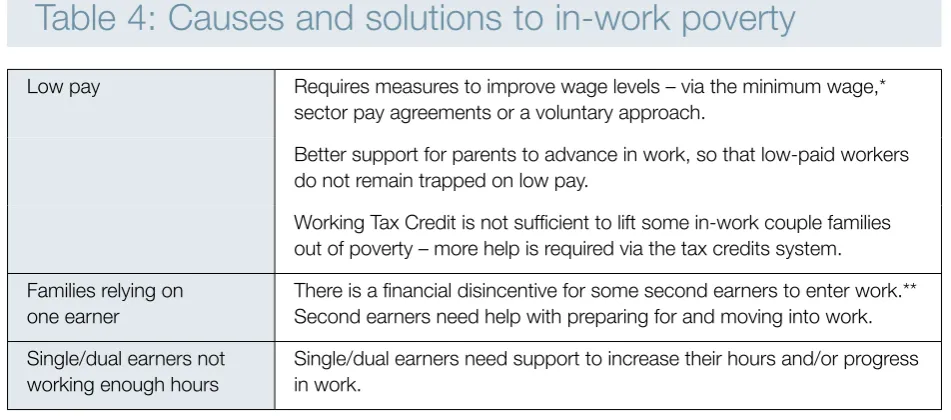
The significant contribution of low earnings to high levels of child poverty in the UK nevertheless raises some fundamental questions about the level of reward attached to jobs in different parts of the labour market, the responsibility of employers towards their employees and the extent to which in-work financial support can be expected to lift families out of poverty. As we look to the future, some of the most significant growth areas of the labour market are in the service sector,7 where many parents
– primarily women – will be looking for opportunities to take up work. The undervaluation of such work and the persistence of the gender pay gap will significantly restrict progress towards ending child poverty by 2020.
5 See Hamilton G, 2002, Moving People from Welfare to Work: Lessons from the National
Evaluation of Welfare-to-Work Strategies, Manpower Demonstration Research Corporation.
6 Griffiths R, Durkin S and Mitchell A, 2005, Evaluation of Single Provider Employment Zone
Extensions to Young People, Lone Parents and Early Entrants, Department for Work and Pensions Report No. 12.
7 Most employed lone parents are now working in the service sector – such as retail, cleaning and
domestic services, catering, childcare, clerical and teaching assistants.
Recommendations
19. Advisers should be provided with sufficient management information to judge not only wh