FORMATIVE ASSESSMENT - IMPLICATIONS FOR
CLASSROOM PRACTICE
Bet McCallum. Institute of Education
Assessment is formative only when comparison of actual and reference levels yields information which is then used to alter the gap. In formative assessment both the teacher and the pupil make judgements of the pupil’s work and learning strategies against learning objectives. Both can give feedback about what is successful and the teacher takes the lead (as a more knowledgeable other) in deciding what is needed to close the gap. The pupil’s responsibility is to use the information to close the gap.
INTRODUCTION
This brief review takes six recent research studies on formative assessment and draws out their messages for classroom practice. While much of the work is based on good practice in primary teaching the messages are transferable to secondary teaching.
Black and Wiliam (1998) Assessment and Classroom Learning
[Black, P. and Wiliam, D. Assessment in Education Vol. 5, No 1 1998
Black and Wiliam’s review of recent literature on formative assessment covers studies carried out in normal classrooms and in ‘ laboratory’ settings. The main implications of the review were summarised in Inside the black box (Kings College, London)]
Assessment Reform Group (1999)Assessment for Learning
[Assessment for L earning. Beyond the black box. University of Cambridge School of Education. 1999
This pamphlet is intended for policy makers and teachers and proposes that more emphasis be placed on using assessment for learning, rather than of learning (summative).]
Torrance and Pryor (1998) Investigating Formative Assessment
[Torrance, H. and Pryor, J. (1998) Investigating Formative Assessment. Teaching,
Learning and Assessment in the classroom. Buckingham, Open University Press Primary Teaching Strategies, Assessment and Feedback funded by Economic and Social Research Council 1997 – 1999. ESRC Reference R000 23 7096 The authors report upon a qualitative research project which focuses closely on the teacher's strategies in authentic situations- the TAFS project - which looks at teaching, assessment and feedback strategies used by Y2 and Y6 teachers considered to be `very good' by LEA inspectors]
Gipps, McCallum and Hargreaves (2000) What makes a good primary teacher? – expert strategies
[Gipps, C., McCallum, B. and Hargreaves, E. ‘What makes a good primary
teacher? – expert strategies’ (forthcoming book to be published by Falmer Press, Sept 2000). This book is based on a research programme which looked at classroom teaching strategies.]
Clarke (1998 –2000) teaching and feedback strategies
Clarke, S. In-service Materials for teachers (1998-2000) Institute of Education,
Getting it right: distance marking as accessible and effective feedback in the primary classroom. (forthcoming book chapter for Sept. 2000)
Clarke writes about her intervention work with teachers on very specific teaching and feedback strategies
Sutton writes for teachers on classroom assessment.
Sutton, R. (1995) Assessment for Learning. Salford, RS Publications
LESSONS
The key lessons from the works studied are:
formative assessment can have a strong impact on learning; the role of pupils in assessment is important;
where formative assessment is effective both teachers and pupils understand what they are doing.
IMPLICATIONS FOR CLASSROOM PRACTICE
Drawing on the studies forming the basis of this report, key components of formative assessment can be described as:
Regular planned ‘assessment incidents’; Regular pupil self-assessment;
Feedback for learning;
REGULAR PLANNED ASSESSMENT INCIDENTS
The studies emphasise that regular and planned assessment incidents are part of formative assessment.
Teachers are assessing all the time. There is no doubt that some assessment goes on during teaching. Torrance and Pryor’s teachers described ‘assessing - while-teaching’. Their teachers picked up information about children’s knowledge and learning strategies through eavesdropping and ‘observing on the hoof’ and they ‘gauged the level’ of general understanding of a class through quick fire quizzing at the beginnings and ends of lessons. These techniques were used more to build or accomplish the lesson than to make useful assessments which could be fed back to children. This is evidence that, in general, teachers subordinate assessment to instruction. The implications are, that if formative assessment is to be effective,
incidents need to be planned so that the goal of teaching is subordinated to the goal of determining children’s level of achievement.
There are implications for pupil organisation and lesson structure. Given the complexity of classroom life and the usual size of classes, it is generally difficult for teachers to focus on the assessment of individuals. The suggestion that
assessment incidents are focused on small group tasks seems reasonable:
A focus group assessment can generate a great deal of information about children’s knowledge skills and understanding while at the same time contribute to the process of creating understanding. Children can do a lot of talking when given time and space by a teacher prepared to listen and observe. Such talk provides evidence of children’s progress to date but also scaffolds the learning of the group as they interrogate each other about the nature of the task and collaborate to accomplish it. (Torrance and Pryor, p.131)
The National Literacy Strategy promotes a lesson structure that includes focus group work, hence this format is likely to be a feature of the natural environment of many ordinary classrooms and would not require deep change in organisational strategy. There are implications for task design in assessment incidents of this type. Tasks need to be carefully designed so that focused assessment can take place. Open
-style activities offering the opportunity for collaboration are more useful.
‘Sorting Leaves’ task for 4-5 year olds is quoted by Torrance and Pryor. We have also seen many instances of appropriate activities including children’s
discussion/handling of historical artefacts and brainstorming the planning of fair tests or model making (TAFS).
There are implications for the teacher’s role in assessment incidents of this type
An overt listener-observer/note-taker role is essential to learn about how and what pupils know, understand and can do. But the teacher also needs to use questions to provoke thinking. ‘Observe, wait, listen, question’ is a useful sequence to follow.
The nature of teacher questioning has received much discussion in the studies used in this report. It is recognised that the IRF structure, which involves teacher
initiation, pupil response and teacher’s evaluative feedback, is widely employed by
seem ‘genuine’ (‘not a test’) prompting pupils into thinking about and thinking aloud their own learning strategies. Other pupils are then likely to appropriate these strategies. The teacher’s responsibility would be to maintain a key role in structuring the dialogue, bearing in mind her own assessment agenda and the kinds of
‘knowing’ she is looking for. (Torrance and Pryor)
Active listening and focused observation are part of the good teacher’s repertoire (TAFS) although skills may need to be developed in some other teachers.
Questioning as an assessment strategy has been discussed at school level in some schools (TAFS) but it is likely that much more work needs to be done. Really useful note-taking as part of observation will also require some examination and discussion.
There are implications for the frequency of assessment incidents of this type. ‘Regular’ is likely to be interpreted differently across schools. However, there is a
view from research (Fuchs and Fuchs) that assessment incidents need to be systematically planned and carried out between 2 to 5 times a week.
Despite the recommendation (above) for dedicated focus group assessment time, the most common lesson structure (and likely to prevail) is the three-stage format: - teacher introduction
- pupil activities
- plenary (TAFS)
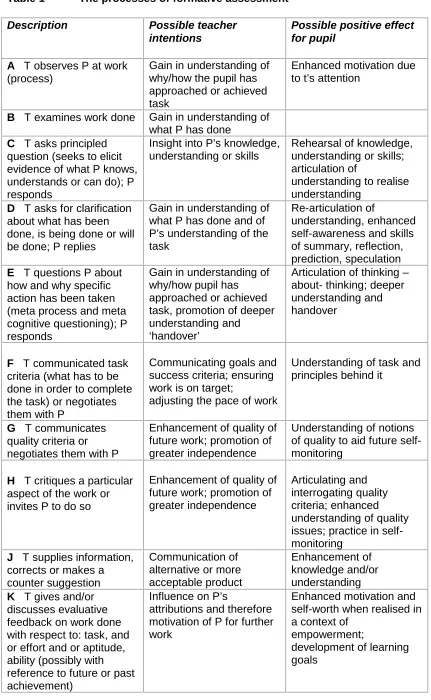
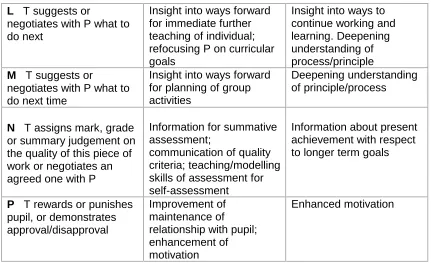
During the pupil activities stage teachers circulate, at times stopping and using a range of teaching, assessment and feedback strategies with individual children (TAFS), with likely intentions and with various possible effects on the children (Torrance and Pryor).
If teachers were made more conscious of these episodes, the implications are that they could make even short interactions more formatively useful.
Torrance and Pryor’s ‘the processes of formative assessment’ is potentially a very useful reference.
Table 1 The processes of formative assessment
Description Possible teacher intentions
Possible positive effect for pupil
A T observes P at work
(process)
Gain in understanding of why/how the pupil has approached or achieved task
Enhanced motivation due to t’s attention
B T examines work done Gain in understanding of what P has done
C T asks principled
question (seeks to elicit evidence of what P knows, understands or can do); P responds
Insight into P’s knowledge, understanding or skills
Rehearsal of knowledge, understanding or skills; articulation of
understanding to realise understanding
D T asks for clarification
about what has been done, is being done or will be done; P replies
Gain in understanding of what P has done and of P’s understanding of the task
Re-articulation of
understanding, enhanced self-awareness and skills of summary, reflection, prediction, speculation
E T questions P about
how and why specific action has been taken (meta process and meta cognitive questioning); P responds
Gain in understanding of why/how pupil has approached or achieved task, promotion of deeper understanding and
‘handover’
Articulation of thinking – about- thinking; deeper understanding and handover
F T communicated task
criteria (what has to be done in order to complete the task) or negotiates them with P
Communicating goals and success criteria; ensuring work is on target;
adjusting the pace of work
Understanding of task and principles behind it
G T communicates
quality criteria or negotiates them with P
Enhancement of quality of future work; promotion of greater independence
Understanding of notions of quality to aid future self-monitoring
H T critiques a particular
aspect of the work or invites P to do so
Enhancement of quality of future work; promotion of greater independence
Articulating and interrogating quality criteria; enhanced understanding of quality issues; practice in self-monitoring
J T supplies information,
corrects or makes a counter suggestion
Communication of alternative or more acceptable product
Enhancement of knowledge and/or understanding
K T gives and/or
discusses evaluative feedback on work done with respect to: task, and or effort and or aptitude, ability (possibly with reference to future or past achievement)
Influence on P’s
attributions and therefore motivation of P for further work
Enhanced motivation and self-worth when realised in a context of
empowerment;
L T suggests or
negotiates with P what to do next
Insight into ways forward for immediate further teaching of individual; refocusing P on curricular goals
Insight into ways to continue working and learning. Deepening understanding of process/principle
M T suggests or
negotiates with P what to do next time
Insight into ways forward for planning of group activities
Deepening understanding of principle/process
N T assigns mark, grade
or summary judgement on the quality of this piece of work or negotiates an agreed one with P
Information for summative assessment;
communication of quality criteria; teaching/modelling skills of assessment for self-assessment
Information about present achievement with respect to longer term goals
P T rewards or punishes
pupil, or demonstrates approval/disapproval
Improvement of maintenance of relationship with pupil; enhancement of motivation
Enhanced motivation
It might also be beneficial if teachers were made aware of two distinct types of assessment conceptualised by Torrance and Pryor: convergent and divergent assessment. The convergent-divergent distinction has potential to offer teachers a
useful framework for accomplishing formative assessment. Teachers could enhance the formative impact of assessment if they moved from one type to the other,
according to the nature of the learning task. Advice from Torrance and Pryor suggests that ‘teachers should always be alert’ to the divergent opportunities and ‘self-consciously’ apply a divergent approach at least once a week.]
[image:6.595.83.514.69.332.2](See Table 2, taken from Torrance and Pryor p153).
Table 2 Convergent and divergent assessment
Convergent Assessment Divergent Assessment
Assessment which aims to discover whether the learner knows, understands or can do a predetermined thing.
This is characterised by:
Assessment which aims to discover what the learner knows, understands or can do.
This is characterised by:
Practical implications Practical implications (a) precise planning and its intention to
stick to it;
(a) flexible planning or complex planning which incorporates alternatives;
(b) tick lists and can-do statements; (b) open forms of recording (narrative, quotations etc.);
(c) an analysis of the interaction of the learner and the curriculum from the point of view of the curriculum;
(c) an analysis of the interaction of the learner and the curriculum from the point of view both of the learner and of the curriculum;
(d) closed or pseudo-open questioning and tasks;
(e) a focus on contrasting errors with correct responses;
(e) a focus on miscues – aspects of learners’ work which yields insights into their current understanding – and on prompting meta-cognition;
(f) judgemental or quantitative evaluation;
(f) descriptive rather than purely judgemental evaluation;
(g) involvement of the pupil as recipient of assessments;
(g) involvement of the pupil as initiator of assessments as well as recipient;
Theoretical implications Theoretical implications
(h) a behaviourist view of learning; (h) a constructivist view of learning; (j) an intention to teach or assess the
next pre-determined thing in a linear progression;
(j) an intention to teach in the zone of proximal development;
(k) a view of assessment as accomplished by the teacher;
(k) a view of assessment as
accomplished jointly by the teacher and the pupil;
This view of assessment might be seen less as formative assessment, than as repeated summative assessment or continuous assessment
This view of assessment could be said to attend more closely to contemporary theories of learning and accept the complexity of formative assessment
REGULAR PUPIL SELF-ASSESSMENT
The studies on formative assessment point clearly to the importance of regular pupil self-assessment as part of formative assessment. Self – assessment involves both reflection on one’s learning strategies and analysis/critique of one’s work.
The implications are for a considered and systematic approach by teachers underpinned by a belief by both teachers and pupils that the process of self-assessment helps learning (Sutton).
For teachers this would entail:
− organising information-giving sessions on self-assessment − systematic explanation of learning objectives behind each task
− frequent and consistent encouragement of children’s self-reflection on learning through planned strategies and dedicated time.
Organising information - giving class sessions
During class sessions teachers could:- clarify what is meant by self-assessment - explain ‘learning objectives’
- describe different self-assessment strategies emphasising how these can aid learning - inform pupils that self-assessment will become part of classroom life - explain that pupil’s own assessment will form part of assessment conversations
with the teacher and that these conversations will be helpful because the teacher and the pupil will be looking for the best route to improve learning.
Explaining learning objectives
The importance of informing children of the learning objectives behind the work they have been asked to do is a recurring theme in the studies reviewed by Black and Wiliam. In addition there is strong advice that learning intentions should be made clear (Torrance and Pryor) for every task (Clarke).
In practice, making learning objectives clear to pupils can be tricky. The implication is that this teaching skill needs development and teachers need support.
Clarke runs in-service workshops in which teachers practise the presentation of different learning objectives for different levels of pupil understanding. [Commonly, teachers draw learning objectives from the National Curriculum programme of study, the QCA schemes of work and the Literacy and Numeracy objectives. Sometimes they break these down into a series of smaller steps. In Clarke’s workshops,
teachers are asked to explain a) what they would like to see or know from the child’s work and b) the purpose of the learning task. Teachers are asked to split learning objectives into: ‘What I’m looking for…’ and ‘the reason we are doing this is…’
Examples include:
Teacher’s learning objective: To begin to use initial letter sounds as an aid
to decoding unfamiliar words.
Words used with pupils: ‘What I want to know is if you can’t read a word,
can you say the beginning sound? This will help you guess or find the word’
Teacher’s learning objective: To find out the role played by different parts
of the digestive system’
Words used with pupils: ‘What I am looking for is whether you can explain
the journey of food from entry to exit using the names for each body bit. This will help you understand how your body works’.
(Source: Training materials; Clarke 1999)
Frequent and consistent encouragement of children’s self-refection on
learning
Encouraging pupil self-reflection in relation to learning objectives
Clarke directs teachers to create a poster of questions to be prominently displayed for use by pupils. Teachers model the use of the poster so that pupils can employ the tool to think back over a task. Questions included in the poster are:Do you remember the learning intention of the lesson? What did you find difficult?
Did anyone or anything help you move on to learn something new? (friend, equipment, resources, teacher)
What do you need more help with? What are you most pleased with? Did you learn anything new?
Encouraging pupil self-reflection in relation to learning strategies
Many studies in the Black and Wiliam review conclude that collaborative discourse can lead to self-reflection and significant gains in learning – therefore the more opportunities there are for conversation the better.
During interviews with pupils on the TAFS project, eleven year-olds in particular explained that they learn from listening and discussing. (‘Often you have an idea together that might just work’; ‘brainstorming helps you connect ideas together’).
Both seven year olds and eleven year olds articulated learning strategies they use to researchers and to teachers who asked. Children described: thinking- about-different -options, visualising, imagining, memorising-and-recalling, talking-and-asking,
listening, doing-handling, observing, reading, practising and ‘being asked questions’. Good teachers asked children about their preferred ways of learning. When pupils were invited to express and explore their own systems, teachers appropriated the same terminology; teachers and pupils were able to assess ‘good’ and ‘poor’
strategy and make suggestions about changing strategy for more success: ‘How did you tackle the task? That’s very interesting. Tell me, did it work? I was thinking I might have tried…… do you think that might have worked?’
Another tactic to promote thinking about tackling tasks reported by Black and Wiliam is: pupils study some worked examples in maths and reflect on the processes used.
Encouraging self-reflection through paired work
There is evidence that peer assessment can ‘make you think more’(Stefani). This may underlie the practice of ‘response partners’ observed in some primary schools. Pupils work in pairs reading and making suggestions about each other’s work. Although more work needs to be done on the potential this has for moving on a child’s understanding, reports from children suggest that they find this useful (TAFS). Teacher marking and self marking of a written piece of work whereupon each
proposes three changes then come together for negotiated evaluation, is another potentially useful exercise.
Encouraging self-reflection in relation to type of task
Three types of tasks given to pupils can be described asa) a specific situation identical to the one studied
b) a ‘typical’ problem but not identical to the one studied
c) quite a new problem requiring new reasoning and the construction of a new approach deploying established knowledge in a new way. (Dumas-Carre and Larcher)
Are some tasks better than others for the purposes of self-reflection? We have seen primary pupils’ quite confident to reconsider their learning when task types b) and c) were used in mathematics and science; pupils were encouraged to think about ways of tackling tasks by listening to other children report the methods they had used and by asking them questions. In preparation for occasions like this Kings suggests training children in the use of generic questions (‘What would happen if?’ Why did you decide on that method above others?’)
Generating criteria
Infants can develop self-assessment skills by generating their own quality criteria. (Higgins; Sutton) All they need is the teacher to invite them to do this and then
enter into a process of negotiation. (‘Let’s decide how anyone would know this
piece of work is good – what would they see?’). Criteria children understand are then drawn up for use in self-assessment of pieces of work.
Dedicating time to pupil self-assessment
Research suggests that self-assessment activities should happen daily (Fontana and Fernandes). Giving time to self-assessment activities has implications for
lesson structure and teachers will need to mark out time slots for self-assessment activities.
There is a range of possibilities.
In the section above it was suggested that the teacher gives time to assessment focus groups. Pupils who are not the focus of the teacher’s attention are likely to be working independently at this time and can use the opportunity for self- assessment activities.
Another approach would be to use the plenary session to structure discussion in a way to promote reflective self – assessment prompted by interaction with others. Clarke suggests that the ‘poster of self-evaluation questions’ is used in a dedicated plenary in each lesson. Time is given to revising the learning intention and then pupils are asked to give individual responses to any of the questions then to work in pairs, sharing thoughts on the set of questions.
Alternatively, pupils might make presentations to the class. Peers are encouraged to ask questions about the presenter’s thinking/reasoning We have seen children ask their peers questions about a machine they made to separate lentils then turn to each other and think back – ‘if we had done that, perhaps…’ (TAFS).
We have seen a 30 minute session dedicated to self-assessment activities when a whole class was organised in circle with pupils bringing to the forum pieces of work they were either proud of or wanted advice on. Pupils, teachers and helpers asked questions of each other and made comments. Questions were of the type ‘Had you thought of…?’ and comments of the nature ‘When I tried that problem, I decided to…’. Teacher and class helpers frequently asked ‘If you were to do this all over again would you tackle it differently?’ ‘Why?’ ‘How?’ (TAFS).
FEEDBACK FOR LEARNING
Feedback is any information that is provided to the performer of any action about that performance.
Black and Wiliam make clear that the core of formative assessment lies in the sequence of two actions:
the perception by the learner of a gap between a desired goal and his or her present state by means of a teacher’s assessment and feedback (or/and through self assessment)
and
action taken by the learner to close that gap in order to attain the desired goal In simple terms, feedback contributes to learning if pupils are helped to act upon it.
This points to a number of implications for teachers:
- organising information giving sessions about feedback
- focusing feedback on tasks and the learning strategies used by children
- using descriptive feedback that gives details of why answers are correct or wrong
- consideration of the public/private and oral/written dimensions of feedback and how feedback could be tailored to individuals.
Organising class sessions
In organised time the teacher can explain that: - feedback will happen
- feedback is a helpful signal
- help-seeking is an essential part of learning
- asking for help leads to really useful commentary on ways of learning.
Focusing feedback on the task and the strategies pupils have used
Teachers are tempted to avoid giving negative feedback to some children (TAFS) Similarly, Torrance and Pryor observed teachers giving ‘protective care at the expense of helping a child to learn’. These tendencies are likely to be widespread but are not helpful - the focus for feedback needs to be on the task, not on the self. Equally, feedback drawing attention to self-esteem has a negative effect on attitude and performance (Cameron and Pierce). Giving grades, even in additional to written or verbal feedback is not a good idea at primary level.Reward systems (giving stickers, stars as feedback on work) are prevalent, if not rife in primary schools (Torrance and Pryor, TAFS). Reward systems can undermine interest and motivation. Stickers and stars do not help close the gap in
understanding how to do better. Reward systems in schools need re-thinking.
Focusing feedback on strategies
When infants had been asked to propose questions for a pen-pal letter to children living in a different country and their questions were too broad (e.g. ‘What size is your school?’) the teacher left them in no doubt about her judgement of their efforts but also encouraged them to think and specify by counter- arguing : ‘Well. What do you mean? Some people might tell you how tall the building was, some might tell you the number of classes or the number of children in the school…can you put the question more clearly?’
Using descriptive feedback
Commonly teachers use a range of both evaluative and descriptive feedback (Tunstall and Gipps; TAFS)
In the TAFS project we isolated feedback strategies were used by all the good teachers and whose function was descriptive:
telling children they are right or wrong; describing why an answer is correct;
telling children what they have or have not achieved; specifying or implying a better way of doing something; getting children to suggest ways in which they can improve.
By telling children they were right or wrong, teachers sorted the correct from the incorrect, so that children knew which paths to follow in future and which they would need to think about again.
Teachers described to children why their answers were correct in order to confirm the child’s achievement, but also to inform the child about what an acceptable performance consisted of. Teachers told children what they had or had not
achieved, in order to inform them what they had learned in relation to a specific goal, and what they still had not learned, in relation to a specific goal. In so doing, the teacher celebrated children’s achievements, motivated children by showing how far they had already come, clarified to children where they were aiming, ordered targets in their heads and consolidated or reaffirmed what they had learned. In relation to the areas where a child had not yet achieved, the teacher could now feed back by specifying or implying a better way of doing something and then get the children to suggest ways themselves in which they could improve.
Feedback is more effective when it gives details about why answers are correct or wrong (Bangert-Drowns) together with commentary on good or poor strategy (Elawar & Corno). It is important then that teachers make a concerted effort to provide
the details. (‘This poem shows very good use of adjectives – you have used ‘freckly’
and ‘polished’ which is a very good description of the top side of leaves’)
Private/public feedback
There is a view that feedback should be private (Ames). The ‘See me’ tradition written in children’s books needs re-thinking. It is possibly an attempt at providing privacy but in fact can be seen by other children and has negative connotations. Private feedback in classes of 30 is difficult unless time is set aside for individual assessment conversations. However, some group-oriented feedback may lead individuals to focus on possible learning strategies. (Torrance and Pryor), especially when set up as in the ‘circle’ episode described above.
to the self. (TAFS); they offer as much or as little response as the pupil needs other than giving a complete solution as soon as the pupil gets stuck (Day and Cordon).
Oral/written feedback
Feedback to younger children needs to be oral and immediate whereas older children are better able to manage written comments or coded marking.
Maximising marking
In practice, teachers take away exercise books to be marked. Clarke has been interested in maximising the potential of ‘distance’ marking as feedback for learning, focusing on the use of teacher comments to ‘close the gap’. She has developed a systematic approach to coded marking. Teachers carry the learning objective through to the marking stage, i.e. they ignore errors that do not relate to what the pupil was asked to do. On pupils’ work teachers highlight where success occurred against the learning objective and suggest where improvement might take place against the learning objective with an arrow and by giving prompts to enable children to make these improvements. Three types of prompt are suggested: a reminder, a question, or a ‘scaffolded’ prompt (whereby the child is asked to choose from a range of options presented by the teacher). Pupils seemed to appreciate the ‘scaffolded prompt’ and often thought of their own answer, given some examples.
ADJUSTING TEACHING TO TAKE ACCOUNT OF THE RESULTS OF
ASSESSMENT
The ARG pamphlet stresses the importance of reviewing and reflecting upon assessment data in order to adjust teaching.
One implication of this is that school policies may need to constrain teachers to be systematic about reviews of data and actions to follow and not leave this up to individual teacher’s judgement. (Fuchs and Fuchs)
As teachers interact with children, they gain insights into what might be necessary for immediate further teaching. To make assessment more formative, they would need to articulate these insights and consciously plan with the child ‘what to do next time’ and generally make greater use of this strategy (Torrance and Pryor).
Looking back to Torrance and Pryor’s conceptual framework, another implication is for teachers to be flexible in their planning and lose some of the ‘must cover’ anxiety instilled by over rigorous and constraining planning sheets.
Although the majority of primary teachers adjust their teaching by differentiation of task (particularly for children with Individual Education Plans) there is probably a need to support teachers in decisions about differentiation. The ARG suggestion that
teachers be given materials containing ‘some indication of the difficulties that pupils encounter in tackling particular topics, how these can be elicited and how teachers might offer strategies for improvement’ is likely to be of value.
Finally, the research reviewed for this report points to three key messages for the culture of classrooms. Children are to be encouraged to:
‘think progress’ – challenge themselves to go beyond what they can do to date (Dweck)
accept that success is due to internal factors (such as effort) rather than to ‘ability’ or whether one is positively regarded by the teacher (Vispoel & Austin; Ames)
CONCLUSIONS
Formative assessment is clearly very demanding. Changes in classroom practice are central not marginal to its effectiveness so the accomplishment of formative
assessment will mean changes in pedagogy (Black & Wiliam)
There is a need then to raise teacher awareness of what formative assessment is, the important role pupils can play, why formative assessment is important and how it can be incorporated into teaching. The national context exerts a powerful influence on whether formative assessment is practised. In particular, national tests and teachers’ preparation for these diverts teachers towards mainly convergent systems. There is a need to enlighten teachers of divergent approaches to assessment. < It is probably necessary to clearly distinguish the term ‘teacher assessment’ from ‘formative assessment’ as teacher assessment gives power to the teacher and is something done summatively in advance of national tests. Formative assessment on the other hand implies more power to the pupil to take control over his/her own learning and is something continually happening.