molecules
ISSN 1420-3049 www.mdpi.com/journal/molecules Review
Recent Advances in Microflow Photochemistry
Michael Oelgemöller 1,* and Oksana Shvydkiv 2
1 School of Pharmacy and Molecular Sciences, James Cook University, Townsville, QLD 4811, Australia
2 School of Chemical Sciences, Dublin City University, Dublin 9, Ireland
* Author to whom correspondence should be addressed; E-Mail: [email protected]; Tel.: +61-7-4781-4543; Fax: +61-7-4781-6078.
Received: 12 August 2011; in revised form: 31 August 2011 / Accepted: 31 August 2011 / Published: 5 September 2011
Abstract: This review summarizes recent advances in microflow photochemical technologies and transformations. The portfolio of reactions comprises homogeneous and heterogeneous types, among them photoadditions, photorearrangements, photoreductions, photodecarboxylations, photooxygenations and photochlorinations. While microflow photochemistry is most commonly employed as a micro-scale synthesis tool, scale-up and technical production processes have already been developed.
Keywords: photochemistry; microflow chemistry; microreactor
1. Introduction
Synthetic organic photochemistry uses light as an energy source to initiate chemical transformations. Following this approach, a large variety of photoreactions with high selectivity, chemical yields and photon efficiencies have been developed [1-3]. Due to its easy generation, control and handling, light (in particular sunlight) is also considered as a ‘clean and traceless reagent’. Consequently, photochemistry has earned its place among the green and sustainable technologies [4-6]. Despite these advantages, however, photochemical reactions in chemical production or R&D processes are rare. Most technical processes are limited to commodity chemicals and have been developed decades ago [7,8]. Recently, miniaturized microflow devices have become widespread in synthetic chemistry [9-13]. The small size of the integrated reaction channel (under a millimeter in at least one dimension), together with favorable heat and mass transport, allows for precise control of reaction
time, temperature, pressure and mixing. These key-features commonly result in increased selectivity, conversion and yield, and make microflow reactors advantageous for industrial [14,15] and ‘green’ processes [16-19]. ‘Microphotochemistry’ combines the advantages of microflow technology and organic photochemistry and has consequently emerged as a new synthesis concept (Figure 1) [20].
Figure 1. Concept of microflow photochemistry.
Flow chemistry
μ-space hν
Photochemistry
'cleaner and greener' product(s) hν hν
hν hν
pumps Green
chemistry
2. Reactor Comparison
Conventional laboratory-scale photoreactions are generally performed as batch processes using immersion well or chamber reactors (Figure 2) [7]. The total reaction volume of these laboratory systems rarely exceeds one liter. In chamber reactors, the reaction mixture is irradiated using an external array of fluorescent lamps, while immersion well systems accommodate a single low-, medium- or high pressure mercury lamp. Small scale reactor systems incorporating LEDs have also been designed and are commercially available (Figure 2c). For photoreactions in parallel, merry-go-round accessories have been developed for both reactor types.
Figure 2. (a) Immersion well system (UV-LRS-1; courtesy of UV-Consulting Peschl); (b) Rayonet chamber reactor with merry-go-round accessory (RPR-100 with RMA-500; courtesy of Southern New England Ultraviolet Company); (c) Small scale reactor with light guide attachment (LUMOS 43; courtesy of Atlas Photonics).
[image:2.595.70.530.595.757.2]Depending on the photophysical properties of the absorbing species, light penetration is commonly limited to a narrow layer within the reaction mixture (as expressed in the Beer-Lambert law; Equation 1). Consequently, high dilutions or narrow reaction vessels are typically applied to allow for improved light penetration. Reactions performed on micro scales can somewhat circumvent this effect due to the small size of the reaction vessels or entire reactors [21-24]:
A = ε× l × c
where: A = absorbance of solution at a given wavelength;
ε = molar absorption coefficient [l mol−1 cm−1];
l = thickness of solution traversed by light (pathlength) [cm]; c = molar concentration of absorbing species [mol l−1].
(1)
An additional limiting factor is the quantum yield at a given wavelength Φλ (Equation 2), which describes the photon efficiency of a photochemical process and needs to be determined using actinometry [7,25]:
Φλ =
absorbed photons
of amount
formed product
of
amount (2)
The quantum yield is unity (Φλ = 1) if each photon absorbed by the absorbing species or chromophore yields a product molecule. Most common photoreactions have quantum yields below this optimal value due to photophysical deactivation processes (Φλ < 1). If the quantum yield is smaller than 0.01, the conversion is very slow and exhaustive irradiation times may be required (the chemical yield of the product may still be high!). Photoinduced chain reactions can possess very large quantum yields (Φλ >> 1) since light is only needed for the initiation step. Photochemical syntheses have a number of additional, practical limitations. Conventional lamps are rarely monochromatic and instead, show multi-wavelengths or broad (±50 nm) emissions. To avoid unwanted side or follow-up reactions, optical filters must therefore be applied. The pronounced heat release of traditional lamps furthermore requires intensive cooling procedures during operations. This, together with the limited lifetime of most lamps (~2,000 h), causes significant installation, maintenance and operation costs. Excimer lamp systems [26], lasers [27] and light emitting diodes (LEDs) [28] avoid some of these disadvantages but have other practical limitations, for example, restricted wavelengths or low power output. In addition, the batch mode with fixed volumes cannot be easily automated and follow-up reactions or decompositions due to ‘over-irradiation’ are frequently encountered. Likewise, the formation of polymeric films and iron deposits on immersion wells is commonly observed. While some smart reactor designs [29], for example falling-film [30,31], ‘liquid bell’ [32] or spinning-disc reactors [33,34], can overcome some of these drawbacks, these more sophisticated reactor types have not been widely utilized yet.
continuous flow operation furthermore prevents or reduces side reactions or decompositions caused by ‘over-irradiation’. Likewise, the irradiation period is precisely controlled via the flow rate of the pumping system. For rapid reaction monitoring, online UV- [35,36] and IR-analysis [37] have both been realized. On demand, microflow systems can be automated, up-scaled or run in parallel. Due to the efficient control of temperature, pressure and residence time, microreactors are also safer in conducting highly exothermic or potentially ‘explosive’ reactions [38].
Figure 3. (a) Dwell device (courtesy of mikroglas chemtech); (b) Cylindrical falling-film microreactor and its standard version (FFMR-cyl and FFMR; courtesy of IMM); (c) Photochemistry module (courtesy of Future Chemistry).
(a) (b) (c)
‘Closed’ microreactors as those shown in Figure 3 have the reaction channel(s) embedded in a solid mold, for example glass, metal or plastic. The two main types are serpentine channel and falling film reactors. Serpentine channels can range from centimeters to several meters in length and may have several inlets. Some models, for example the dwell device, have additional cooling channels embedded in the reactor body (the top, parallel cooling channels are clearly visible in Figure 3a); others, for example the photochemistry module by Future Chemistry, are combined with an external cooling device (Figure 3c). Falling film reactors were specifically developed for gas-liquid reactions and contain a reaction plate with parallel microchannels [39]. The reagent gas is flowing over the liquid, falling film generated in these channels. The large interfacial area (up to 20,000 m2/m3) ensures effective saturation of the liquid film with the gas. Scale-up has been achieved using cylindrical reactor models (Figure 3b) or larger channel plates. In contrast to these ‘closed’ systems, ‘open’ reactor models use flexible microcapillaries as reaction channels [40]. Although a large range of microreactors is now commercially available, ‘in-house’ devices are still commonly constructed and utilized for photochemical studies. The reactor materials, microchannel dimensions and operation protocols can vary significantly for these ‘in-house’ systems.
3. Photochemical Reactions in Microreactors
[image:4.595.78.521.260.377.2]number of (heterogeneous) catalytic applications of microflow reactors have been reported, none was used for synthesis [44-49].
3.1. Homogeneous Reactions 3.1.1. Synthesis of Vitamin D3
The industrially relevant synthesis of vitamin D3 (3) from provitamin D3 (1) under microflow conditions was described recently by Takahashi and coworkers [50]. The two-stage procedure involved a photochemical and a thermal reaction step (Scheme 1). The initially formed previtamin D3 2 may undergo further cis-trans photoisomerization to tachysterol (4) or photoinduced electrocyclization to lumisterol (5).
Scheme 1. Synthesis of vitamin D3.
2
previtamin D3
hν
HO
Me
Me
H
R
HO
Me R
H Me
HO
Me R
H
1
provitamin D3
3
vitamin D3
Δ (100oC)
5
lumisterol HO
Me R
H Me
4
tachysterol Me R
H
Me
HO
hν hν
The photochemical ring-opening of 1 to previtamin D3 (2) was initially investigated in a quartz microreactor using 1,4-dioxane, toluene and butanol as solvents, respectively. These high-boiling solvents were necessary for the subsequent thermal isomerization of 2 to vitamin D3 (3). After irradiation for 2 min or 5 min with a 400 W high-pressure mercury lamp, the crude reaction mixtures were analyzed by HPLC. Of the three solvents investigated, 1,4-dioxane gave the highest conversion (>95%) and selectivity (2: 45–48%; 4: 38–39%). The formation of the undesired photocyclisation product lumisterol 5 was furthermore suppressed below 10% in this solvent. In contrast, an analogue reaction under batch conditions showed much lower selectivity (combined 2+4: 23%; 5: 25%) and conversion (recovered 1: 50%).
shifted the equilibrium of the competing photoisomerisation to tachysterol (4) to previtamin D3 (2) and reduced the formation of the undesired lumisterol (5).
A solution of provitamin D3 (1) in 1,4-dioxane (20 or 30 mM) was introduced at various flow rates with a syringe pump and the compositions of the crude reaction mixtures were determined by HPLC analysis. The highest yield of vitamin D3 (3)—60% (HPLC) or 32% (isolated)—was obtained when a 30 mM solution of 1 was used at the lowest flow rate of 5 μL min−1 (corresponding to an irradiation time of 10 min in the photo-microreactor and 20 min in the photo/thermal-microreactor).
[image:6.595.107.483.521.646.2]The yields obtained under microflow conditions were significantly higher if compared to the industrial process, where the yield of vitamin D3 (3) is typically below 20% [7]. The continuous two-step process additionally prevented the need for purification of intermediates or high dilution conditions.
Table 1. Key parameters of microreactors used (no batch reactor details provided). Photo-μ-reactor Photo/thermal-μ-reactor
Custom-made (quartz)
1,000 μm × 200 μm × 25 cm (W × D × L) 50 μL (Vchannel)
Custom-made (quartz)
1,000 μm × 200 μm × 50 cm (W × D × L) 100 μL (Vchannel)
Submerged in oil bath (100 °C) 400 W high pressure mercury lamp
(Vycor filter)
400 W high pressure mercury lamp (Vycor and glass UV filter)
3.1.2. Barton Reaction
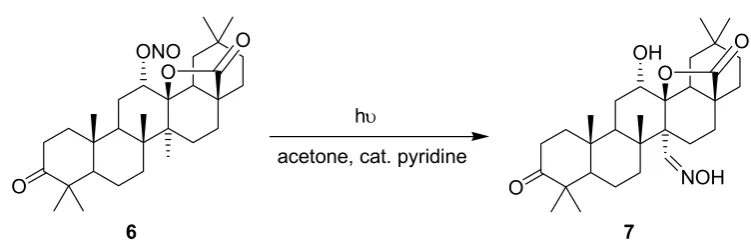
The synthesis of the steroidal oxime 7 from the nitrite precursor 6 under microflow conditions has been reported by Ryu and coworkers (Scheme 2) [51,52]. Oxime 7 is a key intermediate in the preparation of myriceric acid A, a potent endothelin receptor antagonist.
Scheme 2. Barton reaction.
O
O
O ONO
O
O
O OH
NOH
6 7
hυ
acetone, cat. pyridine
subsequently examined using the soda lime top. A distance of 7.5 cm was found to be optimal and 7 was obtained in a yield of 59%. The authors additionally investigated the temperature dependence of the reaction by placing the microreactor into a temperature bath. With the soda lime cover and a distance of 15 cm between reactor and lamp, the yields of oxime 7 remained almost constant over a temperature range of 0–40 °C. Above the critical temperature of 50 °C, however, pronounced thermal
decomposition of 7 was observed.
To circumvent these thermal and photochemical decomposition processes, a more compact and selective 15 W black light (UVA) lamp was chosen for further optimization studies. Subsequently, Pyrex glass and an extended residence time of 12 min gave the desired oxime product 7 in a high yield of 71% (by HPLC). Despite its lower power, the black light source gave a 10-times higher energy efficiency than the more powerful mercury lamp. A batch vs. microreactor comparison study was conducted in the absence of pyridine. Under microflow conditions, 7 was obtained in 56% (by HPLC) after just 6 min, whereas the batch reaction required a prolonged irradiation of 3 h to reach a similar yield of 58%. The authors furthermore examined a UV-LED panel (48 × 35 mW) as an alternative light source for the microreactor setup. Despite the low overall power output of 1.7 W, the desired product 7 was obtained in a yield of 70% (by HPLC) after a residence time of just 12 minutes.
Table 2. Key parameters of batch vs. microreactor used.
Batch Single-lane μ-reactor
20 mL Pyrex round bottom flask 10 mL (Vsolution)
Dainippon Screen (stainless steel, glass window)
1,000 μm × 107 μm × 2.2 m (W × D × L) 0.2 mL (Vchannel)
15 W black light 15 W black light or 1.7 W UV-LED array
3.1.3. [2+2]-Cycloadditions of Coumarin Derivatives
A novel flow-based photochemical reactor named LOPHTOR was recently developed by Abbott Laboratories [53]. The reactor used a pressurized fluorinated ethylene propylene (FEP) membrane to seal off the micro reaction channels. Quartz glass was utilized as a cover plate and irradiations were performed using a 450 W medium pressure mercury lamp. The reactor was connected to an automated syringe pump (auto-sampler) system that allowed for in series operation of experiments.
Scheme 3. Intramolecular [2+2]-cycloaddition of coumarin derivative 8.
8 9
benzene O
O
O
hν
O O O
H
[image:8.595.118.479.477.745.2]H
Table 3. Key parameters of batch vs. microreactor used.
Batch μ-reactor
10 mL quartz Round bottom flask 1 mL (Vsolution)
LOPHTOR (stainless steel with FEP membrane cover, quartz window)
1,000 μm × 250 μm × 3.93 m (W × D × L) 0.98 mL (Vchannel)
450 W medium pressure mercury lamp 450 W medium pressure mercury lamp (with elliptical concentrator and integral UVEXS cold mirror)
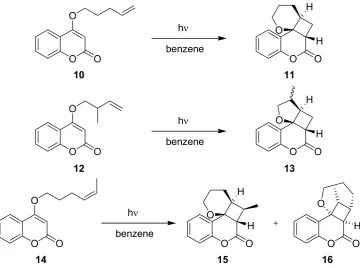
In an extension of the work, additional coumarin derivatives were investigated under microflow and batch conditions using a fixed concentration of 0.12 M (Scheme 4; Table 4). In all cases, the LOPHTOR reactor gave higher yields and conversion rates after significantly shorter irradiation times. The diastereo- and regioselectivity were comparable in both reactor modes.
Scheme 4. [2+2]-Cycloaddition of other coumarin derivatives.
10 11
benzene O
O
O
hν
O O H
H O
12 13
benzene O
O
O
hν
O O O
H
H
14 15
benzene O
O
O
hν
O O H
H O
16
O O
Table 4. Comparison of LOPHTOR vs. batch reaction modes.
Transformation LOPHTOR Batch
Time [h] Yield [%] Time [h] Yield [%]
10 → 11 4 99 48 67
12 → 13 7 50 (1:1 a) 24 30 (1:1 a) 14 → 15 + 16 5 40 (7:1 b) 24 25 (8:1 b)
a Diastereoselectivity; b Regioselectivity (15vs.16).
3.1.4. Diastereoselective [2+2]-Cycloaddition of a Chiral Cyclohexenone
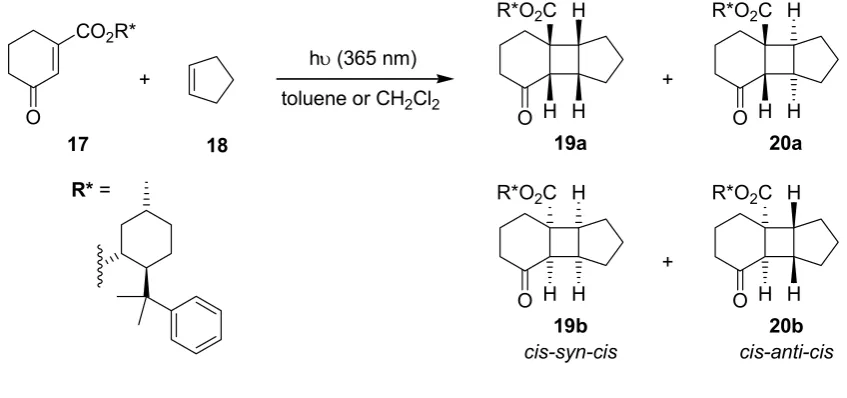
Kakiuchi, Ryu and coworkers have investigated the diastereoselective addition of cyclopentene 18 to the cyclohexenone derivative 17 (Scheme 5), which incorporated a chiral (−)-8-(phenyl)menthyl auxiliary [54]. Batch and microflow experiments were performed simultaneously in Pyrex vessels, which were emerged in a cooling bath, with a single 500 W high pressure mercury lamp (Table 5).
Scheme 5. Diastereoselective [2+2] cycloaddition of cyclohexenone 17 with cyclopentene.
hυ (365 nm)
O O
+
17 18 19a
toluene or CH2Cl2 CO2R*
R*O2C H
H H
+
O
20a
R*O2C H
H H
O
19b
cis-syn-cis
R*O2C H
H H
+
O
20b
cis-anti-cis
R*O2C H
H H
[image:9.595.84.508.343.542.2]R* =
Table 5. Key parameters of batch vs. microreactor used.
Batch μ-Reactor
Pyrex test tube
13 mm (ID) / 17 mm (OD) 2 mL (Vsolution)
Dainippon Screen (stainless steel, Pyrex window) 1,000 μm × 100 μm × 2.2 m (W × D × L)
0.2 mL (Vchannel) 500 W high pressure mercury lamp
(inside a quartz immersion well)
500 W high pressure mercury lamp (inside a quartz immersion well)
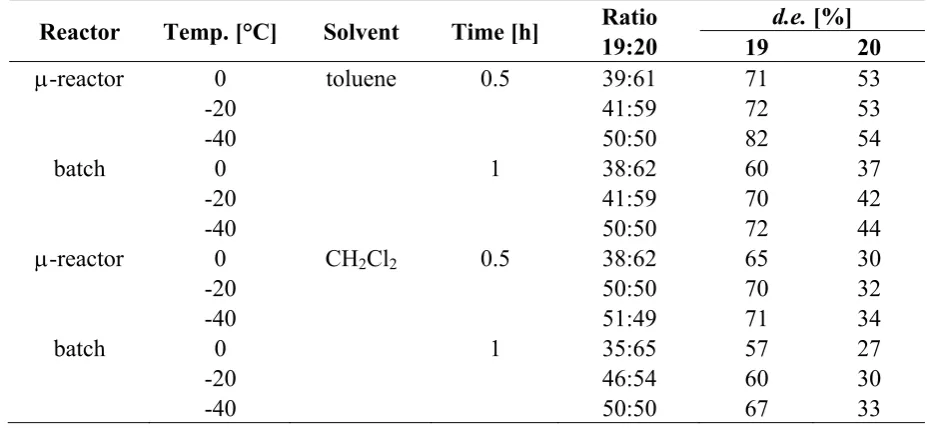
Toluene and dichloromethane were tested as suitable solvents at low temperatures of 0 °C, −20 °C and −40 °C, respectively. The photoreactions in the microflow reactor generally reached completion
after 30 min, whereas the batch reactions required 1 h (Table 6). The ratios of the stereoisomers 19 and 20 were determined by HPLC analysis and were almost identical for both setups in either solvent at any temperature. The preference for the formation of the cis-anti-cis stereoisomeric pair 20 dropped upon lowering of the temperature. At −40 °C, 19 and 20 were obtained in equal amounts for almost all
the microflow experiment at −40 °C in toluene. In contrast, the analogue reaction performed in the test
[image:10.595.64.528.180.394.2]tube gave lower d.e. values of 72% (19) and 44% (20), respectively. The improved diastereoselectivity of the microflow synthesis was rationalized by a more accurate temperature control in combination with a significantly larger surface-to-volume ratio within the microreactor.
Table 6. Comparison of microreactor vs. batch reactions.
Reactor Temp. [°C] Solvent Time [h] Ratio 19:20
d.e. [%]
19 20
μ-reactor 0 toluene 0.5 39:61 71 53
-20 41:59 72 53
-40 50:50 82 54
batch 0 1 38:62 60 37
-20 41:59 70 42
-40 50:50 72 44
μ-reactor 0 CH2Cl2 0.5 38:62 65 30
-20 50:50 70 32
-40 51:49 71 34
batch 0 1 35:65 57 27
-20 46:54 60 30
-40 50:50 67 33
3.1.5. Photochemical Reduction of Flavone
Scheme 6. Photoreduction of flavone.
21 22 23 24
hν (KrF laser) NaBH4, EtOH O
O
Ph O
O
Ph O
OH
Ph OH
OEt
O
[image:11.595.109.486.580.670.2]In particular, the selectivity of 22 and 23 was slightly decreased compared to the batch reaction. These effects were explained by the differences in the optical pathlengths.
Table 7. Key parameters of batch vs. microreactor used.
Batch μ-Reactor
Synthetic quartz cell (10 mm width and 1 mm optical path); 50 μL (Vsolution)
IMT Co. Ltd. (quartz)
100 μm × 40 μm × 16.5 mm (W × D × L a) KrF (248 nm) or XeCl (308 nm) excimer
laser
KrF (248 nm) excimer laser
a Microreactor masked except for a 16.5 mm × 10 mm (L × W) window.
3.1.6. Photodecarboxylations Involving Phthalimides
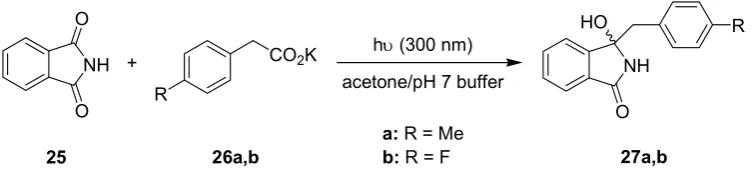
Sensitized photodecarboxylations involving phthalimides have been established as a versatile procedure for alkylation and (macro)cyclization reactions [57,58]. Selected model reactions were also realized on semi-technical scales using an advanced falling-film reactor equipped with a 308 nm excimer lamp [30,31]. The photodecarboxylative benzylation of phthalimide 25 to the benzylated hydroxylphthalimidines 27 was subsequently investigated by Oelgemöller and coworkers under batch and microflow conditions (Scheme 7; Table 8) [59]. The sensitizer acetone functioned as a co-solvent and was thus available in large quantities (50 vol-%).
Scheme 7. Photodecarboxylative benzylation of phthalimide.
acetone/pH 7 buffer hυ (300 nm) NH
O
O
NH
O HO
+ CO2K
25 27a,b
R
26a,b
R
a: R = Me
b: R = F
Table 8. Key parameters of batch vs. microreactor used.
Batch μ-Reactor
Pyrex Schlenk flask (32 mm ID) with cold finger (24 mm OD)
100 mL (Vsolution)
mikroglas chemtech dwell device (Foturan™)
2,000 μm × 500 μm × 1.15 m (W × D × L) 1.68 mL (Vchannel)
Rayonet chamber reactor (RPR-200) equipped with 16 × 8 W UVB lamps
Luzchem UV panel equipped with 5 × 8 W UVB lamps
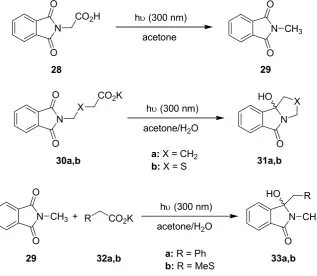
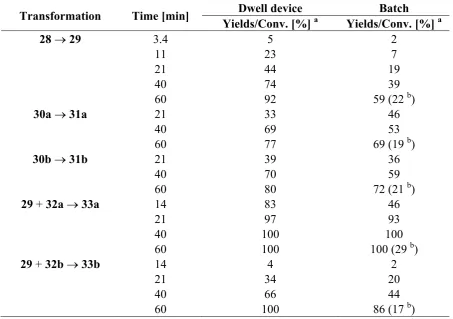
In an extension of this work, Oelgemöller et al. investigated additional intra- and intermolecular photodecarboxylation reactions involving phthalimides (Scheme 8) [60]. A commercially available dwell device was again adopted as a microreactor. The volume of the batch reaction vessel varied depending on the transformation examined. In almost all cases examined, the experiments performed under microflow conditions gave superior results in terms of conversions or isolated yields (Table 9). To allow for a more precise comparison, all reactions were additionally compared using an identical light power of 40 W. Under these conditions, the microreactor setup gave between 3.5- and 6-times higher yields or conversions, respectively. The enhanced efficiency was again explained by the extensive light penetration through the narrow microchannel (500 μm). For the given acetone concentration at 300 nm, complete adsorption was achieved after approximately 1.5 mm, way below the effective pathlength of the Schlenk flask (4 mm).
Scheme 8. Photodecarboxylation reactions involving phthalimides.
acetone hυ (300 nm) N
O
O
N
O
28 29
acetone/H2O hυ (300 nm) N
O
O
N
O HO
30a,b a: X = CH2 31a,b
b: X = S
acetone/H2O hυ (300 nm) N
O
O
R N
O R HO
+ CO2K
29 32a,b a: R = Ph 33a,b
b: R = MeS CO2H
CH3 O
X
CO2K
X
Table 9. Comparison of dwell device vs. batch reaction modes.
Transformation Time [min] Dwell device Batch
Yields/Conv. [%] a Yields/Conv. [%] a
28 → 29 3.4 5 2
11 23 7
21 44 19
40 74 39
60 92 59 (22 b)
30a → 31a 21 33 46
40 69 53
60 77 69 (19 b)
30b → 31b 21 39 36
40 70 59
60 80 72 (21 b)
29 + 32a → 33a 14 83 46
21 97 93
40 100 100
60 100 100 (29 b)
29 + 32b → 33b 14 4 2
21 34 20
40 66 44
60 100 86 (17 b)
a Conversions for reactions 28 → 29 and 29 + 32→ 33. Yields for reactions 30→ 31; b Batch
reactor with 5 × 8 W lamps.
A concentration study was furthermore conducted using the photobenzylation of N-methyl phthalimide 29 as a model reaction. To achieve this, the co-solvent acetone was replaced with acetonitrile. Under these conditions, direct excitation of phthalimide 29 occurred. The reaction time was set to 1 h and the concentration of both reagents 29 and 32a were increased systematically. The microreactor gave complete conversions at concentrations of 29 of 15 and 30 mmol L−1, whereas the batch system solely showed total consumption at the lowest concentration of 29 of 15 mmol L−1, respectively.
The same photodecarboxylation reactions were investigated using UVA light, aqueous acetonitrile solutions and 4,4’-dimethoxybenzophenone (DMBP) as sensitizer [61]. Conversion rates, isolated yields and selectivity were again compared to experiments conducted under batch conditions. In line with previous results, the dwell reactor showed superior performances. In contrast to the acetone-sensitized transformations, however, side- and follow-up reactions were additionally observed. The solid sensitizer DMBP also had to be removed by column chromatography and was sensitive towards photoreduction
3.1.7. Photodecarboxylative Addition to Methyl Phenylglyoxolate
examined under microflow conditions (Scheme 9). A commercially available dwell device was again selected and compared to a larger Rayonet chamber reactor (Table 10). Using a fixed residence time of 1 h, the irradiation in microflow mode showed complete conversion and furnished the addition product 35 and the dimerization product 36 in a ratio of 76:24. When conducted in the batch reactor, an almost identical 77:23 35/36 mixture was isolated. Although there was no visible difference in performance, the microreactor required significantly less lamp power and therefore showed a higher light efficiency.
Scheme 9. Photodecarboxylative addition to methyl phenylglyoxylate.
MeCN/H2O hυ (350 nm) +
34 32b 35
MeS CO2K OMe
O
O
OMe
O
HO SMe HO
OMe
O 2
[image:14.595.114.483.554.649.2]36 +
Table 10. Key parameters of batch vs. microreactor used.
Batch μ-Reactor
Pyrex Schlenk flask (32 mm ID) with cold finger (24 mm OD)
50 mL (Vsolution)
mikroglas chemtech dwell device (Foturan™) 2,000 μm × 500 μm × 1.15 m (W × D × L) 1.68 mL (Vchannel)
Rayonet chamber reactor (RPR-200) equipped with 16 × 8 W UVA lamps
Luzchem UV panel equipped with 5 × 8 W UVA lamps
3.1.8. Organo-Photocatalytic Addition to Diethyl 2-Bromomalonate
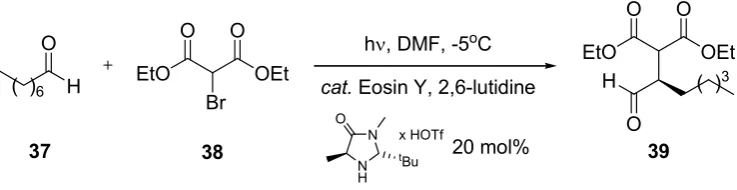
An example of an ‘organic asymmetric cooperative photoredox organocatalysis’ has been briefly described by Neumann and Zeitler [63]. The stereoselective addition of octanal (37) to diethyl 2-bromo-malonate (38) was compared under microflow and batch conditions (Scheme 10; Table 11).
Scheme 10. Organo photocatalytic addition to diethyl 2-bromomalonate.
37 38 39
hν, DMF, -5oC O
H
( )6 EtO OEt O O
Br
EtO OEt
O O
O
H ( )3
cat. Eosin Y, 2,6-lutidine
N
N H
tBu
O
x HOTf
20 mol%
achieved after exhaustive irradiation for 18 h. The reduction in reaction time for the microstructured reactor was rationalized by a maximum population of excited photocatalyst within the channel.
Table 11. Key parameters of batch vs. microreactor used.
Batch μ-reactor
Borosilicate vial (18 mm ID) 5 mL (Vsolution)
Future Chemistry photochemistry module with M-111 basic μ-reactor (Borosilicate) 600 μm × 500 μm (Wmax× D)
100 μL (Vreaction) 1 × 1 W 530 nm LED 2 × 1 W 530 nm LEDs
3.1.9. Isopropanol Addition to Furanones
The DMBP sensitized addition of isopropanol (41) to furanones 40 has been intensively studied by Oelgemöller and coworkers (Scheme 11) [65-67]. The simple protocol used isopropanol as reagent and solvent, which made this transformation especially feasible for a detailed microreactor comparison study (Table 12). Three continuous-flow systems were utilized with different dimensions of the microstructure: a dwell device, a microchip and a dual-microcapillary reactor. Various residence times were investigated and the conversion rates to 42a–c were determined by NMR-spectroscopy. The results obtained in microflow mode were compared to those obtained in a batch chamber reactor.
Scheme 11. Sensitized isopropanol addition to furanones.
41 a: R = H
b: R = rac-OEt c: R = (-)-OMent O
O R + O O R
OH
DMBP
40a-c 42a-c
hν (350 or 365 nm) OH
Table 12. Key parameters of batch vs. microreactors used.
batch μ-Reactor μ-Chip μ-Capillary tower
Pyrex test tube 9 mm (ID) / 10 mm (OD)
15 mL (Vsolution)
mikroglas chemtech dwell device
(Foturan™)
2,000 μm × 500 μm ×
1.15 m (W × D × L) 1.68 mL (Vchannel)
Micronit Microfluidics (Borofloat®)
150 μm × 150 μm ×
757 mm (W × D × L) 13 μL (Vchannel)
PTFE capillary (wrapped around a Pyrex cylinder) 558 μm × 460 cm (ID × L)
2 capillaries
2 × 1.12 mL (Vcapillary) Rayonet chamber
reactor (RPR-200) equipped with 16 × 8 W UVA lamps
Luzchem UV panel equipped with 5 × 8 W UVA lamps
6 × 75 mW 365 nm UV-LED array
1 × 8 W UVA lamp (inside the Pyrex cylinder)
Table 13. Comparison of microreactors vs. batch reaction modes.
Batch μ-Reactor μ-Chip μ-Capillary tower
Time [min] Conv. [%] Time [min] Conv. [%] Time [min] Conv. [%] Time [min] Conv. [%] 42a 5 90 5 81 1 58 2.5 35
20 100 10 100 2.5 89 5 75
5 100 7.5 95
42b 5 90 5 99 1 60 2.5 50
20 100 10 100 2.5 100 5 96
5 100 7.5 99
42c 5 87 5 98 1 59 2.5 64
20 100 10 100 2.5 100 5 99
5 100 7.5 100
3.1.10. Photodimerization of Maleic Anhydride
The photodimerization of maleic anhydride (43) was examined by Horie et al. as an industrially relevant but problematic photoreaction (Scheme 12; Table 14) [68].
Scheme 12. Photodimerisation of maleic anhydride.
43 44 O O O O O O ethyl acetate
hν, ultrasound
O O
O
[image:16.595.179.418.605.686.2]T-piece to create liquid segments of about 2–5 cm and gas segments of about 0.5–1 cm. The N2 segments pushed any precipitated product through the tube. Ultrasound vibrations simultaneously prevented the adhesion and sedimentation of precipitate to the tube walls. A 400 W high pressure Hg lamp in a conventional Pyrex immersion well was employed as a light source.
[image:17.595.74.526.330.442.2]The impact of the tube dimensions, maleic anhydride concentration and residence time on product formation was subsequently examined. At a temperature below 15 °C and using ethyl acetate as solvent solely the trans-isomer of 44 was obtained, as confirmed by 1H-NMR analysis. A satisfactory 70% conversion of maleic anhydride (43) was achieved with a 10% (w/w) solution, a residence time of 22 min and an inner tube diameter of 0.8 mm, respectively. SEM analysis and subsequent polymerization experiments showed that the quality of the dimer 44 was superior over that obtained from the corresponding batch experiment. This feature was explained by the precise control of the reaction time within the microreactor, which reduced undesired side and follow-up reactions. In contrast, the batch reaction gave the desired dimer in a much lower yield of 26% after 6 h of irradiation.
Table 14. Key parameters of batch vs. microreactor used.
Batch μ-Reactor
Cylindrical glass vessel 75 × 300 mm (ID × H) 600 g (msolution)
FEP tube (wrapped around a quartz beaker) 0.5–1.6 mm × 6.4–19.2 m (ID × L)
0.8–12.9 mL (Vcapillary) 400 W high pressure mercury lamp
(inside a Pyrex immersion well; immersed in glass vessel)
400 W high pressure mercury lamp (inside a Pyrex immersion well; placed inside the quartz beaker)
In an interesting extension of the study, the slug flow microreactor was operated in continuous mode for over 16 h without clogging. This was achieved by inline filtration to remove the solid product 44 and reintroduction of the filtrate into the microflow reactor. A total of 300 g of a 10% solution of 43 was used for this experiment. The continuous operation mode allowed for an improvement of conversions and reduction in maleic anhydride waste.
3.2. Heterogeneous Reactions
Heterogeneous gas-liquid reactions require adequate supply of a reagent gas, most commonly oxygen or chlorine. This is most conveniently achieved by pre-saturation of a stock solution prior to introduction into the microreactor. Specialized reactors, for example falling film types, have furthermore been developed and successfully applied [39,69,70].
3.2.1. Photooxygenation Reactions
The photochemical synthesis of ascaridole (46) from α-terpinene (45) has been recently reported by Carofiglio and coworkers (Scheme 13; Table 15) [71]. The glass-polymer microstructured reactors were fabricated by the authors. C60 fullerene or its covalently linked form (Tentagel-C60) were chosen as singlet oxygen sensitizers.
of the gas inlet generated a microbubble flow within the channel. With the soluble sensitizer, the highest conversion of 45 of 97% (by GC) was achieved at −5 °C after a ‘correlated’ residence time of 3 min. The isolated yield of ascaridole (46) was, however, significantly lower with 51% and this discrepancy was explained by partial (photo)decomposition of the endo-peroxide (caused by lamp). At 10 °C and 50 °C conversions and isolated yields dropped significantly, which was rationalized by the lower solubility of oxygen in toluene at these temperatures.
The second reactor model was specifically designed for the solid-supported Tentagel-C60. Oxygen saturation was initially realized in a serpentine channel (so-called oxygenation zone). This solution was introduced into a wider chamber containing the solid sensitizer material. On demand, two addition chambers could be linked in series via suitable tubing. A series of reactions was subsequently conducted at −5 °C with different ‘correlated’ residence times of 27 to 109 s. Independent of the irradiation time, high conversions of 45 of >90% (by GC) and similar isolated yields of 46 of 52–53% were determined. Attempts to further reduce the residence time were unsuccessful. Likewise, irradiation with a 15 × 110 mW white LED array gave no reaction, which was attributed to its unfavorable emission spectrum in combination with the short lifetime of singlet oxygen in toluene.
Under comparable reaction conditions, the batch protocol required a significantly longer irradiation time of 1 h to reach complete conversion of 45. The improved performance of the microreactors was explained by the favorable singlet oxygen diffusion within the narrow microchannel.
Scheme 13. Photooxygenation of α-terpinene.
C60 or Tentagel-C60 hν, toluene
45 46
O O
1O 2
The same authors investigated the S-oxidation of L-methionine methyl ester (47) to its
corresponding sulfoxide 48 in the microflow chamber reactor (Scheme 14; Table 15) [71]. Tentagel-C60 and a functionalized fullerpyrrolidine-silica hybrid (Si-C60) were applied as sensitizing materials. The reaction was carried out in D2O which allowed for direct analysis by 1H-NMR spectroscopy. For Tentagel-C60 and irradiation with a conventional 300 W tungsten halogen lamp at 0 °C, conversions increased from 38–85% with extended ‘correlated’ residence time of 32–102 s. Under similar conditions with the Si-C60 sensitizer, complete conversions were achieved after just 33 s. When irradiated with a 15 × 110 mW white LED array at room temperature, the same silica-supported sensitizer furnished high conversions of 89% and 95% after 30 s and 42 s, respectively.
Scheme 14. Photooxidation of L-methionine methyl ester.
Tentagel-C60 or Si-C60
hν, D2O
47
1O 2
CO2Me H2N
S
48
CO2Me H2N
[image:19.595.94.494.445.675.2]S O
Table 15. Key parameters of batch vs. microreactors used.
Batch Serpentine μ-reactor Chamber μ-reactor
Glass photochemical reactor 10 mL (Vsolution)
In-house (glass-thiolene) no channel dimensions given 0.152 mL (Vreactor)
In-house (glass-thiolene) serpentine oxygenation zone 500 μm (L) with chamber 3 mm × 30 mm (W × L) 0.152 mL (Vreactor)
300 W tungsten halogen lamp 300 W tungsten halogen lamp or 15 × 110 mW white LED array
An interesting new reactor design concept was presented by Park and coworkers and tested for a range of photooxygenations (Scheme 15; Table 16) [72]. A dual-channel microreactor with a separating gas permeable membrane was constructed from poly(dimethylsiloxane) (PDMS).
Scheme 15. Photooxygenation reactions.
45 1O 46
2 2. NaBH4
1. hν, MeCN, methylene blue
49 50
1O 2
OH
51
CH2OH CH2OH CH2OH
OH
methylene blue hν, MeCN
52a,b
1O 2 R
OH
53a,b
R OH HO2 methylene blue
hν, MeCN
a: R = H
b: R = Me
calculations were subsequently conducted for the batch system, mono-channel and dual-channel reactor. The highest value of 50.9 cm−1 was obtained for the dual-channel, followed by the mono-channel (14.9 cm−1) and the batch system (0.76 cm−1). Three model photooxygenations were subsequently investigated in acetonitrile at 5 °C using methylene blue as sensitizer and a 16 W LED spot as light source.
Table 16. Key parameters of batch vs. microreactor used.
Batch Mono-channel μ-reactor Dual-channel μ-reactor 50 ml round bottom flask
4.4 cm (ODmax) 20 mL (Vsolution)
In-house (PDMS, PVSZ coating in reaction channel) concave reaction channel 220 μm × 0.9 m (W × L) 38.9 μL (Vchannel)
segment flow
In-house (PDMS with PDMS membrane, PVSZ coating in reaction channel)
concave reaction channel 220 μm × 0.9 m (W × L) 38.9 μL (Vchannel)
16 W white LED spot light 16 W white LED spot light 16 W white LED spot light
Due to its industrial importance [7,73], the Schenk ene-reaction of citonellol (49) was studied for two concentrations of 49 of 0.1 M and 0.35 M. After reduction of the initially formed hydroperoxides with NaBH4 to the corresponding allyl alcohols 50 and 51, yields and compositions were determined by 1H-NMR analysis vs. an internal standard. In all cases, 50 and 51 were obtained in a ratio of 1:1.5. The dual-channel reactor gave almost quantitative yields of 97% for both starting concentrations after just 3 min of irradiation. Gas and liquid flow could be furthermore controlled separately. Because of its lower contact area-to-volume ratio, the mono-channel system required longer residence times of 15 min and 31 min to reach high yields of 95% and 94%, respectively. The gas-liquid flow also proved to be difficult to control. In contrast to the microflow setups, it took 3 h and 8.5 h to achieve yields of 92% and 89% in the batch system. Daily output calculations were furthermore conducted for all three setups showing that the dual-channel reactor could generate more than 5-times (0.1 M of 49) and over 10-times (0.35 M of 49) the amount produced by the mono-channel. A scale-up was examined with a larger dual-channel reactor. Using a 0.35 M solution of 49, a yield of 95% was achieved after a residence time of only 3 min. The daily output was calculated to 45.49 mmol d−1, even exceeding the values of the batch system (14.7 mmol d−1 and 17.6 mmol d−1).
The [4+2]-cycloaddition of α-terpinene (45) to ascaridole (46) was additionally carried out in the dual-channel reactor to investigate the effect of various reaction parameters. Using an optimized flow rate of O2 of 105 μL min−1, a starting concentration of 45 of 0.35 M and a residence time of 3 min, a yield of ascaridole (46) of 91% was achieved. The analogue batch reaction showed a reduced yield of 82% despite a prolonged irradiation period of 3 h.
3.2.2. Photochlorinations of Cycloalkanes
Recently, Ryu et al. have studied the photochlorination of cycloalkanes 54a–d in various microflow setups (Scheme 16; Table 17) [74]. Monochlorination of cyclohexane (54b) to chlorocyclohexane (55b) was initially achieved in a stainless steel reactor with a Pyrex cover using ambient light and molecular chlorine. The reagent gas was introduced via a separate syringe pump and mixed with the cyclohexane stream in a T-shaped micromixer. The reaction mixture was subsequently pumped through the microflow reactor and the product was collected in a flask containing a 10% solution of sodium sulfite. After a residence time of 19 min, high selectivity for monochlorination (>95%) was achieved and chlorocyclohexane (55b) was obtained in a yield of 20% (by GC).
Likewise, the photoinduced chlorinations of various cycloalkanes 54a–d with sulfuryl chloride as a less reactive chlorination agent were successfully realized using a 15 W black light source in combination with a glass based reactor. When a cycloalkane/SO2Cl2 solution of 40:1 was introduced and irradiated for 57 min, the corresponding chlorocycloalkanes 55a–d were isolated in moderate to high yields of 35–87%. As would be expected, a reduction of residence time caused a drop in product yields. The reaction involving cyclohexane was furthermore performed with 2 × 15 W lamps, which gave an improved yield of 55b of 45%.
Scheme 16. Photochlorination of cycloalkanes. hν
54a-d
Cl2 or SO2Cl2 ( )n
55a-d
[image:21.595.176.420.402.456.2]( )n Cl n = 1-4
Table 17. Key parameters of microreactors used. No batch reactions were performed. Steel based μ-reactor Glass based μ-reactor 2
Dainippon Screen (stainless steel, Pyrex window)
1,000 μm × 300 μm × 2.35 m (W × D × L) 0.7 mL (Vchannel)
mikroglas chemtech dwell device (Foturan™)
1,000 μm × 500 μm × 1.9 m (W × D × L) 0.95 mL (Vchannel)
ambient light 15 W black light
3.3. Scale-Up and Industrial Applications
solution of 300 g [68]. While current microflow photochemical technology may not be suitable for large industrial-scale productions (>1 t a−1), examples of low-volume processes, including an industrial one, have already been realized.
3.3.1. Barton Reaction
[image:22.595.82.522.372.497.2]Ryu and coworkers achieved a multigram synthesis of the steroidal oxime 7 using a DMF solution of 6 (Scheme 2; Table 18) and two stainless steel reactors in series coupled with 8 × 20 W black light lamps [52]. After continuous operation for 20 h with a residence time of 32 min, the isolated amount of product 7 was 3.1 g, equal to a yield of 60%. In an extension of this work and in collaboration with Dainippon Screen Mfg, the authors developed a prototype of a fully automated photo-microreactor system (DS-AMS-1) [52]. This reactor system offered easy operation and monitoring via PC-software together with other important safety features. The setup incorporated a single multi-lane stainless steel reactor with a Pyrex top. Irradiation was achieved with six evenly positioned 15 W black light sources. After constant operation for 40 h with a residence time of 20 min, the desired oxime 7 was obtained in an amount of 5.3 g, corresponding to an isolated yield of 61%.
Table 18. Key parameters of the advanced microreactor systems developed. Multi-lane μ-reactor Automated Multi-lane
μ-reactor Dainippon Screen (stainless steel, Pyrex
window)
1,000 μm × 500 μm × 0.5 m (W × D × L) 16 lanes, 2 reactors in series
8 mL (Vchannel)
Dainippon Screen DS-AMS-1 (stainless steel, Pyrex window)
1,000 μm × 500 μm × 0.5 m (W × D × L) 16 lanes
4 mL (Vchannel) 8 × 20 W black light 6 × 15 W black light
3.3.2. Paternò-Büchi Reaction
Scheme 17. Paternò-Büchi reaction involving 2,3-dihydrofuran.
hν
56
O
58
H O
57
O
O Ph
[image:23.595.176.419.218.405.2]EtOH
Figure 4. Automated microphotoreaction system (courtesy of mikroglas chemtech).
3.3.3. Photoisomerization of Camptothecin-N-oxides
The first industrial photochemical process involving a multi microphotoreactor setup was realized by Heraeus Noblelight [76]. The plant is currently used for the kg-scale synthesis of 10-hydroxycamptothecin (60a) and 7-ethyl-10-hydroxycamptothecin (60b) from their corresponding N-oxides 59 (Scheme 18).
Scheme 18. Synthesis of camptothecin derivatives.
DMF or DMF/1,4-dioxane hν (350-400 nm)
60a,b
59a,b a: R = H
b: R = Et N
R
N O
O
O
O HO
N R
N O
O
O HO HO
of 59a. The developed plant consisted of twelve microreactor units operated in parallel and incorporating individual lamps (Figure 5) [76]. Each microreactor was made of two parallel quartz glass plates separated by a thin spacer. This design feature created a very thin film of the reaction solution (40–100 μm). Compact high pressure mercury lamps with spectral filters (350–400 nm) and an optical power output of 250 W were positioned on both sides of the microfilm reactor.
Figure 5. Photochemical production plant (courtesy of Heraeus Noblelight).
4. Conclusions
Microflow photochemistry efficiently combines the advantages of microspace and flow conditions. Consequently, a broad range of photochemical transformations has been successfully realized. Microchemical processes commonly result in the reduction of irradiation times, enhanced selectivity and increased light efficiency, thus unambiguously demonstrating the superiority of microflow photochemistry over conventional techniques. It is envisaged that this new synthesis concept will emerge as an important future R&D and production methodology. The industrial Heraeus Noblelight process evidently demonstrates this potential. Since the submission of this article, additional examples of photochemical reactions in microflow devices have been published, thus demonstrating the growing importance of microflow photochemistry [77-81]. Ultimately, microflow photochemistry may emerge as ‘the New Photochemistry of the Future’ [82].
Acknowledgments
of Regensburg), Olivier Graber (Atlas Photonics) and Silvia Werner (Heraeus Noblelight) for useful discussions and support.
References and Notes
1 Hoffmann, N. Photochemical reactions as key steps in organic synthesis. Chem. Rev. 2008, 108, 1052–1103.
2 Bach, T.; Hehn, J.P. Photochemical reactions as key steps in natural product synthesis. Angew. Chem. Int. Ed. 2011, 50, 1000–1045.
3 Iriondo-Alberdi, J.; Greaney, M.F. Photocycloaddition in natural product synthesis. Eur. J. Org. Chem. 2007, 4801–4815.
4 Ciana, C.L.; Bochet, C.G. Clean and easy photochemistry. Chimia 2007, 61, 650–654.
5 Oelgemöller, M.; Jung, C.; Mattay, J. Green photochemistry: Production of fine chemicals with sunlight. Pure Appl. Chem. 2007, 79, 1939–1947.
6 Oelgemöller, M.; Healy, N.; de Oliveira, L.; Jung, C.; Mattay, J. Green photochemistry: Solar-chemical synthesis of juglone with medium concentrated sunlight. Green Chem. 2006, 8, 831–834. 7 Braun, A.M.; Maurette, M.; Oliveros, E. Photochemical Technology; Wiley: Chichester, UK, 1991. 8 Fischer, M. Industrial applications of photochemical syntheses. Angew. Chem. Int. Ed. 1978, 17,
16–26.
9 Wegner, J.; Ceylan, S.; Kirschning, A. Ten key issues in modern flow chemistry. Chem. Commun. 2011, 47, 4583–4592.
10 Pohar, A.; Plazl, I. Process intensification through microreactor application. Chem. Biochem. Eng. Q. 2009, 23, 537–544.
11 Wiles, C.; Watts, P. Recent advances in micro reaction technology. Chem. Commun. 2011, 47, 6512–6535.
12 Webb, D.; Jamison, T.F. Continuous flow multi-step organic synthesis. Chem. Sci. 2010, 1, 675–680. 13 Hartman, R.L; Jensen, K.F. Microchemical systems for continuous-flow synthesis. Lab Chip
2009, 9, 2495–2507.
14 Rubin, A.E.; Tummala, S.; Both, D.A.; Wang, C.C.; Delaney, E.J. Emerging technologies supporting chemical process R&D and their increasing impact on productivity in the pharmaceutical industry. Chem. Rev. 2006, 106, 2794–2810.
15 Chin, P.; Barney, W.S.; Pindzola, B.A. Microstructured reactors as tools for the intensification of pharmaceutical reactions and processes. Curr. Opin. Drug Discov. Dev. 2009, 12, 848–861.
16 Mason, B.P.; Price, K.E.; Steinbacher, J.L.; Bogdan, A.R.; McQuade, D.T. Greener approaches to organic synthesis using microreactor technology. Chem. Rev. 2007, 107, 2300–2318.
17 Yoshida, J.I.; Kim, H.; Nagaki, A. Green and sustainable chemical synthesis using flow microreactors. ChemSusChem 2011, 4, 331–340.
18 Hessel, V.; Kralisch, D.; Krtschil, U. Sustainability through green processing—Novel process windows intensify micro and milli process technologies. Energy Environ. Sci. 2008, 1, 467–478. 19 Lerou, J.J.; Tonkovich, A.L.; Silva, L.; Perry, S.; McDaniel, J. Microchannel reactor architecture
enables greener processes. Chem. Eng. Sci. 2010, 65, 380–385.
21 Débieux, J.-L.; Cosandey, A.; Helgen, C.; Bochet, C.G. Photoacylation of alcohols in neutral medium. Eur. J. Org. Chem. 2007, 2073–2077.
22 Carney, J.M.; Hammer, R.J.; Hulce, M.; Lomas, C.M.; Miyashiro, D. Hight-efficient microphotooxidation using milliwatt LED sources. Tetrahedron Lett. 2011, 52, 352–355.
23 Gano, J.E.; Gano, A.J.; Garry, P.; Sekher, P. Small scale reactor for ultraviolet photochemistry. J. Chem. Educ. 2002, 79, 1361.
24 Penn, J.H.; Orr, R.D. A microscale immersion well for photochemical reactions. J. Chem. Educ. 1989, 66, 86–88.
25 Rubin, M.B.; Braslavsky, S.E. Quantum yield: The term and the symbol. A historical search. Photochem. Photobiol. Sci. 2010, 9, 670–674.
26 Sosnin, E.A.; Oppenländer, T.; Tarasenko, V.F. Applications of capacitive and barrier discharge exilamps in photoscience. J. Photochem. Photobiol. C-Photo. 2006, 7, 145–163.
27 Hackett, P.A. Making light work—Applications of lasers to chemical processes. Laser Chem. 1988, 10, 75–106.
28 Kreisel, G.; Meyer, S.; Tietze, D.; Fidler, T.; Gorges, R.; Kirsch, A.; Schäfer, B.; Rau, S. Leuchtdioden in der Chemie - Eine Hochzeit verschiedener Technologien. Chem. Ing. Tech. 2007, 79, 153–159.
29 André, J.-C.; Viriot, M.-L.; Villermaux, J. New developments in photochemical technology. Pure Appl. Chem. 1986, 58, 907–916.
30 Griesbeck, A.G.; Kramer, W.; Oelgemöller, M. Photoinduced decarboxylation reactions. Radical chemistry in water. Green Chem. 1999, 1, 205–207.
31 Griesbeck, A.G.; Maptue, N.; Bondock, S.; Oelgemöller, M. The excimer radiation system: A powerful tool for preparative organic photochemistry. A technical note. Photochem. Photobiol. Sci. 2003, 2, 450–451.
32 Shama, G.; Peppiatt, C.; Biguzzi, M. A novel thin film photoreactor. J. Chem. Tech. Biotechnol. 1996, 65, 56–64.
33 Dunk, B.; Jachuck, R. A novel reactor for UV irradiated reactions. Green Chem. 2000, 2, G13–G14. 34 Yatmaz, H.C.; Wallis, C.; Howarth, C.R. The spinning disc reactor—Studies on a novel TiO2
photocatalytic reactor. Chemosphere 2001, 42, 397–403.
35 Lu, H.; Schmidt, M.A.; Jensen, K.F. Photochemical reactions and on-line UV detection in microfabricated reactors. Lab Chip 2001, 1, 22–28.
36 Benito-Lopex, F.; Verboom, W.; Kakuta, M.; Gardeniers, J.G.E.; Egberink, R.J.M.; Oosterbroek, E.R.; van der Berg, A.; Reinhoudt, D.N. Optical fiber-based on-line UV/Vis spectroscopic monitoring of chemical reaction kinetics under high pressure in a capillary microreactor. Chem. Commun. 2005, 2857–2859.
37 Bentrup, U.; Küpper, L.; Budde, U.; Lovis, K.; Jähnisch, K. Mid-Infrared monitoring of gas-liquid reactions in Vitamin D analogue synthesis with a novel fiber optical diamond ATR sensor. Chem. Eng. Technol. 2006, 29, 1216–1220.
39 Jähnisch, K.; Baerns, M.; Hessel, V.; Ehrfeld, W.; Haverkamp, V.; Löwe, H.; Wille, C.; Cuber, A. Direct fluorination of toluene using elemental fluorine in gas/liquid microreactors. J. Fluorine Chem. 2000, 105, 117–128.
40 Hornung, C.H.; Hallmark, B.; Baumann, M.; Baxendale, I.R.; Ley, S.V.; Hester, P.; Clayton, P.; Mackley, M.R. Multiple microcapillary reactor for organic synthesis. Ind. Eng. Chem. Res. 2010, 49, 4576–4582.
41 Coyle, E.E.; Oelgemöller, M. Micro-photochemistry: Photochemistry in microstructured reactors. The new photochemistry of the future? Photochem. Photobiol. Sci. 2008, 7, 1313–1322.
42 Matsushita, Y.; Ichimura, T.; Ohba, N.; Kumada, S.; Sakeda, K.; Suzuki, T.; Tanibata, H.; Murata, T. Recent progress on photoreactions in microreactors. Pure Appl. Chem. 2007, 79, 1959–1968.
43 Ichimura, T.; Matsushita, Y.; Sakeda, K.; Suzuki, T. Photoreactions. In Microchemical Engineering in Practice; Dietrich, T.R., Ed.; John Wiley & Sons: Hoboken, New Jersey, NJ, USA, 2009; Chapter 17, pp. 385–402.
44 Vesborg, P.C.K.; In, S.-I.; Olsen, J.L.; Henriksen, T.R.; Abrams, B.L.; Hou, Y.; Kleiman-Shwarsctein, A.; Hansen, O.; Chorkendorff, I. Quantitative measurements of photocatalytic CO-oxidation as a function of light intensity and wavelength over TiO2 nanotube thin films in μ-reactors. J. Phys. Chem. C 2010, 114, 11162–11168.
45 Vesborg, P.C.K.; Olsen, J.L.; Henriksen, T.R.; Chorkendorff, I.; Hansen, O. Gas-phase photocatalysis in μ-reactors. Chem. Eng. J. 2010, 160, 738–741.
46 Ye, M.-Y.; Li, B.-X.; Ye, R.-M.; Liu, J.-H. Photodegradation of organics with titanium oxide/hydrogen peroxide catalyst system in microreactor and its application in environmental analysis. Chin. J. Anal. Chem. 2010, 38, 643–647.
47 He, Z.; Li, Y.; Zhang, Q.; Wang, H. Capillary microchannel-based microreactors with highly durable ZnO/TiO2 nanorod arrays for rapid, high efficiency and continuous-flow photocatalysis. Appl. Catal. B-Environ. 2010, 93, 376–382.
48 Matsushita, Y.; Iwasawa, M.; Suzuki, T.; Ichimura, T. Multiphase photocatalytic oxidation in a microreactor. Chem. Lett. 2009, 38, 846–847.
49 Charles, G.; Corbel, S.; Carré, M.-C.; Roques-Carmes, T.; Zahraa, O. Design of a micro-channel reactor for decomposition of organic pollutants in waste water treatment. In Innovative Developments in Design and Manufacturing. Advanced Research in Virtual and Rapid Prototyping; Leiria, Portugal; Bartolo, P.J.d.S., Jorge, M.A., Batista, F.d.C., Almeida, H.A., Matias, J.M., Vasco, J.C., Gaspar, J.B., Correia, M.A., Andre, N.C., Alves, N.F., Novo, P.P., Martinho, P.G., Carvalho, R.A., Eds.; Taylor & Francis Group: London, UK, 2010; Chapter 66, pp. 431–434.
50 Fuse, S.; Tanabe, N.; Yoshida, M.; Yoshida, H.; Doi, T.; Takahashi, T. Continuous-flow synthesis of vitamin D3. Chem. Commun. 2010, 46, 8722–8724.
52 Sugimoto, A.; Fukuyama, T.; Sumino, Y.; Takagi, M.; Ryu, I. Microflow photo-radical reaction using a compact light source: Application to the Barton reaction leading to a key intermediate for myriceric acid A. Tetrahedron 2009, 65, 1593–1598.
53 Vasudevan, A.; Villamil, C.; Trumbull, J.; Olson, J.; Sutherland, D.; Pan, J.; Djuric, S. LOPHTOR: A convenient flow-based photochemical reactor. Tetrahedron Lett. 2010, 51, 4007–4009.
54 Tsutsumi, K.; Terao, K.; Yamaguchi, H.; Yoshimura, S.; Morimoto, T.; Kakiuchi, K.; Fukuyama, T.; Ryu, I. Diastereoselective [2+2] photocycloaddition of chiral cyclic enone and cyclopentene using a microflow reactor system. Chem. Lett. 2010, 39, 828–829.
55 Ouchi, A.; Sakai, H.; Oishi, T.; Kaneda, M.; Suzuki, T.; Saruwatari, A.; Obata, T. Photochemical reduction of flavone with NaBH4 in batch and micro-channel reactors using excimer lasers. J. Photochem. Photobiol. A-Chem. 2008, 199, 261–266.
56 Nakayama, T.; Shimizu, T.; Torii, Y.; Miki, S.; Hamanoue, K. A comparison of the photochemistry of flavanone with that of flavone originating from their lowest excited triplet states in ethanol. J. Photochem. Photobiol. A-Chem. 1997, 111, 35–39.
57 Griesbeck, A.G.; Kramer, W.; Oelgemöller, M. Synthetic applications of photoinduced electron transfer decarboxylation reactions. Synlett 1999, 1169–1178.
58 McDermott, G.; Yoo, D.J.; Oelgemöller, M. Photochemical addition reactions involving phthalimides. Heterocycles 2005, 65, 2221–2257.
59 Belluau, V.; Noeureuil, P.; Ratzke, E.; Skvortsov, A.; Gallagher, S.; Motti, C.A.; Oelgemöller, M. Photodecarboxylative benzylations of phthalimide in pH 7 buffer: A simple access to 3-arylmethyleneisoindolin-1-ones. Tetrahedron Lett. 2010, 51, 4738–4741.
60 Shvydkiv, O.; Gallagher, S.; Nolan, K.; Oelgemöller, M. From conventional to microphotochemistry: Photodecarboxylation reactions involving phthalimides. Org. Lett. 2010, 12, 5170–5173.
61 Shvydkiv, O.; Nolan, K.; Oelgemöller, M. Microphotochemistry—4,4’-dimethoxybenzophenone mediated photodecarboxylation reactions involving phthalimides. Beilstein J. Org. Chem. 2011, 7, 1055–1063.
62 Tan, S.B.; Shvydkiv, O.; Fiedler, J.; Hatoum, F.; Nolan, K.; Oelgemöller, M. Photodecarboxylative additions of α-thioalkyl-substituted carboxylates to alkyl phenylglyoxolates. Synlett 2010, 2240–2243.
63 Neumann, M.; Zeitler, K. Organocatalysis meets photoredox chemistry. In Book of Abstracts, Organocatalysis. New Methodologies for Sustainable Chemistry; CATAFLU.OR Symposium: Bologna, Italy, 2011; p. 23.
64 Neumann, M.; Füldner, S.; König, B.; Zeitler, K. Metal-free, cooperative asymmetric organophotoredox catalysis with visible light. Angew. Chem. Int. Ed. 2011, 50, 951–954.
65 Shvydkiv, O.; Yavorskyy, A.; Nolan, K.; Youssef, A.; Riguet, E.; Hoffmann, N.; Oelgemöller, M. Photosensitized addition of isopropanol to furanones in a 365 nm UV-LED microchip. Photochem. Photobiol. Sci. 2010, 9, 1601–1603.
67 Shvydkiv, O.; Yavorskyy, A.; Tan, S.B.; Nolan, K.; Hoffmann, N.; Youssef, A.; Oelgemöller, M. Microphotochemistry—A reactor comparison study using the photosensitized addition of isopropanol to furanones as a model reaction. Photochem. Photobiol. Sci. 2011, 10, 1399–1404. 68 Horie, T.; Sumino, M.; Tanaka, T.; Matsushita, Y.; Ichimura, T.; Yoshida, J. Photodimerization of
maleic anhydride in a microreactor without clogging. Org. Process Res. Dev. 2010, 14, 405–410. 69 Jähnisch, K.; Dingerdissen, U. Photochemical generation and [4+2]-cycloaddition of singlet
oxygen in a falling-film microreactor. Chem. Eng. Technol. 2005, 28, 426–427.
70 Ehrich, H.; Linke, D.; Morgenschweis, K.; Baerns, M.; Jähnisch, K. Application of microstructured reactor technology for the photochemical chlorination of alkylaromatics. Chimia 2002, 56, 647–653.
71 Carofiglio, T.; Donnola, P.; Maggini, M.; Rossetto, M.; Rossi, E. Fullerene-promoted singlet-oxygen photochemical singlet-oxygenations in glass-polymer microstructured reactors. Adv. Synth. Catal. 2008, 350, 2815–2822.
72 Park, C.P.; Maurya, R.A.; Lee, J.H.; Kim, D.-P. Efficient photosensitized oxygenations in phase contact enhanced microreactors. Lab Chip 2011, 11, 1941–1945.
73 Oelgemöller, M.; Jung, C.; Ortner, J.; Mattay, J.; Zimmermann, E. Green photochemistry: Solar photooxygenations with medium concentrated sunlight. Green Chem. 2005, 7, 35–38.
74 Matsubara, H.; Hino, Y.; Tokizane, M.; Ryu, I. Microflow photo-radical chlorination of cyclohexanes. Chem. Eng. J. 2011, 167, 567–571.
75 Freitag, A.; Dietrich, T.; Scholz, R. Energy efficient photochemistry in automated microreaction plants. Proceedings of the 11th International Conference on Microreaction Technology (IMRET 11), Kyoto, Japan, 8–10 March 2010; pp. 24–25.
76 Werner, S.; Seliger, R.; Rauter, H.; Wissmann, F. Quarzglas-Mikrophotoreaktor und Synthese von 10-Hydroxycamptothecin und 7-Alkyl-10-hydroxycamptothecin. EP 2065387A2, 2009; Chem. Abstr. 2009, 150, 376721.
77 Bou-Hamdan, F.R.; Lévesque, F.; O’Brien, A.G.; Seeberger, P.H. Continuous flow photolysis of aryl azides: Preparation of 3H-azepinones. Beilstein J. Org. Chem. 2011, 7, 1124–1129.
78 Maurya, R.A.; Park, C.P.; Kim, D.-P. Triple-channel microreactor for biphasic gas-liquid reactions: photosensitized oxygenations. Beilstein J. Org. Chem. 2011, 7, 1158–1163.
79 Gutierrez, A.C.; Jamison, T.F. Scalable and robust synthesis of CpRu(MeCN)3PF6 via continuous flow photochemistry. J. Flow Chem. 2011, 1, 24–27.
80 Fukuyama, T.; Kajihara, Y.; Hino, Y.; Ryu, I. Continuous microflow [2+2] photocycloadditions reactions using energy-saving compact light sources. J. Flow Chem. 2011, 1, 40–45.
81 Dionigi, F.; Vesborg, P.C.K.; Pedersen, T.; Hansen, O.; Dahl, S.; Xiong, A.; Maeda, K.; Domen, K.; Chorkendorff, I. Gas phase photocatalytic water splitting with Rh2-yCryO3/GaN:ZnO in μ-reactors. Energy Environ. Sci. 2011, 4, 2937–2942.
82 Ciamician, G. The photochemistry of the future. Science 1912, 36, 385–394.