COMPUTATIONAL MODELLING OF THE DESIGN CONVERSATION AS A SEQUENCE OF SITUATED ACTS
NICK KELLY
The University of Sydney, Sydney, Australia [email protected]
and
JOHN S. GERO
George Mason University, Virginia, USA [email protected]
Abstract. This paper describes the design conversation as a sequence of situated acts. It distinguishes the research questions that require attention for the computation of a more situated design conversation, in terms of design actions and design interpretations. It presents the architecture for ‘more situated’ systems and describes some examples of implementation. The limitations and complexities of what has been achieved are identified.
Keywords. Situatedness; Situation; Design conversation; Situated computing
1. Introduction
1992; Clancey, 1999). The designer’s notion of what it is that they are engaged in changes through this “seeing, moving, seeing” of the design conversation.
Previous work has explored the notion of design as a sequence of
situated acts (Gero, 1998; Gero and Kannengeisser, 2004; Gero 2007). That is to say, actions and interpretations that are a product of first-person knowledge, that are grounded in experience. This work shows that it is possible to computationally model aspects of this situated design conversation and identifies the questions that require addressing within future work.
2. Motivation
Situation cognition is a stream within cognitive science that takes the view that cognition is bound to the interaction of humans with their surroundings and with their own thoughts rather than being separate from other activities. The foundations for such a view of cognition lie with the early work of the experimental psychologists John Dewey (1896) and Frederick Bartlett (1932) and more recently with the research of Lucy Suchman (1987) and William Clancey (1997). That work was based on developing the notions of first-person knowledge based on first-person interactions with the world. First-person interactions have been observed when studying designers as exemplified by the work of Schön and Wiggins and described using the concept of ‘move-see-move’.
This paper describes the notions of ‘situation’ and ‘situatedness’ as necessary constructs for explaining conceptual design activity. Situations are described as an ecology of concepts that create the current ‘world view’ of the designer that is a consequence of their past first-person experiences. Situatedness makes explicit the notion that a designer moves between different cognitive states or world-views while designing, and that a different cognitive state changes the way that they see the world. It uses an agent-based model to build a computational implementation of situations. In a situated agent knowledge is tied to its use. Situated design and situations are described to provide a framework for research into modelling design conversation as a sequence of situated acts.
The departure that situated design makes from traditional models of design (design as search, planning or exploration) is that it puts the emphasis on where the designer is at cognitively, the designer's situation. A useful phenomenon for explaining this is the way that designers can look at exactly the same external representation at two different times, and produce a different internal representation of it.
are analogy, case-based reasoning and emergence. Situated design provides a unified framework within which these processes can start to be explained. For example, a typical problem of analogy-making systems is not so much producing analogies as knowing which ones are interesting. Through the description of situations we can show why an analogy might be interesting in one situation and not another. In a similar way, situated design allows us to begin to answer such questions such as: How it is possible for a designer to commence a design without all the necessary information being available? How is it possible for a designer to continue designing when all the necessary information is not available? How is it that designers are able to produce novel solutions to what appear to be minor perturbations of existing design requirements? How is it possible for a designer to produce a different design when later presented with the same requirements?
3. Situating the design conversation
In the situated design conversation we can define moving and seeing as tied to the current cognitive state, or world-view, of the designer. Moving is concerned with taking design actions within the view of the world held by the designer, whilst seeing is concerned with interpreting the design medium within the current view of the world held by the designer. This distinction of ‘occurring within a world view’ takes on a more concrete significance once we consider the gap between our notions of designerly activity and current ideas about computation. In the course of this description specific research questions are identified. Implementations that address these questions are then presented.
3.1 COMPUTATION OF ‘MOVES’ IN SITUATED DESIGN
In traditional generative design systems it is typically possible, for any given state of the system, to exhaustively list the moves available to the system – the space of possible design actions (Langely et al, 1987). Often there are heuristics for search within this space of moves to select one appropriate to this state. We can describe this type of system as selecting actions based upon third-person knowledge, knowledge divorced from experience.
Within the situated paradigm, the actions available to the designer are a consequence also of knowledge that is grounded in experience. One way that this can be conceived is that, based upon experiences, there is a dynamic filter upon the list of available actions (Smith and Gero, 2005). The reason why the example with this filter is more situated is that the filter itself has arisen from experience.
3.2 COMPUTATION OF SEEING IN SITUATED DESIGN
Similarly, the ‘seeing’ in situated design occurs within the current world-view of the agent. Interpretation in computing is often equated with categorization, i.e. finding the best explanation for a stimulus from what is available. Within the situated paradigm, interpretation is about constructing an interpretation that is appropriate to the current situation, rather than the sum total of all experience (Kelly et al, 2011).
Experience leads to the learning the interpretations that are appropriately available to an agent. Rather than being able to access the sum total of all possible interpretations, an agent is only able to access those that pertain to the current situation.
This generates the second research question for computationally modeling a situated design conversation: (2) How can an agent’s experience in the world lead to the learning of interpretations appropriate within a situation?
3.3 A SIMPLE EXAMPLE OF WHAT IS MEANT BY MAKING A SYSTEM ‘MORE SITUATED’
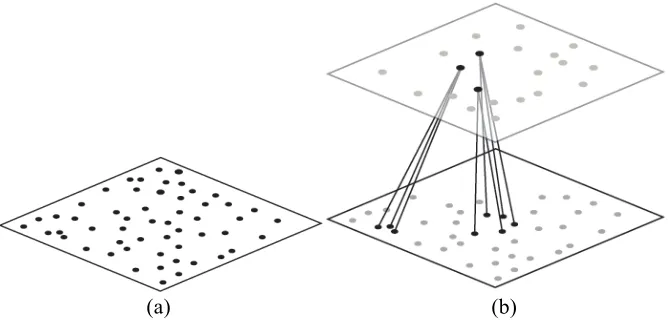
In this section the notion of a “filter” learnt from experience is explained using a simple computational example. Consider an unsupervised neural network that is capable of learning from experience, Figure 1(a)1. In this network each node is taken to be a vector describing a potential design feature that the system knows about. As an unsupervised learning network there are rules in place that means the system is able to learn from novel experiences – perhaps learning new nodes, perhaps adapting or removing existing nodes.
In Figure 1(a), when the system attempts to interpret something from the design medium, it finds the best matching node within the network. In contrast, Figure 1(b) introduces a second layer that also learns. The lines between the layers indicate that when a node within this upper layer is activated, only certain nodes within the lower layer are activated.
The point of the example is that whilst the lower layer is learning about what can be found within the world, the upper layer is learning about which nodes within lower layer are found together.
An example of the kind of behavior that such a system leads to can be seen in the Electronic Cocktail Napkin (Gross 1996) where a squiggly line can be interpreted within one state of the system as perhaps a schematic on a
circuit diagram, within another state of the system as the roof of factory, and within yet another state as a meaningless squiggly line.
(a) (b)
Figure 1 (a) a single layer neural network; (b) a two layer neural network
The configuration shown in Figure 1(b) could be said to be ‘more situated’ than that shown in Figure 1(a), because we have introduced a layer of conceptual co-ordination. This is a simple kind of conceptual co-ordination and the example in Section 4 give a hint of some of the complexities encountered and possibilities afforded by more situated systems.
4. An model of a more-situated design conversation
A system that models this situated aspect of the design conversation was implemented, using an architecture of the type shown in Figure 1(b). Prior to the design conversation, the system goes through a learning phase in which it learns about its world. It is presented with images of floor plans, Figure 2, and it extracts a series of feature maps from each through sharpening, a mosaic filter and greyscale quantization on the original image, Figure 3(a), to produce a monochrome image, Figure 3(b). In this experiment, the ‘nodes’ within the lower network are these feature maps, and the nodes within the upper network learn how they are co-ordinated.
[image:5.595.132.467.181.343.2]Figure 2 Examples of training set for the system – a sample from 39 floor plans (source: Jupp, 2005)
[image:6.595.137.460.301.436.2](a) (b)
Figure 3 Sharpening, greyscale quantization and a mosaic filter lead from the original image (a) to the perceived image of a floor plan within the system
(b) as six different features
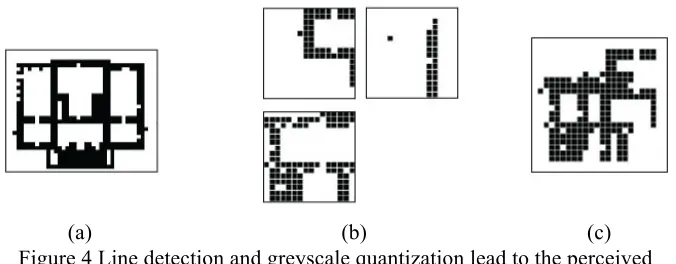
(a) (b) (c) Figure 4 Line detection and greyscale quantization lead to the perceived
image of floor plan within the system as six different features
[image:6.595.130.468.499.631.2]relationships are all learnt through the systems interaction with its world. Regardless off what is presented to the system in its learning phase – be it floor plans, circuit diagrams or modern art – the system creates these feature maps and learns which of them are found together.
This system holds knowledge about many different floor plans (e.g. the 8 seen in Figure 2 and 31 others). When either an action or an interpretation is made, only a part of this knowledge is made use of. The combination of different feature maps to change the design medium, e.g. to produce Figure 4(c), is done through random layout upon a canvas. However, the space of possible design canvasses is limited by the situation, the node currently active at the topmost layer of the system. Similarly, when the system comes to interpret its own work, it doesn’t make use of the features from all 39 known floor plans, i.e. it doesn’t simply make the best categorization possible. It interprets within the bounds of the current situation.
5. Discussion
5.1 CHANGING THE SITUATION
An obvious limitation of this description is that without changing situations, the set of possible actions and interpretations doesn’t change. However, in designers, we see that the situation changes frequently – especially in the early stages of conceptual design (Suwa et al 2000). Consider once more that a designer’s notion of “What I’m doing now” changes throughout the design conversation. In terms of the model, this is the issue of how can we model the movement between different nodes at this topmost layer of the system.
This raises the third research question for computationally modelling a situated design conversation: (3) How is it that a system: (a) learns when to change the situation; and (b) learns how to moves to a situation that is more appropriate when it does change the situation?
Computational explorations were made of both parts of this question. The idea used in addressing question 3(a) is that the situation changes when failure of some kind is experienced. In this model, the idea of boredom was introduced. If the system stayed within the one situation for too long it started looking for low-level cues (feature maps in this model, but representative of perceptual cues) that might trigger other situations. For example, if it sees, within the design medium, that the layout of two feature maps inspired by a Louis Khan floor plan produces a shape, that is reminiscent of a Palladio floor plan, then notions from this higher level concept are introduced into the situation. In this way, the model moves between different situations as the design conversation progresses2.
In answering question 3(b) the notion of an implicit expectation is introduced. If the nodes within a situation are considered as explicitthen the notions of spreading activation (Anderson 1984) and similarity (Tversky 1977) can be used to suggest that nodes close to these within conceptual space (Kelly et al 2011) are more likely to be activated than those that are further away.
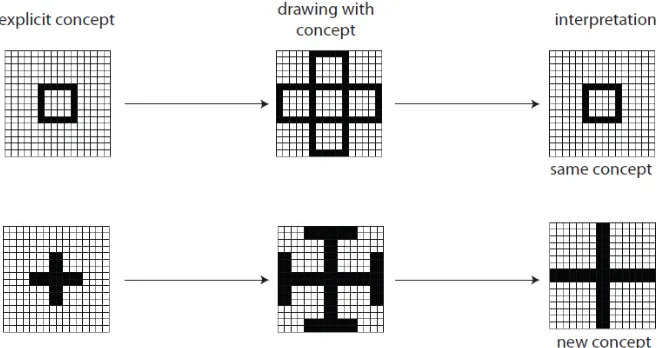
Consider Figure 5, which shows two different scenarios. In the first row, a system is taking actions using a shape (a square) which is labeled as an explicit concept. It then lays out this concept in a particular configuration when drawing with this concept. When it looks at the results of its action, it sees five instances of this same shape to produce an interpretation that uses a structuring of a single concept. In the second example however, the system does much the same thing with a different explicit concept, however it sees a new shape within what it has drawn. How is it that the system is able to distinguish when one or the other occurs?
[image:8.595.133.463.406.580.2]An implementation was produced to explore this phenomenon. The system shows how similarity to implicit concepts within the lower layer can lead to changes of the situation, in the higher layer. The similarity between expected concepts and interpreted data is a key part in resolving questions of the type raised by Figure 5.
Figure 5 Two different responses to a novel feature emerging in the design medium
5.2 A SITUATION IS MORE THAN JUST A FILTER
system is a discrete entity and is always used within the same way. In contrast to this, consider that when a system is interpreting, the nodes that are available potentially affect each other. For example, consider that a single node within Figure 1(b) might be a part of two different situations – and that the node is used differently in some way depending upon which subset it is a part of. Kelly et al (2011) presents approaches to how this may be implemented.
This problem is recognized as the fourth research question for computationally modeling a situated design conversation: (4) how is it that concepts within a situation perturb each other?
6 Conclusions
Our computational constructs are moving closer to our conceptions of designerly activity but still have a way to go to match these notions (Gero 2007), which are founded on concepts from situated cognition. The concepts of situated design cognition are founded on first-person knowledge gained from experiencing the world through interactions with it. This paper has identified four key research questions that need to be addressed in the computational systems of the future if they are to become aids that change their behavior as the designer learns through doing. Early explorations within a two-layer neural network architecture have demonstrated how research into these questions may be conducted and suggest ideas for addressing them based on existing computational implementations that demonstrate how situated design acts occur.
References
Anderson, J.R.: 1983, A spreading activation theory of memory, Journal of Verbal Learning and Verbal Behavior22, pp. 261-295
Barsalou, L.W.: 1999, Perceptual symbol systems, Behavioral and Brain Sciences, 22: 577-660
Barsalou, L.W.: 2005, Abstraction as dynamic interpretation in perceptual symbol systems. In L. Gershkoff-Stowe and D. Rakison (eds), Building Object Categories. Carnegie Symposium Series, Erlbaum, Majwah, NJ, pp. 389-431
Bartlett, F.C.: 1932/1977, Remembering: A Study in Experimental and Social Psychology, Cambridge University Press, Cambridge
Bilda, Z., Gero, J.S. and Purcell, T.: 2006, To sketch or not to sketch? That is the question,
Design Studies27(5): 587-613
Clancey, W.J.: 1997, Situated Cognition, Cambridge University Press
Clancey, W.J.: 1999, Conceptual Co-ordination: How the Mind Orders Experience in Time, Erlbaum, New Jersey
Dewey, J.: 1896/1981, The reflex arc concept in psychology, Psychological Review, 3: 357-370
Gero, J.S.: 1998, Conceptual designing as a sequence of situated acts, in I Smith (ed),
Gero, J.S.: 2007 Situated design computing: Principles, in B.H.V. Topping (ed). Civil Engineering Computations: Tools and Techniques. Saxe-Coburg Publications, Stirlingshire, pp. 25-35
Gero, J.S. and Kannengiesser, U.: 2004, The situated Function-Behaviour-Structure framework, Design Studies25(4): 373-391
Gross, M. D.: 1994, The fat pencil, the cocktail napkin, and the slide library, Proceedings of ACADIA National Conference, Conference Proceedings, St. Louis, MO.
Gross, M.D.: 1996, The Electronic Cocktail Napkin - A computational environment for working with design diagrams, Design Studies17(1): 53-69
Jupp, J.: 2005, Diagrammatic reasoning in design: computational and cognitive studies in similarity assessment, PhD Thesis, The University of Sydney, Australia
Kelly, N., Gero, J.S. and Saunders, R.: 2011 Constructively interpreting floor plans,
CAADRIA 2011, Newcastle University
Langley, P., Simon, H.A., Bradshaw, G.L. and Zytkow, J.M.: 1987, Scientific Discovery: Computational Explorations of the Creative Process, MIT Press, Cambridge MA
Schön, D. and Wiggins, G.: 1992, Kinds of seeing and their functions in designing. Design Studies, 13(2): 135-156.
Smith, G. and Gero, J.S.: 2005, What does an agent mean by being “situated”?, Design Studies, 26: 535-561
Suchman, L.: 1987, Plans and Situated Actions: The Problem of Human-Machine Communication, Cambridge University Press
Suwa, M., Gero, J.S. and Purcell, T.: 2000, Unexpected discoveries and S-inventions of design requirements: Important vehicles for a design process. Design Studies, 21(6): 539-567